Harajuku en fete (#2)

IMG_2471The Ginza had little glory (until Myrna found Fukuya department store anyway). The area round the hotel we stayed when we arrived was rather drab and bleakly urban. We moved to Ueno to join the tour. The view out our window. A field, field?, pond of lilies.IMG_2413.JPG Then as planned we went to Harajuku.

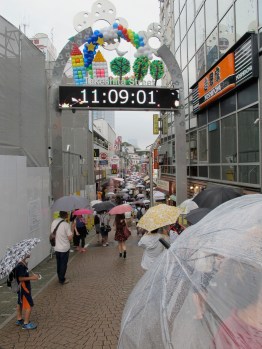
One reason why Harajuku is a drawcard for tourists is Takeshita Street, seen here in the rain.IMG_2432.JPG

IMG_2437Among other things it offers little girls dress ups for females of all ages, and also a wide range of clothing for dogs. IMG_2439

Kawaii, or cute, if you like.

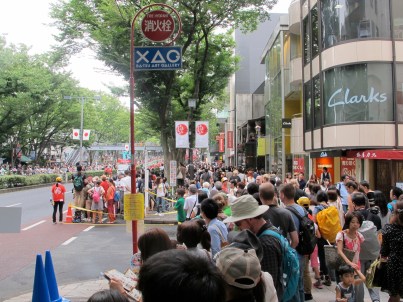
We spent some time in the La Foret shopping complex dazzled by the offerings and the fact that we hadn’t lined up early enough to see an unidentified celebrity. But everyone else had. We wandered outside and heard a lot of noise coming from somewhere and thought we had better go and have a look.

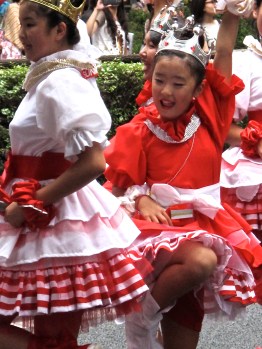
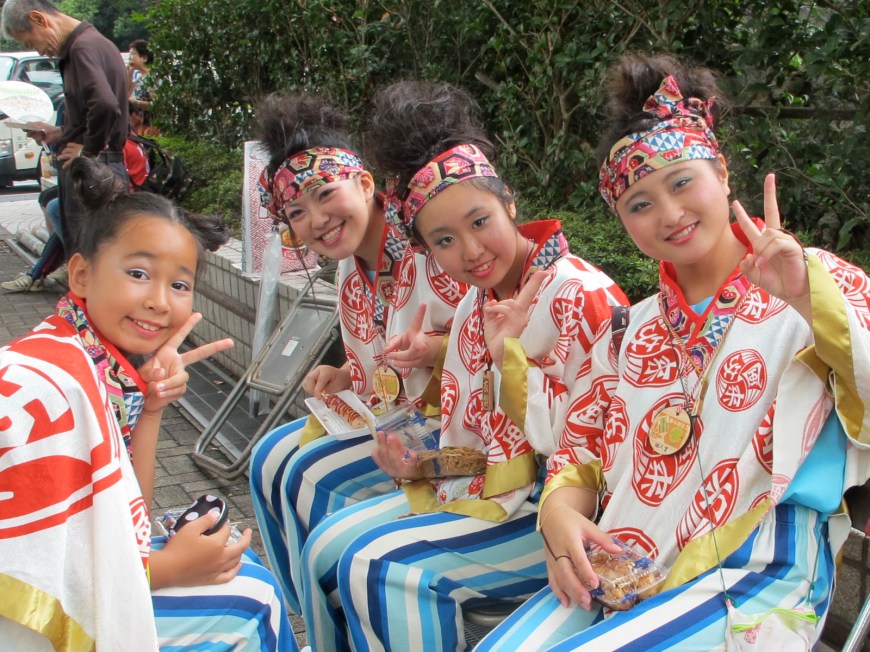
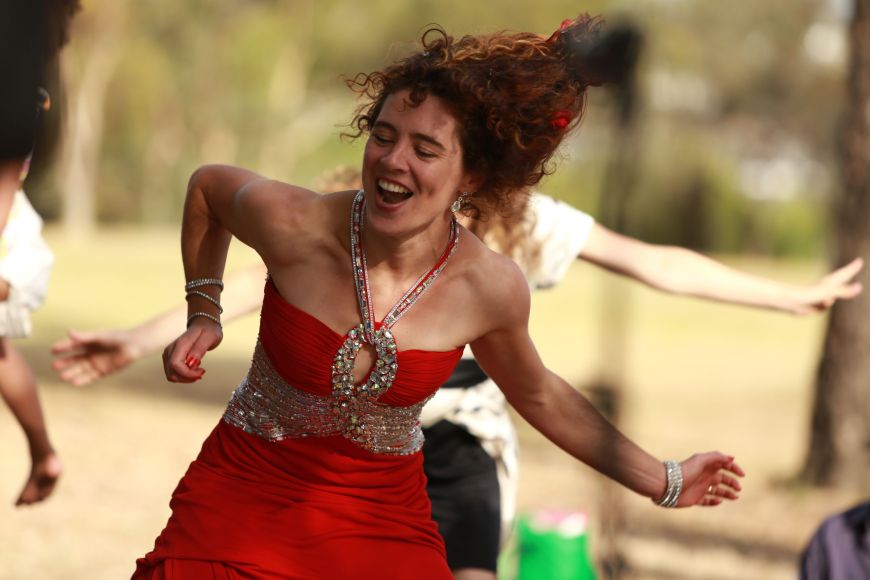
IMG_2474.JPGWe joined the crowd, and found a truly remarkable spectacle, a yosakoi parade. Yosakoi: we heard it before we saw it. Two guys on the back of a van with a massive mobile sound system; one singing, directing, exhorting, the other shooting video crawling along the main drag of Harajuku. Then the dancers come into view, not 25 or 30, but 80-100. I note there is  an upper limit of 150 in a squad and they are PERFORMING. So much action. The guys up the back are waving flags of about 20 square metres and the dancers, both genders all ages, are aflame but in time and motion, singing and dancing for half a kilometre or so. When they hit the finish line they are ushered off for a bottle of water. IMG_2500.JPGSo Japanese. Extraordinary costumes, but the defining aspect of yosakoi is that everyone must use naruko, small wooden clappers that were originally used in Kōchi Prefecture where the dance originated to scare birds away from rice fields. One group comes through. Then another. Then another. Then another. Then … (It’s urban Japan. There’s lots.) And then we crossed the railway line over into Yoyogi park where the yosakoi groups were performing on stages, and on another stretch of asphalt. Ah the joy of it all.IMG_2468

IMG_2514

IMG_2482We walked back home through Shibuya. I suppose every story about Japan needs a shot of Five-ways …IMG_2341

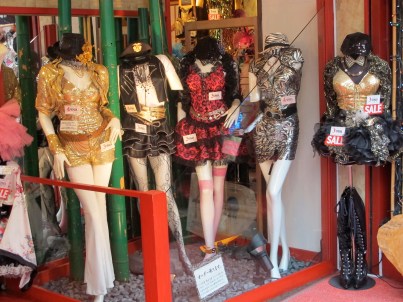
and probably a window display or two.IMG_2511.JPG IMG_2507

Two other photos for the fun of it. Two gorgeous boys I waylaid in Ryogoku and a sumo wrestler on his way to or from the sumo stables nearby. I would like to point out that rubbish appears in this photo. It won’t happen again. Ever. From the Emperor and his family down, we apologise.

IMG_2314.JPG

IMG_2312.JPG

And then we were off in the country. Which differed.

IMG_2516.JPG

Japanned (#1)j

WelcomeEveryone’s been to Japan. Ern Bond went to Japan.

Ern Bond was a pillar of the Hamilton Methodist church and a successful retailer of electrical goods. He was also my first employer. Once a month I used to climb on my bike and deliver his bills for exactly half the price of postage. This produced a complex relationship, especially regarding the five or six left at the end for which I couldn’t find a destination or which just seemed too far away. But that’s another story. Ern Bond didn’t just go to Japan. He and his wife went to Fiji and New Caledonia and New Zealand, and when he came back he held slide nights with loquacious commentary about his trips for the congregation.

Held in the back meeting room of the Sunday School building they were standing room only affairs, although I liked to sit in the front row — gripped. This would have been about 1960 and Ern Bond’s adventurousness, along with his capacity to fund it, was unusual. Simpler times. But he went to Japan. Alf and Alma of Alphington, our neighbours for 23 years, also went to Japan, an extraordinary departure from thoroughly locally-lived lives. So many people we know have been to Japan.

Australians have been going to Japan for some time, and Japanese have been coming to Australia — notably to Queensland. In fact their traffic was a major contribution to building the international airport at Cairns. Buying a beer at Nojiri after a hard day’s walk, the shop owner ducked out the back and played ‘Waltzing Matilda’ on the shop’s sound system for me. She said she’d been to Australia seven times, four to Cairns. This is an interesting relationship. Back in the days of Ern Bond’s slideshows, one of the few sermons of my father’s I remember took Russell Braddon’s End of a Hate as its focus. Russell Braddon was a prolific writer who spent some time in Changi prisoner of war camp, which usually has ‘notorious’ inserted adjectivally. He returned to Japan in the mid ’50s and came away with his mind changed. Other minds have been changed subsequently.

Japanese money developed the Gold Coast and provided Johannes Bjelke-Peterson with a good deal of his working capital. Japanese is by far the most popular Asian language learnt in Australian schools. But we went perhaps mostly because of Myrna’s expectations to find beauty. And we did find beauty, a great deal of beauty. And an endlessly intriguing country. So easy, so organised, so friendly, so polite and helpful to gaijin, such good food. And so complicated; not necessarily a good place to test the boundaries of individuality. In some important ways the antithesis of Australia.

It was verdant when we arrived at Narita, and it was verdant wherever else we went. The greens were so intense and ubiquitous the auto controls on my camera had trouble coping with them. The orange (Pantone Orange no. 1 I’d say) on the other hand it loved. You’ll see both below. It was also urban. An hour on the Narita Express, not a shinkansen but not a slow train, of which perhaps five minutes was outside a built up area.

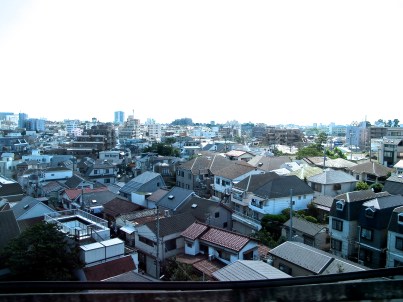
IMG_2572.JPGA lot of  inhabited Japan looks like this. Not high rise, but dense. Flat land on Honshu is at a premium and where it exists it is covered in building. 130 million people, a quarter of them over 65, have to live somewhere. Living dense like this must have some impact on the way you live. Privacy, thoughtfulness about others’ needs, compactness, absorption in detail might all be expected to thrive.

Our hotel, not far from the fishmarket, had beds and wifi in the lobby but had seen better days. IMG_2281

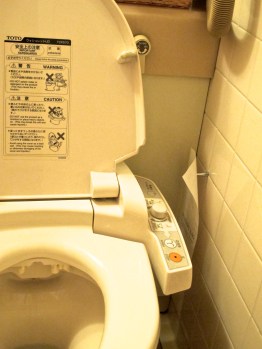
IMG_2360And it had a Japanese toilet, one of the famous ones, providing most of the comfort and functions of an expensive car without the mobility. Except a twin flush: Japan, so clean and green that when some rubbish appears in a photo it is a talking point, and no twin flush.

I wondered then if perhaps the astonishing technological drive of the late ’70s, ’80s and early ’90s may have run out of puff, whether along with the economy it had peaked and had got stuck in the later ’90s. Because, have a look at this: Economic development over the last 200 years. Select Japan and run your cursor along the bottom line. Check out 1946 to1985. (Be patient. This takes a while to load.) A miracle. Many of the galleries we visited were big buildings with few artefacts and not much evidence of an active purchasing regime. Not much public money for inessentials? Probably.

But so many things worked so well. You could get off at the wrong stop from your train, but you’d have to try hard: written crawl bar in two or three languages, announcements in Japanese, English and sometimes Chinese as well. You can watch Narita’s flight program from inside the train, and you can observe announcements about train delays and abject apologies for same. When Kevan (with an ‘a’) Gosper — still going round — described Tokyo as ‘a safe pair of hands’ for the Olympics he was right. I don’t know that you’d notice the addition of even an Olympics-sized crowd at Tokyo Station.

What does it do to the people? One mistake is to assume that ‘modern’ means ‘western’. There are details everywhere that might confuse you about this, but it’s not true. Scrape the surface and you realise you need to start thinking again. Of course it’s rather tenuous to make these sorts of generalisations after four weeks, and it is obvious to say that things got more complicated as time went on. But I thought of it as a grinding process with the very tart but wafer thin wheel of western cultural influence chewing into millennia of something else of another character entirely. For some westerners who love Japan and who have made it their home it is the product of this grinding — Harajuku cosplay, hentai, punk rock for example — that makes Japan such an exceptional country. This is a country where this can co-exist happily with this  and that’s probably a cause for some wonderment.

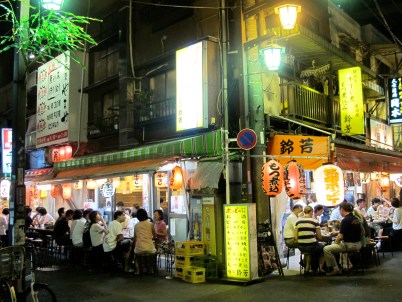
Asakusa being a slightly racey suburb of Tokyo, this one —IMG_2421.JPG

Tucked away on the other side of the street were more people eating. Pete was from Queensland, At this moment our two young Canadian Mexican buddies were having a snooze having just arrived, Kaori was the guide and Pete and I were just on our third helping of fried chicken.IMG_2424

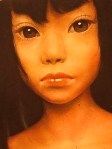
IMG_2356.JPGBut there are still plenty of salarymen (and some women). On the day we arrived we tried our luck at a couple of places in a lane near our hotel. At dinnertime we just asked them just to feed us and they did, but I don’t know whether I’d give them a chef’s hat or a Michelin star. These would come later. But the beer was good and Myrna was the only woman who wasn’t serving in a packed house. The role of women in Japan is something of a mystery. Kimonos and geta, the elevated wooden sandals that women used to wear and that some (actually men included) still do would hobble you, about as much as six-inch cork heels and very tight skirts. The image of woman as doll is ubiquitous, and I don’t know what that means. I just note it in passing.IMG_2391IMG_2358IMG_2452.JPG

From the left: mask from Noh drama (since the 14th century; the mask is several hundred years old). A sample from a display of portraiture in Tokyo’s contemporary art gallery. A nail artist in La Foret, a shop of shops in Harajuku.

But this is the photo which sums Japan up for me, more than any other I took. Hung Yi, a Taiwanese, is the sculptor. Painted steel at Hakone Sculpture Park — one of scores of his works on display. Behind the salaryman there is more … And it could be just a little bit kerrrrazy …IMG_2639.JPG

The Merest Sniff of China (from 15 years ago: 2)

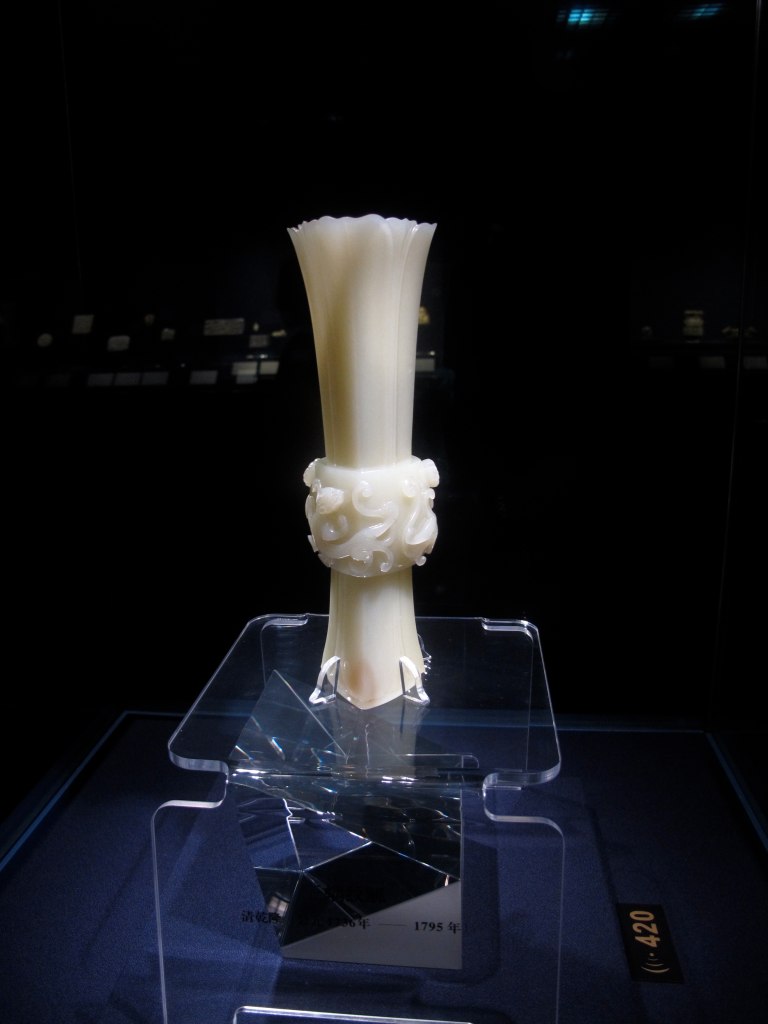
double jadeJade! I wrote what is below in 1998. We went back this time to the National Museum in Shanghai at least partly to look at the jade. This is a carving from a single piece about as big as your finger around 1,750 years old. The colours are natural.

But then it recurred. The mania. I don’t know what there is about China and jade, but it appears potently infectious. What happened last time is recounted below. Then this time Myrna found a shop over the road from our hotel in Shanghai. We found this nice bracelet with lots of good, well organised colour (if perhaps not grassy enough, see the green in the ring), lovely clear sound when struck. 3650 yuan. About $600. No. We tried 1000 and the bloke laughed at us. Next day during a long walk through the French Quarter she got into the Chinese commercial spirit and determined she would go back and make on offer. Went back and a sale had been announced at the shop. The gentleman running the shop got the bracelet out. 350. More or less what she had determined to offer. All done. All sold. Bang. Triumphant but thwarted from the thrill of the chase.IMG_2055

Fifteen years ago … JADE

I had always thought that jade looked like plastic and, although there is that remarkable carved jade carriage in the middle of the Queen Victoria Building, beneath notice. But that was before.

Jing Hong came at the end of an exhilarating but solid set of school experiences. People have asked me what we did at night. Well, lots of things — concerts, karaoke, eating, chatting, packing, night markets, walking — but I was always glad to get into bed, tired by the intensity of the trip and its myriad parts. Jing Hong was a break, a free day at the end of another long bus trip, and it had a backpackers’ cafe (the Mei Mei) which served European breakfasts. Breakfast for 23 plus, cooked on two gas rings is a tall order and so we poured over the menu the night before. Muesli, yoghurt, bacon and eggs, coffee, toast, jam, pancakes — a bit pathetic really to think we might have been slavering over such offerings. But slaver we did.

When it came to the point, the muesli was a big pile of rolled oats, the yoghurt some tofu-ish lumps, the bacon and eggs a test, but the banana pannos, yum. The coffee wasn’t great, but the Golden Dragon in Kunming had been charging the equivalent of $5 Australian for something darkish and wet of lower quality. When in China … that’s the clear message.

So we lay back into these delights and chatted, watching the endless stream of cyclists, some with utterly improbable loads, and eavesdropping on European escapees talking about their adventures in Xishuangbanna (the local area which draws tourists to, among other things, its stone gardens). The day was beatific. Myrna and I hired some bikes and rode aimlessly across the bridge over the Mekong and watched cheeky dogs who weren’t as obviously conscious of their possible fate as they might have been. We found a market where we bought a post-modernist bag (which demonstrated influences from camouflage jackets, Hollywood, the Chinese and various other unknown flags) for approximately nothing, some Nashi pears, a pineapple (the speciality of Xishuangbanna) and some biscuits.

What more could you want? You could want jade.

Near our hotel in Kunming had been a … what? A jewellery supermarket, I suppose. It had rubies from Burma, star sapphires, emeralds and amethyst from Sri Lanka, a certain amount of gold, a profusion of sparkling bits and pieces. But what it really had was jade. Rings, broaches, ornaments, necklaces, mounts for clocks, bracelets — a sea of green.

The neophyte approaches. It might be like looking at the aisles of prepared food in an American supermarket. You’re sure there must be something reasonably inoffensive that you can eat there somewhere, but how would you know? It’s what you like yourself, isn’t it? If you like milky jade or the lime green, who is to tell you the sea green is superior? Then there is something about the clink the jade piece makes when it is on a string and you hit it with something solid. Got your string or your piece of cotton on you? What clink? Do you want it to sound clunky or bell-like? And if you can find a bell-like clink…  well I couldn’t. Flaws. What are we looking for here? No jade is clear, inscrutable substance that it is. With prices for apparently similar objects varying by 10,000 per cent it should be more articulate. We thought the safest bet was to buy the cheapest that we liked, and so emerged from the supermarket with four bracelets, not unlike green marble but more transparent, for 60 yuan ($12) and some rings. Over the road Myrna bought a pair of circlets for ear-rings bargained down to 80 yuan.Mernz and the axe

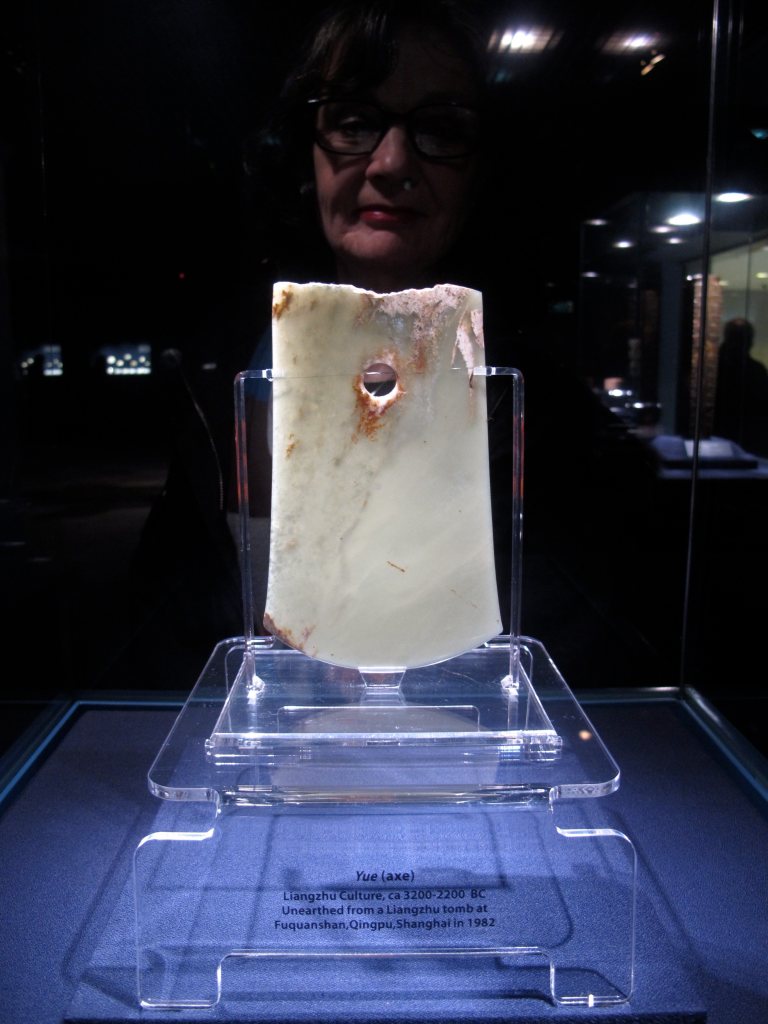
[Here’s the culprit with a jade axe head, about 5,000 years old, in the Shanghai Museum.]

It might be its very inscrutability that gets you in, but I quickly learned that it was nothing like plastic. It has as much character as any organic substance. So when we cycled past Jade Alley in Jing Hong, a street about a kilometre long which has little but jade shops in it, we cycled in. About 40 metres in. That was far enough.

My dear companion had become absorbed by jade and so we went through the stock, not just the stock on display but the stock from out the back, the good stuff, beautifully wrapped in envelopes of multi-leaved paper. The staff was a man in a Mao suit, a sure sign of elderliness, and a younger woman who might have been his wife. He wanted a sale; she wanted the right price. They had their piece of cotton, but I had only the glint in their eye to guide me about respective clinks. Nonetheless, the good stuff didn’t have to explain itself. It seemed visibly superior. Myrna bought a bracelet, a racehorse next to the Clydesdales she had bought in Kunming, finer, translucent, a brightish white with a streak of green viscera through one side. It went clunk satisfyingly and cost 180 yuan.

This objet was admired to the extent that Kathe rushed back to that shop before the plane left and bought a big one, a good one, milkier than Myrna’s with a variety of lovely shades of pale green. Eight hundred.

*****

Later, as they say. A day later. Soft sleepers have four-berth cabins and, whatever you do, four into 23 leaves three. So Kathe, Jing and Ted shared their cabin with a Chinese gentleman who turned out to be a jade dealer. Jade! Let’s talk jade, let’s show how clever we have been with our purchases. He laughed a lot that jade dealer, as I suspect jade dealers must. When you’re dealing with something so mutable as taste in luxury items a capacity to laugh might be considered essential.

He laughed even louder when the pieces came out for valuation. What was good? The Clydesdales produced modest praise, the ear-rings with their grass green-ness and their translucency some applause, but the pieces de resistance were worth, well a good laugh in a train going to Chong Qing. A shame really to have to revert to the shamelessness of: I bought what I’m wearing. I paid a price I’m happy about. I know what I like. I like what I bought. It’s not a completely water tight syllogism, but it makes some sense. And if it doesn’t, you can always have a laugh.

*****

Later again. Ten days later. We are in the Shanghai Museum’s Ancient Chinese Jade Gallery. The jade pieces, intricately carved, are white, black, almost clear, turquoise, grey, ochre, mother of pearl, orange and amber as well as green. The same piece — rings, ornaments, buttons, axes, vases, heads, serpents, dragons — is often multi-coloured. The jade is particulate, marbled, swirly and solid as well translucent. I am unable to administer any clink tests.

However, the prize piece, a wine vessel with three serpents from the early Qing Dynasty, about 30cms high, glamorous in a way which transcends glamour, seems to be fashioned from a rain cloud.

And here it is after all these years. Still in pride of place.jade vase

The Merest Sniff of China (3)

Facing the world, facing the future

The Huangpu makes a final broad sweep before it enters the East China Sea. The Suzhou Creek enters at the apex of the bend, feeding a river already massive by Australian standards. Countless barges with a freeboard which can be measured in millimetres diligently slosh along in its opaque water. Ferries costing almost nothing one way and nothing at all coming back, honk that they are ready to depart.The Bunned

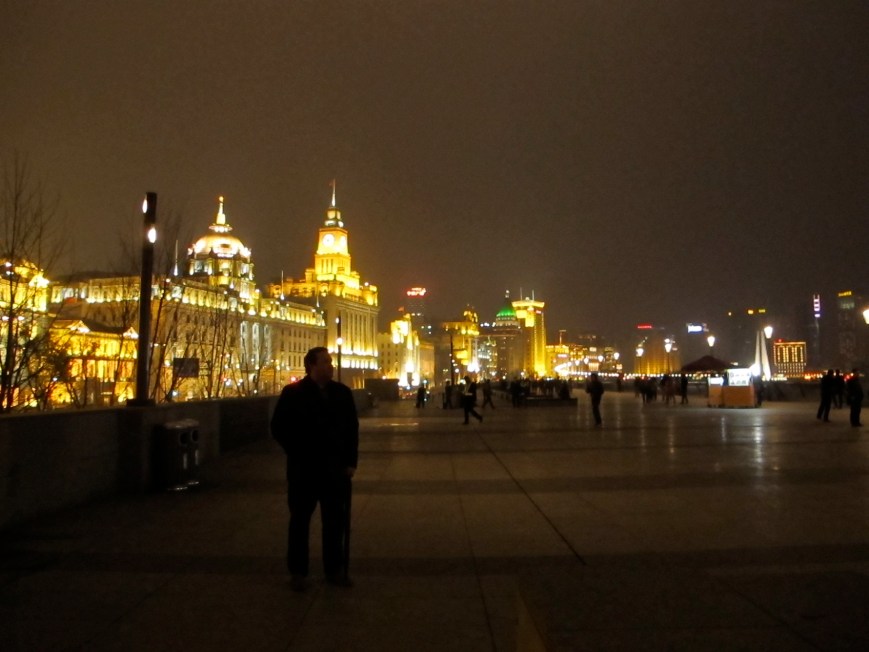
On the western bank is a scene — whether as an oil painting, a massive photograph or the real thing — in front of which Chinese from all over the country like to have their photo taken. The Hong Kong and Shanghai bank, opened to great acclaim in 1921, is the standout building in a long row of examples of muscular European imperialism, sans flair but solid with just a whiff of indomitability. It’s the Bund, old Shanghai, the main drag of the International Settlement, centre of banking and commerce and goodness knows what else for a hundred years from the middle of the nineteenth century. Shanghai was a fishing village on the silt flats of the Yangzi delta with a population of considerably less than 100,000 before the British established a trading concession here in 1842. The French followed, establishing their own Quarter which is still quite identifiable.

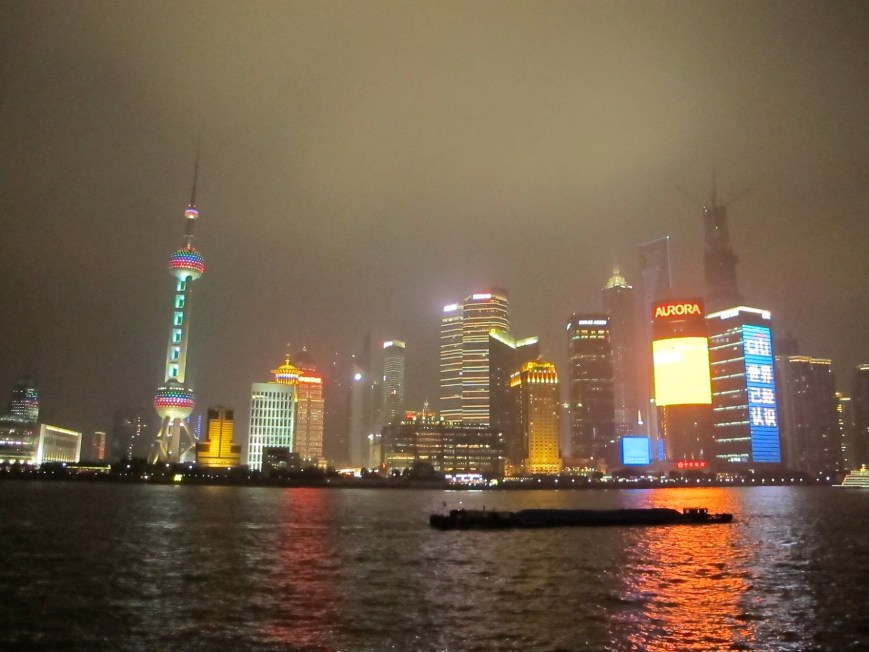
PudongAs you lean on the river wall and look across to the eastern bank, it is not possible, not at all possible, to ignore the Pearl Television Communications Tower, a vast rocket of a building awaiting take-off. There is a taller tower in Kuala Lumpur; but this is Shanghai, a metropolis of eight million, which must surely be one of the great cities of the world. The Pearl Tower, across the river in Pudong, is a potent symbol of where China may be heading.

Not eight million anymore. Fifteen years later, around 25 or 27. Maybe 40 depending on where you draw the line. Regardless, Shanghai is either China’s biggest city or biggest conurbation. And the Pearl Tower is no longer the dominant landmark on the Pudong bank. It’s good. Great. Fabulous really. But one among many. And the big lump in the background with the three cranes hanging off will be 640m. high when it is finished, more than 200m. taller than the Petronas Towers in KL.IMG_1980 (They were working at 10.30 on this gluggy night. I noticed the cranes move; then saw a bucket of concrete on its long journey up.)

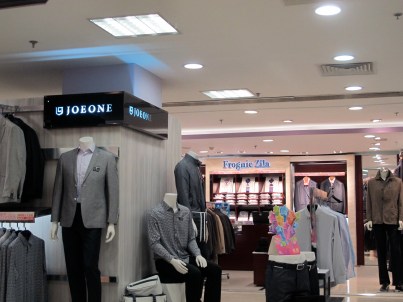
Nor would the ferries cost nearly nothing any more. Shanghai is a world city and charges accordingly. I saw a very ugly watch for 6.3 million yuan in a shopping mall devoted exclusively, exclusively, to shops like Cartier, Bulgari, Ermenegildo Zegna, Ralph Lauren and so on. We also saw department stores full of Sino-ey knock-offs. No not Zegna, Frognie Zila.

We didn’t have to take the ferry either because there is now a tunnel under the Huangpu and for 70 yuan return you can go on a very strange underground traverse with a new attraction/distraction every 30 metres or so. (Magma falls, ooomm, cosmic fossils, oommm, meteor shower, oommm, giant waving air puppets, ooomm, etc.)

We had a couple of days in Shanghai to finish, at leisure as Lord Rowland would say, excited about revisiting the National Museum, looking at Pudong and just wandering around with the prospect of satisfying an unfulfilled penchant for dumplings and pork buns.

Visibility wasn’t much of an improvement from Beijing when we arrived and we were both very tired: 32 interviews in the can, about eight hours of video. Tiring. And that seems to have happened last time as well.

The maximum temperature was still hovering around zero and the air was thick with misty smog. The changes in climate and the density of our activities had taken some toll. On the first night in Shanghai we seemed to walk forever to find our quota of dumplings, Chinese pastries and beer. Homesickness was apparent, there was some trouble about rooms, and … well, all of those things. It looked like Shanghai might be a bit of a slog.

The next morning as we wandered through the hutongs, I found some lip balm for my badly cracked lips in a chemist shop, and was tempted by the vast range of aphrodisiacs and the pillow of roots which, had I slept on it, would have cured senility. My grey hair indicated great age to the shop assistants. The narrowness of the streets and the height of the buildings said city, said people, said, even stationary, plenty to look at, plenty to do. We took the ferry over to Pudong and went up to the observation platform of the Pearl Tower. Even with the limited visibility, you could see perhaps 80 or a 100 buildings going up, almost growing as you looked like bamboo in a tropical rain forest. Directly below us you could see the ingenious lattice-like rafts of concrete which have been devised to allow tall building on silt. (On the other side of the river Shanghai’s buildings had subsided several metres when comparative measurements were made between 1925 and 1960.)

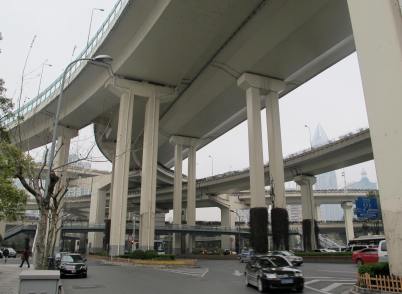
El roadsIn the afternoon we rode the helter-skelter of Shanghai’s traffic system, now on the ground, now up in the air on the ‘viaducts’ of its (not really) freeways, now in a tunnel under the river, now in Pudong proper. Our hosts had brought us to a tower block perhaps fifteen kilometres from the heart of the city and we were escorted up to the thirtieth floor to look at a model of a new development. Mmm … a model. Very nice thank you. Then we looked out the window, and there it bloody well was. Most of the dormitory accommodation was in place with its swimming pools, the villas for the wealthy were there in neat rows, the great sprawl of low rise factories ran west to the horizon and the market gardens to the north had been razed in preparation for more building.

There are currently about 12,000 active major building sites in Shanghai city and, it is guessed, about 15 per cent of the world’s cranes at work. Economic growth (albeit from a relatively low base) has averaged 15 per cent per annum for the last few years. Investment at an estimated rate of US$50million per day is being poured into this area, one of three free trade sites in China. (The others are north of Beijing and in Guangzhou, the province abutting Hong Kong.) The call of the biggest market in the world has been heeded and those with capital have flocked to get their share. The Ricoh factory, assembling fax machines, we visited was a model of technological enterprise — antiseptic, superbly organised, good wages and working conditions, and this is one of a hundred thousand. Consider what one such enterprise can mean to a country town in Australia; then multiply by thousands, hundreds of thousands. I had an image of Bill Bixby turning into the Incredible Hulk, shirt ripping, trousers too short, a new massive creature emerging into the world with its goals and directions not entirely clear.

The sheet anchors of the vast population, almost constant war, famine and ideology have in the past held China’s economic development back. But there is a very strong sense that they have also made the country tough. The world awaits China like the delights of a fun park. Let’s go. Let’s see how many of these rides have some interest and value and, more to the point, let’s see how many we can make some money from. Good at that, the Chinese. Focused. 

Here’s an answer to the question: What do you do when you ‘do’ the future? You go for it. You surge forward on the basis of your instincts and your naked need to do so. You draw on all that restless, unsatisfied energy. You push forward without necessarily thinking about where you’re going, not with any larger view anyway — fire, ready, aim. This is the full tilt unadulterated blast of testosterone, and to unaccustomed eyes it is astonishing. It is a sight every Australian should see. 

Fifteen years ago all that was visible. And it is still is. There is still an apparent capacity to make impossible things happen and keep happening. Focus on the future not the past.

But back to the present…

Shopgirls

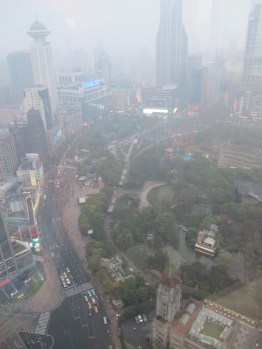
Bayden had commented on the rabid addiction to the mobile phone evident everywhere but certainly making it hard to get attention in shops. Maybe you had to ring up the shop assistants. He had come to Shanghai for some time-lapse footage from the 48th floor of the JW Marriott hotel through the crystalline air. This is the view.IMG_2001

And what it is is part of the People’s Park covering the main subway station and site of Shanghai’s main cultural edifices. It was once the racecourse. The building with the red-roofed tower to the bottom was the Club building. The Grandstand was reputedly the largest in the world, and probably was. The turf was described as “smooth as a billiard table”. (Thank you wikipedia and Mr Findlay.)

national museumThat said we still found solace in the National Museum. Even the coins seemed interesting and I found something newly fascinating about calligraphy which has left me cold in the past. I could see the individuality of the styles and the variation according to purpose. And there was the jade.

We topped up with some dumplings at a street shop over the road from the Museum and walked off to the French Quarter. It all seemed much more knowable than last time. Hundreds of shops with what one might describe as ‘cutting edge fashion’, including dead set no worries ‘pop ups’.popup shop
SH moderne

We found some contemporary art, in sum somewhat discombobulating and not really the feel of having grown naturally out of the environment as was the case at 798 in Beijing. But the top floor had a well hidden restaurant full of style, welcome and nice food.

Our waitress sent us off to her pick of Shanghai’s art areas, hutongs off Taiking Road. There was certainly plenty of art there but it turned out to be like a gigantic Camberwell Rotary Art Fair — nothing wrong with that, and a cultural statement in its own right; but not exactly what were looking for. More the deflated tank made out of leather.

The French Quarter has its charms with ten of thousands of plane trees planted, I believe, by the British. FC street shop

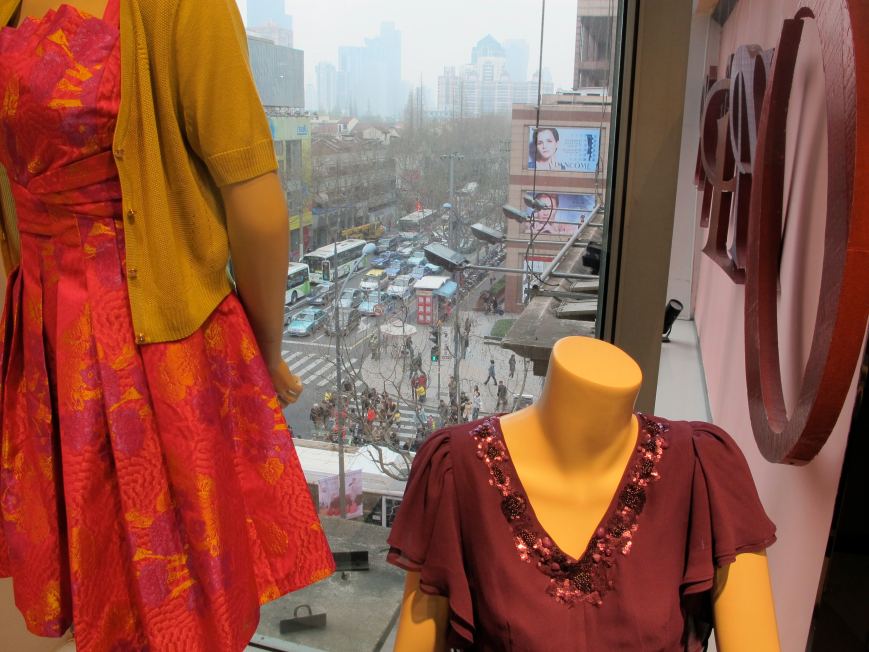
In this photo I’m looking out the window of a Printemps department store. Printemps in Paris provides a very cheering shopping experience. I think we were expecting something the same with perhaps some nice coffee and a macaroon. Incorrect. We worked our way without success through the various offerings of the food hall and, on further exploration, realised we were in a shop (maybe like most other shops in the world) full of pretty awful Chinese knock-offs.

But we had a very fine walk and we found all the appropriate vestiges of humanity including the rather grand house from which Chou En Lai fled the Kuomintang spies in 1942, and the insect market. Could have picked up a couple of quality cicadas cheap but didn’t know if we could get them back into the country.Insect marketChou En Lai

However damaging to my reputation, I’m glad there’s a photo from the insect market stuck in here. It wouldn’t be China if there were no freakshows included, and I would belie my status as a dopey tourist walking around with mouth half open, eyes up to the landmark architecture or down to the map.

Finally it was clear, the last day, and everything took on a new hue. And it was just like it was last time …

If the developments on the east bank of the Huangpu are generated by testosterone, the throb of the west bank comes from the firm palpation of oestrogen — people, their families, their neighbourhoods and their social futures, history, time spent, lessons learnt, as well as their intersection with the things that the east bank, Pudong, produces. When you face the world, you face its calamities, disappointments and treachery, as well as its material richness and splendour. You face the facts of overpopulation and the common challenge of a sustainable future. You face consumerism and its distinctly unpleasant offshoot, commodification. And you have to face the ways in which we might get on together.

The acrobats. That laconic forum for minor miracles, the Flying Fruit Fly Circus, learnt a lot of its tricks from Chinese acrobats. And here we were in the presence of the teachers. The performance began at a very high pitch with tumbling and juggling, and then ascended — a suitable metaphor for the nature of our experience in China. Here was a young man balancing on four layers of rolling slats, standing on one foot, flicking first one, then two, then three, and finally four soup bowls simultaneously from his other leg to catch them on his head. Later, seven young women did handstands on chairs balanced one on top of the other in a long arc. Oooo, we went with the rest of the audience. Aaaaaah. No. Not possible. But with aspiration, discipline, patience, endless practice and a certain carelessness about the possible consequences, it can be done. And this might be a suitable metaphor for the future of the next great world power — China. 

The Merest Sniff of China (2)

Bayden's viewIn 1998 when Myrna and I were in China we spent most of our time in southern Yunnan close to the border with Burma, out of the way and very rural. I’d be interested to see how much things have changed in Mojiang, Simao, Pu’er and Xishuangbanna in that time. But this was an urban visit with nothing as new as the newlands of Wujiang, a vision of the modern world.

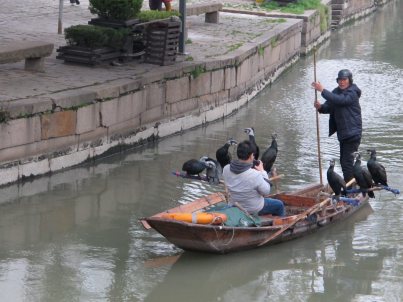
IMG_1905Wujiang means ‘Wu River’ and there were plenty of signs of being in wetlands with water trickling between expanses of concrete, lakes large and small, canals and whole towns claiming to be the Venices of the East. We visited one of these, Tong Li. Nice enough but we seemed to have been to a lot of places a bit like this before. We did see a film being made with a glamorous star (at right), and this amateur effort (below, he’s filming the boatman at work) which we watched for some time. I suppose if you pay you can do what you like. The birds are fishing birds.Tong Li boatman

The Chinese learnt how to build high rise buildings on mud in the mid ’90s — a honeycomb concrete pad with deep piles to stop tilting. It had certainly begun in Pudong when we were in Shanghai in 1998. The Pudong development now extends for 20 or 30 kilometres, a forest of high rises with small clumps of very high rise here and there where extra fertiliser has been applied.

The view above from Bayden’s window is ‘older’ Wujiang. Our view in the opposite direction was not only of a bus station but a series of construction sites. In three different moods —

Wujinag#3 not clearWujiang #1Wujiang #2 clear

and, yes, there was a clear day.

Wikipedia says what we heard regularly:

‘Wujiang is located just south of the city center of Suzhou. Traditionally, It has been regarded as “the Land of Fish and Rice”, and “the Capital of Silk”. In recent years, it is also known to be “the Capital of Cable and Optical Cable“ and also “the City of Electronics”.’ Very sweet.

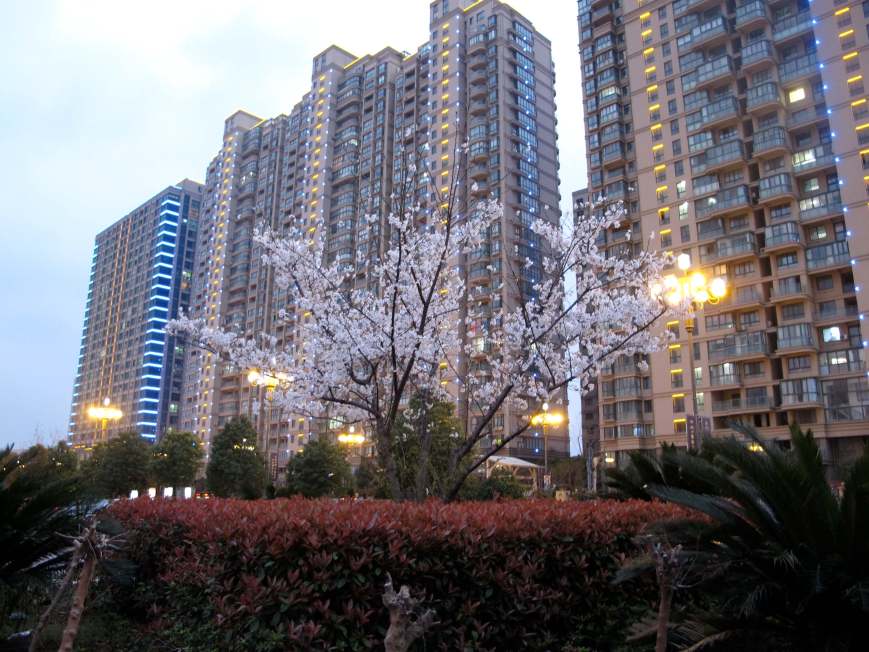
There has been a remarkable effort to vegetate. Literally millions of trees, Suzhou boulevardmany of them apparently mature with boles 200mm in diameter, have been planted along the long straight boulevards. In 20 years time the whole place will look magnificent in Spring.

Many of these tower blocks are not fully occupied or occupied at all. They offer one-, two-, three-bedroom units, the last with two bathrooms and, on the basis of the advertising posters at their base they are very nicely appointed. Forget high rise slums.blossom buildings

High school statuesBut this wasn’t why we were here.

Bayden Findlay and I were making videos for use in a guide to Australian schools for developing partnerships with Chinese schools. This is part of a national initiative to encourage the teaching and learning of Mandarin. You can find an example here. (Although we made both the videos on this page, ‘Connecting Students: China BRIDGE 2012 is the recommended item.)

The previous Victorian government developed a very active relationship with Jiangsu Province of which Suzhou and Wujiang are parts, and its Education Department with a strong International Division has developed 47 such school partnerships. That’s quite a lot. How much longer this relationship will last is not known, but it will not be the fault of the Chinese if it stumbles.

The 17 people we were with were coming back to their seven schools after 12 months to re-enliven their relationships, and we were going to four of these schools to interview Chinese principals and teachers and capture some of what it was that these relationships were about and how they worked.

The studio:studio set up

The first school we went to was a primary with 1700 students and we got there for Monday assembly. Note the big kids. They could have been 13 but no older.Assembly kids

A white-gloved and very formal delegation of students marched the flag in and raised it. Everyone sang their hearts out. We had an exhibition of last week’s best calligraphy (Year Two: the fine motor control of 8 and 9 year olds at the schools we visited was of a startling high order), we had some opera accompanied with dancing, the playing of a traditional musical instrument plucked like a recumbent harp. Then, of course, the in-line skaters.roller bladers

No assembly complete without same. They circumnavigated the whole crowd three times and then went off … somewhere.

I have no way of telling how representative these schools were. The buildings of course were all new — spacious and well equipped. In their whopping classes the kids were attentive and responsive. The teachers were firm and direct but encouraging and perhaps softer than 15 years ago.

As Jane Orton notes, Chinese seven year-olds usually know about 1500 characters (of 48,000; 56,000 with the inclusion of classical characters). The requirement for second language learners of Mandarin at Year 12 in Victoria is 640. With 3000 you can read a Chinese newspaper (although there are those who believe this is on the low side).

The remarkable training that learning Chinese orthography entails must have an impact on neural processes. It is reinforced by hours and hours of homework a night. (Recently some Education Bureaus have tried to institute Wednesday nights as homework free, but this is largely ignored by parents (and students) who fear their child (they) might fall behind.) Learning is also very definitely a binary process — 权 right, 错误 wrong — none of this ‘pretty close’ or ‘I’m not quite sure about that Adrian, but good try’. Bang. One way or the other. Quite useful for maths as well.

This might have something to say about Chinese society more generally, and now I’m really just musing out loud.

Think: a computer. Performs astonishing tricks, but it only uses binary impulses, black and white — no hmmm not quite off, a bit in the middle, sort of a warm spark there. Its operation is completely hidden from those who aren’t afficionados; it uses its own artificial language which is programmed from elsewhere. Its operation might be intuitive, but only as long as you play by its rules.

There were many moments in my interviews and other conversations when I wondered along these lines. I might say that our main school contacts were the manifold English teachers who were keen to be friendly and not just to practice their English which was sometimes perfect. But I also interviewed each of the principals with the help of Julia Gong, our rather brilliantly bicultural tour leader.

Three moments.

In the first I was trying to explain why schools with 43 students might have trouble partnering with a school of 2750. I pointed out, wrote down in fact, that there are about 9,200 schools in Australia of which just under 4,000 have 100 or fewer students. This was the occasion for great hilarity and a certain amount of disbelief from several senior bureaucrats. It was left as a joke rather than an unusual and pertinent fact. It hadn’t chimed with what was known. No black, no white. Just weird. Foreign.

In the second, same audience, Mr Tsien was wondering how Australian schools could have such small classes and be ‘creative’. I could have said, it’s a trade. All Chinese teachers, primary and secondary, teach two or three 40-minute classes a day. I also could have said you’d need two and a half times more rooms if you want discrete classes of 20. Wouldn’t happen. But what I did say, and wrote down, was that it costs about $5,800 annually to educate an Australian primary school child. In China about 2300 yuan (about AUD400; adjusted for cost of living probably in the region of AUD1500-1800, but still rather less — what DO we get for all that extra dough?) He didn’t say, ah yes, of course, or without question, or that’s interesting, or is it really just a question of money? He congratulated me as a representative of Australia and suggested that soon China’s investment would be equivalent.

I was reading Peter Hessler’s book River Town at the time, a recount from an American of his two years spent as a volunteer teacher in Fuling on the Yangtze in Szechuan. A practiced and well-trained amateur athlete, he takes part in and wins a locally-celebrated long distance race. The newspaper report says nothing much about the race per se, or his win, but comments at length how the locals must struggle to do better to conquer their waigouren (foreign) rivals. Mr Tsien’s reaction reminded me of that.

The third moment. I was talking to one of the smartest and most fluent of the English teachers we met and we were talking about variations in schools. I offered the idea that schools were generally a precise product and reflection of the community in which they were embedded. And do you think I could make any way with that idea? Not a hope. And this was a 10-minute effort with diagrams and pictures, not just a passing misunderstanding.

I think the idea that communities might vary may have been a stumbling block, like for example, trying to persuade a Muslim, some Muslims, that there are very different varieties of Islam (‘One God, One Faith, One People’!). She may not have lived far from home, although, remembering, she had. She had lived in New Zealand. Perhaps not in the Uighur Territories or in southern Yunnan. Or it might have been the idea that there could be variations in ‘school’ and its products. Curricula and text books are standardised across China, although we came across teachers perfectly happy to leave bits out or change apparent stipulations and do things a different way. It may just have been a foreign idea in its speculative quality. It registered nowhere.

All students study English. They are aided in this by learning Chinese characters accompanied by their written pinyin pronounciation, so even young kids learn the Latin alphabet and its sounds very early and consistently. In Beijing and Shanghai there was a lot of environmental English: street signs, directions, ads and so on.

But, think, if we want young Australians to learn an Asian language (and that’s why we were there, directly) it should be one language (Mandarin would be a smart choice) in all schools at all year levels for 4-5 hours a week. All signs should have a Mandarin translation and attention should be paid to an increase in environmental Mandarin everywhere. Ridiculous or what?

That’s how the Chinese would do it. Black, white. And er hem … that’s how they have done it. You want to know the difference between Chinese and most western societies? There it is.

Finally, an invention from a 10 year-old student from Suzhou Experimental Primary School. An arrangement so little kids’ chairs don’t fall over backwards celebrated in a glass case at the school’s entry.

inventionWe queued at the designated carriage point (number 13) for the superfast train at Suzhou and, after travelling at 200 kph for 21 minutes, we were in Shanghai. At no point in that time did we not have buildings on either side of us.

(AND, YES, THERE IS STILL MORE. THRILL TO THE DELIGHTS OF SHANGHAI … THE MEREST SNIFF PART III)

The Merest Sniff of China (from 15 years ago: 1)

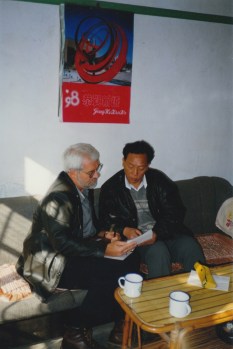
FigureheadSomething from 15 years ago, which might be self explanatory, about a man who moved me.

MISTER SU

Presents are light, but friends are heavy.

— Mr Su

They marched into the Golden Dragon, the four of them, looking as pleased as Punch — (blow out those cheeks and let the tones resonate!) Mr Zhang and Mr Huang and Mr Su and Mr Xu. (Purse your lips, curl your tongue and give a short whistle — Xu, Xu, Xu. You can practice for some time without getting it quite right.)

Mr Zhang had a car; that cut him out of the pack. No one else much had a car where we were going. But it wasn’t his, it belonged to the same mob who provided the mannequins, and he was a driver. I mistook his role for that of a sort of personal assistant/chauffeur to Mr Su, but I was a long way wide of the meaning of democracy in action. If you have an approved purpose you can organise a car, an interesting thing in itself, and for the two-day drive from Kunming to Mojiang you need a car.

Mr Zhang had no English, but he was a great communicator. I had better and easier conversations with him than with some of the Chinese teachers of English we met, providing the first of many encounters with the very high level non verbal communicative skills that were characteristic of our Chinese hosts. It is something about the language that makes you use everything you’ve got including, of course, tones, and gesture to get meaning clear.

Mr Huang was an English teacher and was immediately recognisable as a type. In schools I know, people would say of his ilk, ‘Mr Huang? Indispensable. First here, last to leave; always wanting to see if there is anything he can do to help.’ He would be the person who marked out the oval at 5am on the day of the athletic sports and collected the flags at its end. He almost quivered with alertness, wired in to everything that was happening, and later played basketball in exactly the same manner.

His English was like my best foreign language. You compose carefully and get held up by a bit of vocab that’s missing. Then you deliver your conversational offering in a manner suitable to the completion of a task which has taken you a great deal of effort: a flourish, head back into the shoulders, hand thrown forward: and how was that one! And then, if it was a question, hope that no one would answer or at least not at any length. So, as the group chatted away, my friend Mr Huang would suddenly pounce. ‘And how then do you like our gracious country!’

Mr Xu (Xu. Xu. Xu. I’m still practising.) was also an English teacher from Mojiang, in his early twenties and as bright as a button. His English was excellent and he was a key organiser, the king of the buses, who stayed with us for the fortnight we were in Yunnan, and was one of the factors that made the travel so easy. Immensely good-humoured, he had the world at his finger tips and nothing was too much trouble for him. He would explain with a courtesy and patience that I would like to be able to reproduce.

And Mr Su. That great man, Mr Su, nut brown and sparkling with vitality.

Mr Su 1Mr Su was the reason why we were there at all. Now principal of Mojiang Regional Teachers College, he had been principal of Mojiang No. 1 Middle (secondary) School when one of his teachers had been awarded a scholarship to spend time in Australia. This teacher, Tao Ying She, now working internationally as an engineer, spent some time teaching at Hawker College in the ACT in 1990 where he became friends with Mark Hall, who with Mr Su’s help, organised the first visit by Australians to Mojiang.

‘What was my idea? It was difficult to decide. The government had not decided to make our town open. But the central government had a policy of open-ness, has said we should learn from Western countries. So I thought, yes, some should come. I have never met any foreigner at the time. I think, hmm …  yeop … very, very good thing. We could learn a lot from foreigners. I would hear the language spoken which I have taught for so many years. They too can learn from our school, our people and our country.’

It was, I think typically, a courageous decision. He had stepped over the cautious parochialism of his regional cadres and chosen to interpret the policy of central government in his own way, reaching out to an idea of a higher good.

‘When Mr Tao returned I let him have a report. We knew some things about Australia but very little. Mr Mark Hall visited and when he returned he wanted more to come back. He teaches Chinese and wanted to know Chinese more. He made a plan — The Bamboo Trail (travelling up the rivers to Mojiang from the south). I like to have PE teachers to learn some more about PE, and so a large group came for four days. They are very satisfied. We learned from each other so much, so much. From that time we have had groups of Australian teachers and students, maybe 136 persons.’

‘The best thing for us is that we can learn more English. Teachers and students can talk with native speakers, can make students study English harder and harder. After these activities, they feel it is not so difficult to learn to speak. They are excellent students. They work hard and they live simply.’

Mr Su decided to become a teacher very young. His father who died when he was eight had been a teacher, as are his two sisters. ‘I loved and respected my teachers.  In primary school I thought I would like to be a teacher. When I was young I like to learn very much. My family’s rules are strict, and they think it is good … ahm … discipline to learn languages.’

‘I went to Pu’er (a larger town 150 k.s south of Mojiang, famous for the quality of its tea) to the Middle School where I studied three years. I had to leave my school where I knew everyone and had many friends. Some of my classmates came with me, but from then on I like to make friends. Yeop. I like to make friends very much.’

In 1962 he went to the University of Kunming’s Teachers College.

‘At this time the Cultural Revolution began. We had no lessons at all. We just stayed at the College and had some political study and discussions. At the beginning we were involved; later on some of us not so interested. But for the first time you could go anywhere, you could travel. Sometimes I went to Lancang (‘Lunshung’) or Jing Hong, but everywhere there were Red Guards.’

‘We waited for a job for two years. In October 1968 I was sent to Mojiang Middle School No. 1. At Mojiang the students did not come back. There were no lessons. They stayed in their farms and villages. Teachers had nothing to do for one year. The government organised teachers to do farm work. I could do that because I came from a village.’

‘Then school began again. Many children came back and we could teach. But at that time there were no exams. When students don’t have exams, they don’t work very hard. In our school I think the students were good. They were obedient. But it was a time when you had to be very careful.’

He was telling me this, drinking cup after cup of green tea from his personal thermos, sitting in the spartan principal’s office at Lancang decorated with a chest expander hanging from a peg on the wall.  Ten days earlier when we’d talked about the Cultural Revolution he had mentioned that 600 people had died in Mojiang, a town of about 20,000, and that teachers were disproportionately represented among that group. How did he feel about that? ‘Mao did many great things. He was a very great leader. But this  … very bad, very bad thing.’

These experiences had not diminished his interest in education and belief in its centrality.

‘To be a teacher you must learn a lot of knowledge, about every field. When I was in College I learnt Chinese, English Language and Chinese History and I played sport. To be teacher you must look widely. For me it is not so difficult to be a teacher … and I have children. Now my students are teachers, and I love that they are teachers. They do their job better than me!’

He had recently been studying Chinese history again to teach his own students and what he was learning was very much on his mind. ‘Chinese must know that China is a very old country with a long history. Many famous people tried to make Chinese stronger. They have failed. Too big. Too many people. No good government. Policy is a most important thing. A lot of Chinese people work harder and harder to make China strong, to progress. They must work harder for our country. Make our country richer. Every Chinese people.’

‘Chinese government found the problem in education. Most of the students study only to enter a higher level. When they grow and have to do some job, their abilities are not so good. Our educational rules must change.’

‘If teaching is orderly, regular, consistent, students can learn lot of things. Teaching methods have changed but not so much I think. If students want to go on they have to study hard. The teachers must prepare their lessons very carefully. But every year the children talk back a little bit more to their teachers. They have more free time, more things to choose and they lose what is good for them and their futures.’

‘In the future I don’t know what will happen. The level of life [standards of living] will improve. This is happening all the time. Such a big change in my life time. The important thing is to release students’ abilities, and teach them how to learn to learn. That is the education for the future. But spiritual life may suffer and education has two purposes both of which must be respected: the material life and the spiritual life. The spiritual life is what might suffer.’

When we arrived at the Nationalities School at Lancang (see p. 19) he gripped my arm and pointed at a slogan on a plinth with a huge golden key mounted on it. ‘This is what Deng says: “Education must confront modernisation. It must face the world, and it must face the future”. This is what I think too. This is why you are here.’Mr Su 5

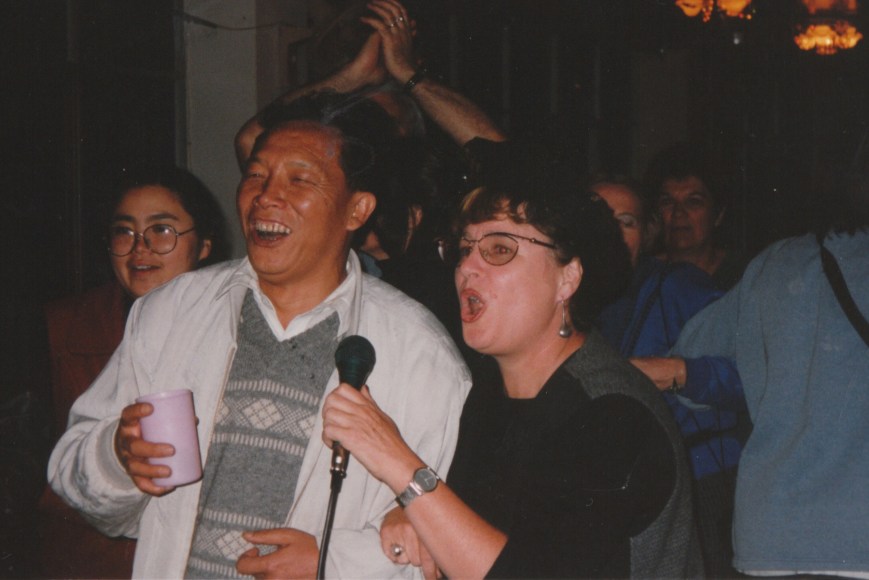
But the slogans of politics could never do justice to Mr Su and his beliefs as he lived them. They are too abstract and arguments about them and their meaning too arbitrary and ethereal. What he offered was his friendship and his vitality and warmth to a group of foreigners. He was at his finest singing ‘Country Roads’ to a karaoke screen, roaring laughing, offering toasts, chatting so openly with strangers, magically causing our luggage to appear after it had been left hours behind on a broken down bus, glowing with pleasure at the obvious success of our contact.

He left us at Jing Hong. We had drunk some whisky together the night before to say farewell because he was leaving for the long drive back to Mojiang very early in the morning. But when we woke up on the rock hard beds we thought we would like to say goodbye once more, and so I pulled a jacket on over my pyjamas and stuck my feet into my boots and we went down to the foyer. We waited for an hour and a half before he appeared beaming. ‘Ah good sleep. Good sleep.’ It was just the right thing to say. I was glad I got up.

The Merest Sniff of China (1)

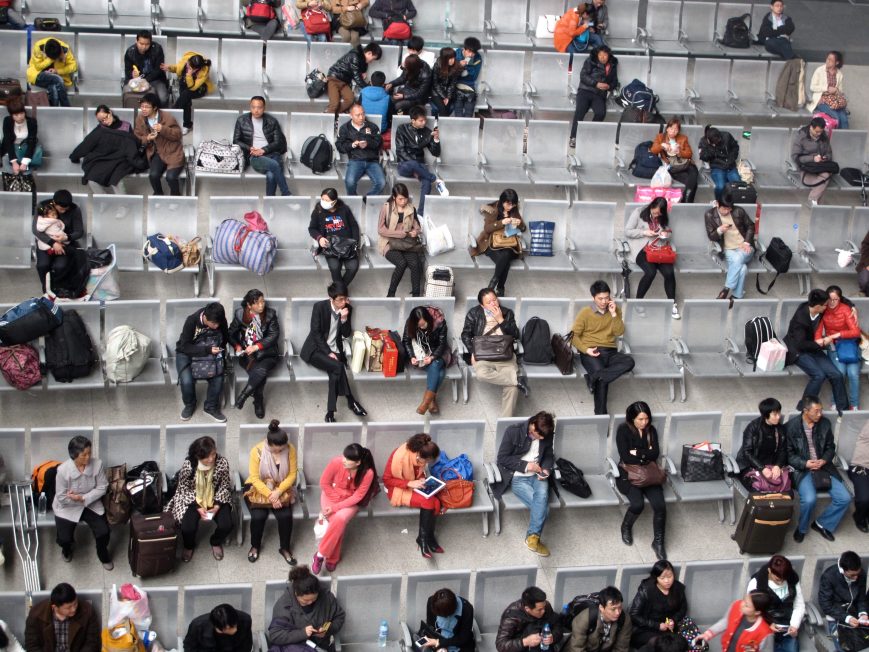
railway station [The photo above repays attention. Suzhou train station. Waiting. Doing what you do in contemporary China when you wait.]

Scale. I think that’s what one has to deal with in China. Scale. Novelty. Volume. Energy. Action. But scale.

Both Beijing and Shanghai have larger populations than Australia. Millions more. Millions. It just trips off the tongue; but how do you govern a city of 27 million let alone a country with more than a billion inhabitants? Fifteen years ago when I was writing about our last trip to China I included the aphorism — possibly local, possibly apocryphal — that China governs to the Second Ring Rd, which is a couple of k.s at least from the Forbidden City, the heart of the Middle Kingdom. But China does manage to build spacious and grand school buildings and, at Wujiang, our real destination, create a city of 1.5m (on mud flats, part of the delta of the Yangtze) in nine years.

Dubbo, yes Dubbo, is one of its seven sister cities, and several of the dignitaries we spoke to had been there — ‘Very clean air. Very spacious and beautiful city’ — although Mr Tsien, the Deputy Director of the Wujiang Education Bureau, had not encountered or seen any Aboriginal people on his visit there which made me wonder.

Pudong airport[This photo is Pudong airport (Shanghai) where we first arrived before going on to Beijing. This terminal (one of two) would be 500m. long and is an exemplar of light weight construction‚ cable trusses every eight or so metres braced by long but fine steel bars secured to concrete stanchions. Beautiful.]

Two weeks. A few days in Beijing, a working week in Wujiang, a few days in Shanghai, with 17 principals and teachers from the hills of eastern Melbourne, Mooroolbark to Warburton. For work. Making films about the experience of these people and their Chinese school partners in establishing a productive relationship. Beijing was orientation, some sight-seeing (the Great Wall, the Olympic precinct, in our case 798, an arts area), some professional contact with Hanban, the Chinese equivalent of the British Council, to marvel at its new educational resources — and boy were they flash— and visits to two schools.

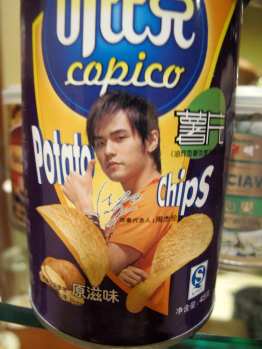
Chips packetOne was ‘e3’, an expensive international primary school, which taught bilingually in Mandarin and English, but otherwise made most Australian primary schools look at least its equal.

The other was an experimental high, about which I can remember very little. I asked why it was ‘experimental’, but wasn’t very clear about the answer. Some schools aren’t, but these days many are. All of the primary schools in Wujiang were also ‘Experimental’.

We saw a ‘model’ lesson with heavy use (by the teacher) of slightly old-fashioned ICTs to reinforce a handful of English vocab, and some pretty funky, passionate even, role plays about turning digital devices on and off.

A suspicion floated through the group that these may have been heavily rehearsed, but why not? I think with a crowd of international critics up the back, I’d be inclined to engage in some rehearsal as well.

I talked to a quartet of the scholars. Two wanted to be engineers, one the goalie for the Chinese soccer team and one to write a book ‘to change the world for much peace’. After 8 years of English for 160-200 minutes a week the goalie was still on greetings, the engineers pretty consistently puzzled by spoken English with occasional moments of illumination, and the author happily and energetically semi-fluent.

Fifteen years ago there would not have been a digital projector, nor would there have been a role play. There were still 50 in the class.

But Beijing was food, architecture, air and art.

We had the first of many many banquets there (somewhere round 24 courses with much toasting), and uncovered the Xiang Wang Family Restaurant in a hutong not far from our hotel, tested the Peking duck, the pork ribs and other weight loss foodstuffs and found them highly satisfactory.

It is a grand and stately city with broad boulevards jammed with near stationary traffic. Fifteen years ago there were bikes; now there are none. It is also a contemporary playground for the world’s architects.

big underpants

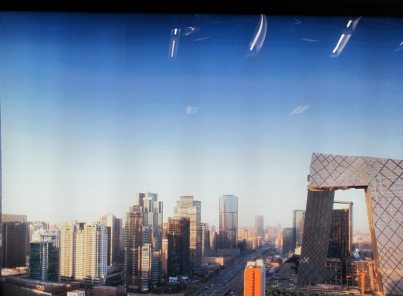
We were staying a few hundred metres from two of the most dazzling (although hundreds were dazzling), the 90-storey tower of the Chinese World Trade Centre (where there’s a bar on the 80th floor and if you could see anything the view would be whizzo) and ‘big shorts’ (at left), the CCTV building. Not closed-circuit TV but Communist China TV which broadcasts six channels of easily recognisable content — reality shows, soaps, news, sport — scarcely distinguishable from TV here. (Note the intriguing assymetrical scoring on the building.)

I took another photo surveying the delights of Beijing architecture with clear skies but I must confess to finding it on the wall of a subway station. Maybe it can look like this.beijing ad

And then there was the air. You might remember 6000 factories were closed for three weeks before the Olympics and this apparently was helpful.

We measure air-borne particles of less than 2.5 microns because they’re the bad ones, million per cubic metre. The standard index says under 50 okay, 51-100 moderate, 101-200 crook for asthmatics or people with other problematic conditions, over 200 very unhealthy for anyone.

Shooting bird's nest[Bayden trying to find the Bird’s Nest in the Olympic precinct. It’s over there somewhere in the murk.]

The ‘e3’ school checks the US Embassy’s air monitoring several times a day. The yellow flag (over 250) was out when we were there which meant ‘windows closed and most play indoors’. 350 or over and, my memory, the school closes. This ocurred for 18 days last October. The Index was over 900 one day a few weeks before we arrived in Beijing. It hovered around 300-350 while we were there.

What’s in the air? Dust, car emissions, factory emissions, coal dust and soot, and so on. Bejing is located in a topographical saucer a long way from the coast, and the air quality would of itself stop me from living there. This isn’t fog.dirty air beijing

And I nearly forgot the art!

Myrna and I had an excursion to 798, an arts precinct developed from converted factory buildings north-east between the Fourth and Fifth Ring Roads. Excellent coffee; great art; great fun; like home on a good day. Except more interesting perhaps. And bigger scale.

Enjoy the pics. (I especially like Mao and his mate propping up the yuan.)

TO BE CONTINUED …

798 streetflat tank

IMG_1751IMG_1734

IMG_1740

WEDDING

It got to 42C (108F) on the day before and that’s too hot for anything really. There were stray northerly gusts strong enough to blow the food off the table at the market where we were eating our breakfast. Buying supplies, of course we were. It didn’t augur well. But we were clinging (for days, weeks) to the forecast which said 26 with light southerlies. Duly at 2am the temperature began dropping, 18 degrees by 6am — and, for Melbourne in summer, Jan 5 was a lovely day. The wedding was on.

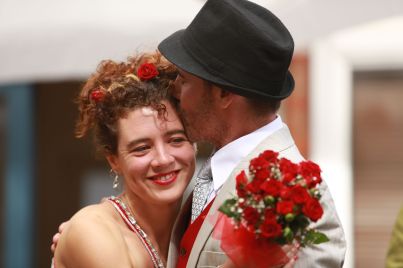
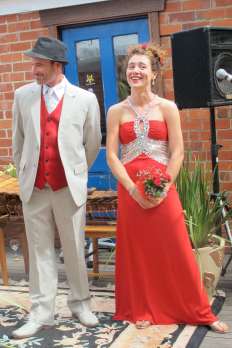
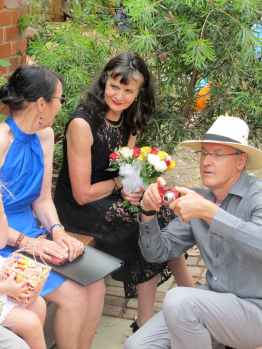
PT9A7900We’re not sure why Mitzi and Simon decided to get married. They’d been living together for five or six years and had two children. It could have been the new suit Simon bought in Bangkok and the need for an occasion to give it an airing. It might have been the constant hectoring from the parents/grandparents whose resignation had descended into fits of misty sighing. Or it could have been the occasion for a fine party. Or all of the above.

It was to be held in the backyard of their house with the catering to be supplemented by contributions from the guests. Our kitchen was papered with lists: ‘160 meringues, 140 Florentines, 200 small cakes, beetroot and lentil salad (no fetta). Small tables from the Salvos. Plastic cloths, clips, golden tissue paper. Rose petals, bucket, containers for …’ that sort of thing, pages of it, exactly the sort of thing I am inclined to tidy up and move along.

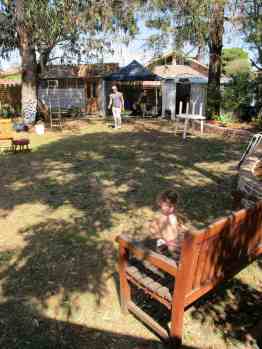
IMG_7375There was getting ready. A Backyard Blitz of sorts had occurred with Simon’s uncle imported to build the snaking wall that had been planned for some time. Mulch had been mulched and top soil soiled. Pots of petunias were cossetted and junk was junked. Mostly. The last remnants of goat hide found their way to the tip, and Frida supervised.Back yard #1

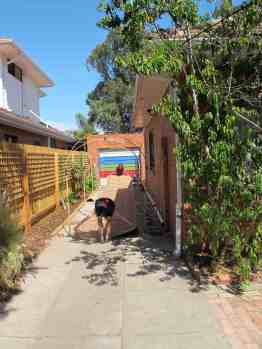
It was of course supposed to not look like a backyard and various cunning ploys were employed for this purpose including a bamboo archway up the drive built by the ever ingenious David Mollison, Simon’s dad. Note new fence. Weddings have their purposes. This is what the bride has to do on her wedding day, an old Australian tradition.

Bum shot

And there were rehearsals to be rehearsed.2. Flowergirl practice

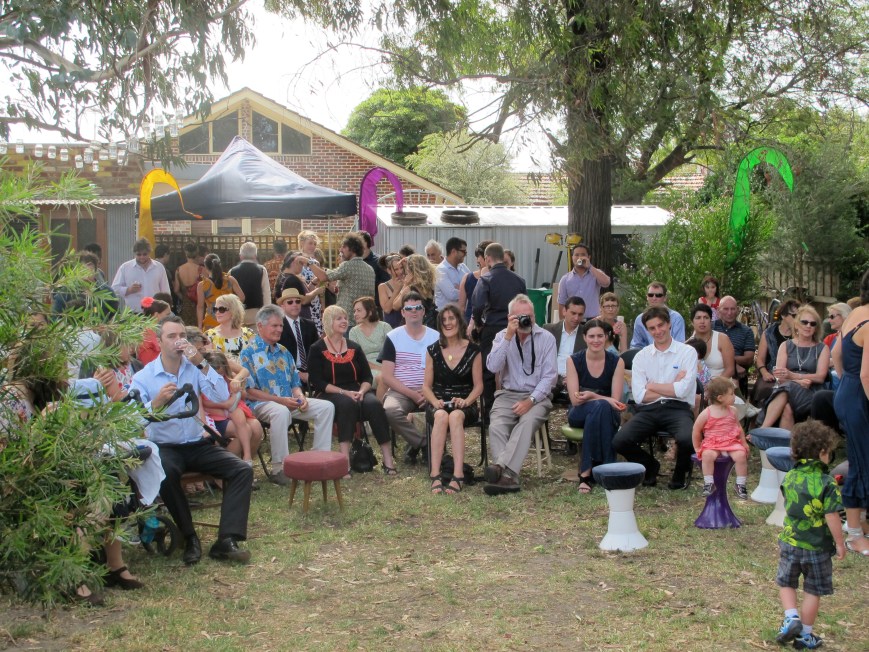
By the time the crowd, which included 40 or 50 kids, started assembling the backyard looked okay. And anyway, of course, the real decorative elements are always the people.IMG_1522 IMG_1529 IMG_1527

It was also a SHOW to be held in the backyard, an all singing/dancing kind of wedding which is what might be expected of a musician and a dancer. It was also as carefully crafted as a drum and as well organised as a biology experiment. The crowd arrived to a genteel concert of djembe and balafon. 4. BassidiGiven a good break among the vicissitudes of fortune, Bassidi Kone (from Mali) playing the balafon may one day become another Youssou N’Dour. Masaki, an African drumming enthusiast from Japan, is drumming. Of course, you say.

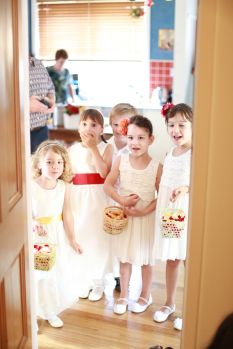
Meanwhile the business of the day was commencing. Simon had decided to wear shoes, Mitzi’s hair had been reorganised, the crowd had got into the bar and Veronica the celebrant had dug up all the featured artists. With a variety of responses, the elite flower persons brigade had got a look at the bride and Shanti, her best woman.PT9A7845PT9A7843

Miriam had sung a very affecting version of Leonard Cohen’s ‘Hallelujah’, and the show was on the road. ‘Today is a celebration’ it was said, ‘of the miracle of all loving relationships which have at their foundation the belief in the best of what it is to be human: the generosity of spirit to be open to another person, to share life’s joys and sorrows, to care for and nurture each other in the journey of life.’8.Simon and Mitzi on arrival

To the delight of all a tear crept into the bride’s eye. The groom’s were of course already streaming. What’s a wedding for if you can’t pack up. They made their vows to each other and it was done.

The event drew a crowd.PT9A7868The only modest and fleeting sensation was the emergence of a ringer who joined herself to the floral guard. But that can happen when you have such a large detachment.7. Flowergirls#1

They sang and sang beautifully: ‘Skinnermerink’ which everyone is supposed to know but I didn’t, and a song Betty, Simon’s mum, wrote for the occasion. Both were belted out lustily. The register was signed …PT9A7946 and the bouquet was thrown. The first recipient at second slip had already been married for 30 years, and so a second throw was called for and a lucky man rose through the pack and brought it down.

17 Off to the parkLed by Simon’s sister Jo, a professional musician based in Vienna, the throng adjourned to a nearby park for dancing and drumming while the food got sorted and the backyard was remodelled. 20 Tent in parkPT9A8198I went down Sydney Rd to the Al Wahal bakery to pick up three spit-roasted lambs with pilaf and pistachios. Good or what! The food turned out to be memorable. And so did the fabulous pick up jazz band playing to greet the party goers as they returned from the park. Just so cool …19 Backyard #2IMG_1680

Speeches aided participants’ digestive processes. There were nine but none longer than two minutes. The topics varied; the quality and heart-feltness little. Dave’s poem may have been a standout.

Mitzi’s Aunt Gill’s cake was cut, and it got dark and so there aren’t many more photos.

But the show went on, and on. Mitzi and Simon provided their own presentation, the humour highlight of the evening. Another sensation was the bridal waltz which began as an African dance, but changed into a salsa as Mitzi and Simon were joined by four other couples — notably beautiful dancing by the men, although Mitzi says we are just not used to seeing men dance and women are customarily wonderful. This turned into a Polynesian hula for the women and a Maori haka for the men. It just went on.

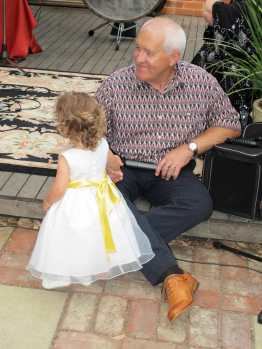
In his speech the father of the bride (pictured with younger granddaughter) described it as a happy happy day, and so it was. Tired but happy? Yes I think that’s it. (Pa David, Betty and Myrna) Wonderful.14 parents13 MC

ROMANIA #3: TO THE SOUTH

It was 20 k.s of dirt before we got back on the macadam and and then a few dozen more before we got somewhere else. Brasov. It was a hot day in the square which you can see right in the middle of the photo, gearing up for an even hotter night. It was party time in Crown City. Thousands were out in their Saturday best, with families a speciality, a stage being erected, scores of big umbrellas already up like a field of flowers. We could hear the noise from the Oktoberfest (whereby a perfectly innocent month has come to mean ‘beer’) happening in the huge white marquee above left, and a big tennis tournament was on. The city was also awash in brides. A truly Spring occasion. I really didn’t know what was happening. I just got excited.

We had a guided walking tour provided by a Moldovan who didn’t think there were many Saxons left in Brasov but those who remained were considered hard-working and competitive, perhaps like Claudia herself. Brasov’s old town was like a child of Vienna — tidy, solid, safe, not awash in grand buildings but with plenty of the nooks and crannies that make Vienna fun. I loved it. These stylish lads outside the university caught the feel.

[This photo of a plaque on that building has been included only for my friends at the AEF. The relevant (black) inscription: ‘Confucious Institute at Transilvania University’. China’s reach is both broad and deep. Prepare. It won’t be all fun.]

After the tour we went for a walk looking for the real town. We sort of found it — a bus station, several dry cleaners, pretzel shops, shawarma shops, roads fat with traffic — but without much contention decided to get back to the festa.

We followed a bridal party up Strada Nicolae Titulescu, the most dense of the party streets. Their photos will be wonderful. For their wedding feast bride and groom slumped in front of pizzas. Good luck to them.

Then we had a crap meal. I did anyway. A shocker. A dud. I would like to place this on record among all this exuding and promiscuous delight. The lamb I ordered was taken exclusively from the heel to the bottom of the calf, a disgraceful collection of gristle parked in some dry polenta. There. I’ve said it. I don’t have to say it again.

We got back to the square just as an opera recital was finishing and we were treated to the ever popular, always tedious ‘Brindisi’. There is music you can hear just too often and this is in a cage match with ‘Bolero’ to be at the top of my list. Sad. I would have loved to have heard the rest. In the morning there was not a vestige left of the stage, just the sort of drifting couples being circled by picturesque litter that you might expect in a film. The satisfaction of a social petit mort.

The next day was athletic. Brasov is built into the side of Mt Tampa and there are 100 ways to get to its 900m. peak, the most popular being via the cable car. I think we took the ‘Snake’s Staircase’, a gently graded series of zig-zags, had some chicken, chips and Chook (‘Ciuc’ really, the local beer) at the top and came down the rather more serious ridge route finding new Brasov, Ceausescu’s Brasov, on the other side.
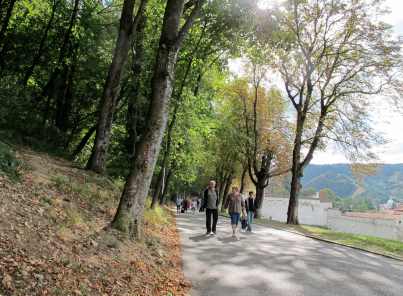
At Tampa’s foot was a lovely promenade with, although it doesn’t look like it in this photo, hundreds of Brasovians out for a stroll. I looked at this, smelling something very deliciously bakery-ish coming from over the wall, and thought — civilisation.

We followed with a swim — no drama, no story, no photos. But then we attended, for free, the grand final of men’s singles, Brasov Challenger, with seats on the net thanks to Neil and Ros. Local hero Adrian Ungur was playing the wicked Austrian Andreas Haider-Maurer (who I think I have seen in the past at the Australian Open; believed to be coming back from injury). The crowd, which over the course of the game grew to be substantial, barracked: hard and positively for Ungur, and never missed even the slightest of H-M’s errors. Ungur won the first set quite nicely, got to 5-2, 40-love up in the second and then produced a choke to rival Jana Novotna’s. Two sets to one down. And I was barracking for him too. Brasov. Fabulous.

On. On. On. We left at dawn, the train snaking round the foot of the Carpathians and then finding a way through via Predeal, a ski resort. As usual I fell asleep and woke up somewhere near the Gara du Nord Bucaresti. If I could have stayed in Brasov for several more days, and I certainly could have, I would have liked another week in Bucharest. This happens. You can’t do everything.

From the station we boarded a subway train completely covered in graffiti. We were no longer in Brasov. A walk to our hotel, a walk down the street and I was faint, faint I tell you, with hunger. By an extraordinary stroke of good fortune we got our instructions standing on a corner outside a Maccas (cnr. Bulevardul Regina Elisabeta (again! She’s everywhere) and Calea Victoriei (gets a good run too) for those already salivating). We had to wait until Marta had gone of course, this was an Intrepid tour after all, before descending like locusts on the Quarter-pounders. As I used to say in my school visiting days: Maccas. You know what you’re going to get; and the toilets will be clean. A golden-arched empire has been built on those two fine principles. Half a k. down the road we found excellent ice cream and coffee and I was again in good order.
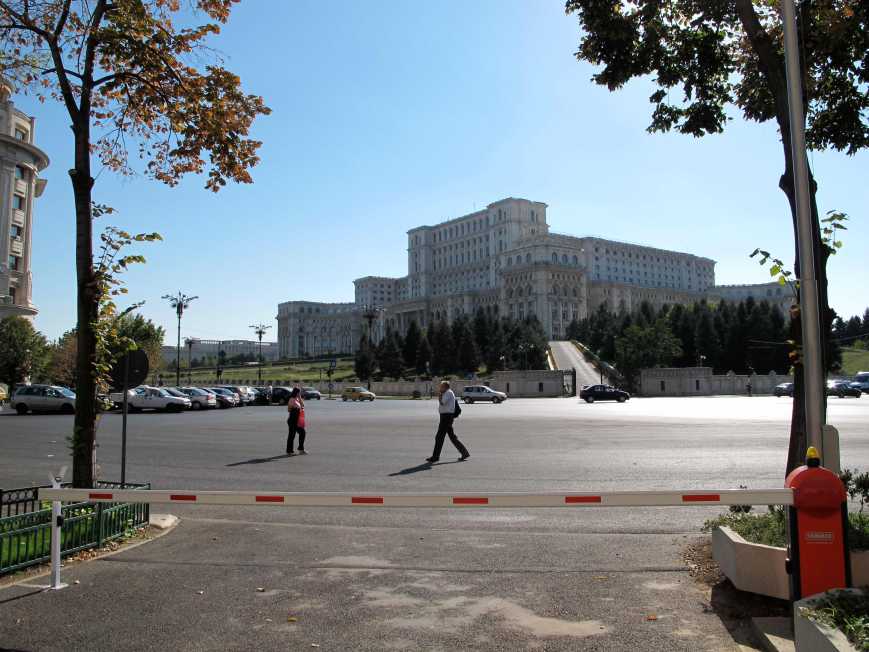
The rest of the afternoon was to be devoted to a visit to Ceausescu’s Folly, the Palace of Parliament, ‘the second largest building in the world in the world’ [after the Pentagon]. I can confirm that it is big, in fact supersized, High and Mighty, an XXXXXL. But there are shopping malls in Jakarta which would inhale it without noticing and blow it out one of their delivery docks. On checking the fine print, I note it is the ‘second biggest government building in the world’ and yes I can well believe it. For the record the two longest parallel corridors in its rectangle are 180m. long and more than a cricket pitch wide. The doors and windows are gargantuan, you could march an army up its staircases and nobody is precisely sure of the number of rooms but it is more than 1,100. It is said, and was by an extraneous member of our tour group who was a useful source for accounts of infamy, that there is as much below ground as above, that car races have been held in the basement, and that the many secret subterranean floors have been the site of unspeakable acts. 10 years, 500 architects, 15,000 workers (whose workmanship is exquisite; look at the way the grain in the marble is matched here) but still significantly unfinished — that sort of thing.

Did I mention that Ceausescu (tshow-sheskoo) was short?

I turn to wikipedia: ‘The building is constructed almost entirely of materials of Romanian origin. Estimates of the materials used include one million cubic meters of marble from Transylvania; 3,500 tonnes of crystal — 480 chandeliers, 1,409 ceiling lights and mirrors were manufactured; 700,000 tonnes of steel and bronze for monumental doors and windows, chandeliers and capitals; 900,000 m3 of wood; 200,000 m2of woollen carpets of various dimensions, the largest of which were woven on-site by machines moved into the building; velvet and brocade curtains adorned with embroideries and tassels in silver and gold.’ Ah my. Meanwhile the population was starving.
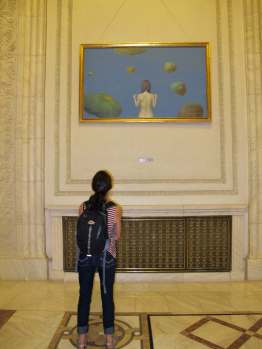
These beautiful raw materials didn’t stop Ceausescu covering the walls with his taste in art which appears to run to about B+ Year 12 work.

To build this monster a great swathe of old Bucharest was razed: 19 Orthodox churches, six synagogues, three Protestant churches (with eight others relocated) and 30,000 residences.

However, besides being white, it is an elephant. Most of it is never used. Parliament sits there and it does house parliamentary offices. It hosts occasional conferences and balls (yes, balls; anything to turn a buck), but most of that lovely work and that huge sacrifice just gathers dust. The grouting in the huge terraces is shot and already you can see how damp has swollen and fractured the exterior cladding.

What do you say? An excellent metaphor for Ceausescu’s 22-year reign? A crumbling shambles? The over-arching impression as we retrieved our passports from the guards was emptiness.

This is the view from the terrace. And that looks nothing like Bucharest. Tucked in behind the buildings on the left is fun, the active part of the old city where we had a simply great meal, a Turkish degustation at which I appear to have ordered the entire mezze menu in error and eight of us knocked it back. In this neck of the woods you could feel what Bucharest might have been not so long ago and may become again, ‘Little Paris’, one of Europe’s really zippy cities, the place which comes so alive in Olivia Manning’s Balkan Trilogy.

Which makes me think, after having let this lie — right there — for a month or so, how odd it is to have spent so much time on the Palace when there was so much else to be interested in about Bucharest. (Here I would like to pump up our walking tour guide, Mihai, who was simply fabulous. When you’re next in Bucharest hook up with him hereMihai. This is a poor photo of  a very handsome young man holding a photo that he has dug out to show us what Calea Victoriei looked like in its heyday.)

A word about guides. I have days when I think I’d like to be guide even though I’m not young enough, educated about the wrong things and almost certainly too impatient. Our guides were people who had excellent educations (all of them) but in areas where you’re relying on the sensibility and largesse of the government to employ you: an anthropologist (Mihai here), an archeologist (Onur in Turkey), a marine biologist (Dylan in Plovdiv). Nicolae (northern Romania) was an trained engineer but not placed to use his skills. However, Claudia MBA at Brasov will be a business woman. They also had strong and mostly well informed opinions about how things were and wanted to talk about them. I suppose fierce introversion is not the first prerequisite for a career in guiding, but I was taken by these very bright young (comparatively) things. And what do they do next? What do they parlay their training into?

It’s a reminder about how the surplus capacity in a phenomenally wealthy country like the USA of the ’60s (or Florence of the 1500s or London of the 1870s or …) can provide patronage for activities that otherwise wither on the vine, in a public sense anyway; and, I suppose, how such activities can be kept alive for a while at least through education which maintains a spirit of generosity about its non-instrumental purposes. I think almost every course I took at university would now be under threat of closure or already gone. But there’s an issue. Even if Romania doesn’t need anthropologists it certainly needs people like Mihai.

We’re not even at the Danube yet. We’ll never get to Istanbul. Three pics with some commentary and then we’ll move on.

FlightFirst, the building in Revolutionary Square from which Ceausescu fled by helicopter.

You can’t talk about contemporary Romania without reference to Ceausescu, head of state for 22 years from 1967 to 1989. Short, delusional, possibly even well intentioned at least originally, he aligned his country not with Russia and its brand of Communism but, when aligned anywhere, it was more likely to be with North Korea or China. (He recognised Pol Pot early and maintained the relationship.) He was a maverick — a patriot of sorts and a brutal despot and the author of one of history’s great and most vicious personality cults.

The infamous orphanages are the result of policies designed to increase the Romanian population: making abortion illegal, introducing significant incentives for women to have children (those with ten or more were declared ‘heroine mothers’), and making divorce very difficult, thus regrettably swelling the number of children abandoned and for whom no reasonable provision was made. (It makes me think of self-harming behaviour. ‘You’re so awful look what you’ve made me do.’ How else can you explain the void that existed where the love and affection that young children need should have existed?)

The mysterious state of the country’s alignment during the Cold War attracted the West which offered Ceausescu huge loans. He borrowed more than $13 billion to finance economic development programs. But as he discovered, they were loans not gifts and required repayment. This became an obsession. He squeezed the last drop of juice out of the country’s agricultural and industrial production and exported it. Food became scarce and utilities (water, gas, power) failed for days at a time. During the 1980s, there was a steady decrease in the population’s standard of living to the point where the bulk of the population in this fertile and well-endowed country was in severe distress. Every effort was made to disguise this reality from Ceausescu including a famous case where he was gulled by bank on bank of plastic fruit and vegetables. Unimaginable the whole experience. Yes it was him, but if you look at the next clip below you’ll see a doddery old man. What pegs were jamming him upright? The Departamentul Securității Statului (Secret Police) no doubt, the army till things turned sour for them, and that might be all you need when aided and abetted by the slough of despond.

He was near his end when he suddenly realised people in this plaza listening to him speak were actually jeering him. The dramatic change of expression on his face  (at 1.32) is an historical moment: he hadn’t done what he thought he had and, in fact, he wasn’t who he thought he was. A small pile of fireworks went off in the Timisoara (close to the Hungarian border) and a revolutionary mood took hold supported by members of the army who thought, possibly mistakenly, they had been betrayed by Ceausescu. In this truly extraordinary age, you may if you wish see the seminal aspects of his trial and death, including an interview with the man who guarded and then shot him right here.

The seated person, broken and reassembled, in the statuary is a version of Iuliu Maniu, anti-communist Prime Minister from 1928 to 1933. The dead tree has its own significance. This is a country which has been terribly punished. And by its own. What degree of complicity would we feel if we were Romanian I wonder?

ArmaniSecond, I took this as one representation of post-communist eastern Europe, an Armani store at the bottom of a standard tower block of flats (along with Neil’s very fine Antipodean hat at bottom right). There are thousands of tower blocks in eastern Europe that are just like this one; never much good, dead ugly on the day it was finished, if indeed it ever was. Time has not been kind to it.

But there is a shoot of something, however incongruous, growing there. I didn’t have a look in the shop — I have all the Armanis I need (a full range inc. apresblog sportswear) but it’s staying open because some people at least can afford to shop there. The discrepancies in wealth here are not as visible as they might have been in the 18th and 19th centuries, but they are substantial. But there’s motion. The renewal of the Old Town is one of Bucharest’s brightest aspects even if you do have to watch for falling masonry.

RomulusLast, the levitating dog. Visual artists are wary of ‘rabbit’s ears’, that is something unintended that turns up in a painting (or a sculpture) which the artist can’t see but everyone else can. It catches your eye and definitively undercuts any efforts to take the work seriously. This sculpture recently installed outside Bucharest’s National History Museum of Trajan with highly prominent genitalia (partly hidden here for your viewing comfort) and the nurturing Roman wolf with Thracian scarf is a collection of rabbit’s ears. ‘A wolf with a pitbull’s head, a lizard’s tail and a tumor on its neck, carried by a guy who is visibly embarrassed by his nudity’ (actually looking rather smug from this angle) is how it was described in one local newspaper by a passerby.

And yet somehow so Romanian. Ilie Nastase was Romanian; so was Ionescu. In descriptions of Romanians that I have read fecklessness is a dominant theme. Quick to anger, quick to forget (anything), quick to fall in love, quick to fall in love again. We will dig up the road to put the gas pipe in; we won’t (quite) fill up the trench. I asked Mihai to tell me what he thought the essence of Romanian culture was, and he said, the language. ‘That is what makes us distinct as a people. That is what we must preserve.’ Anything else? ‘No that is all.’

So finally …

Bulgarian border