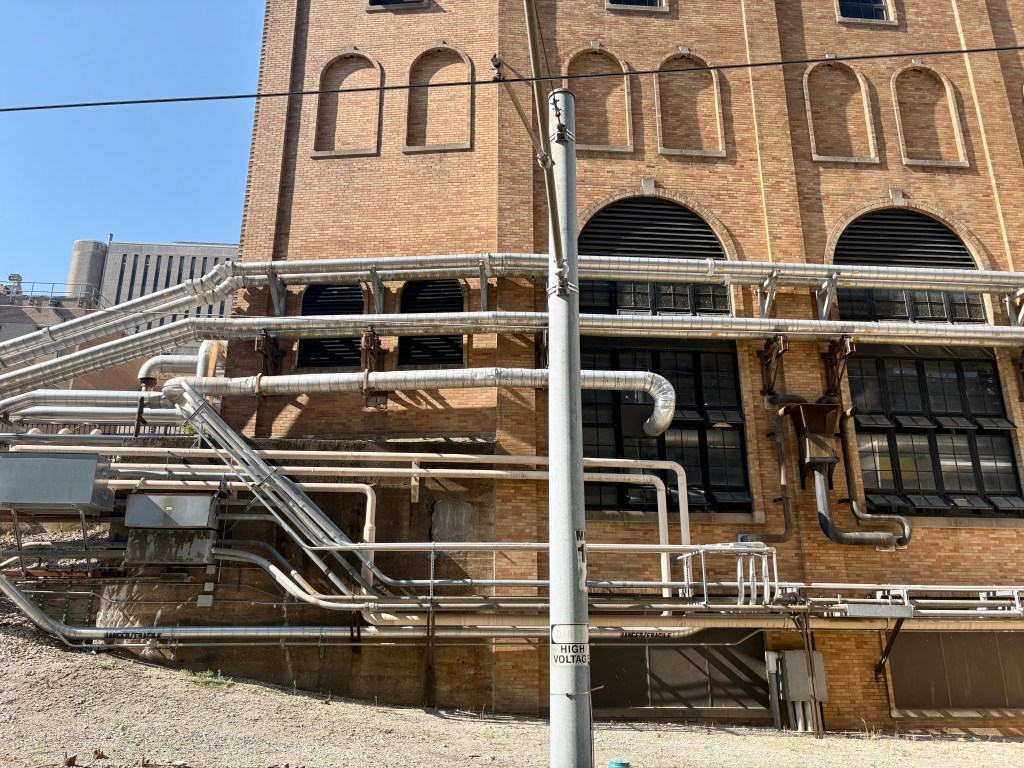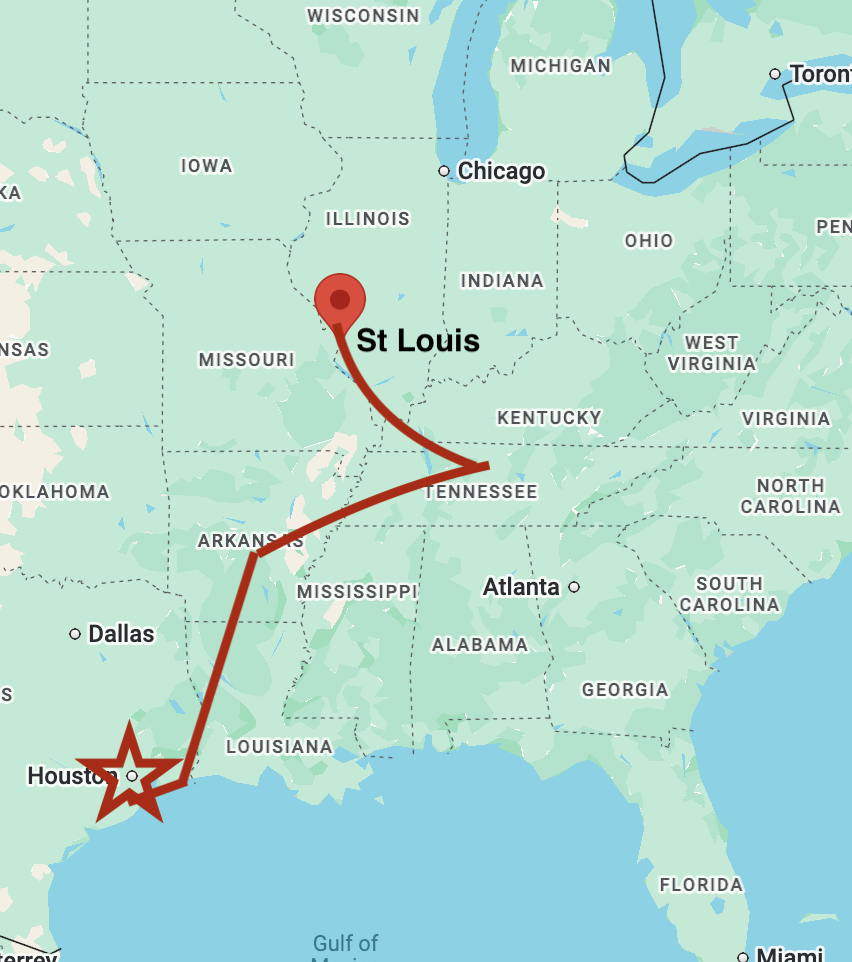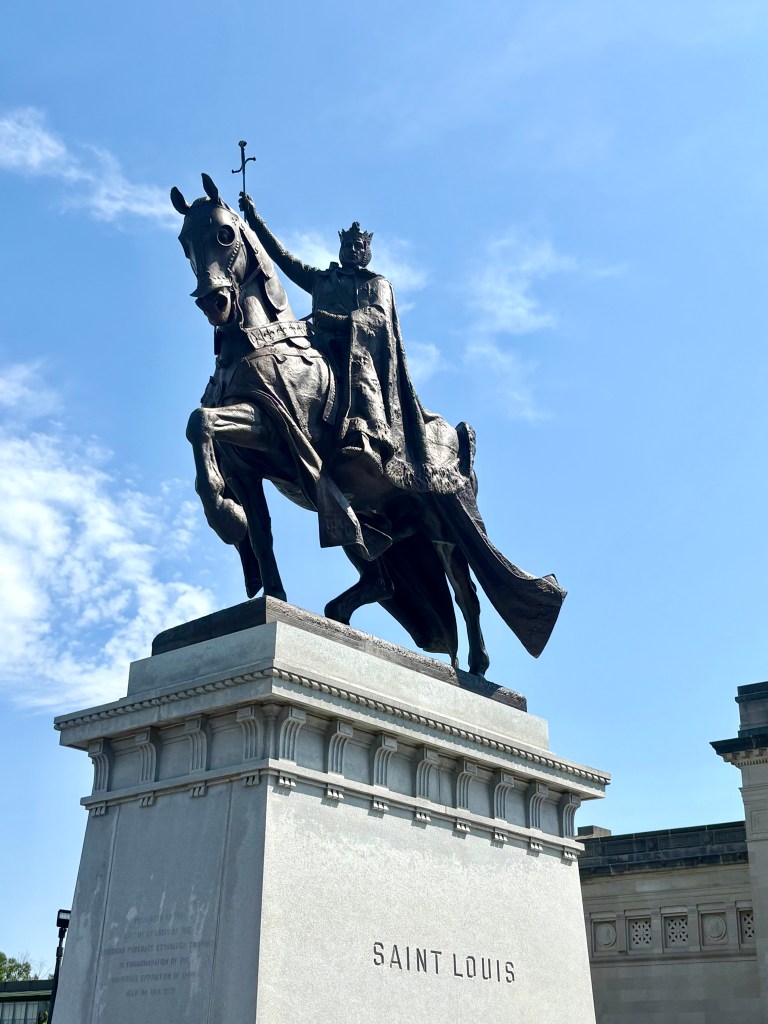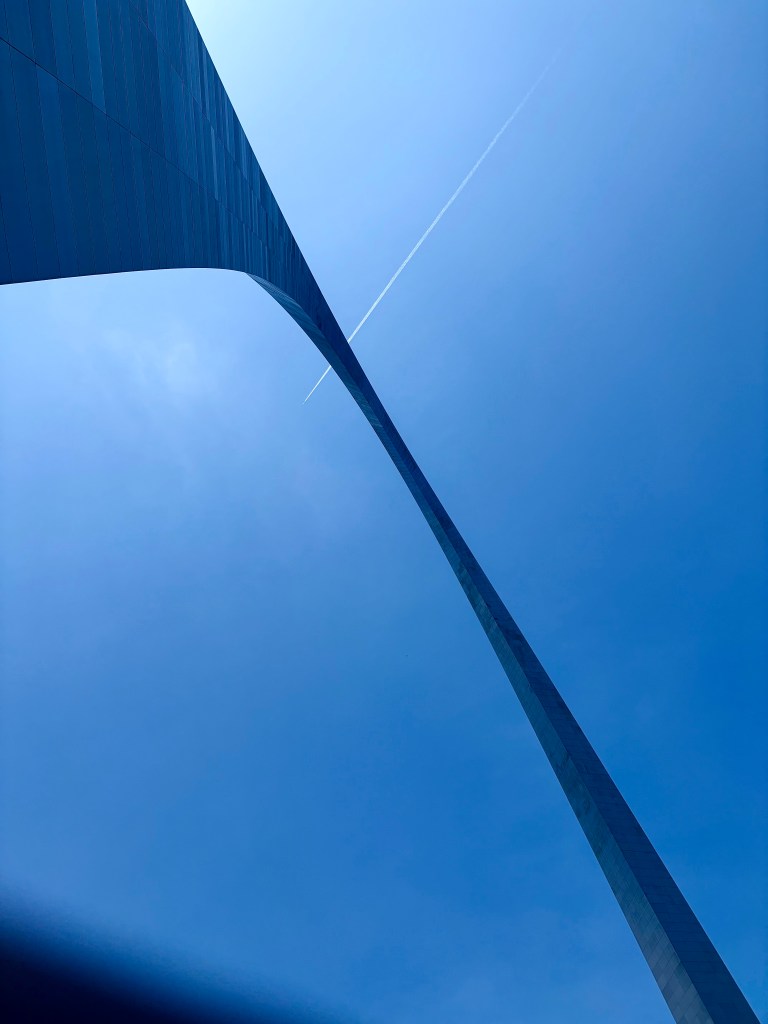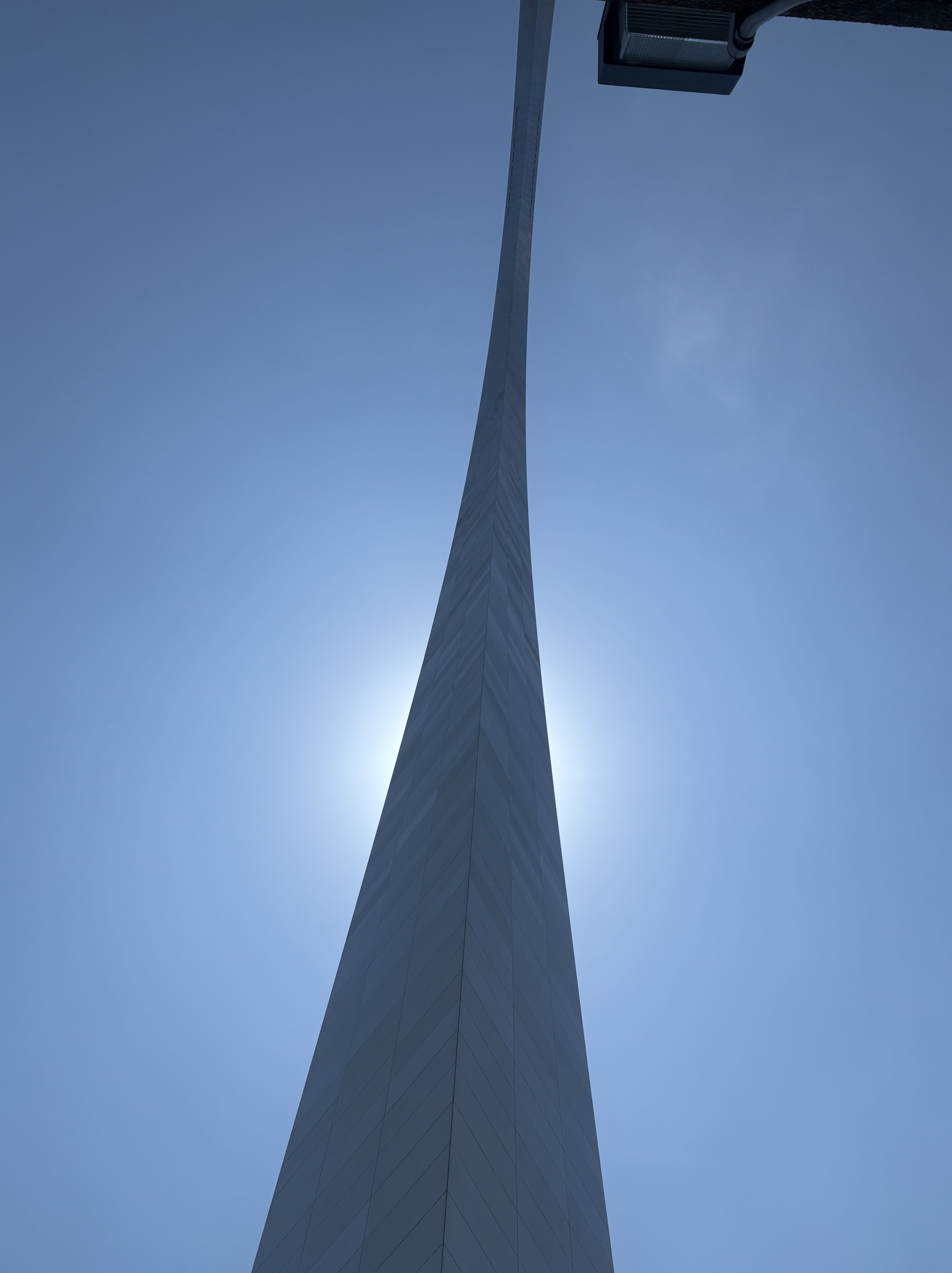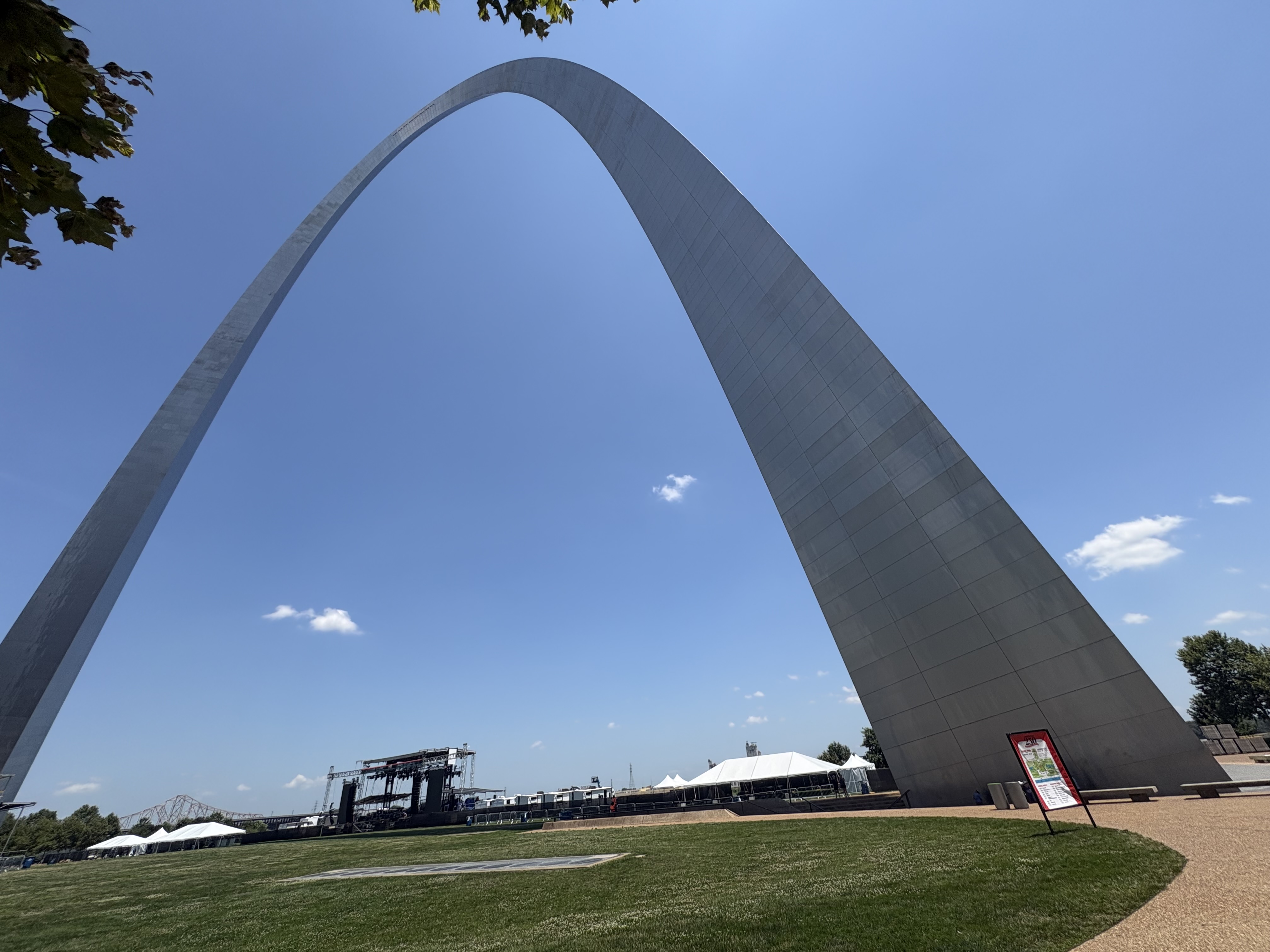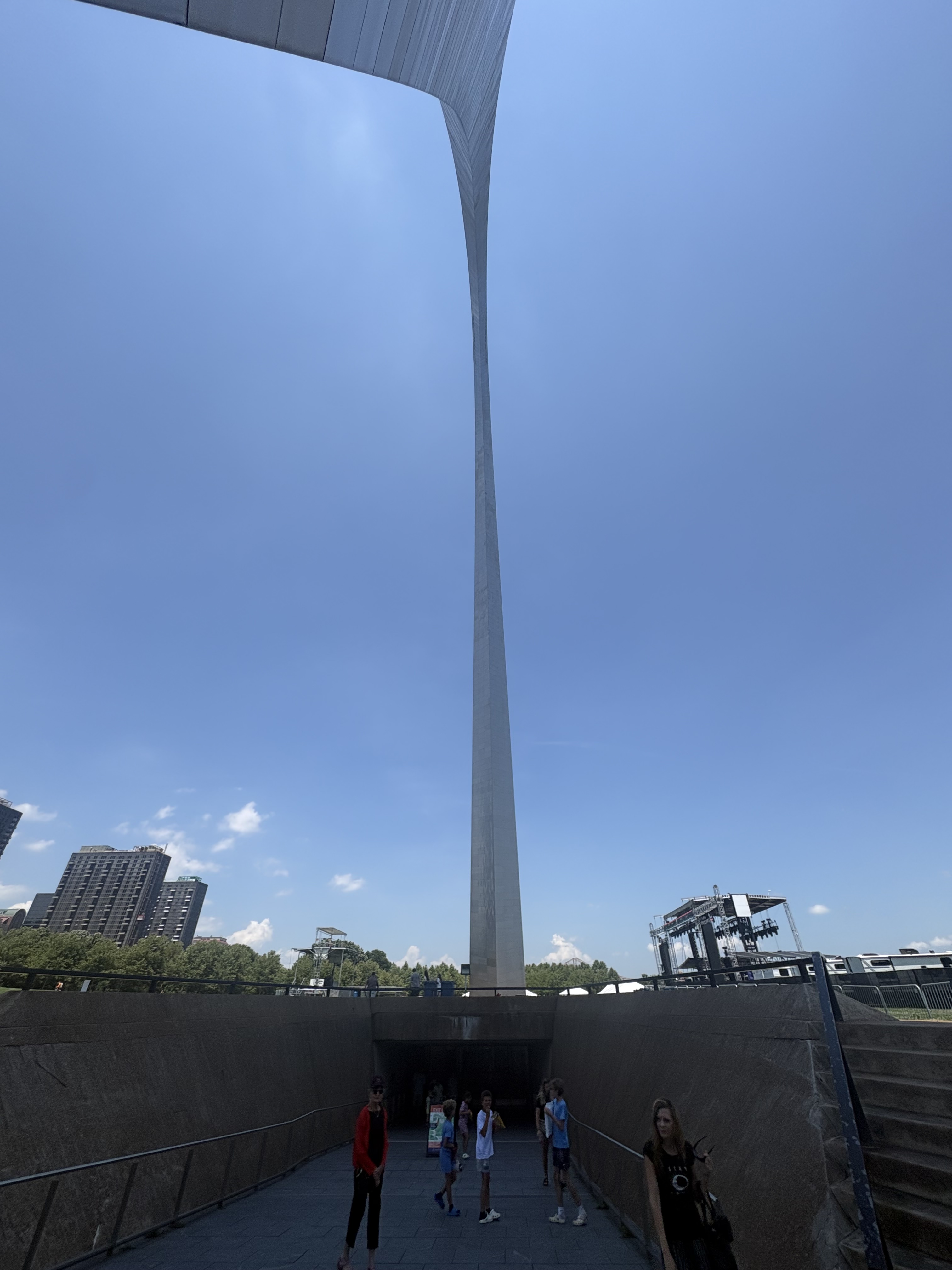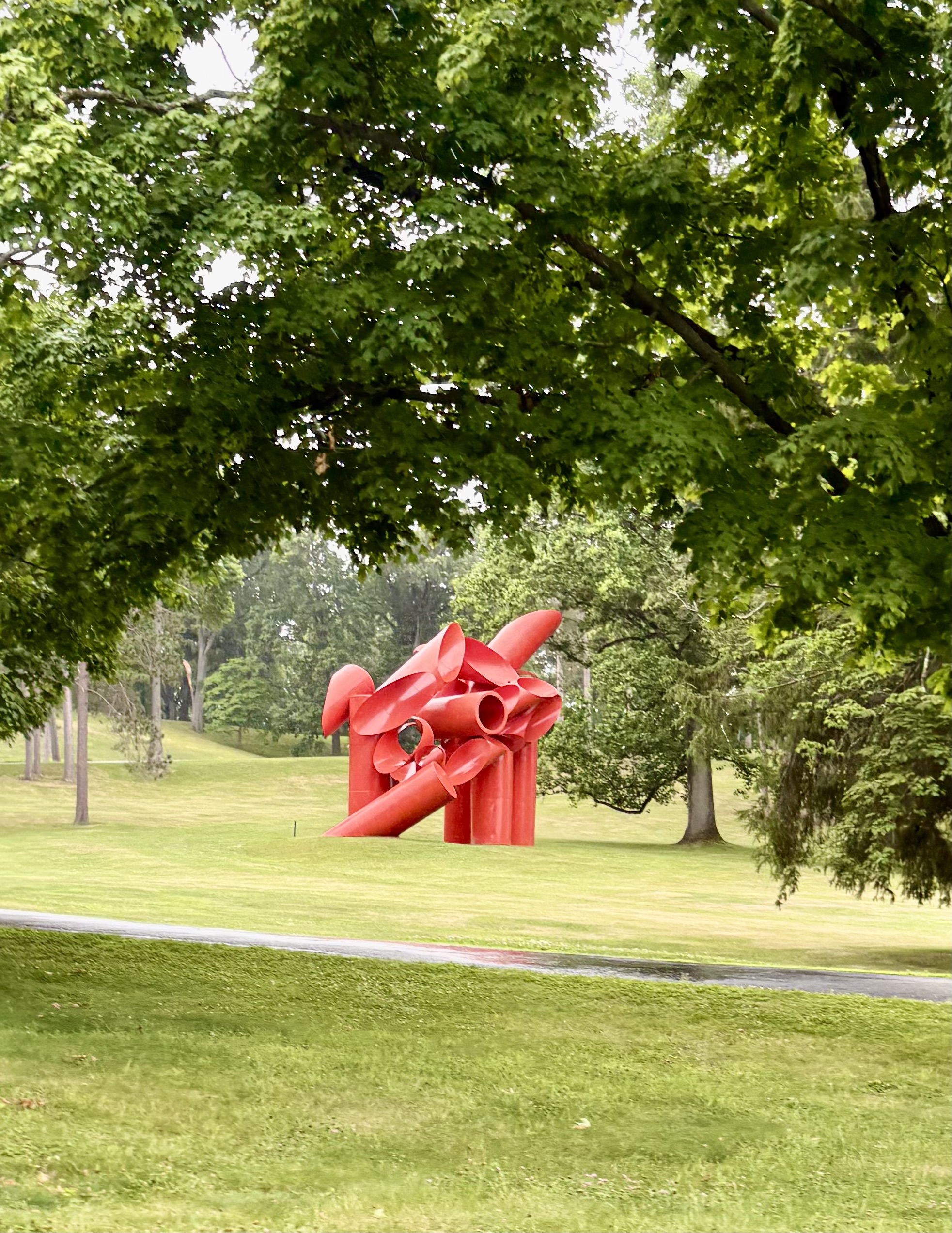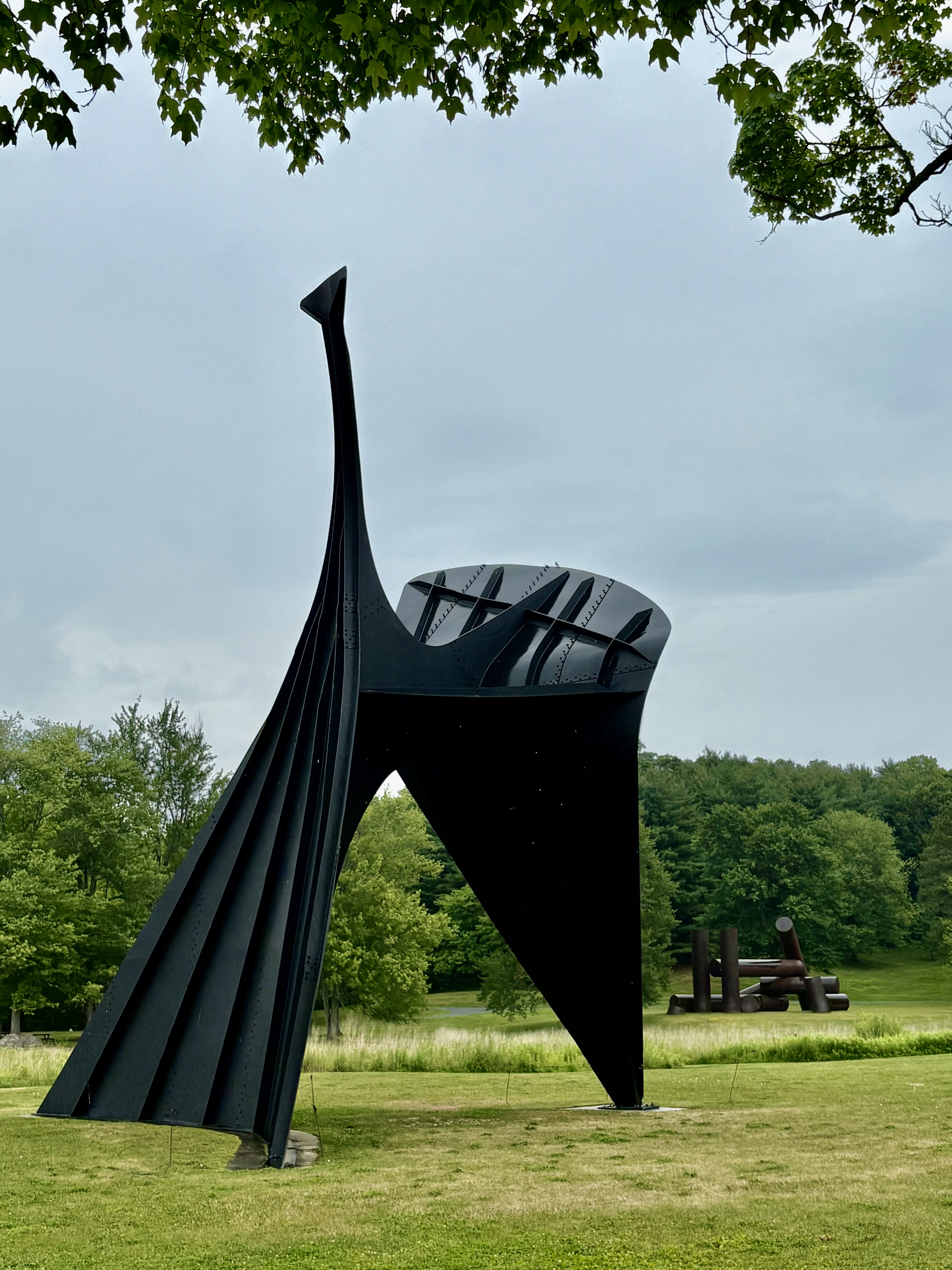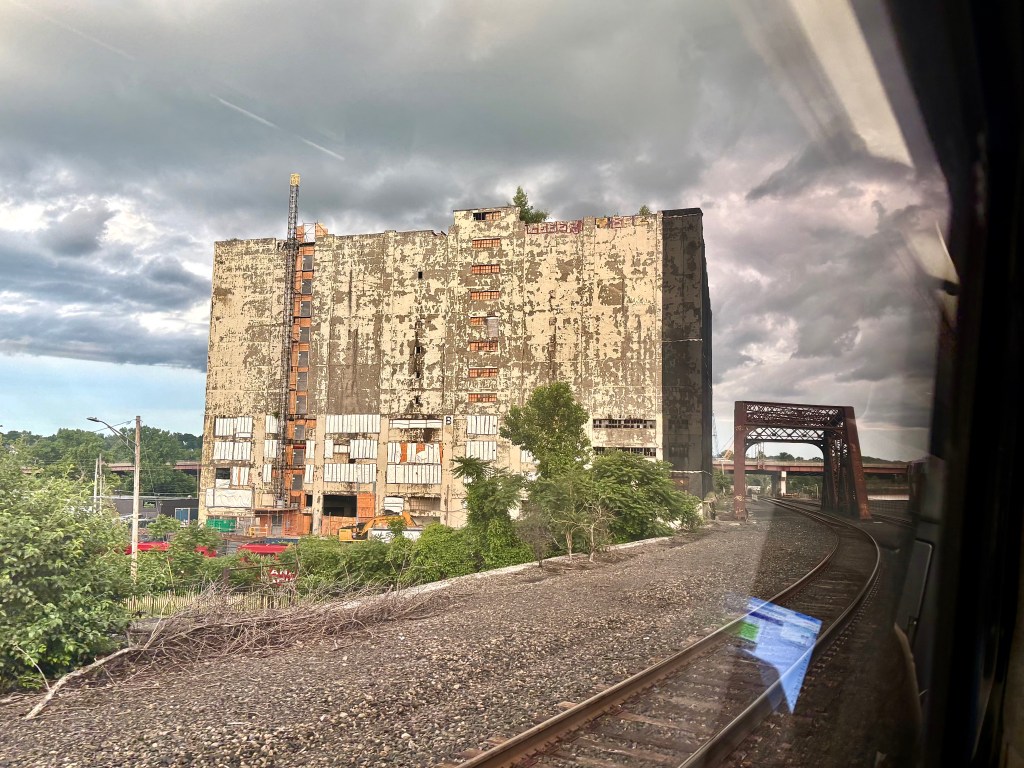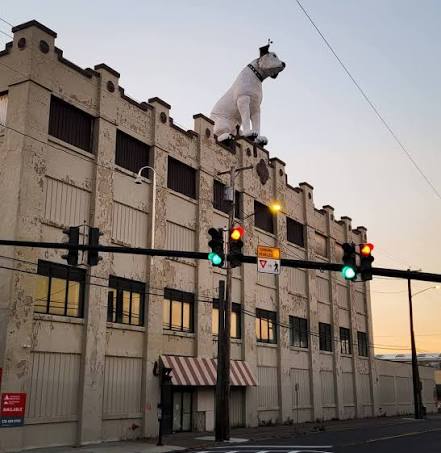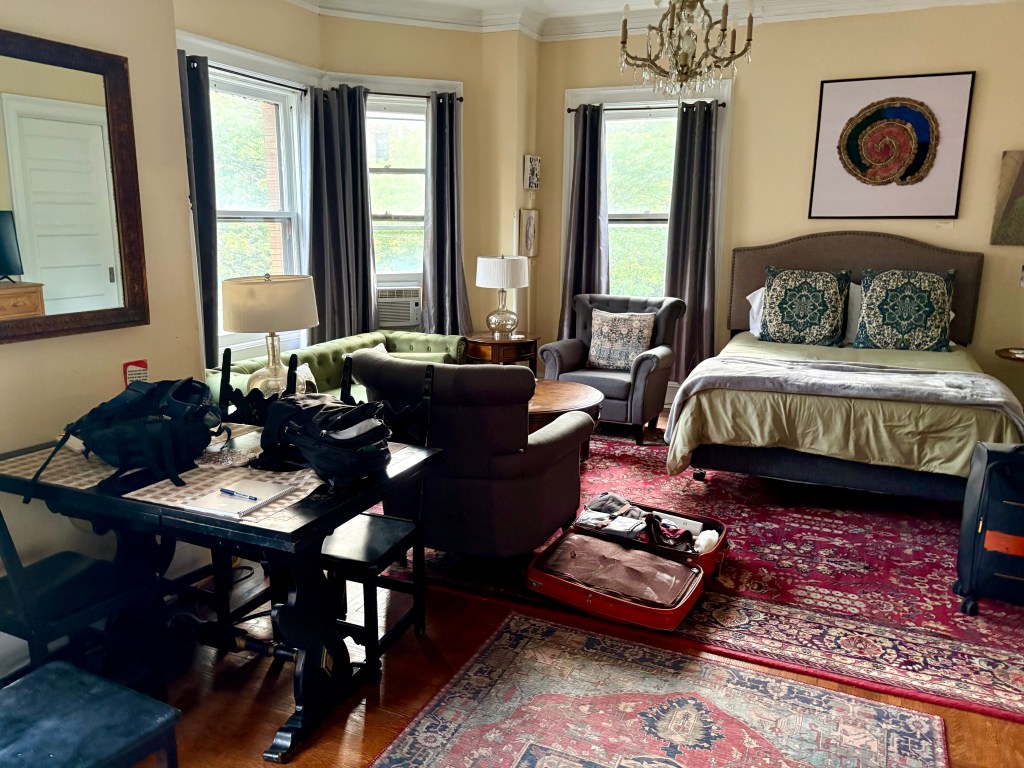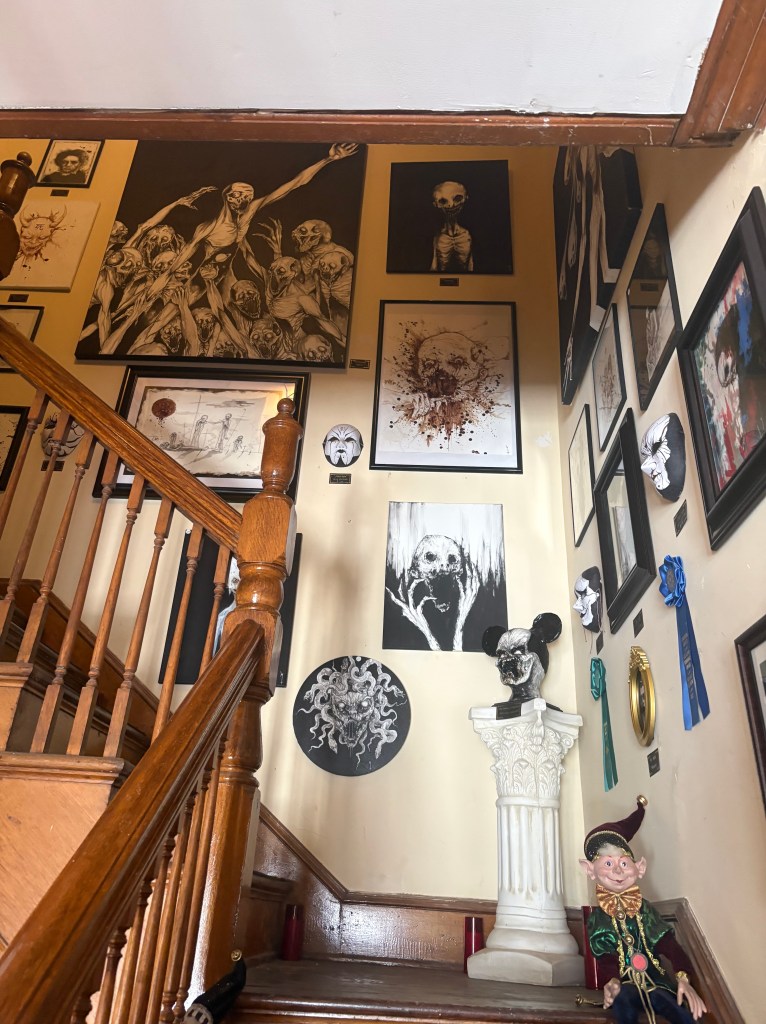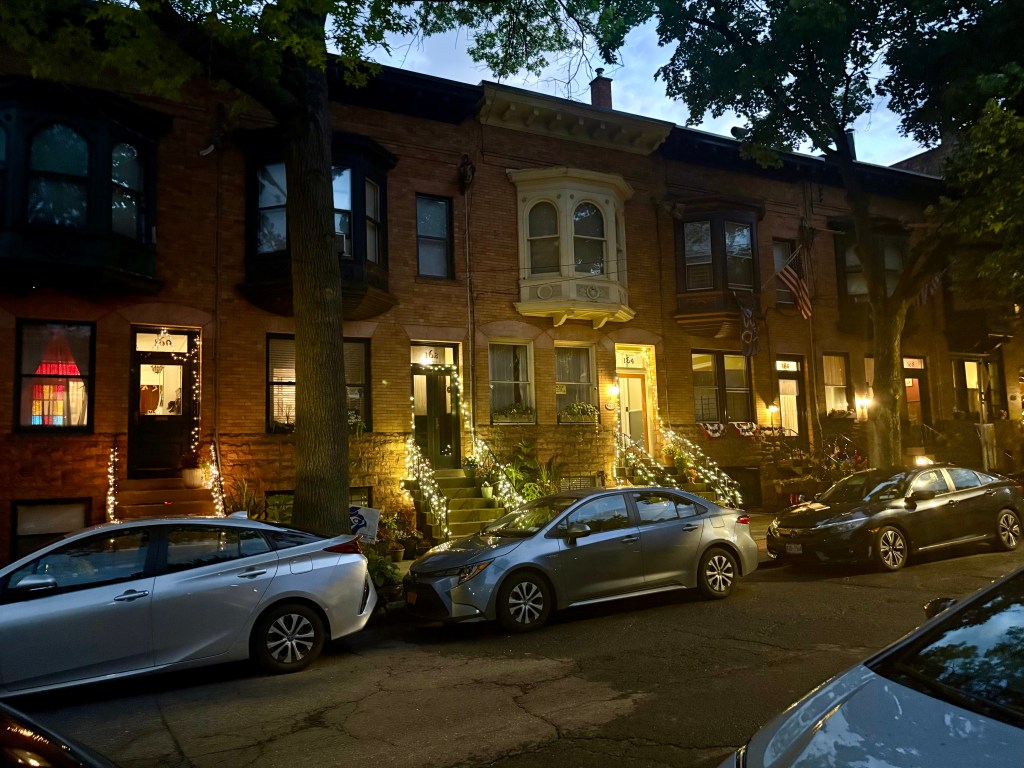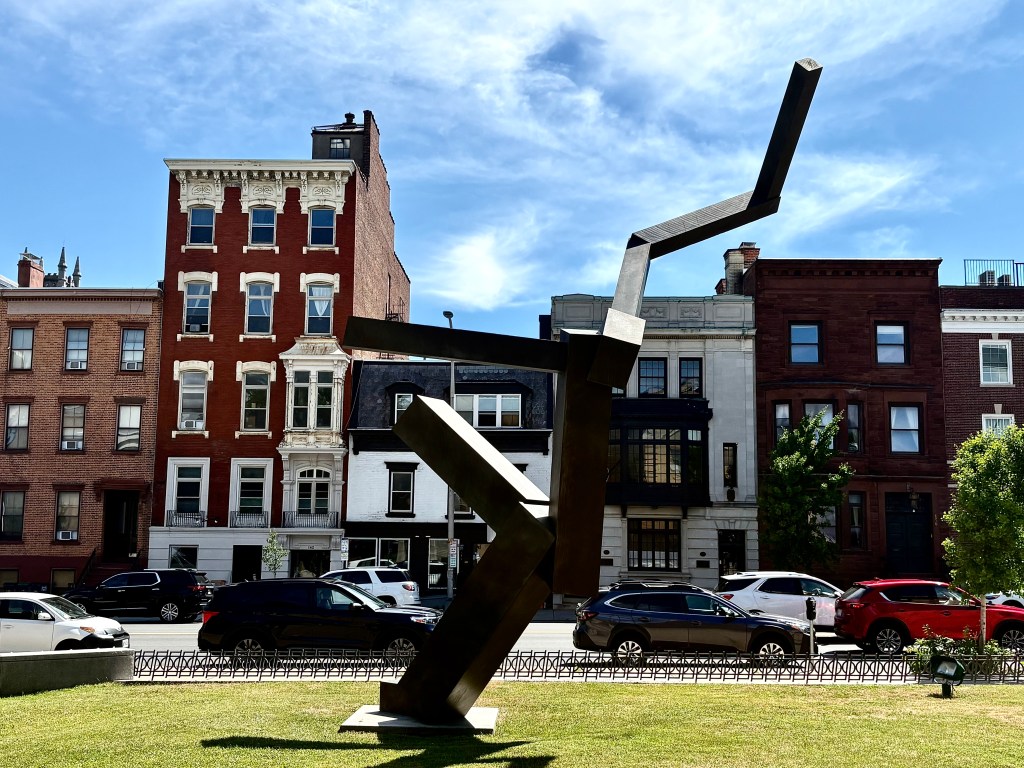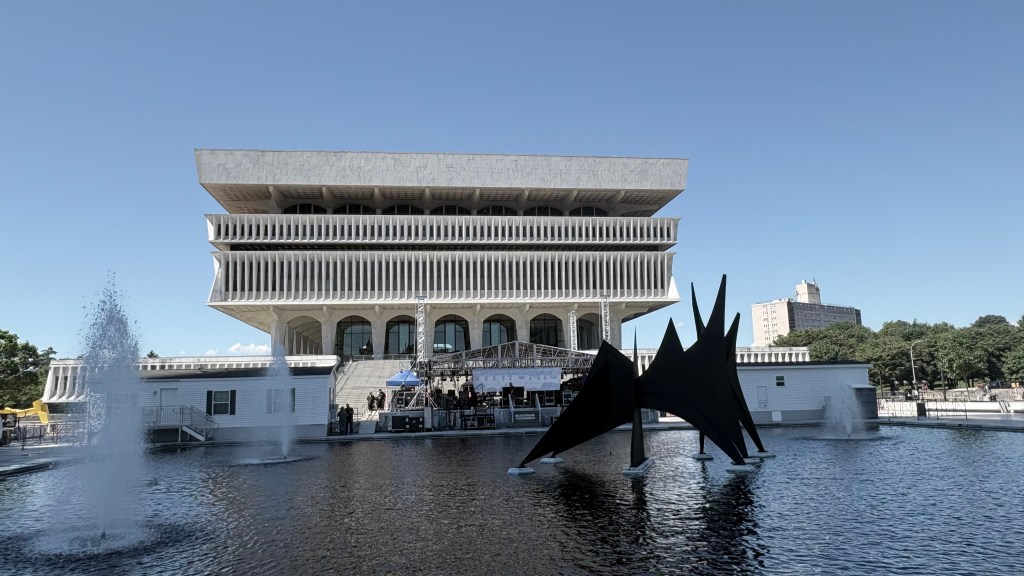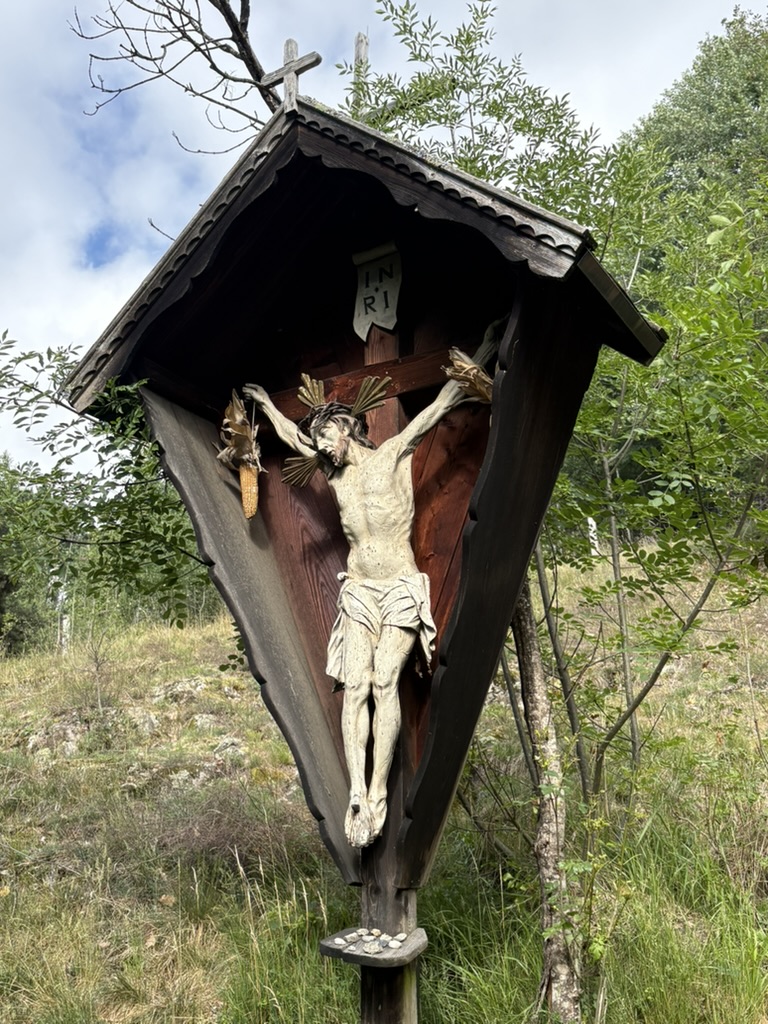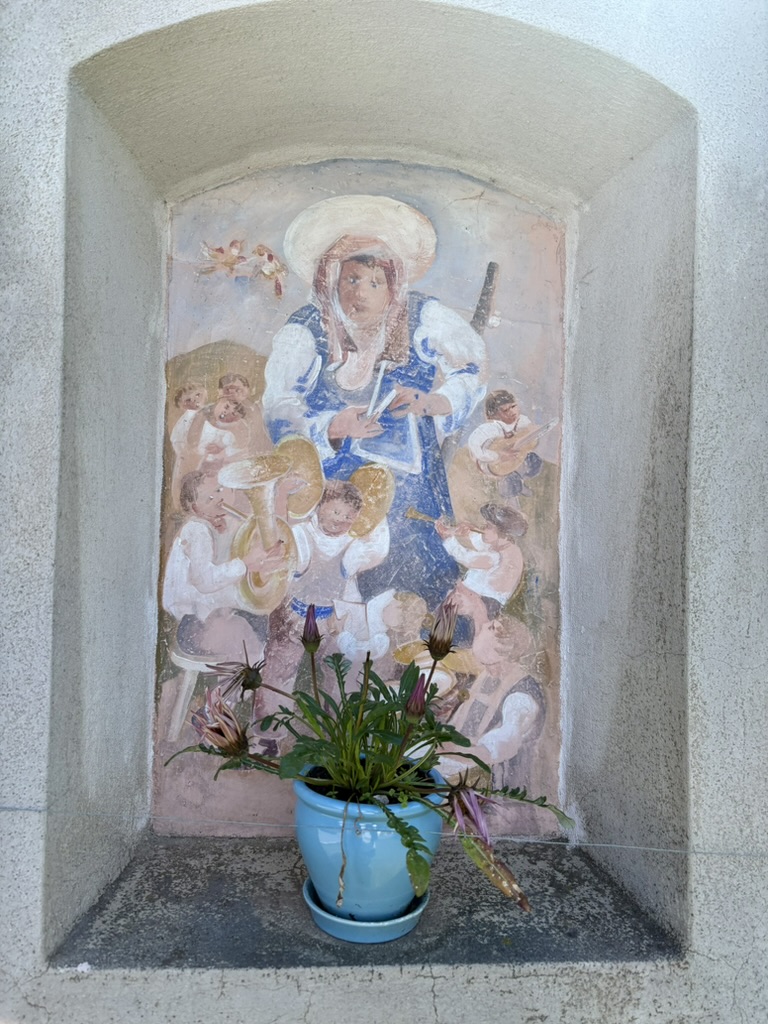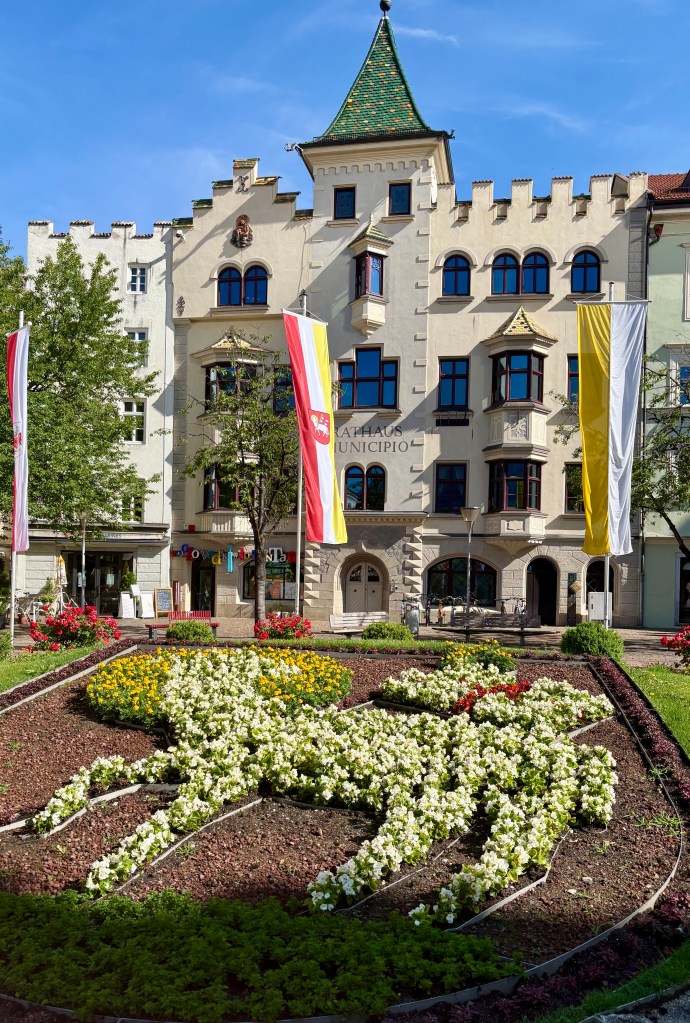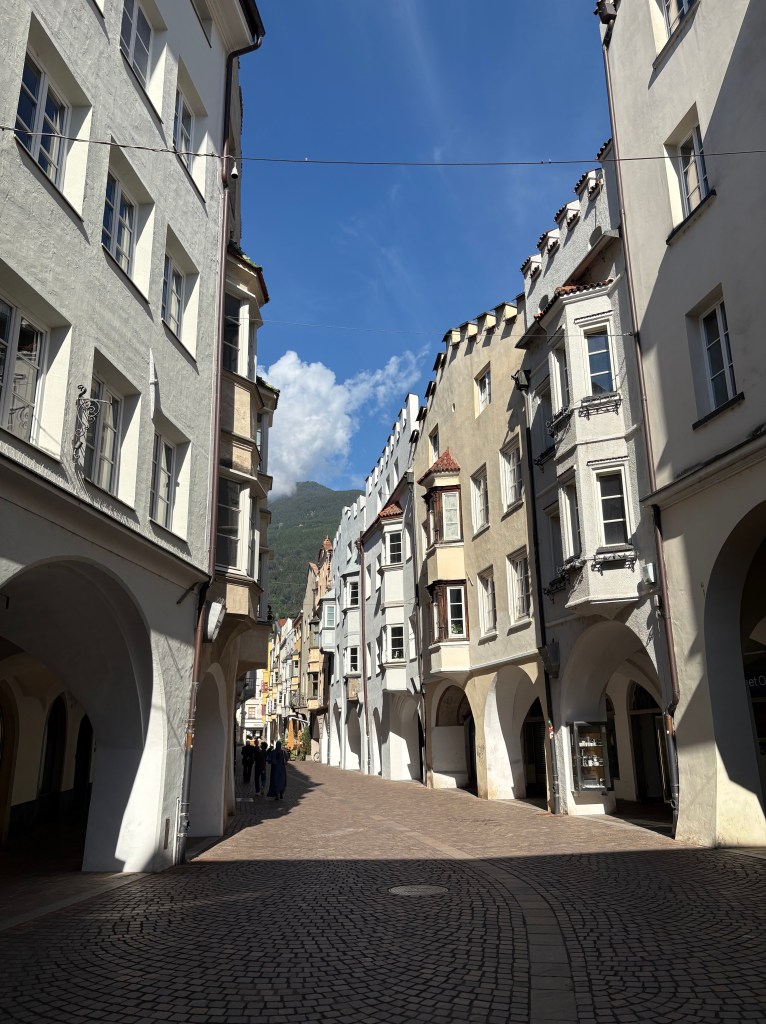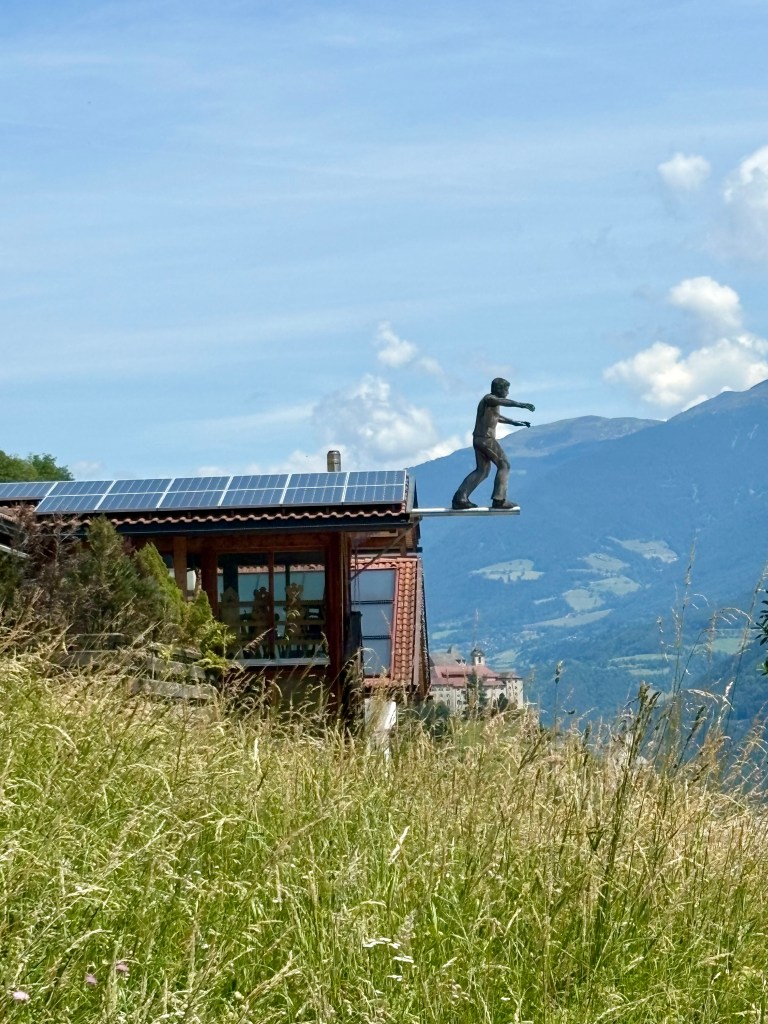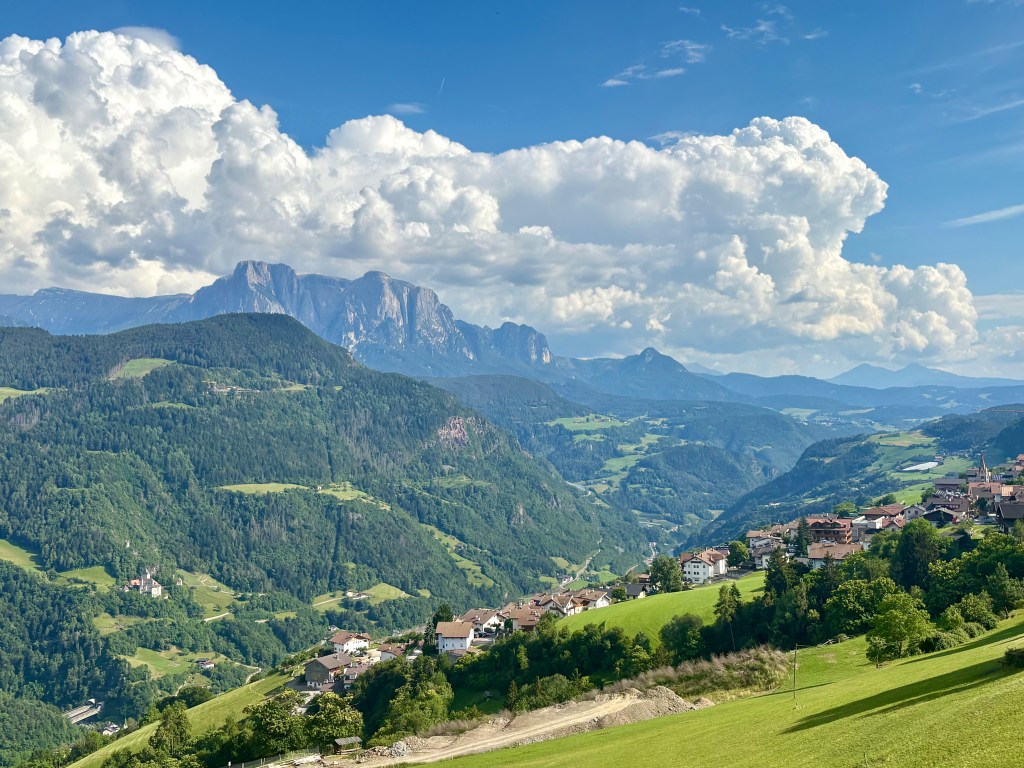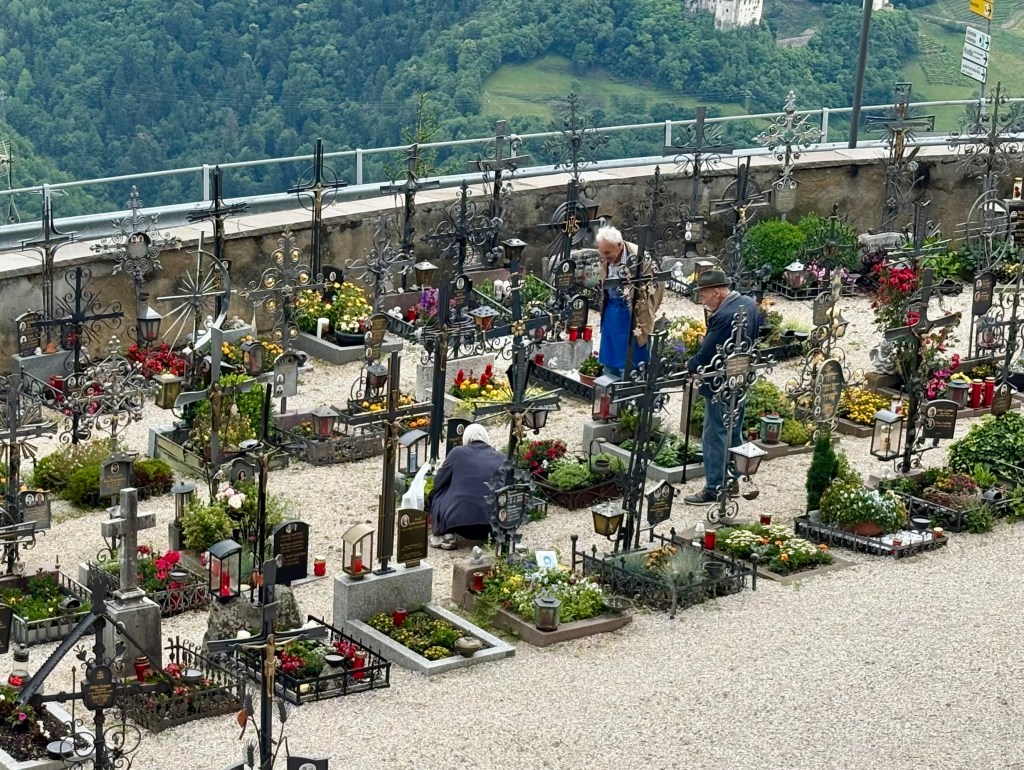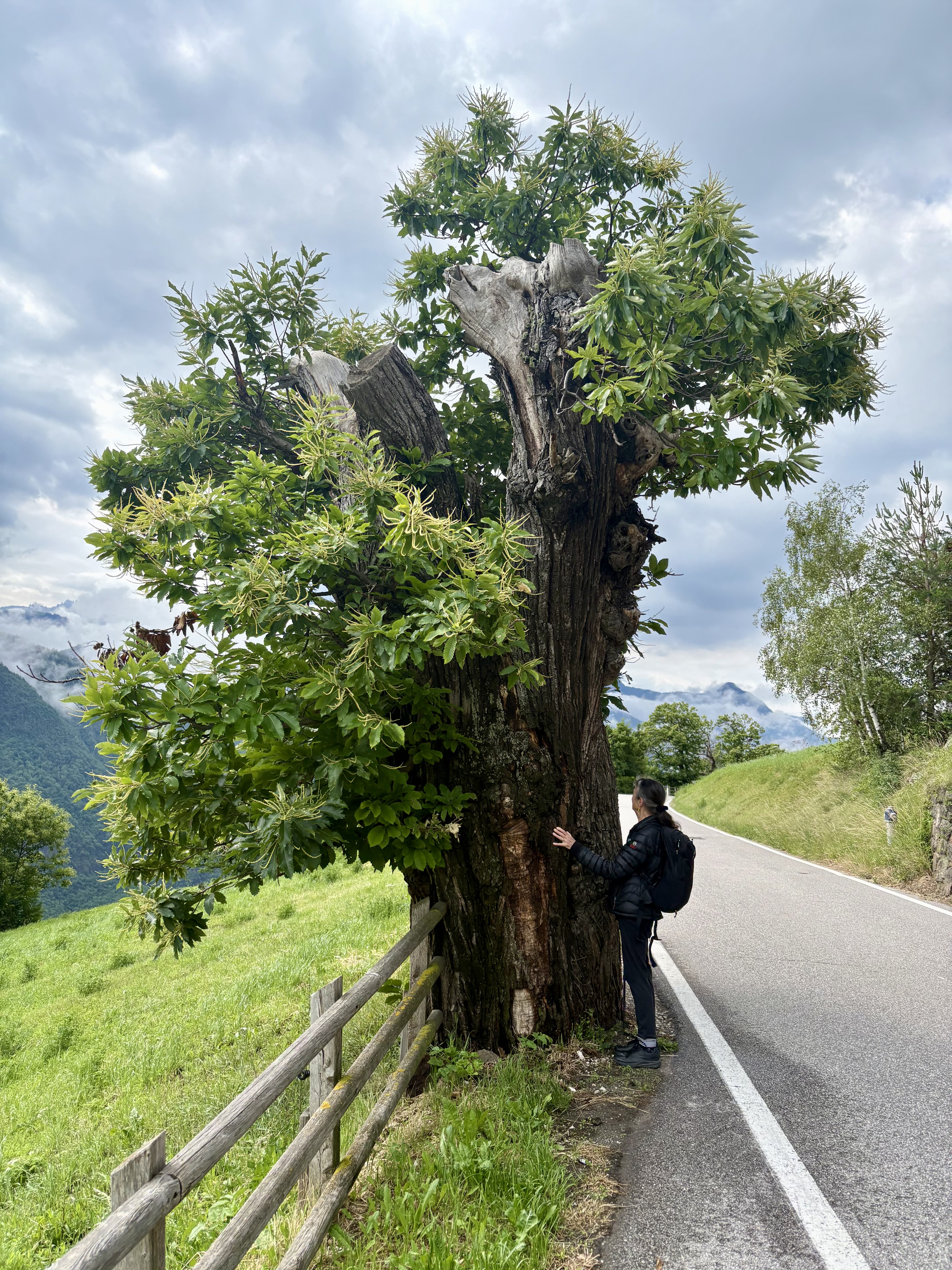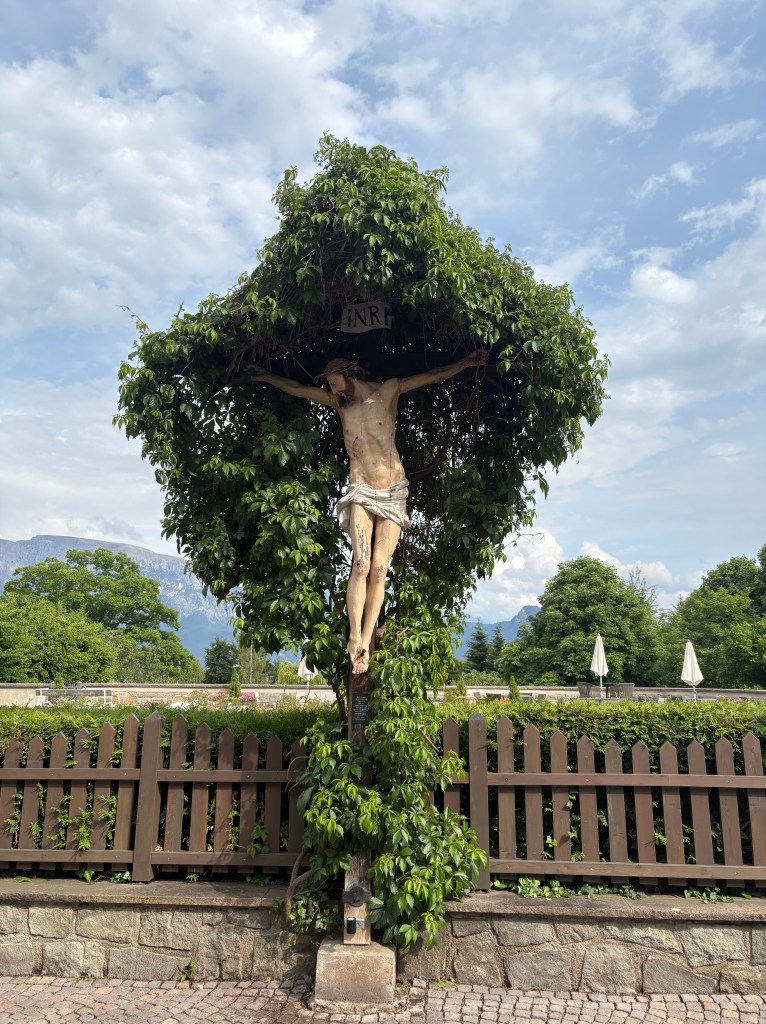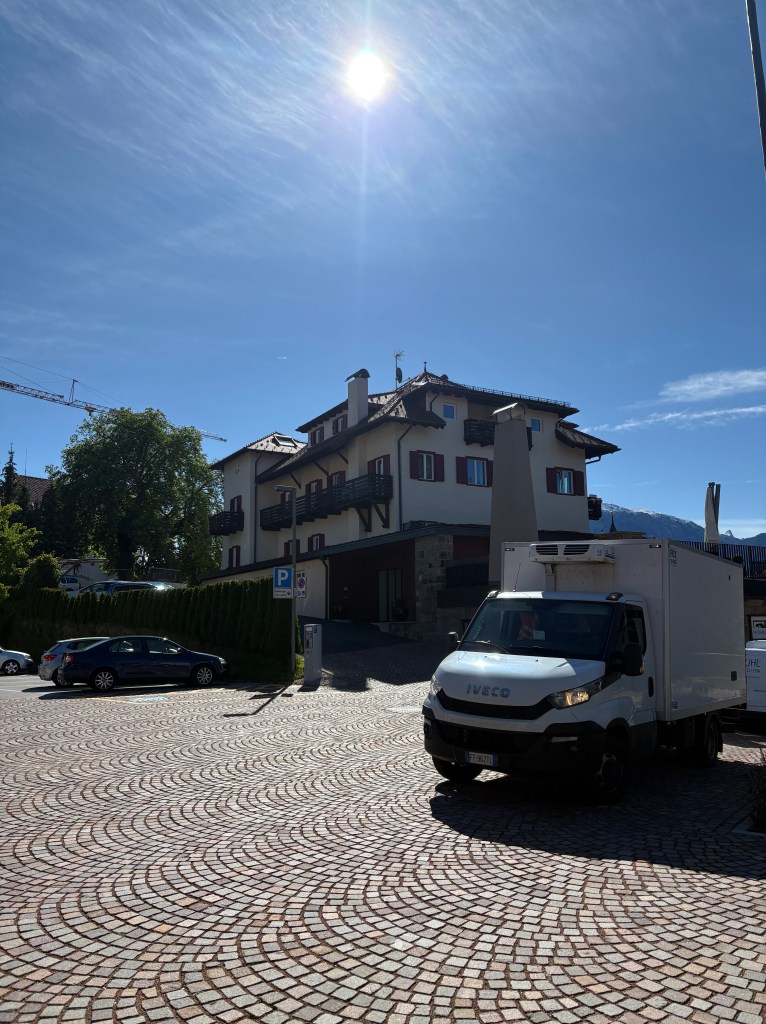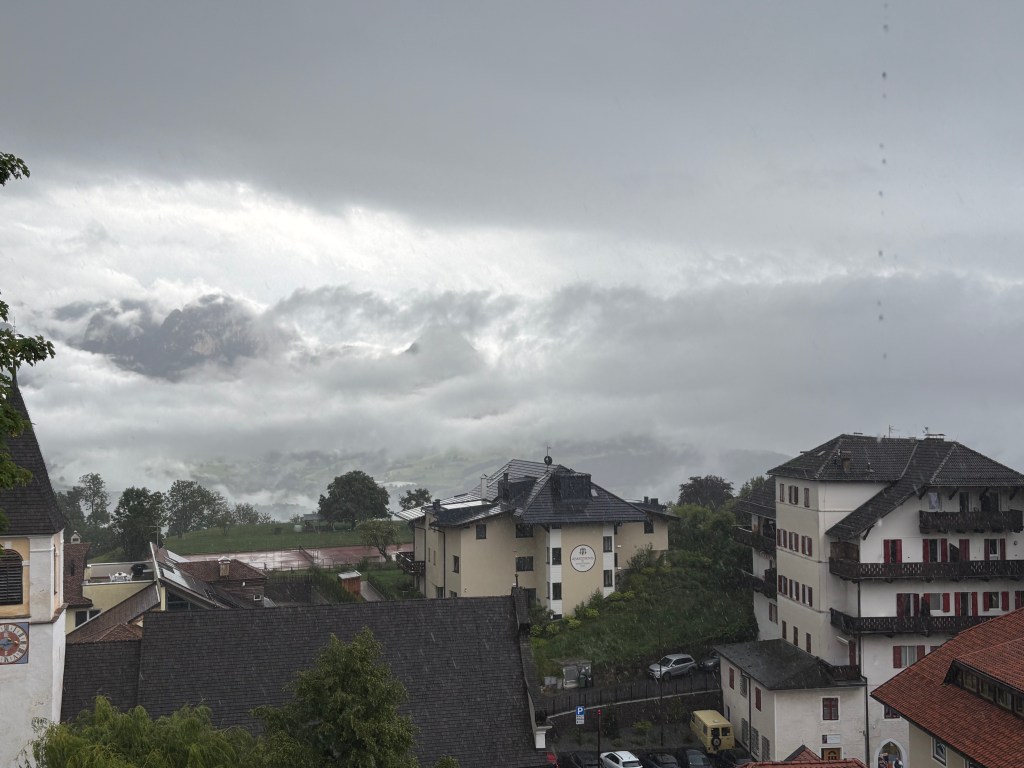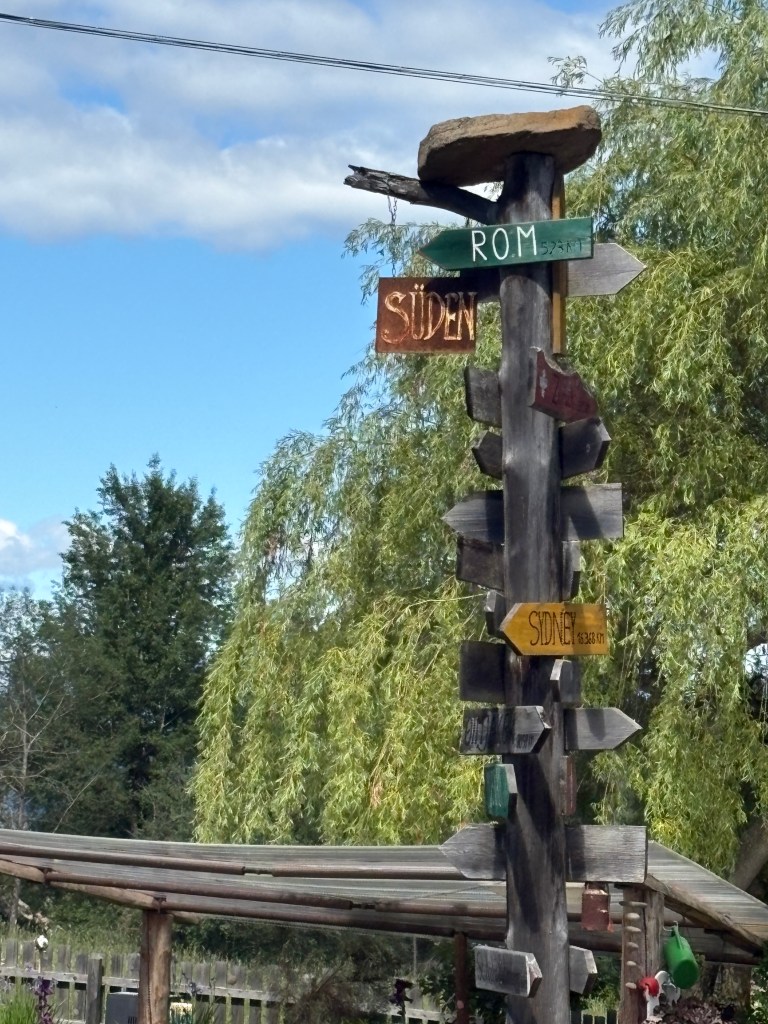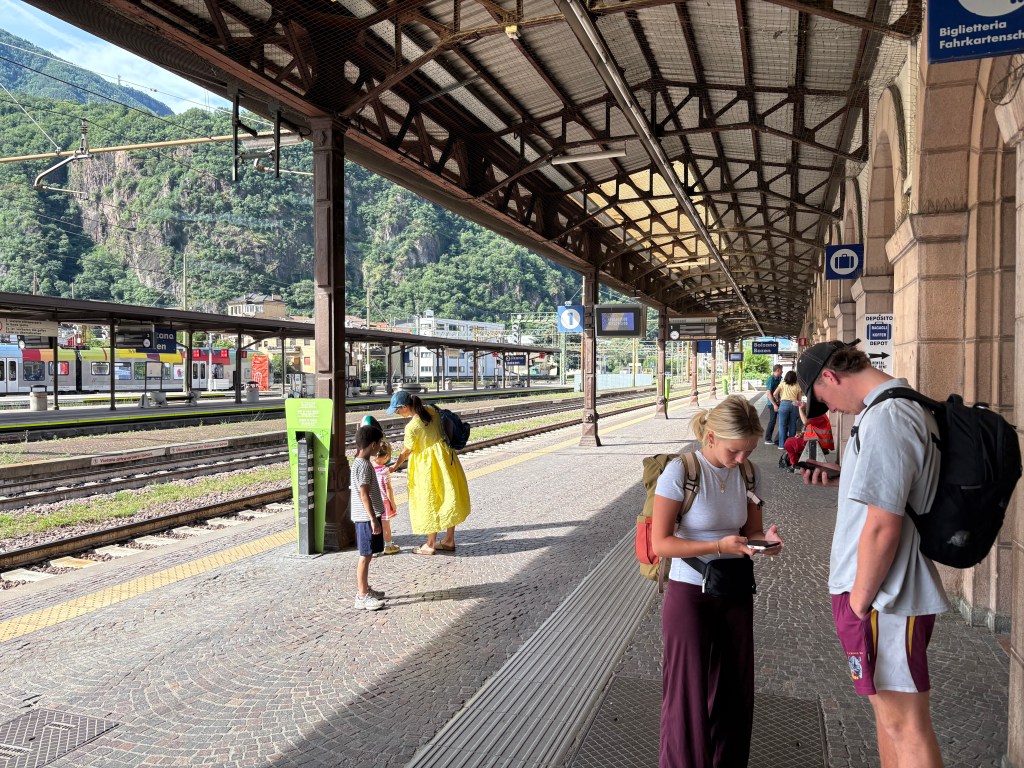
We sat on the platform for 20 minutes looking at this in 100 degree heat and I found myself wondering if this was perhaps some sort of totem for St Louis. We were waiting for the relevant Metro train to take us to the airport, the Metro being St Louis’s rather half-hearted effort at public transport by rail. It was free this day for indiscernible reasons. But it did take you to the airport. It’s just a pity that the Budget car hire depot was on the other side of an 8-lane freeway with no obvious exits and certainly no pedestrian bridges. But there’s always a solution to these issues: a shuttle which took us half way back to St Louis before finding somewhere to cross.
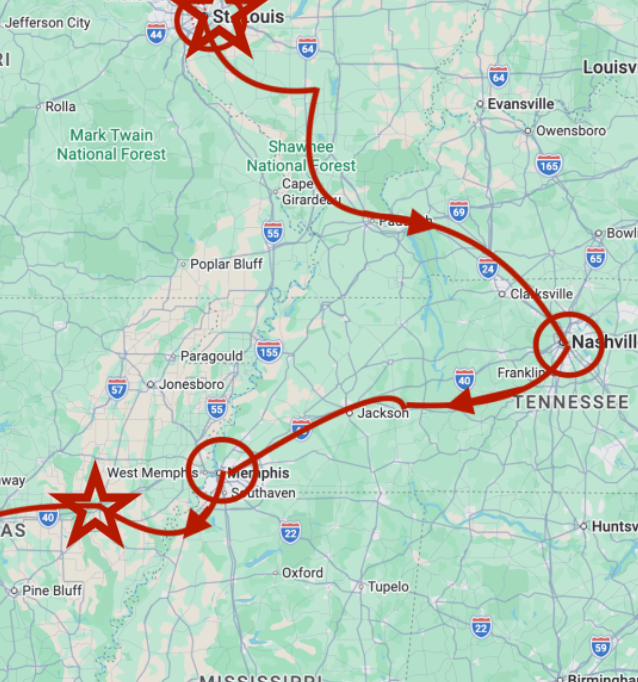
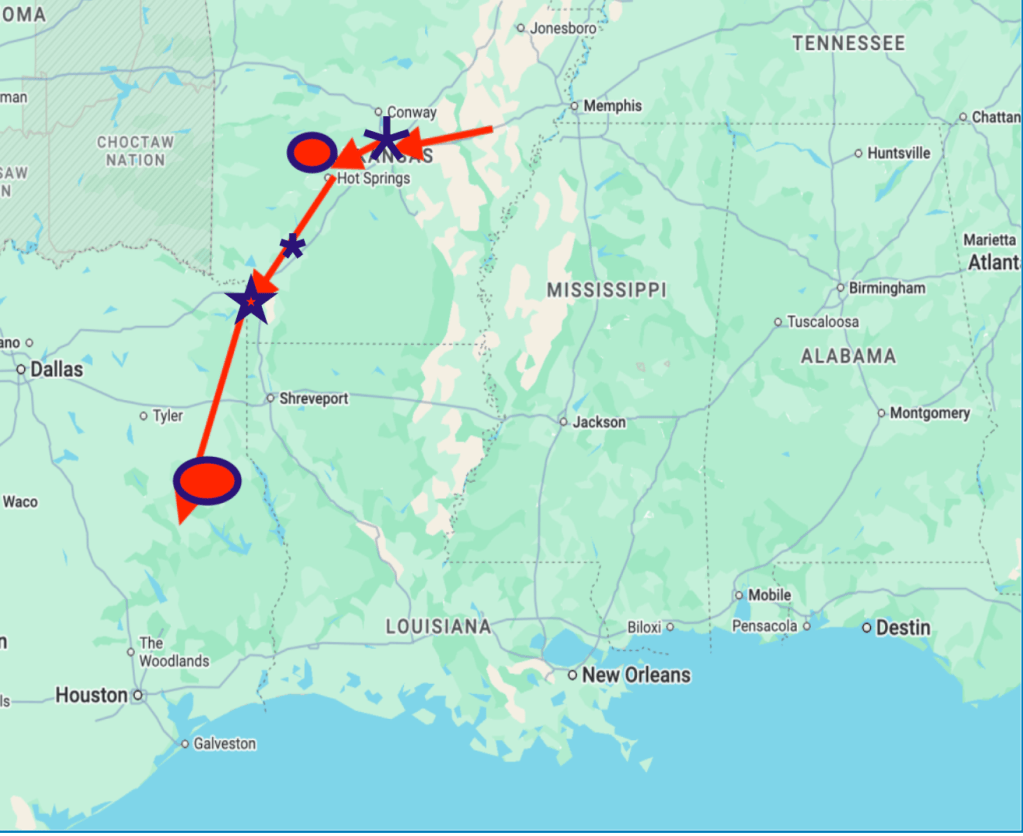
We had just driven from St Louis in a Camry that vibrated and made awful noises. We were held up at the hire and left late. I thought it was about 300kms, and it was actually 328 miles. Out by a factor of 1.6+. There’s no precise direct route so I was enjoying ambling along backroads till the distance made itself real (about 550kms in the end) and I joined the cars on the freeway going 80-85mph. Tiring. The only food we could find readily was a Maccas where we could recognise the menu but not the product. It was only a few days since Myrna had had her root canal done and she wasn’t feeling too flash. It was also a bit complex, not to find the theatre but to get to it.
Still true one blog later. ‘Mmm’, my journal reads. ‘A difficult day.’ Except (other than the execrable food) it was better than that. In fact, at a more gentle pace and with less at stake, it would have been one of the really good days of driving we had in America.
We were going through western Illinois, then a corner of Kentucky and then some distance into Tennessee. I was expecting hills. I had chosen this route to some extent because of the number of national parks and reserves we would drive through, and we did drive down through the Land Between the Lakes National Reserve which was lovely, but really, either side was dominated by endless corn and soy fields. American farmers plant roughly 90 to 95 million acres of corn and about 80 to 85 million acres of soybeans each year, and we were squarely in the Corn Belt. About 35% of this corn and about the same percentage of soybeans is used to feed cattle, pigs, and poultry. There’s something circular about this process that I just can’t quite put my finger on. About the same percentage of the corn is turned into ethanol to blend with gasoline. And then there’s that 10% which becomes high-fructose syrup, such an important component of hyper-processed food. We were driving through things that are absolutely fundamental to the American economy.
And if you want to know why that hairstyle is called ‘cornrows’, this route will make it obvious.
Just here there was plenty of water, for Australians a real lot of water. South of Memphis, Mississippi and Arkansas were supposed to be in drought. We could see struggling crops, but it didn’t look like the brown billiard table Australian drought. It’s a rich country.
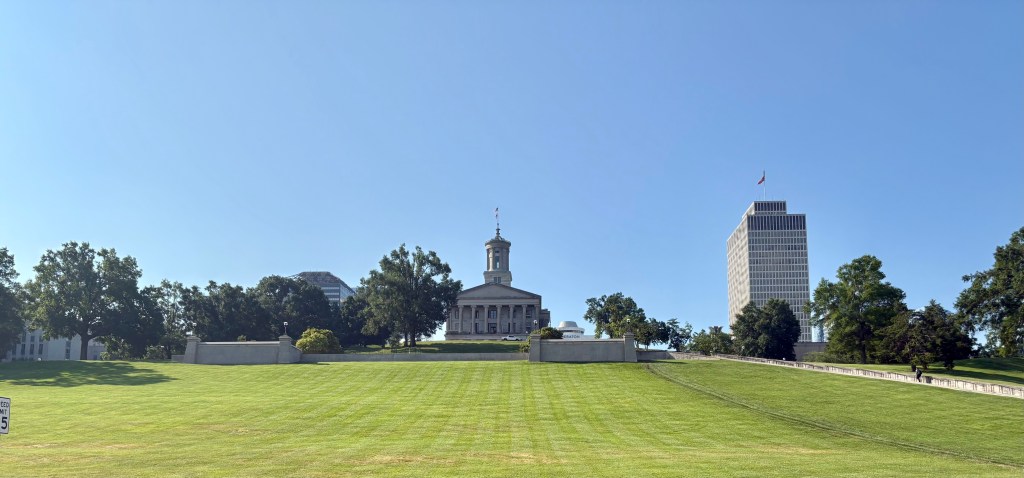
Tennessee’s Capitol on Nashville Hill. Lawn. The Tower named for William Snodgrass is in the background. Did I mention lawn? Did I mention naming?
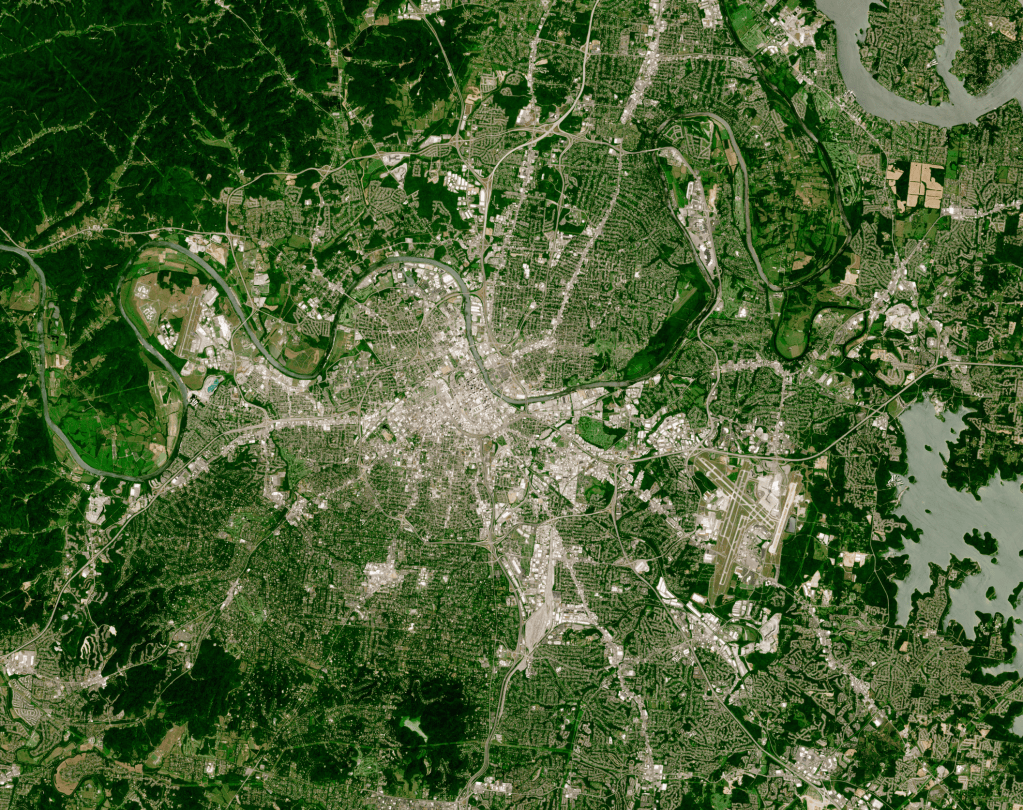
Loved Nashville, vibrant quivering Nashville, at present the second fastest growing city in the US. ‘Municipal area’ really because like so many American cities it sprawls out along the major roads that lead into it. (And there on the right is the newly-named Dolly Parton Airport.) But unlike so many American cities it has a vigorous beating heart. And that heart operates with a musical beat.
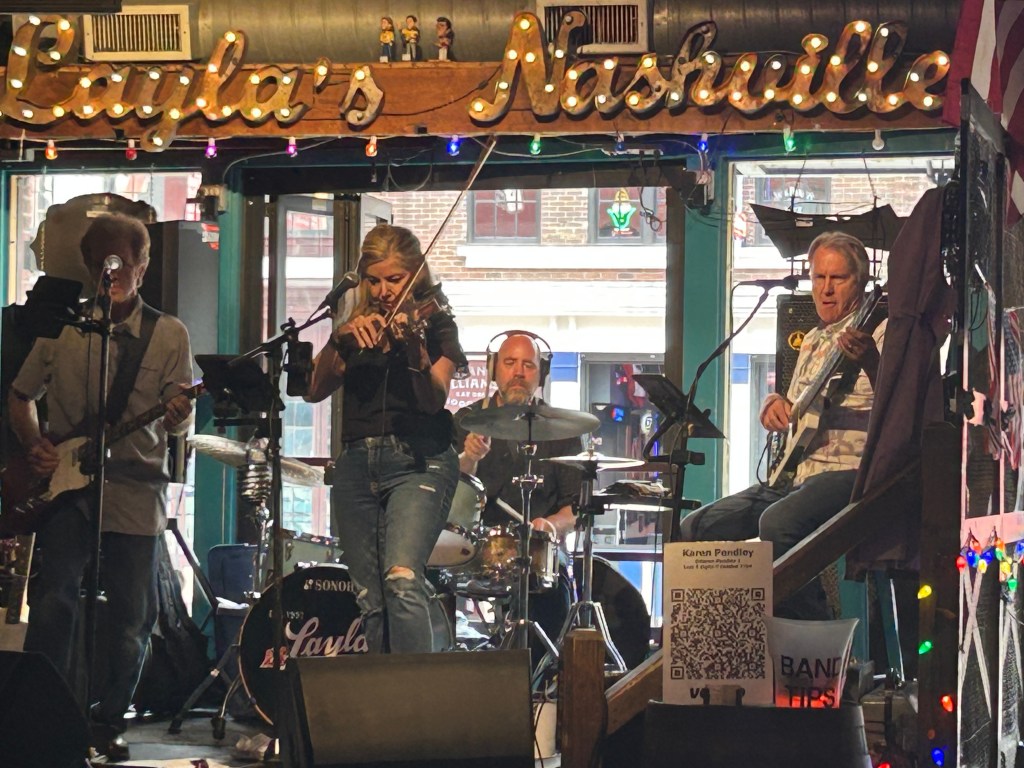
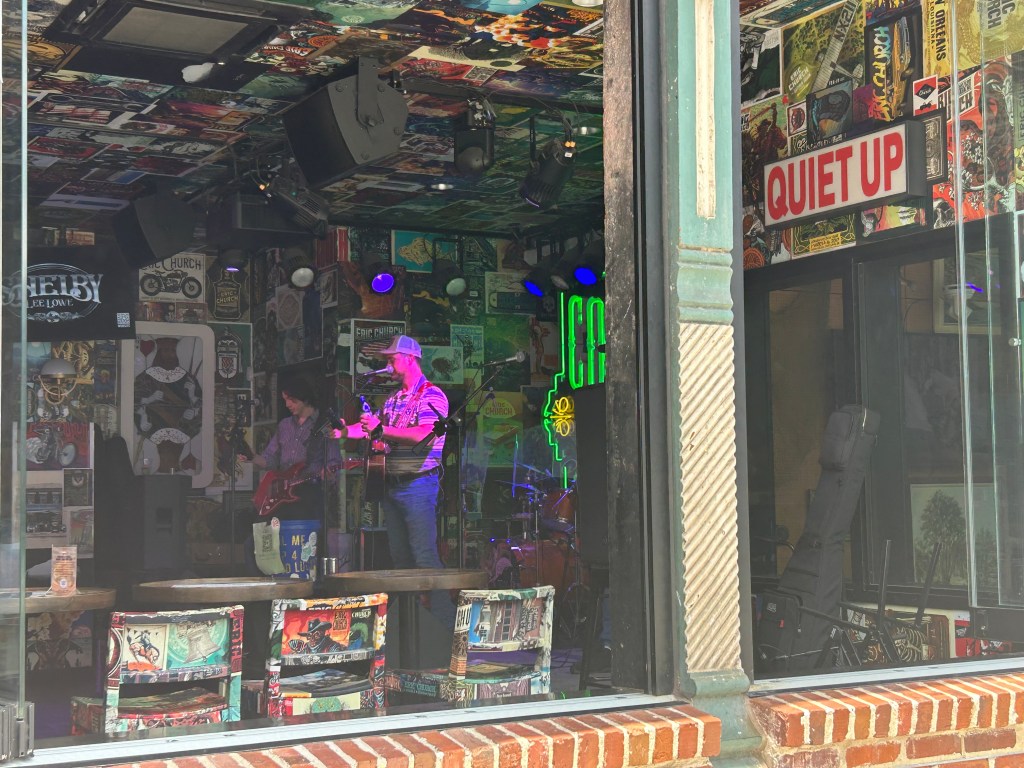
There were dozens of bars, clubs, cafes, venues operating, as far as I could tell, as indoor busking operations. After playing ‘Crazy’ at Myrna’s request, the very professional and stylish Karen Pendley Band did the rounds with the hat and the card-reading square, packed up, and before they got out of the door another band was plugging in.
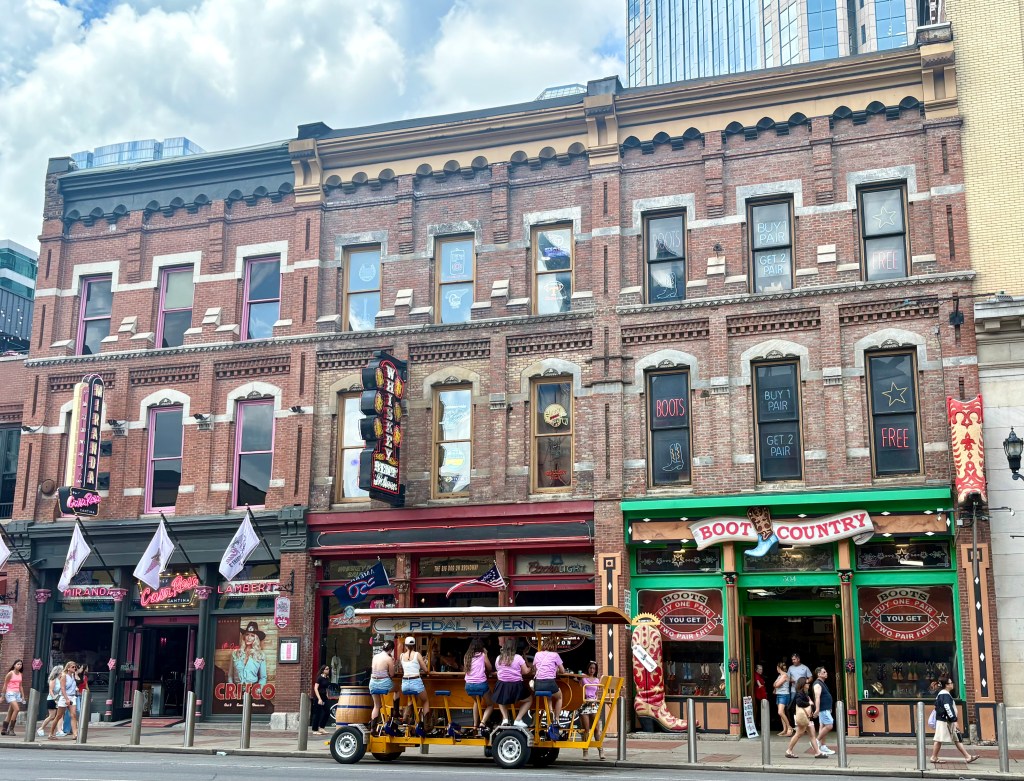
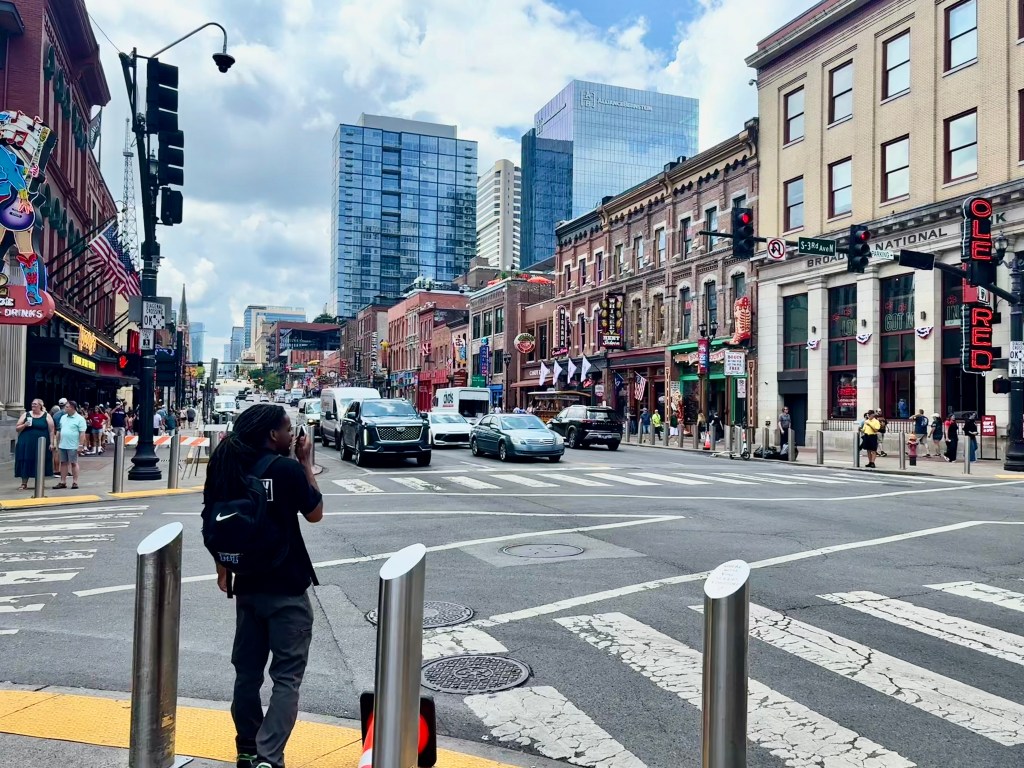
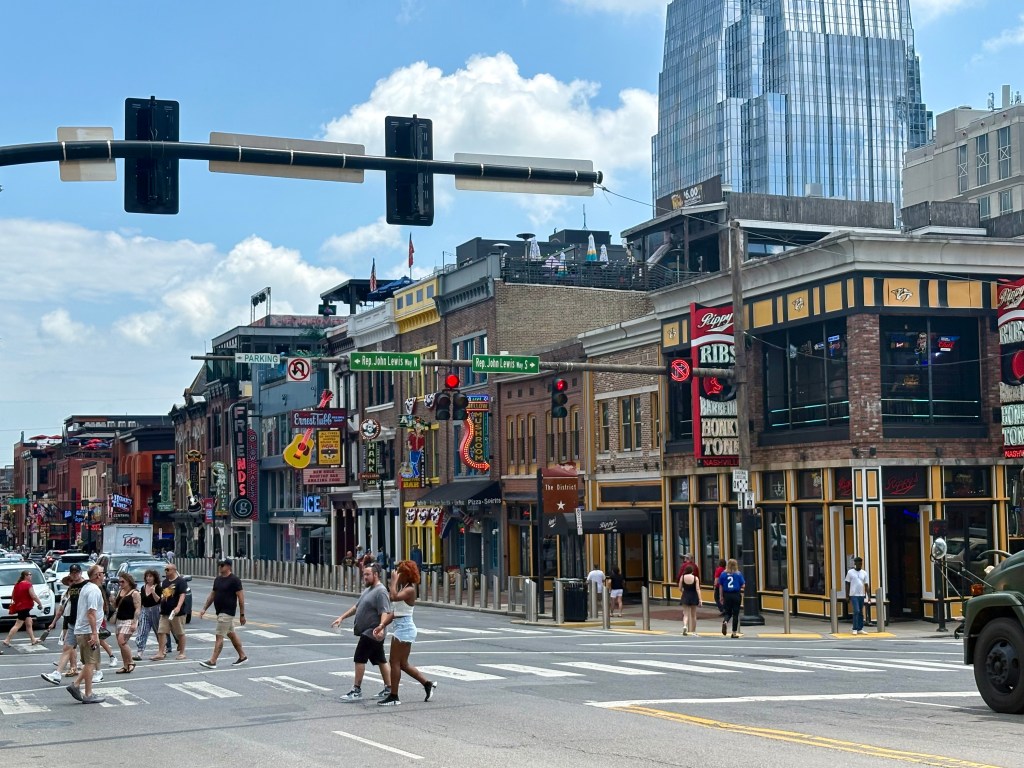
This is Broadway where the bars and clubs cluster but they go round several corners as well, and especially into 2nd Avenue. In the right hand pic above I can count 23 establishments from which musical noise might be emanating. When I said dozens I meant it. It’s not called ‘Music City’ for nothing.
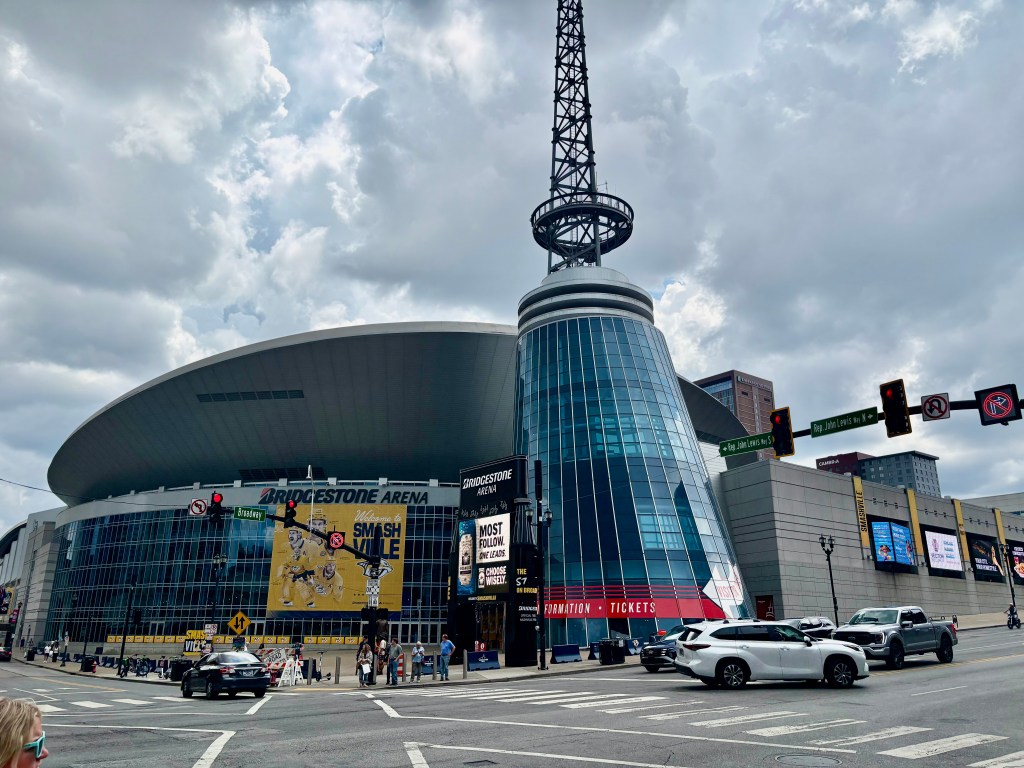
But this is the biggest building on Broadway, the Bridgestone Arena where the Preds play. And the Pred[ators] don’t play basketball, or football or baseball, they play ice hockey. Ice hockey. In this climate. And they do quite well. They have played in a losing Stanley Cup Final. They’ve won their regionals several times. But the club seems to be a roiling hotbed of litigation concerning finance and control. Nonetheless Keith Urban is a fan.
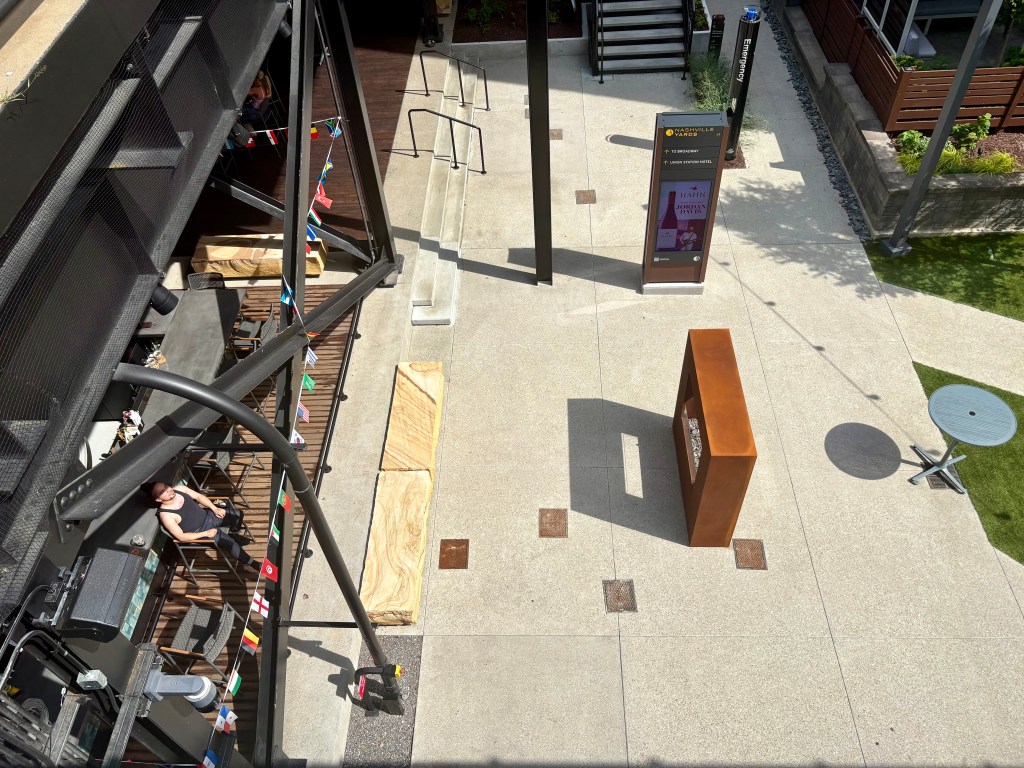
Up and over the rail tracks, this is looking down into the ‘Nashville Yards’. And it’s just a photo I like. I took the video of the endless coal train from the other side of the bridge. But on the other side of this artificial hill is this, the old Post Office.
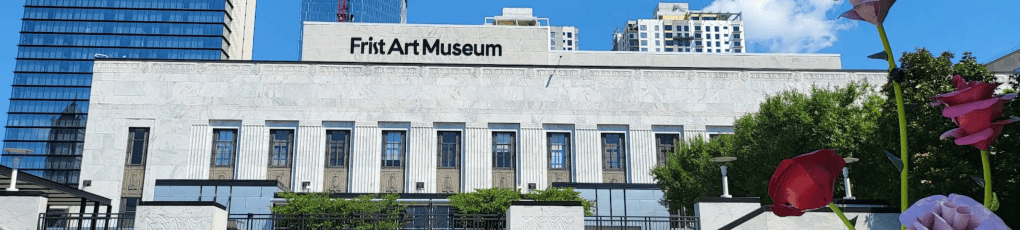
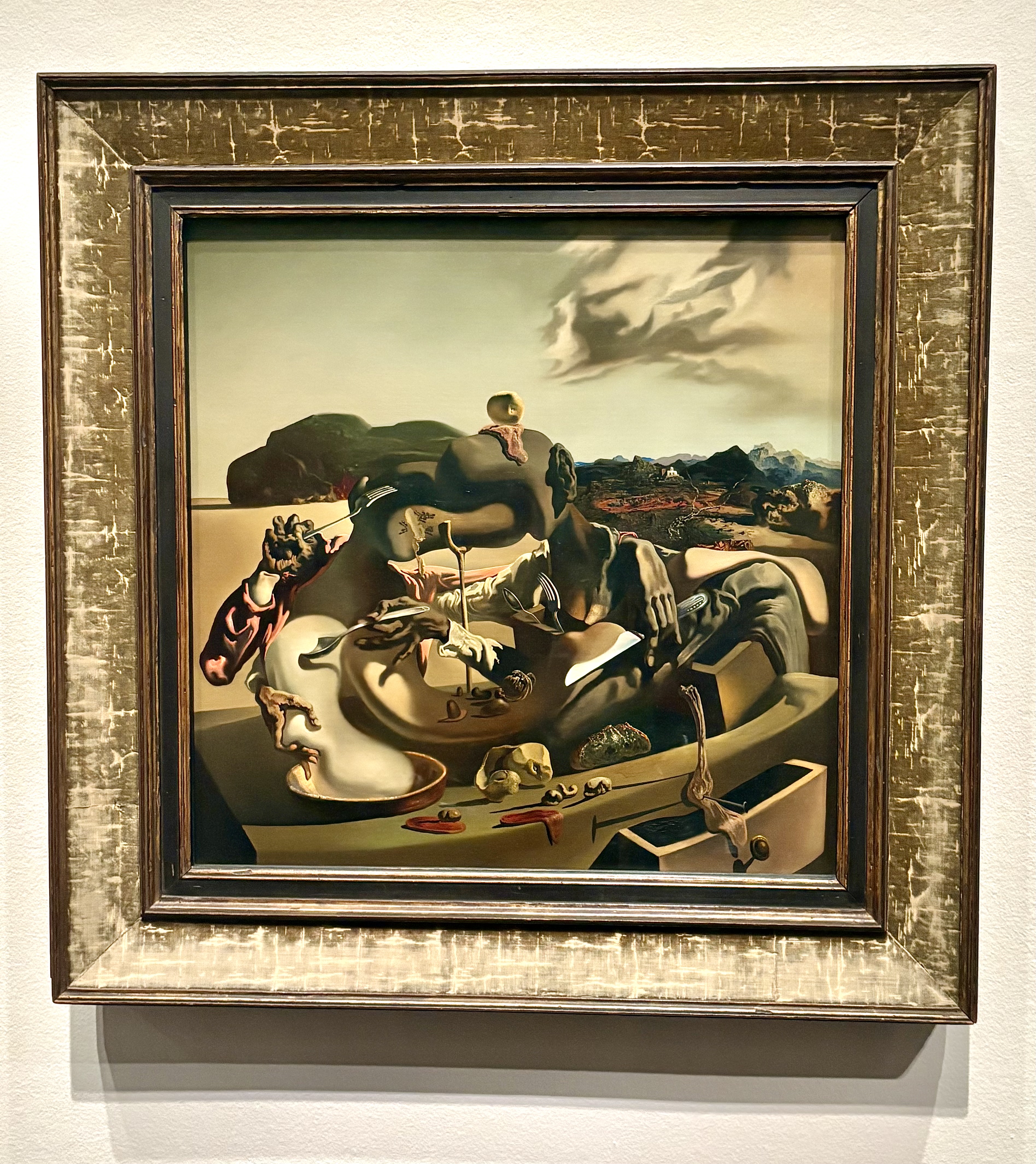
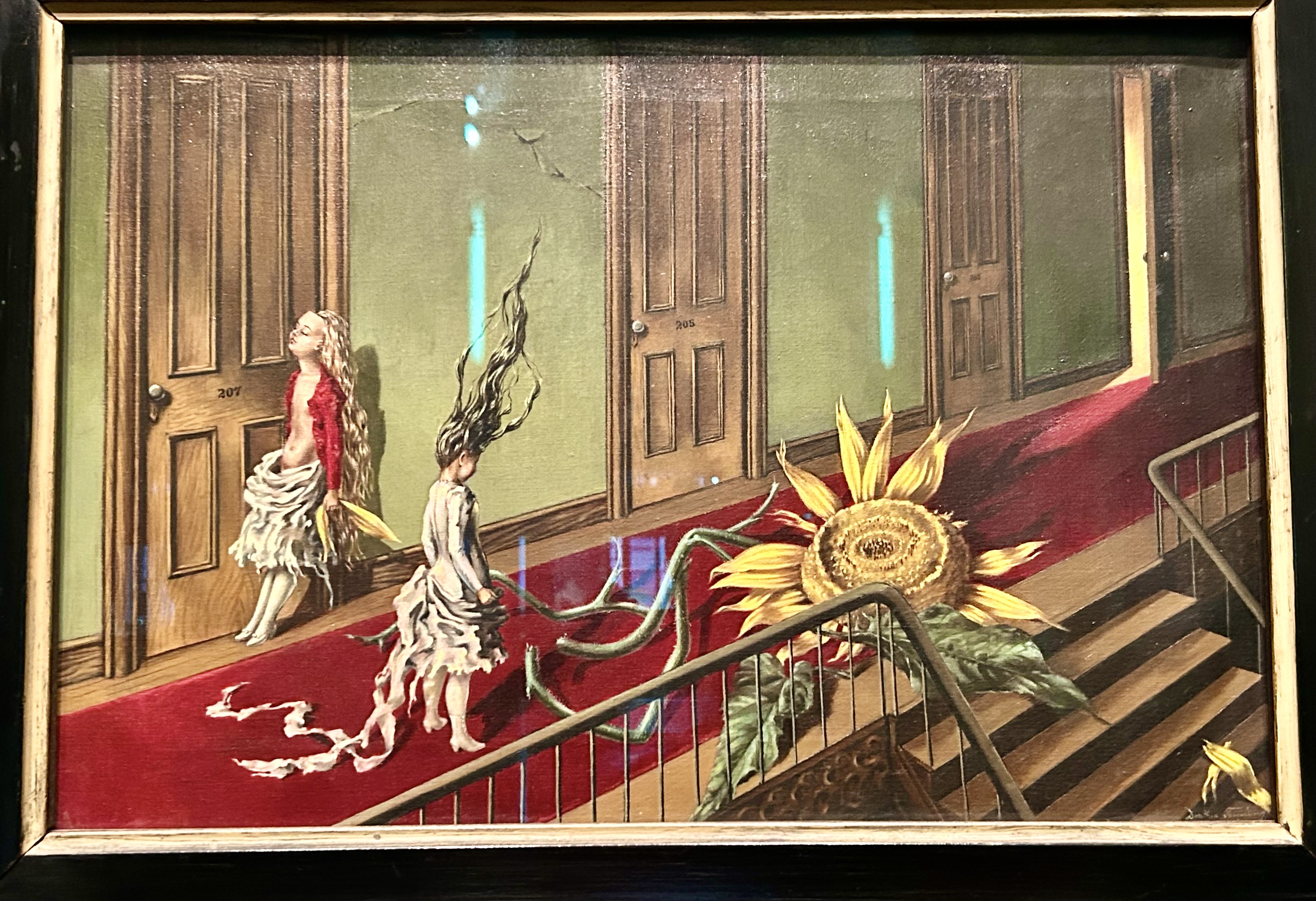
Just one of several major galleries in Nashville. [Another is a full-scale model of the Parthenon. Nashville is also known as ‘The Athens of the South’ for the number of its tertiary education and cultural institutions.] Once we found somewhere to park, no small matter, we got good value out of this one. Among other things it had a very interesting exhibition of what was described as surrealist art. Unlike some of the rest, these two provided no categorisation difficulties. On the left Dali’s ‘Autumnal cannibalism”, and the other is, according to The Age, worth travelling to Nashville to see: ‘Eine Kleine Nachtmusick’ from the ’40s by American Dorothea Tanning.
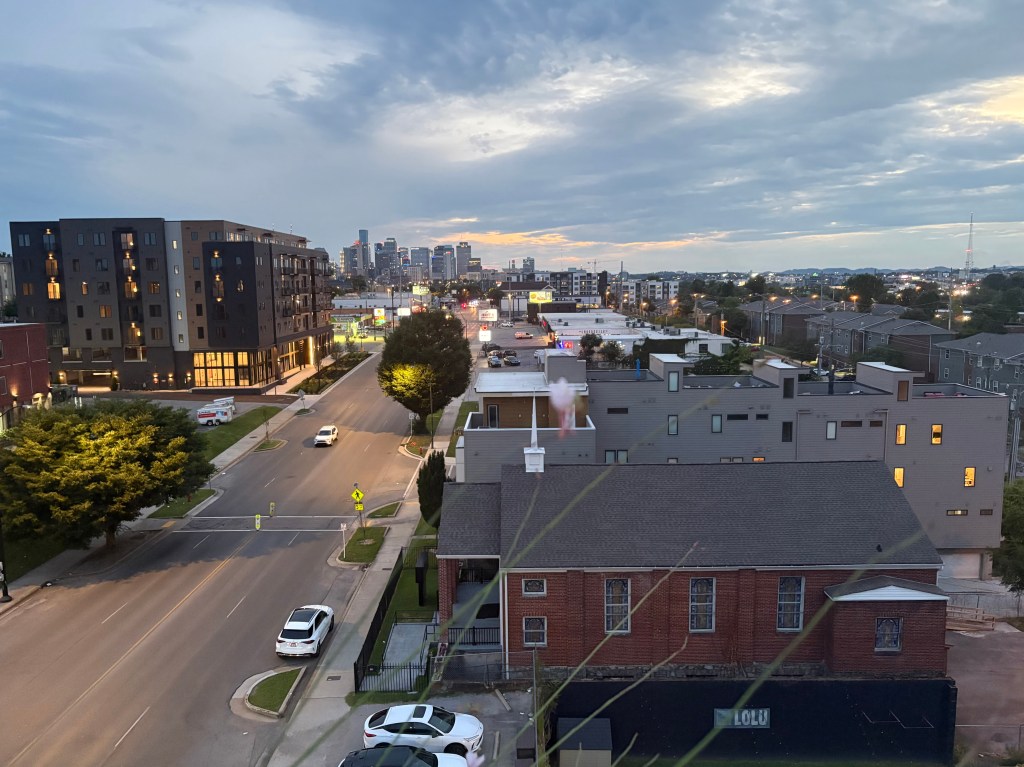
Below: from the terrace of the Waymore Guest House looking down Main St a bit west of south to the city. Frederick Douglass Park and the occasional fireworks are over to the right; the very elegant houses of Historic Edgefield (that is its name) are invisible over to the left. Nicole and Keith used to live in a gated community on the far horizon. Mellifluous temperature, glass of wine in hand, I’d be happy here for quite a few more nights as long as we could have breakfast at Two Hands, the ‘Australian’ restaurant on the left hand edge of the city.
[Just by the way there were 233 reported lynchings in Tennessee between 1877 and 1950 and six took place in Nashville. This is also where members of the Ku Klux Klan burnt crosses outside two African American sites, including the city’s headquarters of the NAACP as recently as 1979.]
* * * * * * *
Driving. You may remember that we had a bodgey car, a car that shouldn’t really have been on the road let alone hired. We found the Downtown Budget depot and explained our problem. They were not entirely sympathetic, but it didn’t matter; they didn’t have any replacement cars anyway. Now this is an issue. We still had quite some distance to cover, 2174 miles as it happened, and you do want to be confident about your car. They suggested we try the airport. So we tried the airport. The depot was accessible and parking was plentiful and easy. I explained our issue to the young Black guy who helped us and threw ourselves on his mercy. And HE WAS HELPFUL. I want that recorded here. JUST SO HELPFUL. He did it all. He got the mileage and took down all the particulars himself, and he guided us off to where we might pick up another one. It was all so different and I was just so grateful. And when we got to the next pick up place, all the paper work had been done, that blessed young man had decided we needed an upgrade and we had a fresh car — a new Rav 4 Hybrid.
* * * * * * *
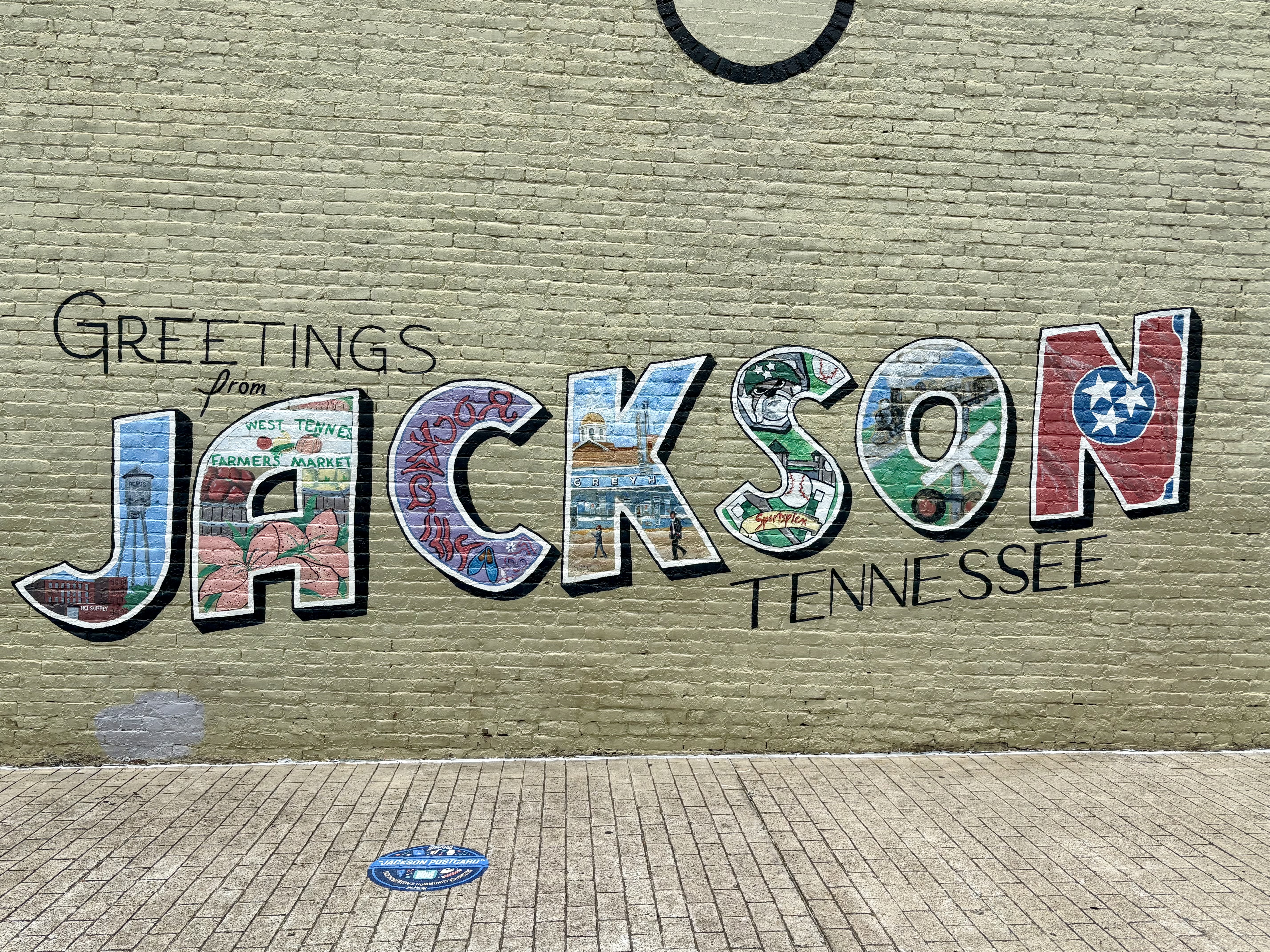
We stopped for coffee at Jackson (Tennessee, not Mississippi) on the way to Memphis.
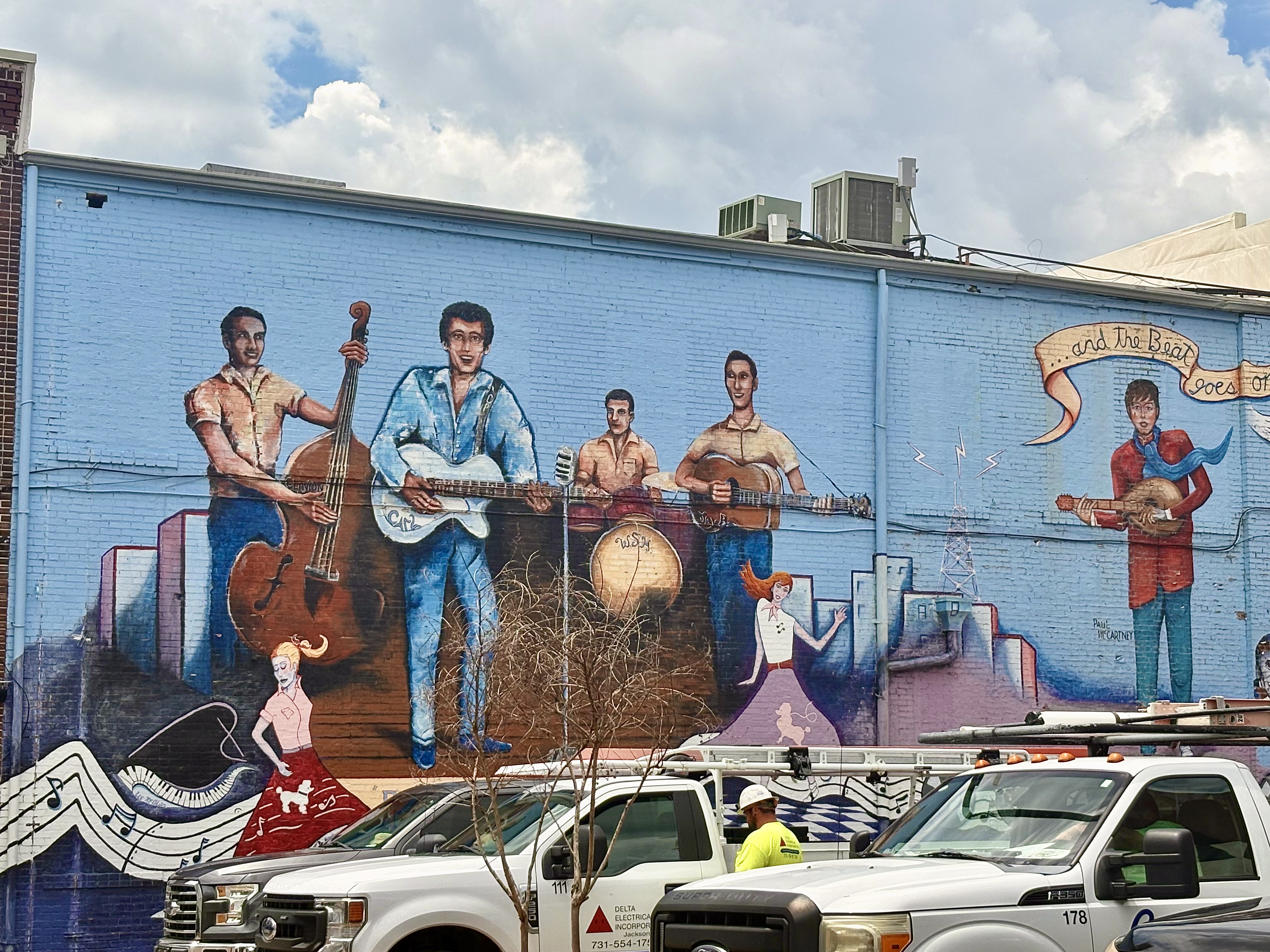
This modest little town had several coffee shops laden with books and other reading material. Fair coffee, a good muffin from memory, and an unusual ambience. Maybe a refuge for the mildly autistic. The mural on the right explains that Jackson TN is the home of rockabilly. This won’t mean much to many people except members of the Browne family.
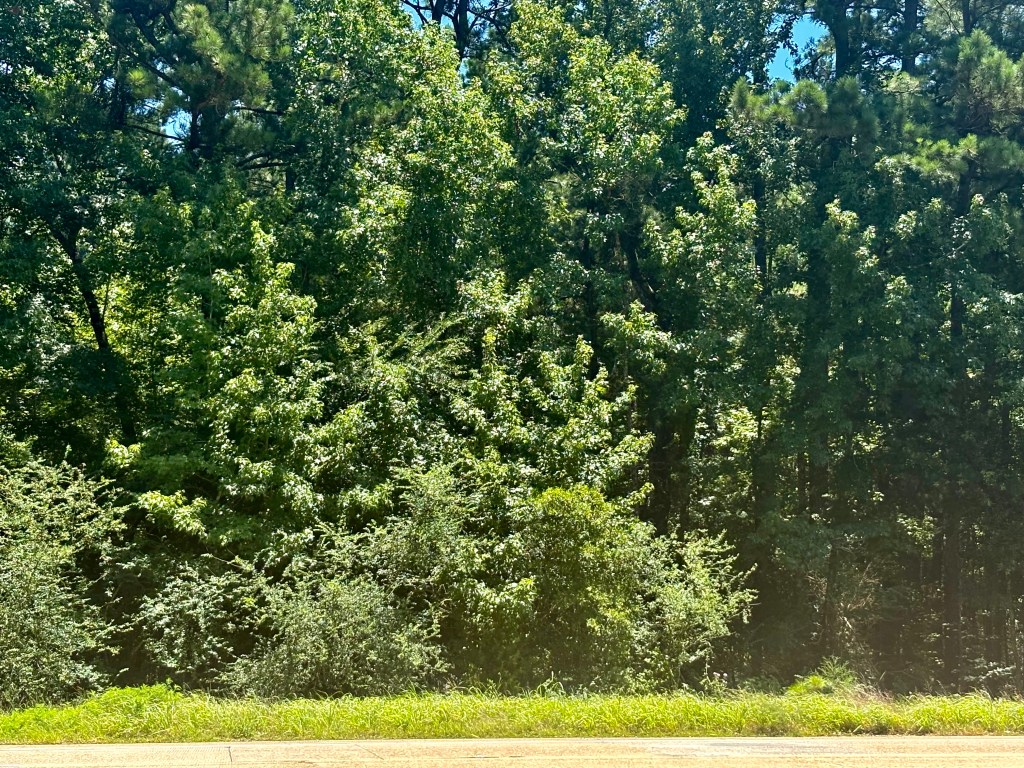
It rained on the way to Memphis, rain of a very particular sort. You could see it like a wall a kilometre or two away, a grey wall. And then, bang, you would enter, it would hit the car with incredible force, and then, after a time and you could see the wall on the other side, the tap would be turned off precisely and definitively. And then after a while, another one. The visibility was modest anyway because the view to either side in gently undulating form was this >. Scarcely varying … ‘piney forest’ I believe.
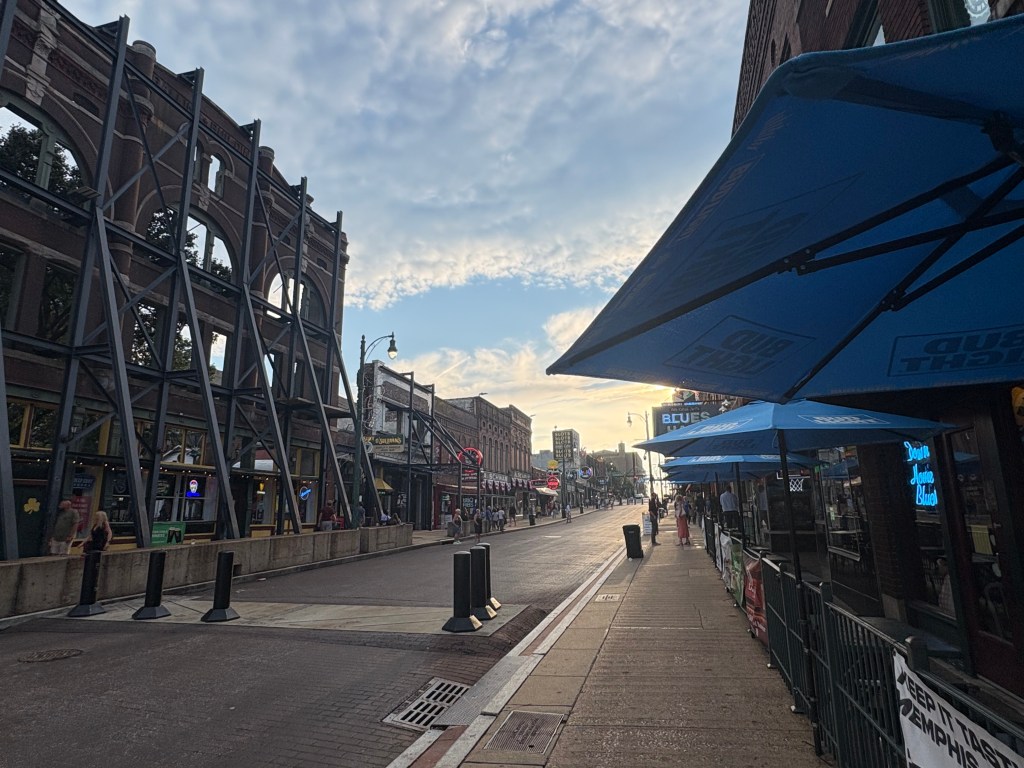
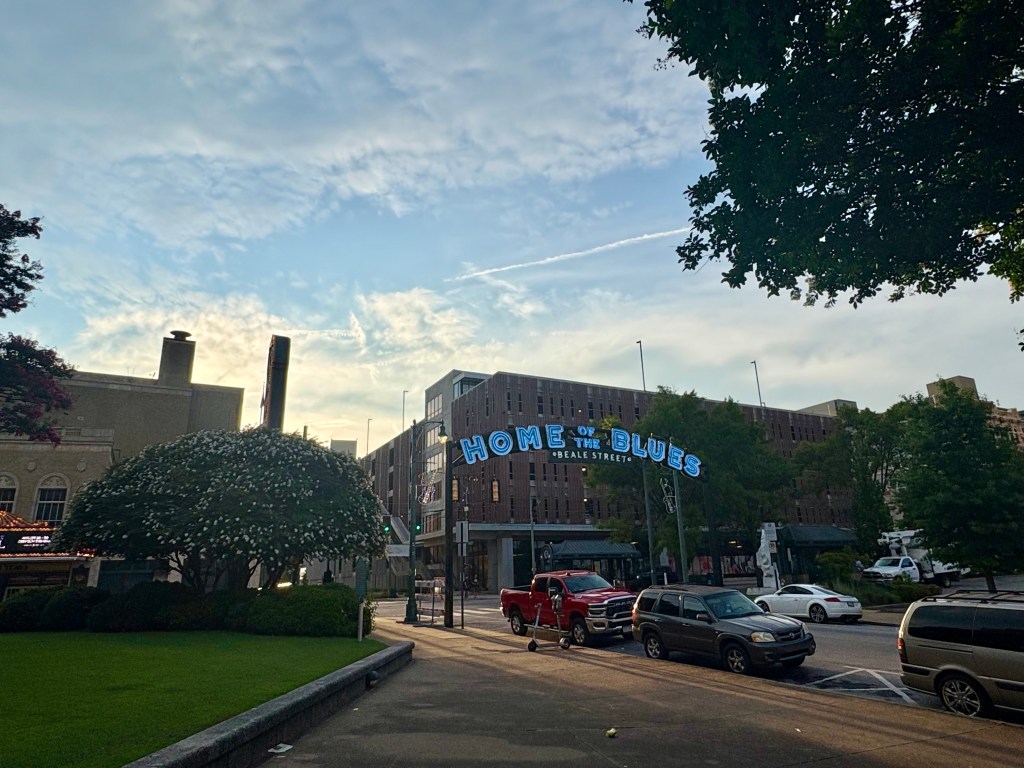
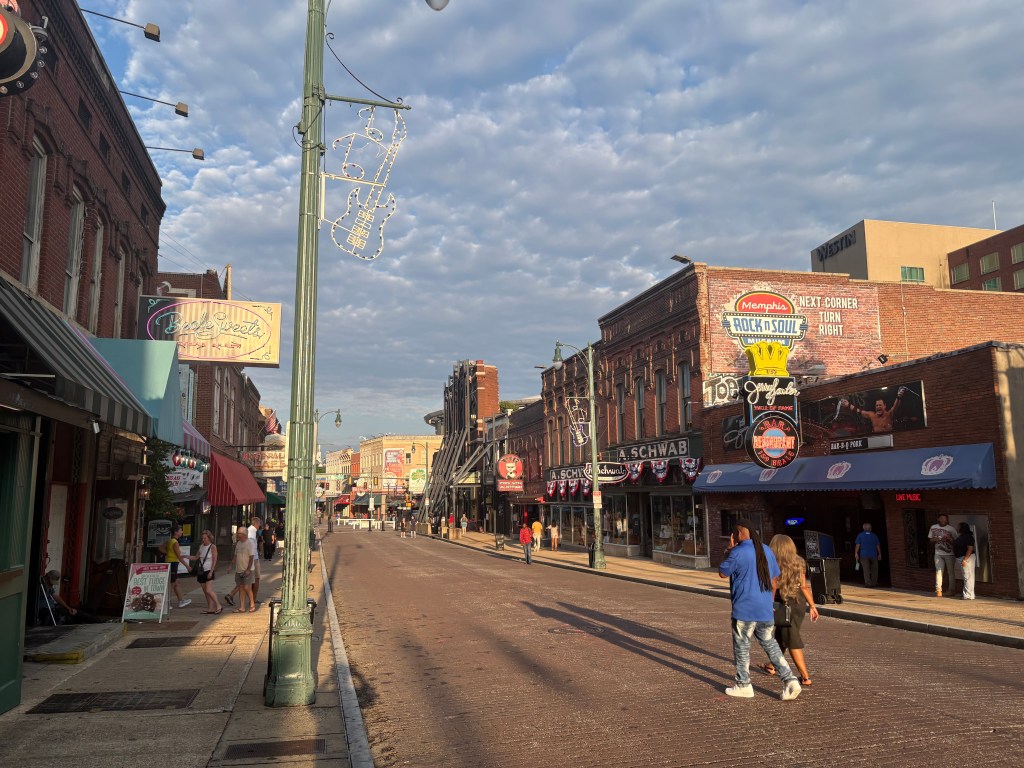
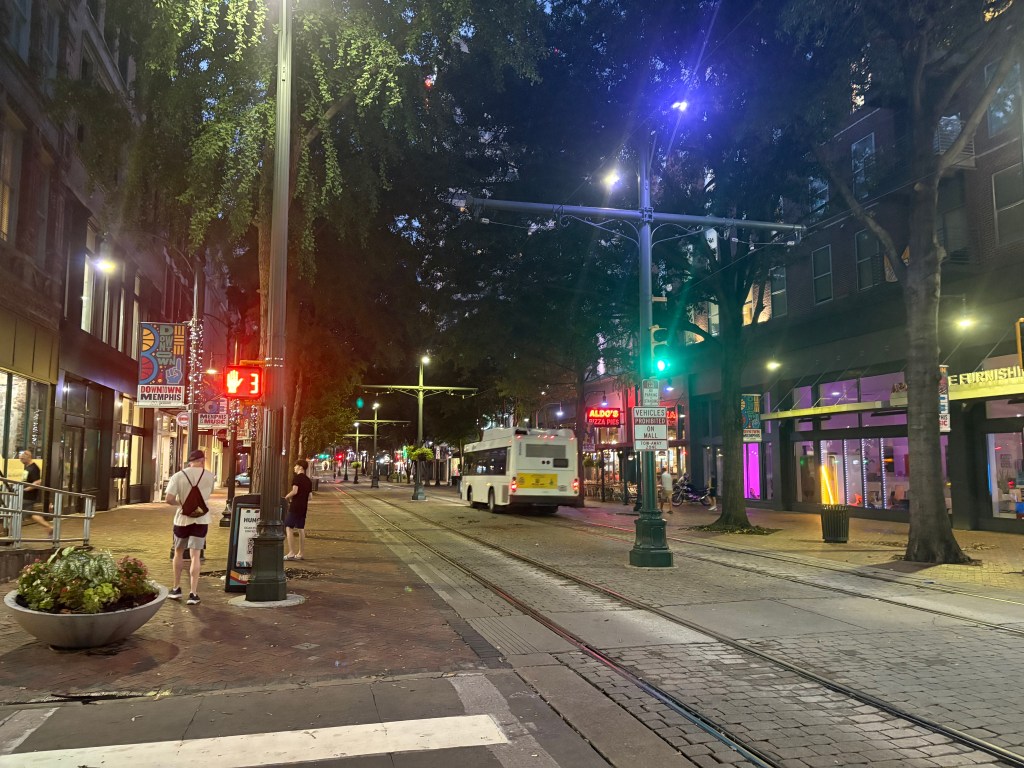
It was also raining quite hard as we entered Memphis. Our hotel was adjacent to Beale St, ‘The Home of the Blues’. Our room contained a sign warning us about possible disturbance from loud music at all hours.
And what a sad old place Beale St was. Two or three joints with some sound coming out of them, in one case clearly recorded rather than live.
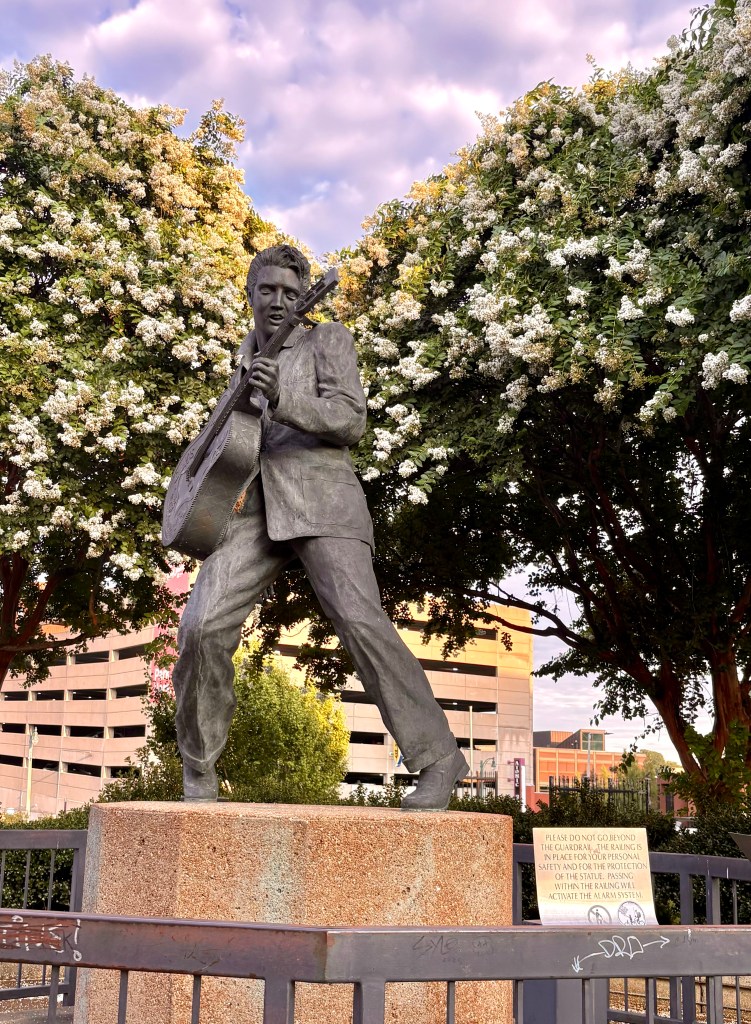
We obviously didn’t give it much of a go but it seemed evident that there have been better times in Memphis, so much better times. We considered a visit to Graceland but we didn’t have the $320 (AUD442) to see an unremarkable house in the southern American style filled with suspect memorabilia.
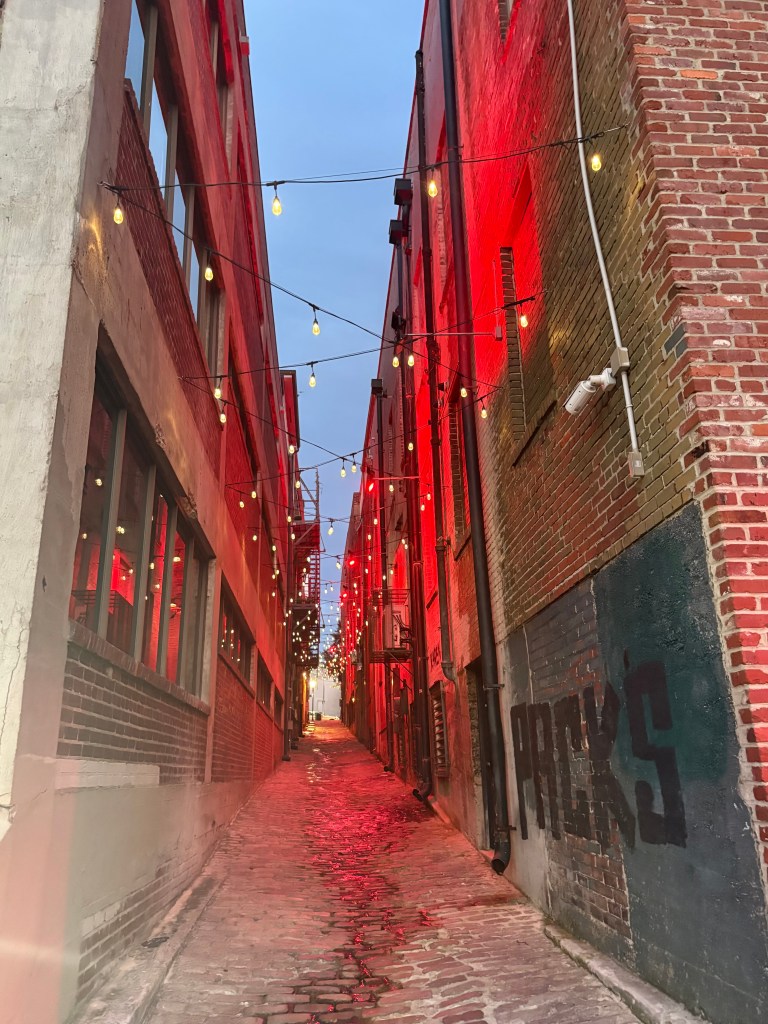
We found a district with red lights and we did find a series of grey disks set into the surface of a car park belting out Supremes songs (Detroit rather than Memphis surely?), and we did find a very acceptable Italian restaurant, and after scouring Downtown for interest we found an open ice cream shop. 7.3 only however.
The next day we chased that tram line to its terminus in anticipation of finding another shopping strip or a set of places of interest. But no, as far as we are concerned it just petered out into other versions of suburbia.
Google took us to a fruit/veg deli in South Memphis where we were served by a very pleasant if somewhat shocked 12 year-old lad about, not exactly, but about, the same age as what he was selling. I remember this so distinctly because I wanted to cook a fine meal of vegetables for my suffering wife — we would have a stove and an oven that night — and I failed some distance past utterly.
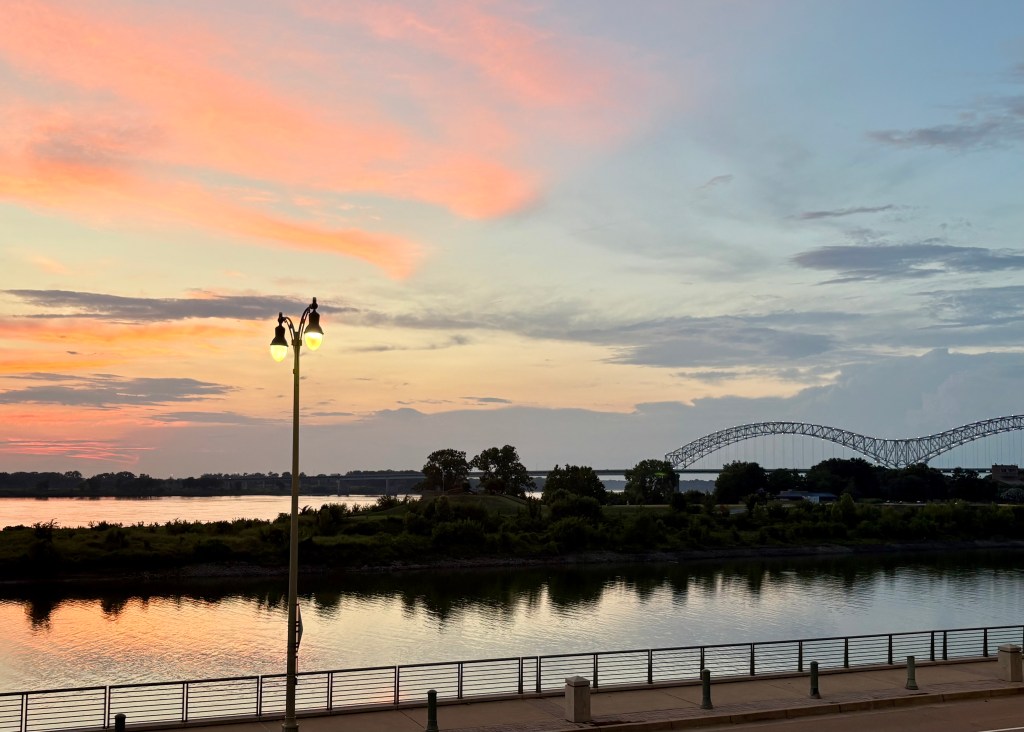
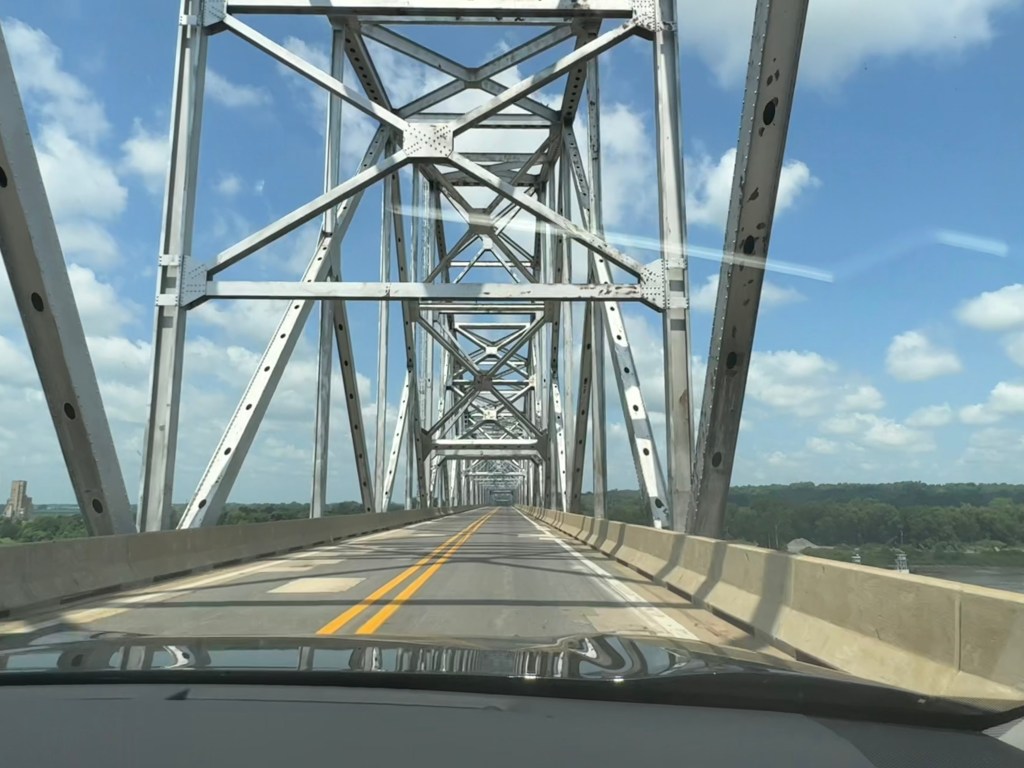
But we did see the river. The Mississippi again. In this case Arkansas is on the other bank. What a body of water.
And you have to choose your route because between Memphis and Vicksburg nearly 400 kms south there seem to be only two places to cross. One of these is at Helena and I thought we should go south to miss the highway and see what we could see, and what we did see, I have written, is ‘a long picture of dereliction’.
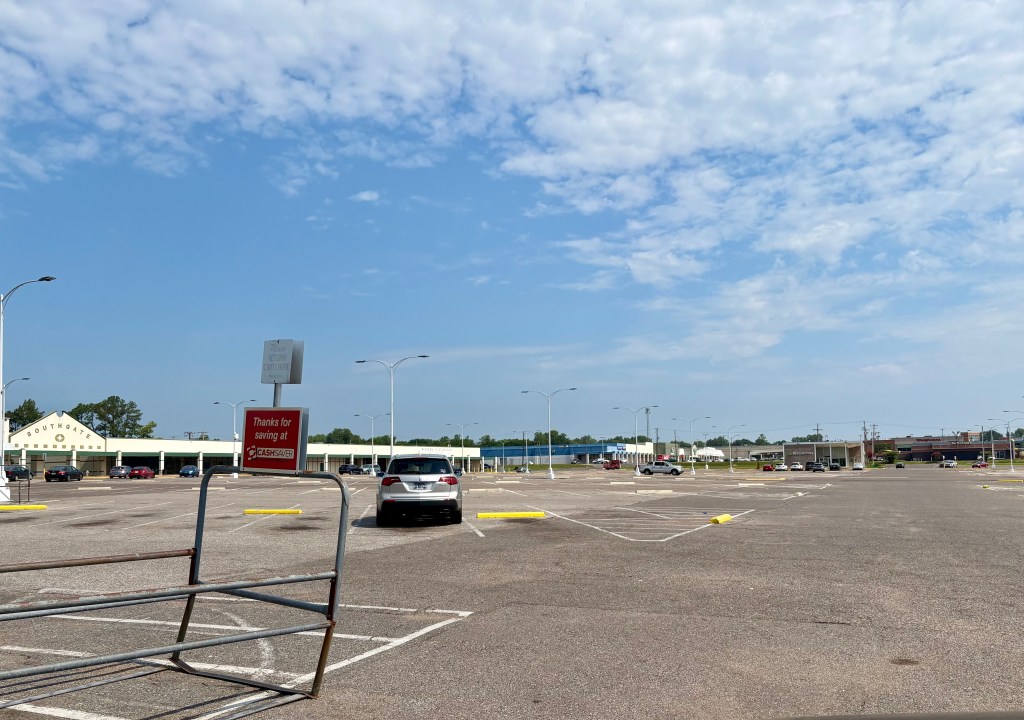
There were half a dozen or more of these: a crescent of empty tilt-block shops forming one side of a nearly empty car park wasteland. Countless wayside shops run down or shuttered. Liquor stores seemed to predominate with barred windows, stumbling verandahs and strange paint jobs. The houses were largely a match. But then, after about 60 kms, we got to Tunica.
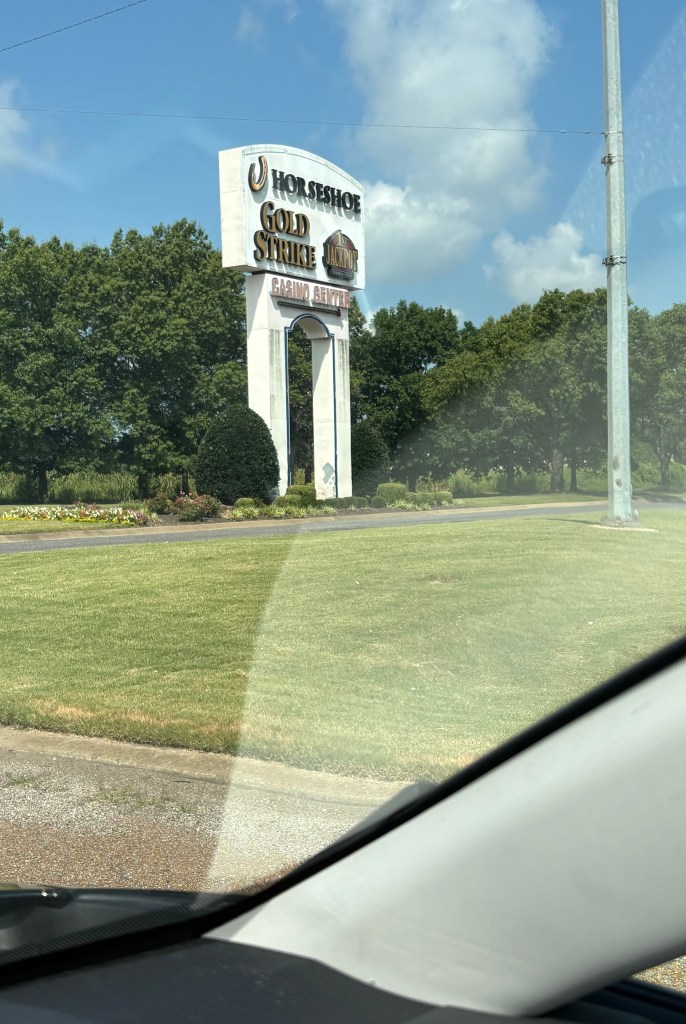
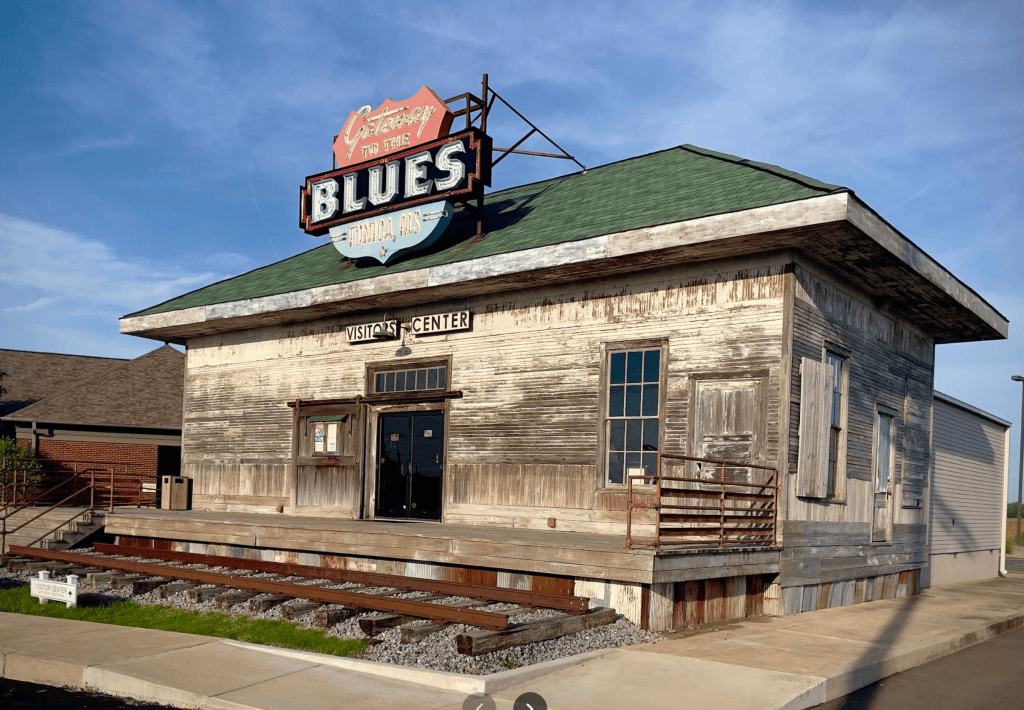
Or Tunica Resorts really. Tunica proper was a little further on. But in the middle of this thoroughly depressed area was a guide to making money (for other people), the Gold Strike Casino. But there wasn’t just one. There was the Fitz, the First Jackpot, the Quality, the Hollywood, the Isle, Lulu’s … and no traffic. Except for a B-double parked outside Lulu’s, no visible traffic.
This was on our way past the ‘Gateway to the Blues Museum’.
I wondered what we’d been looking at and whether we’d taken an odd and uncharacteristic route, but I find that the population of Memphis is the poorest of any city in the US over 200,000: 43% of its inhabitants have an income below the poverty line; and I find that there is a great cluster of ‘counties in persistent poverty’ (a government term) along the southern reaches of the Mississippi. This is in the country with the greatest wealth of any in the industrialised world. America has 65,000 households with a net worth of more than $US100 million. It is also distinguished by being the country among its industrialised peers with the greatest wealth inequality. And not by just a bit. By an enormous amount. (See eg Thomas Picketty: Capital in the Twenty-First Century)
We were down one end of that disparity.
We crossed the river at Helena, and this was where the drought had hit the cornfields in the most pronounced fashion: mile after mile of stunted brown stalks. The towns were similarly run down.
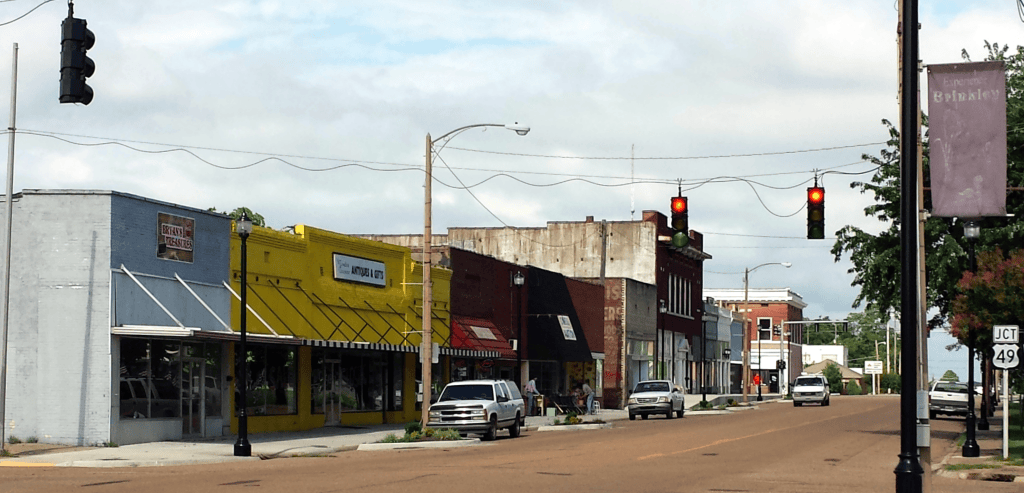
We were heading for the biggest town in the area, Brinkley, for a cup of coffee. It was also at a junction with the highway which would take us into Little Rock.
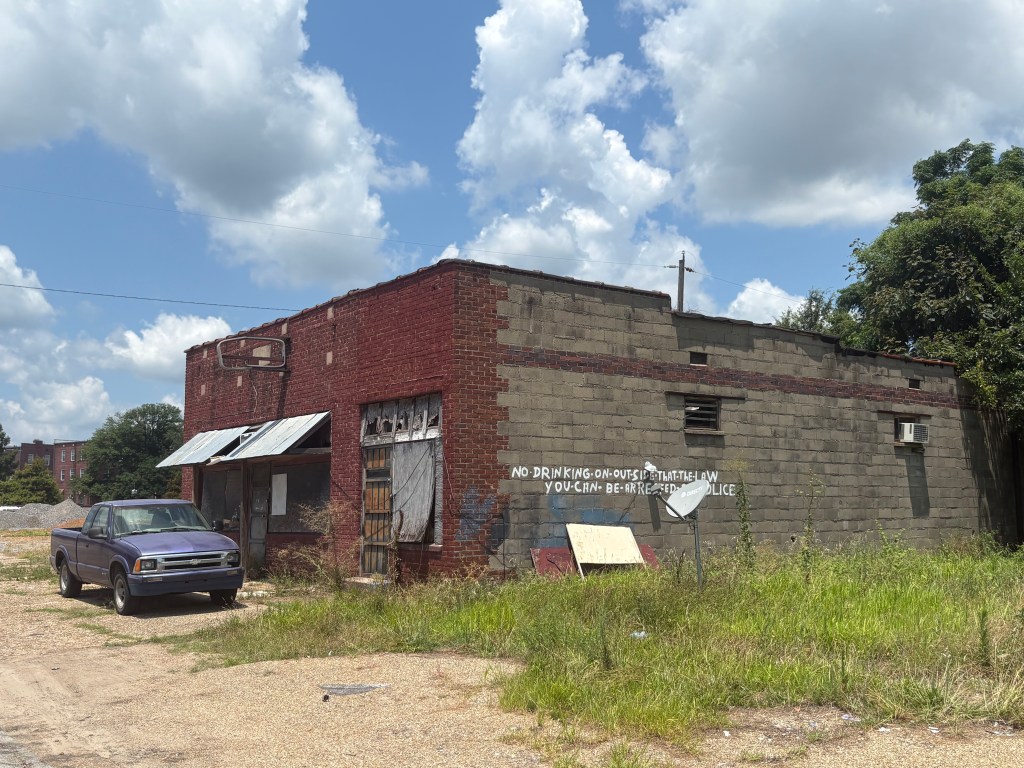
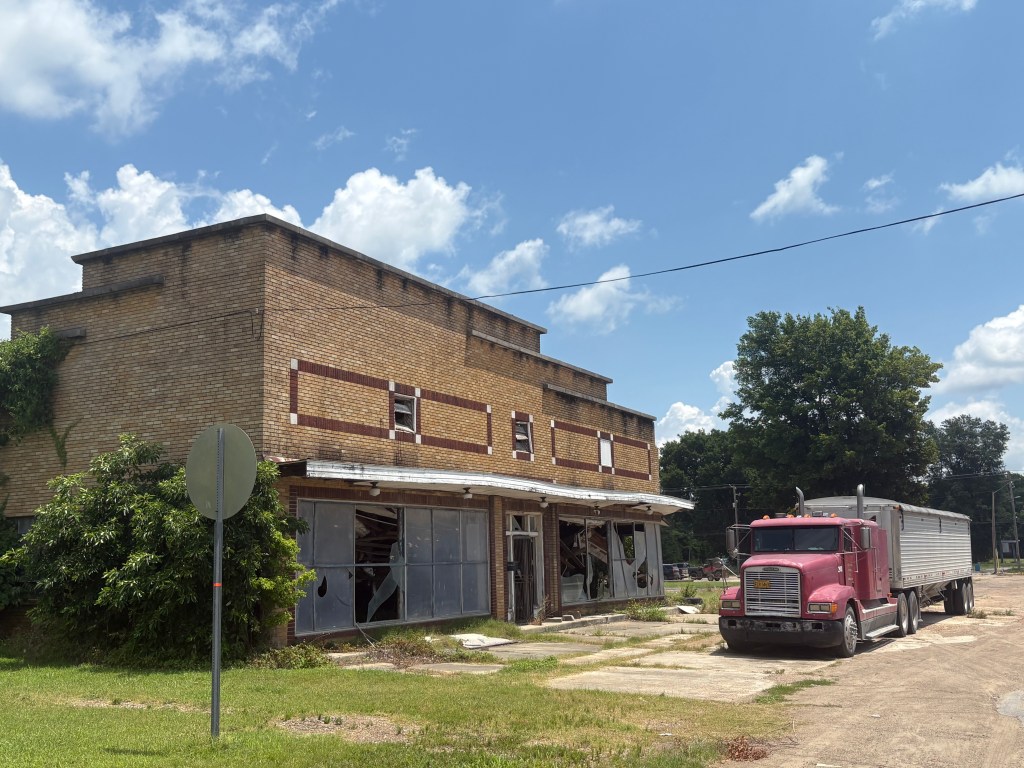
Its current population is 2100 down from 3500 ten years ago. We didn’t look hard enough but we couldn’t find anywhere for a cup of coffee, or even anywhere that seemed to sell food and drink which seems most unlikely. (And it is. I can find two food marts and two cafes now I look and there is a cluster of fast food places out of town round the junction with the freeway.) But we did find quite a lot of places that looked like this. (No.Drinking.On.Outside.That.The Law.You.Can Be.arRESTED.By.Police.)
Trumps’ Golden Age clearly had yet to impact Brinkley and surrounds.
NEXT TIME: Bill Clinton billed himself as the Man from Hope. But was he? The very unlikely holiday resort attracting the cream of America’s organised crime, not to mention all major league baseball teams. And do you need to put Nacogdoches on your must see list?
The Big Drive began in St Louis and went on for 15 days until we flew out of Houston. One special reason for the route was the night at the Grand Ole Opry in Nashville, the rest was just places we’d never been before. Maybe except for Galveston. I wanted to see just where the sea waves have been crashing. What’s Jimmy Webb really trying to tell us?
But everything is interesting. You know that.
• • • • • • • •
What do these people have in common?
Josephine Baker, Yogi Berra, Chuck Berry, William S. Burroughs, Kate Capshaw, Jimmy Connors, Jack (‘Twitter’) Dorsey, Miles Davis, Phyllis Diller, T.S. Eliot, Max Factor, Lee Falk (Phantom Comics), Jonathon Franzen, Betty (30s glamour queen/ actress) Grable, Ulysses S. Grant, the Isley Brothers, Scott Joplin, Jackie Joyner-Kersee (athlete), Tennessee Williams, Kevin Kline, Lewis and Clark (European explorers of ‘The West’), Charles Lindbergh, Sonny Liston, Vincent Price, Joseph Pulitzer, (General) William Tecumsah Sherman, Ike and Tina Turner, Harry S. Truman and Shelley Winters.
It is an eclectic crew isn’t it? It’s hard to imagine Yogi Berra, Joseph Pulitzer and Shelley Winters having afternoon tea together. Or for that matter T.S. Eliot with any of them. What do they have in common?
They were all born or lived in Saint Louis. [‘Loo-is’, rather than ‘loo-ee’.]
And just while we’re there, did you know that John Hamm (‘Mad Men’s Don Draper) was Jenna Fischer’s drama teacher, and that Fischer who starred as Pam in the American ‘The Office’, superior television, and Phyllis Smith who starred as Phyllis and Ellie Kemper who played Erin all came from St Louis? [🎖️AAACertified: Terrific Thing To Know].
From 1870 until 1920, it was the fourth-largest city in the country — that might help to explain things — although it isn’t any longer. The city itself has a population of 300,000 now (one Geelong) and the wider metropolitan area, which sprawls around a relatively decayed heart, has just under 3 million. State-wise (Missouri), Kansas City is bigger and Jefferson City, with the population of Shepparton on a good day, is the capital. It lives in part off a strong tertiary education and medical research presence. The two largest employers in the city are Washington University and the enormous Barnes Jewish hospital.
While we were there the city was hosting the Barbershop Harmony Society International Convention, 5000+ a capella singers from 14 countries. As we walked around the empty shops downtown, there were several clusters of the middle-aged on the footpaths lifting their voices in harmony. I wanted more.
The city is named after Louis IX (1214-1270, not yesterday) the only King (of France) who was also sanctified and the direct ancestor of all subsequent French kings.
The two Frenchmen who founded the city were fur traders. There had been Europeans in the area for decades but in 1763 Gilbert St Maxent commissioned Pierre Laclède to set up a post near the confluence of the Mississippi and Missouri Rivers. For a time at least they seem to have had excellent relations with the Osage traditional owners with trade and gift-giving customary and welcomed.
One interesting historical wrinkle: St Louis was once known as ‘Mound City’ for the hundreds of mounds created by its Native American owners. This is one of the Cahokia Mounds on the Illinois side of the river, a UNESCO World Heritage Site. As many as 15,000 people may have lived in this area in a city as complex and perhaps not unlike contemporary Mesoamerican cities (from Mexico to Costa Rica). And then … around 1350 it was largely abandoned. Explanations of this provide some useful insights into Native American culture.
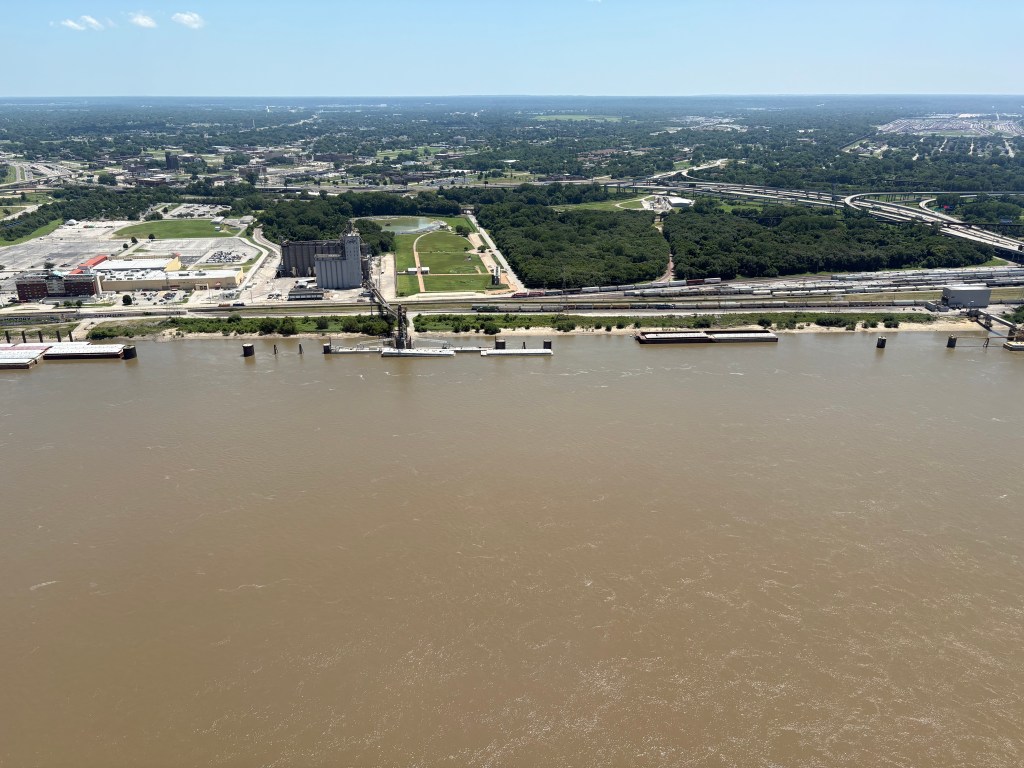
You are looking at the border of Missouri and Illinois.
In the early 1850s if you were a Black American swimming from this side to that side, when you were about half way — a good haul, strong currents, and a fair distance — you would suddenly turn into a free man … or at least you were supposed to. You would have crossed the border from Missouri into Illinois, from a state where slavery and its trade were legal to a state where it was prohibited.
From the time of the establishment of the Constitution the southern and northern states had been at loggerheads over this issue. When the Louisiana Purchase (which includes 13 of today’s states) was consummated in 1804, the northerners wanted slavery outlawed throughout the new territories. But they were at a legislative disadvantage generated by the fact that two-thirds of the slave-holding (ie ‘held’ slaves), while having no actual suffrage, could be counted in determining electoral representation. (Yeah I know. 🤔 And why two-thirds? Oh yes. Because a) in this peculiar instance, five slaves are equivalent to three free men, and b) it meant that southern property holders had to pay tax, ie more, on the same basis. It’s called political compromise. And also, weird.)
It came to another head in 1820 when controversy erupted over whether Missouri should be admitted to the Union as a slave state. The resultant Compromise resulted in Missouri being confirmed in this way but, on the other hand, slavery would be prohibited in territory acquired north of latitude 36° 30′ — so Kansas/ Colorado north.
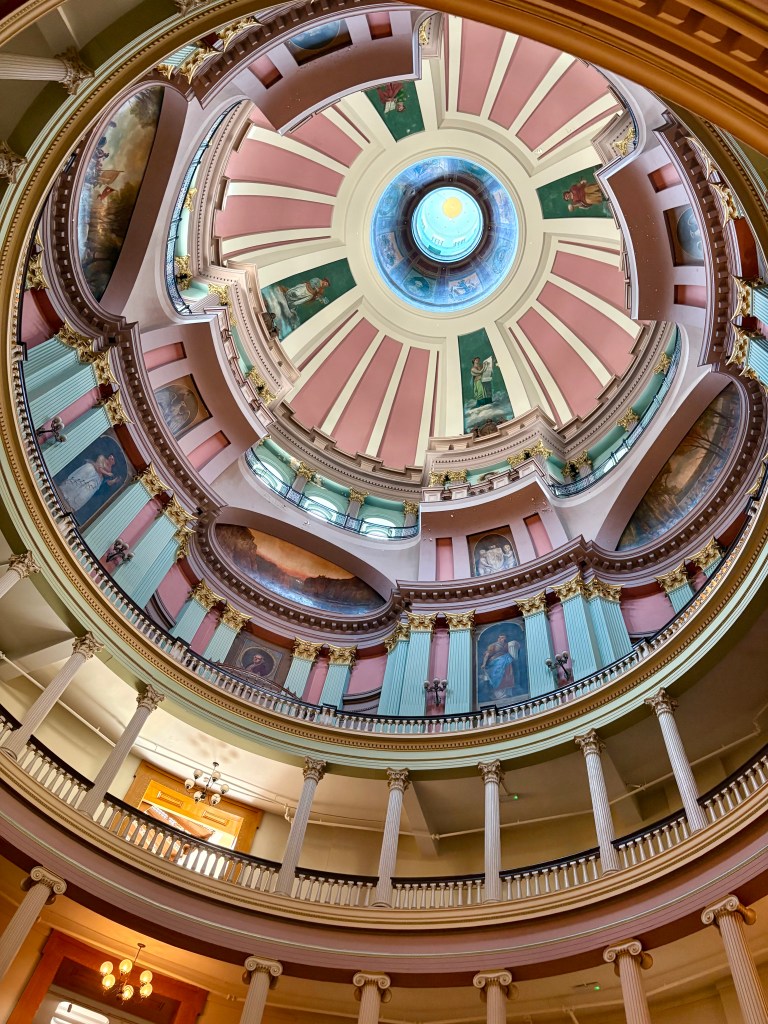
It came to another head in the Dred Scott case heard initially under this beautiful roof.
It is inside the cupola of the St Louis courthouse which you can see prominently in the photo below.
In 1846, an enslaved Black man named Dred Scott and his wife, Harriet, sued for their freedom in St. Louis Circuit Court. They claimed that they were free due to their residence in a free territory where slavery was prohibited.
For some years they had lived with their enslaver, an army surgeon, at Fort Snelling, in the free Territory of Wisconsin. The Scotts’ freedom could be established on the grounds that they had been held in bondage for extended periods in a free territory before being returned to Missouri, a slave state.
Courts had ruled this way in the past as a straightforward issue. However, this lawsuit between two private parties spread out in an 11-year legal struggle through various courts until it found its way into the Supreme Court.
On March 6, 1857, Chief Justice Roger B. Taney read the majority opinion of the Court, which stated that enslaved people were not citizens of the United States and, therefore, could not expect any protection from the federal government or the courts. The opinion also stated that Congress had no authority to ban slavery from a federal territory. Quite a strong position really, and a good target for contestation.
There are views that the decision of Scott v. Sandford might be the worst ever rendered by the Supreme Court. [This idea might be tested in the history of the last two years and the experience of the next two to come.] It was overturned by the 13th and 14th amendments to the Constitution, which abolished slavery and declared all persons born in the United States to be citizens of the United States. But that was after a four-year interregnum commonly known as the American Civil War.
In the photo above you are also looking at The East.
If you want to see The West, you look this way, the beginning of what was once The Wild Wild West.
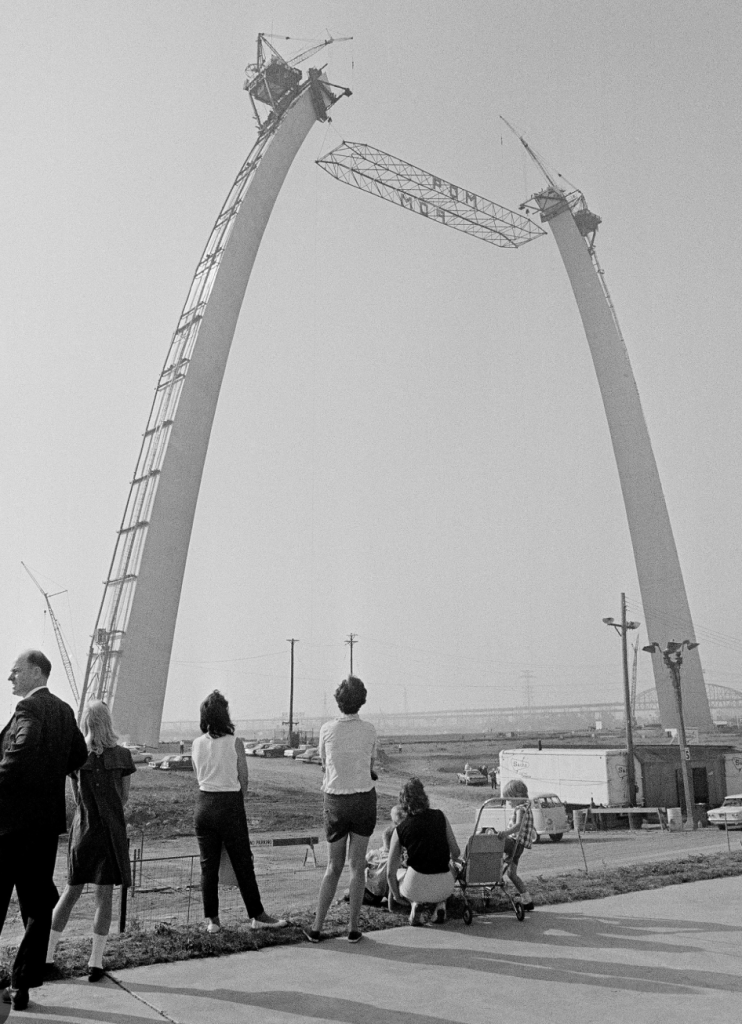
As it happens you are also looking at a modest protuberance from the only National Park in Missouri, The Gateway Arch Park, memorialising that clutch of events which expanded the United States around the beginning of the 19th Century: the Louisiana Purchase (which occurred here with Jefferson leading the American charge); the launch point for the Lewis/Clark expedition tasked with exploring the landforms, flora, fauna, habitation and passageways between here and the Pacific; the base for the settler rush and the land grabs. And here is the Gateway Arch itself, at 630 feet (192m) the tallest memorial in the Western hemisphere. (Did I mention we were in America?)
And ever so photogenic.
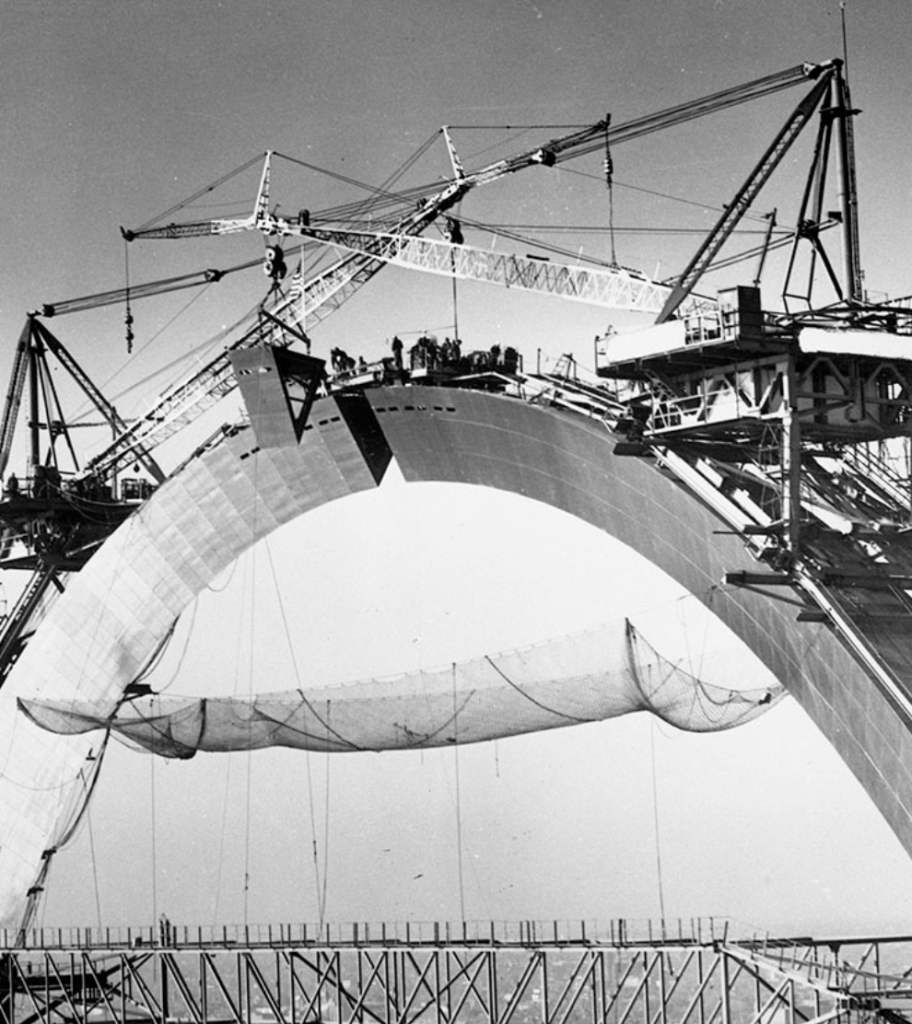
The aerial photos above were taken from inside the top of the arch which we had reached via the ‘tram’ which runs inside the legs of the arch. Extraordinary. As is the way it was constructed. Triangular sections of concrete covered with polished stainless steel were lifted and assembled by specially built cranes crawling up the arms. Last piece going in at right below and it fitted perfectly: an engineer’s wet dream. I took the aerial photos through one or other of the little black dots.
It was very hot, over 100F (38C) each day and 106F (42C) one day, when we were there. Apart from the choristers we didn’t find Downtown very absorbing. To the contrary really. I will remember it a bit this way. And that’s a good bit.
The great public institutions that we were interested in were in Forest Park, the site of the 1904 World’s Fair, nearly 7 square kilometres of greenery about 8 kilometres back from the river, and next to where we were staying for just this purpose. Those institutions were the Missouri State Museum and SLAM!, the St Louis Art Museum. (Quickly, we need to get on the road.)
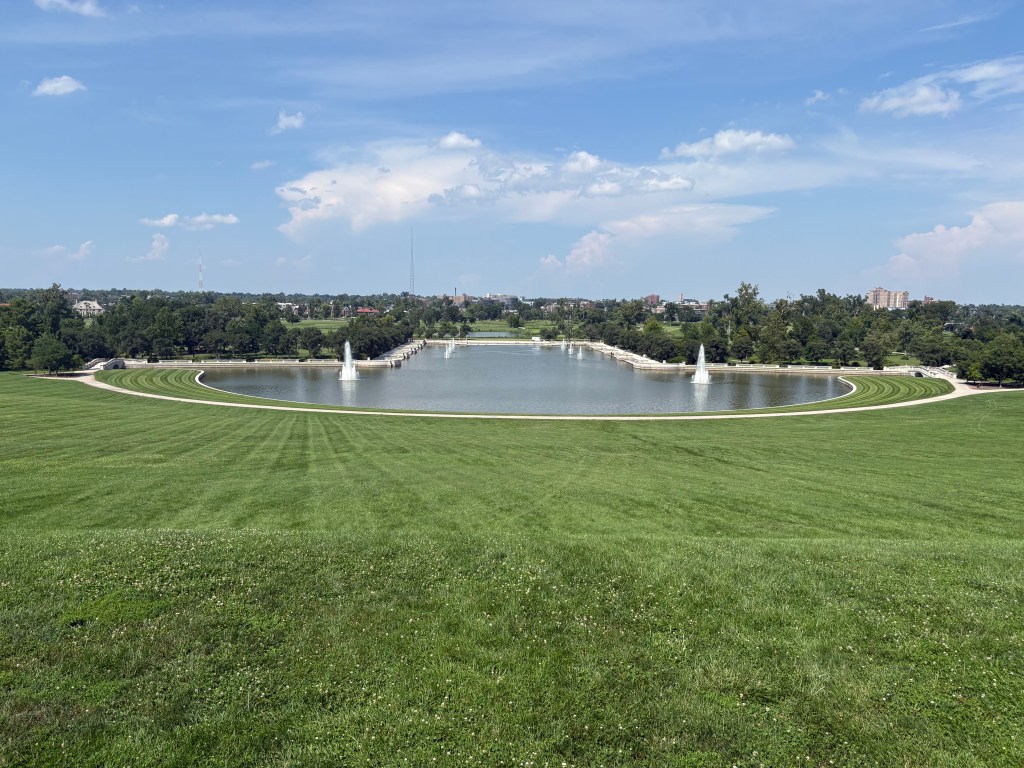
We had a BIG walk round the park. It ended up being about 8kms, too far really for such a hot day (106F that day and unbelievably humid). From the forecourt of the art gallery, lawn! Have I mentioned lawn? The big building on the horizon at right is the Barnes Jewish Hospital. Our accommodation, the starting point for our walk, was just behind that. We got an Uber back.
I discover that not long ago our friend Alan’s son was doing some short-term research at that hospital — it is a huge concern — and while doing so stayed in the same hotel we were in. He was warned not to leave it at night and not to wander round the local area, Central West End at any time. No one warned us off and we did quite a lot of wandering some of which I’ve described here. Nothing we saw or experienced suggested that we should have been home in bed with the blinds drawn. I wonder about such moments and their construction, and the protection that ignorant obliviousness might afford.
The gallery had a lot of interesting things. ‘Lots of Number 2s’ my journal says. But Number 2s are often interesting. There were some early Van Goghs which were shockers for example along with some very good and rarely seen later ones. Big collections of Expressionists. [Footnote: After he heard Hitler describing his work as ‘degenerate’ in 1937, Max Beckmann left Germany ending up living and teaching in St Louis.] A good El Greco … a glorious profusion was how I summarised it.
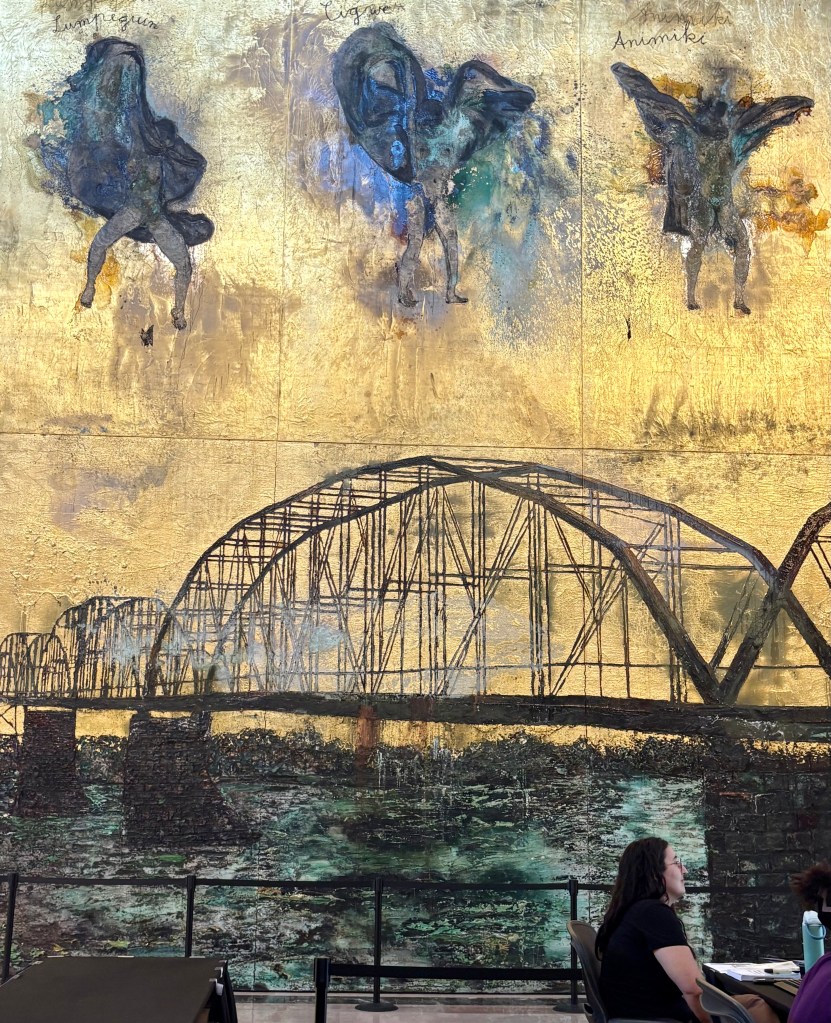
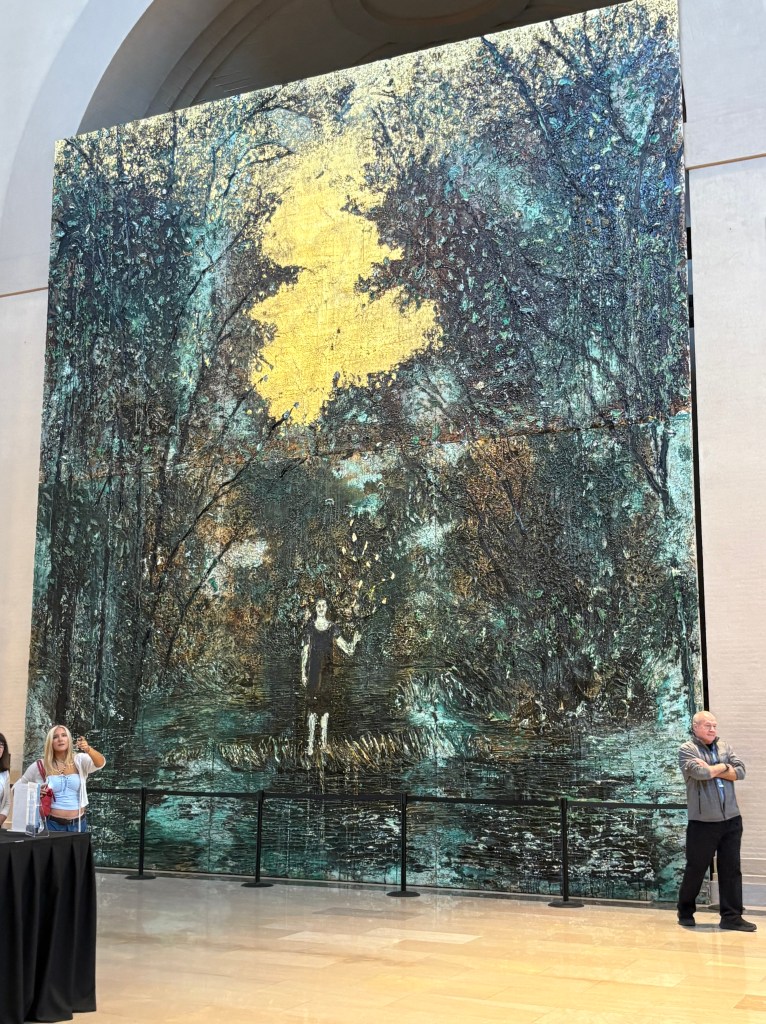
At the entry was this, two of a series of giant canvasses commissioned from Anselm Kiefer, generated by his several visits to St Louis. The bridge at left is the Old Chain of Rocks Bridge now closed to car traffic and pedestrianised. Its aerial visitors, Animiki, Lumpeguin, and Cigwen (also the name of the painting), are mythical Thunderbird creatures from local Native American lore. I can’t help you much with the one on the right.
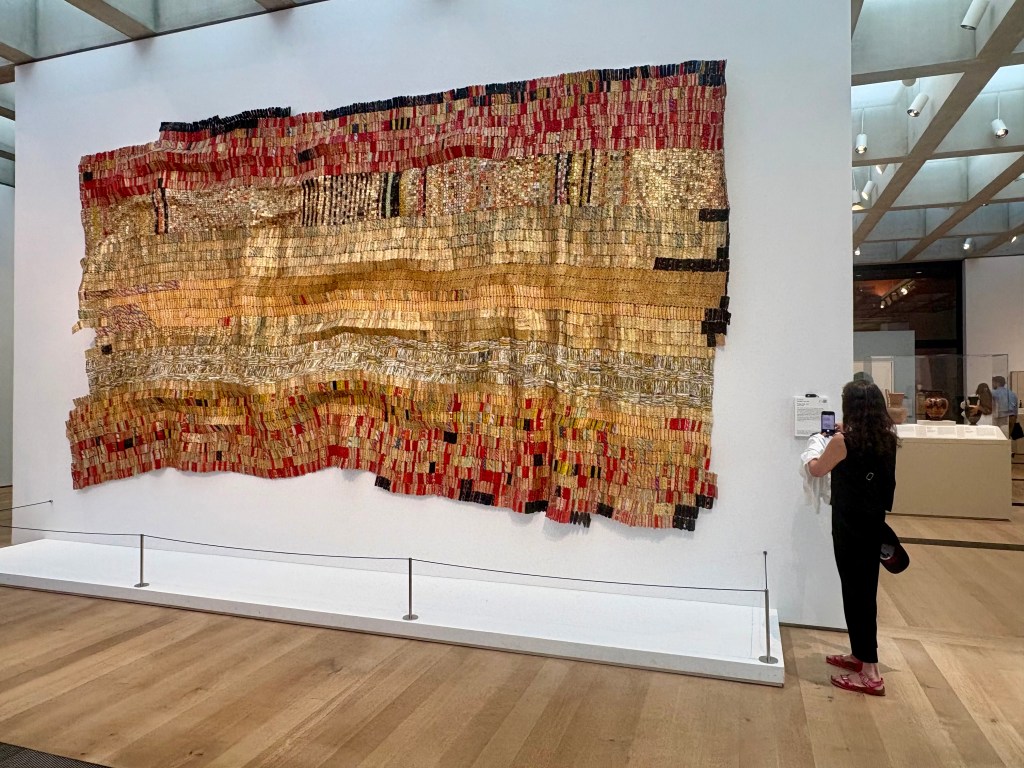
And then near the exit there was this.
El Anatsui, Ghanaian Fading Cloth 2005 mixed media
‘Hues of gold, red, yellow and silver shimmer across the undulating surface of Fading Cloth. Although it looks like textile, the work is actually made from discarded liquor bottle tops, which were flattened and stitched together with copper wire. … These materials are also encoded with meaning. Europeans traded textiles and liquor in exchange for gold and slaves in West Africa. Fading Cloth weaves together a range of political, historical and visual references specific to this region, where Anatsui was born.’ 🤔 Mmmm. Yeah maybe. But maybe it was just turning something which was to hand into something beautiful and aesthetically interesting.
We’re not even in the car yet, and I haven’t mentioned the excellence of the Seared Salmon Salad at Applebee’s Grill and Bar, or the fact that we saw a new print of ‘The Right Stuff’ (long, messy and just slightly tedious, Gus Grissom is made to look a right tool) at the HiPointe cinema in very much another part of town. Or the rare experience at the Shake Shack in Central West End.
Out of control. I got too interested in the Dred Scott case. I didn’t say enough about the importance of good air conditioning or just how bad humidity can get or the influence of a profoundly riverine environment, and the funny bits of water, expansive and otherwise, that turn up in Forest Park.
I can only apologise and redirect your attention here.
Sounds a bit thin and reedy doesn’t it. It was less so on the evening. Darin and Brooke Aldridge singing ‘God Bless America.’ While Darin and Brooke were singing we were surrounded by people joining in singing a number standing up with their hands on their hearts. (Just before we move on, you might like to check mid-left. There’s an interpreter signing the song, as she did all night, for 10 or 15 people. Just for them; not much obvious value on a radio show. It’s worth remembering that that too is America.)
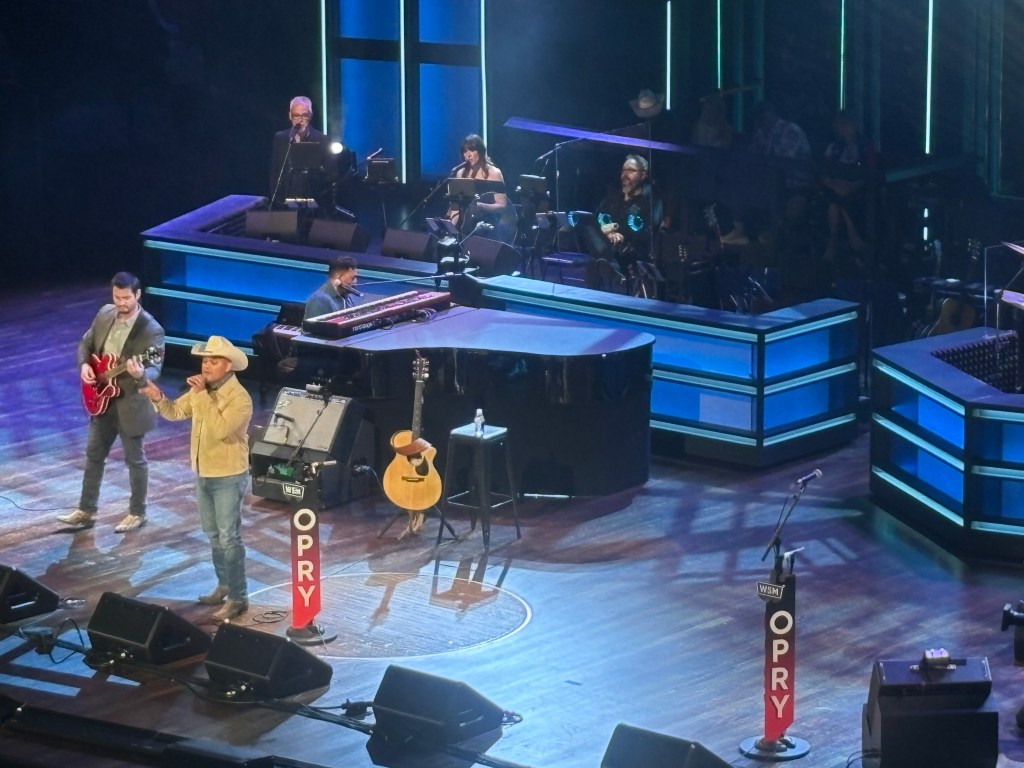
We’re at Nashville’s Grand Ole Opry on July 4, the 250th anniversary of the Continental Congress formally approving the Declaration of Independence, separating the 13 north American colonies from Great Britain. I thought that might be a good place to be. The Grand Ole Opry, a live radio show, was also celebrating its own centenary. Special program? Special guests? As it turned out, not really.
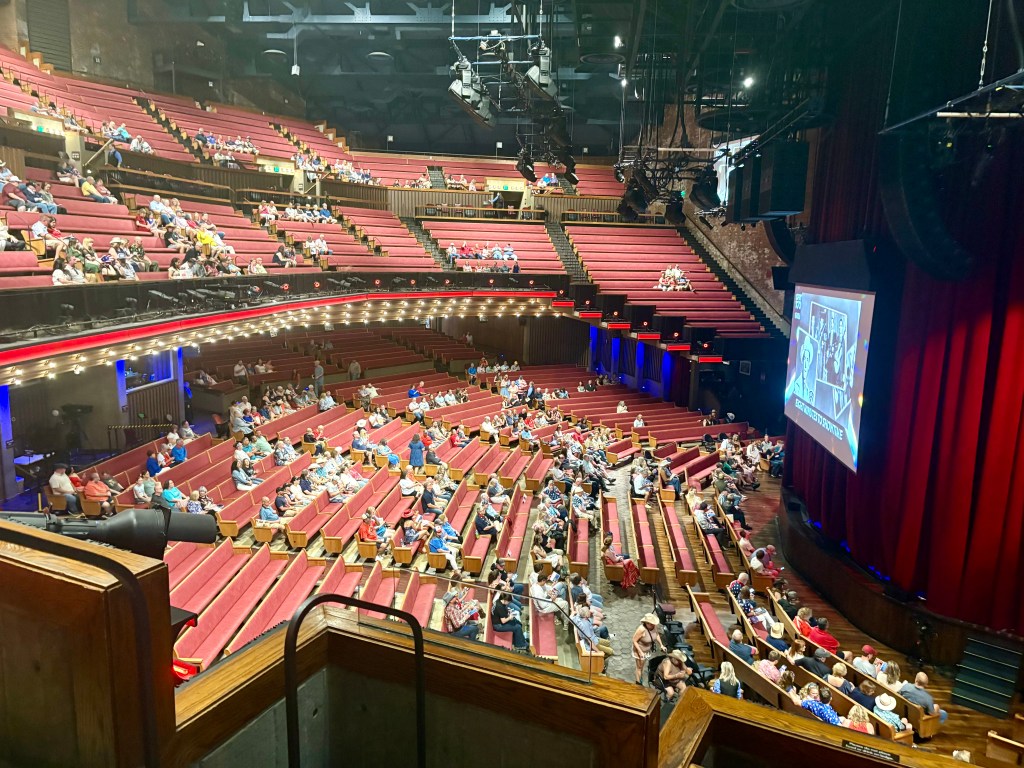
This was the crowd with 8 minutes to go to showtime, and I know that because it says so on the video screen. Recorded live shows need preparation like that.
There were more when the show started, about three or four times as many, but plenty of room to improve our seats which no one seemed to mind at all.
The Opry is an institution nonetheless. It’s where Taylor Swift began her career nearly 20 years ago when she had just turned 16. Dolly Parton was 13 when she graced the stage introduced by Johnny Cash, although it was another 10 years before she was ‘inducted’. All the greats of Country music have played the show. (And one of the great Greats as identified in a large mural downtown? Front and centre, nudging Dolly, Hank Williams, Kenny Rogers, Garth Brooks and Tanya Tucker just slightly off to the side is Keith Urban. That’s Aussie Keith, ex-husband of Nicole Kidman, actually born in Whangerai NZ but raised in Caboolture Qld.)
The show used to be recorded in the Ryman Theatre — still there in downtown Nashville looking like a church hall — before moving to its own premises on the outskirts of the city where the theatre is part of its own precinct with bars, accommodation, amusement parlours, playgrounds and huge car parks. In the middle of the current stage is a six-foot circle of oak cut out of the Ryman theatre’s stage. Newcomers to the Opry stand there while being inducted. And this is how you become an institution: you build stories around yourself. (And songs. One was sung the night we were there about the ‘Six foot circle at the Grand Ole Opry’.) Boy, are Americans good at this or what!
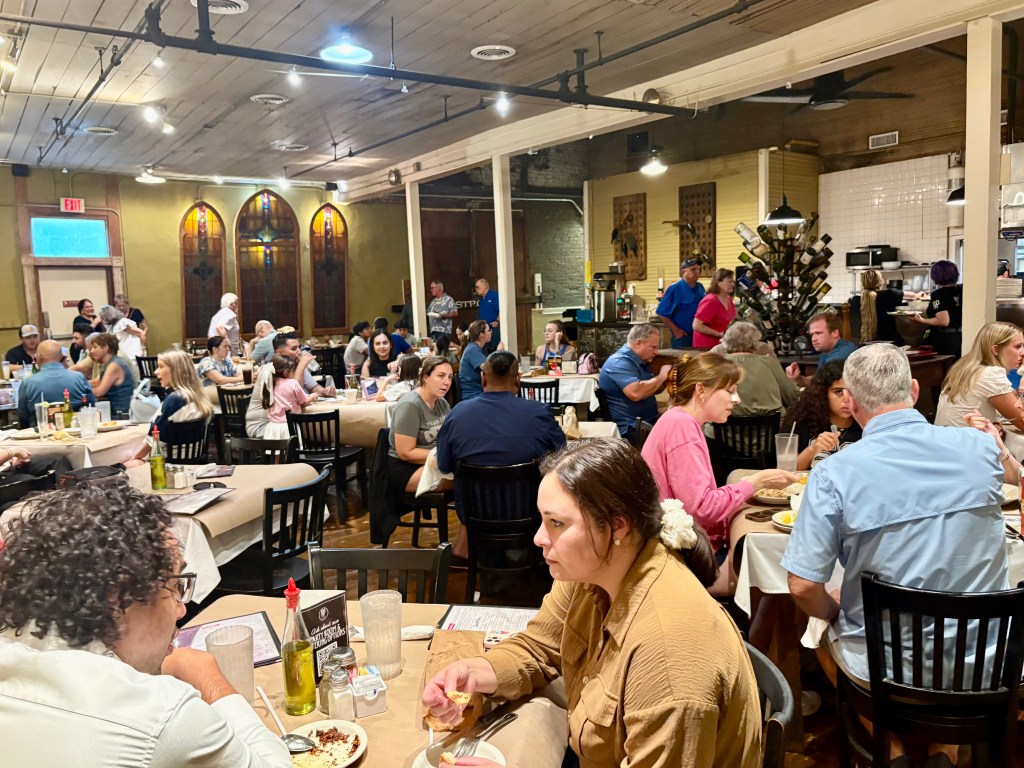
It was an odd night. We had just driven from St Louis in a Camry that vibrated and made awful noises. We were held up at the hire and left late. I thought it was 300kms, and it was actually 328 miles. Out by a factor of 1.6+. There’s no precise direct route so I was enjoying ambling along backroads till the distance made itself real (about 550kms in the end) and I joined the cars on the freeway going 80-85mph. Tiring. The only food we could find readily was a Maccas where we recognised the menu but not the produce. It was only a few days since Myrna had had her root canal done and she wasn’t feeling too flash. It was also a bit complex not to find the theatre but to get to it. We soldiered on.
Let’s start with the conclusion. It was a completely fascinating and entertaining night. The showband was sensationally good and the artists very slick. Why wouldn’t they be? I laughed very hard at the comic Gary Mule Deer. Sample: ‘Interesting that John the Baptist and Winnie the Pooh should both have the same second name.’ And we left the theatre happier than when we arrived. It had been fun.
There was some dancing to open — not sure how that went down on radio, but it looked terrific. Then 79 year-old John Conlee sang. It was an effort. Watching him prepare for the high notes hurt a bit, but he hit them all. Then he spoke: about the importance of church-going, his recent spiritual experiences, what his family got out of it, where you could find the church and who was in charge of it. Different. A surprise. As it transpired the only artist who didn’t mention God was the comic.
There was also a good deal of, and painless, self-promotion. ‘You made us Top 10 on the country charts for three months god bless you. We’ve gone to a whole other level since then. We’ve been voted …Etc.’ But there was another strong undercurrent — no. Surface current, main current — of which Frank Ray provided the best example.
Here’s Frank (born Francisco Gomez; no one from ICE in the audience) who besides being a country and western singer with some recent solid commercial success had been a cop in Las Cruces, New Mexico for 10 years. And he had a well-developed and very effective schtick.
He kicked off with his magnum opus ‘Hard to be a Hero’.‘You did what you had to do, but that’s not what they’re saying on the six o’clock news. Sometimes it’s the good guy who lives with the blame.’
He invited any current military or veterans to stand up for applause which they did with a degree of alacrity. Might have been 60. (In the US, military personnel, past and present, can be invited to board flights with the first boarding group.) Then first responders; same but more. Then national guard and security personnel. Yes. We are, as it happens, skewing fairly heavily male at this stage.
And then an invitation to stand up if you love your country. ‘There’s so many people don’t love this great nation of ours these days …’ The crowd didn’t rise as one, Amen, but in time and mostly they did rise and hold their arms in the air and cheer and they did say ‘Amen’ when he said ‘Amen’. And when he said God loves and blesses this great nation. (‘Amen.’) And when he said Gittalong to church for the sake of the nation. (‘Amen.’) And then he sang ‘I’m proud to be from the good ole USA.’ All the artists were playing the same cards but Frank had the strongest hand.
Is it uncertainty that drives this, nostalgia, wistfulness about a past that may or may not have existed when there was a chicken in every pot, all children were above average, jobs were plentiful and intelligible, and when women didn’t answer back so much? And the supervisor was a Bountiful God? Or maybe it’s just embedded cultural habit.
It makes Pete Hegseth so much more intelligible. Not Kash Patel. But Pete Hegseth. In this particular context, he can seem a more or less conventional part of the ecology.
* * * * * * *
We had arrived at one version at least, quite modest but heartfelt, of the celebration of the 250th.
It was Nashville. And it was country music. You must expect a bit of variation in a country with a registered population of 341,784,857 a year ago with perhaps 12-15 million unregistered and illegal immigrants. (Who knows? The relevant statistician has just been sacked.) Plus these people live in a country which can be 5000 kms from sea to shining sea, a big one with lots of geography.
A few days earlier we’d been in Washington.
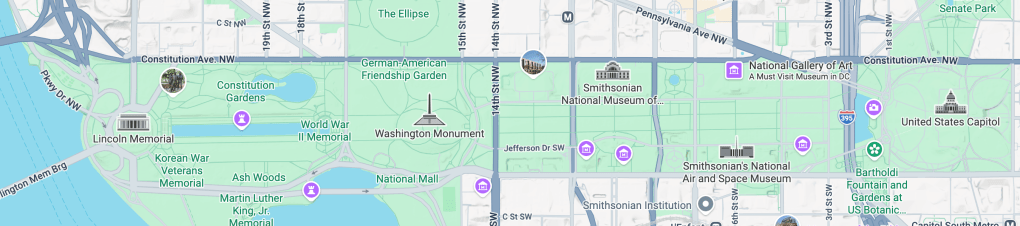
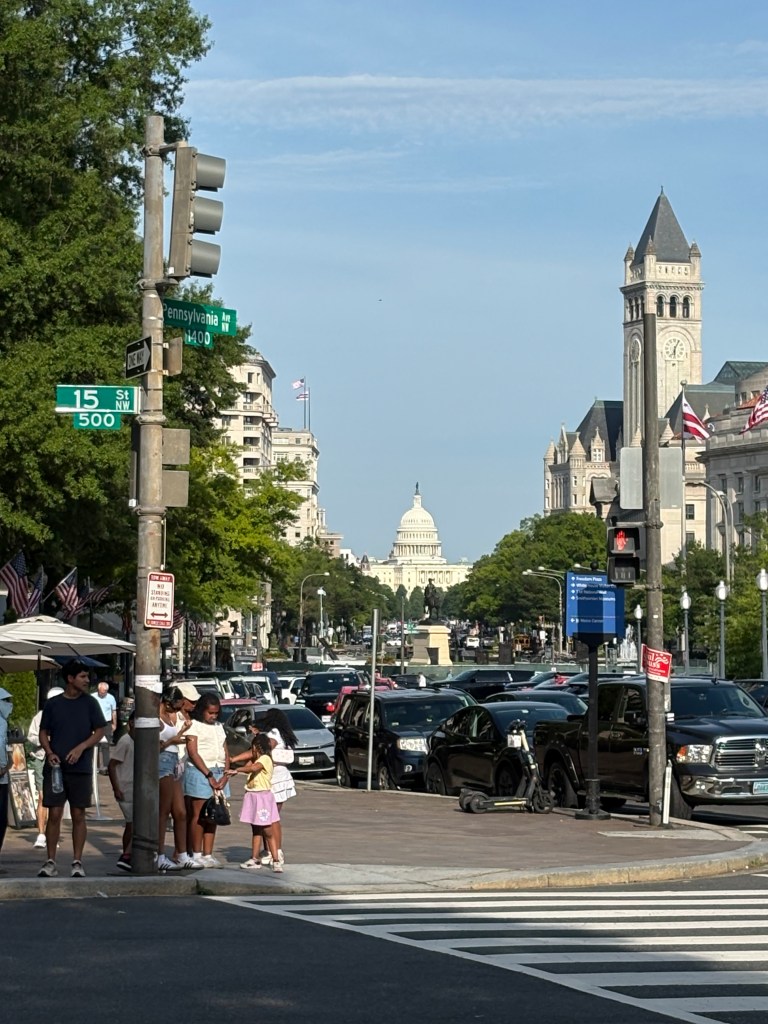
For the purposes of orientation (and Alan). This is the National Mall just south of the White House and its grounds. It is about 2.5 miles or 4 kms from one end to the other. It is bookended by the Capitol, the seat of government (down Pennsylvania Avenue in the pic at left), and the Lincoln Memorial. In between is the Washington Monument.
Between the Lincoln Memorial and the Washington Monument is the much vexed Reflection Pool. Lined along the Mall are institutions holding and displaying many of the nation’s most precious artefacts in the bits and pieces of the Smithsonian and other national museums and galleries.
At the left of the map you will see the Arlington Memorial Bridge. Trump plans his arch for the other side of the Potomac following the throughline of heritage monuments to the Arlington Cemetery where major figures in the life of the country are buried. (Including several Presidents and Audie Murphy.)
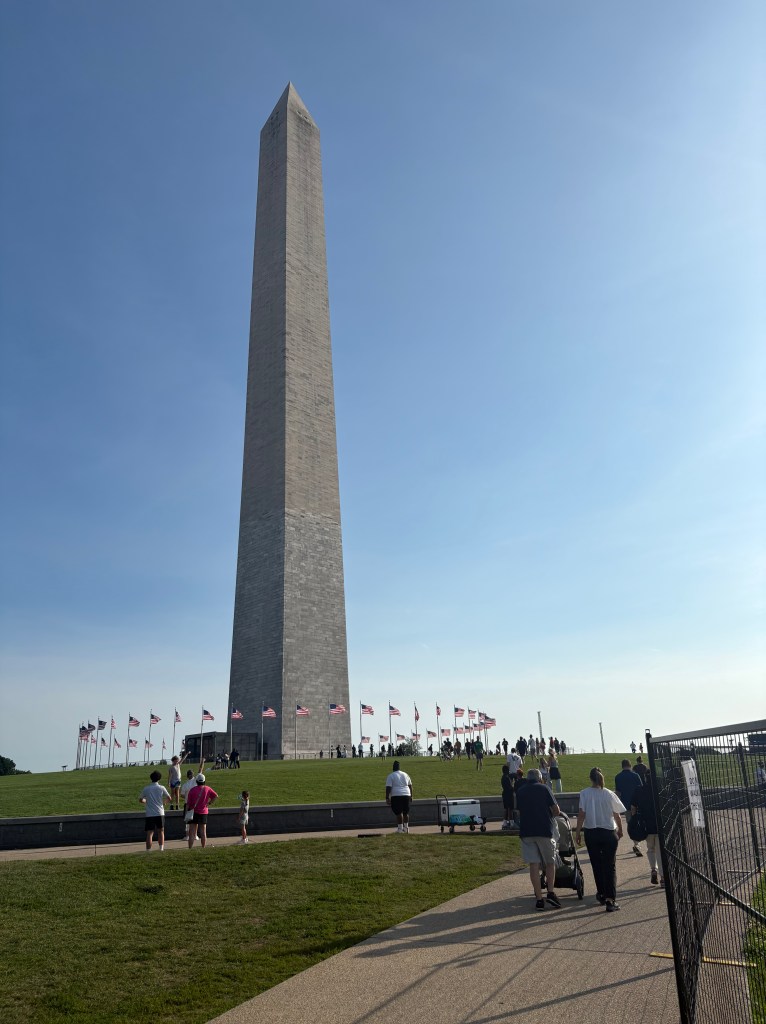
We wanted a look at the Great American State Fair which ran in the Mall for a fortnight before its climax on the night of July 4. A few days before then, we walked down 15th Street to the Washington Monument, at right, thinking to catch a glimpse of the Reflection Pool. Not a hope: all blocked off.
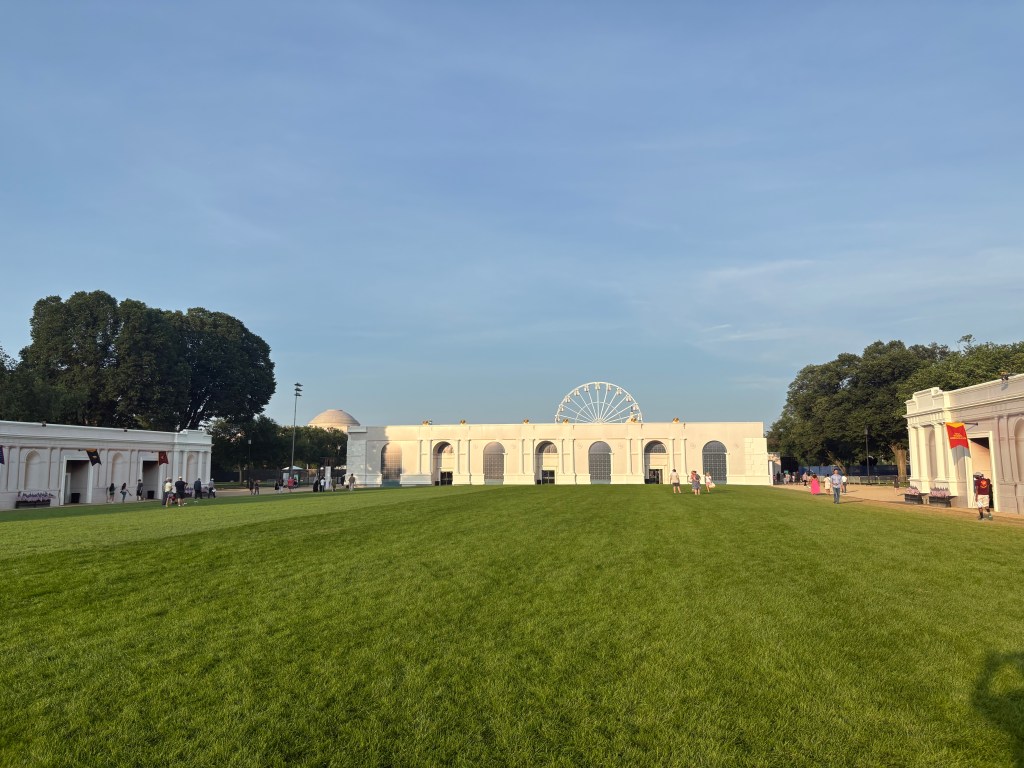
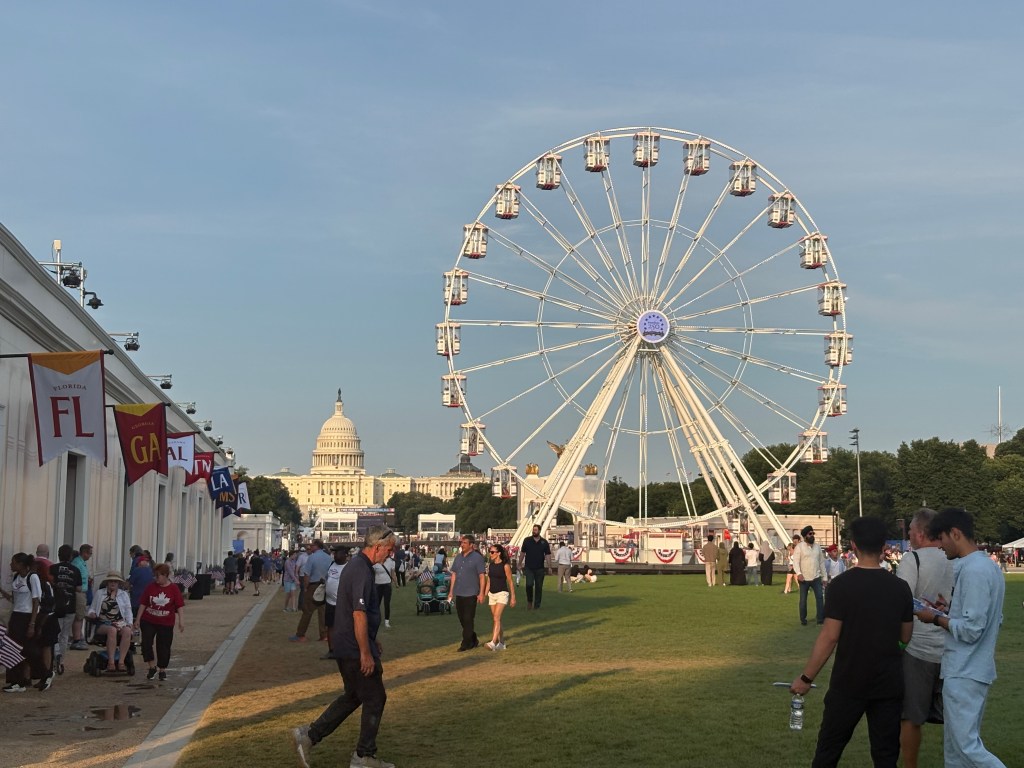
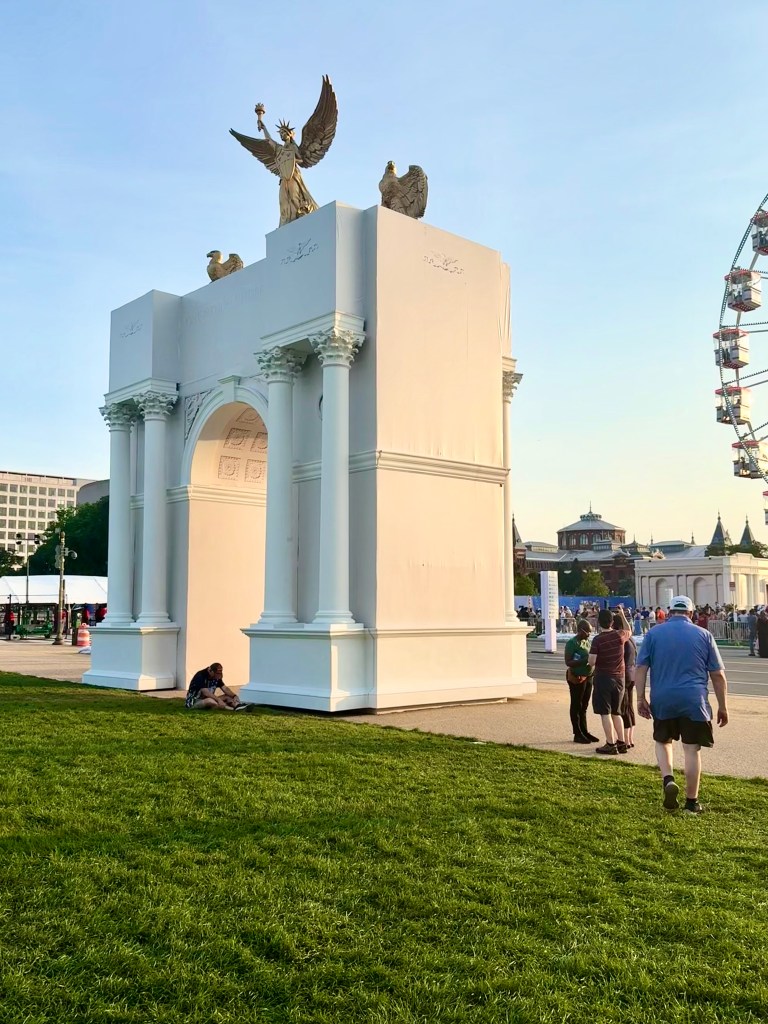
The State Fair was supposed to have exhibitions from all the states and federal government Departments as well as some other bits and pieces … a Ferris wheel, a rodeo operating sporadically and a scale mock-up of Trump’s arch. (To be 250 feet high. 250. Get it?) But this is the US, the greatest country on earth on the occasion of its semiquincentennial with such profound skills in entertainment and organisation. The Fair would have to be a bit out of the box surely.
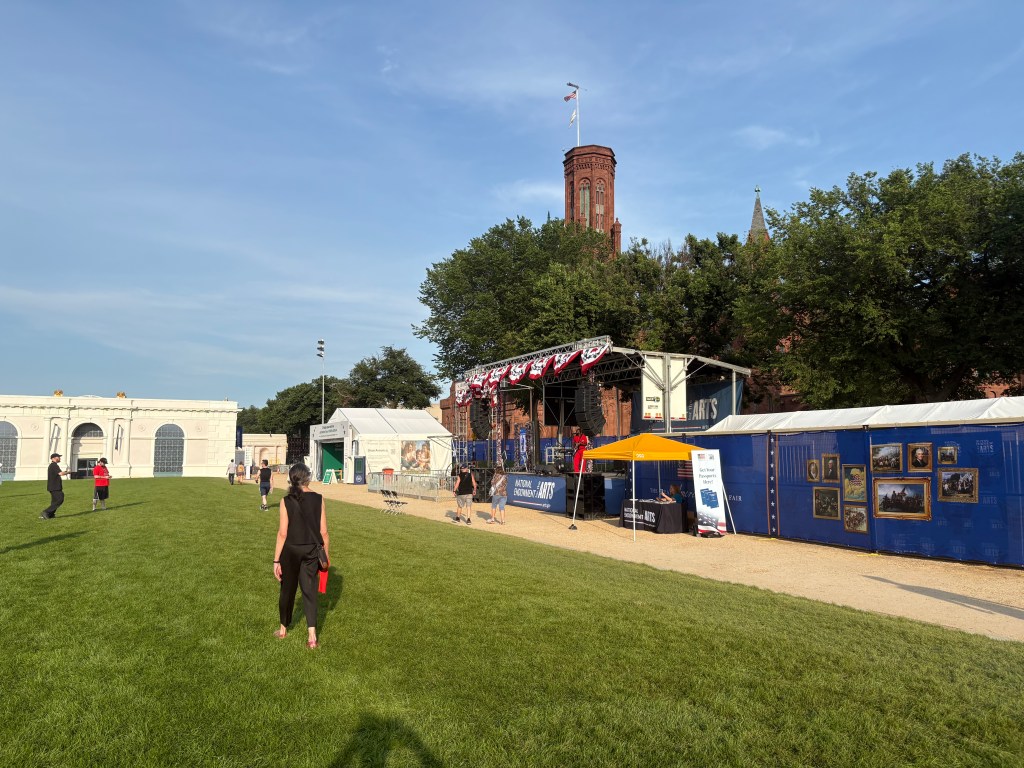
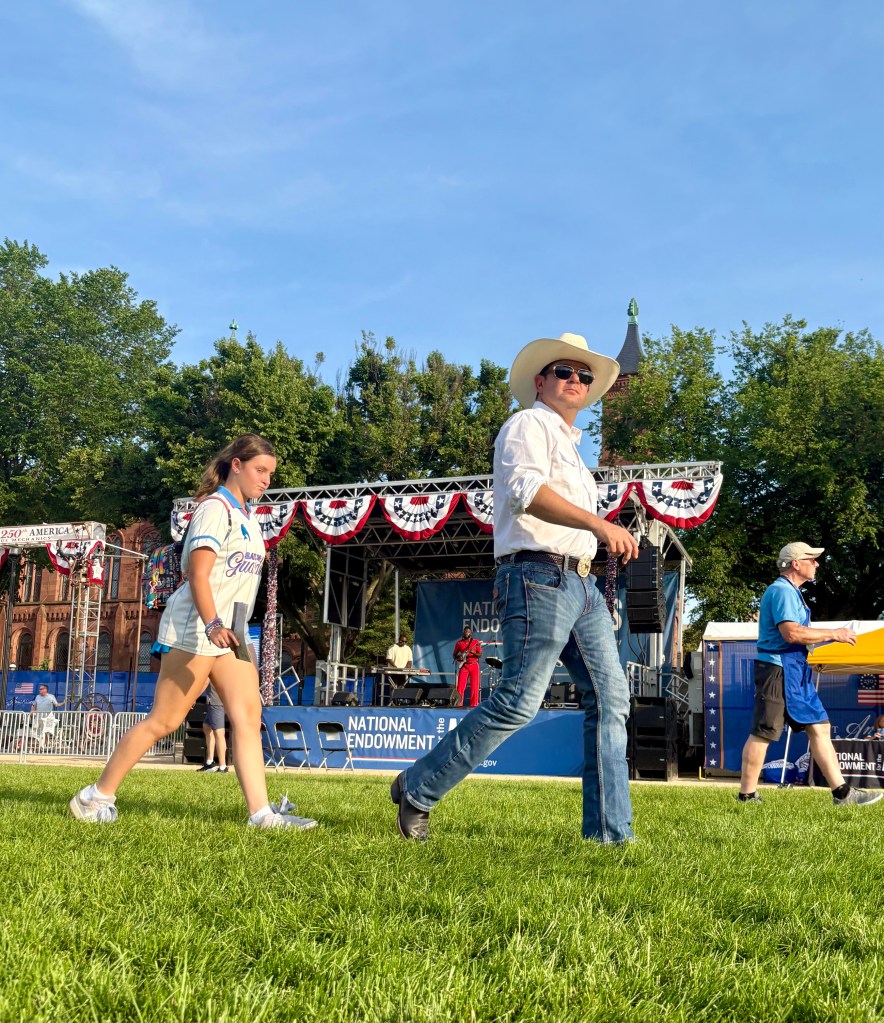
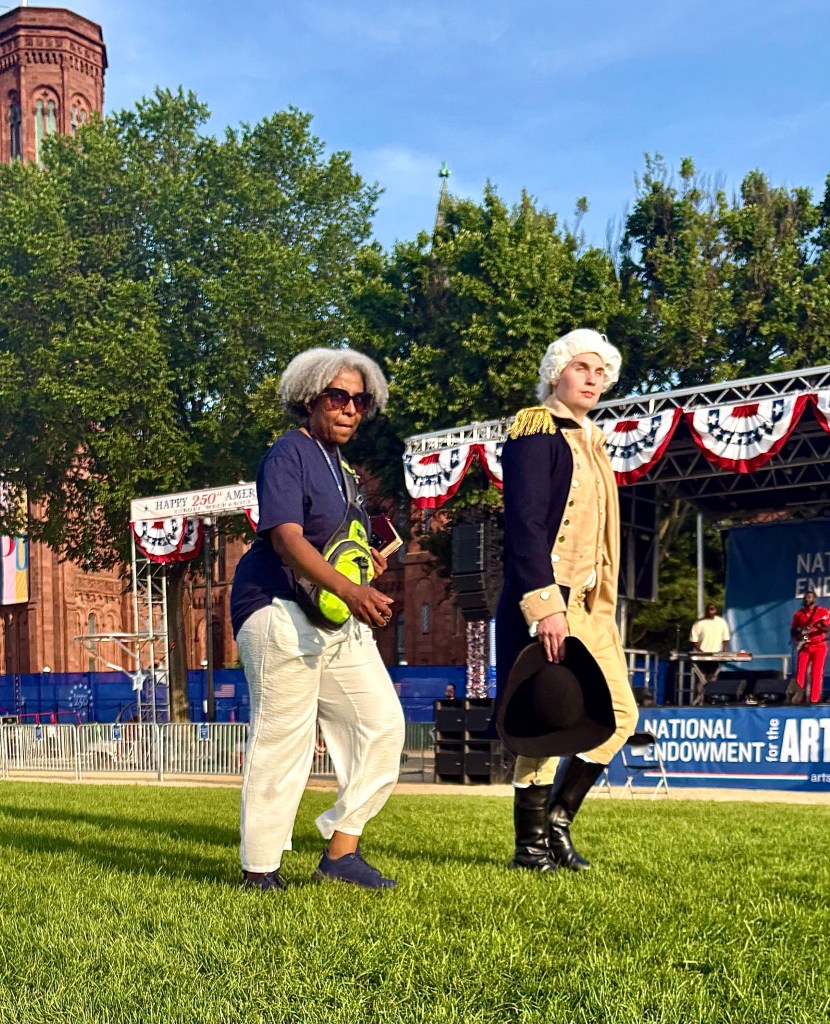
We could hear a band in the distance which sounded great, so we found our way in, not as it happens an easy task, and walked past I’ll say several thousand porta-loos which seemed to be locked away behind a two-metre ringlock fence. But the music was beguiling and we found its source: the contribution to the Fair from the National Endowment for the Arts. Under the yellow awning they were giving away mock passports with Trump’s picture inside.
The band? Three pieces only, but absolutely 10/10. Heartfelt rhythm and blues very capably sung and played. Some of the best music we heard in America. But that was as big as the crowd got, although there were a couple of people who walked past.
This is one half of the fair, no question the quieter end, but all the food, ALL THE FOOD, the only food, was down to the left. Turkey leg $27. Freedom hot dog $21.50. Lemonade $13. Unsurprisingly not much commerce was taking place.
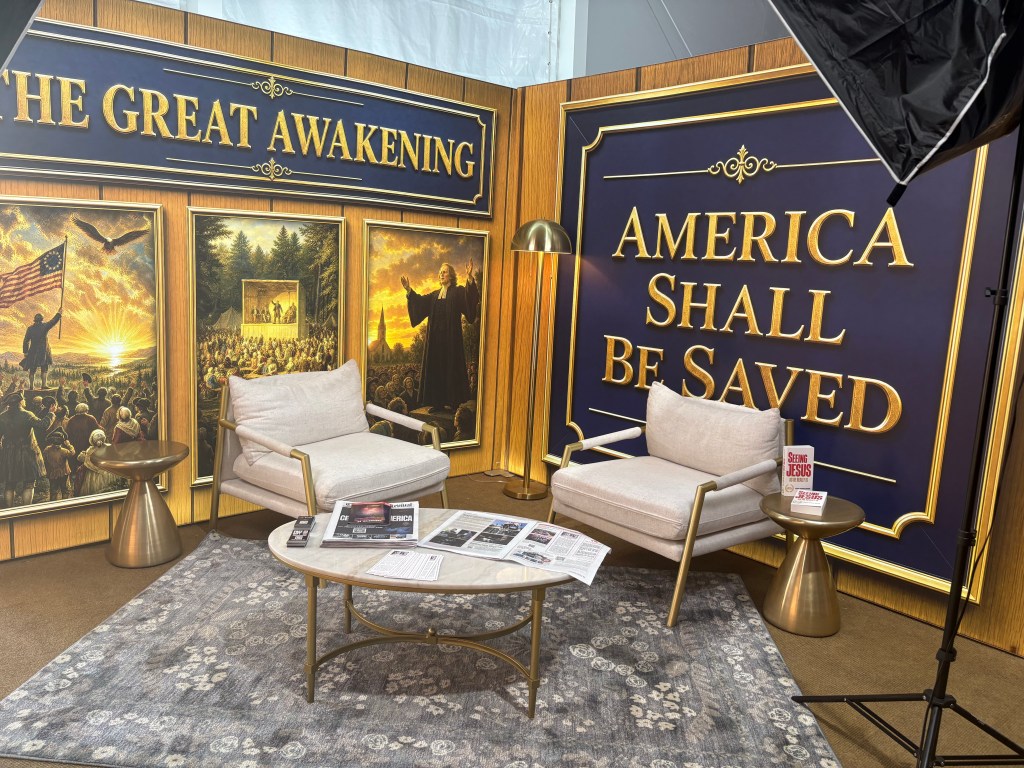
The divider building looks fairly solid but wasn’t. Like the rest, it was temporary in the extreme. It did only have to last a fortnight. It contained seemingly unusual contributions for a fair. This is one of them.
This is another.
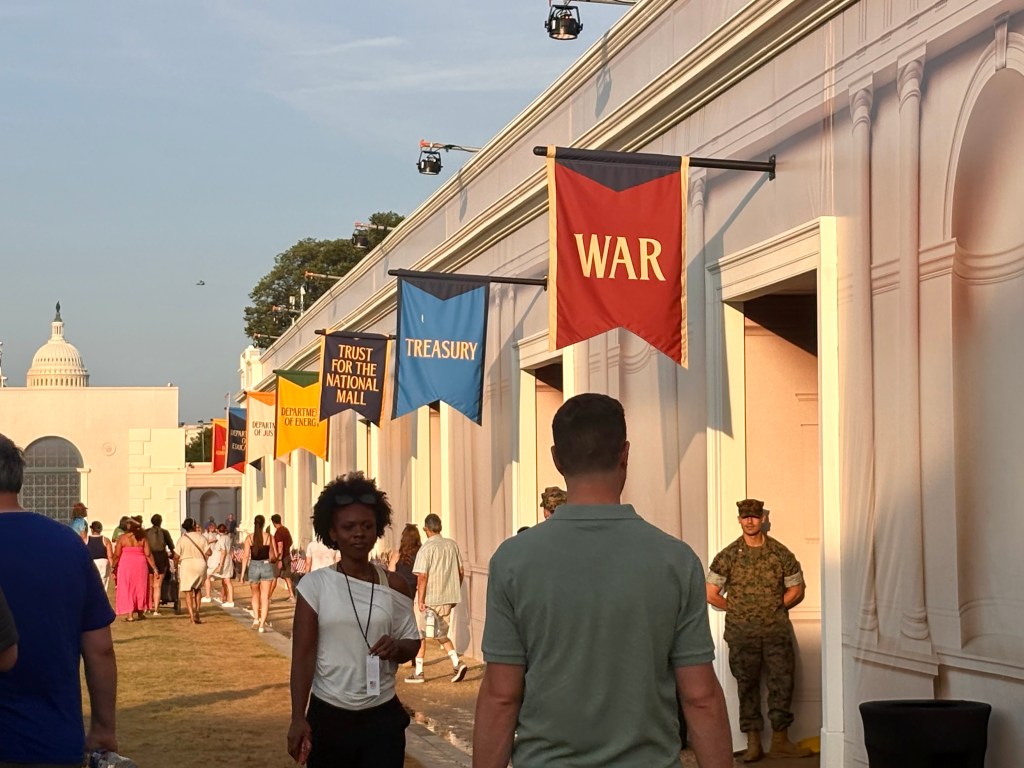
And then the busy side, remembering that this was peak hour 3.30-4.30pm on a Sunday afternoon.
The flags above indicate the exhibits of the states and territories, Florida, Georgia and so on. A number chose not to participate. Below are the Department exhibitions.
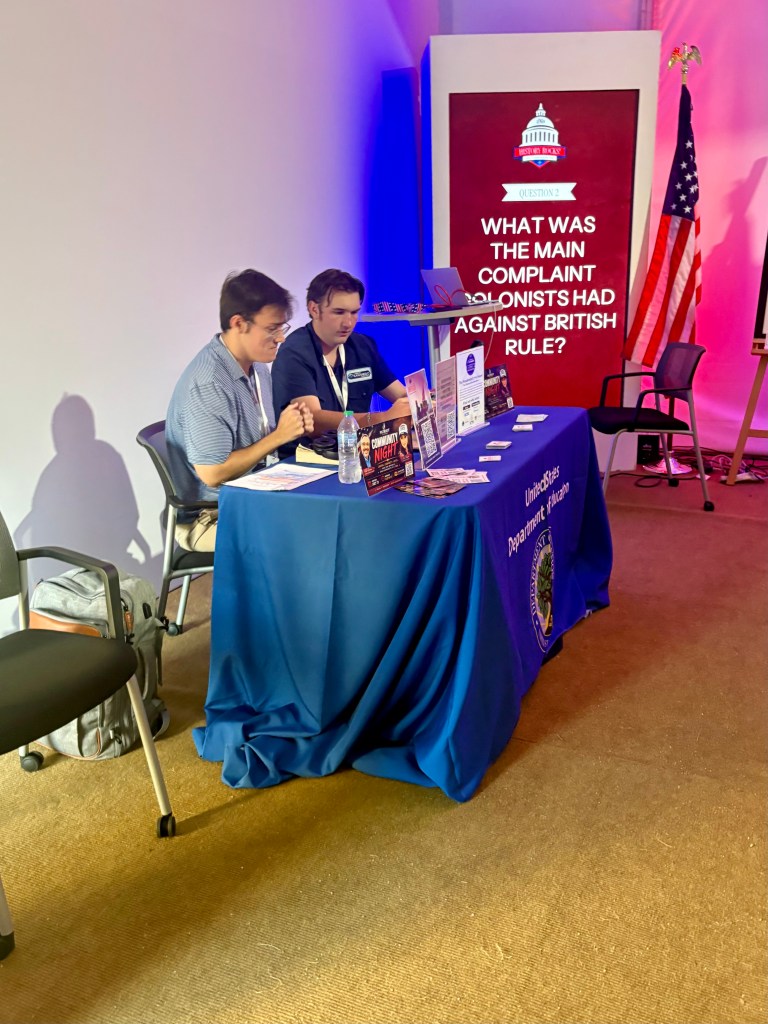
And this is the best that the Department of Education of the greatest nation on earth could do. That’s it. You’re looking at it. The lot. And now I investigate more closely it’s Kristi Noem’s picture on the brochure for the Community Night, lips pumped, MAGA-style hat. She’d been sacked for three months by then.
Finally, the crowning glory, the scale model of Trump Arch.
I left thinking that the Horsham Show could generally be of more interest and is usually better attended. How could Mr Showman Himself countenance such a fizzer? Well, there was no money to be made I guess. Besides being focused on important history, it was about good will and fun and people having a good time, so of marginal consequence.
* * * * * * *
‘The US is a country stubbornly and intensely attached to myths about the military’s positive transformative power on the health and quality of individuals who enlist.’ (David Craven in commentary about Graham Platner’s disastrous run for the Senate in Maine.)
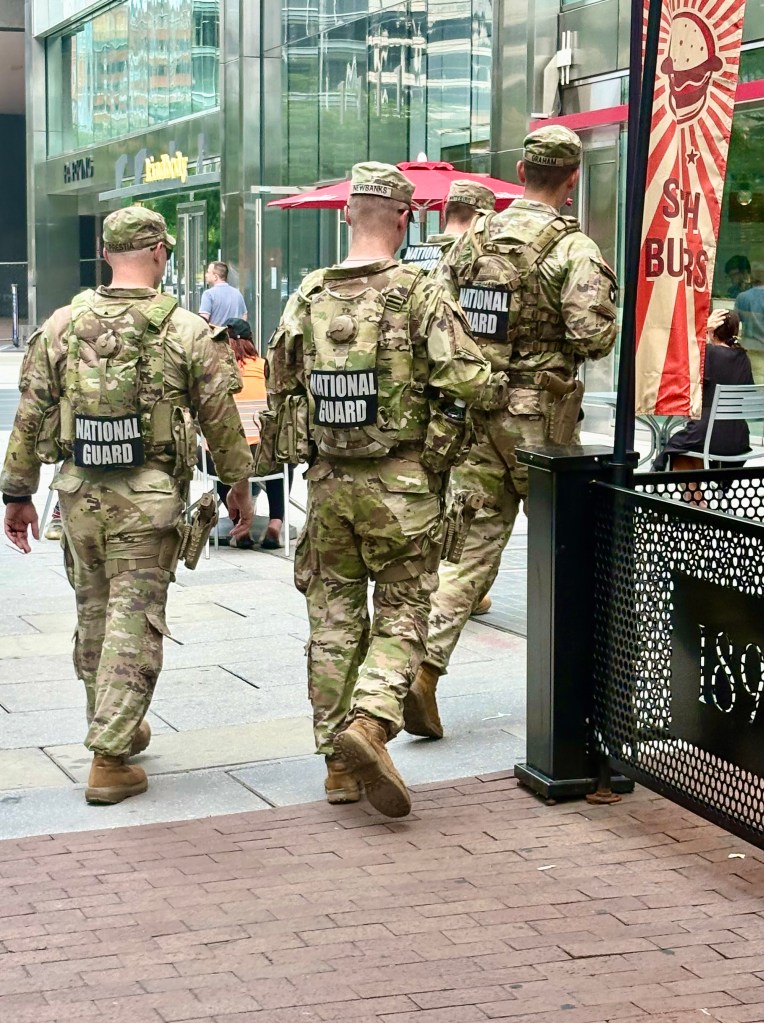
Prestia, Newbanks, Britebird and Graham refuelling at Smash Burgers downtown Washington.
* * * * * * *
On the wall at SLAM! aka the St Louis Art Museum, explaining its choice of contribution to the 250th.
Picturing Independence: ‘The American flag is more than a national emblem. It is a living, evolving symbol that reflects the nation’s highest aspirations and greatest challenges. The flag of the United States of America was first recognised by Congress on June 14 1777. For many Americans, the image of the flag is an important means of expressing their identity.
* * * * * * *
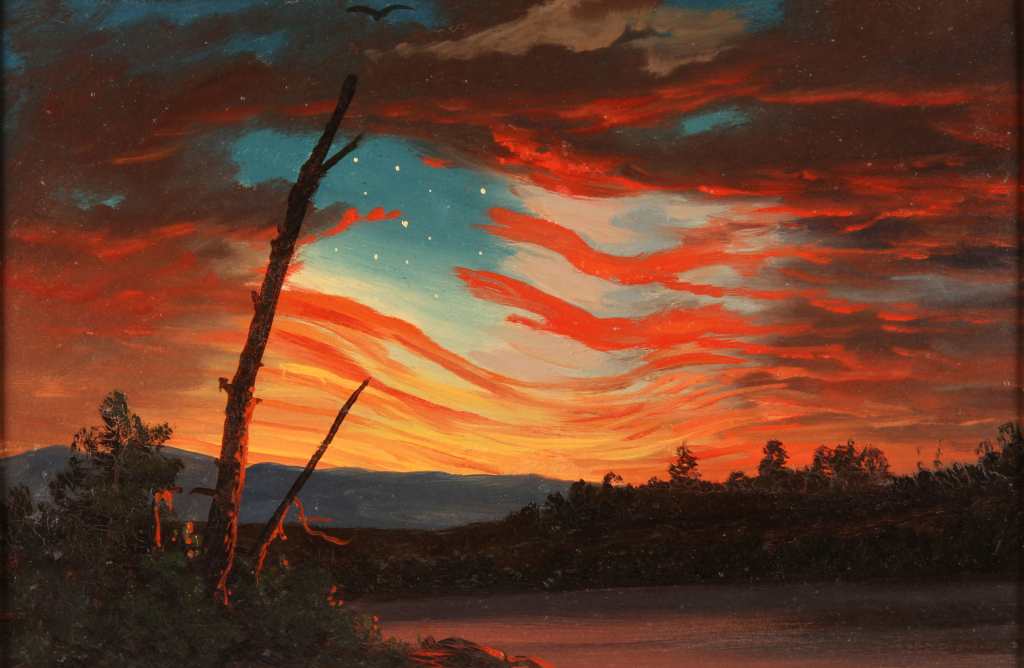
‘Our Banner in the Sky’. Frederic Church painted this after the attack on Fort Sumter in 1861 by Confederate forces began the Civil War. It was widely reproduced and became very popular. A lithograph was made from it and sold to benefit the families of Union soldiers. There are two versions extant both held privately. It is America. But one is quite regularly exhibited in the Smithsonian Museum of American Art in Washington. For a time Church was America’s best known and best remunerated artist. He achieved that status, at least partly, by producing the work of a great patriot. (We visited his remarkable house just out of Hudson.)
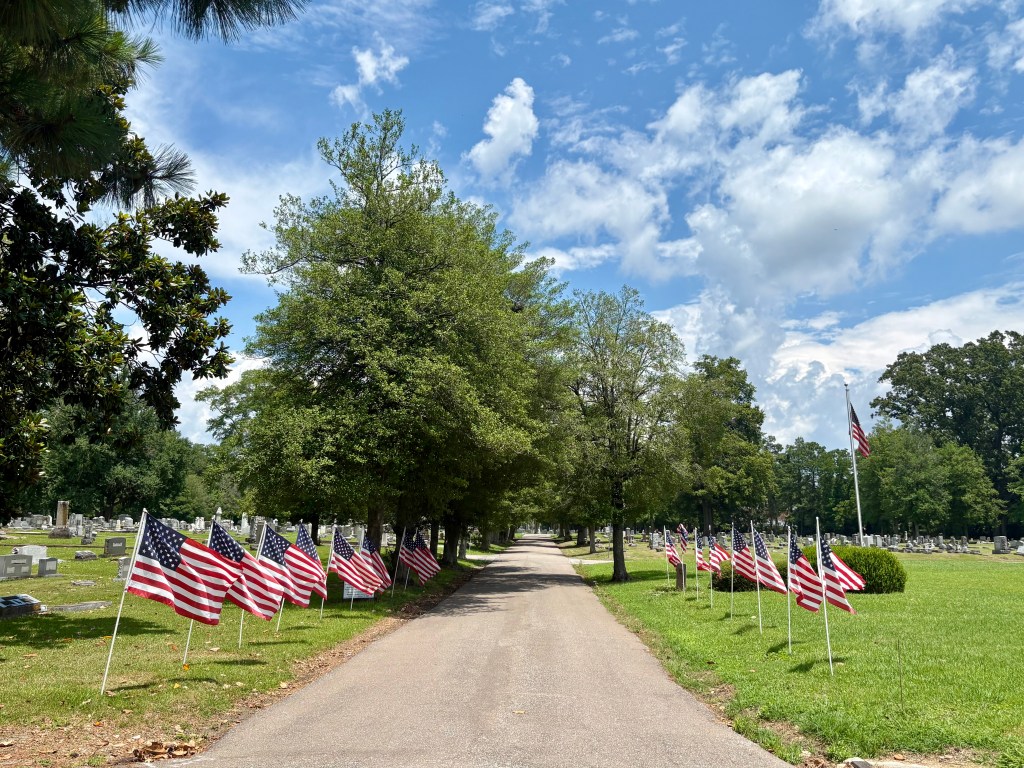
The entrance to the cemetery in Jackson, Tennessee.
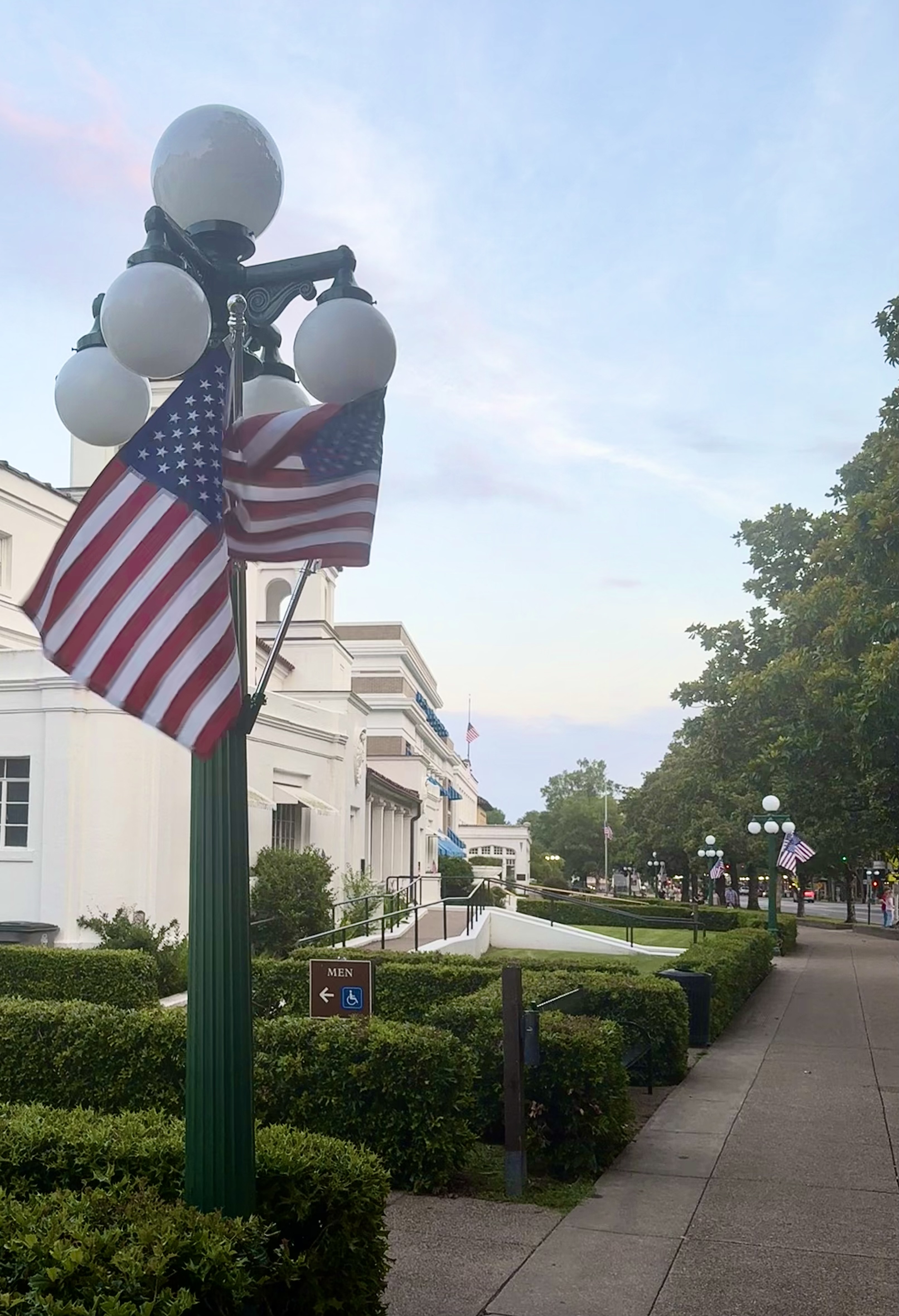
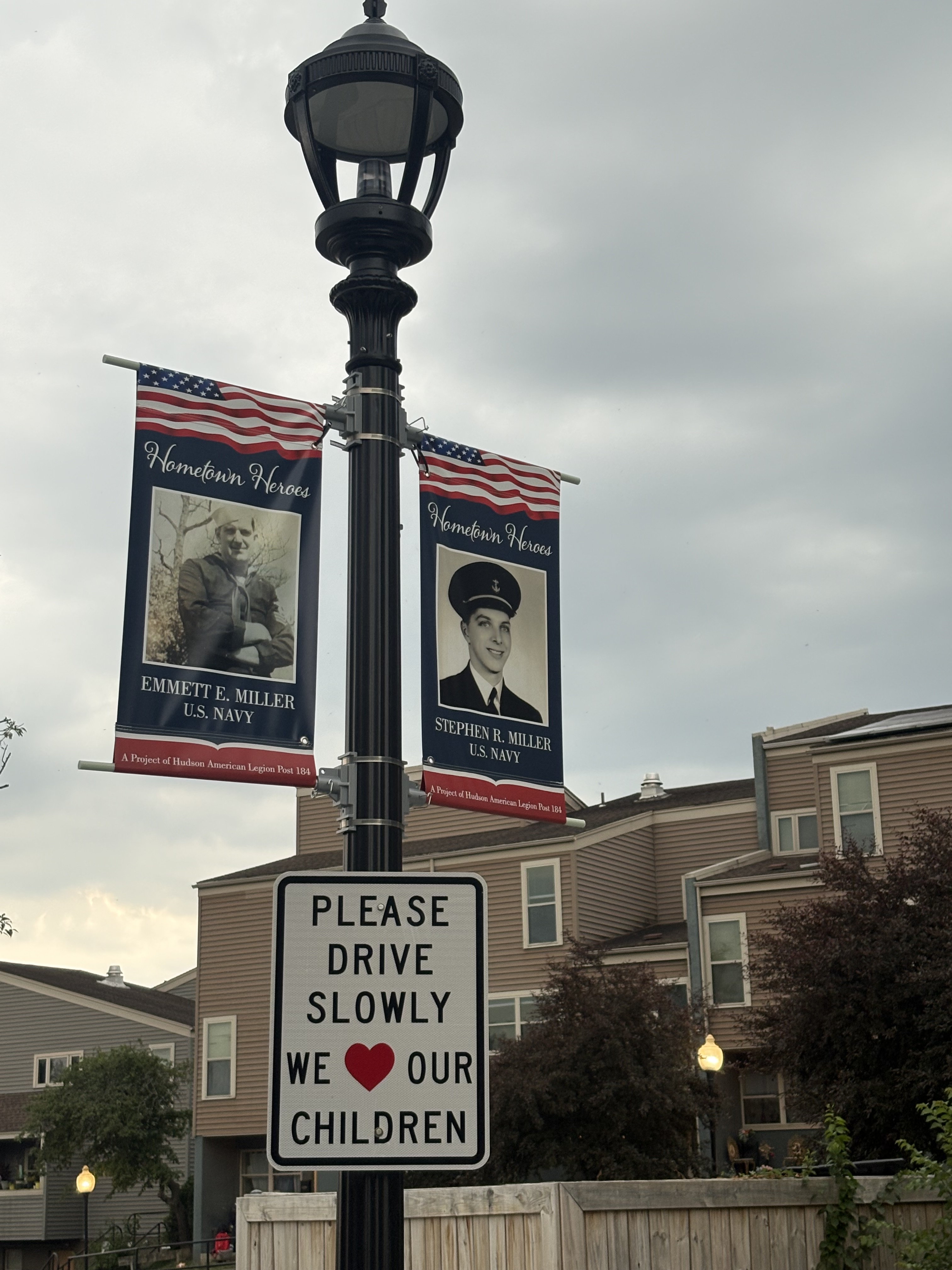
Street decorations in Hot Springs, Arkansas. Hometown Heroes decorating most lamp posts in the Hudson Valley (NY State).
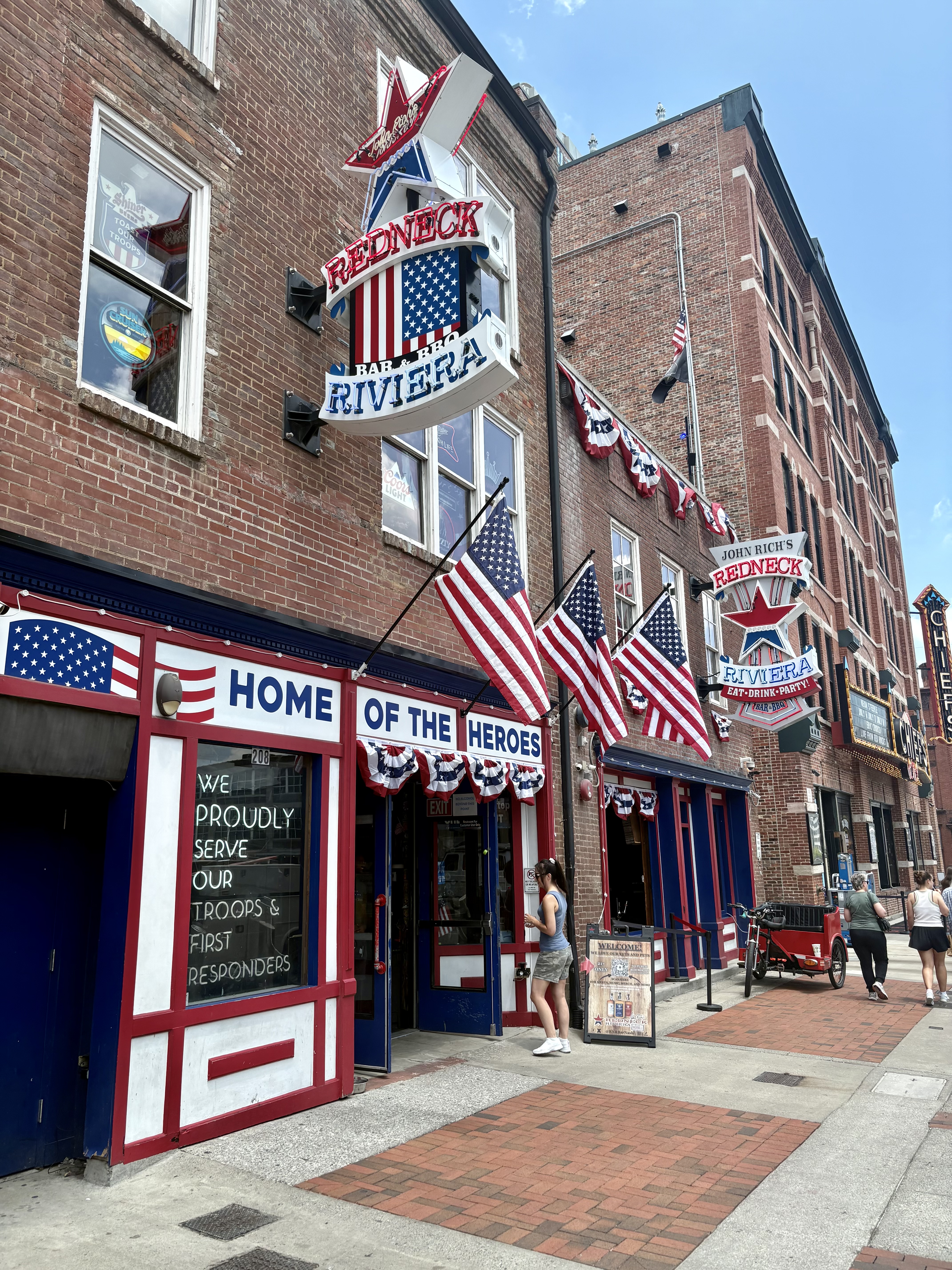
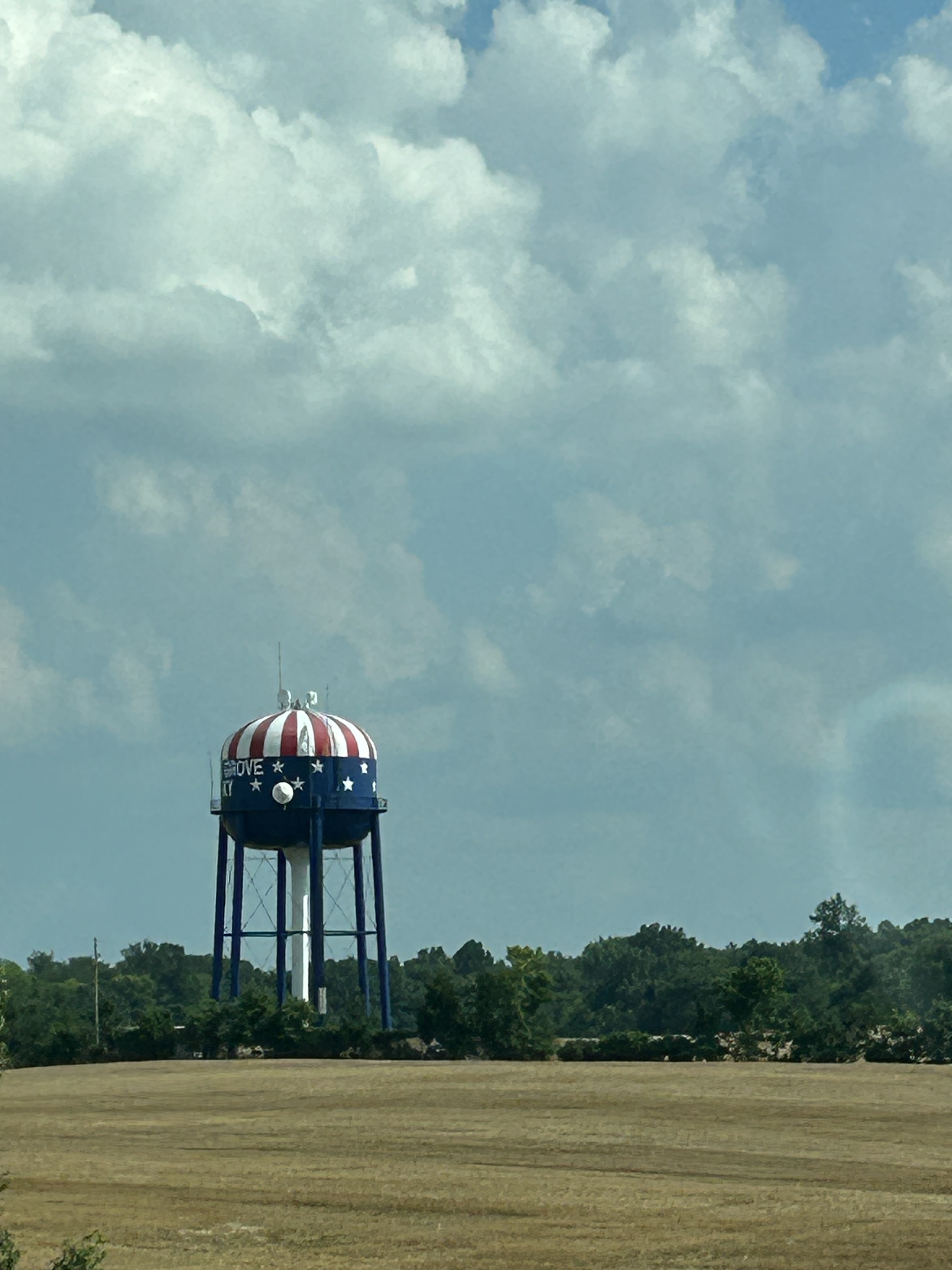
The Redneck Riviera Bar in Nashville’s Broadway, ‘proudly serving our troops and first responders’. [The ‘Redneck Riviera’ actually could be said to run along the Louisiana/ Texas coastline.]A water tower near Pembroke, Kentucky. The words might say ‘We love Kentucky’. One of many decorated like this we saw.
The Kody Norris Show playing with enormous speed, power and verve closing out the night at the Grand Ole Opry.
We went out into the night and Nashville was ablaze with fireworks, a peak hour’s worth of honking cars, drunks yelling greetings to each other and the world. It was appallingly difficult to find our way home.
* * * * * * *
The President of the United States’ public birthday party took place on the White House lawn focused on an erection called The Claw. It consisted of a series of cage fights in which two men (in this case) fight each other almost bare-knuckled and almost without rules (‘No kneeing in the head when the opponent is kneeling or on the floor.’ ‘No eye-gouging.’ ‘No kicks to the groin.’ That’s about it.) It cost $60 million to stage. Members of the audience paid a lot to attend but the event still managed to lose half its cost.
On completion of the main event, the winner announced, ‘I’m from America. Two hundred and fifty years ago we were way bigger than six-to-ten underdogs, and look at this country now.’
Among those attending were male members of the Trump family, Kash Patel, the CEO of Paramount (a deal in the wind), the Winklevosses, Mark Zuckerberg, (sitting near each other!), Kid Rock, the President of Poland, Joe Rogan, J.D. Vance, Marco Rubio and Pete Hegseth. This selection does skew male even if some of them seem to have gender anxiety issues.
After one of the events on the undercard the winner completed his amplified public ramble by yelling, and … ‘Michelle Obama is a man.’ Perversely in these circumstances this could have cast her in a very positive light.
* * * * * * *
According to a 2025 Ipsos poll, nearly 60 percent of Gen Z men (14 to 29 year-olds) say that their country has ‘gone so far in promoting women’s equality that we are discriminating against men’.
* * * * * * *
We listened to quite a lot of country music while we were driving. It was what was on offer but also there is often something quite telling in the lyrics. ‘Three chords and the truth’ don’t they say?
We were driving through the suburbs of Houston on our way back home from the H-E-B supermarket, itself a considerable entertainment, when I heard this song. It’s called ‘Gary’. The first line of the chorus is ‘There ain’t a lot of boys named Gary these days’, and it got me in. I think the clip builds a story that’s a bit grand for the sentiment. I like it like I heard it, in a lower key. But I thought it might have something to say about one stream of American life. (I also thought that John G with whom I had been corresponding would know what it was about.)
* * * * * * *
Elsewhere I have written about New York State’s public buildings. They’re not in New York; they’re in Albany, the state capital, and they are prodigious. Rockefeller prodigious. We went to their Museum, and saw a great deal of interest. But we stood just here for 15 minutes, transfixed, watching the video.
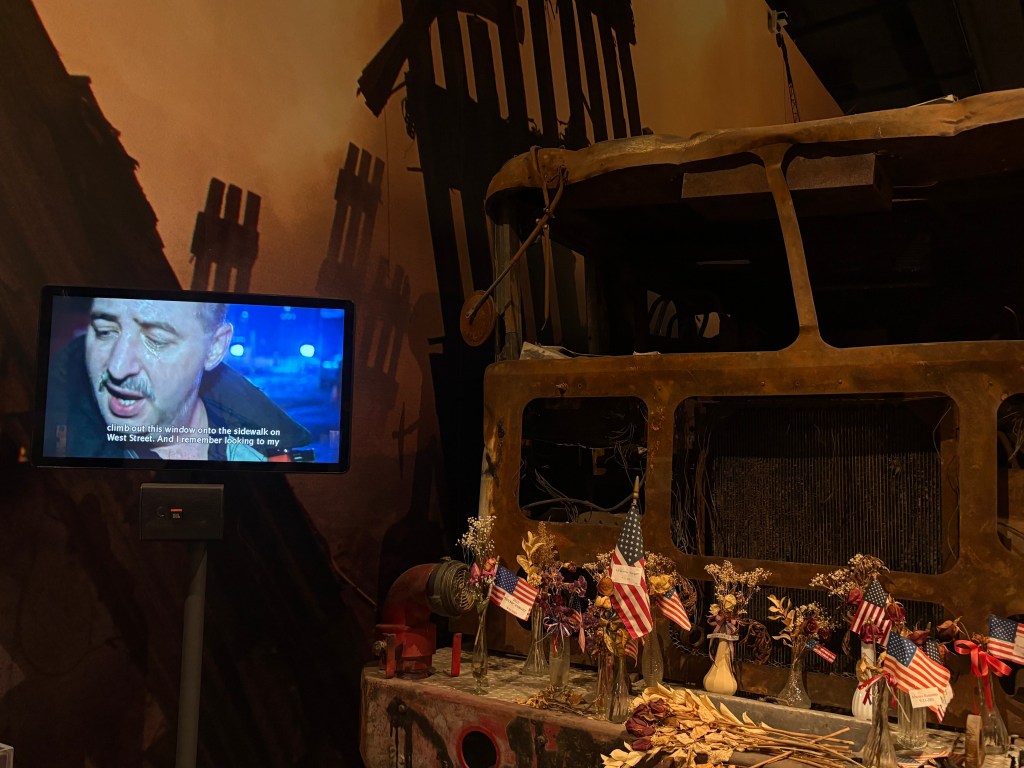
Below right is one of the fire trucks which attended the World Trade Centre disaster. It’s front is throughly burnt out. The back half still has its paint and fittings which were protected by the collapsed foot bridge which crushed it. At left is Billy Green, a first responder who responded first.
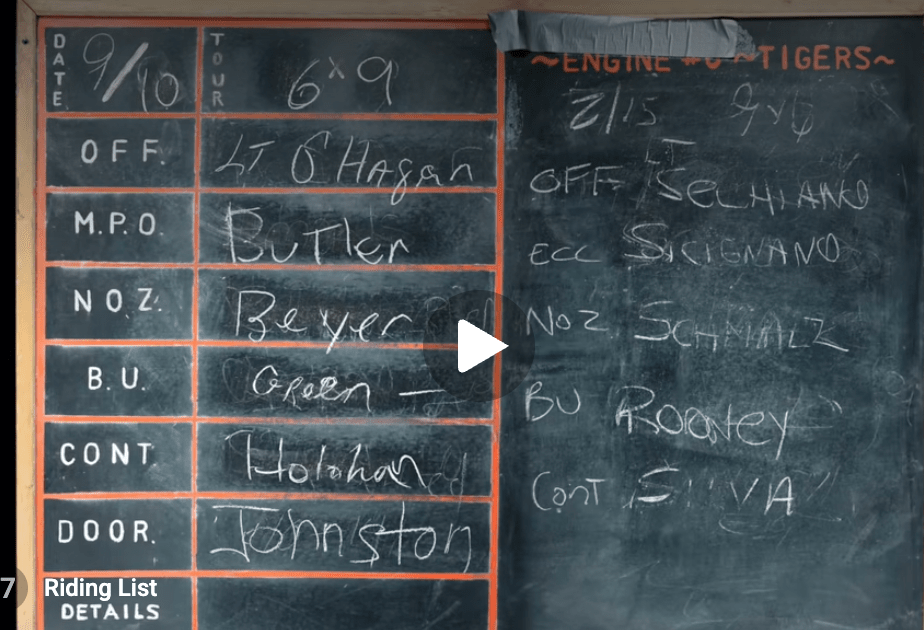
Billy, is not I think, a fireman any longer; but he was that day (which started on 9/10 and went into 9/11), one of a crew of six. The blackboard duty schedule of New York City’s Engine Company 6 for that day is mounted on the wall just behind the truck. The crew was the first to respond to the World Trade Center site on September 11, 2001. Their vehicle was a ‘pumper’, especially designed to push water all the way to the top of immensely high buildings, in this case two 110-storey towers. (Perhaps only in America.)
The building was on fire when they arrived but not yet collapsing. I wish I could tell you everything he said. I wish you could hear it for yourselves. I remember him talking about trying to find a way upwards on the stairs through the crowds coming down, the air already full of dust and detritus. One of his mates stopped him and told him they’d been climbing for 75 minutes (with 60lbs of equipment) and they had only got to the 20th floor. Shortly after that point the radio ordered a withdrawal and they had to find their way down again, this time with extremely limited visibility and still trying to clear floors by helping people who were trying to do the same. They finally found their way to the exit but he became conscious of heavy thuds nearby, the thuds of bodies hitting the ground, the jumpers. Even with a face mask and oxygen equipment, he lost all vision after that. He remembers putting his arm up to his face and not being able to see it whatever was in the air was so thick. It was chaos. He was not aware of anything around him but tried to walk in a single direction. After some time he hit a fence and he remembered a basketball court in the area and thought he knew how to find the gate. He felt his way round the fence, found the gate and was able to walk for some further time before collapsing. He was eventually rescued; four other members of his crew were not, four of the 344 firemen who died.
Only 20 people were rescued alive from the site. At least 2823 people died. There could have been more. There were fewer people in the building than normal because a vote was taking place and people were taking the opportunity to go to polling places before work. It was also the first day of the school holidays.
Over nine months the wreckage from the disaster, weighing 1.8 million tons — 108,342 truck loads — was taken to a place on Staten Island called Fresh Kills [‘Kills’ which recurs in place names in New York State and elsewhere in New England is a Dutch word for ‘creek’.] where it was sifted and sorted more carefully for a second time. An unusual proportion of the people involved in this task became sick as a result, not just from the copious amounts of asbestos in the buildings but the contact with dozens of other toxins as well.
But it will be Billy’s story, and his telling of it — still obviously indelible, both real and painful — that will stay with me. Nothing ersatz or ceremonial about that. And that too, is America.
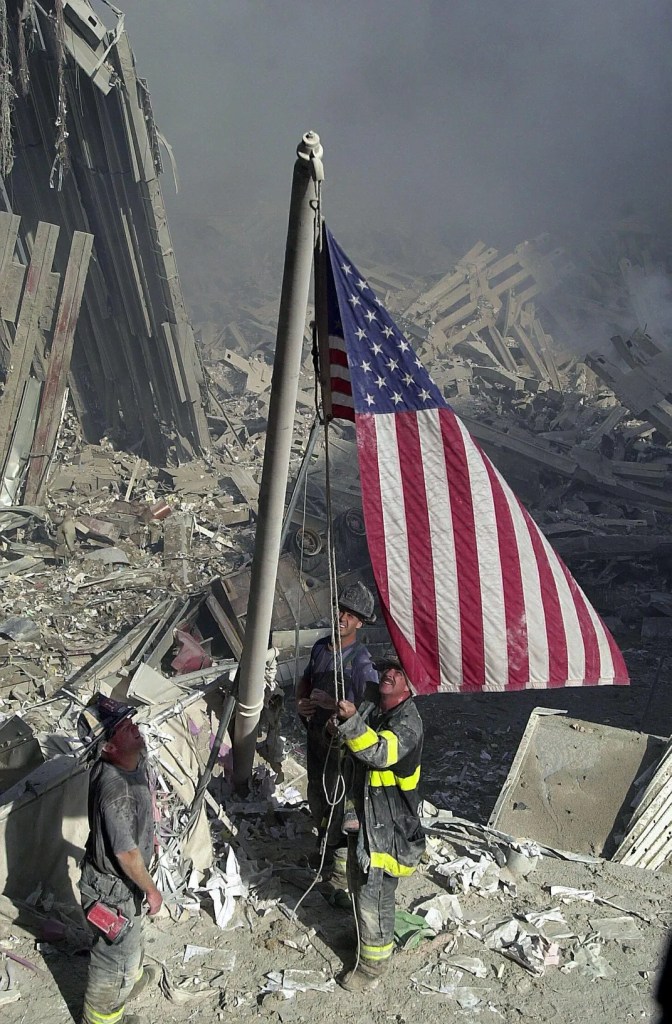
The first thing the firefighters did at the site when they were able was to raise the flag.
* * * * * * *
We are standing under the Gateway Arch at Saint Louis, July 3. Below us again is an auditorium where, in a most moving ceremony, 40 or 50 people have just received their American citizenship. There was much excitement and fervour among the new citizens.
First, you must be able to drive. After an hour’s wait eavesdropping on the most improbable accounts of misfortune and attempts to represent oneself other than one is/was and to magically change the size and seating arrangements of vehicles, we were granted a nearly new Rav4 Hybrid. Could one have wanted anything better? No. Toyotas are so intuitive and easy to drive. Could I drive it on the wrong side of the road? Yes I could. Only two bits of weirdness on consecutive days with a divided road in Galveston.
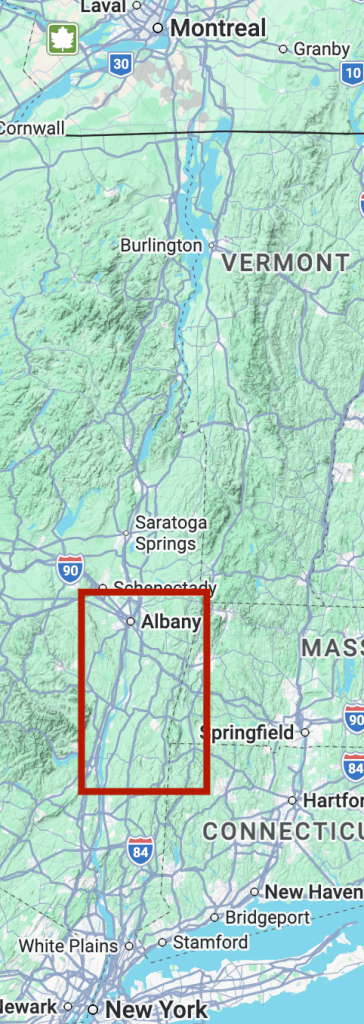
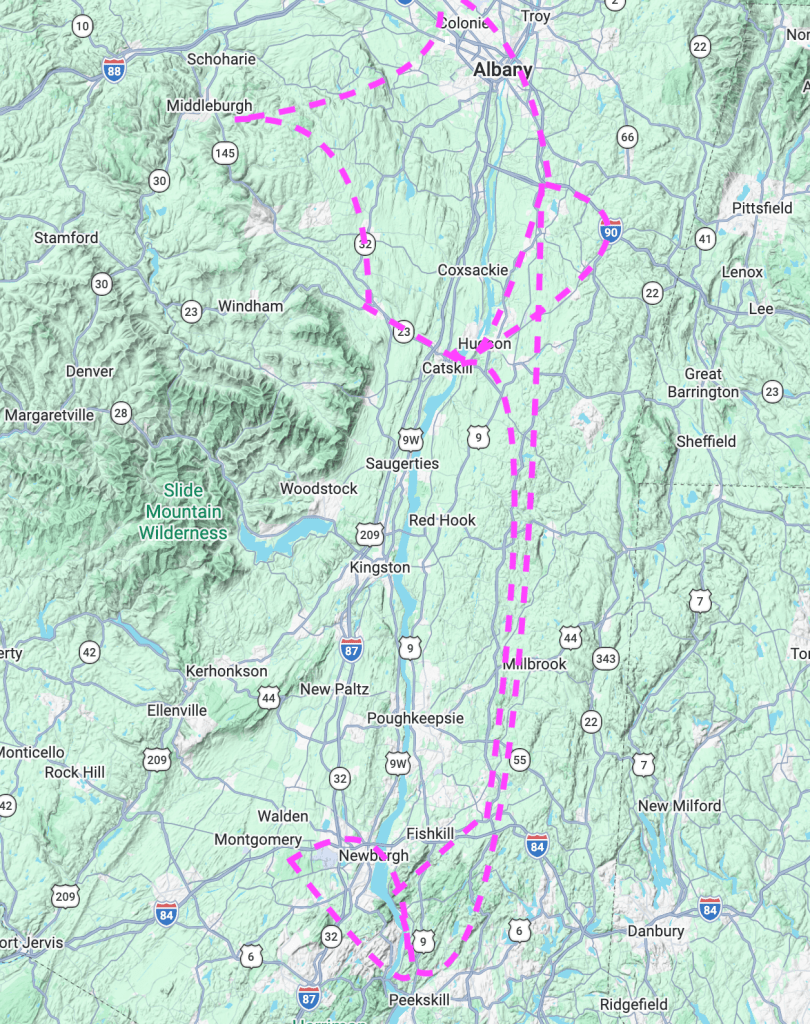
We were driving to look rather than get somewhere. At this point it was emphatically the journey rather than the destination. So we wanted to stay off freeways. To leave an airport that’s harder than it sounds. Besides Albany doesn’t so much finish as merge into a dozen or more towns: Schenectady, Watervleit, Colonie, Waterford, waves of lighter and heavier development, a shopping mall here, a nature preserve there. We were shooting for Guilderland because I liked the sound of the name.
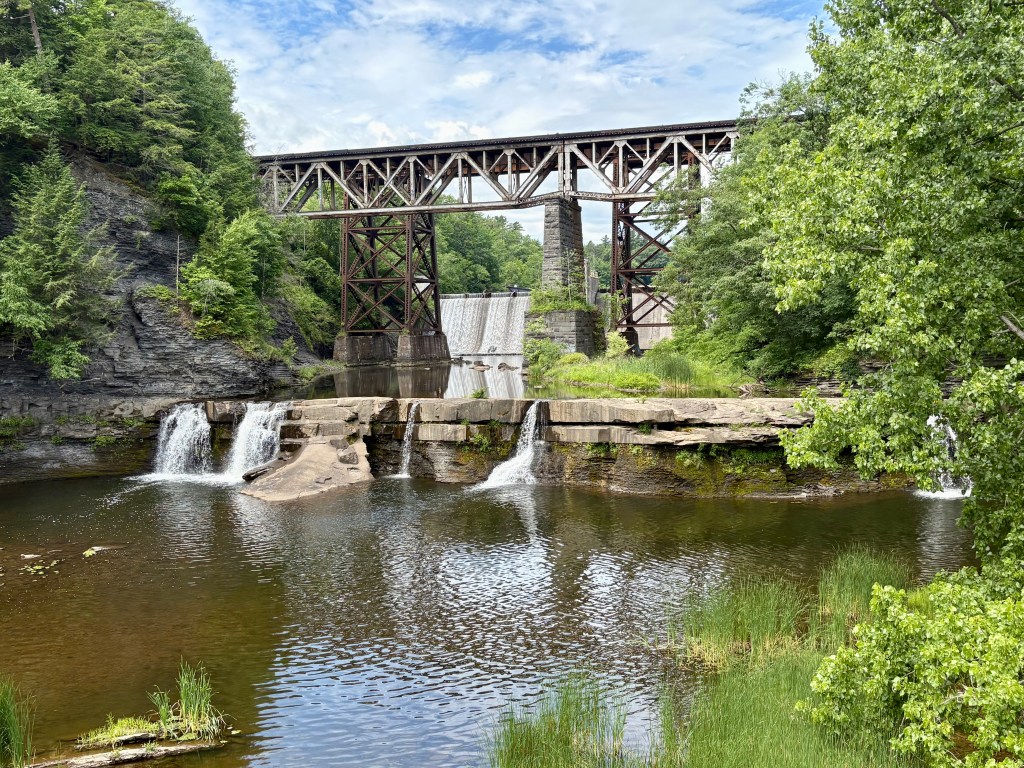
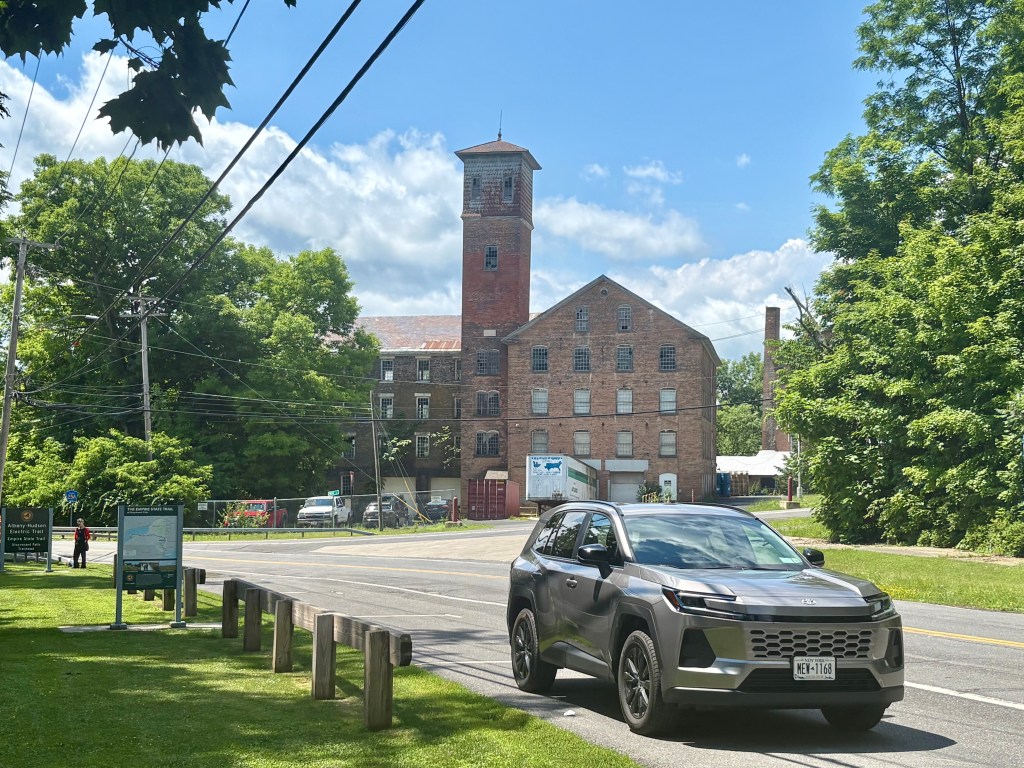
And because we could visit French’s Hollow Falls which were unremarkable except for the very strange girder structure underpinning the rail line.
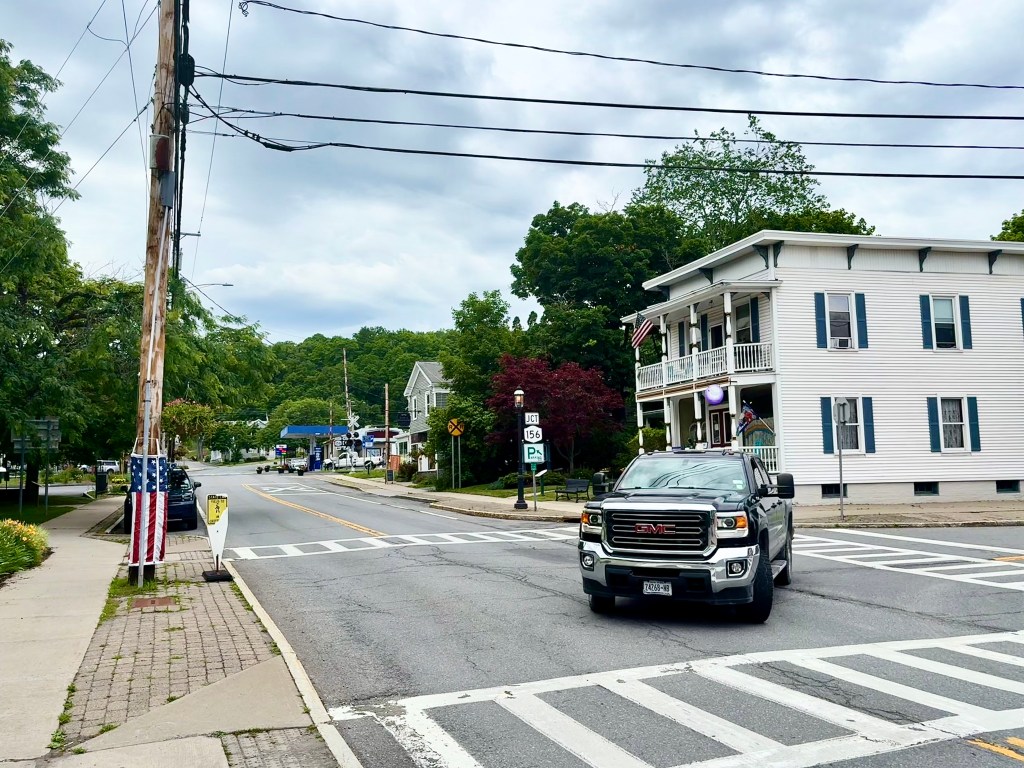
And we could visit Altamont (main street at right) and I could think about the Rolling Stones and their disastrous concert, except of course it wasn’t here at all. It was at the Altamont Speedway on the other side of the country not so far from San Francisco to which they fled in a deeply unseemly fashion. I could be allowed this mistake to some extent because we were just a few hills away from Woodstock. But then Woodstock didn’t happen at Woodstock either. It happened at Max Yasgur’s dairy farm near Bethel another 60 miles south.
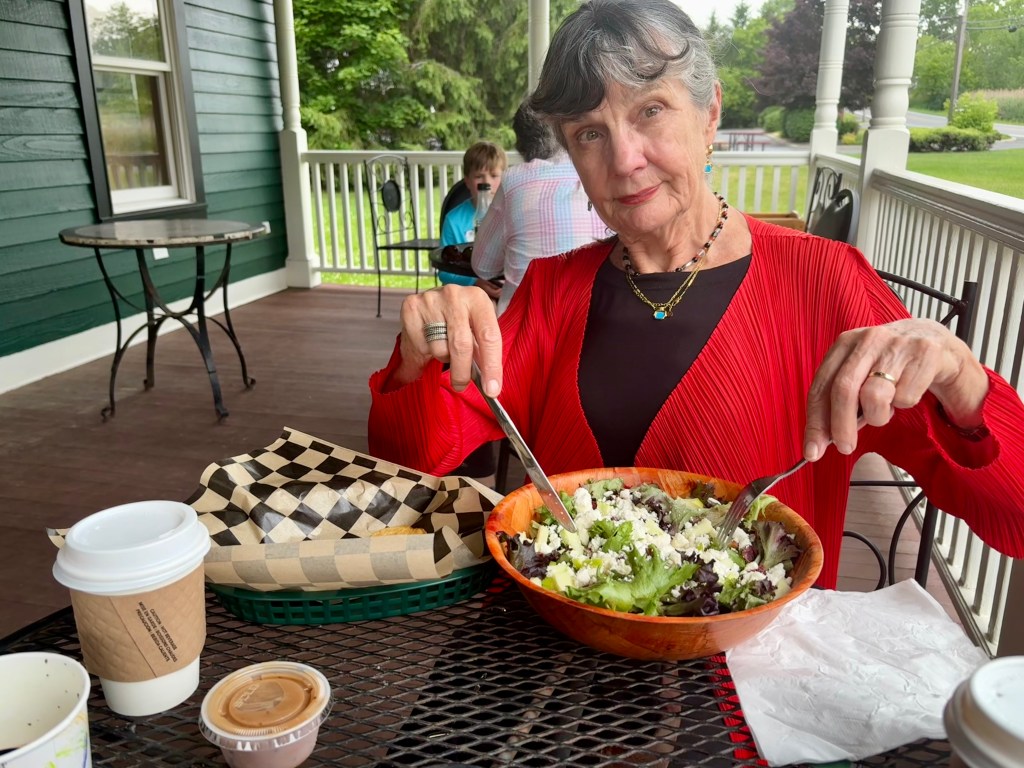
The identifier for this photo says ‘Slingerlands’, but it is more likely to have been New Scotland at Emma Cleary’s Cafe where this is what happens if you ask for a salad.
Nearby was the first sign that we saw saying “Nobody Voted For This. Stand Up. Speak Out.” The first of quite a number, along with others saying: “Stop Marxism from destroying the country.”
John Boyd Thacher State Park, East Berne, Renssalaerville, Medusa, Greenville, Freehold, Earlville, Climax, Coxsackie, Athens. Quiet little towns where better days have been seen. Not so long ago Upstate New York was a powerhouse of industry and enterprise. General Electric, IBM, Kodak, and Xerox were established here, and don’t those names sound just a little bit last century now. Empty shops, quiet streets … a civil and verdant version of the Rust Belt.
Then a choice between Catskill and Hudson to spend the night. Not much between them really except that Hudson had an Opera House. They both had views of the Hudson. What looks like it might be a boat is a lighthouse. The other photo is a bit Hudson The Town-esque although he is standing near feast and floret, an Italian restaurant, which was humming.
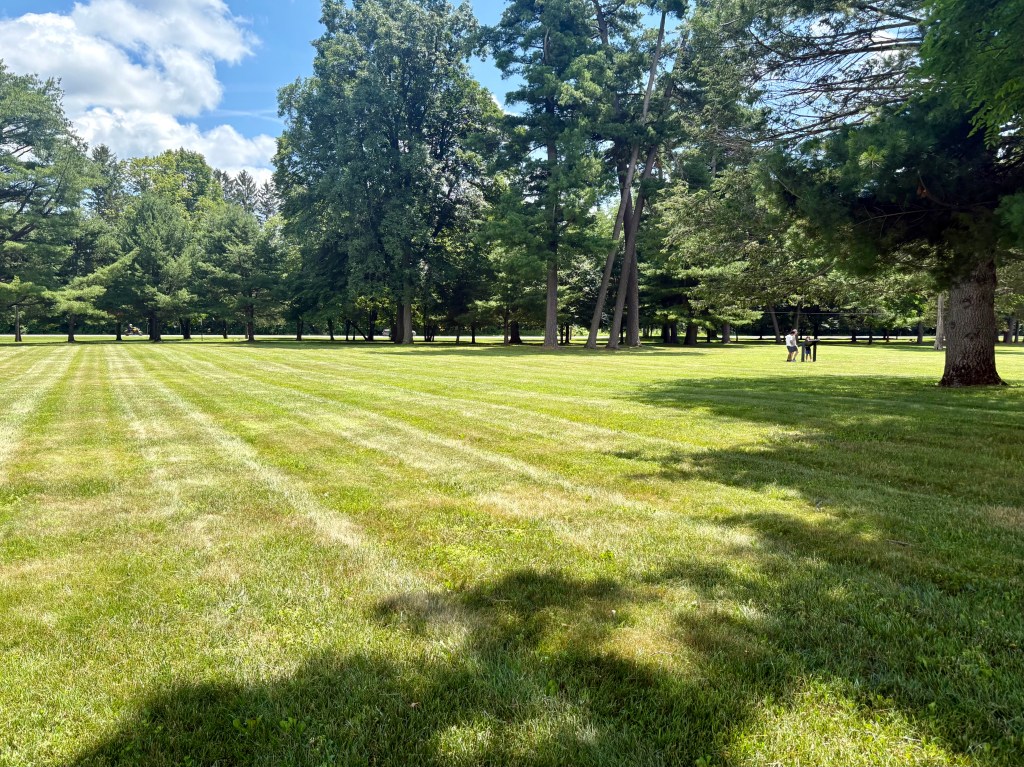
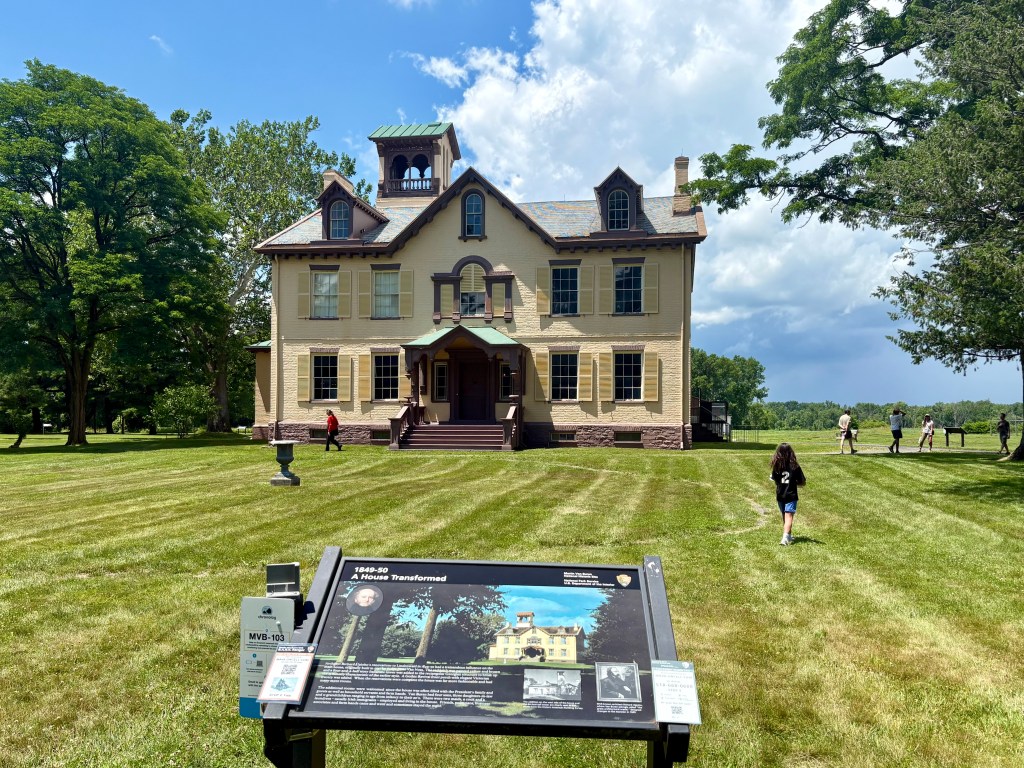
The next day we went looking for the house of Martin Van Buren, the eighth President of the US and the first to be born after the Revolution and of non-British ancestry. We found what we found throughout our version of the US, not so much gardens as vast expanses of lawn, tended, mown and cherished with love and pride.
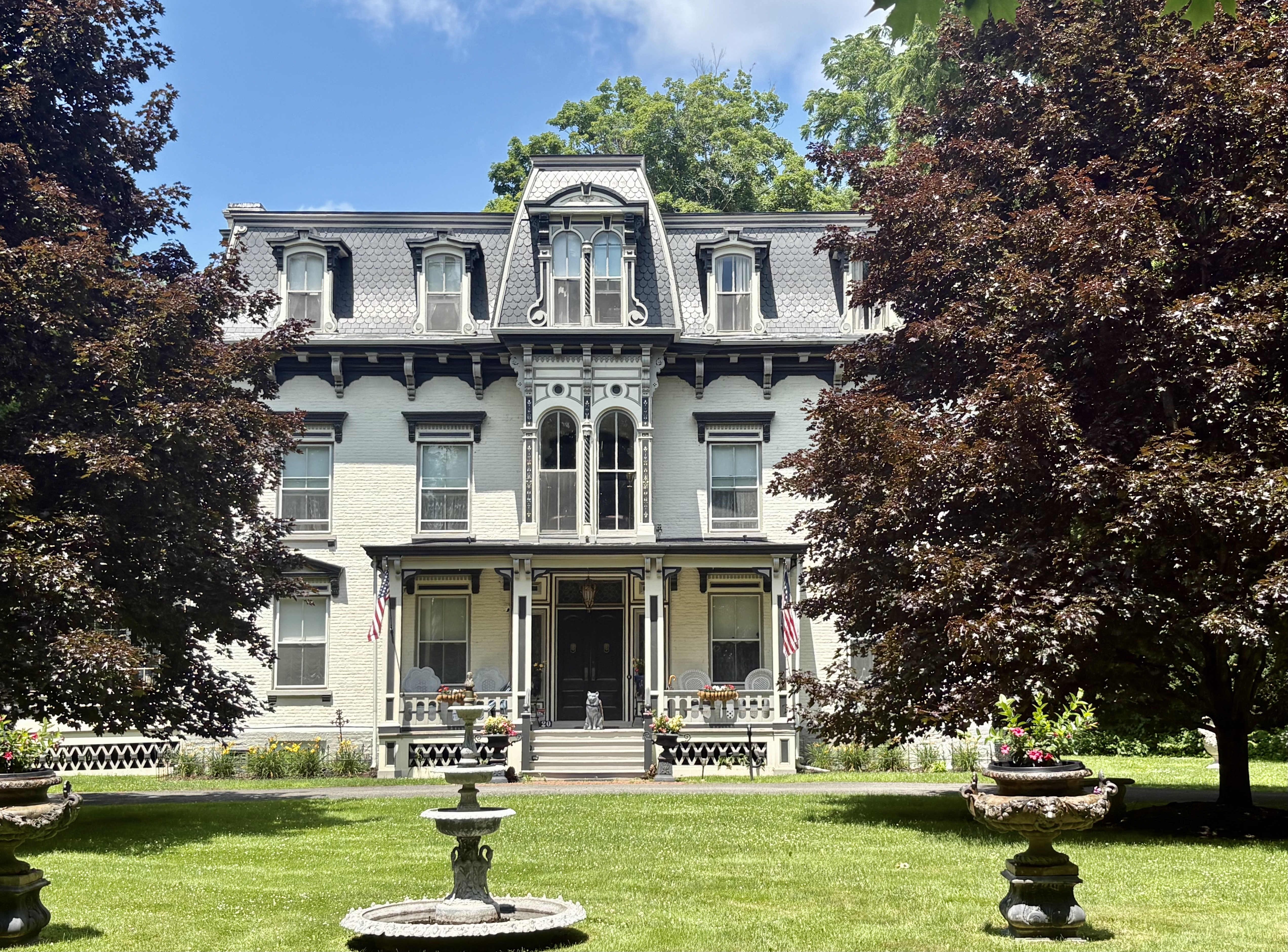
That’s Martin Van Buren’s front yard. This is his house.
You had to have a guided tour. The last guided tour had just left. It would be some time and some expense till one could join the next. What could be in there that would justify the wait? We didn’t. Applauded warmly and left.
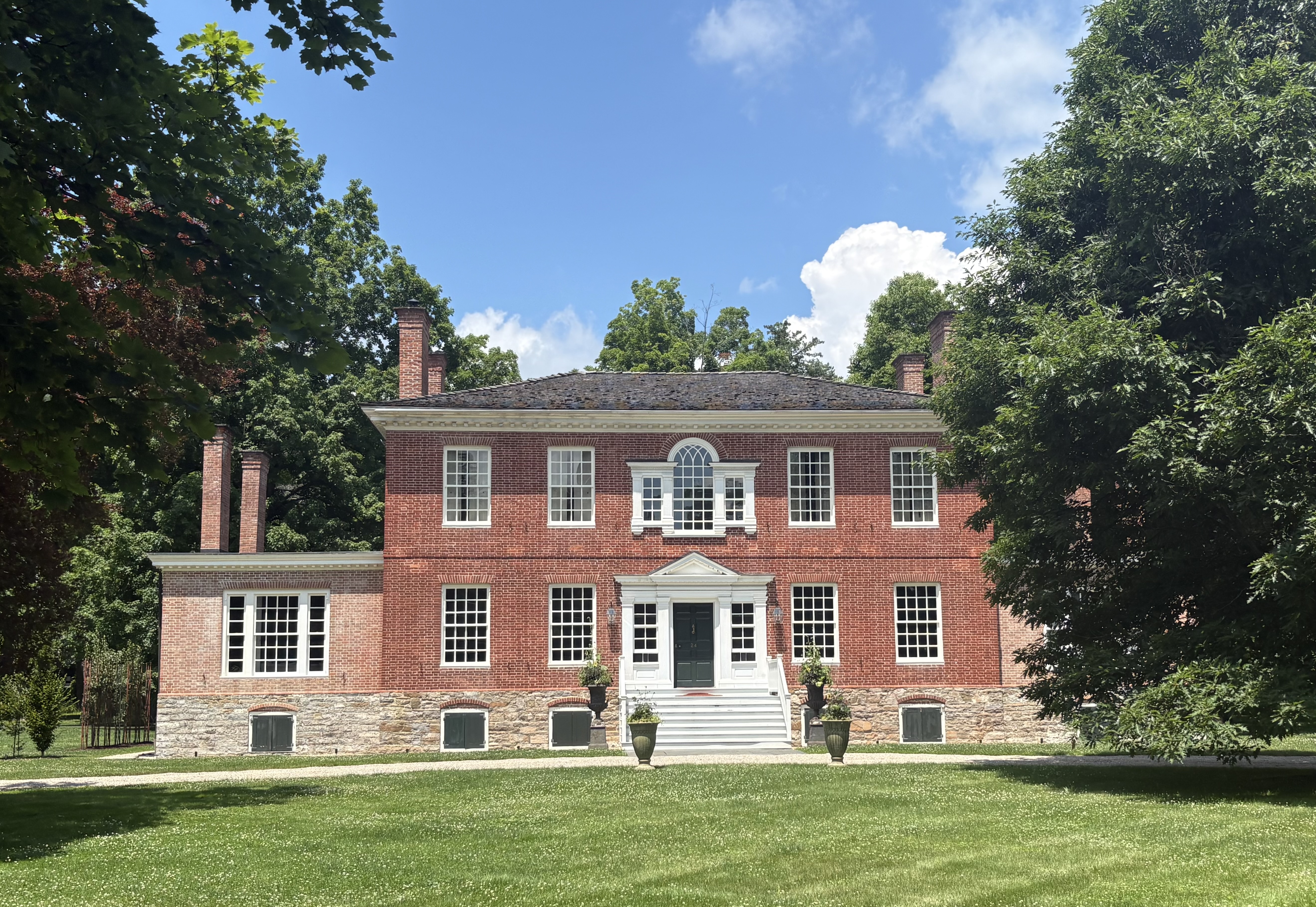
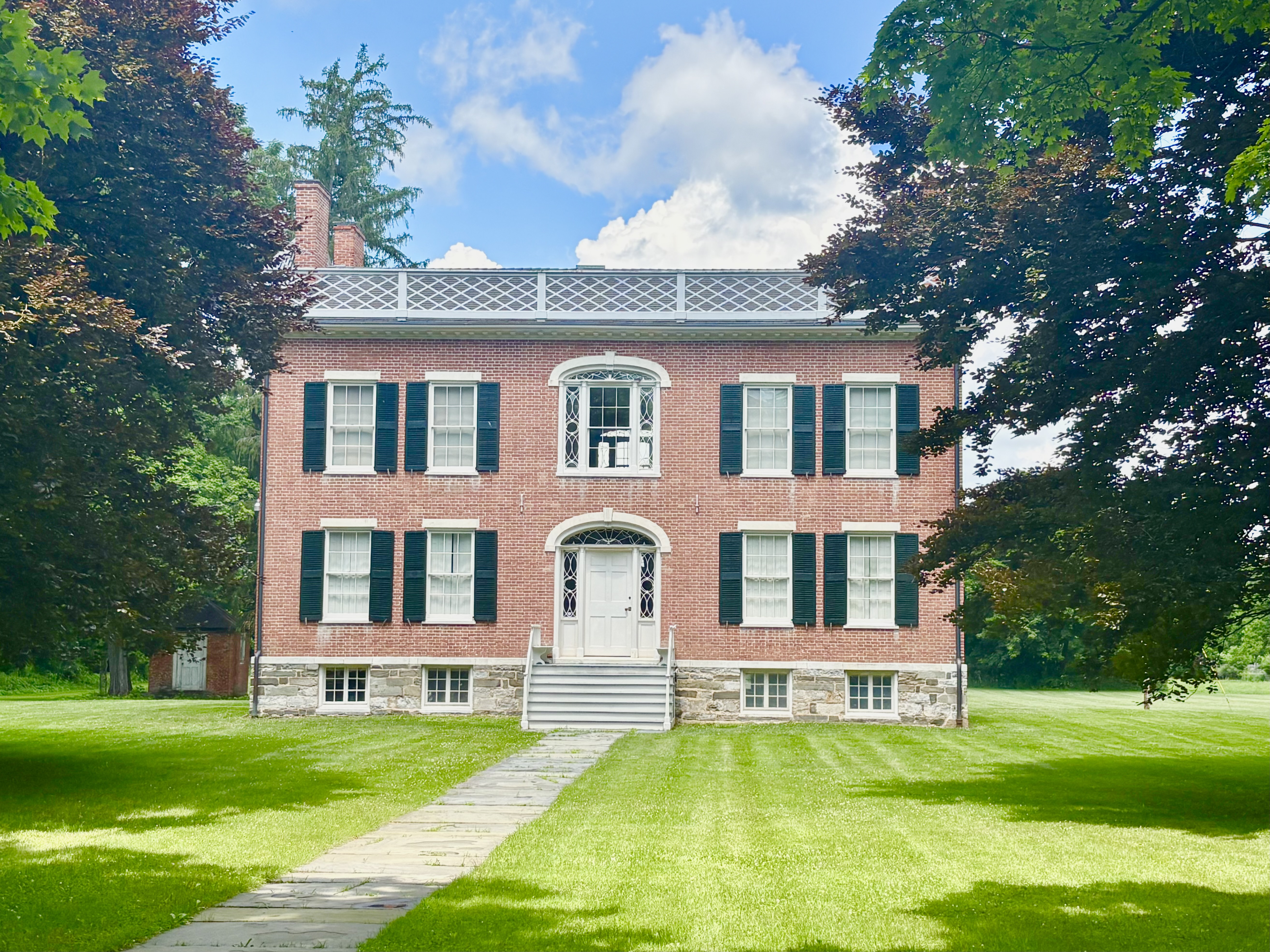
But we did find an avenue of interesting houses on their own fenceless expanses of lawn. We are at Kinderhook 20 minutes drive north of Hudson.
They each have plaques. The one related to the house at top right explains that the British General Burgoyne ‘was entertained’ in this house after being removed from the Battle of Saratoga as a prisoner of war. The two Battles of Saratoga fought on September 19 and October 7, 1777 just north of Albany — the target and the prize for both armies — were a major turning point in the Revolutionary Wars. The British were emphatically defeated, the ‘Americans’ gained new resolve and vigour and, most importantly, the French chose to become full partners in the Americans’ struggle.
Immediately on the other side of Rothermel Lane is the Benedict Arnold House.
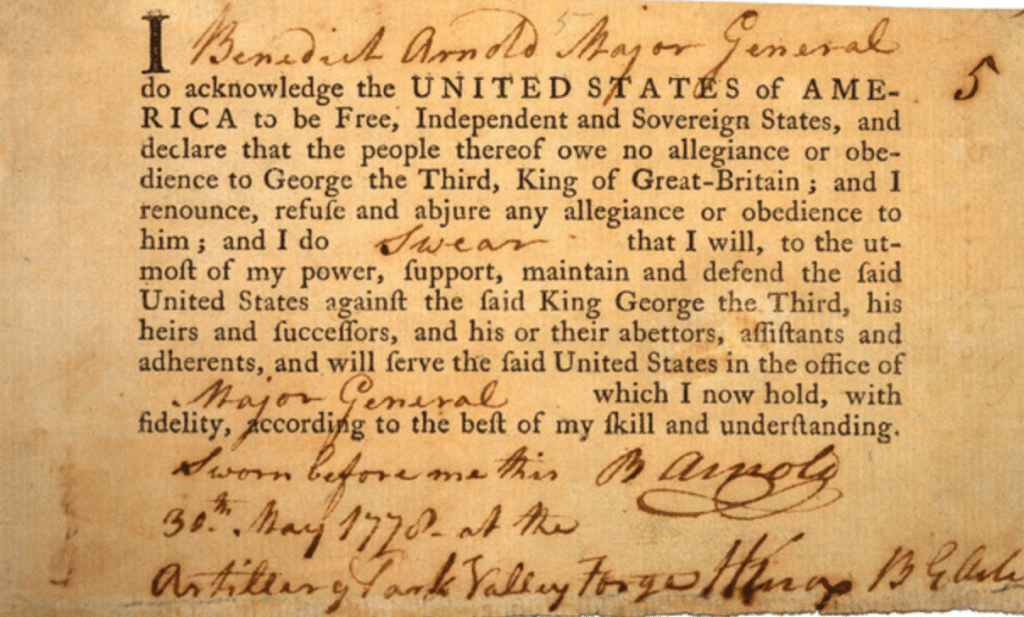
The American Generals at Saratoga were Horatio Gates and Arnold. Yes Benedict Arnold, an American synonym for the worst kind of traitor. He didn’t get on with Gates and, in a very short version of the story, felt that his achievements at Saratoga and elsewhere were insufficiently recognised. He married into a Loyalist family (ie Americans fighting for the British) and negotiated via his brother-in-law to become an officer in their army and to be paid a substantial sum of money in return for surrendering West Point of which, at the time, he was in command. It’s a long and fascinating story which includes being incriminated from evidence found in his brother-in-law’s boot. He escaped and did fight for the British; his brother-in-law was hanged. But no one argues that he wasn’t a brilliant general.
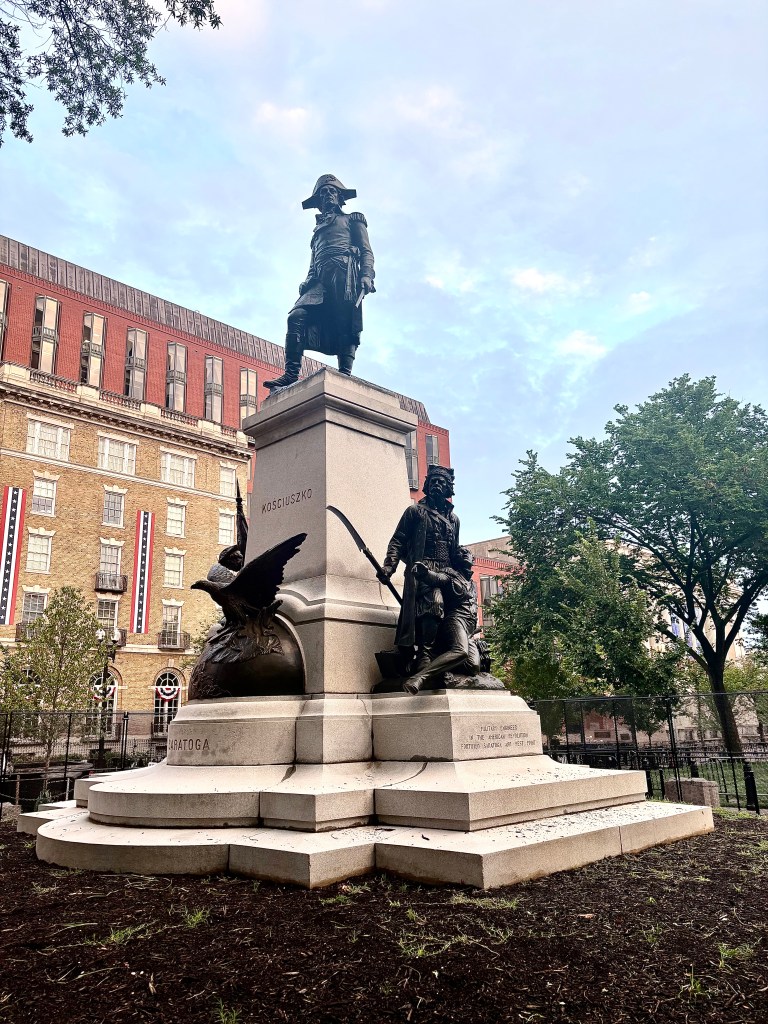
It is generally agreed that his strategy at Saratoga was decisive, along with the brilliant defensive engineering of Tadeusz Kosciuszko whose memorial statue can be seen both here and very prominently on the corner of Lafayette Square adjoining the White House lawns in Washington. And that is OUR Kosciuszko (‘ko SHOOS koe’ if you want to pronounce it like a Pole.)
He fought for the Americans for seven years without payment, was a war hero in Belarus, Poland and Lithuania, embarrassed Napoleon, led an uprising for Polish independence, was a good friend of Thomas Jefferson and left whatever money he had when he died to ‘the betterment of the American Negro’.
What a guy.
His fortifications are still evident at West Point where another memorial statue stands in another prominent position overlooking the Hudson.
He never came to Australia of course. It was Pavel Strzelecki (‘shtriz LIT ski’ if you care) who named the mountain, some people think incorrectly. The nearest mountain, Townsend — where just as it happens we spent the night of the turn of the millennium — has a mound on top of it which apparently looks very like a memorial to Kosciuszko in Kraków. The top of Mt Kosciuszko itself is a featureless hill. Townsend can look higher. Strzelecki may have been in error. [For the non-Australian reader, Mt Kosciuszko at 2228m above sea level (7319 feet for Michael) is the highest point on the Australian continent. Townsend is 19m lower.]
Our hero was born in Mereczowszczyzna. (I put that in only to encourage efforts at pronunciation and to see how many words you know that have four ‘z’s in them that aren’t sleep-related.) But we’re off track, except that Ann and Richard’s house in Garrison (garrison, get it?) is almost directly across the Hudson from the West Point statue.
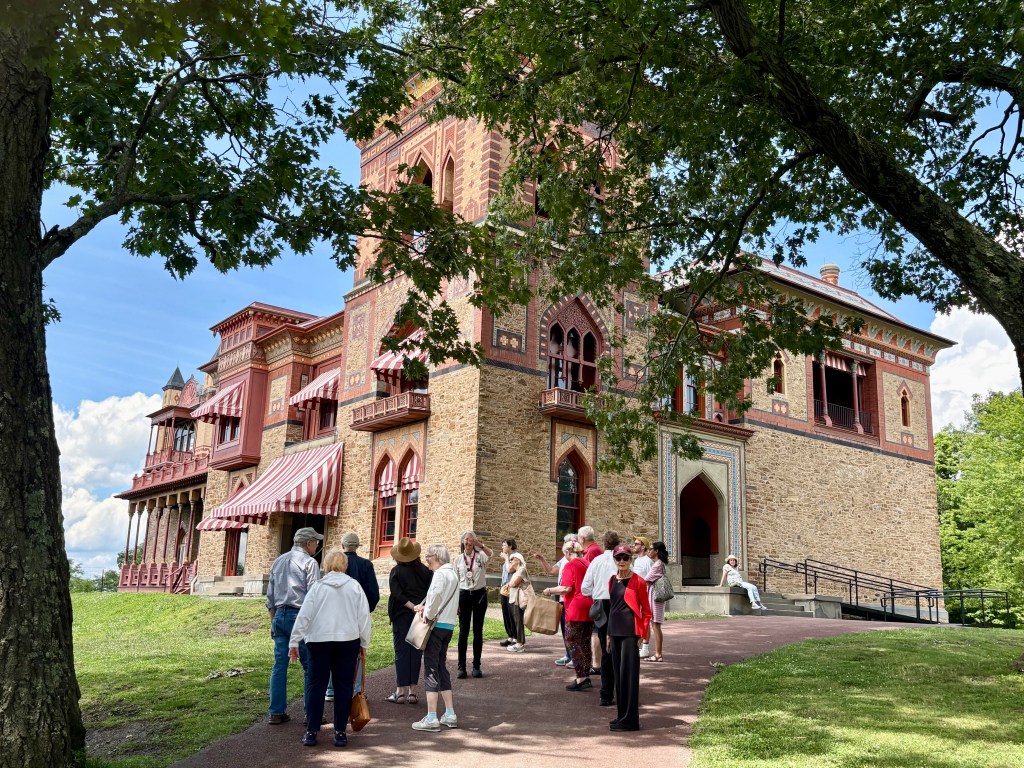
We were on our way to another grand house, Olana, home of Frederic Church, doyen of the Hudson River School artists and referred to in another one of these blogs.
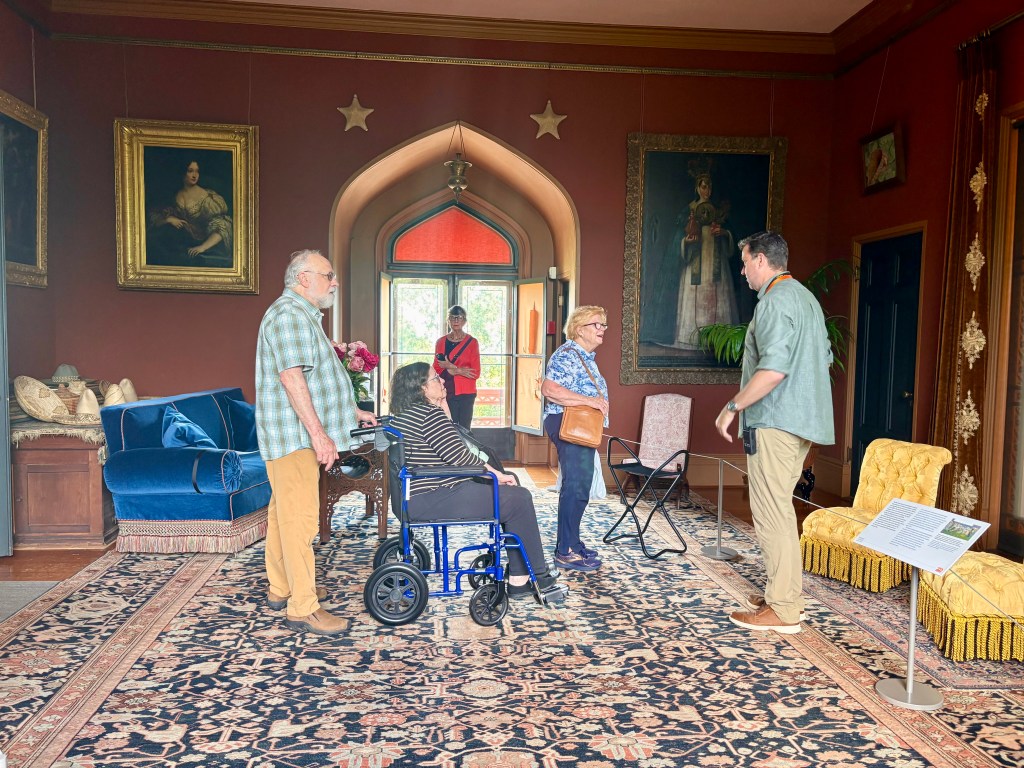
We could explore what was available to explore on our own, but in a fairly heavily supervised way. The American docent (‘a person who leads guided tours as a volunteer in a museum, art gallery, zoo, or park’, from the Latin ‘I teach’) is not to be denied.
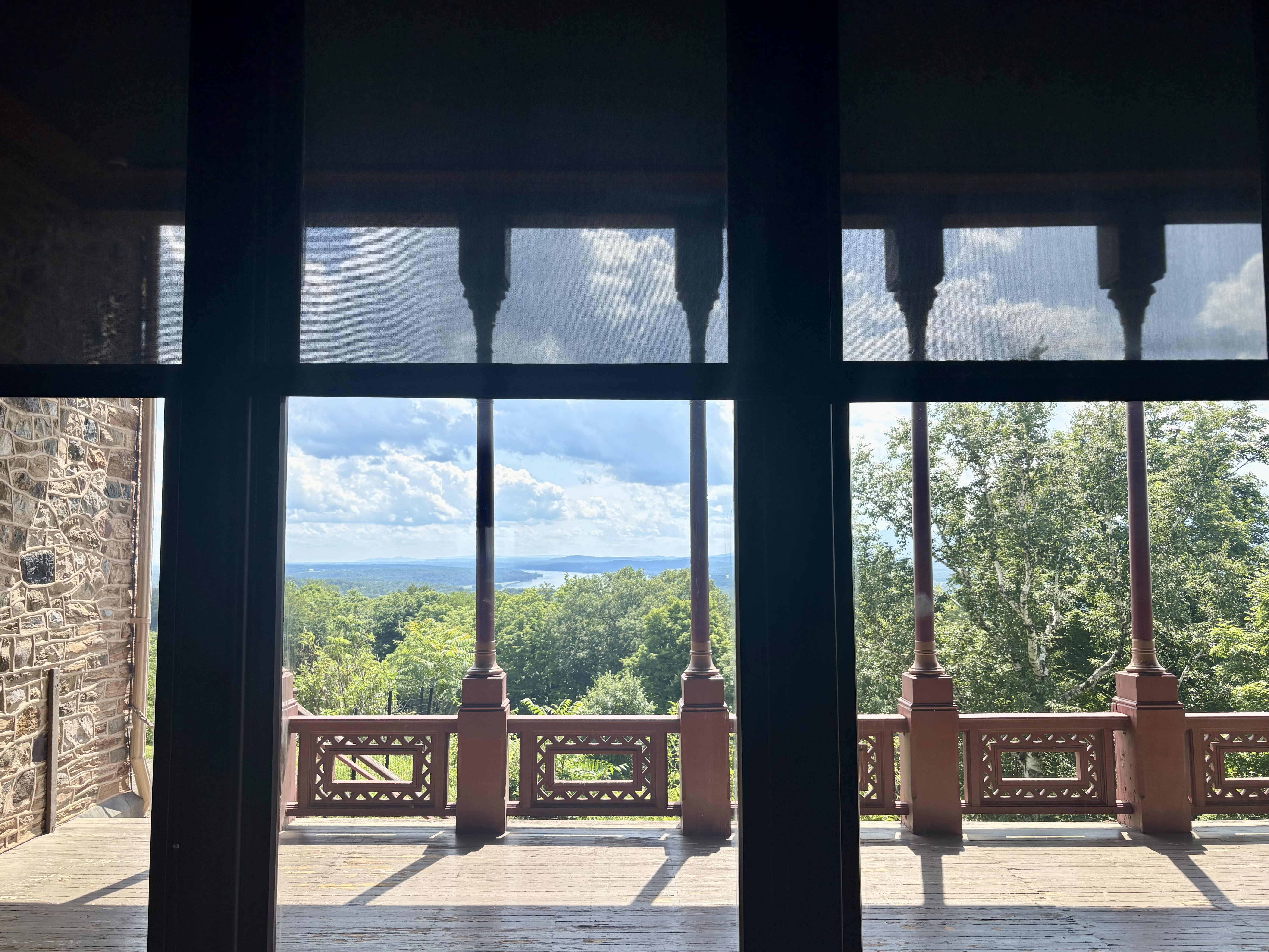
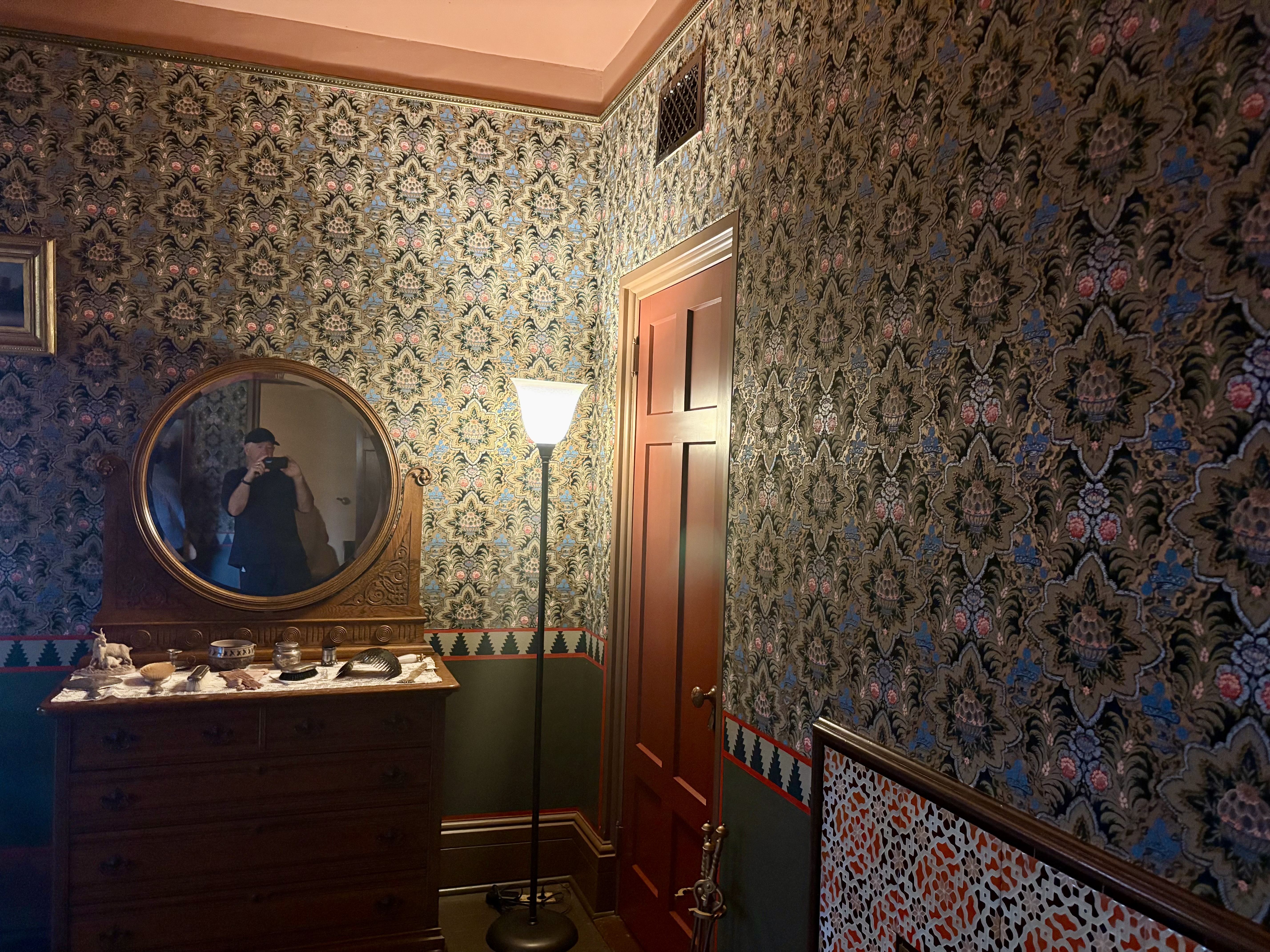
This remarkable house, ‘an Orientalist fantasia’ located on a 250-acre estate, also meticulously planned and curated, was built with the proceeds of an immensely successful career in art. It was commenced in 1870 and finished in 1872 with an extension a few years later. It is full of treasures both fixed, like the Moorish tiles, and loose, like an extraordinary collection of 19th century American and other art. Church treated the interior decoration as an artwork itself being very particular about colours and where they should be applied. He designed the wallpaper in the bedroom above as he did all the wallpaper in the house, and there’s a lot.
You see what I mean. And I just like this photo.
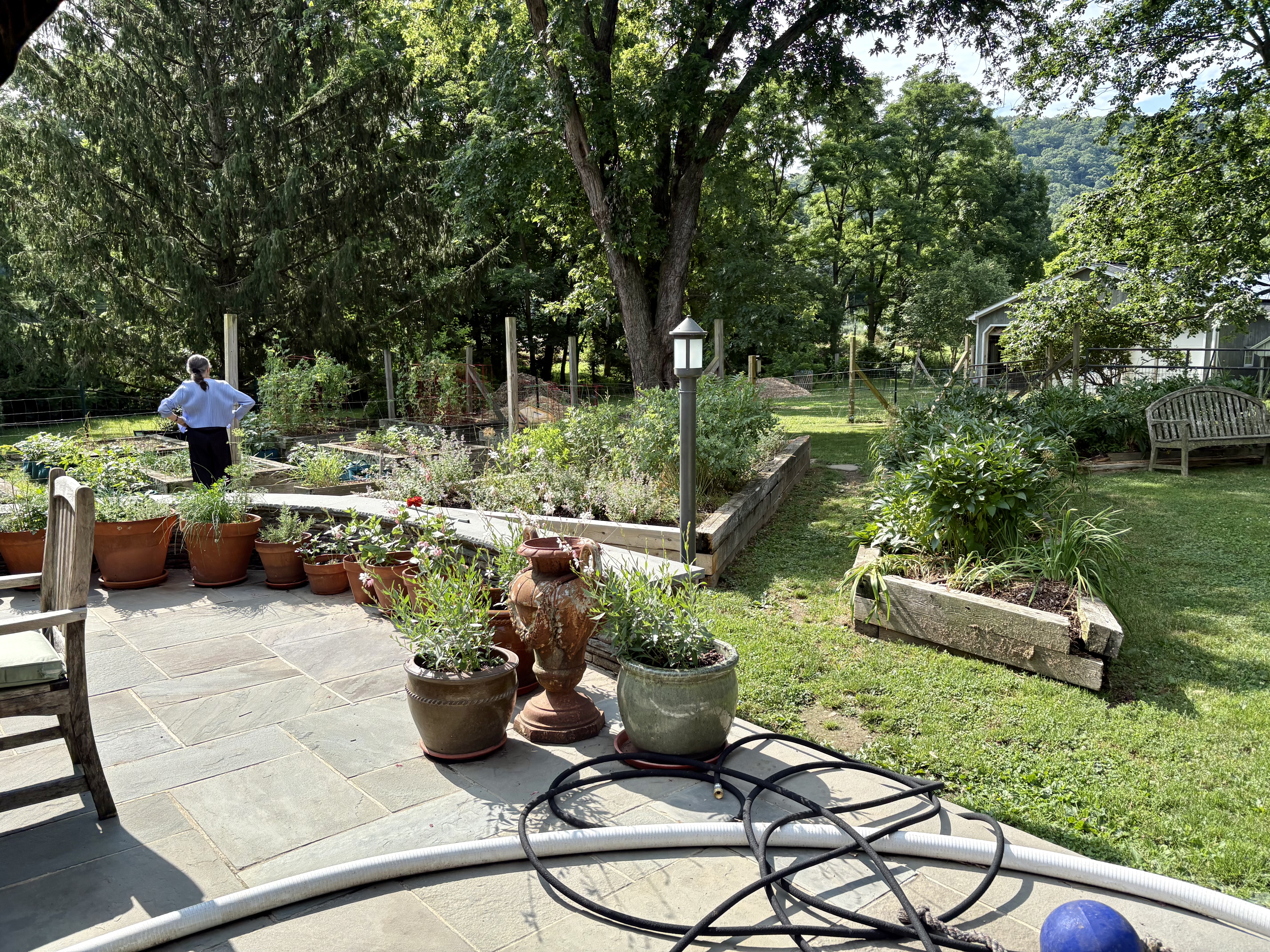
Off to Garrison to see our friends and their little slice of heaven. I used to work with Ann who went to work in America for the National Center on Education and the Economy 34 years ago. She met Richard at a school she was working with.
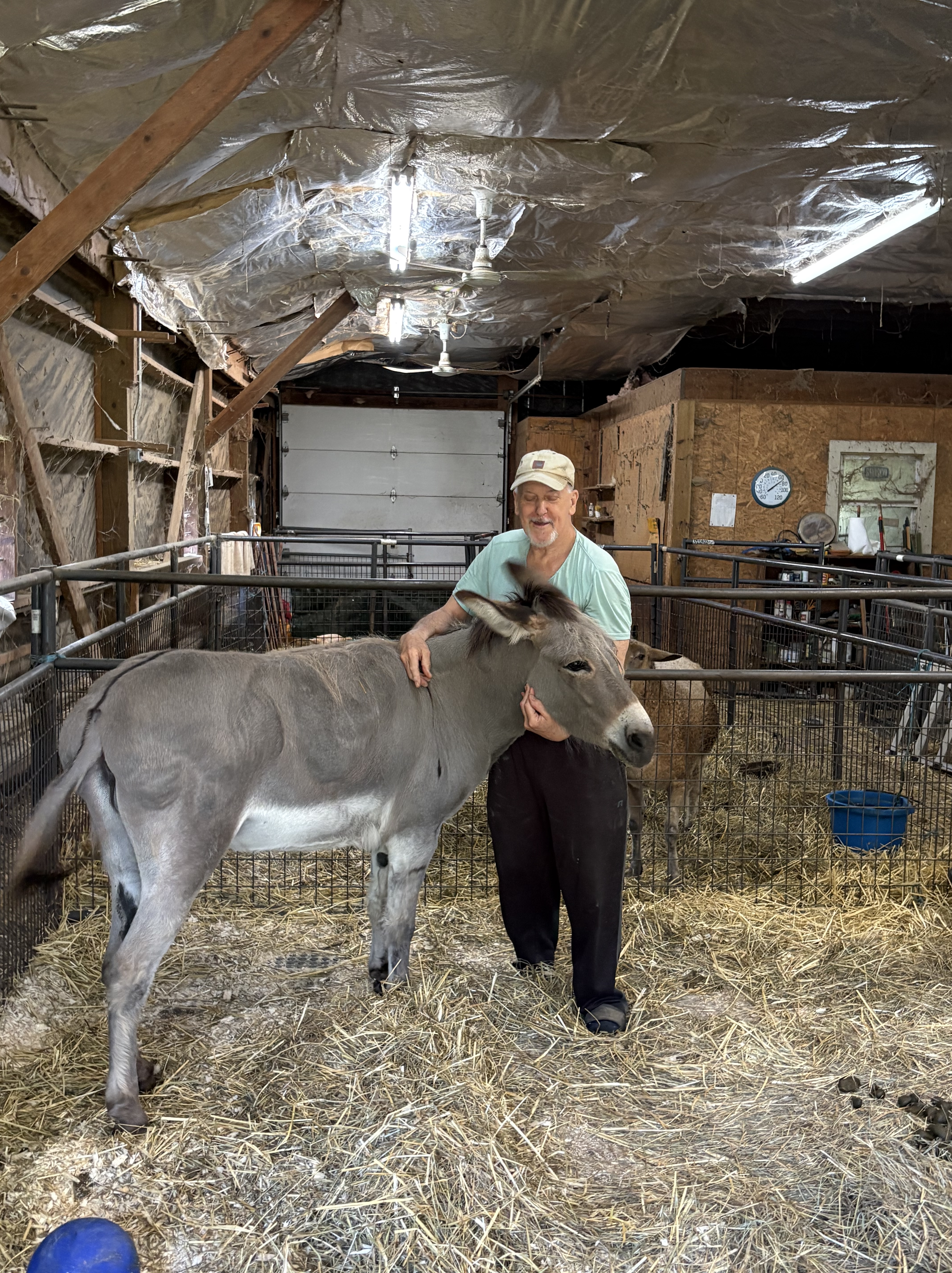
They live on a four-acre property with a barn and an eye-popping garden. They share the property with two very large sheep named Pluto and Jupiter, a rooster named Edgar and hens named Lavender, Peony and Lilac. Their ducks are Van Gogh, Toft and Thompson. The donkey is Venus.
The actual owners of the property are three poodles named Juno, Hemingway and Jackson.
We had come via the Taconic Parkway: ‘Its winding, hilly route was designed by landscape architect Gilmore Clarke [at the behest of FDR when he was President] to offer scenic vistas of the Hudson Highlands, Catskills and Taconic regions. The bridges and now-closed service areas were designed to be aesthetically pleasing. It has been praised for the beauty of not only the surrounding landscape and views it offers, but the way the road itself integrates with and presents them.’ America.
It was certainly a cruisy drive, very easy, but there wasn’t much in the way of views of any length. Dense vegetation — it might be what they call here ‘piney forest’ — lined both sides. That can happen. This is country where it seemed anything would grow.
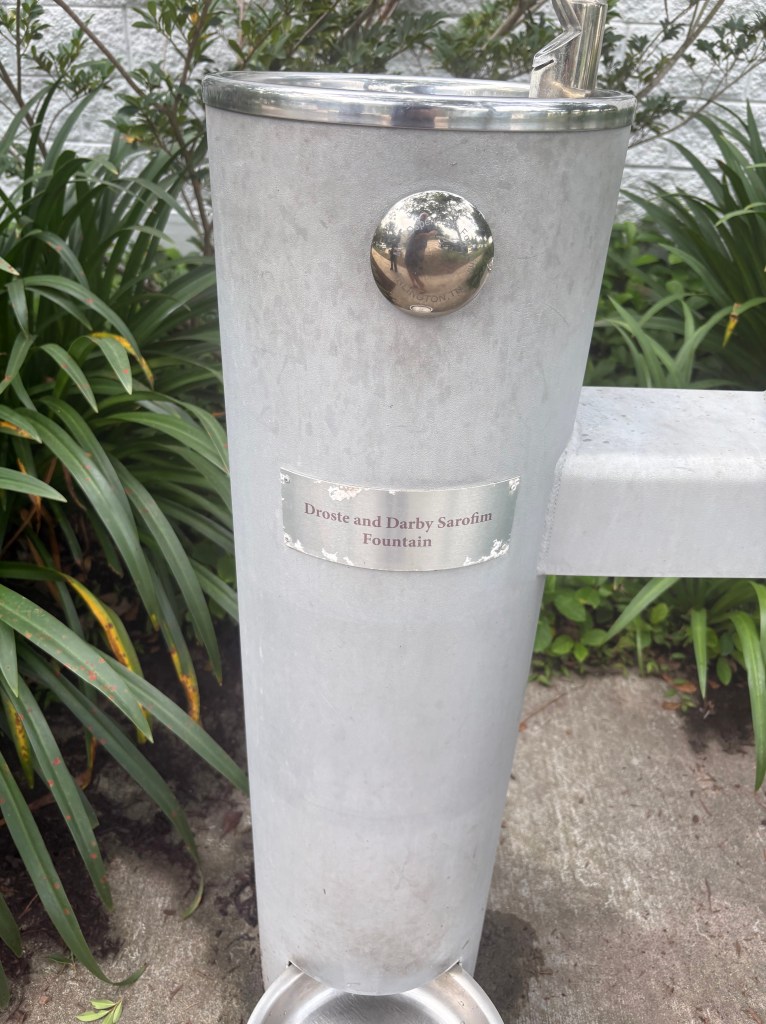
Ann had cooked up a vegetarian storm, a feast, and we talked about America and money and philanthropy and the naming fetish. We had passed the Private Melvin V. Byrok Bridge and the Hudson American Catholic Children’s Brigade Bridge. Later we were to encounter a section of a highway being looked after by the Baby Jesus Knights of the Templar, and this splendidly isolated drinking fountain in Houston which may have deserved a name, or not, is the ‘Droste and Darby Sarofim Fountain’.
I proposed that this might be part of the extraordinary web of motivational tools and processes in America, so very sophisticated and so very ubiquitous. The Americans told us about graduation ceremonies for kids from Grade Two where the kids wear academic gowns, and from Elementary School where the kids are driven around in loops so that the whole community can applaud them, the very widespread practice of clapping yourself and the naked pleasure of telling others how successful you’ve been. IT IS HOW YOU GET ON. Of course. Sometimes the obvious really works.
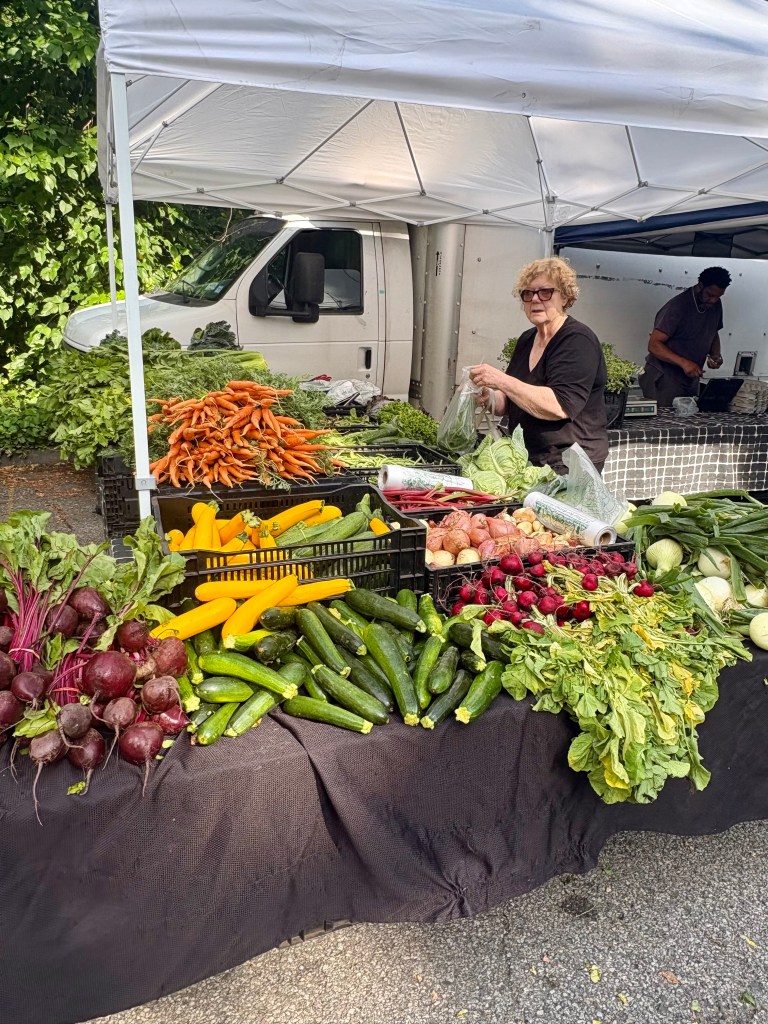
The next day we visited the Farmer’s Market that Ann frequents and saw (and later ate) produce, including a salmon, of the very highest quality.
Never let anyone say you can’t eat well in America. It is possible, especially on the eastern bank of the Hudson Valley in Upstate New York.
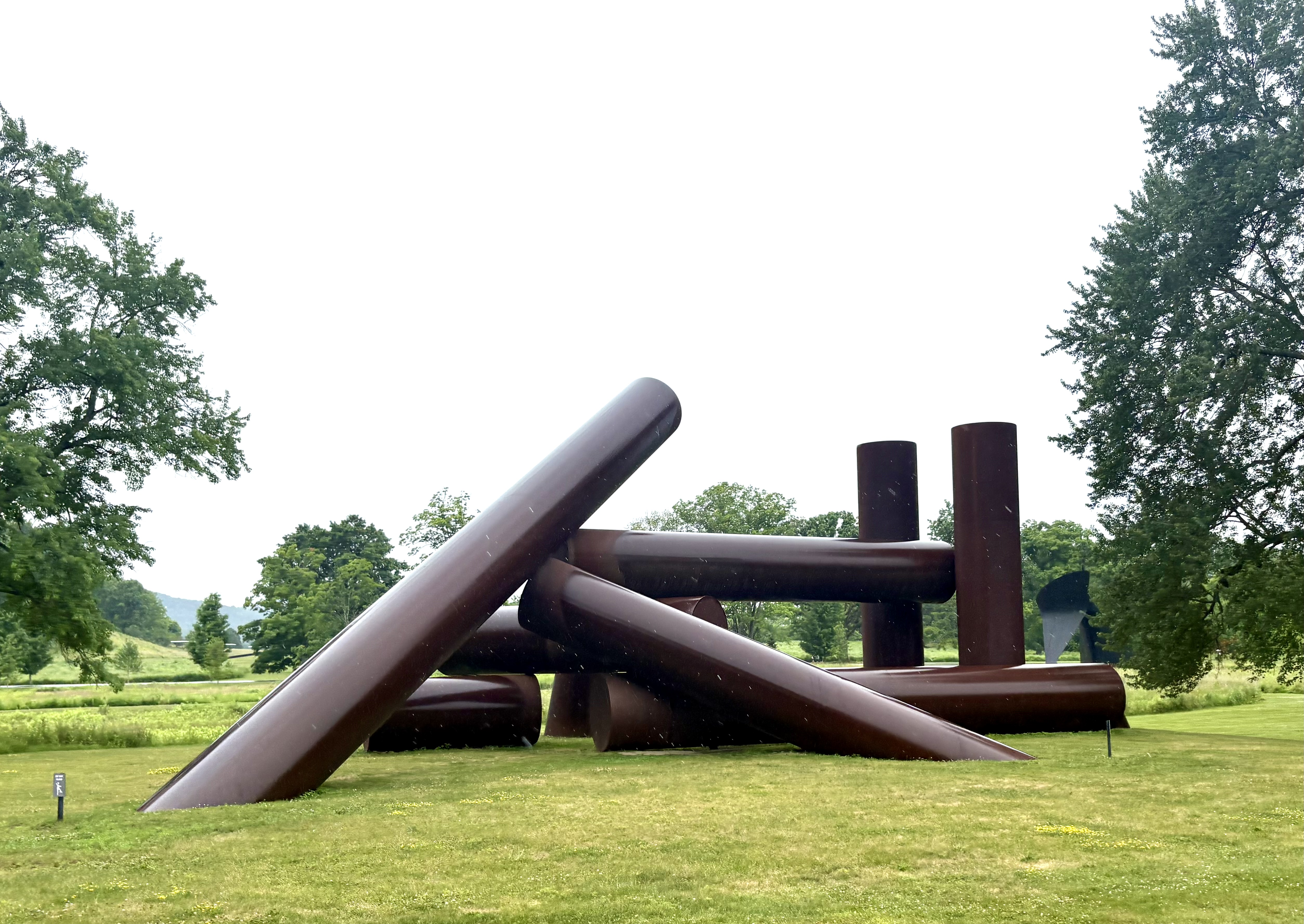
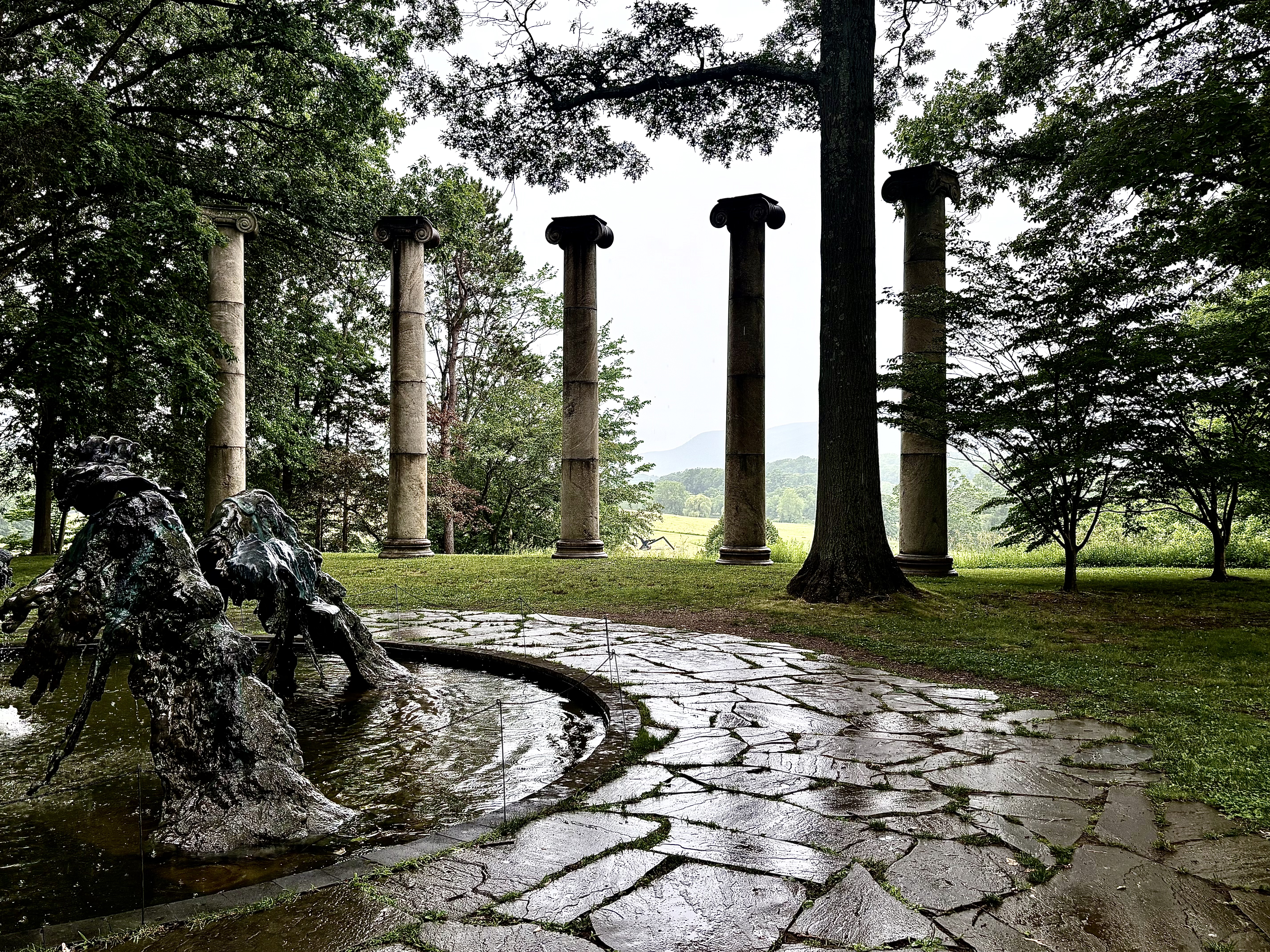
Later we crossed the Bear Mountain Bridge (currently available for additional naming rights) to visit the Storm King Art Centre, outdoors and only the second day it had rained in the four weeks we’d been away.
I don’t know about big lumps of things in mown paddocks. They have their moments I suppose. Well actually they don’t. That’s how they are all the time except when they get wet. Good but not overwhelming I think was the final judgment. The drive there and back north across the Newburgh-Beacon Bridge (straightforward, more naming possibilities) had been just as interesting. You couldn’t call where we were the Mexican side of the Hudson but there was clearly another cultural presence and a fair bit less money. We stopped at Gus’s Diner for a drink and, lo and behold, they had banana splits on the menu, and I do love a banana split. They may have been on the menu but I don’t think Gus’s very Mexican diner had had much call to create a banana split before, ever. Ordering one was a jolt for the orderee, a jolt that was transformed into a challenge, a challenge that was met. I’m sure the counter staff moved with new confidence after that. I moved the already startling tip up one digital notch.
That night we watched Bill Maher interview J.D. Vance on TV. It was billed as a big moment. Vance was there to plug his new book. Maher was there to ask him the tough questions: the Iran war, the cost of living, petrol prices blah blah blah. Except he didn’t. It was a study in ingratiation, and Vance handled him with an easy and superior charm. There is a lot of strength in incumbency.
Next day we found our way back onto the Taconic Parkway (no tolls) to Albany airport and flew, without incident, to the nation’s capital.
And just as a footnote, we didn’t see Baby. I can only think she must have stayed in her corner.
We were coming from Montreal. We were going to visit friends who lived at Garrison. I was interested in at least a bit of a drive through the Catskills/ Adirondacks. The Borscht Belt. Somewhere New York Jews could go for summer holidays. Dirty Dancing. All that. Romance. And besides, we hadn’t been to Albany.
Bearing in mind what is to come, at left below is how one enters Albany by train. I saw it as a work of art, but it is most certainly not an example of urban triumphalism. A short while later there is a much loved 28-foot fibre glass dog, Nipper, sitting on top of yet another empty factory building.
Our accommodation was a comfortable room — good bed, big bathroom, kitchenette — in what had been a modest mansion owned by an artist and featuring his works on entry.
The house itself was in a block of cosy-seeming look-alikes which in 1997 had won the City of Albany Block of the Year. I know that because there was a sign saying so which also incorporated the mayor’s name (Gerald D. Jennings). Deeply American in all aspects: award, topic of award, example of massive range of topics of awards, signage, inclusion of name.
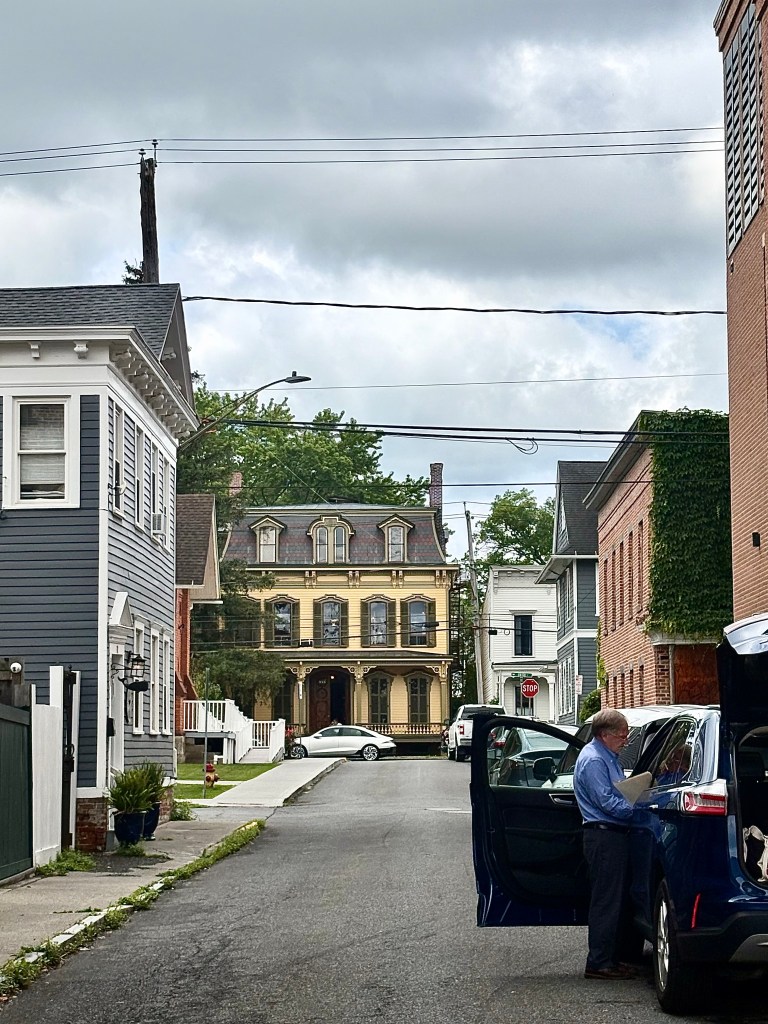
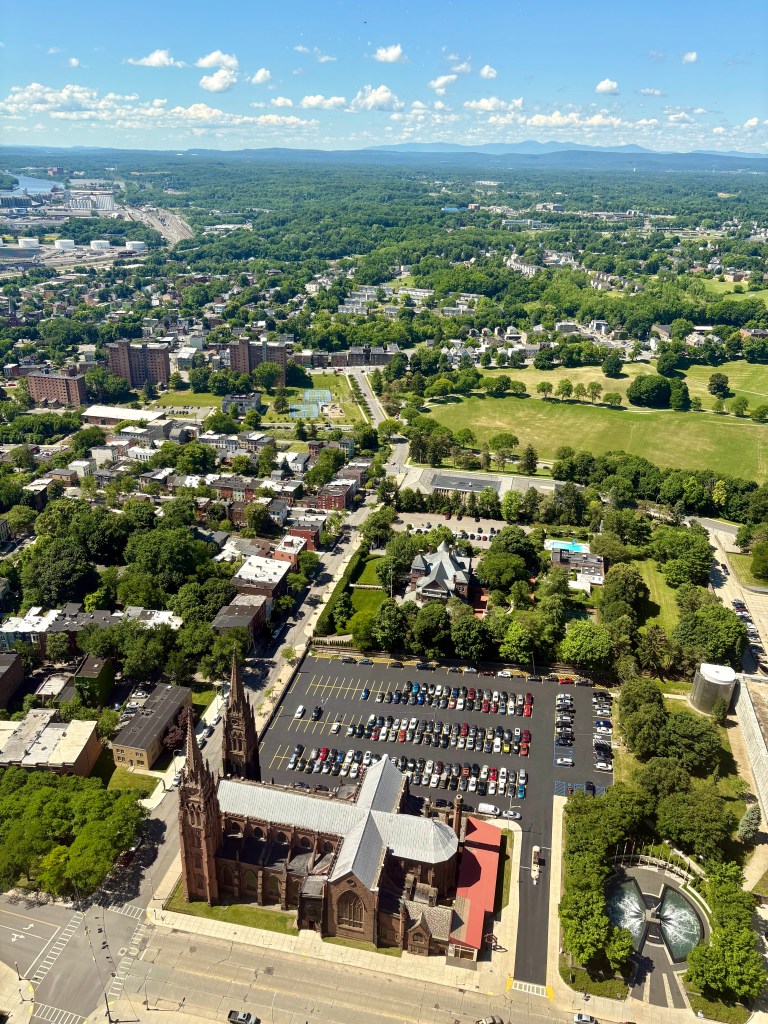
Albany stretches and stretches into all sorts of permutations but where we were it had lots of attractive period building. This view from the centre of the art gallery lawn is vaguely representative.
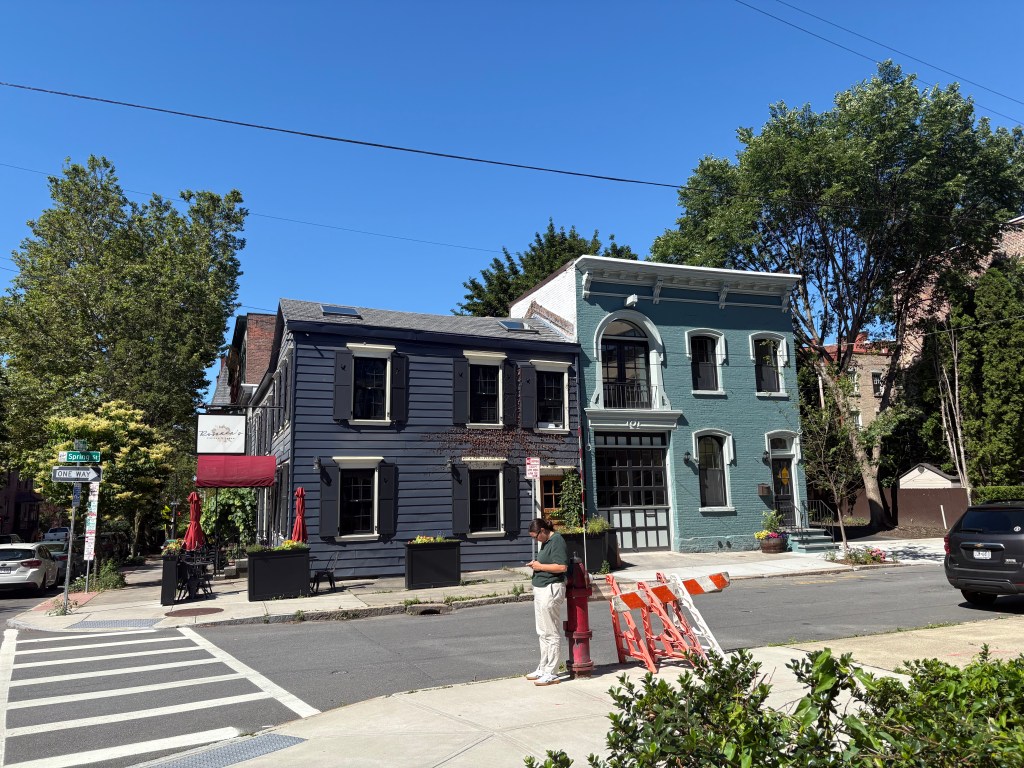
Just around the corner from our place was a series of modest eateries. We had dinner at one of these, Rosanna’s, in the darker grey, and ate well.
You don’t need to know all this of course. It’s just a bit of scene setting.
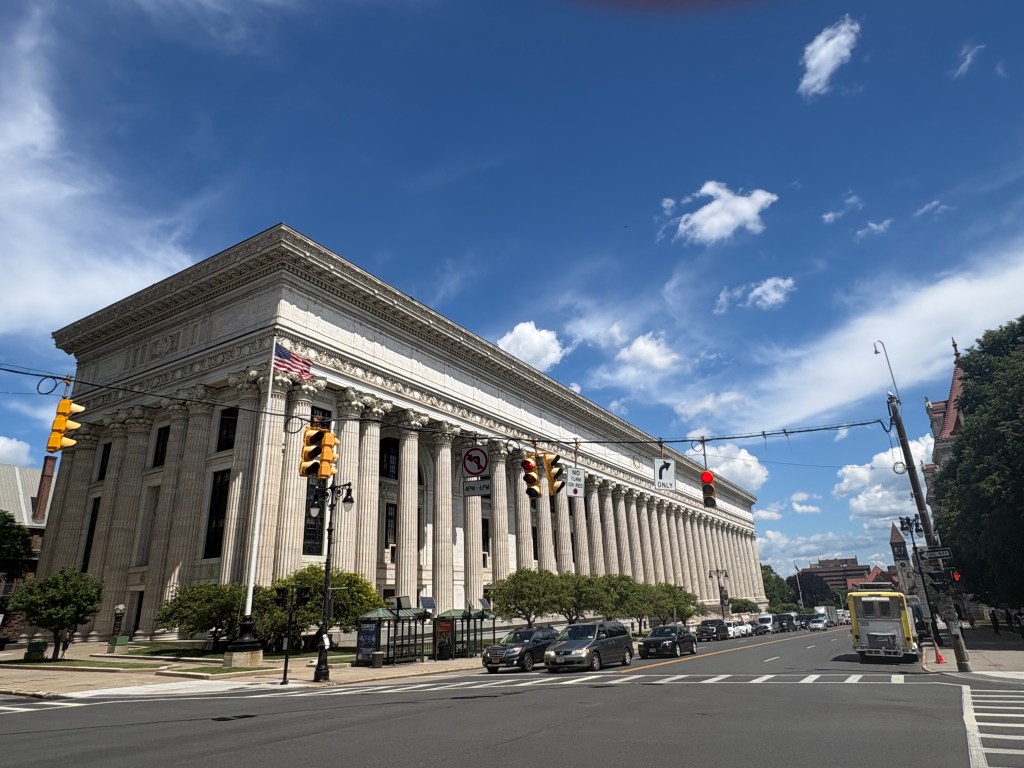
At the eastern end of our street there were two major buildings. This is one. You’re guessing aren’t you … and you got it! Amazing. Yes, the New York State Department of Vehicle Registration. A bit obvious. Over the road, and this one is harder, but — the clue — imported fairly directly from Athens Central 2500 years ago?
You mightn’t get this one … ah you did. New York State’s offices of the Department of Education.
But then you look round the corner …
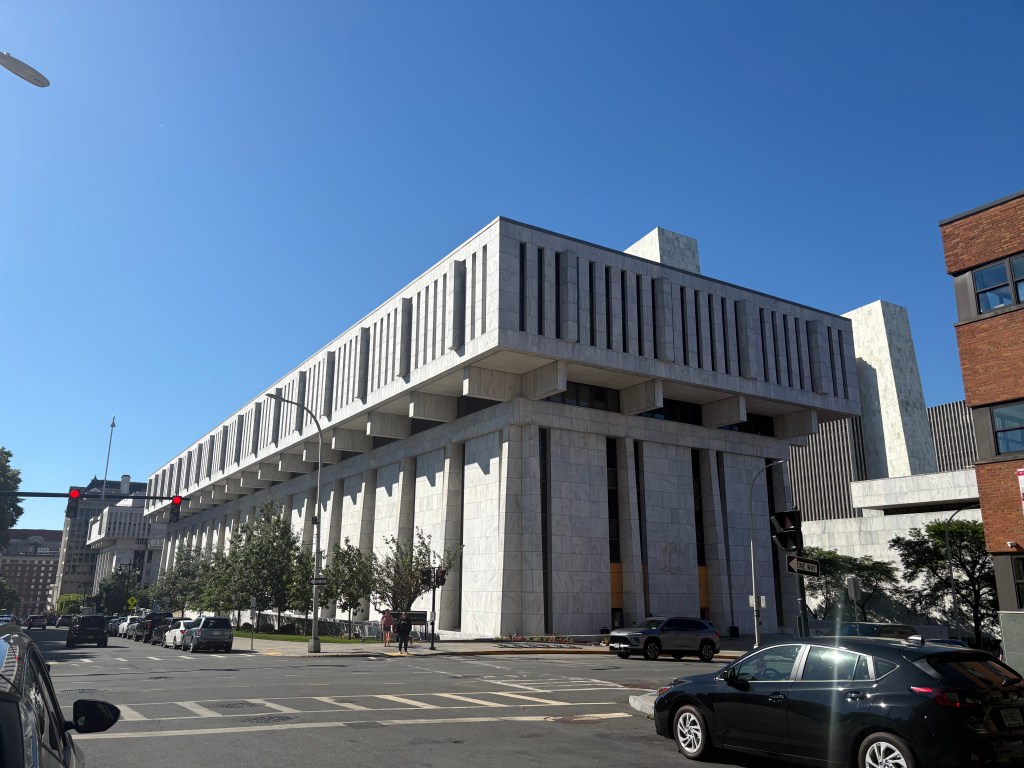
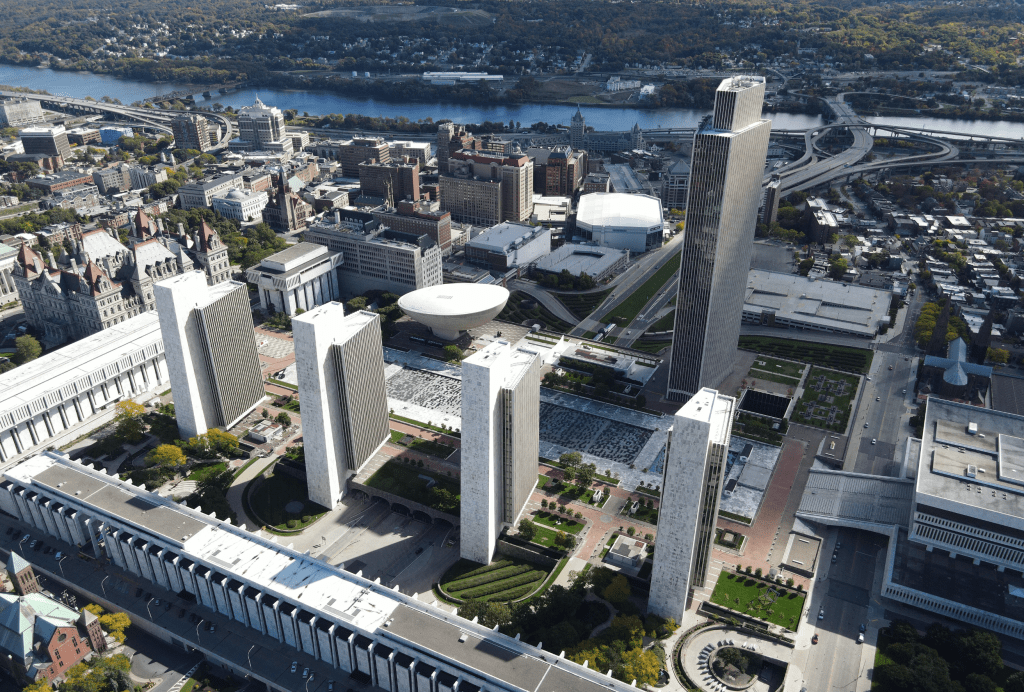
and there, on the right, you are struck by one of the largest buildings I have ever seen.
This was our first direct encounter with America as the Land of Surfeit.
There’s New York City, and there’s New York State which shares a long border with Canada. Albany (popu. about 100,000, one-third a Geelong!) is the capital of New York State, and has been since 1797, established at least partly so that it wasn’t New York City. Hence it is home to a large number of public servants and, before COVID anyway, they needed to be housed at work. They used to be, and still are, in the tall building on the left above. But in 1960 Nelson Rockefeller, then Governor, was hosting then Princess Beatrix of the Netherlands and was embarrassed when driving through the downtown area: ‘There’s no question that the city did not look as I think the Princess thought it was going to.’
‘He conceived the basic design of the complex with architect Wallace Harrison in flight aboard the governor’s private plane. Rockefeller doodled his ideas in pen on the back of a postcard, and Harrison revised them. They used the vast scope and style of Brasília, Versailles and Chandigarh as models. [Today Astana and other Stalinist neo-Brutalist epics could be added.] The massive scale was designed to be appreciated from across the Hudson River, as the dominant feature of the Albany skyline.’
So, from the back of a post card to this.
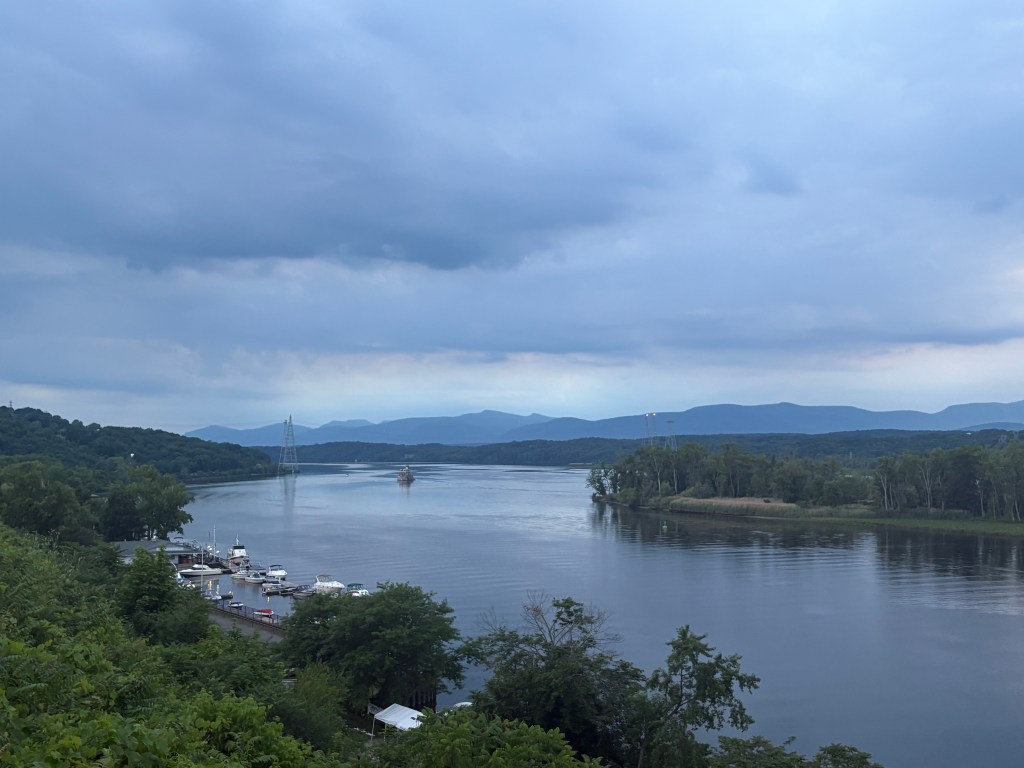
And can you see it from the Hudson seen here mooching gently through the top half of the photo?
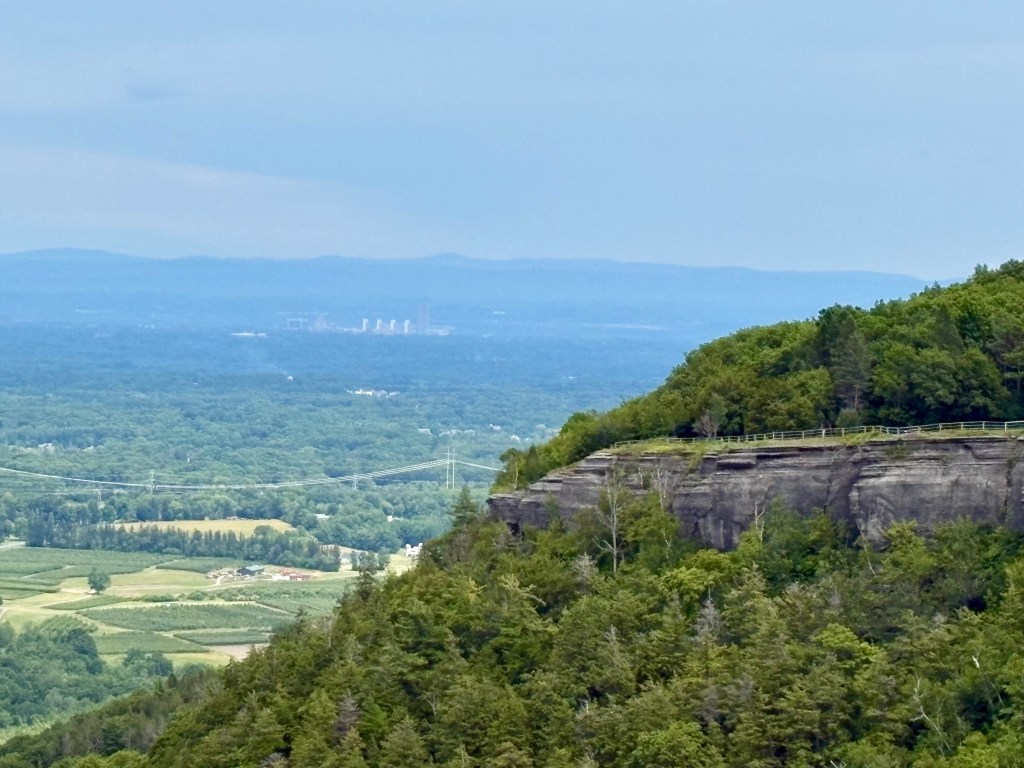
You can see it from Thacher’s Overlook (memorable for the difficulty of not adding an additional ‘t’ when pronouncing it) 40 or so kilometres away. The four white splodges in the middle are four of the towers of Rockefeller’s Empire State Plaza. These ones.
And they’re the little ones.
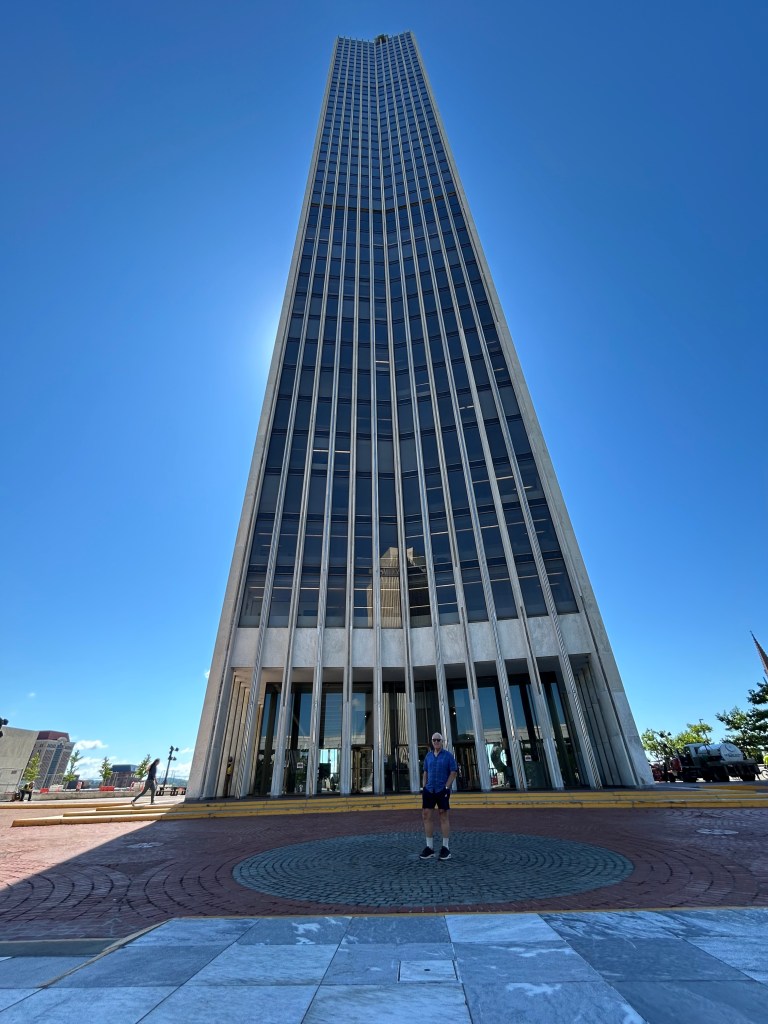
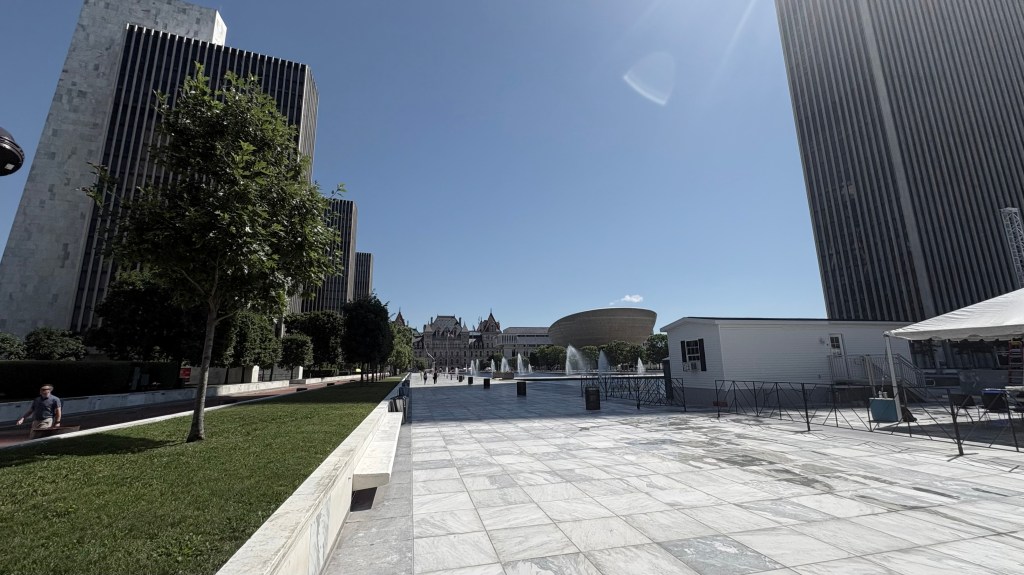
There’s the Corning Tower on the other side of the concourse with its, not one, but three Reflecting Pools, which
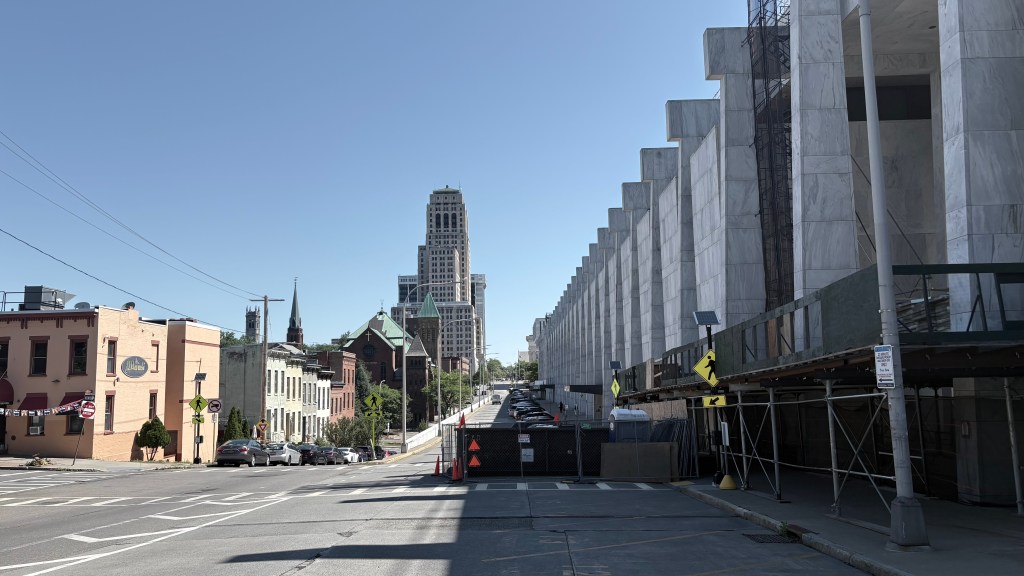
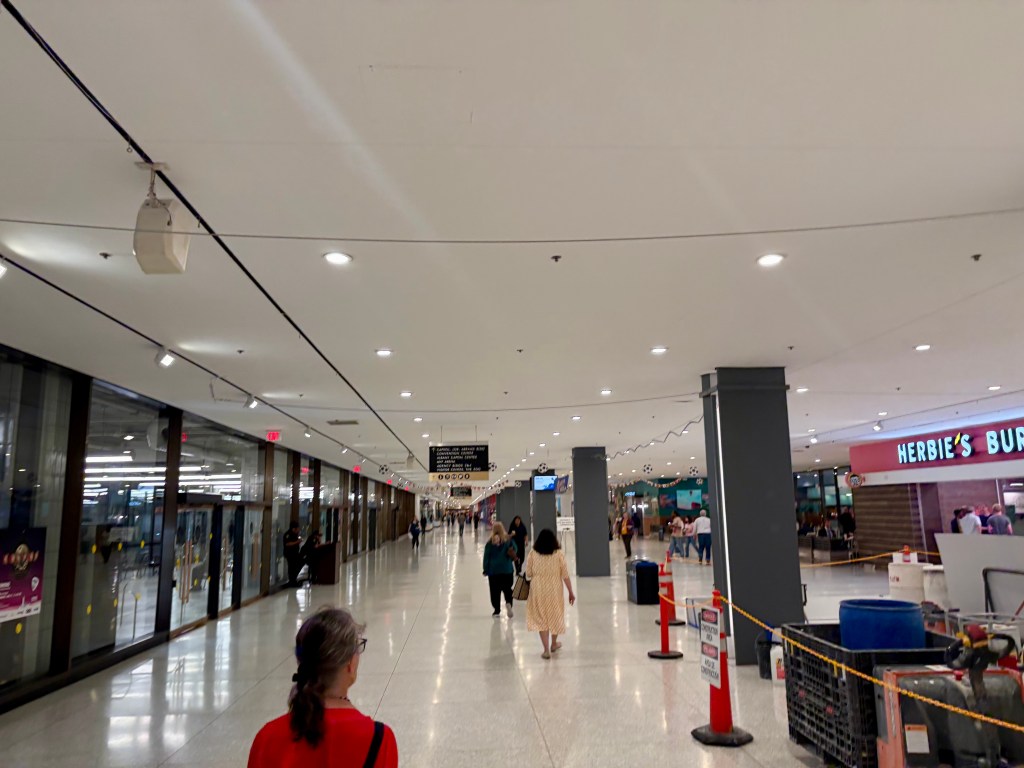
is about 600m long, the same length as the building you can’t see to the right and the same length as the two underground floors which include, inter alia, a food court (below) and a garage. The Egg, an auditorium apparently with remarkable acoustics, can be seen in the mid ground looking like a beached flying saucer.
Building commenced in 1963 following the razing of about 1400 buildings in a part of the city mostly populated by Italians and Black Americans. 7000 people were evicted hastening the decline of the city’s centre, still readily apparent. It was dedicated in 1973 having cost $2 billion, using 900,000 cubic yards of concrete, 272,320 tons of steel, and 500,000 cubic feet of marble every cubic inch of which was imported. It was re-dedicated in 1978, reflecting the naming fetish of America, as the Governor Nelson A. Rockefeller Empire State Plaza. So I suppose at least we know who to blame.
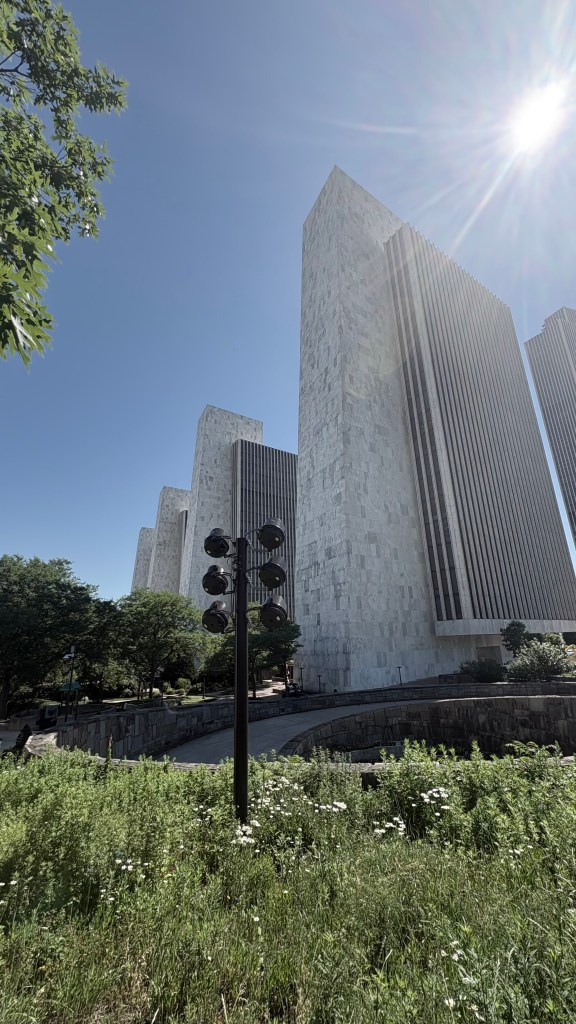
Its critics have not held back. Paul Goldberger, writing at the time of its completion in the New York Times, said: ‘The ideas here were dead before they left the drawing board, and every design decision, from the space allocations to the overall concept, emerges from an outdated notion of what modern architecture, not to mention modern government, should stand for.’ Martin Filler, quoted in The Making Of Empire State Plaza, says ‘There is no relationship at all between buildings and site, neither at grade nor atop the podium, since all vestiges of the existing site have been so totally obliterated. Thus, as one stands on the Plaza itself, there is an eerie feeling of detachment. The Mall buildings loom menacingly, like aliens from another galaxy set down on this marble landing strip.’
I know what he means. Correct. That said, we had two excellent experiences on the Mall.
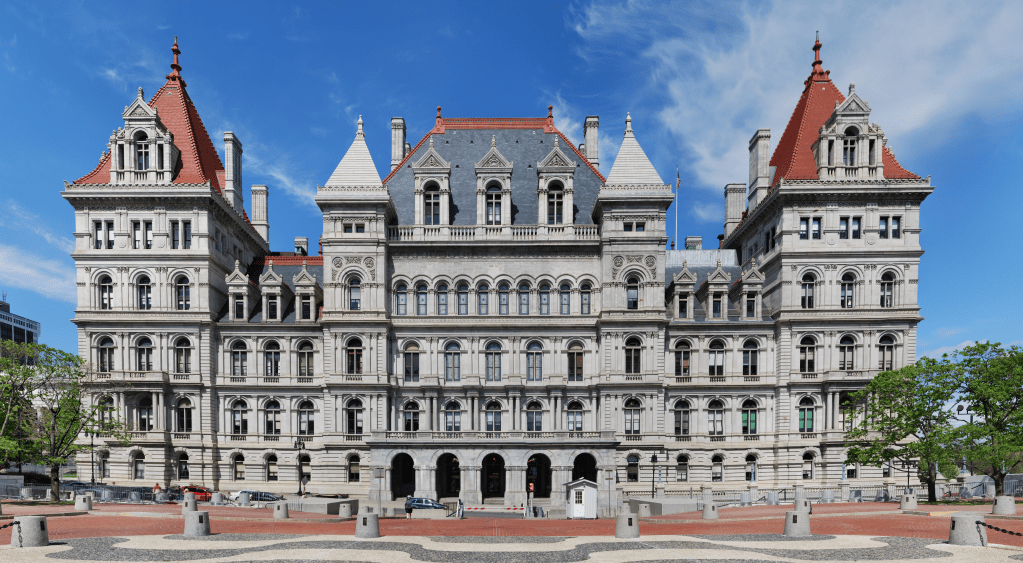
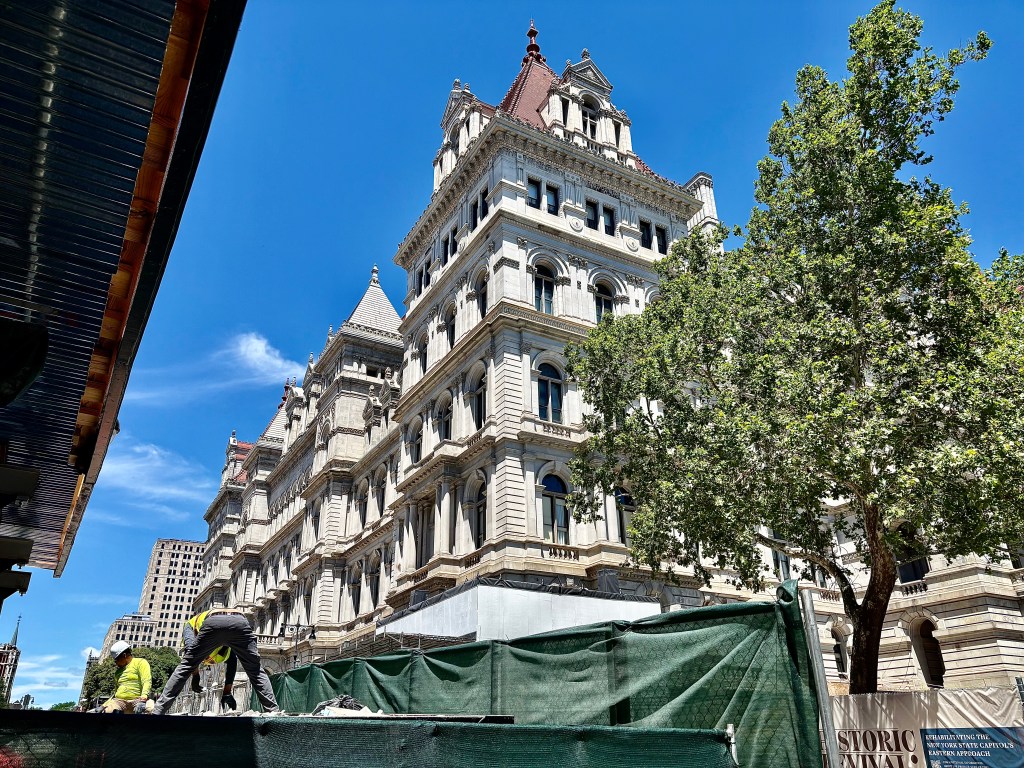
One end of the Mall is the State House, the parliament. When it was built in the late 19th century it was the most expensive building in the country. There’s a history here. It can look like this.
But I prefer my photo.
At the other end is the State library and museum.
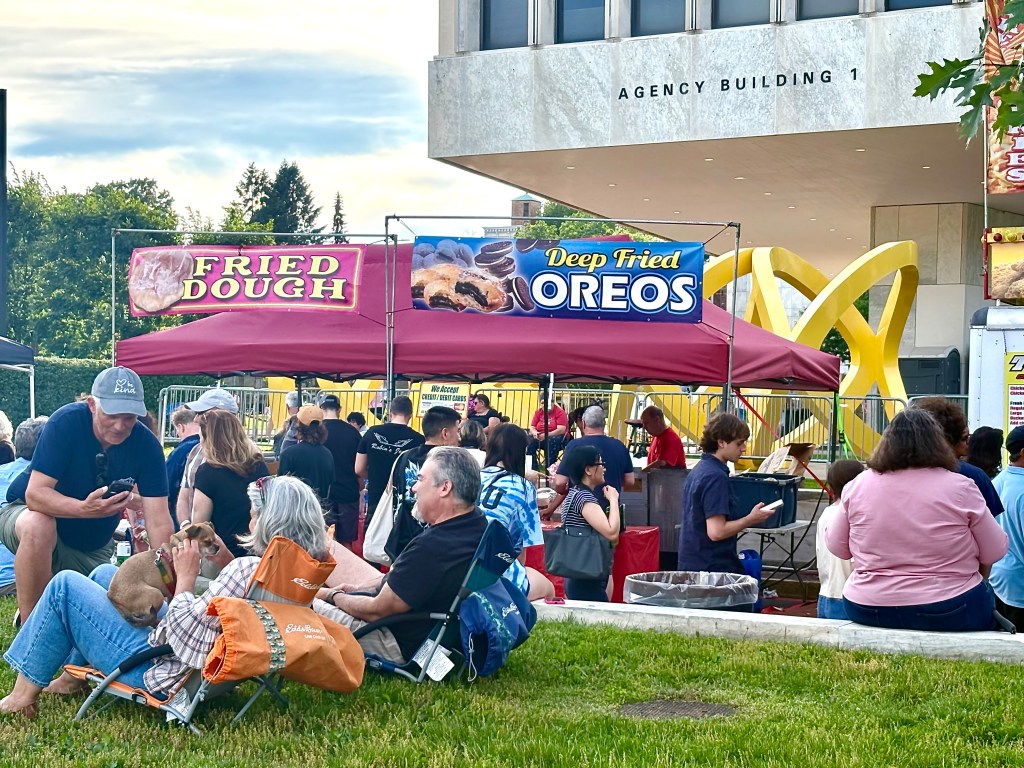
I have written elsewhere about some of what we found in the museum that made the experience of visiting it so memorable. But visible here in the mid-ground is the setting-up for the open air concert we went to that night. Not a great band, but willing. The crowd, packed, roaring, fun, having a great night out.
Look it’s a sixties mistake. You wouldn’t do it again I hope, although Trump seems keen to. But maybe people find a way, despite the best efforts of architects, to populate and humanise these peculiar spaces.
The details above about the building, plus a note about the controversial aspects of the development, come from a plaque in the Corning Tower which provides this view.
The Governor’s mansion and, presumably, the Governor’s swimming pool are on the far side of the car park. But that’s south where we are heading.
The train ride from Montreal nearly due south to Albany and on to New York could be comfortably described as scenic. It begins with the crossing of the majestic Saint Lawrence. I missed a photo of the crisp clean lines of the lock attached to the far bank which framed some complex industrial buildings and a massive Ferris wheel. But soon the scenery settled into farmland, mostly cornfields, with buildings nestled into them as though they’d grown there.
It’s just 50 kilometres to the border and this was how we had chosen to enter the United States. Some media reports suggested that there might be a fuss. I thought that was fairly unlikely, being as we are two elderly Australians without obvious terrorist tendencies. But I didn’t want there to be a fuss. I had made some modest adjustments to my socials. I had confirmed our ESTAs long before, had made copies blah blah blah. [ESTA = Electronic System for Travel Authorization, required to enter the US.] I had filled in and paid our I-94s in Lisbon, BUT the damn app wouldn’t let me make a copy which for a time drove me crazy. [I-94 = an electronic arrival record showing your visa status and permitted stay period. Cost: AUD 42.62] You know … these things … can’t be too careful. In addition, airports, the international version anyway, are never much fun. I thought entry via train might be lower key. Anything to ease the journey.
A brief digression: the day before in Montreal we had both received notifications on our phones that there was a shooter loose in Côtes de Neige a couple of streets over from where we were. This situation ended with two dead, so … you know. Things happen.
The train stopped at a major installation at what my phone says is Rouse’s Point. And it is in the U. S. of A.
I counted 12 men and women as they got off, 12 very heavily-armed men and women. But that’s just America. So, 12 very heavily-armed men and women got on and began their border control. It wasn’t a big train and there weren’t many people on it. It nonetheless took them 75 minutes to complete whatever it was that they were completing.
In our case not much.
They asked for our passports. Hard to argue with that. Asked where we’d come from and where we were going. The woman actually; the guy was mostly just there for colour. Why were we travelling? And then, were we married? And then, didn’t we get homesick travelling? Which brought in the big guy who told us he lived just over the hill in Champlain and that he’d hardly been anywhere else in his life and that suited him just fine.
No interest in our ESTAs, no checking our I-94s, just amiable and pleasant Americans. It had taken about three minutes.
Another 50 kilometres, we’re now travelling through mixed forest, and the line swerves across to the shores of the waterway we’re near. It’s the top of the Hudson Valley. At this point Lake Champlain seems like a vast expanse and, at this point, it is — about 15 kilometres across.
The waterway narrows but the track stays on the shoulder of the western shoreline, sometimes up on rocky outcrops — palisades they might call them here — and at other points, more often, gliding over bridges through swamp land.
At times the river, the Hudson in which the island of Manhattan is eventually embedded, got so narrow that it became a channel carved through rush and swamp grass. But that was before we came to Port Henry.
There weren’t many in our carriage: two young adults travelling for work, a family of four whose children were buried in books, another young woman, another family whose father spent at least some of his time on the train rolling joints. But it was quiet. There was the clack of the line and the regular warning noise the engine made whenever we came to a road crossing, fairly constantly as it seemed. We fell to trying to find suitable terms for it. It was certainly not a toot or a whistle or a siren or a blast. I decided a moan, a muscular bovine moan. Moowaooowooo. Distant. Cinematic. Lovely.
And then at Port Henry three more passengers got on. At first, and this is not to my credit, I thought it was a sort of joke. In France I would have been confident that it was un spectacle and they would do something and then ask for money.
Their hats were made for comedy. They were in such good order, cream straw cylinders on cream straw discs, symmetrical and probably not much fun to wear. And they were in uniform. Royal blue work shirts done up to the neck, pants and waist coats of a darker shade of blue, heavy black work shoes. Identically clad, the three of them, two adults and a 14 or 15 year-old. The adults had under-the-chin beards which I’ve never really understood. They took their hats off, each chose a window seat, and the two older ones started shouting to each other with the younger one joining in from time to time. I thought it sounded a bit like German, often long ‘yaaar’s. I consulted my phone. I was probably listening to Pennsylvania Dutch, with ‘Dutch’ being a corruption of ‘Deutsch’. Amish.
For a start they climbed up on their seats and gestured loudly at what we were passing, possibly identifying landmarks and land ownership. Someone suggested that this might have been their first time on a train as Amish usually do not travel this way.
Look, if a shout is a 7 they were probably on 5.3 to 5.6; but it was loud. And it went on. Not for 15 or so minutes but for several hours. It was a long trip. One would think of something and shout it over the seat to another person sitting a metre away. Then that person would shout back. Then they would shout together for some time. A lull. A shout, a shout back. Their obliviousness to anyone else on the train would suggest that it was an act, some cunning traducement, and then they’d be normal and say, ‘Ha! Like that? We sure tricked you!’ But no. No. They shared what I decided was a nasal braying drawl which, after some time, was like having a screw driven into your head.
And, here I am moving onto thinner ice, I became conscious of the way they smelt. As soon as you start talking about ‘smell’ there’s trouble. It becomes a pejorative and really it shouldn’t. But I can’t do anything about that. I have a keen sense of smell which usually provides me with a lot of pleasure, but these chaps smelt like chewed chewing gum. Stale spearmint? And that’s not necessarily an unpleasant smell. No disparagement intended. But they did. And somehow it added to the bother. Oh, and they ate crateloads of chips very loudly! Speaking all the while. They REAALLY gave me the shits.
Why didn’t I ask them if they’d mind being a bit quieter? I would usually. Was it because they were Amish? Maybe I felt I didn’t know how because of their difference. At the time it seemed to go beyond those apparently trivial markers to become an obligatory principle of de-association.
Our own Pauline Hansen had been in the news saying unpleasant things about people — genres of people, races of people, religions of people — she doesn’t like. Am I like her? I was at that point. Would I like to have those three forcibly deported? Then, yes. Would I act to have them forcibly deported? Possibly. Do I want them to live in a ghetto which is broadly inaccessible? (As they may. I don’t know.) That might be one solution.
How do people with quite radical differences of view and of cultural practice live together? At that moment I didn’t care. I just wanted them out of the carriage. I may have even hated them.
* * * * * * *
So, here I am entering America and already, a couple of hours in, absorbing some of the characteristics that the media, ours and theirs, feed on and spit out as normal.
Were we arriving in a country riven by cultural wars, where both sorts of extreme positions are sublimely stupid, and even the more moderate ones seem unnecessarily aggressive? Where the administration seems to be wanting to stamp out empathy and tolerance, and where the operative version of the Bible seems more focused on incarcerating your neighbour than loving them? Where anger is a marketable commodity, the more furious the more lucrative?
That was the eye I was looking with.
This may disappoint you, but most of the Americans we encountered were scrupulously polite or, better, cheerily warmly polite. They wanted to invite you into their world, if a superficial version of it. (Superficial’s okay; you’re only buying milk.) They were quite insistent about engaging with you and eagerly responsive if you showed interest. ‘You’re so very welcome’, would easily be the phrase we heard most commonly. Easily.
Even if it’s an idea and practice which can readily be challenged, the country lives off philanthropy. In the welter and complexity of philanthropic projects in America there are clearly generous and companionate instincts present. And, just as it happens, in each case the people we spent more time with were mentoring kids who were having a hard time in close and warm relationships. These things seemed commonplace but they’re often left off the scales when weighing Trump’s infamies. (And infamies they are, except, and let’s be clear here, someone has to do something about illegal immigration.)
It’s a big country.
* * * * * * *
You want to know what happened don’t you? In fact you want a look at the photos I took of them.
With 45 minutes to go they went off to the dining car. We got off at Albany. They didn’t.
* * * * * * *
Our accommodation in Albany was next to the Emmanuel Church and clusters of customers for the Food Pantry were often, in clouds of ganja smoke, just over the road. This sign wasn’t madly unusual, but it had an addendum which did offer something different. The church had recently taken ICE and the government to court to protect someone (named, but not described) and they had won. This person was no longer in custody. The church had done that not via the customary tools of rhetoric or a sermon, but by action, which in this case had succeeded.
Newton’s Third Law of Motion: Forces always come in pairs: One force is the action, and the other is the reaction.
* * * * * * *
Our very friendly hostess and the dominant figure at the cafe where we breakfasted in Albany was Venezuelan. The shocking earthquakes which had occurred the day before we arrived had had an impact on her family. She was glad Trump had kidnapped Maduro because she thought that meant the local rescue effort might be more efficient and successful. Her own citizenship status was uncertain.
* * * * * * *
At the Phillips Collection in Washington, housed in a mansion near Dupont Circle where this, at left, was the music room, it was thought appropriate to post this sign at the entry.
One way — in this stockpile of Rothkos, Braques, Van Goghs, Kandinskys, Pisarros and so on — might have been to take the work below and feature it. Well, that’s what they’d done anyway, and we liked and admired it. Friendly. Charming. Unusual media. Ethiopian. Bit out of the way. Great. Loved seeing it there.
‘Yediro Suk’ by Elias Sime, born Addis Ababa, Ethiopia 1968. Paint, ink, acrylic yarn embroidery.
But I don’t think that’s the answer to the question and its embedded assumptions. Privilege may offer more chances to encounter some forms of art or to be exposed to ideas about art, but it mightn’t have much to do at all with taste.
* * * * * * *
TheChase Bank, Washington, 600m from the White House. Which clearly has not been able to stamp out expressions of DEI. Or is it just clever marketing? Maybe chasing the pink dollar? Maybe firmly suggesting that you don’t say things like ‘chasing the pink dollar’?
* * * * * * *
A hoarding on a fence surrounding major new works in Forest Park, St Louis. I can’t see who is doing the yoga down below but there are no Caucasians on the terrace.
* * * * * * *
Food. Can food be political too? Well prima facie, no. It’s absence, yes. Bobby Kennedy would say, most certainly. What you choose to eat will help to define who you are.
MAGA-ites and Red Meat? Yes. Barbecued red meat, two-inch steaks. Rare. The smashed avo brigade? You know who I’m talking about. They’re drinking oat milk lattes. Felafal and hummus? Don’t get me started. Didn’t we just obliterate their nuclear stockpile?
The American supermarket may have something to say about cultural identity and conflict.
In Nashville we found the ‘Turnip Truck Natural Market, the city’s locally owned full-service natural and organic grocer, open daily from 7:00 AM to 9:00 PM.’ We were looking for some breakfast, fruit still in the first fresh bloom of youth and cereal that was less than 85% sugar. Confoundingly even in the Turnip Truck we could find no natural yoghurt to accompany same. All the options were heavily interfered with.
I did find Love Crunch Dark Chocolate and Red Berries Premium Organic Granola, and as something you’d want to eat first thing in the morning was inclined to treat this less than seriously.
However in the process of aimless phone wandering I discovered this:
‘Dark chocolate and red berries provide a powerful boost of antioxidants, flavonoids, and fiber. When eaten together, this combination supports heart health, lowers inflammation, improves blood flow, and feeds healthy gut bacteria to protect metabolic health.’
That’s what AI says anyway. What would The Science say? What would Anthony Fauci say? (No not the bit about Barbra Streisand, or Joan Baez either for that matter …)
We didn’t purchase.
I was even less confident about these.
Nashville
But they did sell fruit and vegs.
[A passing note: The really good Nashville breakfasts we found and most certainly the best coffee by many miles outside of Washington was at an ‘Australian’ cafe, Two Hands presumably a play on the Heath Ledger/ Bryan Brown film, which served ‘mindful meals’.]
* * * * * * *
There is a fundamental, inescapable and probably insoluble paradox at the heart of American cultural history which still instructs and shapes contemporary life: America as a beacon of freedom in thought, word and deed; and, a country founded on Western cultural norms which, when all said and done, shake down into a Judeo-Christian white republic. To some degree, this is the difference as an idea between 1619 when the first arrival of slaves from Africa in Virginia was recorded and 1776 when 56 ‘American’ men signed the Declaration of Independence.
It is desperately untidy, and is likely to remain so, because just what can you do about history?
* * * * * * *
As you would expect, the Missouri History Museum was celebrating the 250th. On entry, you will encounter a large statue of Thomas Jefferson, a permanent fixture. Prominently at his side when we were there is a display which is framed by the following text:
Thomas Jefferson wrote the Declaration of Independence in the summer of 1776. In it, he made a stirring claim for the equality of men and the existence of inalienable rights. In the decades that followed, he sought to expand white American’s rights and opportunities while at the same time profiting from the enslavement of Black men, women and children at his Virginia plantation, Monticello. During his life, Jefferson enslaved more than 600 people. He also had six children with an enslaved woman, Sally Hemings — a relationship which began when Jefferson was in his 40s and Hemings was a teenager.
Apparently he didn’t think much of Native Americans either. In the same display it is noted that the only reference to them in the Declaration is to ‘merciless Indian savages, whose known rule of warfare is an undistinguished destruction of all ages, sexes and conditions’.
This is followed by a quote from Frederick Douglass, a hero of the African-American civil rights movement.
‘A government founded on justice, and recognizing the equal rights of all men; claiming no higher authority for its existence, or sanction for its laws, than nature, reason, and the regularly ascertained will of the people; steadily refusing to put its sword and purse in the service of any religious creed or family, is a standing offense to most of the Governments in the world, and to the narrow and bigoted people among ourselves.’ (1869)
* * * * * * *
In an article about America’s complex response to the 250th celebrations, and prompted by his experience at Philadelphia’s Museum, David Smith wrote in the Guardian (10/7/26):
‘The exhibition [at Philadelphia’s museum] is proof that, while the White House stages its partisan spectacles, the nation’s cultural institutions are engaging in a quiet, methodical resistance, wielding primary sources and complex story-telling against the the onslaught of the great man theory of history.’
* * * * * * *
The Douglass quote is, in turn, next to a display about the Louisiana Purchase. [In 1803, the nascent US paid France $15 million for 827,000 square miles of land west of the Mississippi, thereby doubling the size of the country.] The display asks:
‘Should the Louisiana Purchase be celebrated?
Should the United States have had the right to buy this land from France when most of it was already inhabited and controlled by Native Americans?’
Vexed and challenging questions to which the Heritage Foundation and Steven Miller (at right) would have answers. But here are the questions nonetheless, in public and in big stylish print, as the focus of the celebration of America’s founding moment, seeming to suggest that the correct answers might be ‘No’, and ‘No’, leaving contemporary Americans in a somewhat invidious situation.
What do you do if you say ‘No’ and ‘No’? What could the consequences and appropriate course of action possibly be?
* * * * * * *
In 1904, Saint Louis actually did celebrate the centenary of the Louisiana Purchase by holding a thoroughly memorable world fair. It was a giant enterprise covering a good deal of what is now Forest Park and was designed to show off the world’s latest in industry and technology. More than 50 countries provided exhibits. It was also designed to show off the greatest: America and its progress. Forty-three of the then 45 states had exhibitions. (You may wish to compare this with Trump’s WORLD’S GREATEST fair for the 250th.)
As President William McKinley said in his address to open the Fair:
Expositions are the timekeepers of progress. They record the world’s advancement. They stimulate the energy, enterprise, and intellect of the people; and quicken human genius. They go into the home. They broaden and brighten the daily life of the people. They open mighty storehouses of information to the student.
The Fair ran for seven months and attendance was recorded at just under 20 million. 450,000 were there on its biggest day. Its 1,500 buildings were connected by 120 km of roads and walkways. The Palace of Agriculture alone, fitted out in Greco-Roman style, covered 20 acres. (It was the Big One.)
At right is a portion of the Palace of the Arts. It was a no nonsense affair architecturally anyway.
Wireless telephones, electric streetcars and X-ray machines were among the featured marvels. Helen Keller gave a lecture. George Ferris opened and ran his first Wheel. T.S. Eliot, a native of St Louis, wrote a paper on anthropology after his visit. Max Weber arrived hoping to gain some additional insights into capitalism. The Anglo-Boer War Concession re-enacted major battles from the Second Boer War twice a day. Several generals and 600 veteran soldiers from both sides of the war participated. After 2–3 hours the show would conclude with the Boer General, Christiaan de Wet, escaping by diving from a height of 35 feet (11 m) into a pool of water.
But the celebration of imperialism and conquest was a dominant theme. Today we might call it abject, unalloyed racism.
A number of groups of what we might call First Peoples (2600 individuals counted collectively) were pressed into service. They were arranged in clusters along ‘The Pike’, the road running through the main entertainment area, in a continuum graded from ‘Savage’ to ‘Civilised’.
[It might be noted that some of the participants in this ‘Human Zoo’ made a living this way. A ‘Canadian’ Inuit, for example, was born at the Chicago World’s Fair and lived in this way for decades while she and her family maintained a home on Coney Island.]
Various events were held to demonstrate the superiority of the white races. These sometimes took the form of the ‘experiments’ which in this febrile environment were very popular.
One of these was the ‘Anthropology Days’. The administrators paid indigenous peoples (already employed as exhibits in the ‘human zoo’ at the Fair) to compete in European-style sporting events like discus throwing and high jump, and collected data on their athletic performance in order to investigate the scale of white physical superiority.
“We have for years been led to believe,” said the official report, “that the average savage was fleet of foot, strong of limb, accurate with the bow and arrow and expert in throwing the stone, and that some, particularly the Patagonians, were noted for their great size and strength, and owing to the peculiar life that many had been called upon to lead they have been termed natural athletes.” The competitions were scheduled so that scientific observers could be present and, continued the report, the results “disprove these tales.”
The organizers ran hundred-yard heats for six groups, “Africans, Moros (from the Philippines), Patagonians, and the Ainu (Japanese), Cocopa (Mexican) and Sioux Indian tribes. The best time, by an “Americanized Indian,” was one “that almost any winner of a schoolboy event could eclipse at will.” The best shot put “was a ridiculously poor performance,” and other events were equally disappointing. The report did acknowledge that some of the competitors weren’t that interested. “With the pigmies, however, it is only fair to state that they entered into the spirit of this competition for fun and only became interested in the pole climbing and their mud fight.”
Correct. Racism, pure as the driven white snow. But only in a country which already had profoundly racist foundations.
* * * * * * *
The relevance of the following story might not be immediately obvious. But maybe it is. It might tell you something important about the times. It wasn’t all X-rays and wireless telephones. You decide. Regardless, it’s a glorious story.
The burghers of Saint Louis strong-armed those of Chicago to allow the shift of the 1904 Olympic Games to the Fair, where they would become the first to be held in the United States. It was a mess as bits of the Games ran over five months and got very mixed up with the ‘Anthropogical’ events. Athletes from only 12 other countries participated; 523 of the 630 involved were American, many running for their club or state.
The marathon is famous.
The slowest ever at an Olympics by forty minutes (!), it was run in exceptionally hot weather through ‘normal’ life conditions so that runners were dodging pedestrians and traffic. One was hit by a trolley car, another chased by wild dogs and bitten. There was only one place on the course 12 miles from the start where athletes could officially get fresh water. James Sullivan, the chief organizer of the games,wanted to minimize fluid intake to test the limits and effects of purposeful dehydration, a common area of research at the time. 🤔😵💫🫣 The roads were so dusty (3-4 inches deep) that dust coated William Garcia’s aesophagus and stomach lining so completely it caused serious hemorrhaging. He was found unconscious by the side of the road and nearly died. 32 started, 14 finished.
Félix Carvajal of Cuba (in the centre of the photo above. Hicks is at the left, number 20), who travelled to St. Louis using money raised by staging various exhibitions in Havana, stopped in New Orleans and lost all of his money in a crap game. So he hitchhiked. He showed up on the starting line wearing heavy shoes, long trousers (which another competitor trimmed for him), and a long-sleeved shirt, and eventually finished fourth. He had taken a nap on the way and also eaten two peaches that he had stolen from a picnic and some rotten apples that he had been given. Two Zulu tribesmen who were part of the Boer War exhibition at the fair competed for fun. They came 9th and 12th.
First across the line was Fred Lorz. He was actually on the presentation dais with President Roosevelt’s daughter Alice anointing him with the laurel wreath when it was revealed that he’d become very thirsty during the race and left the course looking for a drink. He had then hailed a car and hitched a ride for 14 miles before getting out after the car broke down and running the last few.
The subsequently adjudged winner was T. J. Hicks from Massachusetts. When he asked his support team for water initially they just wiped his mouth out with a damp towel which had been soaked in distilled water. But then they gave him egg whites and in turn brandy and a tablet containing strychnine. He was also given a bath in warm water at the side of the track. When he was carried over the line by his handlers, feet in the air making slight running-like motions, he was hallucinating and asking if there was still 20 miles to go.
You’re laughing. I’m laughing. Every time I read it I laugh. In a context where these seemingly remarkable happenings are simply conventional behaviour, what do we think about casual or even institutional racism? How much really can we expect of human beings? Awkwardly, they’re just like us.
But we can be cruel, and we can be just stupid.
* * * * * * *
‘From 2014 to 2024, roughly 862,000 Americans died of drug overdoses, more than twice as many as the previous decade. Several studies have shown that addicts who shoot up at official injection sites are far less likely to die of overdoses than those who use drugs in, say, alleyways and parks. Over the past decade, however, overdose-death rates climbed sharply in nearly every city where the strongest harm-reduction policies were in place. …
[Newly appointed City President Sara] Nelson also asked pointed questions about what had become the received wisdom in Seattle, such as why the county government paid millions of dollars to supply kits to addicts with tinfoil, pipes, and instructions on how to smoke fentanyl. What harm was reduced, Nelson asked at a 2023 council hearing, by helping addicts get high? Amber Tejada, an employee of a health nonprofit that had partnered with the city, raised her hand to answer. “I know it can be a little controversial, but one of the key tenets of harm reduction that I see is that we want to be able to facilitate and champion the autonomy of people who use drugs.”’ (Michael Powell, ‘The Cities That Said Yes to Drugs’, The Atlantic 10/7/26.)
* * * * * * *
A contented, congenial, relaxed and very multi-cultural crowd, a few smoking dope happily but otherwise not appearing to take drugs, at a free concert (‘Kansas’: are you old enough to remember?) in Albany. The guy sitting in front of me has a T-shirt expressing an aspiration. If you can’t read it it says ‘Explore Goodness’.
It’s the rolled trouser leg I think, and the gesture to support whatever it is she’s saying on the phone. There’s that. Makes the photo. But the weather. The hill. The stacked buildings. The odd roofed area which you wouldn’t find in Madrid for example. There’s a figure there. Collectively, could be Lisbon.
It was. We had come to see our friends Geoff and Vera and good dog Moti, worth a blog in herself. Like quite a few of the folk in Arroios, the area where we stayed, Moti is an immigrant from India and contented with her lot. Which was and remains a pretty comfortable Lot. We followed two of Moti’s favourite routes round town and they were instructive in themselves. Not necessarily the most touristed of tracks.
We did go downtown. Look for the yellow flag in the photo on the left. That’s leading the party of 35. And the chap in the black T-shirt is at one end of Rua Augusta, one end of tourist-ville. Lisbon has become incredibly popular with tourists, one reason being that is notably cheap. A perfectly fine haircut from one the aforesaid local Indians (with relatives in Cheltenham, Victoria, Australia) was €5.
We were shopping. A scarf had disappeared and some T-shirts had been left behind. We didn’t go to the castle (above right), and we didn’t use the Elevador de Santa Justa at left. Like a good many other things that might have detained us in Lisbon (the Gulbenkian, one of the great galleries of the world; the National Tile Museum — yes, really; six other museums with varying degrees of attraction; the Belem Tower; etc.) it was temporarily closed.
But we were standing outside an H&M that seemed to have most things required. In the photo below we were just as near a shop which had an extraordinary selection of hand-woven scarves and other things you might hand-weave. Great to look at; not quite so much to buy. Somewhat out of our range.
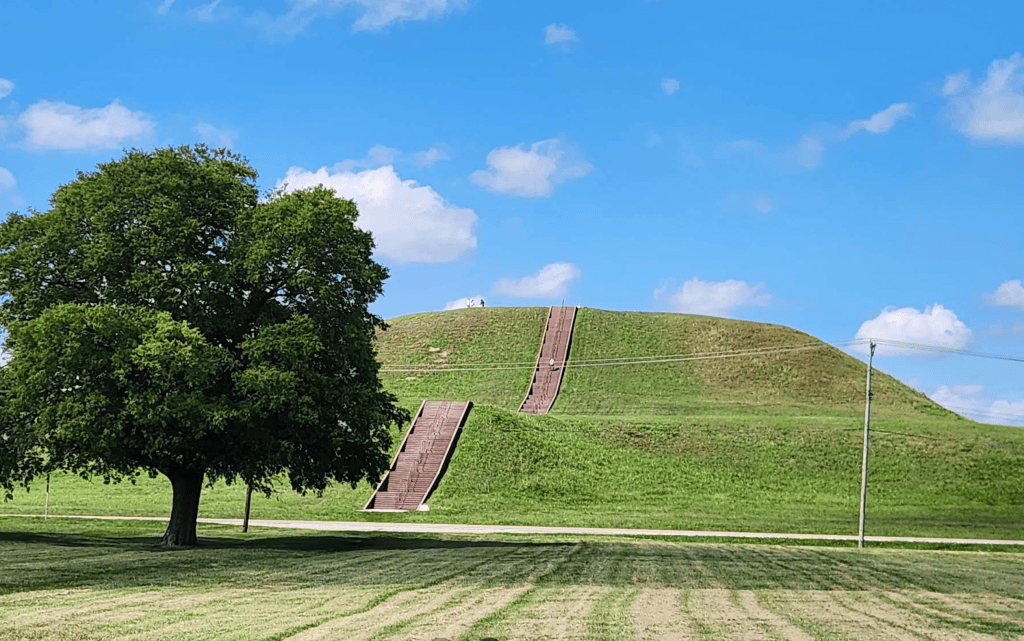
To enhance one of our days Geoff and Vera took us on a tour out of town south to the Atlantic Coast and the Castelo de Sesimbra.
From its battlements one way, and then the other.
The castle also had a modest chapel with a fine display of azulejos, the distinctive tiles — often blue and white and sometimes incredibly detailed and realistic — of, among other places, the Iberian Peninsula, reflective of its Moorish influences.
The contents of the canopy of one alcove did puzzle me. I wondered if we were to celebrate the leg or perhaps its successful amputation. There would be a story. The other similar spaces were full of incidents in the life of Mary. After all, it is the Igreja de Nossa Senhora do Castelo, the Church of our Lady of the Castle, but I don’t know any relevant stories about a leg and its accompanying walking stick.
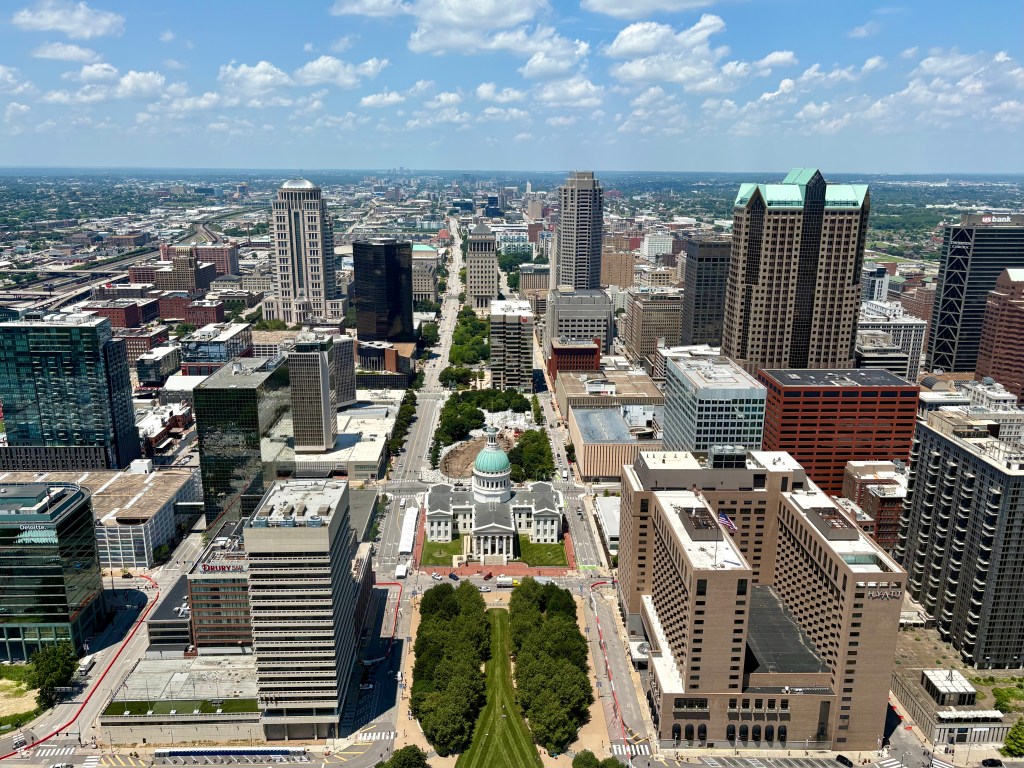
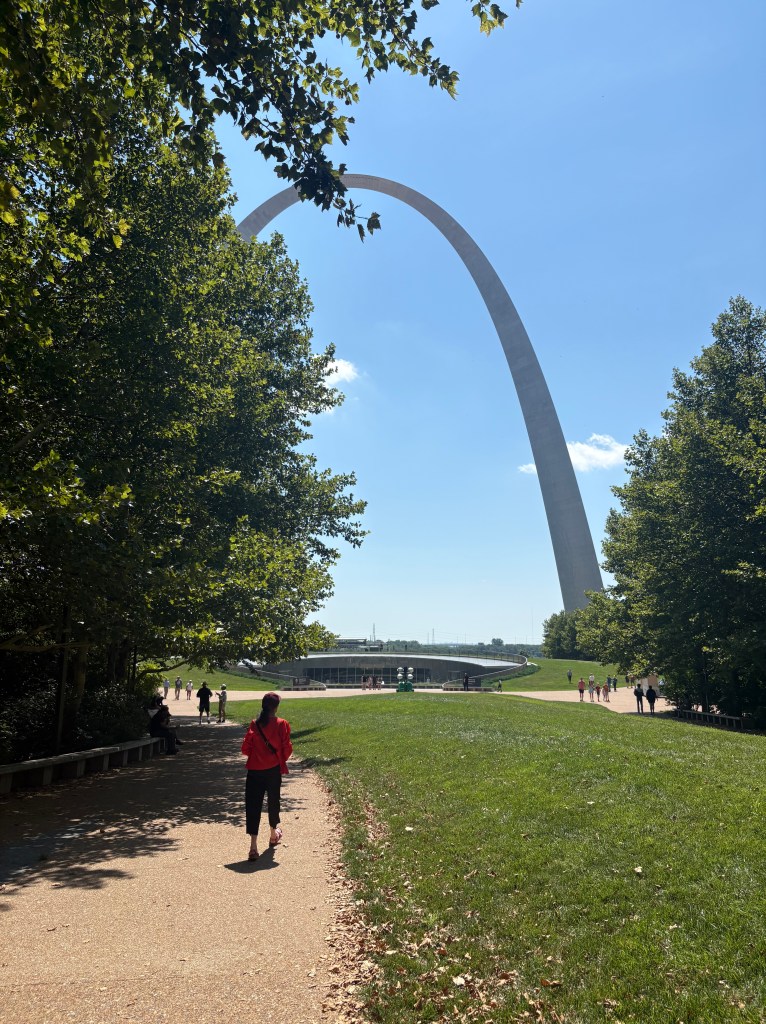
We also visited a nearby beach where some courageous people swam.
Note the stand of trees in the centre picture. We walked a kilometre or so down to the beach from the car through stands of eucalyptus.
Any shortfall in tourist attractions to visit was made up by the pleasures of the area near Geoff and Vera’s unit where we were staying, Arroios on the Rua Morais Soares. It was the real world where people lived and did what people do.
We bought excellent material for breakfast in the local Pingo Doce, a supermarket chain. We weren’t far from the Grill n Chill or the Tandoori Fusion. There was a pastelaria almost next door (The ‘Star of Paris’) selling all manner of pastries and baked goods but also first rate Portuguese tarts which in the past I have dismissed. But not this time. Chai Wala Indian Traditional Sweets was on another corner, sort of an outgrowth of Pali Baba Frutaria e talho (‘Fruit shop and butchery’) itself shoulder-to-shoulder with the Oculista Do Chile, Lda, The Chilean Optician. [I have further advice on this. It is more likely to mean ‘the optician of Chile Square’, Praca do Chile, which is nearby.] I thought I’d smashed the screen of my phone but one very helpful set of young techies (from four or five options) diagnosed the issue and removed and replaced its protective layer. A chemist, kids clothes, a very busy beautician, several convenience stores, a dollar shop, a dentist, several bars, the Barbearia Dom Juan where I had my hair cut. It was ACTIVATED. There is something deeply sustaining about being in a locale like this. You get a good look at things you otherwise wouldn’t see.
When I took this photo we were eating outside at the Tasca do Mercado (the ‘Market Tavern’). Very fine food. Our unit was one block down either of these streets.
Not a Portuguese tart.
The elegance of rubbish. Lisbon on the left, and on the right we’ve moved an hour’s flight away to Madrid.
Maurie my treasured barber of profound Italian descent who I think has never been to Italy, is going next week to Rome, Florence, Venice and Lake Como. Mid-August. Could be hell. But his elder daughter’s boyfriend wants to propose marriage at the Colosseum. Can’t say fairer than that can you? Could be anything. We checked the location of their accommodation in Venice: 100m from the Rialto on a line running directly south to the Piazza San Marco. And this is squarely in the middle of the train tracks. The heart of San Marco. Could be murder. And I’ll hear. I’ll be told. (‘Daaaavey … why diddun you tell me? We cooden even get out the front door. Too many people. And when we did the food was shit. Starbucks! I go half way round thu world to go to Starbucks! Cost me a FORTUNE.’)
[An addition 2/8 provided by Helen Beresford, one of her husband Jan Senbergs’ wonderful paintings, and yes, it’s all there: Venice. Marvellous! Thank you Helen.]
Alan loves a map. This is for you Al. We were staying just above the ‘e’ in Cannaregio. The dotted line is the route of the hordes. Maurie is staying just below the second arrowhead.
About 30 million tourists come to Venice each year. Since I moaned albeit quite cheerfully about the number of tourists there in 2010 that number has multiplied 2.5 times. The resident population has declined from 178,000 in 1950 to just under 50,000 in 2023. There are reasons for this and they are all fairly grim, a consequence of anticipating and feeding the desires of the itinerant hordes in the service of profit. And we were there distributing our own version of largesse and making our own contributions to its decline.
So, what’s our story then? The end of the walk was not very far due north from Venice on a major train route. We were flying from Venice to Lisbon. There’s that. Stick with it. But also Venice is violently addictive. It seems that there are things there you simply must see. And the vibe. All those canals. So I confess, only a bit repentant: we’re part of the gang. Suited up.
There is something preposterous about Venice, something that makes you chuckle if not laugh out loud. A city built on piles from the Croatian forests rammed into 120 islets in a shallow lagoon. A city whose main thoroughfare is lined with palaces but which has an appalling problem managing waste. A city whose cultural foundations are deeply serious overrun by haymakers and partying boaties with blasting boom boxes. A city whose identity is built on religion but whose daily life could scarcely be more secular. When I wrote about it in 2010 I called it Disneyland on Water. Maybe that’s why we go. Of course it is.
My list wouldn’t have been everybody’s but in a day we seemed to fit that and most of the rest in as well. Didn’t cross the Rialto. But look:
We’re just about to get into that gondola and go across to the other side 50 metres away for some ostentatiously large sum of money. [I’ve just checked and I need to qualify that. Two euros each which Michael had in his pocket possibly for just such an occasion.] But what are you going to do? Swim? No. Join in. Be part of the flood of humanity who for some opaque reason wants to ride in a gondola.
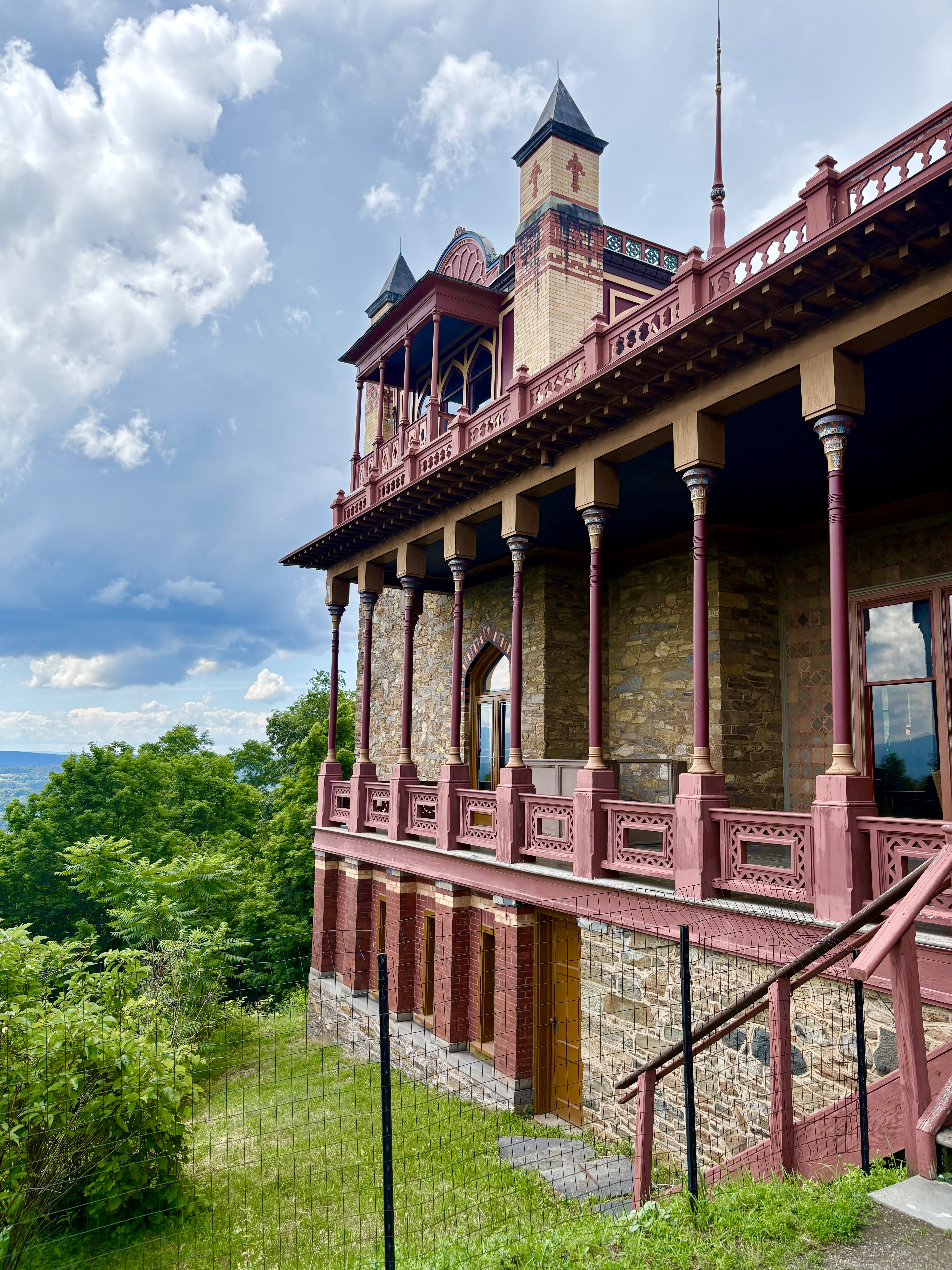
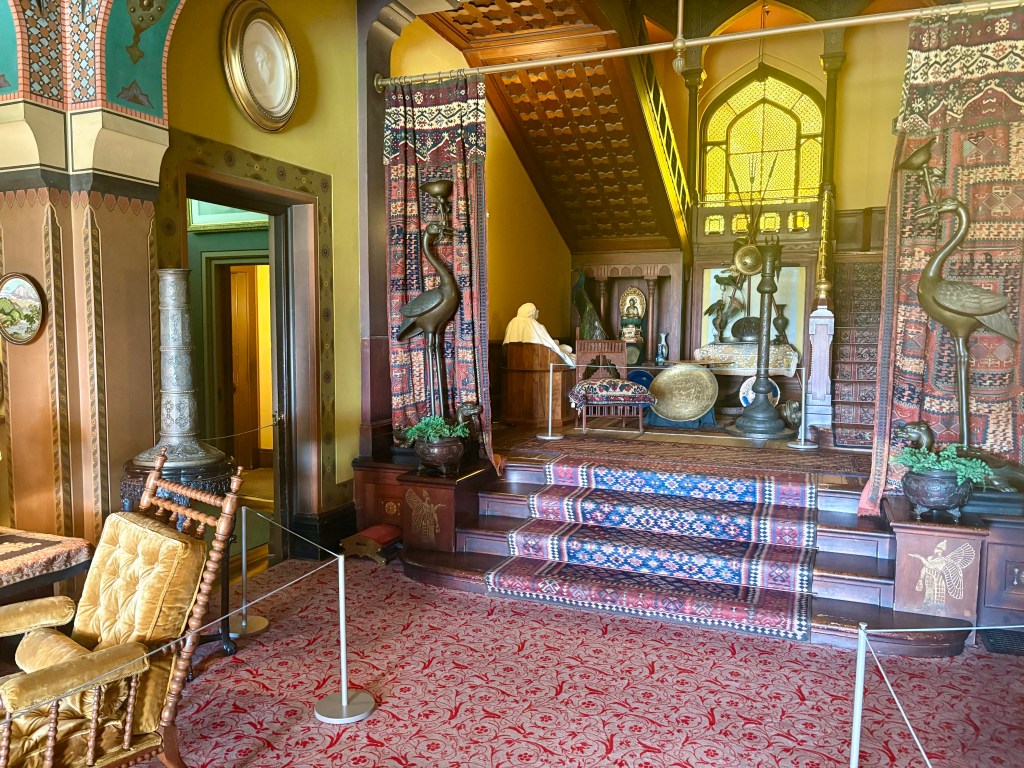
And the other side included:
Yes we’re at the Piazza and San Marco. Saw the Doge’s Palace. Did it all. Sat down for a drink, and this time I am correct because it is written down in front of me: media alla spina, smallish glass of draft beer, €23, or if you like AUD 37.88 per favore. A cup of coffee €15 (AUD 24.70). We didn’t choose to participate in that way here or anywhere else. An hour or two later we were eating a delicious meal in Cannaregio which was only plausibly expensive having had a very pleasant and substantial beer at a bar on the northern littoral for €8 a pop. (Looks like not that many people. Far fewer than August of course — this is in mid-June — but people were sheltering out of the sun. It was VERY hot.)
I had proposed a plan.
Stay somewhere nice a bit out of the way that’s not too far from the transport you want to use, in and out. Cannaregio? Great. Very comfortable accommodation, two bedrooms, huge kitchen off to the right — we could have a cup of tea!— AND a laundry! Hoorah.
Michael threatened to read all the books during the two nights we were there. A very impressive selection: classical and canonical supplemented by a few racey choices of the airport newstand genre.
The second element of the plan was to go against the traffic and get on the ‘wrong’ side of the Grand Canal into San Croce and Dorsodouro as soon as possible. There are still as many canals and bridges as you could wish for, elegant buildings, long views and excellent ‘normal’ places for food and drink. In 2010 as we did this, I thought, ‘Suddenly, perhaps obviously, as we strolled we found ourselves in a different city, one where people seemed to live.’
It wasn’t quite the same in 2026, but it wasn’t too far off it. We were sitting having our morning coffee and breakfast watching this happen. Quiet, mild and his camera is further away than arm’s length from the subject.
We were on our way to fulfil the third part of the plan, visits to the Accademia and Peggy Guggenheim’s Gallery. I had timed tickets for the latter and the former was on our way.
The Accademia has a great collection of medieval and renaissance art, primarily northern Italian with a focus on the rich vein that is Venetian. (Venice, of course, has been an imperial capital: boats, shipping, trade, a navy, 139 churches, 88 still operating, patronage, plenty of opportunity for religious art.) It is a good place to see stuff by Veronese (featuring strongly this time), Tintoretto, Titian, Canaletto (landscapes of the city), Bellini and Tiepolo (up there on the roof and in high corners looking down at you) among many others. And it has a reputation for being lightly populated. It is on the wrong side of the Canal I guess.
Some group photos:
There are a couple not looking at you … but not many.
and a large hatfull of religious mysteries not all of which are necessarily biblical. There’s this one for example.
Early Tintoretto (1555-ish?) Saint Mark saves the slave from torture or The Miracle of The Slave. ‘The miraculous apparition of The Evangelist swoops into the scene causing the instruments of torture to break, nullifying the punishment that the Provencal Lord (seated top right) wants to inflict on his slave, guilty of having travelled to Venice to venerate the remains of Saint Mark.’
There’s an issue here. Saint Mark coming to save someone who has just been to see the remains of Saint Mark? Arid nitpicking.
However, despite the weapon-grade radiance emanating from his head, Saint Mark may not be in time. The slave has already got a stick in his eye and another one looking like it’s on its way down, an axe similarly poised. The handle of the sledgehammer might be broken but what has it already been up to? Plus the hangers-on seem more interested in arranging themselves in a tableau than effective intervention. From Tintoretto’s tabloid period. But he knew his audience. This is one of a set of four big ones focused on Saint Mark, Venice’s patron saint.
This is another of the four.
I do not know what the ghostly figures fleeing off left are up to. (It’s likely that the painting is unfinished.) But this is his Saint Mark’s Body Brought to Venice, The Abduction of the Body of Saint Mark or Translation of the Body of Saint Mark, referring to the transfer of Saint Mark’s relics from Alexandria to Venice. And here is an explanatory expansion:
Saint Mark spent most of his life in Alexandria, Egypt. His body was brought to Venice eight centuries after his death in AD 68. Venice’s ruling class wanted St. Mark as the patron saint for their economic status, so they arranged to smuggle his body from Egypt. While stealing the body, the thieves Buono da Malamocco and Rustico da Torcello hid the body under pork and vegetables. Once they arrived in Venice on January 31, 828, Mark’s body was kept in Doge Giustiniano’s palace. When the doge died, his widow was ordered to build the Basilica di San Marco to house Mark. Fear that Saint Mark’s body would be stolen again continued after the death of the Doge. According to a French monk, Mark’s body was safely stored in “one of the great pillars”. However, when the chapel of Basilica di San Marco was rebuilt in 1063, Saint Mark’s body could not be found. Thirty years after this, it was said that Saint Mark’s body re-appeared, with his arm appearing from an old pillar. After re-appearing, Saint Mark’s body was finally put in a sculptured coffin below the high altar in the chapel.
‘The thieves Buono da Malamocco and Rustico da Torcello hid the body under pork and vegetables.’ The arm … my gracious. That would have been a moment. And the camel? What of the camel? Another panel in life’s rich tapestry I guess. Venetian history. Love all this. So much to be known isn’t there? And some of it at least is there waiting for you in the Accademia.
I have written at some length about Peggy Guggenheim and her Venetian gallery elsewhere. A most absorbing figure. Out there. Full frontal. And her daughter who had the misfortune to be named Pegeen, and whose artwork while pushed hard never toppled over into credibility. And that’s what I thought on this visit: the mountain, mighty mountains and vast expanses, of work on which really good art is built. The collection was slightly musty, and perhaps more about Peggy and her many mates than art per se.
This Miro is the work of a young man. If you knew his later work you could see some of the foundations here.
A Mondrian below. I can’t remember whether it was a window or a painting. It’s whichever you think it’s not. [It’s a painting.] And lovely, but he went on from here.
And I don’t know who did this or its name. (It’s got ‘Le genie de l’espace’ written on it. The space genius? The genius of space? Andre? Yolande? An interpretation please.) But it was striking. I contributed the reflection.
That night I looked at my phone and we had walked 12.8 kilometres not a step of which I regretted.
There’s this.
And there’s also this.
Magic. Some of that will have rubbed off on Maurie and his family. I have no doubt of that. None. It’s Venice.
It’s the Chestnut Way, the Keschtweg or the Sentiero del Castagna in this very multi-cultural part of the world, north-eastern Italy, not so far from the Austrian border.
And it is either in or, more accurately, very close to I Dolomiti, The Dolomites. The most renowned peaks in the Dolomites, the Cimi are visible in the background of the first photo above and a constant presence during the walk. But they are on the other side, the eastern side, of the valley carved out by the Isarco or Eisack river. And on the other side of the formidable autostrada which lines the base of that valley.
It was only on the train from Innsbruck that I realised we were going through the Brenner Pass, since Roman times one of the main entry points from the north through the Alps to Italy. The nose-to-tail traffic, trucks especially, on the autostrada suggested that it still is. The Southern Tyrol as the area is known was granted to Italy (from Austria) after the First World War. In 1940 the Pass itself was the site of the signing of the Pact of Steel by Hitler and Mussolini. When Italy surrendered in 1943 the Nazis shifted the nominal border of the Reich well south of Bolzano. This helps to explain its cultural complexity. I found the shift from ‘Central Europe’ to ‘Italy’ over 50 kilometres quite pronounced and most certainly part of the fun.
At left, Michael doing his best to look South Tyrolean.
And it has been a route of pilgrimage for centuries. I have mentioned elsewhere that the walk nominally starts at an abbey north of Bressanone/ Brixen, the Abbazia di Novacella, and finishes at the cathedral in Bolzano. Shrines ranging from the obvious to the opaque are legion along the way.
Churches provide some of its most distinctive sights, but the walk gets its name from the stands of chestnut trees you encounter. It’s an amazingly fertile area full of vineyards on impossible slopes along with a huge range of fruit trees.
Bressanone/ Brixen has its own tourist allure. It is the oldest city in the area and its old quarter almost defines picturesque. A floral Lamb of God in the Square in front of the Rathaus (Town Hall) on the left. The marching chaps? No idea, just mightily impressive. They demobbed into the cathedral swords sheathed.
Rather than tangoing with the sharp grey peaks — and there is a very enticing walk along their base which people I know have done — we were on the old folk’s side of the valley. We were walking, more or less, along the lip of the western side of the valley which still had plenty of ups and downs as well as consistently glorious views. Like this: ‘This track is rated moderate and is suitable for regular walkers with most days offering 4-8h of walking and sections with steep ascents. The routes cover a variety of terrain including grass, roads and stone paths as well as dirt roads and forest tracks.’ That’s about it.
It’s not so far. On the autostrada it’s 50 kms; we walked just over 80. (Melbourne to Geelong. Glad to get Geelong in somewhere.) The only interest this very faint map provides is that little oval off to the east. The final day was a circumambulation of an alpine plateau, Siusi. We got there via a 50-minute bus ride and a cable car.
I was a bit apprehensive because I had pulled a muscle in my thigh a few weeks previously and it was still coming and going. But nothing ventured …
Apart from one very wet day which I spent mostly in bed reading and resting, the weather was sunny and often very warm.
********
We look all right here in Bressanone’s Square just outside one of its two cathedrals, almost next to each other as it happens.
We look all right because we haven’t done anything yet. It’s Sunday morning and we are waiting for the bakery to open so we can buy some lunch. Waiting waiting waiting. So I decided to poke my head inside the cathedral. It was a serious affair.
A version has been on the site since the 980s. It was re-built after burning to the ground in the 1170s and then again to a firmly baroque and grand style over 10 years from 1748. It is the seat of the Diocese of Brixen. (The Catholics here go with the German.) It looked like a new portico was going up when we were there.
We waited at the bus stop, hoping, because there was quite a long way to go — we walked about 20 kms that day, climbing up onto the ridge — and it was getting later than it should have been. A taxi stopped exactly at the bus stop to let a passenger out. Providence: an opportunity like that is not to be missed.
The abbey itself was equally serious, and Providence again sent a signal.
We were heading back to the departure point when round the corner came this.
Being of religious heritage I would have stayed longer, especially to listen to the choir, but my companions choofed me along. Fifteen minutes later we were climbing out of the valley albeit in what seemed like the wrong direction. Below is the abbey which owns at least some of the vineyards which surround it.
We turned south at Varna, not much more than the small cluster of houses which recurred, and it was near here that Myrna found the suspicious issue in the woodpile: a waymark of some importance.
The coat of arms with its splendidly assertive figures was on the front wall of a house we passed. Scheuchenstuel Lucerna seems to be just a Proper name. (1417-1940! That’s a long time.)
Soon, after five or so kilometres, we could see Bressanone/ Brixen from above. The two cathedrals stand out. The big yellow building to their left is a school.
It was unquestionably rural walking with the occasional religious experience.
One of the pleasures of the walk was the feast of smells. The pine forests for a start, and the drifts of floral not fragrance necessarily, although many of them were lovely, but just interesting smells. There was the cow shit and the vegetal aromas from composting silage, and an unusual sort of lanoline smell which recurred. Lots of wood smells: cut, fallen, wet, drying, rotting, fungal, and very occasionally dried or smoked meats. I enjoyed them all.
Our first clear view of the Tre Cime di Lavaredo, or the Drei Zinnen (in the background here). They are as dramatic in the flesh as they look here. The highest peak, Cime Grande (‘Big Peak’, 🤔) is 2999m above sea level. (You’d think they’d build a cairn or some modest construction to break through the 3000 barrier wouldn’t you. Or perhaps the 2999 is so distinctive you’d want to just leave it at that.)
We were at Velturno, our destination, when they looked like this, and I was tired and sore. We’d had a big climb and walked a bit further than we meant to. This storm arrived 30 minutes after we did and it was a powerhouse. I slept very soundly and woke feeling considerably better. Breakfast was excellent and we started early. The morning turned out to be a relatively easy stroll down into Chiusa/ Klausen.
Looks easy — and attractive— doesn’t it.
That’s Chiusa down there …
and that church and abbey on the protuberance (the Monastry of Sabiona) kept dodging around our sightlines.
As suggested pictorially we found some good coffee and food.
But then, of course, we had to get up again.
We took an option to cheat slightly, ie to avoid the 75 degree slope and instead take, as it turned out, the 65 degree slope. ‘BIG climbs and not much respite’, my diary says. We did find the chap jumping off the roof.
Above is Barbiano, where once again we walked past our destination, a character-full pub with character-full staff which didn’t seem likely as we tottered past (that’s me; the others were striding personfully as usual) on what passes for a main road just here.
Barbiano is famous for its leaning church tower, now stabilised we are assured.
I found the cemetery which adjoined it just as interesting if not more so.
Drawing back a little, we look up the valley of an unidentified watercourse which joins the Isarco/ Eisack 1200m below us at Waldbruck. It’s hard to see but the valley on the other side is dotted with habitation, including a ‘town’ on the edge of the upper green flat bit on the right. What do they do in these places? What’s life like? In the latter case how do you even get there? There would be answers, and they mightn’t even be surprising.
My journal reminds me that I was a bit sick that night. I hadn’t eaten much, it had been hot and a very big climb. I thought I might have had mild heat stroke. The symptoms were about right. But, maybe a virus. Possibly just worn out. Whatever, I wasn’t sure about continuing the next day. There was always the option of going with our luggage which was collected and moved on every day, part of the deal with the company we went with. (I had completely forgotten all this. We protect ourselves from our infirmities don’t we.)
My journal also says, next day: ‘Felt a bit better, a lot better really, first thing, and it was a pretty easy start on a flat road for the first five. We found a good Despar (supermarket) and a bakery, and the first five were pretty easy. And I’ve just written that twice which indicates how well I am.’
We got going. (This is just as well. This was a great day of walking.) The first five were pretty easy. Or have I mentioned that?
The same glorious views.
I was planning to get from Bolzano to Venice by driving on backroads. This incident helped to change my mind. The roads were as narrow as they look. The truck had NO chance of getting to where it was pointed. The line of traffic above was probably about 200m long. These issues were more general. We had a 20-minute bus ride at the end of this day, full size bus, and that too was an experience.
We found the chap with his finger to his lips where I’m standing to take the big photo. An oddity. According to the plaque, this is John Nepomuck, Vicar General to the Archbishop of Prague. In 1393 (! Life has a long tail here.) he defied King Wenceslaus IV when the King suspected his wife of adultery and demanded that Nepomuk break the seal of confession. When Nepomuck refused, he was thrown from the Charles Bridge and drowned in the Vltava. As a result (is that what we say? In consequence? As it happened …?) in 1729 he was canonized. He is considered the patron saint of bridges and the guardian of the seal of confession. (How about the word Beichgeheimnisses, ‘confession’. Don’t you love German?) This would be an excellent place to toss someone off a bridge if you wanted to get rid of them, but one among many others on this walk. This doesn’t look anything like the Vlatva 700kms and a world away, but it’s a pilgrimage, so the licence for inclusion may be expansive.
The top of the cliff on the other side is our immediate destination on our way to a lookout which was surmounted by the chapel pictured below. How people get there I do not know. Ah yes, it’s a pilgrimage. I’d forgotten.
It was another hot day. I was very glad to find this spring, a saving grace for a time. The red-and-white waymark, and a heavily pollarded ancient chestnut to which Myrna took a fancy.
AND, I’d forgotten this too. There was a shortcut after about 12 kilometres which would take us up to Lengstein and a stop for a bus that would take us to our final destination. That way we would avoid a very nasty 3 kilometre climb, and we’d had a big day.
We found the access turnoff point okay, or at least I think we did. I knew where we were and where we were headed, but perhaps in the broad sense.
We began with a climb that was almost as bad as the other track promised. Nonetheless the right corners appeared. It looked a bit like a plausible track and we got into an open paddock that inspired confidence but provided a series of options. (Ah laugh.) I chose one and we ploughed along it for about a kilometre before coming to an unassailable fence. I knew where we were don’t you worry. Precisely. But where we were suggested a 90-degree right turn up through — the journal says, jungle. It wasn’t jungle. Hyperbole. But it was very steep and there weren’t any tracks and it was you might say heavily forested. We could have gone back but that would have rather defeated the idea of the short cut. Myrna decided she would forge on ahead to find a way leaving the men to dither. Anyway, despite a certain degree of frazzlement, it turned out. Adventure!! We got to the bus stop. The bus arrived, even though the driver wasn’t going to drive any further for 40 minutes. Timetabled requirements. He enjoyed several smokes while we drank in the alpine air.
I’m sure I was forgiven. Eventually.
On arrival, the dominant feature of the viewing terrace for tourists at Collalbo. (‘Klobenstein’ doesn’t do such a lovely place justice.) And a mere gesture at our excellent hotel.
The clouds were gathering.
We’d known about the advent of this day, the fourth day, and its weather for a fortnight, becoming ever more certain as it came closer. And it didn’t disappoint. It pissed down. All day. Graphic, strong, unrelenting.
Myrna and Michael, separately, got their umbrellas and wet weather gear out and went wandering. I didn’t. I stayed in bed, cancelled our hire car, bought train tickets, attended to correspondence. (John G.: That’s where the surgical pictures arrived. Marge: the news that you’d arrived in an Emergency Department in foreign climes.) I also dozed and slept. We were in the best hotel of this collection. The food was amazing. We had a very comfortable room from which I am taking these pictures. The day was intended as a there-and-back which didn’t sound like it couldn’t be missed, so two consecutive nights in the same place. How lucky is all of that! And I felt the pain in my leg like a permanent cramp diminishing. Party time. Very watchable athletics were on the telly. In a tourist shop Michael found a plausible power connector the absence of which had been annoying him since he left his behind in Innsbruck. Any problems melted away. AND I developed a cunning alternative way to get to Bolzano.
Well … cunning. Not really. The fifth day as described was the 900m descent into Bolzano. Lots of zig-zags and steep bits. I thought we could do a version of the fourth day which we had passed up. This would allow us to arrive at Oberbozen/ Soprabolzano, whatever, but above all above, and in fact well above, the town below we wanted to get to. I discovered that it had a cable car that would take us almost to the door of our next hotel. Fabulous. So we would do our 12 or 13, and then glide downhill. And that’s how it worked out.
It had snowed during the night and there was still an overlay on the higher peaks.
This route took us past the very modest Lake Caminata, a feature of the walk 🤔, and its associated church and accommodation. I liked the church. St Ozempic was its patron.
But it was a different sort of day: more populated? more farmy? Not sure. The rain had had a significant impact on the underfoot and the river in the valley when we glimpsed it was in full spate. But these are among the things we saw.
Sydney ‘16,368 km’ for anyone interested. And we walked through an alpaca farm. Shearing in progress.
And then after a most satisfactory lunch at Upper Bolzano, down down down. A long way down down down.
Still with us? Last day: a bus trip, a cable car ride, and then a 13km loop around the Alpe di Siusi.
What’s an alp then? A craggy mountain n’est-ce pas, often grey, snowy? That’s what I thought. However, ‘An alp refers to a high mountain pasture, typically near or above the tree line, where cows and other livestock are taken to be grazed during the summer months and where huts and hay barns can be found, sometimes constituting tiny hamlets. Therefore, the term “the Alps”, as a reference to the mountains, is a misnomer.’ A further addition to my stock of knowledge. And, at 6000 hectares mostly over 2000m, the Alpe di Siusi is the largest alp in Europe.
Spitzbuhl, an iconic and consistent presence, is in the background.
Off the carefully made tracks, the ground was startlingly spongey. Really about the texture of a sponge. There were stacks of composting dung mixed with cropping hither and thither and you would wonder how this soil could be made more fertile. The surface is dense with plants and at this time a profusion of flowers. So many types with the yellows (daisies?) dominant. But look at this exquisite thing.
I was feeling in very good form this day, but one of Michael’s feet was inflamed and swollen — and obviously painful. We decided that we would do half the loop and meet him after he had got himself across the middle on a narrow but surfaced road a bit less than half the distance.
There were quite a few people on Siusi this day, all ages and quite a few means of transport, electric bikes being popular. (Love these photos.)
And even a bit of commerce. Five euros a pop if you’re interested.
This photo was taken by one of an American family who had been shadowing us on the walk, same tour, same hotels, same dining rooms, but also same shortcuts and same day indoors during the rain. A 50 year-old who worked at the State Department in Washington who never looked like he really wanted to be trekking, his wife who worked at the Federal Bureau of Financial Regulation, spoke fluent Italian, was always very carefully dressed and made up, and evidently the driving force behind the walk. Two kids, a quiet and fit boy of maybe 19, and an all-American girl of maybe 16?17?
We talked to them more here than we had the whole trip. We had made a mistake: they were both friendly and interesting. The girl made the memorable comment, re July 4 in the Mall: ‘Trump is awful, but he has great fireworks.’
Myrna is taking her 30th flower pic. The result is at right.
At left above is the hotel where we found Michael enjoying a beer.
The way home.
Last glimpse.
That was it. Fabulous. Loaded ourselves on the train …
This series of blogs will provide an account of our recent travels. They were pretty good. But no episode is without blemish. The worst are probably where illness or injury are involved, but travel is not staying home. It is not knowing where you can get a particular set of groceries or where the fruit is likely to be at its best. A bad bed, an airless room, a shocking meal … Each time it might be an adventure, or a failure, or a disappointment, or a disaster. That’s the gamble.
So I collected these bits and pieces out of my journal as an offset to all the other wonderful things I will otherwise describe and illustrate. And I did take some photos of moments that seemed to say travel.
••••••••••••••••••
Do travellers lose their humanity I wonder?
As we went through customs [in Zurich] I was moved to think how infantilised travel makes you. Unmoored. A good word. Tired, disoriented, that twilight consciousness business, ripe for any sort of picking, and in no need of any further duties. Somehow fellow travellers become aliens too. And all those well-rested officials who’ll be off to their own bed. Do they care? I don’t think so.
There is that constant wrestle with uncertainty. The Uncertain Aged: that’s not a new category at all.
Waiting. So much waiting. And those damn zig-zag lines.
[Montreal airport: THE worst.]
Night sweats as you wake too early and try to get back to sleep meanwhile managing swimming visions, snatches of music, memories, projections.
You need to deal with things that are in the moment and get control of that. Except that it is always necessary to be looking at least a bit ahead. You might get into bad trouble if you don’t. But everything is so immediate because your wits must be about you. It is another sort of exercise, and it’s why you so often just have to let go and laugh your way through.
Travellers are different somehow. Wearing the uniform — their travel cazh and all the accoutrements. And the horseshoe ballon round the neck. And all those people who don’t realise they’re wearing a pack. And those enormous carry on bags, and people who rush down the aisle to get off first and save about 15 seconds. And the ones who stand immobile in door ways. And the ones who walk along staring at their phones and expect you to get out of the way. Hate that.
That unreserved seat, that one you’re looking for. Where is it? Who’s watching your mission and what for, entertainment? You can be reduced to just food and sleep, if you can get both or either that is.
[In Innsbruck] it was Corpus Christi Day and everything was shut! Everything. Corpus Christi Day! What the hell is that?! (It turned out that wasn’t true and we had an excellent meal at a very friendly Italian restaurant.)
In a bank of four seats we have seats 2 and 3 for a 13 hour flight, and the flight is full. How can that be possible? The Worst Seats Ever, for which we’ve paid a fortune!
The bakery didn’t open till 9.30. Sunday. What the hell!
Ah filling in a form in an unknown foreign language which requires your credit card details to enable you to get get on or off a means of transport when you’re in a queue with dozens of people behind you. NOT PLEASANT. [The ferry from Venice to the airport. Worked out okay. Hmm … it is possible that I didn’t pay. Too late now.]
I wonder if I have misjudged this itinerary, or perhaps have become more certain I have. Too much packed in … hard work this travel business.
The test really is was it possible? And the answer must be yes, without qualification. Because it has happened. We’re doing it. And better than surviving. So much that is a thrill-a-minute, and we can always conk out. There is a new level of acceptability for conking out. Yeah. Let’s conk out.