
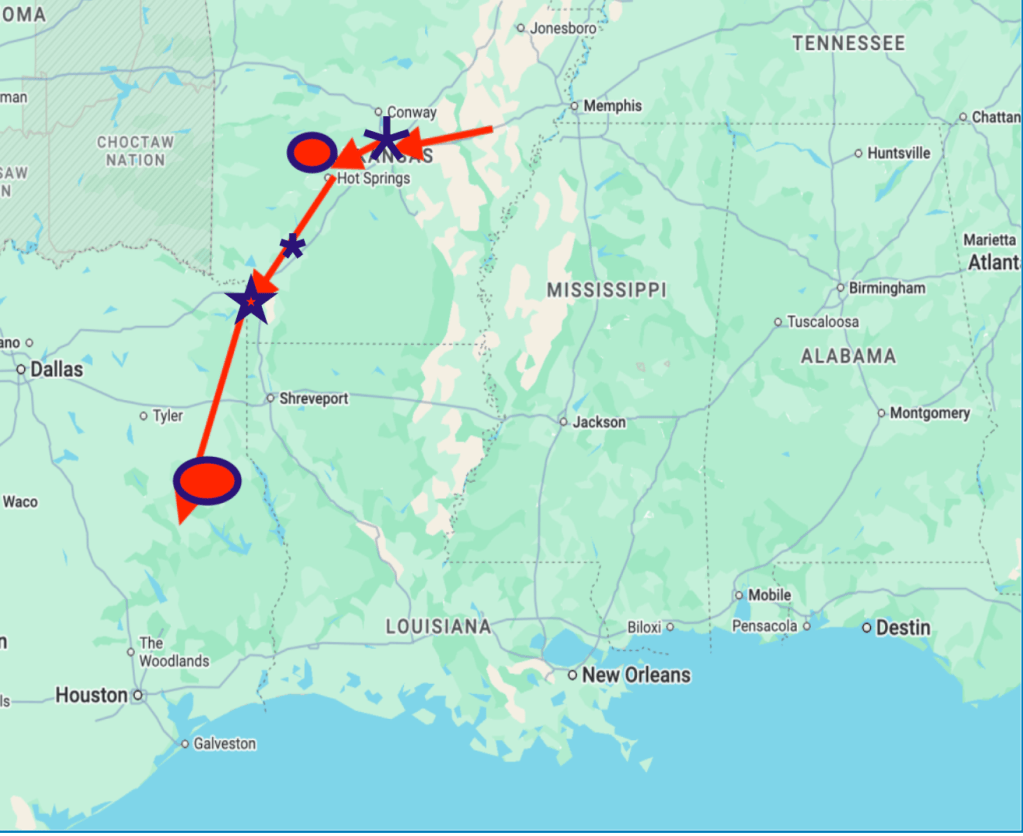
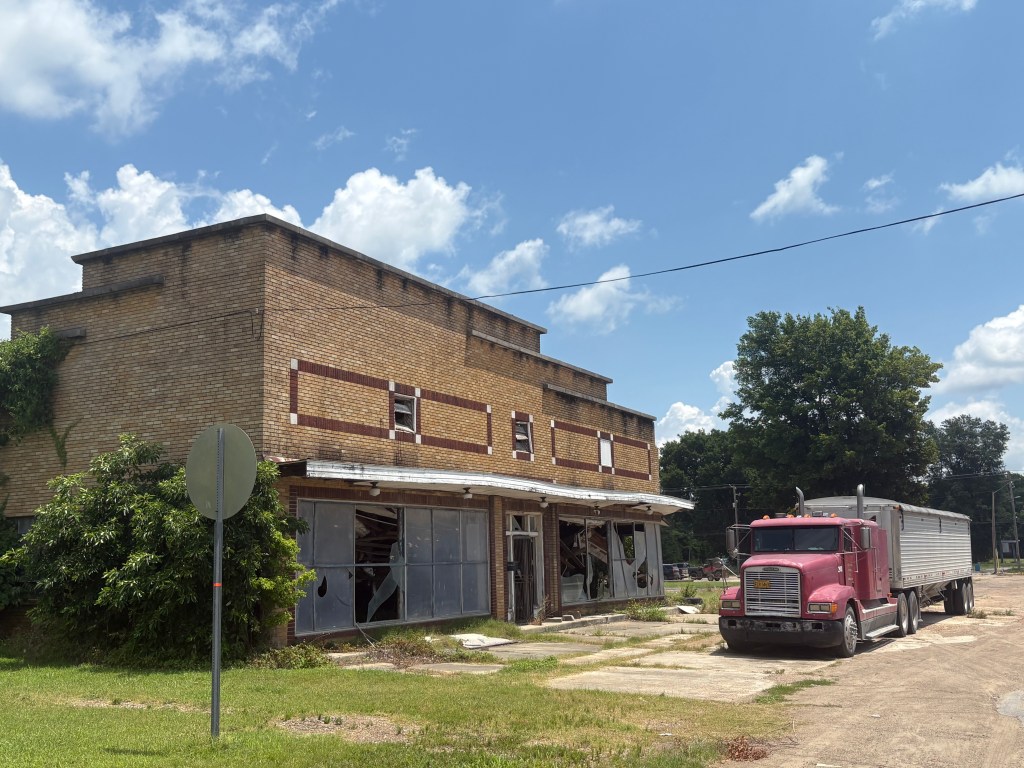
Brinkley needn’t detain us because the destination, not so far away, was Little Rock. I wanted to see what a Presidential Library was like. And what it’s like is that it thrusts its jaw out over the Arkansas River. (AR-kn-SAW. There are three pieces of legislation that say so. None of this AR-KAN-SAS business please.)
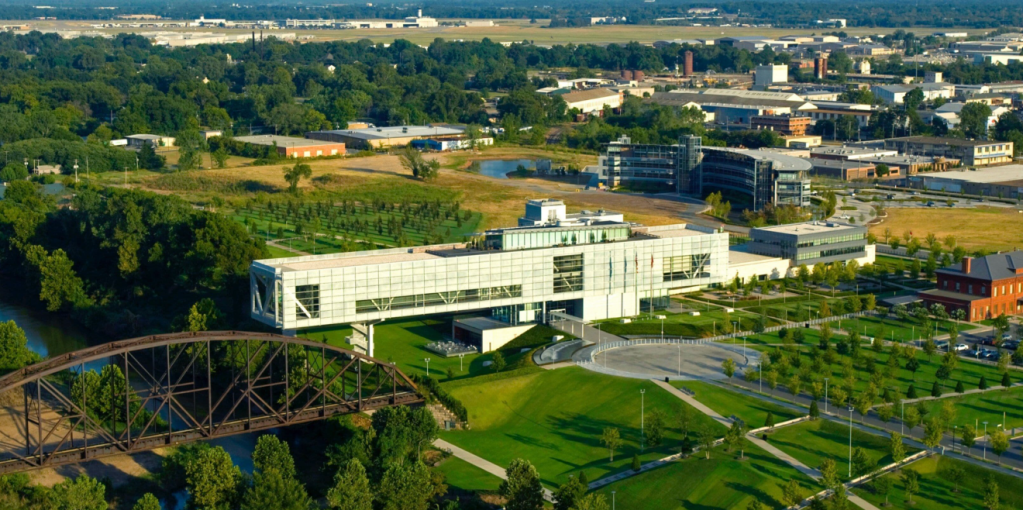
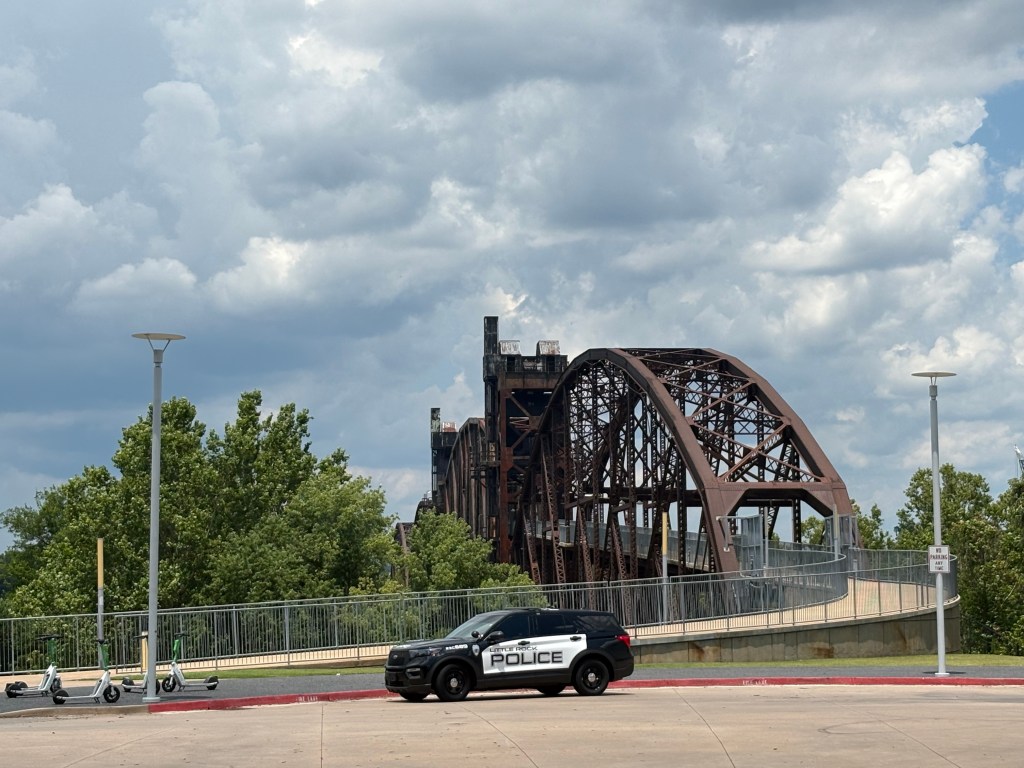
The bridge was once known as the Choctaw and Memphis Railroad Rock Island Bridge. I prefer that to its current name: the Clinton Presidential Park Bridge. You would too. I know. The series of steel bow arches is a style typical of its time. It was built in 1898 for trains to cross the river with a central lift span to accommodate water traffic. Fifteen years ago the bridge was closed and remodelled for bike and foot traffic. The lift span stays up and you cross it via two ramps. There is a constituency in Little Rock that still believes emphatically that this was all a waste of money.
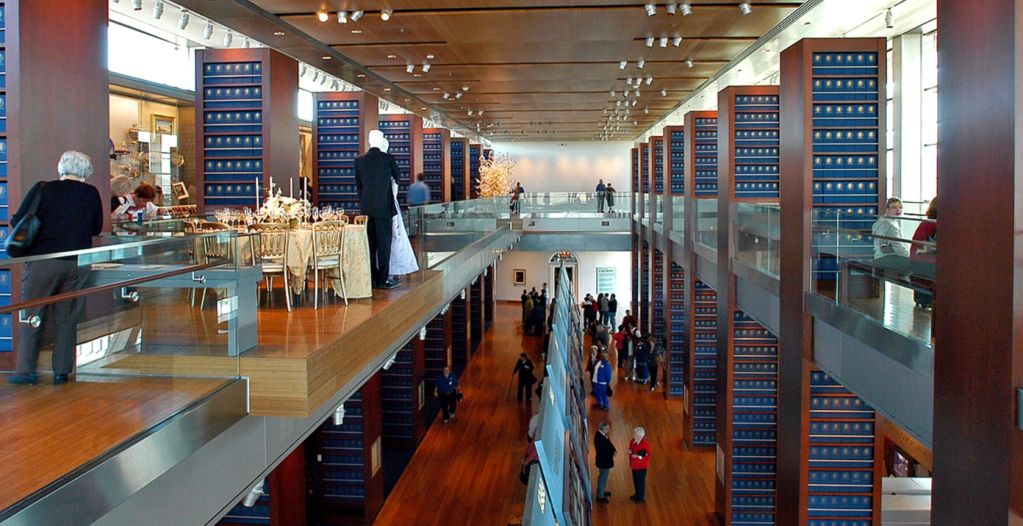
They might say the same about the Bill Clinton Presidential Library which cost $165 million to build (paid for by 112,000 public donations including $10 million from the Saudi government) and rather more to stock and run. There’s a Secret Service limo inside as well as approximately 2.6 million photographs, 12,400 video recordings, 12,000 audio recordings, 80 million documents, 21 million e-mails, and 79,000 artefacts related to Clinton’s presidency. The blue things in the photo below are document boxes — there might be several thousand of these —and I would wonder just how many of them would ever be opened. Still it’s all there — you can’t argue with that — and if someone wants to write the story of Bill’s public life there’s lots to work with.
The sketch below appears in one of the alcoves and is a vigorous reminder of the hopeful clarity that was being applied to the world’s problems at the time. Bang!! Got it! That’s Education fixed.
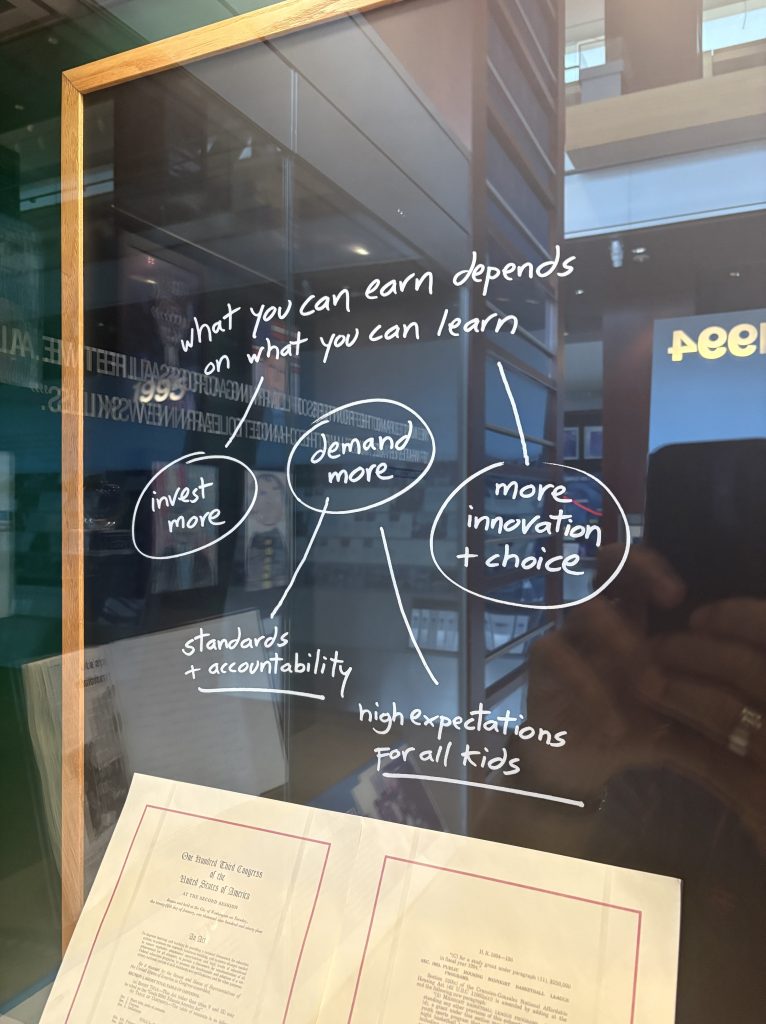
I remember this period of my working life well. Grease things up a bit with some funds that in the end could be lifted painlessly, bang a few heads together especially those belonging to the people doing the actual work, then more sanctions, more responsibility and more directions (from me, just for example, and the plentiful others like me). You could call it The Consultant-led Period.
This might be what The Third Way actually consisted of. Not the employers (the First, or Customary, Way) or the employed (the Second Way, and never really fashionable) but the chaps who turned up, had a look, wrote some things and went away again, leaving behind a tissue box of certainties. (Number Three!) Some, perhaps many, of those chaps had zero imagination or insight and produced the same solution endlessly: sell public institutions into the private sector and deregulate. Then … let the Market decide! (Footnote: this was when the accountancy firms with initials for names — KPMG, PWC, EY and Deloitte which can’t really be abbreviated — discovered they could make a fortune out of the work previously done by public servants. McKinsey had known this for some time.)
One of the areas that the Clinton administration (which, it should be remembered, had hostile majorities in both houses of Congress for almost two-thirds of its life) wanted to tackle was welfare. This is what we learn about that in the library:
‘In 1992, [he] promised to “end welfare as we know it”. As President, he made good on that pledge. The landmark welfare reform law required recipients to find work, and imposed time limits [two years] on their benefits. But it also gave them the tools they would need to find and hold a job—from child support to health care, food stamps, housing, skills training and transportation. … The welfare system no longer held people back, it helped them to move ahead.‘
Prima facie, that seems like a pretty good idea. There might be quite a few people who should be encouraged to get off their arse and get busy about making something of their lives (also described as ‘teaching people the dignity of self reliance’), a very American idea, a caramel twirl of the values of individualism, enterprise and money (your own) as the foundation of life. But, in addition, you’re not being uncaring. You’re offering support, pathways, training.
How did it go?
‘The number of people on the welfare rolls fell significantly after the program was instituted. Many recipients did find jobs—something that may have been unusually possible during the booming economy of the ‘90s. But several million, with an over-representation of African American and Hispanic single mothers, became what sociologists call “disconnected,” and today receive neither government support nor jobs. Today, they live on almost no money and have to resort to help from family, friends, or strangers, to survive.’ (Alena Samuels ‘What the Clinton Library Says About Welfare Reform’ The Atlantic)
But ‘the number of people on the welfare rolls did fall significantly’. Politics consists of endless trades, and you can’t please everyone. However it may be that the authors of the policy — men — may not have had much contact with African American and Hispanic single mothers — women. This was noted at the time. By women.
A case could also be made that the actions of Clinton’s government generated the global financial crisis by ‘tearing down old laws that stood as barriers to competition between commercial banking and the securities and insurance businesses’, by removing any safeguards from derivatives trading, and by pressuring commercial banks into high risk housing loans.
Here’s a snatch from the Administration’s press release announcing the changes.
‘So who benefits by the dismantling of these outmoded laws? The answer is, just about everyone. Banks, insurance companies and securities firms now have the ability to escape their narrow market niches and compete head-to-head by selling a full range of financial products and services. Consumers benefit by having unfettered access to a wider array of products—products that will be delivered more efficiently than in the past. In fact, the U.S. Treasury estimates that consumers will save $18 billion annually because of the new law.‘ (👏👍😂 It’s the grandparent of the One Great Big Beautiful Bill.)
You may have forgotten what happened.
‘Financial stresses peaked following the failure of the US financial firm Lehman Brothers in September 2008. Together with the failure or near failure of a range of other financial firms around that time, this triggered a panic in financial markets globally. Investors began pulling their money out of banks and investment funds around the world as they did not know who might be next to fail and how exposed each institution was to subprime and other distressed loans. Consequently, financial markets became dysfunctional as everyone tried to sell at the same time and many institutions wanting new financing could not obtain it. Businesses also became much less willing to invest and households less willing to spend as confidence collapsed. As a result, the United States and some other economies fell into their deepest recessions since the Great Depression. Millions of people lost their jobs and homes.’ (RBA Education)
That can happen.
Mind you, Bill was long gone by 2008, and he could say ‘I did not have economic relations with that GFC’. And, I must say, he did much that was impressive and valuable which Trump and others are still unpicking.
This is how the Clinton years are wrapped up at the Library:
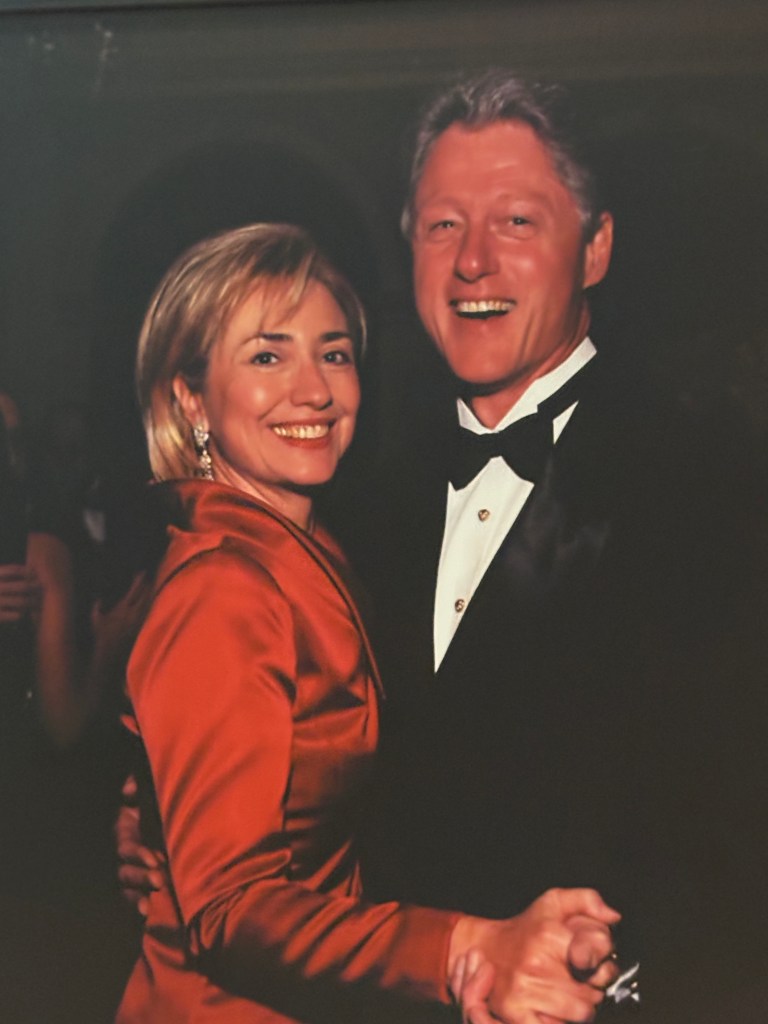
‘The President and Vice President’s strategy of fiscal discipline combined with opening foreign markets and investing in the American people led to unprecedented economic progress. The United States enjoyed the longest economic expansion in history; the lowest unemployment rate in 30 years; the most new jobs ever created under a single administration; the highest home ownership rate in history; the lowest poverty rate in twenty years and the largest five-year drop in child poverty since the 1960s.’ All true.
To which could be added bringing the budget into surplus the first time for 30 years for four years in a row, landmark environmental legislation, groundbreaking work on abortion and gay rights, a dozen or more really useful contributions to child and adolescent education including the Headstart Program, effective armed intervention in Bosnia and Kosovo, modest but unique firearms control legislation and so on. He also played a role in the Northern Ireland Good Friday agreement and significantly stiffened the spine of NATO.
I left convinced that Bill’s performance as President had been excellent, outstanding really, if perhaps lucky. The Library had done its work. But what do we remember him for?
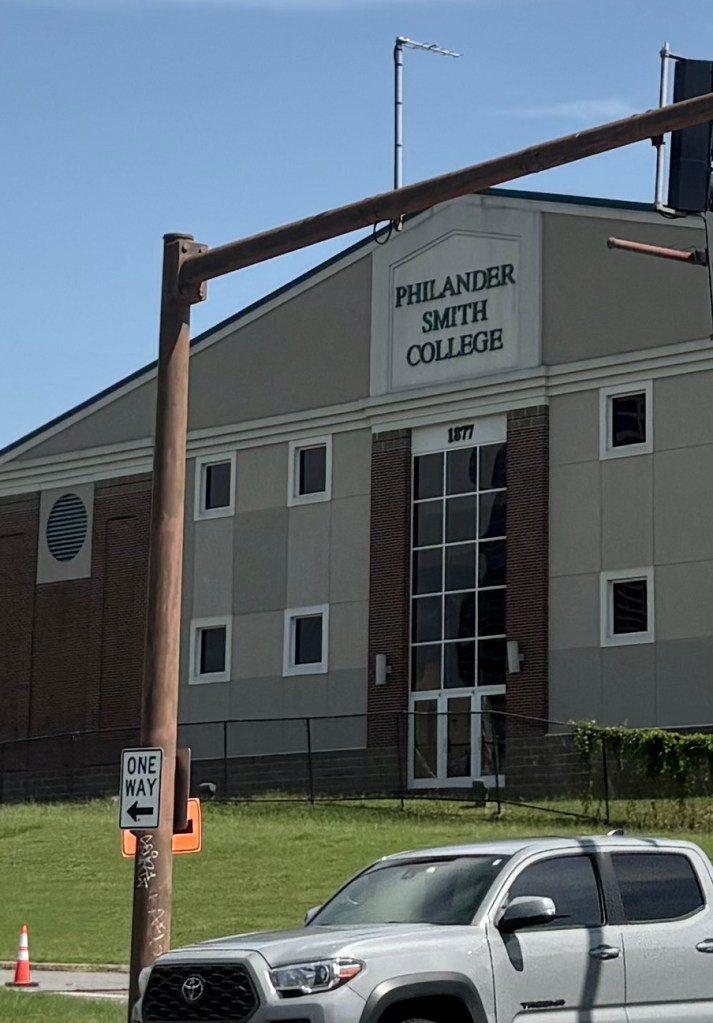
Philander: vb. to flirt, casually date, or have casual sexual affairs without serious intentions, traditionally used to describe a man who is unfaithful to his wife or partner.
Philander Smith College is in fact a school in Little Rock. I was going to say something smart and silly about it and Bill, but in fact it is an HBCU with a noble and important history.
An HBCU? An Historically Black College or University. Most of these were founded in the South during the Reconstruction era and the late 19th century after the Civil War because legal segregation barred Black students from most other colleges. There are still 107 of these in the US, now open to any students but still with primarily Black enrolment. Martin Luther King Jr., Kamala Harris, and Toni Morrison are HBCU alumni.
One of the reasons Philander Smith is significant is the role the school played in the de-segregation of Arkansas’s schools, a process which became an international issue and a lurid scandal in some quarters.
On the evening of September 2, 1957, the day before the students were returning to the public schools of Little Rock, the Arkansas Governor, the memorably-named Orval Faubus (born in Greasy Creek AR), announced on television that he intended to mobilise Arkansas National Guard troops to Central High School because of ‘evidence of disorder and threats of disorder.’
The ‘disorder and threats of disorder’ were occasioned by the prospect of enrolling nine Black students at all-White Little Rock Central High School in compliance with the Supreme Court decision in Brown v. Board of Education of Topeka. This generated an order to de-segregate American schools and had been resisted in a number of jurisdictions in the South. But Faubus ratcheted up this stance by the deployment of National Guard troops nominally to protect public order but in practice to support the White protestors blocking the entry of the nine, who for the media and other purposes became the ‘Little Rock Nine‘. When they did attempt to enter the school, riots did break out and at the behest of Little Rock’s mayor, Woodrow Wilson Mann, President Eisenhower sent an armed division (1200 members of the ‘Screaming Eagles’, 101st Airborne) to the city to settle things down and escort the students to school. Imagine … that’s another sort of orientation day.
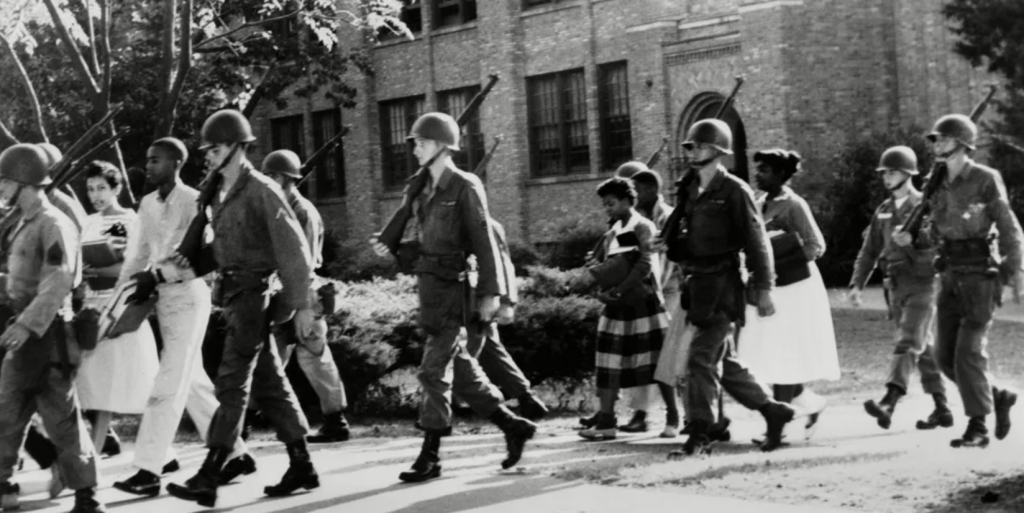
Some things were settled; others were not. Little Rock’s four public high schools were closed in late September 1957, and reopened a year later. Race integration across all grades was not fully achieved until 1972, 15 years after the initial attempt.
As explained by Carlotta LaNier, one of The Nine, Virgil Bloom, the School Superintendent, had advised that integration would be gently staged and the students were ‘not going to be able to go to the football games or basketball games. You’re not going to be able to participate in the choir or drama club, or be on the track team. You can’t go to the prom. And heaps of other cannots.‘ No extra-curricular activities at all in fact.
Philander Smith’s role in this eruption was to support and teach The Nine. Melba Beals, one of them, is quoted as saying: ‘Teachers from our community along with other professionals were offering to give us books and to tutor us. It felt good to dress in school clothes and go to Philander Smith, our community’s college. For part of each day, I studied schoolwork and spent time with my eight friends, enjoying a thimbleful of normality.‘ Other students from Philander Smith were involved in many of the protests which subsequently took place against the various forms of segregation present in Little Rock and Arkansas more generally. Faubus, a member of the Democratic Party, remained Governor until 1964, the last of a record six successive terms. He subsequently put himself on the ballot three more times. All failed.
There were five more Governors before Bill Clinton’s election in 1979, a post he held in two tranches for just a month short of Faubus’s 12 year record. Bill … the Man from Hope.
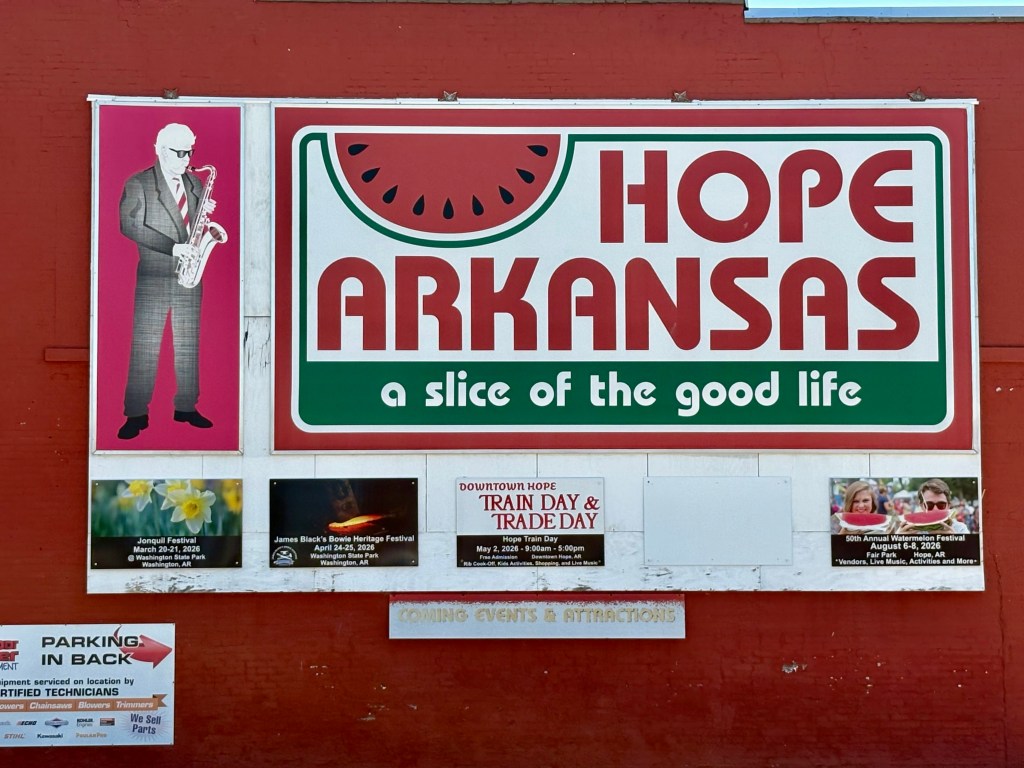
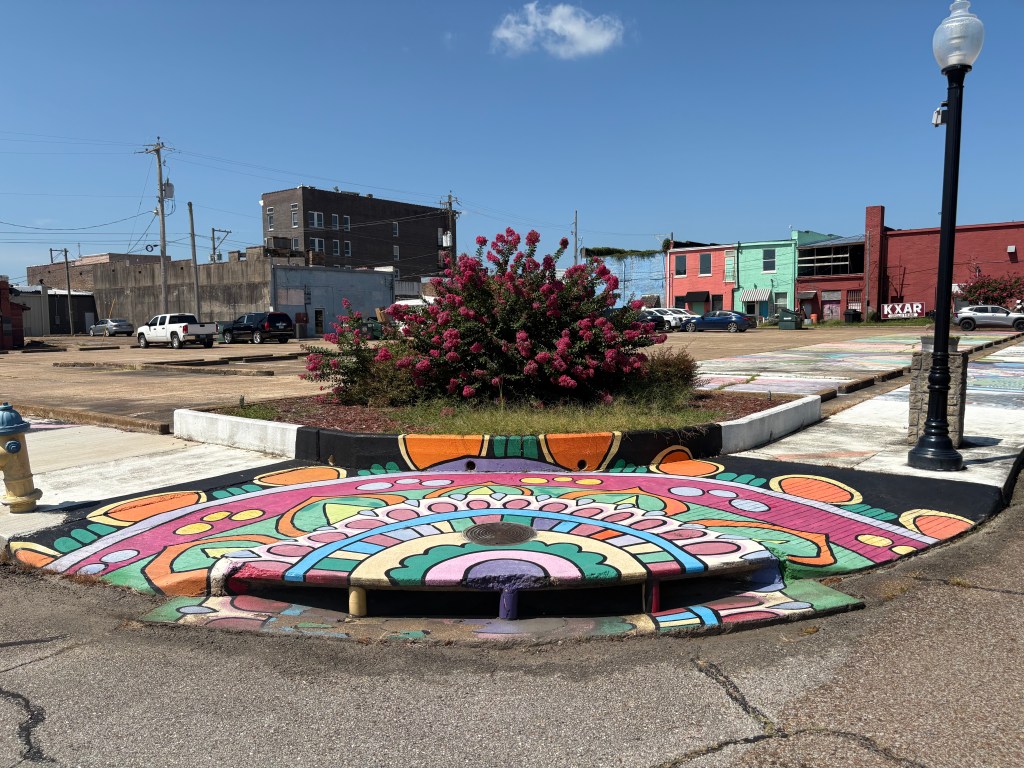
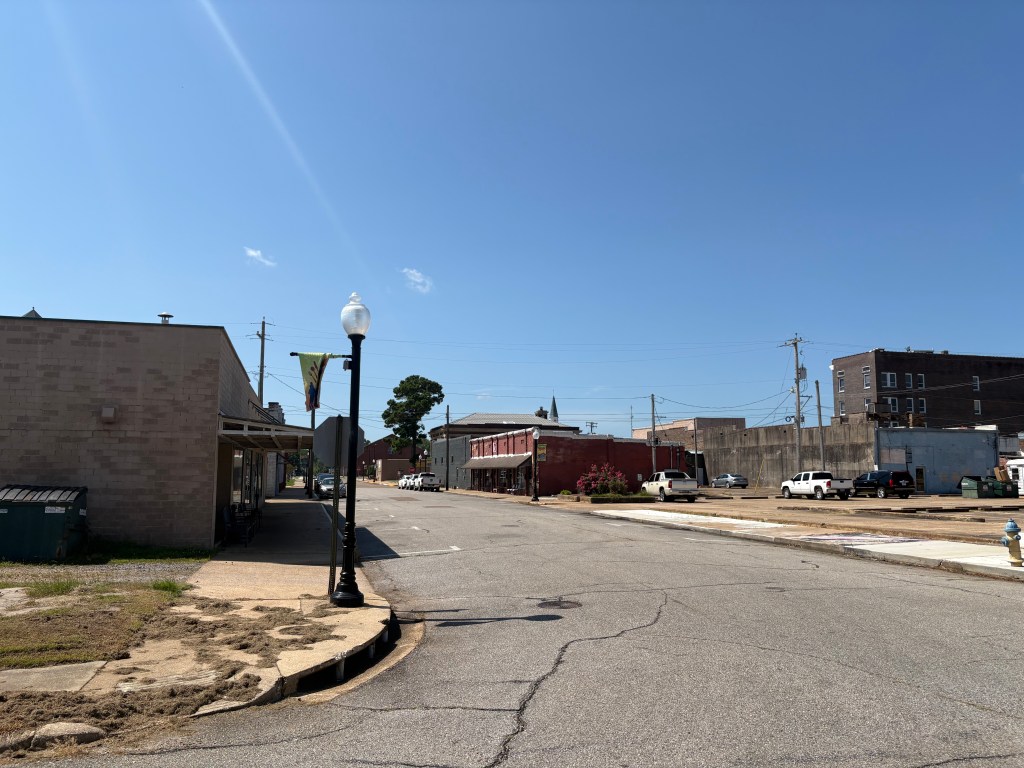
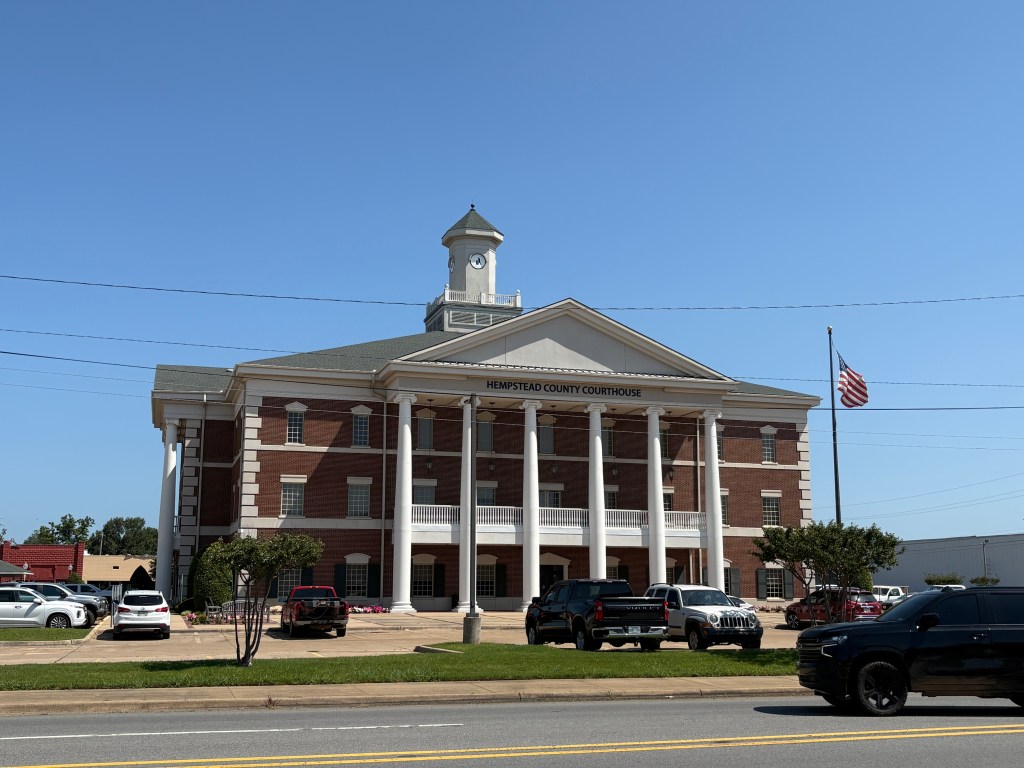
Hope is about 120 miles south-west of Little Rock. The only famous people from Little Rock I could recognise were Daisy Bates (an early Black activist and writer), General Douglas Macarthur, and Helen Gurley Brown who wrote Sex and the Single Girl and turned ‘Cosmopolitan’ into a persistent voice for its world view. Besides Bill, Hope has Mike Huckabee and his daughter Sarah, former and current Governors of Arkansas. Plus the largest watermelon ever grown: 269 lbs or 122 kgs. 😳🫣🤷🏼♂️ That’s gotta count for something. But apart from that, and the enormous courthouse, by many multiples the biggest — and grandest — building in town, Hope doesn’t have a lot to offer. The snap on the right above is pretty close to being one of the main street.
So, Bill. He was born here, but his name wasn’t Bill Clinton. It was William Jefferson Blythe III after his father William Jefferson Blythe Jnr., a traveling salesman who died in a car accident three months before Bill’s birth. Clinton’s blood parents married in 1943, but this union was dissolved as it turned out that Blythe was still married to his fourth wife who wasn’t Clinton’s mother. (😳 again.) Soon after Bill was born, his mother left him with his grandparents Eldridge and Edith Cassidy, who ran a small grocery store in Hope. His mother returned from nursing school three years later and married Roger Clinton Sr., who seems to have been a gambler and an alcoholic who regularly abused his family physically and otherwise.
Despite this background, Bill (like Tony Blair, 6’3″, good looking, good hair) had a golden touch. After High School he got scholarships which enabled him to go to Georgetown University in Washington where he was voted class president several years in row. He was studying law and spent some time clerking for Senator William Fulbright. He got a Rhodes scholarship, no sport involved, solely for leadership and academic achievement. For what it’s worth, he did play basketball and rugby at Oxford. (In 1994, while President, Oxford gave him an honorary Doctor of Civil Law degree for being ‘a doughty and tireless champion of the cause of world peace’.) And then to duck the draft he didn’t do his second year at Oxford but transferred instead to the Yale Law School. He met Hilary in the Law School library.
All this from Hope. Remarkable, if not astonishing. But he was only born there. He was three when his family moved to Hot Springs to live with Clinton Snr. and he finished school there. There is no doubt that he grew up in Hot Springs. Thus, we pedants prefer that he be The Man from Hot Springs. It also suits this blog because we don’t have to drive as far to get there. Hot Springs is only about 60 miles from Little Rock, you can get off the Interstate 30 into the forest, and it’s a suitably weird place with an irregular history. Over the road from the Ozark Bathhouse, for example, is the Gangster Museum of America which this is not.
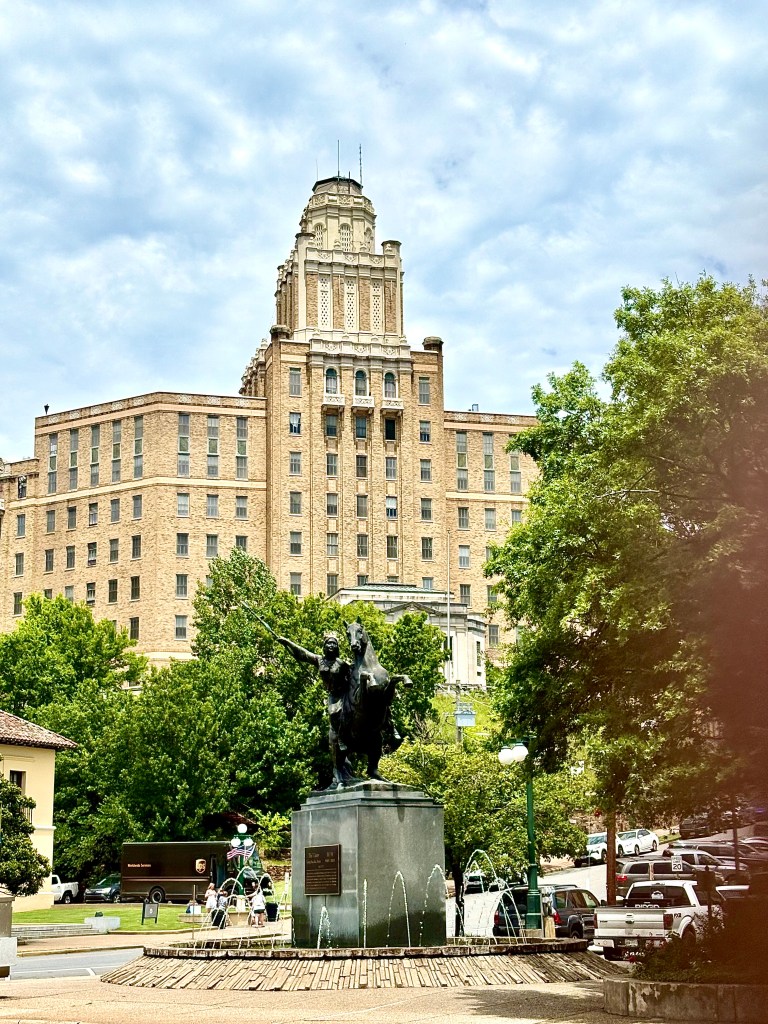
As explained by the local information centre ‘The Visitor honors the deep cultural roots of the region. The bronze statue depicts a Native American woman on horseback, a powerful and graceful tribute to the enduring spirit of the Hot Springs community and its connection to the natural wonder!’ The inscription says something like: ‘Water is life’ in Quapaw, the language of the local tribe, and ‘The meaning of the water can be found in the hot springs’. The sculptor is Longhua Xu and the plaque also contains inscriptions in Chinese and a dedication to his late wife.
But who’s looking at that when that huge building is towering over the background? We’re looking at about one-sixth of it. And it’s empty. Completely empty, and it has been for years. It used to be a veterans’ hospital, the Army Navy Hospital, and I was told it once housed several thousand wounded and disabled people, I think all men. And now there’s no one in there. There’s your bath houses and your springs and your wells, but — even if the vast Convention Centre is bigger — as far as I’m concerned this is the dominant visual matter of Hot Springs.
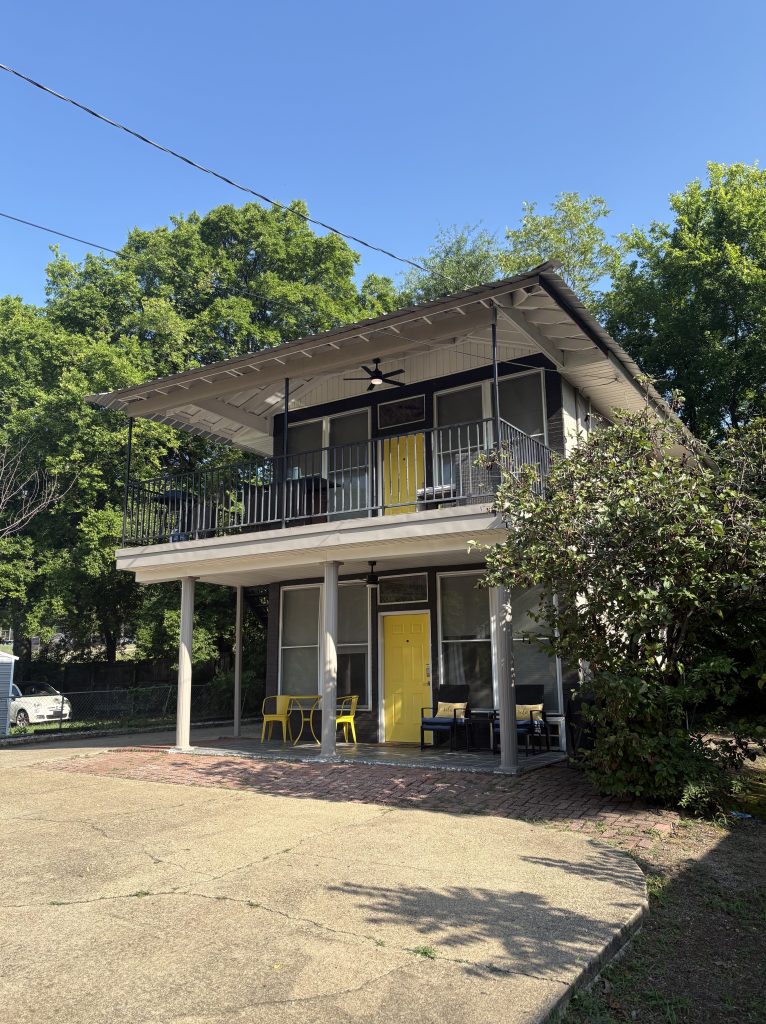
What were we doing in Hot Springs? Well … it was on the way to somewhere, and there was a pleasant AirBnB available (the bottom half of the building at left) which seemed to be very near a trailhead for some of the walks above the town. As it turned out I’d misread the map and I was looking at roads rather than tracks but it would have been too hot to go on extended walks anyway.
A better question is what were the Mafia doing here?
They began moving in during the ’20s and were heavily involved in the building of the Art Deco palaces along Bathhouse Row.
But why Hot Springs?
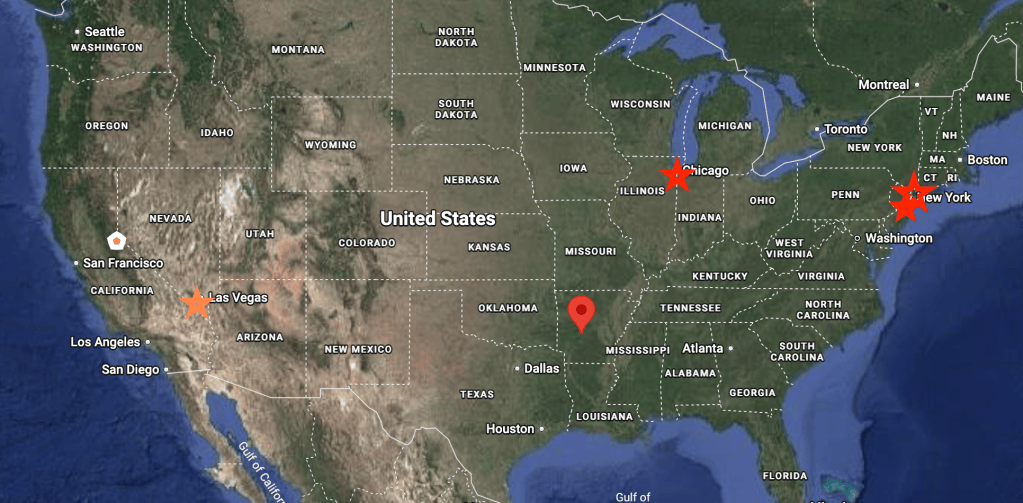
At the time the Mafia were/was [can’t decide] very active in New York, New Jersey, Philadelphia and Chicago. Operations had just begun in Las Vegas and were nascent in Lake Tahoe. Hot Springs is pinned. It’s a loooong way from where the mafiosa lived. And, of course, that might have been some of the point. But there were other reasons as well.
The area around Hot Springs was declared the very first US National Reserve in 1832. Besides its 47 springs, it is set into the thoroughly picturesque Ouachita Mountains, and the posh people and fisherpersons have found the shores of Lake Hamilton a 15-minute drive away. But, by themselves, not cause enough.
I quote: ‘The Mafia chose Hot Springs, Arkansas as their premier vacation destination primarily because it operated as a corrupt wide-open “sin city” offering a unique blend of safety, luxury and illicit business opportunities.’ (The main reasons for our visit.)
‘Under the 22-year reign of the notoriously corrupt Mayor Leo McLaughlin (elected in 1926), local law enforcement and politicians completely turned a blind eye to vice. Long before Nevada legalized gambling, Hot Springs hosted a massive underground network of illegal casinos, brothels, off-track betting, and horse racing at Oaklawn racetrack. It also offered sanctuary. Hot Springs functioned as a strictly neutral territory for rival gangs. The mobsters enforced a strict code: no hits or turf wars allowed in town. Violating this rule meant bringing federal or state law enforcement “heat” down on the town which would have ruined the lucrative setup. And then there were the baths. Al Capone, who suffered from advanced syphilis, regularly bathed in the hot springs in an attempt to find a natural cure. The mineral baths were also popular among mobsters looking to dry out or recover from their high-stress, alcohol-fuelled lifestyles.’
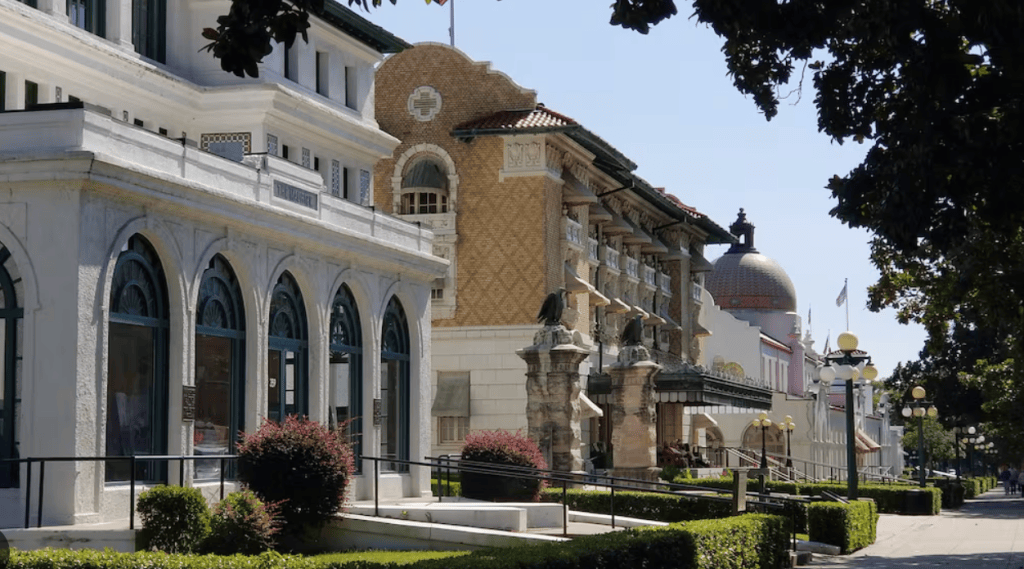
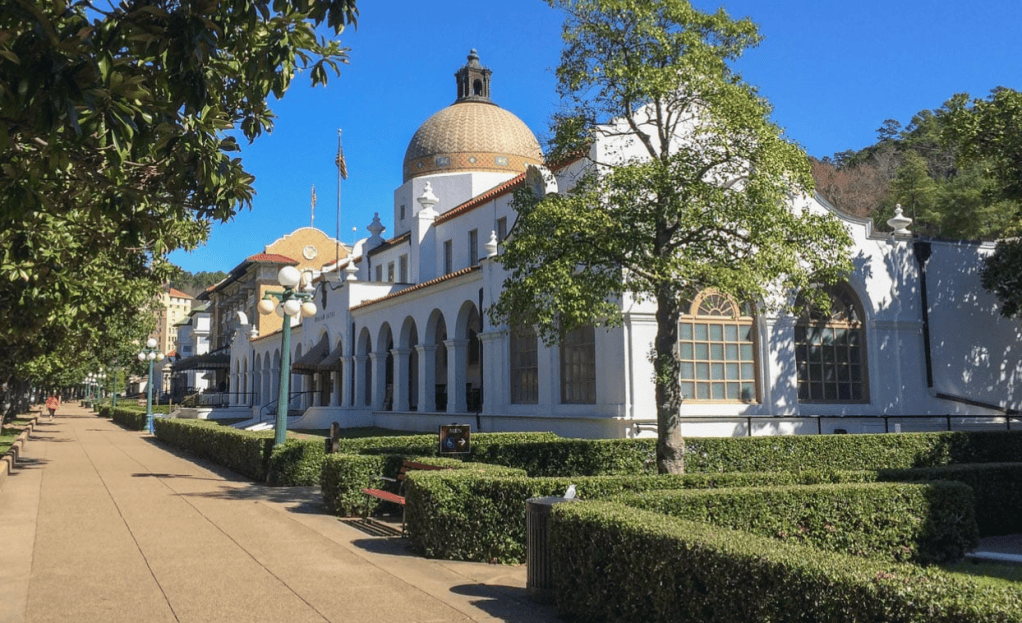
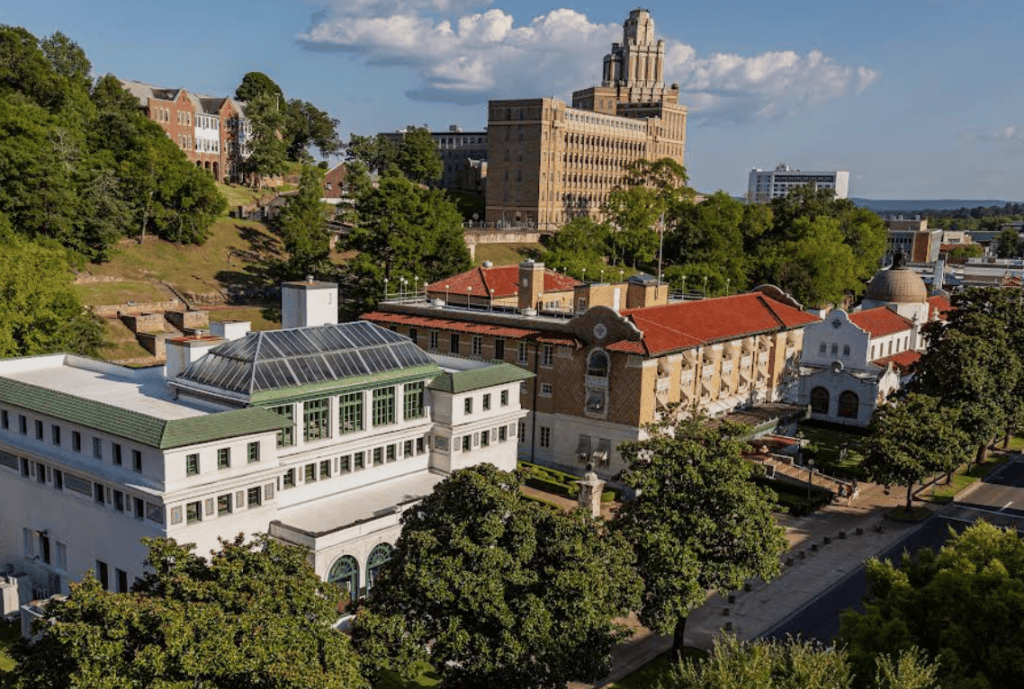
In the 1960s the Feds moved in and …er hem … cleaned up the joint. The evidence left of this phenomenon is largely architectural. Some views of Bathhouse Row with a number of the bigger bath houses still operating. At bottom left, you can see what I mean about the very empty Army Navy Hospital being a dominant construction.
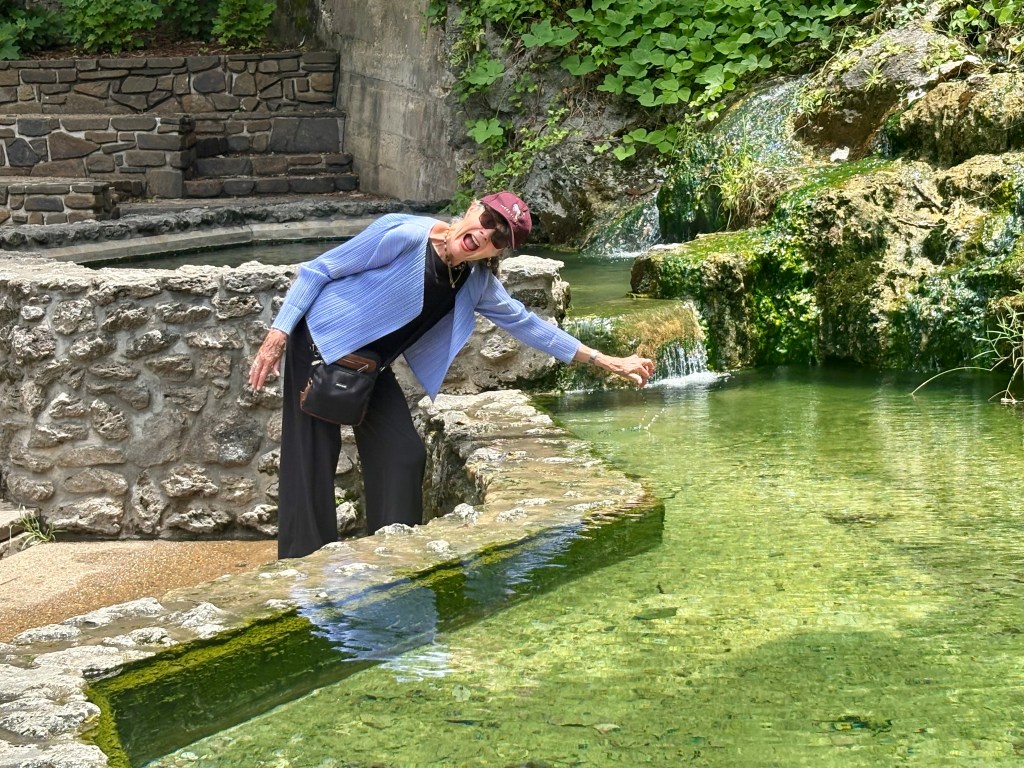
The water remains at 145 degrees Fahrenheit …
and The Pancake Shop, ‘A Hot Springs Tradition Since 1940’, continues to serve pancakes.
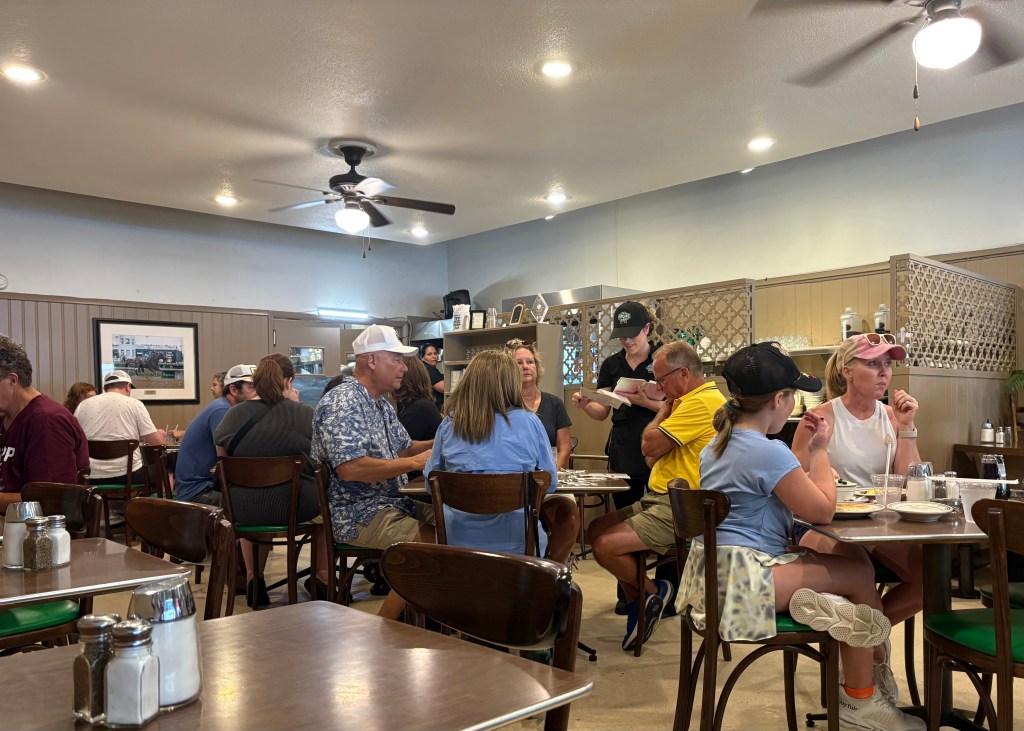
‘The Pancake Shop has been family-owned and -operated in Hot Springs since 1940, proudly serving the community for more than eight decades. The original restaurant, Mason’s Pancake Shop, was founded by Albah D. Mason and located just across the street at 133 Central Avenue. The original Mason’s menu still hangs on our wall today, a reminder of a simpler time, when a cup of coffee cost just a nickel. [four more paragraphs elided]
‘Since 1966, The Pancake Shop has flourished under the stewardship of the Ardman family. Tom and Ruth Ardman — and today, their daughter Keeley — have welcomed generations of locals and visitors alike along with a number of distinguished guests, including musicians Liberace and Al Hirt, comedian Joe E. Lewis, and hall of fame major league baseball player Johnny Bench. Our ties to the thoroughbred racing run deep, and we are honoured to have served many legendary horse owners, trainers and jockeys whose photographs line our walls.
‘When Tom passed away … [three more paragraphs elided].’ This is from the menu of a pancake shop which sells quite edible pancakes. Americana, or How to Build The Legend.
Johnny Bench was in Hot Springs because this is where the idea of ‘spring training’ began, pre-season fitness and conditioning, a big deal taken as given in all professional sports these days. The Chicago White Stockings (now Cubs) brought its players to Hot Springs to benefit from its waters for the first time in 1886. The other clubs followed suit in remarkably short order. (Those waters!) This is also where on St Patrick’s Day 1918 George Ruth, better known as ‘Babe’, Boston Red Sox pitcher, hit two home runs, one of which went into the Hot Springs Alligator Farm and Petting Zoo and was measured at 573 feet or 175 metres, a very very long way to hit anything. He became a hitter after this game.
Half an hour out of town we found this, the Anthony Chapel, wooden-framed but with roof and walls clad in glass.
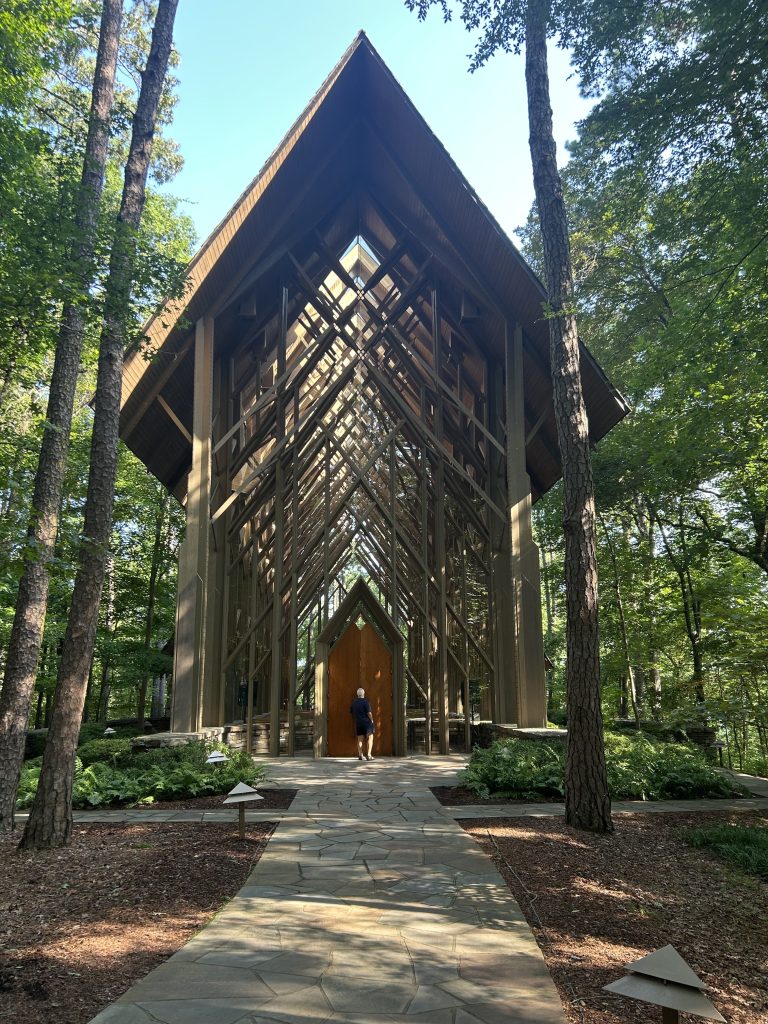
Along the entrance track it has a series of long lists of donors who supported its construction apparently happy to just enjoy it for the sake of its ambition and aesthetics. It is used almost exclusively for weddings.
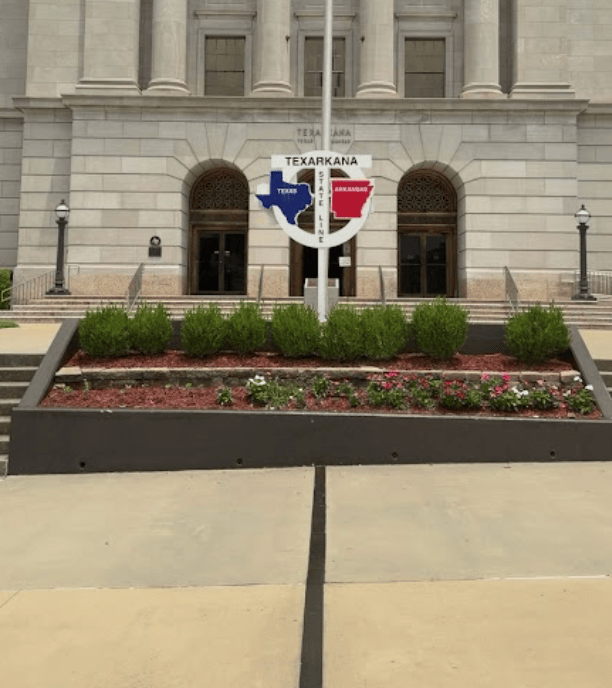
The chapel is adjacent to the Garvan Woodland Gardens but we’ve only got a minute, it’s $25pp to get in and we need to get to Nacogdoches, at least that day. Now I look, it was another 300 mile day (480 kms). So we turned our back on nature’s wonders and drove on (through Hope, see above) to Texarkana (somewhat further than a mile from Louisiana Lead Belly fans). It is notable in my mind for two things. One is that the state line between Arkansas and Texas follows the main street through the middle of town. Tex Arkana … get it? Of course. They don’t shy away from this bit of excitement. There’s a bi-state fountain just behind me.
The second was our visit to The Stained Page and the conversation with mine host Don, and his excellent products.
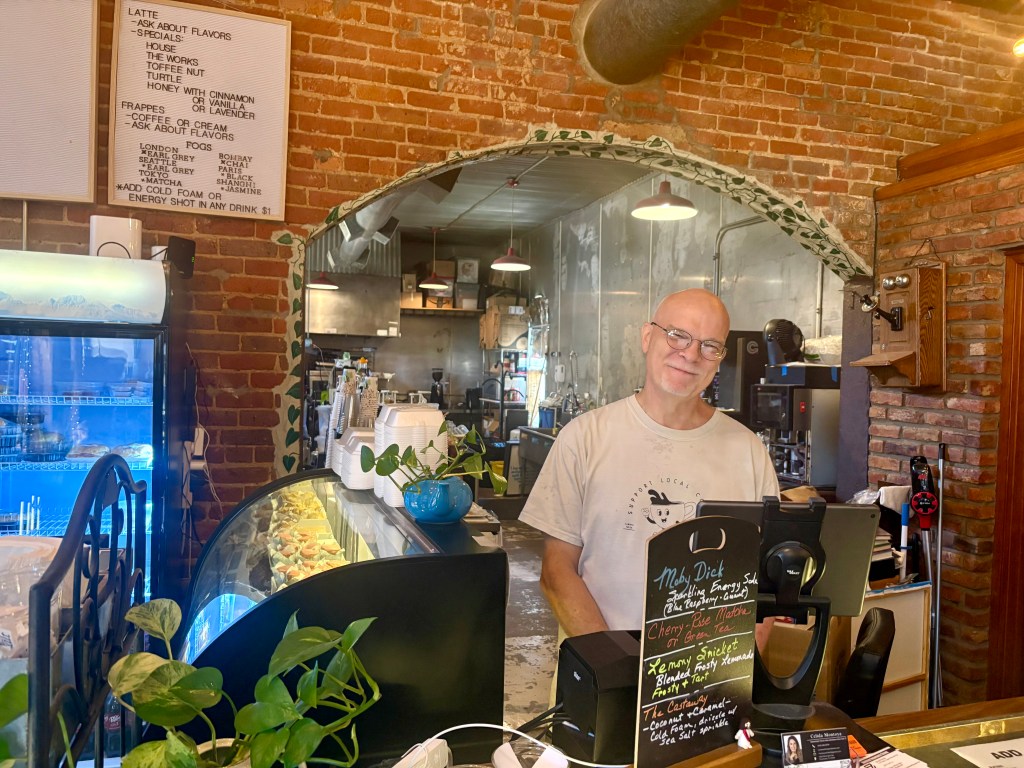
It was one of those just slightly hippy leftovers with the walls covered in books and the clientele reading, studying and getting on with their own business on their laptops. The menu was nothing if not inventive. The Moby Dick was a soda made from blue raspberry and coconut; the Castaway has coconut and caramel, cold foam, and is drizzled with sea salt. Great salads, excellent sandwiches, first rate coffee and a long conversation. I can remember none of its content, just its tenor of warm friendliness and mutual interest. I’d go back there in a heartbeat.
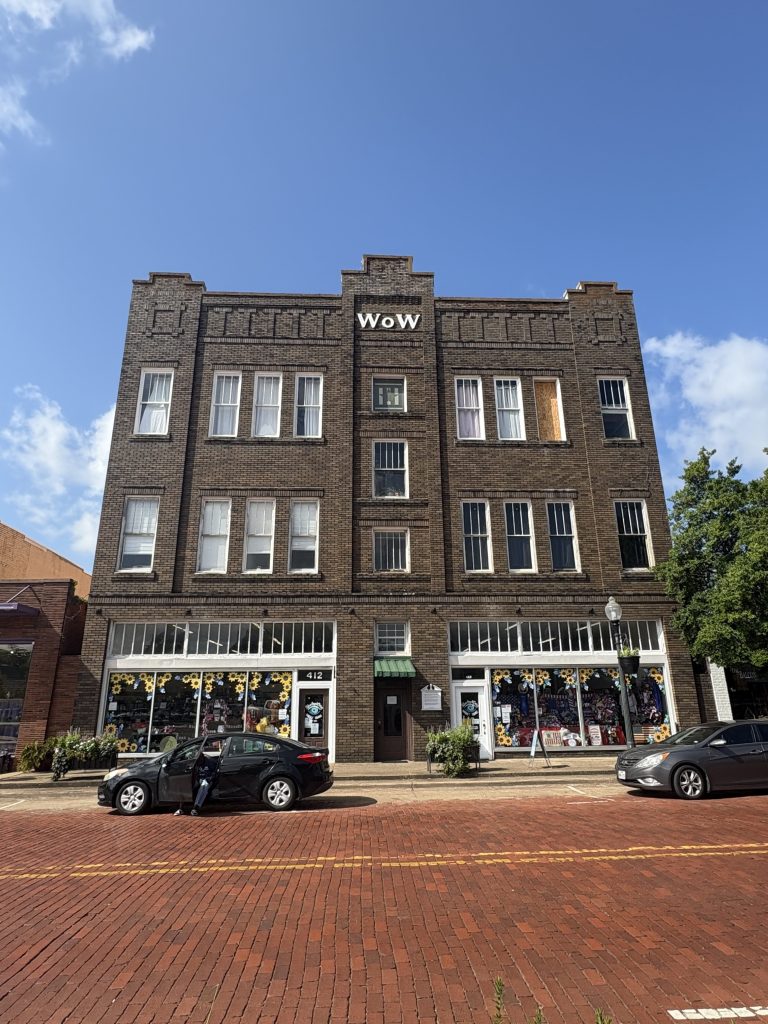
But we were on our way to the ‘oldest town in Texas’, Nacogdoches, (NAK-e-DOH-CHESS) named for the Native Americans who lived there — wait for it — the Nacogdoche. Yes. That meant it had a bricked main street with old buildings and a vast number of antique shops.
We took up a recommendation to eat at Aunty Pasta’s which turned out to be a very good idea. You do NOT go to Hot Springs for the food.
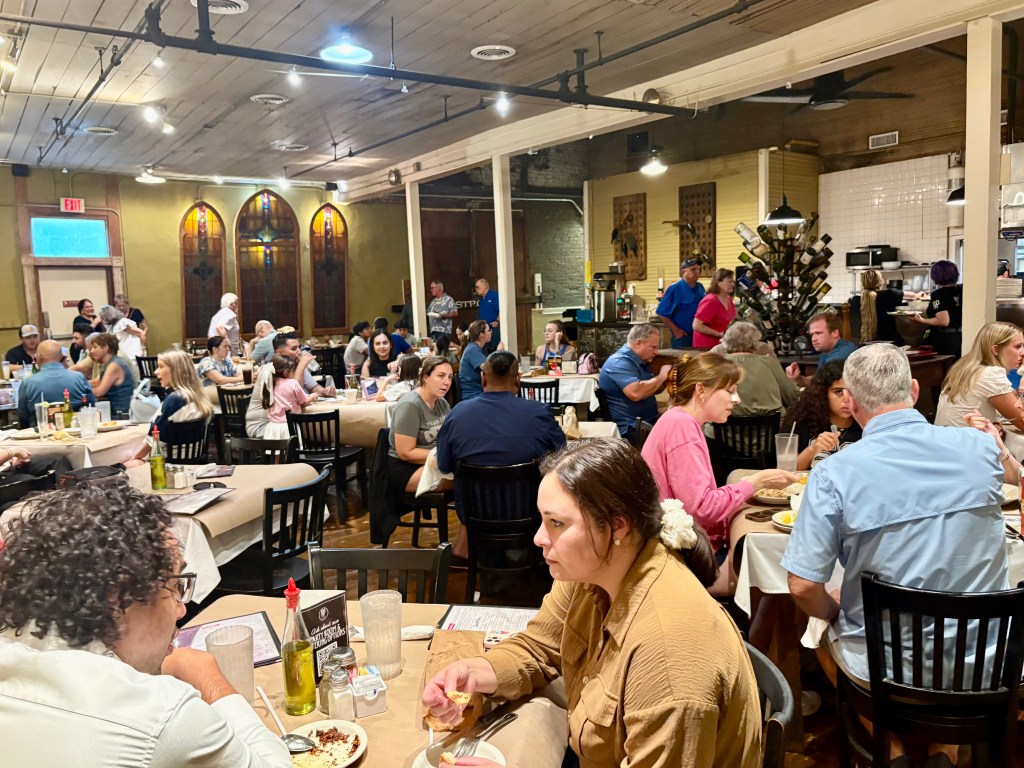
Packed, noisy, lots of activity. Fast in; fast out. The faster the pace, the bigger the tip. The American Way. That said, very nice food was produced quickly and eaten slowly enough to watch what was going on.
This has gone on long enough, and the delights of Galveston and Houston await, but … The Jacks. Everywhere we looked as we drove around we saw signs saying (more interestingly constructed, but essentially) Go Jacks. Nacogdoches, population 33,000, has a tertiary institution, the Steven F. Austin University or, if you like, and the University and town seem to like, SFA. It has a football team the Lumberjacks, and just here we are a long way from Oregon or Washington State or, for that matter, Canada and other places where one would imagine jacks tackling lumber. We were still driving through the same piney forest of modest dimensions which had accompanied us for almost all the drive and would continue to do so for several hours further south. The Lumberjacks eh? Well, SFA specialises in agriculture and forestry and, more winningly, the Jacks have not been beaten at home in 26 games and have not been beaten at all since 16 November 2024. This year they are 7-0 and have, in their last match, very recently, beaten Incarnate Word 28-26. And if they can beat Incarnate Word who knows what the future may hold. Ascension?
Okay. Sorry to keep you. We’re in the car. Driving. We want to get through the rain navigating the Texas marshlands, the Bolivar Peninsula and the Port Bolivar Ferry to in order to arrive in Galveston and the houses that only oil could buy.

