
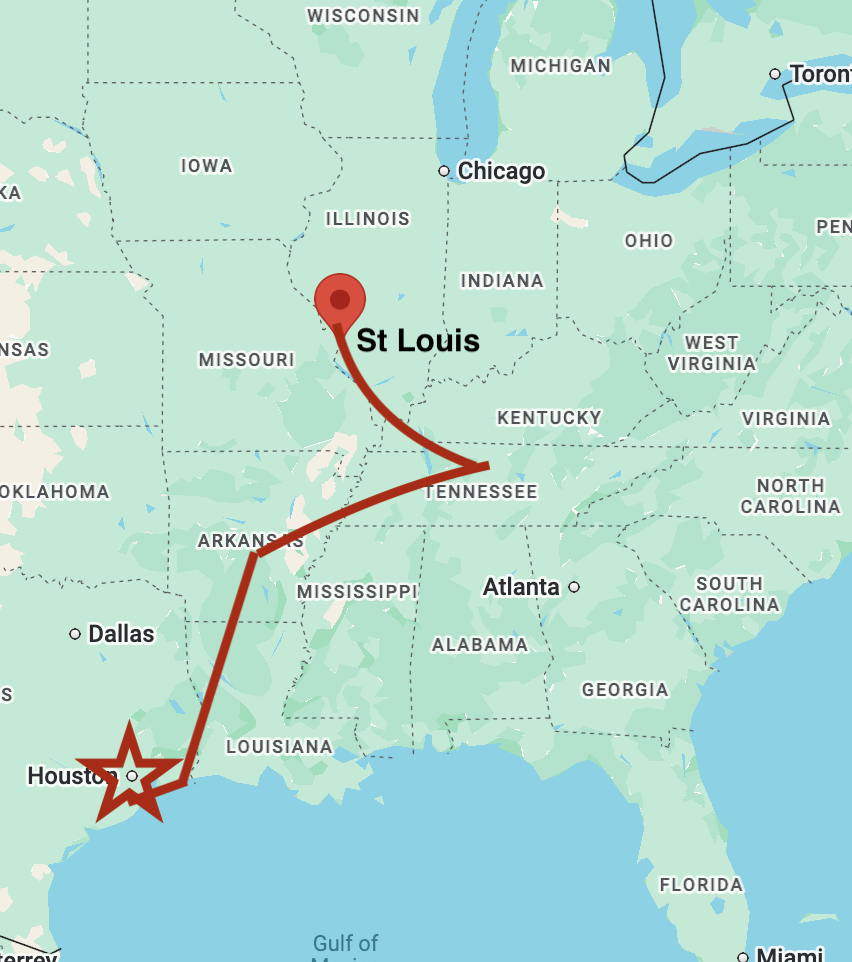
The Big Drive began in St Louis and went on for 15 days until we flew out of Houston. One special reason for the route was the night at the Grand Ole Opry in Nashville, the rest was just places we’d never been before. Maybe except for Galveston. I wanted to see just where the sea waves have been crashing. What’s Jimmy Webb really trying to tell us?
But everything is interesting. You know that.
• • • • • • • •
What do these people have in common?
Josephine Baker, Yogi Berra, Chuck Berry, William S. Burroughs, Kate Capshaw, Jimmy Connors, Jack (‘Twitter’) Dorsey, Miles Davis, Phyllis Diller, T.S. Eliot, Max Factor, Lee Falk (Phantom Comics), Jonathon Franzen, Betty (30s glamour queen/ actress) Grable, Ulysses S. Grant, the Isley Brothers, Scott Joplin, Jackie Joyner-Kersee (athlete), Tennessee Williams, Kevin Kline, Lewis and Clark (European explorers of ‘The West’), Charles Lindbergh, Sonny Liston, Vincent Price, Joseph Pulitzer, (General) William Tecumsah Sherman, Ike and Tina Turner, Harry S. Truman and Shelley Winters.
It is an eclectic crew isn’t it? It’s hard to imagine Yogi Berra, Joseph Pulitzer and Shelley Winters having afternoon tea together. Or for that matter T.S. Eliot with any of them. What do they have in common?
They were all born or lived in Saint Louis. [‘Loo-is’, rather than ‘loo-ee’.]
And just while we’re there, did you know that John Hamm (‘Mad Men’s Don Draper) was Jenna Fischer’s drama teacher, and that Fischer who starred as Pam in the American ‘The Office’, superior television, and Phyllis Smith who starred as Phyllis and Ellie Kemper who played Erin all came from St Louis? [🎖️AAA Certified: Terrific Thing To Know].
From 1870 until 1920, it was the fourth-largest city in the country — that might help to explain things — although it isn’t any longer. The city itself has a population of 300,000 now (one Geelong) and the wider metropolitan area, which sprawls around a relatively decayed heart, has just under 3 million. State-wise (Missouri), Kansas City is bigger and Jefferson City, with the population of Shepparton on a good day, is the capital. It lives in part off a strong tertiary education and medical research presence. The two largest employers in the city are Washington University and the enormous Barnes Jewish hospital.
While we were there the city was hosting the Barbershop Harmony Society International Convention, 5000+ a capella singers from 14 countries. As we walked around the empty shops downtown, there were several clusters of the middle-aged on the footpaths lifting their voices in harmony. I wanted more.
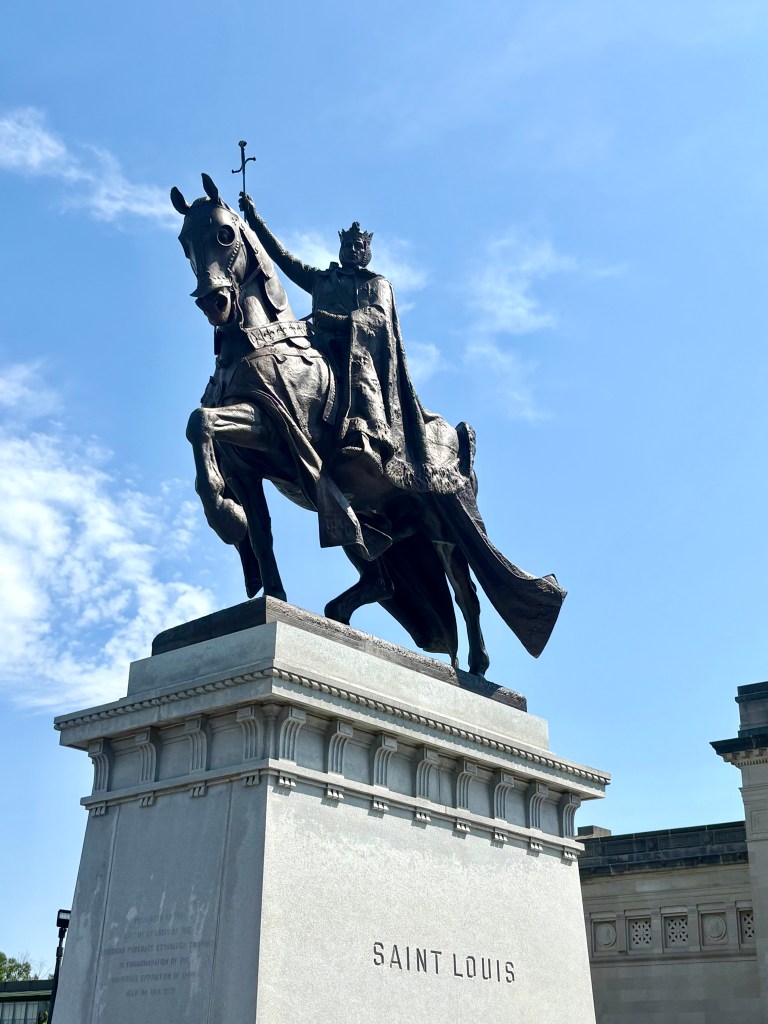
The city is named after Louis IX (1214-1270, not yesterday) the only King (of France) who was also sanctified and the direct ancestor of all subsequent French kings.
The two Frenchmen who founded the city were fur traders. There had been Europeans in the area for decades but in 1763 Gilbert St Maxent commissioned Pierre Laclède to set up a post near the confluence of the Mississippi and Missouri Rivers. For a time at least they seem to have had excellent relations with the Osage traditional owners with trade and gift-giving customary and welcomed.
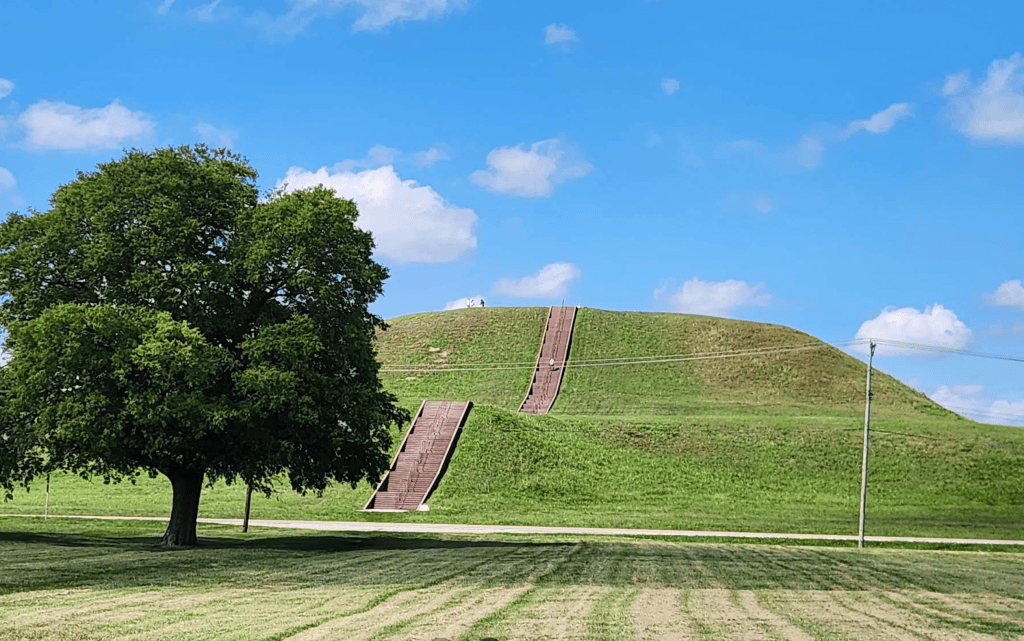
One interesting historical wrinkle: St Louis was once known as ‘Mound City’ for the hundreds of mounds created by its Native American owners. This is one of the Cahokia Mounds on the Illinois side of the river, a UNESCO World Heritage Site. As many as 15,000 people may have lived in this area in a city as complex and perhaps not unlike contemporary Mesoamerican cities (from Mexico to Costa Rica). And then … around 1350 it was largely abandoned. Explanations of this provide some useful insights into Native American culture.
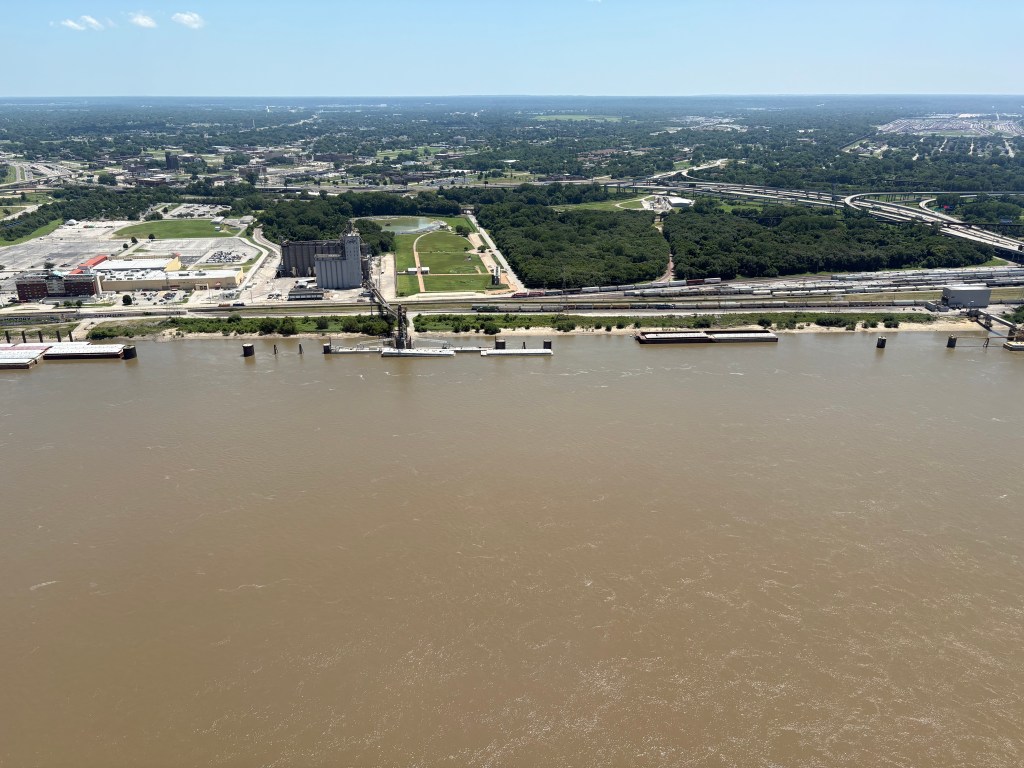
You are looking at the border of Missouri and Illinois.
In the early 1850s if you were a Black American swimming from this side to that side, when you were about half way — a good haul, strong currents, and a fair distance — you would suddenly turn into a free man … or at least you were supposed to. You would have crossed the border from Missouri into Illinois, from a state where slavery and its trade were legal to a state where it was prohibited.
From the time of the establishment of the Constitution the southern and northern states had been at loggerheads over this issue. When the Louisiana Purchase (which includes 13 of today’s states) was consummated in 1804, the northerners wanted slavery outlawed throughout the new territories. But they were at a legislative disadvantage generated by the fact that two-thirds of the slave-holding (ie ‘held’ slaves), while having no actual suffrage, could be counted in determining electoral representation. (Yeah I know. 🤔 And why two-thirds? Oh yes. Because a) in this peculiar instance, five slaves are equivalent to three free men, and b) it meant that southern property holders had to pay tax, ie more, on the same basis. It’s called political compromise. And also, weird.)
It came to another head in 1820 when controversy erupted over whether Missouri should be admitted to the Union as a slave state. The resultant Compromise resulted in Missouri being confirmed in this way but, on the other hand, slavery would be prohibited in territory acquired north of latitude 36° 30′ — so Kansas/ Colorado north.
It came to another head in the Dred Scott case heard initially under this beautiful roof.
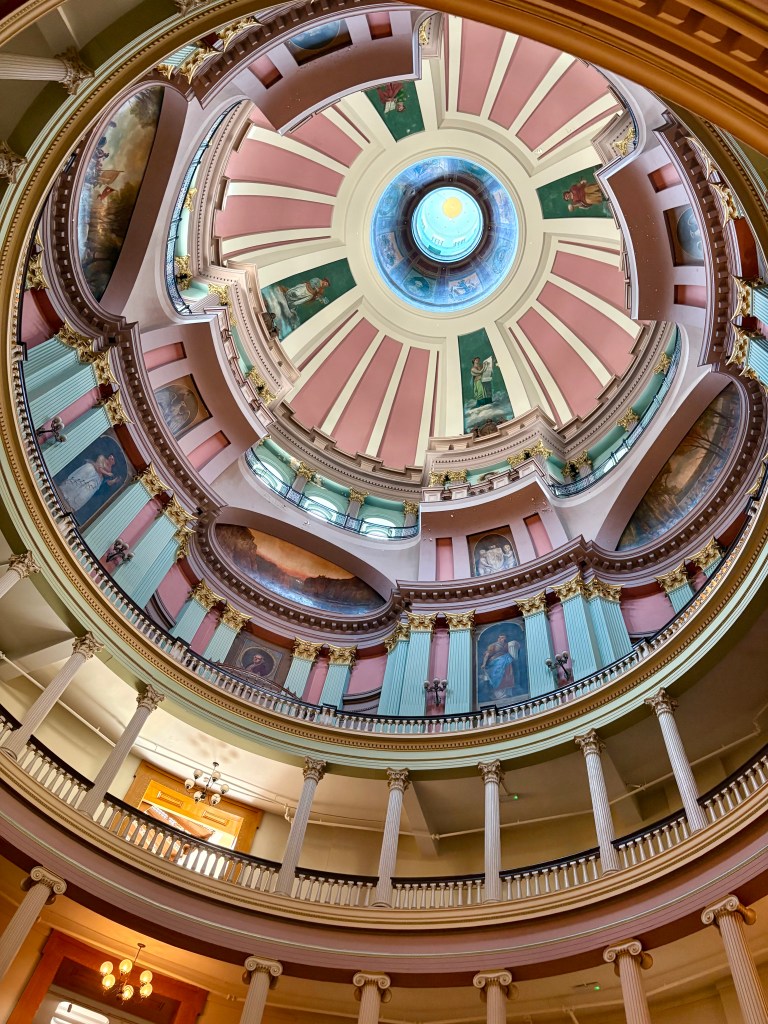
It is inside the cupola of the St Louis courthouse which you can see prominently in the photo below.
In 1846, an enslaved Black man named Dred Scott and his wife, Harriet, sued for their freedom in St. Louis Circuit Court. They claimed that they were free due to their residence in a free territory where slavery was prohibited.
For some years they had lived with their enslaver, an army surgeon, at Fort Snelling, in the free Territory of Wisconsin. The Scotts’ freedom could be established on the grounds that they had been held in bondage for extended periods in a free territory before being returned to Missouri, a slave state.
Courts had ruled this way in the past as a straightforward issue. However, this lawsuit between two private parties spread out in an 11-year legal struggle through various courts until it found its way into the Supreme Court.
On March 6, 1857, Chief Justice Roger B. Taney read the majority opinion of the Court, which stated that enslaved people were not citizens of the United States and, therefore, could not expect any protection from the federal government or the courts. The opinion also stated that Congress had no authority to ban slavery from a federal territory. Quite a strong position really, and a good target for contestation.
There are views that the decision of Scott v. Sandford might be the worst ever rendered by the Supreme Court. [This idea might be tested in the history of the last two years and the experience of the next two to come.] It was overturned by the 13th and 14th amendments to the Constitution, which abolished slavery and declared all persons born in the United States to be citizens of the United States. But that was after a four-year interregnum commonly known as the American Civil War.
In the photo above you are also looking at The East.
If you want to see The West, you look this way, the beginning of what was once The Wild Wild West.
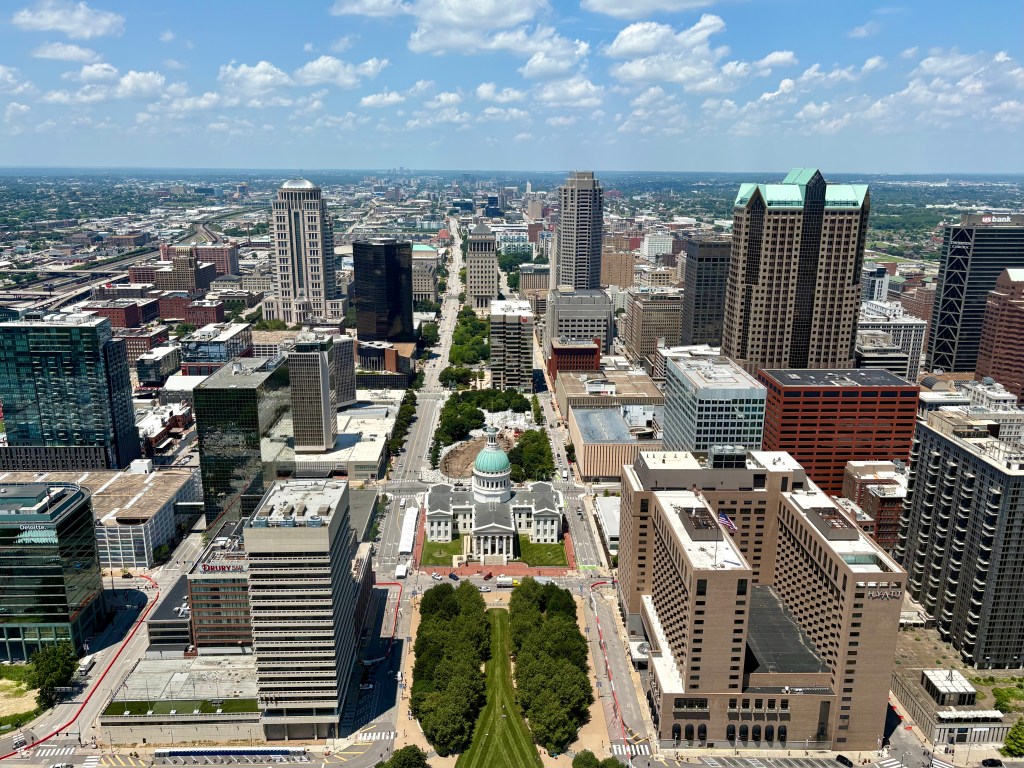
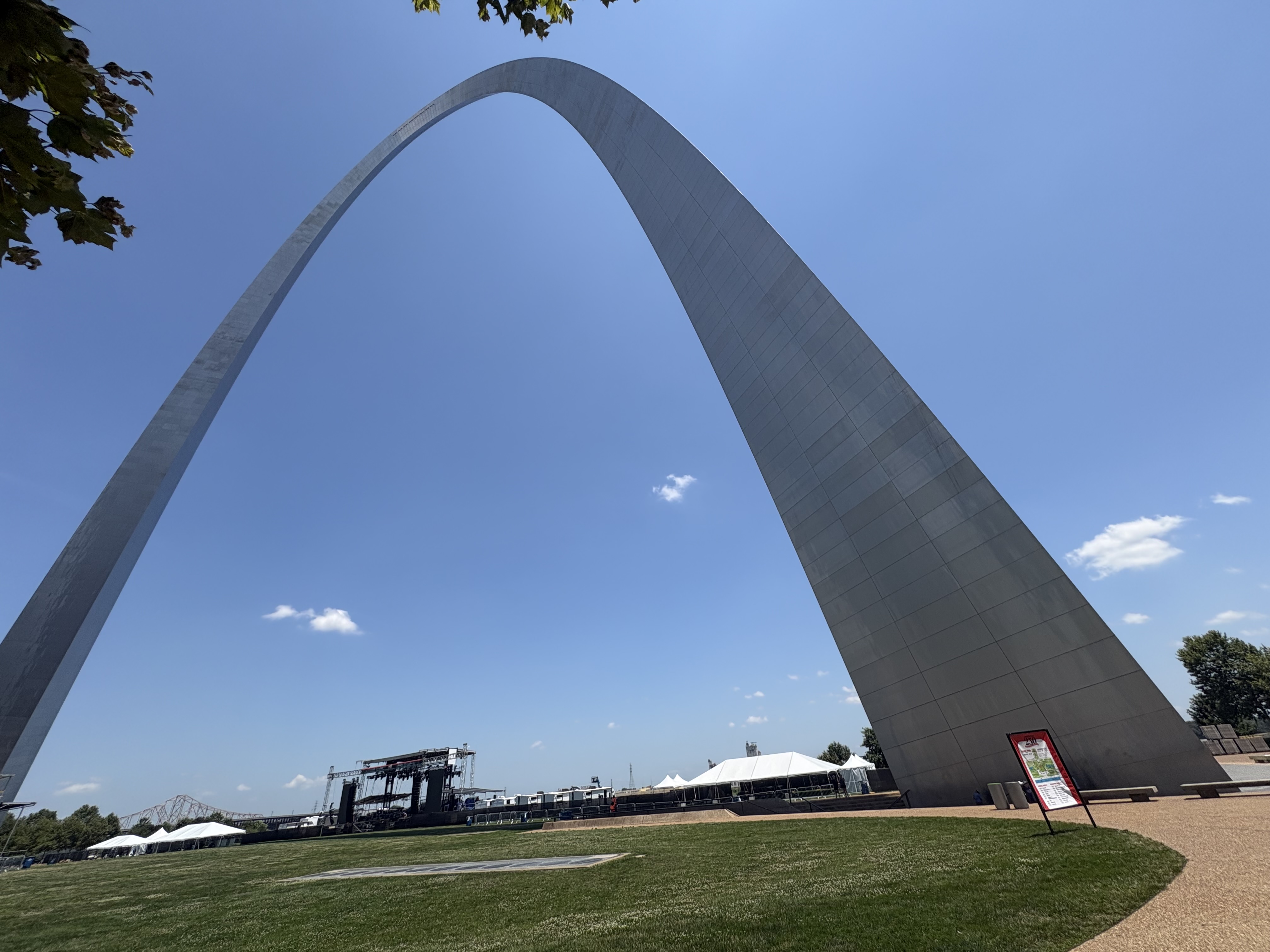
As it happens you are also looking at a modest protuberance from the only National Park in Missouri, The Gateway Arch Park, memorialising that clutch of events which expanded the United States around the beginning of the 19th Century: the Louisiana Purchase (which occurred here with Jefferson leading the American charge); the launch point for the Lewis/Clark expedition tasked with exploring the landforms, flora, fauna, habitation and passageways between here and the Pacific; the base for the settler rush and the land grabs. And here is the Gateway Arch itself, at 630 feet (192m) the tallest memorial in the Western hemisphere. (Did I mention we were in America?)
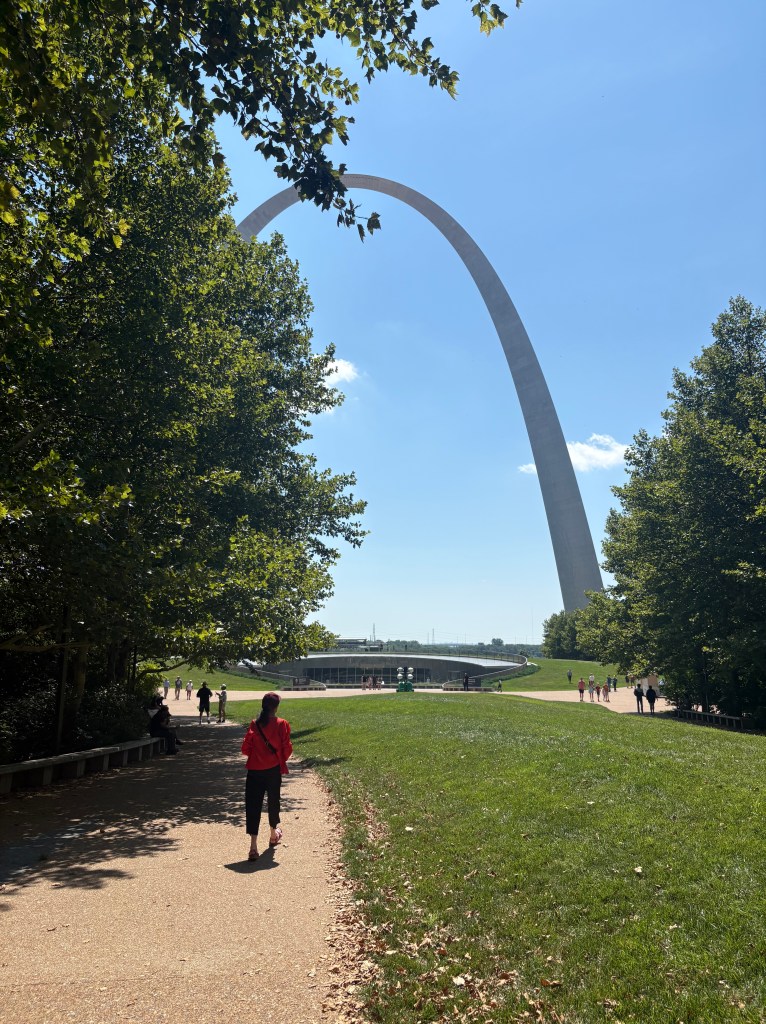
And ever so photogenic.
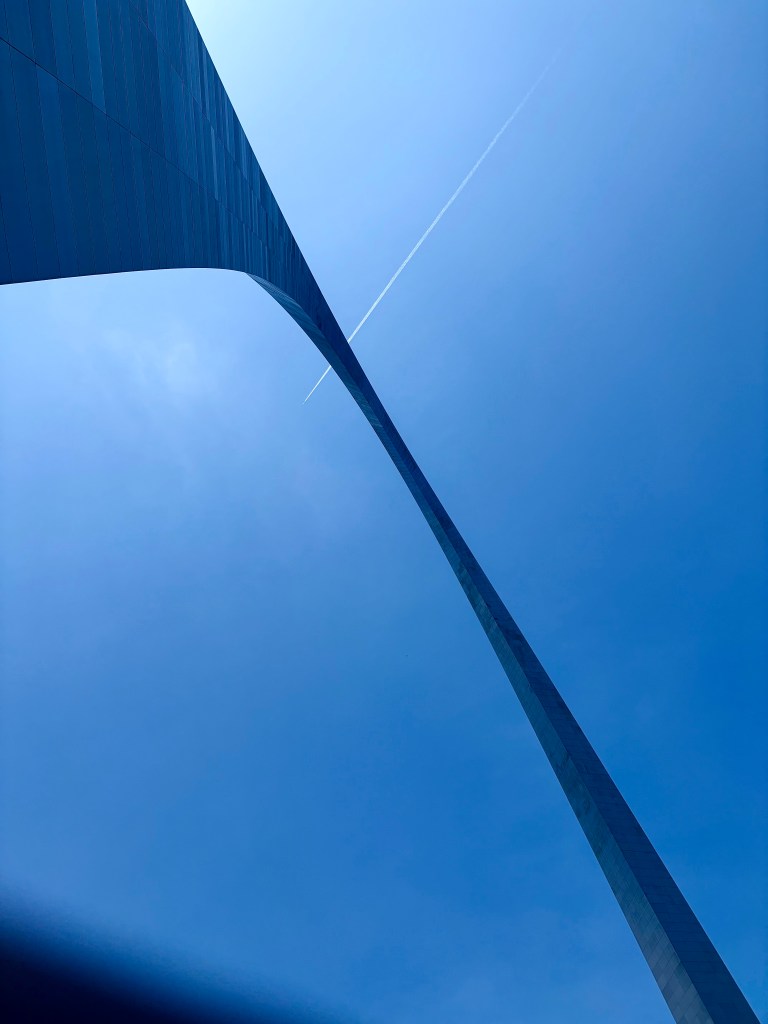
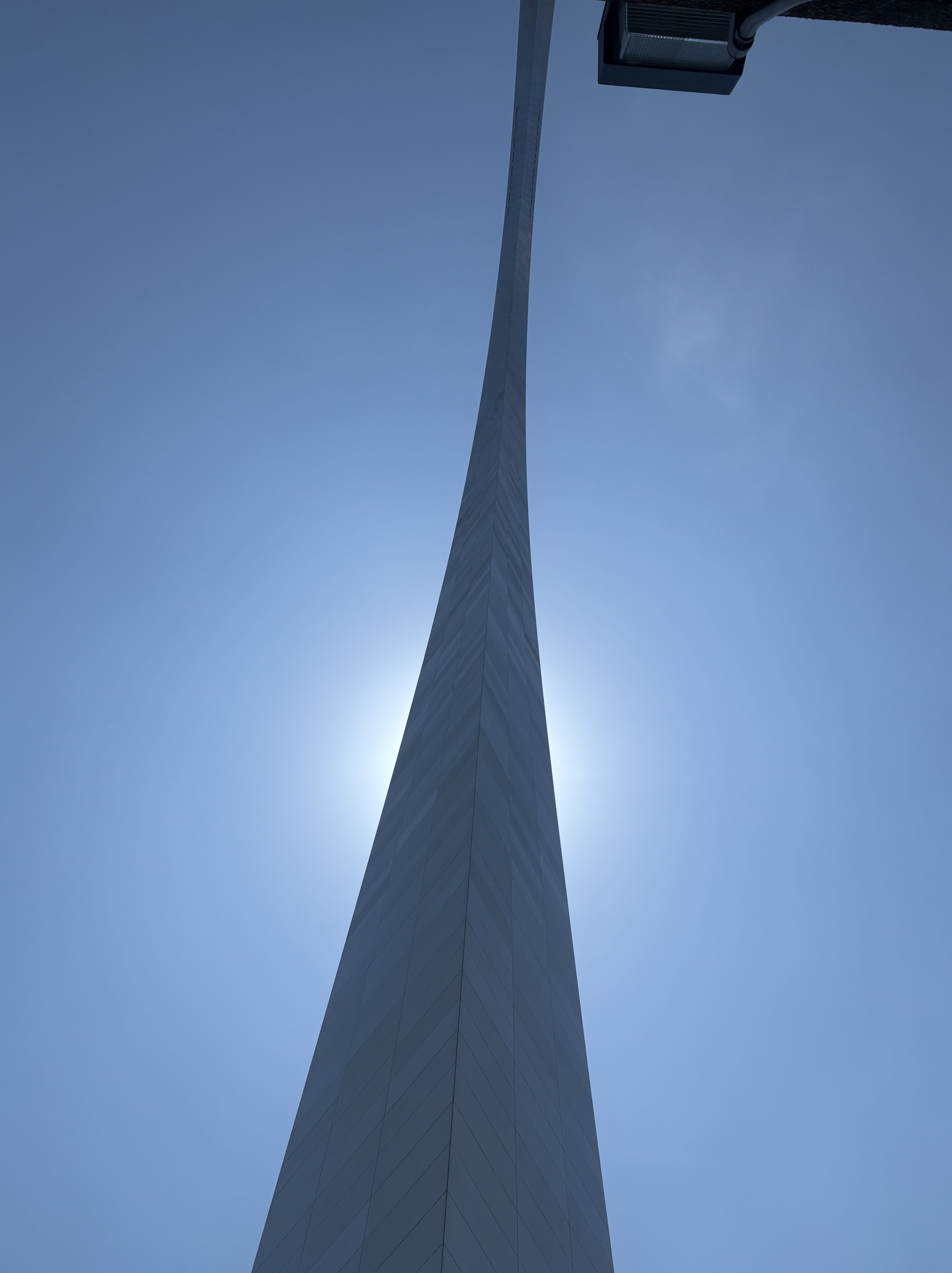
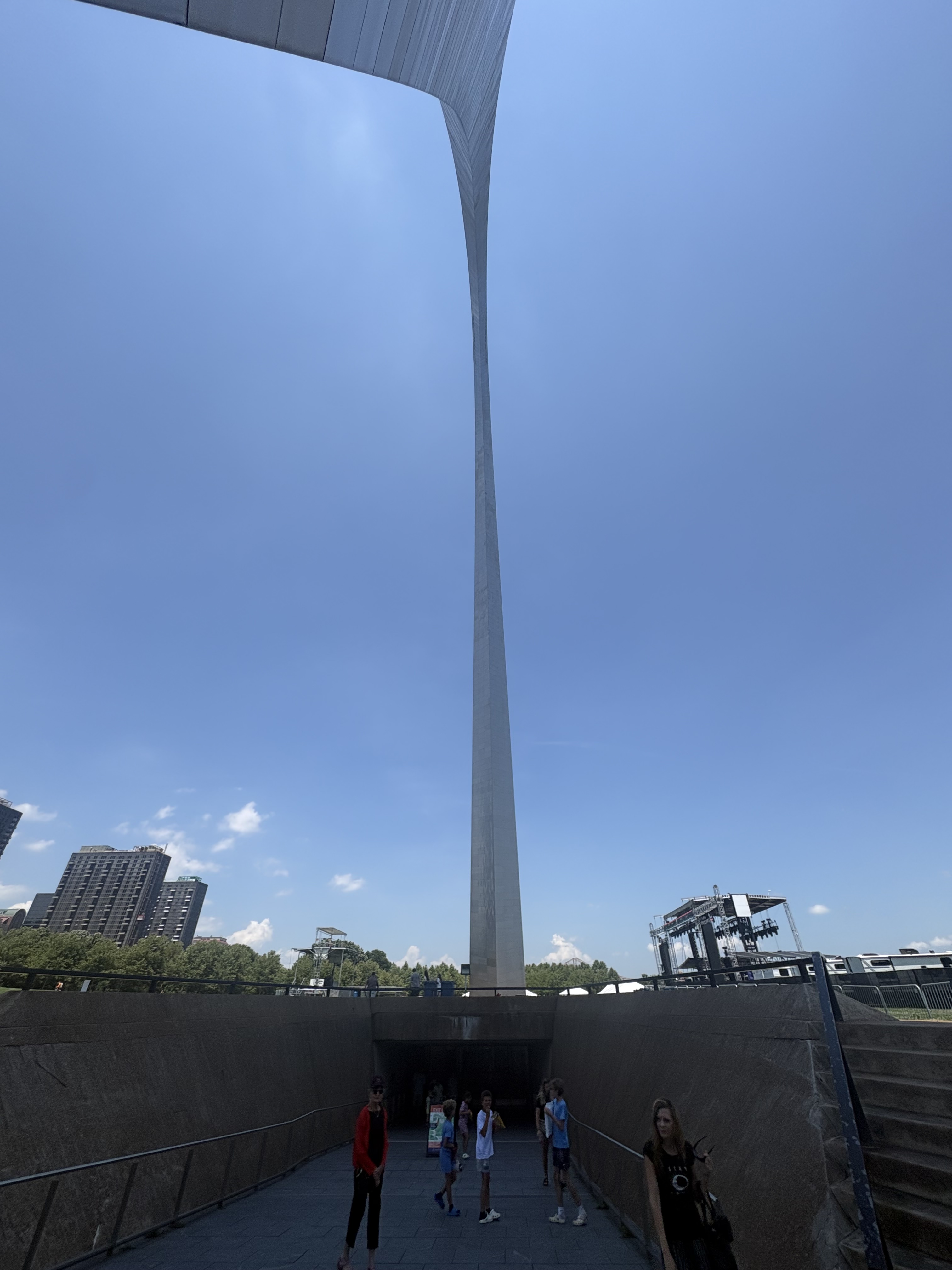
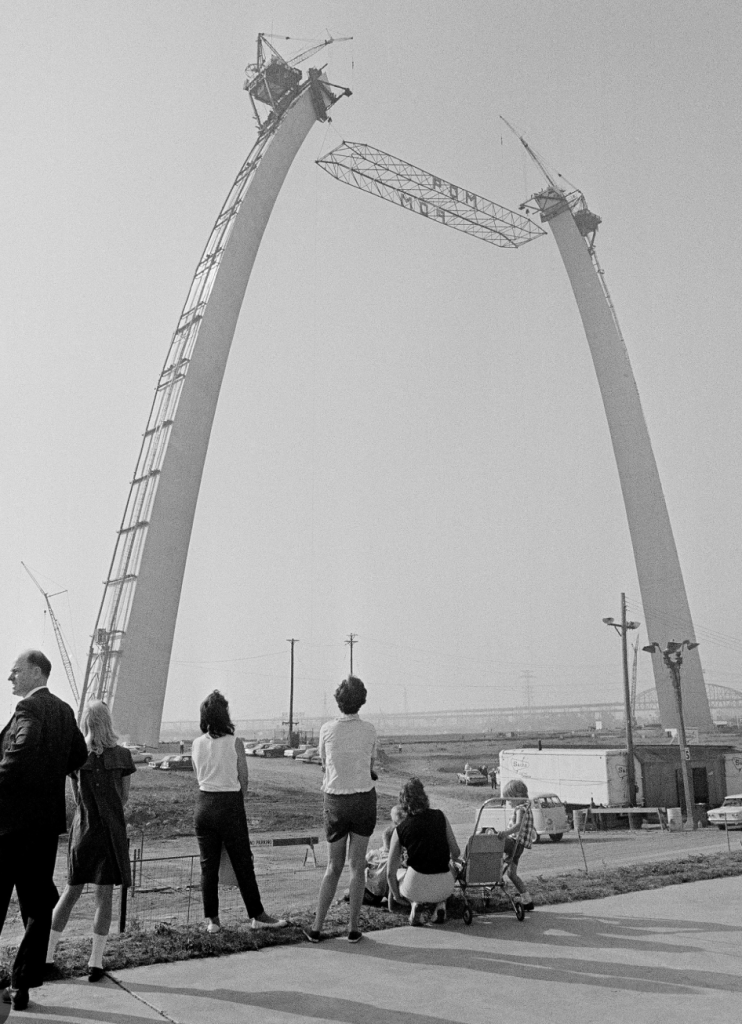
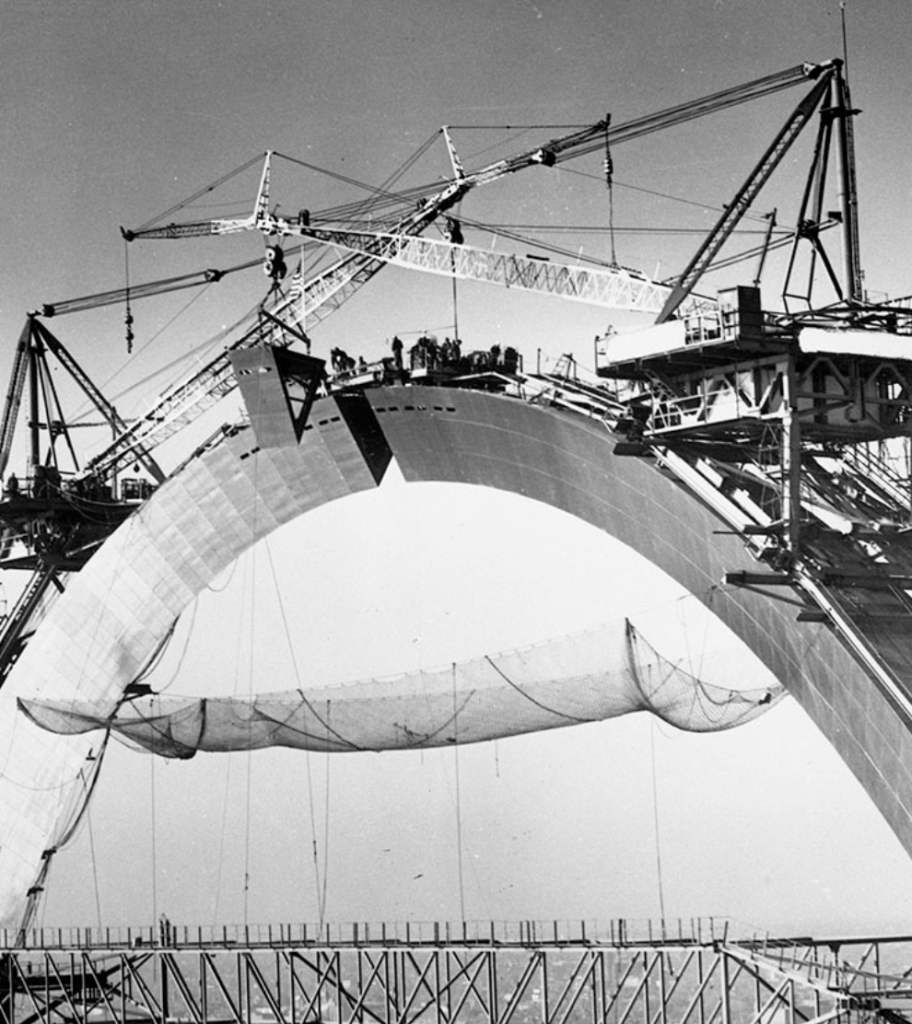
The aerial photos above were taken from inside the top of the arch which we had reached via the ‘tram’ which runs inside the legs of the arch. Extraordinary. As is the way it was constructed. Triangular sections of concrete covered with polished stainless steel were lifted and assembled by specially built cranes crawling up the arms. Last piece going in at right below and it fitted perfectly: an engineer’s wet dream. I took the aerial photos through one or other of the little black dots.
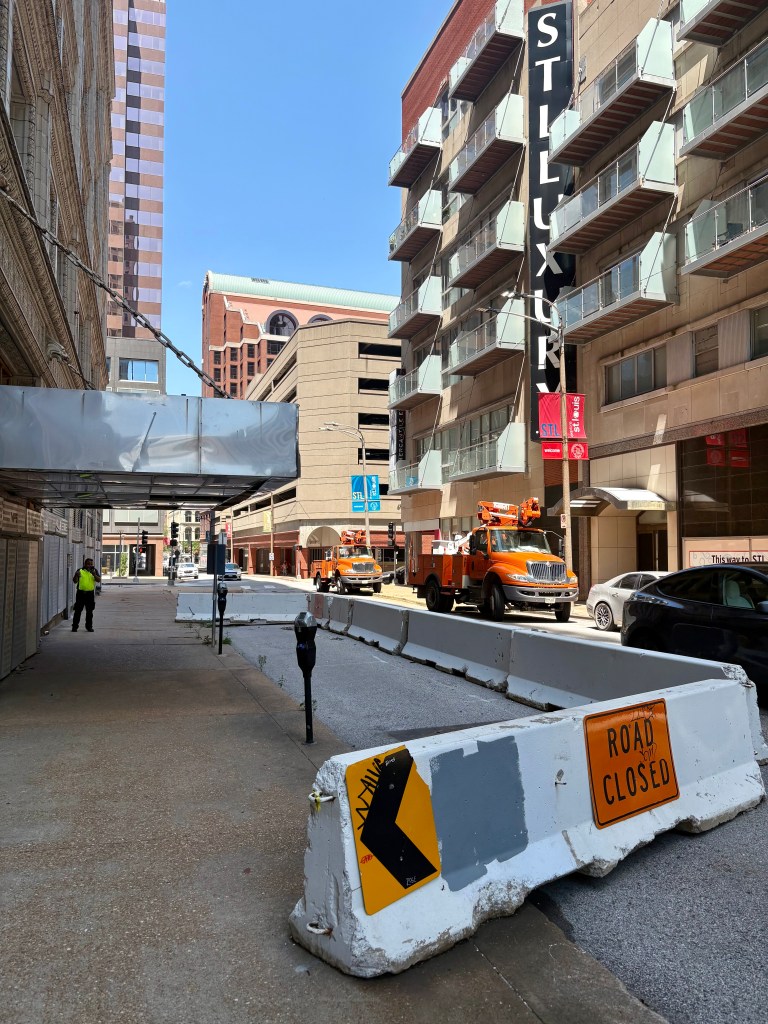
It was very hot, over 100F (38C) each day and 106F (42C) one day, when we were there. Apart from the choristers we didn’t find Downtown very absorbing. To the contrary really. I will remember it a bit this way. And that’s a good bit.
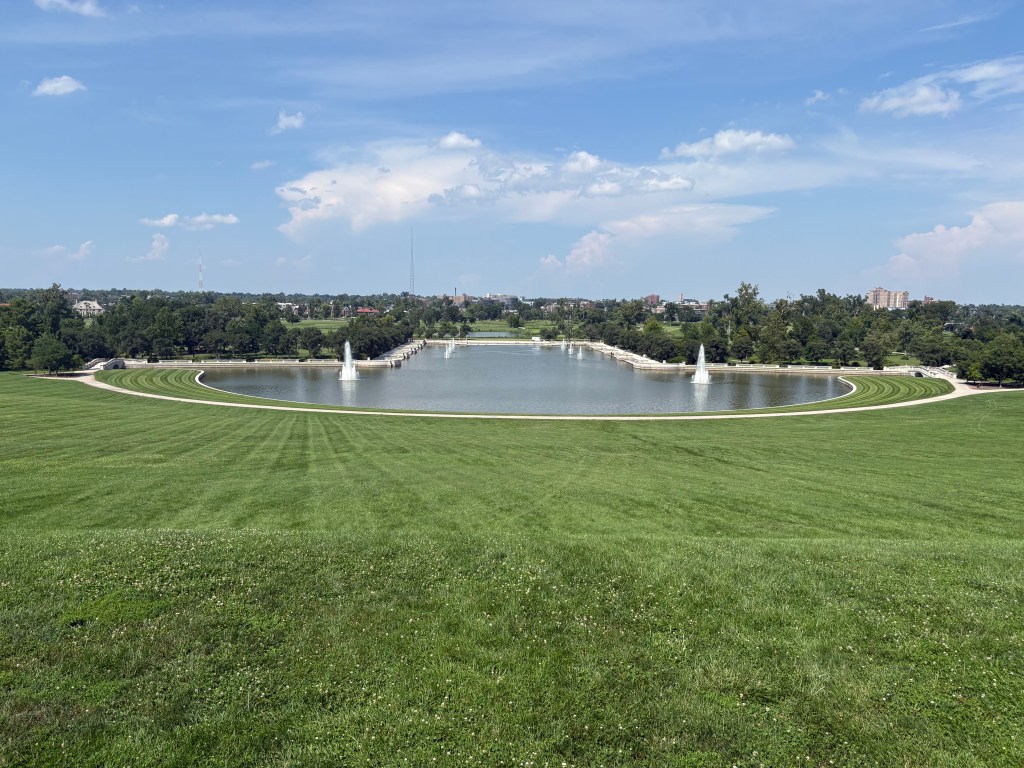
The great public institutions that we were interested in were in Forest Park, the site of the 1904 World’s Fair, nearly 7 square kilometres of greenery about 8 kilometres back from the river, and next to where we were staying for just this purpose. Those institutions were the Missouri State Museum and SLAM!, the St Louis Art Museum. (Quickly, we need to get on the road.)
We had a BIG walk round the park. It ended up being about 8kms, too far really for such a hot day (106F that day and unbelievably humid). From the forecourt of the art gallery, lawn! Have I mentioned lawn? The big building on the horizon at right is the Barnes Jewish Hospital. Our accommodation, the starting point for our walk, was just behind that. We got an Uber back.
I discover that not long ago our friend Alan’s son was doing some short-term research at that hospital — it is a huge concern — and while doing so stayed in the same hotel we were in. He was warned not to leave it at night and not to wander round the local area, Central West End at any time. No one warned us off and we did quite a lot of wandering some of which I’ve described here. Nothing we saw or experienced suggested that we should have been home in bed with the blinds drawn. I wonder about such moments and their construction, and the protection that ignorant obliviousness might afford.
The gallery had a lot of interesting things. ‘Lots of Number 2s’ my journal says. But Number 2s are often interesting. There were some early Van Goghs which were shockers for example along with some very good and rarely seen later ones. Big collections of Expressionists. [Footnote: After he heard Hitler describing his work as ‘degenerate’ in 1937, Max Beckmann left Germany ending up living and teaching in St Louis.] A good El Greco … a glorious profusion was how I summarised it.
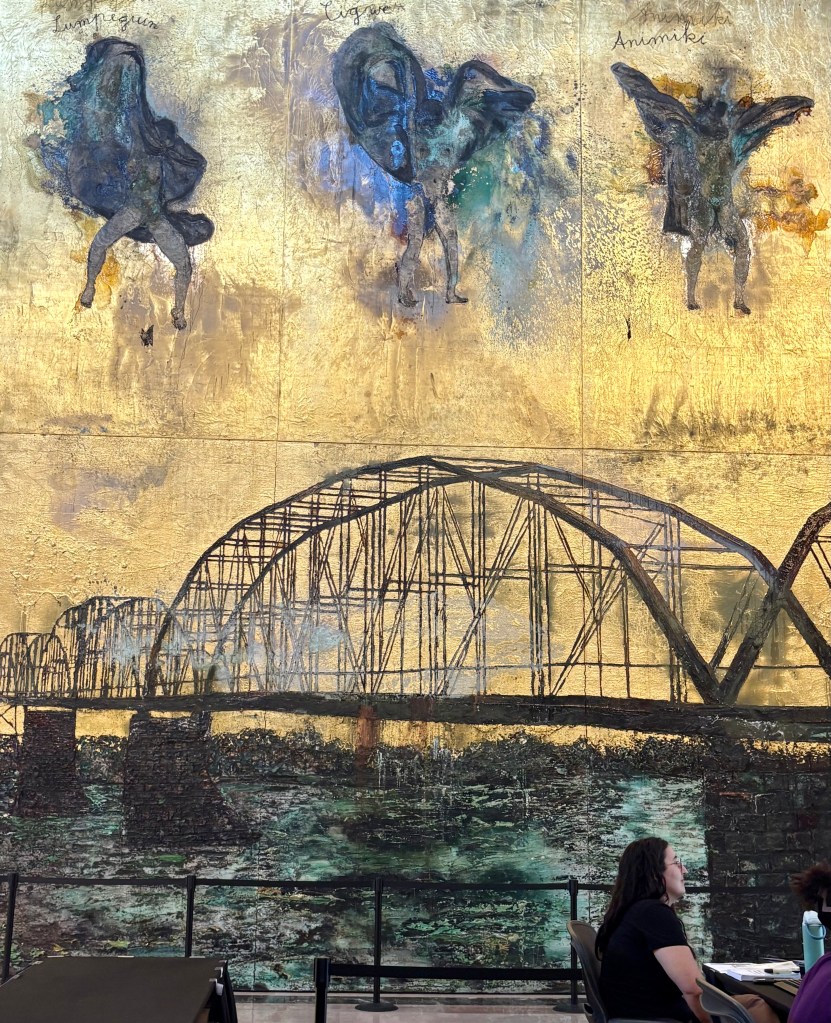
At the entry was this, two of a series of giant canvasses commissioned from Anselm Kiefer, generated by his several visits to St Louis. The bridge at left is the Old Chain of Rocks Bridge now closed to car traffic and pedestrianised. Its aerial visitors, Animiki, Lumpeguin, and Cigwen (also the name of the painting), are mythical Thunderbird creatures from local Native American lore. I can’t help you much with the one on the right.
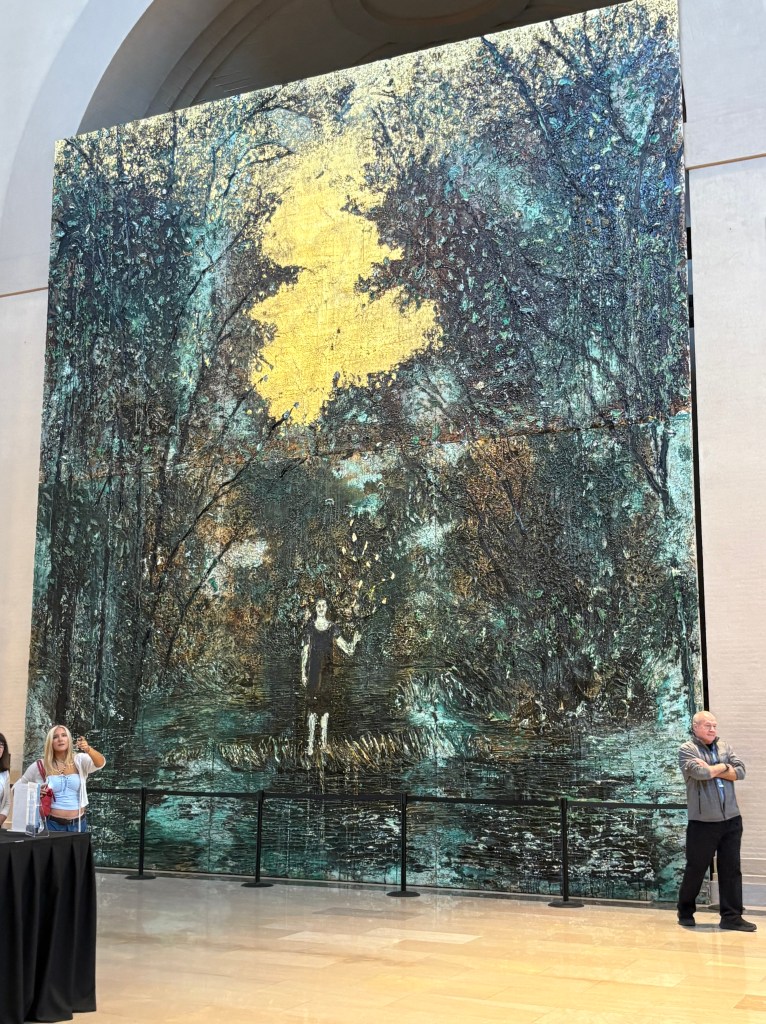
And then near the exit there was this.
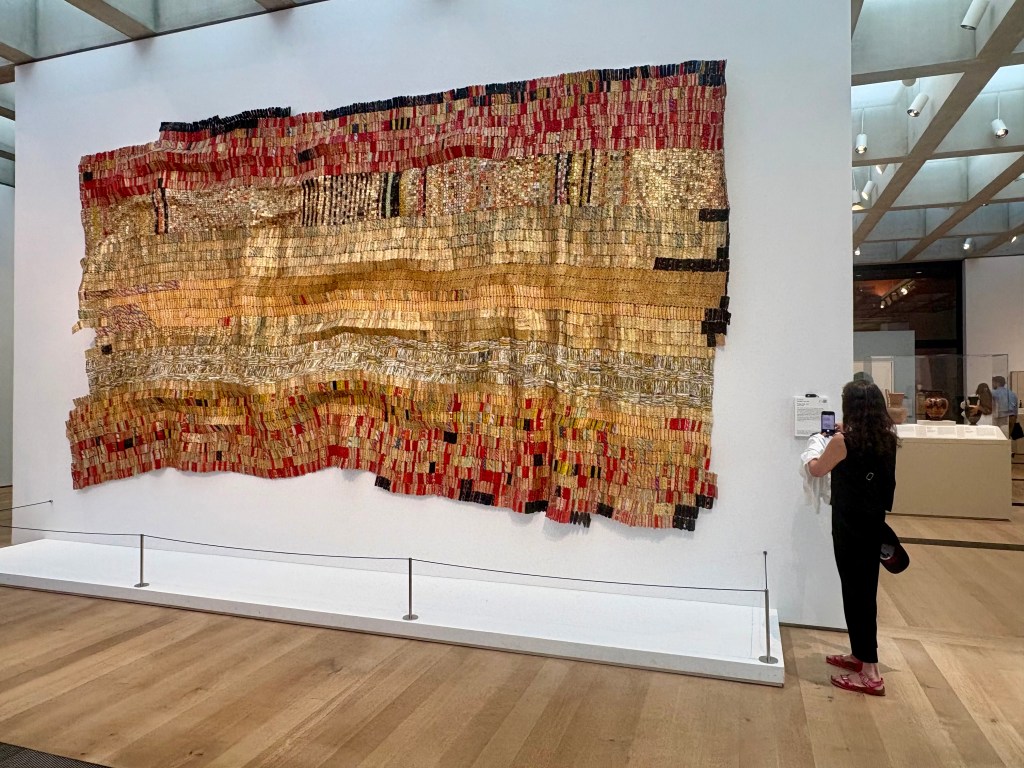
El Anatsui, Ghanaian Fading Cloth 2005 mixed media
‘Hues of gold, red, yellow and silver shimmer across the undulating surface of Fading Cloth. Although it looks like textile, the work is actually made from discarded liquor bottle tops, which were flattened and stitched together with copper wire. … These materials are also encoded with meaning. Europeans traded textiles and liquor in exchange for gold and slaves in West Africa. Fading Cloth weaves together a range of political, historical and visual references specific to this region, where Anatsui was born.’ 🤔 Mmmm. Yeah maybe. But maybe it was just turning something which was to hand into something beautiful and aesthetically interesting.
I have written about some of what we learnt from our trip to the very fine museum here.
We’re not even in the car yet, and I haven’t mentioned the excellence of the Seared Salmon Salad at Applebee’s Grill and Bar, or the fact that we saw a new print of ‘The Right Stuff’ (long, messy and just slightly tedious, Gus Grissom is made to look a right tool) at the HiPointe cinema in very much another part of town. Or the rare experience at the Shake Shack in Central West End.
Out of control. I got too interested in the Dred Scott case. I didn’t say enough about the importance of good air conditioning or just how bad humidity can get or the influence of a profoundly riverine environment, and the funny bits of water, expansive and otherwise, that turn up in Forest Park.
I can only apologise and redirect your attention here.

