The Merest Sniff of China (2)

Bayden's viewIn 1998 when Myrna and I were in China we spent most of our time in southern Yunnan close to the border with Burma, out of the way and very rural. I’d be interested to see how much things have changed in Mojiang, Simao, Pu’er and Xishuangbanna in that time. But this was an urban visit with nothing as new as the newlands of Wujiang, a vision of the modern world.

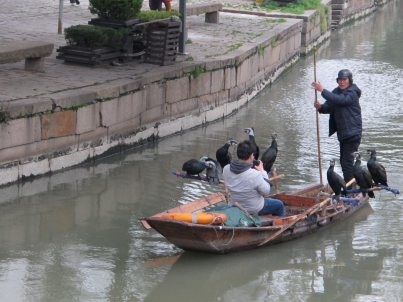
IMG_1905Wujiang means ‘Wu River’ and there were plenty of signs of being in wetlands with water trickling between expanses of concrete, lakes large and small, canals and whole towns claiming to be the Venices of the East. We visited one of these, Tong Li. Nice enough but we seemed to have been to a lot of places a bit like this before. We did see a film being made with a glamorous star (at right), and this amateur effort (below, he’s filming the boatman at work) which we watched for some time. I suppose if you pay you can do what you like. The birds are fishing birds.Tong Li boatman

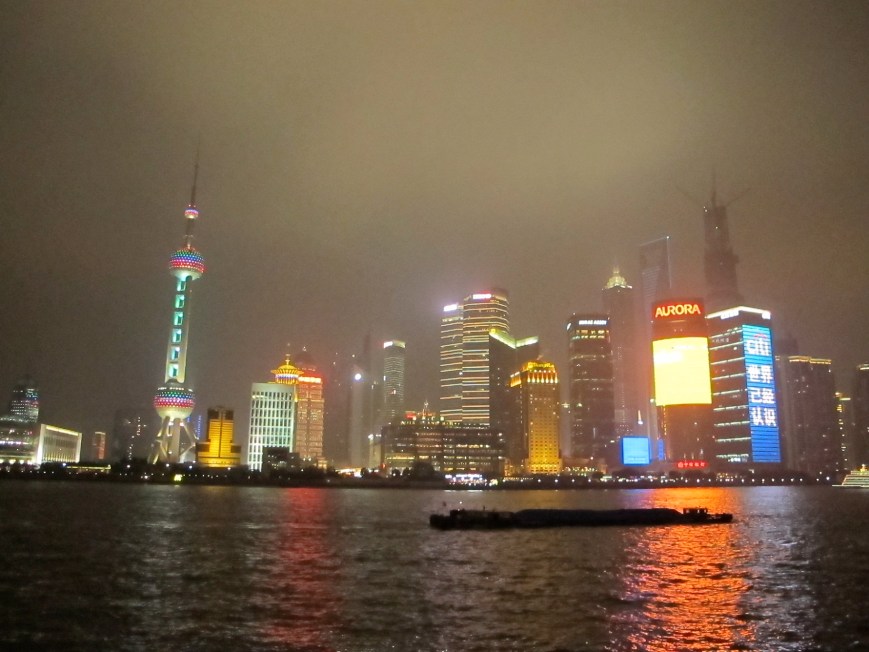
The Chinese learnt how to build high rise buildings on mud in the mid ’90s — a honeycomb concrete pad with deep piles to stop tilting. It had certainly begun in Pudong when we were in Shanghai in 1998. The Pudong development now extends for 20 or 30 kilometres, a forest of high rises with small clumps of very high rise here and there where extra fertiliser has been applied.

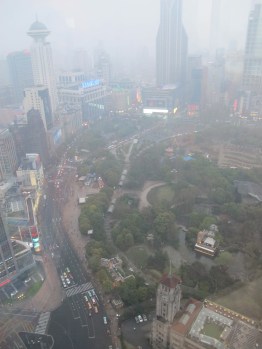
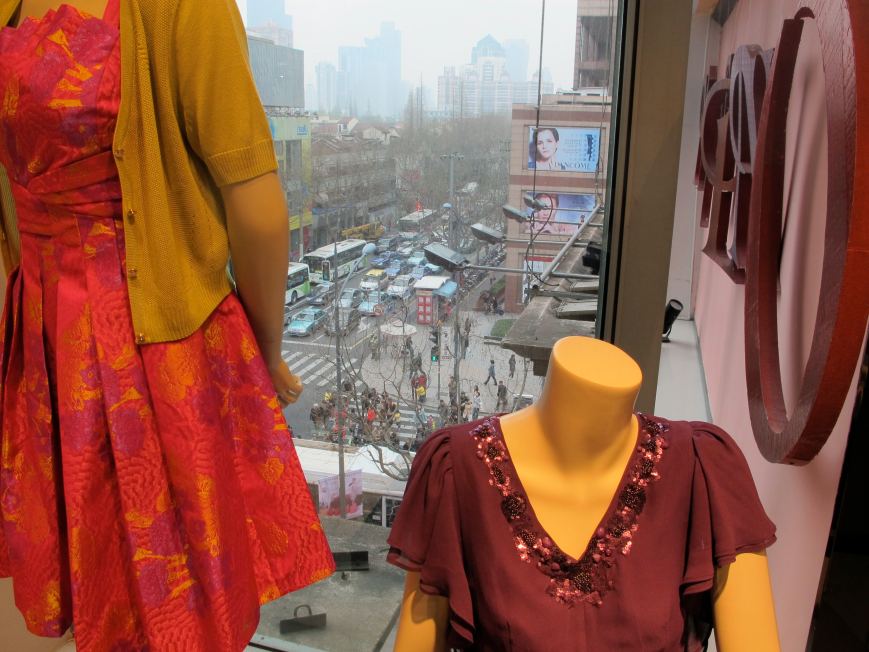
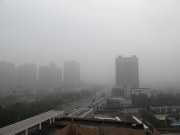
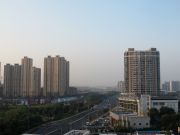
The view above from Bayden’s window is ‘older’ Wujiang. Our view in the opposite direction was not only of a bus station but a series of construction sites. In three different moods —

Wujinag#3 not clearWujiang #1Wujiang #2 clear

and, yes, there was a clear day.

Wikipedia says what we heard regularly:

‘Wujiang is located just south of the city center of Suzhou. Traditionally, It has been regarded as “the Land of Fish and Rice”, and “the Capital of Silk”. In recent years, it is also known to be “the Capital of Cable and Optical Cable“ and also “the City of Electronics”.’ Very sweet.

There has been a remarkable effort to vegetate. Literally millions of trees, Suzhou boulevardmany of them apparently mature with boles 200mm in diameter, have been planted along the long straight boulevards. In 20 years time the whole place will look magnificent in Spring.

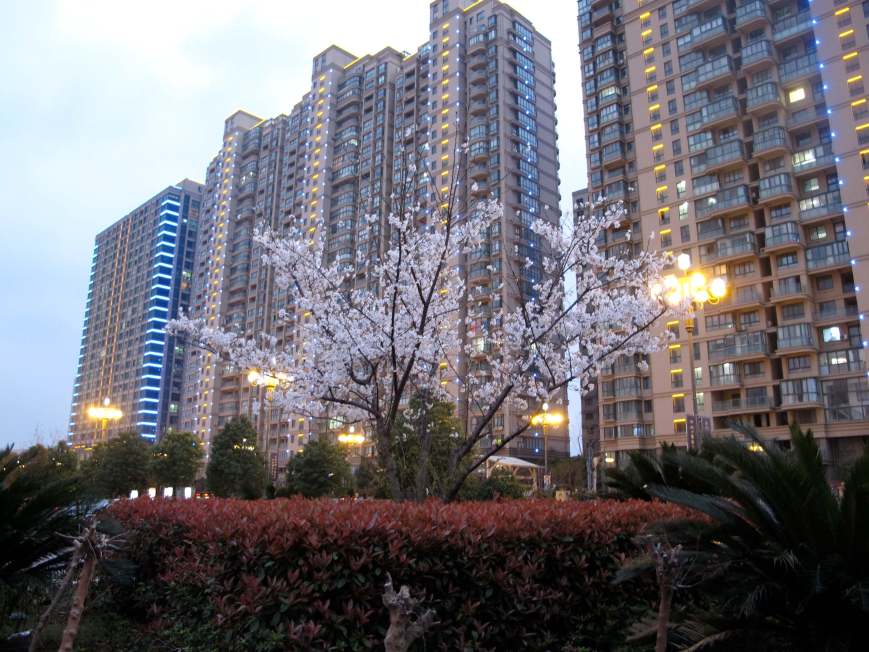
Many of these tower blocks are not fully occupied or occupied at all. They offer one-, two-, three-bedroom units, the last with two bathrooms and, on the basis of the advertising posters at their base they are very nicely appointed. Forget high rise slums.blossom buildings

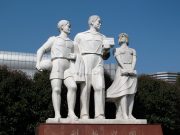
High school statuesBut this wasn’t why we were here.

Bayden Findlay and I were making videos for use in a guide to Australian schools for developing partnerships with Chinese schools. This is part of a national initiative to encourage the teaching and learning of Mandarin. You can find an example here. (Although we made both the videos on this page, ‘Connecting Students: China BRIDGE 2012 is the recommended item.)

The previous Victorian government developed a very active relationship with Jiangsu Province of which Suzhou and Wujiang are parts, and its Education Department with a strong International Division has developed 47 such school partnerships. That’s quite a lot. How much longer this relationship will last is not known, but it will not be the fault of the Chinese if it stumbles.

The 17 people we were with were coming back to their seven schools after 12 months to re-enliven their relationships, and we were going to four of these schools to interview Chinese principals and teachers and capture some of what it was that these relationships were about and how they worked.

The studio:studio set up

The first school we went to was a primary with 1700 students and we got there for Monday assembly. Note the big kids. They could have been 13 but no older.Assembly kids

A white-gloved and very formal delegation of students marched the flag in and raised it. Everyone sang their hearts out. We had an exhibition of last week’s best calligraphy (Year Two: the fine motor control of 8 and 9 year olds at the schools we visited was of a startling high order), we had some opera accompanied with dancing, the playing of a traditional musical instrument plucked like a recumbent harp. Then, of course, the in-line skaters.roller bladers

No assembly complete without same. They circumnavigated the whole crowd three times and then went off … somewhere.

I have no way of telling how representative these schools were. The buildings of course were all new — spacious and well equipped. In their whopping classes the kids were attentive and responsive. The teachers were firm and direct but encouraging and perhaps softer than 15 years ago.

As Jane Orton notes, Chinese seven year-olds usually know about 1500 characters (of 48,000; 56,000 with the inclusion of classical characters). The requirement for second language learners of Mandarin at Year 12 in Victoria is 640. With 3000 you can read a Chinese newspaper (although there are those who believe this is on the low side).

The remarkable training that learning Chinese orthography entails must have an impact on neural processes. It is reinforced by hours and hours of homework a night. (Recently some Education Bureaus have tried to institute Wednesday nights as homework free, but this is largely ignored by parents (and students) who fear their child (they) might fall behind.) Learning is also very definitely a binary process — 权 right, 错误 wrong — none of this ‘pretty close’ or ‘I’m not quite sure about that Adrian, but good try’. Bang. One way or the other. Quite useful for maths as well.

This might have something to say about Chinese society more generally, and now I’m really just musing out loud.

Think: a computer. Performs astonishing tricks, but it only uses binary impulses, black and white — no hmmm not quite off, a bit in the middle, sort of a warm spark there. Its operation is completely hidden from those who aren’t afficionados; it uses its own artificial language which is programmed from elsewhere. Its operation might be intuitive, but only as long as you play by its rules.

There were many moments in my interviews and other conversations when I wondered along these lines. I might say that our main school contacts were the manifold English teachers who were keen to be friendly and not just to practice their English which was sometimes perfect. But I also interviewed each of the principals with the help of Julia Gong, our rather brilliantly bicultural tour leader.

Three moments.

In the first I was trying to explain why schools with 43 students might have trouble partnering with a school of 2750. I pointed out, wrote down in fact, that there are about 9,200 schools in Australia of which just under 4,000 have 100 or fewer students. This was the occasion for great hilarity and a certain amount of disbelief from several senior bureaucrats. It was left as a joke rather than an unusual and pertinent fact. It hadn’t chimed with what was known. No black, no white. Just weird. Foreign.

In the second, same audience, Mr Tsien was wondering how Australian schools could have such small classes and be ‘creative’. I could have said, it’s a trade. All Chinese teachers, primary and secondary, teach two or three 40-minute classes a day. I also could have said you’d need two and a half times more rooms if you want discrete classes of 20. Wouldn’t happen. But what I did say, and wrote down, was that it costs about $5,800 annually to educate an Australian primary school child. In China about 2300 yuan (about AUD400; adjusted for cost of living probably in the region of AUD1500-1800, but still rather less — what DO we get for all that extra dough?) He didn’t say, ah yes, of course, or without question, or that’s interesting, or is it really just a question of money? He congratulated me as a representative of Australia and suggested that soon China’s investment would be equivalent.

I was reading Peter Hessler’s book River Town at the time, a recount from an American of his two years spent as a volunteer teacher in Fuling on the Yangtze in Szechuan. A practiced and well-trained amateur athlete, he takes part in and wins a locally-celebrated long distance race. The newspaper report says nothing much about the race per se, or his win, but comments at length how the locals must struggle to do better to conquer their waigouren (foreign) rivals. Mr Tsien’s reaction reminded me of that.

The third moment. I was talking to one of the smartest and most fluent of the English teachers we met and we were talking about variations in schools. I offered the idea that schools were generally a precise product and reflection of the community in which they were embedded. And do you think I could make any way with that idea? Not a hope. And this was a 10-minute effort with diagrams and pictures, not just a passing misunderstanding.

I think the idea that communities might vary may have been a stumbling block, like for example, trying to persuade a Muslim, some Muslims, that there are very different varieties of Islam (‘One God, One Faith, One People’!). She may not have lived far from home, although, remembering, she had. She had lived in New Zealand. Perhaps not in the Uighur Territories or in southern Yunnan. Or it might have been the idea that there could be variations in ‘school’ and its products. Curricula and text books are standardised across China, although we came across teachers perfectly happy to leave bits out or change apparent stipulations and do things a different way. It may just have been a foreign idea in its speculative quality. It registered nowhere.

All students study English. They are aided in this by learning Chinese characters accompanied by their written pinyin pronounciation, so even young kids learn the Latin alphabet and its sounds very early and consistently. In Beijing and Shanghai there was a lot of environmental English: street signs, directions, ads and so on.

But, think, if we want young Australians to learn an Asian language (and that’s why we were there, directly) it should be one language (Mandarin would be a smart choice) in all schools at all year levels for 4-5 hours a week. All signs should have a Mandarin translation and attention should be paid to an increase in environmental Mandarin everywhere. Ridiculous or what?

That’s how the Chinese would do it. Black, white. And er hem … that’s how they have done it. You want to know the difference between Chinese and most western societies? There it is.

Finally, an invention from a 10 year-old student from Suzhou Experimental Primary School. An arrangement so little kids’ chairs don’t fall over backwards celebrated in a glass case at the school’s entry.

inventionWe queued at the designated carriage point (number 13) for the superfast train at Suzhou and, after travelling at 200 kph for 21 minutes, we were in Shanghai. At no point in that time did we not have buildings on either side of us.

(AND, YES, THERE IS STILL MORE. THRILL TO THE DELIGHTS OF SHANGHAI … THE MEREST SNIFF PART III)

The Merest Sniff of China (from 15 years ago: 1)

FigureheadSomething from 15 years ago, which might be self explanatory, about a man who moved me.

MISTER SU

Presents are light, but friends are heavy.

— Mr Su

They marched into the Golden Dragon, the four of them, looking as pleased as Punch — (blow out those cheeks and let the tones resonate!) Mr Zhang and Mr Huang and Mr Su and Mr Xu. (Purse your lips, curl your tongue and give a short whistle — Xu, Xu, Xu. You can practice for some time without getting it quite right.)

Mr Zhang had a car; that cut him out of the pack. No one else much had a car where we were going. But it wasn’t his, it belonged to the same mob who provided the mannequins, and he was a driver. I mistook his role for that of a sort of personal assistant/chauffeur to Mr Su, but I was a long way wide of the meaning of democracy in action. If you have an approved purpose you can organise a car, an interesting thing in itself, and for the two-day drive from Kunming to Mojiang you need a car.

Mr Zhang had no English, but he was a great communicator. I had better and easier conversations with him than with some of the Chinese teachers of English we met, providing the first of many encounters with the very high level non verbal communicative skills that were characteristic of our Chinese hosts. It is something about the language that makes you use everything you’ve got including, of course, tones, and gesture to get meaning clear.

Mr Huang was an English teacher and was immediately recognisable as a type. In schools I know, people would say of his ilk, ‘Mr Huang? Indispensable. First here, last to leave; always wanting to see if there is anything he can do to help.’ He would be the person who marked out the oval at 5am on the day of the athletic sports and collected the flags at its end. He almost quivered with alertness, wired in to everything that was happening, and later played basketball in exactly the same manner.

His English was like my best foreign language. You compose carefully and get held up by a bit of vocab that’s missing. Then you deliver your conversational offering in a manner suitable to the completion of a task which has taken you a great deal of effort: a flourish, head back into the shoulders, hand thrown forward: and how was that one! And then, if it was a question, hope that no one would answer or at least not at any length. So, as the group chatted away, my friend Mr Huang would suddenly pounce. ‘And how then do you like our gracious country!’

Mr Xu (Xu. Xu. Xu. I’m still practising.) was also an English teacher from Mojiang, in his early twenties and as bright as a button. His English was excellent and he was a key organiser, the king of the buses, who stayed with us for the fortnight we were in Yunnan, and was one of the factors that made the travel so easy. Immensely good-humoured, he had the world at his finger tips and nothing was too much trouble for him. He would explain with a courtesy and patience that I would like to be able to reproduce.

And Mr Su. That great man, Mr Su, nut brown and sparkling with vitality.

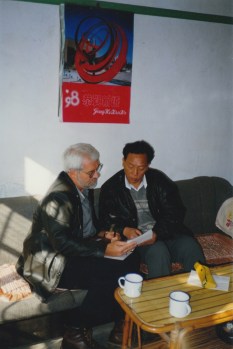
Mr Su 1Mr Su was the reason why we were there at all. Now principal of Mojiang Regional Teachers College, he had been principal of Mojiang No. 1 Middle (secondary) School when one of his teachers had been awarded a scholarship to spend time in Australia. This teacher, Tao Ying She, now working internationally as an engineer, spent some time teaching at Hawker College in the ACT in 1990 where he became friends with Mark Hall, who with Mr Su’s help, organised the first visit by Australians to Mojiang.

‘What was my idea? It was difficult to decide. The government had not decided to make our town open. But the central government had a policy of open-ness, has said we should learn from Western countries. So I thought, yes, some should come. I have never met any foreigner at the time. I think, hmm …  yeop … very, very good thing. We could learn a lot from foreigners. I would hear the language spoken which I have taught for so many years. They too can learn from our school, our people and our country.’

It was, I think typically, a courageous decision. He had stepped over the cautious parochialism of his regional cadres and chosen to interpret the policy of central government in his own way, reaching out to an idea of a higher good.

‘When Mr Tao returned I let him have a report. We knew some things about Australia but very little. Mr Mark Hall visited and when he returned he wanted more to come back. He teaches Chinese and wanted to know Chinese more. He made a plan — The Bamboo Trail (travelling up the rivers to Mojiang from the south). I like to have PE teachers to learn some more about PE, and so a large group came for four days. They are very satisfied. We learned from each other so much, so much. From that time we have had groups of Australian teachers and students, maybe 136 persons.’

‘The best thing for us is that we can learn more English. Teachers and students can talk with native speakers, can make students study English harder and harder. After these activities, they feel it is not so difficult to learn to speak. They are excellent students. They work hard and they live simply.’

Mr Su decided to become a teacher very young. His father who died when he was eight had been a teacher, as are his two sisters. ‘I loved and respected my teachers.  In primary school I thought I would like to be a teacher. When I was young I like to learn very much. My family’s rules are strict, and they think it is good … ahm … discipline to learn languages.’

‘I went to Pu’er (a larger town 150 k.s south of Mojiang, famous for the quality of its tea) to the Middle School where I studied three years. I had to leave my school where I knew everyone and had many friends. Some of my classmates came with me, but from then on I like to make friends. Yeop. I like to make friends very much.’

In 1962 he went to the University of Kunming’s Teachers College.

‘At this time the Cultural Revolution began. We had no lessons at all. We just stayed at the College and had some political study and discussions. At the beginning we were involved; later on some of us not so interested. But for the first time you could go anywhere, you could travel. Sometimes I went to Lancang (‘Lunshung’) or Jing Hong, but everywhere there were Red Guards.’

‘We waited for a job for two years. In October 1968 I was sent to Mojiang Middle School No. 1. At Mojiang the students did not come back. There were no lessons. They stayed in their farms and villages. Teachers had nothing to do for one year. The government organised teachers to do farm work. I could do that because I came from a village.’

‘Then school began again. Many children came back and we could teach. But at that time there were no exams. When students don’t have exams, they don’t work very hard. In our school I think the students were good. They were obedient. But it was a time when you had to be very careful.’

He was telling me this, drinking cup after cup of green tea from his personal thermos, sitting in the spartan principal’s office at Lancang decorated with a chest expander hanging from a peg on the wall.  Ten days earlier when we’d talked about the Cultural Revolution he had mentioned that 600 people had died in Mojiang, a town of about 20,000, and that teachers were disproportionately represented among that group. How did he feel about that? ‘Mao did many great things. He was a very great leader. But this  … very bad, very bad thing.’

These experiences had not diminished his interest in education and belief in its centrality.

‘To be a teacher you must learn a lot of knowledge, about every field. When I was in College I learnt Chinese, English Language and Chinese History and I played sport. To be teacher you must look widely. For me it is not so difficult to be a teacher … and I have children. Now my students are teachers, and I love that they are teachers. They do their job better than me!’

He had recently been studying Chinese history again to teach his own students and what he was learning was very much on his mind. ‘Chinese must know that China is a very old country with a long history. Many famous people tried to make Chinese stronger. They have failed. Too big. Too many people. No good government. Policy is a most important thing. A lot of Chinese people work harder and harder to make China strong, to progress. They must work harder for our country. Make our country richer. Every Chinese people.’

‘Chinese government found the problem in education. Most of the students study only to enter a higher level. When they grow and have to do some job, their abilities are not so good. Our educational rules must change.’

‘If teaching is orderly, regular, consistent, students can learn lot of things. Teaching methods have changed but not so much I think. If students want to go on they have to study hard. The teachers must prepare their lessons very carefully. But every year the children talk back a little bit more to their teachers. They have more free time, more things to choose and they lose what is good for them and their futures.’

‘In the future I don’t know what will happen. The level of life [standards of living] will improve. This is happening all the time. Such a big change in my life time. The important thing is to release students’ abilities, and teach them how to learn to learn. That is the education for the future. But spiritual life may suffer and education has two purposes both of which must be respected: the material life and the spiritual life. The spiritual life is what might suffer.’

When we arrived at the Nationalities School at Lancang (see p. 19) he gripped my arm and pointed at a slogan on a plinth with a huge golden key mounted on it. ‘This is what Deng says: “Education must confront modernisation. It must face the world, and it must face the future”. This is what I think too. This is why you are here.’Mr Su 5

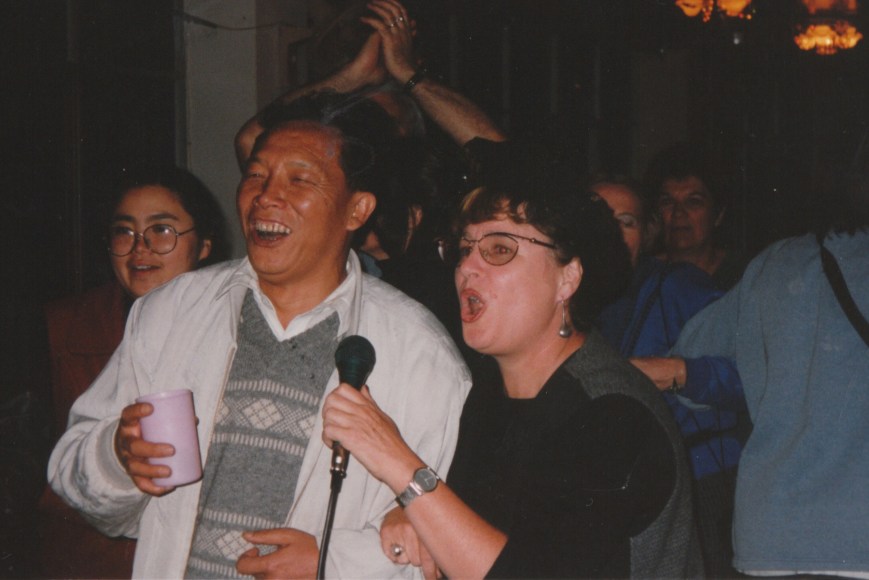
But the slogans of politics could never do justice to Mr Su and his beliefs as he lived them. They are too abstract and arguments about them and their meaning too arbitrary and ethereal. What he offered was his friendship and his vitality and warmth to a group of foreigners. He was at his finest singing ‘Country Roads’ to a karaoke screen, roaring laughing, offering toasts, chatting so openly with strangers, magically causing our luggage to appear after it had been left hours behind on a broken down bus, glowing with pleasure at the obvious success of our contact.

He left us at Jing Hong. We had drunk some whisky together the night before to say farewell because he was leaving for the long drive back to Mojiang very early in the morning. But when we woke up on the rock hard beds we thought we would like to say goodbye once more, and so I pulled a jacket on over my pyjamas and stuck my feet into my boots and we went down to the foyer. We waited for an hour and a half before he appeared beaming. ‘Ah good sleep. Good sleep.’ It was just the right thing to say. I was glad I got up.

The Merest Sniff of China (1)

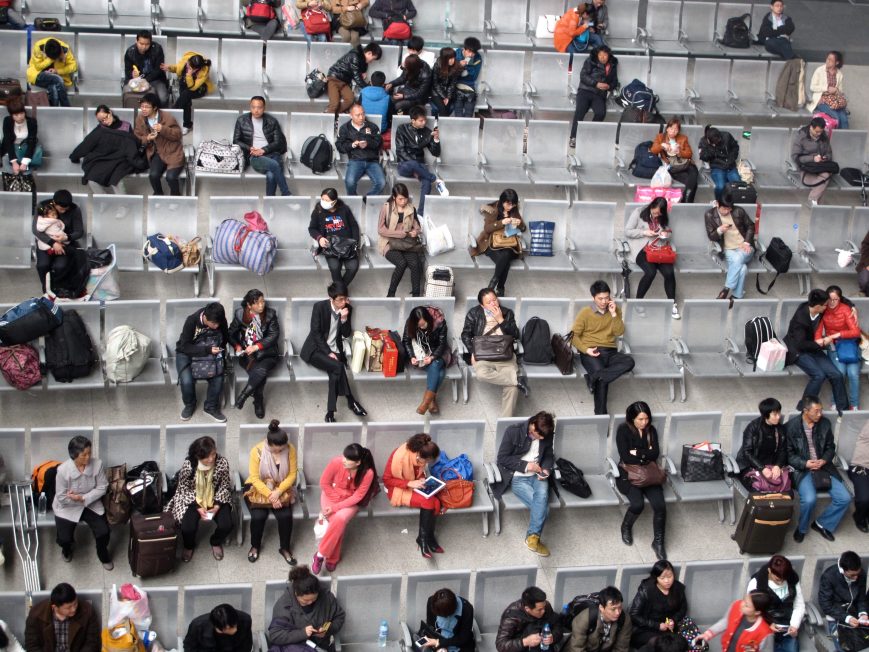
railway station [The photo above repays attention. Suzhou train station. Waiting. Doing what you do in contemporary China when you wait.]

Scale. I think that’s what one has to deal with in China. Scale. Novelty. Volume. Energy. Action. But scale.

Both Beijing and Shanghai have larger populations than Australia. Millions more. Millions. It just trips off the tongue; but how do you govern a city of 27 million let alone a country with more than a billion inhabitants? Fifteen years ago when I was writing about our last trip to China I included the aphorism — possibly local, possibly apocryphal — that China governs to the Second Ring Rd, which is a couple of k.s at least from the Forbidden City, the heart of the Middle Kingdom. But China does manage to build spacious and grand school buildings and, at Wujiang, our real destination, create a city of 1.5m (on mud flats, part of the delta of the Yangtze) in nine years.

Dubbo, yes Dubbo, is one of its seven sister cities, and several of the dignitaries we spoke to had been there — ‘Very clean air. Very spacious and beautiful city’ — although Mr Tsien, the Deputy Director of the Wujiang Education Bureau, had not encountered or seen any Aboriginal people on his visit there which made me wonder.

Pudong airport[This photo is Pudong airport (Shanghai) where we first arrived before going on to Beijing. This terminal (one of two) would be 500m. long and is an exemplar of light weight construction‚ cable trusses every eight or so metres braced by long but fine steel bars secured to concrete stanchions. Beautiful.]

Two weeks. A few days in Beijing, a working week in Wujiang, a few days in Shanghai, with 17 principals and teachers from the hills of eastern Melbourne, Mooroolbark to Warburton. For work. Making films about the experience of these people and their Chinese school partners in establishing a productive relationship. Beijing was orientation, some sight-seeing (the Great Wall, the Olympic precinct, in our case 798, an arts area), some professional contact with Hanban, the Chinese equivalent of the British Council, to marvel at its new educational resources — and boy were they flash— and visits to two schools.

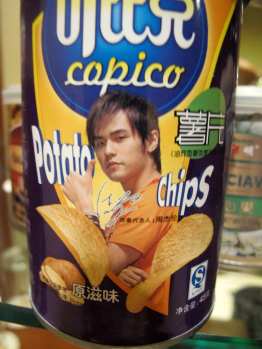
Chips packetOne was ‘e3’, an expensive international primary school, which taught bilingually in Mandarin and English, but otherwise made most Australian primary schools look at least its equal.

The other was an experimental high, about which I can remember very little. I asked why it was ‘experimental’, but wasn’t very clear about the answer. Some schools aren’t, but these days many are. All of the primary schools in Wujiang were also ‘Experimental’.

We saw a ‘model’ lesson with heavy use (by the teacher) of slightly old-fashioned ICTs to reinforce a handful of English vocab, and some pretty funky, passionate even, role plays about turning digital devices on and off.

A suspicion floated through the group that these may have been heavily rehearsed, but why not? I think with a crowd of international critics up the back, I’d be inclined to engage in some rehearsal as well.

I talked to a quartet of the scholars. Two wanted to be engineers, one the goalie for the Chinese soccer team and one to write a book ‘to change the world for much peace’. After 8 years of English for 160-200 minutes a week the goalie was still on greetings, the engineers pretty consistently puzzled by spoken English with occasional moments of illumination, and the author happily and energetically semi-fluent.

Fifteen years ago there would not have been a digital projector, nor would there have been a role play. There were still 50 in the class.

But Beijing was food, architecture, air and art.

We had the first of many many banquets there (somewhere round 24 courses with much toasting), and uncovered the Xiang Wang Family Restaurant in a hutong not far from our hotel, tested the Peking duck, the pork ribs and other weight loss foodstuffs and found them highly satisfactory.

It is a grand and stately city with broad boulevards jammed with near stationary traffic. Fifteen years ago there were bikes; now there are none. It is also a contemporary playground for the world’s architects.

big underpants

We were staying a few hundred metres from two of the most dazzling (although hundreds were dazzling), the 90-storey tower of the Chinese World Trade Centre (where there’s a bar on the 80th floor and if you could see anything the view would be whizzo) and ‘big shorts’ (at left), the CCTV building. Not closed-circuit TV but Communist China TV which broadcasts six channels of easily recognisable content — reality shows, soaps, news, sport — scarcely distinguishable from TV here. (Note the intriguing assymetrical scoring on the building.)

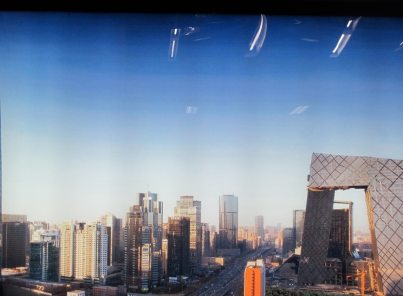
I took another photo surveying the delights of Beijing architecture with clear skies but I must confess to finding it on the wall of a subway station. Maybe it can look like this.beijing ad

And then there was the air. You might remember 6000 factories were closed for three weeks before the Olympics and this apparently was helpful.

We measure air-borne particles of less than 2.5 microns because they’re the bad ones, million per cubic metre. The standard index says under 50 okay, 51-100 moderate, 101-200 crook for asthmatics or people with other problematic conditions, over 200 very unhealthy for anyone.

Shooting bird's nest[Bayden trying to find the Bird’s Nest in the Olympic precinct. It’s over there somewhere in the murk.]

The ‘e3’ school checks the US Embassy’s air monitoring several times a day. The yellow flag (over 250) was out when we were there which meant ‘windows closed and most play indoors’. 350 or over and, my memory, the school closes. This ocurred for 18 days last October. The Index was over 900 one day a few weeks before we arrived in Beijing. It hovered around 300-350 while we were there.

What’s in the air? Dust, car emissions, factory emissions, coal dust and soot, and so on. Bejing is located in a topographical saucer a long way from the coast, and the air quality would of itself stop me from living there. This isn’t fog.dirty air beijing

And I nearly forgot the art!

Myrna and I had an excursion to 798, an arts precinct developed from converted factory buildings north-east between the Fourth and Fifth Ring Roads. Excellent coffee; great art; great fun; like home on a good day. Except more interesting perhaps. And bigger scale.

Enjoy the pics. (I especially like Mao and his mate propping up the yuan.)

TO BE CONTINUED …

798 streetflat tank

IMG_1751IMG_1734

IMG_1740

WEDDING

It got to 42C (108F) on the day before and that’s too hot for anything really. There were stray northerly gusts strong enough to blow the food off the table at the market where we were eating our breakfast. Buying supplies, of course we were. It didn’t augur well. But we were clinging (for days, weeks) to the forecast which said 26 with light southerlies. Duly at 2am the temperature began dropping, 18 degrees by 6am — and, for Melbourne in summer, Jan 5 was a lovely day. The wedding was on.

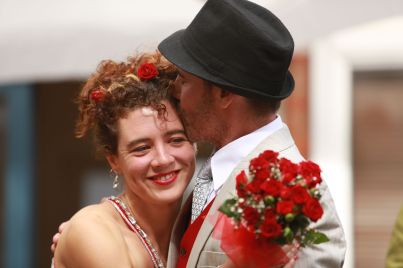
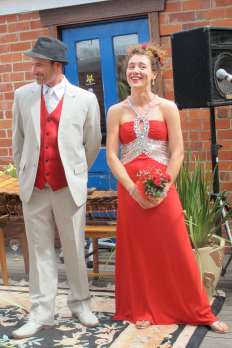
PT9A7900We’re not sure why Mitzi and Simon decided to get married. They’d been living together for five or six years and had two children. It could have been the new suit Simon bought in Bangkok and the need for an occasion to give it an airing. It might have been the constant hectoring from the parents/grandparents whose resignation had descended into fits of misty sighing. Or it could have been the occasion for a fine party. Or all of the above.

It was to be held in the backyard of their house with the catering to be supplemented by contributions from the guests. Our kitchen was papered with lists: ‘160 meringues, 140 Florentines, 200 small cakes, beetroot and lentil salad (no fetta). Small tables from the Salvos. Plastic cloths, clips, golden tissue paper. Rose petals, bucket, containers for …’ that sort of thing, pages of it, exactly the sort of thing I am inclined to tidy up and move along.

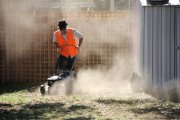
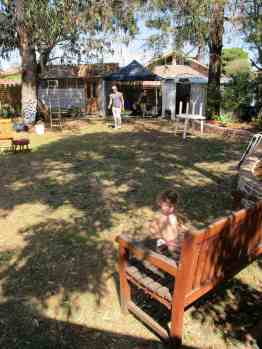
IMG_7375There was getting ready. A Backyard Blitz of sorts had occurred with Simon’s uncle imported to build the snaking wall that had been planned for some time. Mulch had been mulched and top soil soiled. Pots of petunias were cossetted and junk was junked. Mostly. The last remnants of goat hide found their way to the tip, and Frida supervised.Back yard #1

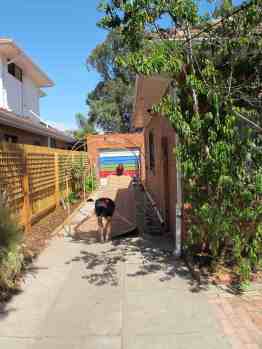
It was of course supposed to not look like a backyard and various cunning ploys were employed for this purpose including a bamboo archway up the drive built by the ever ingenious David Mollison, Simon’s dad. Note new fence. Weddings have their purposes. This is what the bride has to do on her wedding day, an old Australian tradition.

Bum shot

And there were rehearsals to be rehearsed.2. Flowergirl practice

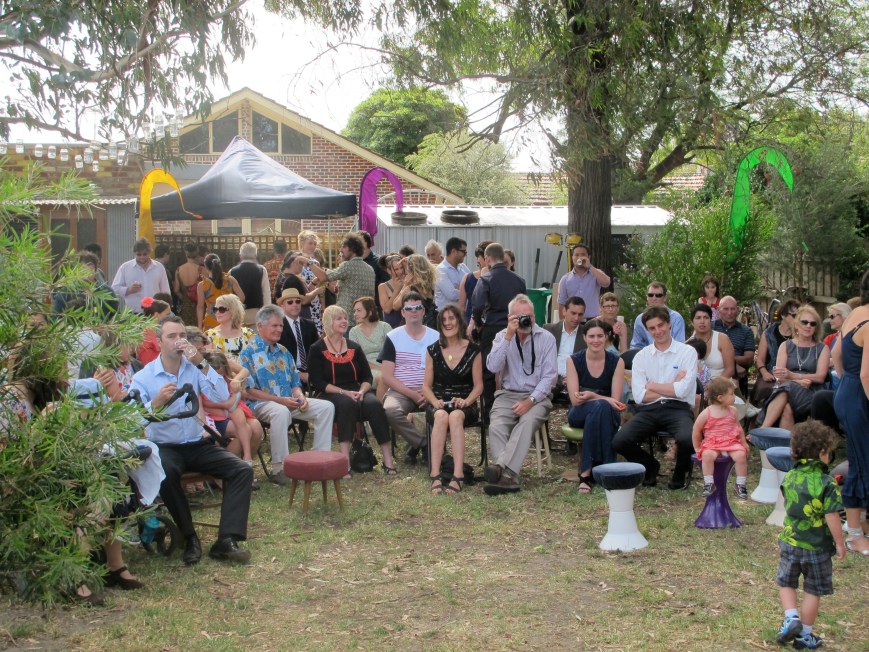
By the time the crowd, which included 40 or 50 kids, started assembling the backyard looked okay. And anyway, of course, the real decorative elements are always the people.IMG_1522 IMG_1529 IMG_1527

It was also a SHOW to be held in the backyard, an all singing/dancing kind of wedding which is what might be expected of a musician and a dancer. It was also as carefully crafted as a drum and as well organised as a biology experiment. The crowd arrived to a genteel concert of djembe and balafon. 4. BassidiGiven a good break among the vicissitudes of fortune, Bassidi Kone (from Mali) playing the balafon may one day become another Youssou N’Dour. Masaki, an African drumming enthusiast from Japan, is drumming. Of course, you say.

Meanwhile the business of the day was commencing. Simon had decided to wear shoes, Mitzi’s hair had been reorganised, the crowd had got into the bar and Veronica the celebrant had dug up all the featured artists. With a variety of responses, the elite flower persons brigade had got a look at the bride and Shanti, her best woman.PT9A7845PT9A7843

Miriam had sung a very affecting version of Leonard Cohen’s ‘Hallelujah’, and the show was on the road. ‘Today is a celebration’ it was said, ‘of the miracle of all loving relationships which have at their foundation the belief in the best of what it is to be human: the generosity of spirit to be open to another person, to share life’s joys and sorrows, to care for and nurture each other in the journey of life.’8.Simon and Mitzi on arrival

To the delight of all a tear crept into the bride’s eye. The groom’s were of course already streaming. What’s a wedding for if you can’t pack up. They made their vows to each other and it was done.

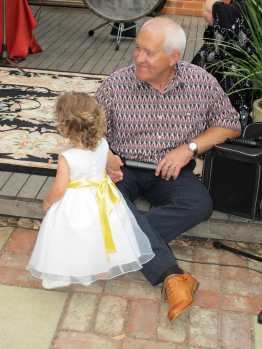
The event drew a crowd.PT9A7868The only modest and fleeting sensation was the emergence of a ringer who joined herself to the floral guard. But that can happen when you have such a large detachment.7. Flowergirls#1

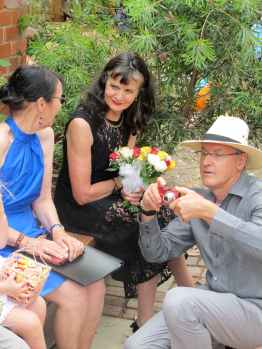
They sang and sang beautifully: ‘Skinnermerink’ which everyone is supposed to know but I didn’t, and a song Betty, Simon’s mum, wrote for the occasion. Both were belted out lustily. The register was signed …PT9A7946 and the bouquet was thrown. The first recipient at second slip had already been married for 30 years, and so a second throw was called for and a lucky man rose through the pack and brought it down.

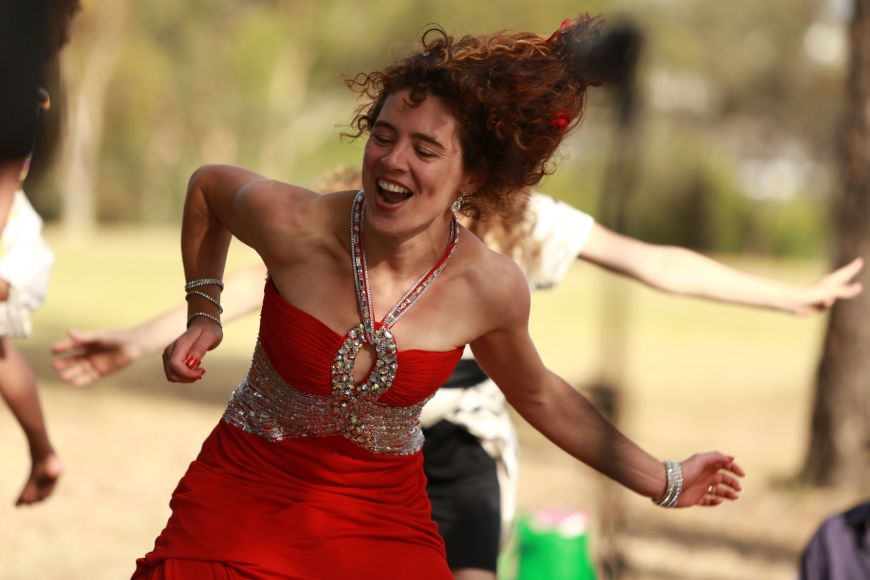
17 Off to the parkLed by Simon’s sister Jo, a professional musician based in Vienna, the throng adjourned to a nearby park for dancing and drumming while the food got sorted and the backyard was remodelled. 20 Tent in parkPT9A8198I went down Sydney Rd to the Al Wahal bakery to pick up three spit-roasted lambs with pilaf and pistachios. Good or what! The food turned out to be memorable. And so did the fabulous pick up jazz band playing to greet the party goers as they returned from the park. Just so cool …19 Backyard #2IMG_1680

Speeches aided participants’ digestive processes. There were nine but none longer than two minutes. The topics varied; the quality and heart-feltness little. Dave’s poem may have been a standout.

Mitzi’s Aunt Gill’s cake was cut, and it got dark and so there aren’t many more photos.

But the show went on, and on. Mitzi and Simon provided their own presentation, the humour highlight of the evening. Another sensation was the bridal waltz which began as an African dance, but changed into a salsa as Mitzi and Simon were joined by four other couples — notably beautiful dancing by the men, although Mitzi says we are just not used to seeing men dance and women are customarily wonderful. This turned into a Polynesian hula for the women and a Maori haka for the men. It just went on.

In his speech the father of the bride (pictured with younger granddaughter) described it as a happy happy day, and so it was. Tired but happy? Yes I think that’s it. (Pa David, Betty and Myrna) Wonderful.14 parents13 MC

ROMANIA #3: TO THE SOUTH

It was 20 k.s of dirt before we got back on the macadam and and then a few dozen more before we got somewhere else. Brasov. It was a hot day in the square which you can see right in the middle of the photo, gearing up for an even hotter night. It was party time in Crown City. Thousands were out in their Saturday best, with families a speciality, a stage being erected, scores of big umbrellas already up like a field of flowers. We could hear the noise from the Oktoberfest (whereby a perfectly innocent month has come to mean ‘beer’) happening in the huge white marquee above left, and a big tennis tournament was on. The city was also awash in brides. A truly Spring occasion. I really didn’t know what was happening. I just got excited.

We had a guided walking tour provided by a Moldovan who didn’t think there were many Saxons left in Brasov but those who remained were considered hard-working and competitive, perhaps like Claudia herself. Brasov’s old town was like a child of Vienna — tidy, solid, safe, not awash in grand buildings but with plenty of the nooks and crannies that make Vienna fun. I loved it. These stylish lads outside the university caught the feel.

[This photo of a plaque on that building has been included only for my friends at the AEF. The relevant (black) inscription: ‘Confucious Institute at Transilvania University’. China’s reach is both broad and deep. Prepare. It won’t be all fun.]

After the tour we went for a walk looking for the real town. We sort of found it — a bus station, several dry cleaners, pretzel shops, shawarma shops, roads fat with traffic — but without much contention decided to get back to the festa.

We followed a bridal party up Strada Nicolae Titulescu, the most dense of the party streets. Their photos will be wonderful. For their wedding feast bride and groom slumped in front of pizzas. Good luck to them.

Then we had a crap meal. I did anyway. A shocker. A dud. I would like to place this on record among all this exuding and promiscuous delight. The lamb I ordered was taken exclusively from the heel to the bottom of the calf, a disgraceful collection of gristle parked in some dry polenta. There. I’ve said it. I don’t have to say it again.

We got back to the square just as an opera recital was finishing and we were treated to the ever popular, always tedious ‘Brindisi’. There is music you can hear just too often and this is in a cage match with ‘Bolero’ to be at the top of my list. Sad. I would have loved to have heard the rest. In the morning there was not a vestige left of the stage, just the sort of drifting couples being circled by picturesque litter that you might expect in a film. The satisfaction of a social petit mort.

The next day was athletic. Brasov is built into the side of Mt Tampa and there are 100 ways to get to its 900m. peak, the most popular being via the cable car. I think we took the ‘Snake’s Staircase’, a gently graded series of zig-zags, had some chicken, chips and Chook (‘Ciuc’ really, the local beer) at the top and came down the rather more serious ridge route finding new Brasov, Ceausescu’s Brasov, on the other side.

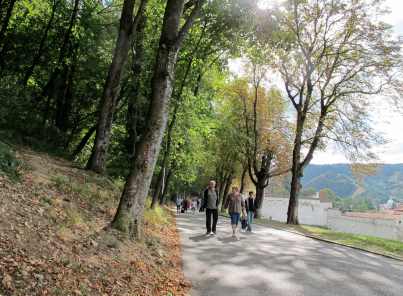
At Tampa’s foot was a lovely promenade with, although it doesn’t look like it in this photo, hundreds of Brasovians out for a stroll. I looked at this, smelling something very deliciously bakery-ish coming from over the wall, and thought — civilisation.

We followed with a swim — no drama, no story, no photos. But then we attended, for free, the grand final of men’s singles, Brasov Challenger, with seats on the net thanks to Neil and Ros. Local hero Adrian Ungur was playing the wicked Austrian Andreas Haider-Maurer (who I think I have seen in the past at the Australian Open; believed to be coming back from injury). The crowd, which over the course of the game grew to be substantial, barracked: hard and positively for Ungur, and never missed even the slightest of H-M’s errors. Ungur won the first set quite nicely, got to 5-2, 40-love up in the second and then produced a choke to rival Jana Novotna’s. Two sets to one down. And I was barracking for him too. Brasov. Fabulous.

On. On. On. We left at dawn, the train snaking round the foot of the Carpathians and then finding a way through via Predeal, a ski resort. As usual I fell asleep and woke up somewhere near the Gara du Nord Bucaresti. If I could have stayed in Brasov for several more days, and I certainly could have, I would have liked another week in Bucharest. This happens. You can’t do everything.

From the station we boarded a subway train completely covered in graffiti. We were no longer in Brasov. A walk to our hotel, a walk down the street and I was faint, faint I tell you, with hunger. By an extraordinary stroke of good fortune we got our instructions standing on a corner outside a Maccas (cnr. Bulevardul Regina Elisabeta (again! She’s everywhere) and Calea Victoriei (gets a good run too) for those already salivating). We had to wait until Marta had gone of course, this was an Intrepid tour after all, before descending like locusts on the Quarter-pounders. As I used to say in my school visiting days: Maccas. You know what you’re going to get; and the toilets will be clean. A golden-arched empire has been built on those two fine principles. Half a k. down the road we found excellent ice cream and coffee and I was again in good order.

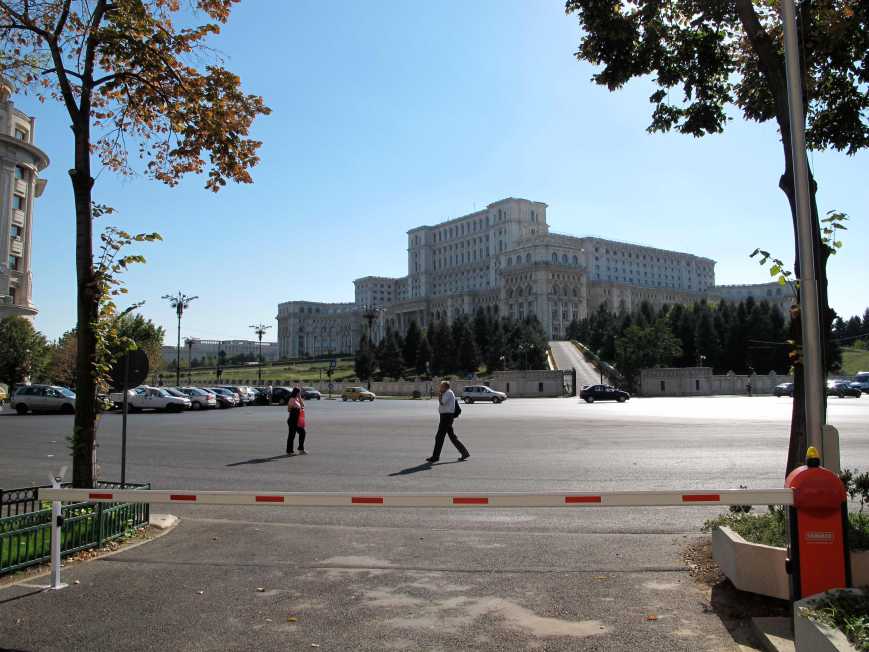
The rest of the afternoon was to be devoted to a visit to Ceausescu’s Folly, the Palace of Parliament, ‘the second largest building in the world in the world’ [after the Pentagon]. I can confirm that it is big, in fact supersized, High and Mighty, an XXXXXL. But there are shopping malls in Jakarta which would inhale it without noticing and blow it out one of their delivery docks. On checking the fine print, I note it is the ‘second biggest government building in the world’ and yes I can well believe it. For the record the two longest parallel corridors in its rectangle are 180m. long and more than a cricket pitch wide. The doors and windows are gargantuan, you could march an army up its staircases and nobody is precisely sure of the number of rooms but it is more than 1,100. It is said, and was by an extraneous member of our tour group who was a useful source for accounts of infamy, that there is as much below ground as above, that car races have been held in the basement, and that the many secret subterranean floors have been the site of unspeakable acts. 10 years, 500 architects, 15,000 workers (whose workmanship is exquisite; look at the way the grain in the marble is matched here) but still significantly unfinished — that sort of thing.

Did I mention that Ceausescu (tshow-sheskoo) was short?

I turn to wikipedia: ‘The building is constructed almost entirely of materials of Romanian origin. Estimates of the materials used include one million cubic meters of marble from Transylvania; 3,500 tonnes of crystal — 480 chandeliers, 1,409 ceiling lights and mirrors were manufactured; 700,000 tonnes of steel and bronze for monumental doors and windows, chandeliers and capitals; 900,000 m3 of wood; 200,000 m2of woollen carpets of various dimensions, the largest of which were woven on-site by machines moved into the building; velvet and brocade curtains adorned with embroideries and tassels in silver and gold.’ Ah my. Meanwhile the population was starving.

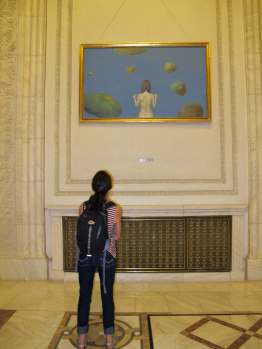
These beautiful raw materials didn’t stop Ceausescu covering the walls with his taste in art which appears to run to about B+ Year 12 work.

To build this monster a great swathe of old Bucharest was razed: 19 Orthodox churches, six synagogues, three Protestant churches (with eight others relocated) and 30,000 residences.

However, besides being white, it is an elephant. Most of it is never used. Parliament sits there and it does house parliamentary offices. It hosts occasional conferences and balls (yes, balls; anything to turn a buck), but most of that lovely work and that huge sacrifice just gathers dust. The grouting in the huge terraces is shot and already you can see how damp has swollen and fractured the exterior cladding.

What do you say? An excellent metaphor for Ceausescu’s 22-year reign? A crumbling shambles? The over-arching impression as we retrieved our passports from the guards was emptiness.

This is the view from the terrace. And that looks nothing like Bucharest. Tucked in behind the buildings on the left is fun, the active part of the old city where we had a simply great meal, a Turkish degustation at which I appear to have ordered the entire mezze menu in error and eight of us knocked it back. In this neck of the woods you could feel what Bucharest might have been not so long ago and may become again, ‘Little Paris’, one of Europe’s really zippy cities, the place which comes so alive in Olivia Manning’s Balkan Trilogy.

Which makes me think, after having let this lie — right there — for a month or so, how odd it is to have spent so much time on the Palace when there was so much else to be interested in about Bucharest. (Here I would like to pump up our walking tour guide, Mihai, who was simply fabulous. When you’re next in Bucharest hook up with him hereMihai. This is a poor photo of  a very handsome young man holding a photo that he has dug out to show us what Calea Victoriei looked like in its heyday.)

A word about guides. I have days when I think I’d like to be guide even though I’m not young enough, educated about the wrong things and almost certainly too impatient. Our guides were people who had excellent educations (all of them) but in areas where you’re relying on the sensibility and largesse of the government to employ you: an anthropologist (Mihai here), an archeologist (Onur in Turkey), a marine biologist (Dylan in Plovdiv). Nicolae (northern Romania) was an trained engineer but not placed to use his skills. However, Claudia MBA at Brasov will be a business woman. They also had strong and mostly well informed opinions about how things were and wanted to talk about them. I suppose fierce introversion is not the first prerequisite for a career in guiding, but I was taken by these very bright young (comparatively) things. And what do they do next? What do they parlay their training into?

It’s a reminder about how the surplus capacity in a phenomenally wealthy country like the USA of the ’60s (or Florence of the 1500s or London of the 1870s or …) can provide patronage for activities that otherwise wither on the vine, in a public sense anyway; and, I suppose, how such activities can be kept alive for a while at least through education which maintains a spirit of generosity about its non-instrumental purposes. I think almost every course I took at university would now be under threat of closure or already gone. But there’s an issue. Even if Romania doesn’t need anthropologists it certainly needs people like Mihai.

We’re not even at the Danube yet. We’ll never get to Istanbul. Three pics with some commentary and then we’ll move on.

FlightFirst, the building in Revolutionary Square from which Ceausescu fled by helicopter.

You can’t talk about contemporary Romania without reference to Ceausescu, head of state for 22 years from 1967 to 1989. Short, delusional, possibly even well intentioned at least originally, he aligned his country not with Russia and its brand of Communism but, when aligned anywhere, it was more likely to be with North Korea or China. (He recognised Pol Pot early and maintained the relationship.) He was a maverick — a patriot of sorts and a brutal despot and the author of one of history’s great and most vicious personality cults.

The infamous orphanages are the result of policies designed to increase the Romanian population: making abortion illegal, introducing significant incentives for women to have children (those with ten or more were declared ‘heroine mothers’), and making divorce very difficult, thus regrettably swelling the number of children abandoned and for whom no reasonable provision was made. (It makes me think of self-harming behaviour. ‘You’re so awful look what you’ve made me do.’ How else can you explain the void that existed where the love and affection that young children need should have existed?)

The mysterious state of the country’s alignment during the Cold War attracted the West which offered Ceausescu huge loans. He borrowed more than $13 billion to finance economic development programs. But as he discovered, they were loans not gifts and required repayment. This became an obsession. He squeezed the last drop of juice out of the country’s agricultural and industrial production and exported it. Food became scarce and utilities (water, gas, power) failed for days at a time. During the 1980s, there was a steady decrease in the population’s standard of living to the point where the bulk of the population in this fertile and well-endowed country was in severe distress. Every effort was made to disguise this reality from Ceausescu including a famous case where he was gulled by bank on bank of plastic fruit and vegetables. Unimaginable the whole experience. Yes it was him, but if you look at the next clip below you’ll see a doddery old man. What pegs were jamming him upright? The Departamentul Securității Statului (Secret Police) no doubt, the army till things turned sour for them, and that might be all you need when aided and abetted by the slough of despond.

He was near his end when he suddenly realised people in this plaza listening to him speak were actually jeering him. The dramatic change of expression on his face  (at 1.32) is an historical moment: he hadn’t done what he thought he had and, in fact, he wasn’t who he thought he was. A small pile of fireworks went off in the Timisoara (close to the Hungarian border) and a revolutionary mood took hold supported by members of the army who thought, possibly mistakenly, they had been betrayed by Ceausescu. In this truly extraordinary age, you may if you wish see the seminal aspects of his trial and death, including an interview with the man who guarded and then shot him right here.

The seated person, broken and reassembled, in the statuary is a version of Iuliu Maniu, anti-communist Prime Minister from 1928 to 1933. The dead tree has its own significance. This is a country which has been terribly punished. And by its own. What degree of complicity would we feel if we were Romanian I wonder?

ArmaniSecond, I took this as one representation of post-communist eastern Europe, an Armani store at the bottom of a standard tower block of flats (along with Neil’s very fine Antipodean hat at bottom right). There are thousands of tower blocks in eastern Europe that are just like this one; never much good, dead ugly on the day it was finished, if indeed it ever was. Time has not been kind to it.

But there is a shoot of something, however incongruous, growing there. I didn’t have a look in the shop — I have all the Armanis I need (a full range inc. apresblog sportswear) but it’s staying open because some people at least can afford to shop there. The discrepancies in wealth here are not as visible as they might have been in the 18th and 19th centuries, but they are substantial. But there’s motion. The renewal of the Old Town is one of Bucharest’s brightest aspects even if you do have to watch for falling masonry.

RomulusLast, the levitating dog. Visual artists are wary of ‘rabbit’s ears’, that is something unintended that turns up in a painting (or a sculpture) which the artist can’t see but everyone else can. It catches your eye and definitively undercuts any efforts to take the work seriously. This sculpture recently installed outside Bucharest’s National History Museum of Trajan with highly prominent genitalia (partly hidden here for your viewing comfort) and the nurturing Roman wolf with Thracian scarf is a collection of rabbit’s ears. ‘A wolf with a pitbull’s head, a lizard’s tail and a tumor on its neck, carried by a guy who is visibly embarrassed by his nudity’ (actually looking rather smug from this angle) is how it was described in one local newspaper by a passerby.

And yet somehow so Romanian. Ilie Nastase was Romanian; so was Ionescu. In descriptions of Romanians that I have read fecklessness is a dominant theme. Quick to anger, quick to forget (anything), quick to fall in love, quick to fall in love again. We will dig up the road to put the gas pipe in; we won’t (quite) fill up the trench. I asked Mihai to tell me what he thought the essence of Romanian culture was, and he said, the language. ‘That is what makes us distinct as a people. That is what we must preserve.’ Anything else? ‘No that is all.’

So finally …

Bulgarian border

For those who were away the day Romania was done

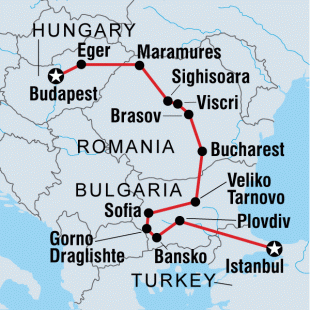
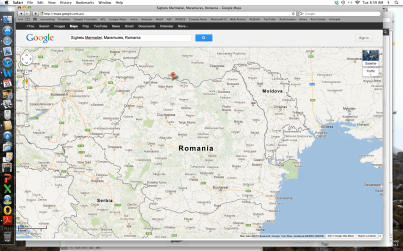
I got an email the other day, a while ago now, asking me to explain where Romania was because my correspondent couldn’t work out the screen shot in a previous post. I thought this might present an opportunity to stick in some bits and pieces that don’t obviously go anywhere else and to answer some questions. Geography. Okay. There. That’s Romania. Bordered to the north by the Ukraine and Moldova (now there’s another new (but actually very old) one for you), to the west by Hungary and to the south by Serbia and Bulgaria. After providing the southern border, the Danube turns sharply north at Silistra and drains through a vast marshy delta into the Black Sea. There is a sprawl of seaside resorts down this coast which continue all the way to Turkey and beyond. The Carpathians curl across its north and down through its centre leaving the Pannonian Plain to the west, and to the east the coastal plain which is part of the steppelands which finish somewhere near Siberia. It is almost exactly the same size as Victoria but a lot harder to get around. This is where we went. Maramures is a region not a city.
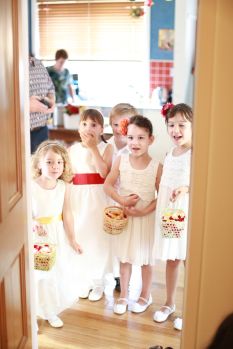
The people. I took this photo not just because the ice cream was good, which it was, but because this charming Romanian at Sighisoara seemed to suggest a much more widespread physical type: smooth olive skin, neatly defined features, warm brown eyes, slender, sometimes tall but generally not. I don’t know whether you are allowed to talk about physical types; probably not. But at Brasov (‘brush-off’) I had this sense of being surrounded in the Square on a party night by hundreds of very good looking people with similar features.

At left Mircea Eliade, the great Romanian philosopher and writer. Ionescu fits. Even Ceaușescu, at right, at a pinch.

History. Romania doesn’t get its name from the many Romany (‘gypsies’) who live there. That’s a story for another day. It gets its name from its inhabitants’ desire to be clear that they are ‘citizens of Rome’, and in fact one of the very last remnants of that classical empire. But both Herodotus and Thucydides are clear that the people who originally lived between the Danube and the Tisa were Dacians (not to be confused with Thracians who lived where contemporary Bulgaria is).

In the second millennium of the Christian era, this was part of the Ottoman empire, the dominant ‘international’ political influence of at least half that period. It wasn’t a heartland of the empire in the way that the western Balkans and Greece were, and in fact when Mehmet II was at his peak so was Vlad Tepes, (‘tsepesh’ if you care, also ‘The Impaler’) providing constant interference and harassment from the northern provinces of Wallachia, much of today’s Romania, and Moldova. (Vlad had a son called Mihnea ‘the Bad’. If you were his dad wouldn’t that set you back? It would me. But in the circumstances, it may have been his father who coined the tag.)

I have found the vestiges of the Ottoman empire irresistible, and its story bears greatly on this whole area. So, indulge me a few glimpses.

I must have been away the day the Ottomans were done, an empire that lasted 600 years, possibly about 10 times longer than the international dominance of the US of A. (The Persian Empire wasn’t covered in great detail either as I remember. As for Ashoka … well! The new National Curriculum will resolve these problems I am sure.)

The Ottomans emerged from nowhere if that’s what we can call the Anatolian foothills. No city, great or small; just raggle taggle bands of nomads who got a taste for real estate which eventually extended from the Persian Gulf to the walls of Vienna and from North Africa to the Crimean peninsula and beyond. This was the Abode of Peace, Dar ul-Islam, and areas outside it Dar ul-Harb, the Abode of War.

Although this expansion had been going on for a century or more, the first recorded battle is a giant landmark in Balkan history which remains a bitter and provocative memory today. On 15 June 1389 they destroyed the Serb forces at Kosovo on the Blackbird Field and swept north. Their ‘capital’ was Bursa south of where Istanbul is today near the shore of the Marmara Sea, and their playground for hunting and leisure was Edirne now on the border of Turkey and Bulgaria where our bus was stripped and our luggage searched at 1.30 in the morning before we were sent on our way. At its height its armies were assembled each year on 23rd April, St George’s Day (how odd that the patron saint of both England and the Ottomans was St George, and that both versions are depicted, as we saw in Cappadocia, slaying a dragon), and the season of conquest — north, south, east or west, whatever had been chosen — would begin. After six months or so, for 200 years, these armies which often included the sultan would return fat with the spoils which would make them temporarily rich and new tax regimes which made them rich for a great deal longer.

The Ottomans won (for several hundred years, invariably) because they had cannons and because they were organized. Theirs were the first armies in the world to have uniforms, to be paid timar, a regular stipend, and to have a band playing to egg on the warriors. (We heard what such a band would sound like in the 1453 Museum in Istanbul and it would have been suitably terrifying.) The shock troops were janissaries, a quite particular form of levy. Every three years towns, especially in the Balkans and Greece but more widely spread as well, would be visited by a representative of the empire to select the finest Christian youths — the fittest, the strongest, the best looking, the power forward match-winners (in a localised football note, think Carey, Brereton, Brown, Ablett snr.) — to serve the Sultan in a complicated form of slavery. They were taught Turkish, fed, housed, educated and trained and never allowed to marry. This semi-desirable situation was not available to Turkish Ottomans because Muslims could never be slaves.

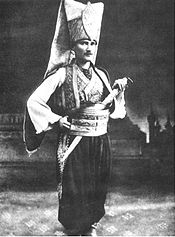
Here we see Kemal Ataturk, hero of modern Turkey and its President for 15 years, in a janissary uniform.I can’t help you with why. The remarkable head gear is said to be shaped like a sleeve of the gown worn by the founder of the Dervish order.  Its name, ketche, can be literally translated as ‘felt’. It was worn by all janissaries without exception.

The janissaries became soldiers, and those who displayed particular aptitude for study became kapikullari, the bureaucrats who provided the empire with its strength. The CEO of the empire was the Grand Vizier who walked the finest of lines between being all powerful and subject to strangulation by the Sultan’s bowstring (among the jobs of the Head Gardener). Of the 36 Grand Viziers who followed the Sultanate of Mehmet II, 34 were not Muslim born and several were Jews. The Grand Vizier who caused the building of the bridge over the Drina, Sokolovic, was doing his Serbian home town a favour. (For a visual sample of the area and an aural sample of the book click here.)

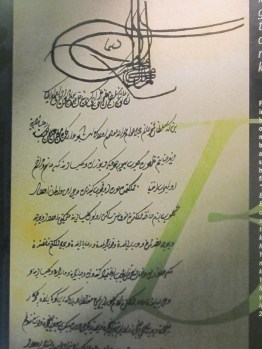
The Ottomans were comparatively benign rulers. At left is a copy of the edict of Mehmet II guaranteeing religious freedom to Bosnia in 1458 for example, which enabled Bosnia to survive as such an unusual amalgam of Muslim Turk (or Bosniak), Catholic Croat and Orthodox Serb, for as long as it did. (Digressing, Ottoman script is truly remarkable as this close up of a ‘deed’ describing the towns and villages to be administered by one pasha illustrates. One story says that it derives from the illiterate Osman’s signature, inking his fingers and swirling them across the page.)

The Ottomans didn’t interfere much with local culture or language. As a rule, new, or old, subjects were not required to become Muslim. A rough but comparatively consistent form of justice was instituted. They weren’t traders; that was left to the Armenians who built their own niche in the empire’s workings. They were rentiers, and the rent was, for the times, fair. The real violence was kept for the palace and its inhabitants.

Sultans were lineal descendants of the House of Osman and, for the first few centuries at least, when a Sultan was near death or died, fratricide was the standard and accepted practice. The son who got in first and organized the killing of his siblings (often half siblings considering that at its peak the Sultan’s seraglio had around 4000 women) would ascend to the throne. As with many of the royal houses of Europe this did not produce an especially healthy lineage.

The taking of Constantinople (from the remnant members of the Byzantine Empire) was a high point in Ottoman history, not least because it united ‘the two halves of the world’. It’s a story too long to be told here, but it includes the portage of dozens of large vessels over Pera (where we stayed in Istanbul) to be refloated behind the giant chain which cut off access by water to the Golden Horn. Ten metre long brass cannon which could fire shot weighing ¾ of tonne moved by carts pulled by 30 bullocks and attended by 700 men damaged the walls. Mehmet had an army of what may have been 300,000 men, but even so was constantly being counseled that this was inadequate to defeat the fortifications defending the 4,983 (names recorded) inhabitants capable of bearing arms. The deep defensive ditches (correctly, fosses) between the double walls were filled with the bodies of the dead so that other forces could cross them. But in the end it appears that the Ottomans won simply because someone from inside left a postern gate, the tiny hidden entrances used to nip in and out while a siege was in progress, open. The failed siege of Vienna 150 years later where the Ottomans were defeated by what we now call an extreme weather event is an equally dramatic tale.

Albanians were still paying tribute to Turkey in the 20th century, still sending delegates to a parliament which had become a shell game with no pea.

This is the empire described by Tsar Nicholas II as ‘the sick man of Europe’, a phrase which has delighted sub editors ever since. The bigger it got, the more flaccid it became. It never seemed to learn that there were other sources of wealth besides plunder; and when the plunder dried up, the cost of the war machine broke the country. Among other infamies, the janissaries began charging ‘tooth rent’, a cost to food suppliers generated by the act of eating, and famously revolted  before being disbanded.

One of the Sayings of the Prophet that had strong currency in the Empire was: ‘Every novelty is an innovation. Every innovation is an error. Every error leads to hellfire.’ Time was thought to be circular rather than linear. Evliya Celebi (at left), a janissary who among many many other things wrote, describes himself looting the same house he looted one year previously and looking for and finding the hatchet he had left there, a small proof of the ubiquity of eternity. Great empires become encrusted with a thousand types of cosmopolitanism, all too digestible when the direction is strong and the leadership inviolate. But when the order changes what is left is a potpourri of romance and memories.

After that modest digression, back to Romania — Food. Superb. Delicious. Wonderful. Here’s a portion of what the Intrepid trip notes had to say about food: ‘Vegetarians might find the menu selection less varied than they would see at home. Vegetarianism is not as common in this region and generally the choices are basic, involving vegetables and fried cheese. Vegans will find it even more challenging. Vegetarians might choose to supplement meals with supplies bought from home, e.g. protein bars, dried fruits and so on.’ Not so.

A full tilt Romanian evening meal is likely to consist of soup (phonetically ‘chorb’ or ‘chorb-uh’ everywhere in the eastern Balkans and Turkey) often vegetal, salad (anything up to 10 or 12 on a restaurant menu, variations on a theme, with shepherd’s salad the heartiest with corn, cheese and nuts), stew (the Hungarians do not have a mortgage on goulash), cake and fruit. Polenta in various forms appeared as an option at most meals. Cheese was a staple. At one hotel where we had breakfast I counted 14 different types. Snacks come out of the street windows: a score of different types of pretzels, and layers of filo, rolled or flat, filled with cheese or fruit. Shops selling gyros (the meat we get in souvlaki) were everywhere. Breakfast was bread (often home made), hard and soft cheese, excellent yoghurt, tomatoes and peppers — and when I say tomatoes and peppers, I mean tomatoes and peppers straight out of the garden such as you have never tasted. Four of our five local guides commented on the exodus of young people from country regions. Each of them, remarkably, used the image of there being no one left to tend the tomatoes to describe the calamity that was in the offing.

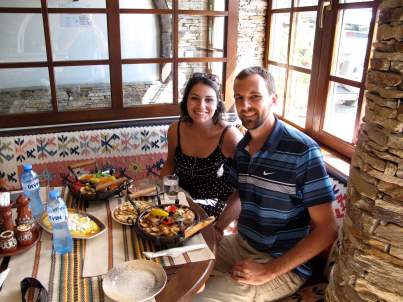
It is true that we were there at the height, or just after, of the harvest; but what we ate was food rather than salt, sugar and fat. Here are the highly photogenic Mat and Luz eating in a hotel in Velika Tarnovo (Bulgaria actually), the sort of meal we could have had although from memory I think I had a cheese omelette and Myrna a salad at the same table. What you are looking at is a ‘sache’ (that mysterious English word) of roast vegetables, another of pieces of pork, some bread which has been on the griddle and some polenta.

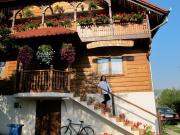
Accommodation. Great. Clever. Very well located 3-star hotel accommodation, very clean, very comfortable, everywhere with wifi internet connection. Three ‘homestays’, which could be better described as very good quality bed and breakfast places; not, definitely not, sleeping on straw palliasses being nudged by donkeys. At right Myrna is on the stairs of the one we stayed in at Sighitu, and yes that is a Jag in the driveway. To the considerable amusement of all those not concerned, Chris and Joop did have drawer beds in Viscri. Our room had an ensuite and a gorgeous ceramic stove just in case the weather turned cold which, of course, it never did. Why did I become interested in eastern Europe? I’ve been wondering that myself. It could have been getting excited about Balkan music after watching Emir Kusturica’s film ‘Underground’. It was so gay, so crazy, such a exhilarating mixture of east and west. And that’s an interest I’ve pursued. But it might have been reading Neal Ascherson’s book The Black Sea, a masterpiece, which introduced me to the Samartians, the Scythians and the Pechenegs and the prospect of ecological catastrophe if the Black Sea turns itself upside down (which is all too possible). I also think it introduced me to the idea of the Saxon villages in Transylvania which ever since I have wanted to see. And then during the troubles in the mid-90s I was reading Robert Kaplan’s Balkan Ghosts and Ian Malcolm’s Bosnia: A Short History and Rebecca West’s Black Lamb Grey Falcon. All these are from a genre of writing which attracts me greatly: going somewhere and thinking out loud about what it means (another master, the Pole Ryszard Kapuściński).

More recently I’ve read Patrick Leigh Fermor’s Between the Woods and the Water. An 18 year-old Englishman determines to walk from Amsterdam to Istanbul and has adventures on the way. A Time of Gifts, devoted to the first section of the walk is not as good, but once he crosses the Danube at Esztergom, in Hungary but on the Slovak border (in 1934), the story just gets so interesting and the language begins to sing. As well as being a war hero, a boxer, a horseman, the lover of a Romanian princess and an historian, Leigh Fermor is a stylish magician with the English language.

There is a story attached. Not only did he write this book in his 70s, five decades after the experiences he describes, but he left all his notes at a Romanian country house he was staying at in the 1950s. They were miraculously recovered 25 years later.

This book sits with Robert Byron’s The Road to Oxiana, Eric Newby’s A Short Walk in the Hindu Kush and maybe Bruce Chatwin’s In Patagonia (a bit disappointing on a recent read) on a list of the great contemporary travel books ever written. There is vivid curiosity, exuberance and joy, all great human qualities, in each of these books, all that I have mentioned in fact.

Was our trip anything like these adventures? Of course not. We were cosseted middle-aged tourists, and anyway the world has changed so very much. But still, there were times when the fragrance of these experiences of travel could still, just, be sniffed in the air. Now where were we? Ah yes. Three favourites.

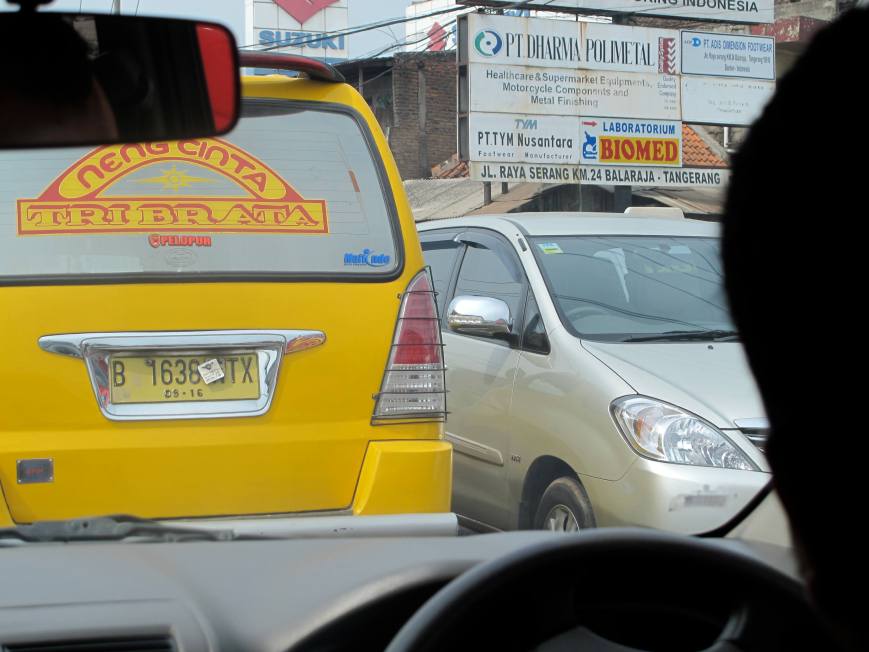
Sorry sorry pak. Stuck in traffic.

NOTED

There was plenty of opportunity to observe Colonel Harlan Sanders in both face and figur(ine) in Indonesia. He looks like he’s dropped a lot of weight. Maybe 10 or 15 kilos! He could have diabetes and be looking after himself, or could have just sworn off the product. Or it could be a purely local phenomenon in a land not noted for its fatties. Worthy of further investigation.

ERRATUM

I’ve been calling Joop, Jope. Profuse apologies.

ADDENDA

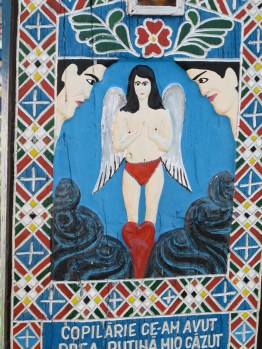
1) A significant omission in my description of the Merry Cemetery is that the texts on the headmarkers are in the first person: ‘I loved my car so much …’, ‘I couldn’t choose between two men …’, ‘We were hunting in the forest when …’, and , of course, ‘Here I lie …’. You will agree that this makes all the difference.

2) Re ‘Language’. On the way home in the plane I read in ‘The Guardian’ that the issue of whether or not to teach grammar to second language learners has finally been resolved (by the customary new meta analysis of research). You need to. And also chocolate cures cancer. This is one of these issues like genes or heredity, free market versus regulation, god or the void that just bleeds dispute which is both trite and tedious. I found the following small contribution in Diego Marani’s New Finnish Grammar. ‘The rule always succeeds the word; this is the great weakness of all grammar. The rule is not order, it is just a description of some form of disorder. … A language’s prescriptive baggage comes into being less to facilitate its comprehension, that to prevent foreigners’ access to it.’

ROMANIA#1: To the north

Hmmmm. Where were we now? Ah yes sitting on the terrace of the pub in Satu Mare (sartoo maray) opposite the station drinking beer. The twilight was lengthening attractively and the beer was cold and very nice. That’s right. It all comes back. Our minibus is waiting for us to get on board and I’m rooting around in my pack looking for something nice to eat, as relaxed and comfortable as John Howard advised us to be.

What? Chris and Marta? What about them? Marta told Jope that we should get off at Satu Mare and we did.

The train had travelled north along the border of western Romania and the country hadn’t changed much. I’d spent most of the time with my head out the window because it hadn’t got any cooler. Yes okay like a dog in the back of a ute if that helps you. This was interesting but poor country: some dilapidated houses still in use, tumbledown farm buildings, horses and pony carts instead of tractors, long arid patches, the occasional smell of piggeries and sewage, an even more occasional village but little you’d want to go to war over.

Chris and Marta? Again? What … I told you. We left them being looked after … in custody? Well yes, in custody if that makes you happy. Custody. With the people in the blue uniforms.

The pub was a bit of a dive actually, a few blokes in the bar mumbling into their beer. Mine testy hostess wasn’t interested in euros, had no interest at all in forints and once we got some lei out of the ATM hidden in the inverted commas first class waiting room at the station, indicated fairly clearly that their denominations were too big. In this rather bleak corner of Satu Mare, money spoke only a particular dialect of Romanian.

Okay. They escaped. Chris the resourceful Kiwi had secreted some number 8 wire about her person and had fashioned first a pick lock and then a flying machine which allowed her to … aaaaah, no imagination. All right then. The people in blue stamped her passport and then dumped them both on the outskirts of town which would have been a matter of metres away. Marta, to whom this had happened before, knew the drill and they hitch-hiked to Satu Mare requiring only two rides. (Maybe three. I think the second ended up in Satu but a long way from the station.) They got there an hour after we did. I can only shake my head in wonderment.

We had started this day in Eger; we had been to Debrecen; we were drinking beer at Satu Mare and we still had a two or three hour drive in the mini bus over execrable roads. Big day.

‘Mare’ means ‘high’, perhaps ‘upper’ in this context seeing we’d been through Satu Sud (yes, you got it). Baia Mare (‘high baths’) and Tarna Mare are nearby. I’d like to have done this drive in daylight because we were certainly in the Carpathians. On arrival at about 11pm we had a delicious dinner with a glass or two of palinka which I had begun to enjoy, the bed was comfortable, the weather cool and we woke to the sound of people digging spuds in a Romanian version of paradise. We’re looking at the food we ate here.

Nicolae was there at breakfast looking chipper. An engineer by training and experience, working for a time in a senior and well paid position for Ikea, he now worked as a nurse in his wife’s medical clinic (with 2000 patients) so they could live together — a very interesting man and our guide for the day. He took us everywhere.

Where are we again? Here, the red dot: separated from the Ukraine by the river Tisa and not  much else.

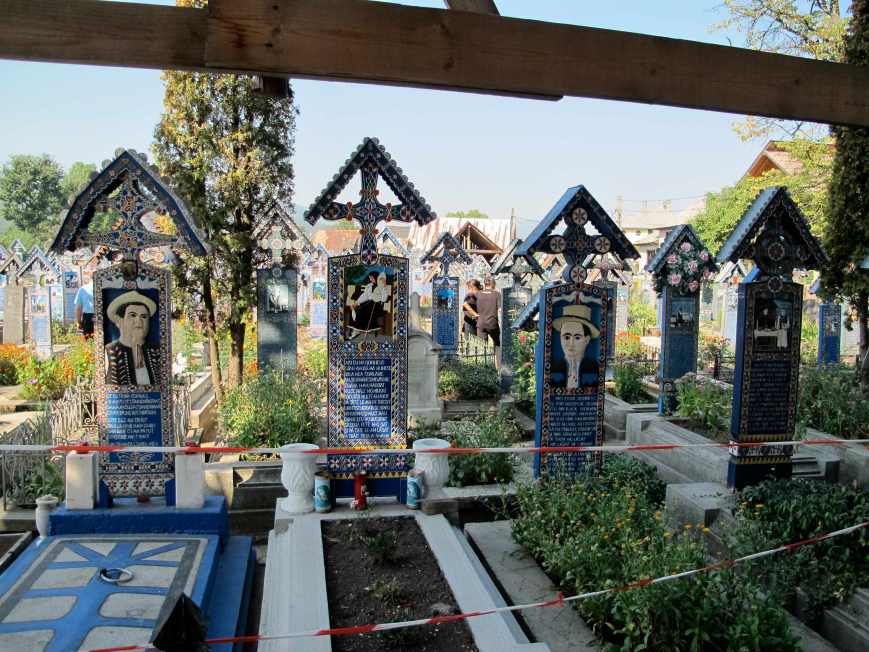
We bought lunch at the swish supermarket in Sighetu Marmatiei (‘siget’ to its intimates). I have an undistinguished but otherwise interesting photo of the main street which shows that in Sighetu there is a bistro called the Eldorado, a branch of Western Union and a shop that has ‘Orice produs 3 lei’, ‘All products 82.7 Australian cents’ which provides a rough idea of the exchange rate. We drove on to Săpânţa where I, at least, got a surprise — the very Merry Cemetery.

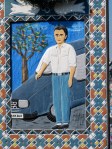
Stan Ioan Pătraş began carving these headpieces in 1935 and now there are more than 800 of them. As well as their good humour one of their distinctive features is their honesty. An 18 year old boy loved his car too much and was killed driving it. Despite her angelic nature, one woman had two gentlemen friends. And one rather grisly one talks about how the ‘bastard Hungarians’ shot the subject in the back and decapitated his friend while they were out hunting. (In nearby Harghita province more than 80 percent of the population describe themselves as Hungarian.)

Taken together they provide a strikingly honest as well as deeply affectionate portrait of a community. The farewell on Stan’s own oak marker is plangent.

Since I was a little boy/ I was known as Stan Ioan Pătraş/ Listen to me, fellows
/ There are no lies in what I am going to say/ All along my life
 I meant no harm to anyone/ But did good as much as I could
/ To anyone who asked/ Oh, my poor World
/ Because it was hard living in it.

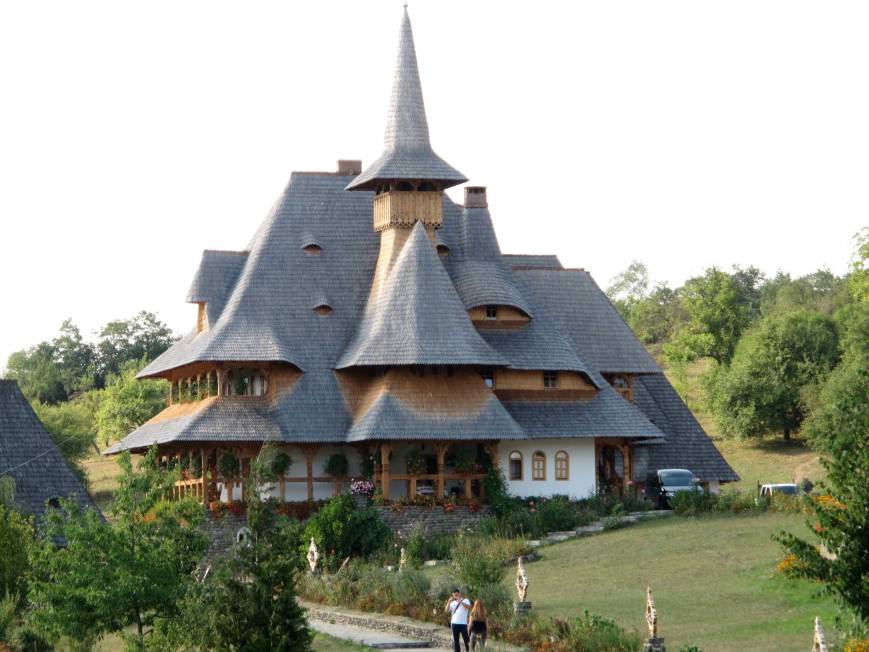
This area is famous for its old wooden churches, in one case so grand I couldn’t get back far enough on site to get the tower (sans bell, too heavy for timber construction) into the frame. But here’s Luz recording its altar decoration.

The general cladding principle went like this. (Double click for a proper look. Beautiful craftsmanship producing fluid forms. They don’t seem to mind cracks in the timber.) One result, the convent at Barsana, is a Romanian treasure.

There’s a lot here, but I must tell you briefly about Sighisoara (siggishawra) well south of the red dot in the screen shot above and pretty close to the centre of Romania. It is famous among other things as the birthplace of the gentleman looking over Marta’s shoulder, Vlad Tepes, a member of the House of Drăculești, also known by his patronymic, Dracula. ‘Tepes’ means ‘the impaler’. If you have an interest in this particular process I direct you to Ivo Andrić’s remarkable book The Bridge on the Drina where you can get as much detail as you’d like and possibly a little more. Later I want to write something about gypsies and I note in passing that Andrić chose a gypsy to do the impaling because that way the wicked Ottoman pasha responsible for building the bridge could be sure of the lingering quality of his victim’s death. Said victim, innocent of course but a minor character, was still breathing after 24 hours. But the really dirty work had to done by a gypsy.

Sighisoara is a fortified village built on one of the rocky outcrops so beloved of the builders of medieval fortifications. It is colourful and picturesque. Here, for example, is its clocktower.

And the view from our window to the real town below.

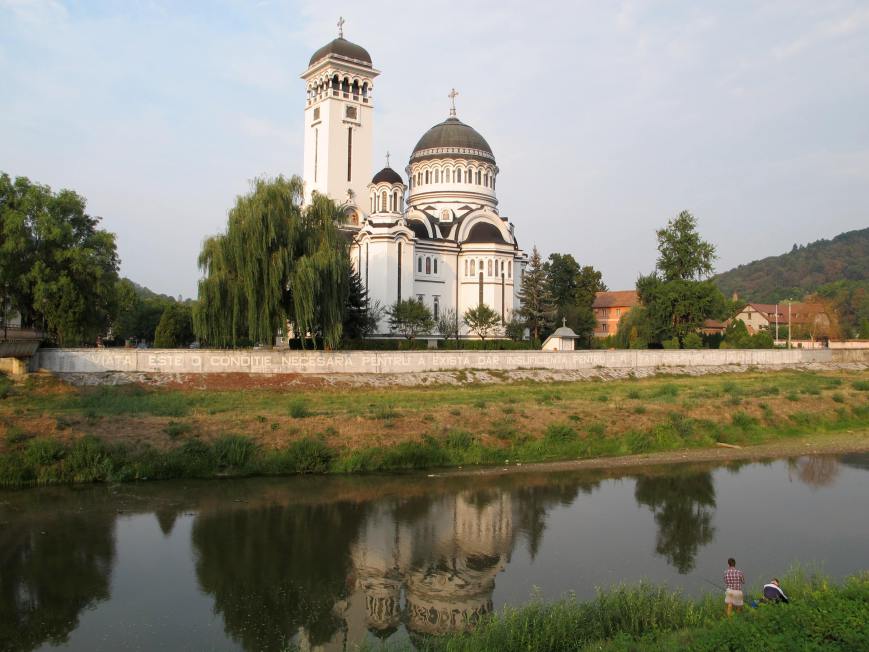
We liked the real town. Real towns always have something to offer. We found the Orthodox basilica and, more or less on our own, attended an Orthodox version of evensong.  The ‘graffiti’ on the concrete levee says, in Romanian of course: ‘Life is a necessary condition to exist, but insufficient to be. Do your duty and you will know (perhaps ‘discover’) who you are.’

Myrna turned 60 that day and we had a fine celebration under one of the roofs in the picture above, a chocolate cake produced by Marta drenched in liqueur, and happy birthday sung in five languages: English, Polish, Dutch, Indonesian and Mexican Spanish. Then Myrna, who had spent a lot of time on this trip trying to remember all the words to Robert Frost’s ‘Stopping by Woods on a Snowy Evening’ and ‘Ragamuffin Man’ (lyrics and music by Peter Callander and Mitch Murray and performed so admirably by Manfred Mann. Don’t ask. Ha ho. If you must know we heard it in the foyer of our hotel in Budapest, and it’s a Myrna kind of song: ‘As you rise in the mornin’ rain/  Take a look down that road again/  Does the thought ever grab your mind/ For the life that you’ve left behind?/ Hey Mister etc.’), yes back to where we were, Myrna, sitting within a metre or two of a giant plasma TV near silently screening the semi-porn video Kiss channel and full of very good Romanian salad and wine, stunned us all by reciting ‘The Seven Ages of Man’. For those who have recently missed its peerless sentiments, they can be found on a post below (or above or somewhere on this mysterious site). Life can sometimes be a kind of party.

THE SEVEN AGES OF MAN

As Jaques explains to Duke Senior in Act 2 Scene 7 of As You Like It (now out of copyright):

All the world’s a stage,

And all the men and women merely players;

They have their exits and their entrances,

And one man in his time plays many parts,

His acts being seven stages. At first, the infant,

Mewling and puking in the nurse’s arms.

Then the whining schoolboy, with his satchel

And shining morning face, creeping like a snail

Unwillingly to school. And then the lover,

Sighing like a furnace, with a woeful ballad

Made to his mistress’ eyebrow. Then a soldier,

Full of strange oaths and bearded like the pard,

Jealous in honour, sudden and quick in quarrel,

Seeking the bubble reputation

Even in the cannon’s mouth. And then the justice,

In fair round belly with good capon lined,

With eyes severe and beard of formal cut,

Full of wise saws and modern instances;

And so he plays his part. The sixth age shifts

Into the lean and slippered pantaloon,

With spectacles on nose and pouch on side;

His youthful hose, well saved, a world too wide

For his shrunk shank, and his big manly voice,

Turning again toward childish treble, pipes

And whistles in his sound. Last scene of all,

That ends this strange eventful history,

Is second childishness and mere oblivion,

Sans teeth, sans eyes, sans taste, sans everything.

(Note the somewhat prejudiced attitude of the schoolboy to schooling, even in 1599.)

I still have my teeth.