Japan 2016

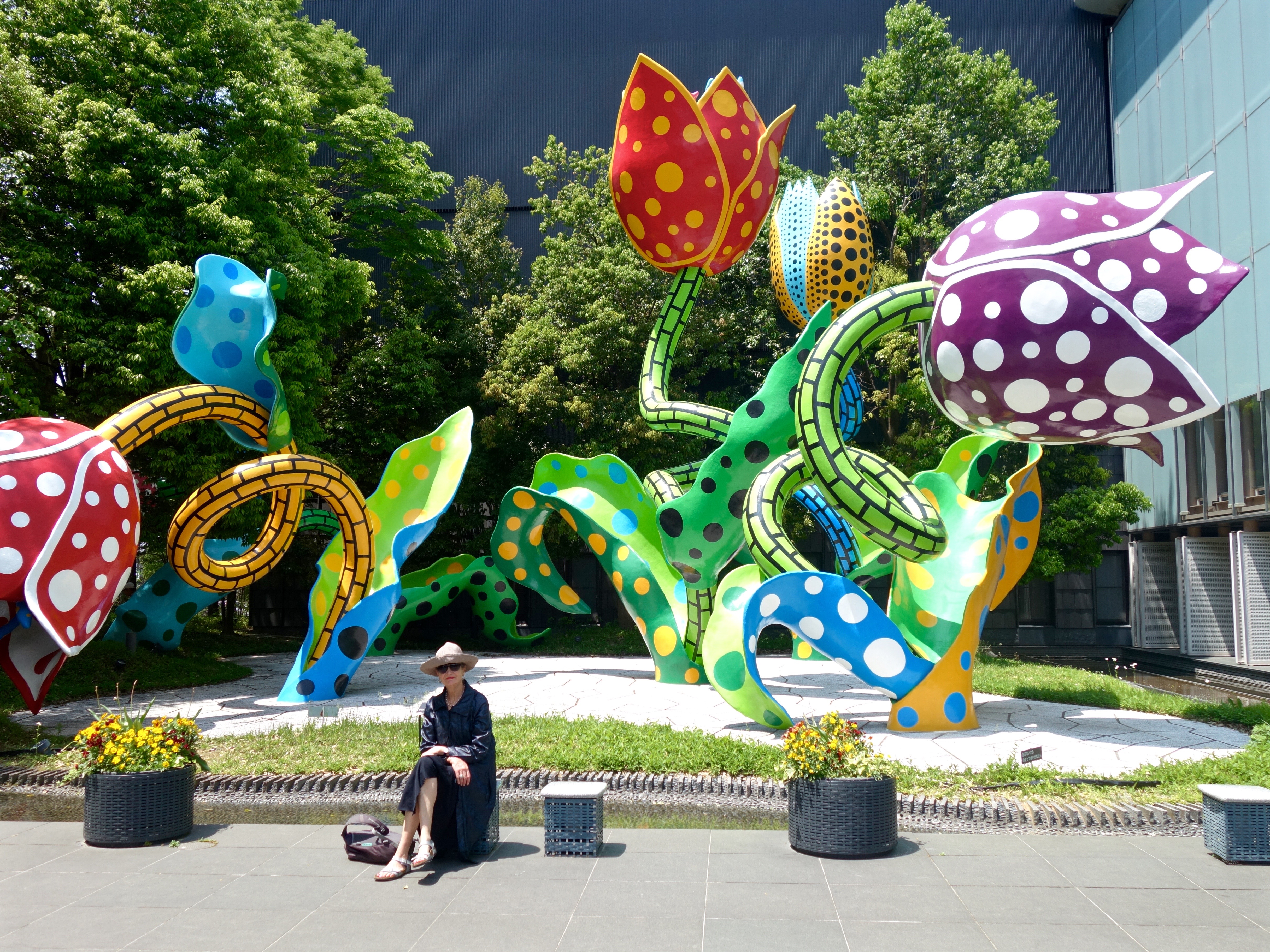
DSC00817.jpgYayoi Kasuma’s ‘Visionary Flowers’ in the forecourt of Matsumoto’s art gallery.

DSC01069

Four weeks. Great weather. Wonderful. Anything else? Let’s see …

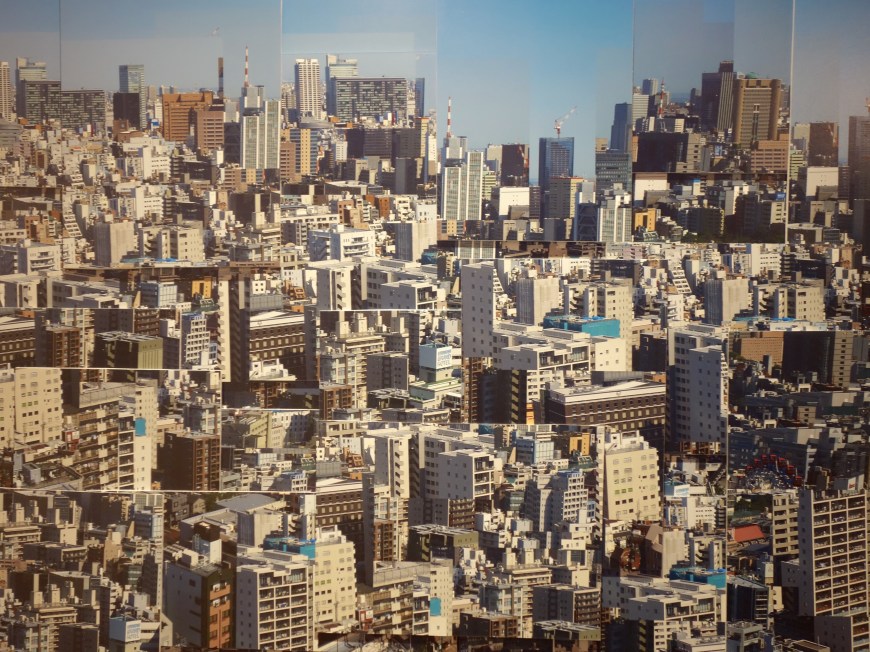
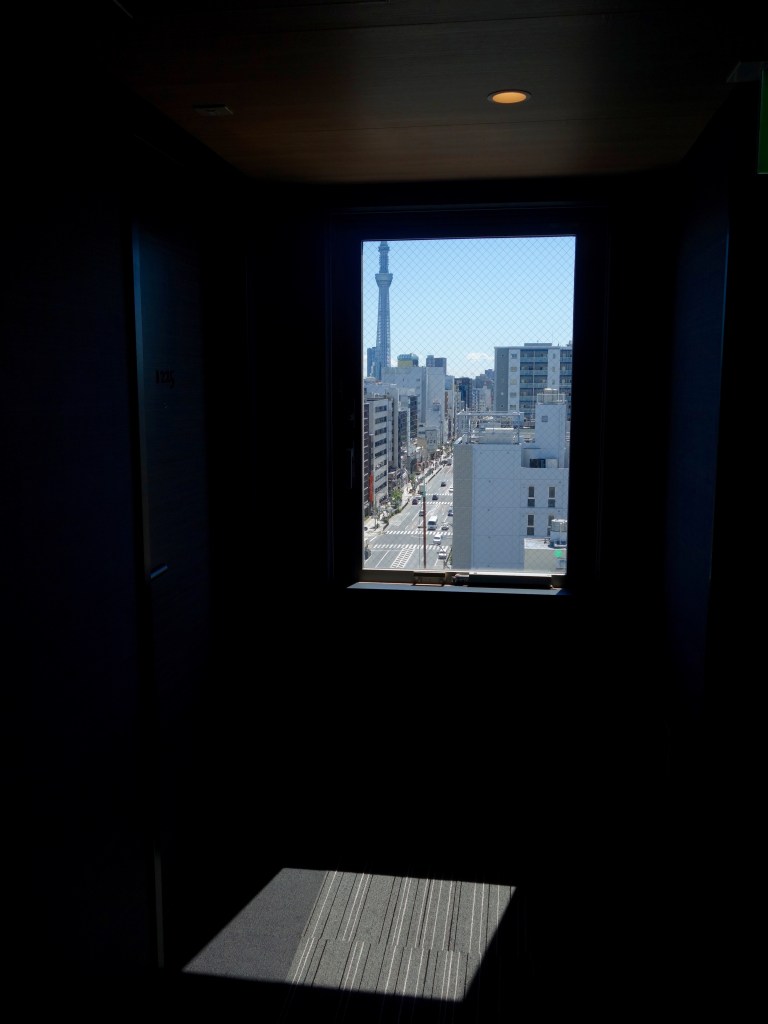
Screen Shot 2016-06-16 at 3.08.07 pmWe got off in Tokyo, bought Pasmo cards to get around, got on a Yamanote Line train and suddenly everything fell into place. Like we’d been here before. A couple of days were spent investigating Issey Miyake’s clothes, art ancient and modern including a Caravaggio exhibition, one of those cobbled together ones where the audience was as interesting as the art. We worked our way through Yanaka and Fabric Town in Nippori, the commercial and art palaces of Roppongi Hills, the shopping malls and oddities of Odaiba, the izakaya (pubs with food) of Ueno — and marvelled again at Tokyo.

DSC00804We went east to Matsumoto (its fort is above) and spent a couple of very satisfying days there, the highlight of which was an exhibition of Yayoi Kasuma’s art at the city’s Museum of Art.

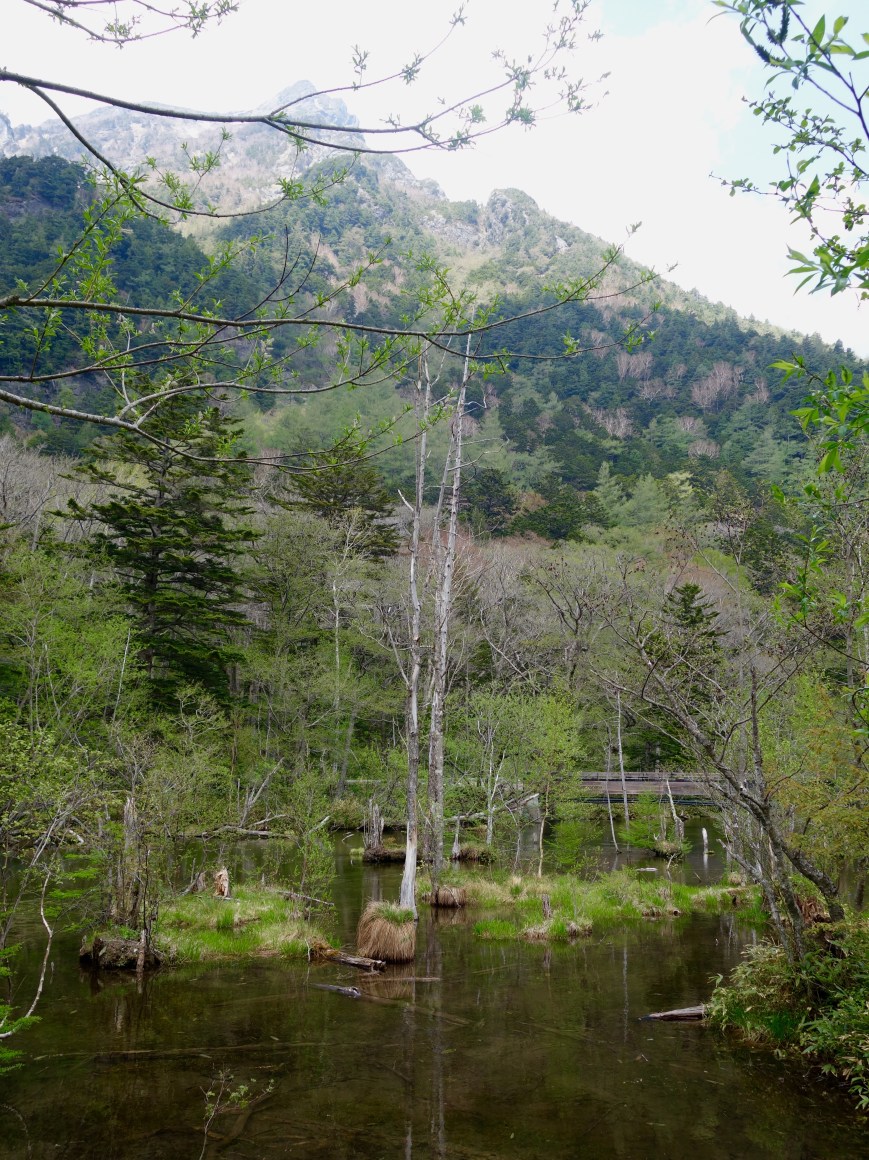
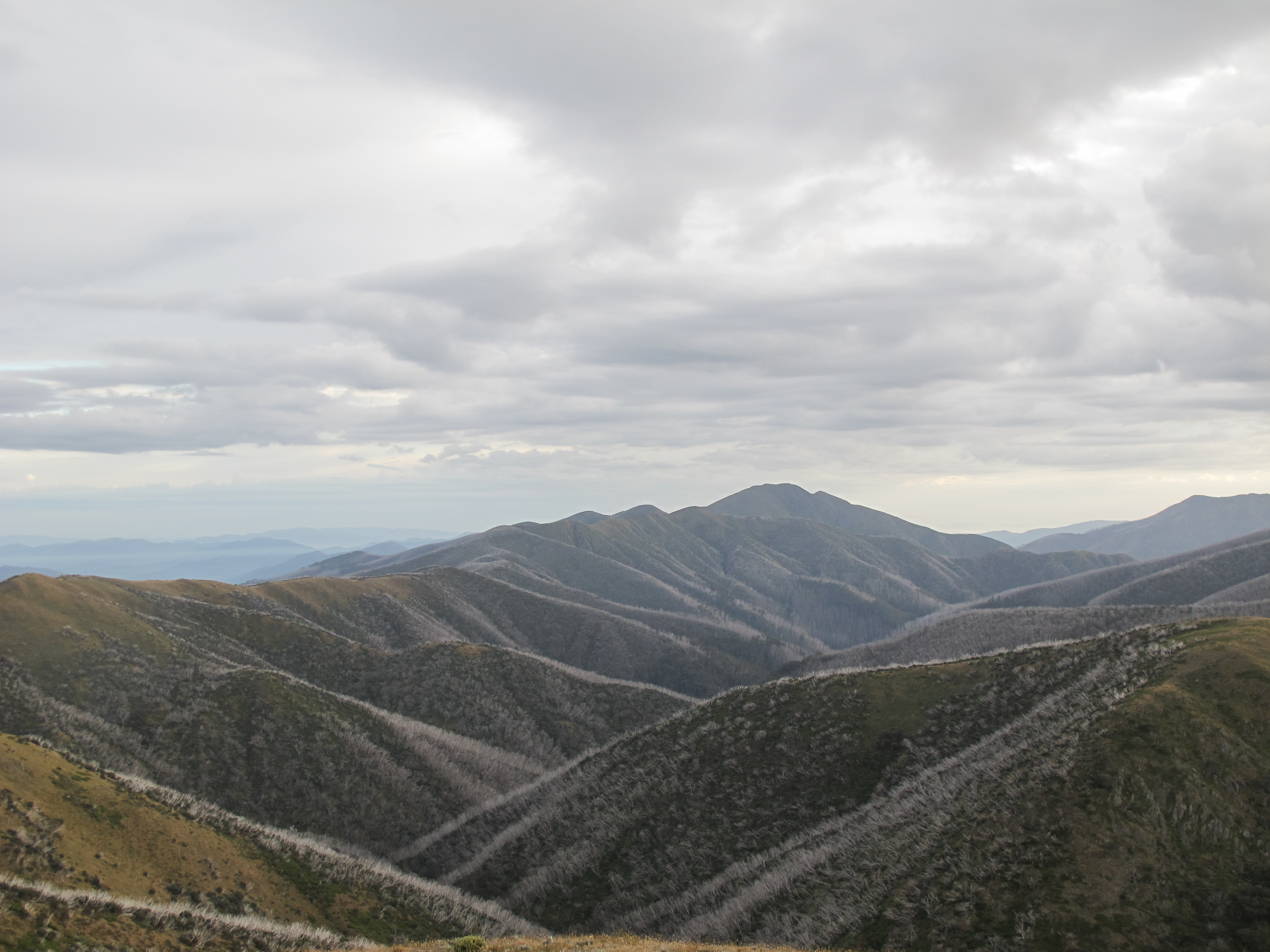
I wanted to go back to the Japanese alps for another look, just a look. So we got a train and bus to Kamikochi, one of Japan’s ‘Natural Cultural Assets’ and spent a day walking up the Azusa valley with snow-topped mountains either side.

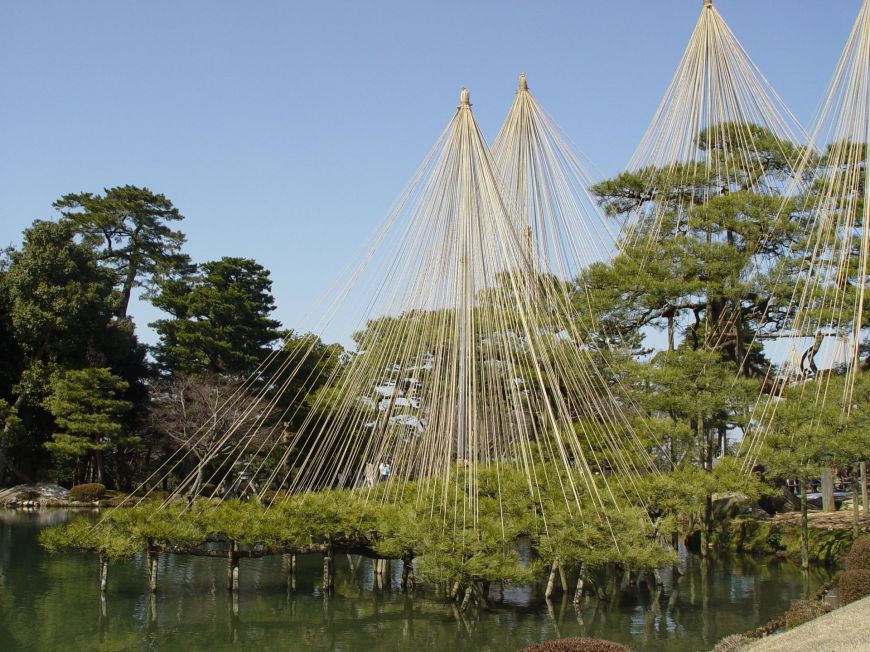
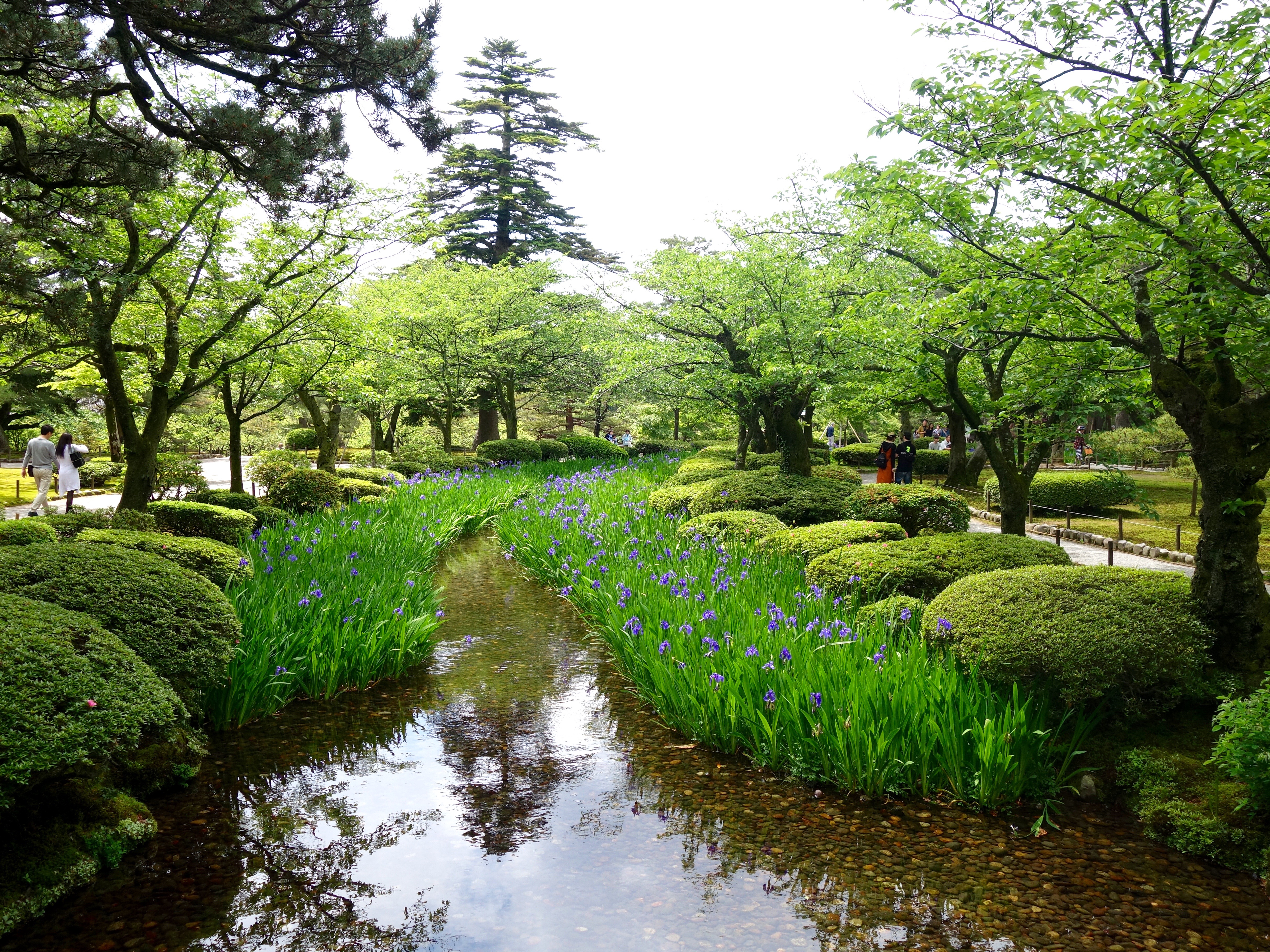
We moved on to Kanazawa on the west coast. Once a major city, in fact the wealthiest city in Japan outside the capital in the 17th and 18th centuries, it seems to have missed the post-war industrial revolution (and the bombing) and remains a centre for crafts with more gold leaf manufactured here than the rest of the world combined! There now; sit back and marvel. It also has Kenrokuen, one of the ‘three great gardens of Japan’, and so they were. Japanese people spoke of Kanazawa with great fondness and an intimation that something different and delightful was contained there. Everyone’s second favourite team. I felt right at home.

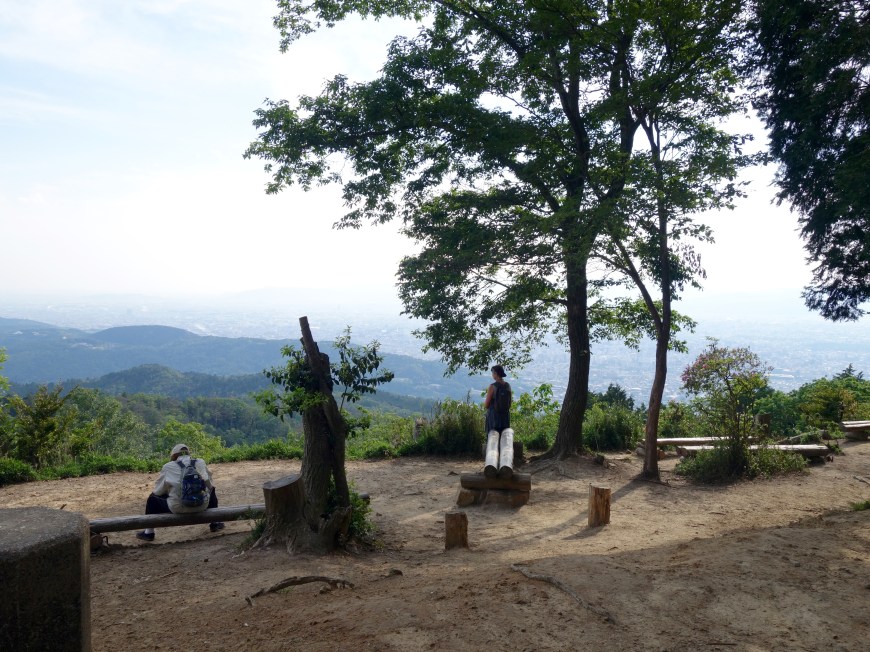
From there we took the train to Kyoto. Why did we go to Kyoto? It was on the way to Shikoku. We climbed Mt Daimonji the difficult way, found the Tiger Gyoza Hall and consumed its products two nights in succession, investigated the Disneyland that much to our surprise is Arashiyama, bought some walking gear, watched a film called ‘The Eichmann Show’ which, despite starring Martin Ferguson and Anthony LaPaglia, will be very little seen. Kyoto. It might be important to go there once, perhaps for a week. After that not so much.

This is likely to be my only chance to include a photo of the Japanese synchronised swimming team with whom we shared the Kyoto Aquacentre twice. They’re clothed and not even doing their tricks — which were completely amaaazing.DSC01022Then the reason we went to Japan, and unquestionably the highlight, a 10-day walk following some of the Pilgrim’s Trail on Shikoku to see how just how Myrna’s three month-old hip was. Great seems to be the accepted answer. Taken in entirety, this walk of 1200 (or 1600) km. (which includes a lot of possibly boring kilometres) would be sacrificial. We did about an eighth of that and Oku Japan had exercised its usual skill in picking out excellent bits. Are Buddhist temples still interesting after the 25th time? And how steep were those hills? You’ll just have to read on to find out. I will reveal that on Shikoku buses don’t necessarily run on time, that there is both rubbish and rubbish bins, and that there is very little Romanised signage and very few willing English speakers, but a truck load of charming and helpful people.

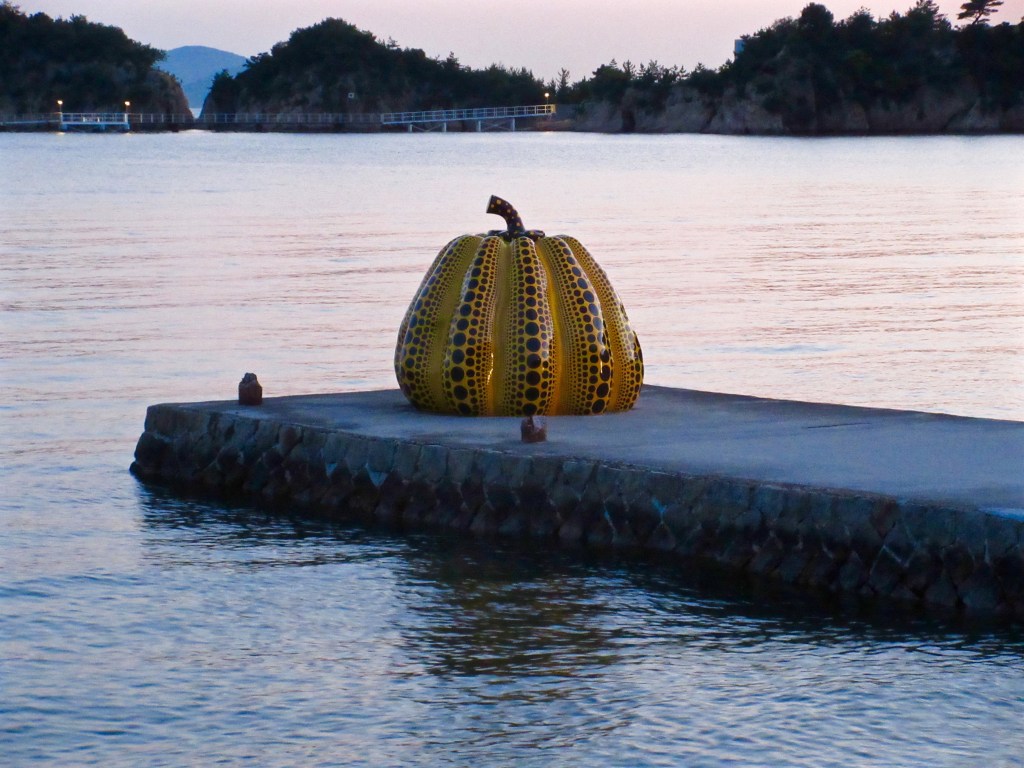
We came back to Tokyo via Naoshima, the ‘art island’, located conveniently for us between Shikoku and Honshu’s railway stations which would take us firstly to Osaka and then back to Tokyo. I’ve got a lot to say about Naoshima some of which runs against the grain of prevailing opinion. That may be because of the juxtaposition of that experience with the walk. Or it might all be a bit of rip-off. Just a bit. IMG_0315It does have its Kasuma pumpkins and we did have a swim in the Inland Sea that was lovely.

Osaka is a bustling thrill-a-minute city where we could have spent much more than two days. A bit less stitched-up than the rest of Japan? Another highlight was seeing a major retrospective of Yasumasa Morimura’s work which I would have difficulty explaining but which I found conceptually and in craft terms as interesting as anything I’ve ever seen. In the same gallery at the same time was a collection of Ikko Tanaka’s graphic art which in any other circumstances would have been a top 50 lifetime art experience.

Here is Yasumasa, being Frida Kahlo. What can I say?IMG_0349Back in Tokyo we stayed on the other side in Shibuya, mooched around, looked for presents, went to the Museum of Emerging Science and Innovation, explored Daikanyama and Shimokitazawa (the South Yarra and Fitzroy of Tokyo) and found a very good place to eat on our doorstop. We also saw ‘Deadpool’ in a theatre (monster Japanese sound and screen) with 800 or so others, maybe 20 of whom had a chance to get the verbal jokes. We celebrated our departure by revisiting where we’d been on the first day walking through Yanaka and Ueno Park, coupled with a visit to the National Museum in which every exhibit is a treasure and where the bento boxes are a feast.

How do you tell that story successfully? I think, in bits.

We met dozens, scores of people, who contributed in various ways to making the trip memorable. Till just now I had forgotten the pilgrim who accosted us on the descent from Kakurin-ji who was thrilled to discover we were from Australia.

Unknown-1

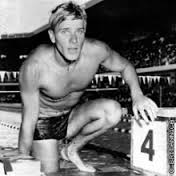
‘Murray Rose. He still alive?’ Murray Rose, six Olympic medals, 15 world records, but in 1956-60, plus he went to live in America. Still … ‘Died quite recently. He was nearly 80.’ [Actually 73, but that’s okay. We’d been walking for several hours up a steep hill and then down most of another one.] ‘Sorpo. Jan Sorpo!’ ‘Ian Thorpe? Thorpedo? Still going.’ ‘Morgan Freeman?’ ‘Mmm…’ ‘At the Olympics!’ ‘Oh yes. Cathy.’ ‘Kenneth Rosewall?’ He was casting through as many possibilities as he could to make points of connection. So many people were.

DSC00923Then there was the landscape. I started thinking about it on the train to Matsumoto, when only after 50 minutes of high speed travel had we come to anything I’d think of even vaguely as countryside. Again at Kamikochi where all the prizes of natural Japan were on display. Again from Mt Daimonji where we could see the flood pour of the vast Kyoto-Osaka-Kobe conurbation, defined almost exclusively by a contour line. And then the conceived, constructed landscape — gardens, private and public, traditional and contemporary. There is a story about relationships with nature there.

2012-12-28_1356670449

We were wandering through the temples of commerce in Harajuku and ran into a long queue standing quietly in light drizzle and we wondered why and decided to investigate. The answers prompted thinking about markets and marketing, in Harajuku, in Naoshima and in life more generally.

DSC00992
t02

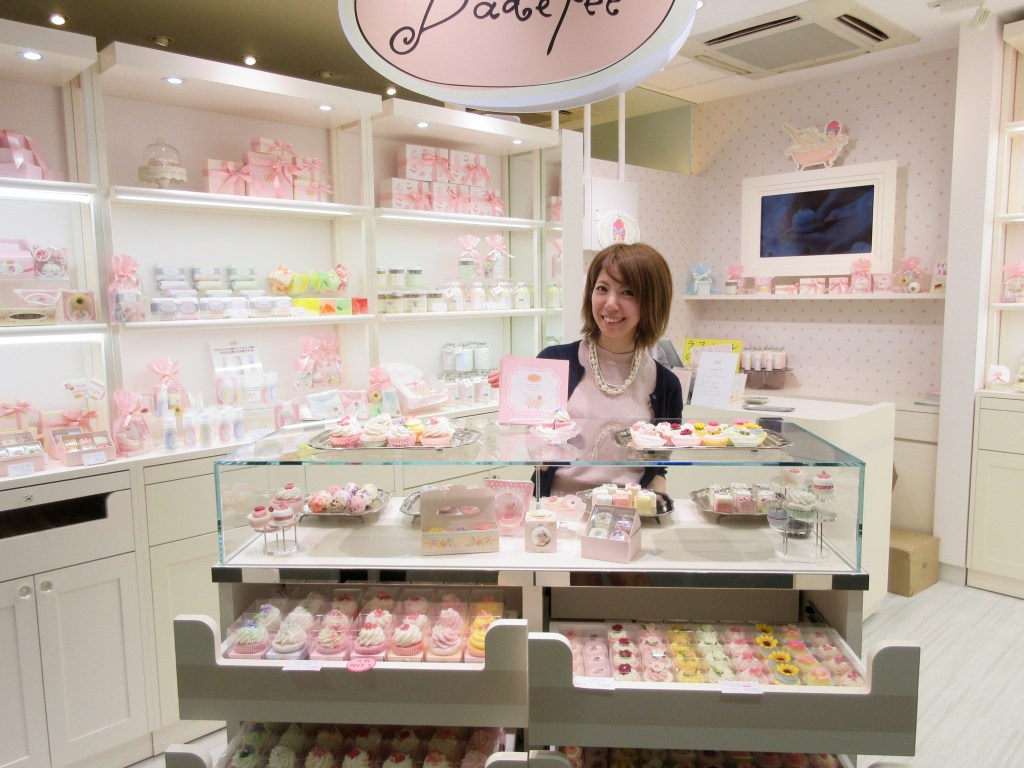
I mightn’t get round to writing about this but I also thought about the Japanese notion of kawaii, which can be translated as ‘tiny’, ‘cuddly’, ‘sweet’ or often, with pop world overtones, ‘cute’. IMG_0473 Like this (above) is soap and these are girls. She’s a pop star and she’s a pilgrim. It’s on the T-shirts; it’s everywhere. It has an unparalleled place and life in Japanese culture. And I think it helps a great deal in explaining the strange notes in Haruki Murakami’s novels. This last was a revelation if one that I could have trouble persuading other people to be interested in.

But we started with Issey Miyake or really Miyake Issey, and we stayed with him as a representative of Japan’s inventiveness for all sorts of things but straying constantly into engineering and infrastructure. I’ll see if I can explain what I mean.

And the walk. People want to know about the walk. It needs some narrative as well as how, and why.

Let’s finish with another Yayoi. I am standing in a closed mirrored room ‘Filled with the brilliance of light.’DSC00834

GATED COMMUNITIES

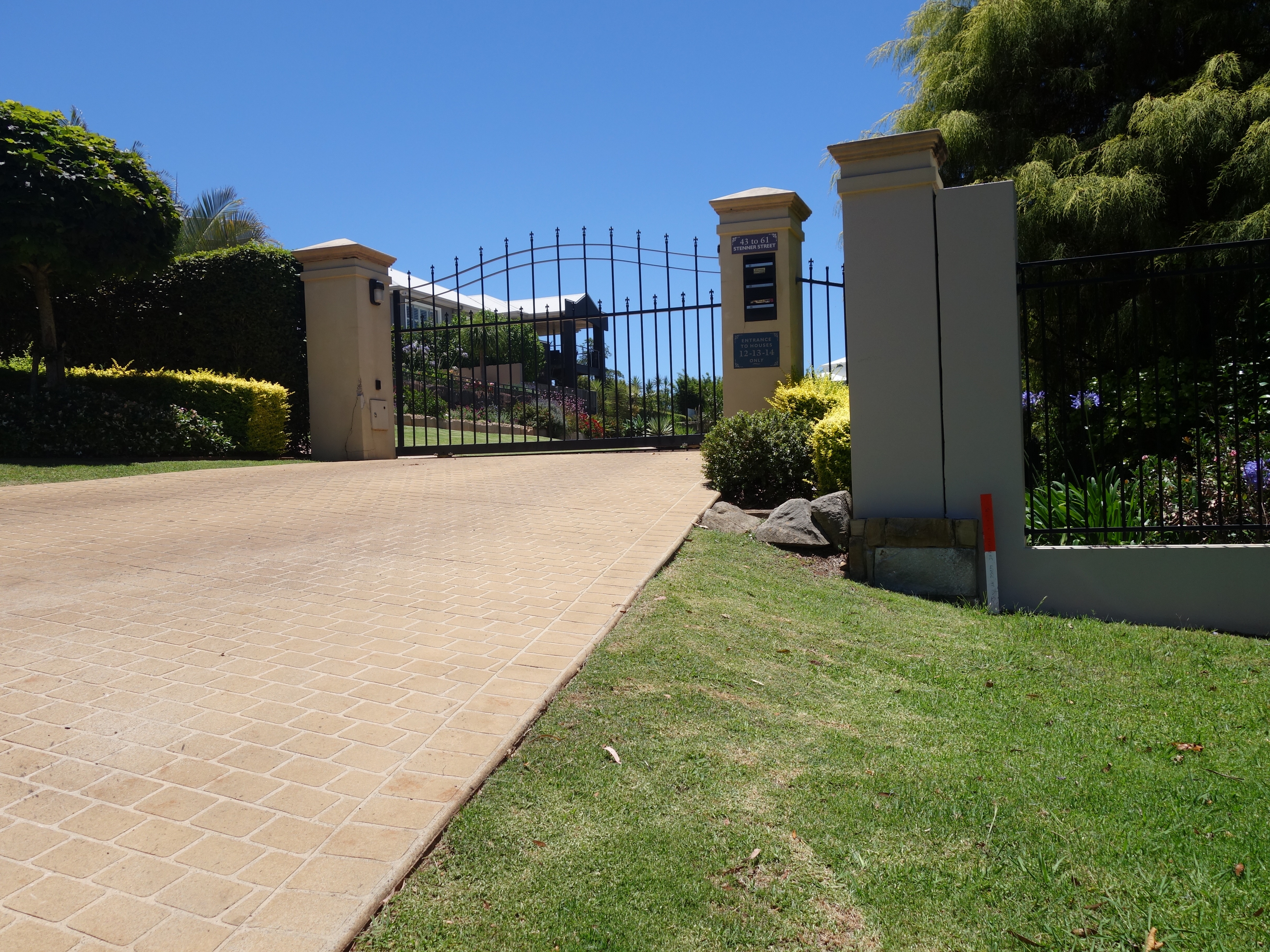
DSC00351It doesn’t look like much. A bit tinny in fact. Rendered cement block pillars with concrete cappings and a gate made out of slender hollow aluminium extrusions with spear points I suppose for the joy of it. All it says is don’t come in. The sign notes that this is the entrance to houses 12-13-14 only, so you can’t get in to the whole place that way, the whole 14 houses, properties more correctly, that are tucked in behind this fence and this gate in the expensive part of Toowoomba.

It doesn’t look like much, but for whatever reason it ruffled my feathers. What was in there that needed this sort of protection? Gold? Jewels? State secrets? Julian Assange? Does the pizza delivery boy have a key I wondered, to save the nuisance of answering the gate call?  And what about the drivers of ambulances and fire trucks, cops for that matter if they’re ever needed? Maybe gated communities don’t have emergencies.

But then as fences and gates go this one wasn’t much more than a gesture. The real question for me at the time was just who, in assertively egalitarian Queensland, did the occupants think they were? What flag were they waving at me?

                  Before I built a wall I’d ask to know/ What I was walling in or walling out,

                  And to whom I was like to give offense./ Something there is that doesn’t love  a wall,

                  That wants it down. …

The emboldened print in the real estate ads suggest that the idea of a gated community is a big  drawcard. According to the 2009 census more than 10 percent of the occupied houses in the US at that time were in gated communities, a 53 percent rise from 2001. In the south and west of the country this figure was as high as 40 percent. Many of these communities are in what Joel Garreau calls ‘Edge Cities’, the new developments on the fringes of older cities, farmland become ‘technoburbs’, where the shopping malls, the office tower blocks, the corporation headquarters are, and where their inhabitants live in new gated communities. Some time ago Garreau pointed out that there were 190 ‘Edge Cities’ larger than Orlando (the City Beautiful, a fairly random benchmark) in the US; but only forty downtowns the size of Orlando.

But what do we discover about how these communities operate? In the wealthiest ones domestic workers are the main source of activity during the day. (A fascination of mine. It’s tradies, cleaners, gardeners and pool boys who wallow in this luxury as a rule.) Studies have confirmed that in general, gated communities in the US constitute dormitory towns for their inhabitants. Most daily activities – work, leisure, study, or purchasing activities – happen elsewhere.

In a bitter critique of this development, Tom Vanderbilt says ‘Edge City is fundamentally hostile to community. … It is aggressively designed to keep others out. … What Edge City boils down to is not only an economic and cultural distancing from people of a different race and class, but a purposeful withdrawal from involvement in and responsibility for the greater politic of the city.’ He cites as an example Atlanta Edge City coalition ‘where 75 chief executive officers of major firms joined together to substitute for and supplement governmental actions affecting quality of life … funding equipment needs for mall policing, providing improved roadway access, support for the public high school, marketing the community through an annual guide book….’ Hardly malicious or illegal; just a narrow definition of the body politic. Liberté, perhaps egalité, but fraternité only with folks like us.

‘What are you doing round here?’ is the last confirmed recorded comment made by George Zimmerman, volunteer neighbourhood watchman for Twin Lakes gated community in Florida, before he shot dead Trayvon Williams, a 17 year-old black teenager who was staying with a friend who lived at Twin Lakes.

 * * * * *

Unknown

Gated communities can be larger and more autistic.

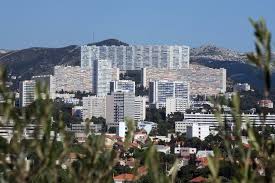
La Rouvière on the outskirts of Marseille consists of seven giant buildings comprising 2,200 dwellings with a population of about 9,000. It was built originally to house settlers (colons) returning from Algeria in the 60s and 70s and, with its internal shopping, schools and leisure facilities, could be called self-contained. Its gates are closed at night.

As real estate agents say, it has been tightly held. Operating exactly like an engorged body corporate, its management monitors the background of any prospective new buyers. Its boss is quoted as saying, ‘New residents all belong to the same class (white, lower middle class) … Immigrants know they will not be welcome. That is the case and it’s a very good thing.’ There is a consensus among its populace that people who live there are courteous and there are no delinquents. There is certainly no graffiti. About half the votes cast in its polling booths at the last election were for the Marine Le Pen’s Front National, but you can’t leap to judgment. Courtesy, hard-working youth, clean streets … who’s complaining? And I think the La Rouverians would draw a causal connection with their vigilance.

However as the Syrian (and North African) refugee crisis sweeps through Turkey, Greece, Italy and into various parts of Europe where are the fences and gates to be erected? They’re going somewhere, these several million people. They don’t simply evaporate. For those with longer views these are the tidal surges of history. One of the more recent was in 1938 with a different crew involved. A solution was proposed and enacted.

And what is this doing to the grand vision of a comparatively borderless Europe embodied in the European Union? A great deal is the answer. Yanis Varoufakis, the former Minister of Finance in Greece’s Syriza government has written a new book And the weak suffer what they must? It draws a picture of how the governments which produced and insisted on the Sisyphean solutions to Greek’s economic crisis are now being populated by anti-semite and anti-refugee xenophobes. He believes that the far right has achieved a position of being ‘in power if not in office’ in many of these countries. Today’s headline in The Guardian: ‘Austria’s lurch to the right shocks EU’.

Fear of the other (Muslim or infidel, Jew or Palestinian, and so on in very long list) is meat and drink for authoritarian/ nationalistic political movements. These are apparently not times for generosity of spirit. That’s for fools.

 * * * * *

And they can be larger again.

Gating of a residential areas is a very old phenomenon, and may have had always had similar bases — the primary one being to keep unwanted people out.

It was a way, for example, to assist the aristocracy with managing riotous behavior as well as the various plagues which ran through the locals. But on a larger scale the idea was that security would be enhanced by protective walls.

wall-cloudsWhether even this one, all 21,000km of it, worked is moot. Around 1600 the wall did its job for 40 years. But in 1644 the Manchus (the northerners of primary concern) overran the Shun and Ming overlords via the gates at the Shanhai Pass. With or without a gate, a wall will inevitably present challenging problems, but a gate will always be a weakness. Despite its triple-decker walls and fortifications which are impressive even today, Constantinople fell in 1453 because someone left a postern gate open.

And there’s this one.

images-1In 1992, the idea of creating a physical barrier between the Israeli and West Bank Palestinian populations was proposed by then-prime minister Yitzhak Rabin, following the murder of an Israeli teenage girl in Jerusalem. Currently more than 500km of the barrier has been completed. Another 212km is planned. The impact on the occupants of the area, especially the Palestinians, has been profound. One fairly sober account of that impact can be found here.

IsraeliFenceWall2011Banksy-Israel-Wall-620x350Palestinian boy climbs through opening in barrier in Shuafat

And Donald Trump wants to build a wall, I beg your pardon, he insists that Mexico build a wall along the border between that country and the US. That border is around 3,200km long. In his defence there is already, at the behest of the US Senate, some sort of fencing for 1,125 km of that distance at a cost of USD2.4 billion.

 * * * * *

‘The gated community is nothing but the legitimate and natural response of a people who through hard work and enterprise have come to the point in their life when they can give themselves and their children a quality of life the state is unable to offer.’

— Indian businessman/ property developer Rohit Gore, responding to a journalist’s question in Mumbai.

images

‘So pervasive has neoliberalism become that we seldom even recognise it as an ideology. We appear to accept the proposition that this utopian, millenarian faith describes a neutral force; a kind of biological law, like Darwin’s theory of evolution. But the philosophy arose as a conscious attempt to reshape human life and shift the locus of power.

‘Neoliberalism sees competition as the defining characteristic of human relations. It redefines citizens as consumers, whose democratic choices are best exercised by buying and selling, a process that rewards merit and punishes inefficiency. It maintains that “the market” delivers benefits that could never be achieved by planning.

‘Attempts to limit competition are treated as inimical to liberty. Tax and regulation should be minimised, public services should be privatised. The organisation of labour and collective bargaining by trade unions are portrayed as market distortions that impede the formation of a natural hierarchy of winners and losers. Inequality is recast as virtuous: a reward for utility and a generator of wealth, which trickles down to enrich everyone. Efforts to create a more equal society are both counter-productive and morally corrosive. The market ensures that everyone gets what they deserve. 

‘We internalise and reproduce its creeds. The rich persuade themselves that they acquired their wealth through merit, ignoring the advantages – such as education, inheritance and class – that may have helped to secure it. The poor begin to blame themselves for their failures, even when they can do little to change their circumstances.

‘Never mind structural unemployment: if you don’t have a job it’s because you are unenterprising. Never mind the impossible costs of housing: if your credit card is maxed out, you’re feckless and improvident. Never mind that your children no longer have a school playing field: if they get fat, it’s your fault. In a world governed by competition, those who fall behind become defined and self-defined as losers.’

 — George Monbiot, The Zombie Doctrine (read it all, and you should, right here)

* * * * *

The gated community at Toowoomba that sparked these reflections is innocent and trivial in this world of comparisons. But what reinforced the strength of these feelings was something else I wrote about in the blog on the Darling Downs: the massive shift towards the privatisation of Australian schools. The really serious issue driven by the neoliberals of our current government — in whatever party — is the reallocation of public resources to the private sector: to ensure that there is a second suite of tennis courts, or a new arts and music centre, a new auditorium, a training pool, a campus in China leaving the residualised public schools — still educating two-thirds of the population — with minimal support for kids with special needs or for providing additional literacy support.

Because it is right here, absolutely on this point rather than anywhere else, that the cost to the community of exclusion (partial, symbolic, financial, themed, whatever) becomes most apparent and the issue most palpable.

First, you can run neoliberal arguments about entitlement related to adults if you must. But children (aged 5 for example!), ipso facto, are not in a position to control their development and thereby their destinies. They need help, support and direction — all of them, not just a select group.

Second, no country can afford to deliberately choose to have an ill-educated and disaffected sector within their community. The cost of that is appalling; and it is a cost to the whole community, everyone, in liveability if not in taxation. That vast cost is also only about remediation to some sort of maintenance level; it is not investment in growth and development. We don’t get that much out of the AUD2.6billion we spend annually on keeping people in prison, a very high proportion of whom are illiterate or close to. AND, suggestive of the presence of this problem right now, the reason Australia’s international test scores are as bad as they are is because of the extraordinary spread of performance. The bottom end has a long tail. It’s that mob outside the gates talking back.

And then there is the question of walling out or being walled in?

When I went to university I lived in a boarding college which had a preponderance of graduates from private schools, some of my closest friends today in fact. But I also had friends among the private school boyos, many of whom are now highly placed in the professions and commerce. Unless they were good at sport, high school boys puzzled them in so far as they thought about them at all. High school boys were never likely to understand the exigencies of life because they hadn’t been inducted into a lifestyle where the one certainty, beyond the existence of hierarchies in which everyone had a place, was that they belonged to a group that was different, better and therefore entitled. In so far as they thought about high schools girls, they were probably sluts, and that was that. Resolved. Simple.

There’s a lot missing from that picture and not just as I have sketched it. My point: the personal cost of having such a distorted and cavalier view of the world from this sort of ‘gated’ and socially-ordered perspective is profound. Walled in, you miss so much.

OLYMPUS DIGITAL CAMERA

At Kłodzko in southern Poland I remember looking in wonder at the fort which dominated the town with its layers and layers of fortifications, accretions from 1300 until the second world war, and being forcefully struck by the resultant sense of enclosure and imprisonment — walled in. And like the invisible darkness full of the unknown around the corner in a horror film, a source of terror.

The Darling Downs, New Year 2016

DSC00369Main Street, Clifton, with a message for you all.

The Darling Downs are a plateau in southern Queensland, beginning 120 or so km west of Brisbane.

We arrived the most common way, through the Lockyer Valley one of the ten most fertile places in the world according to list makers with such things as an interest, and scene of extraordinary floods in 2011. The scarp at the end of the valley takes you up 650m quite promptly and the temperature falls 5 degrees which was one of the reasons why we were there. The road up the scarp was swarming with police. A big arrest had been made in the Valley: drugs, guns, money, etc. That was not one of the reasons why we were there.

It’s fertile on the Downs as well. Beef, pork and meat packing once, sheep a bit further out; these days more corn syrup and sunflower and safflower oil. But a lot of money was made and some of it at least was spent in Toowoomba.DSC00296

It has snowed in Toowoomba when I’ve been there in the past, a distinct oddity for Queensland, but precipitation could be a theme. Some say the name ‘Toowoomba’ is a corruption of the Aboriginal word ‘tchwampa’ meaning ‘water sit down’ an idea I like. The big town (110,000 souls, second biggest inland Australian city) sits on and around swamp drained by the East and West Creeks.

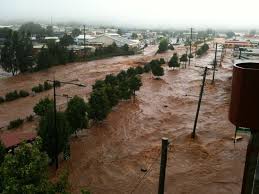
When the Lockyer Valley flooded so did Toowoomba, but the water didn’t rise with the sullen inexorability that flood water so often does. imagesIt rose in a blaze of furious anger, a two metre wave from nowhere in ten minutes. The ground was completely sodden when the town got 70mm of rain in an hour, 150mm on that day. At least partly for the commentary, this is the clip of the event I like the best. DSC00349

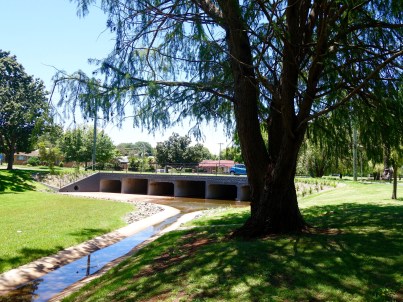
The two people who died were washed off the bridge to the left. It scarcely seemed possible when we were there.

The eastern edge of the scarp is also the absolute defining point of the Great Divide. None of this water contributed to the floods in the valley below. It will all have run off into the Condamine, a river with folkloric resonances, before finding its way to Lake Alexandrina not so far from Adelaide 2500km away.

DSC00293

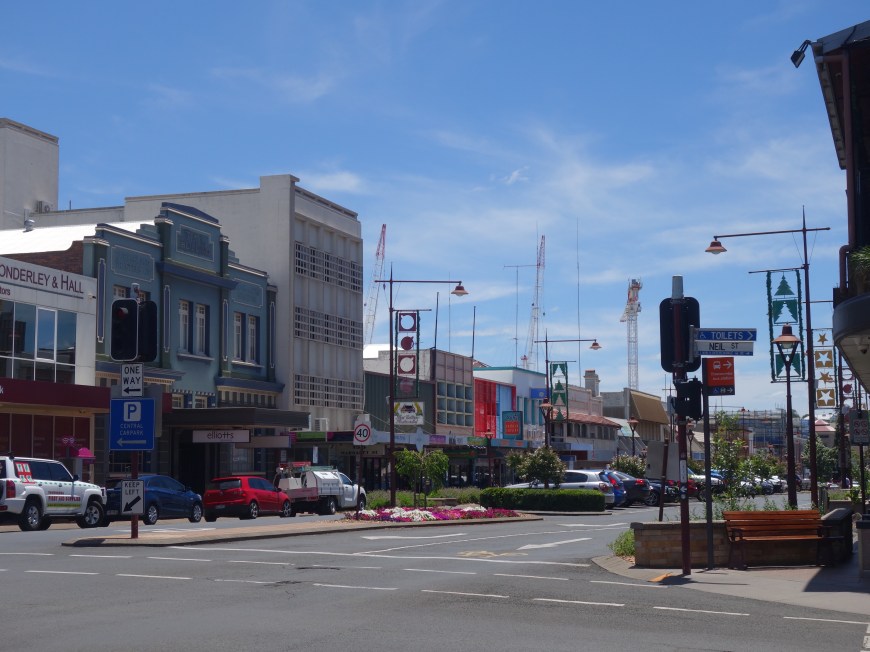
The strip shops in the main drag are being cannibalized by two giant shopping malls at its western end and three or four others plopped where cars can get to them.DSC00330

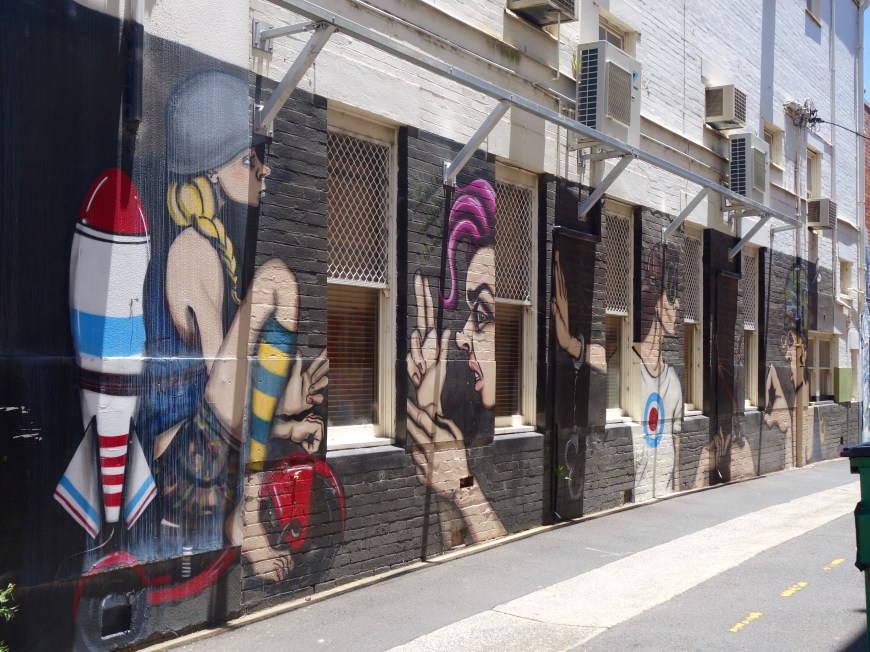
It can feel a bit like it looks above. But for all that it’s a university town and you can find areas with a bit of groove. A lane decoration for example.DSC00338

It has Queens Park. In fact it has 150 public parks and gardens including the all star rose gardens which were well past their best when we were there.
DSC00303
DSC00343Old Toowoomba has wonderful plantings more generally — plane trees, camphor laurel, crepe myrtle, jacaranda, European species, everything seems to grow here — providing plenty of shade on a hot Queensland day. New Toowoomba (below) not so much.DSC00362


And it has some of its built heritage. They seem to be more respectful of that, in some parts of Queensland at least, than in other parts of the country.

DSC00342DSC00324

DSC00340In 2015, the Vault was designated Australia’s best adult nightclub, possibly supplanting the city’s 2008 win as Australia’s Tidiest Town.

We left Toowoomba and drove south ambling over the Downs deviating via Nobby and Clifton to Warwick, and then east to the coast through Legume, Woodenbong and Beaudesert, a very fine drive.

Three food photos.

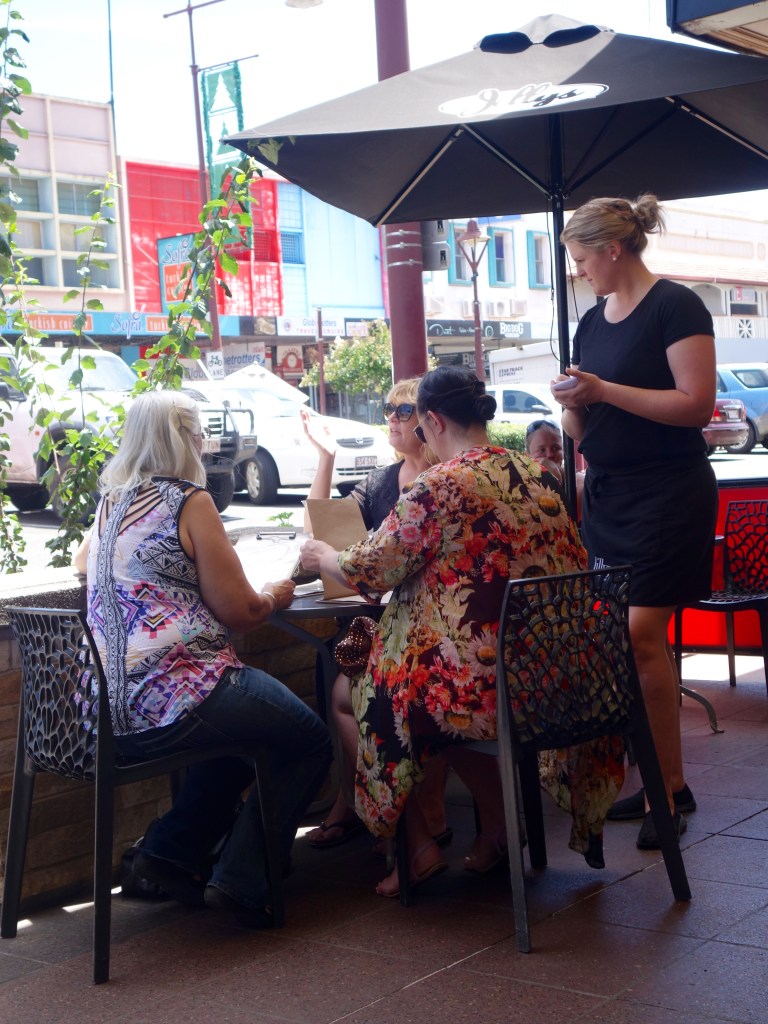
Ordering at Jilly’s, ToowoombaDSC00294

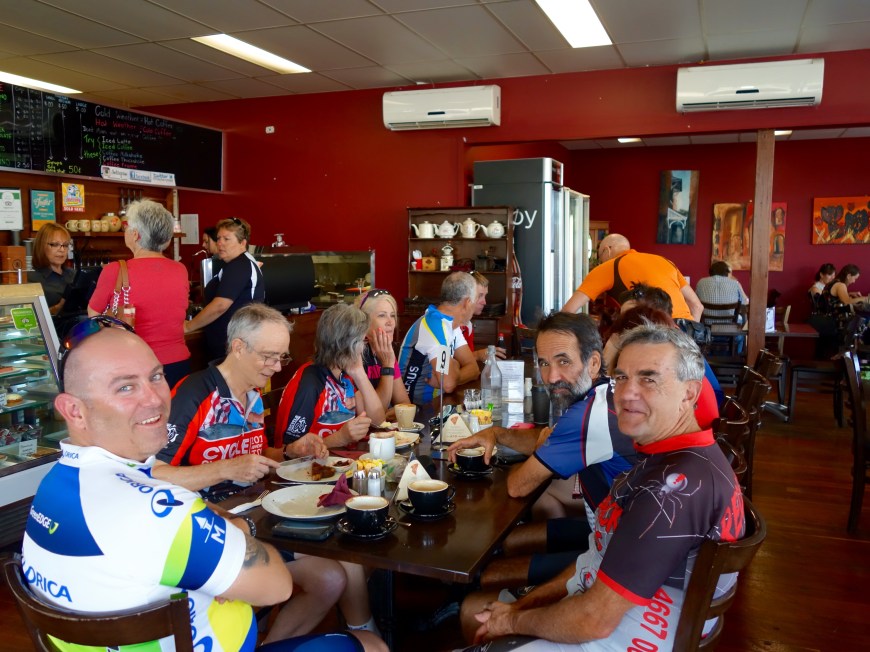
After 45 k.s. 9am Saturday Morning, Cherry Tree Cafe, WarwickDSC00378DSC00381


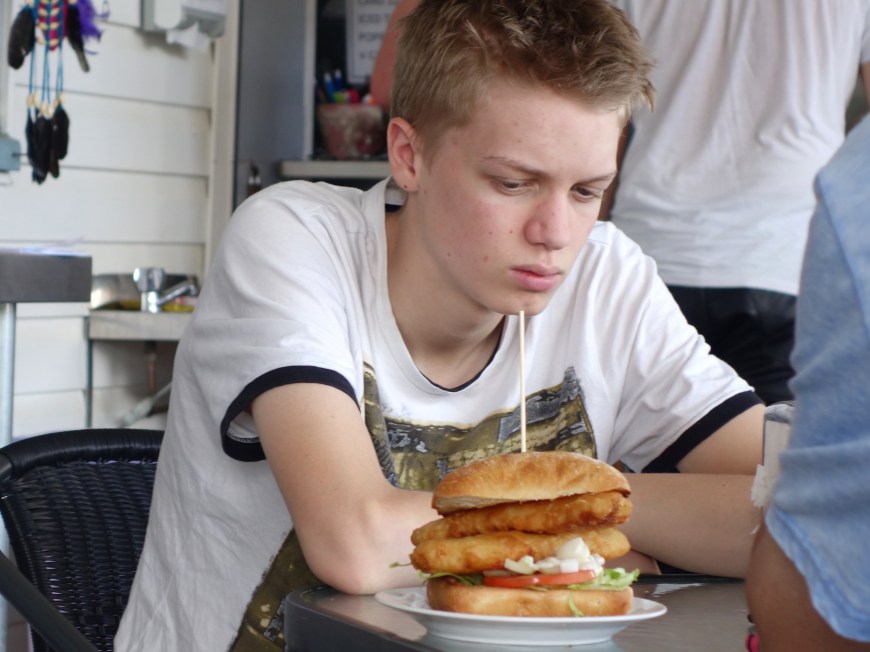
Fishburger at Carole’s Arts and Crafts, Woodenbong

DSC00389
220px-Steele_RuddONOURSELECTIONFLYER4‘Steele Rudd’ (Arthur Hoey Davis) wrote On Our Selection (the original Dad and Dave stories) while living in this area. He was born in Drayton, the original site of Toowoomba and now a suburb. I was pleased to discover that he ‘detested his struggling but admirable family being made into comic yokels, and had nothing to do with the radio program. Davis had a profound respect for the pioneering Australian woman, and he was particularly incensed by the use of ‘Mum’ when referring to Mrs Rudd.’ Hoorah.

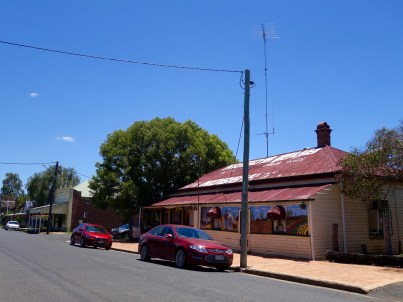
This might be like Rudd’s Pub in Nobby. Mr Davis may or may not have sat at a table here writing.DSC00365And Jackie Howe who once shore 321 sheep in 7 hours, 40 minutes, using hand shears (October 1892, at Alice Downs Station near Blackall Qld) is commemorated in Warwick because it is near where he was born. It is important to scrape things like that into a pile which over time will take form.

Glorious Mt LindesayDSC00390

And the purpose of our visit. This is how Australians celebrate 70th birthdays.DSC00396• • • • • • • • • • •

DSC00346Back to Toowomba, one of the really remarkable things about it is schools.

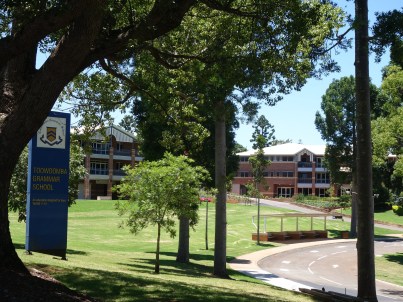
As you enter Toowoomba from the road up the scarp there is no choice but to veer right or left around the two kilometre perimeter of Toowoomba Grammar and its vast grounds.

Should you choose to do so, you can stay at the Grammar View Motel and what you will see when you look, as of course you must, is this (below) … and a great deal more. The ‘more’ that I could see that day included a groundsman mowing patterns into the turf of Old Boys Oval in front of the agapanthus display.

DSC00347Unlike the built cacophony of somewhere like the University of Melbourne for example, it is all of a style. And that style is palatial. And it is not alone in that regard. Concordia (Lutheran), Fairholme (continuing Presbyterian), The Glennie School (Anglican) and Downlands (Catholic) have equally sumptuous facades.

But they are just plums in a much bigger pie. Toowoomba has 32 schools educating primary students and 21 for secondary students. Certainly they collect students from all over the Downs, but this would still appear to be a surfeit.

The schools are often almost cheek by jowl. For example, Glenvale Christian School and Darling Downs Christian School sandwich Glenvale State School almost sharing fences. Glenvale Christian School, ‘Kindy’ to Year 6, has an enrolment of 97, while Darling Downs Christian School (which is not Christian Outreach College Toowoomba or Toowoomba Christian College) and is designed to promote ‘a redemptive relationship between each student and Jesus Christ’ has an enrolment of 184 Years P-12.

This is the growth area: not the schools that charge you $30 grand to get in the gate, but the ones which charge $5 grand and then get topped up by the Commonwealth Government. And in some cases, too often, who ‘teach all their subjects from a Biblical worldview’ which may inter alia indicate that the earth is 6031 years old, that Adam (930) was outlived by Noah (950), and that the sentence ‘Now Terah lived seventy years, and begot Abram, Nahor, and Haran’ (Genesis 11:26) suggests that at the age of 70 Terah had triplets, and that that is worth arguing about. I saw all this on a giant wall poster, 20m long by 2m high, called ‘World History’ at a school in the Riverina not so long ago. It made me deeply uneasy.

Of the 21 secondary schools, six are government schools. I could work out the proportionate enrolment but suffice it to say Toowoomba provides more than a hint of the new world of fully privatised school education. It will of course never be fully privatised because, if you have a choice, you don’t want yobbos, tarts, oddballs, noisy kids, blacks*, druggies, and ones who don’t know what the right thing to do is. You don’t want unnecessary trouble. So there will always need to be a home for the residualised unless you want them on the streets, and the shopkeepers don’t fancy that.

[* ‘The College is all inclusive and inter-denominational. We also welcome students from indigenous backgrounds.’ So blackfellas as well as everyone. Splendid.]

I began my secondary schooling in Hamilton (Victoria) a town not unlike Toowoomba in some ways: a regional centre of a very wealthy grazing area. The bottom hasn’t quite fallen out of its economy but its population has been static for a long time — it could never quite crack 10,000 — and the principal of the school I visited there recently described the current social bifurcation: ‘The town is splitting in two: the ones who are going okay and the ones, more of them everyday, who are stuffed.’

It was always a bit like that. My father was never going to be invited to join The Squatters’ Club. But the school — a government school — I went to was excellent. Very strong in science, history and art, but good across the board. Solid, orderly, well administered, excellent morale, it had 890 students. Over the road was the Tech School, another government school, all boys, again very good at what it did. It had about 400 kids. Monivae, a Catholic secondary school then just for boys, which had been recently established, had around 200 (including Pat Dodson who I remember playing football against). Hamilton and Western District College (private, boys) and Alexandra College (private, girls) had about 400 between them and across primary and secondary years. Note that as happens today these kids were being collected from all over the place. Lots of bus travellers; and Pat was from Broome.

I had reason to visit one of these schools recently. Unsurprisingly things had changed. Monivae had girls and 608 students. The Colleges amalgamated years ago. The new institution has an enrolment of 477. A new Lutheran school has a P-12 enrolment of 199. (In what respect is that viable?) I can’t find the enrolment of the new Plymouth Brethren school, Glenvale. It could be 50-80 (and it could be a sister school of Glenvale school in Toowoomba which has as part of its mission statement: ‘With humble reliance upon the grace of our sovereign God, in order to assist Christian parents to fulfil their educational responsibility, and complementing the work of the Christian Church, to nurture our students in the fear and admonition of the Lord.’)

And my alma mater? Amalgamated first with the Tech School and then with a primary school, it now has a total enrolment across Years P-12 of 487 and a fragile reputation. That’s what two decades of neo-con thinking and sleight of hand distribution of federal funds has achieved.

Free? No not really. Secular? Increasingly less so. Compulsory? Absolutely. Trouble? In due course, nothing surer.

Warwick High looked like I want my schools, across the board, to look like. Confident, stable and proud.DSC00377

• • • • • • • • • • •

As you’d expect the edge of the scarp provides much-coveted building sites. Kara View Court had just been opened up. Big blocks, big houses, several of them far more interesting than these.DSC00353

But going back to the highway we drove past a gated community.

#6 A Green and Pleasant Land: walking along the Thames

ROYALTYIMG_1608You’ll just have to read on to find out. But just in case you’re worried, she didn’t die. They cut her down in time.

Windsor: a day of rest

IMG_1562We had a hugely expensive cup of tea on the Eton side of the river watching the tidal wave of tourists engulf the shops successfully designed to relieve them of their hard-earned.

It must be one of the few schools in the world to be a tourist attraction. It might be worth remembering that while Princes William and Harry, David Cameron and 18 other British Prime Ministers were educated there, so were George Orwell, John Maynard Keynes and Eddy Redmayne.

All boys; all boarders. Two conditions which would influence outcomes. Base fees of AUD70,000 per year. That’s another condition that may have already determined outcomes, although the school and its apologists are quick to emphasise that one-third of the boys receive some amount of financial assistance. But, of course, if you have to ask how much, it’s too expensive for you and yours. The chap at left is in school uniform. Must be a lot of work keeping that white bow tie clean.IMG_1557 

The day after we arrived in Windsor Prince Charles opened the school’s new £18million Bekynton Field development which includes a debating hall modelled on the House of Commons so that the kids will feel at home on graduation. And that’s great. A proper transition program. Education at its most considered.MK17792_Eton_College_Chapel At right, the school’s modest chapel.

IMG_1631


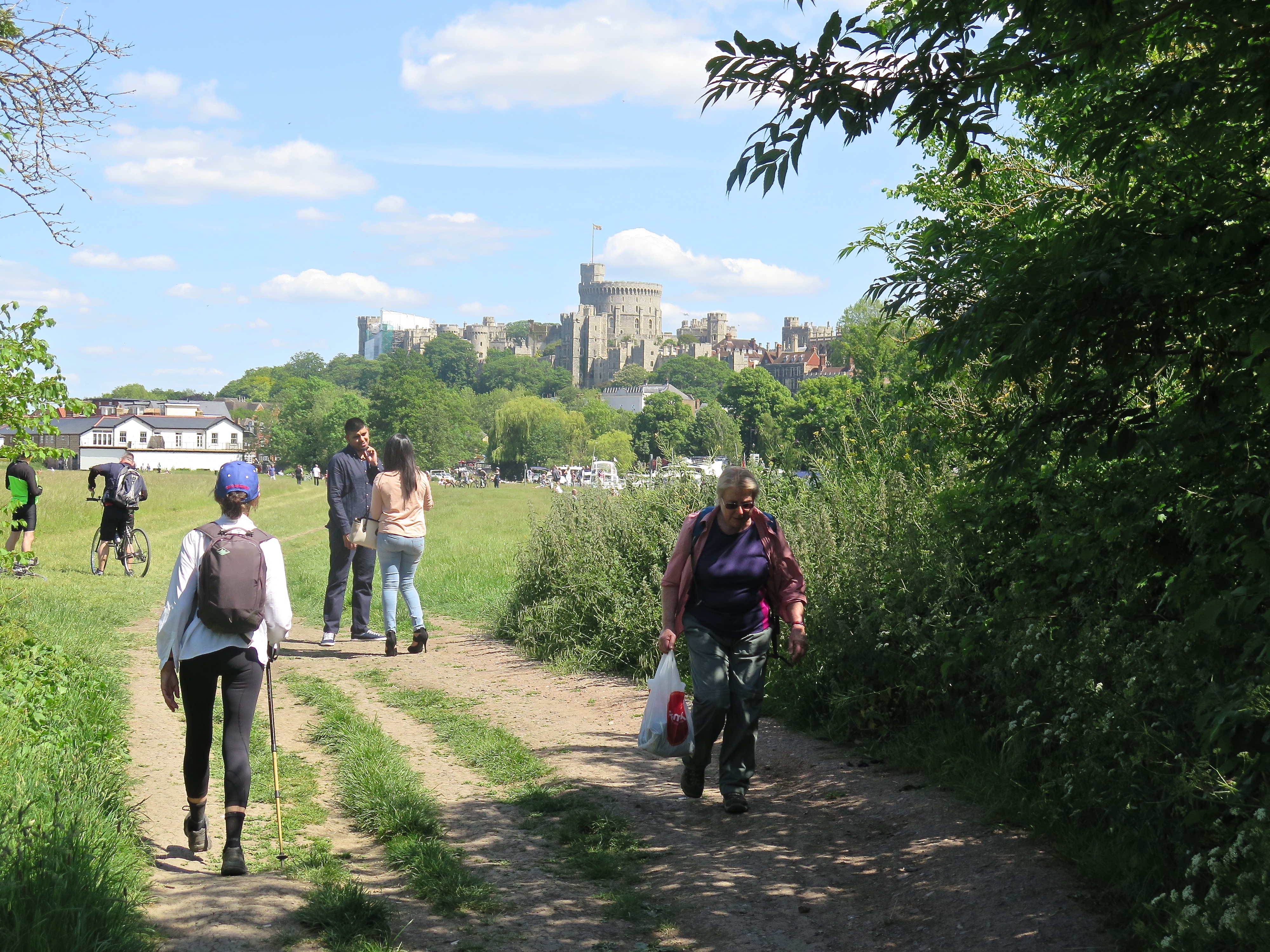
Eton is on one side of the river and Windsor and its castle are on the other. It’s more homely on the right bank. We ambled up over the hill (yes a hill, that will be one of the reasons why the castle is there) and down bustling Peascod St to our destination. <These boys absolutely bopped. We found a Moroccan restaurant at the top of the street near our hotel. Meimo: ★★★★★. Have the lamb shank tagine, the chicken wings and green beans. At least.

That night I wrote in my journal that I was missing what I described as the previous simplicity of the walk: look at the map, read the notes, eat, walk, sleep, then do it again. Myrna and I have often talked about the meditative quality of long walks. There may be some empirical basis for a belief that such a great deal of repetitive motion (in this case about 300,000 steps) reduces anxiety, or as I prefer to think, clears the crap out of your head. That certainly happens for me. The entry might have been about the increasing proximity of London and its urban tentacles, although I was looking forward very much to seeing our friends there. It might just have been closing in on the end. I don’t know whether I’ve got this across, but this was all pretty good fun. Whatever, it was a twinge of sadness.

IMG_1569Was the castle enough to hold my interest? With the addition of a visit to a laundrette and some good coffee, for a time, certainly. It’s a big one, and a going concern. About [insert huge number] people visit it every year and each of them spends [insert huge number] pounds which enables the whole show to be in very good condition.

The Queen wasn’t there — she texted to say she was gearing up for her big day at Runnymede a couple of days later — but her presence, of course, was everywhere. We struggled personfully with ideas about lineage and succession but realised that we had no idea. How did a Greek and a German come to be regents of England again? Take me through it slowly.

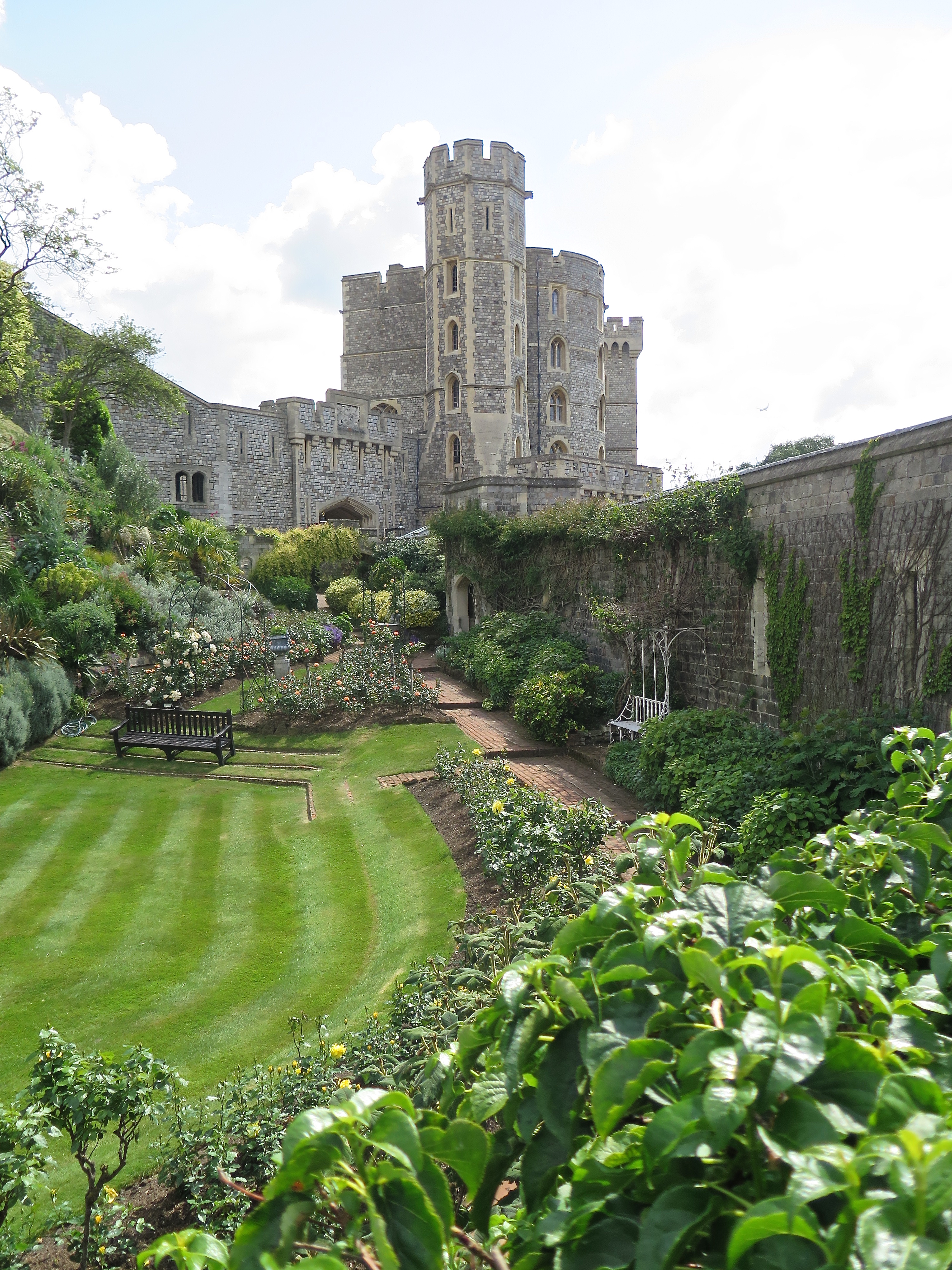
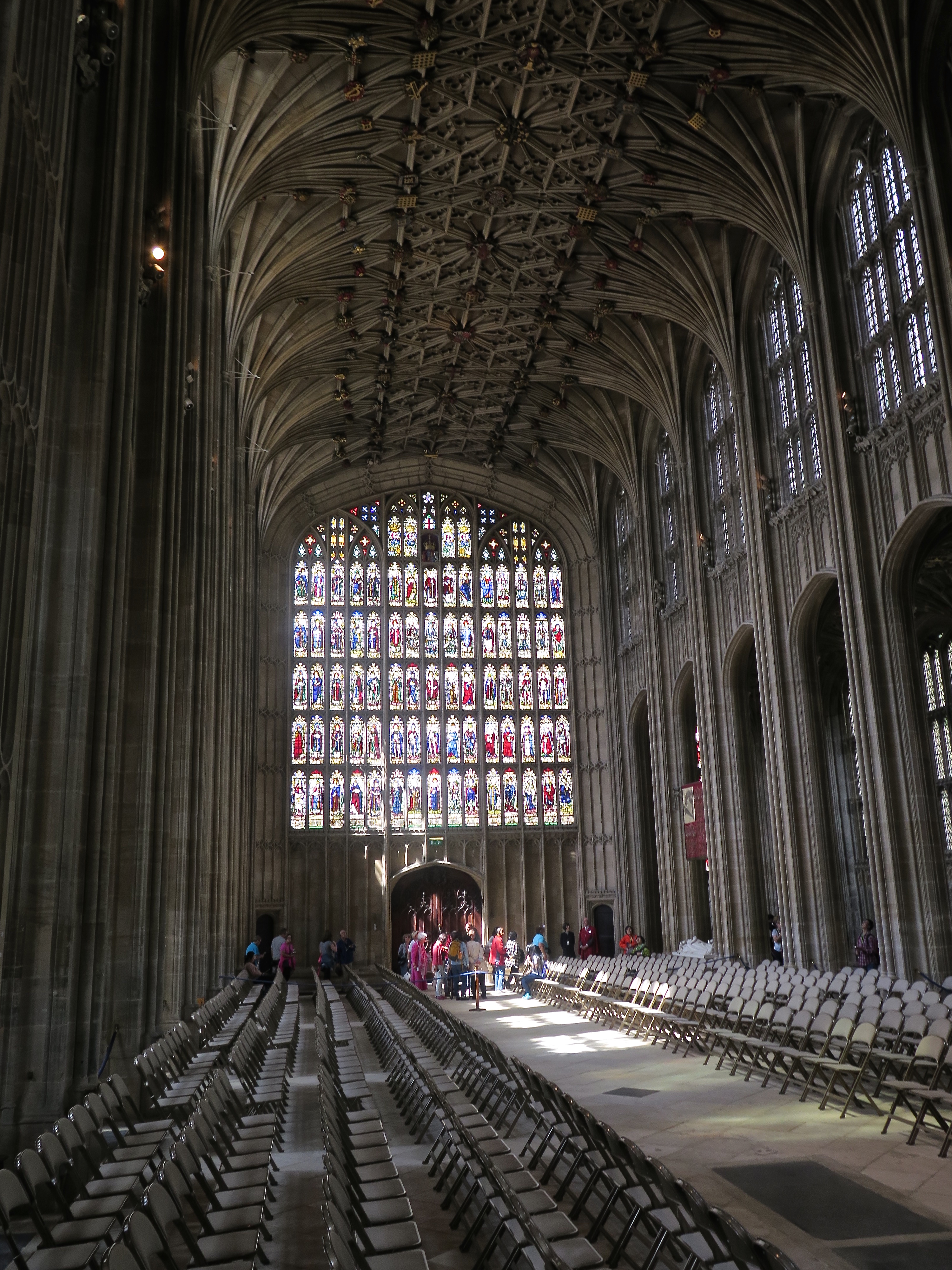
The castle was a vision in grey and gold, and as mentioned was beautifully kept.IMG_1571 The chapel (below left) had all the celestial exuberance and elegance one expects from late Gothic architecture. Not as good as Ste. Chapelle, but this is just a bit of a castle, not a free-standing miracle.

IMG_1587The state rooms were stately: full of stuff. Lots of portraits — Van Eyk’s multiple views of Charles I, clearly a bad lot, being a standout —  lots of sumptuary, lots of muskets, lots of swords, lots of bayonets.

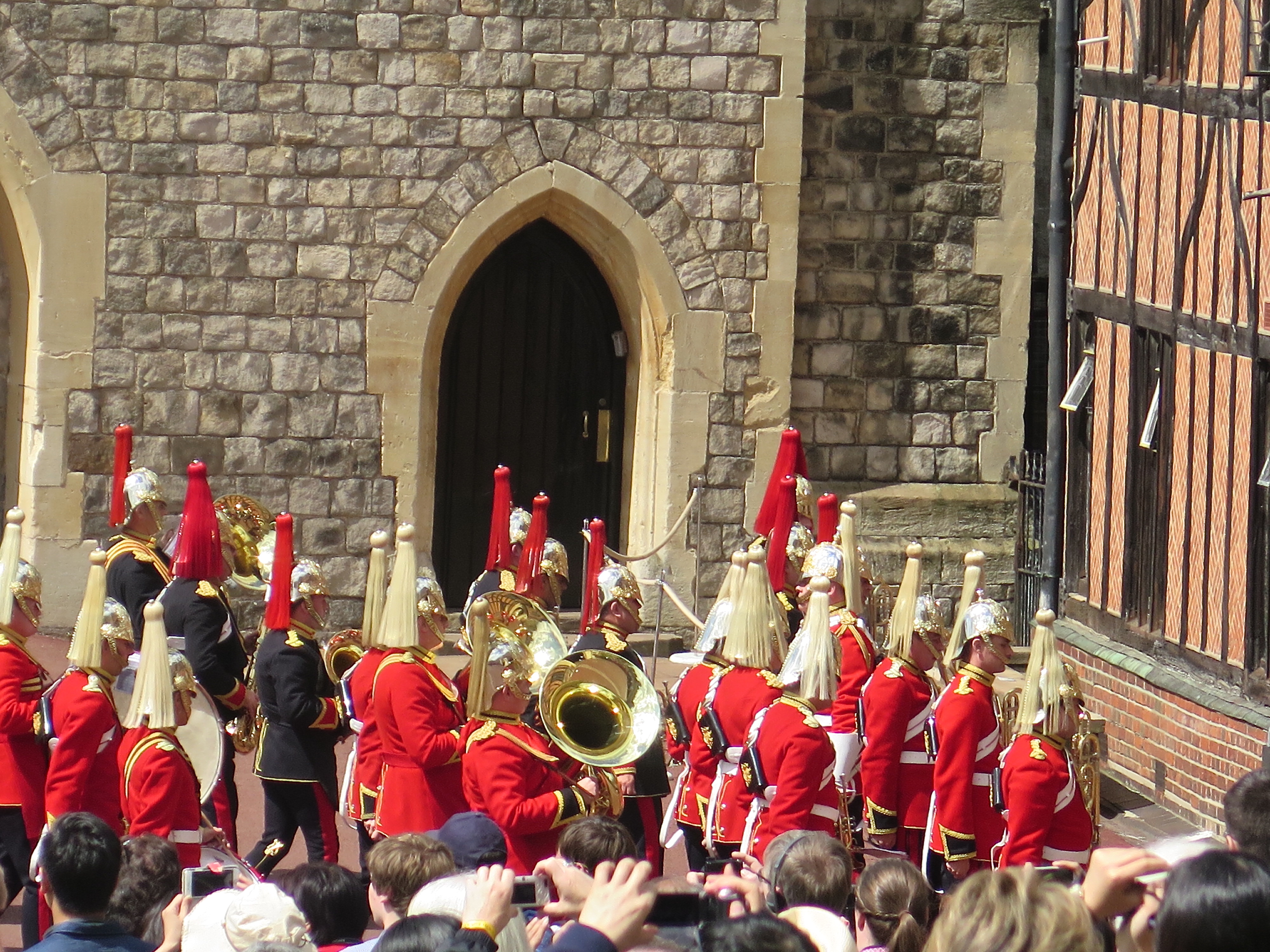
We were poking round in the book shop trying to work out who was who and why when the band struck up for the changing of the guard. I didn’t think I had to be interested but a band is a band and when you’re in the grounds of Windsor Castle with the opportunity to hear the theme from ‘Star Wars’ played by guys with either highly polished things or bits of animal coming down over their noses you go along.IMG_1573 When this is followed by the late M. Jackson’s ‘Thriller’ you stay. In both cases flawless and riveting renditions.

You could never fault the English on their capacity to put on a show, like Dr Brian May (CBE, musician (Queen), songwriter (‘We will Rock You’) and astrophysicist) playing his guitar on the ramparts of Buckingham Palace. Or to acknowledge those who can put on a show: like, for example, Sir Elton Hercules John, CBE.

It’s this capacity to be a good sport and to make use of everything you’ve got including your historical and cultural heritage that seems to be crucial in maintaining contact across the screamingly evident social divisions. The agreeable impact of this sort of entertainment seems to be smeared right across the population like a good spread of Vegemite on toast. [Finalist: Inapposite Metaphor of the Year Award]

That’s one thing. But as well it seems to generate widely-shared pride. It’s up to date and often effortlessly cool. Unknown-1(Footnote: It was not Angry Anderson in a Batmobile (at right, tragic. I was there that day) or an overcooked Meatloaf.) The Regimental band could have played ‘Colonel Bogey’ say, or a snatch of Pomp and Circumstance — that’s English — or even the Radetzky March; but they didn’t. The band master went for smart choices, guided by refined and very capable populism. Well-judged, intelligent, even artistic.

Whatever this style/ movement/ public choice and expectation is, it also understands precisely the vein it’s looking to tap into. Getting with it is, for now at least, not something you have to argue about. And certainly not when it might turn a quid. I remember this from the Olympics. Even if you don’t like the product you can be proud that someone else is putting on a show, a show in which you may claim a proprietorial stake.

And it’s not too distant, an odd combination of both c’est moi and c’est pour moi.

You know the Queen didn’t go skydiving with Daniel Craig, but she probably really was with him in the room when they were getting that shot in the Palace. She can, within limits, muck around. When I think of the Queen, well I don’t really. But if I did it is of this very remote and buffered figure, not someone whose humanity and ‘lovability’ is quite regularly on display. The reality of this accessibility might be nonsense but English celebrities seem to understand connectedness. You can have a picnic in the grounds of Hampton Court, if fact you’re encouraged to. Graham Norton is just so cute, and he is your friend.

This sort of stuff won’t make you any richer, but it might make you think twice about dynamiting the ramparts. In other times it might have been called the free distribution of cake perhaps.

images-1I suppose that’s what the Queen is for. Colour and movement. A living embodiment of post-modernism: a clutch of paradoxes stitched up into a pastel twin set by a string of pearls and crowned by England’s finest milliners. God bless her.

• • • • •

Got sick of the castle and its implications and went for a swim. I left a trail of blood but there were no sharks in the pool.

Windsor to Shepparton — 23 km

Is that all? It seemed a lot longer. Apart from anything else we crossed the M25 and returned to something more like ummm … other versions of the real world. 

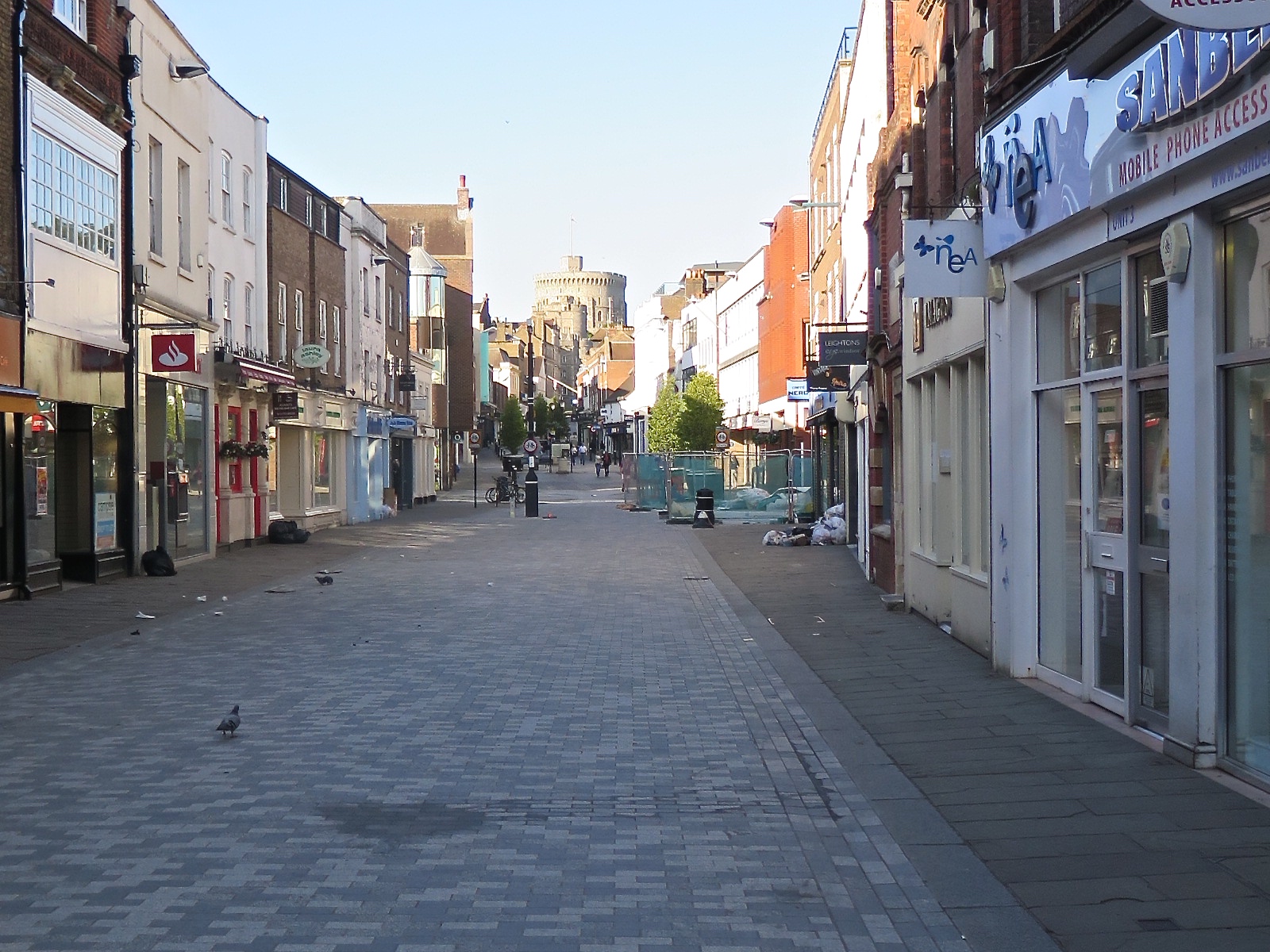
We got up an hour early by mistake and saw Peascod St just about empty. That’s like getting a jump on the day, in this case a very worthwhile activity.IMG_1567

We hauled our way round ‘The Home Park’, encountering this genuinely regal site. Click the pic to see the relevance of the bathroom offerings.IMG_1590

IMG_1595Walkers get choofed across the Albert Bridge for security reasons a little further on. Conditions on our side were as illustrated. We had seen a lot of nettles but nothing like the acreage of this section. They were everywhere. These enormous rhubarby weedy things were everywhere too. On the other bank I’ll swear I saw one off the Princes in this trap racing along the Home Park’s tow path.

IMG_1597

IMG_1600Two very elegant cottages designed by Sir Edwin Landseer Lutyens, OM KCIE PRA FRIBA (we’re on regal honours just now) signalled our arrival at Runnymede. 

There are three memorials overlooking the Thames at Runnymede. The oldest is on the modest hill overlooking the meadow and is dedicated to the memory of the men and women of the Allied Air Forces who died during the Second World War.

A second is dedicated to the memory of JFK. The inscription reads: ‘This acre of ground was given to the United States of America by the people of Britain in memory of John F Kennedy, born 19th May 1917: President of the United States 1961-63: died by an assassin’s hand 22nd November 1963. “Let every Nation know, whether it wishes us well or ill, that we shall pay any price, bear any burden, meet any hardship, support any friend or oppose any foe, in order to assure the survival and success of liberty”: from the inaugural address of President Kennedy, January 1961.’

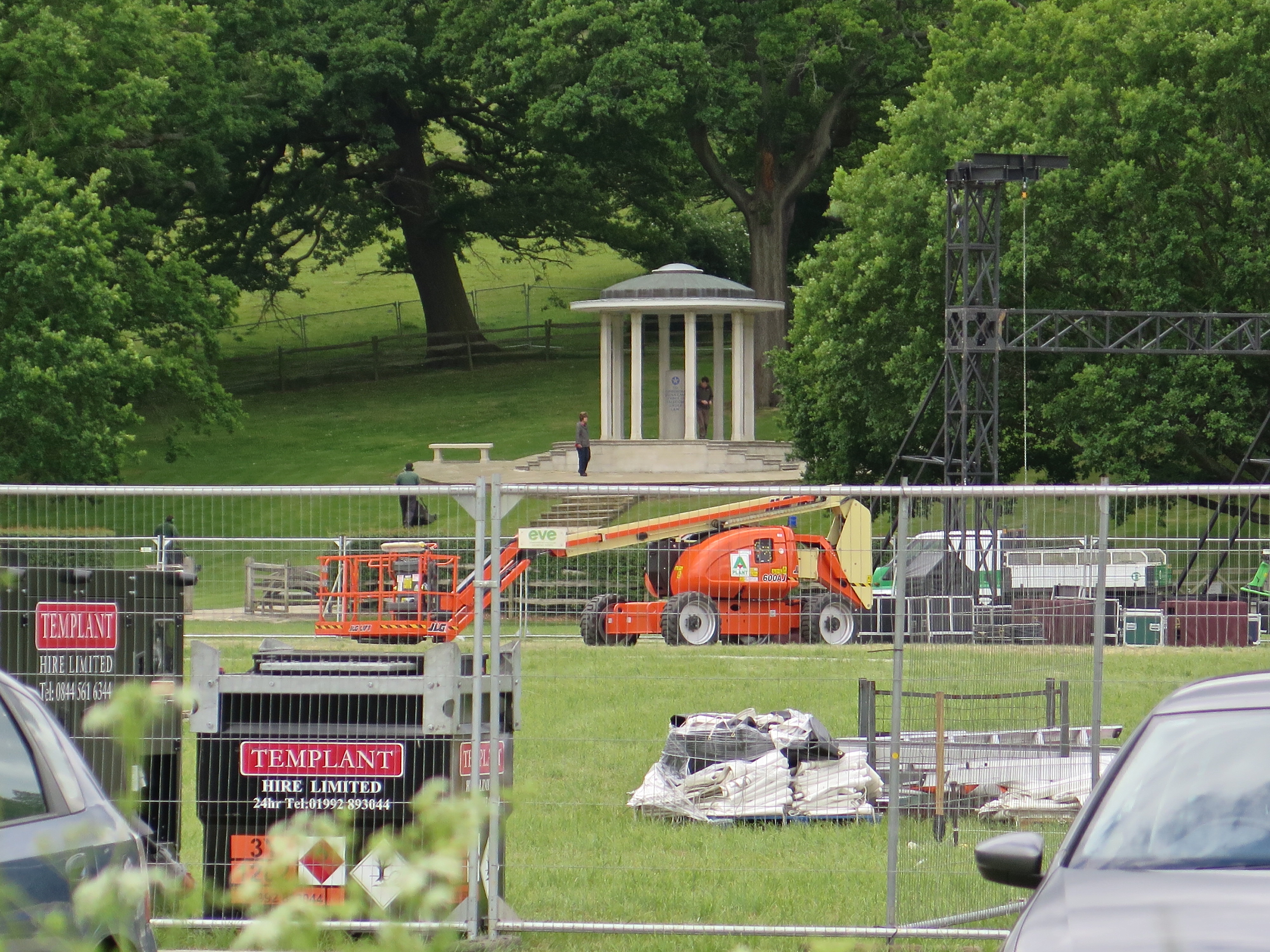
IMG_1601Only the third relates to the Magna Carta and it’s not even British. The Magna Carta Memorial was built by the American Bar Association funded by donations from 9,000 American lawyers. IMG_1599

When we walked past it was exactly 800 years less six days since the Grand Charter had been signed there by King John and 25 Barons. Eminent historian Christopher Pyne and his acquaintance Dr Kevin Donnelly have announced this experience as the foundation of all aspects of Australian life deemed to be civilised. They may have been supported by the American Bar Association in this, but the workers appeared unmoved. They were getting ready for a big party. Headline act: Elizabeth Windsor.

A related blog post: ‘Meanwhile, half a mile up the hill, a gathering of musicians, speakers and gentle people looking to engage with the issues around democracy have their gathering surrounded by police and shut down, under the false allegation of it being an ‘illegal rave’. This is the truth of democracy. It doesn’t matter if the Queen or the government have sovereignty = the robber barons are still calling the shots, and democracy is just a game they play to keep things how they want. All the pageantry is a smokescreen, a comforting fop. We are surfs [sic], and always have been.’

Elsewhere Beer Day Britain ran a ‘Cheers to Magna Carta’ national event.

Just round the corner I decided to flout an explicit direction and pursue a shortcut across some public park — Runnymede Pleasure Ground now I look — where we encountered the events which provided the photo which began this blog: the installation of a new sculptural memorial to Her Maj.

Its installation was interesting. I’ve never seen a statue installed on its plinth before and these boys were good at it.

But we found ourselves standing next to a Royalophiliac, whose disease she made every effort to communicate. The statue and its installation was going to cost £756,000 of which at that time there was a £280,000 shortfall. (Grand Designs all over again!) She intended to increase her already substantial contribution. It would possibly be renowned British sculptor James Butler’s final work, he’s 83 now, but certainly his finest. The statue was derived from Pietro Annigoni’s 1969 portrait which we chased down later in the National Portrait Gallery. Annigoni also painted the Queen in 1956 to vast acclaim and probably got her about right and this is why Annigoni got another go.  Unknown-2<1956. 1969 below.

by Pietro Annigoni, oil on panel, 1969

But 1969? Way off. Slightly hircine (a polite way of saying ‘goat-like’), and what on earth is going on with the hair? She’s quite a good-looking gal — good bone structure, attractive figure — but if her stretched neck allows it, this one bleats. And James Butler had been quite faithful. The bronze was almost equally astray. If anything slightly worse. Is there a new dash of the equine in there as well? Anne rather than Elizabeth say? Scroll up and have a look.

Bad luck guys. Those are big bucks to pay for a dud. We did enjoy the installation though. Excellent. And a lovely plinth.

We could hear the M25 roaring about a kilometre away from where we were. My friends from Leigh-on-Sea defined that as the entry to London. Somewhere near here too is the outlier ‘coal post’ from 1831 warning merchants that as they were now entering London they are required to pay the coal levy. But what there really was there was, dah dah, Staines! or Staines-upon-Thames as it renamed itself in 2012.

Ah Staines. Staines Staines Staines Staines Staines.

The entry was not auspicious. I haven’t mentioned that all morning we had been walking under the main Heathrow flight path — the runway being as close as 3 or 4 km from where we were —  and every 45 seconds, someone said, a plane takes off or lands. That’s what it seemed like. Extraordinary. We padded down a long path next to the Egham sewage works, the Egham waterworks and the Egham gasworks followed by, from our vantage point, the slightly forbidding office buildings of Staines Business Park which appeared largely unoccupied.

We were hungry. I think because we still had a couple of maps to walk through we had ignored an offer of sustenance near Runnymede that looked quite promising. So the search was on for the cafe with the delicacies and the 40 year-old woman etc etc. We did the main street, and don’t make me laugh. Yes to Maccas. Yes to KFC and so on, but we were in lino land. This is Staines at its finest.IMG_1612

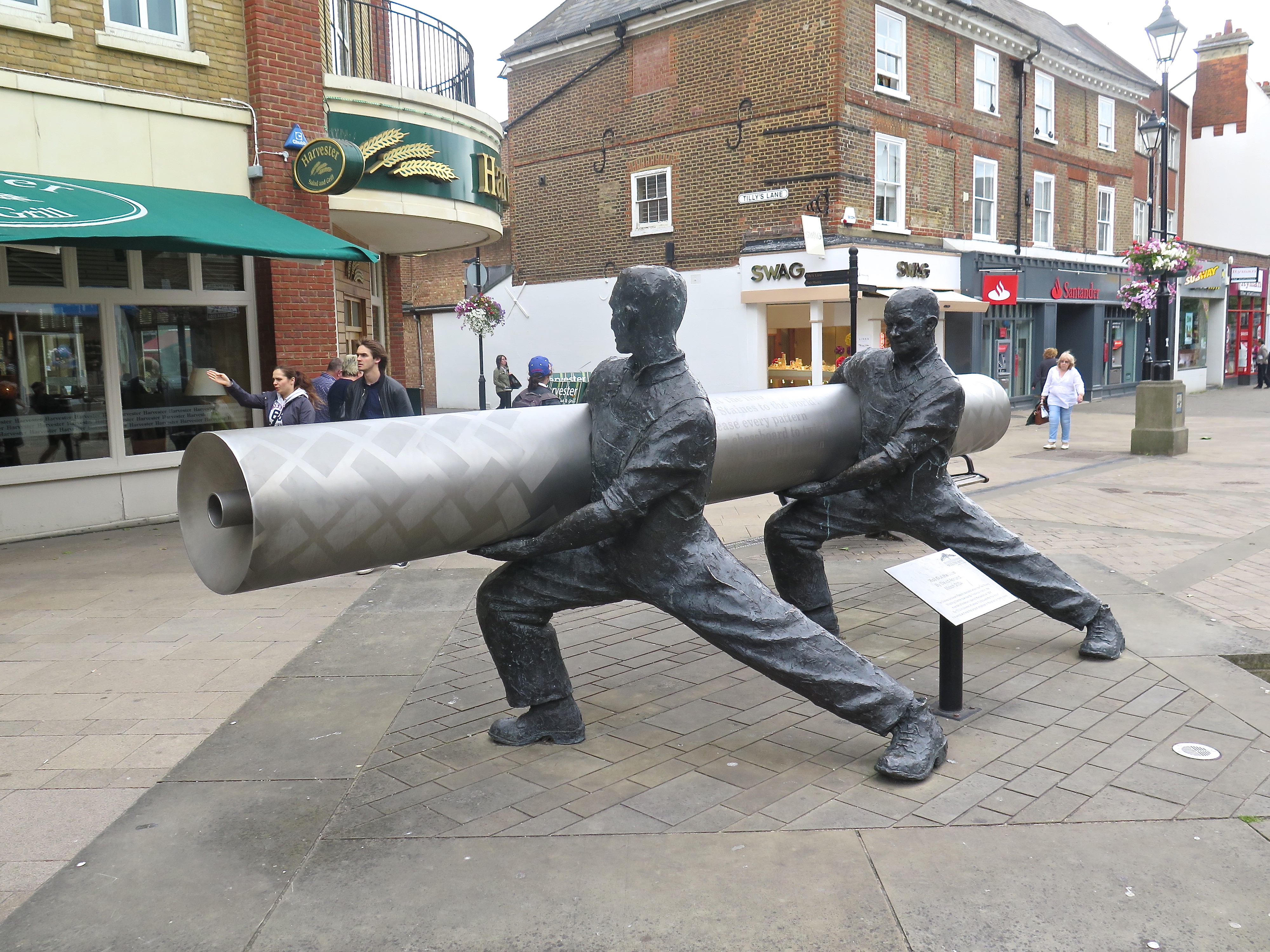
‘Roll out the Lino’ by David Annand. A terrific sculpture. Engraved on it:

    Roll out the lino from Staines to the world!
    Release every pattern from chessboard to twirl!
    In every hopeful kitchen let life unfurl,
    Bathrooms are artrooms from soapsuds to swirl!
    Roll out the lino from Staines to the world!

(Words by Richard Price and Leona Medlin, 2003. As far as I know not yet set to music.)

Sir Frederick Walton, a Staines native (as was Christine Keeler) invented linoleum and offered it to the world in 1864. It’s the empire again. What can I say?

We continued our search for edible food. It was fruitless in the main drag. You get impatient when you’re hungry, so we launched ourselves into the local mall resolving to take the first offering; and that was BHS Foods which offered classic British food at very cheap prices with plenty of room for wheelchairs.IMG_1613 imagesWhen Ali G (at left) says he comes from Staines, he doesn’t. He’s far too young. I believe he has now taken to saying he really comes from Egham, across the river. I also believe however, that the Staines FC has taken to describing themselves as Staines Massive which is excellent.

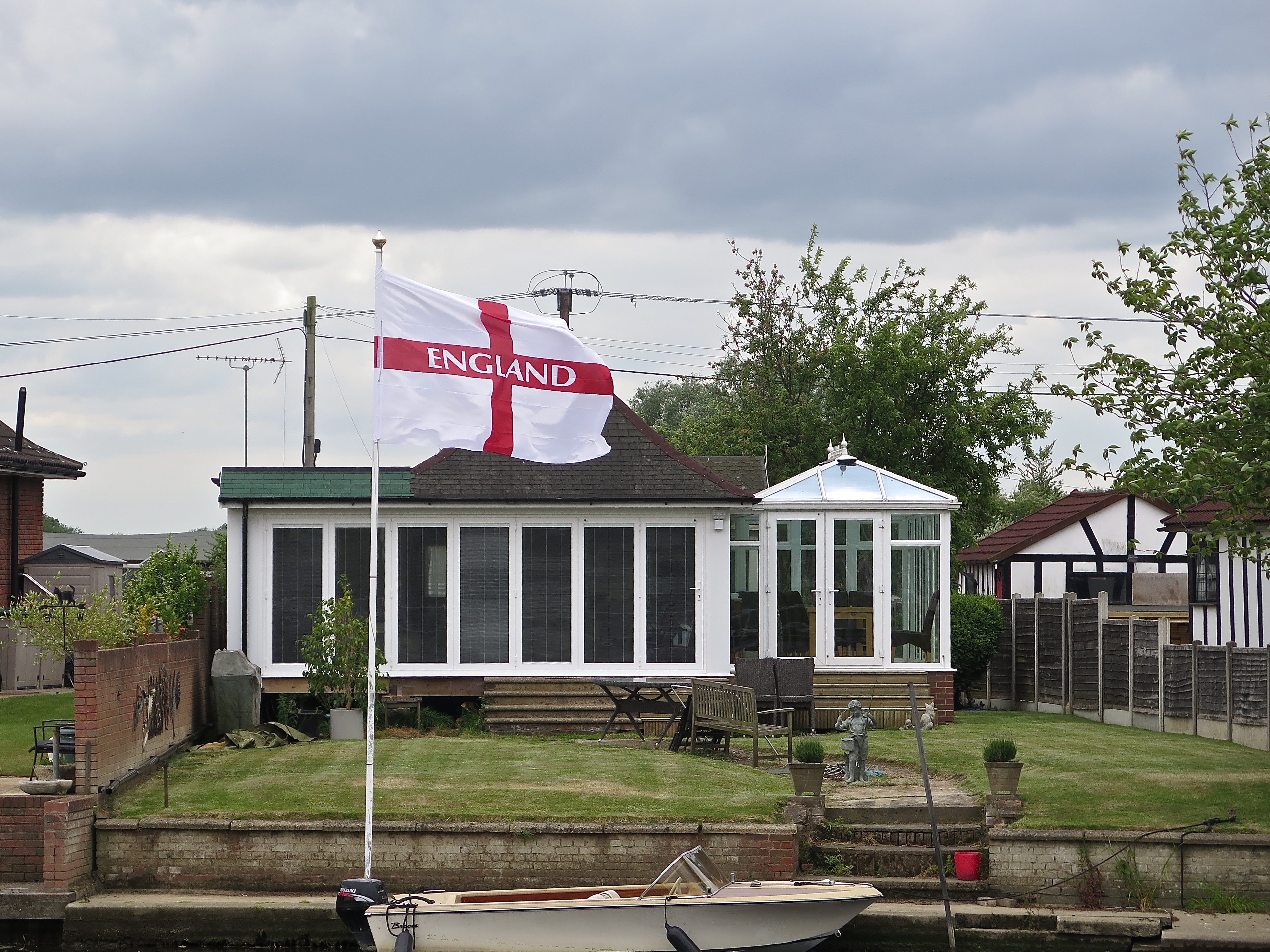
We fought our way out of Staines Central back to the river which we had somehow mislaid, and that had all changed too. The first houseboats appeared, although boats in name only. They weren’t going anywhere.IMG_1615My journal says: ‘A long stretch of slightly crap properties. The houses needed painting or the garden cleaning up or getting the rubbish out of the yard or the barge boards repairing.’ Even the boatbuilders’ yards were like that — just massive tumbles of junk. Unworkable you would think. I wondered if we were looking at backyards and shortly we were, on both sides of the river which had shrunk in width. The guidebook says: ‘Along riverside Staines, the little houses, in their infinite variety, still reflect the joy of simply living by the Thames.’ Maybe. Your choice.IMG_1627

By Laleham we had returned to more bourgeois offerings. The BMWs were back in the drives. In the naming stakes ‘The Willows’ had replaced ‘Iris’s Wet Dream’. We veered off the Path again to find some refreshments at the Feathers pub (high marks) returning to walk around Dumsey Meadow, the only meadow in Surrey left with its original vegetation. It was lovely, full of buttercups, red clover and the other plants with which we had become familiar. Which was why I was surprised, looking across, that it had been chosen to locate what looked like a dump for old caravans and vehicles next door. IMG_1629We got bit closer and realised that this congregation was actually in, on, the meadow. A very large man was holding a toddler by one leg behind his head and shaking him or her up and down. On the river bank three people in hi vis jackets were trying to hit swans with stones shot from shanghais (catapults you might say elsewhere). They and their dogs greeted us. The only word I really caught was ‘wankers’. Then we hit the area of the Path which they had been using for their lavatory. 

The rest of the day was spent walking through one of those strange nether lands that grow up around big cities, the transitional spaces, worked over for utilities, remnant green patches, perhaps sporting grounds, bits of farming life not far from apartment tower blocks, big fences and, here, complex water ways and reservoirs. We were quite tired by this stage — it had been big day, among other things we’d walked about 28km — and I found this disorienting and slightly surreal. As we walked the final kilometre along Ferry Lane with its huge mysterious hedges and then turned into a most unanticipated small village square set into all of this, I really wasn’t at all sure where we were.

Shepperton to Hampton Court — 10 km

When we arrived I had asked for a room on the ground floor with a bath, requests graciously granted, and we woke feeling better oriented. This was where we were.

 IMG_1636It still could have been anywhere. Shepparton Studios, source of a heap of very good British films, was nearby. Stanley Kubrick, for example, seems to have felt at home here (Dr Strangelove, 2001, Gosford Park and Eyes Wide Shut).

The day started slow and stayed that way. We only had 10 km to do, and we weren’t in any special hurry to finish. Because it would be the end.

Industrial Thames. We wandered round past the big brick wall of Las Palmas Estate and got back to the river at Walton Bridge (today’s version at right)IMG_1637 which might have been where Julius Caesar crossed the Thames. Except there is no evidence for this at all. As I have noted previously, this is very minor issue in historical terms.

Huge brick walls hid the water storages and treatment plants — think how much water London would require daily, and marvel. The only truly smelly encounter on the river was at an inlet from the river into one of these storages. The Path takes a long slow curve around the Queen Elizabeth and Bessborough reservoirs, the banks increasingly lined with house boats.IMG_1640

We seemed to arrive at East Molesey in no time, Molesey being to Hampton Court as Windsor was to Eton, a neighbour across the river where the humans live. At the East Molesey Cricket Ground we found exactly the sort of cafe required for lunch the name of which escapes me. No it doesn’t, I wrote it down: Thyme by the River. Who could have forgotten? Ha ho. We got the very best table on a mild and still English summer’s day,IMG_1641

and fell to talking to the Club President who was putting the caps back on the aluminium pickets visible in the photo. Kids pick them off and drop them in the garden on the other side of the fence. By the time he’d finished, post photo, he’d found most of them and got them back on. I asked about losing balls in the river not that far to the left of Myrna, and he told us a story about an Australian touring team which played here in mysterious circumstances in 1953. 

For years cricketers had been trying to hit a six over the trees on the bank to Tagg’s Island in the centre of the Thames just here. For this match the Molesey and Ditton News offered £50 to the first man to put a ball on the island without a splash during the course of the match. The paper invited further contributions and by match day the sum had risen to £1000, worth close to AUD50,000 today. This project had been driven partly by the presence of Keith Miller — 6’2″ of sexual allure, oh digressed, famous for his big hitting — in the Australian team. 

There are two endings for this story both with the same conclusion. One, the official account as checked, has Keith plopping them very close but in the drink a metre or two short of the island. The second, as parlayed by the President, has him hitting the island but the ball rolling back off the bank into the river — with a splash. And what do the rules say? Either way he didn’t get his money.

He probably made it up at the races the next day, along with the acquaintance of some of the finer flowers of English womanhood. When asked on return to Australia about the three most beautiful things in England, Miller said, ‘The hills of Derbyshire, the leg sweep of Denis Compton and Princess Margaret.’ Keith made the most of things.

From here it was 15 minutes to our hotel. Over this bridge, you can see it centre left in the backgroundIMG_1642

and in here.IMG_1648

A great hotel, directly opposite Hampton Court where we spent the next day, and as it turned out the next night at a fabulous Jools Holland concert. Just a whiff of luxury to finalise things. No more than a whiff. But there was a bath and some very nice real ale.

We had one of each of those, and then went for a walk.

• • • • • •

    I will not cease from Mental Fight,
    Nor shall my Sword sleep in my hand:
    Till we have built Jerusalem,
    In England’s green & pleasant Land.

It’s good, desirable even. But there’s plenty more to do.

#5 A Green and Pleasant Land: walking along the Thames

Regatta-land

The Thames is host to 41 major regattas. Thousands of oarspersons participate. At Henley alone in 2015 there were 528 entries. The marquees to accommodate them, their equipment and their supporters might cover 10, 12 hectares. There are more than 40 major long distance rowing events held annually on the river. The apex of these is the Oxford-Cambridge Boat Race, four miles and 374 yards, 600 strokes, from Putney to Mortlake through the western suburbs of London. There are 88 substantial rowing clubs on the river and goodness knows how many smaller ones.

I didn’t try to count the number of racing boats we saw in use and on the banks, certainly hundreds, possibly a couple of thousand, but we were looking again at money. A new racing eight from those eminent Australian suppliers Sykes the Boat Builders costs around AUD40,000, a set of oars 3,200. Most of the boats we saw in use on the Thames, even the eights, were double-rigged (each rower has two oars), comparatively rare in Australia, but very good for going fast, learning to row well and to create either-sided sweep rowers, i.e. with the one oar, as in most prestigious events (except single sculling). With an amoury like this GB should win every rowing medal all the time.

The ideal rower is a very strong robot with a long reach who can repeat precisely the same motion with undiminishing power for, depending on the size of the boat and the length of the race (championship usually 2000m) somewhere between six and 18 minutes (The Boat Race). For this reason it can be the case that competitive rowers are considered thickos. But while racing is never pleasant and usually occasions very high levels of pain and discomfort, the experience of rowing in a well-drilled eight on a glassy river with the catch of oar to water perfectly synchronised, the surge and glide of the boat under power and the click of the recovery in perfect time — it is a profound aesthetic delight.

We visited the National Rowing Museum at Henley devoted of course to rowing but the Thames as well, and while it meant well, it didn’t come close to describing and relating that pleasure.

redgrave-and-pinsent

In the Museum’s grounds. At left Sir Steven Geoffrey Redgrave, Commander of the British Empire, Doctor of Letters (hon), Doctor of Laws (hon) and Sir Matthew Clive Pinsent, Commander of the British Empire. Pinsent won gold medals for rowing at four consecutive Olympic Games 1992-2004. Redgrave, born at Marlow, dyslexic, a diabetic and occasional sufferer from ulcerative colitis, won gold medals at five Games in a row, 1984-2000. Big boys; grand men. 

tumblr_mxyz7nY2Dz1szju7bo1_540Actor comedian Hugh Laurie (second from the right with rowers’ thighs; dead set! you can find anything on the net) doesn’t have a statue but it may be of interest that he rowed in the Boat Race for Cambridge. He was on track to row in the Olympics until he got glandular fever. 

Racing is not compulsory. I mentioned my envy of the pair in the skiff in the previous post. A well set-up clinker-built boat would be close to perfect in these circumstances. Ratty’s skiff for example. If you want to go rowing, the Thames is your river; and we were entering rowing’s heartland.

Reading to Henley-on-Thames — 15 km

Reading, which has its own off-river ‘artificial’ 2000m straight course, was just fine. We pulled up short at the Crowne Plaza right on the Path for a cup of tea and sort of wished we were staying there. It looked like the sort of place where the floor might be flat and you mightn’t have to lug your cases up near vertical narrow staircases.IMG_1416 But the ‘Great Expectations’ (at right) met our modest expectations and, along with a very fine collection of fire doors, provided a comfortable bed and a good pie. I might note en passant that Reading was once the world capital of biscuit manufacturing and home to Joseph Huntley the inventor of that splendid symbol of Empire — the biscuit tin. (How else might you get scotch fingers to Chandigarh without them breaking up?)

Misery and wetness were forecast for the next day, but nothing of the sort occurred. We saw the clean-up of the early market and were centimetre perfect in our return to the Path which glided around another meadow mostly full of a giant Tesco before returning to what the guidebook calls ‘a simple country way’.

The zippy buildings in this pic are the Luscinia View housing development on Reading’s fringe. More importantly, note the goalposts in the foreground. Proper ones.IMG_1420

We noted that parking issues could also apply to boats.IMG_1422

This one might over time have accumulated some tickets. IMG_1421

IMG_1426The Sonning Bridge gets a mention in guidebooks because the borders of two Counties meet on its middle arch, one of 11 which are all different sizes. But we didn’t stop to enthuse. We were cantering along.

At the entry to Shiplake we met a couple who were unsure of the way back to their hotel. They’d gone for a walk and got turned around and the signage wasn’t decisive. It turned out not only that our immediate destinations were the same but that she had parents living in Mooroolbark (a suburb of Melbourne) who she visited annually. We chatted for 15 minutes or so. Fulfilling a lifelong dream her parents had moved to the other side of the world after a comparatively early retirement leaving friends and family behind. Now they were getting older and less capable this was presenting a challenge that several but not all of the parties were trying to resolve. So many people we met had personal and family connections in Australia, that slightly coarse and untutored but rich and suntanned relative so very far away. 

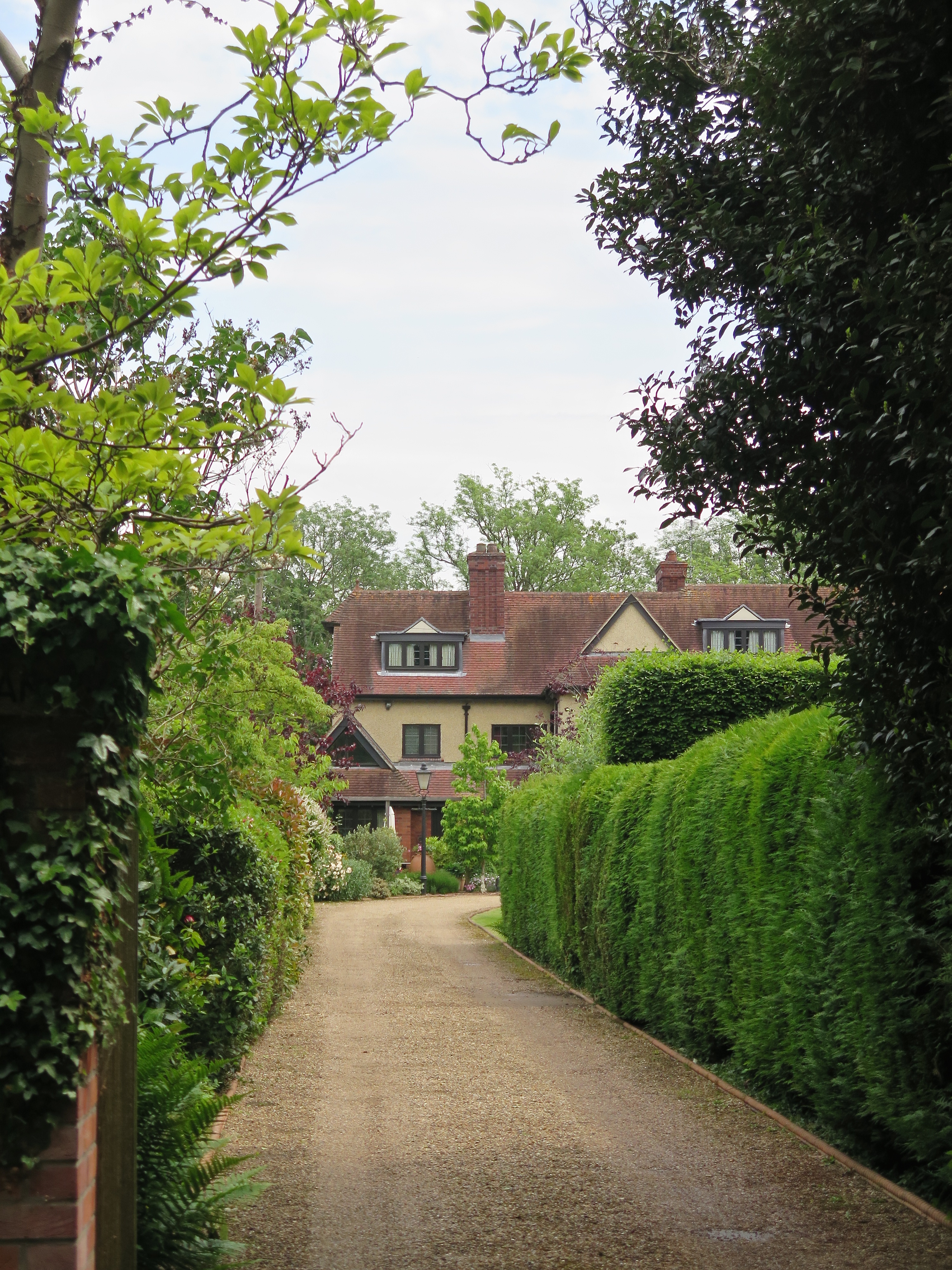
With the scent of a possible cream tea in our nostrils, we walked up to the Shiplake pub through an avenue of glorious trees and even gloriouser homes. Beyond very nice. VNH+, even ++. Their names had become riparian, The Ripples, The River Cottage etc, and for a kilometre or so they had their own private river frontages.

IMG_1432We stopped to look at the map for a moment and, blow me down, I was pretty sure that what we were looking at was a house featured on ‘Grand Designs’ (at right) and, apart from ‘budget’ and ‘then the winter rains came’, the big issue was building a distinctively modern house on this very narrow Shiplakian block. Out of keeping; not like the neighbourhood; neighbours stacking on a turn. Boo hiss, in fact, hissssss, to the stodgy complainants.

IMG_1434Looking very like the others nearby, this was the house next door (at left). In situ, I wondered if my hiss might have to be withdrawn or at least moderated. Can you build whatever you like, or should you pay respect to the rest of the built environment? From a cosmic perspective it is not of the slightest importance, and the new building was actually beautifully designed (still not finished I noted), but standing there in Bolney Rd I felt much more sympathetic than I had to the views of the locals.

Further down the road was Thames Side Court. We didn’t see it, you can’t see it unless you’re invited in. The Path takes you round its most substantial perimeter. Ooo ah you go, not least because in the midst of all this rain the huge garden was being watered, and Oo ahh a mini rail line is running along the fence. And then ahh ooh, the much photographed mini rail station. Unknown-1The tower is perhaps 2.5m high.

We ran into a tradie here who had been doing some work on the other side of the fence. What went on there? What was the railway about? Big money, he said. Pots of dough. Owns the polo grounds next door. They never come here, but they built the railway for the grandkids, but now they don’t come much either. So this property the size of a small farm with its enormous upkeep impost, well … as  far as I could tell, not far, was left to the artisans and the ducks to enjoy.

While we’re on houses, check this one out. IMG_1445

Start right at the pollarded trees. Then the patterned lawn. Move up to the arch of boulders. Left to the clipped fascia. Left again to the decorative elements on the feature wing. Down to the boat entrance. Left again and up to the brand new screened wing with huge viewing platform on its top. I’m not sure what it would be like to live in, but it’s worth a round of applause at least.

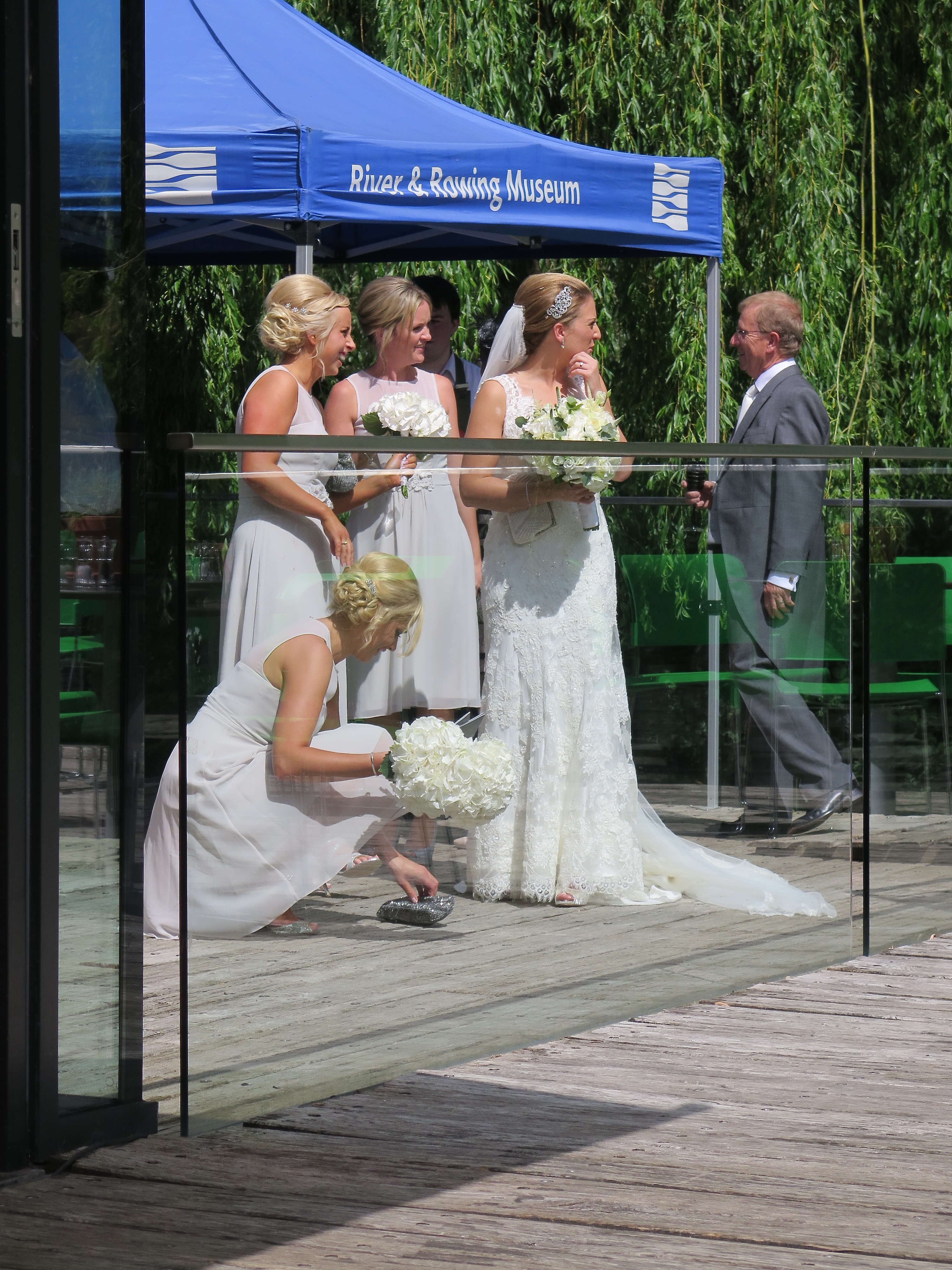
IMG_1454We got to the Museum, watched a wedding, drank elderberry fizz and ate scones. Could life have been improved? Only in one regard.IMG_1464

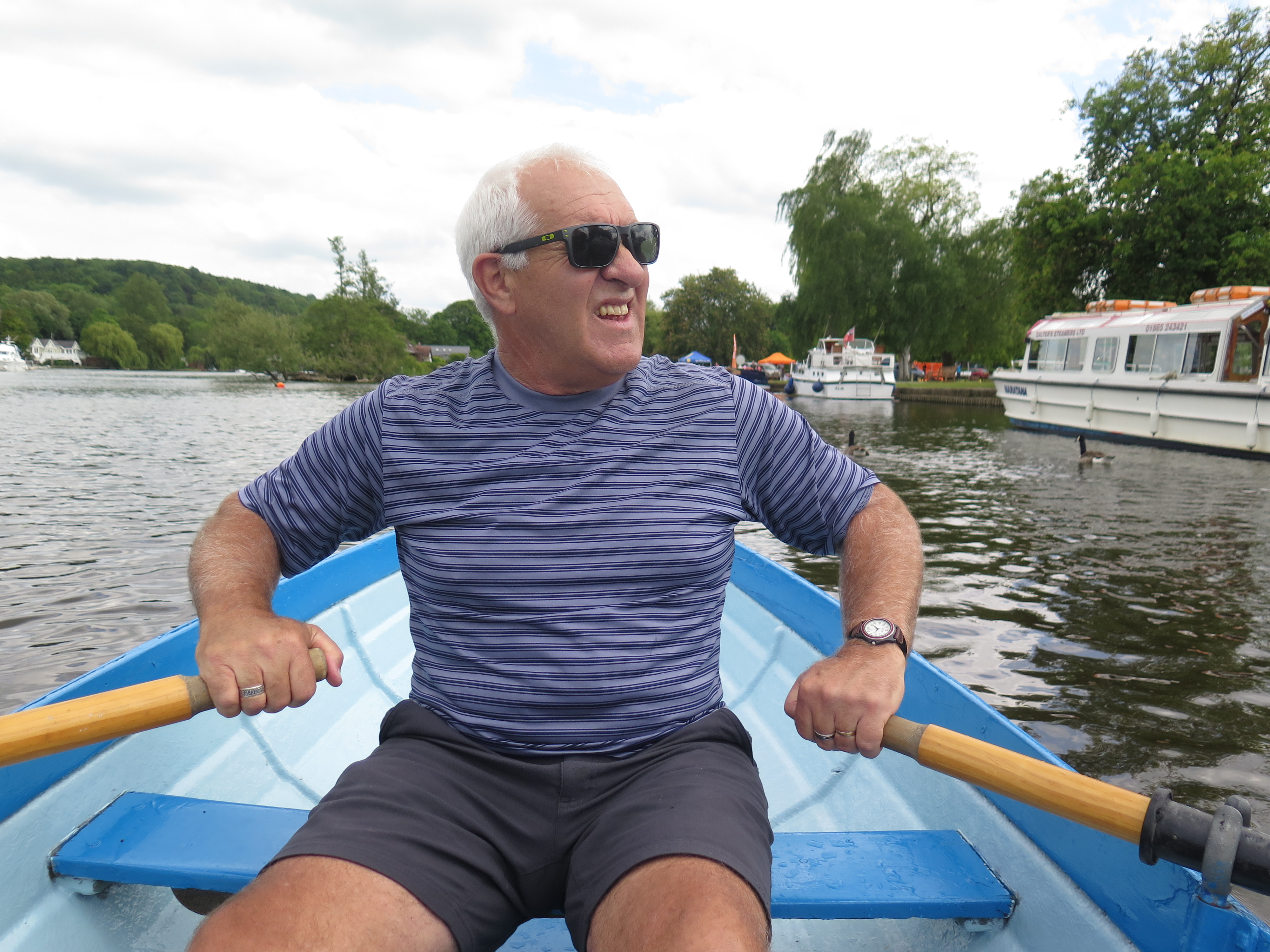
We went rowing.

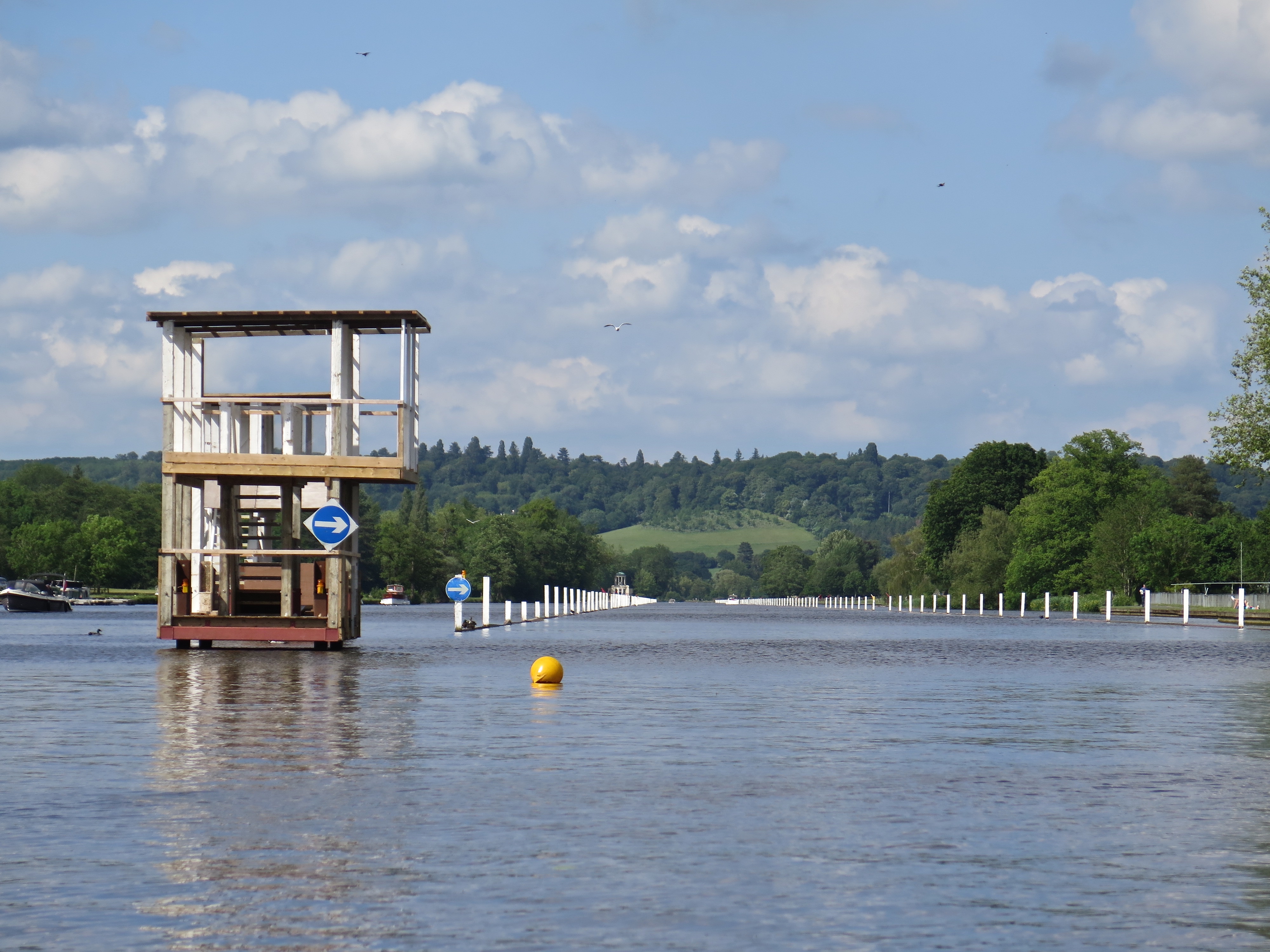
This was not the well set-up skiff I was looking for; in fact it was an awful boat. But we were out on the water and with the regatta being set up a week away we rowed half the course.IMG_1488

And this, ladies and gentlemen, is Henley from the water, Temple Island the starting line just visible in the far distant centre with the finish line in the foreground. 

We repaired to our excellent hotel, The Row Barge, the one we liked most on the walk I think, and I drank beer and swapped good cheer with a party from Leigh-on-Sea which, for a start, my untutored ear took as somewhere in France. (Like Beyoncé?) It was a weekend and they’d driven over from the other side of London for a drink. ‘Mightn’t stop at one.’ The men averred they were rugby union fans. The two women said there wasn’t a match they’d ever seen the end of. ‘Roarin’ blind by then.’ They knew about Australia and Australians. Shit daytime TV and really bad ads generally. The people are friendly, but they’ve got no ‘brains’, meaning I think, are not quick-witted. No one goes to sport; they all go to the beach. Anyway it’s too hot to watch sport.  And if they do go they don’t know how to behave (don’t sing), and there are no good pubs. A cousin of the alpha male of the group lived in Sydney and was coming home for those very reasons.

What could I say except, my round? We had in fact become addicted to the early morning BBC, and there isn’t anyone as smooth and or as smart as Charlie Stayt and Naga Munchetty probably anywhere on Australian TV. But the ads? Ok we’ve got crap ads.

Henley and this stretch of the Path — fabulous.

Henley-on-Thames to Marlow — 14 km

We paid our respects to the late great Dusty Springfield and the Leander Rowing Club which is not where the guidebook thinks it is, and with a hop, step and a jump we knew when we’d done the first 2000m. The Path took us off the river to Aston through a thrilling display by a horde of kites careening around above a big chook run and from here there was the first sense of the Thames running through a valley.
IMG_1516
The river is tucked away behind those trees. It is still no monster. Races at Henley are only ever rowed two abreast.

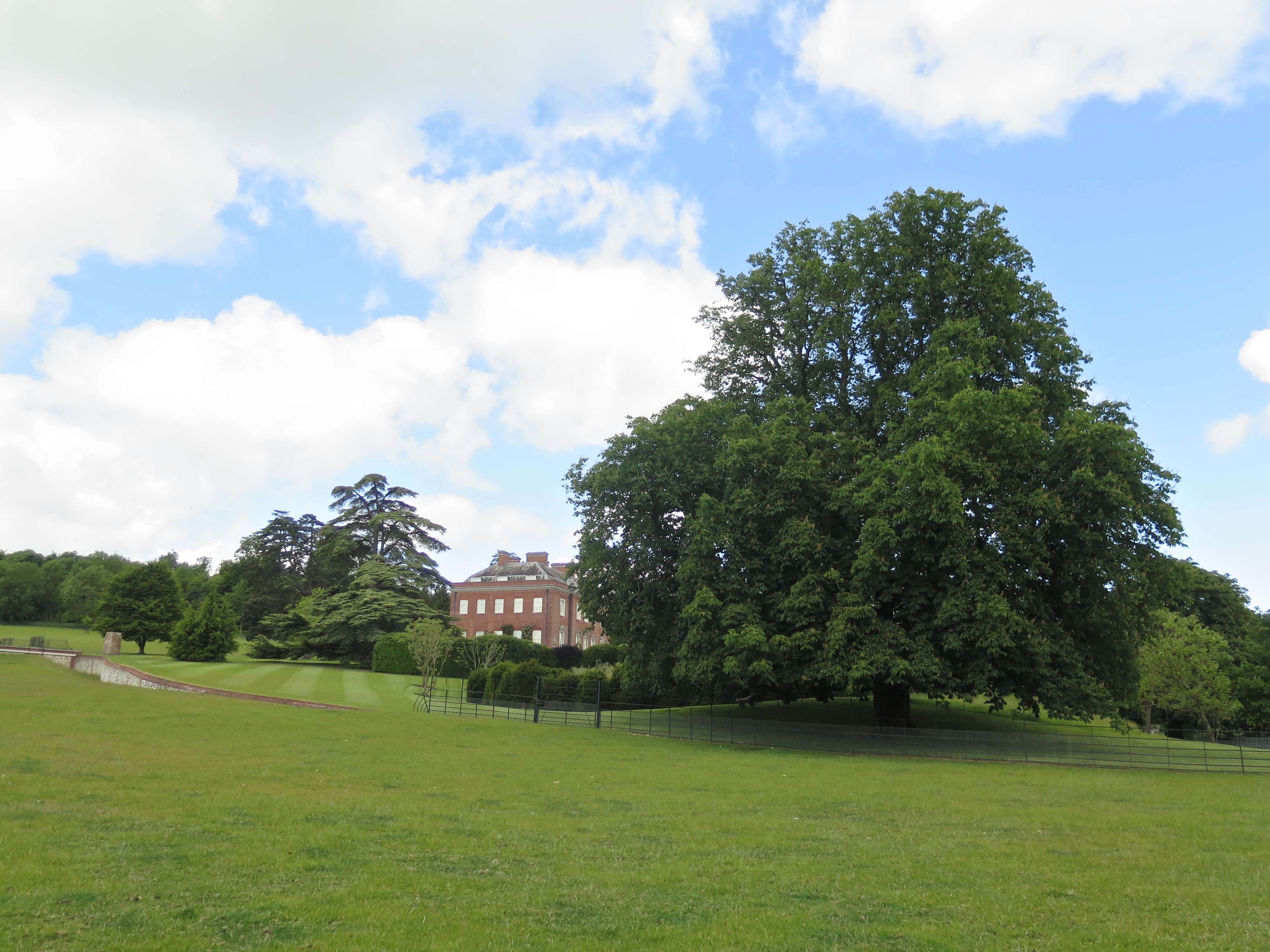
The pic above was taken just near Holme farm. A few hundred metres more and we were in Culham Farm walking past Culham House, its glorious chestnut tree, and its ha-ha.IMG_1529

Myrna was bemused by this vast pile and the efforts which had been made to ensure privacy when it was all battened down with no one home. And, lo and behold, what did I discover!

Daily Mail Aug 27, 2006: 

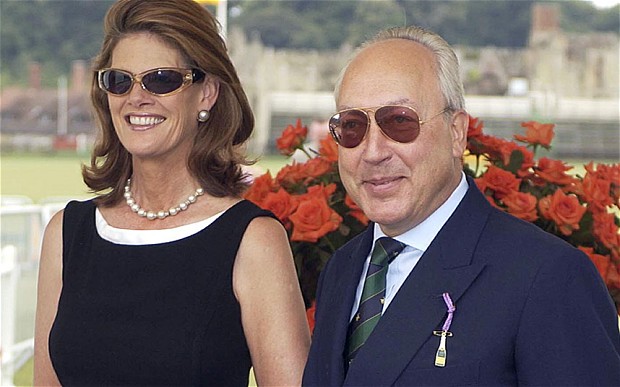
Schwarzenbach_2984188bWhen a magnificent country house went on the market for £25million, financier Urs Schwarzenbach decided that the owners weren’t asking enough. He offered £10million extra and exchanged contracts within a week on Culham Court, on the banks of the Thames. (!)

Swiss-born Mr Schwarzenbach, 57, and his wife Francesca, a former Miss Australia (!!), plan to move into the ten-bedroom house near Henley, Oxfordshire, later this year. … “We are thrilled at the thought of moving into Culham Court and making it our home,” the couple said in a statement. 

The departing owners, Paddy and Annabel Nicoll said: “We are delighted that a local family is buying Culham Court. The Schwarzenbachs have always been incredibly supportive of causes in and around Henley, most recently through their funding of the redesign and build of the River and Rowing Museum. (!!!)

Clive Hopkins, head of farms and estates at Knight Frank, said: “It is a classic Georgian house in a perfect location. It doesn’t get any better than this.” 

Mr Schwarzenbach, a keen polo player and friend of Prince Charles, has lived in Britain since the 1980s. His current home, Thames Side Court in Shiplake, has polo facilities and has been described as a ‘Disneyland-style park modelled on the train station at St Moritz’. (Et voila!!!!)

He also owns a 26,000-acre estate in Scotland on which he has lavished more than £20million, reportedly adding a bowling alley, marble-lined hot tub and a panic room to hide from potential kidnappers. The family also has a £3million chalet in St Moritz, four other homes in Switzerland and 123,000 acres in Australia, including a ranch where Prince Harry spent part of his gap year. 

This wasn’t in the guidebook! Especially the panic room bit. The threads — all drawn together — to unify the last 30 km! Even if he is only the 115th richest person in England, he owns a lot of south Oxfordshire including the village of Hambleden where ‘Midsomer Murders’ has been filmed. His paw marks are everywhere!

I note ‘In 2012 the Schwarzenbachs revoked their consent for the permissive footpath that had run alongside the Thames in front of Culham Court as part of The Thames Path for many years.’ Must have changed their minds. But we were there even if Mr Schwarzenbach, now 67, and his wife the former Miss Australia (godmother of Lady Louise Windsor, daughter, Earl of Wessex (Edward*)), weren’t.

IMG_1530The grounds were full of white harts and there was noise coming from a large industrial shed on the hill that sounded like something out of ‘Brittania Hospital‘. I didn’t like to make that connection and we moved on.

At Hurley Lock we did, for the very first time, find a cream tea and, as might be anticipated, it was not quite what it was cracked up to be. Bit stodgy. But the dogs enjoyed their repast. IMG_1531[Please insert your own humorous tagline. Publication and prizes will be considered.]

IMG_1538 2Despite a sign defaming its very elegant bridge as ‘weak’, Marlow was as welcoming and pleasant as Henley. The concentration of Rollers, Mercs, BMs, and Bentleys in High Street Marlow was just as high as in Hart St Henley; the number of Ferraris, Bugattis, Aston Martins, Maseratis, and top end Jags on a par. Felt right at home.

* From a biography: ‘Prince Edward made two very public attempts to pursue a career but, after failing at both, returned to his life as full-time member of the royal family.’

Marlow to Windsor — 24 km

The mess round the two first toes on my left foot was in train of becoming pretty gross. Several new blisters had emerged consequent on trying to correct the implications of the first including, not that I realised it at the time, a blister or blisters below other blisters, deep blisters. I couldn’t see anything properly, but what you couldn’t see could still be a bit painful. The bottoms of my feet are generally like rhino hide but they had been constantly wet for most of 10 or 12 days, absorbed water, got soft and their calluses had lifted off the underlying skin. My standard treatment had caused more harm than good and when I removed the elastoplast a fair bit of skin came too. Ha ho. Issues.

I plundered Marlow’s Boots for anything that might work. I had also put some ti tree oil on the affected areas, as we professionals say, in anticipation that it would produce a magic result. What it did was to make it difficult to stick the ‘second skin’ plasters on. But, hey, what’s science but trial and error?

We had three choices: just walk on; get a cab the whole way to Windsor; or take punt on getting a cab to somewhere in the middle and see how I went from there. It wasn’t if we were in the middle of a wilderness.

It was one of the longer sections so walking the whole way was probably not that good an idea. But it was another nice day and I didn’t want to miss it by sitting still. So we decided to get a cab to the bridge at Maidenhead which the driver insisted on calling Boulter’s Lock which was about 2km north and not where we wanted to go at all. My advantage of being in possession of the relevant A-Z map had no impact. There are times when foreigners just can’t win. But he did drop us at the bridge where we got some coffee served by a gal from Mt Isa on her gap year.

We’d knocked off 8km and in doing so we missed seeing a Stanley Spencer-assisted resurrection in the Cookham cemetery (a pictorial representation of which we were later able to consult in the Tate), missed drinking in the atmospherics of Cliveden and Cabinet Ministers playing up with Russian spies possibly joined at or near the hip by Ms C. Keeler, missed eating at the Fat Duck at Bray (wrong bank) but anyway Heston Blumenthal was in Melbourne.

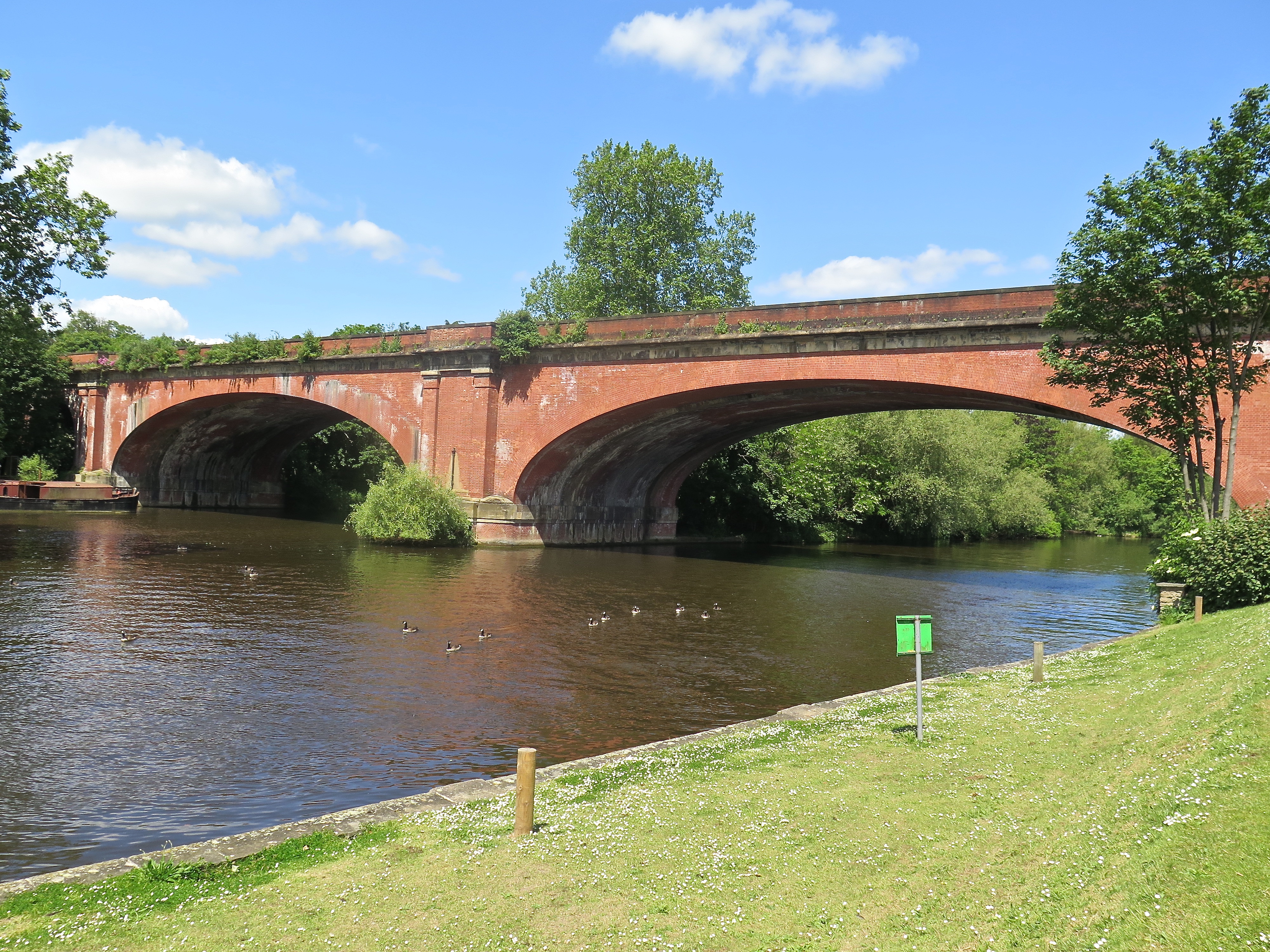
I began a bit nervously, but it wasn’t problem. Perhaps as we warmed up my foot had self-anaesthetised. I don’t know. Maybe I had a shoe full of blood. I didn’t look. By the time we got to Brunel’s next bridge I’d forgotten about it.IMG_1546What a killer. What an absolute killer. All brick with two long flat arches. The sign says [still, since 1838] the longest (128 feet, 39m) and flattest (24 feet, 7m) brick arches in the world. I have read that his backers would not believe this bridge (I think) would hold up, so they demanded that he build in-fill supports. He did, leaving a gap of a few inches between the top of the supports and the bridge, i.e. there was no support happening. Some time later at the next high water the supports were washed away and never replaced. That’s confidence for you. But who could believe that a curve shaped like that built out of bits of baked clay and burnt lime would support generations of train traffic? Applause applause.

On exit, Maidenhead offered a generous esplanade lined with VNHs which could even be described as gracious. It wasn’t long before we were walking along the side of the Dorney Lakes Rowing course. Ten years to build and costing £17m, it is owned and of course used by Eton College, but was the site of the rowing events held at the London Olympics. (Wags head. Were we walking through money or what?) The Path was grassy and busy with walkers and cyclists and, closer to Windsor, swimmers (of the naughty boy variety). The last stretch perambulates around and was sheltered by trees.

You walk through casual artIMG_1548IMG_1551 and more deliberate art (at right, for the Olympics, on the track to the rowing), just moseying along, and then suddenly across a river meadow called ‘The Brocas’, named for a 13th century family of local nobles and now owned by Eton, you come out of the wood andIMG_1552

Have a rest and then continue east.

#4 A Green and Pleasant Land: walking along the Thames

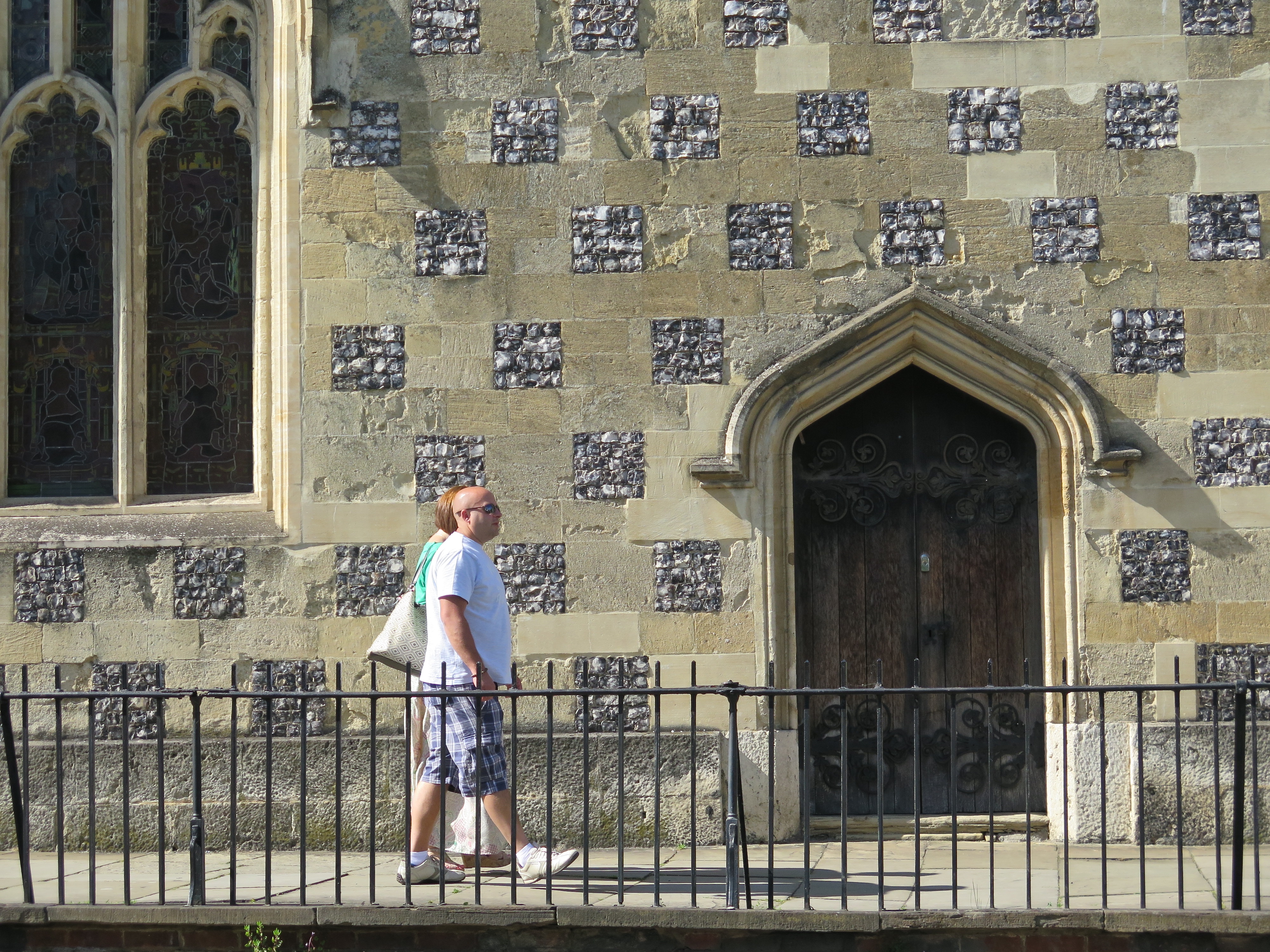
Flint!

In Goring we thought we would try our hand at something different for our evening meal. So, generating the usual crisis, we wandered up the main street to explore the range of options. Indian we decided. Masoom was a very clean, very cautious, white linen napkin version of the genre and appreciated as such by the well-heeled scions of Goring. Whether or not any of the food would be recognised in Varanasi, Delhi or Mumbai is neither here nor there; it was tailored to palates very similar to our own and we left well-pleased.

A couple of doors up was this house.IMG_1375

There, I said. There it is. Writ large. The late evening sunlight bouncing off it. And I stood there trying to take just the right photo and failed because the owner came out quite briskly to see what we were up to. This provided the perfect opportunity for an investigation. Flint, she said. The house is a couple of years old and while there were some issues about its construction, you couldn’t fault the flint work.

So, flint. Bugger me. Harbinger of civilisation, essence of early tools, provider of the first blades and arrowheads, the spark for a million fires, the flint in flintlocks — and I’d never seen it before.

Flint is a hard, sedimentary cryptocrystalline form of the mineral quartz. It occurs chiefly as nodules and masses in sedimentary rocks, such as chalks and limestones. And what are The Cotswolds? A chalk escarpment.

You can see the glassy quality and the splendid variation of shade in the photo. These had been knapped, in this case split to provide a flat surface. Knapping is just the process of hammering a piece off the original ‘ball’ of flint. It is possible to make the pieces square or any shape in fact. Historically, flint knappers commonly suffered from silicosis, due to the inhalation of flint dust — the world’s first industrial disease. So much information. Truly blogging with a public purpose.

Flint does not occur naturally in Australia. Anywhere. Isn’t that interesting? Plenty of iron ore, loads of bauxite, uranium, mineral sands, rare earths, opals, even cognac diamonds, and yes, chert which is in the flint family — but no actual flint. That might mean something. Where we were however, there was plenty of flint. Sections of the Path were strewn with it. I picked up a piece that I’m looking at now. I like rubbing my finger on the napped section. On the other side it still has its vernix.

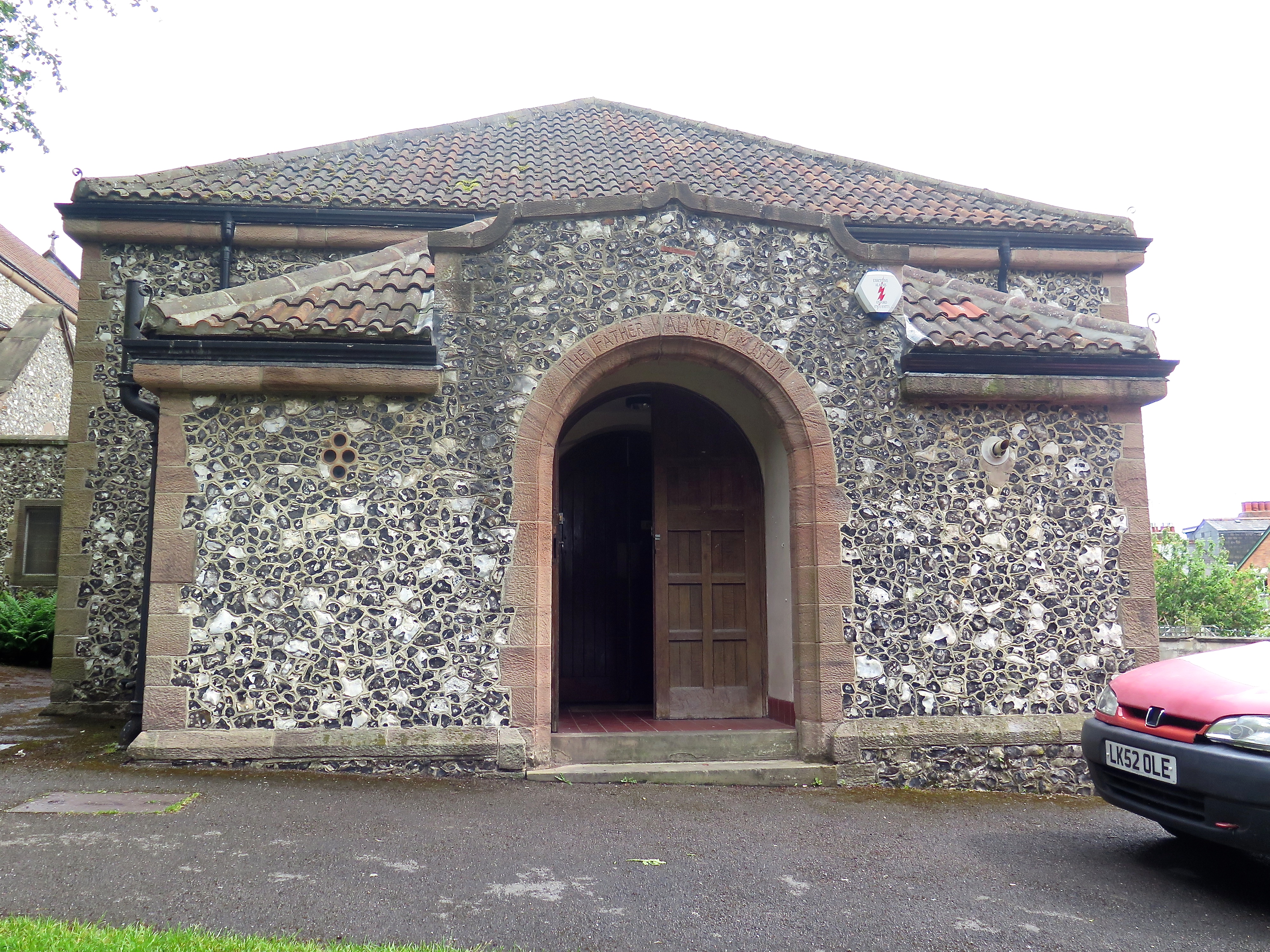
IMG_1250Flint at Oxford. The Father Walmsley Museum, an annexe of the church where I remarked on it first. The mortar is pointed unusually.

IMG_1288


Flint at Abingdon, squared off by knapping.


IMG_1328


Flint at Dorchester, still cobbled but fitted into rectangular slabs.

IMG_1394


Flint at Whitchurch-on-Thames knapped to the size of half a brick.


IMG_1498


Flint at Henley-on-Thames. Could it be called diapered? Actually no. It needs to be a diamond-shaped pattern for that.

IMG_1570


Flint at Windsor inserted into the mortar courses of the castle. To reduce the construction effort, or to make the mortar sparkle? Either way it’s galletting.

Goring to Reading — 18 km

We began the day with a return to Ms Pierrepont’s establishment for proper coffee and the sandwiches we’d been promised. It was sunny day of sculptural stillness, the surface of the river a mirror.IMG_1378

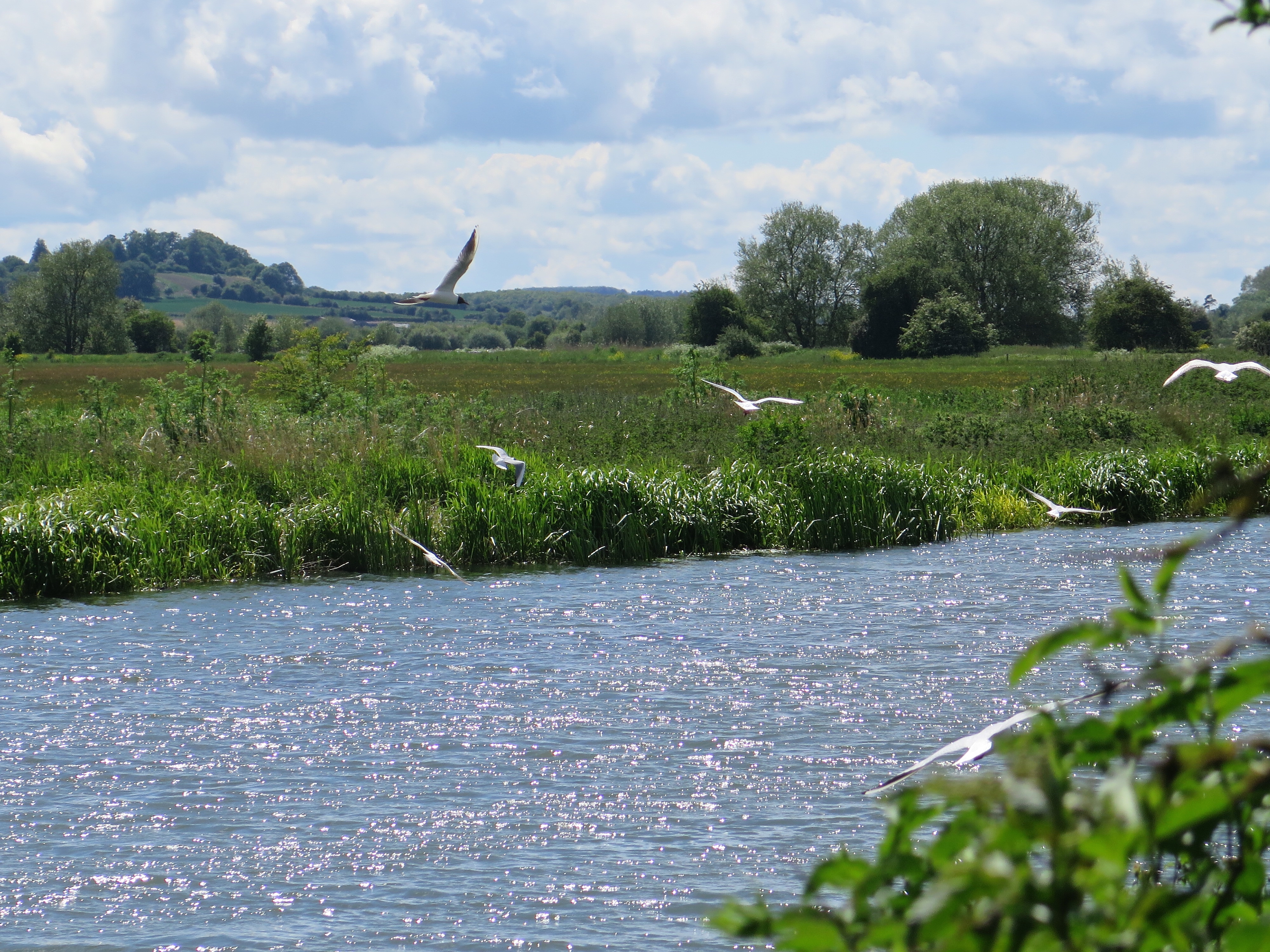
IMG_1398Classic meadow walking with the river still about 25-30m wide. Cows, geese, black-faced gulls, kites and another one of Brunel’s masterpieces about halfway to the wood and the climb, ‘down to a dry bottom and then a steep ascent’ clinging to the rugged chalk cliff faces like human flies. The wood and the climb did make a change and like the rest of the day, they were just lovely.

All of which does not stop people being in nature, but not of nature.IMG_1379

Another of Brunel’s masterpieces near Gatehampton Manor.IMG_1381


Below, a walker struggling up the ascent.

IMG_1390

IMG_1384At left, two walkers finding themselves in a crazy mirror used presumably for practising dressage.


The climb preceded an attractive stretch through wooded farmland before a gentle glide down a busy road into Whitchurch, a very very pretty little town with a toll bridge authorised by the ‘Whitchurch Bridge Act paffed In this thirty-second year in the reign of His Moft Gracious Majesty King George III’. However the paffage of horfes engaged in drawing veffels along the river was legislatively exempted. And does the toll still apply? Yef indeed it does. Depending on the type of vehicle, anywhere between 40p and 3 quid. Pedestrians go free.IMG_1395

And on the other side of the bridge, the beginning of another cheery form of messing about in boats.

IMG_1397Mole and Ratty (from Kenneth Grahame’s Wind in the Willows) should be introduced here.

[Mole] thought his happiness was complete when, as he meandered aimlessly along, suddenly he stood by the edge of a full-fed river. Never in his life had he seen a river before—this sleek, sinuous, full-bodied animal, chasing and chuckling, gripping things with a gurgle and leaving them with a laugh, to fling itself on fresh playmates that shook themselves free, and were caught and held again. All was a-shake and a-shiver—glints and gleams and sparkles, rustle and swirl, chatter and bubble. The Mole was bewitched, entranced, fascinated. By the side of the river he trotted as one trots, when very small, by the side of a man who holds one spellbound by exciting stories; and when tired at last, he sat on the bank, while the river still chattered on to him, a babbling procession of the best stories in the world, sent from the heart of the earth to be told at last to the insatiable sea. …IMG_1405

[He meets the very capable Ratty.] ‘What?’ cried the Rat, open-mouthed: ‘Never been in a—you never—well I—what have you been doing, then?’

‘Is it so nice as all that?’ asked the Mole shyly, though he was quite prepared to believe it as he leant back in his seat and surveyed the cushions, the oars, the rowlocks, and all the fascinating fittings, and felt the boat sway lightly under him.

‘Nice? It’s the only thing,’ said the Water Rat solemnly as he leant forward for his stroke. ‘Believe me, my young friend, there is nothing—absolute nothing—half so much worth doing as simply messing about in boats. Simply messing,’ he went on dreamily. …

‘I beg your pardon,’ said the Mole, pulling himself together with an effort. ‘You must think me very rude; but all this is so new to me. So—this—is—a—River!’

The River,’ corrected the Rat.

And here, and on this day, that’s just how it was. I was most envious of the pair in the skiff above.

There is some conjecture about which of the grand houses on the long delectable curve of the other bank Grahame used as a model for Toad Hall, but I’m going with Hardwick House because of this squadron of ducks. I can also see the stoats and weasels living in the slightly wild wood beyond.IMG_1403We sat on the bank at Pangbourne eating our lunch watching four child care workers with a passel of very small kids, some just toddling, and agreed that good quality childcare could be very good indeed. The focus was explicitly on the kids and what they were doing; they were talked with, encouraged in lots of language practice, and what they were doing was constantly named and converted into something interesting. An hour or so later we ran into a group of young mums in Purley. They were talking to each other, not watching the kids and in fact ignoring them as they wandered back and forth across a trafficky road and played in the cow pats on either side. Not bad mums, just a bit bored with their lot. It can be a virtue to get professional assistance. Go, you massively underpaid and undervalued childcare workers!

This chap was waiting his turn at Mapledurham Lock. There was a lot of opportunity to take dog on boat photos. IMG_1408Question. In the event of a sinking would the vest have saved the pooch? That could only be investigated empirically. I have no answer. Sort of looked cute though, in a hi-vis kind of way.

IMG_1409And this guy was, on his ladder, waiting for trains, which we had been following directly for a few kilometres and which — it must be said — were roaring past every five minutes. But it wasn’t just any train he was waiting for. He wasn’t even sure that the engine he wanted to photograph was coming past this afternoon. But if it did he would be there to see it. He gave me a very generous description of just what was going on. Perhaps when you’re walking you have time to see and note some of the world’s vast clutch of enthusiasms.

Rounding the big meadow that the Path brings you back to after the suburbs of Purley and the company of the train line there is little intimation of what lies beyond. Suddenly, with the advent of the Reading esplanade the river grows up. I had a sense that we’d left the countryside behind — not quite true as it happens — but we certainly had here. There was also a newly-minted sniff of grandeur about the view.IMG_1410Right here we saw our first oarsperson, in a scull, 153 km from the source and 64.59% of our way. And, for almost the first time in 20 years, I had a blister.

#3 A Green and Pleasant Land: walking along the Thames

The Dreaming SpiresIMG_1220

Over there. Over the back. Over some of the 440 acres of the Port Meadow that have never been ploughed, vested to the burghers of Oxford by either King Alfred or William the Conqueror (contested: official guide book v. Wikipedia) for their help in sending the Danes packing around the turn of the first millennium, and subject to regular flooding. Still can’t see it? No? You might need to go back to Matthew Arnold (Line 19) for further advice. 

But dreaming spires or not, Oxford looked like a lot of fun, a place to go back to and spend more time.

If I say we wanted to do three things it will sound like we were organised. We are organised but within a very limited compass. However, when we were walking through town we had walked past some posters advertising a show of ‘Great British Drawing’ at the Ashmolean. That sounded attractive and we got enthusiastic. I tried to get tickets on the website and couldn’t pull it off. Our hosts thought it would possibly be booked out. Myrna wanted to chase down the groovy part of town to see what was offering in terms of fashion, and we both wanted a swim to use some different muscles.

Gown

After a brief tutorial on bus usage and a longer session locating a suitable pool, we set off in light rain walking past the Martyrs’ Memorial (Thomas Cranmer in flames; I should have paid more attention) and all sorts of other no doubt significant architecture. It was a grey Sunday morning with absolutely no one about and that included aspirants for viewing ‘Great British Drawing’. There were more people on the desk (four) than in the exhibition. This turned out to be more Great British than Great Drawing but it was interesting enough.

IMG_1233I include this especially for members of my family who will understand. It is the original. Any fule kno that. Seeing this was a highlight of my advancing years. Enuff said.

The museum itself more than made up for any inadequacy in the drawings. I was overwhelmed by the china, the collective noun for which may be ‘surfeit’,IMG_1234 but the Scandinavian runestone and Alfred’s Jewel definitely gripped me.

IMG_1238Wikipedia notes that the ‘Jewel’ is an Anglo-Saxon artefact made of enamel and quartz enclosed in gold (about as big as your thumb, a big thumb) that was discovered in 1693, and has been dated from the late 9th century. It was made in the reign of Alfred the Great and is inscribed ‘aelfred mec heht gewyrcan’, meaning ‘Alfred ordered me made’. The jewel was once attached to a rod, probably of wood, at its base. After decades of scholarly discussion, it is now ‘generally accepted’ that the jewel’s function was to be the handle for a pointer stick for following words when reading a book (or whatever was to be read) suggesting that Alfred may have been literate. I like that idea.

Town

We walked off to Jericho looking for the groovy shops and they might have been there, but they may also have been disguised by the weather, the time and the day of the week. An inspection was conducted of several but the expert could find nothing that obtruded from the ruck.

IMG_1245We had a good cup of coffee and an outstanding banana split at a café nearby, and then with the very helpful assistance of these two splendid gals spent 40 minutes trying to raise a taxi. The drive through the northern suburbs to the Ferry Pool Leisure Centre was at least as interesting as the city centre. After getting a sworn declaration that a taxi would return to the pool for us in an hour, we joined the two other foreigners swimming laps.

Our B&B was very close to the Iffley Rd track where Roger Bannister ran the first sub-four minute mile. I was taken by that, but I had also noticed and puzzled over this church next door. IMG_1247Polkadottery? Poor quality petroglyphs? Stoney small pox? Fortuitous meteorite shower? I remained puzzled for several days until we had this all explained. But we had come across something indigenous which does not exist in our country. (For further discussion, see here.)

I was examining the church but heard crowd noises close at hand and thought I should investigate. I would have liked to have seen a game of rugby at Oxford. And so I did, Oxford versing Gloucester All Gold; but it wasn’t union, it was league — not the dullest game on earth but a promising candidate.
IMG_1251And what on earth was league doing this far south anyway? Surely there’s some barrage or gate near Nottingham or Leicester where the size of south-bound immigrants’ necks is measured, along with their propensity for running into brick walls.

I found myself standing next to the team manager’s wife — one son was providing radio commentary, the other was shooting the video — and we had a long conversation about the task of building a rugby league team in Oxford. They were from Leeds and each weekend drove down for the games. Being Australian, I was presumed to be an expert. Pas de problème. Unknown-1I had watched the most recent State of Origin, plus I’m a big fan of Billy Slater’s. End of story really. I was happy to oblige. Yet another instance of leaving England just that little bit better off than when we arrived.

IMG_1261Launched ourselves at the Magdalen Arms again and observed one of the great domestic non-competitive eatathons ever. I think the table of four next door consumed the entire menu. That’s what it looked like anyway. Our requirements were more modest and again most agreeably satisfied.

MidsomerIMG_1321

(Dorchester above) Midsomer is the county. Causton is the town. The ground is not covered in blood so much as corpses, because it’s the manner of death that matters more than the attendant gore. You may be impaled, for example, by a filigreed letter opener or trampled by a rabid badger. You may die by staring too fixedly at a photo of Tony Blair, or be throttled by a radio-controlled Barbie doll. It is, so to speak, murder.

I organized the walk so we could spend a night at Abingdon because I thought, mistakenly, that it was one of the prime sites for filming ‘Midsomer Murders’. But no. Wallingford is one base, and it was in the pub at Dorchester that we found the photos signed by Detective Chief Inspector Barnaby and his sidekick Detective Sergeant Jones.

In March 2011, the series’ producer, Brian True-May, was suspended by his company after telling the magazine Radio Times that the program did not have any non-white characters because the series was a ‘bastion of Englishness’. When challenged about the term ‘Englishness’ and whether that would exclude different ethnic minorities, True-May responded: ‘Well, it should do’, adding somewhat unnecessarily, ‘Maybe I’m not politically correct’.

Mr True-May crept out of his crease only just a little too far. He could have simply said, well that’s who lives where we make the series. Because I don’t know who lives in this little patch of southern Oxfordshire but very few of them appeared to have skin other than of a pinkish hue (and the vast majority seemed to drive very expensive cars). As the District Council says: ‘Although located less than an hour from London, Southern Oxfordshire is a proper rural retreat of village greens, country pubs and thatched roofs; the ideal spot to recharge batteries.’ Or to be murdered in some highly imaginative way by another Anglo-Saxon.

 Oxford to Abingdon — 15 km (-4)

It was the first day of summer when we got back on the Path, a day which was chilly, short (we began from well down the Iffley Road) and without incident. This is where we got back on. You can see the very well-trodden (and cycled, by rowing coaches) version of the Path running along the far side.IMG_1262

IMG_1272One VNH that in other circumstances I may have coveted. It is not a great photo because it doesn’t show how well the house was settled into its landscape. In addition I was trying to do something clever with the tree in the foreground  that absolutely did not come off. The property was beautifully maintained, and we watched the tribes at work on it. You want to see how trees should be pollarded? Like this.IMG_1291

It reminded us of walking from South Head back to the city in Sydney through some of the most expensive real estate on earth. Did we see any of the inhabitants? No we didn’t. On a daily basis the people enjoying the southern shore of Sydney harbor are cleaners, gardeners and tradespeople. Much the same thing seemed to be occurring here.

We came to a reach almost four km long, just a slight bend in it, which would be a rower’s heaven. Radley College’s sprawling boatsheds with their 11 follow boats moored to the landing were well located to take advantage of this. We’re walking through serious money here.

IMG_1266The tourist water buses went up and down empty, or near as dammit. If you are bothered to click on the pic above you will see one lonely soul. And geese, it was a day of geese. We found one spot where they had obviously been nesting, although the goslings were now well advanced. A semicircle 50m in diameter had been carved into the crop by foraging geese. Just bare earth was left. 

IMG_1286We got to Abingdon at lunchtime and tooled around its streets. The town has its stories: possibly the oldest continuously inhabited settlement in the country with evidence of Iron Age humankind; bun-throwing from the roof of the C17th County Hall to celebrate big moments; a rather lovely bridge that meets on an island in the middle of the Thames; home of MG (Morris Garage) sports cars. But it mightn’t have been exactly at its best. We were waiting for a thunderstorm, this time with 80-100 mph winds, a good big one — and the town all looked a bit tired, old and, if you can look smelly, smelly. In the built environment it often doesn’t take much for the picturesque to slip on the more honest garb of decrepitude. The weather plays its part.

Our accommodation, the Kingfisher Barn (rated ★★★★) was an intriguing study in the second rate. Everything, through and through — just off. The reception, the cleaning, the furniture, the bathroom, the breakfast, the floor of the breakfast room, the works. Except for the car parking. You could readily find a car park there. And Myrna will correct me here. We had a swim in a small tepid pool that was pleasant enough.

To eat we walked the mile back into town to The Nag’s Head through biting sleet, the precursor of the storm, the receptionist driving in the same direction after work casually nudging us off the road onto the wet verge.

IMG_1294The Nag’s Head (at right, on the bridge) had good food, but the entertainment was watching a couple both breaking up and cementing their relationship at the same time.

While he spoke to her intently she would look wooden, occasionally yawning and stretching expansively. He would cry, she would hug and kiss him. He would turn away. She would plead. He would go and get another drink. She would draw him into her arms and they would cuddle. Then she would cross her arms and look away, turn back and speak to him solemnly, get up to go. He would grab her arm, she would pull away, and then return. She would look serious and try to be reasonable. Tears would well in his eyes.

Repeat four or five times. Foreplay for sure, but what would happen after that night was anybody’s guess. I want you to know I wasn’t staring.

And, folks, if you’re reading this, hope it all worked out. (June 1, Nag’s Head. Wild weather. Yeah I know. It was you? How about that, eh! Everything okay now? Yeah good.)

That night also we finished reading ‘Cymbeline’. What was he (Shakespeare) thinking?

In his critical reflection on the play Dr Johnson wrote: ‘To remark the folly of the fiction, the absurdity of the conduct, the confusion of the names and manners of different times, and the impossibility of the events in any system of life, were to waste criticism upon unresisting imbecility, upon faults too evident for detection, and too gross for aggravation.’ Correct weight Sam.

 Abingdon to Dorchester-on-Thames — 14 km

The predicted storm arrived. It was a night of violent weather and it rained all next morning. Just steadily. Nothing remarkable. My feet had been constantly wet for some days, but that was a function of long wet grass as much as rain.

We were back on the river bank weaving around a lot of damp patches, dams, small swamps, alternate bits of stream. IMG_1297Crowds of yellow irises growing with their feet in water poked their heads clear of the rushes and other tall water plants. Goldfinch_xSome gold finches appeared for us. We also ran into the first of many bridges for the extremely busy Oxford-London train line. This is a truly fabulous piece of early Victorian steel work, 170 years old and as good as the day it was opened.IMG_1298After a short leg south and a right angle the track took a slow curve right and then, lazily, most of a circle in the opposite direction to Day’s Lock staying on the pastoral rather than the settled bank. If you wish you can duck off to Sutton Courtenay (where Eric Blair/ George Orwell is buried), Appleford or Long Wittenham, but it is not until Clifton Hampden that you must encounter settlement.

IMG_1304This view is supposed to be one of the highlights of the walk. It could be. It may be better in autumn with a lot of leaf colour. Given my choice I’d have stopped the rain and brought the narrowboat up into the foreground, but you take what you can get. It was a lovely bridge. The bricks were a very desirable shade of red with just the right amount of blue in it.IMG_1305

But more to the point it was lunchtime and we had our fingers crossed that The Barley Mow might be able to oblige us. It had been a slightly miserable morning, and this was the The Barley Mow. IMG_1309Referred to very positively in Three Men in a Boat, thatched roof, built in 1352, the requisite number of beams on which you can brain yourself — the Ye Olde England works. We had a quiet reconnoitre because it was actually 11.40 rather than midday when it was due to open and no one seemed to be about. But one of the staff generously let us in and suddenly life looked better.

IMG_1313This was one of the great steak and ale pies ever. It began a steak and ale pie crawl through the pubs of the Home Counties, the products of which were often very good but never challenged the benchmark established here.

IMG_1315Suitably refreshed we moved on with the Wittenham Clumps mostly in view through the rain and mist. I had misread the guidebook and believed them to be the Queen Mother’s favourite part of England. I spent quite some time trying to work out why. Unknown-2In fact she had a painting of Paul Nash’s called ‘Wittenham Clumps’ (one of many possible options is at right) above her bed … and after two nights probably never noticed it again. Their more formal name is the Sinodun Hills. Dun = Fort; Seno = Old. That might make them more interesting. Maybe.

We got off the Path to spend the night in Dorchester at the George, a C15th coaching inn, ie with a substantial entry way in its frontage for coaches to pass through. There were nine right angle-ish turns and a complex set of stairs (not to mention a peculiar up-and-over) between the front door and our bedroom which among its very many attractions included no horizontal surfaces. A character property. We liked Dorchester.IMG_1326Dorchester-on-Thames to Goring — 20 km

 A very good breakfast at the George where, in a sunny conservatory, we discovered the 50 other people who had been staying there.

There hadn’t been a day, and wasn’t, when I didn’t think, whacko, this is going to be fun, let’s get on the track — but I felt especially bright and fit this morning. We’d slept well after watching ‘Skyfall’, Daniel Craig being James Bond. I hadn’t remembered how patriotic it was, a London Olympics Queen’s Jubilee year paean to Britain and things British.

IMG_1330This was a great day, diverse and intriguing. We left Dorchester past the dyke hills, remnants of an Iron Age fort, well pre-Roman, before Myrna felt in her pocket and decided she would take the key back while I watched a group of kites playing in the air currents.

IMG_1332The name of this house at Shillingford is Wisteria House. Are you able to tell me why? And yes, just the one plant.

And at the end of this stub of a road the Path goes a couple of hundred metres down IMG_1334this long lane. It’s always entertaining trying to imagine what’s on the other side of such a determined barrier. So you too don’t have to sneak up the drive, it was this.IMG_1339

But we’d scarcely got started when we arrived at Benson where we were delighted to join a rather select group of the bourgeoisie in an early brunch on a perfectly located deck next to the lock. Fellow walkers, plan to eat and drink here. To quote a departed friend who was proud of his rather faint Marxist tinge: ‘You can say what you like about the bourgeoisie, but by Christ they know how to live.’ And then it seemed a matter of minutes to Wallingford.

Wallingford was all that Abingdon hadn’t been. Myrna bought some sunglasses in a very grand Waitrose. I bought some lollies at the lolly shop, and the sandwiches were excellent. IMG_1350It doesn’t look like it above, but the square was busy. The streets really were South Oxfordshire.IMG_1348

We found the site where Oliver Cromwell’s cohorts had dilapidated a very ancient castle for taking the wrong side in the Civil War. Or perhaps because the building went into decline after the advent of the Black Death in 1349 and the stone was taken to Windsor to be used for the castle there. They both sound reasonable explanations. The open-work spire of St Peter’s was stylish and on the walk out of town we found another church both glamorous and staid with that odd stone again. ‘What is that stone!!’ I ask in my journal. It was everywhere.

On this sumptuous day and at this point the river was glassy, wide — about 25-30 metres here — and straight-ish. Perfect again for rowing. No sooner had we got out of town than we fell on the enormous Oxford University Boat Club sheds. Sheds! We can’t say ‘sheds’. Boathouse. Boathouses. Boats houses. Enough to accommodate a great many Syrian refugees.

IMG_1354And mansions. We had stepped well up from VNHs. They started to appear across vast green swards, several confidently exposed to the hoi polloi.

The viaduct at Moulsford amazed me, a rail bridge crossing the river at an oblique angle built with not just four skew arches but with curved intradoses as well, and all from brick. I think Brunel must have sat at home thinking, hmm how much harder can I make it? What can I pull off next? There were chaps patching it up as we went past, but the first version is 177 years old. (An additional bridge was built in 1892 to provide four tracks. As previously noted this is a busy line and it will be your companion for the 70km of Oxford to Reading.) IMG_1357Skew arches are hard enough to design and build, but the additional curve in the intrados, the underside of the arch, everything has a name — well, I just can’t fathom how it would be built.

220px-IKBrunelChainsIsambard Kingdom Brunel begins to become a figure at this point of the walk. What do experts call him? ‘One of the most ingenious and prolific figures in engineering history.’ ‘One of the 19th century’s engineering giants.’ ‘One of the greatest figures of the Industrial Revolution, who changed the face of the English landscape with his groundbreaking designs and ingenious constructions.’ 

If you didn’t know, you might think he was American. His father was French but he was born in Portsmouth. His father taught him drawing from the age of four and by the time he was eight Isambard had a grip on the fundamentals of Euclidean geometry. During this time he also learned French and the basic principles of engineering. As an adult, after nearly perishing in his father’s preliminary efforts to build the first tunnel under the Thames, he took on the task of building the Great Western Railway with the visionary idea of being able to buy one ticket which would take you from London to New York, first via rail to Bristol and then across the Atlantic on the steel-hulled, propellor-driven steamships he would design. (We walk along the original from Didcot to Reading, but the branch line to Oxford and Hereford is also his work.)

What glorious heady days! This is what the profusions, effulgences and revelries of imperial life can do for you. Your aspirations begin from a higher platform with a much greater degree of confidence about success. (I might note that, while undoubtedly capable and popular, James Bond left very little behind him in the way of public infrastructure.)

At the viaduct you turn right off the river. I thought at the time and elsewhere (Shiplake for example) one reason for deviation from the river was money. In this case we had to make our way round a Prep School. We could hear a host of golden children behind a hedge but we couldn’t see them. It was sports day and suddenly we could see them, hundreds of them, the future of England and possibly some of the wealthier and more stable parts of the Middle East and the sub-continent, all in their whites.IMG_1359This was Moulsford Prep School. Shortly we passed Cranford House, another school, P-12 this time, the motto of which is Per salicem ad alta, ‘Through willow to the heights’. True. Possibly another more classical reference to the significance of cricket.

And so to Goring, a grassy open walk with The Chilterns modestly looming to the north, and across the bridge the very happy discovery of Pierrepont’s Café, so much better than handy. That stone. It was everywhere here.

#2 A Green and Pleasant Land: walking along the Thames


IMG_1042Match artist and song:

Cathy’s Clown. Lipstick on your Collar. Just Walkin’ in the Rain. Wanted Man. Crazy. Only You.

Johnnie Ray. Patsy Cline. The Platters. Connie Francis. Frankie Laine. The Everly Brothers.

You can get the answer from the links, but you’ve probably got them right already.

This was the soundtrack at the Kemble Tavern. We’d gone further back in time. To the real classics. ‘Twenty in the posse/ Ain’t never gonna get no rest …’ The collegial bonding cry of the Birchip Secondary College staff in 1972. Even if golden, these songs are olden.
IMG_1069But the baguettes were excellent, the rosé a treat and although the taxi came from Cirencester to take us a very short distance, and charged 10 quid to do so, our destination, the Thames Head Inn on a beautiful attempt at a summer’s day, dispelled any discolourations on the horizon.

To shake out the jams (or are they kicked out? Not knowing what the jams actually are it probably doesn’t matter), we went for a stroll over to the source, a kilometre or so away, read the inscription on the stone [‘The Conservation of the River Thames 1857- 1974/ This stone was placed here to mark the Source of the River Thames’], and chatted to two Yorkshiremen our age who were going as far as Reading this time, 153 km in a week.IMG_1060 That would be good going. Oppressively so. We hadn’t even started. Hadn’t even drunk our first pint of ale.
We continued on through the pasture and past one of those fenced mini-jungles that an Englishperson might call a wood and found the remnants of the Severn canal which once connected the Thames with the Severn. An ambitious engineering marvel, this meant that you could transport stuff — anything you could put in a barge — from London to Bristol by water. But it ran through limestone and chalk country and springs kept creating leaks in its base. And then the trains came. Point finale.IMG_1045
A ramshackle barn with an extraordinary collection of farm equipment, and mud, cemented the notion that was forming that we were living in 1960s Punch cartoons. Norman Thelwell and his little girls with rotund ponies is a start, but not quite my memory of narrow lanes with hedgerows and taciturn farmers in beanies with a smoke on their lower lip driving tractors with the front shovel up, an MG going past driven by some nobs, often young, tweed cap, pipe, glamorous woman with a scarf, forcing them off the road or vice versa and some witticism passing. Mud, wellies, old sheds, more mud, tractors, cows, sheep across the road, sheep dogs, mud.

While sharp as a knife in my memory I can’t find any examples. But that’s where we were regardless.

I did find this.images

 The Source
IMG_1065
The Source to Cricklade — 20km

As we reconnoitered the night before I kept thinking of a 19th century note in a guidebook about just ramming your stick into the earth on the side of the hill where the source stone is located and, whoosh, you’ve activated a spring. There’s a tumble of rocks near the stone which might suggest a spring and from which water might flow after rain, but not when we were there. I think it’s likely that climate change might be playing a role just as it will be in the increasing incidence of floods, a once in 50-year phenomenon on the Thames except there have been three in the last decade with the 2007 floods the highest ever. According to the lock keeper it came half way up this window.IMG_1448
IMG_1055You can trace the possible course by following the cabbage-leaved weeds in this photo. Begin at the cow pat.

The First bridge: distance from source about 1km. Depending on your purview and range of interests, this bridge could carry the A433, Tetbury Road or the Fosse Way, the Roman road which went from Exeter near the coast of Devon to Lincoln, 300 km in something very close to a straight line.IMG_1078
As you can see from the other side of this bridge, the track leaves more definition than the river.IMG_1076
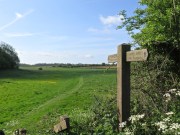
First puddle: 2 km from the source.

IMG_1084Just a puddle. It far more frequently looked more like this (far right).IMG_1083
First flow: 3.4 km from the source just near Parker’s Bridge. IMG_1085Invisible in the photo, the water glinted as it oozed through the gravel. Just a motion. Nothing more. I was more interested in the bustle in the hedgerows at the time. I wasn’t quite sure whether or not to be alarmed but soon realized it was just the spring clean for the May Queen. Ooo but it did make me wonder. [Drugs. Stay with me.]
First swan: Appeared as a mysterious white cloud in the distance across a park which encompassed Bittenham Springs’ private lake and event facility near Ewen. It was a swan, but not as we know them. Too big. BUT Bittenham Springs is a wedding venue, and as a matter of course — magical. ‘The perfect setting for our 145 guests and Welsh choir, in your amazing barn.’ ‘We had a tipi wedding there in August 2014, and it was the perfect setting for the relaxed, country-style theme.’

We went ooh ahh then and later that day when the swans (officially and actually Mute) were much closer on the river, and then we found families with goslings, and then over time they dropped beneath notice as the black-faced gulls, terns, cormorants, herons, finches and kites proved far more interesting.
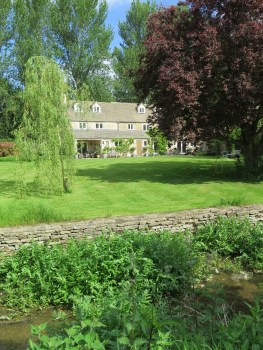
IMG_1087This first sighting however corresponded with the appearance of the VNHs, the very nice houses. Here, the Thames is just a trough at their rear, a boundary. But that doesn’t diminish the polish on the Range Rover or the Bentley. They might be very snug these houses but they also seemed like they could be very lonely and not much used.

An interesting tendency emerged here. To name these houses one must choose the definite article and a very low key noun, sometimes with a temporal component (although really only ‘old’ or ‘new’; not, say, ‘eternal’ or ‘periodical’): The Beech, The Lodge, The Stables, The Mews, The Brow (?), The Orchard, The New Granary, The Old House (see? at right)IMG_1449, The Stick (made that one up); or an assemblage of low key noun plus ‘Cottage’: Elm Cottage, Hill Cottage, Rose Cottage, White Cottage; or that dual-play masterstroke, The Old Cottage. When the river grows, one can became more expansively riparian: River’s Edge, River Bank, River Cottage, The Rivulet. Anything. Anything at all. Just as long as you’ve rinsed out all colour. When you get to Staines you can put a sign up on your house saying ‘Iris’s Wet Dream’, and I regret not being able to share a photo of that with you. But not in Ewen. No ‘Sherlock’s Home’ or ‘The Tardis’ here.
After Somerford Keynes (a Norman family, the De Kaines?) you are walking between the lakes of the Cotswold Water Park. They’re tucked away mostly shielded from view by the naturally thick vegetation. But on the map these gravel pits filled with water, 150 of them, are quite dramatic. It’s wet wet wet round here.
IMG_1094The river wanders where it will through here in multiple channels (one can be seen at left), and the only time we were in dispute about direction was when I chose to follow the river rather than the track, ending up in Happy Land.Screen Shot 2015-08-25 at 3.31.56 pm True. (Click at right.) I got turned around pretty smartly and we ambled down Back Street (naming!) to Kent End (encore) and recovered the track before encountering a warning that I haven’t come across before, a dream warning. IMG_1095Fabulous. Made me want to leap in and, against all advice, struggle before someone threw me a rope.
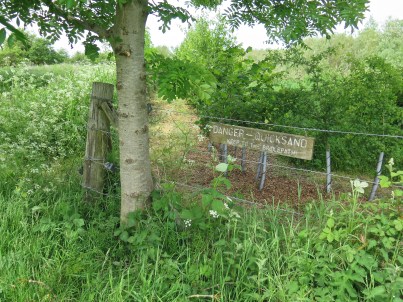
This is what the river had become 18 km from its source, contiguous water but not a torrent.IMG_1102
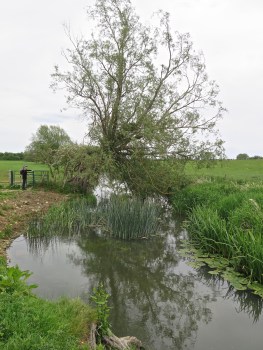
 IMG_1105The photo above was taken just before arriving at North Meadow, a nature reserve which has on its day more than 80 percent of all snake’s head fritillary in the UK. This wasn’t that day but it was delightfully floral, a first experience of the ubiquity of buttercup, saxifrage, red clover and other English meadow flowers.

 And so to Cricklade.IMG_1108
First a coffee. When I asked the barista if I could take her photo, she said, ‘All you Australians on the Thames Path take my photo. And then you write a blog about it.’ Lord, it’s hard to be original.IMG_1110
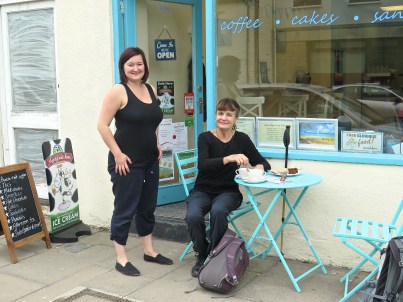
 IMG_1111And we stayed in the White Hart. Could every pub in the world named the White Hart be reflective of the influence of Richard II’s personal emblem? Surely not.

The church below with a few odd bits (vide for example, the clock, and the agglomerative additions which are hard to see in my pic) is distinguished by being the oldest (1000+ years) continuously operating Christian church in England, at inception Catholic and then via Henry VIII’s fiat Anglican, and then after 1983, leased by Roman Catholics.IMG_1112
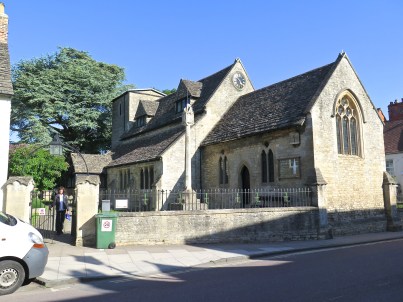
Rural Splendour

IMG_1116

Cricklade to Lechlade — 18km

It rained during the night and although doom was forecast we awoke to another beautiful day, a day of meadows, cow parsley and muscular cereal crops. In fact below is the story: crop, track, cow parsley, river.IMG_1119
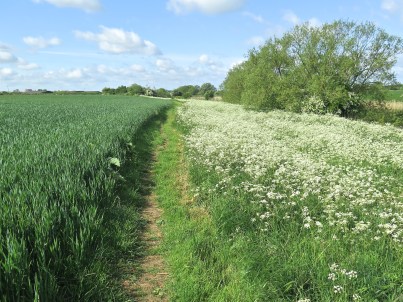
I thought we might hustle along a bit to Lechlade to beat the promised storm, but we didn’t. Hustling was not an appropriate activity for this stretch of the still very modest river. We got to Castle Eaton at about exactly the right time for a cup of tea and a little bit of something to eat. The map indicated the presence of a pub there, but it was closed.

I stood grizzling in The St. Yes, ‘The Street’ is the name of the the main thoroughfare of Castle Eaton. That’s really pushing the naming principle. Really pushing it. The other streets in toto in Castle Eaton are: School Lane, Long Row, The Lawrels and Mill Lane. Good, but not as good as The Street. (In that street and elsewhere here, lots of VNHs.)

A gentleman came past and I asked him if he had any idea where we might get a cup of tea. Indeed he did. It was Thursday morning, therefore the post office/ town hall/ community centre. We were warmly welcomed and, tossing our pounds into the pot, greatly enjoyed the cup of tea, the biscuit and the conversation.IMG_1121
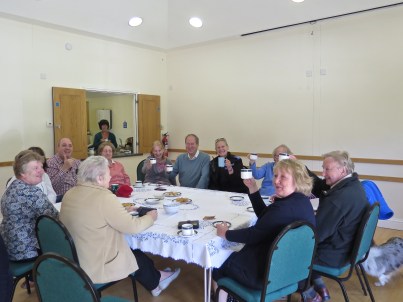
Castle Eaton had been hit by a crime wave, and it was the talk of the group. In the navy blue on the other side of the table is the Castle Eaton constabulary and she had several stories of malfeasance including, the big one, person or persons unknown dumping a wrecked caravan next to a bend in Blackford Lane. I didn’t know if I could help, but I willingly cast a forensic eye over the scene of the crime expressing my concern in a visually identifiable way. I can’t guarantee that the experience of the Path will always be quite that intense.IMG_1127IMG_1129When I said verdant countryside I meant it. Even the runoff from silage is a distinctive shade of green.
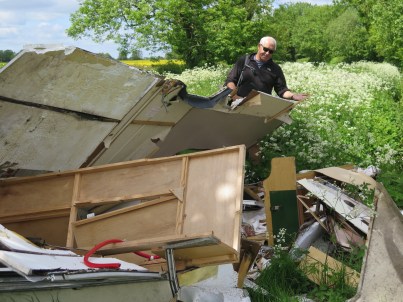
We met a few folk on the track this day and the received strategy was to hasten to Lechlade, have a pint and rush onwards to try to avoid the heavy storm due that night and the next day. There were places to stay at Kelmscott and Radcot further down the Path. But the day stayed beautiful with mild winds and long meandering open stretches, the very picture of fecundity — cow pats, nettles, crops, extraordinarily thick pasture, blackberries, cow parsley and wild rape in equal measure, hazel, chestnut, elder, linden, lilacs, hedgerows of hawthorn, pollarded trees.

Husbandry, that’s what I thought. Skillful. Endlessly experienced husbandry. And I wondered yet again just what on earth the English colonists must have thought when they arrived in Australia. It would be as though some horrible cosmic joke with an agricultural/ pastoral flavour had been played on them. The untended-ness of it all, the wildness, the lack of water, the unproductive soils, everything so unfamiliar and so utterly and completely unsympathetic. For those who could, there would have been every reason to pack up and go home.

This section of the Path has quite a long detour away from the river and 2km along the side of a reasonably busy road. One of our companions of the track was outraged by this in a very English way. A sharp letter was going to be shot off. IMG_1131But on the return to the river you pass the most unusual St John the Baptist Church at Inglesham. IMG_1133It was built very early in the 13 century and was going to be renovated and redecorated in 1880 when William Morris the Pre-Raphaelite stepped in and campaigned for its restoration as was. He won; and so we have box pews, a Jacobean pulpit, Anglo-Saxon carvings on one wall, medieval wall paintings on another and, from the Reformation, passages from the Bible etched elsewhere. It is unexpected and highly appealing.
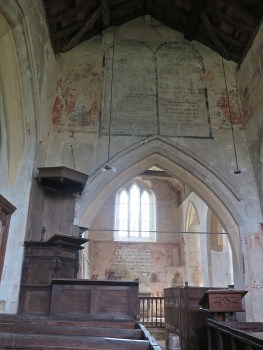
First narrowboat: 36 km from the source, at the confluence with the River Coln and the Severn Canal. IMG_1136I’ve chosen to say narrowboat rather than barge. Canal barge might do, but I think of barges as having little infrastructure above their hull, and many if not most of the hundreds of narrowboats we saw were done up to the nines and enclosed.
First ordinary boat: a hundred metres further on.IMG_1137
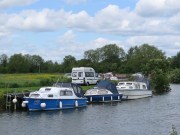
Lechlade is the beginning of the Thames as a navigable entity, still not very wide — there’s a turning pool in front of the pub, The Riverside (good food, good accommodation, and yes, good name) — but perhaps 15 metres otherwise.IMG_1139Not having walked quite far enough, we mooched around Lechlade, a gratifyingly moochable town. The post office had post cards and even better was willing to send them elsewhere. Many of the buildings were of Cotswold stone, a dense limestone sometimes with a lovely golden hue. The buildings in the background might be of Oxfordshire stone, greyer, but perfectly able to set off their vines and wisteria.IMG_1140
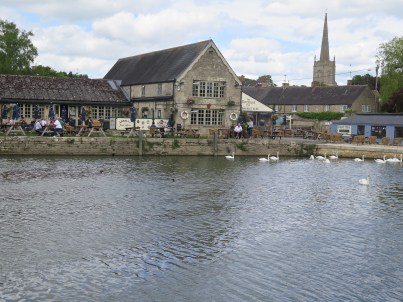
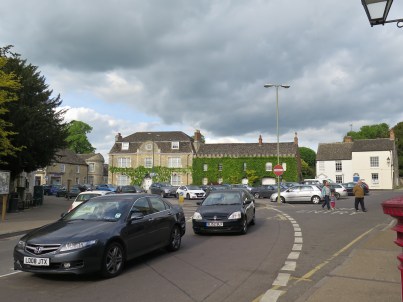
Lechlade to Newbridge — 28 kmIMG_1161

 IMG_1142Our breakfast hosts at the Riverside.

As forecast, it had rained all night. The BBC Forecast was almost always right — to the half hour. It was chill and drippy as we breakfasted, but nothing of any consequence. We crossed back over the Halfpenny Bridge,IMG_1144 its name a remnant of tolling, and moved on into a longish day which included an appointment with a taxi at 5 on the dot at Newbridge, so not too much fooping around.
Goslings were the first distraction. Ooh ahh, aren’t they … etc until we realized that this stretch of the river was littered with new families of birds, not least being Mute Swans.IMG_1146First lock: St John’s at Lechlade, distance from the source 39 km. Look at these beams. Wouldn’t you like a swing on one of them?
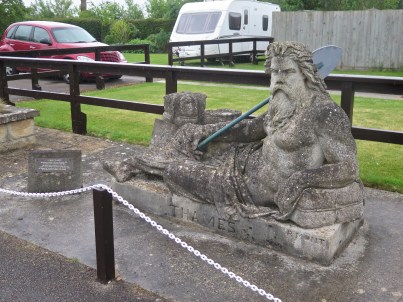
IMG_1147First lock replete with Father Thames, Rafaelle Monti’s not entirely prepossessing statue (it’s the spade … lose the spade) which began its life in 1854 at Crystal Palace before being moved to the source and then in 1974 for reasons that someone will know — vandalism? loneliness? — to the lock.

We were walking along the edge or through the middle of huge meadows, and the river was beginning to emerge into waterway form.
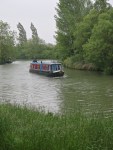
IMG_1155The first moving boat, a narrow boat, 46 km from the source, and at about this point a simply wonderful row of trees began. Forty or fifty metres high, perhaps a kilometre long, statuesque but also particularly graceful. It was raining too hard at the time for me to take a picture, but a bit like this only better.IMG_1148The concrete structure in the study in yellow below is the first pillbox, one of several dozen you encounter on the Path. ‘Stopline Red’. I think the name would probably have been more daunting to Panzer divisions than the pillboxes themselves. I can imagine myself sitting in a tank saying, ‘Okay Ernst. There’s another one over there. Go on. My turn. You popped the last one.’IMG_1151I offer you a map of their location on the basis of which it might be assumed that they were designed to protect Swindon, nummer eins target of the Nazi juggernaut. It could have been one of those initiatives where it was important just to be seen to be doing something.Screen Shot 2015-08-13 at 3.52.24 pm
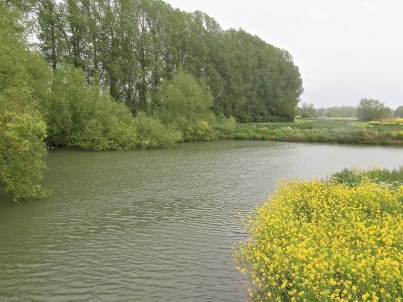
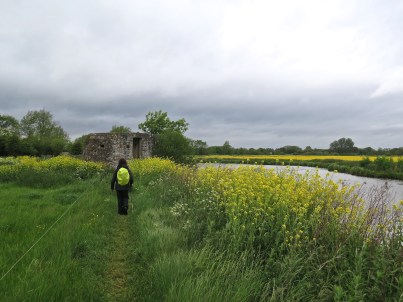
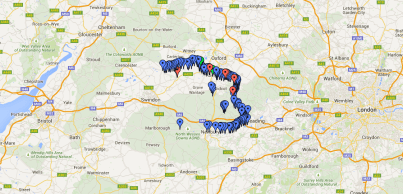
But it was a day for birds, the swans hardly counted — lapwings, pheasants, ducks, geese, hawks, kites, chaffinches, gulls are just some we knew. The rain faded.
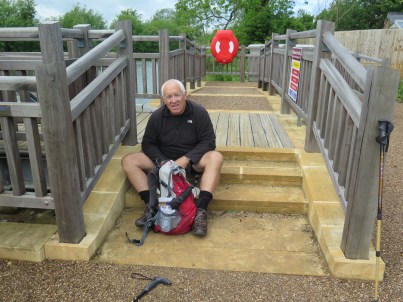
IMG_1175I squeezed half a cup of water out of my socks and tipped the other half out of my shoes — not so much the rain as the saturated long grass. We stopped and watched dazzled by a performance of either black-faced gulls (what were they doing so far from home?) or common terns, or both, in a protected lee near Shifford Cut. They were extraordinary. The natural meadows were drenched with colour and the crops were prize-winning. Rain is such a useful adjunct to agriculture.IMG_1188IMG_1178< This is the colour of Cotswold Stone and this > is what burgeoning pussy willow looks like.IMG_1176
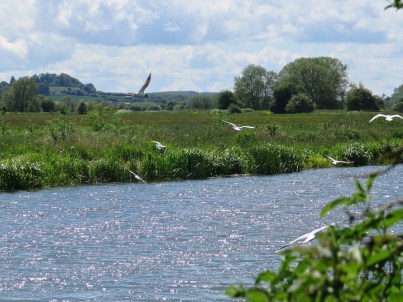
I also discovered the sort of mud that makes it possible to make buildings out of cob. I have never encountered such sticky mud nor had more difficulty in getting it off my shoes as I later discovered on the very light green velvet carpet of our accommodation.
IMG_1194This had been an excellent day. We were waiting for the cab when it arrived to take us off to Rectory Farm in Northmoor a few km off the river where we stayed the night and met Carolyn and Ranald MacDonell who were staying in the same B&B. We ate together at the Red Lion and they were wonderful company.IMG_1196
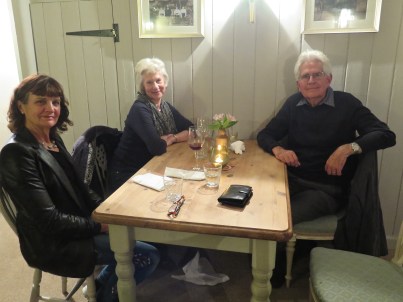


Newbridge to Oxford — 23 km (+5)

IMG_1199

I felt very good when I got up. My body had caught up to the exercise and was quietly cheering. More it said. More.

The day provided a lovely start. Clear again, with that little rill of breeze you appreciate so much when you’re walking. The grass was sodden but we got to Bablock Hythe (hythe = ‘a landing place or small port’; lade, ‘a place for loading’) hardly noticing, hoping for some sustenance at the Ferryman Inn. It was closed and we began a bad-tempered detour.IMG_1204The generative cause was a caravan park/holiday cabins from memory, but actually something called a ‘chalet estate’ now I’ve checked, planted squarely on the bank of the river and you bloodywell don’t walk along the river, or park your car, or stop and look, or in any way make a nuisance of yourself in any way that the owners will define.
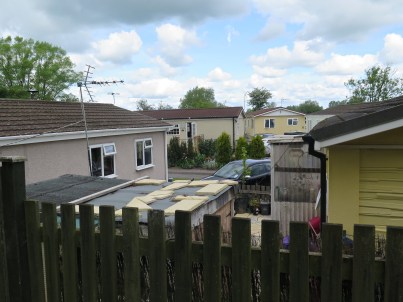
It was a jolt. It’s interesting how sensitive we had become to being taken away from the river’s company. Even by this early stage it had become a right.

I’d begun thinking quite fondly of it. The night before I had written in my journal: ‘It may be as much as 20m across now. Undemonstrative, phlegmatic, featureless. Is this an English river perhaps, a cultural mirror? No V-shaped valley, no rapids or cataracts, no gorges, no waterfalls, no stone in fact except at the locks where it has been imported. Intersects only with agricultural land and national park — to date. The Thames Valley is not a valley; it’s a plain. But for we walkers, a very sympathetic and forgiving one.’
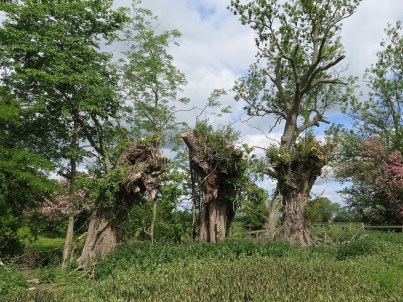
IMG_1205So down a road and turn right onto a long straight track through the paddocks which might be parts of Payne’s Farm, Pimm Farm and Tawney’s Farm and, lo and behold, this had turned modestly sour too. Thin pasture, the sheep were badly cared for, the fences needed attention. Even the pollarding (at left) was well back into the ordinary range. This was interesting. Different.

Then in another couple of kilometres and back on the river just to keep us alert but not alarmed, we came to Swinford Farm which welcomed us, invited our interest and explained itself and its plans on several large information boards. It looked to be a model farm.

The river here piles endless small meanders on top of one very large meander round Wytham Hill. Last night on my TV in North Melbourne Inspector Morse insisted (infallibly as usual) that he would find bodies in Wytham Wood. They put the dogs to work in this open and logged forest with no ground cover, and I’m very sorry to have to say that wasn’t the Wytham Wood that we saw. Even though this section of the Path is very airy and open, it was another of those English mini-junglesWytham Wood with Swinford Farm sheep.IMG_1211Depending where you start or finish, this section also has six or seven locks and there’s a lot of opportunity to watch riparian boating skills, lock management and rope tricks. This lock was near a camping ground and a small crowd had gathered to watch these two youngsters get their way through, or/ and maybe to see if they could get a push on the beams.IMG_1203
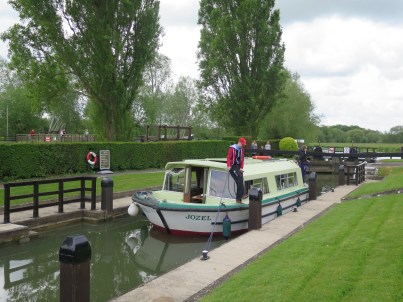
IMG_1208Further downstream this chap just parked in the lock and got off to have a cup of tea, only to be harassed by a kayaker who wanted to use the lock rather than port his very modest vessel 20 metres using the available facilities tailored for precisely this purpose. There’s no pleasing some people!

Although, I’m casting about here, maybe the guy from the Environment Agency could have moored his boat past the lock where there was provision for precisely this eventuality and he could have walked the 20 metres back. Later I spent a very interesting 10 minutes talking to the lock keeper at King’s Lock who had turned his avocation into a passionate study of just this sort of thing.

I think if, as a student of human behavior, you spent much time at all at a mid-Thames lock in summer, you’d see a lot to interest you.

People had begun appearing. It was a Saturday afternoon after all, very pleasant out and we were well within range of the cyclists and walkers of Oxford. After the Ferryman Inn had disappointed us we planned to lunch at The Trout Inn, just a long torp from Oxford really, arrived and unsuccessfully wrestled with the available circumstances. You know. Arrived late-ish, hadn’t booked anything, sat in the wrong place, stumbled into a room being prepared for a wedding, waitress for food but drinks from the bar not the other way round, collapsing chairs and, let me remember: lamb patties, a salad and something else. Bar snacks to make it easier. And this was the worst food we ate in two months. The salad had lettuce you could see through where the mould hadn’t interfered with its transparency. The tomatoes and the cucumber had long passed into another world achieving that fungal sheen produced by long association with dressing. Etc. In The Trout’s defence, they were very busy, we had arrived late, they were getting ready for a big wedding. Pah! No defence. IMG_1218Then the bloke in the black on the left told Myrna he didn’t like her cap. Myrna’s cap! (at left)IMG_1132 But that was quite agreeable. He was a Tigers fan from Traralgon.
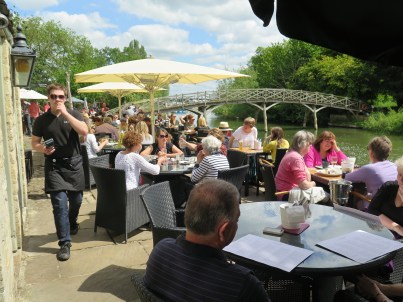

We were also getting tired, and I think it might have been something of a shock to be back in the urbs. It was only three km and we’d be there, and that would be enough for the time being. 88 km, that’s a pretty good go. A rest day tomorrow.

Oxford looked fantastic, really interesting. Food, books, buildings, lots of VNHs, people. These folk in the square for example.IMG_1226He was, inter alia, knocking out a version of Amazing Grace. (I showed my Londoner friends this pic and they felt that it was unlikely that he could be English.) But we were too tired to tackle any of it really. You know that feeling. Looking at something wonderful, all your favourites — and you just can’t any more. Can’t anything. Too tired.
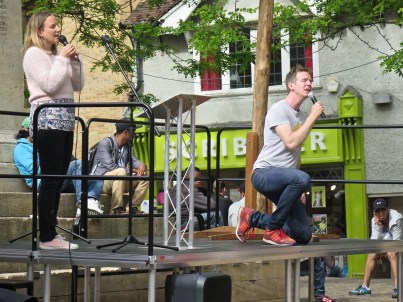
Furthermore, our place of rest was not in this bit of Oxford. We asked directions and where we were going was too far away to generate a useful response. We were already well past the measured distance but we still had another four km to go, and your feet do get heavier on tarmac and concrete at this time of the day. Get a bus? Don’t know how to pay. Don’t know where to get off. Get a cab? No hailing cabs in Oxford. No ranks. Phone bookings only (and as we discovered the next day very bloody lucky if you can pull that off). So we walked.

Another B&B. My heart sank. I wanted the anonymity and ease of a hotel room. Ah well. It seemed a nice one. A tiger mum who would do laundry, a very amiable Englishman and their charming 14 yo daughter who wrote love songs — and it was just fine. We wanted a swimming pool. After struggling with their amazement, they found one for us. And they recommended the Magdalen Arms for dinner.
IMG_1261That worked very well as I wanted to watch the FA Cup in company. A rubbish game. Arsenal 4 – Aston Villa 0. Hardly in doubt from the kickoff. Only me and one other bloke were interested. So we just ate the feast that the Magdalen Arms provided, and collapsed into the arms of Morpheus.

 It’s long way to go yet.

#1 A Green and Pleasant Land: walking along the Thames

IMG_1817

Caveat ambulans: Talking to myself about walks

Preparing to write this I read quite a few blogs describing walks, and this walk in particular. I was struck by how fluid the nature of a walk is and how defined they are by the conditions in which they occur.

When describing walks one option is to take the approach that they are ‘genetically determined’, fixed entities, the Guidebook approach. You talk about the length and/or time, the terrain, the landscape features, the waymarking and so on. Except in Portugal, these matters are largely changeless. In Portugal they can be a variety of fantasia.

IMG_1113The ‘historical footsteps and notable landmarks’ approach is a version of the same thing. (A contribution from Cricklade at left.)This did happen there; that’s a sign of that. Yes, you are walking on Roman cobbles. It used to be the Voie des Marchands. That might spring to life for me or it might not. I remember walking through the top of a pass in Japan where 500 samurai had been slaughtered some time ago and remaining completely unmoved. It was hot and I was thirsty.
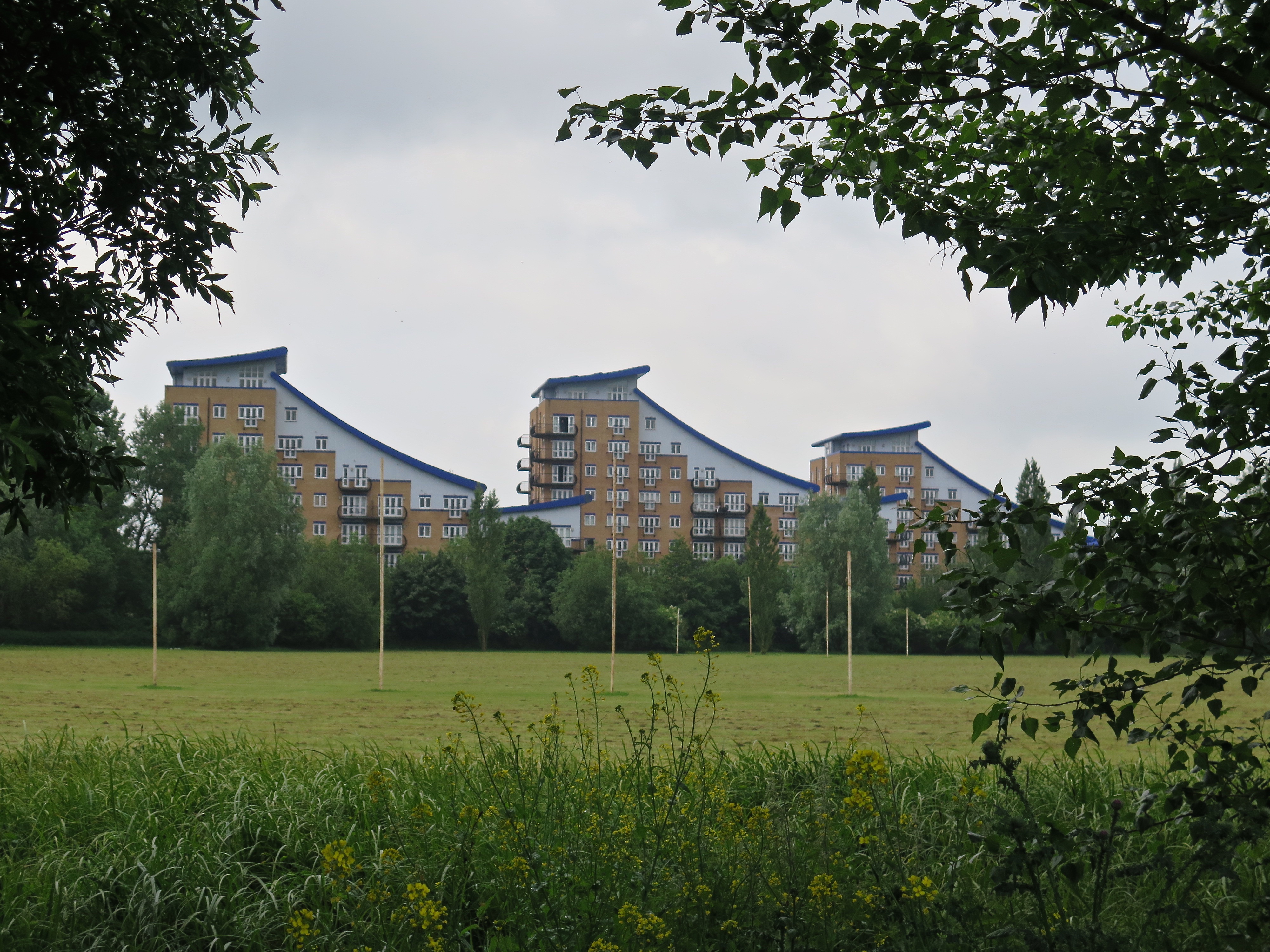
Alternatively you can take the approach that it is the conditions that are the walk, the argument from context or, pursuing the previous metaphor, ‘upbringing’ — the subjectivist perspective.

In this case what do you talk about? The weather of course, but also who you are with, who you meet, what you do and what choices you make — you, not someone else — the state of your body, unforeseen difficulties, the food you take or find, the accommodation. This is in the splendid tradition of Jerome K. Jerome, and all good travel writers. It’s the story and its rendering that is interesting.

But — the classic subjectivist problem — you can say it’s like that, but what I found was … possibly nothing like that at all. You saw the most expensive private house in England (we missed it), but where did you say Dusty Springfield’s grave was?IMG_1505 (The grounds of the Parish Church of St Mary the Virgin, Henley-on-Thames. Bad luck you didn’t see it.) And I know four lots of people who are going to read this to make up their minds whether or not to do the walk. Caveat ambulans.

Should this be a revelation, or am I running through the bleeding obvious by saying that it is probably true that there is an organic and indivisible relationship between the two; and anyway, inevitably, you just follow your nose when you’re writing? Yes. The bleeding obvious. Thank you.
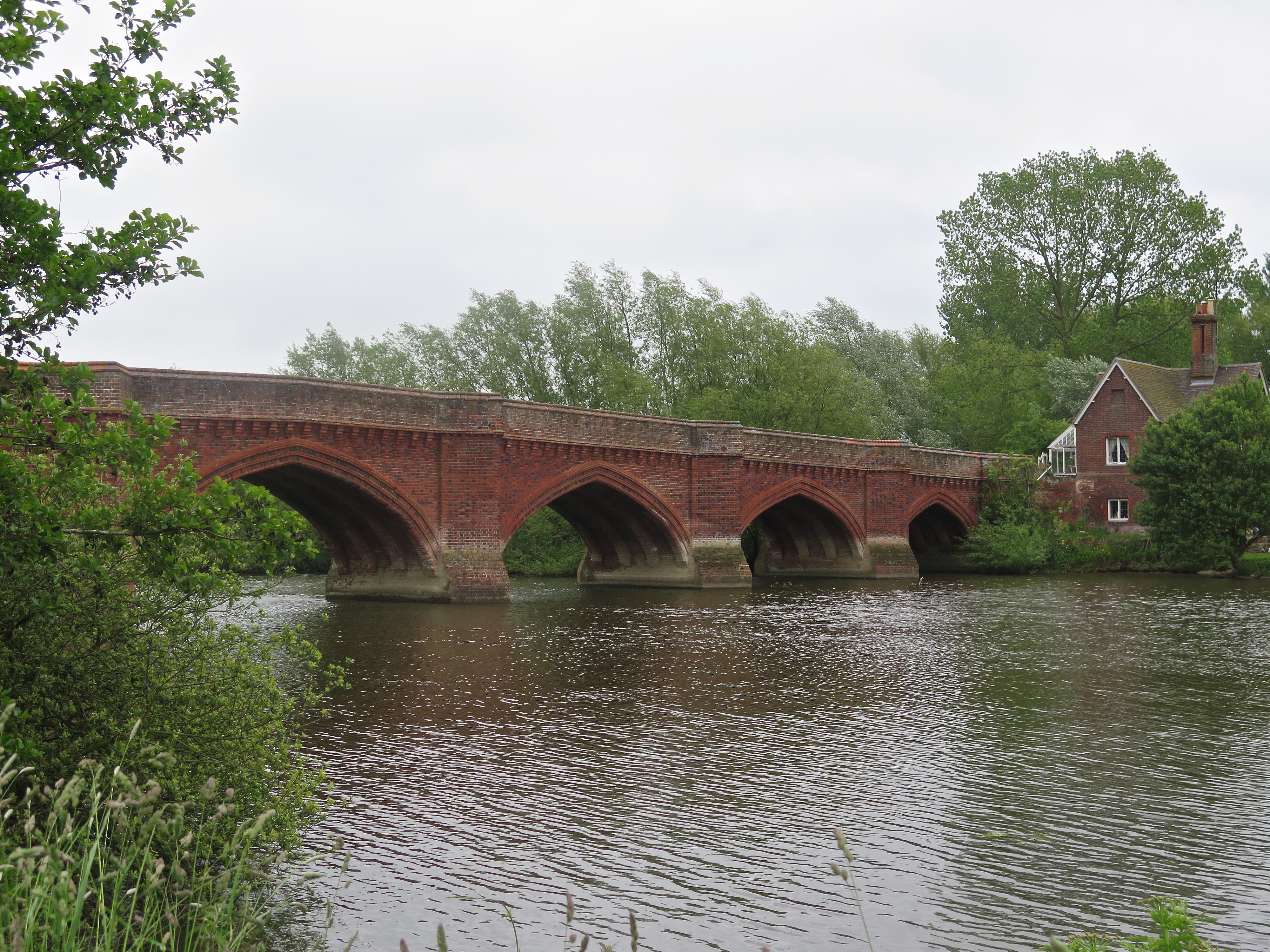
A secondary thought, of slightly better than marginal relevance, is that, taking the idea that a walk can be the sum of its conditions and that the conditions include the sorts of things above, it is possibly true that the more remote the walk the less there is to write about.

What to say, for example, about one of my favourite walks, the Razorback between Hotham and Mt Feathertop and back again? It’s 22 km. It’s exposed. It’s not for beginners or the unfit. There will be mountain weather; but regardless, the views are constantly fabulous. You must climb Feathertop to enjoy it properly. You don’t have a chance to access Dusty Springfield’s (or in this case, anybody else’s) grave. There’s no water. Anything else? You can have a close up look at the impact of bushfires. You’ll walk through a lot of Alpine mint which tinkles when you brush it. You may see some gang gangs and yellow tails. There is an important Alpine gum at the Federation Hut junction that’s somehow avoided the fires. And that’s about it. You could put photos in I guess. (Look! Amazing.)IMG_0259

But also vice versa. There is plenty to write about, far too much in fact, from the Thames walk.

We’ll start here.

STARTLING. YOU NEVER KNEW. CELEB. NUDE. 

10 Things about the Thames and the Thames Path. 

  1. The Thames, the second longest river in the UK and the longest in England, begins not far from the Severn Estuary/ Bristol Channel close to due west of London. (The tea towel above has a common illustration suggesting it flows north-south. It doesn’t.) The Thames Path, a National Trail, finishes formally at the Thames Flood Barrier east of central London 295 km (184 miles) away.
  1. Following the Thames you walk through bits of Gloucestershire, Wiltshire, Oxfordshire, Berkshire, Buckinghamshire, Surrey and the City of London (Middlesex). So to walk the Thames Path is a bit like walking across the south of England.
  1. We walked, this time, from the source to Hampton Court. The official distance for this, without errors or digressions, is 237 km (148 miles). The distance as the crow flies from the source to Hampton Court is 120 km (70 miles). This implies correctly that the river meanders extensively.
  1. The source is 108m above sea level. Sea level occurs at Teddington (possibly a corruption of ‘tide end town’) 244 km from the source. Thus the average gradient of its downstream flow is 1: 2259, almost uphill but not quite. It starts slow and, for most of its length, stays slow.
  1. The river has 51 tributaries from which it gets its eventual heft. But only half a dozen pack much punch. The impact of the Cherwell at Oxford is noticeable; the Kennet at Reading also makes a significant contribution.

It does gain considerable heft. Looking upstream from near Hammersmith Bridge while walking part of the city leg of the Path three years ago.IMG_0177 copy
6. The greatest altitude attained on the walk was 62 m asl, on a chalk cutting above Whitchurch-on-Thames (with the magnificent private gardens and superb examples of flint work). At no point during the walk did I breathe heavily. This is the peak, with steps.IMG_1392

  1. Until you cross under the M25 just west of Staines 212 km from the source, ¾ or more of the walk is either rural or provides you with the illusion of rurality. A lot of the time is spent walking through or next to meadows, the vast majority in close proximity to the river.

Getting the idea? Not the Tour de Mont Blanc. Not the Dolomites by via ferrata. Congenial, long but easy, accompanied by a river that is undemonstrative, polished, polite, meandering and not given to large gestures. 

8. The river has 45 locks (between Lechlade and Teddington). These are now all ‘pound’ locks (based on a design by Leonardo da Vinci) with gates that close either end of a box. Opening either end allows the water, and whatever is floating on it, to find its level. Closer to the source, the gates are operated manually using the mechanical advantage afforded by huge timber beams. (The possibility of having a swing on one of these is tremendously seductive. Beam mania is kept in check by hi-vis safety-scarved volunteer supervisors.) Further down, the gates are power operated. Sandford Lock (below), ‘The Lasher’, has the highest fall — 2.69m, just a tad over the world high jump record. You can see why Conan Doyle went elsewhere to find a suitable setting for Moriarty to hoick Holmes over a waterfall. ‘The Lasher’ indeed.images

With a river of such very minimal gradient why would you want locks? Without locks sections of the upper Thames would be dry after a spell without rain and floods would be even more prevalent in the wet. Locks allow navigation by boats to Lechlade 250 km upstream. They are picturesque — tres tres tres important — and most have well developed and kept gardens. At some of them, but not nearly enough, you can get a cream tea (which is English for a cup of tea and scones, perversely what we would call a Devonshire Tea).

They also provide important opportunities for the older boat-type person to demonstrate competitive marine skills and handiness with ropes. While no one is in any doubt who the complete dork is, this process is handled almost invisibly with restraint and forbearance. Gifted. English.

9. ‘Riparian’ is the correct adjective for the zone defined by a river and its surrounds. This is one of only 15 biomic terms used to classify and describe all terrestrial plant and animal communities. You may be able to work this into the conversation sometime.

FIG7

  1. If you encounter carbohydrate debt on your walk, rest easy. There are reasonably regular opportunities to enjoy battered halloumi (salty Cypriot-style cheese, with either one ‘l’ or two) served with chips, mash and gravy. [From a food blog: ‘The lightly battered halloumi cheese bizarrely (in a good way) had the texture of fish and chips.’ I can’t comment.]

Swindon

The story should start here, one version of contemporary England.

Like the rest of the crowd in post-Eurovision Vienna, we were swept up in the rush to get to Swindon. The Queen of the west, backed onto the Wessex Downs, a short Sunday drive from the Cotswolds, home to the Magic Roundabout, Brunel’s rail works and modest early experiments in socialism. Equidistant from Bristol, Reading and Oxford, and so so not like any of them. In fact so not like anything else we saw for a fortnight or so, all within an hour’s drive.

We’d landed at Heathrow and the carefully constructed plan for three train trips culminating in an arrival at Swindon RS had worked like a charm. Swindon because our destination, Kemble, was yet another train trip, a whole 12 minutes away as it turned out. But as well as a chance to have a look at something else, it was a sort of rest insurance.IMG_1027

He loved his new bike with the tyres that still had their sprues on them. (And sprues are the little rubber ‘hairs’ left after the molding process. I’d always wondered if they had a name.)

The Jurys Inn (Get it? Ok. Put the apostrophe back. Jury’s, jury is … Look, talk to me later) loomed over the car park, the building site, the struggling houses and the tarmac of a couple of big roads — a dominant presence.IMG_1039

The assumption that people in England would speak English had already been tested and found wanting. Reception — you know, when you’re a bit tired, want to sit down, have a cup of tea … where are you anyway, some commercial travellers’ stopover? And, despite a real concern about not wanting to be a grumpy old man, a real concern, you have a lot of trouble making yourself understood. And like a shiney suit and a well-rutted line of patter, it was a commercial travellers’ stopover — some kind of refuge from the depredations of what the rest of the day held. Fine. Fine. Just …

We walked out through the rather desolate town. The five pm bell had tolled a minute before and everyone had fled.IMG_1032Even though ‘Mad Max: Fury Road’ and ‘Pitch Perfect II’ beckoned from the Cinemax, we were on our permanent search for the gorgeous little boutique café run by the energetic, gifted and committed 40 year-old woman serving fabulous little inventive treats and equally fabulous coffee. (090901These do exist. Pierrepont’s Café, Goring, at left, being an outstanding example.) Burgermaster, Nando’s, McDonald’s, Starbucks, Cisco’s, Costa (spread through the UK like the flu. So promising, but always such a let down), pizza joints jostling each other for visibility and punching on with the equal number of establishments offering souvlakia: that’s what we found.

We proceeded up the limestone ridge where Swindon began (historically; geographically it’s spread all over the place) towards the better but still modest class of houses in the grip of a frenzy of renovation. Past the craft beer and folky jam joint (that’s the music rather than the conserve), past the churches that have changed hands in the last decade or so: the First Assembly of God, the Assembly of the First Christ, the Strict Baptist Church, to the street of restaurants most of which were empty except for South England’s Best Indian Restaurant 2013 which overflowed. So much of our shared primal dreaming in these streets.

91661286After the customary struggle to choose, we found The Goddard Arms to our taste. Myrna’s first choice of meal in England in 2015 was Lincolnshire sausages and mash while I, less remarkably, had cod and chips. Also rather oddly, she wasn’t completely put off by the two-hour hagiography of Warney being televised. ‘And this … is the greatest ball ever bowled. … Oh no. This one.

Down the hill again to Jurys Inn past Swindon’s next two biggest buildings, the Jobcentre and the social security, swarming with signs warning of damnation if you tried to get in. We went to sleep to more TV, a special on Dolly Parton, Kris Kristofferson, Rita Coolidge, Crystal Gayle and Emmylou Harris. 1970. It seemed entirely appropriate.

In the morning we had the commercial traveller’s breakfast of orange juice that wasn’t orange juice, organic toast that redefined ‘organic’, homemade crumpets that weren’t homemade, muesli that hadn’t been muesed, although the coffee may well have been coffed. It was fine. Fine. Then a tour of down the hill down at heel Swindon, a pretty beaten up burb with a huge mix of nationalities and ethnicities, but not many from Richland or Wealthitria.IMG_1036

We visited an outdoor gear shop. I wanted a beanie but a beanie was way out of range. No prospect of a beanie. Impossible. An almost offensive request. This may be what has happened to gear shops. You get a big shed, a truckload of puffer jackets and polar fleece vests from China, some silvery metal things and a backyard tent and call it done. Come in customers. Buy. It would surprise me if any of the staff had been outdoors beyond the trek from the car park to the front door.

We inspected the Little Vegas Club, and considered signing up for the Goan Football Tournament but weren’t church married.IMG_1038IMG_1037

Reviewed the main street. Myrna gave a very large donation (as requested) to the hairdresser who cut her fringe and we moved on thinking that Swindon, whose soccer team the Robins is the only club ever to have played in both the Premier League and the bottom tier, probably deserved more time to fully appreciate what it had to offer.


IMG_1040Swindon provides a frame of reference for the slightly preposterous luxury that was in evidence for the next fortnight. If we hadn’t stopped at Swindon we would have spent quite some time thinking that all Englishpersons drove cars worth more than a lot of the houses we had seen in Swindon, and that a frontage means several hundred metres of carefully manicured green sward. I kept thinking of Mark Lawson’s excellent book The Deaths, set not so far away in Buckinghamshire.

But you haven’t even seen river yet. Sorry to keep you waiting. Try here.

‘Now is the winter of our discount tents …’

IMG_0154A sign in a New Zealand outdoor gear shop. From which, if you want to stretttchh, it might be inferred that in New Zealand:

  • they do a very fine line in ‘outdoors’. Beech forest, glaciers, green hills, alpine peaks, braided rivers, volcanoes, etc. Modestly illustrated below.
  • they do a very fine line in outdoor gear. Because of long practice New Zealanders understand weather. As alliterative evidence: Wellington on a wet and windy winter weekend.
  • they, not uncommonly, have a very fine sense of humour. It may be that, like me, all your favourite Australian comedians — John Clarke, Tony Martin, Alan Brough — are Kiwis. Fearless, wry, clever. Add Rhys Darby and the Conchords and you also get innocent, fatalistic, delighting in life’s absurdities without feeling any need to pass judgment, and ignoring even the possibility that Jack might not be as good as his master. For that matter, what’s a master? 
  • they can be well educated.

Australians often think that New Zealand is like an extension of Australia, just across some water. The language, apart from the fascinating and much remarked vowel shift, is the same. You can manage the money with a bit of help. The food and wine are easily recognisable (and often great).

Same. But it isn’t.

Our favourite television show in NZ used to be the sheep dog trials. Why they took them off I’ll never know. Since then we have discovered ‘The Crowd Goes Wild’, and when some meat and drink is offered to it like the rugby world cup it gets jaw-droppingly engaging. It’s sports news, but the teeter-totter of not being quite sure whether the presenters are serious or not provides one of the central attractions of the program.

484125-235347-34Andrew Mulligan (on the left) has a peerless way with pursing of lips. Mark Richardson — 38 tests for the Black Caps (cricket is the game for those elsewhere), test average 43.43, dour left-hand opener — is one of the world’s all time great dags. (Dagg happens to be a not uncommon NZ name.) 

images-1Hayley Holt is a case study in Kiwi multi-dimensionality: champion ballroom dancer, snow board rider, boxer, intelligent. images(The boxing: it’s a pretty standard NZ way of raising money for good causes. Two ‘amateur’ people fight each other. Other people come and watch. That harks back to different roots, and some latent shift in direction. It might be why Sir Colin ‘Pinetree’ Meads who once wrenched Aussie opponent Ken Catchpole’s leg so violently that he tore the hamstring off the bone is widely revered as the greatest ever All Black.)

After ten years the Crowd Goes Wild folk ought to be getting a bit tired, but their continued freshness stems from their complete lack of artifice. Not art; artifice. The amiable dag is a familiar figure in sports shows, but this is different. While you get their plain unvarnished selves, what arrives is fearless, startlingly direct and incomprehensibly open, qualities underpinned by a keen sense of irony honed with the whetstone of competitiveness.

And I think that these are distinguishing national characteristics more broadly. An unusual degree of physicality — that crowd in Wellington looks stronger, straighter and fitter than an equivalent crowd in Melbourne — genial openness, inventiveness, adaptability, resilience and just a taste of insensitive hardness. 

Unknown-1
I’ve thought along these lines since we climbed Temple Basin near Arthur’s Pass on a visit years ago.
It was a very stiff track, broken rock and drifts of scree as well as being badly rutted with erosion. It might have been two hours before we got to what seemed like a staging point. To get any further was going to be a pain. But right there was a manually-operated tow. After you’d carried your skiing gear up this high, up that track, you could scramble up another several hundred metres and then haul it up after you to ski. That’s an afternoon’s entertainment.images-3

I don’t think it’s an accident that bungee-jumping began in New Zealand. (‘Hey bro I’ve got this wicked idea…’) I’ve seen the scree slope at Avalanche Peak down which you are supposed to run, part of a race (running, climbing, kayaking, bike riding) from one side of the South Island to the other. I guess it’s what you get used to, the impact of your environment, the impact of how other people spend their time in this slice of heaven. That fearlessness … fatalism qualified by indomitability. It’s not nothing.cropped-1-background-macaulay-river-tekapo-3

It might be a product of size: 4.5 million people parked in 268,000 square kilometres (a bit bigger than Britain), 1.4 million of them in Auckland. That means you can get a go at a lot of things, and that you might be expected to: like the undertaker in a small country town who is also the butcher, the post officer and the town clerk. Multiskilled multidimensionality. I had a Scottish friend who described this phenomenon as being a ‘lad o’ pairts’, someone who could, and was willing, to turn their hand to most things. And in NZ that applies to lassies as well lads.

images-4It might be a product of a particular sort of isolation: extra-murally a step further even than Australia from what used to be ‘home’; intra-murally because of the population’s wide distribution in small pockets of settlement. ‘Southern Man’ is the caricature of these attributes, hunters who get choppered into the Southland with a slab of beer and a gun and emerge somewhere near the Cardrona Pub well and cheerful three months later with a range of venison products. The Southland does provide ample opportunity to be isolated. But so do parts of the North Island.

It might be the product of unusual and relatively successful biculturalism. At a session of the NZ Film Festival we went to, two of the six directors introduced their short films speaking Maori: without pretension, embarrassment, show or surprise by either speaker or audience. There’s a lot to say about this including the fact that the Maori and Pasifica sections of the New Zealand population have in recent decades been left behind economically in a way that the Anglo-Celts haven’t. But New Zealand still provides one of the best examples anywhere of indigenous and introduced human species living happily together. While Australia is a big dry unresolved and complex lump, New Zealand is most definitely three Pacific Islands.

These sorts of generalisations have boundaries and might be faintly ridiculous. They are also replete with stereotypes and cliché. However, I never doubt that stereotypes have a foundation, and without cliché we wouldn’t be able to communicate.

Whatever. It’s another world that I particularly enjoy visiting and thinking about.IMG_0223.JPG

•• •• •• ••

The first time we went to New Zealand was because I wanted to look at kauri trees. I had bought a hundred or so lineal metres of unusual 200 x 50 tongue and groove which had been used as flooring in a chook shed. The surfaces were in pretty rocky shape but when I cut into it beautiful golden wood emerged. It was kauri and I had no idea what I had or how precious it was. I only knew how wonderful it was to work.

IMG_0471Kauri (‘bark’ at left, double click for a better look) is a big story. It deserves an entire blog in itself. (If you’re keen, read on here, or better still visit the Kauri Museum at Matakohe. )

The trees look like giant cylindrical vases with a rather unkempt bunch of flowers jammed in their tops. They are squat rather than sky scraping, the Pacific Islanders of the tree world. Paying no respect to how long they take to grow, whole forests were slaughtered and now some of the best kauri comes out of marshland or from under metres of dirt where fallen trunks have been buried. But in the Waipoua Forest in the north of the North Island some remarkable specimens remain.

IMG_0474

Animated by Maori lore, this is Tane Mahuta, ‘The Lord of the Forest’. Bigger ones have been measured in the past but at present this is the country’s largest kauri tree, approximately 2,000 years old and still growing, nearly 22 metres to the first branch and 15.4 metres in girth. The human subject was just someone who happened to be there and we got chatting. She fitted like a glove.

•• •• •• ••

IMG_0126Just for context. The grey mouth of the Grey. West coast South Island. Not far from the Pike River coal mine where 36 people died in 2010.

There aren’t that many reasons to visit Greymouth which is one reason why we like it. Like many smallish NZ cities and towns, its art gallery usually has something of considerable interest to offer. But like the rest of the town it was closed on the Sunday afternoon when we last were there. But on the levee along the southern bank is this.IMG_0125

You mightn’t be able to read the plaque. In its completely unadorned and secular way, it says ‘To those who help others’.

The implication of the sou-wester and the gum boots might be ‘at sea’. But I don’t think so, and it doesn’t mean the government either.

You might get that elsewhere, but I think it unlikely.

•• •• •• ••

These photos are about the turn of the New Zealand plane, the extraordinary shadows you get in the late afternoon describing the ridges in these geologically very young mountains and hills. IMG_1951IMG_0140

images I don’t know if I have the colour right in these photos. It’s a deep purple even darker and redder than in Rita Angus’s ‘Cass’, a much loved painting. At left, Rita as she at one time painted herself and, at right, the Cass siding from a less interesting perspective.images-1images-2


•• •• •• ••

IMG_0405I stopped here, parked and got out. Hang the consequences.

It’s some distance along the Forgotten World Highway which runs between Taumaranui and Stratford, west of the North Island and perhaps obviously not much visited. We’d been rebuffed by ice on the Tongariro Crossing and were on our way from Whakapapa to see if Mt Taranaki was going to make itself available for viewing and of course it wasn’t. But to return to the original theme, anywhere where parking is less likely to be a problem is hard to imagine. We may have seen another car in motion during those 150 k.s but I can’t remember one.

The only town of any consequence between one end and the other is Whangamomona, notable for the fact that it has seceded from New Zealand to establish its own republic. An exquisite drive.

•• •• •• ••

IMG_0210We were walking around Dunedin following a self-published walking guide that a resident thought others might enjoy, poking our noses hither and thither. The street was in the guide; the house was not. We were staring up the drive at the garden when the owners came home. They’d just been to church where the sermon had been on welcoming strangers, so we got invited in for a cup of tea and some scones.

I did know their names but have lost them. He turned out to be an academic working at the University of Otago and what was keeping him off the streets at this time was something he and his team had just invented, a ‘fabric’ or material through which it was possible to control the flow of material so that single atoms could be passed through at a given time. That struck me as extraordinary. This apparently has very wide application in some fields such as medicine. How did he come to this idea? By thinking about the fabric of which collapsible canoes (also invented in NZ) were made.

He was at the time in process of negotiating patent and development issues with a German company. If matters worked out as he thought they would $10-15 million, as an initial payment, would pass in the direction of his team. They were lovely people.

•• •• •• ••

IMG_1955This is the real reason for the blog.

Mt Isobel, 1ooom. above some houses at Hanmer Springs, a resort town in the north of the Canterbury Plain, South Island.

The first half included steep zig-zags mostly with a layer of snow over ice. The third quarter was steeper and straighter with some hand climbing and very icy. Semi-controlled bum sliding on the way down. The last quarter was a ridge walk on gravel, scree and snow beds accompanied by a very sharp wind. A steep pitch up to the peak.

We older people made it.IMG_1935


This was the view.IMG_1943

images-2And then a bath in the springs.

We arrived not late but after nightfall. Several hundred people were there, enjoying themselves. Probably a very good date destination. Enough skin but natural and unobtrusive in context, perfectly kosher. You’d just lie there chatting. And then you could, say, go off for a drink.

The air temperature was hovering above and below zero Celsius. The pools ranged from 33-42 degrees. Getting between them was a thrill a minute. But no one seemed to notice.

I must make mention of the bathers dryer in the changing rooms, which I think Australians would either ignore or treat with suspicion. Modelled on a spin dryer, you put your togs in, hold the lid down for 5-8 seconds and then lift them out dry. It’s free. Such a good idea — daggy and wonderful at the same time, so practical — and very popular. New Zealand-ish or what? 

•• •• •• ••

IMG_1989The full name of Te Papa, ‘Our Place’, is Te Papa Tongarewa ‘Where we keep our treasures’.

In the blog on earthquakes I mentioned that the Christchurch art gallery was going to have base isolators installed. Wellington, where Te Papa is located, is just as subject to earthquakes as Christchurch. The treasures are protected by this entire building resting on base isolators, a New Zealand invention. They look like this.IMG_1990

A big block of rubber with cylinders of lead inserted in them. The rubber accommodates lateral movement and shaking; the lead helps to absorb motion and heat energy. How smart is that!

The treasure includes one floor of art and it’s not nearly adequate for what could be on display. This might be the lowest ratio of ‘shown’ to ‘stored’ pieces of any respectable national gallery. But what was there on our last visit was great. We particularly liked this.

IMG_1986

It’s called ‘Dromorne Rd – Putiki Street’. What do you think? Marble? Terrazzo?

The tag says: ‘Andrew Barber created this work from the drop sheets he used in his 12-year career as a house painter. The squares were stitched together by sail-makers on industrial machines.’ Dromorne Rd was where he did his first painting job.

Does that change how you feel about it?

Or how you feel about a country that devotes a major exhibition space in its precious national gallery to its display?

•• •• •• ••

Without pretension. Without artifice. What’s a master?IMG_0485.JPGFar north in Northland, North Island. But it could be anywhere.

Home.