
Albany. What were we doing here? Well I’ve partly explained elsewhere.
We were coming from Montreal. We were going to visit friends who lived at Garrison. I was interested in at least a bit of a drive through the Catskills/ Adirondacks. The Borscht Belt. Somewhere New York Jews could go for summer holidays. Dirty Dancing. All that. Romance. And besides, we hadn’t been to Albany.
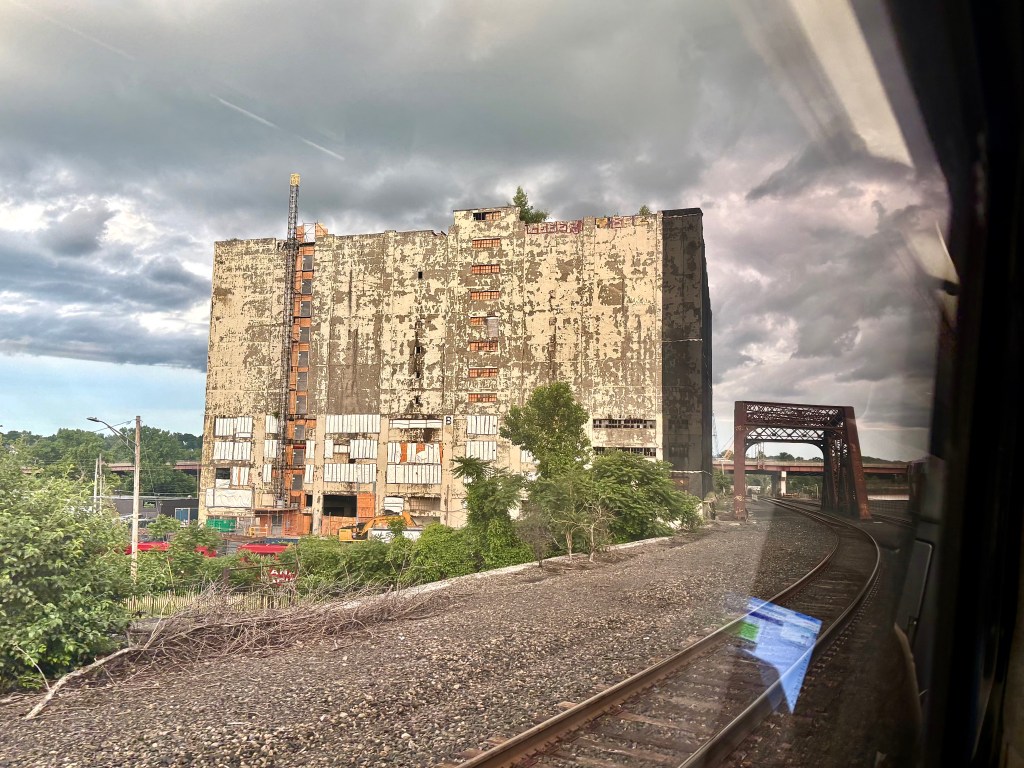
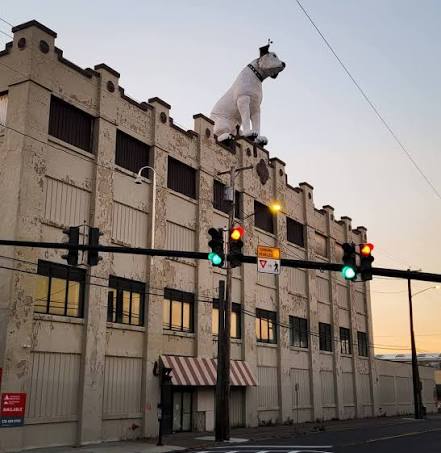
Bearing in mind what is to come, at left below is how one enters Albany by train. I saw it as a work of art, but it is most certainly not an example of urban triumphalism. A short while later there is a much loved 28-foot fibre glass dog, Nipper, sitting on top of yet another empty factory building.
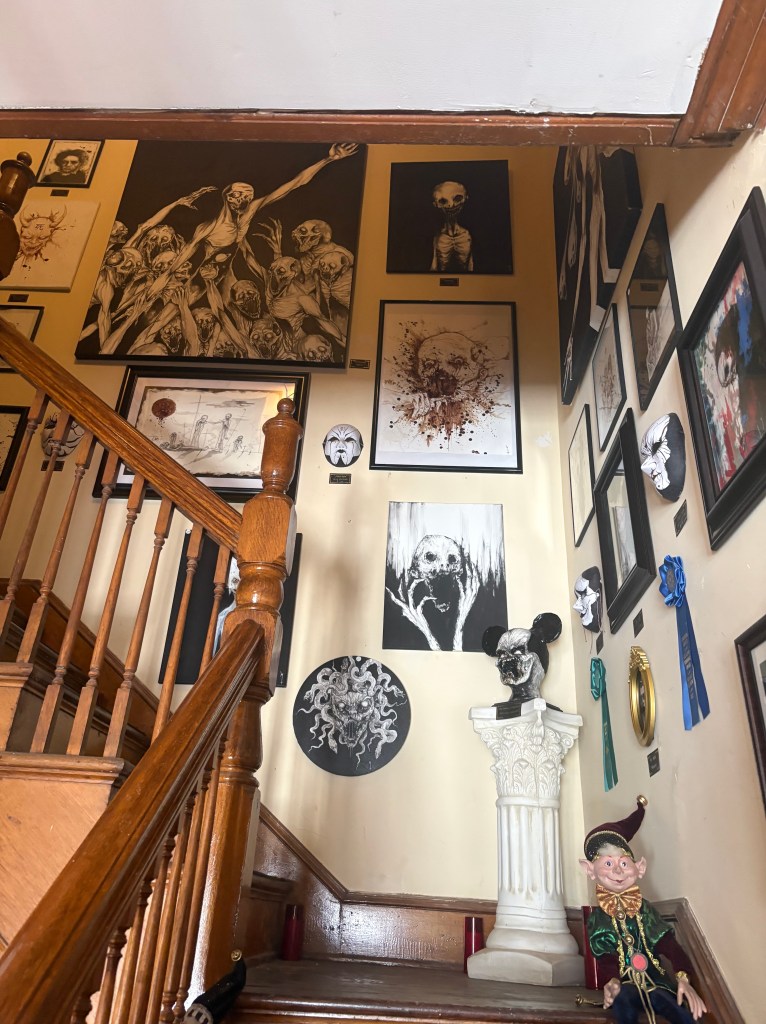
Our accommodation was a comfortable room — good bed, big bathroom, kitchenette — in what had been a modest mansion owned by an artist and featuring his works on entry.
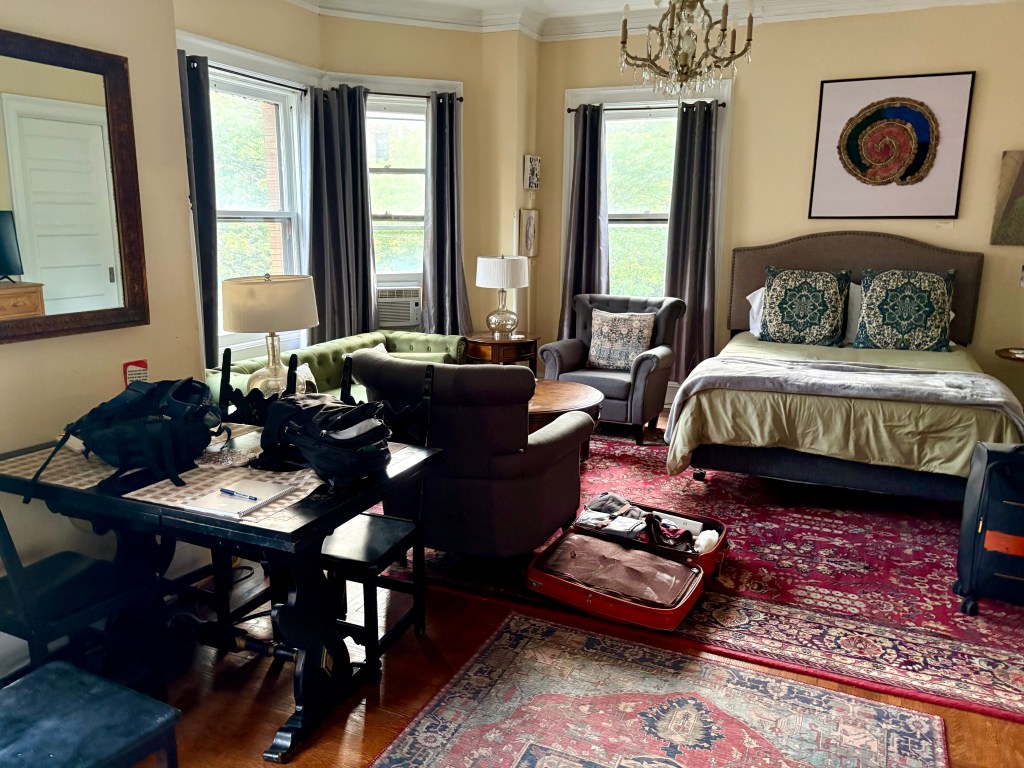
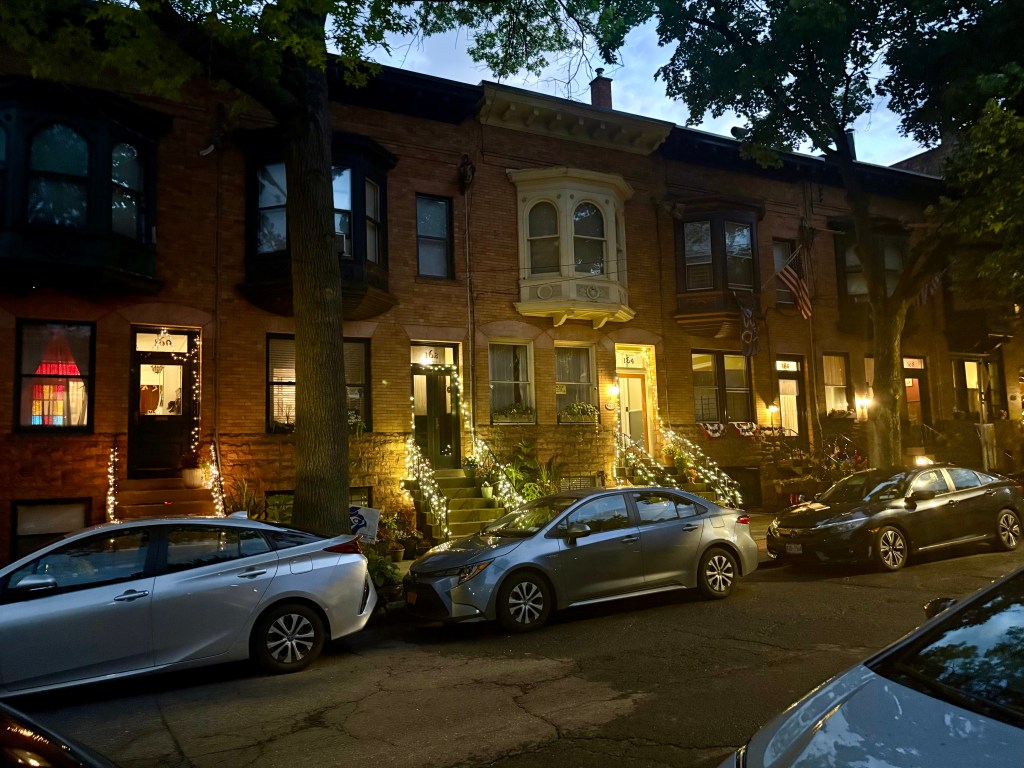
The house itself was in a block of cosy-seeming look-alikes which in 1997 had won the City of Albany Block of the Year. I know that because there was a sign saying so which also incorporated the mayor’s name (Gerald D. Jennings). Deeply American in all aspects: award, topic of award, example of massive range of topics of awards, signage, inclusion of name.
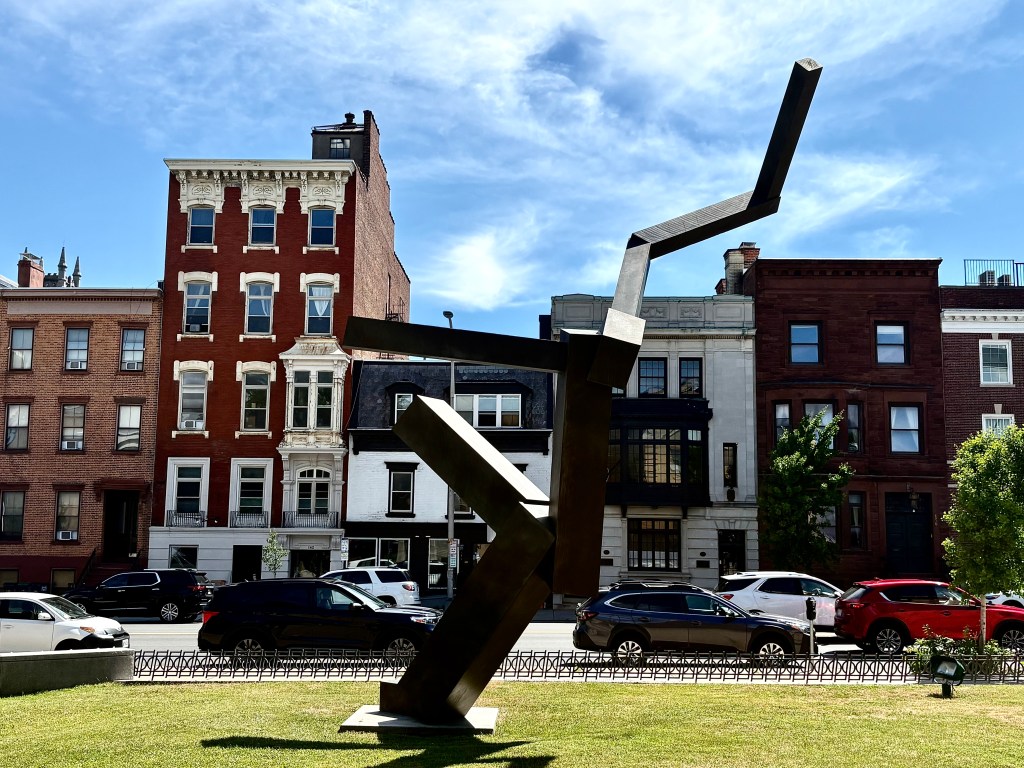
Albany stretches and stretches into all sorts of permutations but where we were it had lots of attractive period building. This view from the centre of the art gallery lawn is vaguely representative.
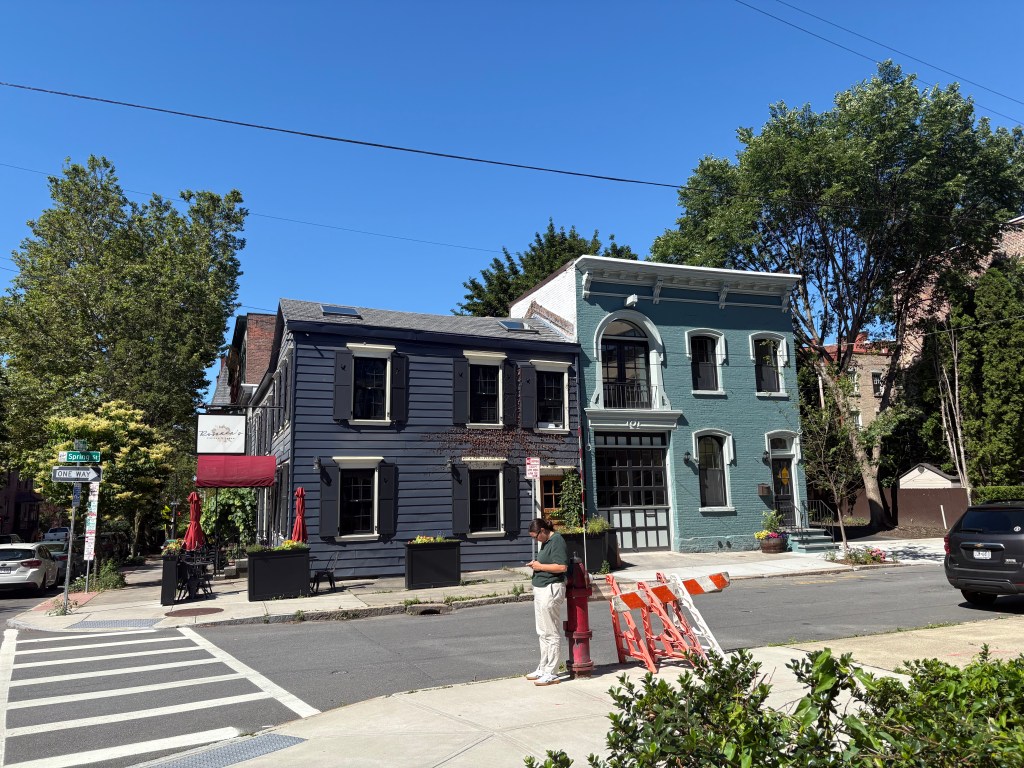
Just around the corner from our place was a series of modest eateries. We had dinner at one of these, Rosanna’s, in the darker grey, and ate well.
You don’t need to know all this of course. It’s just a bit of scene setting.
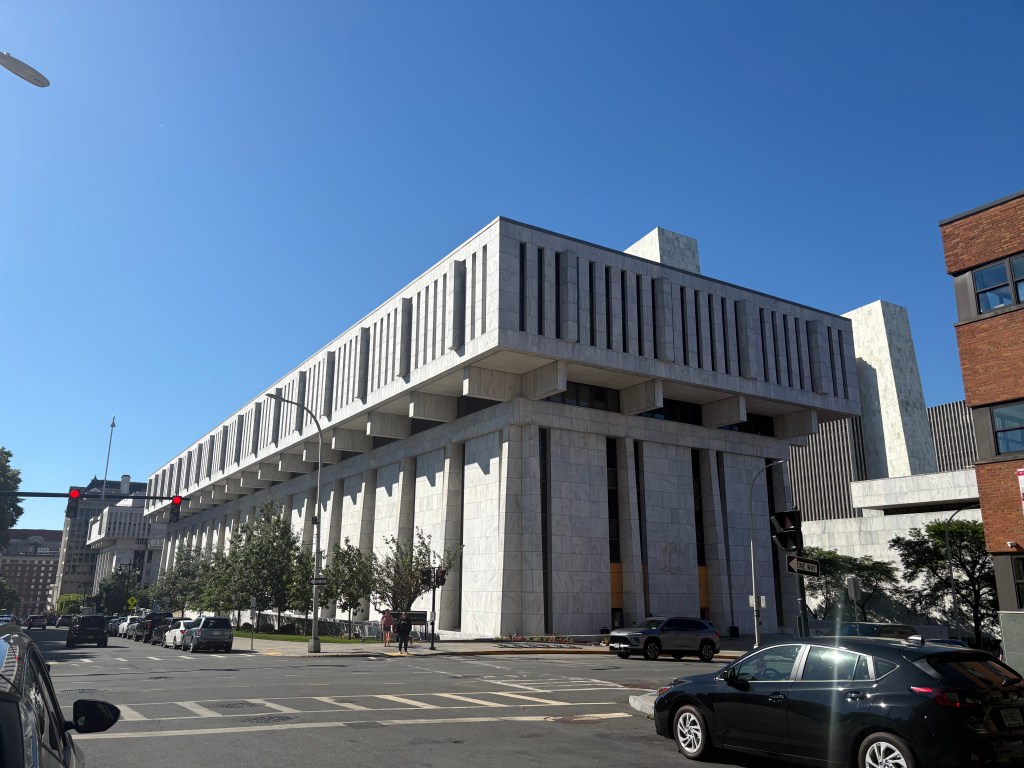
At the eastern end of our street there were two major buildings. This is one. You’re guessing aren’t you … and you got it! Amazing. Yes, the New York State Department of Vehicle Registration. A bit obvious. Over the road, and this one is harder, but — the clue — imported fairly directly from Athens Central 2500 years ago?
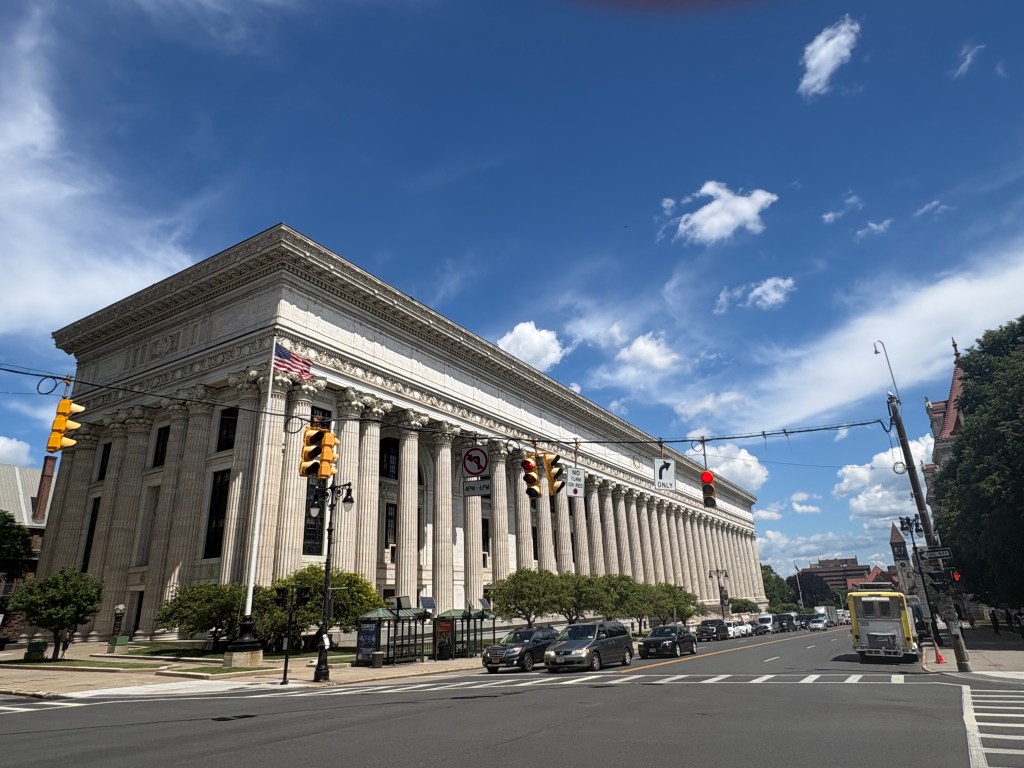
You mightn’t get this one … ah you did. New York State’s offices of the Department of Education.
But then you look round the corner …
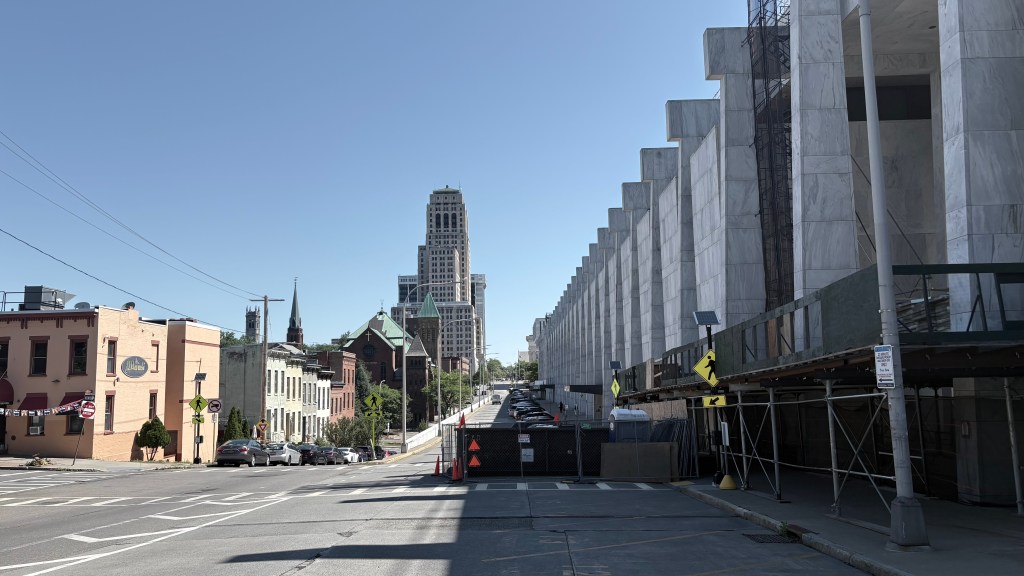
and there, on the right, you are struck by one of the largest buildings I have ever seen.
This was our first direct encounter with America as the Land of Surfeit.
There’s New York City, and there’s New York State which shares a long border with Canada. Albany (popu. about 100,000, one-third a Geelong!) is the capital of New York State, and has been since 1797, established at least partly so that it wasn’t New York City. Hence it is home to a large number of public servants and, before COVID anyway, they needed to be housed at work. They used to be, and still are, in the tall building on the left above. But in 1960 Nelson Rockefeller, then Governor, was hosting then Princess Beatrix of the Netherlands and was embarrassed when driving through the downtown area: ‘There’s no question that the city did not look as I think the Princess thought it was going to.’
‘He conceived the basic design of the complex with architect Wallace Harrison in flight aboard the governor’s private plane. Rockefeller doodled his ideas in pen on the back of a postcard, and Harrison revised them. They used the vast scope and style of Brasília, Versailles and Chandigarh as models. [Today Astana and other Stalinist neo-Brutalist epics could be added.] The massive scale was designed to be appreciated from across the Hudson River, as the dominant feature of the Albany skyline.’
So, from the back of a post card to this.
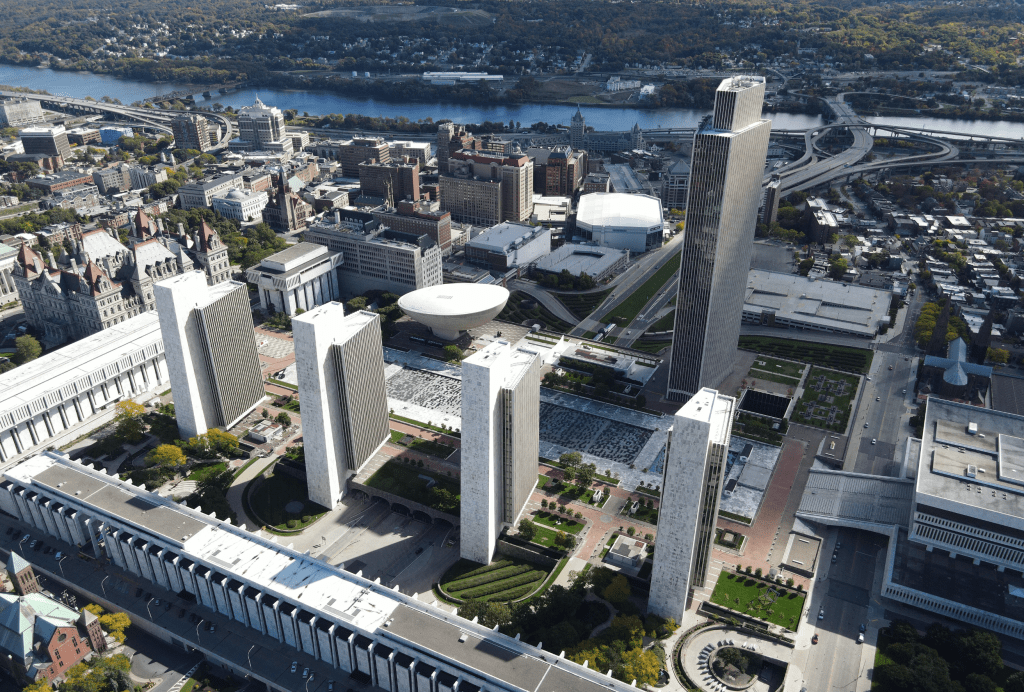
And can you see it from the Hudson seen here mooching gently through the top half of the photo?
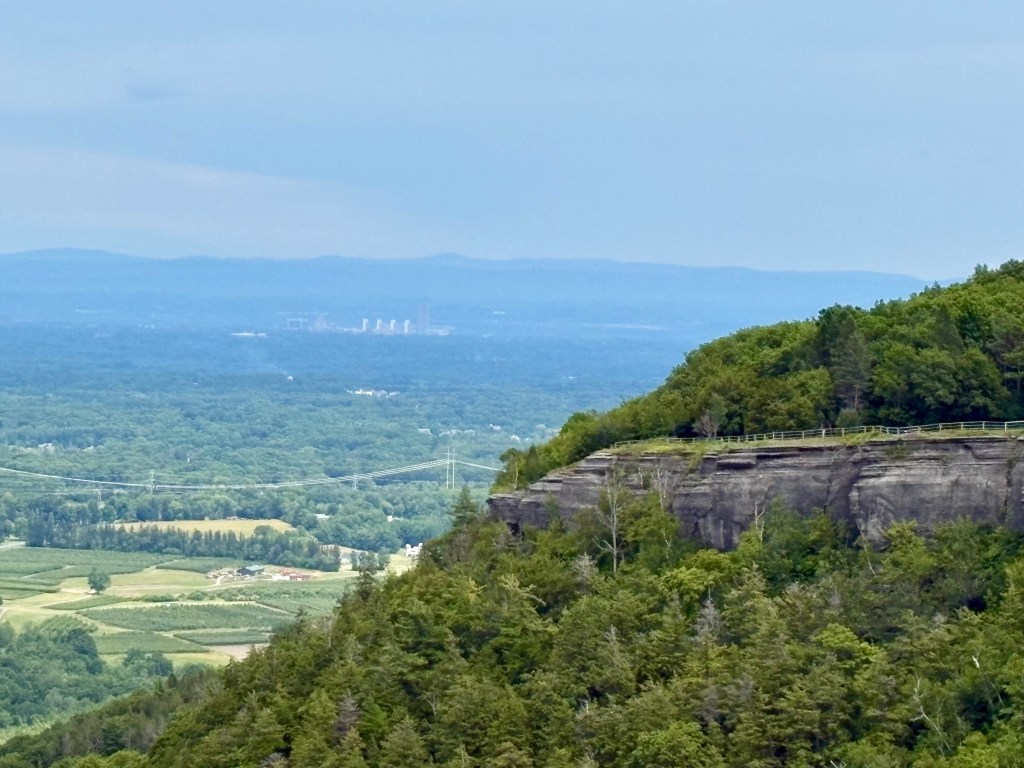
You can see it from Thacher’s Overlook (memorable for the difficulty of not adding an additional ‘t’ when pronouncing it) 40 or so kilometres away. The four white splodges in the middle are four of the towers of Rockefeller’s Empire State Plaza. These ones.
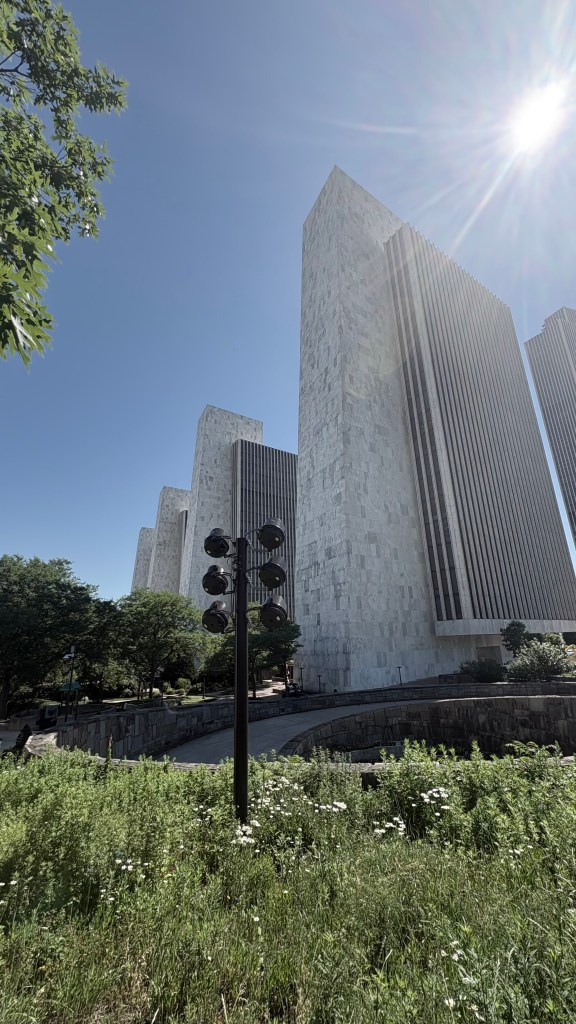
And they’re the little ones.
There’s the Corning Tower on the other side of the concourse with its, not one, but three Reflecting Pools, which
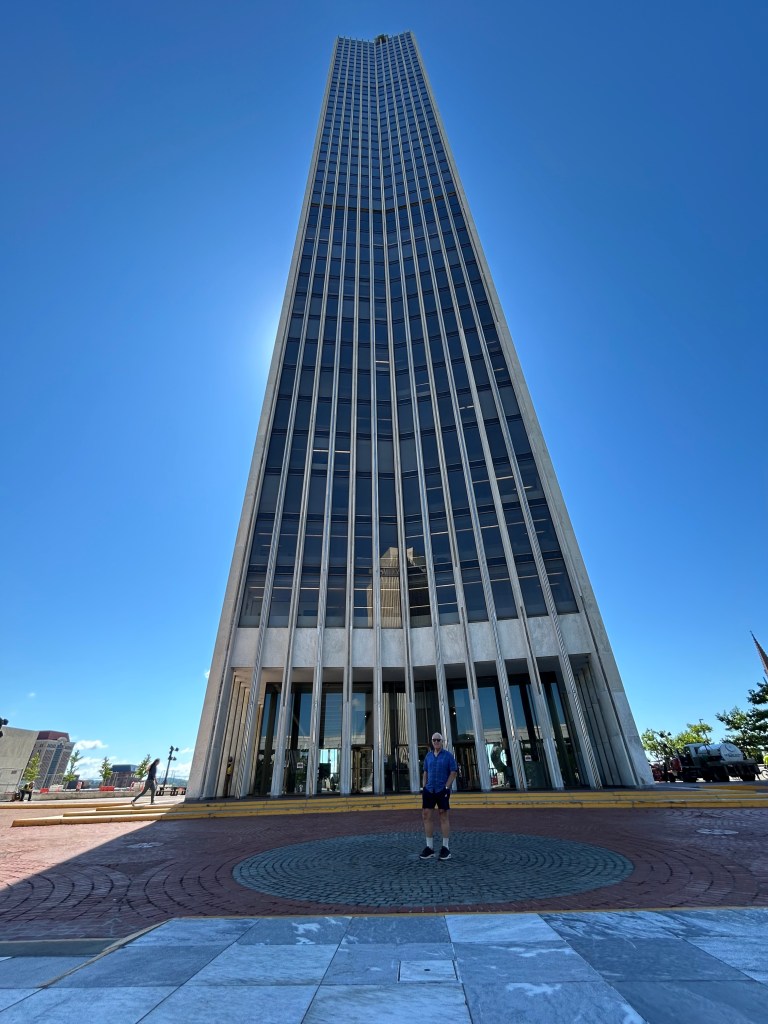
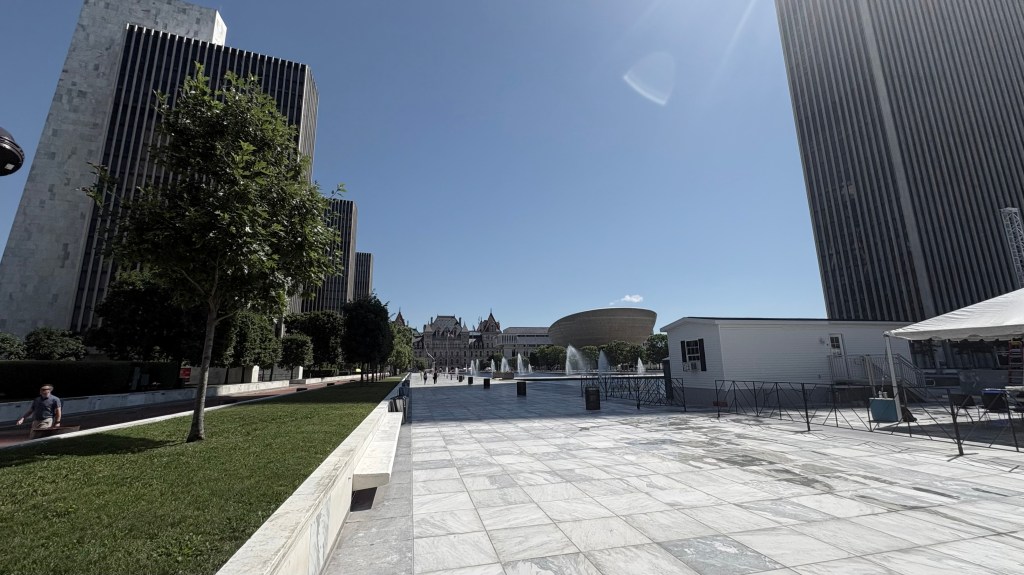
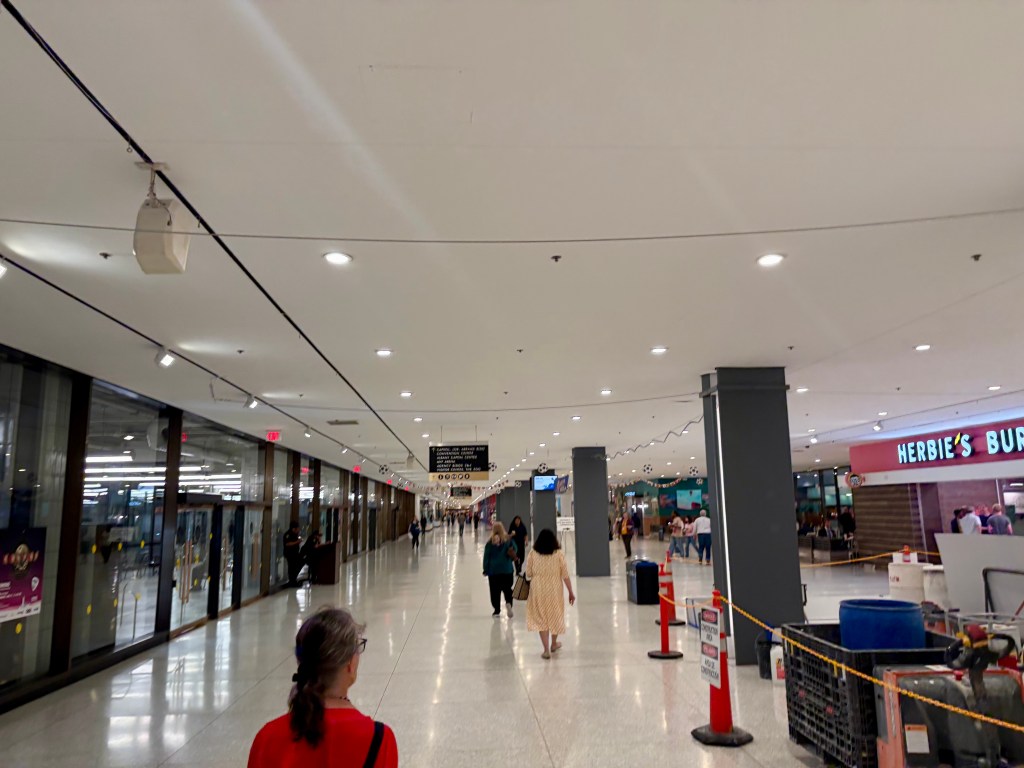
is about 600m long, the same length as the building you can’t see to the right and the same length as the two underground floors which include, inter alia, a food court (below) and a garage. The Egg, an auditorium apparently with remarkable acoustics, can be seen in the mid ground looking like a beached flying saucer.
Building commenced in 1963 following the razing of about 1400 buildings in a part of the city mostly populated by Italians and Black Americans. 7000 people were evicted hastening the decline of the city’s centre, still readily apparent. It was dedicated in 1973 having cost $2 billion, using 900,000 cubic yards of concrete, 272,320 tons of steel, and 500,000 cubic feet of marble every cubic inch of which was imported. It was re-dedicated in 1978, reflecting the naming fetish of America, as the Governor Nelson A. Rockefeller Empire State Plaza. So I suppose at least we know who to blame.
Its critics have not held back. Paul Goldberger, writing at the time of its completion in the New York Times, said: ‘The ideas here were dead before they left the drawing board, and every design decision, from the space allocations to the overall concept, emerges from an outdated notion of what modern architecture, not to mention modern government, should stand for.’ Martin Filler, quoted in The Making Of Empire State Plaza, says ‘There is no relationship at all between buildings and site, neither at grade nor atop the podium, since all vestiges of the existing site have been so totally obliterated. Thus, as one stands on the Plaza itself, there is an eerie feeling of detachment. The Mall buildings loom menacingly, like aliens from another galaxy set down on this marble landing strip.’
I know what he means. Correct. That said, we had two excellent experiences on the Mall.
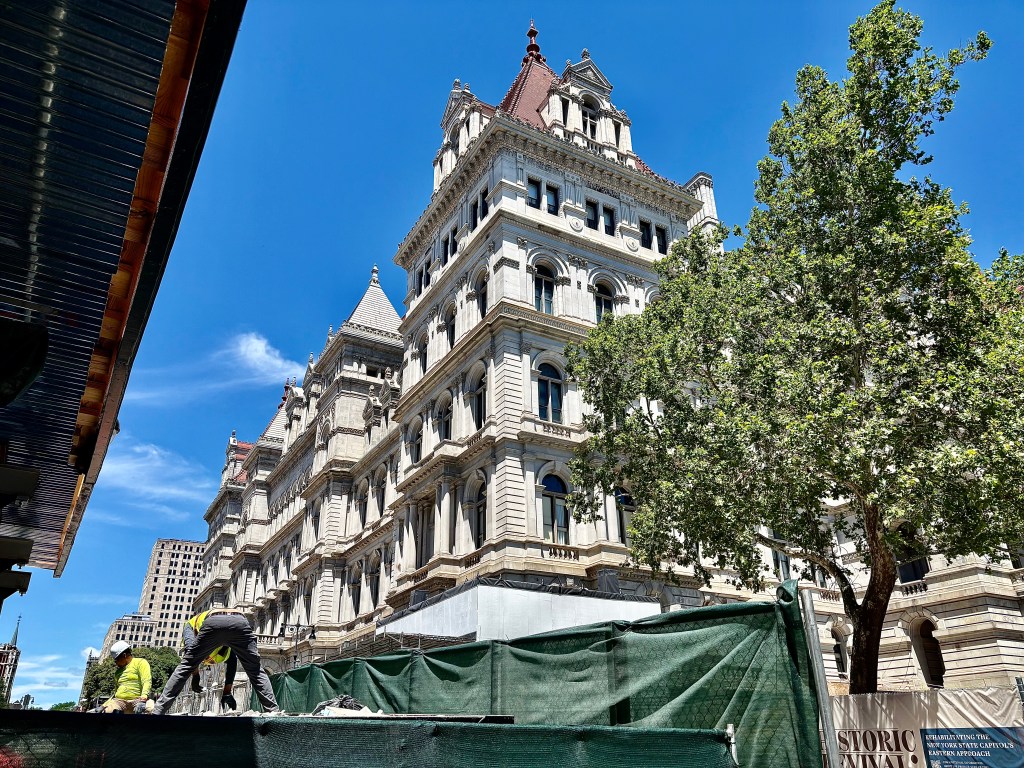
One end of the Mall is the State House, the parliament. When it was built in the late 19th century it was the most expensive building in the country. There’s a history here. It can look like this.
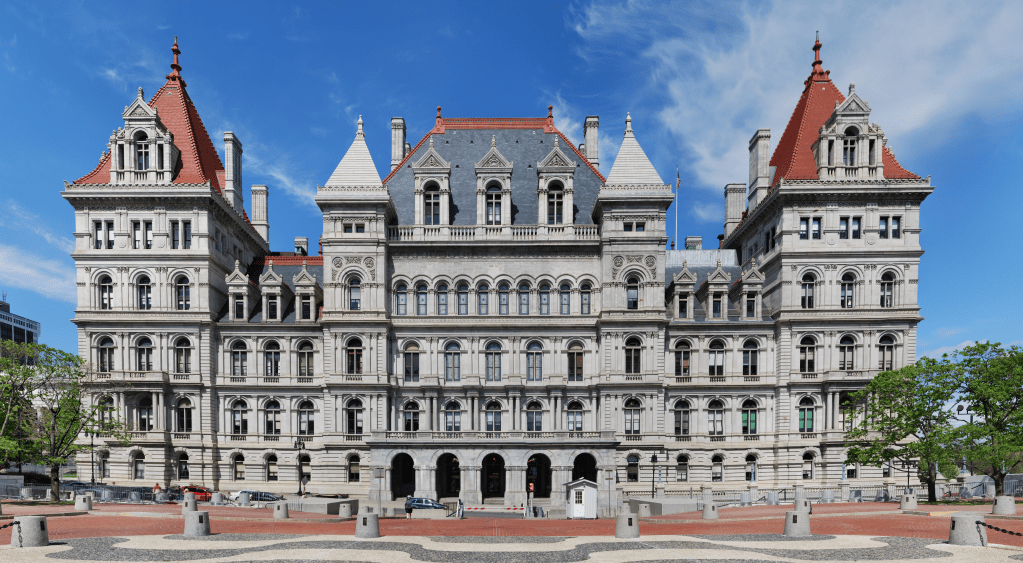
But I prefer my photo.
At the other end is the State library and museum.
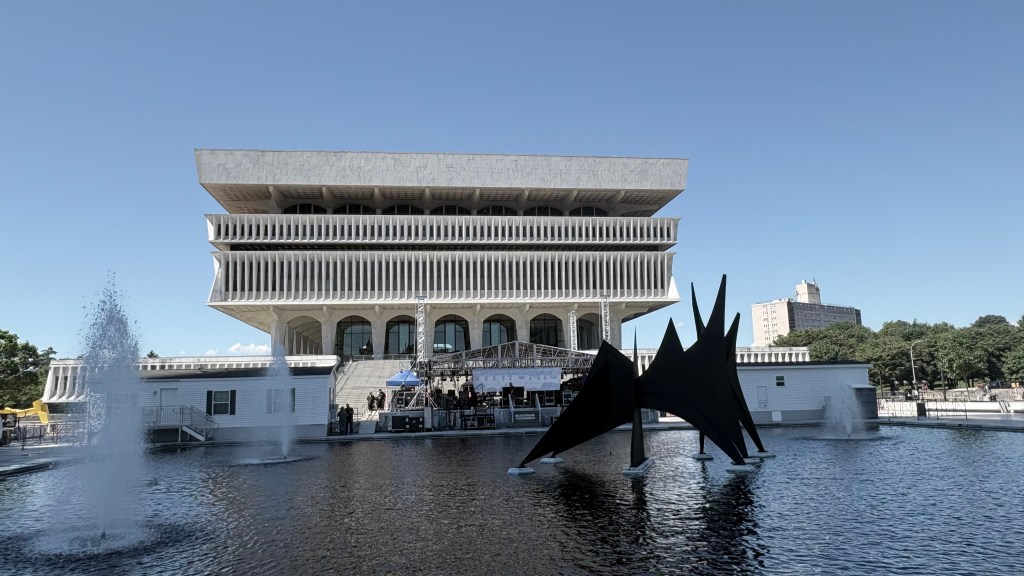
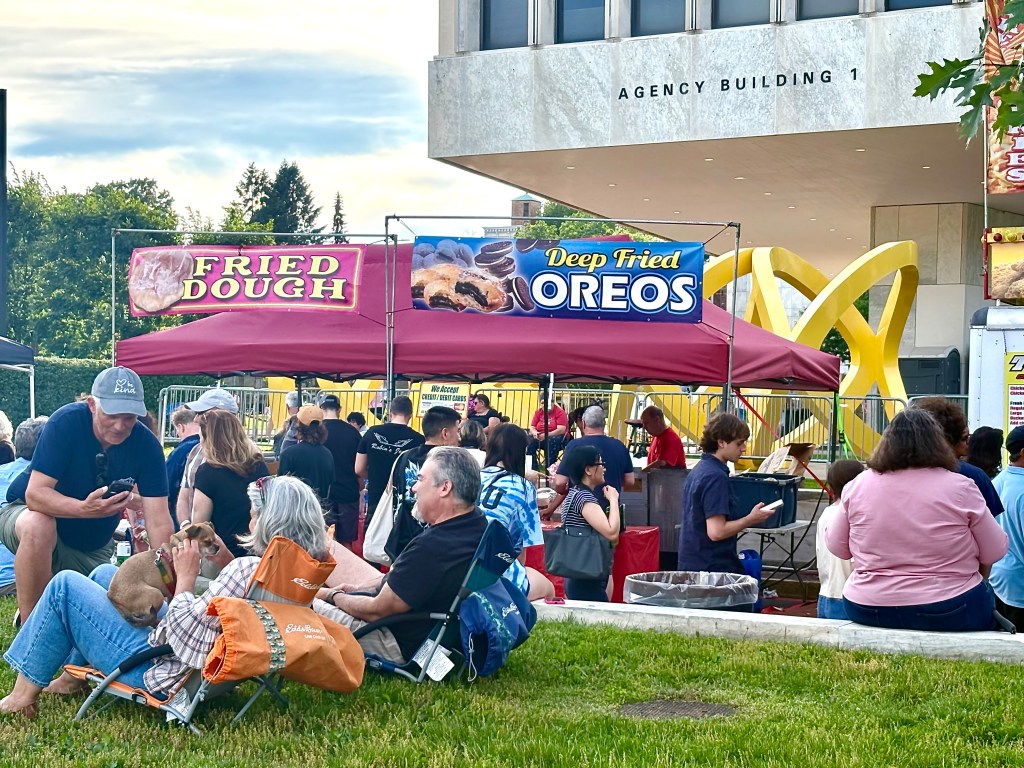
I have written elsewhere about some of what we found in the museum that made the experience of visiting it so memorable. But visible here in the mid-ground is the setting-up for the open air concert we went to that night. Not a great band, but willing. The crowd, packed, roaring, fun, having a great night out.
Look it’s a sixties mistake. You wouldn’t do it again I hope, although Trump seems keen to. But maybe people find a way, despite the best efforts of architects, to populate and humanise these peculiar spaces.
The details above about the building, plus a note about the controversial aspects of the development, come from a plaque in the Corning Tower which provides this view.
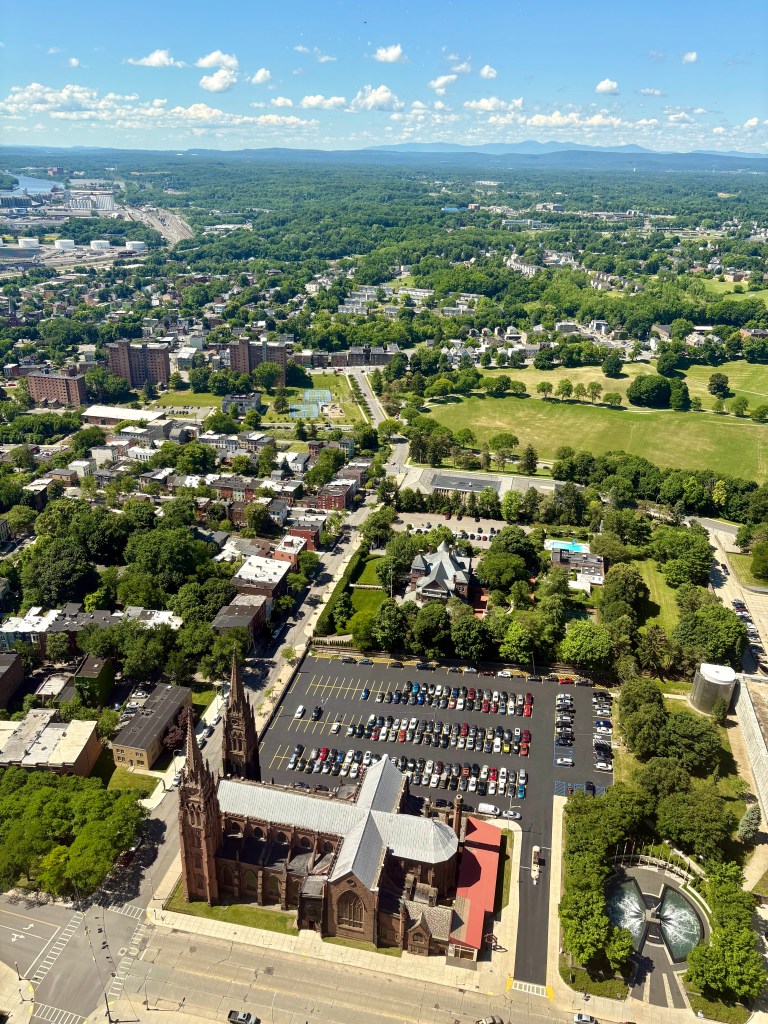
The Governor’s mansion and, presumably, the Governor’s swimming pool are on the far side of the car park. But that’s south where we are heading.

