IN MEMORIAM #3: LIVING ON THE LAND

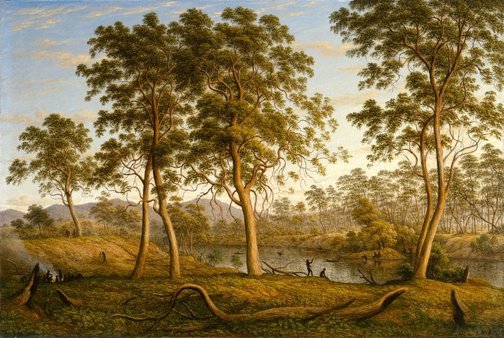
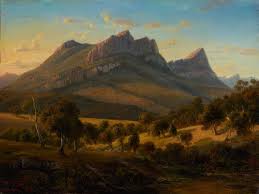
images-2 copy 2[Eugene Von Guerard, 1862: ‘Mt Abrupt and Mt Sturgeon’]

The Grampians are the southern end of the Great Divide which runs for more than 3000 kilometres down the east coast of Australia, separating the fertile coast line from the more challenging interior. In contrast to the massive shield in Western Australia where the earliest evidence of life on earth dated from 3.5 billion years ago can be found in Pilbara rock , the mountains of the Great Divide are fresh young things, and the Grampians younger again.

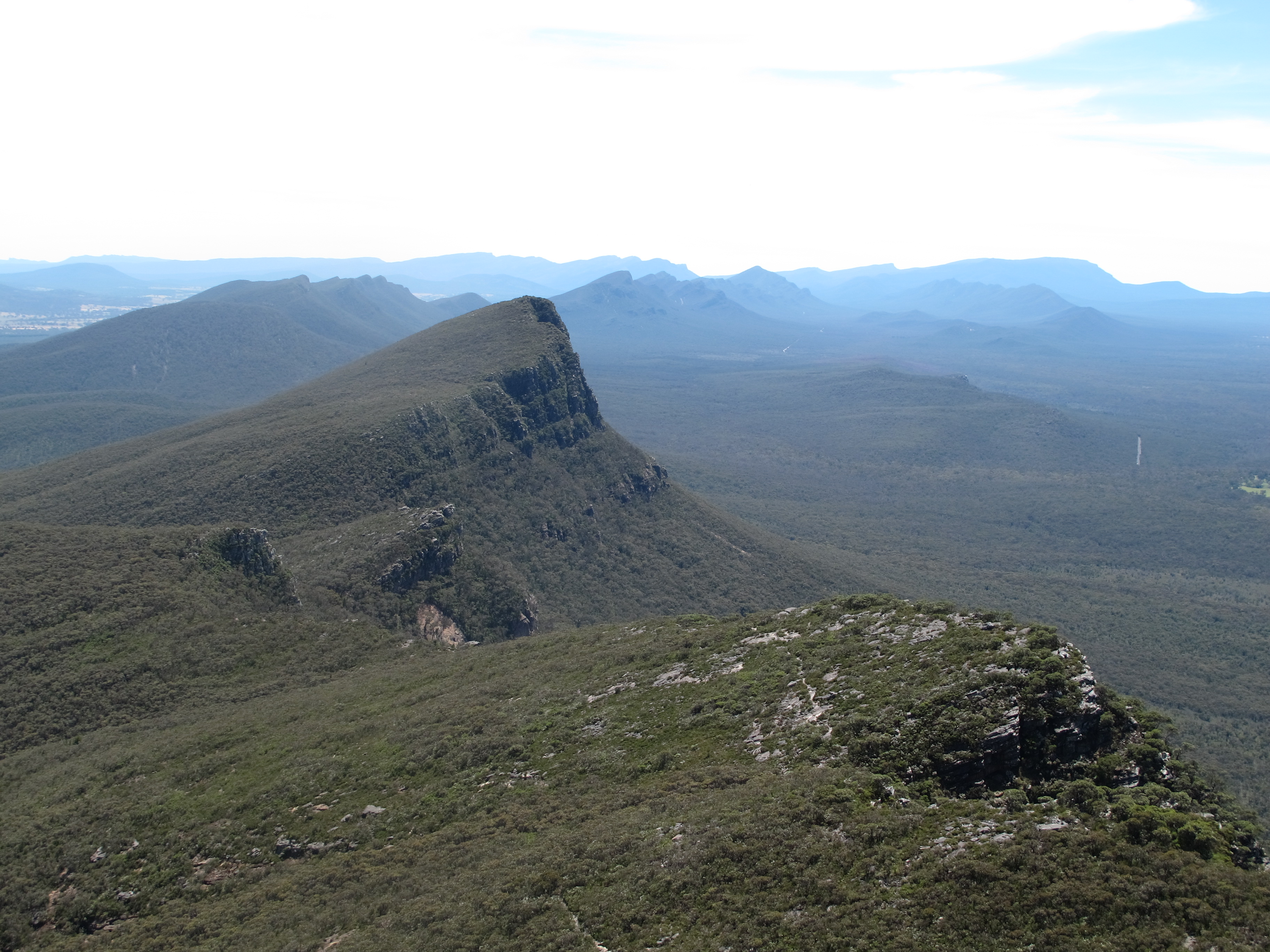
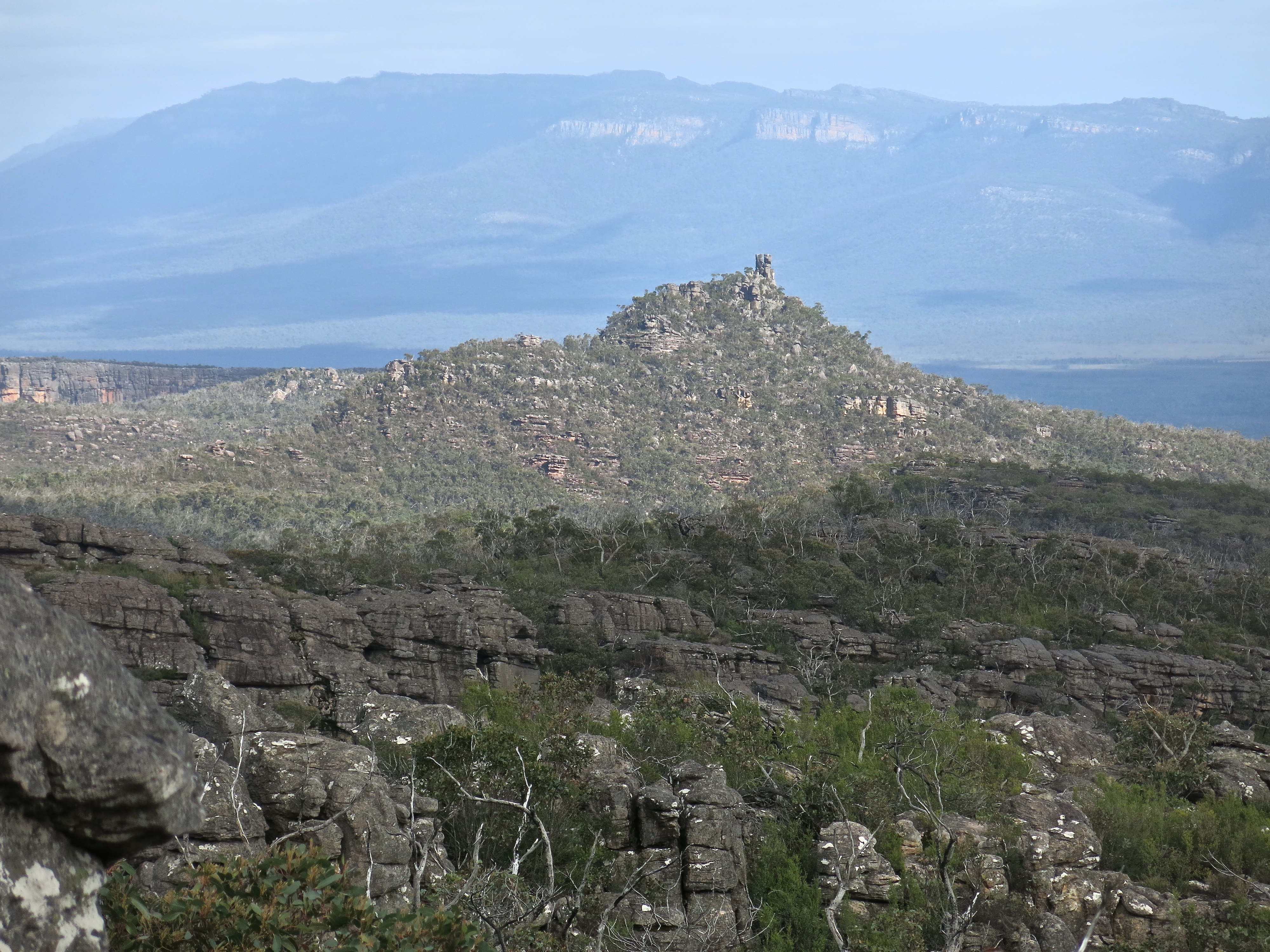
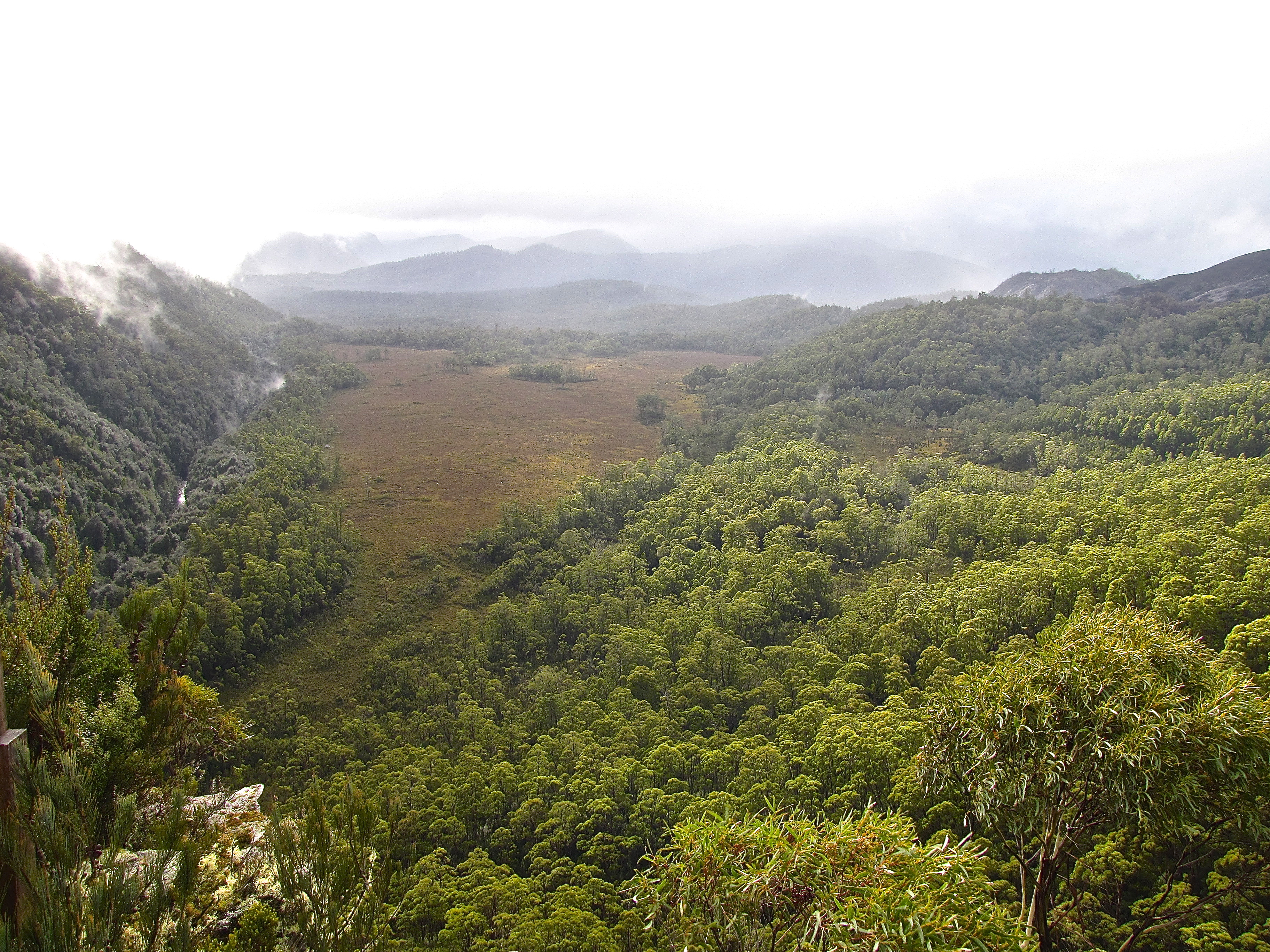
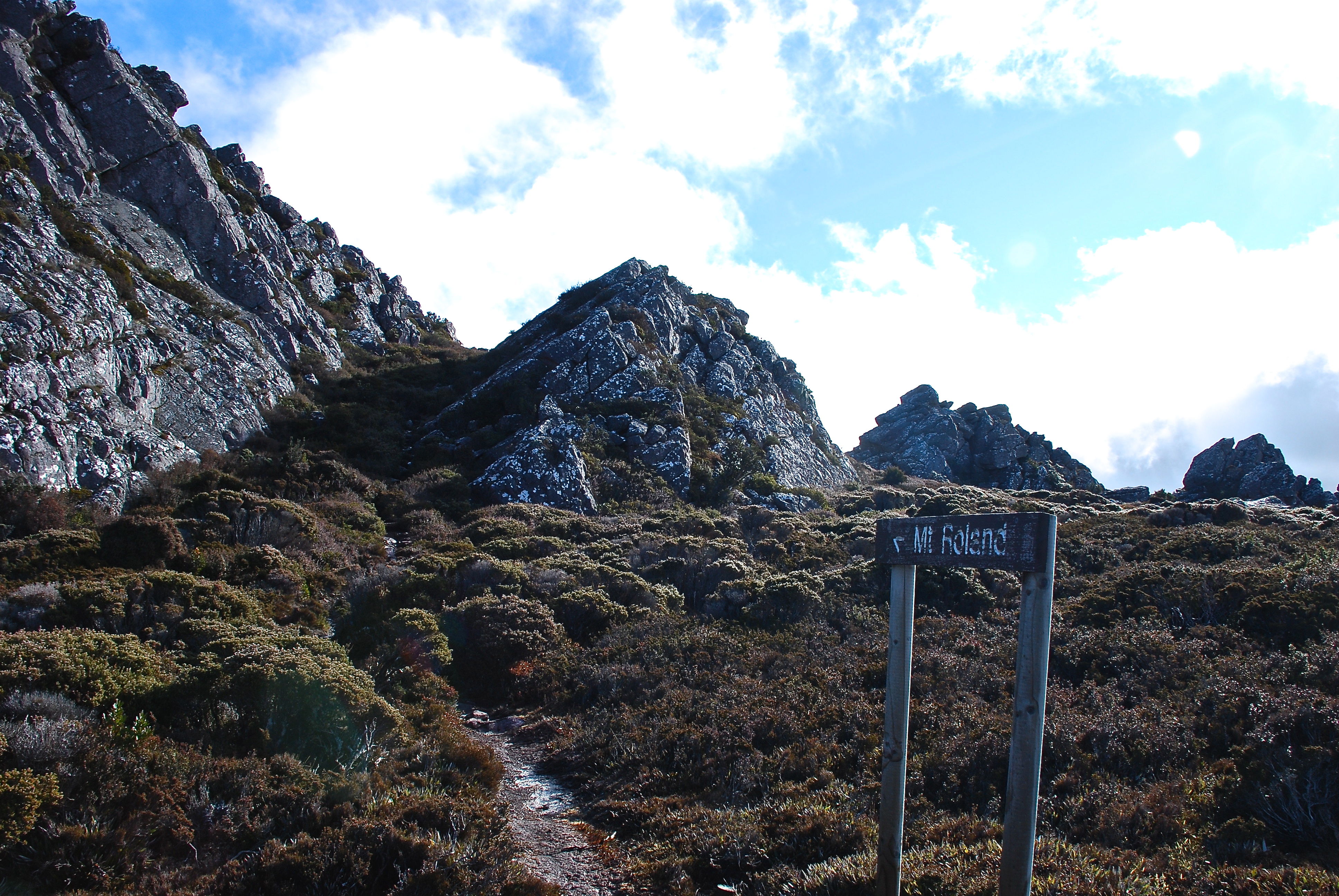
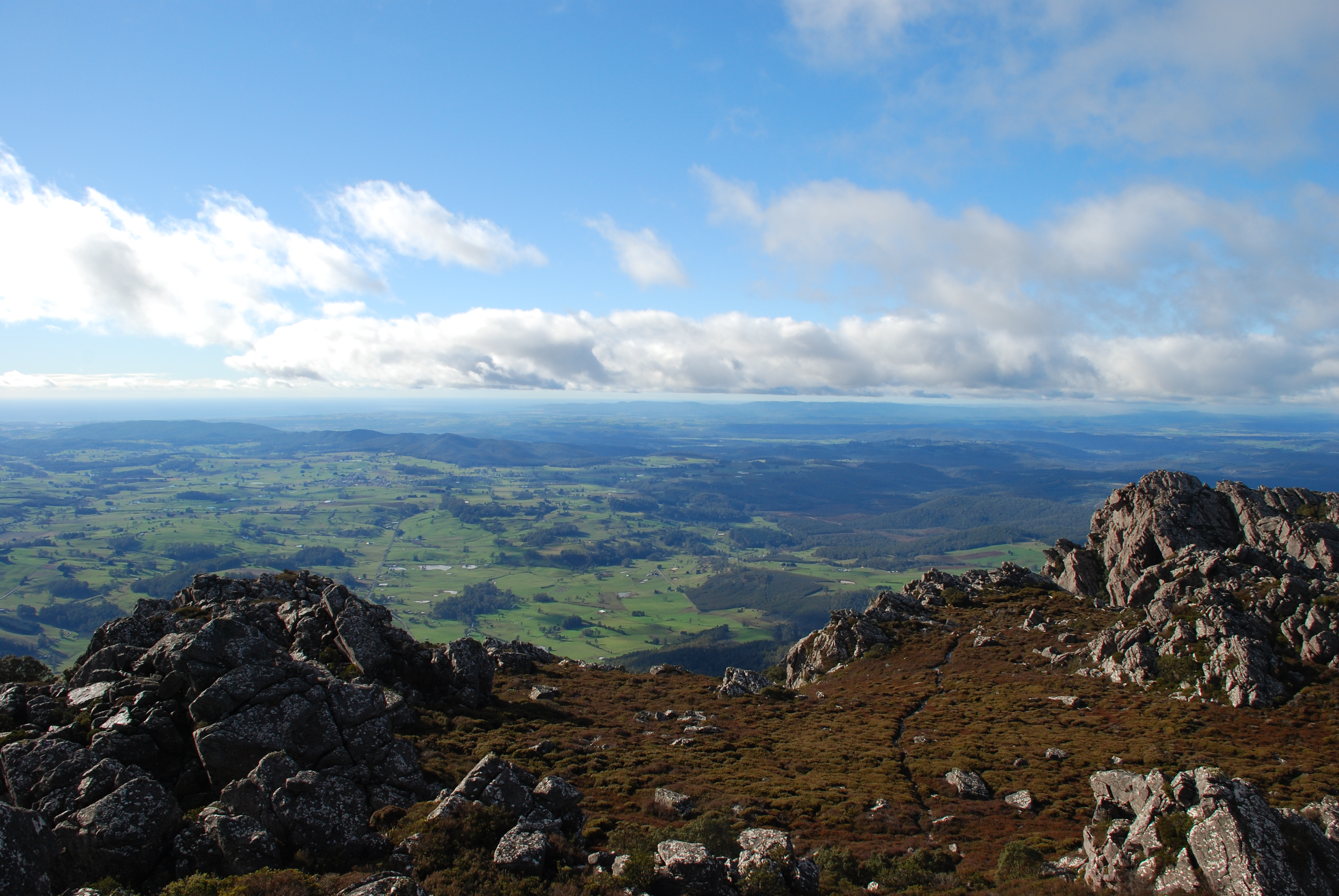
IMG_1410Unlike most of the rest of the Divide the dominant landform in the Grampians is the cuesta, a long slope with a sharp scarp, the result of folding and faulting. Except for a couple of granite outcrops in the Victoria Valley the Grampians are all sandstone, in geological time not long from the sea bed. [The pic? I’m on the peak of the highest mountain in the Von Guerard looking north. The hump on the horizon to the right is Mt William/Duwil.]

Growing up first to their south in Hamilton and later to the north in Horsham, I was a familiar. Picnicking and walking in the Grampians was a staple of domestic entertainment, just as it was for Myrna who grew up in Horsham. Sunday afternoon? Mt Zero and Flat Rock.

I have always been struck by the way they spring out of the surrounding plane, without topographical warning. There are few foothills, so there can be sublime ‘whole’ views like the one west from Carroll’s cutting just out of Ararat on the way to Moyston, north across the paddocks from Glenthompson, south from the Laharum turnoff or in any direction from the Glenelg Highway.2702050-16x9-940x529
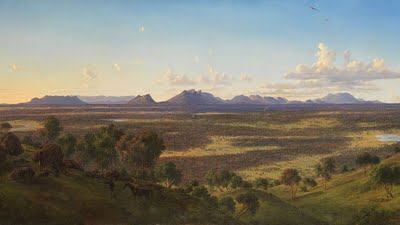
[The Glenthompson view. Von Guerard again, same time but really ‘Grampians viewed from Mt Rouse’]

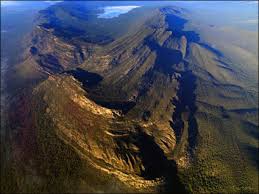
images copyFrom above (in the dry, this area can be greener than this) they are shaped, broadly, like a saucer with two tails. A large cutlet of fish perhaps. images-3 copyThe fin at the apex is shaped like a nose (in Jardwajali, ‘gar’, see Peter Bellingham’s fabulous pic) and is capped by Brigg’s Bluff from the top of which eternity appears just beyond the horizon.IMG_0921Lake Wartook, dammed in 1886 but probably a very long standing body of water, is in the middle of the saucer (‘syncline’ to its intimates). To the north are the chocolate soils of the Wimmera plains and to the south the volcanic soil pastures of the Western District.

Less than 100 k.s from north to south and not much more than 50 east to west (ignoring the Black Range, a small outlier further west), they have always struck me as fragile and small. Since I walked from Dadswell’s Bridge to Mt William as a callow youth of 14, the development of roads, tracks and other infrastructure has made them a lot smaller. Some of the Victoria Range might be considered isolated but when I hear of people getting lost in the Grampians (as they do from time to time, very occasionally fatally) I am puzzled.

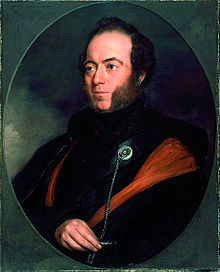
220px-Mitchell,_Sir_Thomas_Livingstone,_Explorer,_1792-1855,_NLAThey were named ‘Grampians’ by Major Thomas Mitchell, leader of the first group of Europeans to visit the area. He thought they looked like the Grampians in his native Scotland. Hard to know what he was thinking really, although it had been very cold and wet. The bullock drays carrying the expedition’s baggage were being pulled through the soil almost axle deep just here and they were only making a few miles a day. When he and his party climbed Mt William (or Duwil, the range’s highest peak at 1167m.) on July 14 1836 they were completely fogged in. The view next morning on a clear day must have been a revelation.

In the early 1980s there was a move to rename the ranges and their features (and in this heavily weathered sandstone country there are many more features than you can poke a stick at) with their original Koori names. [‘Koori’ = Indigenous Australian term used in Victoria for ‘people’; ‘Jardwajali’ one of the many local tribes or groups.]

Instead of ‘Grampians’ for example, ‘Gariwerd’, a rendering of the Jardwadjali generic term for ‘mountain’, and Gar (‘nose’) instead of Mt Difficult, Wudjub-Guyun instead of Hollow Mountain, and Djibilara rather than Asses Ears, Galbidj rather than Birge’s Nose. I was interested to discover that the ‘Billy wing’ of my childhood was actually ‘Billawin’, and the ‘Cherrypool’ where I’d spent time looking for the cherries was actually ‘Djarabul’. For several months the letters pages of the ‘Wimmera Mail Times’ shimmered with choler and bile. This clunky state government initiative produced a  reaction from the locals which set the cause of Indigenous recognition and reconciliation here back years.

Indigenous people lived in the Grampians for more than 20,000 years before the first whitefellas appeared — Jardwadjali to the west and north and Djab wurrung to the south and east. Billawin, a most unusual sometimes marshy area full of heath and head-high ti tree with an increasing number of lumpy and exotic rock formations as you close in on the Victoria Range, was an important ceremonial meeting place. This area, like much of the Grampians out of the tourist swarm, has a very particular and striking flavor. It resonates with something that is difficult to describe. It’s incredibly particulated but of a piece; it works; but it’s not you, or me anyway. Both fragile and resilient; scrubby but graceful; worn out but enduring; brimming with life a lot of which is crepuscular or nocturnal.
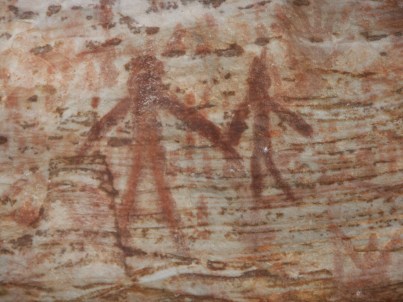
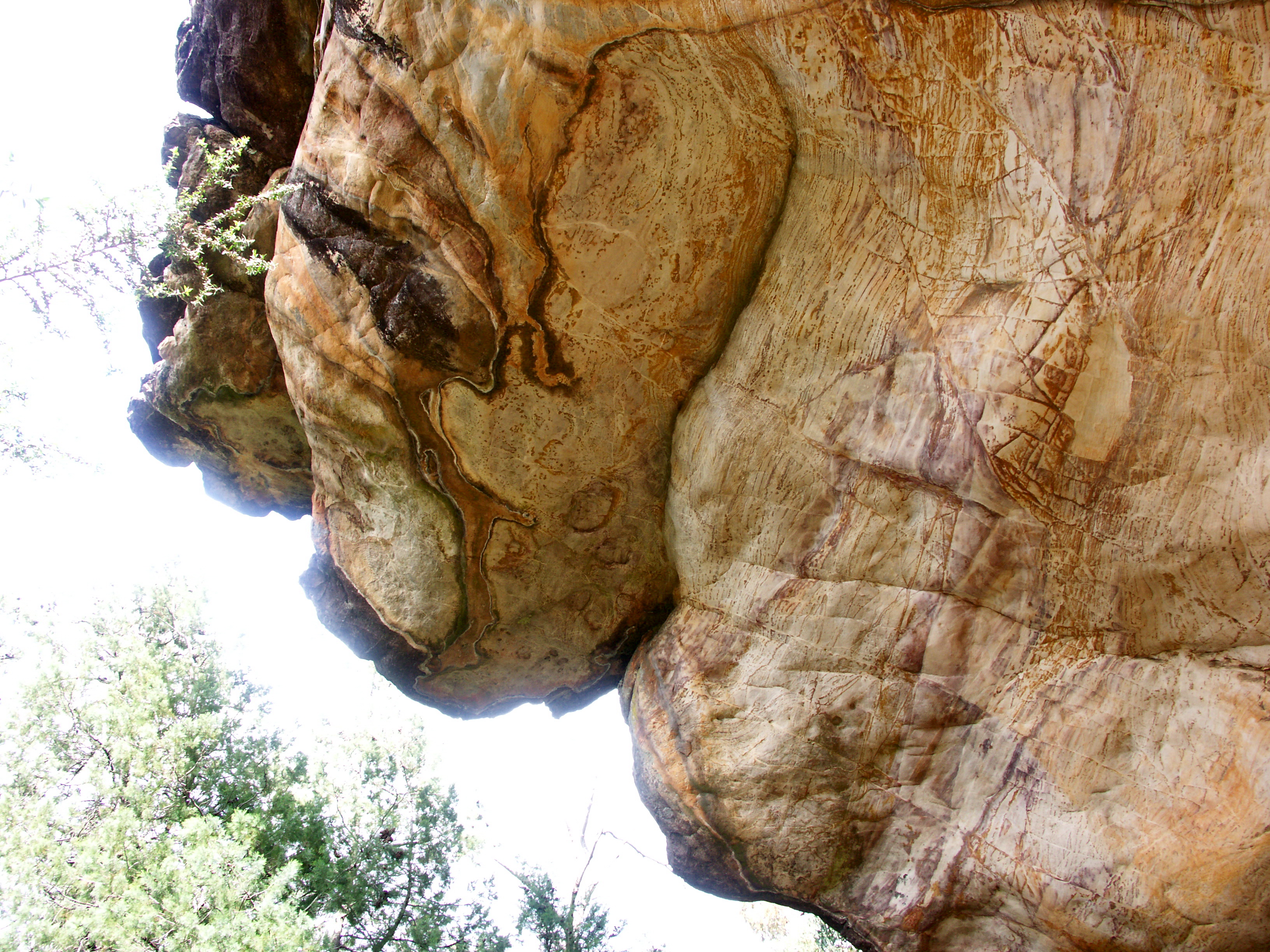
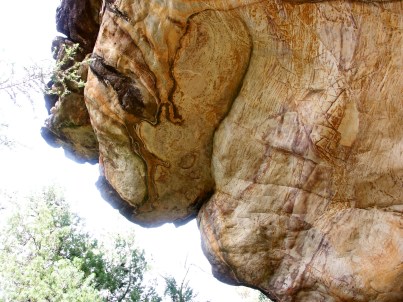
KONICA MINOLTA DIGITAL CAMERAThere are more Indigenous rock art sites in the Grampians than in all of the rest of south-eastern Australia combined, many of them near Billawin. These pics are from Buandik and Billimina shelters where the sandstone is polished and the art more than 10,000 years old.KONICA MINOLTA DIGITAL CAMERA
Four years after the Major’s first visit almost all the land around the Grampians and beyond to the southern coast had been colonised by Europeans. Four years. So very fast. Eight years later around 3,200 members of the two Gariwerd tribes, about 70 per cent of the total, had died or been killed. There is no doubt about the scale of the deaths; the circumstances are foggier. Introduced infections (like colds) certainly killed many, but there are also stories about massacres one of which may have taken place on or near the site of the current Hall’s Gap football ground, and there are other equally repellant stories about the activities of the ancestors of some of our erstwhile neighbours.

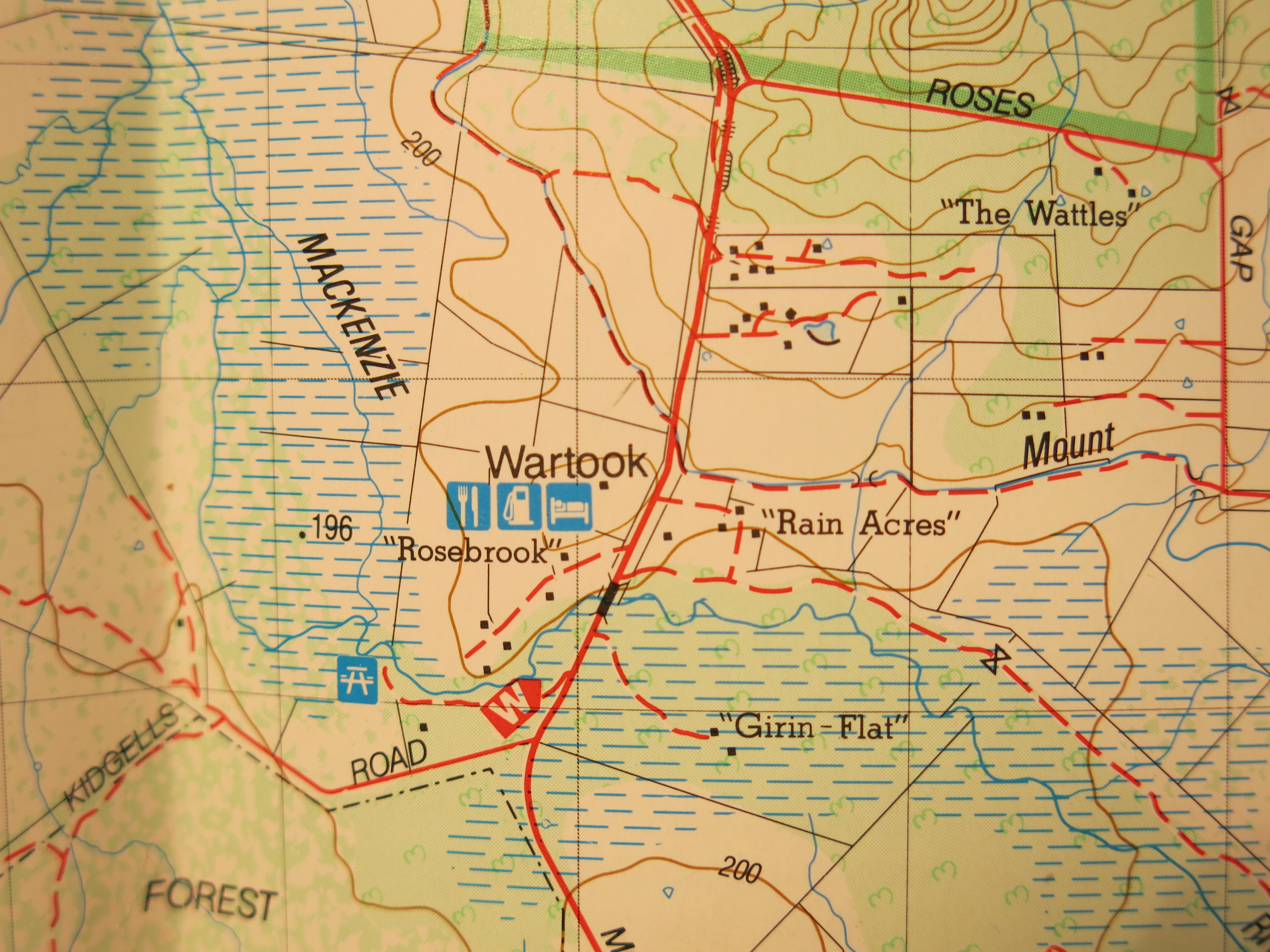
IMG_0785Further to issues of naming, here’s proof, of a type, from a Government of Victoria Department of Survey and Mapping map (Northern Grampians, 1994) that our property did exist. The area is called Wartook. When we were round there were nine (9) little black squares: four at ‘Rosebrook’ home of Peter Carter’s family, three at ‘Rain Acres’, Bernie Caelli’s holiday property, and two at ‘Girin Flat’. No others. No knives and forks, no petrol bowsers, no (public) beds. Our property was bounded by the road, the creek and the two black lines. ‘Joan’s paddock’ is the area containing the ‘200’ contour line mark.
IMG_0904Proof also that we have contributed to the named features of Victoria. ‘Girin’ is the Jardwadjali word for sulphur-crested white cockatoo. It seemed appropriate. Every evening hundreds of them would gather in our trees and chatter — hawaack waak waak hhhaaawaak qwaaaack waak waak poi poi poi WAAACK waak waak waak — until sundown after which you might hear a lonely cry from stragglers flying home.IMG_0911

The birds were and are a spectacular feature of life in the Grampians. The variety of environments, the plentiful flora and insects and the mild climate mean they are there in profusion. Geoffrey ‘The Twitcher’ Ainsworth began this list. Think of it as a poem.

Blue wrens, crimson rosellas, eastern rosellas, grey thrush, emus, eastern shrike-tit, southern yellow robins, willy wagtails, yellow-tufted honey-eaters, yellow-winged honeyeaters, wedge-tailed eagles, white-browed babblers, sulphur-crested cockatoos, Major Mitchell cockatoos, southern magpies, chestnut shelducks, kookaburras, brown and grey tree creepers, brown flycatchers, orange-winged sitellas, pied currawongs, long-billed corellas, lorikeets, crested and bronzewing pigeons, rufous whistlers, welcome swallows, crows, spotted and striated pardalotes, yellow-tailed thornbills, galahs, kestrels, whistling kites, screech owls, southern lapwings (I say spur-winged plover), gang gang cockatoos, yellow-tailed black cockatoos, noisy miners, magpie geese, bronzewing pigeons, white-faced herons, ibis, pipits, flame robins.

And dozens more. More than 240 species of bird have been identified in the Grampians and I suspect we would have seen at least a third of them on our land.

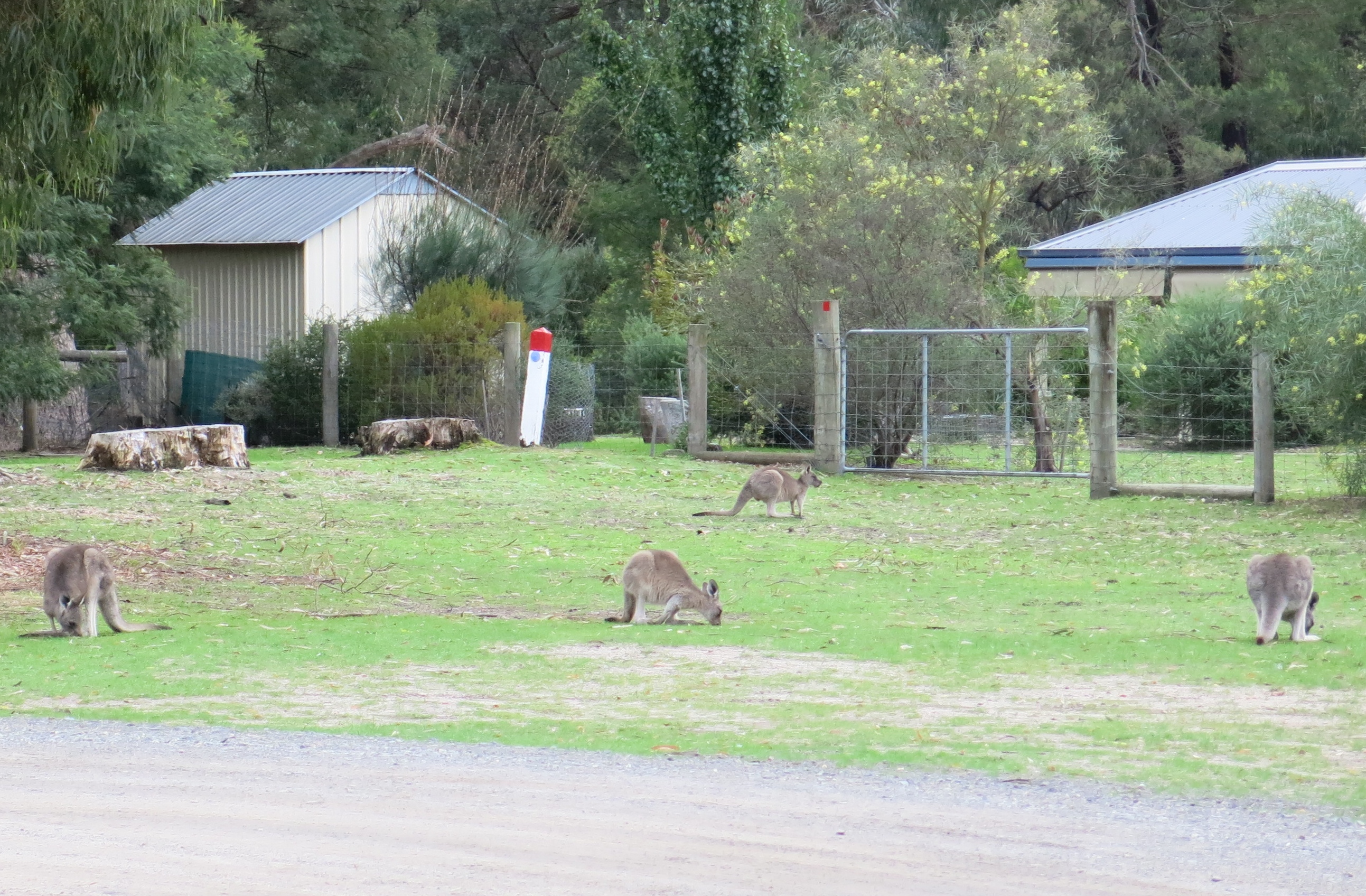
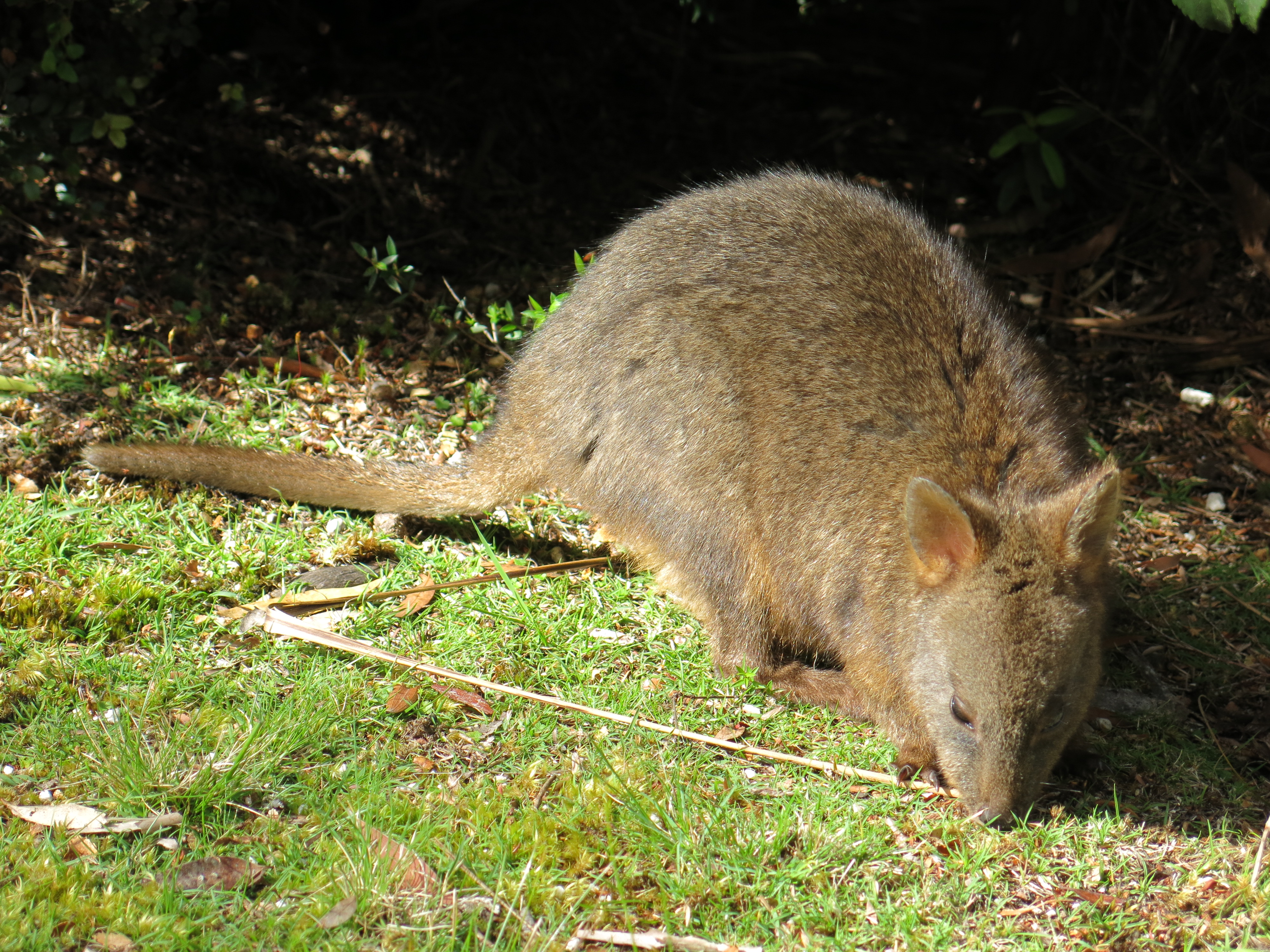
IMG_0832The Grampians are also alive with animals. There are more species of kangaroo living here than anywhere else in Victoria and they’re not difficult to find. This is one place in Australia where the tourist dream of kangaroos loping up the main street is realised. They particularly enjoy grazing on pasture, or lawn for that matter if it is available, and that was one reason why groups of hundreds of roos were common in Joan’s paddock. When the trees in our orchard started to grow kangas also proved to be partial to young fruit tree growth.
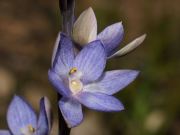
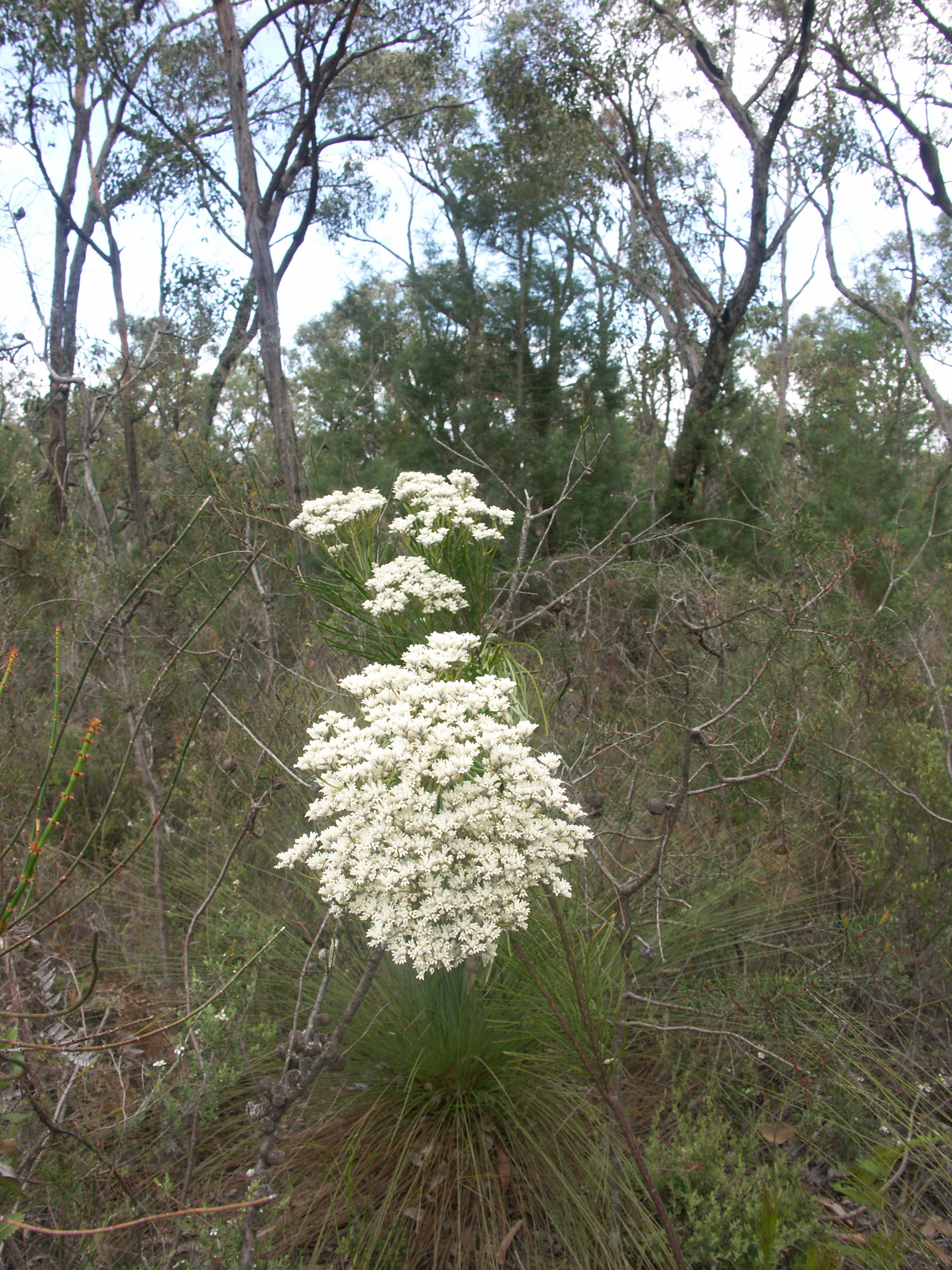
orchid_Thelymitra_aristata_Grampians131106-4682C_tensa_Rigid_Spider-orchid_G_Rudolph341KONICA MINOLTA DIGITAL CAMERAAnd flowers. Flowers are one of the reason why the Grampians are overrun by tourists in spring. Unexpectedly prolific, diverse, florid, sometimes tiny like the orchid on the right, but gorgeous among the standard khaki, grey and dusty greens.

One other thing you might note about the map and the location of Girin Flat is the blue hatchings, the err … ‘subject to inundation’ information. We didn’t look at this or any other map when we tried to buy it. We got things under way in early summer, signed up (after a fashion) in mid summer, and anyway knew the western side of the Grampians is far drier than the eastern side. It has a Wimmera climate: hot summer, beautiful winter with freezing clear mornings warming up to 25 or so, shirtsleeves if not shorts. It rains from time to time but not very often and not very much.

Except when we moved there.

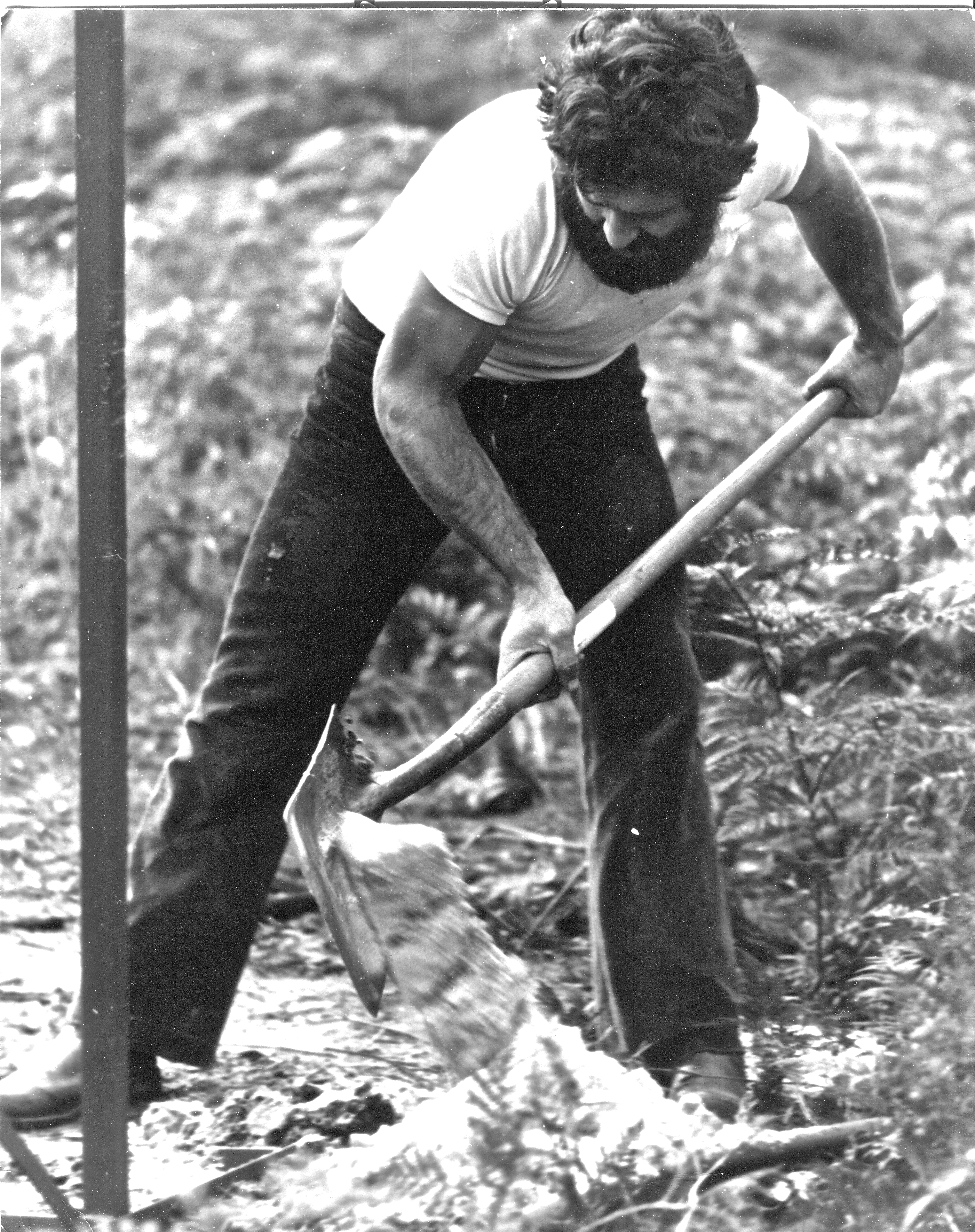
In July 1974 the rain began and it kept raining. Four inches (100mm) in three days, then six inches over a week, then it just rained continuously during August — the wettest month on record. I tried to plant fruit trees but the holes I dug would fill with water as soon as I sank the shovel in.

Quicksand has struck. There is sort of a crusty surface and very paddly sticky stuff underneath. Cam [a nephew, young at the time] got his foot and leg into a patch near the creek and went straight up to his groin which was rather exciting. And today when, as is my custom, I got bogged next to the shed, I was able to watch all four wheels slowly sinking into the dirt until the body was more or less resting on the ground. A job for P. Carter’s tractor that one.

Talcum powder, quicksand, bogs, washaways, puddles, frogs, lakes, swamp, marsh, floods, night noises, taddies, water birds, creeks. We’ve bought a creek, a wide one. By judicious and careful calculation one can conceive that this might be what happens every year about this time.

As the floods tore through our first garden, Myrna wrote:

IMG_0847Floods in the vege garden nearly broke my heart yesterday. It was so depressing. I came close to understanding how the farmers feel. It is a very different thing to be dependent on the weather. For the first time ever the Grampians seemed really quite hostile. … There were hundreds of kangaroos at Zumsteins busy grazing. The looked quite prehistoric with their enormous backbones extending out to the end of their tails and their tiny heads. I’ve never looked at them like that before. They seemed to belong to the rugged hardy trees and the prickly complicated mountains. The Grampians didn’t seem to be sympathetic to us at all. It made me see how nature can stop or destroy things so easily. …

That’s the way it is when you want to be in touch with living things. It isn’t all beautiful and fresh and invigorating. It is often trying and bewildering and hurtful and very very harsh. Living here isn’t going to be a lovely time in the country. It will be sometimes. … But we will have to keep reminding ourselves about all the animals and plants which have evolved tough strong durable systems before we ever arrived and started doing things. … We should respect what is here and not try to do too much.

The water finally receded in early November. The water table dropped about 90 cms. We moved the garden and the site for the house up onto a modest rise. The native grasses came up in profusion. Hundreds of emus populated Joan’s paddock. And, because it’s Australia — ‘a sunburnt country of droughts and flooding rains’ — the country browned off after six weeks to the point where we were watering hours a day.

IMG_0852[pic: not Billawin, but typical. Looking south to Sentinel Rock from Mt Rosea ridge]

IMG_1409.JPGThe alien quality of much of the Australian physical environment to its European settlers is a commonplace if not a cliché. I thought about this when we were walking through the Ardeche in southern France a year or two ago: picturesque stone houses in a rolling green countryside that seemed to be the very embodiment of fecundity, an ecology apparently in fine balance, a landscape so palatable I could just loll around in it permanently without thought. But is this some atavistic memory, some throwback, some chocolate box archetype of how things are supposed to be? Myrna has always been more fond of the Grampians than I have. I like them very much. She might say they were part of her identity: I wouldn’t. I can remember times, just as she describes above, when I’ve been shaken by them.

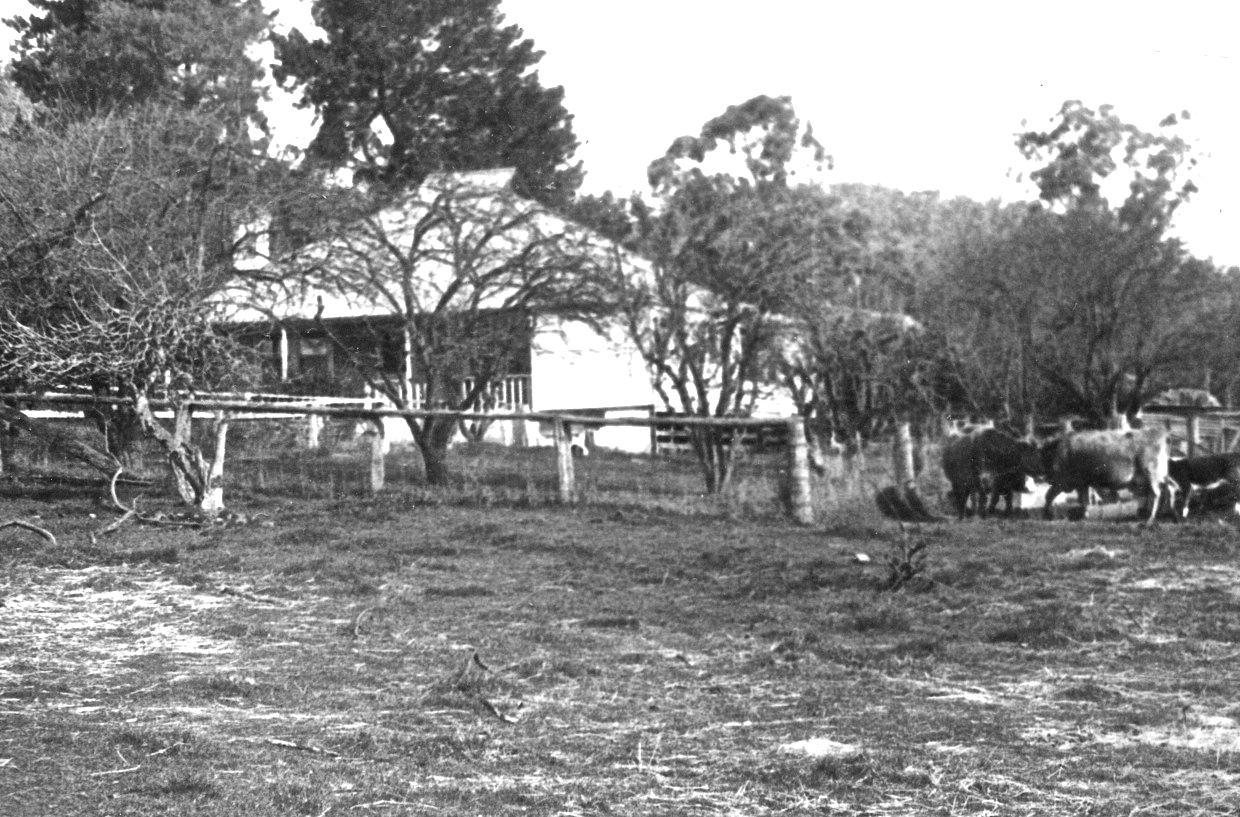
If we’d been doing this at Molyullah, a softer and more settled landscape, it would have been different. Girin Flat wasn’t virgin country; it had been logged by sleeper cutters and there were remnants of a camp half way over to the creek. But it wasn’t that far off. At Molyullah we would have been starting with cleared land (surrounded by national reserve), we would have had sheds, a garage, sewerage, a phone, water and power. At Girin Flat we had none of those things, which was partly the point. (Or was it? I don’t remember thinking about it much).

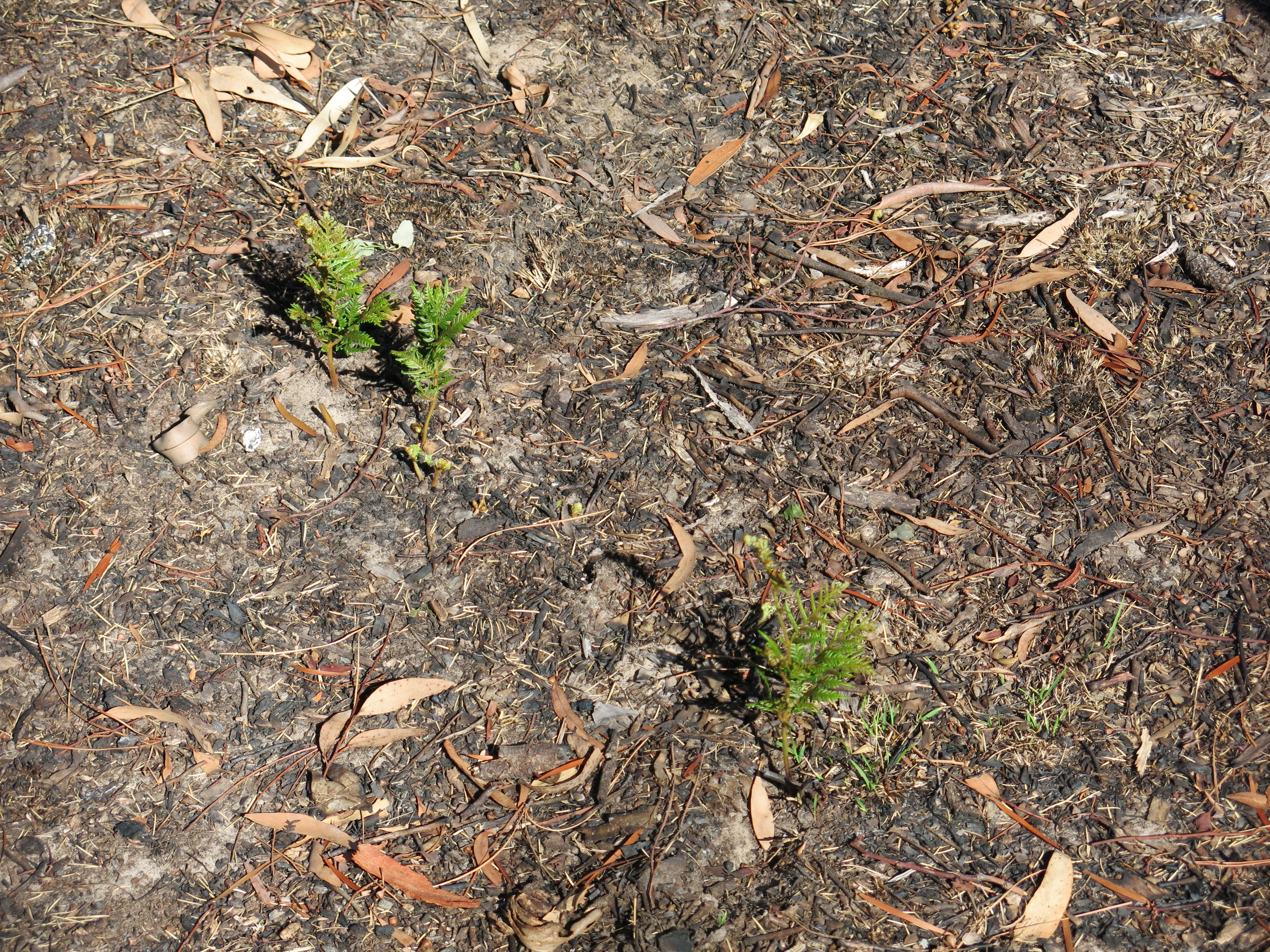
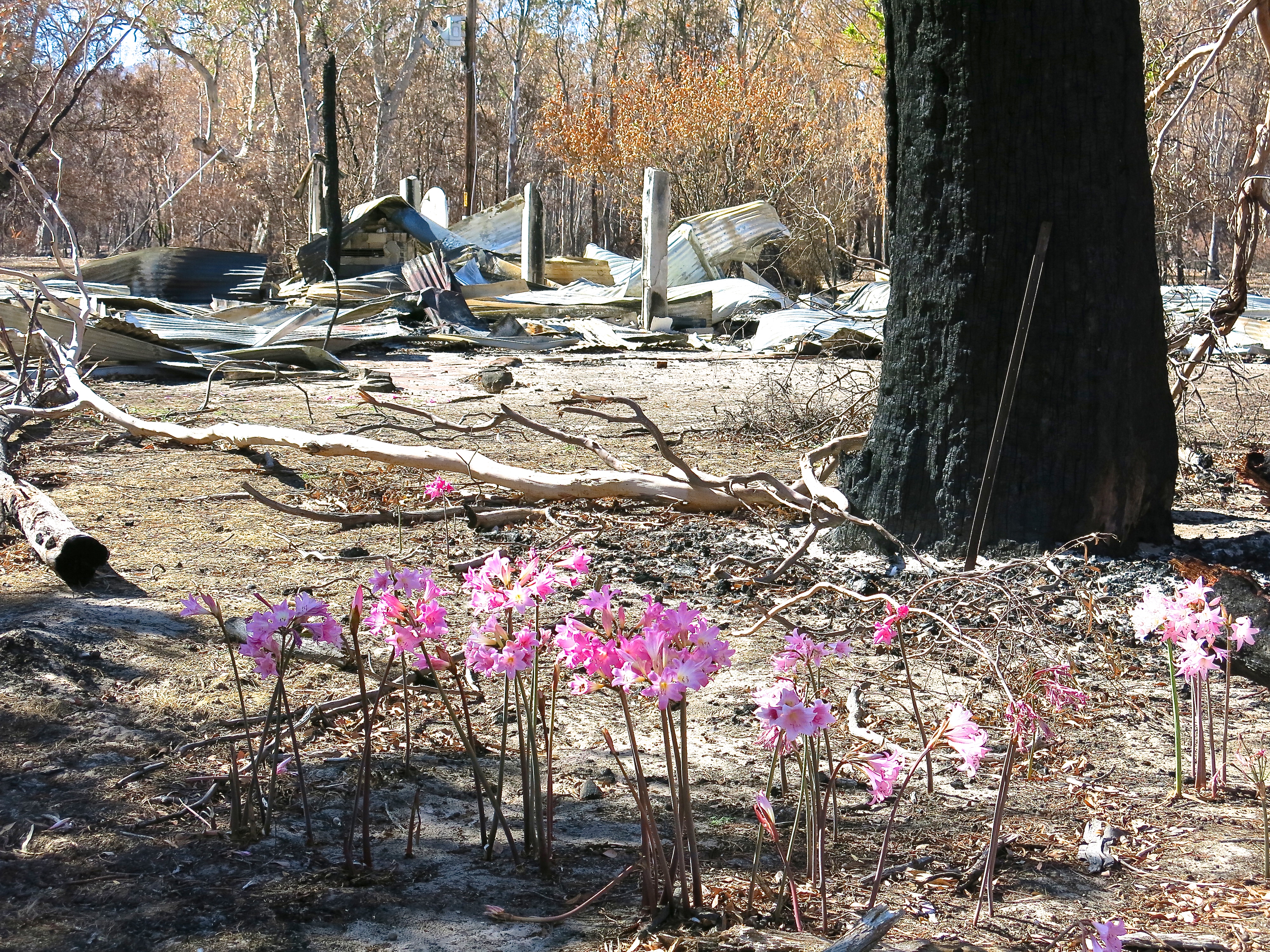
We spent endless hours trying to clear the bracken from around the house, and from the orchard and the garden. Bracken grows from extremely hardy rhizomes (underground rooting systems) which are very hard to remove. We didn’t want to poison them so we had a permanently available job cutting bracken. And look here at the first thing coming back after the fire.IMG_0549

There is no shelter in the bush. I knew that, and that was one reason why we valued the shed so much. It had a roof. But there wasn’t anywhere to put building materials or other stuff which might become rain-affected. We established a sewerage system after a while which worked very well, except for some reason we needed twice the length of runoff piping than was standard. I doubt whether runoff would have got much past the first few metres.

We used tank water to drink (after we had a roof to collect it). To wash and to water the garden and orchard we pumped water to a header tank from the creek (Horsham’s water supply but 40 k.s cleaner). Our pump was much better at blowing than sucking so we moved it over to the creek 500m. from the house which meant that you had to go (usually walk) over there to start and stop it. This was not always convenient.

This morning I was running late. I tear into the bathroom, tramp round the ice-encrusted tiles, leap in the shower and turn on the tap. Nothing. Nada. Rien. Zilch. No drips. No noise. Nothing. Thinks: no water. Bloody hell blooody hell. The wife has emptied the tank with all her watering.

So without further ado I stick on boiler suit and slippers jump in the ute and drive heedlessly through native vegetation. (I did stay on the track.) Got there and had a real struggle trying to get the aluminium-flavoured ice block that was the trusty Honda 4-stroke to fire. As I casted through all the things that could have gone wrong, rusty water was coming out the drip line, always a bad sign.

Then, lo! Bonzo the idiot wonder dog appears at the side of the clearing with infuriating Jack Nicholson grin. Then even more lo!, glamorous wife appears in pyjamas on Space Ranger bicycle and tells me the whole pipe is frozen. I’ve been trying to drive a 50mm x 500m. icicle through the house. I will read this in few years and, no doubt, marvel at nature. But I was pissed off this morning. Minus 6 degrees.

And for most of the time we had no electricity. We used wood for heating, cooking and hot water and had efficient technology for each. Both our slow combustion stove and our hollow-backed open fire place were brilliant performers. You did of course need wood. I found a great pile of red gum sleeper offcuts somewhere up the creek and cut them up using Peter Carter’s docking saw. That lasted a couple of months. Wood goes fast.

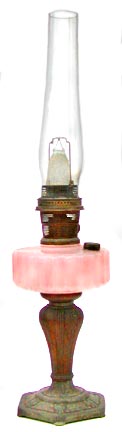
Our fridge ran on gas. (See ‘In Memoriam #4’ for its exotic source.) It mostly worked okay. Entertainment came from a battery-powered cassette player which turned over a set of batteries a week. I tried to hook it up to a car battery, swapping them over, but never succeeded. For light we used a kero pressure lamp which as I have complained elsewhere hissed relentlessly and six or more Aladdin lamps (see pic. Ours weren’t just like that, but same principle.) which gave a lovely light but not enough to read by and their mantles were very fragile.Bmajectic And no phone. Never thought about phones then. Imagine.

When Jessie came along we bought a small generator, enough to drive the record player and one light to read by. (Not reflecting very well on me at this point.) But you had to start its motor and leave it running for anything to happen. The Pykes (see below) had a large, and quiet, diesel generator which was automatically activated by turning any switch on. That was too complicated for us.

Not having electricity wasn’t a matter of ideology. We were more than a kilometre from a pole and it would have cost as much as the land did, more than $6000, to get connected to the grid. And for a good while we seemed to be getting on all right. Except for the matter of actually buying the land.

It took forever. The stages: hope, wonderment, mystification, fury, disdain, fatalism.

It was a subdivision which made it more complicated. It needed to be surveyed for a start. Before it could be surveyed we had to cut a clear eye line about a kilometre through ti-tree which we did quite promptly.

31/2/74 First visit from Noel Ferguson the surveyor. Seems like a good bloke. We may be getting a little closer to fixing things up. It looks like the survey will be taking place before Easter.

25/5/74 Despite the fact that we’ve cut a clear line for more than half a mile Noel says he won’t be able to survey it for another month. Needs new equipment or something.

27/6/74 Today I had a rather cathartic visit to Bob Stewart of Power and Bennett, solicitors and vile bodies of Pynsent St Horsham. Nothing has happened. Nothing. He suggests, from behind his professional mask, worn threadbare from overuse, that it might be 6-8 months before we are able to finish buying the land. That’s just crazy. There is a whole collection of misunderstandings combined with the slowness (indolence, sloth, sluggardliness) of the surveyor. I hate this.

15/8/74 Ferguson is now in a position of even lower esteem. Joan has been in touch and he’s fobbed her off, told her he’d finished the job but he hasn’t been anywhere near the place.

2/9/74 It is certainly not a matter of being patient and having your expectations pleasantly fulfilled. The right date, the right time or, as a delightful surprise, a fraction earlier, a good job, that extra mile — NO WAY. It always seems to turn out crazily rushed at gunpoint, shoddy work, things missed or mucked up. Anyway after all this time Noel F, our poster boy, has finally confirmed we are going to buy 23 hectares of finest Grampians land.

Seven months. What a rat. And that was just the surveying.

In July, 1974 we became official holders of Crown Grazing Licence No. 302.130 with ‘the transfer from Joan Carter to yourselves duly endorsed thereon. Signed: E. Kennedy, Secretary for Lands.’ Five dollars per annum allowed us ‘to enter with cattle, sheep or other animals upon parklands to depasture same’. This was the slice of land between what we wanted to buy and the creek. But it didn’t allow us to build anything.

I spent a long time trying to talk Fred Heinz, the building inspector for the Shire of Arapiles, in long distance control of our area, into considering plans for a building under Joan’s signature.

12/9/74 I had a long talk to Fred Heinz yesterday when it was so wet and miserable it almost guaranteed that everybody would be home. Noel F. had at last, a pleasant surprise, got off his bum and done the prints for the survey map. So all the stuff is sitting at the Shire of Arapiles. Fred says that —

1)     There is absolutely nothing to do before 100 days. Hi ho. Same old thing.

2)     He will not look at the plans even under Joan’s name until the sub-division is approved.

3)     He was all over the place about whether or not we would be able to build here! It might be ok … probably. And we won’t know that until we have bought the land and completed an Interim Development Order which may be subject to a number of conditions.

4)     I was a land developer. I said I wasn’t. I was a teacher who wanted to live on the land. He eased off a bit after that was established.

In the end he did agree to look at a building submission signed by Joan. And finally, after a good deal of the house had been built —

9/8/75 Today we signed some dubious looking papers that apparently indicate that sometime in the future the bank will buy the land from Joan and that we owe them $6310.50 for that particular privilege. This has occurred an offensively long time since this game began. I’m past caring.

Nearly two years in fact. That was as hard to manage as anything. Not least because Fred was based in Natimuk an hour’s drive away, so regular contact was difficult and in his mind pointless. There was no basis to have contact with the Councillors of the Shire (we weren’t rate payers till we owned the land) and Fred ruled with an iron fist anyway. Short, very blond, cropped hair (can I say Germanic? I think I will), he was exceptionally keen on the letter of the law. But his Wartook confidants were also the dark side of the Carter family.

We were the first of the new settlers (which 20 years later multiplied egregiously as the Carter boys found there was very comfortable money to be made from land sub-division). There were three families besides us. Ron and Gwyneth Taylor, a few k.s away, had come from (‘been driven out of, by development’) Vermont, an outer suburb of Melbourne. He was a retired solicitor and Gwyn was a gifted naturalist (plants. native) and they were staunch ‘greenies’, I think the first formal versions of the genre that I encountered. Ron was an irascible crock, Gwyn a lovely person. Further round towards Zumsteins were the Raleighs, Royce and Zhan and their three young kids. He was a primary teacher working in Horsham too, but they wanted to quit and set up a native plant nursery which they eventually did. Then back towards Horsham and more remote than any of us on a glorious and large block, several hundred hectares with a great view, were the Pykes. Will was an ag scientist and good at a lot of practical things and Prue was a TAFE teacher before they began producing children.

Fred had made the Raleigh’s pull down their shed frame and insert new reinforcing plates on the slab. That helped our relationship.

But our immediate neighbours were Peter and Denise Carter and their young kids Bradney and Genene. Peter was Joan’s nephew. The only stipulation Joan asked of us when we started buying the land was to keep our gate shut so that, and I quote, Peter’s lice-infested sheep wouldn’t get into her paddock. He was thoroughly amiable, dreamy in a sort of orotund way, enjoyed a drink, was keen on the races and not so much on work. He had a well-rehearsed theory that good farms looked after themselves. His brother Don owned the land adjacent to the national park nearest to Zumsteins. He was another sort all together. I thought he was sharp, mean and hard and he quite evidently didn’t like us and our ilk.

The back to the earth literature is full of the presence of wise ancients who can advise you of the ways of the land and guide you through the thickets. They may have among their skills an ability to talk to the wind or to call emus at will. They know knots, how to baffle wasps and at their finger tips have 32 practical uses for (traditionally refined and organic) sump oil. Old Justiney or Black Beardy James. Joan and her man Jack Smith were a bit like that, but mainly we were embedded in quite a large colony of red neck arseholes (for whom of course we were fly-by-night drug-infested hippies).

Three things gave me a sharp fright when we were on the land.

One was the first and every subsequent time I heard a screech owl. You would swear that someone was being murdered. The second was the time a possum dropped on us when asleep in the shed. It didn’t like it; we didn’t like it. There was a ruckus. The third was again in the shed, again asleep, but home from school sick as a dog. The door was crashed open and the two Carter boys — men, how old? probably 40 — stood over me, demanding to know all sorts of extraneous things that were none of their business. Was I building on Crown land? Where did those bricks come from? Who gave me the right to … Were there drugs on the property? (I think they might have been drunk themselves.) I was physically shocked and utterly nonplussed. How and why that happened is still a mystery.

This event coloured our relationship somewhat which may already have been coloured by the Horvath affair, something to which there is no reference in the journals and about which I had completely forgotten till last week.

Here’s a note to self that is in the journals: A good thing to do after we own the land and have a building permit, would be to get Royce and Ron and the Pykes, all the people round here we could muster and people who don’t want shooters crawling over their properties. Could set up an organization devoted to conservation causes.

This admirable notion was pushed ahead because a Mr Horvath, who we never met, purchased some land on the other side of the creek up the hill in order to set up a theme park full of Disney characters. This, like most things, infuriated Ron who in short order sought an injunction to stop any such thing happening.

This is a classic land use issue of course. If we could do what we liked with our land, why couldn’t he? Whose values should prevail? What notion of amenity applies? Is there any role for the idea of ‘appropriateness’? Oooo land development, what a Sargasso Sea of untethered rights and cravings.

So, long story short, we hooked up with Ron; and the Carters (with, I would have to say, an eye on their own subdivisions) went with Horvath. I set up a public meeting in Horsham to try to establish a Grampians Conservation Society. It started nasty and got much worse. I think the whole Laharum Football Club — players, relatives, friends and acquaintances — led by Bruce Lamshed whose son I was teaching (as if that means something), turned up to yell and catcall. There were no fistfights because there was no one on our side. It was the most abject of disasters. I would have done better if I’d played footy for Laharum, but I was too busy building the house.

orchardI could talk about the garden and the orchard and how we were trying to woo plants to grow in sand that had been scoured by the creek for centuries, maybe millennia. Great for mortar and foundations, useless for vegetables and fruit trees. How we used to spend days collecting manure for these enterprises: on one day alone 17 ute loads of aged sheep shit were dug from under Bernie Caelli’s historic shearing shed and carted off. And, despite all, how things did grow. We never had any fruit off the trees but they blossomed and some of the 40 or so thrived. Myrna’s garden was a major source of food.Garden

One meal I noted: three fish from the creek, mushrooms from Joan’s paddock, broad beans, zucchini, brown rice and homemade bread. Yum. I don’t know where the fish came from. I’m not a fisherperson. But the garden did flourish, maybe hydroponically.

There’s so much more. But the subject is the house. Let’s return to the topic in hand. In Memoriam #4 and 5: How do you build house.poles
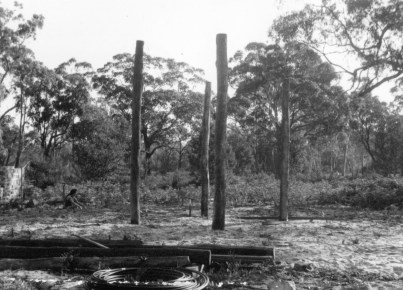
IN MEMORIAM #2: HIPPIES AND HOMESTEADERS

The crewYeah that’s us. 1973.

From the back: Dan, me, Diane (dee-arn), Johnny boy, Mernz and Alice the German short-haired pointer.

The first time we went to have a look at the land. We had walked through the boundary of melaleuca, banksia and leptospermum which I think at the time we would have called ti-tree or just scrub, into Joan’s paddock where, as usual, there were scores of emus grazing and a few clutches of kangaroos. There may have been wedge-tailed eagles spinning lazily on the currents and certainly our place to be would have been full of sulphur-crested cockatoos and Major Mitchells squawking before the stillness at night fall. The Mount Difficult Range at the rear is probably turning pink, mauve and golden in the late light on this gorgeous still night and there is nothing in front of us but prospects.

A five-part relationship, a quintuple perhaps, close but with very specific affinities, was always going to propose difficulties. Although, until it wasn’t, it was elastic enough to accommodate a good deal. I think it might have been the wedding and certainly its upshot that did us in.

John and Dan had led the way really. They had ‘dropped out’ for a year (although the chronology isn’t important, most of 1973) and found a farm house at the end of a blind valley near Molyullah (on the alpine side of Benalla) in which to explore their existential states. Myrna and I had our five-person honeymoon there. From time to time John and Diane were a couple. Moly#1We visited regularly. It was a very easy place to like. Moly#1 3The soil was magnificent, rich and black, and we refurbished the garden. Chooks, cows, goats from time to time, old fruit trees decorative with lichen but salvageable, shed and a garage.

But like most farm houses of its day the house was a simple creature, well-sited mid slope with an amazing view down the valley, but cold and damp in winter, hot as blazes in summer, oriented the wrong way and with no insulation. I became itchy to fix it.

I drew up plans and wrote lists which had practical as well as cosmic elements. However Zade and Bob Willett, the farmer owners who lived a bit further down the valley, weren’t keen for anything major to occur, nor at the time did they have any interest in selling it. (Four years later the perfect package, that house and 40 hectares appeared in the for sale ads.)Moly#2 [This photo is really only here because I like it. John and Dan did too. Dark menace threatening happy families. In the foreground my father and brother John holding John’s twins. Our bucolic adventures were always strongly supported by our families.]

Myrna’s brother, Robert, was a real estate agent in Horsham and Joan, a delightful ageing and single member of the pioneer Carter family, crossed his path wanting to trim down her holdings — specifically 33 hectares of scrubby dry sclerophyll forest with a Crown Reserve with a grazing licence between it and the McKenzie Creek, taking water west and north from Lake Wartook in a no more than amiable but permanent trickle. Myrna had always loved the Grampians, and it looked like the formal part of purchase was going to be easy.

The stories of communes always seem to contain a very bossy-boots figure who is placed somewhere on the benign-malign spectrum and I think that was probably me. I had no doubt that it was the right thing to do because I think at the time it would not have occurred to me to wonder. Great idea, it’s what we want, let’s get on with it. Now. I spent a certain amount of time trying to convince the others of the delights that loomed ahead. When communication was mediated by a stoned haze I was quite successful, but when breakfast was finished and there was work to be done, I had less impact. Different speeds: that was certainly one issue. And it was more real for us because Myrna and I both had jobs in prospect at Horsham High so our source of income was local. No one else had a job or any money. Shed

We had some spare money because a film I had made won an AFI award in 1973 which included a $1000 prize. I had sweated blood over its production — script, direction, star, editing,  production supervision, host to production team, etc etc — so, in what at the time would have been very uncool, I was pleased to have a pay-off.

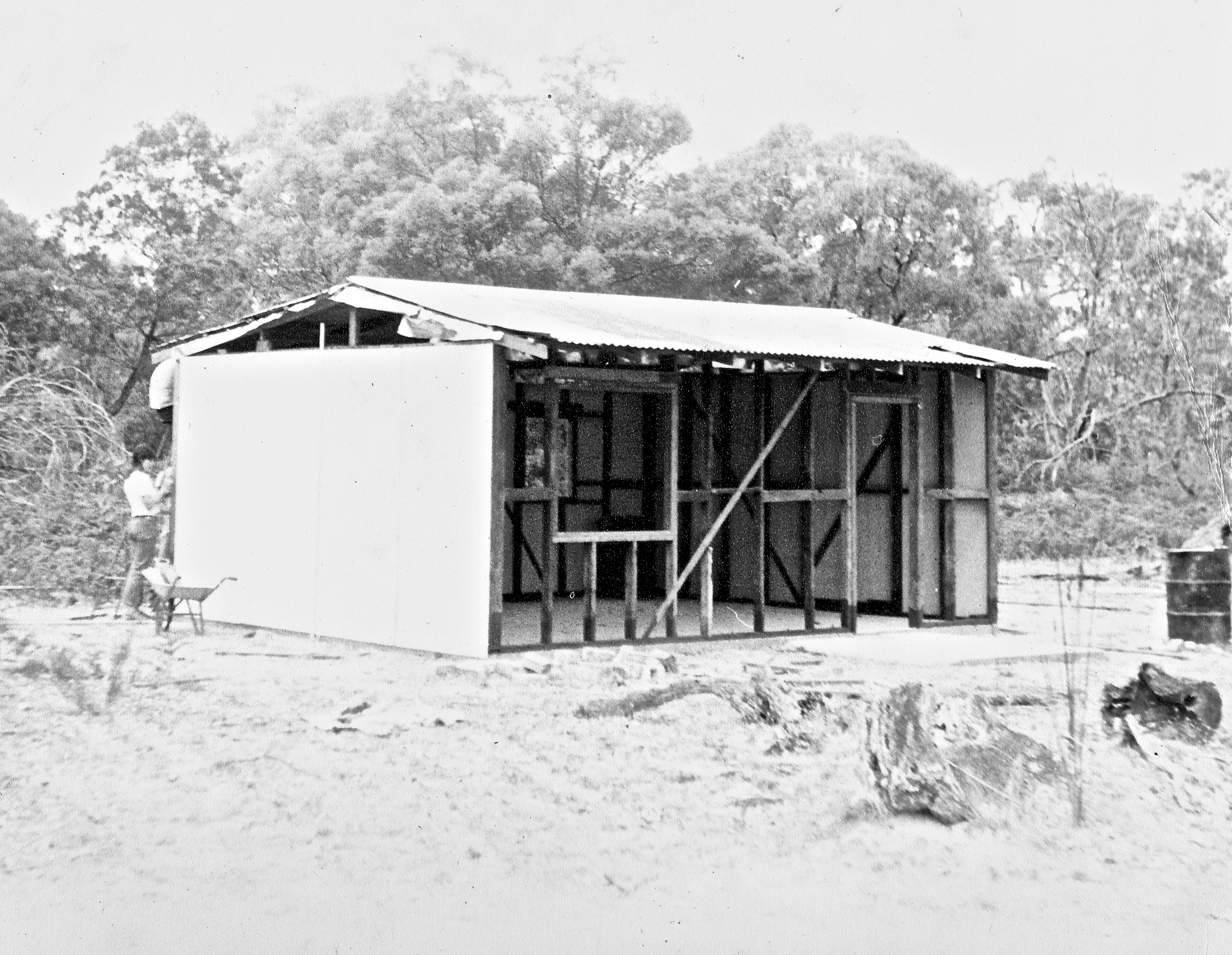
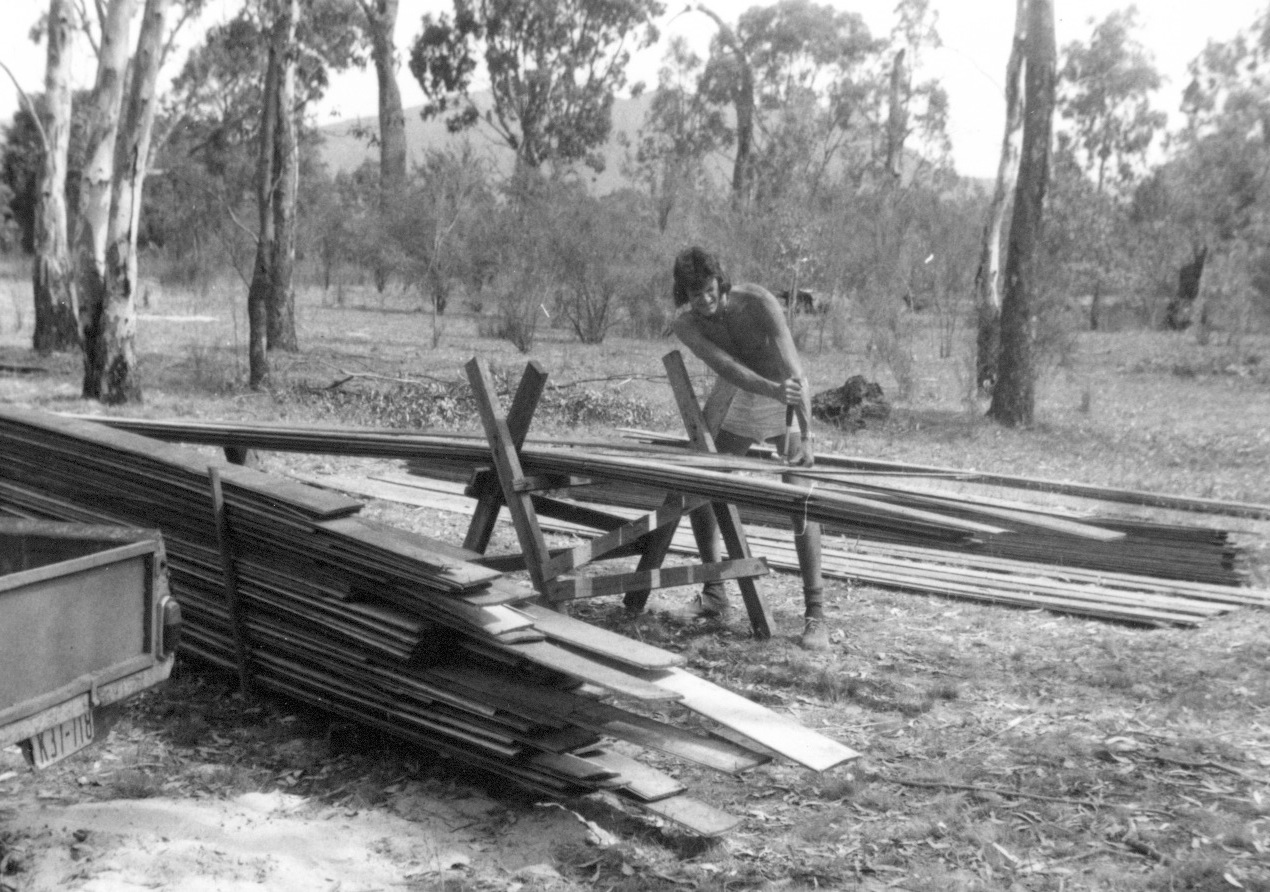
During the summer we spent a week building a shed ($893) on the property which Joan still owned — several bouts of illegality right there. Second-hand everything, murder to work with and rubbish building — but an epiphanic experience, such a good time and a result we later lived in for four months with great pleasure and in considerable comfort. the wedding

I’ve said it was the wedding that began the slide, and that was early in 1974. John decided he wanted to get married and that Dianne was a suitable candidate for the other side of the equation. It was one of those courtships, not entirely uncommon, which divagate, one partner and then the other being interested but not necessarily at the same time. I’ve always thought of this process as akin to stretcher bearing. It’s a matter of great and unusual good fortune if you’re both carrying a relationship at the same time; it’s when you both put it down that it’s all over.

During the ceremony John described how this step ‘shook his cosmos and rocked his world …’, and then promptly had a dry. You shouldn’t laugh, you should only tell these sorts of jokes against yourself, and it wasn’t so funny at the time, but truly … Dianne on the other hand foreshadowed how hard she thought it was going to be and how much she felt she would need support from those present.

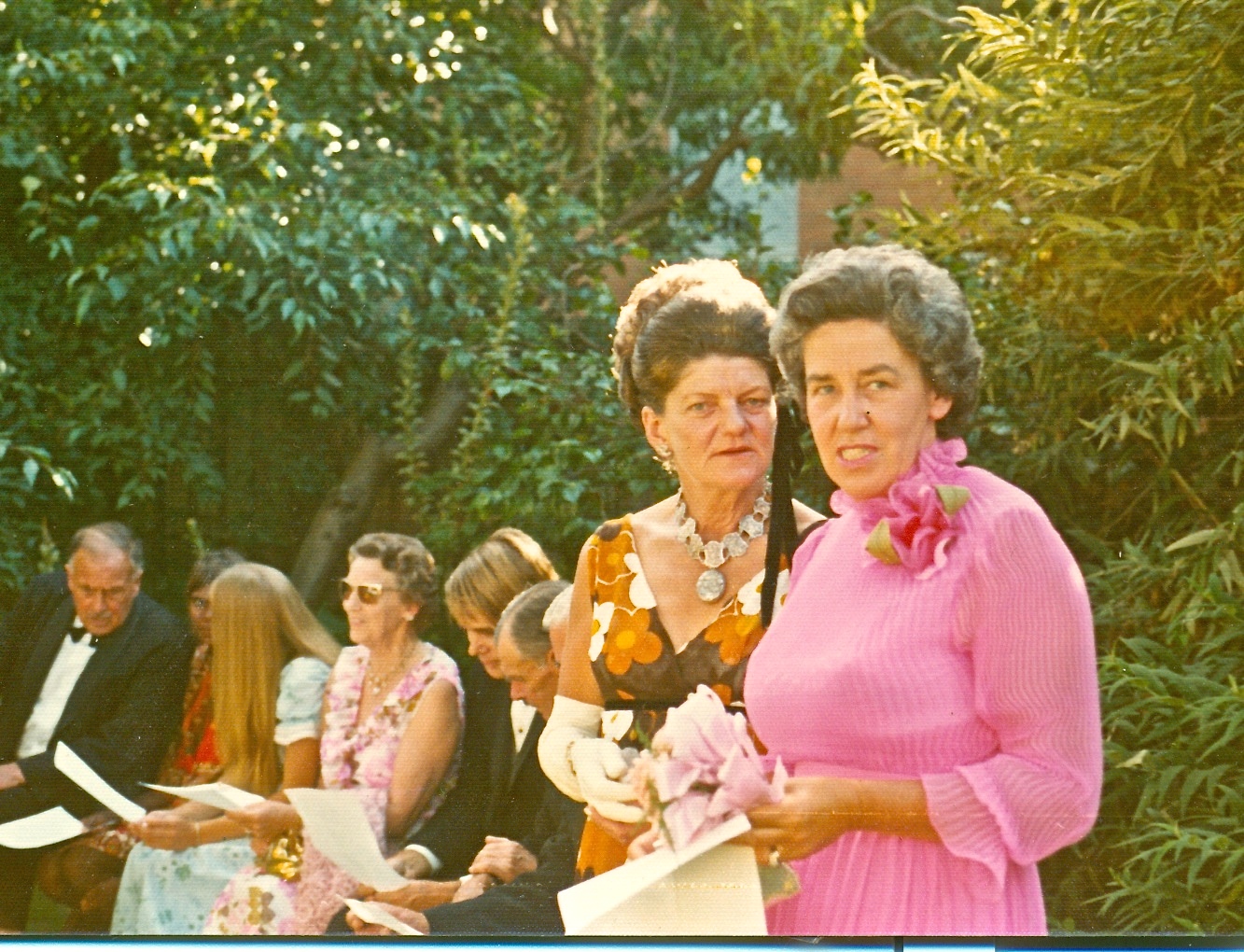
It was in Laurie and Ruth’s Canterbury backyard. There were balloons in the pool and midges in the lawn which found a congenial home in the layers of chiffon being worn by Dianne’s relations and parents’ friends, the aristocracy of the Western District. On seeing the groom, Zetty, the bride’s mother exclaimed, and not in a good way, ‘Oh John. I knew you’d try to outdo Diane.’ She then turned to her friend and said with a shrug of earnest distaste, ‘But what can you expect when the bride and groom are hippies.’ ZettyZetty, in the pink at left here, was a piece of work.

The reception was at Leonda on the banks of the Yarra in Hawthorn and probably cost the equivalent of the annual GDP of a small west African country. After an hour or so of copious amounts of drinking by one section of the throng and a good deal of cannabinoid ingestion by another, something like a fight broke out. This began with an assault by a female member of the WD squattocracy (I remember her as old, she was probably 40) on one of the hippies, trying to pinch his hat and scarf. She was joined in this assault by crack troops from the pastures of Australia Felix using food as the primary weapon. The hippies responded in kind. Like the Tatar raids on eastern Europe, there continued sporadic short but fierce outbursts unpredictably timed until the whole thing just crumbled into low grade uproar.

Rather betraying my petit bourgeois roots, I stood guard over the presents thinking they were next in line — I mean if there are toasters to throw, let’s throw ‘em — shaking my head in incomprehension and thoroughly embarrassed. John’s father came up and we agreed it was a lively show. ‘Good luck Dave,’ he said as only he could.

After, John wanted to host a party at the house they were living in at the time. He got there and realized in a state a long way from straight he had no idea where the keys were, so he got Weirdo (yep Dave Weir, but never did a nickname suit better) to climb over the back fence and unlock the door. During this adventure Weirdo fell through a fibre glass roof cutting himself quite badly and otherwise injuring his leg. He managed to drag himself to open the front door so he could be taken to hospital. (The dangerous years, the careless years.) LawrenceMuir_EDIT

The honeymoon was in New Zealand, but after a few days (Myrna and I disagree about how many; somewhere between five and ten) we got a call from Diane asking us to pick her up at the airport; she was coming back alone. It fell to us to tell John’s parents. Laurie inhaled deeply and then pressed a $50 note into my hand, about a week and half’s wages, and said, ‘Thanks for telling us Dave. Why don’t you go and get something to eat.’ (The Viking, Burke Rd Camberwell. I had Odin’s Delight medium rare. What sort of junk heap is your memory?) As befits a man knighted for services to the Liberal Party as its Treasurer, Laurie had a gift for monetizing experience.

John stayed in New Zealand coming back some four months later. On June 11th in ‘The Book of the Land’ where all this information is stored he provided the heading ‘Sho’ bin some changes goin’ down’. (One of the difficulties in returning to this literature is the funky mock heroic form, just a little bit like smallish boys showing you their muscles).

He wrote in part: I suppose you could say that the land came between my good wife and myself. The part of my nature that insists on following through on my own trip (ie build the best environment to accommodate the needs of one’s self and one’s mates — the broadest, the least finite, the richest, the deepest, the most challenging) has emerged rampant, with boots on. To her the land is a settling down, constrictive thing, to me it’s putting down roots so the ol’ trunk can go straight up. To quote the old adage … weddings come and go but land deals go on forever.

So here I am with a real big future but a fairly pedestrian now. And to think that it was only a month ago that Alan Watts was strongly with me, Marlborough was showing its full autumnal splendour, Gabi’s heart was softly pounding next to mine — and I was the raft farer on the edge, and the man from Vibrapac to boot. For the first time in my rather spotty life I had a need — or I respected a need — to fill up the future, a purpose, a focus, a direction.

I need Melbourne like a moose needs a hat stand. My finances are tidied up — no more embarrassing shares in Australian monopolies — all assets have now been poured into the land account. My soul is hangin’ on the line, and I am a happy and committed man.

Well they hadn’t been, and he wasn’t. The call of the softly pounding heart was, as proper, inescapable.

Diane stayed friends, not least with several of our close male acquaintances; but John was in New Zealand. He came back but it was mainly spent avoiding telling us that Gabi wasn’t going to have a bar of an enterprise in which she had no real part. Dan popped in and out from time to time and it was always lovely to see him, but he bought a house in Koroit and became a rural lawyer.

Gabi and John the day they left to go back to New Zealand.John and Gabi It almost certainly wouldn’t have worked regardless.

At the time I read Robert Houriet’s book Getting back together — I think I made an unsuccessful effort to make it compulsory reading for further group discussion; okay, well what would you have done? — a very forthright and insightful study of communes by someone who quite recently was still living in one. It’s probably still a very good book about people trying to live together.

Among the dozens of communes he visited, Houriet hadn’t found one that had achieved anything like self-sufficiency (startling news), many of the longer term ones were run with exceedingly strict discipline, and the initial political, religious and lifestyle motivations were as likely as not to have become somewhat twisted. Charles Manson of course was a communard. Houriet concluded that there was no such a thing as perfect commune but you could find one where the vibrations were right, where they coincided with those you were giving off.

And, I’ve forgotten just what actually happened — I think John and Dan had the job of digging a dozen holes to fill with compost and sheep shit for fruit trees and we got back after a weekend away and one and half had been dug, yes I’ve just found it in the book. In the space of some 20 minutes a hole of some enormous dimensions was dug and two tired but happy kids dragged selves off to the shed for refreshments. Dan you bastard.

Shortly after I have noted: Mad Dan and his car Harold again distinguished themselves by getting a flat tyre descending the Wallaby Rocks Road with no wheel brace or spare to hand. That was a three hour walk to sort out.

I’ve given myself away — these were my vibrations. While we’re on norms here are few more to chew on.  1) ‘Trippin’ where your head feels good’ doesn’t get you very far. 2) Cruisin’ is romantic indulgence, failure to consider the needs of others, failure to be straight about things, failure to initiate and failure to finish what one has initiated. 3) No cruisin’. (Among other things it gives rise to meditations of this sort, in third person absentia. And just makes me cross.)

It is easy to abstain from the reality of your situation and difficult to be frank, forthright and analytical about your failings. (Thank you Dale Carnegie and Norman Vincent Peale.) ‘Let burst forth what will’, said Oedipus and he had quite a bit of news coming. ‘Man must suffer. Through suffering man learns.’ Agamemnon. Can’t argue with the classics. Cassandra, cursed with foresight but fated never to be believed. I feel a bit like Cassandra at present, but then I would. It’s not going to work. I can feel it in my bones. Steve H

We had talks with someone else who would have been, and was, a very willing worker and a great guy — Steve Hicks of Steve and Mary’s catering some will know. But in the end, there were two. With quite a lot of work to do.

But in a very interesting place.

IN MEMORIAM: GIRIN FLAT 1974-2014

IMG_05509c5e803d-861f-403e-82d9-d2f593537164Perhaps everyone has stories to tell of their 20s: the dangerous years, the careless years, when you knew everything, alert to neither Scylla nor Charybdis, scarcely aware of their existence so immersed are you in your own immediate framework of concerns — relationships, friends, trying to find a job, brooding about who you are and what you should be doing. John Fowles wrote The Collector, The Magus and six other never to be published novels in his 20s. We built a house. (And we did NOT plant the bella donnas.)

•••••••

Gough Whitlam was elected as Prime Minister in 1972. A commentator of the time claims that he ‘installed major changes across the fields of health, education, immigration, Indigenous rights, foreign affairs and industrial relations. He withdrew all Australian troops from Vietnam, abolished the White Australia Policy and increased funding for the arts, introduced free university education and lowered the national voting age from 21 to 18, giving Australia’s youth a greater influence on the way their country was governed.’

And so he did. All those things and much much more. I remember the federal election of 1972 as a blast of fresh air after 23 years of torpor and stagnation, nation as suet pudding flavoured with an abundant sauce of colonial mean-spiritedness. But it had ‘been time’ for years beforehand. ‘Don’s Party’ is about the one they lost, not the one they won. The Whitlam government was a product of the zeitgeist rather than a dominant ingredient in its construction. But its haphazardness, its wildness, its colour and its fine intentions were also a reflection of the times.

It was an interesting time to grow up. My brother is six and a half years older than I am and Myrna’s youngest sister six and half years younger. While the edges get knocked off over time, it is still apparent that neither of them belong to our generation, just one small envelope with an entry slot considerably shorter than those 13 years. And even then you had to choose to participate.

crowdFor baby boomers like me the Vietnam war provided a focus for resentment and anger and a training in disobedience and ready distrust of nominal authority. Two of my brothers-in-law were conscripted. At great cost to his parents if not himself, my friend John Muir (son of Sir Laurence and Lady Ruth) decided to be a conscientious objector. The marble with my birthday on it never rolled out.

But it wasn’t just the Vietnam war. (‘What are you rebelling against?’ ‘Whaddya got?’ That was 1953 and youth rebellion had probably run contiguously for several millennia previously.) Like culture in this sense always is, it was the whole thing. It was the way you lived your life. It was what you took for granted. It was the compound of sources of influence.
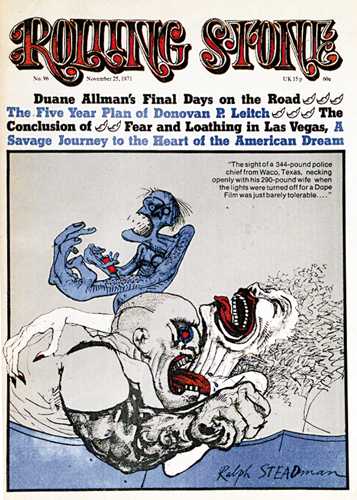
Did I want to be Hunter S. Thompson? I think the answer is no, but I gobbled up every word of his despatches from the front that Jann Wenner cared to print in Rolling Stone.Fearandloathing_rollingstone

BeatlesAnd the music. It was only ten years after ‘Please Please Me’ after all, and when that arrived it changed everything. White people all over the shop performing black music. For a teen audience with money. I don’t think it is too extravagant to say that the influence of pop music on youth culture in the late ‘60s and ‘70s was equivalent to the influence of social media today and certainly caused as much adult consternation. It was the social medium, and a medium for construction of your identity.

Stones ahead of the Beatles. Not everybody’s choice but that’s the point. Wasn’t it? Steely Dan not Led Zeppelin, Eagles not Simon and Garfunkel, Pink Floyd not the Jacksons, Neil Young sure but Crosby Stills Nash and Young only sometimes. Linda Ronstadt not Donna Summer, not ever Olivia Newton-John maybe Carly Simon, Fleetwood Mack not Elton John, Van Morrison but ‘Moondance’ not ‘Astral Weeks’, Little Feat not Bob Seger, Grateful Dead not Jefferson Airplane and never Starship, Bob Dylan, both Acoustic Bob AND Electric Bob.

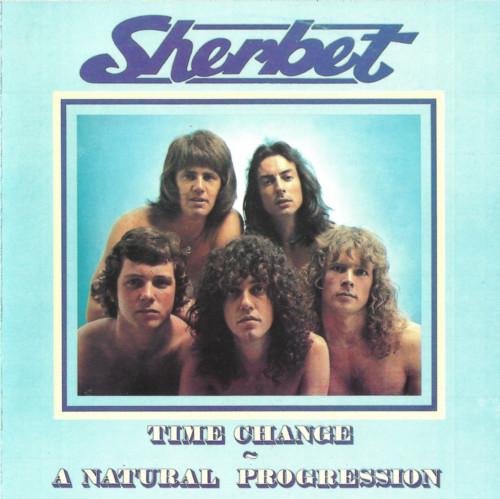
SherbetSkyhooksIn a more local context, the ultimate question: Skyhooks or Sherbet? (Oh really?!! Surely not. No!)

Hair. What a simple way to say I’ve joined the other party. ‘Let your freak flag fly.’ I certainly never said that and was hardly even conscious of doing so but my hair grew. It became a delicious point of confrontation, an all-in wrestle to the death over something of nil significance in absolute terms but overwhelmingly plangent with cultural symbolism.

HairStudents were expelled from school for refusing to cut their hair. Fabian Douglas, Hurstbridge High, 1967 — fancy remembering that. In 1975 his father Neil, an artist, attended one of the biennial ceremonies to receive a national gong. ‘He wore a hessian suit he had woven, dyed, and tailored himself. To add insult to injury he was shoeless. His hair (which, he claimed, had not been cut for 20 years) and his beard almost obscured his quizzical, rosy, bony face. “He might have got away with it had he been an Abo,” hissed one Toorak matron.’ Those were the days.

And then there was drugs/ were drugs — singular notion, plural manifestations — new drugs, different drugs and a considerable literature about them. (See eg HS Thompson above.) There have always been drugs and always drugs at least like the drugs in circulation at the time. But the idea, elevated to high seriousness and so vigorously promoted, that they should be treated as a way of deliberately altering and thereby improving consciousness was probably a bit novel. (‘Psychedelic’ = ‘mind manifesting’: that’s a big call.)Carlo#2 Jack Kerouac, Al Ginsberg, Ken Kesey, even Coleridge, de Quincey and Huxley, A. were rolled out to become partners with ‘Carlos Castenada’ (or, as it turns out, Carlos Castenada, a real person with a PhD from UCLA) in suggesting you hadn’t lived until you had had an out-of-body experience and leapt from a mountain peak. This is what your mother was right to worry about.

Someone I knew then did leap from what he thought was a mountain peak which was in fact the roof of a stall he was running at a music festival. He broke one leg and injured his spine. Sometime before his accident he came, I took him bloody hell, to a meeting of the staff and friends (an ‘open’ administrative meeting) of the community school where I was teaching and, at this most earnest and sober meeting of (largely) ex-Methodist communards, he produced some makings and asked if it was cool to roll a joint.

It was most assuredly not, but in the most tolerant empathic way imaginable. He could perhaps have rolled it but not smoked it; or not smoked it inside; or smoked it outside with other members of the meeting standing next to him to indicate mutuality but not participation. Pretty hard to say. On the basis of being the first man to have sailed a balloon over Everest (true), Chris Dewhirst may have claimed moral right to just to yell at him and tell him to have some manners. That in itself may have turned into an encounter group session in which case I probably would have felt it time to mosey along home. Chris himself when asked at one of these meetings what he felt about an issue memorably responded that just at that time he had a train of camels going through his head. As it was I just shook my head rather urgently.

This is a schism, one which is to recur in this story, that was present more widely: hippies and homesteaders.

Maybe one of the things it signalled was the rift between people who like meetings and people who don’t. Although it’s not very hip to say so I don’t mind meetings; and the meetings I went to at the time were not small beer. They were designed to change the world. Despite, with hindsight, the plans having the hallmarks of youth and inexperience tattooed into their entrails and some of them being abjectly dopey, they were nothing if not ambitious, and serious, and deeply felt, and passionately expressed, and bitterly fought over. Meetings were for the collective, built the collective, were the exchange of the collective, and the collective was at the heart of the revolution. (I note at this point that people who have lived through genuine revolutions and years of near intolerable political oppression will, with my respect and apologies, be turning away.)

Pram-Factory_greyThe Australian Performing Group who sometimes performed in but weren’t The Pram Factory provided an outstanding case in point. It’s worth watching this clip just to be reminded of what they were about, and there’s quite a lot to be reminded of because of the concern of its members to record what happened. (Its members went on: Max Gillies, Graeme Blundell, Kerry Dwyer, Jack Hibberd, Evelyn Krape, John Romeril, Ponch Hawkes, Jon Hawkes, Bill Garner, Peter Cummins, Rod Moore, John Duigan, Barry Oakley, Wilf Last, Jo Bolza, Jane Clifton, Bill and Lorna Hannan, Greig Pickhaver (or ‘HG Nelson’; I’d forgotten he was right in the middle of all this), Bruce Spence and Sue Ingleton.)

Sue Ingleton has nearly finished a website about the APG bubbling over with stories and memorabilia which has the following epigraph:

The Australian Performing Group was an agent of change and, some thirty years after its demise, its seminal influence on the cultural life of Australia is at last recognised. It stimulated a whole generation to see themselves in a new light, to see their culture emerge as truly Australian and to claim it thus. From the creative community that was the Pram Factory came many gifted writers and actors, directors of film, theatre and TV, artists, musicians and singers, circus performers, arts administrators and community artists. It is unique in the history of the arts in Australia, maybe in the world. It was very much of its time, and was at the cutting edge of theatre, new left politics, comedy, popular theatre, new Australian writing, puppetry and of course, circus. Circus Oz remains the last, great living branch of the Pram Factory tree.

OK? Right.

I wasn’t in the APG but I went to the shows. ‘Marvellous Melbourne’, ‘The Feet of Daniel Mannix’, ‘A Stretch of the Imagination’, ’The ‘Hills Family Show’, ‘Betty Can Jump’, ‘The Floating World’, ‘Dimboola’, ‘A Toast to Melba’ — vivid vivid vivid if not masterpieces.dimboola-db

And I had friends both in the heart of things and loosely connected. Myrna was in the premiere season of Jack Hibberd’s ‘Klag’, and I laugh when I read the eternally young Rod Moore’s stories of his thespian adventures, driving up from Colac with Peter Cummins to get pissed, perform and then drive home again. And yes, he probably was the first man to appear naked on stage in Australia and yes he was on roller skates (A Night in Rio & Other Bummers, 1972). But what makes me laugh even more are the stories of the meetings and the machinations and the takeover bids and the yelling and the equal pay struggles — all normal when you’re in the middle of it, but from one step back pretty exotic.

Here you’ve got the times: feeling that you’re on the cutting edge, an exuberant explosion that is both artistic and political and, as required at the time, personal, encompassing whole of life issues, everything, and importantly, taking yourself and your concerns very seriously — almost as though a stage of history was being governed or strongly flavoured at least by a stage of life.

The APG is a good example because it is an example, one example. The school where I was working at the time, Sydney Road Community School, was the APG of school education. You could come and visit, as many hundreds did; but if you weren’t part of it, you weren’t part of it. (Pursuing Sydney Road and what it meant would take another 500 pages. Not here.) When I watch the films I made at the time, especially ‘A Nice Place to Be’ which was about Sydney Road, the arrogance of those involved, and particularly mine, sets my teeth on edge.

Maybe taking yourself and your enterprise very very seriously is a necessary flipside of adventurous public endeavor, because this fairly sober seriousness and intentness of purpose lived alongside what was often untrammelled recklessness. It was just NOT a time for occupational (or personal) health and safety. This is caught wonderfully in the recent film Not Quite Hollywood: The Wild, Untold Story of Ozploitation! about Australian film in the ‘70s and ‘80s. Category headings: Action, Horror, Sex Romp, Aussie New Wave. My favourite bit is the revelation that live ammunition was used in one filmed gun fight to spice things up a bit.

age-of-consent-mirrenThe other night I watched the first film mentioned on the ‘Aussie New Wave’ list, ‘Age of Consent’ (1969), Helen Mirren’s breakout film as it happens (included in the end titles: ‘Miss Mirren is a member of the Royal Shakespeare Company’, never seen that before). Made by Michael Powell, an Englishman, with English actors in the leads, it’s a deadset 100% turkey, a shocker, but there is something about it that makes you want to cuddle and console it, something open, cheerful and naked (and that is not just Dame Helen, although she does seem to spend much of the film either disrobed or dripping wet — the times). But open, cheerful and naked are three adjectives that might work for the times more generally, some particular innocence. While someone might put sand in your sump, you were not in any danger from a carelessly deployed bomb.

This is somewhat ironic given the list of musicians above, but another theme which emerged at the time was an assertive nationalism, especially rejection of the idea that anything that came from overseas was ipso facto better than the equivalent produced here. Robert Hughes, Germaine Greer, Richard Neville and Clive James didn’t fight the good fight at home. They went elsewhere to sate their appetite for fame and, from time to time, to write about a country which was not as they left it and never would be again, vitiating the quality of their insights.

But other people stayed home and fought their own fights to develop an authentic voice which didn’t look elsewhere but was resolutely and firmly local. (And so of course republican.) In my professional world this produced wonderfully interesting thinking and practice very firmly rooted in the reality of experience which for two decades probably didn’t have a clear parallel elsewhere in the world. It was evident that people grew up, became adult and mature, by thinking and doing things for themselves. A dose of autonomy was good medicine. I am distressed that controlling the teaching profession and infantilizing its members has become a standard current preoccupation. But to the point …

Molly#3A nationalist cultural hero of the time? My nomination is one of Kyabram’s favourite sons, Ian ‘Molly’ Meldrum. MollyKylieWas there ever a nationalist with such a powerful practical platform to influence the musical and cultural tastes of a nation’s youth. (Rob, his brother who was just as nice, was mixed up with the APG and other theatrical adventures. Small world this one.) Was there ever such a widely-loved public figure with such an unwavering commitment, just so solidly in his bones, to his country’s cultural development? When INXS didn’t tour enough at home he applied the garotte and chopped them off Countdown’s playlist. Molly, mate, hats off to you. (OK, you can leave yours on.)

The renewed interest in the Country was allied with a new interest in country, an interest both romantic and ecological. It was the time of ‘Grass Roots’ and big gardens (big gardening efforts anyway) and ‘The Whole Earth Catalogue’ and yoghurt makers and debate about the comparative merits of Jack Smith’s duck poo versus the sheep shit from under the historical shearing shed. ‘Live simply’ was the byword, in order to ‘get back to the earth’. These are not uncomplicated notions but they were firm, direct and ubiquitous. Shelter, food and clothing were the elements of the base level in Maslow’s hierarchy of needs that you could do something about. Respiration and sex were about equally beyond control.

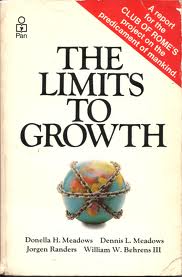
Unknown-1It was also the time of the first big wave of environmental concern. Pollution was an issue. Rachel Carson’s disturbing book about DDT Silent Spring came out in 1962. The impact of exponential population growth was an issue (The Population Bomb, Erlich, 1968). But the public focal point was the sustainability of resources and that thinking was led by the Club of Rome’s Limits to Growth published in 1972. This had an enormous impact on the people I was surrounded by, formalizing and justifying what they were thinking and discussing anyway. It certainly had an impact on me.

From my journal in November, 1973:

Life is best lived at a very simple level. Things that one has made or helped produce are always better than things that are bought. Work should be immediate, be related as closely as possible to survival and be fitted into the web of the world at the simplest level. I don’t want to have anything I can’t fix. … I am a happier and more purposeful person when I am working. It is just good for me. I sleep better, worry less, am more creative and enthusiastic. …

Decisions should be made by the people they affect. One should always be able to justify the work one is doing and be inventive and creative in its application. Work done for others is the most easily justified type of work. There is no room anywhere for the bureaucratization of living.

The more I know about the environment the more I become a part of it. I am constantly annoyed by the little I know about things that are fundamental to an understanding of it. …I need to try out my own self, strength and abilities in ways that I haven’t.

DiggingCowdyIn aggregate, tossed as we are by the currents of the times, how could we not have ended up deciding to go and live in the bush in a house we’d built ourselves? But as hippies or homesteaders? And who were we anyway?


Read on to find out.

Tassie#5: MONA the remarkable

IMG_0039Walking down the 99 steps that lead from the entry to MONA (David Walsh’s Museum of Old and New Art in Hobart) to its very own wharf, I couldn’t do other than try to work out why, yet again, the experience had had such an impact on me.

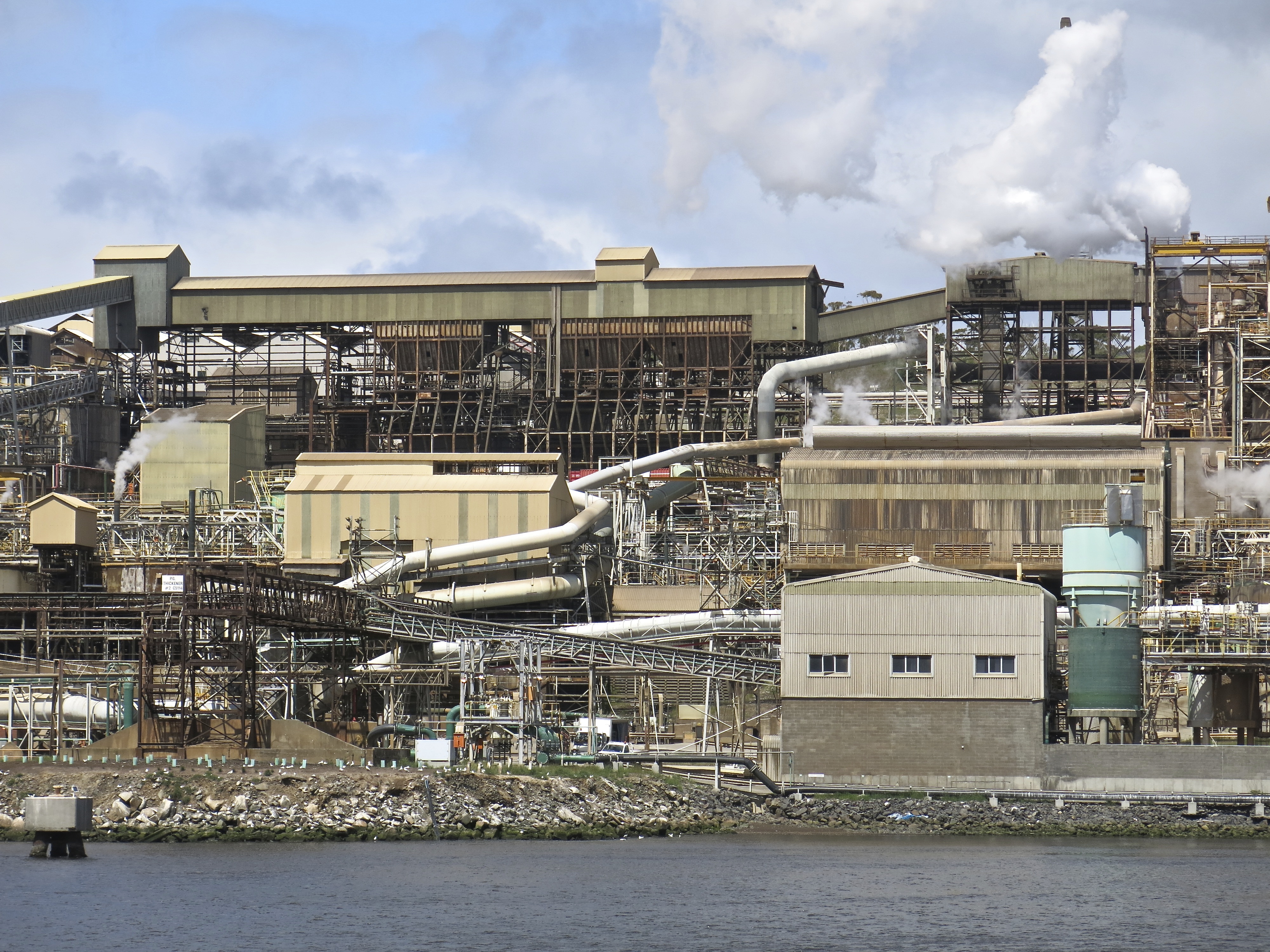
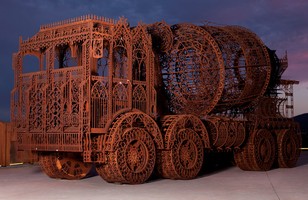
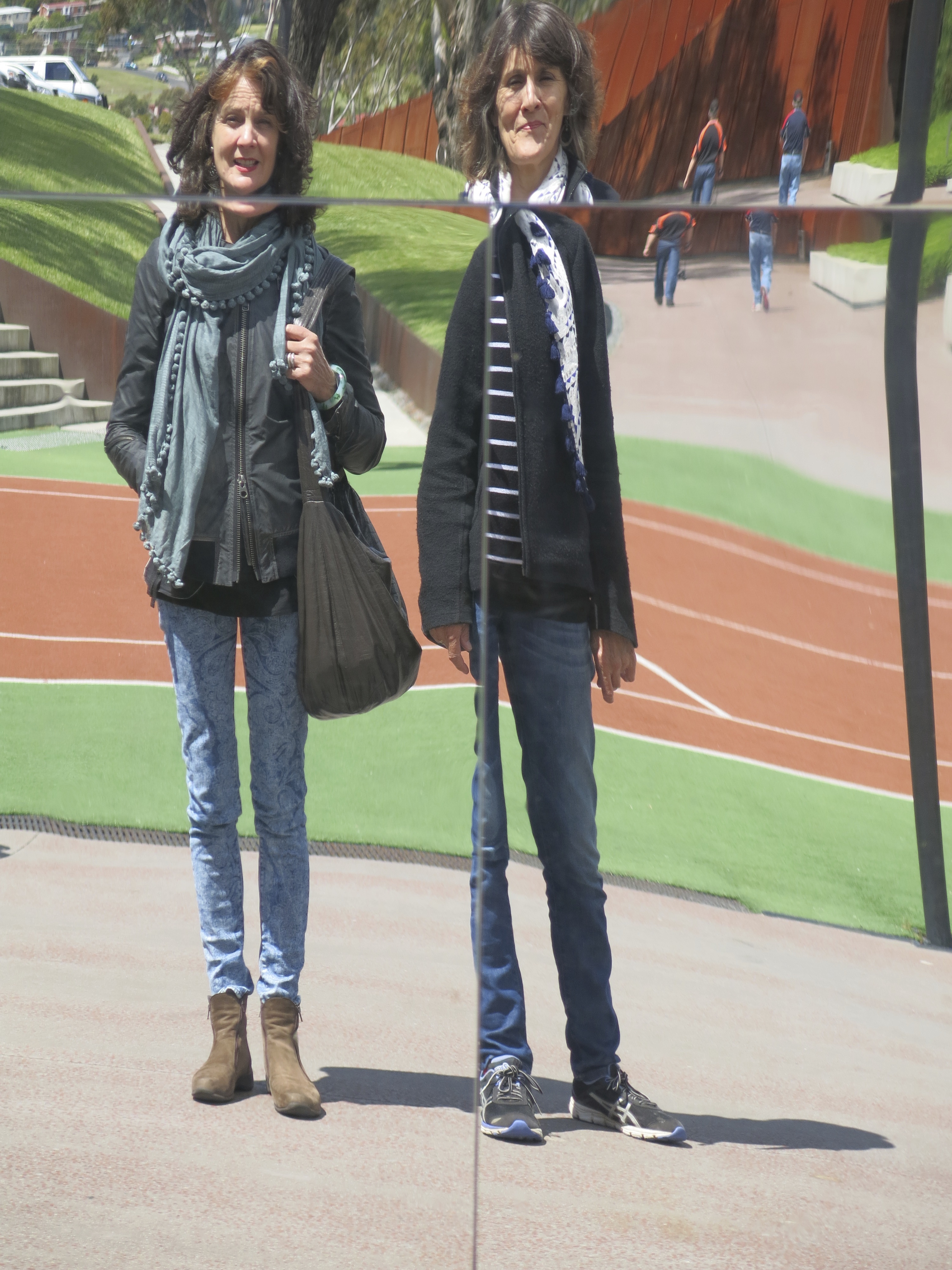
The ferry ride is certainly part of the preparation. IMG_0365You might see, for example, Sea Shepherd’s ‘Bob Barker’ (Art? quite possibly.). IMG_0368You will see the interstices of Pasminco’s smelter at Risdon. And apart from any of that, it’s a ride up the Derwent Estuary which is long enough to become slightly intoxicated by the scenery, short enough not to stale expectation or redirect interest. 0e505a05e7a72b14b3893e80465f20943c34ad1c_1385911567Near the top of the stairs is the rusting cement truck that isn’t a cement truck but lacework with a vaguely subcontinental feel. It’s near the tennis court and the polished stainless steel crazy mirrors cladding the exterior of the foyer. And the carpark designated for ‘God’ next to the one for ‘God’s mistress’ (now wife). IMG_0374Strangers pay; Tasmanians get in for free. So far so wacky. Fun. A hook. Happily sucked in to date. What’s next?

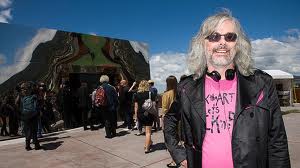
images This is already chewing away at your expectations of what the experience of art — the gallery experience of art, the experience of gallery art — should be, SHOULD be. (Just beyond the corner of your eye you can see Nonda (architect) or Nicole (curator for Australian art) or Olivier (for international art, both in the pic) ringing David (creator, funder and muse) images-2and saying: hey, you know what we could do? When they … blah blah blah and then they … how about …? And David saying: Yeah yeah great great. And then you could … blah blah blah… ? And it happens. Is that the art? The profusion of realised ideas?)

Then there is the literal immersion among the cliffs of sandstone. You are firmly in the heart of the Berriedale peninsula and there are no distractions apart from the artworks in which I include the building. The sandstone is part of the aesthetic experience, as managed and considered as any of the other works. In fact I like this pic with its mix of natural and constructed orders as much as I do any of the other photos I have taken there.IMG_0390 [imagesA footnote. The Guggenheim at Bilbao is also a truly remarkable building but it overpowers everything inside it except Richard Serra’s ‘Snake’, three vast curved and aligned sheets of rusted steel perhaps 30 metres long and 4 metres high. If you wrote about it and didn’t use the word ‘sinuous’ you would be fired. And in this case you measure quality by weight. Considerable. Everything else? Negligible. The Guggenheim in New York, another famously distinctive art building is, with its canted floors and functionally-speaking, just a nuisance.]

At MONA you are inside, captive to the experience. You’re not going anywhere quickly (as you might for example inject yourself with an hour of classic Australian in the top floor galleries at Fed Square, or a dedicated trip to the netsuke and their accompaniments in Sydney). That noted, how strange it is that the usual art fatigue/satiation takes so much longer to kick in. IMG_0375

During this last visit the first sensation was the chiming of bells generated by guest trampoliners. Yes quite. Trampoliners. The trampoline had replaced the intermittent spurts of water lit to notify us of the most Googled headlines of the day.

About this Mr Walsh writes on the iPod-like ‘O’s which provide (considerably more than) a guide to what is in MONA.

We wanted to be brave. We wanted to show that, unlike traditional public museums, we were not running a popularity contest. We wanted to show that we didn’t need ‘destination art’. So just before we opened I imprudently said, ‘If a work is “loved” too much, I’ll take it down.’ That’s about as silly as Opus Dei Catholics wearing a cilice, or deliberately picking up the ugliest boy or girl at the nightclub.

But I go in for a bit of self-flagellation occasionally. I know that we humans are machines that improve from the impact of stressors. Muscles that work hard become harder-working muscles. And I subscribe to that perspicacious platitude, ‘Whatever doesn’t kill you only makes you stronger’, independently invented by those two great philosophers of the human condition, Frederick Nietzsche and Kelly Clarkson. So now, we’ve taken down bit.fall (loved by 114,938 at the time of writing), and we’ve taken down [Sidney Nolan’s gigantic] Snake (loved by 56,787). And we replaced them with a trampoline and a movie. Let’s hope you love trampolines and movies. But I think nearly everyone loves trampolines and movies.

Nearby was the pick-pock of table tennis played on a deeply creviced table and another covered by ‘art’. (Why? Why not.) 747328a2379609d4dc8d54d3dcdb69e048b2a4da_1385914139I seized the handles of the machine designed to record my pulse and send it pumping through pairs of large light bulbs along with hundreds of others on a most orderly voyage to oblivion. For someone inclined towards atrial fibrillation I got an inspiring response, regular and strong. The cloaca machine was making its olfactory presence felt; and David, if you’re there, it’s becoming intrusive. Happy to have a shit factory in one corner of an art museum but not for it to dominate the whole show. OK? The other miracles of human ingenuity present suggest that you can probably sort this small problem out.

I began doing all the same things I did last time but better. I was going to duck past the ‘When my heart stops beating’ cabinets but was waylaid and absorbed for the best part of twenty minutes and could have stayed longer. I listened to all the music tagged on to the videos in the red room (and went back later to listen to some of the songs again). I found new images and ideas in Juan Davila’s Burke and Wills ‘The Arse End of the World’.  IMG_0377The mummified cat’s head transfixed me again. In the process of checking what else was around here I examined the chocolate cast of the terrorist’s body parts with more care because this part of the gallery/museum/building — its displays as far as I know more stable than in other sections — has begun metastasizing in the best possible sense. 0808ff23bed0ac060c70db19d83d428ff3cff2ac_1387125285
There are thick gestalt undercurrents of sensation, speculation and meaning at work here — every curator’s wet dream realised.

Escaping, I got caught up in watching Leni Riefenstahl’s ‘Olympia’, her film of the 1936 Olympic Games. Years ago I saw ‘Triumph of the Will’, but this was something different and just as addictive. Perhaps it’s hard to muck up films of peak sporting moments. But her astonishing craft was on open display. (Am I still talking about art here? Have I been at all? Are these just stimulating curiosities?) IMG_0388And I spent quite some time looking at this door, ‘the first work David bought – way before he thought of building MONA. David bought this from a gallery in South Africa because he had too much money to take out of the country.’
I do like this door. The closer you look the more puzzling it becomes. What’s going on in that top panel for example? Footballers worshipping goal posts? Samson pulling down the temple pillars? But there is that child at foot who could be crying. And then there is the bike. Such a dominant position in the whole, and the pipe … what’s that about? If I’d had 18,000 pounds I had to get rid of and this was at hand I would have bought it too.

What did the ‘O’ say? The O is the guide that everyone wears around their necks. There are no labels or explanations on the works so there’s a strong incentive to use the O. This is such a clever place.

I’m not keen on guides as a rule, nor explanatory statements attached to artworks (especially if they are written by the artist. One could almost generalise and say visual artists should never under any circumstances be allowed to write anything down, at least about art and especially their own. Except you Helen, of course.) But what you get at MONA is of a different order. There are people there who can write for a start; several people, including the boss. And material filed under ‘Artwank’ is a lot less artwanky than most such and almost always contains information that you’d like to know. So …

WHAT IS THIS DOOR?

This elaborate carved door is one of many made for palaces in the region of Osi-Ilorin, an Opin village in northeast Yoruba (now part of Nigeria). Such carved doors were one of the marks of kingship for the Yoruba people. Working in the first half of the twentieth century, Areogun evolved a distinct style of his own, combining elements from centuries-old Yoruba tradition with contemporary motifs on the themes of royalty, law and order.  

Areogun’s name — The artist’s birth name was Dada, the name given to people born with curly hair. Areogun, as he was known in his lifetime, was his oriki, or praise name: the local dialect version of a ri owo gun, meaning ‘he sees money [through] iron’. His son, George Bandele, began to use the standard Yoruba form, Arowogun, in later years.  

Areogun’s workshop — Many carvings from Areogun’s workshop or atelier would have been identified with his name and it is rarely possible to attribute them to specific hands (he had four apprentices in the 1940s). Doors from his workshop, exhibited in London at the British Empire Exhibition at Wembley in 1924, are now in the British Museum.  

Yoruba culture — Yoruba cultural heritage now extends to an estimated 25 million people of Yoruba descent in other parts of Africa and the Americas – including Brazil, Cuba, Trinidad, Haiti, and the USA – as a consequence of the Atlantic slave trade and diaspora of the eighteenth and nineteenth centuries.

I’m pleased to know those things and I’m pleased to have them at hand when I’m looking at the piece rather than when I get home or am down the street with Dr Google. It builds the picture and fills out the detail in ways I appreciate.

Click on ‘Gonzo’ and what do we find?

Why do artists make art works?  

This is a Nigerian Palace door made by Aerogun. You already knew that, it says so on the front page. But what does it mean? Why did he make it? He clearly had a flirtatious interest in the West, and his unsteerable, downhill bicycle must at least be a joke, perhaps a metaphor.

[And so you check the bicycle and yes, you see what the writer (Walsh) means. If it matters, yes, it will not turn. You missed that the first time. How closely were you looking?]

Presumably he was ordered to make it, but did he make it for the one who gave the order, or did he make it for himself? If for himself, and I think it’s always a bit for himself, presumably the motive was an assemblage of: pride in craftsmanship, need for self-expression, love of status, an urge to serve and maybe even a fear of the consequences of failure.

[Hmm yes. Why do people make art? It’s such hard work generally with so little public pay off. I read today about the 8 million unique music tracks sold on iTunes in 2011: 102 tracks sold more than a million units each, but 94 percent sold fewer than 100 units. One-third sold one unit each. Does that matter? It doesn’t seem to discourage artists, potential or active. If no one read this blog, would I care? Would it make the experience different? Are there some members of the potential audience I am counting on more than  others? Will one special reader make it worthwhile? Five? And why sit by yourself in a room researching, thinking and writing? Isn’t that faintly neurotic? And isn’t the point that you want to get something straight in your own mind and plodding through revision after revision is the only way you know how to do that? Isn’t that sort of sad, and incompetent? If you can make something not so much beautiful as well-crafted so much the better. Something that will satisfy and interest someone else. Something that reeks of ease and simplicity … And do you fear failure? Of course. Although you will probably be happy to define what failure is yourself.]
These are the proximate motives but what generates them? Is the capacity of biology to reproduce genetically selected talent on display here? He’s clearly good. All it takes is: good having a bit to do with biology; good being a bit sexy; good not getting in the way of making kids; and some generations.  I guess I’m saying all the reasons he does stuff were real to him, but there is stuff that is real to everyone. Do all artists, whether tribal or western, antiquarian or contemporary, concrete or conceptual have the same fundamental motives? I think so. That goes for most people from most fields of endeavour, I think.

[See you can understand this. You could talk about this at lunch or even at the footy if you were keen enough. It’s unconstipated, direct, all meat with quite a lot of rather piquant sauce.]

Culture hides this stuff, but it keeps rippling through. I collect it.  Does that make me a bit more sexy? I bloody hope so. I’m grasping at straws here.  

[The honesty (real or artificial, I don’t care) which — perhaps admiring the courage, the insouciance of the author — makes you want to go back for more.]

But this is all a serious matter. The first time we went to MONA the special exhibition was ‘Theatre of the World’. This time it was ‘Red Queen’. I paid no attention to this whatsoever. I wasn’t required to. I didn’t see signs. There wasn’t a ‘Red Queen’ room set aside. It would have added another layer of complexity to what was already too much to absorb. I saw lots of other things. I spent quite a while looking at Arthur Boyd’s ‘Melbourne Burning’ for example. As a rule I am not drawn to Arthur Boyd, but here is a Boyd with a significant wrinkle that makes you wrestle with it further, not ‘just a painting’ or ‘just art’ (what’s with this Melbourne burning business? He’s not a realist), but reaching out to you with another cognitive demand.

This is one of the important factors that makes what is in MONA so interesting.

I noticed, but barely, a couple of lonely looking Kimberley paintings tucked away in a corridor. Probably Rover Thomas, and probably masterpieces if I’d looked at them carefully, but I strolled past without looking at them. In other galleries they would be taking carefully lit central space. (MONA is not alone in this regard. In the Louvre people run past two very fine Caravaggios, one of which is ‘Death of the Virgin’, a very rare subject, to join the impenetrable crowd in front of the Mona Lisa. ‘Smaller than I thought it would be.’ ‘Did you get a photo?’ ‘That’s bullet proof glass over it you know?’ ‘Yeah. Amazing isn’t it.’ Just a digression.) IMG_0385
I spent most time watching 30 TV screens (6 x 5 on a wall) each with a person singing along a capella (‘in the chapel’, unaccompanied, they’re singing along to their headphones) with Madonna’s ‘Immaculate Collection’. Just wonderful. Giving it their uninhibited all. The attractive girl second column second bottom had a neat seemingly unconscious shtick which never missed a beat. Most of them had something going on but she had it all. Someone, one of the guys in the top right hand corner, was singing flat. I say that without prejudice. And is that art? I think I have to say, I mostly don’t care; but if I did have to care I would almost definitely say yes. As I’ve gone back over not just the things I saw but the things I missed I’ve come to appreciate what the Red Queen might have been. It is built around the issue of art as an evolutionary adaptation, and what a good question.

Why does art and art practice survive? Why don’t Andre Rieu and Hallmark Cards define its boundaries?

I did look at Balint Zsako’s water colours again (wonderful) and tried to confront but was overwhelmed by Henry Darger’s Vivian Girls. I was also absorbed by the work of the Rabus brothers. Swiss. Why haven’t I seen their work elsewhere? Does David Walsh sit at the end of the production process buying the lot? Here’s ‘Neige et Renard’ (Snow and Fox).40af1022dcd8d98b45069328524e46c58cc7d33a_1385913063 On your O you may listen to the artist yodelling (formidably) if you wish but here is what Tweedledum has written about it.

Leopold Rabus dabbles in the realm of fairy tale and fantasy but, crucially, there is an inner coherence – a kind of madman’s logic, if you’ll pardon my hyperbole – to the worlds he presents us with. This has something to do with the strange-but-familiar forms he depicts, and a lot to do with his mastery of the genre he is using: painting. He constructs his generic outlines with reverence and skill, and then imaginatively and expressively colours them in. I don’t mean that he actually does this, literally, in this order. What I mean is that he is, consciously or otherwise, striking a rather sumptuous balance between creative innovation (his works are distinctively his; you can sense just from looking that he is expressing something natural to him) and reverence to the tradition he is working with. In other words, the boy can paint. My eye is spectacularly untrained but still, to me, his stuff just looks right, pulls together without any seams poking through, and at the same time is disorientating and intriguingly difficult to decipher.  

You may have noticed by now that in this exhibition, The Red Queen, we are starting to consider the arts as an evolutionary adaptation. An adaptation is a trait modified by natural selection that improves the individual’s chances of surviving and procreating. … In order for art-making to be established as an adaptation, a number of criteria have to be satisfied. Most importantly: how or why might the trait confer some sort of advantage over others who lack it? There are a number of possible answers to this. In brute sum: art-making enhances sexual status and attractiveness; or it coheres and unifies individuals so they are better placed to thrive as a social group; or it isn’t an adaptation, it’s a by-product of other related ones. And finally, perhaps the arts allow individuals to exercise and develop their flexibly abstract social imaginations, so that they are better placed to walk that tightrope – so important to our hyper-social species – between competition and co-operation?   Keeping this last point in mind, consider again Leopold Rabus’ creative ingenuity.

Brian Boyd, one key proponent of the ‘flexibly abstract’ theory of the arts as adaptation, explains in his book On the Origin of Stories the need for artists of all kinds to strike a balance between innovation and tradition. From an evolutionary perspective, economy is key: the ‘cost’ of a behaviour (in energy use or exposure to illness or danger) must be more than cancelled out by its benefits (increased social status or access to attractive mates, for instance). That is one reason why we do not re-invent new genres each time we write a poem or a book, or paint a painting or compose a symphony. Such extreme acts of creativity are too costly to be sustained. Observing and imitating established artist forms – such as the fairy tale, or the use of perspective in painting – ‘reduce invention costs by posing well-defined problems and offering partial solutions’. At the heart of creativity, therefore, lies the ability to build on what came before – but, crucially, to twist it, or pervert it, or thwart or react to it in some new way, in order to retain the attention of your audience. ‘We appreciate,’ says Boyd, ‘even minor variations within established forms as worthy of attention and repose. With our senses highly tuned to basic patterns, we enjoy repetitions and variations on a theme in art as in play’. This is one way to look at this painting.

And indeed it is. But this is serious discussion. This is a very thoughtful idea thrown in from left field. But what a good one, thickening out the whole experience.

I’ve read press articles about MONA and there are two stories: 1) David Walsh; and 2) the shocking stuff in this gorgeous gallery. That’s it. Two roads diverge on the latter matter: shocking delight on the one hand (see Amanda Lohrey, Richard Flanagan, Vicky Frost) and just shock including a wide range of reactions among them disdain and disbelief (Michael Connor. Do you think ‘Quadrant’ might mean ‘four rants’?).

So what’s in MONA worth commenting on? You get similar lists in all these articles. Richard Flanagan (a year or two ago) puts it nicely: It is a theatre of curious enchantments: from a wall of 151 sculptures of women’s vulvas to racks of rotting cow carcasses; a waterfall, the droplets of which form words from the most-Googled headlines of the day; the remains of a suicide bomber cast in chocolate; a grossly fattened red Porsche; a lavatory in which, through a system of mirrors and binoculars, you can view your own anus; mummies; X-ray images of rats carrying crucifixes; a library of blank books; cuneiform tablets; and stone blocks from the Hiroshima railway station destroyed by the atom bomb. Its most loathed exhibit is also one of its most popular: Wim Delvoye’s Cloaca Professional, a large, reeking machine that replicates the human digestive system, turning food into faeces, which it excretes daily at 2 pm. IMG_0389

Sure. I’ve mentioned the chocolate terrorist and the shit machine. I poked my head into the blanched library. But I didn’t spend much time on the rest of the list. Too much else to see. Mind you I wasn’t looking to be shocked; I just followed my nose so to speak.

I was more ‘shocked’ by Michael Connor’s article than anything I saw at MONA. He doesn’t like MONA, oooooo but he does love writing about it.

MONA is the art of the exhausted, of a decaying civilisation. Display lights and taste and stunning effects illuminate moral bankruptcy. What is highlighted melds perfectly with contemporary high fashion, design, architecture, cinema. It is expensive and tense decay.

W. B. Yeats eat your heart out! He derides the material on the Os, the ‘cultural Left’ (that mystery group who can also be located in ‘The Australian’ but perhaps nowhere else), the indications of popularity and the people making it popular (‘For the uncomprehending, uncritical, unmoved tourists it is meaningless matter superbly showcased—though if you threw out the art and put in a (gay) wedding expo, a psychic convention or a showing of hot rods they probably wouldn’t even notice, or care.’). He’s sorry for Walsh but cross about how much (completely undeserved!) money he’s obviously got, and he might be sorry too that Tasmania isn’t always bathed in ‘the autumn tones of a superlatively good colonial painting.’ (An example at right.)48.1985##S.jpg.505x338_q85 Oh wow. Such a buffalo wallow of derision — poisoned and  poisonous.

There is a lot about sex, death and religion at MONA; and there’s a lot that isn’t.

At the end of my visit I sat watching the quivering pen being driven by Cameron Robbins’ ‘weather powered drawing machine’ and its products. That might have been because there was a window which freed me of some of the intensity of the last six hours. But I wasn’t feeling shocked.IMG_0391 The recent exhibition ‘Melbourne Now’ provides a strong example of just how hard it is to do what has been done at MONA. As exhibitions go it was massive, contemporary and mostly pretty feeble. Wunderkammers without the wunder. (The ‘Gallery of the Air’ was filled with things with ‘air’ in their title or nearly: LP covers of Air Supply and ‘Hasten down the wind’. Weak weak weak.) Some (but not much) fine craft; some meaning or wit (but not much). And is that perhaps because it was not driven by any specific idea or vision? So many people to satisfy, so much bureaucracy, instead of, as at MONA, the much discussed (and questioned if not maligned) ego/vision/tastes of its creator? images-1

David Walsh. Well good on him. Kerry O’Brien’s interviews with Paul Keating were on while we were in Tasmania. In the last of these Keating said: ‘Politicians come in three varieties: straight men, fixers and maddies. … Thatcher was a maddy. Charge in and get it done. Not that I want to be in included in any company with Thatcher; but I am certainly a maddy. Absolutely.’

Walsh, bless his heart, is a maddy and, more plumb than a finger up a duck’s bum, has a place in a long line of other great Tasmanian maddies: Dame Enid Lyons, Bob Brown, Matthew ‘Richo’ Richardson, Alannah Hill, Errol Flynn, Tiger Croswell. And Hobart and Tasmania are just the right size to allow him his head. Its very insularity reduces the pressure to conform to extraneous ideas about taste and to weaken the inspiration that has driven the character of MONA.

Paradoxically, Melbourne, eighteen times the size of Hobart, could only produce something more provincial (and Quadrant-like) because it is always looking somewhere else for direction and approbation. (And that somewhere isn’t there, trust me.)

What MONA says about art and what makes it so very very distinctive AND, hoorah, so best of Australian is: ‘This is something which has been made. See what you can make of it.’

Its objets do not sit sniffily in their glass cases saying, ‘Behold. Adore me. I’m a masterpiece’, even though from the perspective of craft so many of them are.

MONA’s art proposes. It engages. It says react, don’t presume, don’t cower. Fight back. Ask me questions. Check my provenance. Consider my future. Chase some of the cognitive prompts which  stream from my presence. What do you think? What is your response? Why? Fill your brain. Wrestle with this. And that’s what makes it just so different.

That’s why, as Bruce Macavaney would say, it’s special. So special.

And the experience, how does MONA work so well?

This might be disappointing. No doubt you’d prefer a bolt of lightning or the earth opening beneath our feet, but in fact it’s just like the elements of very good education all present and combined.

There’s a hook, something a little tantalizing — the place’s reputation. There’s preparation, building expectation and readiness — the ferry ride and the exterior. There’s immersion, keeping you focused and directed to the task in hand — the interior design and layout. There’s a rich environment which will keep you stimulated — the exhibits. There’s scaffolding to prompt and guide your thinking, that you can connect with — the O material. And of all things, there’s reinforcement. You can do just what I’ve done and relive the whole experience again. And again. And again.

Let’s go out on a (short) limb here: The purpose of art is to generate a response (which of course has implications). Among other things that accounts for its evolutionary survival.

I leave you with these thoughts from the late great Charles Hardin Holley.

Tell you Mona what I wanna do

I’ll build a house next door to you

Can I see you sometime

We can go kissing through the blind

[alt renderings — A-we could go kissin through the blind: Bo Diddley

We can blow kisses through the blinds: Rolling Stones

Can I make love to you once in a while?: Quicksilver Messenger Service*]

When you come out on the front

Listen to my heart go bumpity bump

I need you baby and that’s no lie

Without your love I’d surely die.

* recommended: John Cipollina at his best with, among others, Nicky Hopkins, playing somewhere that looks like it could be Yulecart Gymkhana.

Tassie#4: Greenies and loggers

IMG_0207This is a greenie. You can tell. It’s the cunning alignment of the tailfeathers as much as anything. You should have seen the flight.

And this, the Macquarie Harbour end of the Gordon, is the sort of thing they like.

IMG_0283

What’s there? Nothing.

IMG_0146But we come to Corinna across the Pieman River via human interpolation, a ferry. Although we hadn’t been there before, Corinna (the Aboriginal word for a young Tasmanian tiger, now as far as anyone knows extinct) has been here for a while. In 1883, the largest nugget of gold ever discovered in Tasmania (7.5 kgs) was found at nearby Rocky River producing a flurry of mostly disappointed activity, although 30,000 ounces of gold were taken out.

The Government Surveyor’s Report on the area in 1884 commented that: ‘These creeks have yielded some gold, but as the scrub is so excessively dense and almost impossible to penetrate, the results of the prospectors’ labours have up to the present time remained an unsolved problem to a very considerable extent.’ My father notes in the pages he wrote so admiringly about the west coast forest, There are many miles along the majestic Gordon River where it is impossible to land without cutting a place with an axe, and where you cannot continue without further cutting. Later, the Pieman River became a hunting ground for the Huon pine which grew along its banks. It isn’t found north of here.

But now, and I quote from the brochure for the Wilderness Lodge where we stayed, ‘at Corinna, nature is the hero. The owners are committed to providing responsible access to the pristine wilderness and operating a sustainable and carbon neutral experience for visitors.’ That’s us. That’s what we like, and for a few days we plundered its considerable treasures.

IMG_0180

We saw this rainbow kingfisher on the Whyte River walk, a chest stuffed full of gentle treats, one after the other, although I did hear another visitor say that it was hardly worth the bother. Just muddy really. IMG_0178But take my word for it. If you’ve got your eyes open and your heart in the right place and functioning you won’t do much better for an easy 90-minute walk.

We scampered over the ridge to Savage River through nothofagus forest which as I’ve said before is a delight. There is little more comforting to the feet than four inches of nothofagus leaf litter. This was another particularly nice walk.IMG_0167

The Savage River was on this day poorly named and it was hypnotic watching it bubble past.IMG_0170

IMG_0181Pademelons fed happily and confidently, sea eagles entertained and god was in the appropriate place.IMG_0296

But the next day the weather turned. It was clear, mild and sunny and we climbed Mt Donaldson, a genial 500 metre rump with a generously graded track. (And these are some of the people who made this generously graded track, and in that weather too. Thank you Tasmanian Walking Track Services.) OLYMPUS DIGITAL CAMERA

It was windy on top but the view was simply glorious, revivifying: the Pieman winding its way west out to the Southern Ocean, the Norfolk mountain range to the north, the peaks of the Cradle Mountain area over to the east and … er … the Savage River mine in mid ground. Ah yes, the Savage River mine … from which magnetite is piped as slurry 85 k.s to Port Latta near Smithton on the north coast, a most substantial feat of engineering. I can admire that. But it has prompted the incidental thought that appears below.

I don’t appear to have a photo of the mine; in fact the bulk of them from here appear to be taken up with Keith’s attempts to fly. However there were two other intrepid travellers, and that is the Pieman glimpsed in the background.IMG_0218

The incidental thought. It’s all very well to talk about vast tracts of wilderness but in fact Tasmania does not have vast tracts of wilderness. The area of the entire island is only 68,000 square kilometres. Its north-west, midlands and south-east have been extensively cleared for agriculture and pasture. Where Myrna and Gill are standing is about 10 k.s from Corinna. Corinna is 48 k.s from Zeehan. Zeehan is 40 k.s from Strahan. This is highly accessible ‘wilderness’. The fact that so few people drive down the Maydena Road to Mt Anne and Lake Gordon doesn’t mean you can’t do so even after having spent the night in Hobart. You can see a lot of Tasmania in 10 days travelling by car. There are only three major north-south routes. The quickest will get you from Hobart to Launceston in about two hours. By contrast, the Big Sandy Desert, another sort of wilderness on the big island to the north, is by itself 285,000 square kilometres in area. Wilderness is not, cannot be, pockets of trees populated with eco-lodges. And that should make you think about context, scale and prospective fragility.

IMG_0434

I’ve mentioned Huon pine. The table above, which I think was Myrna’s 40th birthday present, is made of Huon pine with some blackwood inlay. A day does not pass when I don’t admire it. (So many negatives. Sense: I really like it.)

I was hoping to find the photo we saw several times on the coast, once I think in Hamer’s Hotel at Strahan, of huon pine logs caught in a boom, thousands of them, but this is the best I can do. imagesImagine these logs stretching almost across to the other bank, perhaps 50, 100 times as many. This photo was a reminder of how many were taken, what a very high proportion of those that were there. The 120 boats built at Sara Island during its convict period (only 11 years), some of which were upwards of 40 metres long, were all built from Huon pine.

IMG_0227Although it can be found in the Huon, a delightful area (and river) south of Hobart, it is neither Huon nor pine. It is Lagarostrobus Franklinii, the sole species in the genus Lagarostrobos, and a podocarp, not a pine. Tightly grained and full of methyl eugenol which not only makes it smell wonderful but also makes it resistant to bugs and rotting, it was hunted along the waterways of the west coast for its ship building qualities.

Another of my father’s stories, this time about workmen erecting poles for a power line through Zeehan. In order to set up one pole they had to remove a King Billy pine. They found that its roots had curled around the trunk of a Huon pine entombed beneath it. The pine’s wood was still perfectly sound and still strongly fragrant. Examination showed that the King Billy pine was more than 300 years old. No one could tell how long the other had lain beneath it. More recently on the Teepookana plateau out of Strahan a vast stash of ancient Huon pines has been found under the forest floor, up to eight layers deep, with the top ones being more than 1000 years old. A living stand of the treesmtreadhuoncb has been found near Mt Read between Rosebery and Zeehan with the oddity that each of the trees is a genetically identical male that has reproduced vegetatively, that is asexually without seeds or spores. Although no single tree is that old, the stand itself has existed as a single organism for more than 10,500 years. To the right is  a picture of one of those trees.

IMG_0310The ‘pine cones’ containing seed are themselves tiny, a couple of millimetres long, the red bits in this photo (which on my computer is pretty close to actual size). The tight grain comes from growth which increases the total girth of a tree between half and two millimetres a year. Reread that. Girth. Circumference. All the way round the trunk. Grows between half and two millimetres (small) a year.

Some of trees were substantial as indicated by this photo taken around the 1930s. huon01The logs were dragged by a range of means to the rivers — never far, it was too difficult, and anyway the trees grow along waterways — marked and then floated down to log booms. When you put big logs into small waterways they are inclined to clog up into jams, and the last task of the piners before they left their camps to return to Strahan for the winter was to work down the rivers breaking the jams up. But as the pining industry declined in the 1950s and 60s there were fewer opportunities for the workers to access the rivers, and the log jams became legendary. In August 2007 a huge flood roared down the Gordon and all its tributaries. Thousands of Huon pine logs cut two generations before were dislodged. As many of these logs as possible were salvaged. Over the next three summers 650 tonnes of timber were retrieved. (Thank you: huonpine.com. A tree with its own website!)

Today its genius is more widely recognized. The ‘birds’ eye’ in our table would once, and not so long ago, have qualified it for firewood. images-1But the timber is now highly prized for high end woodcraft like the table and this rather glamorous carving.

If something is 1000 years old is it ipso facto valuable? I would say more likely than not. But beyond the fact of its age, valuable for what? It’s great that these wonderful uses have been found for the logs — and boles and branches, all grist to the craft mill — that have already been cut. There is a quarry full of them at Strahan. But what do you do about tree species that grow a millimetre in girth a year? How do you think about them? I think you’d have to say look after them very carefully, and I think there are few people in Tasmania who would argue.

Huon pine, like Darrel Baldock and Peter Hudson, has become a state icon. (What would you do if Christ came to Hawthorn? I think still leave Hudson at full-forward. Christ might be better value as a mobile target further up the ground. Forgive me. Non-Australian Rules fans will have to click on the link to understand. Even then it may be beyond comprehension.)

But what about the blackwood and the beech myrtle and the sassafras? Or for that matter the eucalyptus in the Styx and the Florentine? Or, dreaming even further, the rivers?

UnknownAfter the mineral flurry and the eruptions of unkempt mountains on the west coast, as you progress east you find series of long ranges broadly oriented north-south culminating in the Arthurs which in their own delightfully perverse and magnificent way run, insofar as they run anywhere, east-west. In the valleys of these ranges, as you’d expect given the rainfall, are some of the wildest rivers in the world. On a world scale, not big. Wild.

IMG_1756.JPGIt’s the Collingwood above. I’ve been here a few times and always imagine dinosaurs hiding away in the forest just about to run, or whatever it is dinosaurs do, leap, glide, perambulate, across the button grass in this lost world.

It’s the Collingwood just above its confluence with the Franklin, and the Franklin provides a marker in Tasmanian history.

  In IMG_03681978 it was proposed to dam the Franklin to generate further hydroelectricity. You can see the lakes on the map above. Many of these are artificial and at their walls are clusters of power stations that send power to industries such as the refinery on Hobart’s Derwent estuary, the largest such in the world, which refines zinc mined, among other places, from Rosebery near Zeehan. My brother John has an excellent view of it across the estuary from his house in Lindisfarne. When they bought it the estate agent suggested that a selling point was the glory of the refinery lighting up at night. It’s a pity that it left the estuary’s bed with a coating of heavy metals now being cleaned up.

Over the five years between the announcement of the dam proposal in 1978 and the axing of the plans in 1983, there was pungent and angry debate polarising the community and not just in Tasmania. Mainlanders bought in with a will, which would be one reason for the local support. On one side it was suggested that the construction of the dam would assist in bringing industry to Tasmania, on top of the jobs that it would create directly. The initial opinion polls showed around 70 percent support for the dam.

The protest movement, generated originally to fight the construction of the Lake Pedder dam and led by Bob BrownUnknown (at right, for many years the leader of the Australian Greens), thought otherwise. The photographs of Peter Dombrovskis and his colleague Olegas Truchanas, a good selection of which we had seen in the Launceston gallery, attracted significant public attention. In June 1980, 10,000 people marched through the streets of Hobart, demanding that the government not proceed with construction — the largest political rally in the state’s history.Franklin_River_Rally_Hobart_Tasmania-1982In December 1981 the state government held a referendum in an attempt to break the deadlock. The referendum gave voters two choices, one for a dam on the Gordon below Franklin, one for a dam on the Gordon above the Olga.

No_Dams_In_SW_Tasmania_World_Heritage_Triangle_StickerAnd here is an excellent opportunity to mount a small soap box. ‘Begging the question’ has come to mean ‘encouragement to ask a question’. When I was at school it meant including an assumption in a question that was yet to be proved, a very functional and handy notion. When did you stop beating your wife? was the conventional example. I don’t beat my wife. Which dam do you want? I don’t want either. Forty-five percent of the voters voted informally; more than 30 percent wrote ‘No Dams’ on their ballot paper.

franklin-blockadeIn late 1982, Bob Brown announced that a blockade of the dam site would begin at Warner’s Landing on the same day that the UNESCO was due to list the Tasmanian wild rivers as a World Heritage site. During January 1983 around fifty people arrived at the blockade each day adding to the 2000 already there. A total of 1,217 arrests were made, many simply for being present at the blockade. Protesters impeded machinery and occupied sites associated with the construction work. Nearly 500 people were imprisoned for breaking the terms of their bail. This caused an overflow of prisons in the region.

6a0105371785e7970b0148c8034d91970c-500wiOne of the people arriving was Keith Cumming (not in this photo, but it is rafters and it is the Franklin, to provide an idea of what it might be like). But while most of the protesters came upstream from Strahan, Keith had come downstream from Derwent Bridge after 21 days of rafting with, at one stage, the bottom of his raft split in two. While we’ve established he was and is a greenie, I’m not sure if he had any idea of what was happening at the other end, not anyway till a police boat hooked up and towed his raft away. That clarified things.

The federal Hawke government was elected a month or two later. Its platform included a pledge to save the Franklin. Dam building continued however and was only stopped finally by a High Court challenge which was won by a judgment of four votes to three.

IMG_0362

That’s Keith revisiting the Franklin at Derwent Bridge.

At a surprisingly rowdy meeting for the 25th anniversary of these events in 2008, Hawkey said: ‘We are now faced with an unprecedented environmental challenge … As you listen to the arguments mounted today you see a complete replication of what was said back then in 1983. You can’t do this. It’ll cost jobs, cost economic growth. What’s the argument today? … What is the greatest obligation that politicians of any stripe have to families? It is that we take action to pass on to them a planet which is inhabitable, viable and enjoyable. Don’t play politics on this issue. It’s far too serious.’

I suppose I’m a greenie too. Mines fascinate me, I am full of admiration for farmers and I’ve used my share of timber, but my heart sinks when I hear about today’s ‘environmental initiatives’. There are so many of them just now: cattle back into the high country, awful and unnecessary, we’ve personally seen the impact and its dreadful; dredging near the Great Barrier Reef for a new coal port, crazy; commercial development of National Parks, a disaster; trying to reverse Tasmanian World Heritage listings, why? This is the environmental ‘direct action’ that is happening and that is real.

But my heart sinks even further when I read of things like plans to log the Tarkine, the area around and north of Corinna. These areas have already been logged. The lumber has gone. Fine timber — sassafras, beech, blackwood, even huon pine — is still there. But you could make a lot of jewellery boxes, and tables, from the specialty timber already felled and seasoned. My heart sinks not because of the fate of the forest so much, but because this is breaking something precious just to watch the expression on your opponent’s face. It’s brainless sociopathological behaviour. Nuts. Sick. Poisonous.

UnknownIt’s the Tasmania of Edmund Rouse who in 1989, as chairman of logging company Gunns (he was also, on Tasmanian scale, a media mogul), offered $110,000 to MP Jim Cox to cross the floor. The bribe was designed to thwart the Labor party from forming an alliance with the Tasmanian Greens. Justice was served. Rouse got three years and lost a lot of his grunt. Prior to this for some reason he was present at a Council of Australian Governments’ meeting held in Launceston. As Joan Kirner, then Premier of Victoria, rose to speak, he stood up and shouted at her, ‘Sit down girlie. We don’t want to hear from you.’ And kept shouting at her, without restraint. I wasn’t there, but at the time I was working for someone who was. Not in the same league as the bribe, but drink from the same bottle; and I fear just as Tasmanian as the decency of Bob Brown. You could think that courtesy, respect and generosity might be among the virtues espoused and realised by the conservative side of politics. But in practice you’d be wrong. OK … both sides of politics.

But Bob’s right. Don’t play politics on this issue. It’s far far too serious.

Finally, just for Keith. A pic of the Tasmanian waratahs that he enjoyed so much, IMG_0089

and the Franklin with Frenchman’s Cap in the background.IMG_0355

Tassie#3: Ministers and mines

IMG_04351929. A group of Methodist ordinands.

My father is in the front row second from the left looking remarkably like his grandson Simon.

After leaving school at Form Four he thought he wanted to work on the newly-electrified Victorian railways and went to the senior tech school in Echuca with a lot of servicemen returned from the Great War (‘not altogether for our good’ which could mean anything between smoking in the toilets to attempted murder). But the workshops burnt down (possibly, were) and he went back to the farm (14 acres, seven kids, NO money) deciding he wanted to be an ‘agriculturist missionary’ in the western Pacific. ‘But the church authorities stressed the value of doing theology as well, or instead.’

He wrote about the group of twelve above in luminous terms as ‘quality men’, his friends for life. ‘I don’t think I have ever known (apart from my own immediate family that is) anyone as loyal, self-giving, straight and ‘dinkum’ as George Douglas Brimacombe.’ That’s my father talking. I can hear him. ‘Twelve men, nine Presidents of Conference, two President-Generals, one (and only one ever — him) a Bishop, three College Principals.’

After they dispersed to their various appointments they formed a book club, each person buying a book in January. These were circulated on a roster system so that at the end of the year each had read the same 12 books which were discussed via an extensive correspondence. Those were the days.

IMG_0436During their two-year probationary periods (in his case spent at Nyah West on the Murray) they weren’t allowed to marry, so my parents conducted their six-year pre-nuptial courtship almost entirely by correspondence. After Beth died Dad found a box containing every letter she had ever received from him. (The fact that he didn’t know she had them is somewhat indicative of the way he lived his life, just an inch or two above the ground.)

April, 1932. After just one week of marriage my wife and I found ourselves disembarking at Burnie in the rain. The ship had been the old Oonah, noted for her sturdy sea-worthiness, her slow speed and her smell. It had not been a particularly smooth trip, and we were unused to ocean travel.

At 7 am our train duly left for Zeehan, an 88 mile trip which took six hours. … Through forests of eucalyptus, myrtle, blackwood and all kinds of lesser trees and scrub our train steamed on, forever changing direction with screaming wheels. A driver told us that on one section of this line there was not one straight rail for six miles — and it was easy to believe him. This was our introduction to the magnificent forests, turbulent rivers and wild mountain scenery of the West Coast. In those days there was no way into Zeehan other than rail, unless you walked along the railway track which I did a good deal of.

IMG_0121Zeehan in its heyday, 1926. Methodist church in the foreground, with the parsonage just behind it. This building burnt down in  1956 and was replaced by the building below, also burnt down. There was no reticulated water in Zeehan — so much fell so often from the sky. In case of fire you just put an axe through the next fellow’s tank and formed a bucket chain from the stream …  Obviously not always successful. Zeehan’s history seems to lurch from one razing to the next. During our second year at Zeehan we were awakened early one morning because of a fire in the house second from us. The neighbour’s house also caught, and it was feared that ours would go too. So about half of Zeehan trooped in to empty our house of all its contents. They pulled down the light fittings and pulled up the floor coverings — all of course in the spirit of helpfulness. They even dismantled and removed the iron chain on which one could swing a kettle over the open fire.

The man who really saved our place was Tom H. He was the only man game to go in between the buildings, prop sheets of iron against the windows and throw water where the paint was blistering. Tom reputedly also had the lightest fingers in town, and sure enough he was back there at the break of day scratching round through the cinders in case of a find.

They travelled between their two churches by train. In their second year another fire burnt out the rail bridge over the Little Henty River between the two towns. All the rolling stock was left on the northern side of the river, so for the three months it took to rebuild the bridge in order to get to Strahan they travelled to the river, got out and crossed it on a log, my mother heavily pregnant for most of the time, and climbed aboard an Abt engine running backwards for the rest of the trip. The Abt engine had virtually no tender so at every water course all male passengers got off and formed a bucket chain to top up the boiler. This took most of a day. There were times when he just walked.

IMG_0139I would like here to acknowledge my plunder from the West Coast Pioneers Museum in Zeehan’s main street partly housed in the old Gaiety Theatre where Nellie Melba once sang; still there, still lurching into life from time to time. Below in living colour is the site of the church today.IMG_0140

At that time Zeehan was in the depths of depression. Once a city of 10,000 it now had a population of 900. [In 2011, 728] Mining had long since ceased, and most things spoke of dereliction. Our great wooden gable church, stayed against the gales (but not enough to stop it moving when they blew) seated 600. Our congregations were more usually around 20.

I was responsible for Zeehan and Strahan, 26 miles south, the only connection being a narrow-gauge meandering railway. Later, we opened a week night service at timber-milling area in between.

 So my bride commenced her married life spending ten days each fortnight in a rather down-at-heel parsonage in Zeehan, three in an old and very cramped vestry at Strahan where she did her cooking over an open fire, and the fourteenth at a bush worker’s hut infested with rats at Koyule. And she loved it all.

img244(To the left is the bush worker’s hut where they lived once a fortnight.)

Maybe she did. Maybe she didn’t. I mostly remember her talking about how hard it was to get washing dry.

Their first child was born there and some parishioners were famously of the opinion that she should be named Zena. But she wasn’t. She was Dorothy and, when the time came, she was equally famously restored to the mainland in a fruit box.

IMG_0125

This is a mine’s worth of workers from this area in the late ’20s, Zeehan’s ‘Oonah’ silver mine. Some of them could barely be into their teens, but apart from the variety in facial decoration you know all these faces. They are our familiars. More worn than the polished young men in the clerical collars above, but just as real.

IMG_0322Geoffrey Blainey made his name via The Peaks of Lyell, a history of mining on the west coast focused on Queenstown where most of the action was. The main street and the peaks themselves are above. As he notes in the preface written in 1954, copper worth more than £170 million (today’s equivalent, $5.38 billion) had been won from these mountains. The fifth edition of the book came out in 1994, the year the primary subject of the book, the Mt Lyell Mine and Railway Company, which had clung on for 101 years, closed. The mine is operating again today owned by a subsidiary of the Indian company Vedanta. (As of 2014 they had quit too.)

The Peaks of Lyell, the first half of which was Blainey’s Master’s thesis, is a terrific book, a very fine account of what mining is like, although perhaps more accurately what conducting a mining operation might be like. The museums of Zeehan and Queenstown teem with a different sort of information, not from the pulpit or the board room, more from the pub. Stories of mine pranks for example. Great hilarity over someone tipping over a mechanical loader into a chute. No wonder the list of work rules could basically be summarised as ‘do what you’re told’ and ‘don’t muck around’.

But there are many other snatches of loneliness and fatigue, what it was like, for example, driving home in driving rain after midnight from ‘The Blow’ a huge open cut about five k.s from Queenstown after a 12 hour shift navigating round the endless bends and readying yourself for a shift starting at six next morning. Letters from sweethearts who never visited or from those who left never to return. The museums are like the forests in their disorderly profusion and their tangled thickets of information, but collectively they build their own very human mountain of lives lived close to the bone.

IMG_0335But there was always the football!

Almost one quarter of the Queenstown museum is devoted to the football.IMG_0130The thumbnail at right provides evidence that East Zeehan won the premiership in 1923.

‘WTFA’ stands for Western Tasmania Football Association which over time had ten clubs each with several teams. But the distinctive aspect of the WTFA is that all games were/ are played on the Queenstown oval which has a gravel surface. We ran into an ex-Smelters football hero who may have played a season or two with Melbourne in the big time who described picking stones out of his elbows and knees after the game just like all the other players.IMG_0329

IMG_0336And in this account of men men men we even have a picture of women, the (Queenstown) Smelters’ football club’s ladies auxiliary in 1954.IMG_0348

IMG_0343Gormy’ is Gormanston pictured here today, now with its own heritage overlay. This town once supported four football teams. Double click for a better look.

Queenstown still has a bit of kick in it. Artists come and go. IMG_0332This rather elegant building houses a gallery as well as a home. What the folks are looking at is clever usage of what were formerly wooden pipeline staves of King Billy pine. IMG_0333Like this in fact.

There are dozens of reminders of past glories. I liked this one, a former home of the Royal Antediluvian Order of Buffaloes with its encouraging brick facade, now the workspace of Jim Young Electrical.IMG_0328

IMG_0124But Zeehan not so much. It once had a stock exchange, but now has rows of empty barrack-style accommodation.IMG_0108 You can get a room for $10 a night in the hotel below. Maybe the one with the broken window.IMG_0116

It looks a fair bit like this.IMG_0111

And there aren’t many bikes in the school’s bike shed. But this is a mining town, and that’s what happens with mining towns. They come; and they go.IMG_0109

We’ve been to Zeehan three times now and, despite the excellent feed at the Heemskerk Motel, Myrna thinks that’s enough. But I’d go back again just to see if there was something I’ve missed, to check on adventures which were still adventuring, to see how the women get their washing dry. Maybe for the rhododendrons.

IMG_0138

Tassie#2: Launceston and mountains

DSC_0026Launceston is much underrated. There are 502,000 people living in Tassie, 210,000 of them in Hobart and that’s where visitors are inclined to go. But there are 80,000 in Launceston and, while the Tamar may not be the Derwent,  Launceston has great charms.

DSC_0077The food can be excellent and the streetscapes splendid.  And it’s often got a trick or two up its sleeve. IMG_0042Like the fact that the best location in town is given over to a swimming complex, or the quality and inventiveness of the home made food in the local art gallery, or DSC_0020the fact that the upper section of the post office tower is about five degrees off true, if true is alignment with the building’s walls and the street it fronts.

We got off the plane there and spent half a day in the lately refurbished Queen Victoria gallery. We were drawn by the long-running exhibition of wilderness photography and a first class collection of Piguenits of whose work I am very fond.painting_webheaderBut they had also done something very smart and got Tasmanian artist David Keeling to respond in his own way to some of the key works in the standing collection. These fake windows with Launceston scenery are inserted between the brick ribs of the gallery wall, a lovely trompe l’oeil.IMG_0020

DSC_0089.JPGHowever one reason for beginning here is that I wanted an excuse to stick in a couple of favourite photos taken on Ben Lomond, Tasmania’s second highest mountain, not far south-east of Launceston and legitimated by the fact that we have climbed it with Keith and Gill even if it didn’t look quite like this that day.

I have mentioned the redoubtable plant scoparia. The bottom photo contains, among other things, rime on scoparia.DSC_0084.JPG

DSC_0092.JPGDSC_0101.JPGWe also wanted to revisit Mt Roland which features in late sun in the header to these blogs. We’ve made an effort to climb it four times, been rebuffed twice by late starts, daunting weather and bad knees, but were successful this time again. It disguised itself in cloud and constant drizzle, but in any weather it is a wonderful mountain. UnknownDSC_0040.JPG

It looked nothing like this on our most recent visit; but this is what it can look like. On a clear day  from its summit there is a remarkable 360 degree view which takes in Bass Strait (on the horizon below), Cradle Mountain and Barn Bluff, and the Western Tiers. Ben Lomond, most of 150 kilometres away, can also be visible.DSC_0045

IMG_0055The climb up Roland is an hour and a half or so along an old forest road (below), followed by a sharp climb up a creek gully coming out onto a button grass plateau. IMG_0062From there it’s about an hour and a half of rock-hopping with a boulder climb to the peak. The gully offers some arresting sights and moments.

This was more like it. Tassie weather. Like it or leave it.IMG_0067

IMG_0069We spent that night and the next day, both very wet, at Cradle Mountain. Nothing daunted, we did the simple walk around Dove Lake. IMG_0076The southern end of this walk takes you into pandanus country.

The northern end takes you back to shelter and good pub food and, this night, IMG_0082wombats and a little light drama.

IMG_0087

Tassie#1: The West Coast

IMG_0252The locals are keen to tell you that if you head west from here you will go 8000 nautical miles, about 15,000 kilometres, before landfall on the shores of Argentina a bit south of Bahia Blanca (White Beach, ha ho) in the Golfo San Matias. And yes, you will travel well south of the Cape of Good Hope, a piddling 32 degrees south and even several hundred kilometres south of Cape Agulhas the actual southernmost point of Africa. And this is the Southern Ocean which on this day was unusually temperate. It frequently rejoices in a 20 metre swell which has been known to build much higher. South, it’s about 3,400 kilometres to Antarctica.

And the ocean water really is dark brown here, the product of tannin from vegetation coming down the Pieman River — we’re near its mouth. Immediately behind us is a button grass plateau consisting of very muddy peat. A little further back and we would be truly in west coast vegetation: up higher, scoparia which when you try to move it punches you back and much harder, and in most places ‘horizontal’  scrub which weaves a thick impenetrable web by falling over, shooting vertically from the stem, falling over, shooting vertically again, weft and warp, weft and warp, some of the densest forest in the world. IMG_0293We are at one version of the end of the world.

IMG_1734Especially if you live in England. ‘Bad’ convicts were sent to Australia; the worst were sent to Tasmania; the very worst were sent to Sara Island in Macquarie Harbour on its west coast. To get to Sara Island one passes through Hell’s Gates (at left). This is history with heft.

And even if you had been living in what is now called Tasmania 30,000 years earlier you wouldn’t choose this part of the island. It is suggested that in the early 1800s, the formative years of European settlement, there were nine language groups of palawa living there. Some may have worked their way down the west coast from time to time as far as Macquarie Harbour but there is little evidence that they lived inland from there. Even with possum blankets and capes it is a harsh environment.

The 3200mm average annual rainfall isohyet passes through Zeehan — that’s more than 10 feet of rain a year. One of my mother’s many stories about living in Zeehan was keeping shoes in the oven because otherwise the thread would rot and the upper would lift off the sole. I remember being in the vast paddock of boulders on Mt Field once when we saw a little muscle of storm cloud coming, quite isolated in the western sky. I was sure we could get to the K Col hut only a few hundred metres away for shelter but we failed comprehensively, and the horizontal sleet drove so hard that it hurt everywhere it hit.

‘Zeehan’ was the name of one of Abel Janszoon Tasman’s ships (the other was ‘Heemskerk’, names for the two mountains nearest to Zeehan) when he and his crew became the first Europeans to sight what he called Van Diemen’s Land (after the Governor of the Dutch East Indies) in 1642. After being blown out to sea from what is now known as Storm Bay, they eventually made landfall at Blackman’s Bay near Kingston. They didn’t try to come ashore until rounding South Cape leaving the west coast.

It is a place where one doesn’t necessarily live, but to which one clings. Just.

When my parents arrived in Zeehan in 1932, its population had been more than 10,000 but there were still no roads in or out, just train tracks. They arrived at their new home via three train rides. The Zeehan they found had a population of around 900. It had been a mining town, slowly gathering speed in stops and starts from the mid 1880s, but as elsewhere the Great Depression had broken the back of the mining industry. Gold had been hoped for initially but it was copper, silver and zinc that appeared in pay loads. The geological map of Tasmania consists of a patch of rainbows over this part of the world. There is an astonishing range of mineral deposits but not all in payable quantities.

At nearby Queenstown what it did produce was an ecological disaster which became a drawcard for tourists. Forests were cleared for mining props and to feed the mine’s 11 smelters which in turn produced acid rain and corrosive run off. This is turn killed off the remaining vegetation on the hills of Mt Lyell producing a moonscape. Some of this vegetation is now returning. Clinging. Just.IMG_0351

IMG_0319

The Queen River which runs through the middle of town is still not quite pellucid. (Click on the photo to see just how much not pellucid.)

And yet, and yet, this is not why the tourists come to the west coast.

Wherever there are beech myrtle forests  — the wonderful nothofagus cunninghamii, you’ve seen them in ‘Lord of the Rings’, albeit in New Zealand — there is something absorbing and confounding.

I started by calling it beauty, but it’s more like profusion and also something more complicated and adult, older than beauty. The colours, especially and obviously the fluoro and neon greens of the mosses and cabbagey lichens, are too strong for simple beauty and anyway, with standard regard, you’re never quite sure what you’re looking at. Yes, it once was a tree but now its shape is outlined in moss creased by vines, and the dominant organism is actually a laurel using the beech’s ancient trunk as a host. It’s all wound together somehow. It’s the only forest anywhere that can still be traced directly to the forests of Gondwanaland, the ancient supercontinent from which all land masses south of the equator emerged.

This is not what goes on chocolate boxes, but you can’t help but stand back, absorbed.IMG_0151

Endless complex communities of plants and other creatures.IMG_0225

Right here is a very Tasmanian conundrum. World Heritage Areas cover about one-fifth of the island, 1.4 million hectares, with other substantial areas — if not the Tarkine where these pictures were taken — reserved from agriculture, forestry and mining. It is the original home of the Australian Greens and the only state government to have had Green Parliamentary Ministers. But we saw the utes with ‘Mine the Tarkine’, ‘Green is the new Red’ and ‘Save the planet. Plant a greenie’ stickers. The population is deeply split over conservation issues. 

Many of the big ideas that matter can be found in raw form on Tasmania’s west coast. Like the forest, wound strangely together in the same experience. Loggers will tell you they are conservationists and that they love and care for the forest more than the greenies do. On the cruise up the Gordon, Captain Gary provided a fine representation of the developers’ outlook with an especial fondness for history and the prospect of a beer and a cray. ‘We live well over here on the coast. … Even though it was a couple of hundred bucks worth of fuel, the ladies used to get up to Burnie for the latest fashions. Paris, London. They love to shop, the ladies. A little red-haired fire-cracker who still drinks in the front bar at Hamer’s, she was the leader of the pack. Lord knows, you’ve gotta love ’em.’ I applauded every shovelful of authentic west coast soil he lifted from the hole he was digging for himself.

The explanation and commentary on the reasons for the area’s World Heritage status of the area was left to a  woman — highly articulate, well-informed and very cheery.

And then there’s the Hydro …IMG_0097

the richest organisation in and de facto government of Tasmania for 30, 40, 50 years.

300px-Rock_island_bendOne of the reasons we were there this time was to accompany Keith, our most arboreal (actually living ‘with’ rather than ‘in’ trees) relative who, accompanied by a one-armed non-paddler, rafted down the Franklin River in 1983 arriving at the blockade two months before the election of the Hawke government which intervened to create the Wilderness World Heritage Area and, quite incidentally, saw the end to 50 years of the Hydro damming wild rivers in Tasmania’s south-west. A 30 year anniversary pilgrimage. (And no I didn’t take that photo. I haven’t got anything that iconic in my library.)

We first went to the west coast 20 years ago and one thing among very many that I remember was the vegetation meeting over the road a bit like this but more so.IMG_0102 There was considerably less tar on the road, no restraining posts, stretches of dirt only. The ‘Western Explorer’ otherwise known as the ‘Road to Nowhere’, in fact from Corinna to Marawah, wasn’t there. The Waratah and Corinna roads were dirt tracks. Strahan now has plenty of posh food. The cruise boats are 32 metre aluminium catamarans with giant but whispering diesel motors. Cradle Mountain is almost civilised. The busy tracks are duckboarded. The trail is more than thoroughly blazed.

However we had some tastes of the weather which is not subject to closeting. The Western Explorer and the West Coast Wilderness Train are both presently closed because of landslips. Frenchman’s Cap is still available only by backpack and tent. The roads still wind. And it’s still 15,000 k.s to Argentina.

Historian, miner, logger or green, there’s still so much to love. (And much more to come.)
IMG_1735

13 Beautiful Things (#10)

I said at the outset we went to Japan to see beauty and beautiful things; and we did. Herewith a selection. If you double click on the image you’ll get a better look.

1. Jomon period vase, National Museum, Tokyo

About 4000 years old, famous and for its time extraordinarily unusual anywhere in the world. Decoration has been a long term interest in Japan.IMG_2381.JPG

2. Embroidered kimono, National Museum, Tokyo

Of uncertain vintage but old. You can buy kimonos today which are almost as remarkable but you will have to mortgage your house to do so.IMG_2388.JPG

3. The ‘lounge’ and dining room of the Sosuke ryokan, Takayama

The quality of light, shadows and colours here are typical and wonderful.IMG_2668.JPG

4. A crepe myrtle at Hida No Sato (Hida folk village), Takayama

We were there ‘between seasons’. Almost no blossom left, leaves just beginning to colour. But the crepe myrtles were reliable.IMG_2681.JPG

5. A collection of Buddha figurines, with beanies, in the rain at Miyajima

Hundreds of them, all different, all in various states of happiness, all proffering good fortune.IMG_2729.JPG

6. Sweets, a gift from Tsukiko and Masahiro Sasitani, Kyoto

We met Tsukiko and Masahiro many years ago on the Milford Track in NZ and it was a pleasure to catch up with them again. These jellies, for so they are, are versions of flowers. We ate them together.IMG_2873.JPG

7. Moss growing on a road siding, Yokokawa

A photo I could have taken so many places. Moss and Japan; bacon and eggs.IMG_3049.JPG

8. The roof structure of the Iseya ryokan, Narai

There were many beautiful things in this ryokan. It was a special privilege to view this. Rafters blackened by centuries of wood smoke, the very cunning use of bent tree trunks to give the bearers extra strength. Not a nail, a screw or a bolt anywhere.IMG_3128.JPG

9. The Golden Pavilion (Kinkaku-ji), Kyoto

Yes, post card. Yes, a million people having their photo taken in front of it. Yes, garden etc. tended by a cast of thousands. Yes, not perhaps as interesting or as beautiful as the setting at least of the Silver Pavilion. But really …IMG_2965.JPG

Bonus pic: the Golden SpoutingIMG_2969.JPG

10. Drain cover, Takayama

Why can’t our drain covers be beautiful? What would it take? There were endless styles according perhaps to municipality or Prefecture. The ones at Hakone were particularly stunning, but no photo.IMG_2682

11. Some logs on the outskirts of Tsumago

That moss again, and yes these are the true colours. Breathtaking.IMG_3006.JPG

12. A chap’s garden somewhere near Homuri-sawa

Just off the track. We went for a special look. The gardener, who was pruning, saw us. I applauded and said ‘kanpeki’, intending to mean something like ‘perfection’. Probably should have been ‘tashika’. But he grinned and bowed regardless.IMG_3043

13. The Nakasendo track, not far from Yokokawa

On descent from Usui Toge, just near a former hangout of the sanzoku (mountain bandits). Everything you could ever want from a track.IMG_3166.JPG

Little cars (#6)

Yeah, little cars. I think I got excited about them in Takayama. The shape:  the shoe box, the loaf of bread on wheels. So efficient and sensible. I remember an effort to sell them in Australia which came to exactly nought. This might be mainly for the little girls. Get your mouses out Rom and Freda.

IMG_2651IMG_2694.JPGIMG_2597IMG_3101.JPGAnd you can park them just about anywhere even if you have to be slender to get out of them.IMG_2696.JPG

And the winner …IMG_2850.JPG