
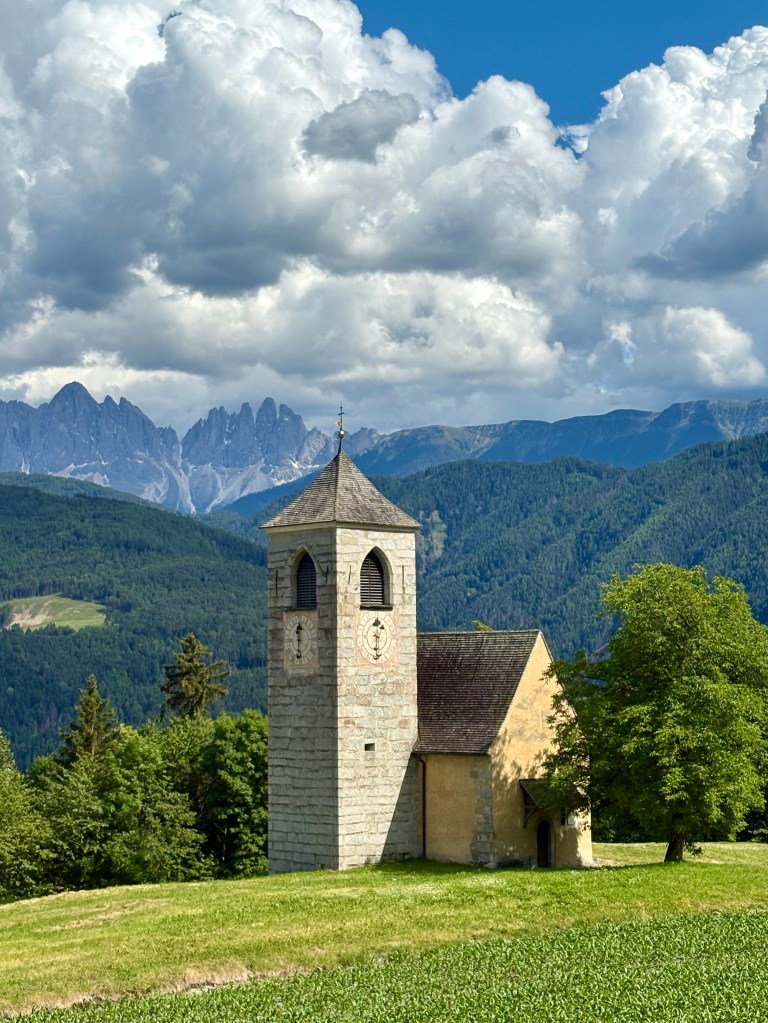
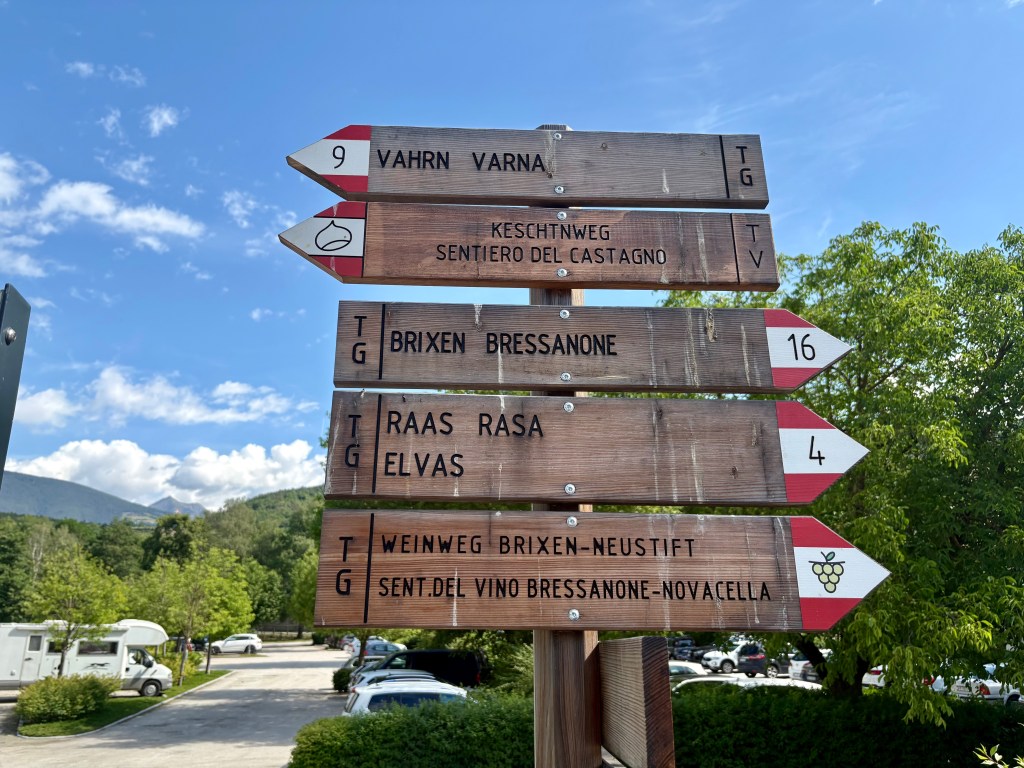
It’s the Chestnut Way, the Keschtweg or the Sentiero del Castagna in this very multi-cultural part of the world, north-eastern Italy, not so far from the Austrian border.
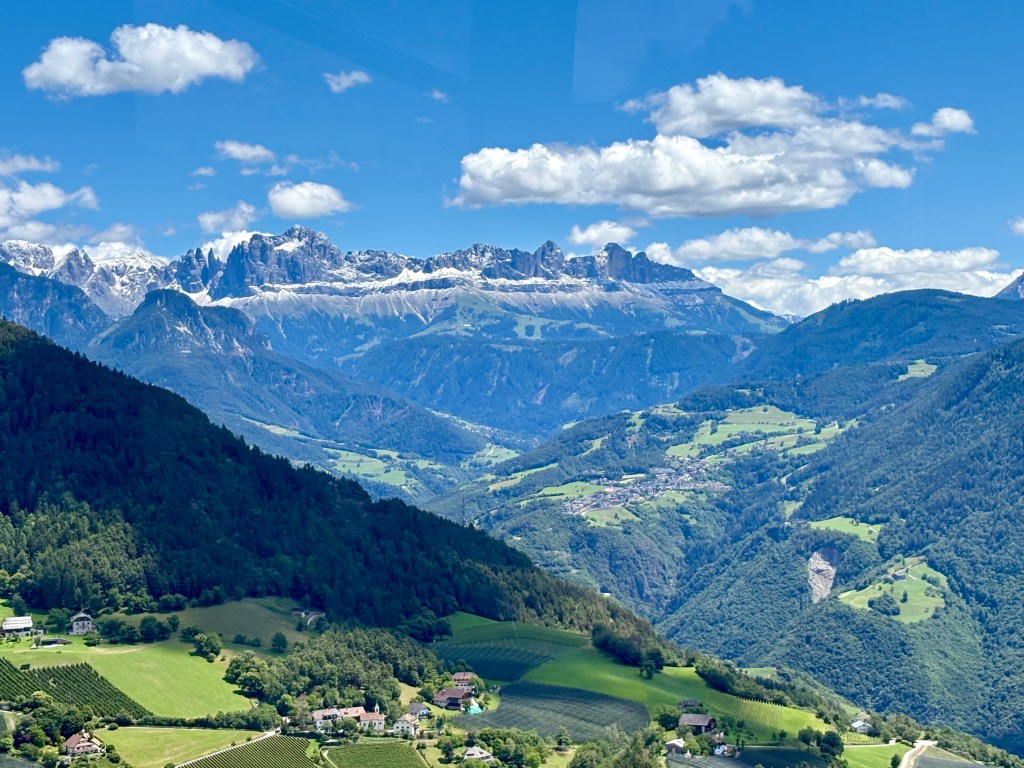
And it is either in or, more accurately, very close to I Dolomiti, The Dolomites. The most renowned peaks in the Dolomites, the Cimi are visible in the background of the first photo above and a constant presence during the walk. But they are on the other side, the eastern side, of the valley carved out by the Isarco or Eisack river. And on the other side of the formidable autostrada which lines the base of that valley.
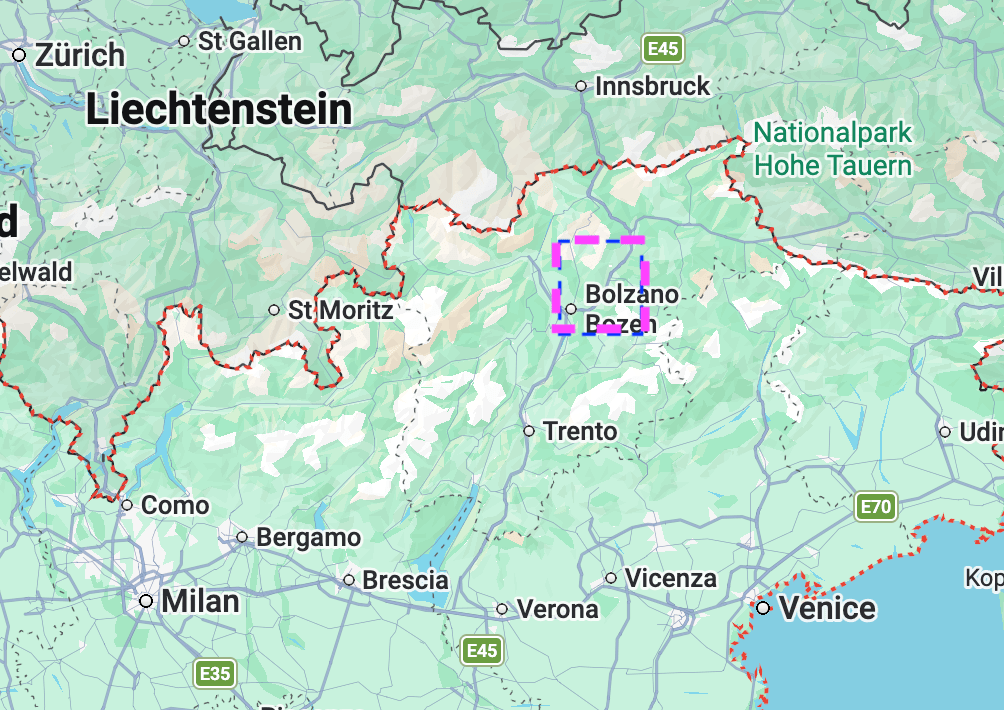
It was only on the train from Innsbruck that I realised we were going through the Brenner Pass, since Roman times one of the main entry points from the north through the Alps to Italy. The nose-to-tail traffic, trucks especially, on the autostrada suggested that it still is. The Southern Tyrol as the area is known was granted to Italy (from Austria) after the First World War. In 1940 the Pass itself was the site of the signing of the Pact of Steel by Hitler and Mussolini. When Italy surrendered in 1943 the Nazis shifted the nominal border of the Reich well south of Bolzano. This helps to explain its cultural complexity. I found the shift from ‘Central Europe’ to ‘Italy’ over 50 kilometres quite pronounced and most certainly part of the fun.
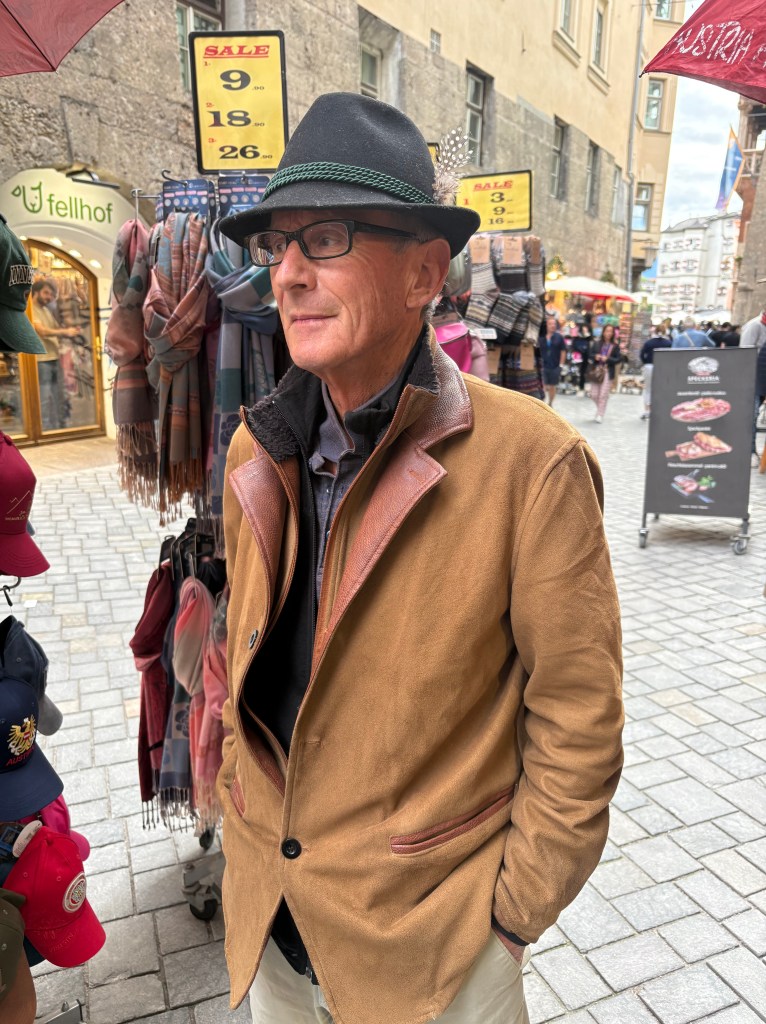
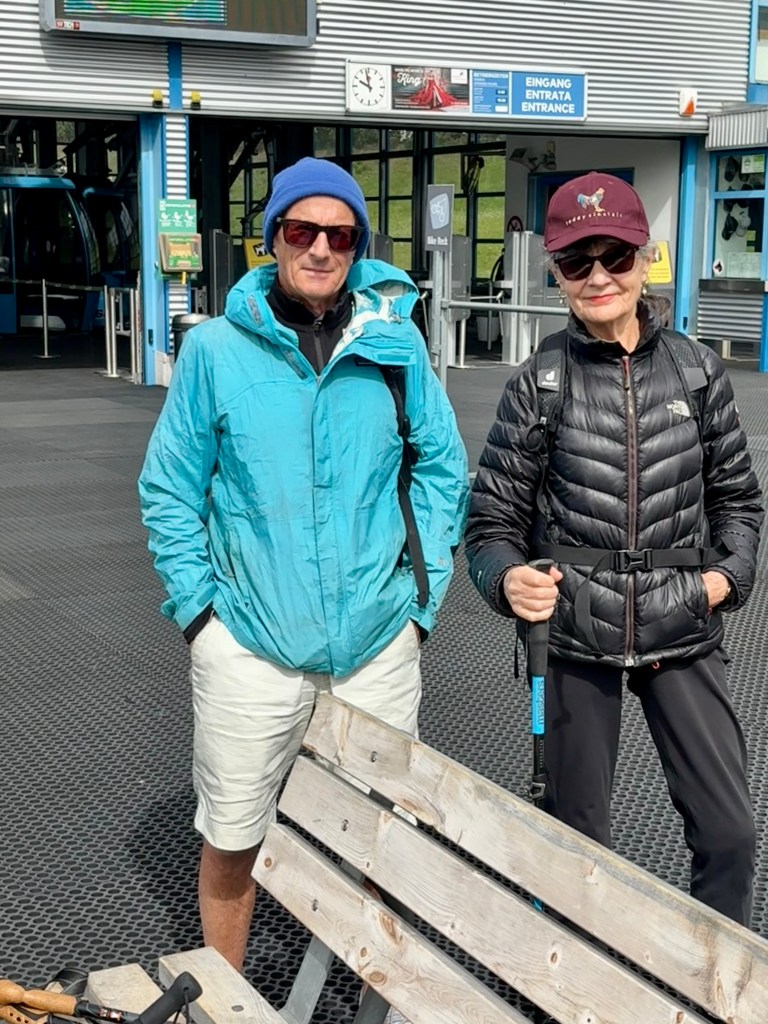
At left, Michael doing his best to look South Tyrolean.
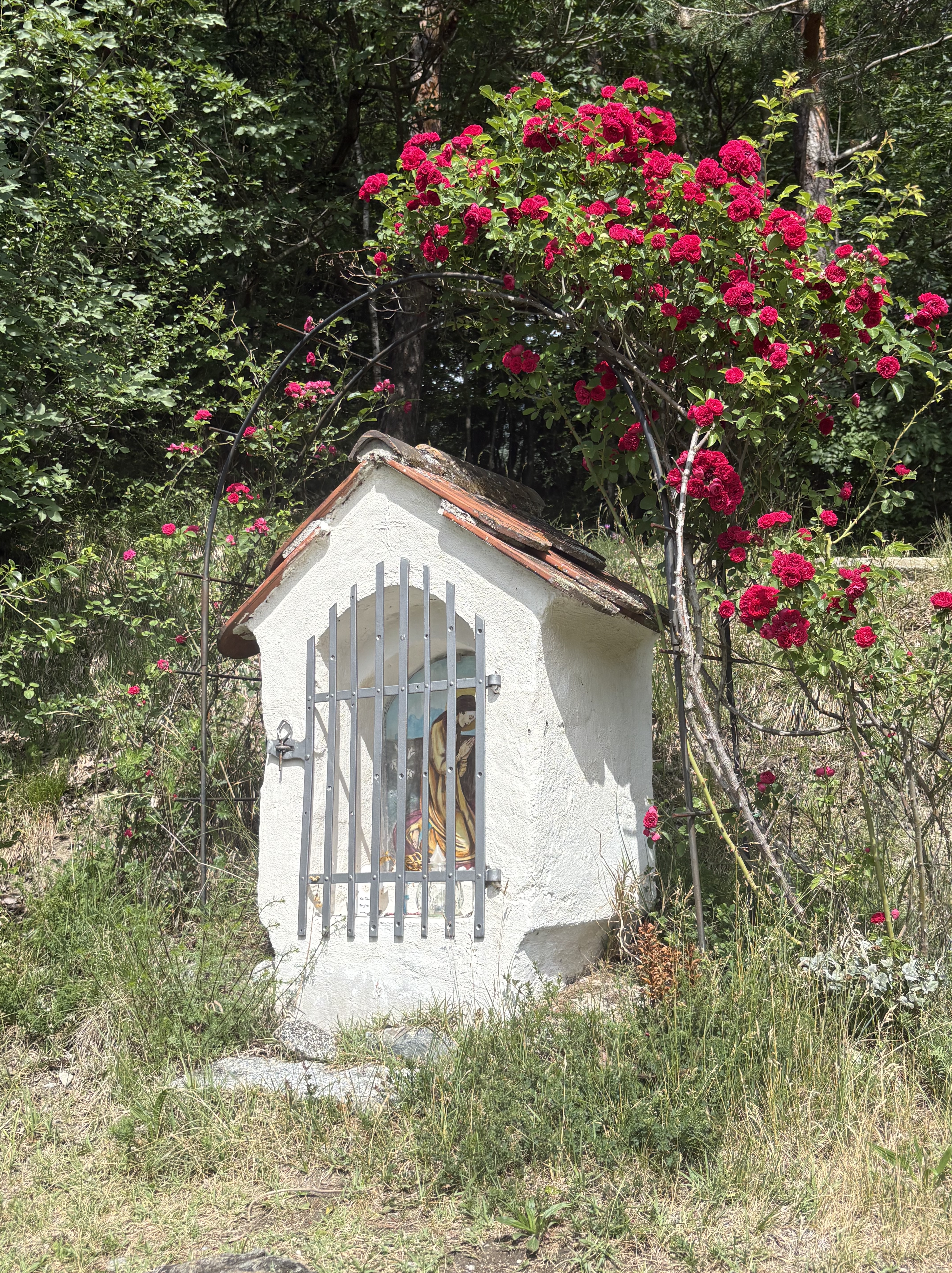
And it has been a route of pilgrimage for centuries. I have mentioned elsewhere that the walk nominally starts at an abbey north of Bressanone/ Brixen, the Abbazia di Novacella, and finishes at the cathedral in Bolzano. Shrines ranging from the obvious to the opaque are legion along the way.
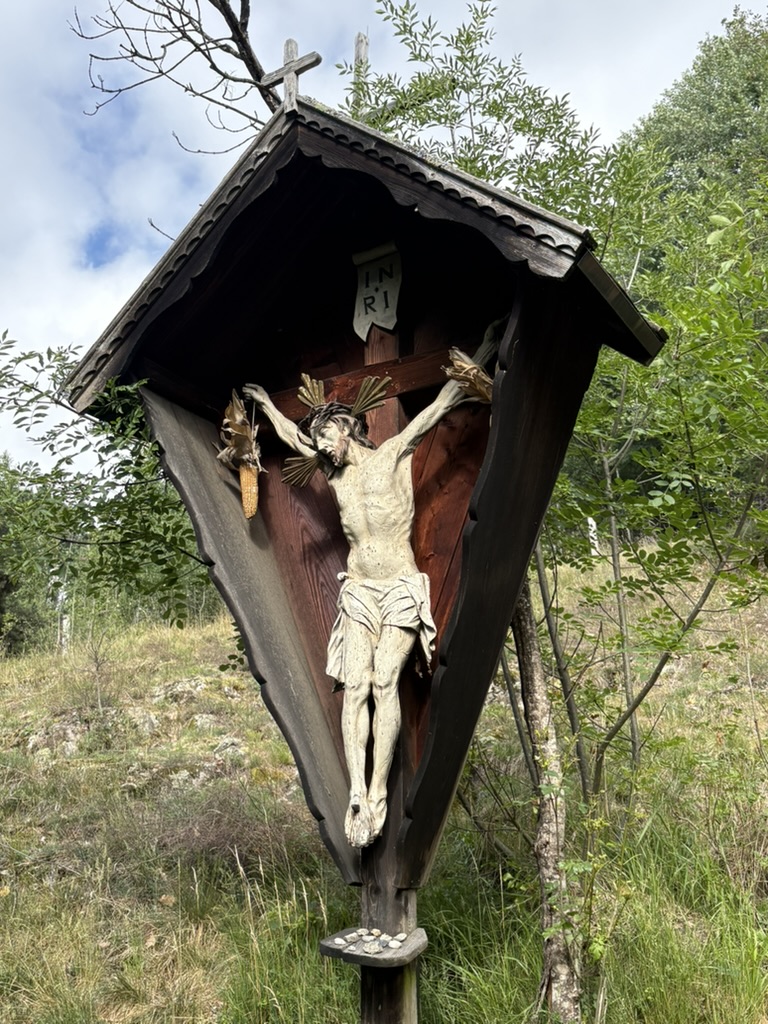
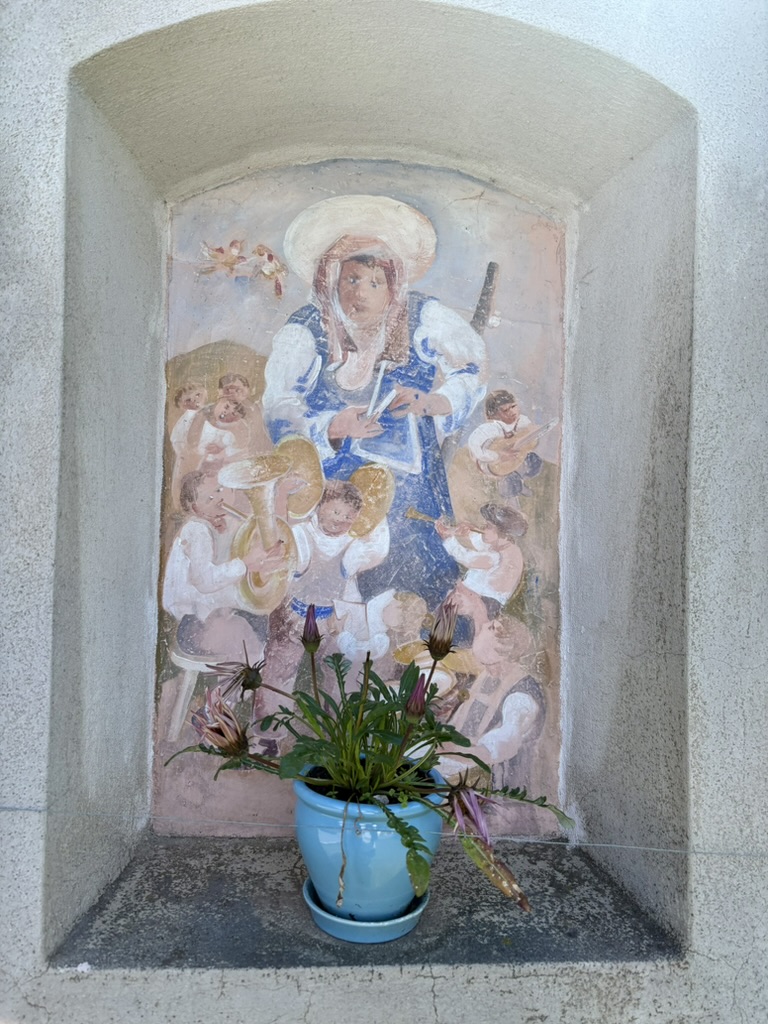
Churches provide some of its most distinctive sights, but the walk gets its name from the stands of chestnut trees you encounter. It’s an amazingly fertile area full of vineyards on impossible slopes along with a huge range of fruit trees.
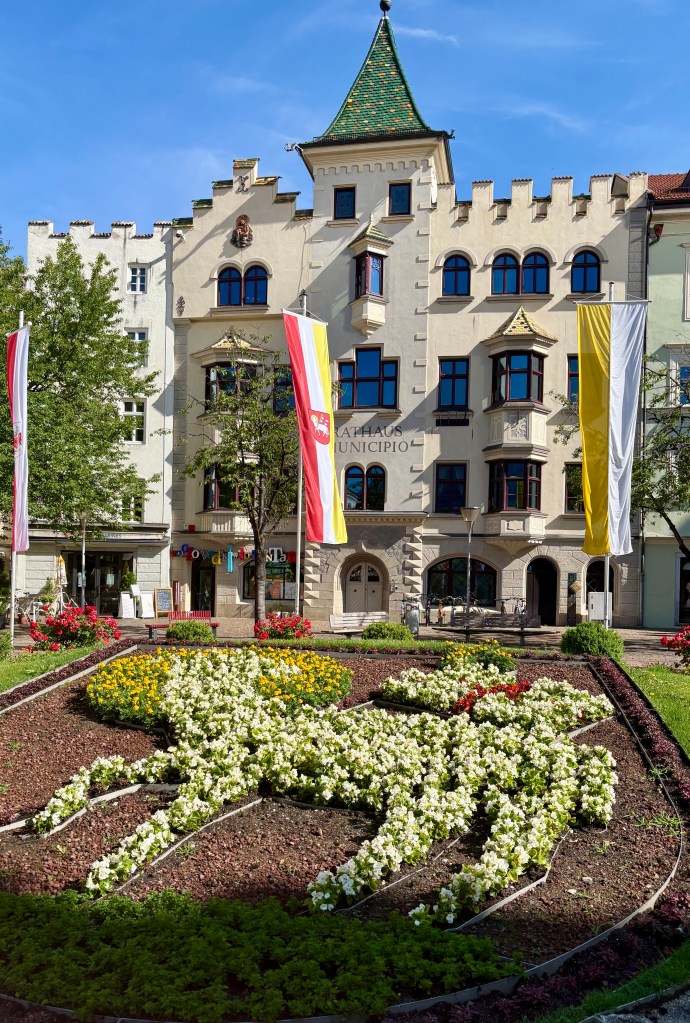
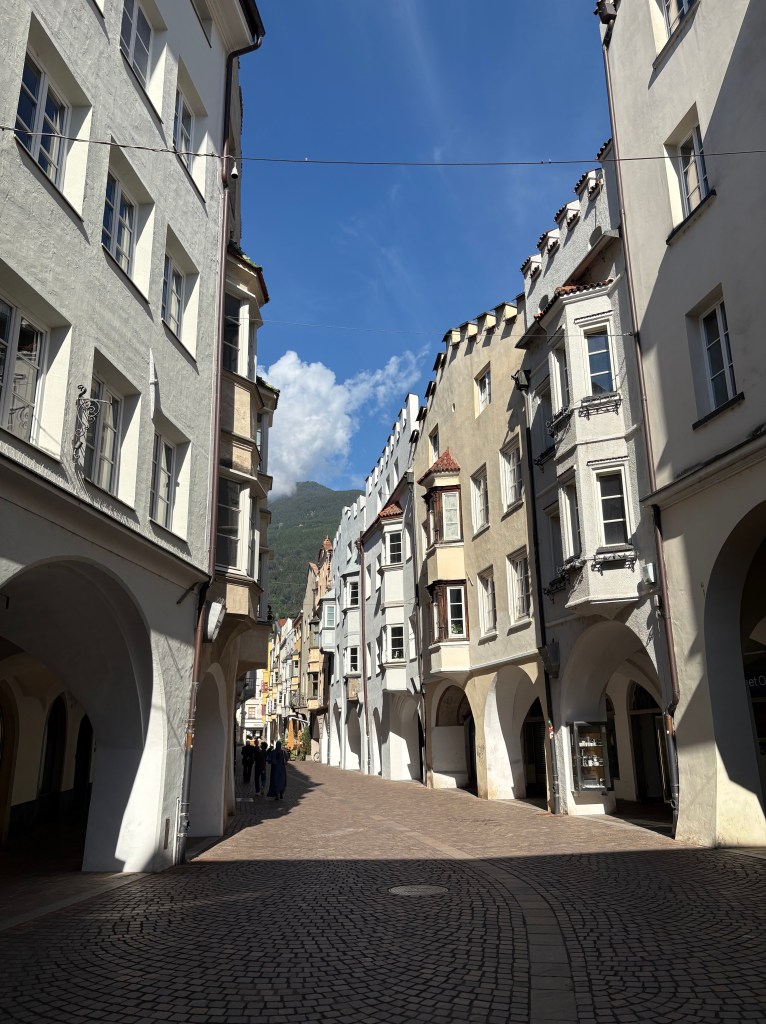
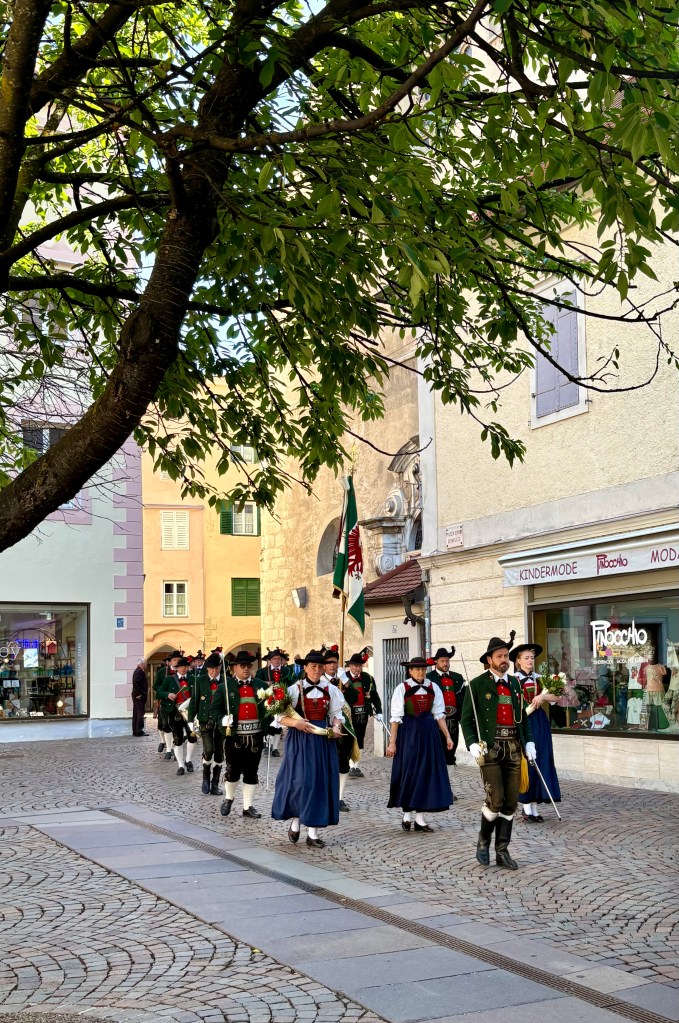
Bressanone/ Brixen has its own tourist allure. It is the oldest city in the area and its old quarter almost defines picturesque. A floral Lamb of God in the Square in front of the Rathaus (Town Hall) on the left. The marching chaps? No idea, just mightily impressive. They demobbed into the cathedral swords sheathed.
Rather than tangoing with the sharp grey peaks — and there is a very enticing walk along their base which people I know have done — we were on the old folk’s side of the valley. We were walking, more or less, along the lip of the western side of the valley which still had plenty of ups and downs as well as consistently glorious views. Like this: ‘This track is rated moderate and is suitable for regular walkers with most days offering 4-8h of walking and sections with steep ascents. The routes cover a variety of terrain including grass, roads and stone paths as well as dirt roads and forest tracks.’ That’s about it.
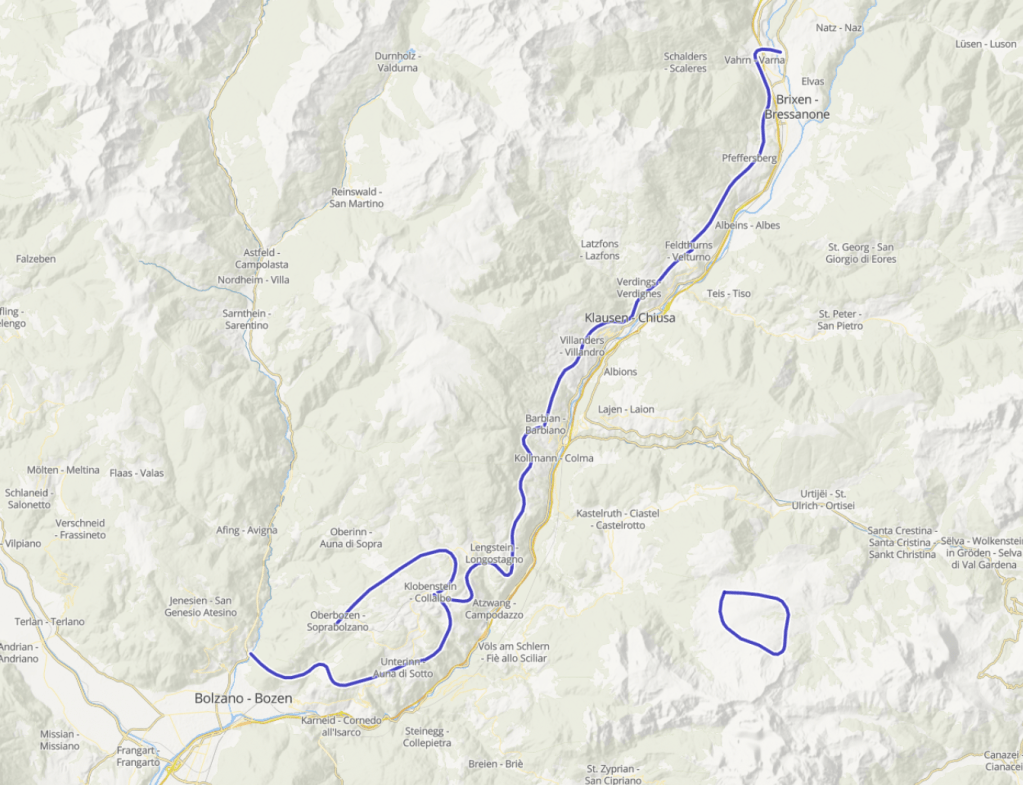
It’s not so far. On the autostrada it’s 50 kms; we walked just over 80. (Melbourne to Geelong. Glad to get Geelong in somewhere.) The only interest this very faint map provides is that little oval off to the east. The final day was a circumambulation of an alpine plateau, Siusi. We got there via a 50-minute bus ride and a cable car.
I was a bit apprehensive because I had pulled a muscle in my thigh a few weeks previously and it was still coming and going. But nothing ventured …
Apart from one very wet day which I spent mostly in bed reading and resting, the weather was sunny and often very warm.
********
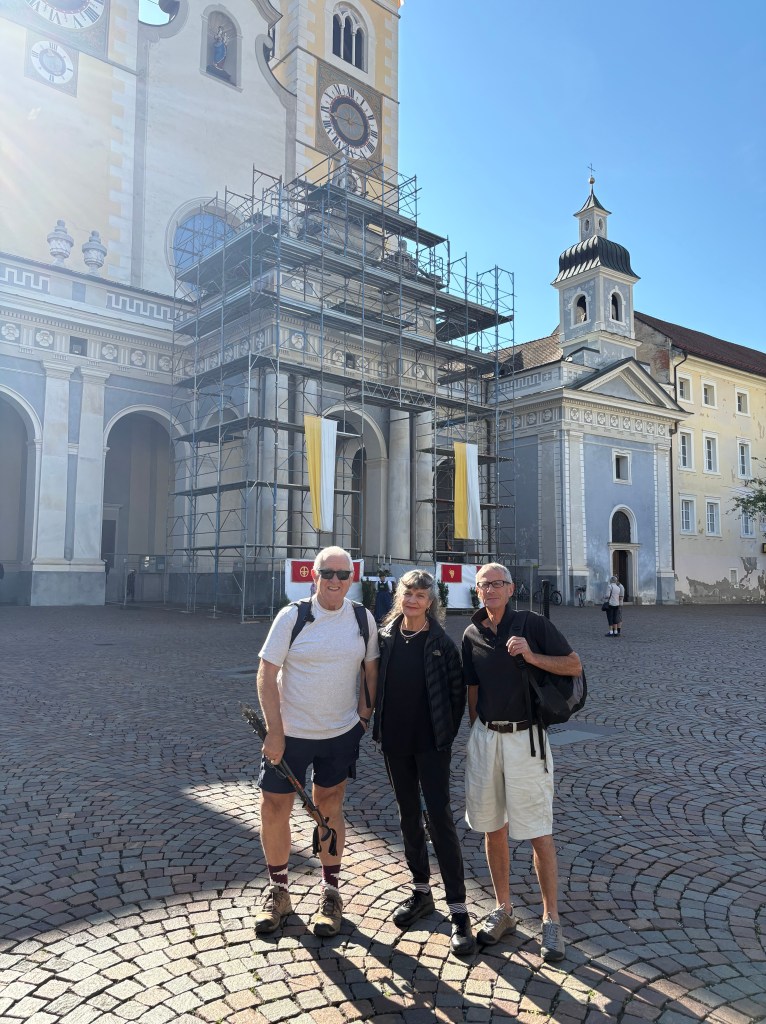
We look all right here in Bressanone’s Square just outside one of its two cathedrals, almost next to each other as it happens.
We look all right because we haven’t done anything yet. It’s Sunday morning and we are waiting for the bakery to open so we can buy some lunch. Waiting waiting waiting. So I decided to poke my head inside the cathedral. It was a serious affair.
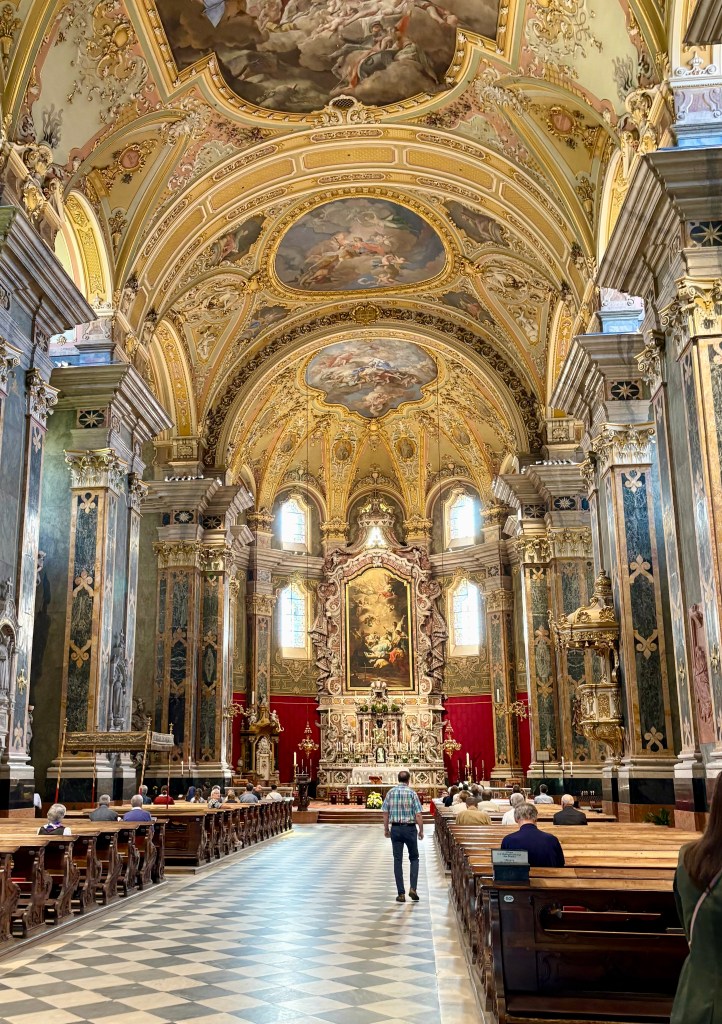
A version has been on the site since the 980s. It was re-built after burning to the ground in the 1170s and then again to a firmly baroque and grand style over 10 years from 1748. It is the seat of the Diocese of Brixen. (The Catholics here go with the German.) It looked like a new portico was going up when we were there.
We waited at the bus stop, hoping, because there was quite a long way to go — we walked about 20 kms that day, climbing up onto the ridge — and it was getting later than it should have been. A taxi stopped exactly at the bus stop to let a passenger out. Providence: an opportunity like that is not to be missed.
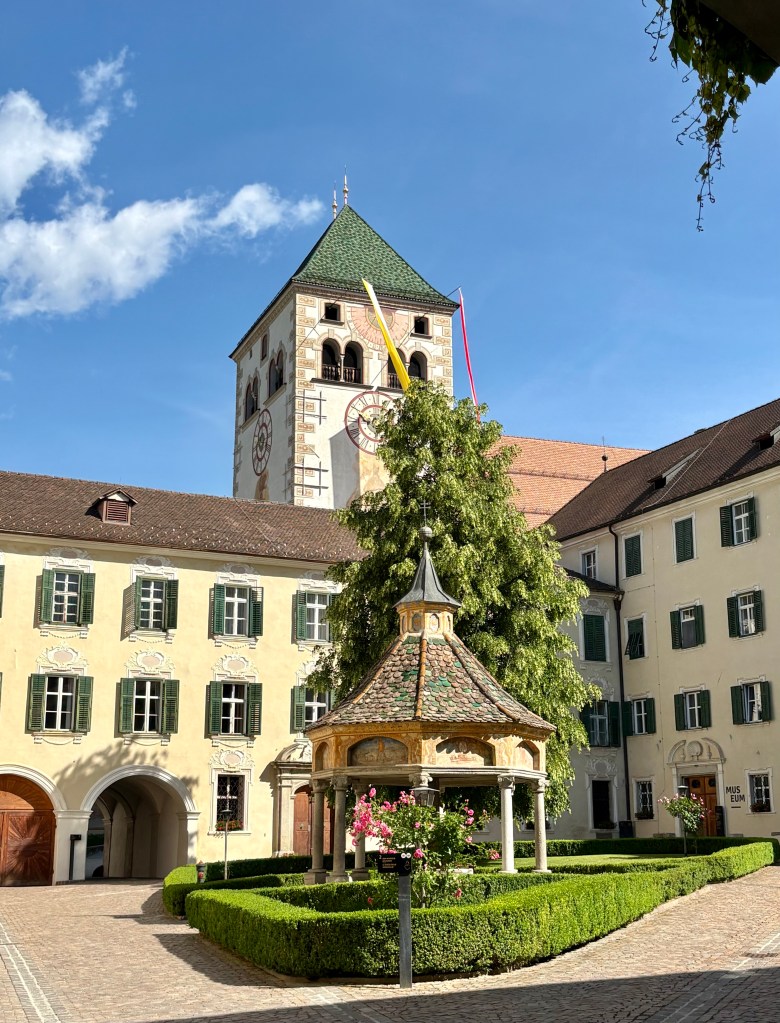
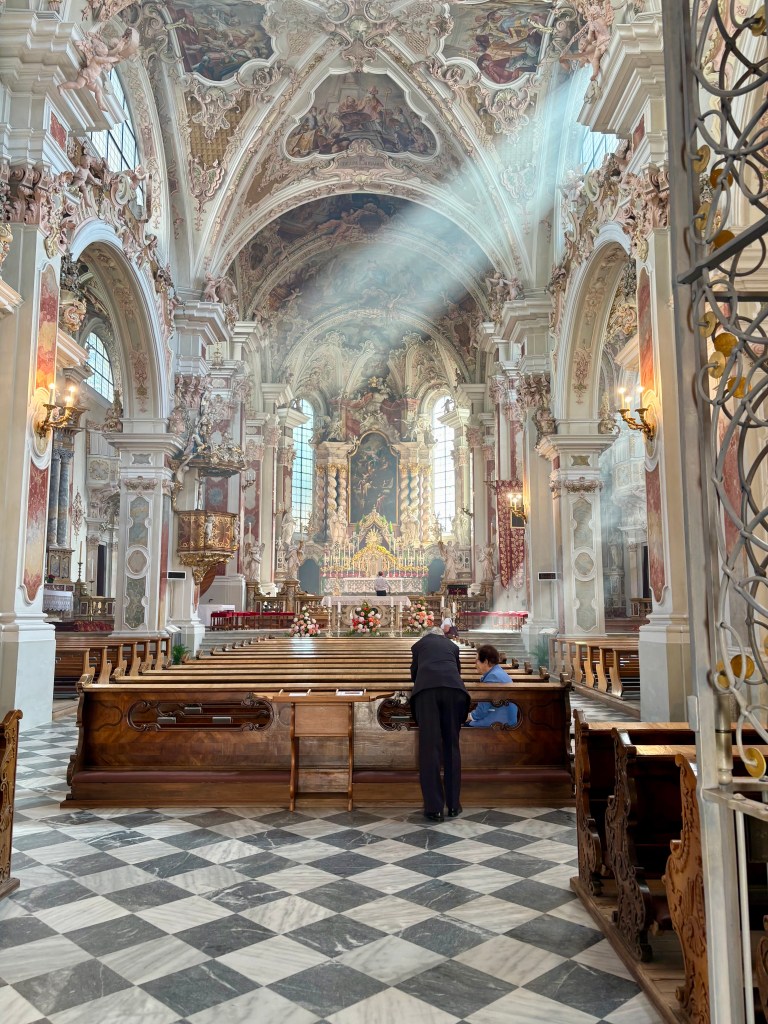
The abbey itself was equally serious, and Providence again sent a signal.
We were heading back to the departure point when round the corner came this.
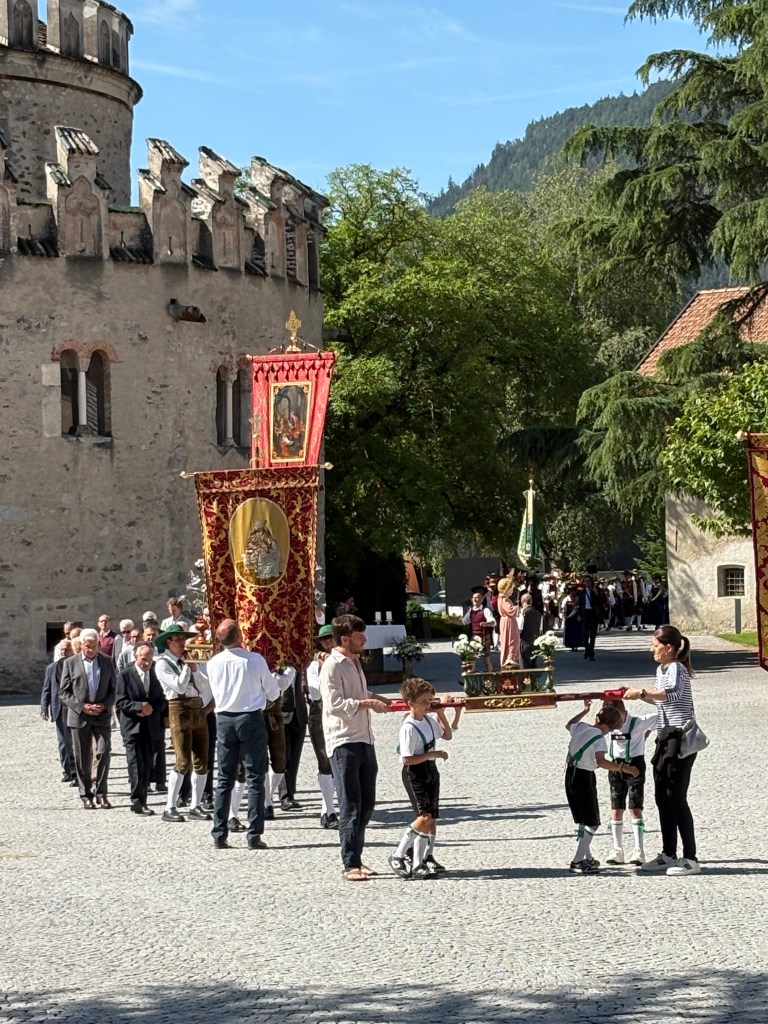
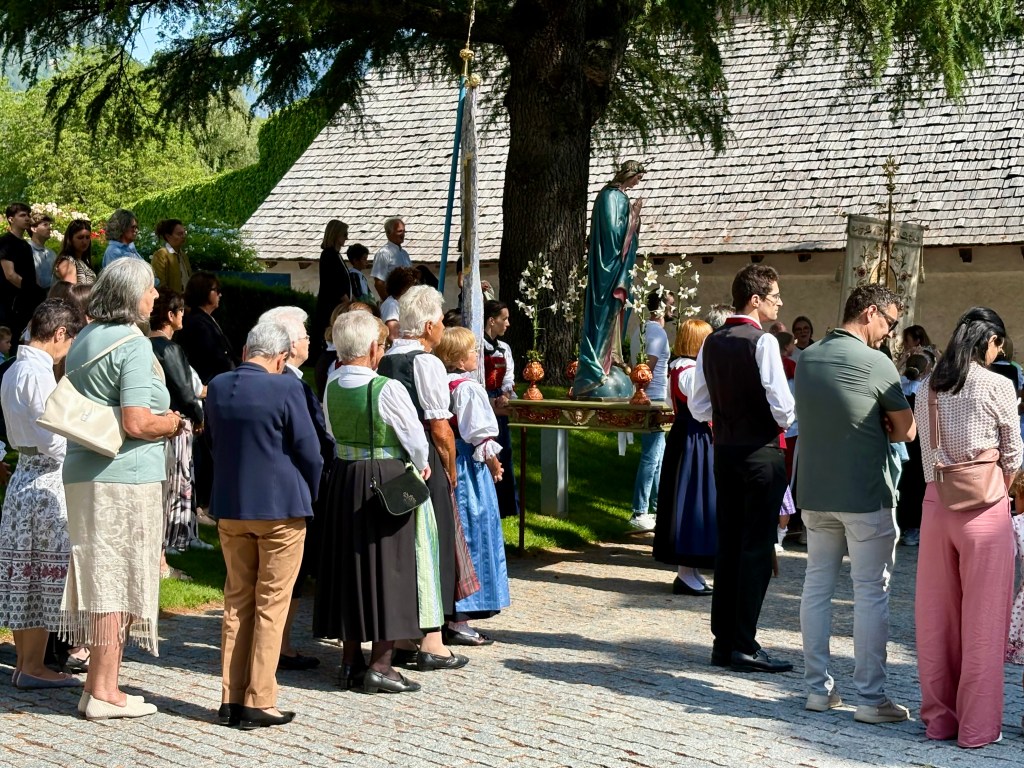
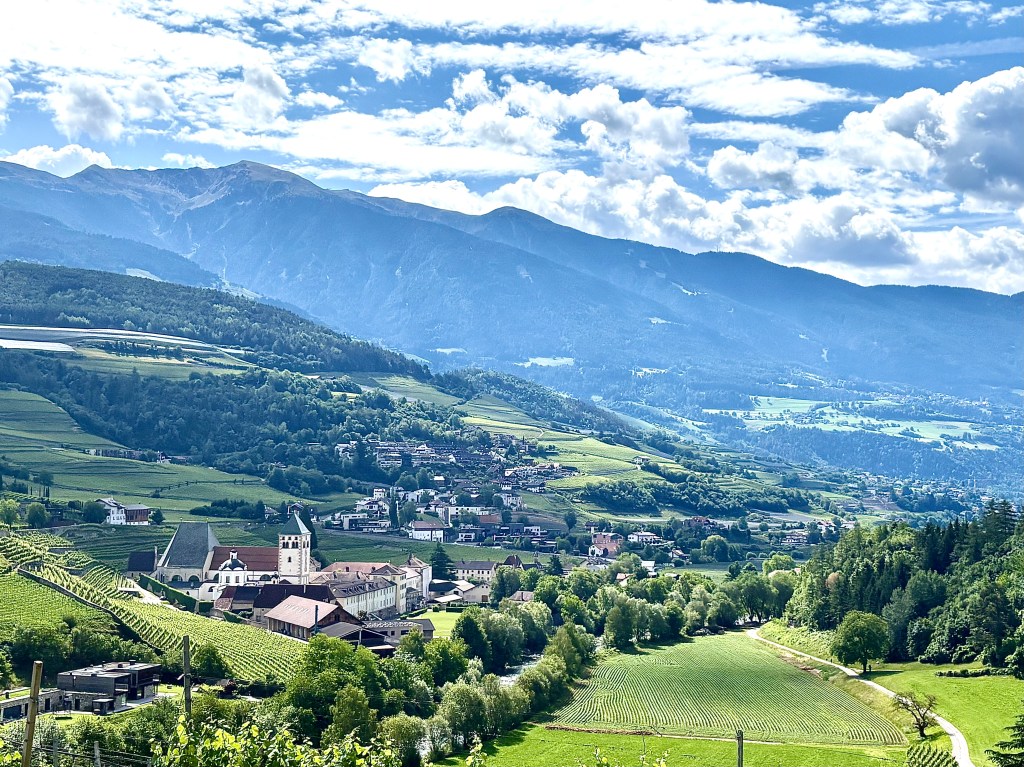
Being of religious heritage I would have stayed longer, especially to listen to the choir, but my companions choofed me along. Fifteen minutes later we were climbing out of the valley albeit in what seemed like the wrong direction. Below is the abbey which owns at least some of the vineyards which surround it.
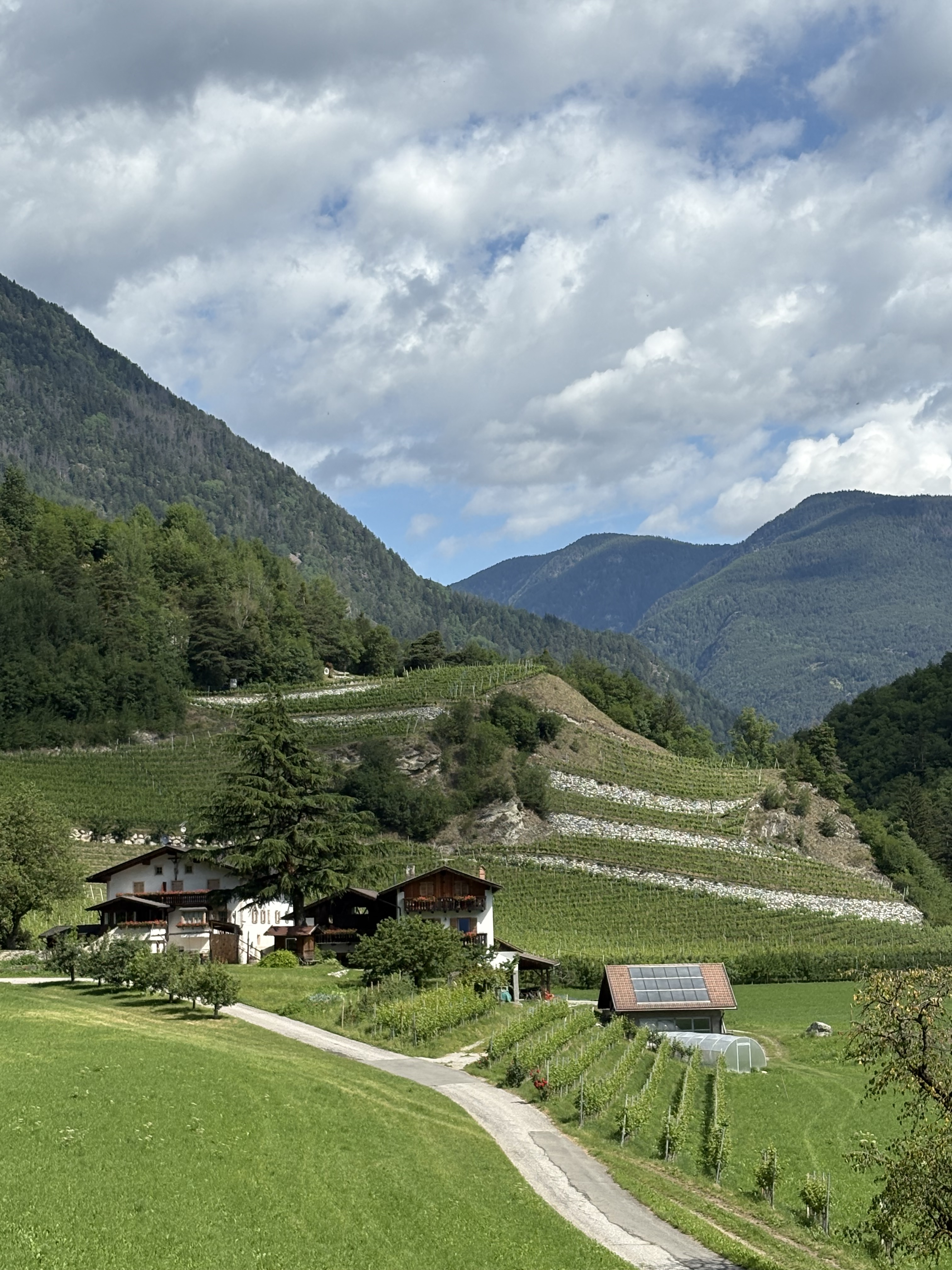
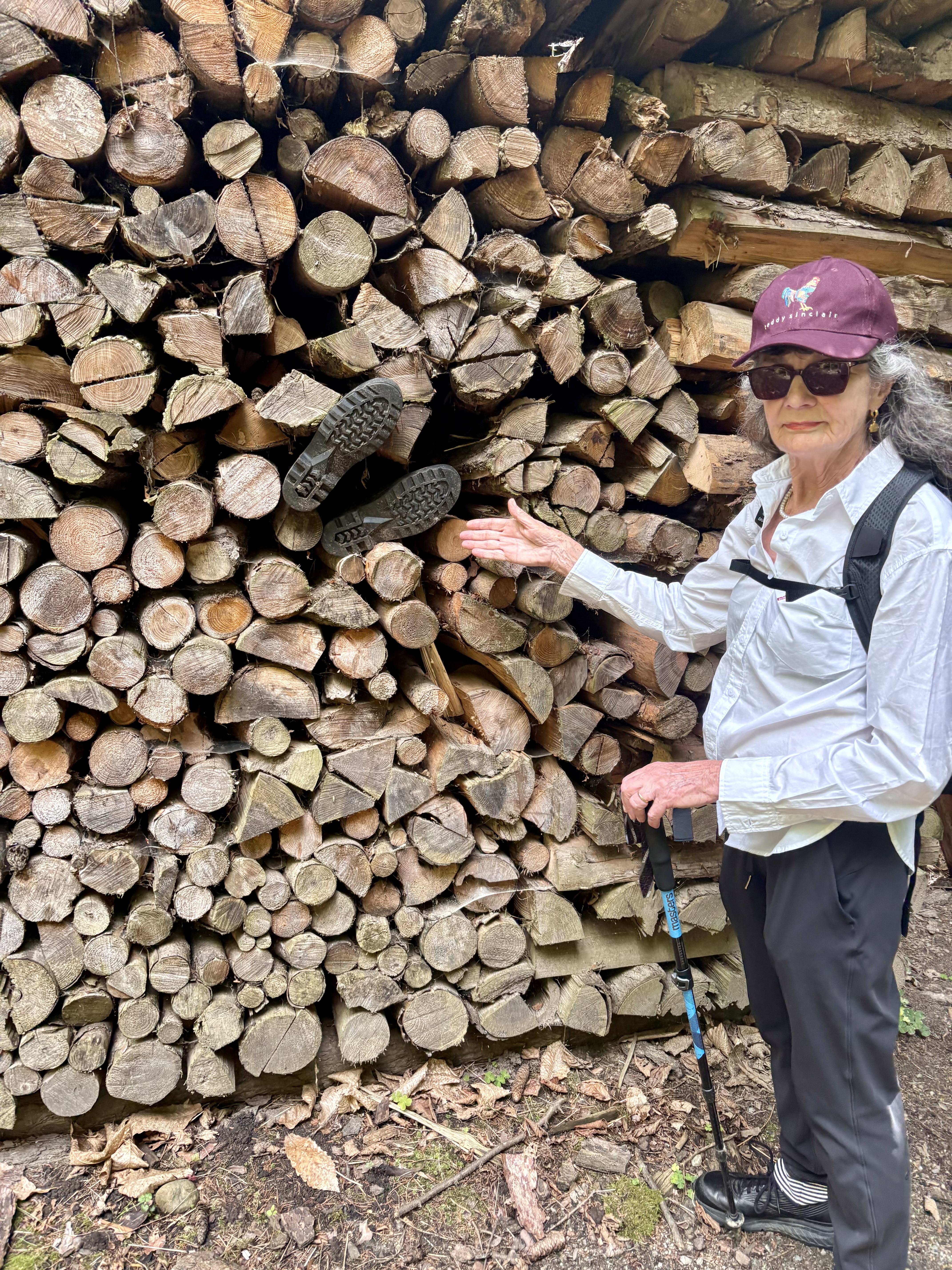
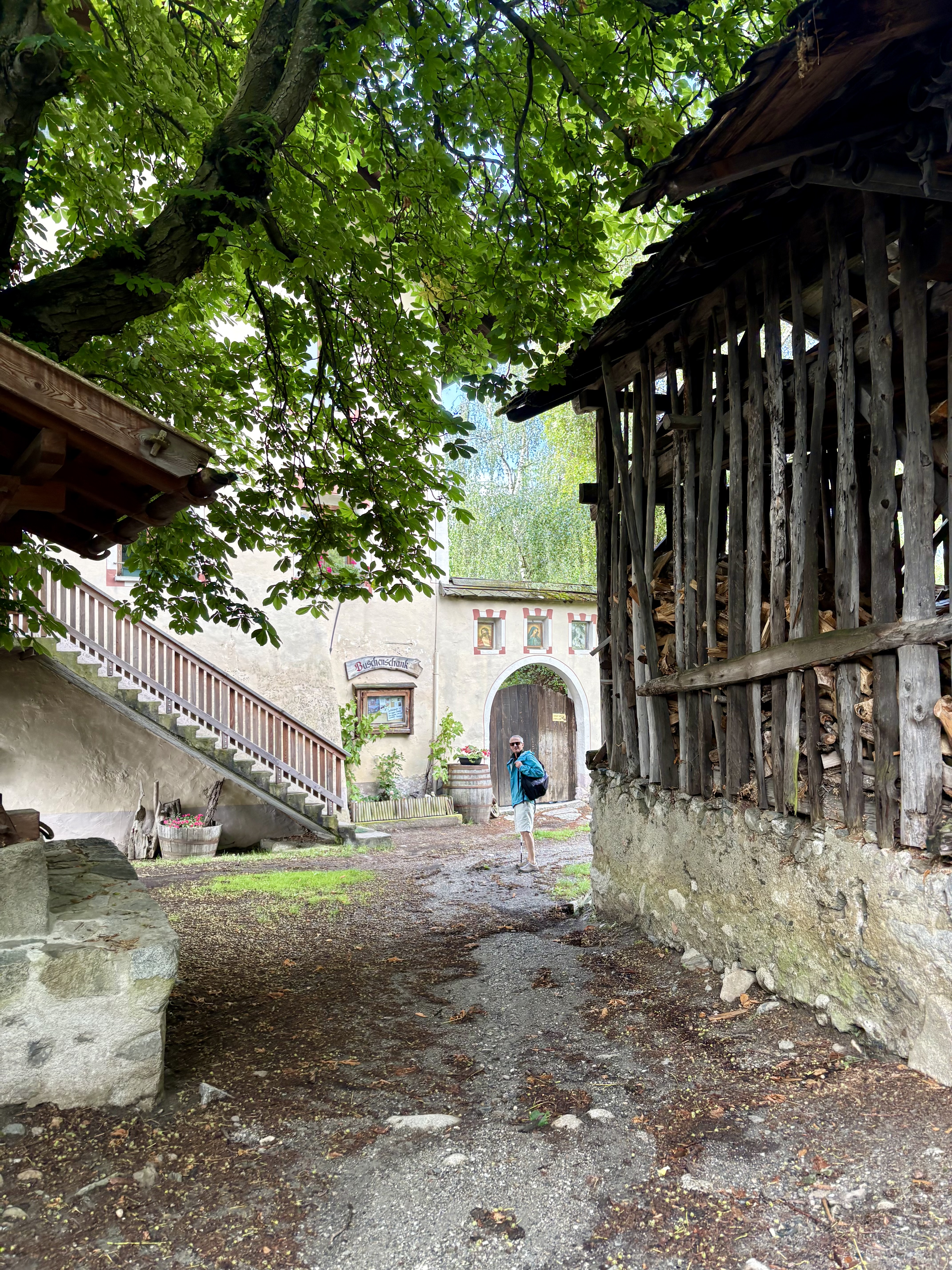
We turned south at Varna, not much more than the small cluster of houses which recurred, and it was near here that Myrna found the suspicious issue in the woodpile: a waymark of some importance.
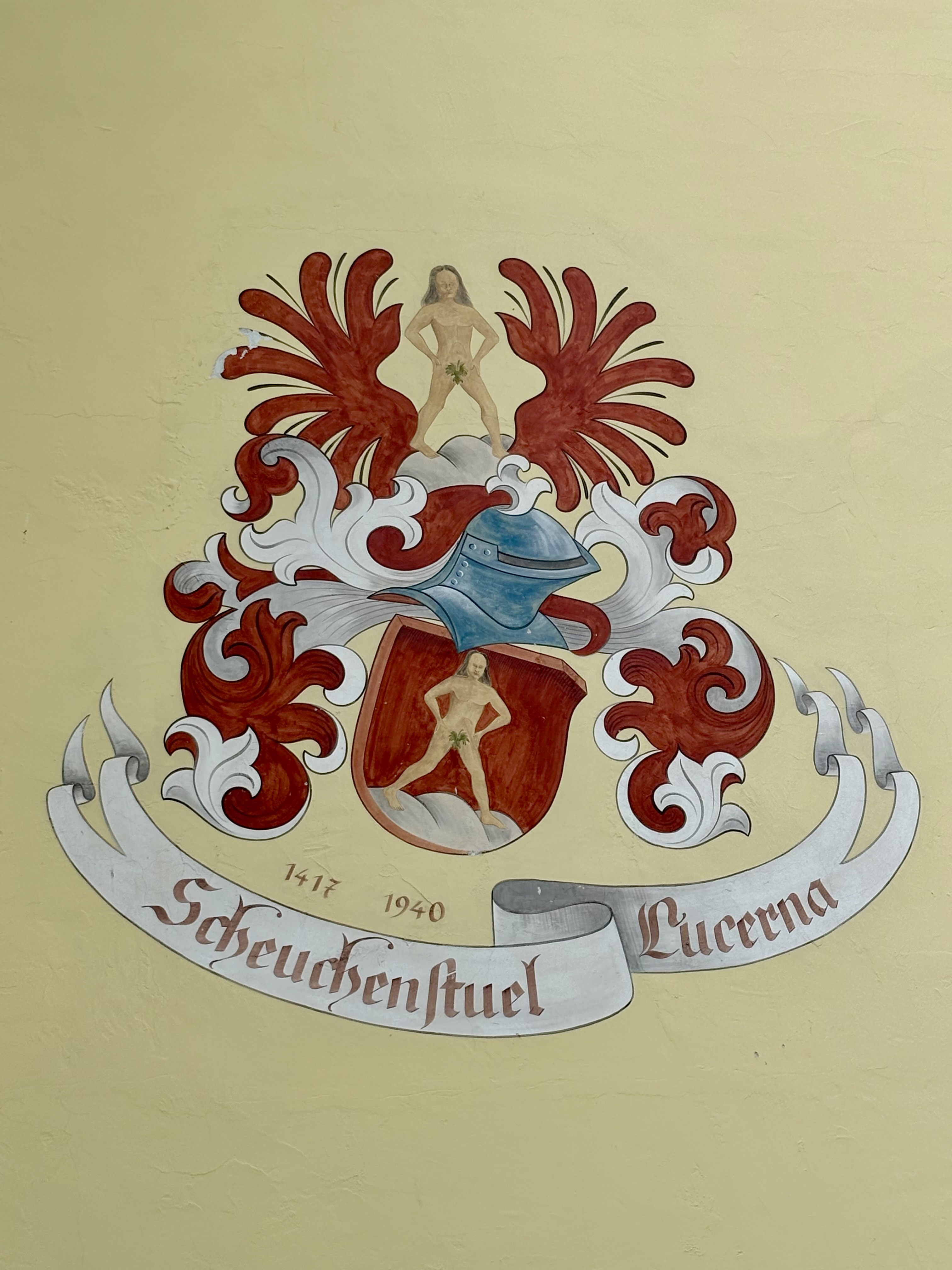
The coat of arms with its splendidly assertive figures was on the front wall of a house we passed. Scheuchenstuel Lucerna seems to be just a Proper name. (1417-1940! That’s a long time.)
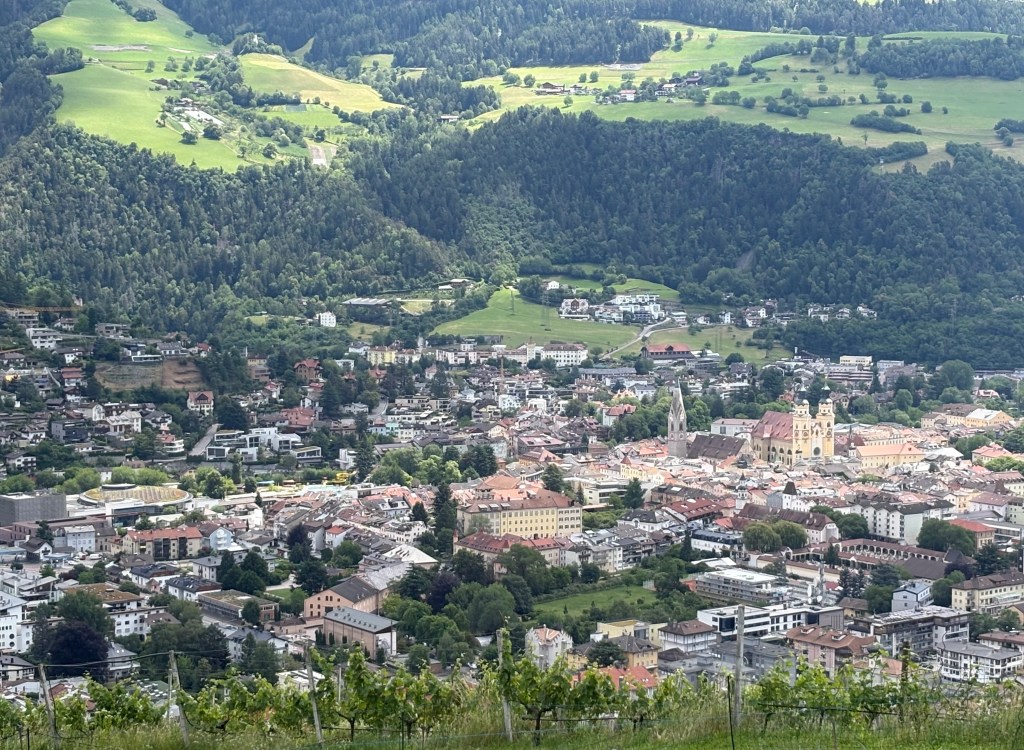
Soon, after five or so kilometres, we could see Bressanone/ Brixen from above. The two cathedrals stand out. The big yellow building to their left is a school.
It was unquestionably rural walking with the occasional religious experience.
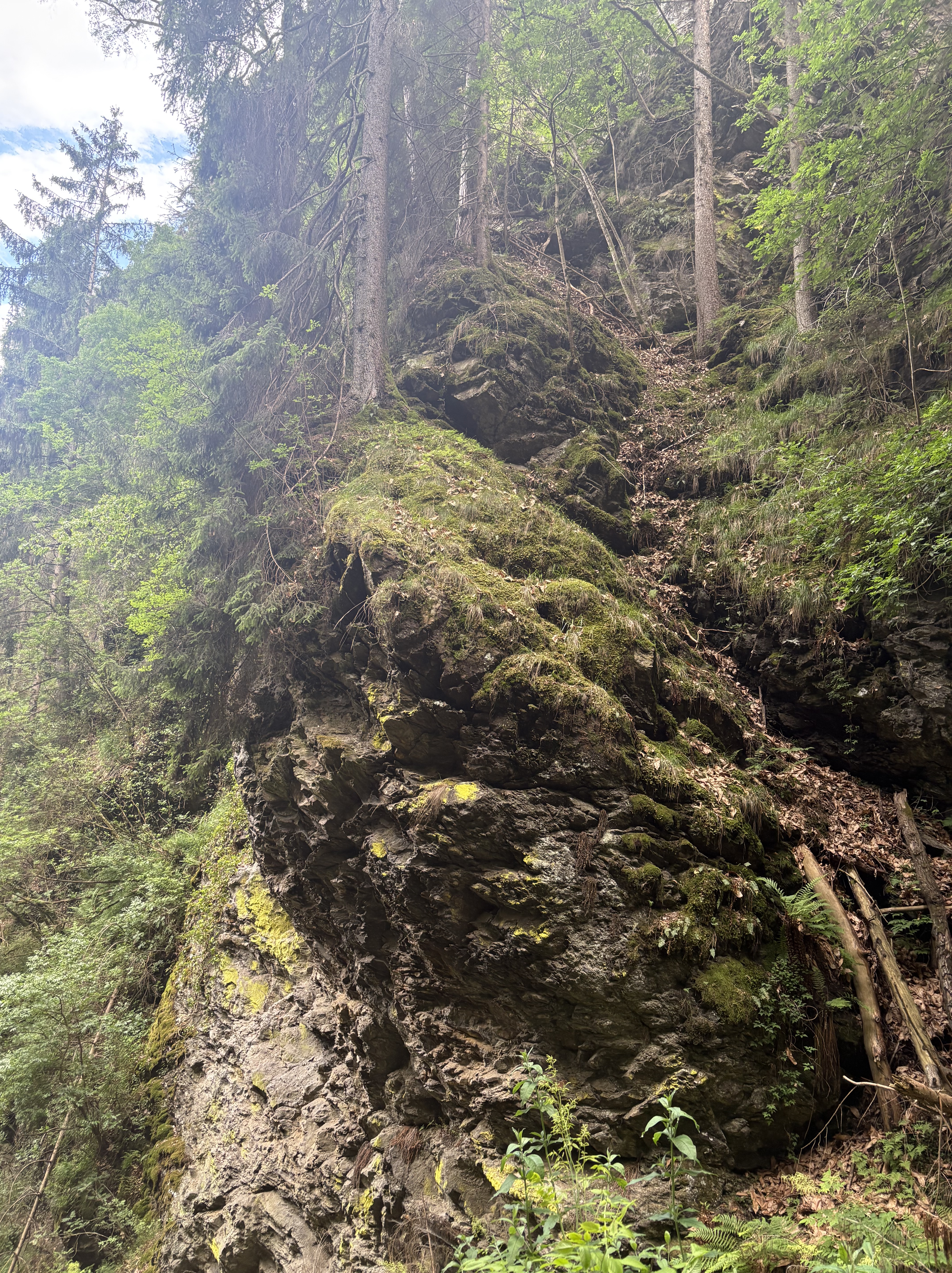
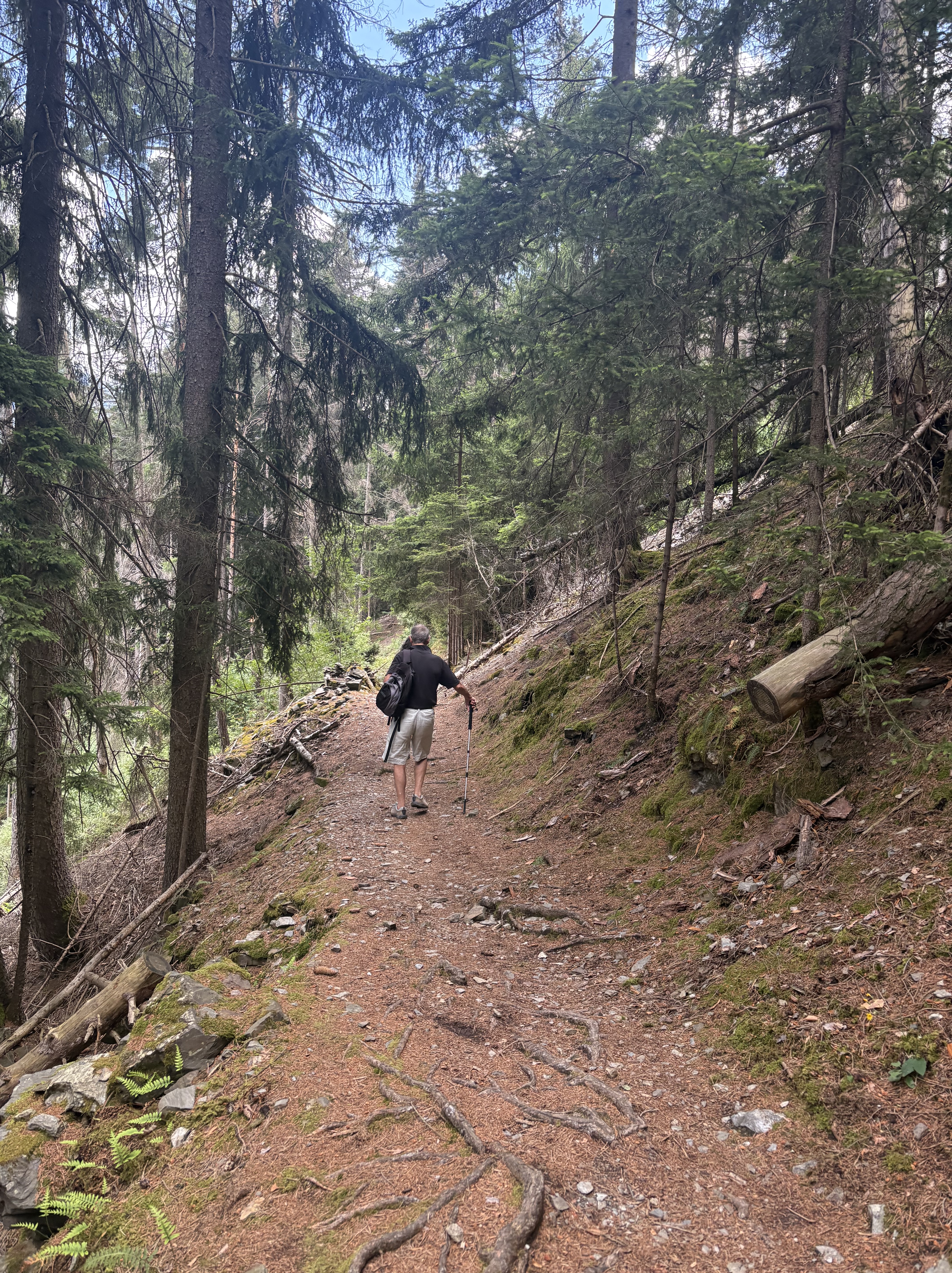
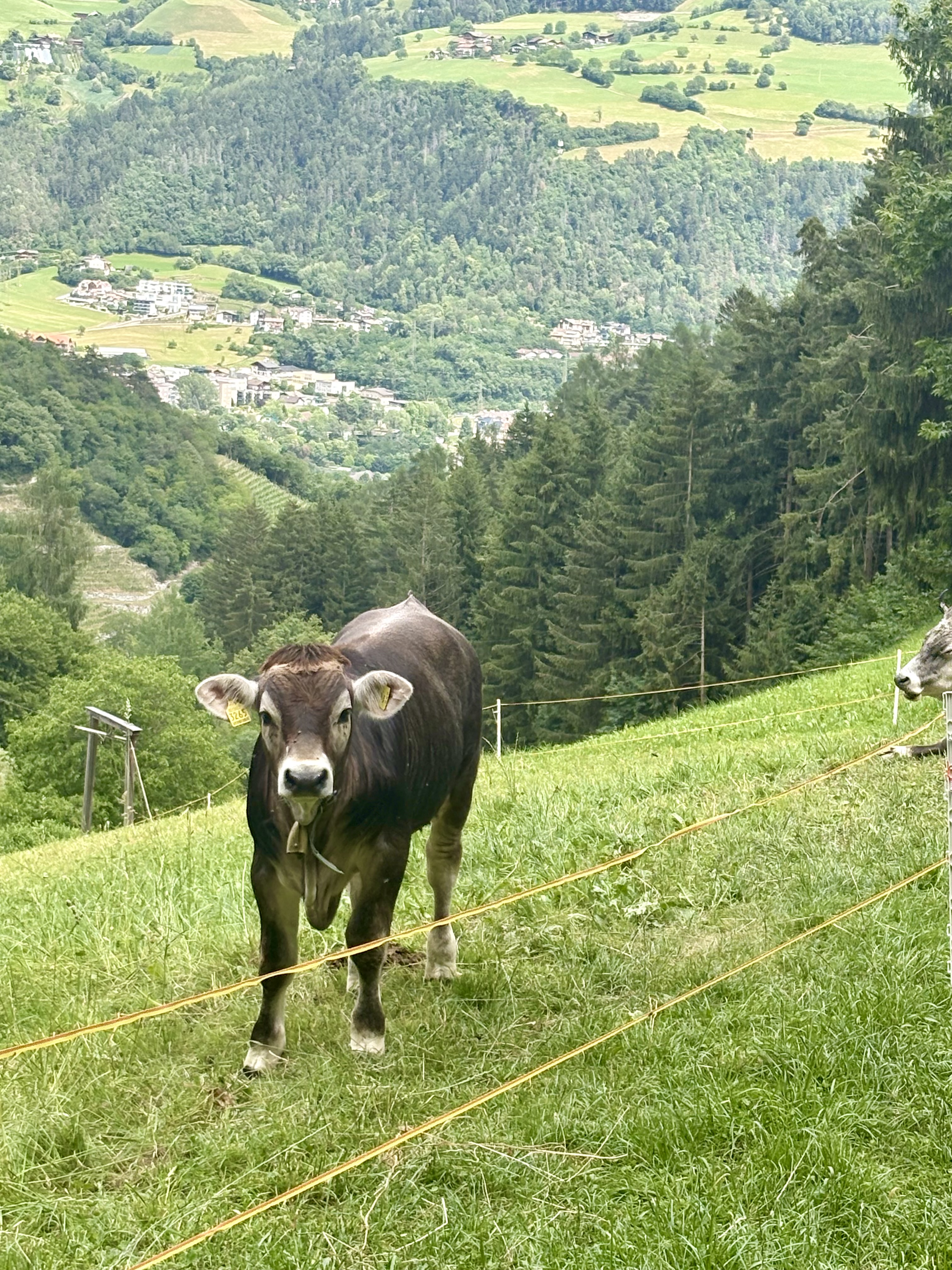
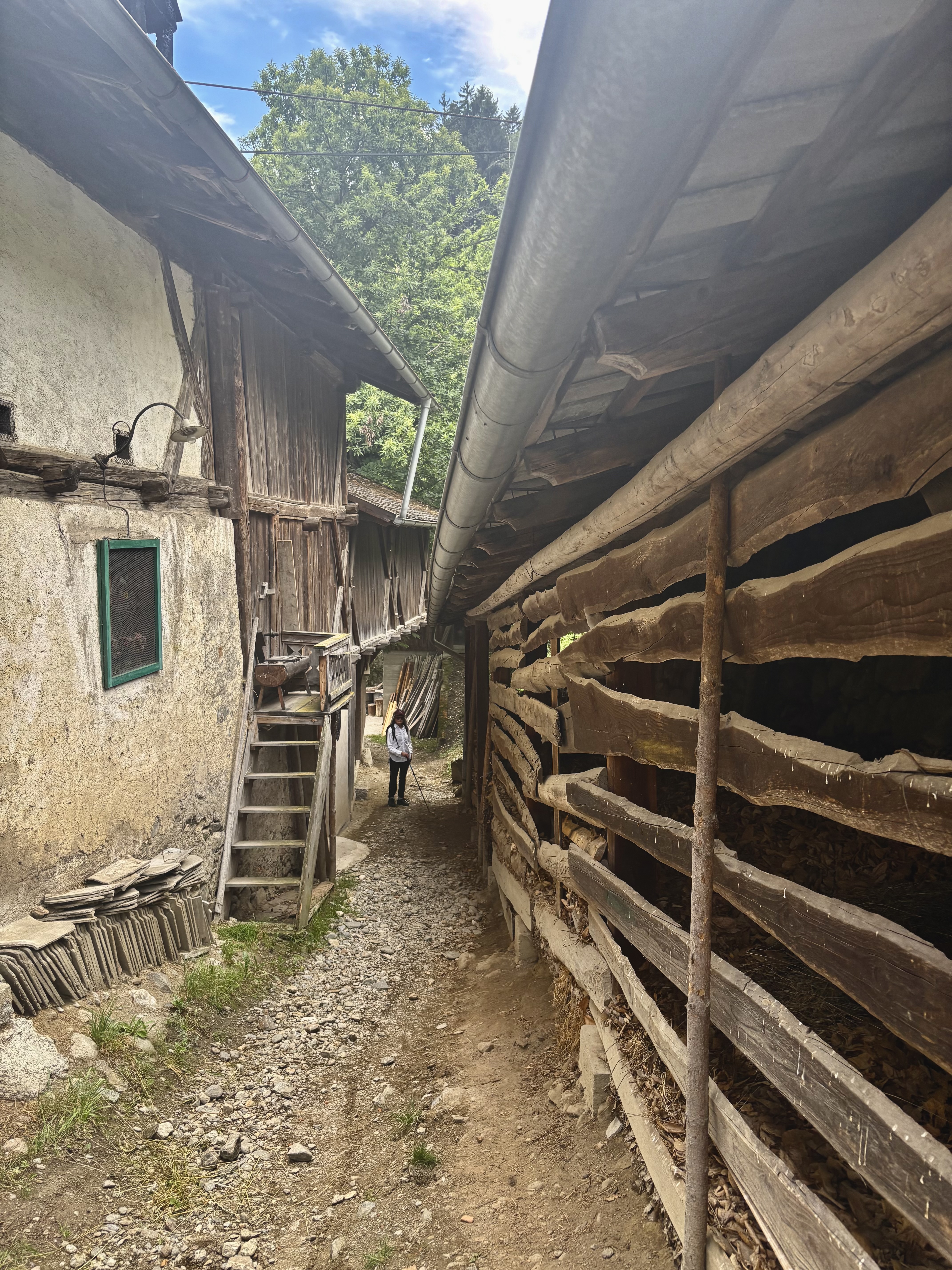
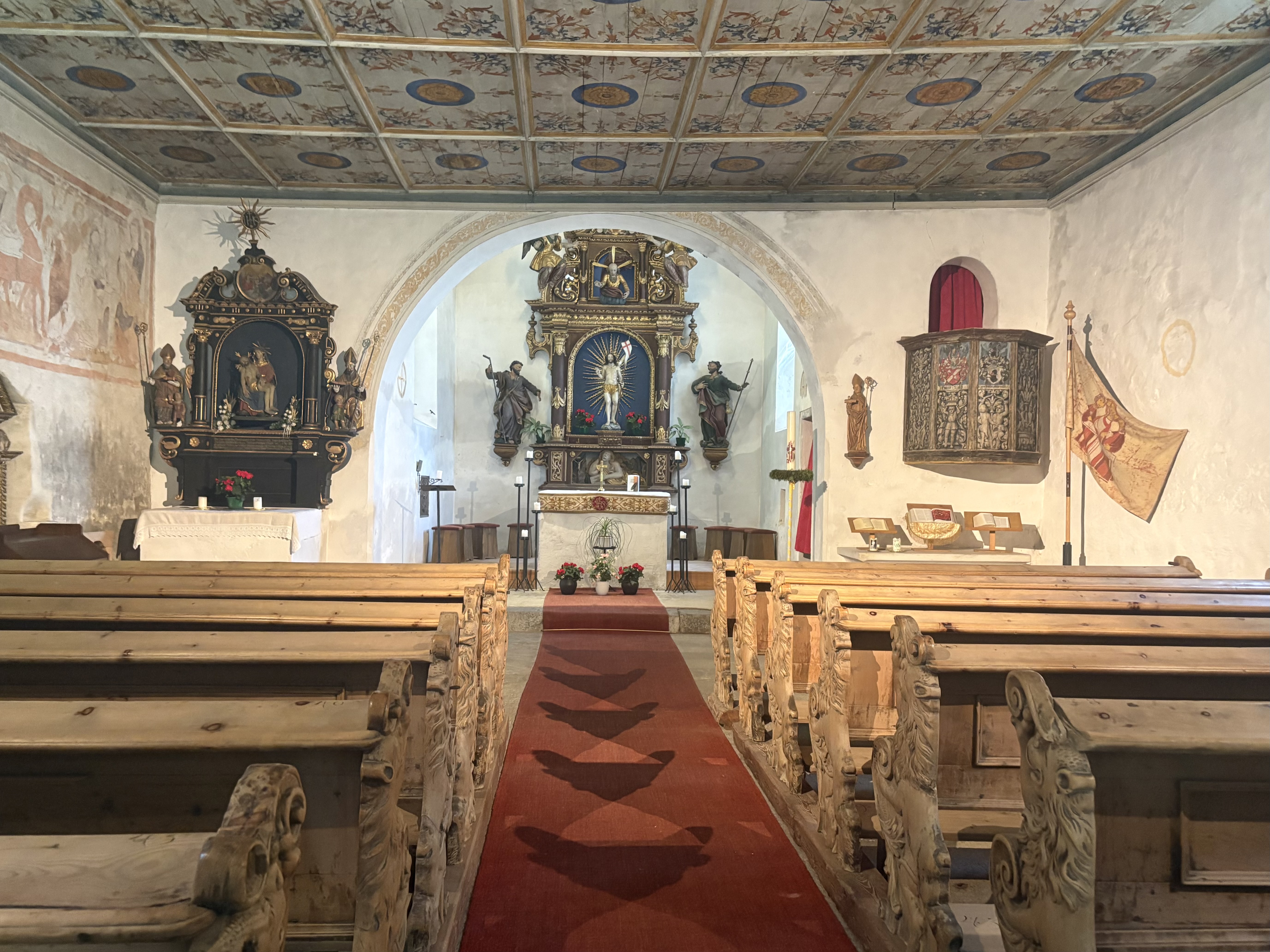
One of the pleasures of the walk was the feast of smells. The pine forests for a start, and the drifts of floral not fragrance necessarily, although many of them were lovely, but just interesting smells. There was the cow shit and the vegetal aromas from composting silage, and an unusual sort of lanoline smell which recurred. Lots of wood smells: cut, fallen, wet, drying, rotting, fungal, and very occasionally dried or smoked meats. I enjoyed them all.
Our first clear view of the Tre Cime di Lavaredo, or the Drei Zinnen (in the background here). They are as dramatic in the flesh as they look here. The highest peak, Cime Grande (‘Big Peak’, 🤔) is 2999m above sea level. (You’d think they’d build a cairn or some modest construction to break through the 3000 barrier wouldn’t you. Or perhaps the 2999 is so distinctive you’d want to just leave it at that.)
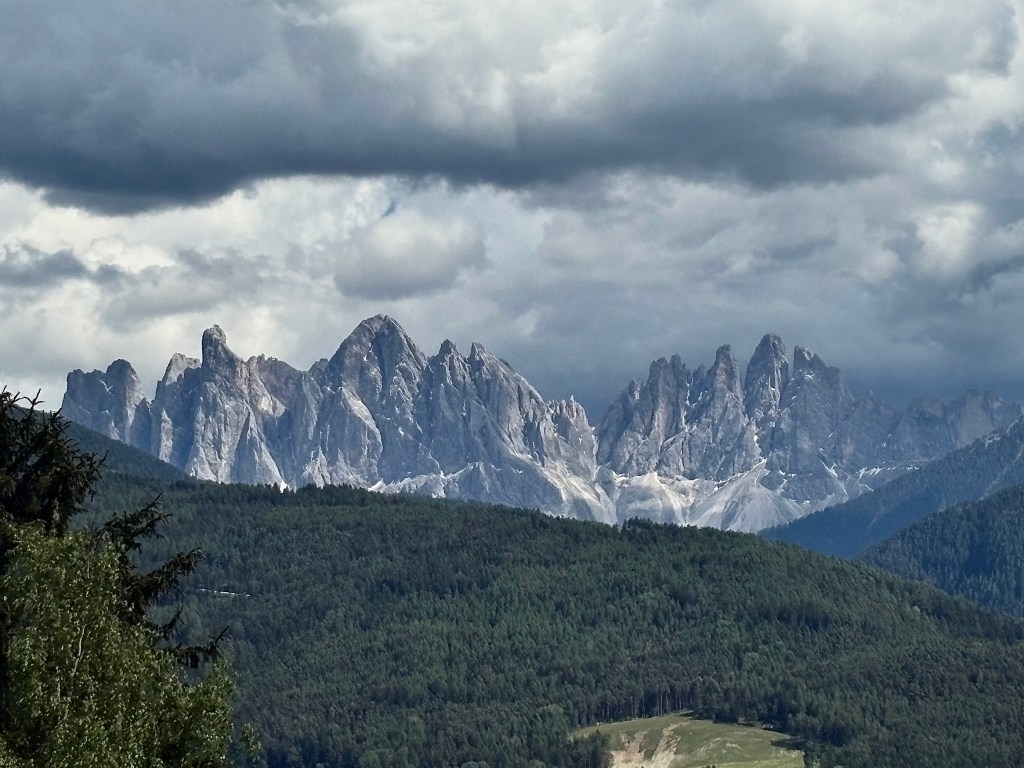
We were at Velturno, our destination, when they looked like this, and I was tired and sore. We’d had a big climb and walked a bit further than we meant to. This storm arrived 30 minutes after we did and it was a powerhouse. I slept very soundly and woke feeling considerably better. Breakfast was excellent and we started early. The morning turned out to be a relatively easy stroll down into Chiusa/ Klausen.
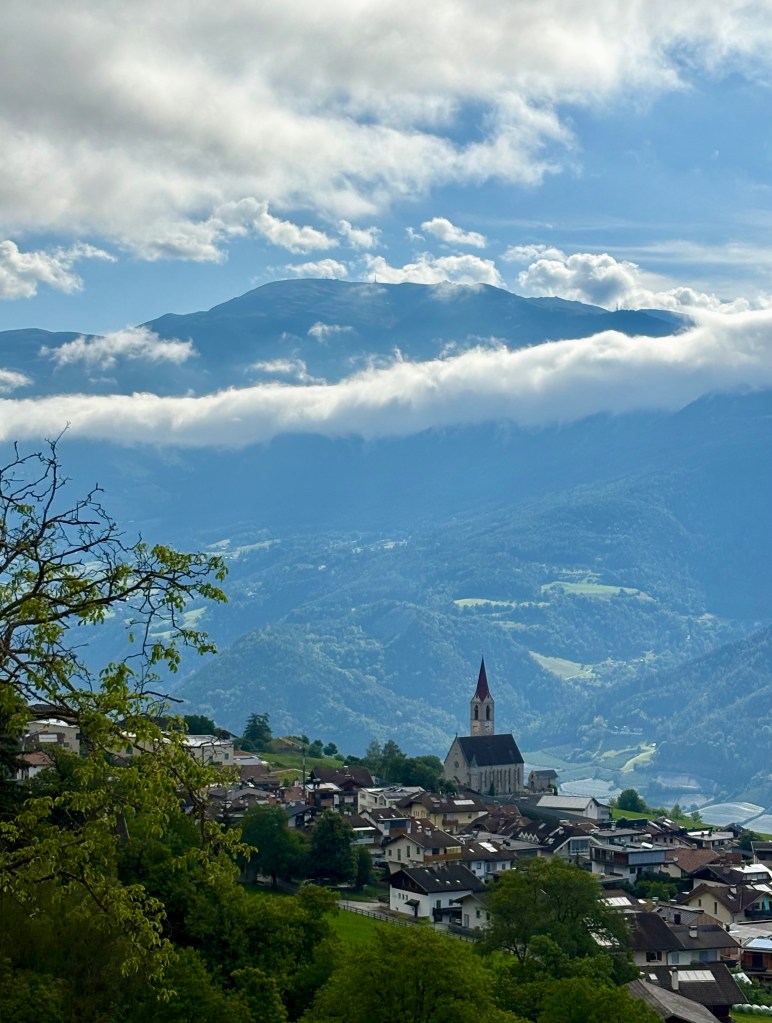
Looks easy — and attractive— doesn’t it.
That’s Chiusa down there …
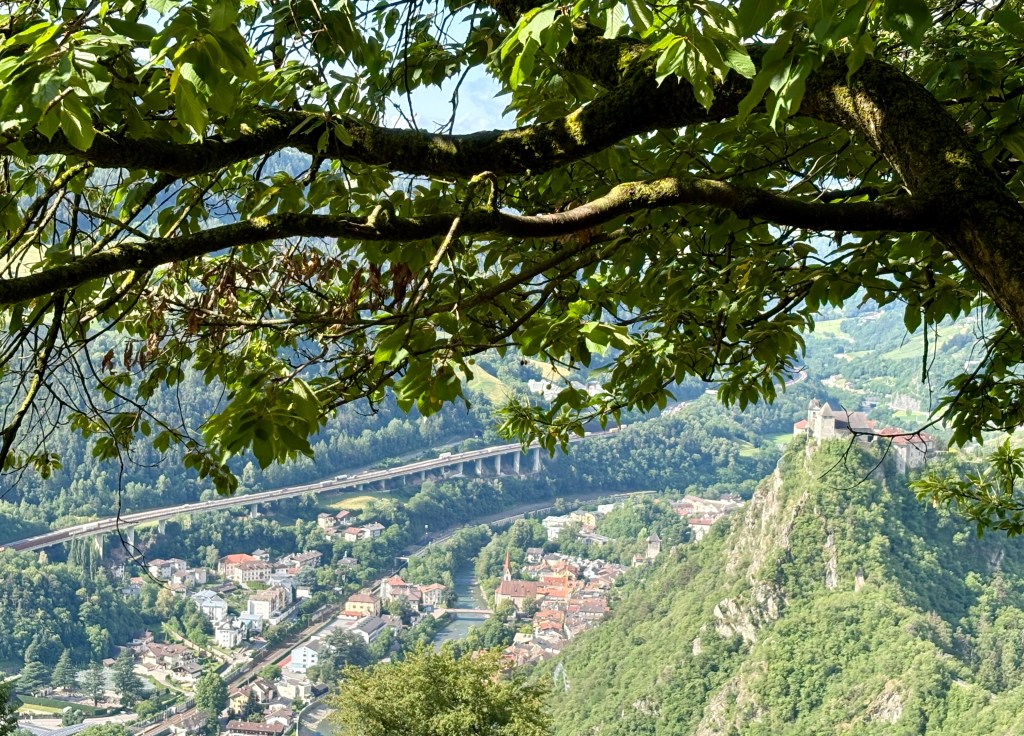
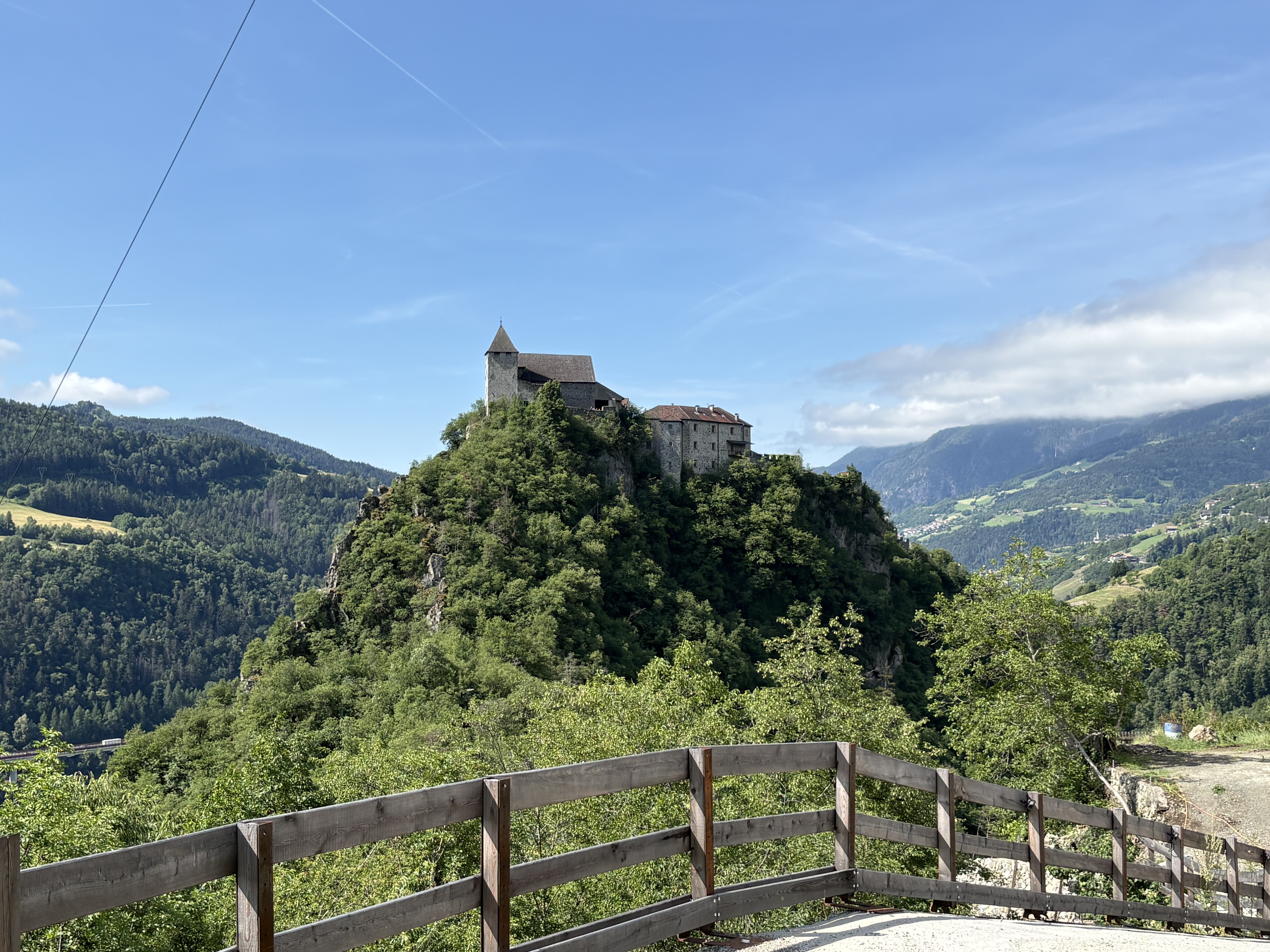
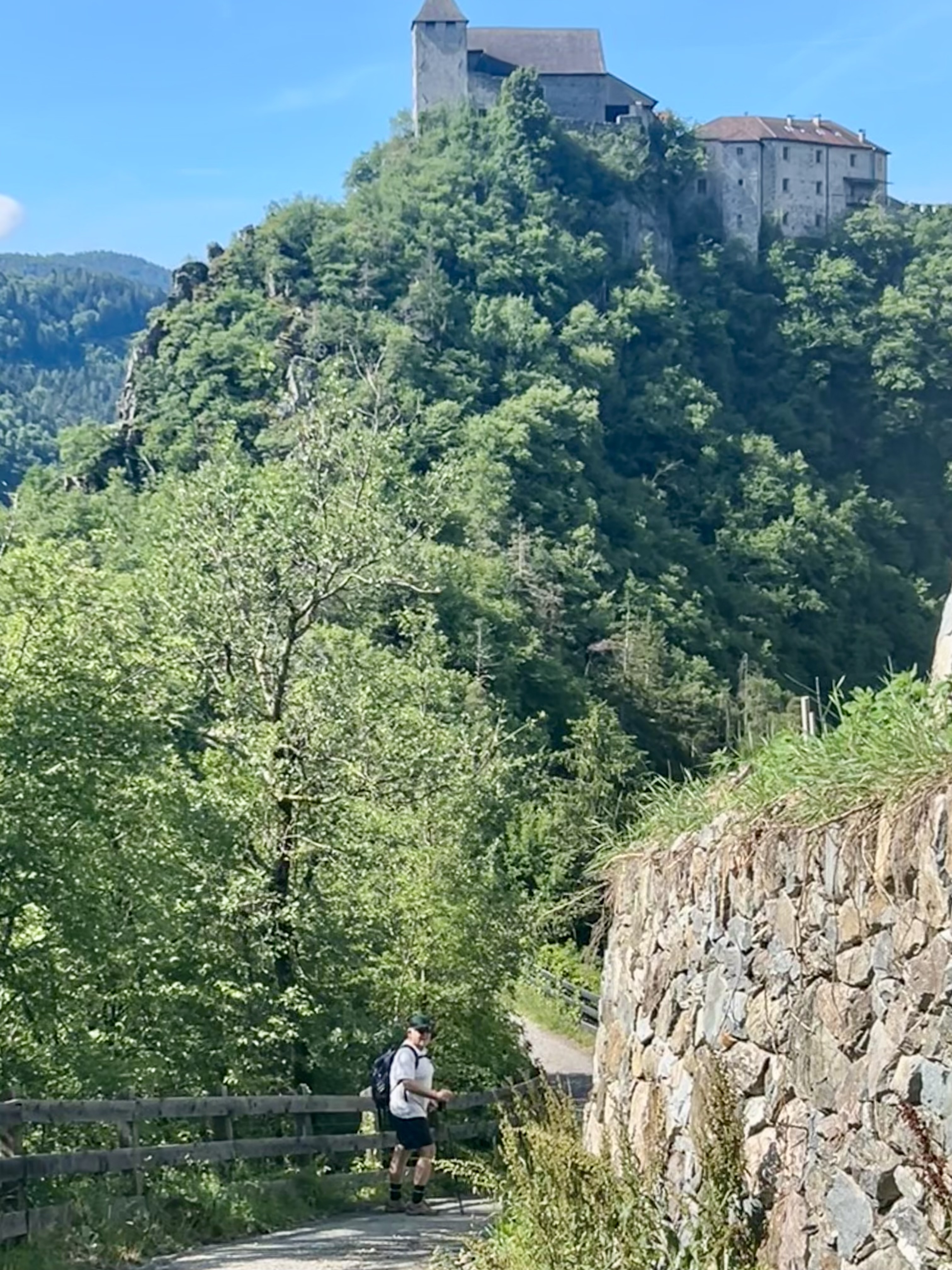
and that church and abbey on the protuberance (the Monastry of Sabiona) kept dodging around our sightlines.
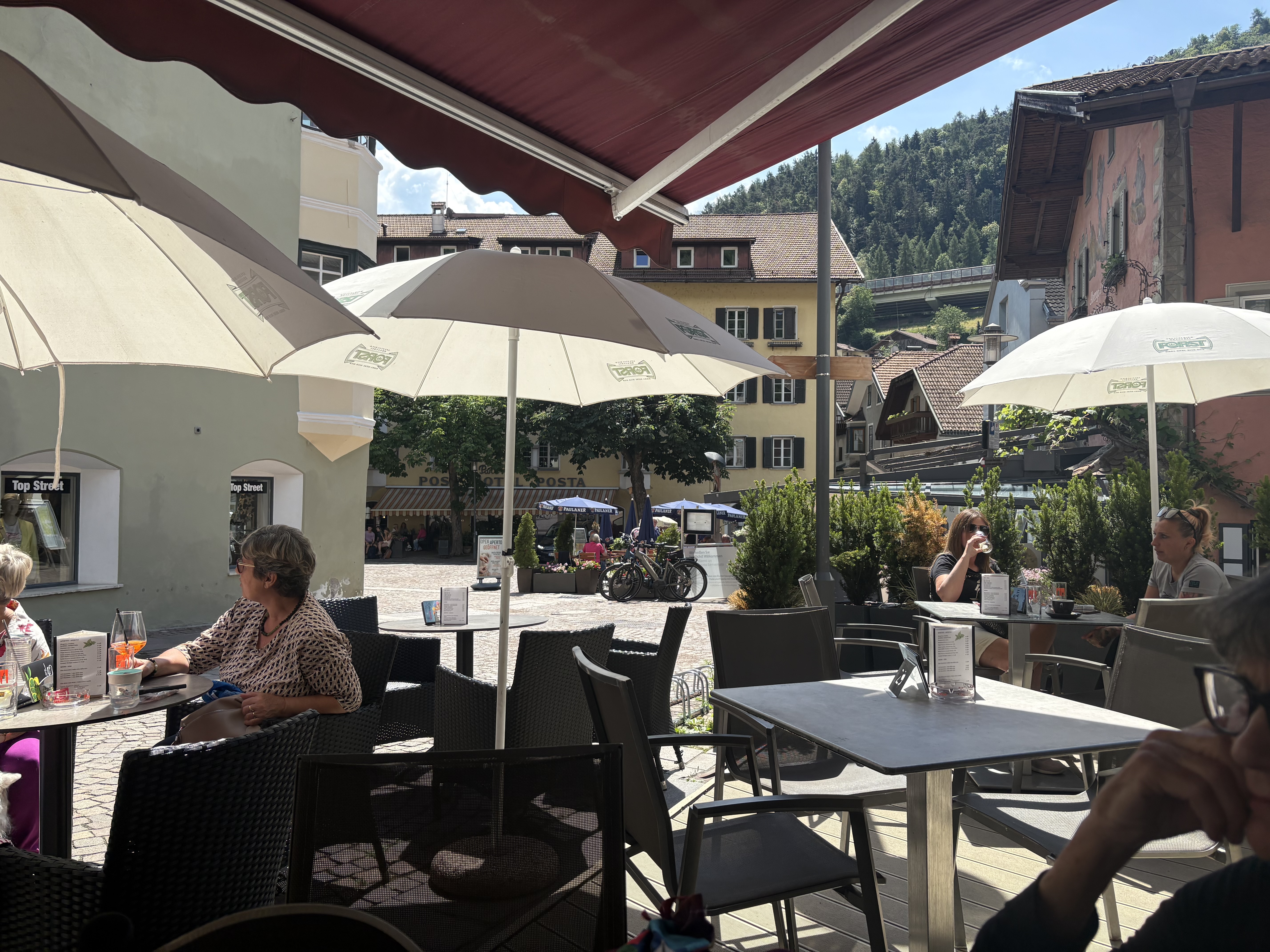
As suggested pictorially we found some good coffee and food.
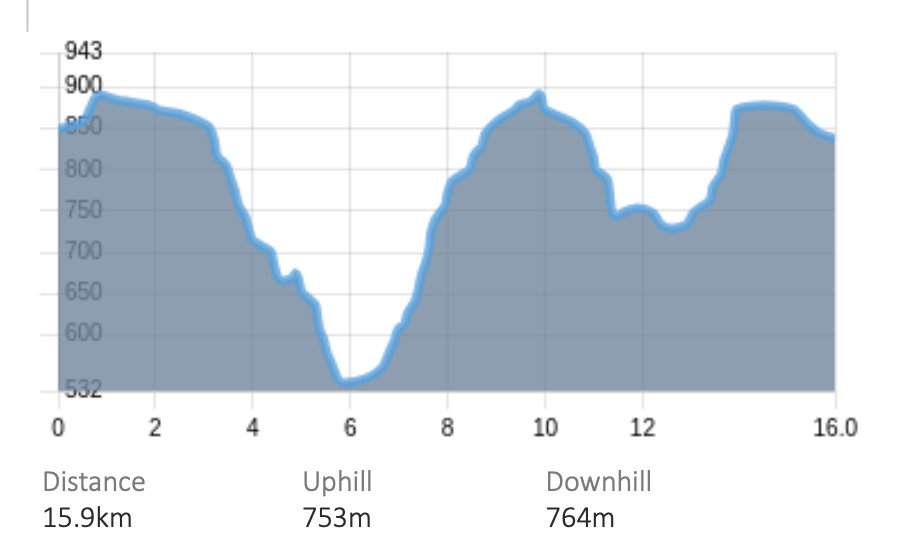
But then, of course, we had to get up again.
We took an option to cheat slightly, ie to avoid the 75 degree slope and instead take, as it turned out, the 65 degree slope. ‘BIG climbs and not much respite’, my diary says. We did find the chap jumping off the roof.
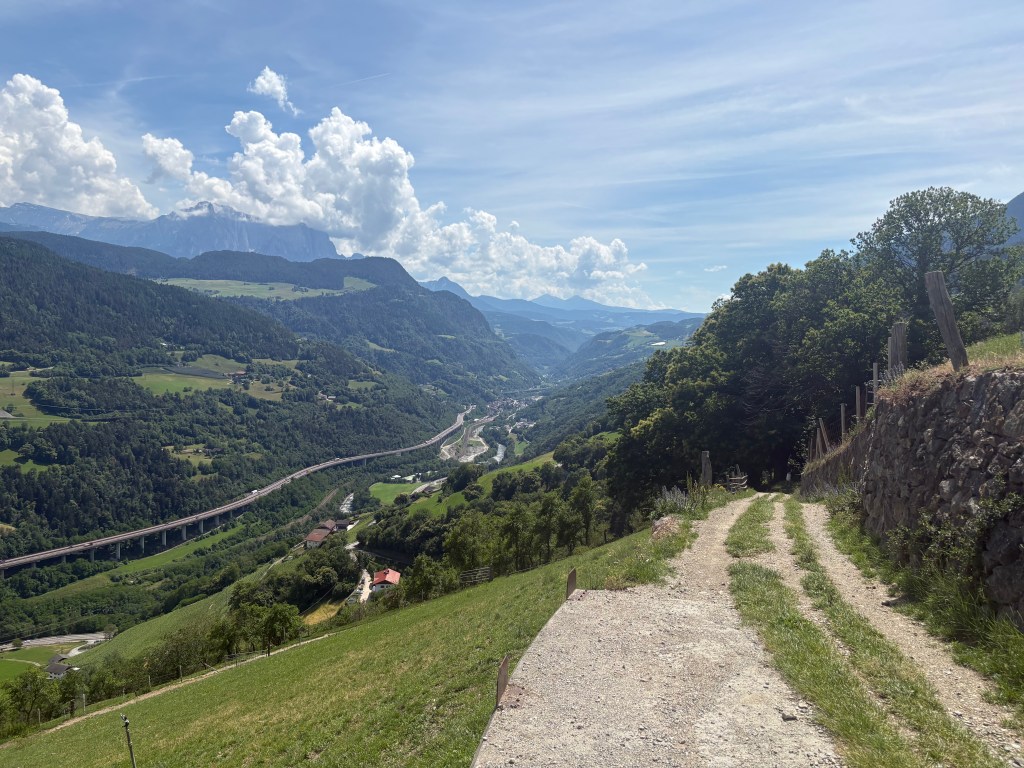
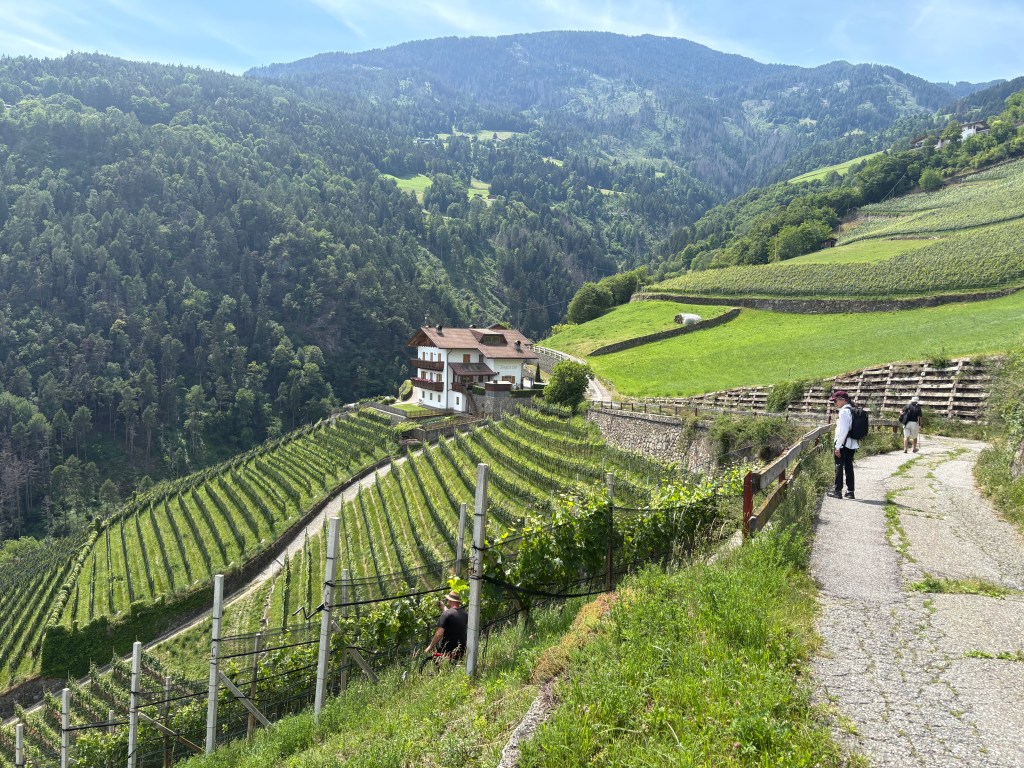
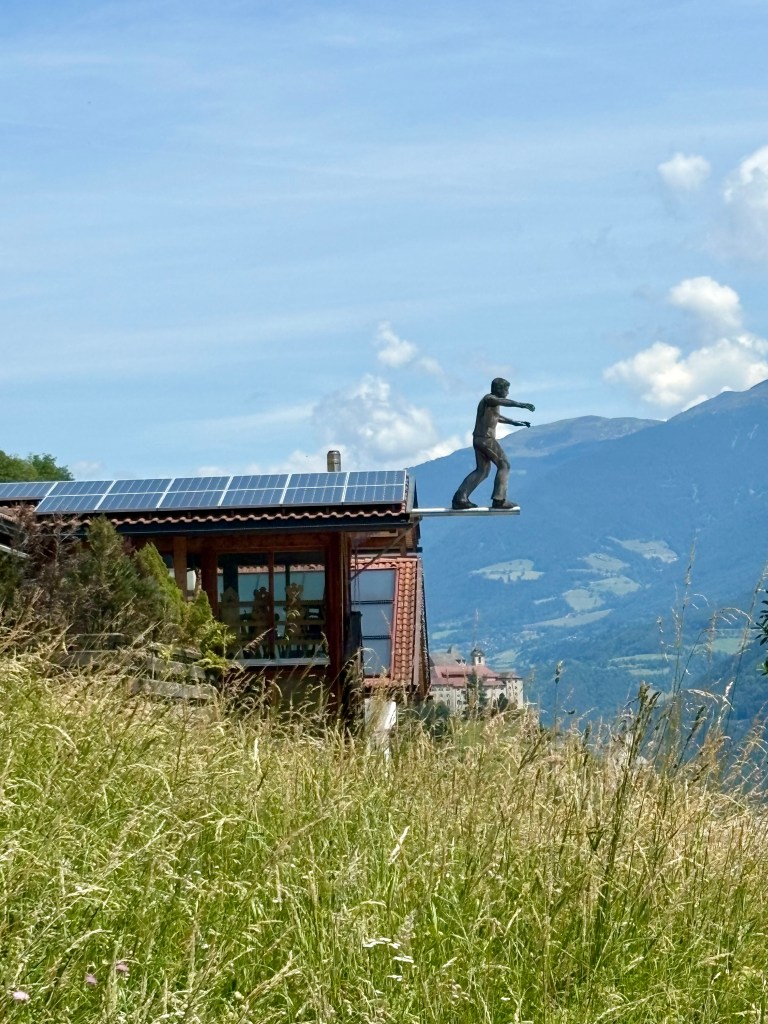
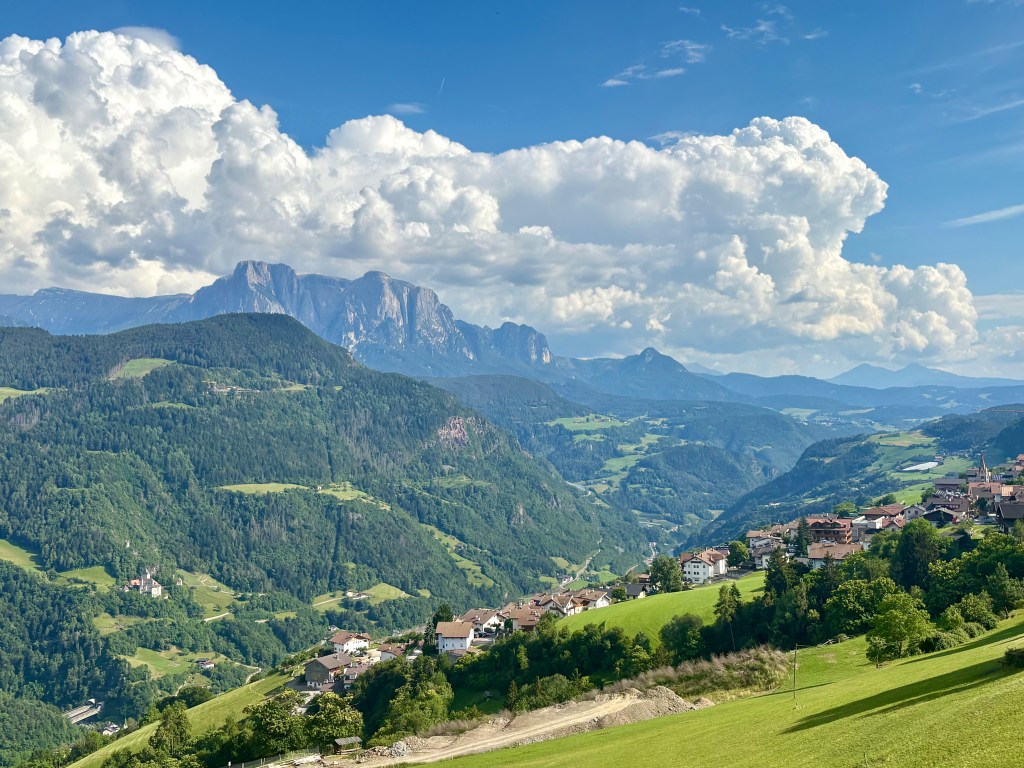
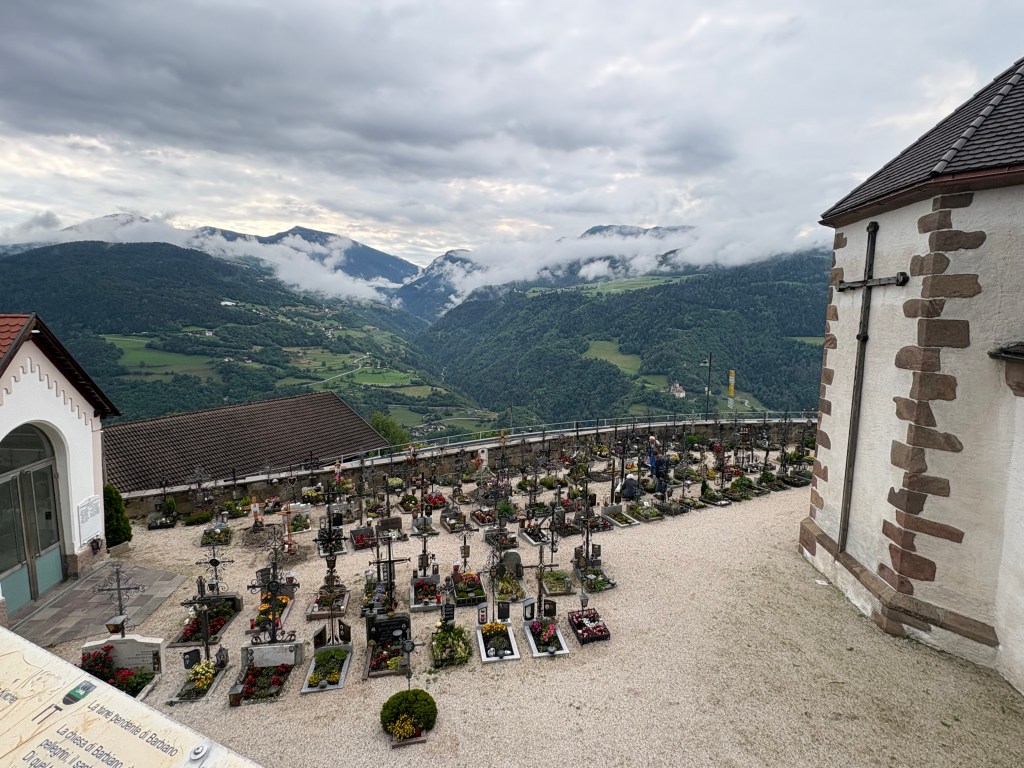
Above is Barbiano, where once again we walked past our destination, a character-full pub with character-full staff which didn’t seem likely as we tottered past (that’s me; the others were striding personfully as usual) on what passes for a main road just here.
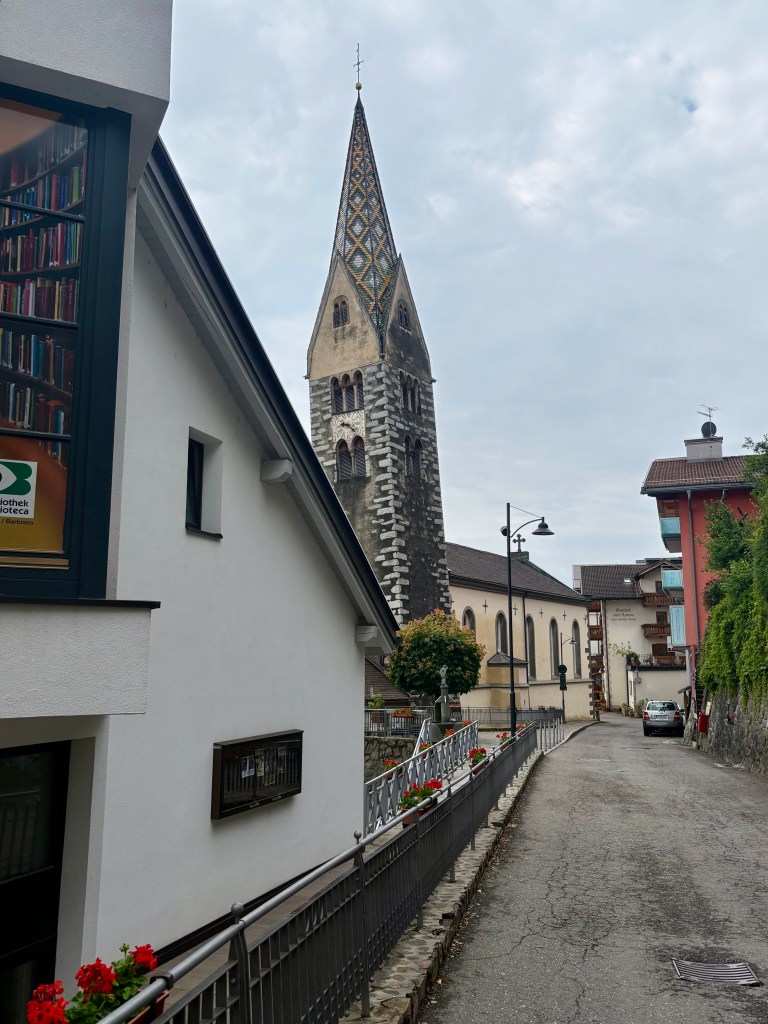
Barbiano is famous for its leaning church tower, now stabilised we are assured.
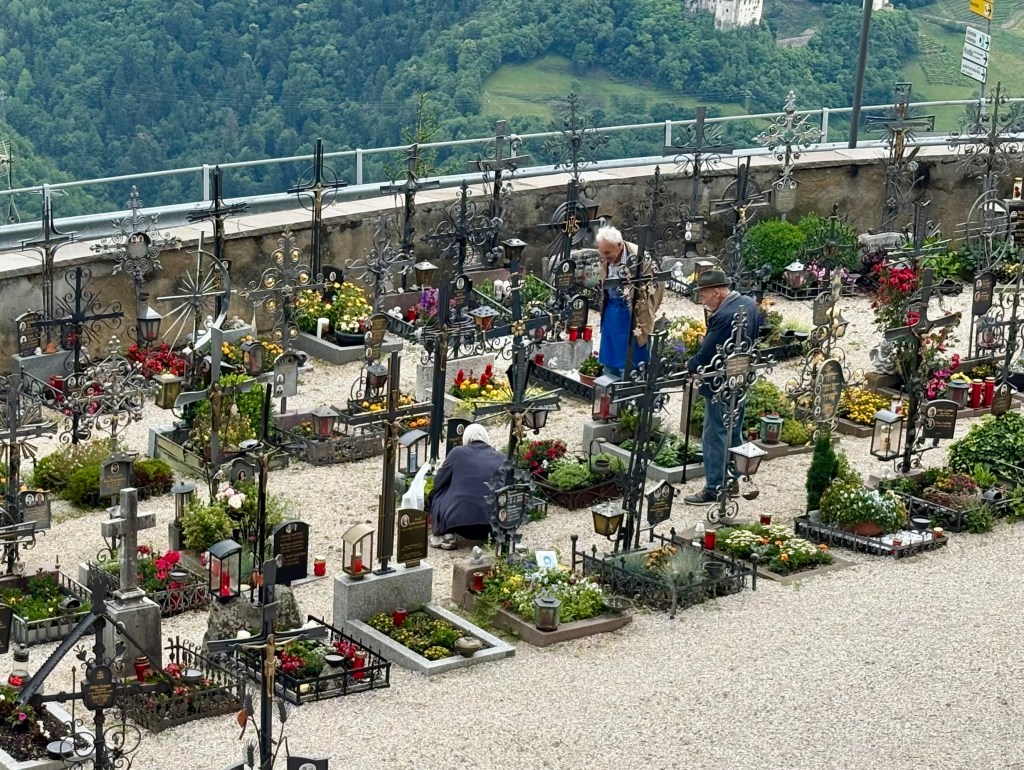
I found the cemetery which adjoined it just as interesting if not more so.
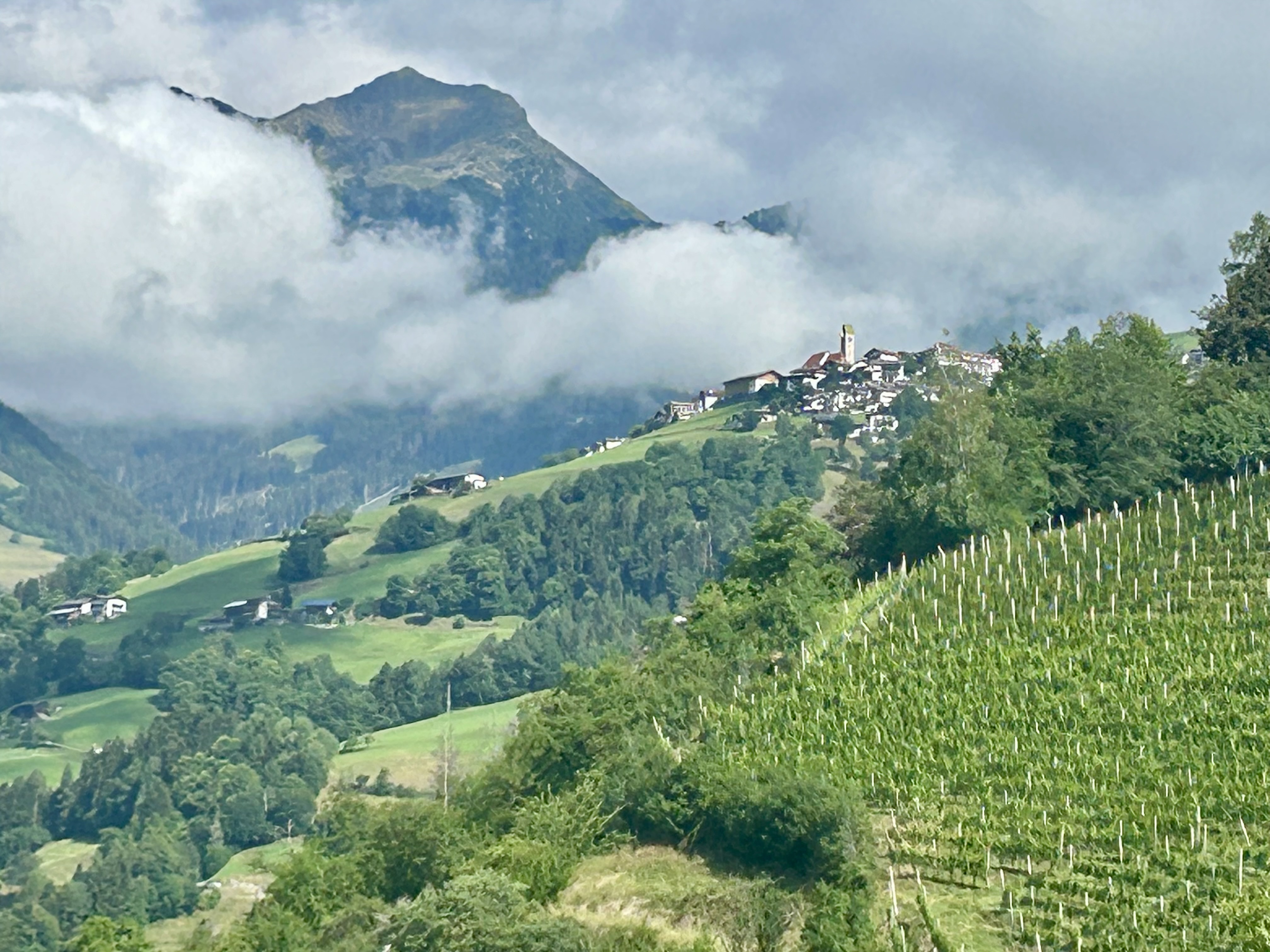
Drawing back a little, we look up the valley of an unidentified watercourse which joins the Isarco/ Eisack 1200m below us at Waldbruck. It’s hard to see but the valley on the other side is dotted with habitation, including a ‘town’ on the edge of the upper green flat bit on the right. What do they do in these places? What’s life like? In the latter case how do you even get there? There would be answers, and they mightn’t even be surprising.
My journal reminds me that I was a bit sick that night. I hadn’t eaten much, it had been hot and a very big climb. I thought I might have had mild heat stroke. The symptoms were about right. But, maybe a virus. Possibly just worn out. Whatever, I wasn’t sure about continuing the next day. There was always the option of going with our luggage which was collected and moved on every day, part of the deal with the company we went with. (I had completely forgotten all this. We protect ourselves from our infirmities don’t we.)
My journal also says, next day: ‘Felt a bit better, a lot better really, first thing, and it was a pretty easy start on a flat road for the first five. We found a good Despar (supermarket) and a bakery, and the first five were pretty easy. And I’ve just written that twice which indicates how well I am.’
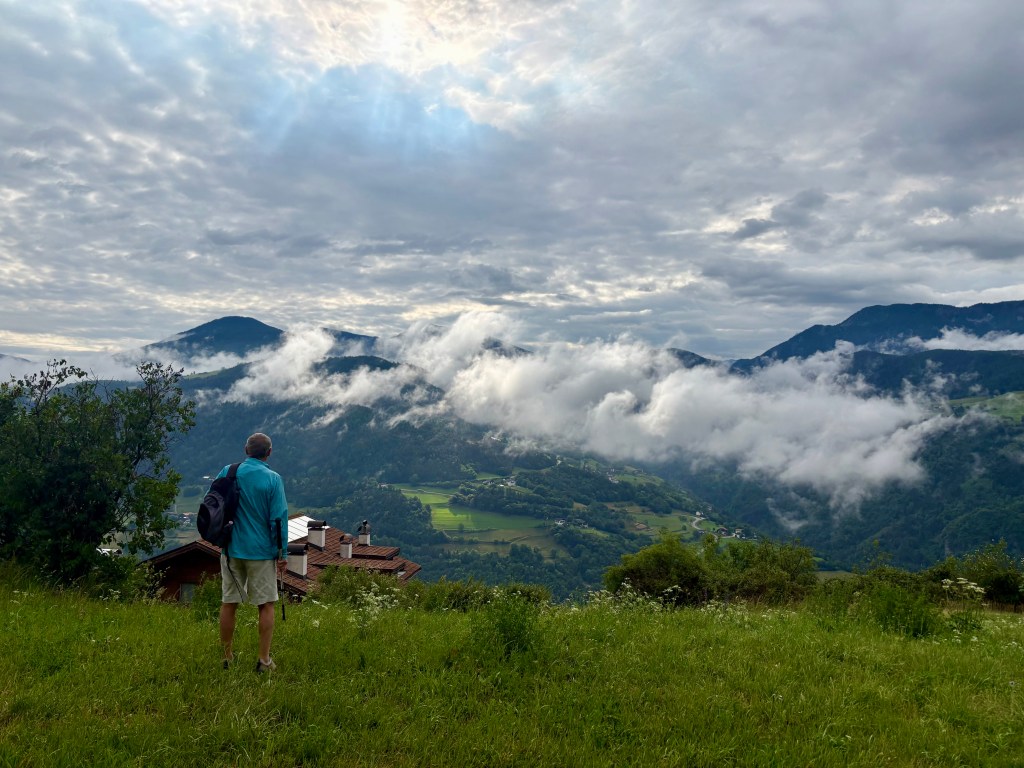
We got going. (This is just as well. This was a great day of walking.) The first five were pretty easy. Or have I mentioned that?
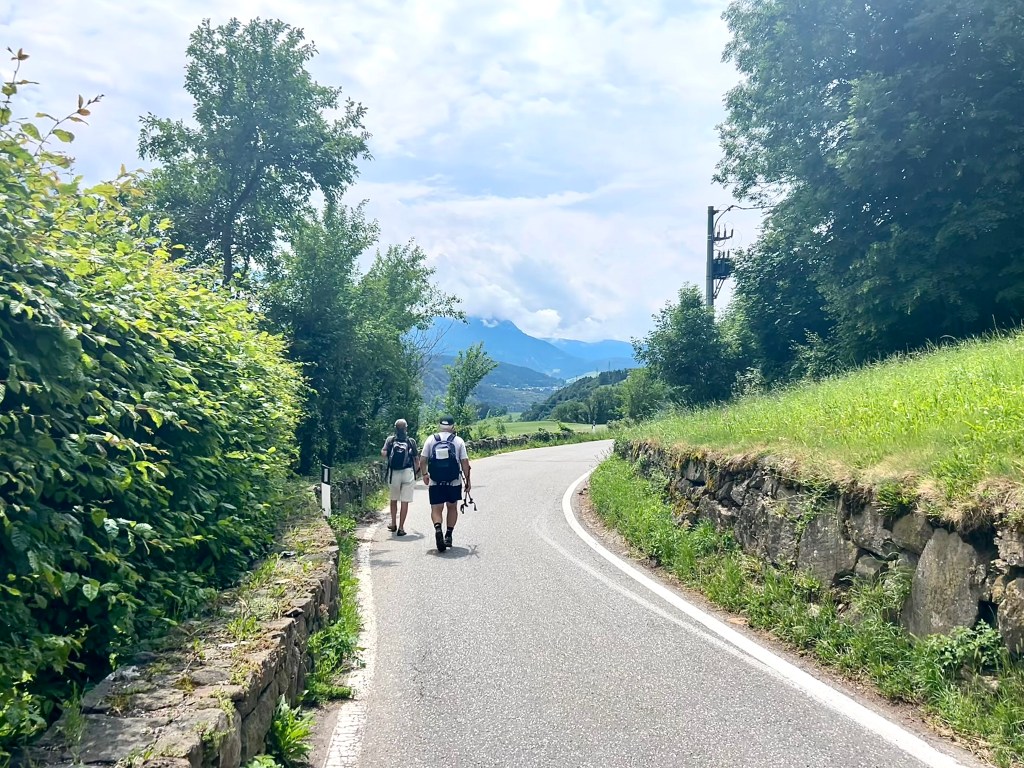
The same glorious views.
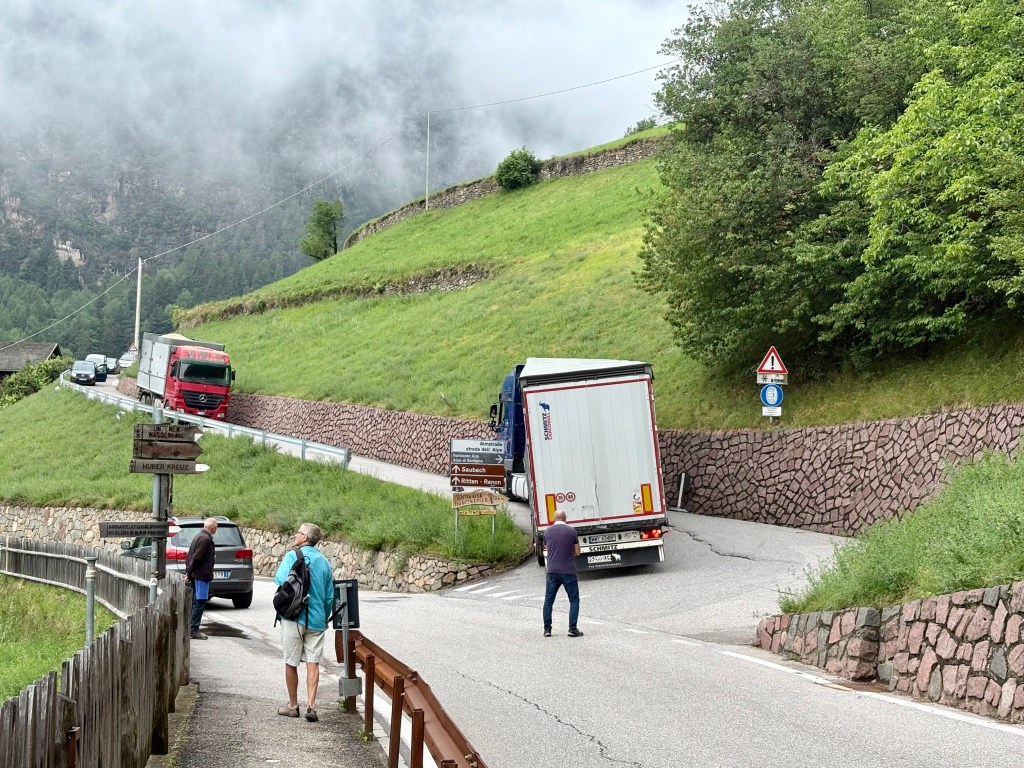
I was planning to get from Bolzano to Venice by driving on backroads. This incident helped to change my mind. The roads were as narrow as they look. The truck had NO chance of getting to where it was pointed. The line of traffic above was probably about 200m long. These issues were more general. We had a 20-minute bus ride at the end of this day, full size bus, and that too was an experience.
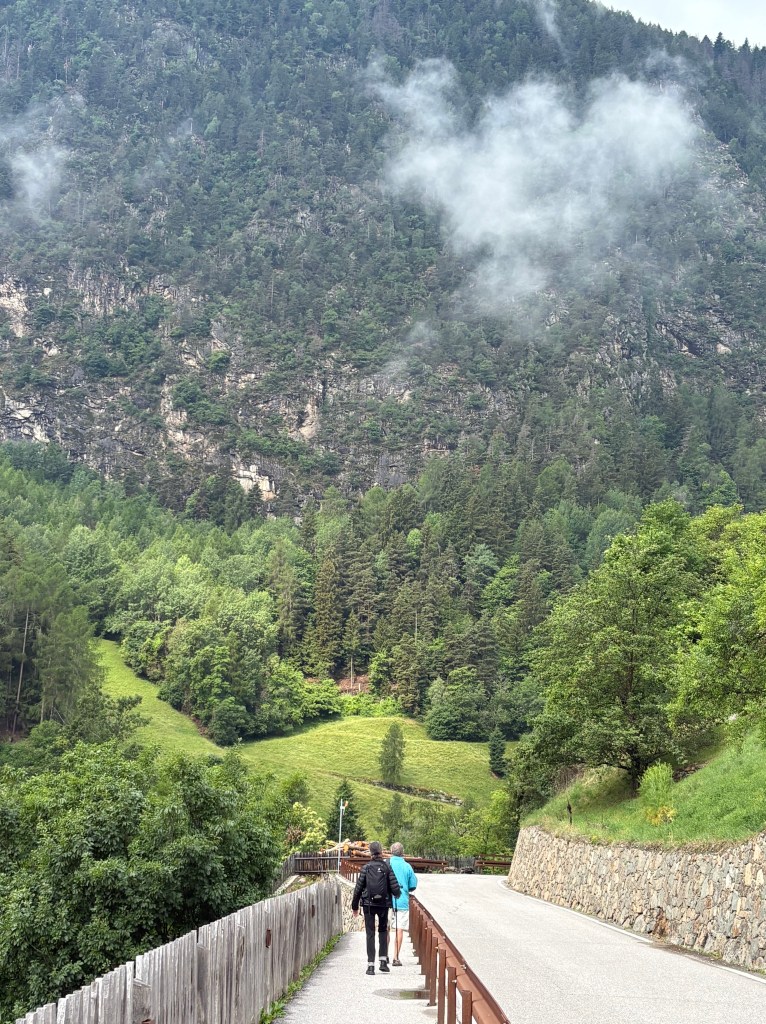
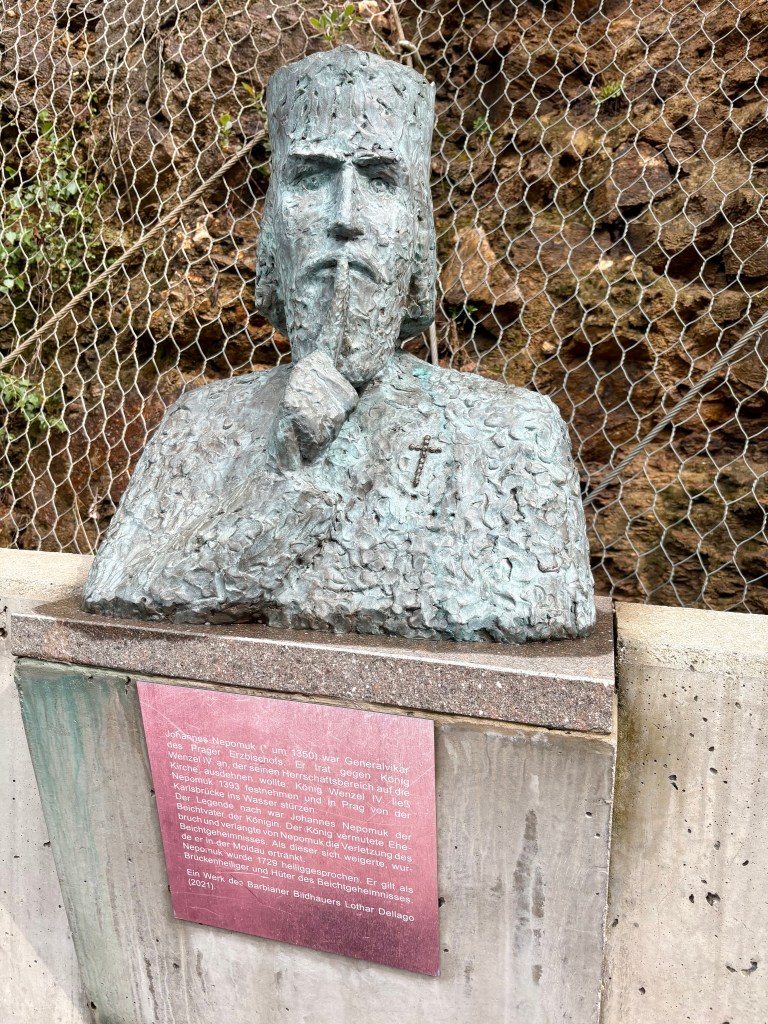
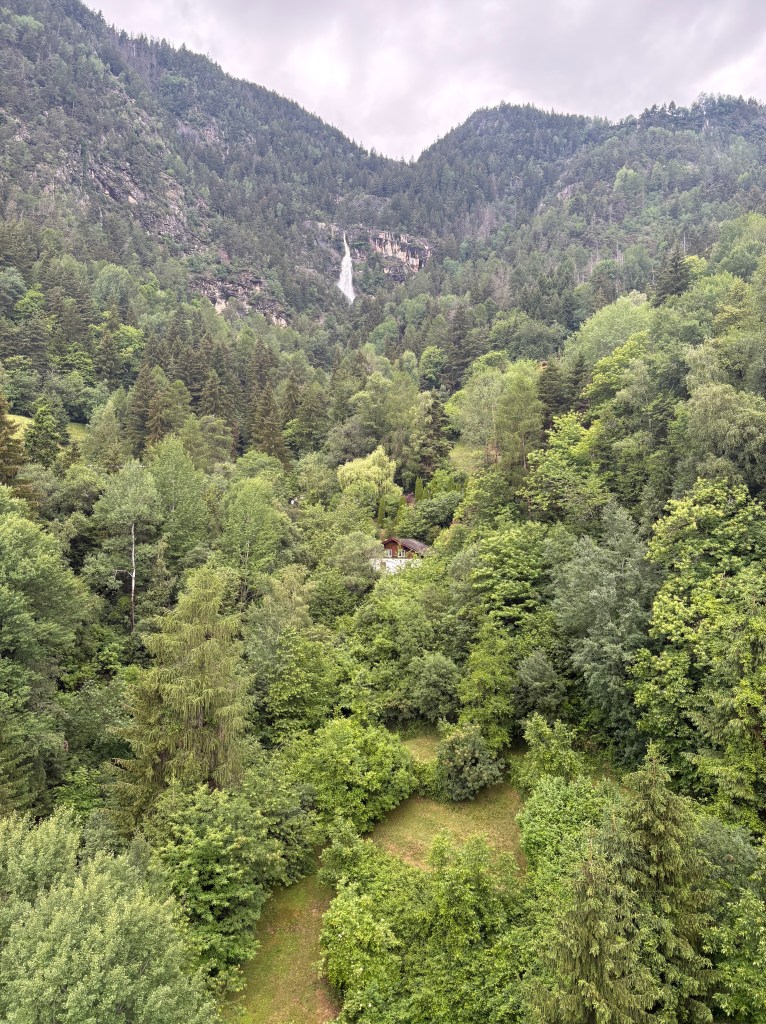
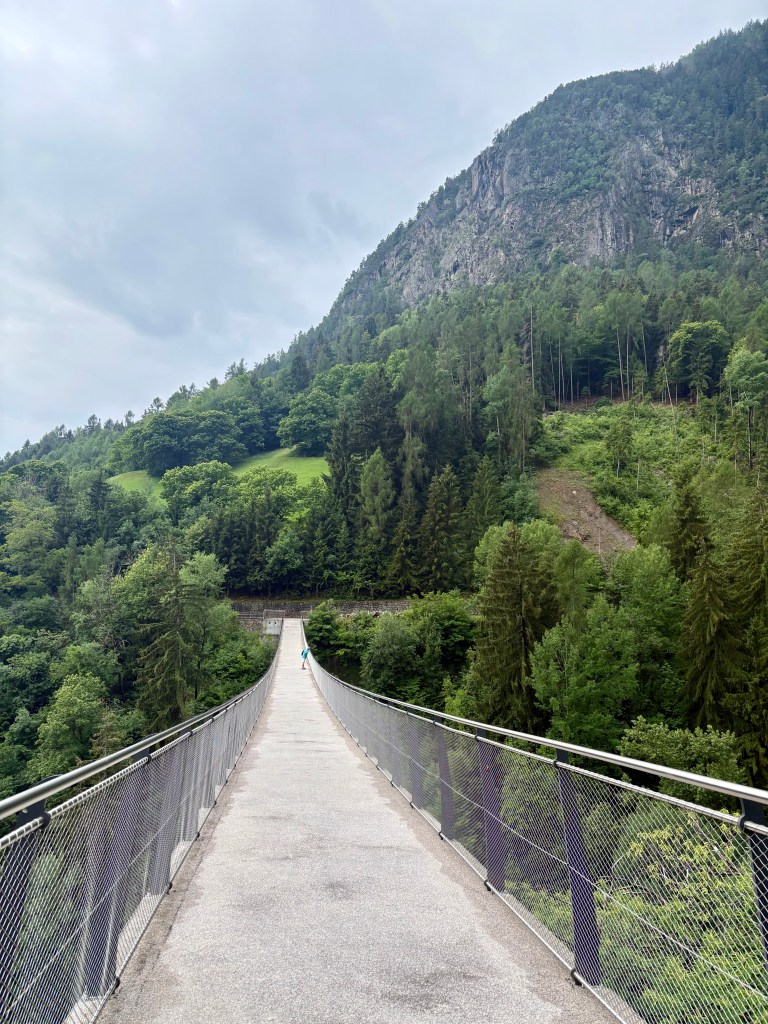
We found the chap with his finger to his lips where I’m standing to take the big photo. An oddity. According to the plaque, this is John Nepomuck, Vicar General to the Archbishop of Prague. In 1393 (! Life has a long tail here.) he defied King Wenceslaus IV when the King suspected his wife of adultery and demanded that Nepomuk break the seal of confession. When Nepomuck refused, he was thrown from the Charles Bridge and drowned in the Vltava. As a result (is that what we say? In consequence? As it happened …?) in 1729 he was canonized. He is considered the patron saint of bridges and the guardian of the seal of confession. (How about the word Beichgeheimnisses, ‘confession’. Don’t you love German?) This would be an excellent place to toss someone off a bridge if you wanted to get rid of them, but one among many others on this walk. This doesn’t look anything like the Vlatva 700kms and a world away, but it’s a pilgrimage, so the licence for inclusion may be expansive.
The top of the cliff on the other side is our immediate destination on our way to a lookout which was surmounted by the chapel pictured below. How people get there I do not know. Ah yes, it’s a pilgrimage. I’d forgotten.
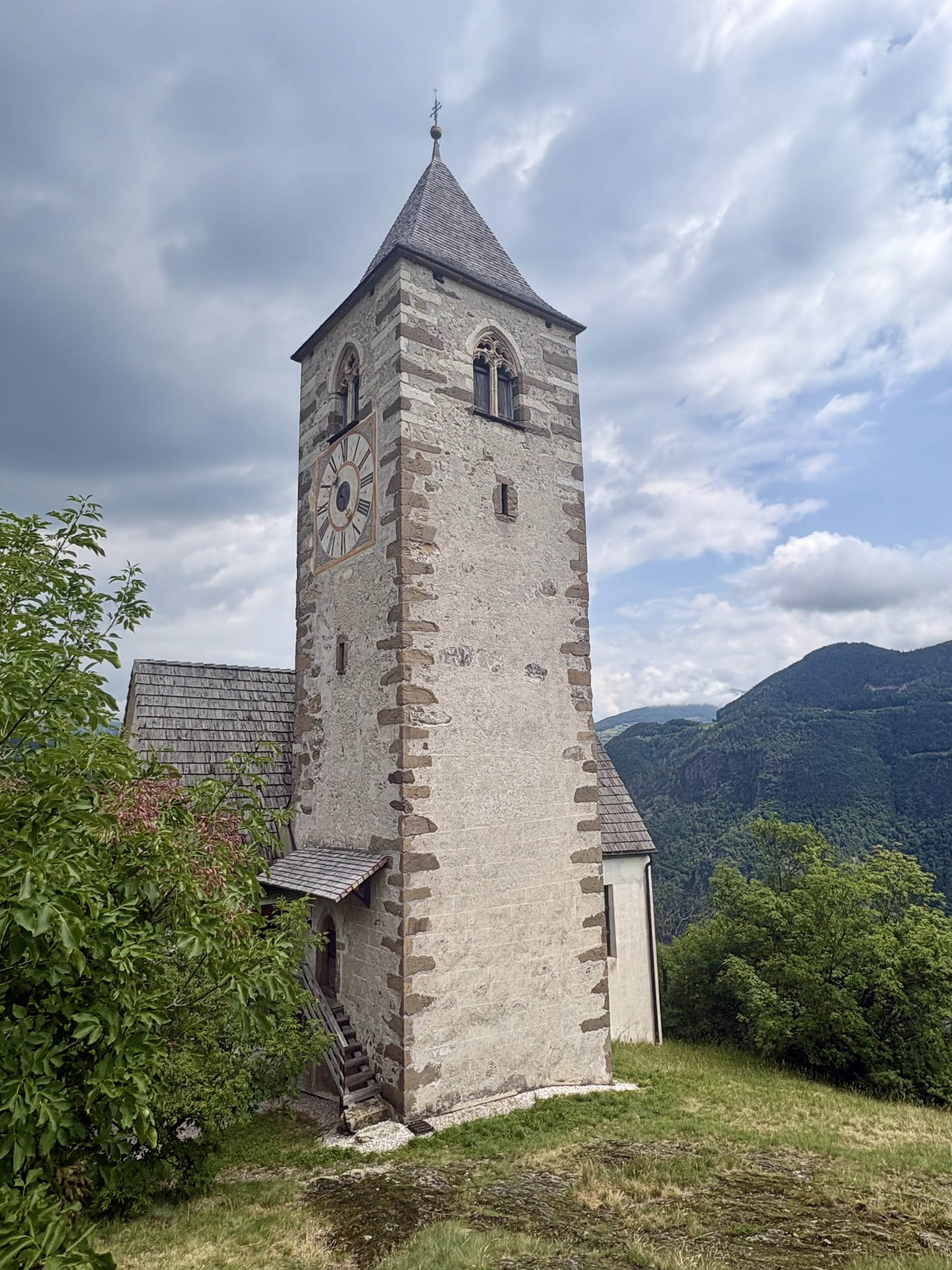
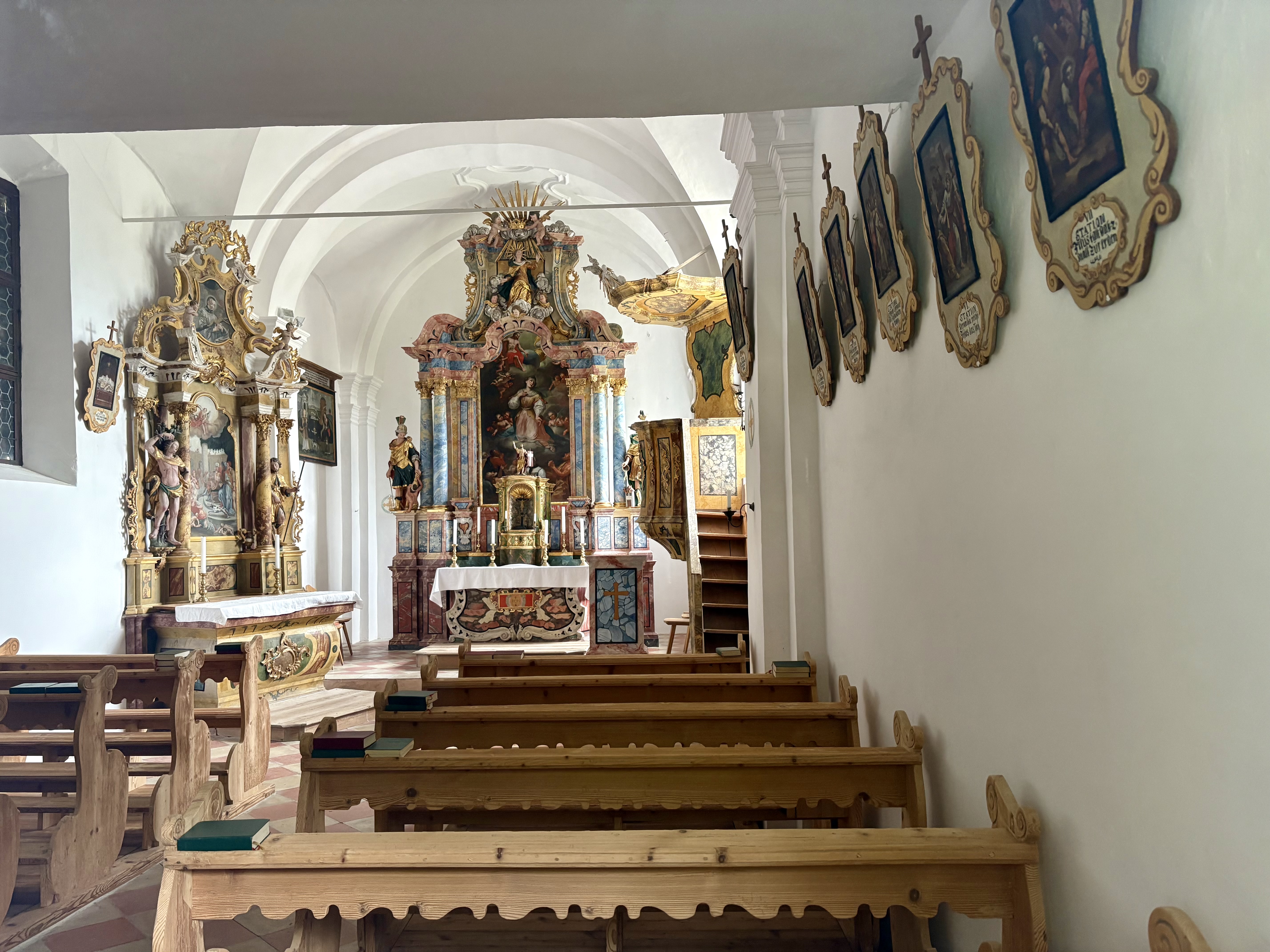
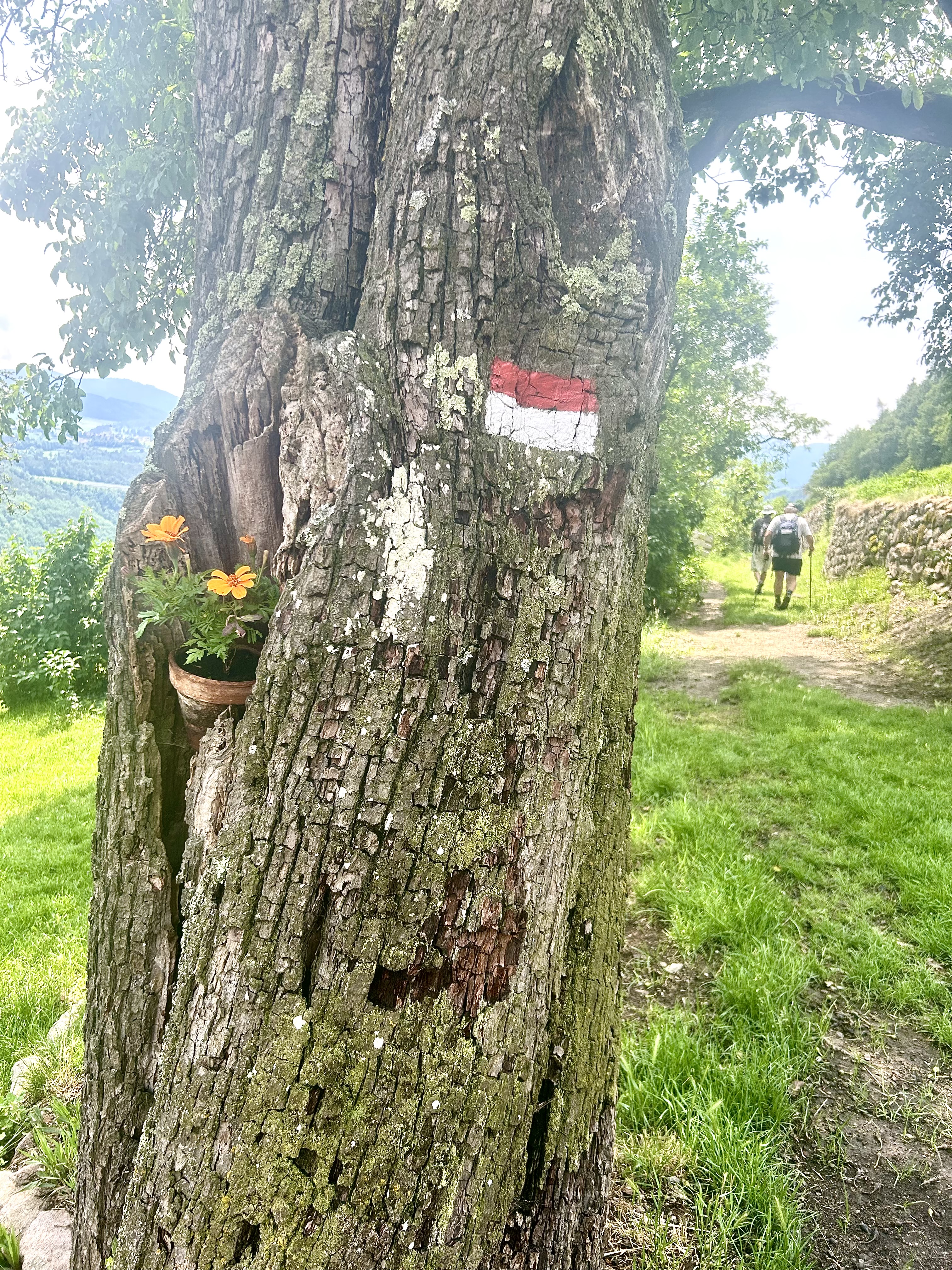
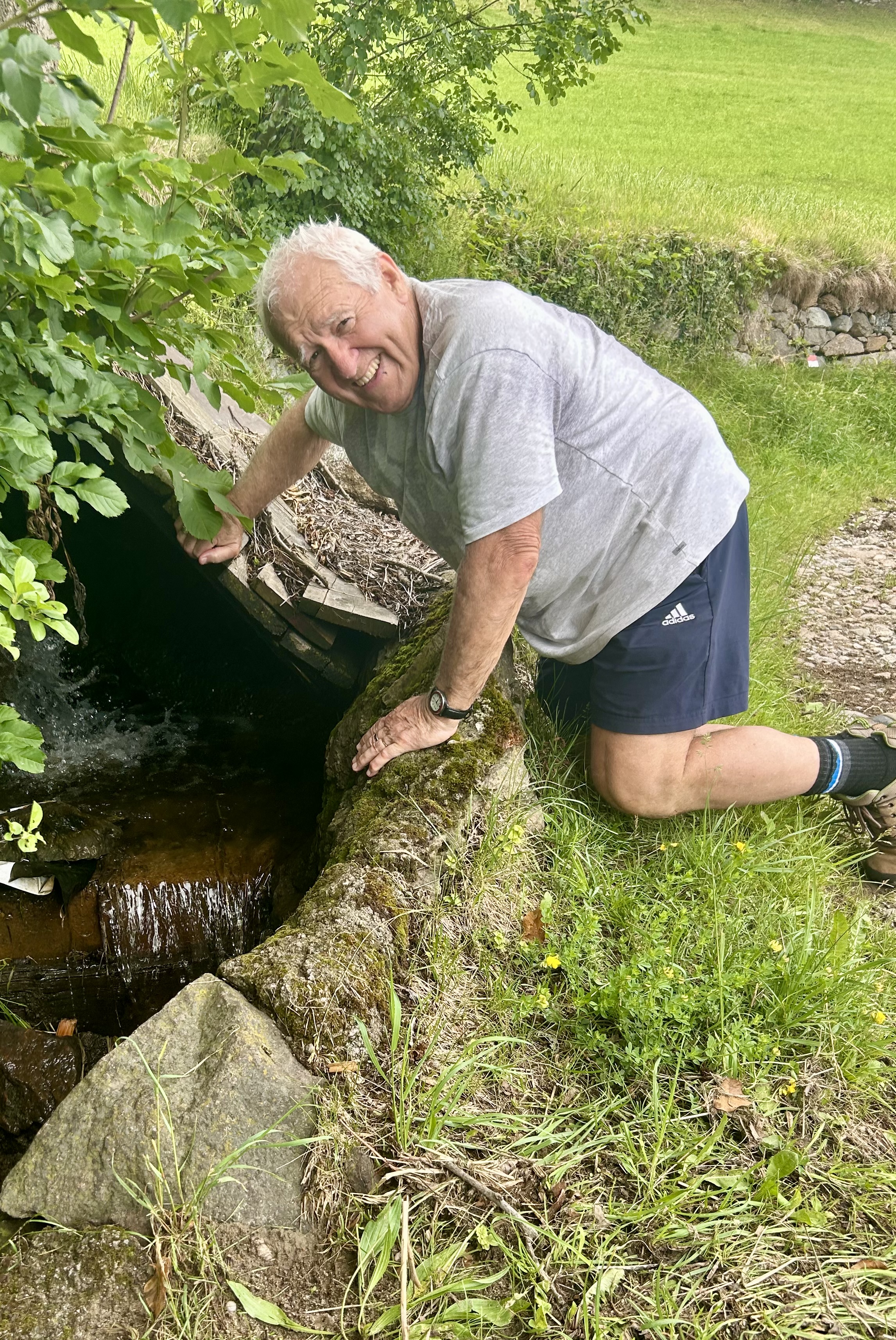
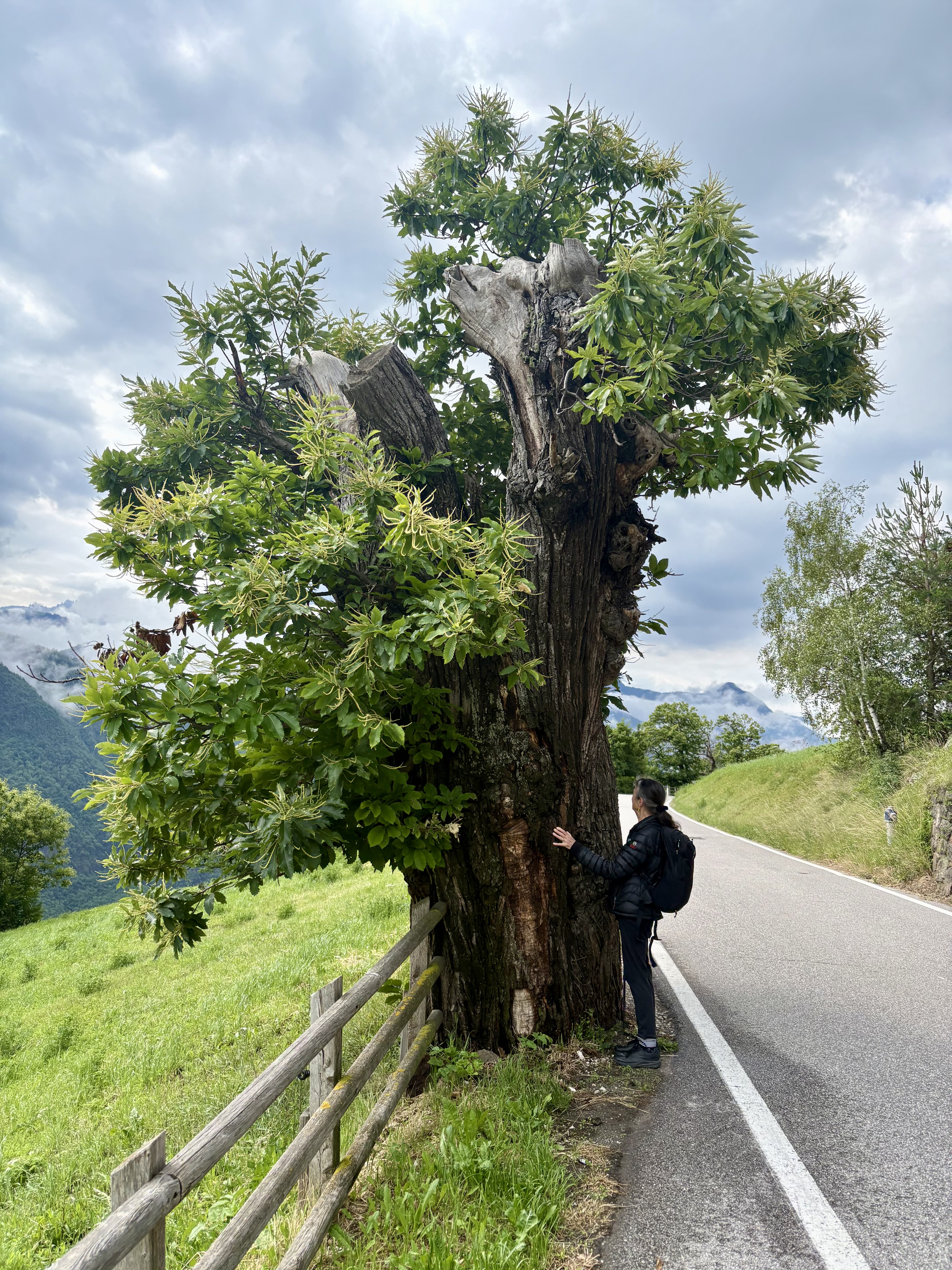
It was another hot day. I was very glad to find this spring, a saving grace for a time. The red-and-white waymark, and a heavily pollarded ancient chestnut to which Myrna took a fancy.
AND, I’d forgotten this too. There was a shortcut after about 12 kilometres which would take us up to Lengstein and a stop for a bus that would take us to our final destination. That way we would avoid a very nasty 3 kilometre climb, and we’d had a big day.
We found the access turnoff point okay, or at least I think we did. I knew where we were and where we were headed, but perhaps in the broad sense.
We began with a climb that was almost as bad as the other track promised. Nonetheless the right corners appeared. It looked a bit like a plausible track and we got into an open paddock that inspired confidence but provided a series of options. (Ah laugh.) I chose one and we ploughed along it for about a kilometre before coming to an unassailable fence. I knew where we were don’t you worry. Precisely. But where we were suggested a 90-degree right turn up through — the journal says, jungle. It wasn’t jungle. Hyperbole. But it was very steep and there weren’t any tracks and it was you might say heavily forested. We could have gone back but that would have rather defeated the idea of the short cut. Myrna decided she would forge on ahead to find a way leaving the men to dither. Anyway, despite a certain degree of frazzlement, it turned out. Adventure!! We got to the bus stop. The bus arrived, even though the driver wasn’t going to drive any further for 40 minutes. Timetabled requirements. He enjoyed several smokes while we drank in the alpine air.
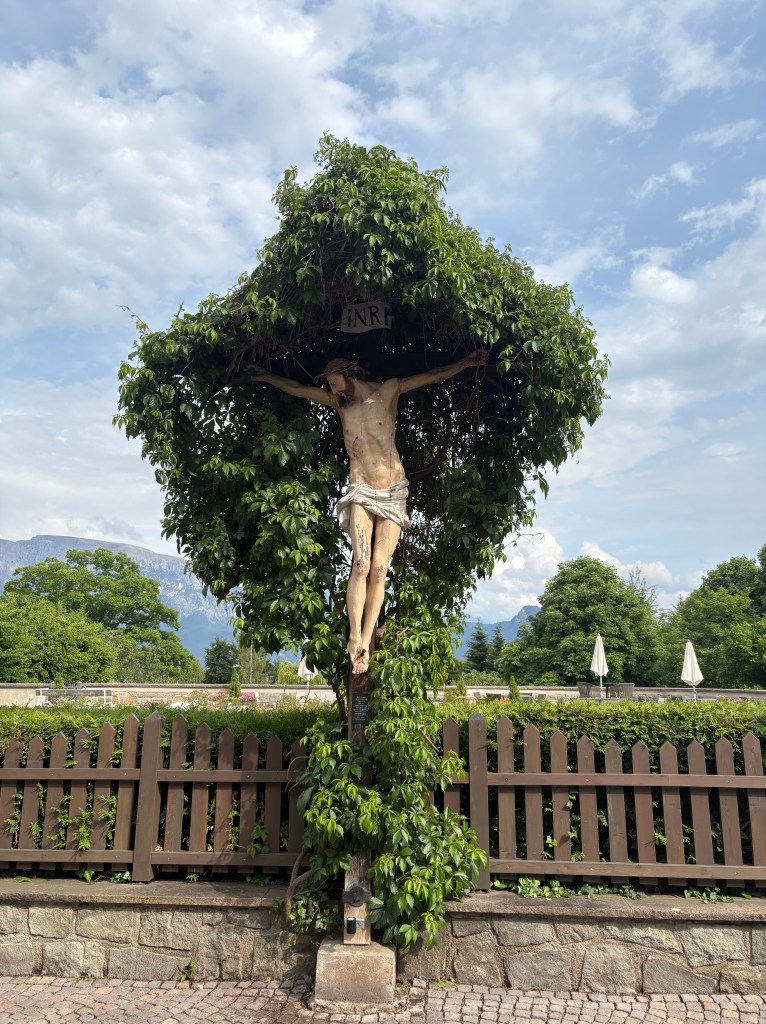
I’m sure I was forgiven. Eventually.
On arrival, the dominant feature of the viewing terrace for tourists at Collalbo. (‘Klobenstein’ doesn’t do such a lovely place justice.) And a mere gesture at our excellent hotel.
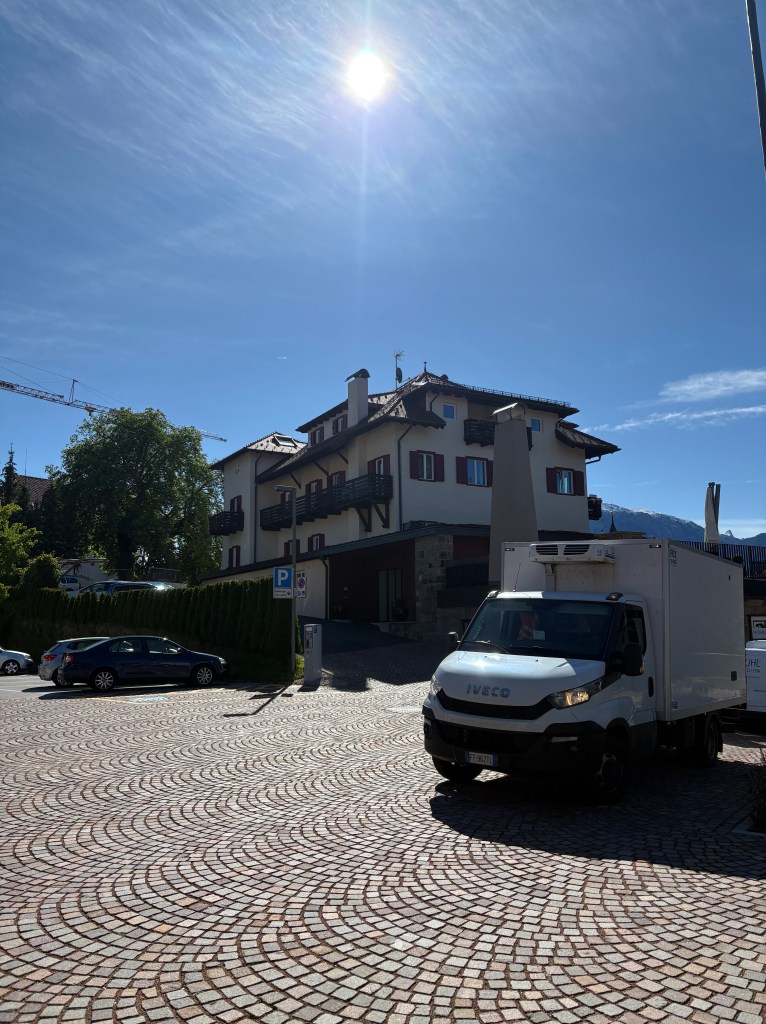
The clouds were gathering.
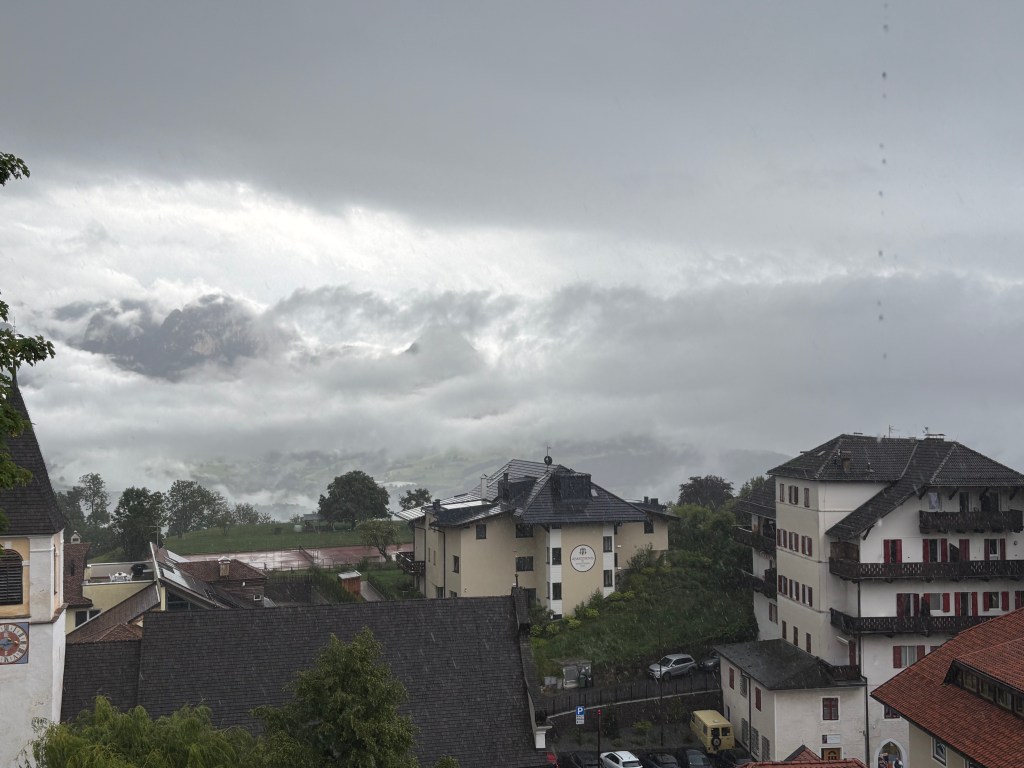
We’d known about the advent of this day, the fourth day, and its weather for a fortnight, becoming ever more certain as it came closer. And it didn’t disappoint. It pissed down. All day. Graphic, strong, unrelenting.
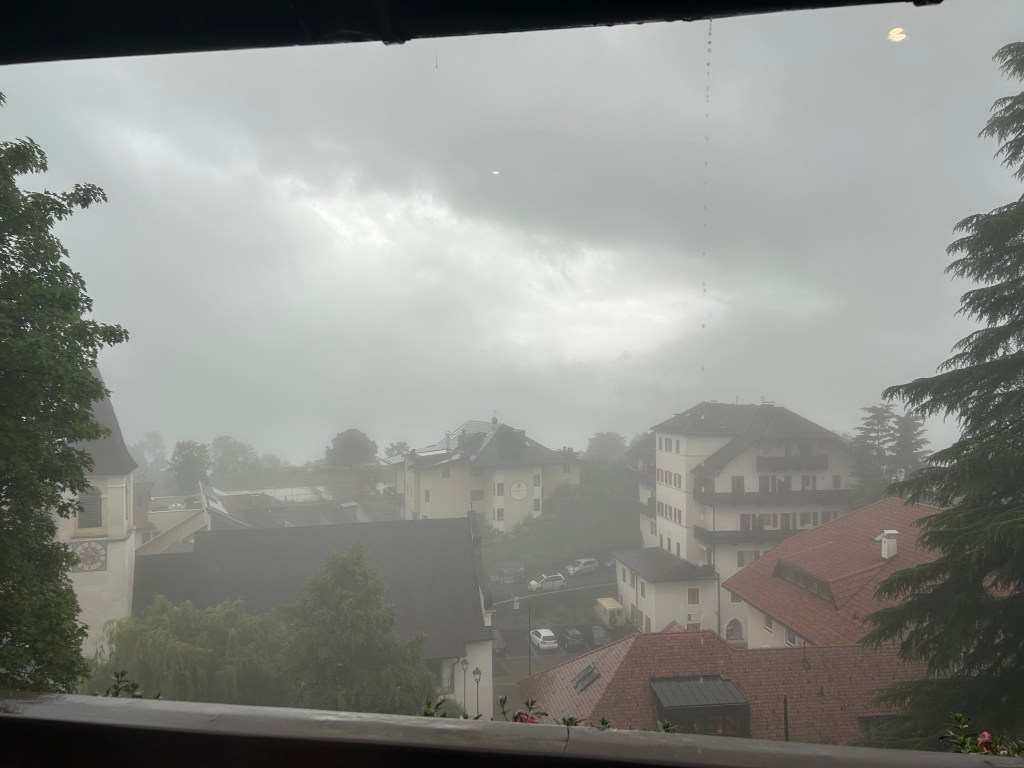
Myrna and Michael, separately, got their umbrellas and wet weather gear out and went wandering. I didn’t. I stayed in bed, cancelled our hire car, bought train tickets, attended to correspondence. (John G.: That’s where the surgical pictures arrived. Marge: the news that you’d arrived in an Emergency Department in foreign climes.) I also dozed and slept. We were in the best hotel of this collection. The food was amazing. We had a very comfortable room from which I am taking these pictures. The day was intended as a there-and-back which didn’t sound like it couldn’t be missed, so two consecutive nights in the same place. How lucky is all of that! And I felt the pain in my leg like a permanent cramp diminishing. Party time. Very watchable athletics were on the telly. In a tourist shop Michael found a plausible power connector the absence of which had been annoying him since he left his behind in Innsbruck. Any problems melted away. AND I developed a cunning alternative way to get to Bolzano.
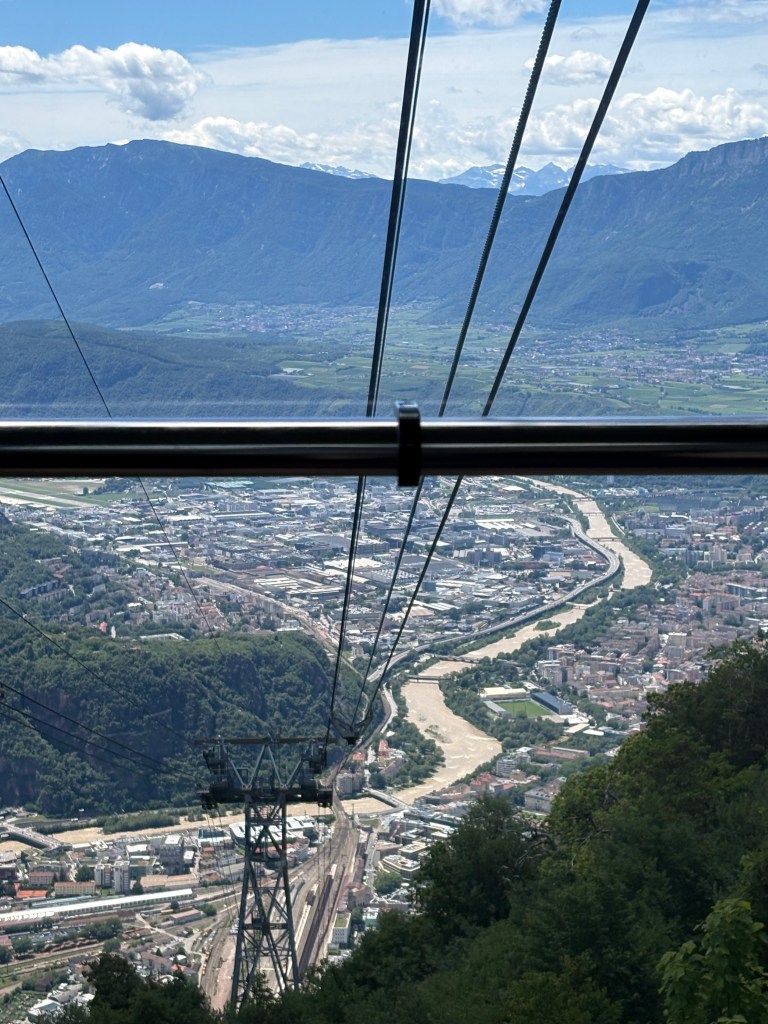
Well … cunning. Not really. The fifth day as described was the 900m descent into Bolzano. Lots of zig-zags and steep bits. I thought we could do a version of the fourth day which we had passed up. This would allow us to arrive at Oberbozen/ Soprabolzano, whatever, but above all above, and in fact well above, the town below we wanted to get to. I discovered that it had a cable car that would take us almost to the door of our next hotel. Fabulous. So we would do our 12 or 13, and then glide downhill. And that’s how it worked out.
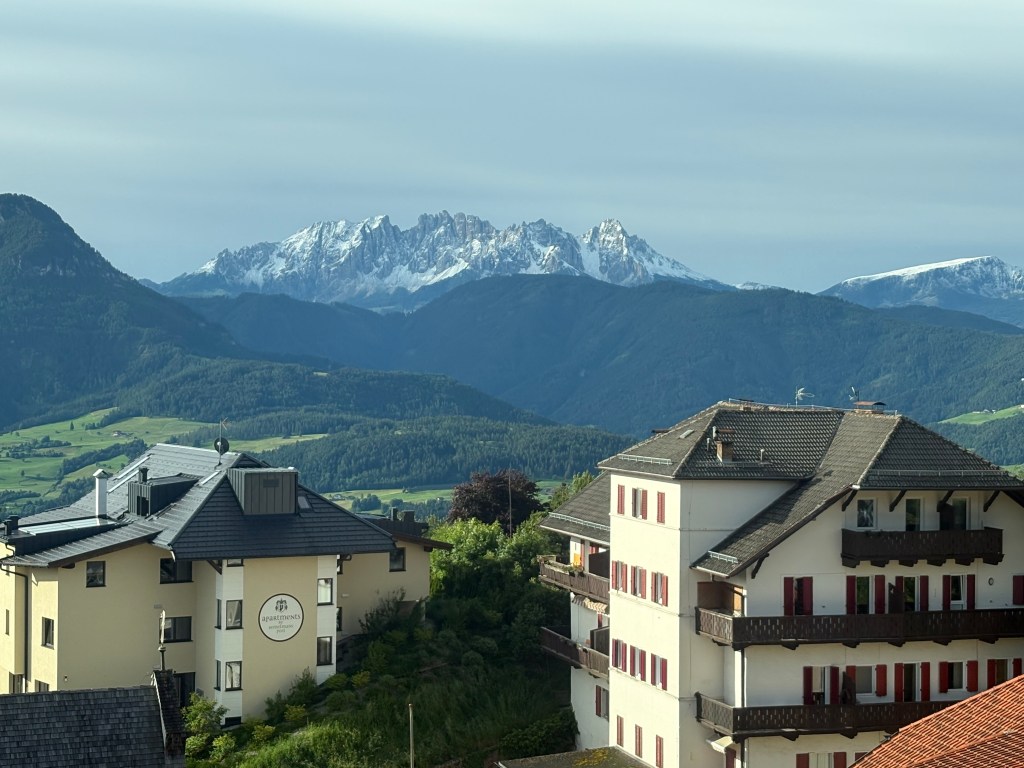
It had snowed during the night and there was still an overlay on the higher peaks.
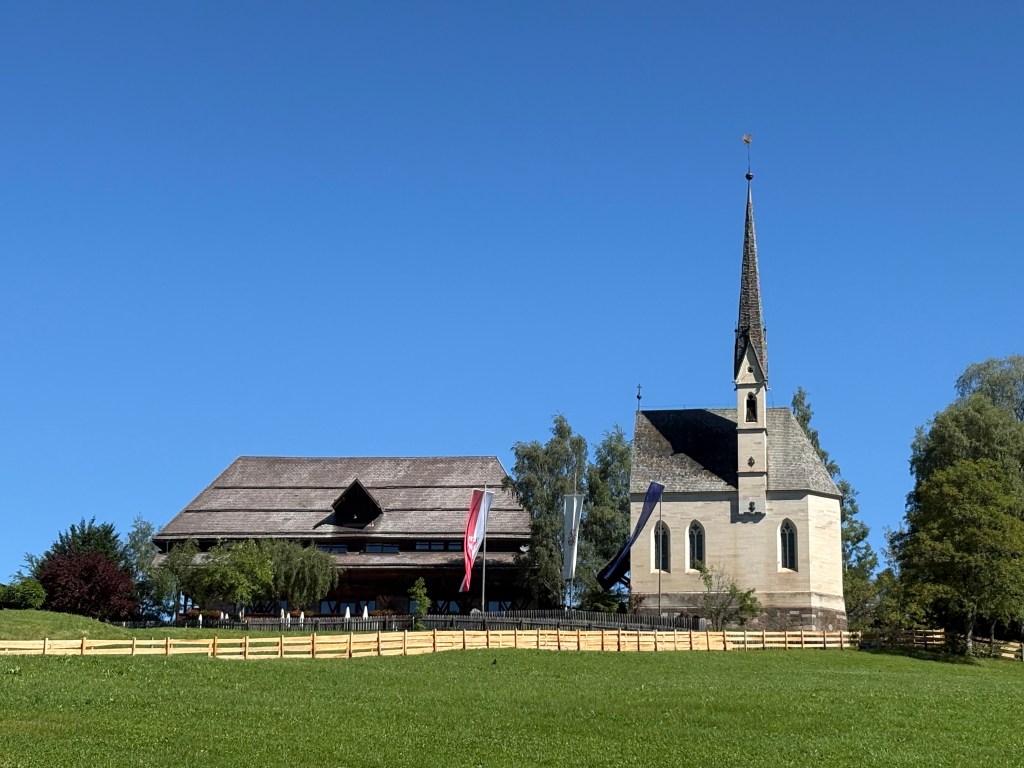
This route took us past the very modest Lake Caminata, a feature of the walk 🤔, and its associated church and accommodation. I liked the church. St Ozempic was its patron.
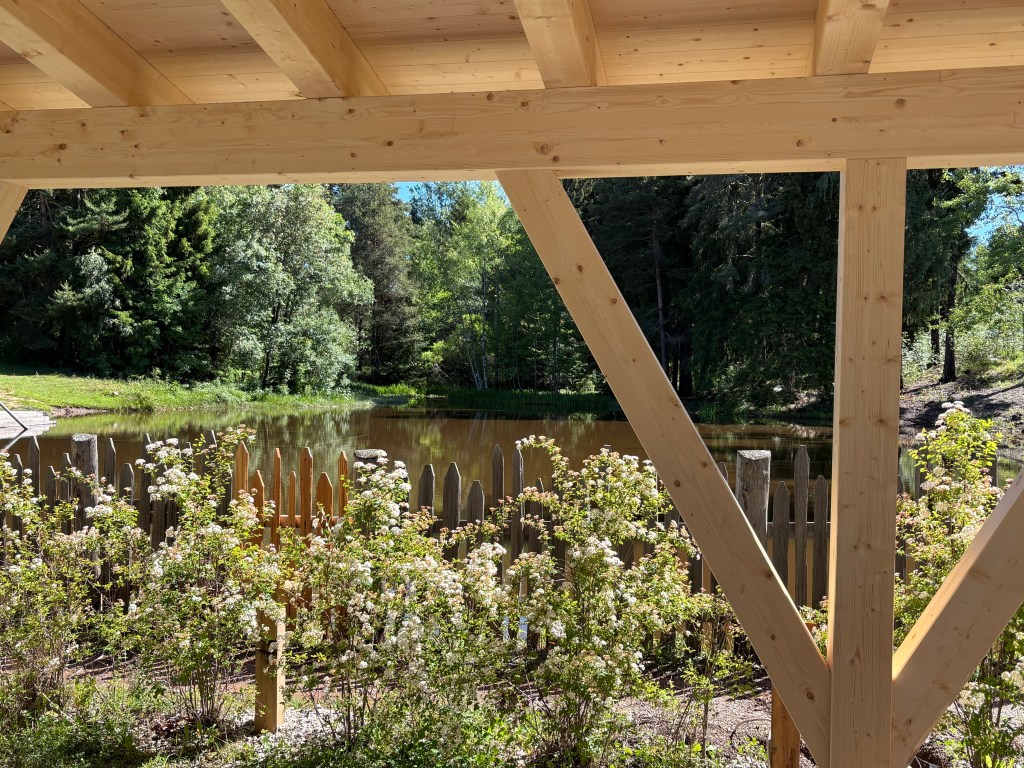
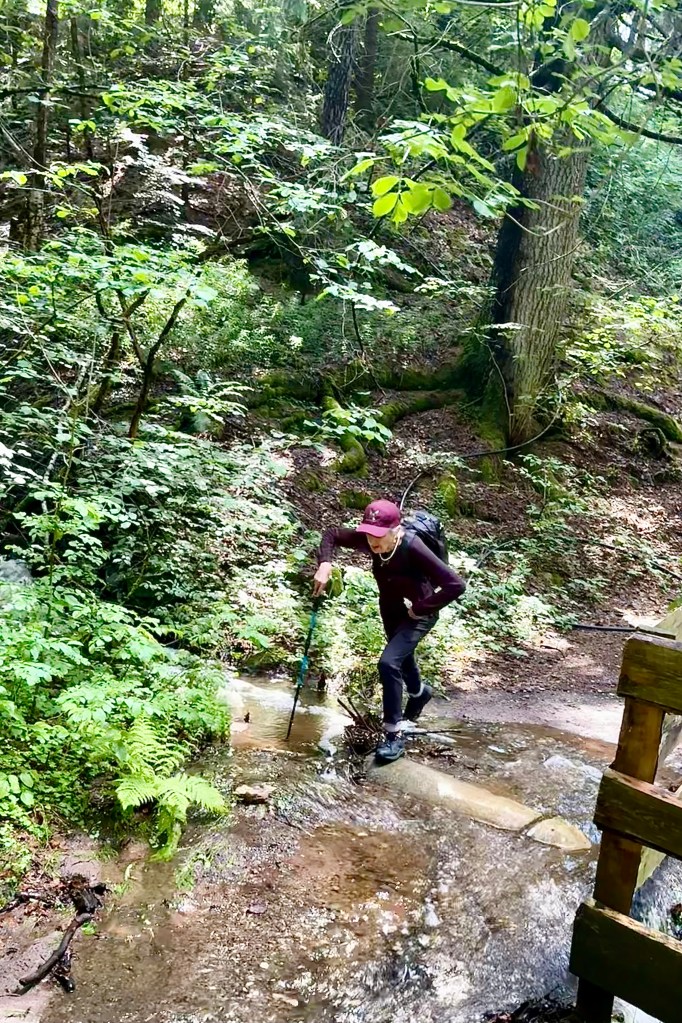
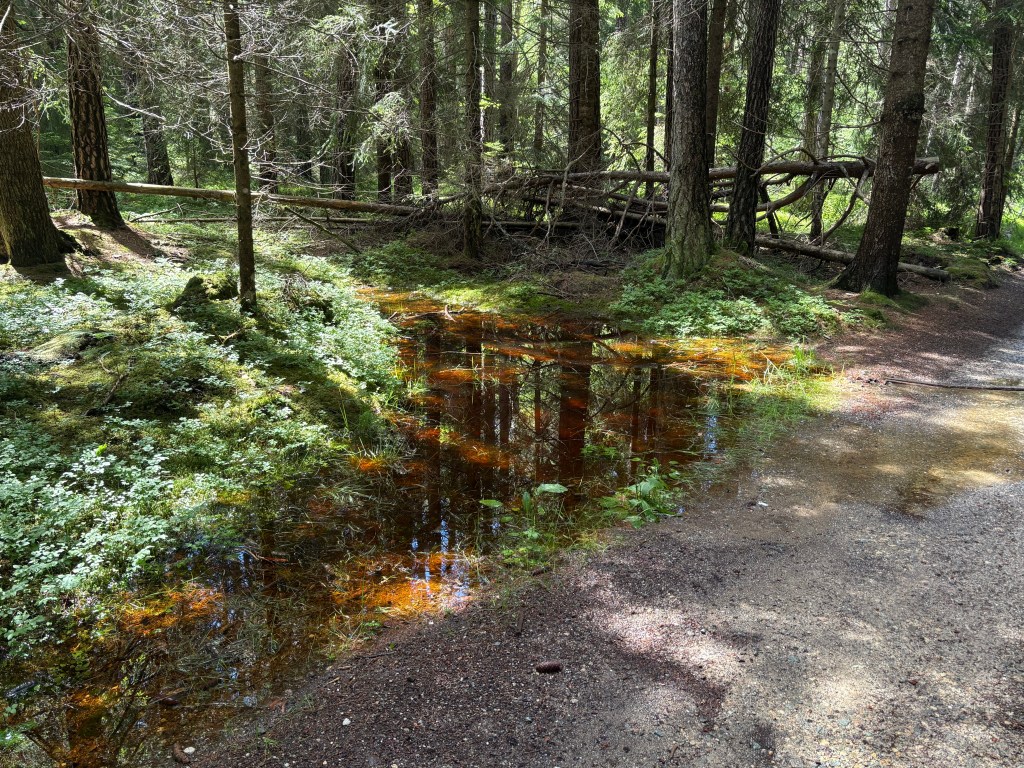
But it was a different sort of day: more populated? more farmy? Not sure. The rain had had a significant impact on the underfoot and the river in the valley when we glimpsed it was in full spate. But these are among the things we saw.
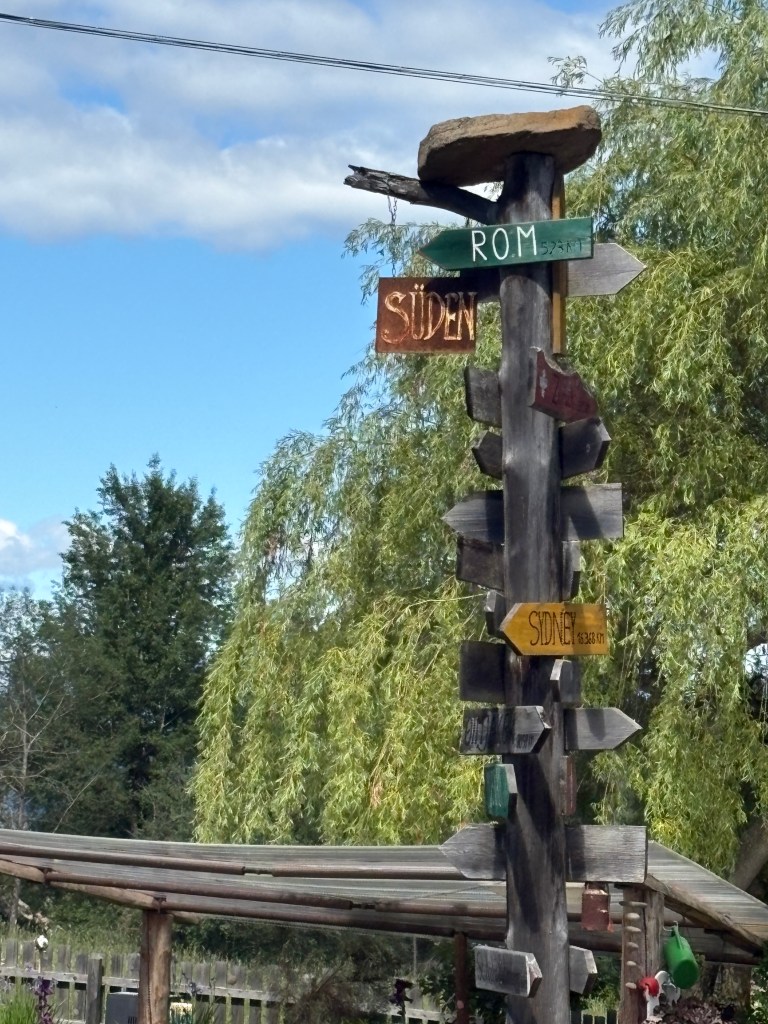
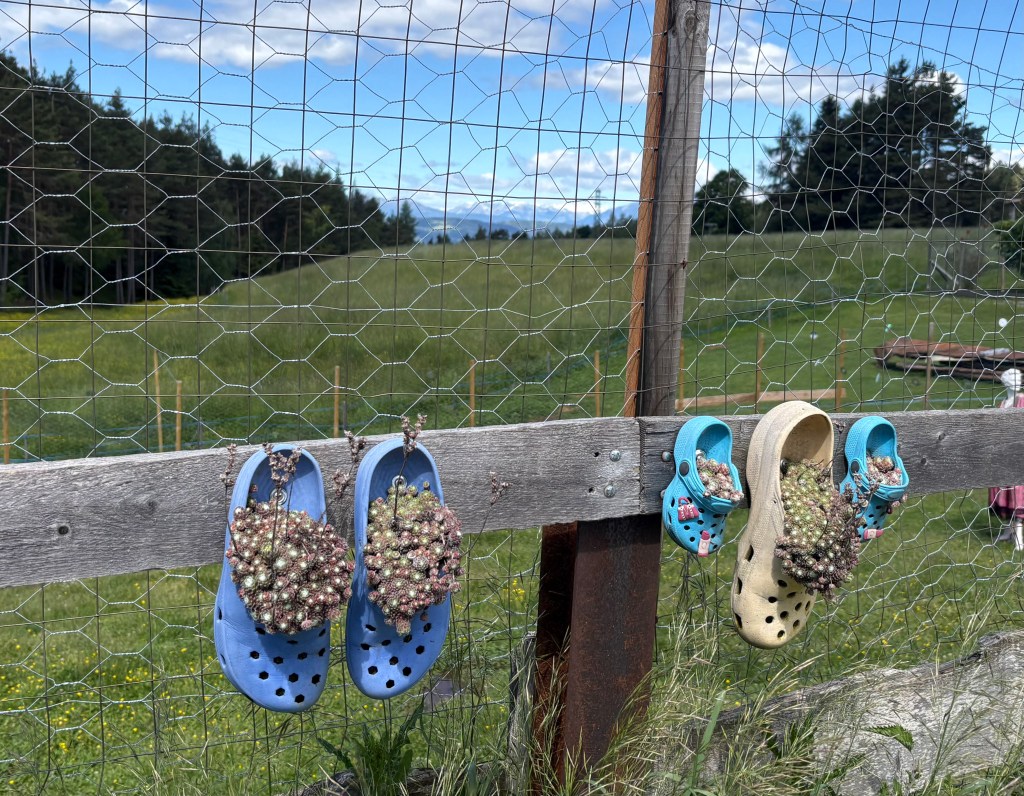
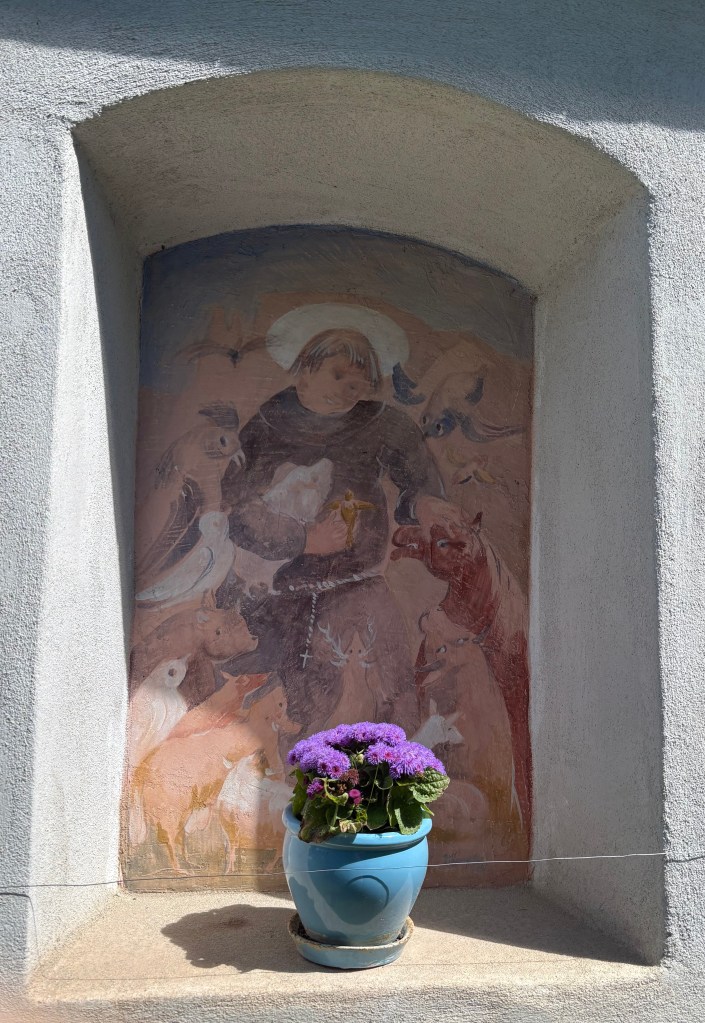
Sydney ‘16,368 km’ for anyone interested. And we walked through an alpaca farm. Shearing in progress.
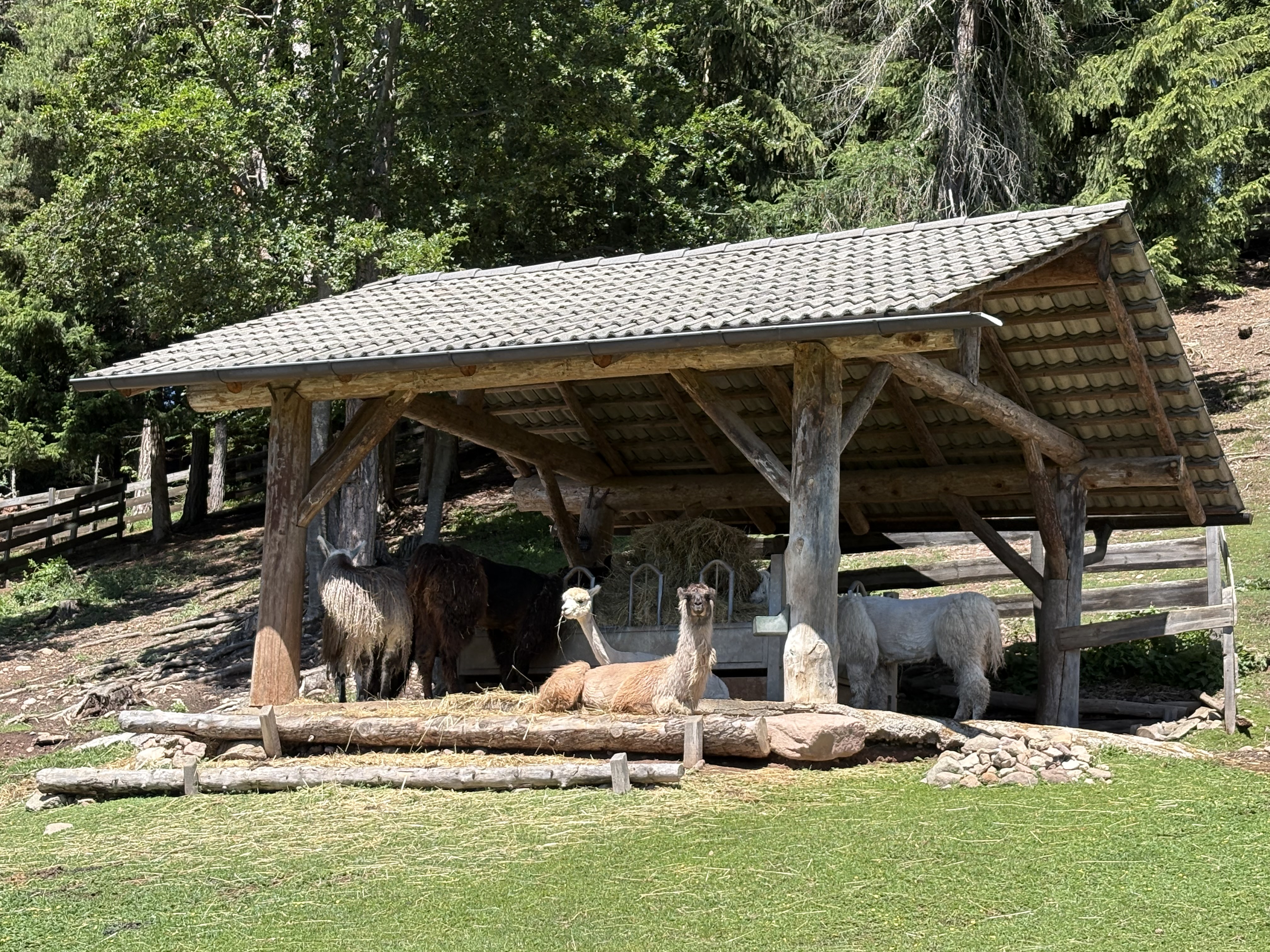
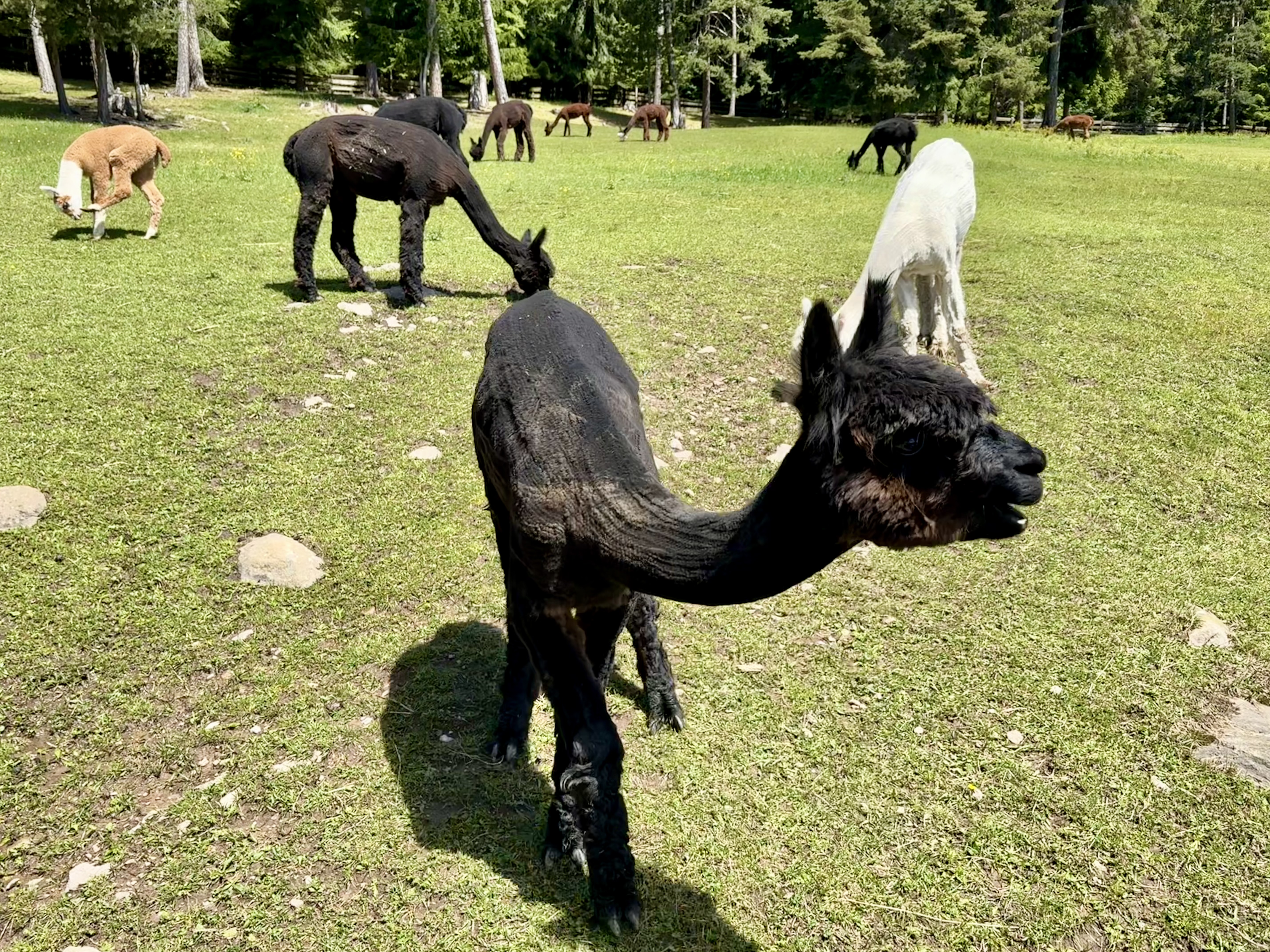
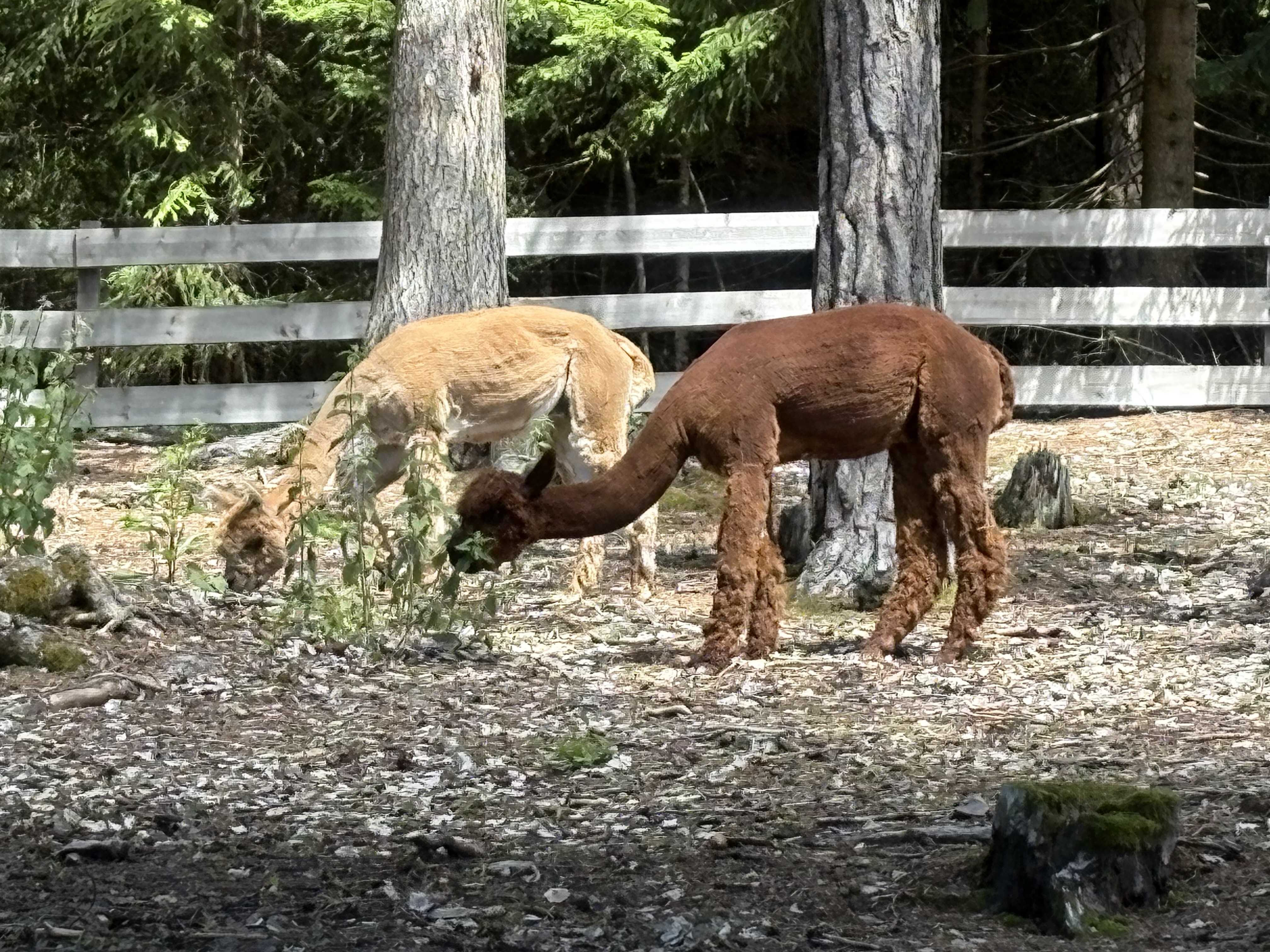
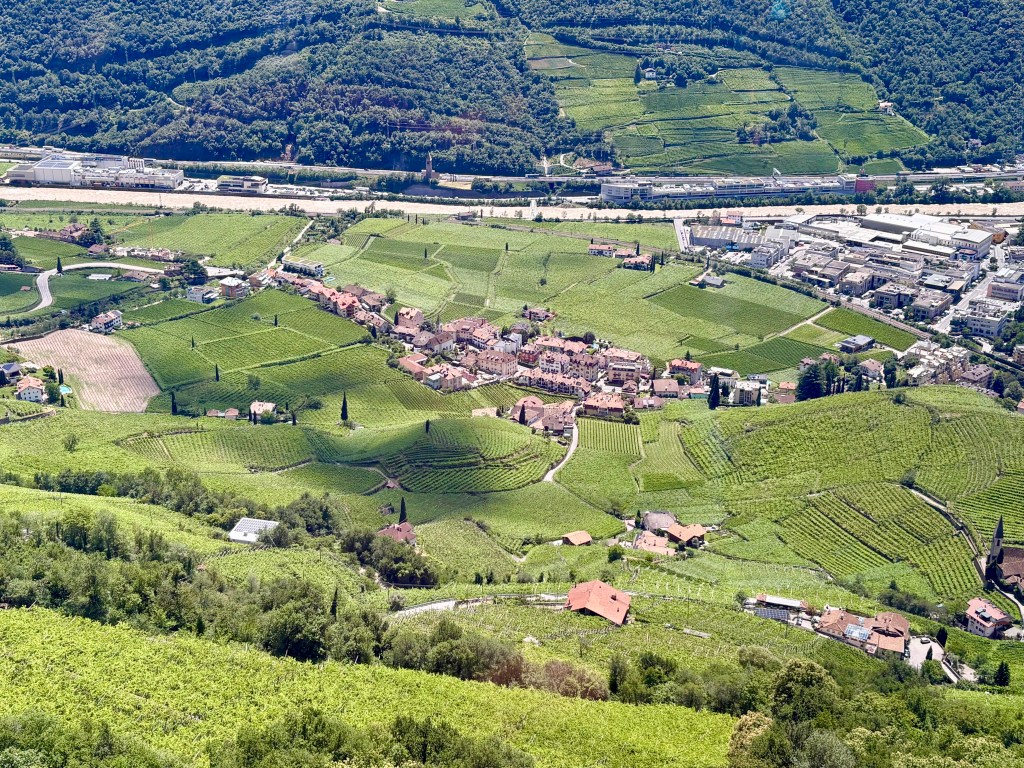
And then after a most satisfactory lunch at Upper Bolzano, down down down. A long way down down down.
Still with us? Last day: a bus trip, a cable car ride, and then a 13km loop around the Alpe di Siusi.
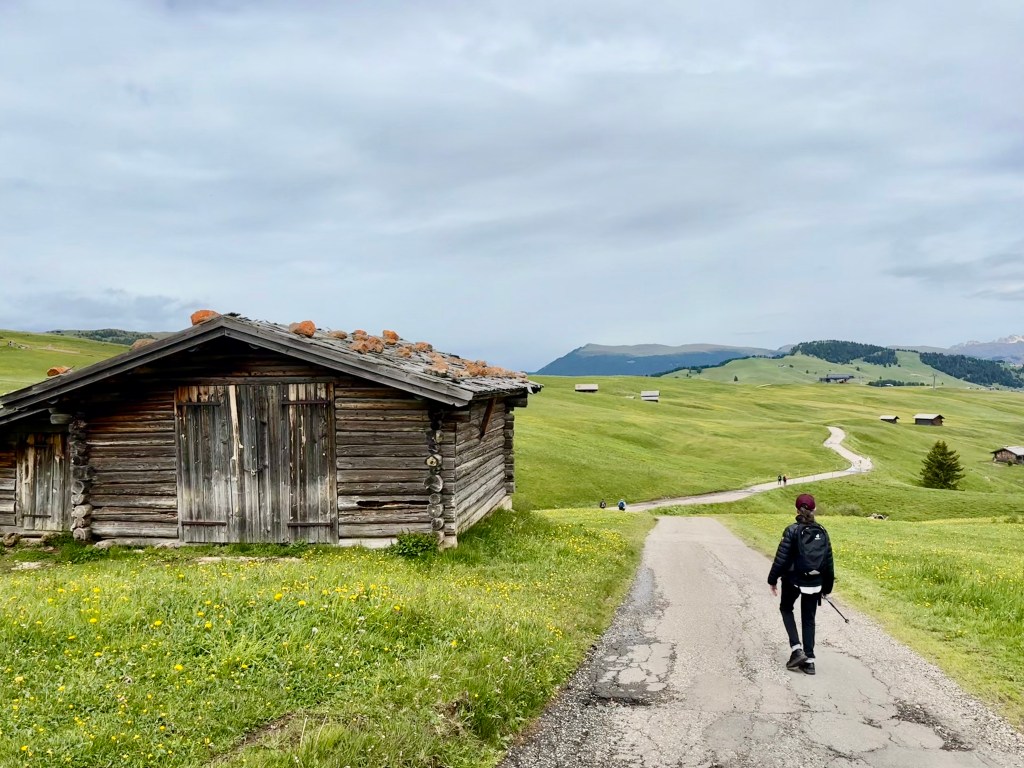
What’s an alp then? A craggy mountain n’est-ce pas, often grey, snowy? That’s what I thought. However, ‘An alp refers to a high mountain pasture, typically near or above the tree line, where cows and other livestock are taken to be grazed during the summer months and where huts and hay barns can be found, sometimes constituting tiny hamlets. Therefore, the term “the Alps”, as a reference to the mountains, is a misnomer.’ A further addition to my stock of knowledge. And, at 6000 hectares mostly over 2000m, the Alpe di Siusi is the largest alp in Europe.
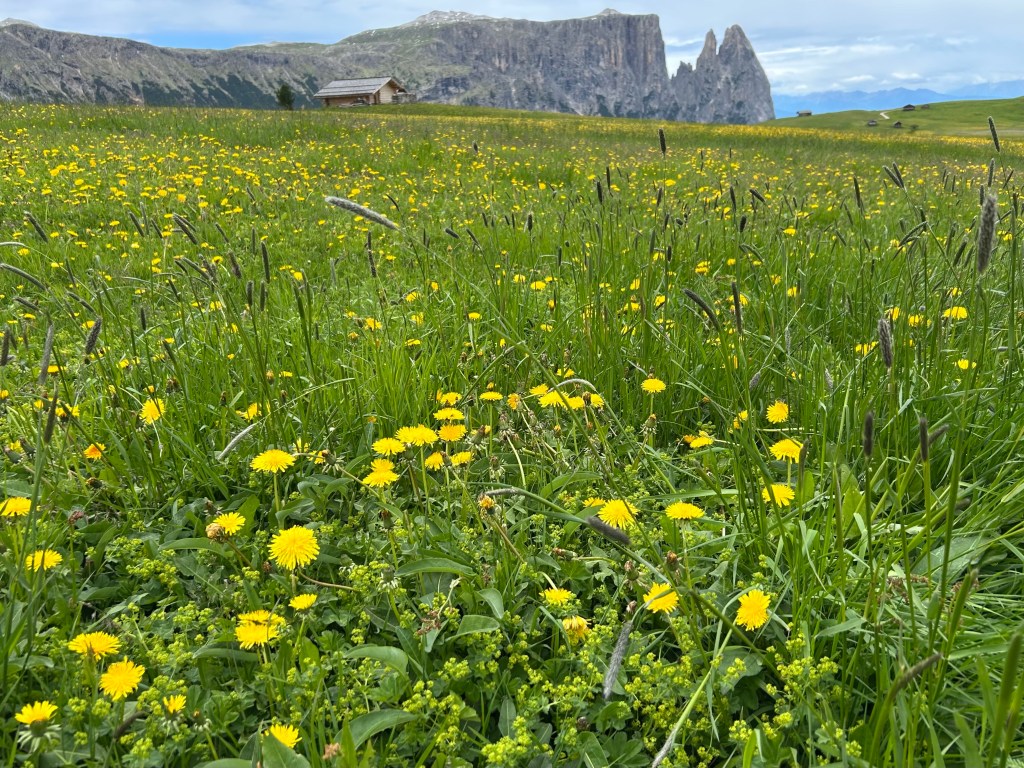
Spitzbuhl, an iconic and consistent presence, is in the background.
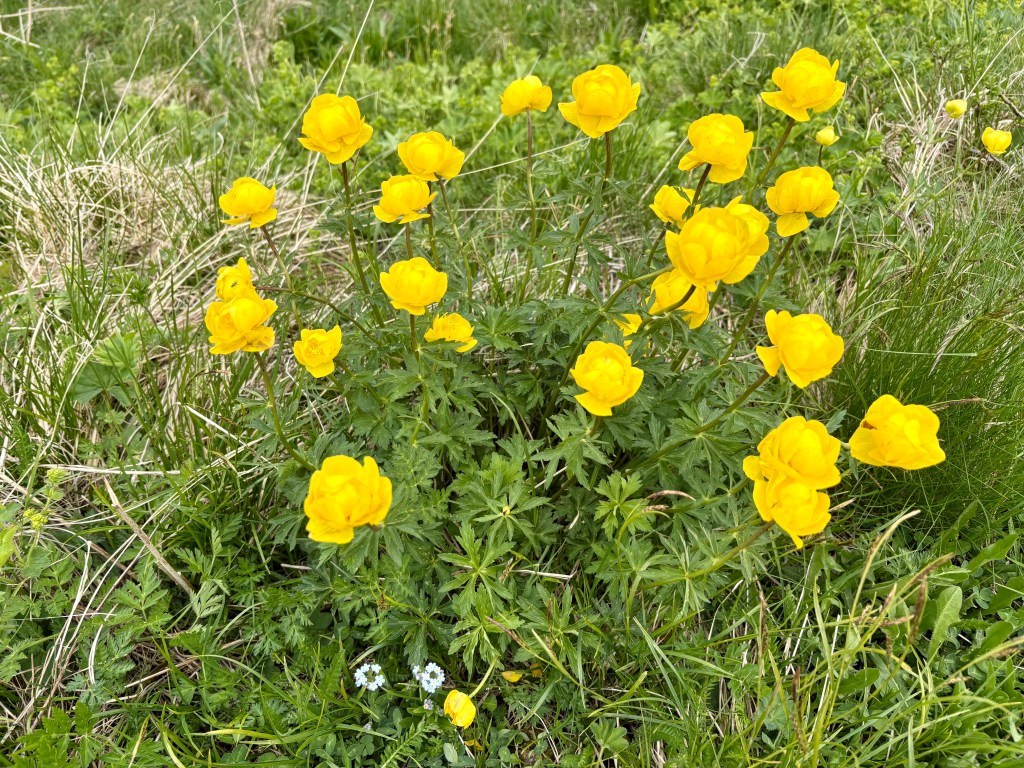
Off the carefully made tracks, the ground was startlingly spongey. Really about the texture of a sponge. There were stacks of composting dung mixed with cropping hither and thither and you would wonder how this soil could be made more fertile. The surface is dense with plants and at this time a profusion of flowers. So many types with the yellows (daisies?) dominant. But look at this exquisite thing.
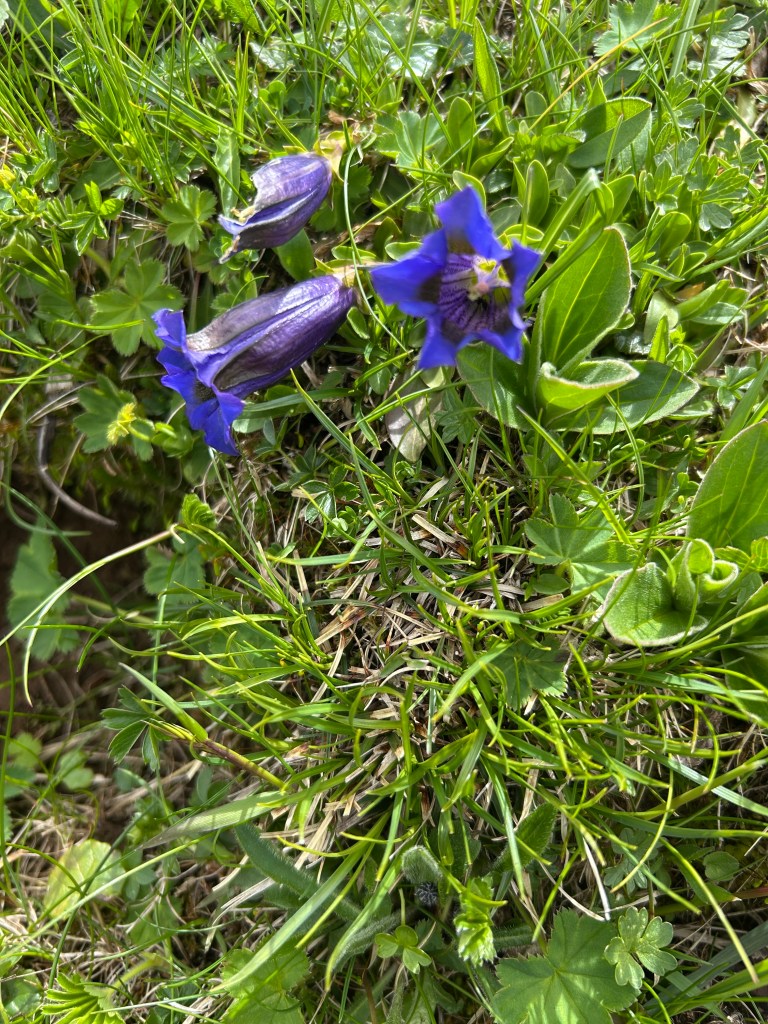
I was feeling in very good form this day, but one of Michael’s feet was inflamed and swollen — and obviously painful. We decided that we would do half the loop and meet him after he had got himself across the middle on a narrow but surfaced road a bit less than half the distance.
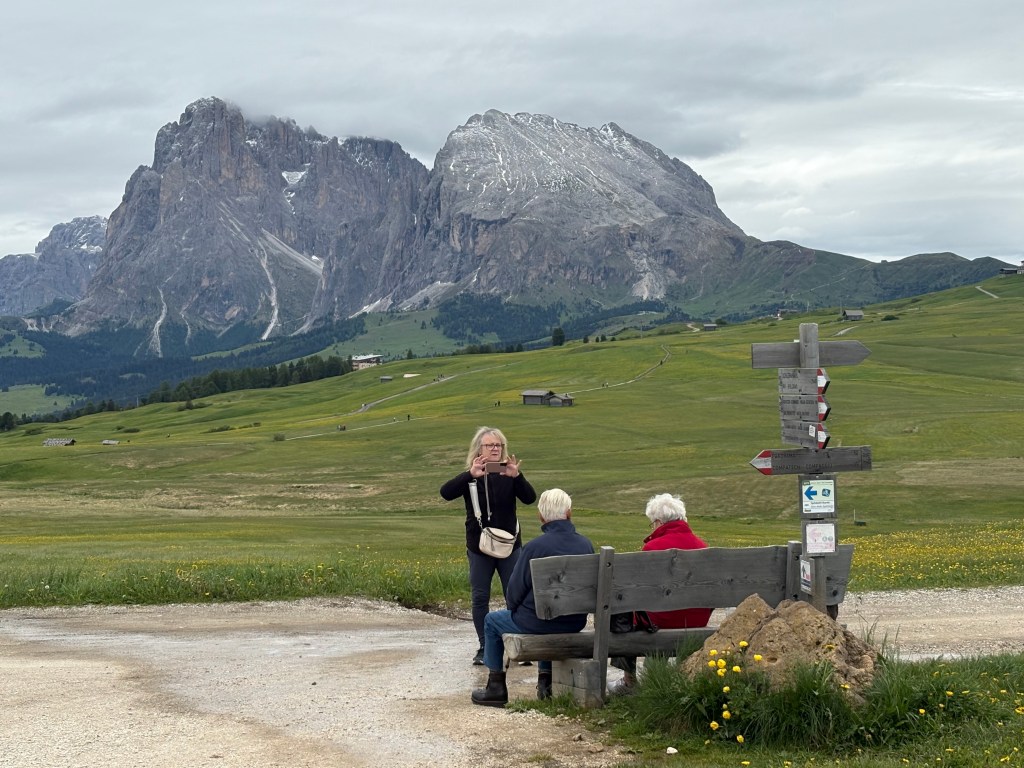
There were quite a few people on Siusi this day, all ages and quite a few means of transport, electric bikes being popular. (Love these photos.)
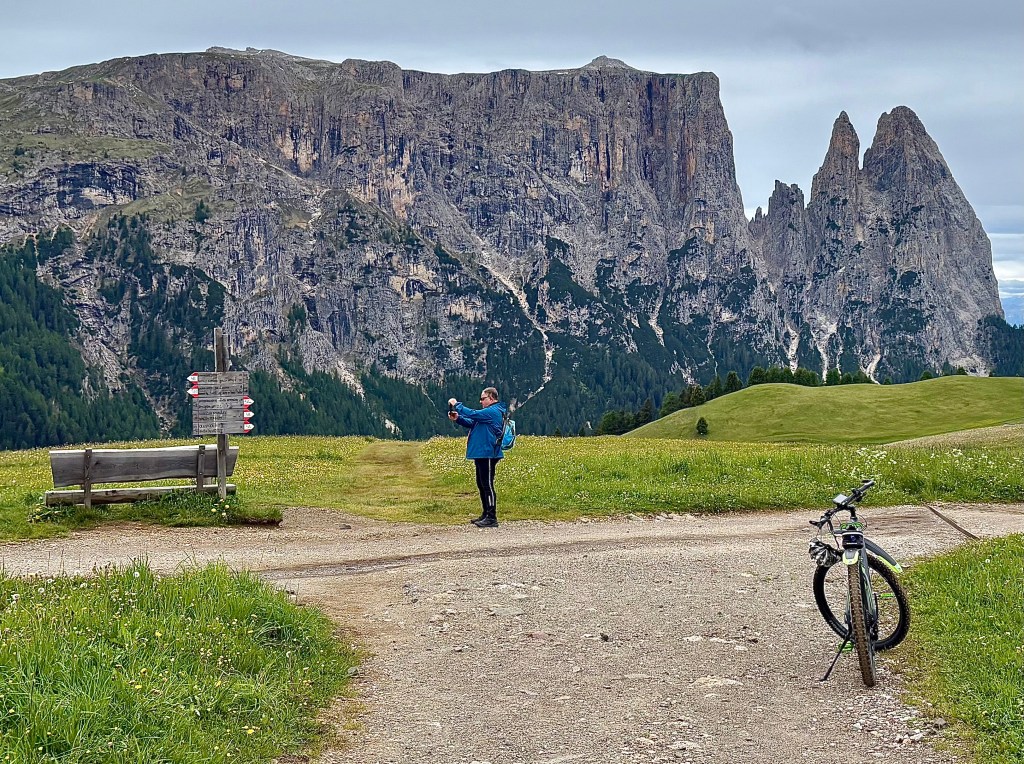
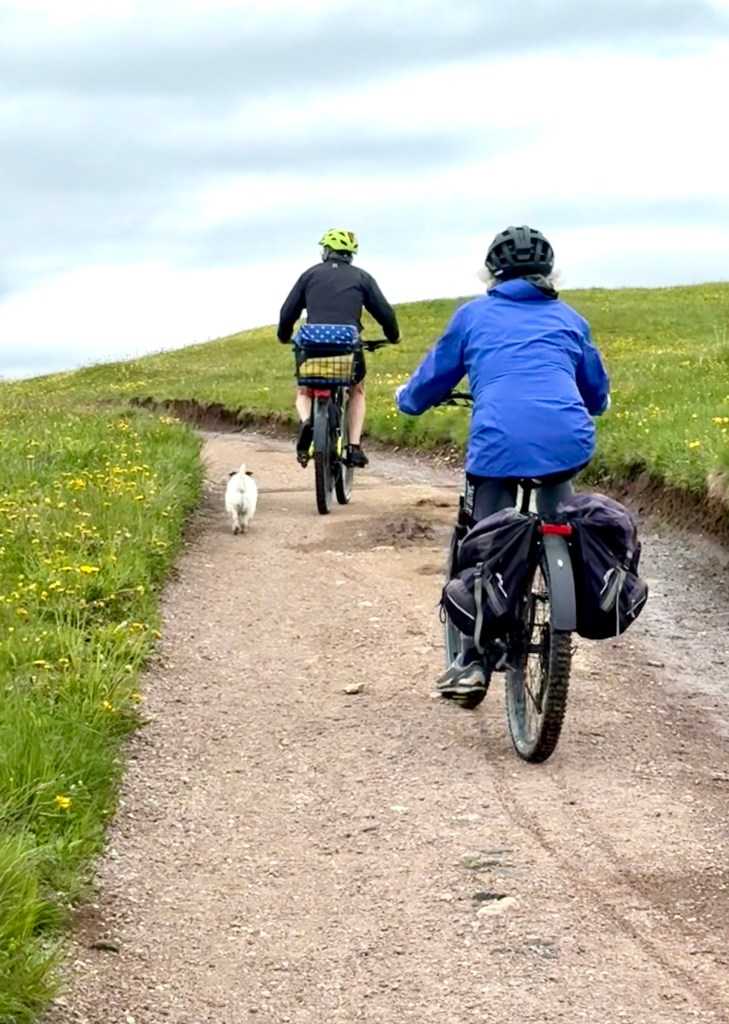
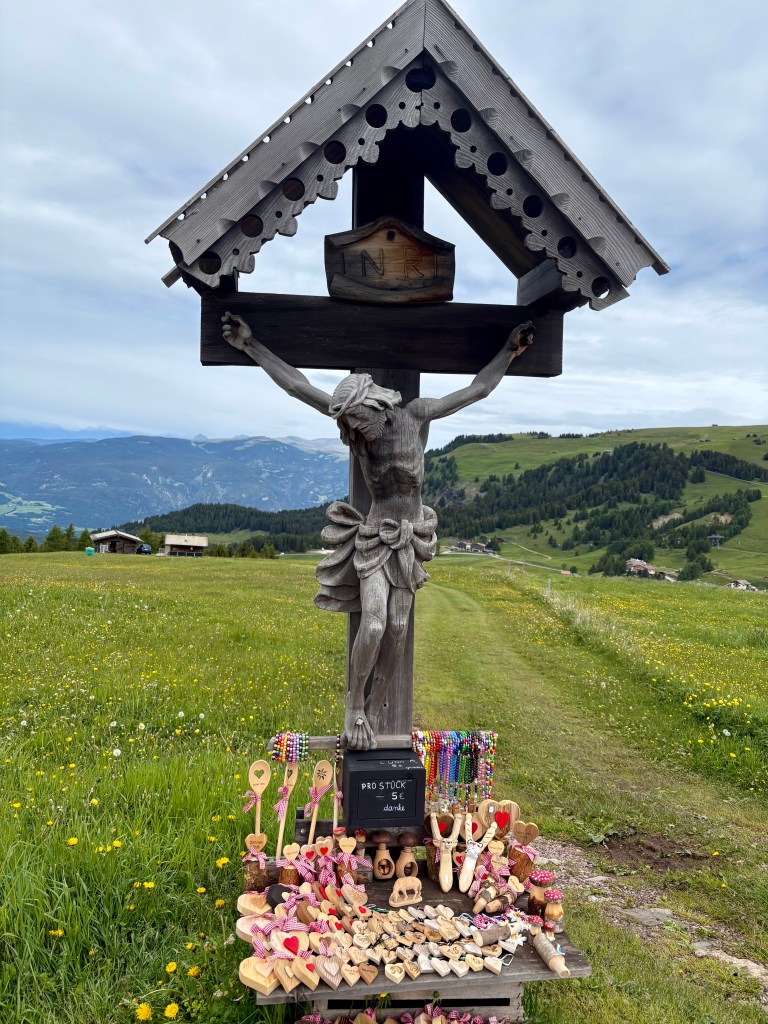
And even a bit of commerce. Five euros a pop if you’re interested.
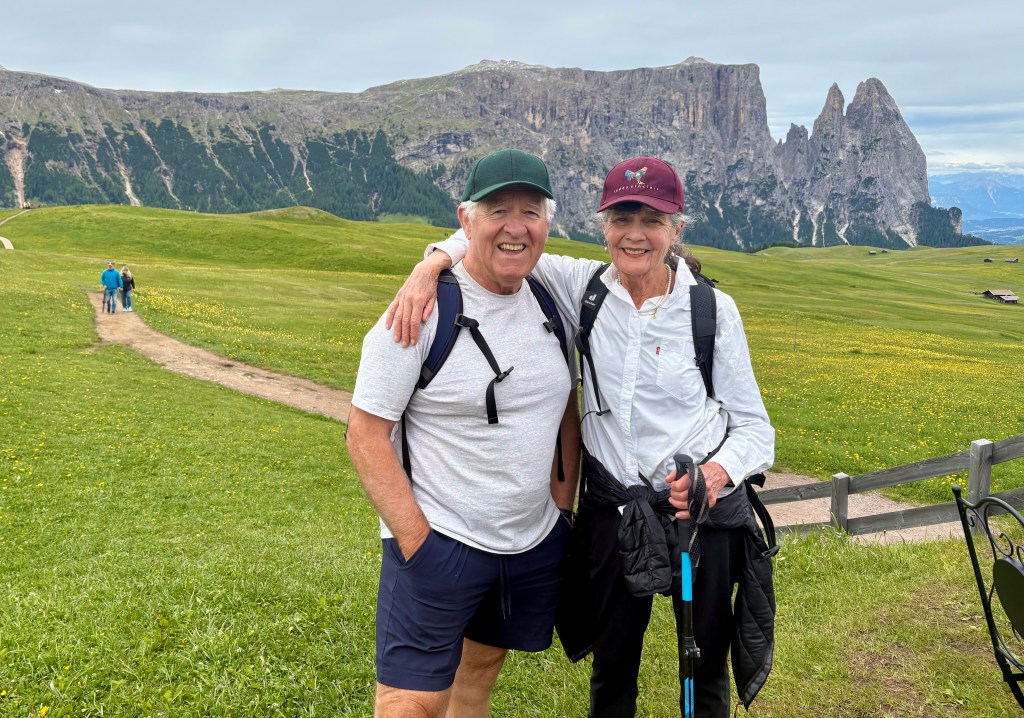
This photo was taken by one of an American family who had been shadowing us on the walk, same tour, same hotels, same dining rooms, but also same shortcuts and same day indoors during the rain. A 50 year-old who worked at the State Department in Washington who never looked like he really wanted to be trekking, his wife who worked at the Federal Bureau of Financial Regulation, spoke fluent Italian, was always very carefully dressed and made up, and evidently the driving force behind the walk. Two kids, a quiet and fit boy of maybe 19, and an all-American girl of maybe 16?17?
We talked to them more here than we had the whole trip. We had made a mistake: they were both friendly and interesting. The girl made the memorable comment, re July 4 in the Mall: ‘Trump is awful, but he has great fireworks.’
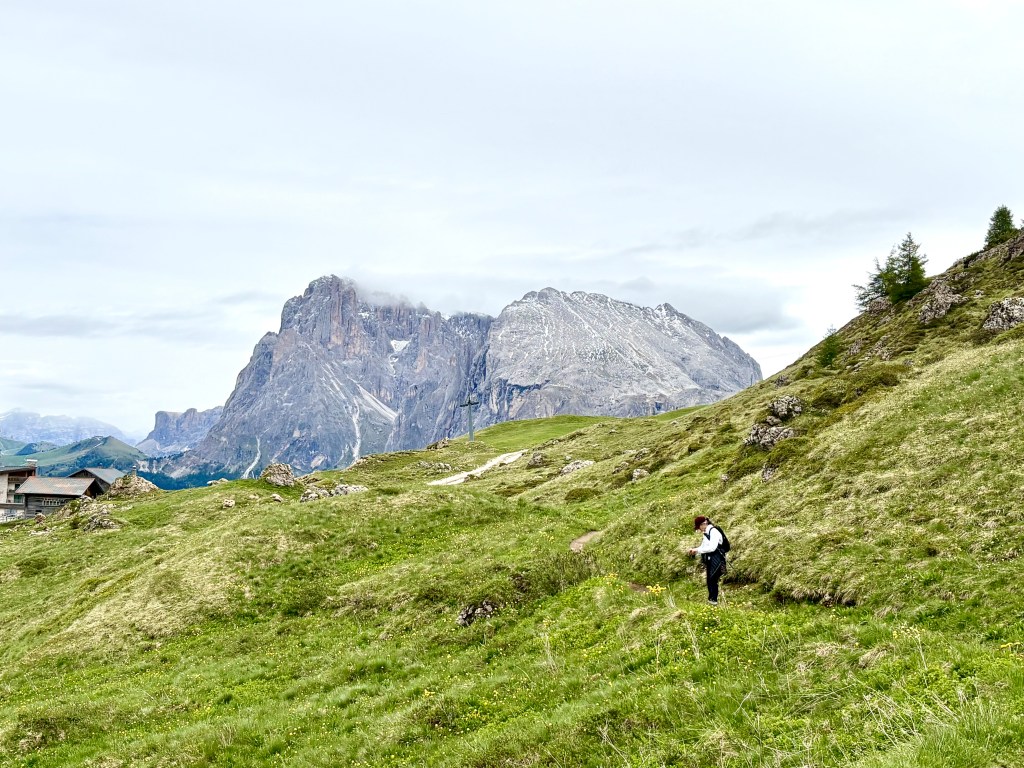
Myrna is taking her 30th flower pic. The result is at right.
At left above is the hotel where we found Michael enjoying a beer.
The way home.
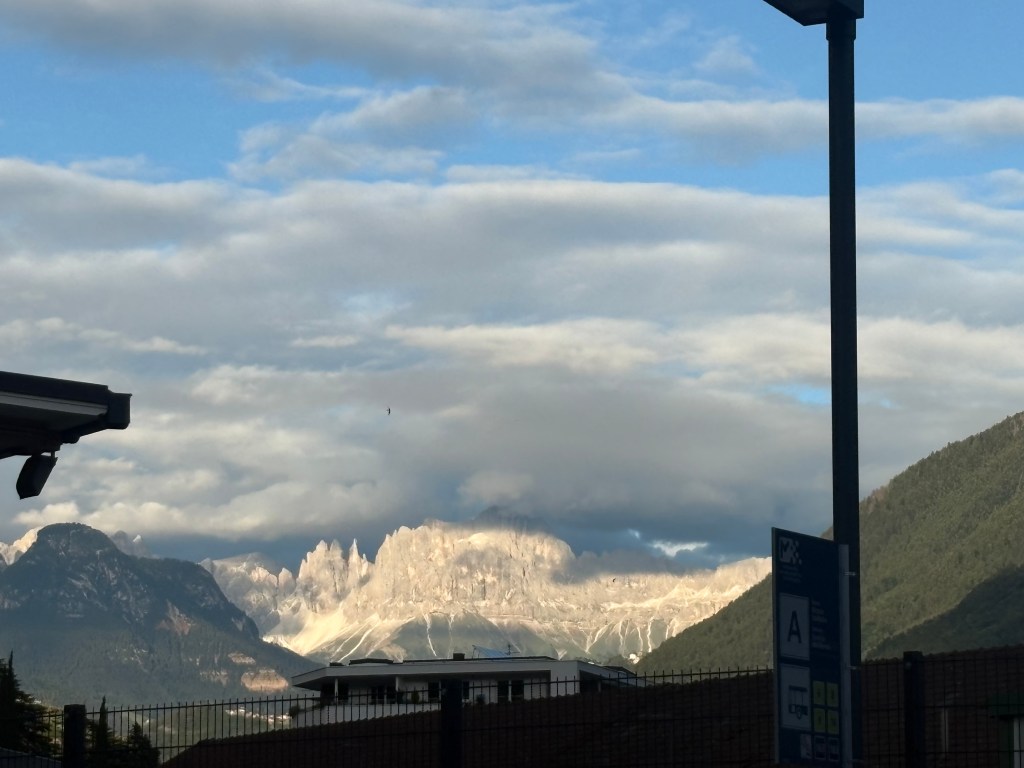
Last glimpse.
That was it. Fabulous. Loaded ourselves on the train …
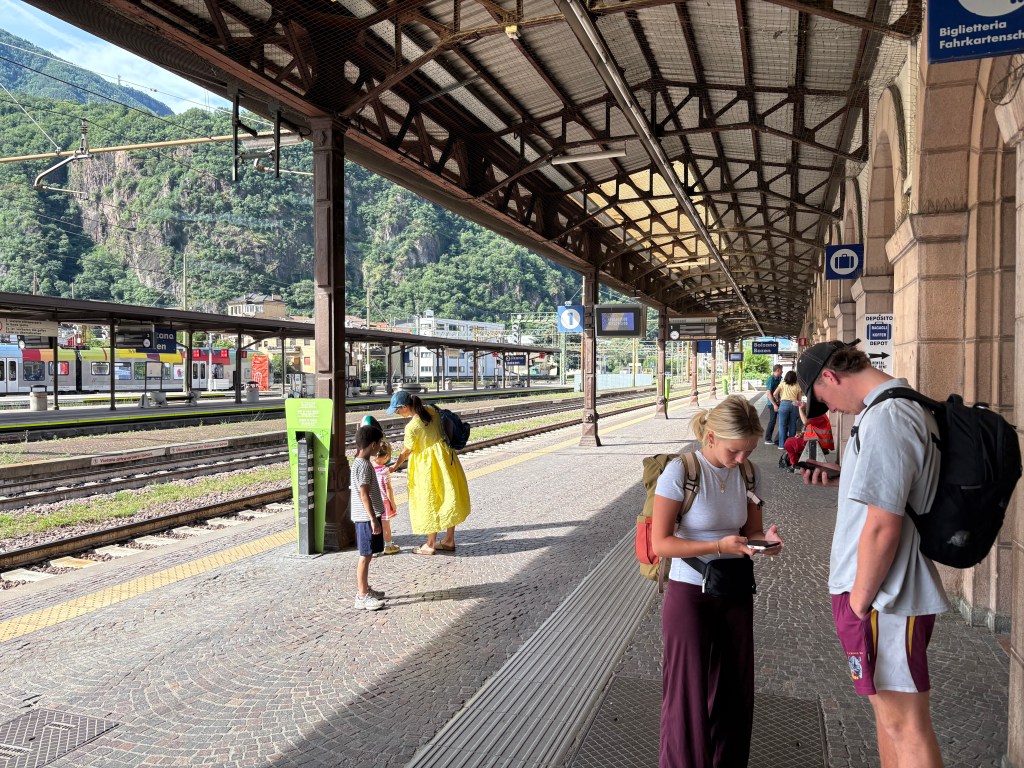
And after a while, not so long, we were somewhere quite else.
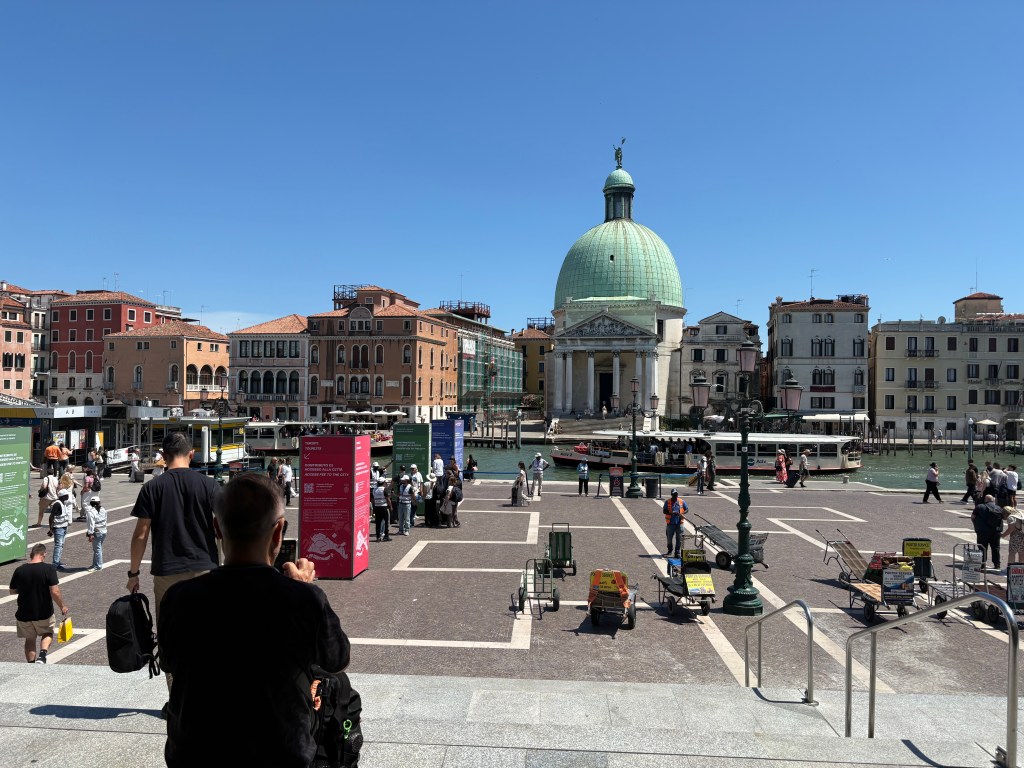


Sembra incredibile. Tutto quel camminare! Impossibile. Ma bellissimo.