A collection of pics that didn’t really go anywhere else of things I’d like to rememberfrom Japan in 2024.
Atmospheric. At an izakaya (small neighbourhood pub that serves food and beer) under the main northern rail line flyover near Tokyo Central Station. It’s hot and the end of a long day. We are eating edamame (‘A great source of plant-based protein, fibre, healthy fats, vitamins, and minerals. It is also low in calories’) and salad and, like the gentlemen nearby, drinking excellent Japanese beer.
Our bedroom at the Sonic Apartment Hotel in Dazaifu. Plenty of bed, not much room. I am standing in the shower.
Where salarymen have their smokes in central Tokyo, but you need a phone as well.
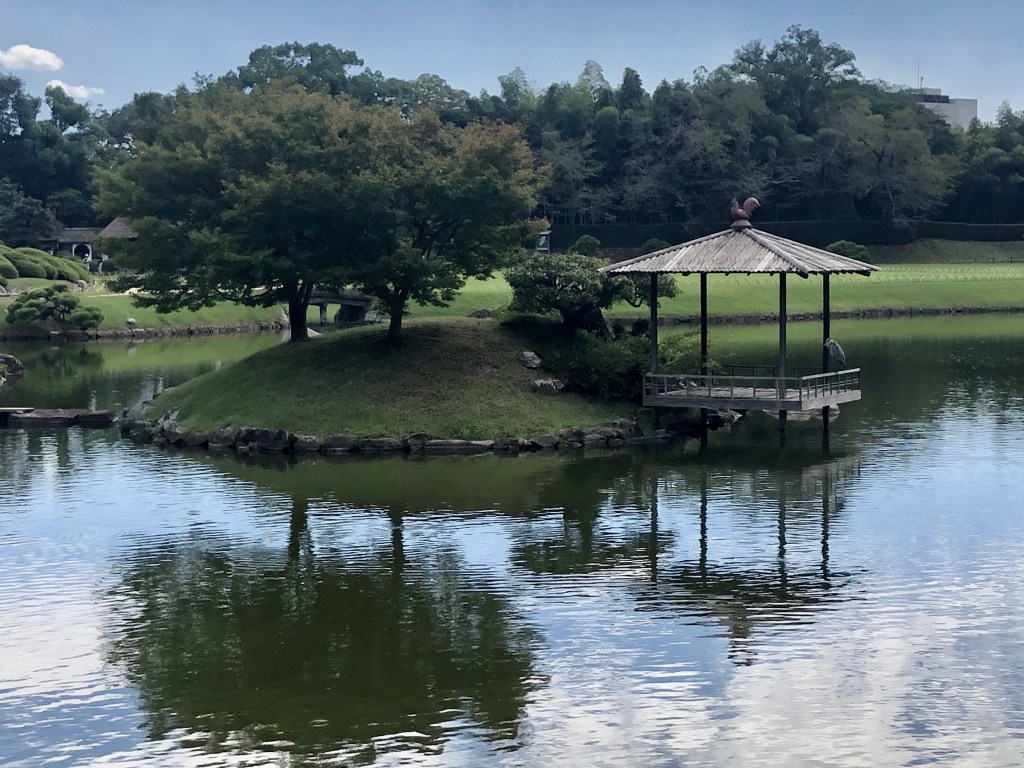
Korakuen (‘Lake Paradise’) of Okayama, one of the four ‘Great Gardens of Japan’. Michael and Myrna thought it was pretty good. I was disappointed. I wanted more variety and inventiveness in the layout. But what do I know?
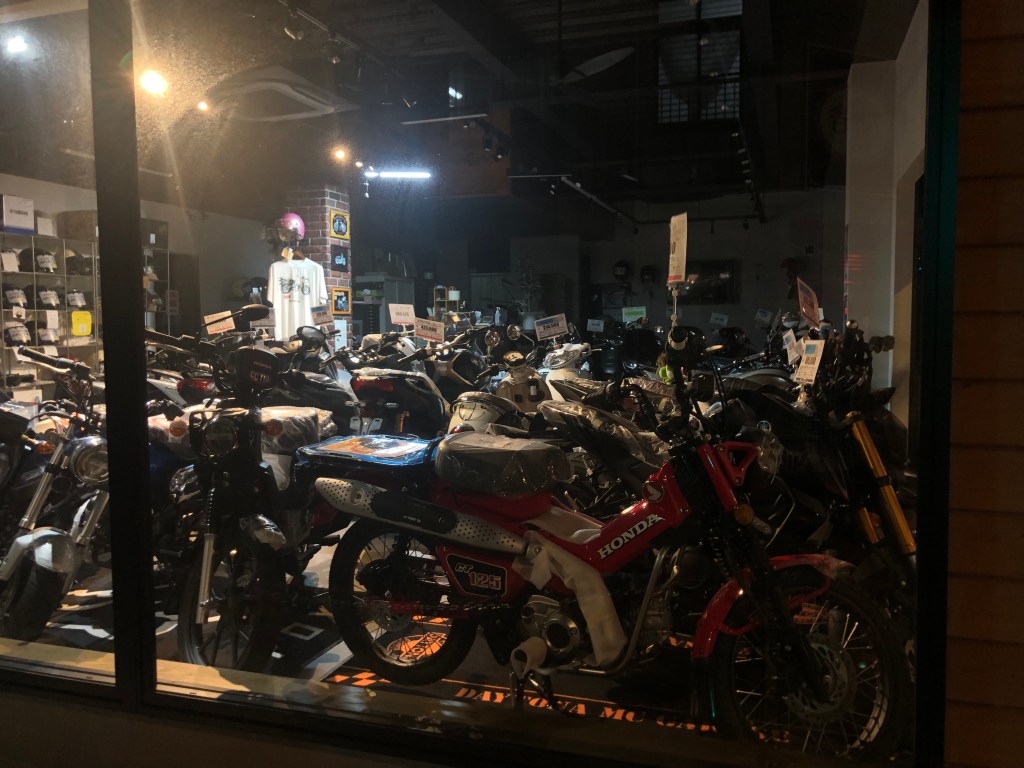
A motorbike shop over the road from our hotel in Nagasaki. There was something about the busy-ness of the illuminated highlights and also the way the T-shirt rises so ghostfully out of the machines.
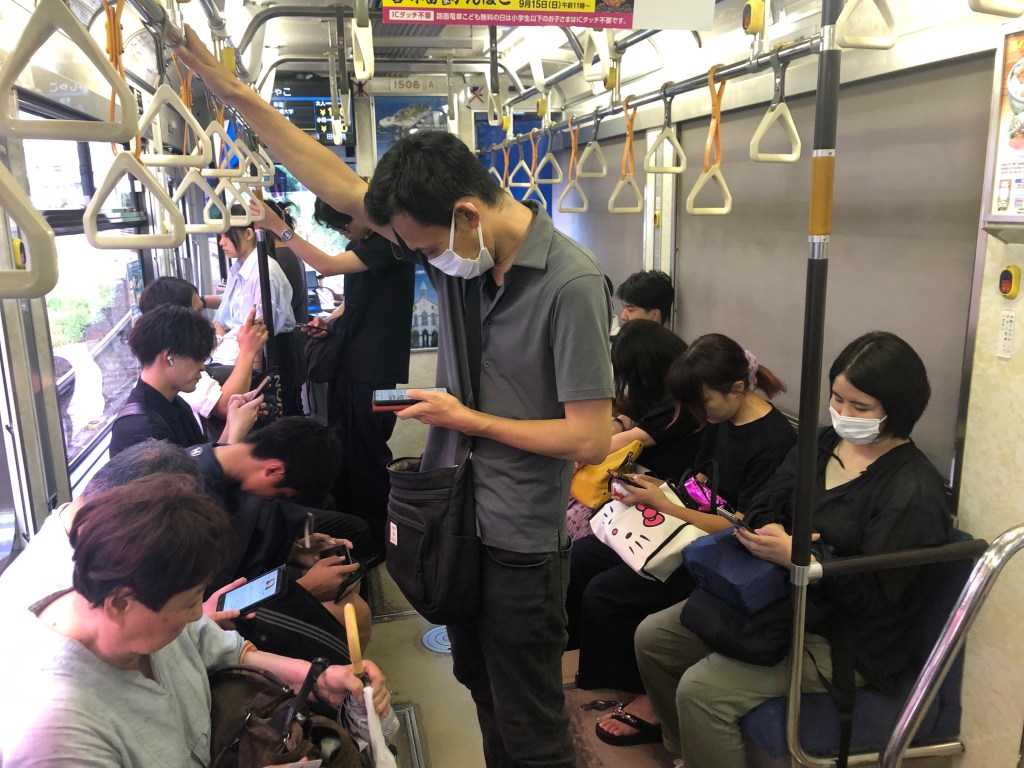
The trams and tram stops of Nagasaki. Trams several decades old with very peculiar driving control mechanisms which produce a great deal of jerking, but otherwise just so functional. And cheap to ride. Panels at each tram stop include a stylish floral decoration.
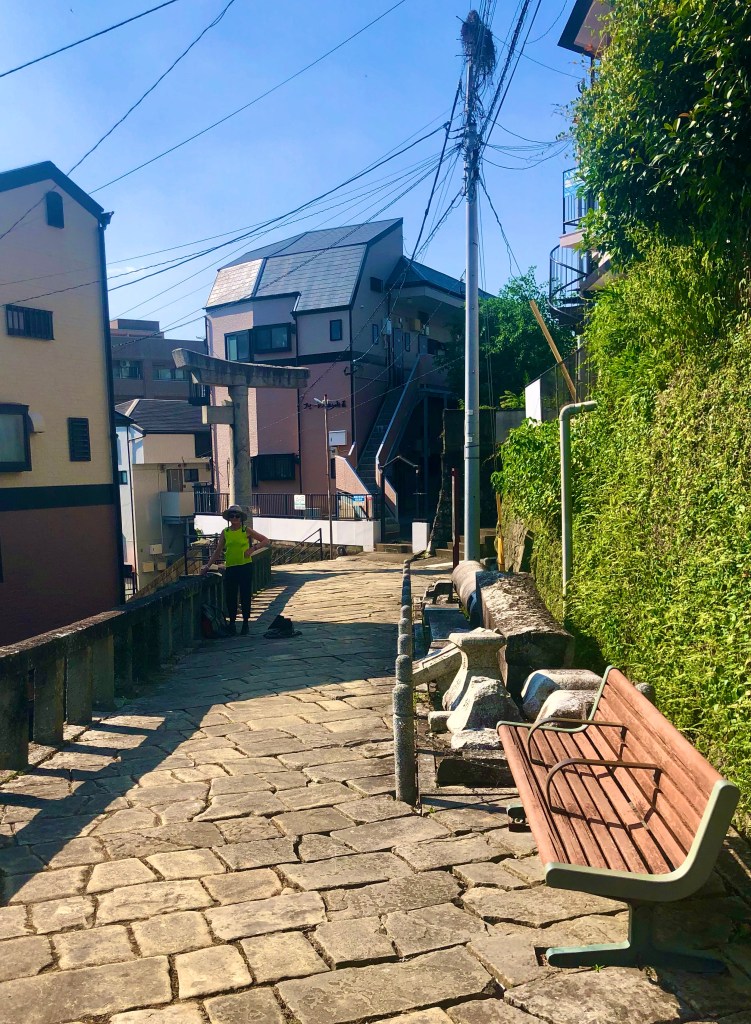
Nagasaki again. Looking closely behind Myrna you can see the tori which became one-legged after the atomic explosion. But to the right arrayed along the hedge behind the seat and protected by bollards is all the rest of it. A fine act of remembrance.
This is some of what sits under the red heart on your iPhone. Often not terribly reliable. If you want to know exactly where and how far you’ve walked you need another version of a GPS. Or a GPS. Either will soak up a large amount of power. The red heart doesn’t. Usually you don’t even notice what it’s up to. And as for being accurate I’m sure it didn’t know what time I went to bed and may have interpreted being carried around as being awake. It doesn’t seem to have registered how my walking asymmetry was going — it would have to have been much worse than that as I staggered along. On the other hand, I’m not sure how it registers ‘Flights climbed’ but 237 both seems about right, and seems like a lot. That benchmark edifice, the Empire State Building has 102 floors and the tallest building in the world Burj Khalifa in Dubai only has 163. There is some suggestion that a ‘floor’ equals 3m. which would make sense. So we might have climbed 711 m. How much is that? The Empire State is 381m high. Burj Khalif is 828m, but only 585m can be occupied. This was the last day on the Kumano Kodo and my sense of things is that all that’s missing is the additional descent of 237 floors.
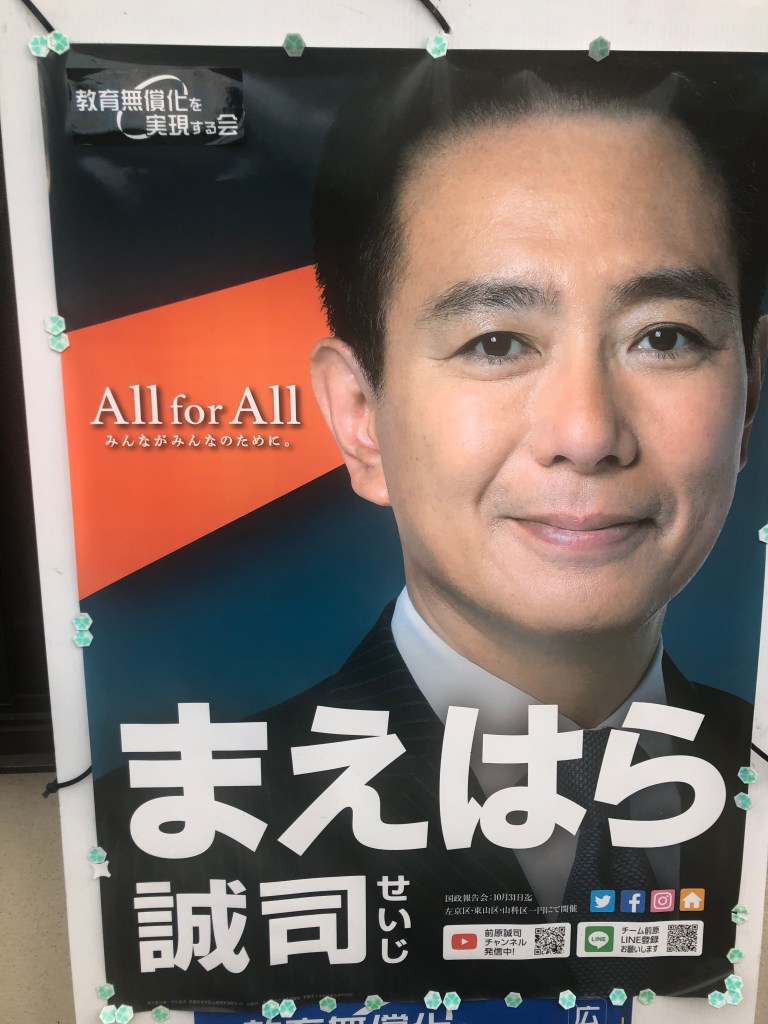
The walls and power poles of Kyoto. So good looking and such an expansive policy. I hope he got in.
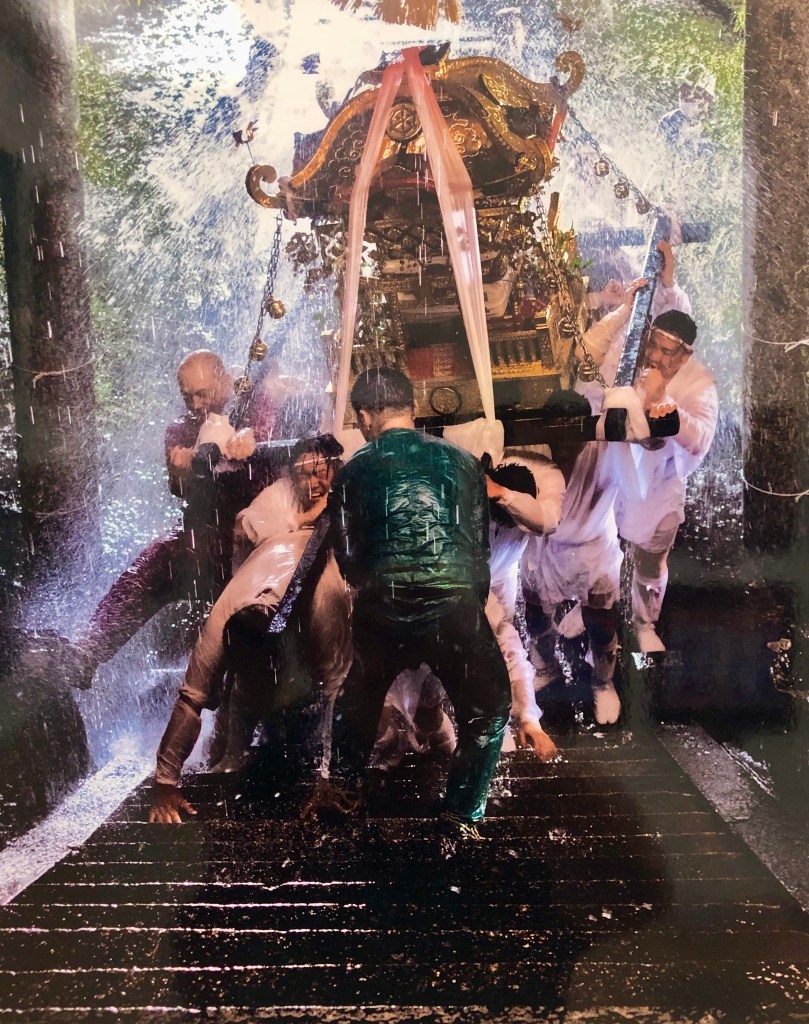
Tokyo’s National Art Centre. A photo of a photo from an art society’s massive biannual exhibition. Stairs, pain, effort, teamwork, artificially added difficulty, a religious icon. Can you get more Japanese than that?
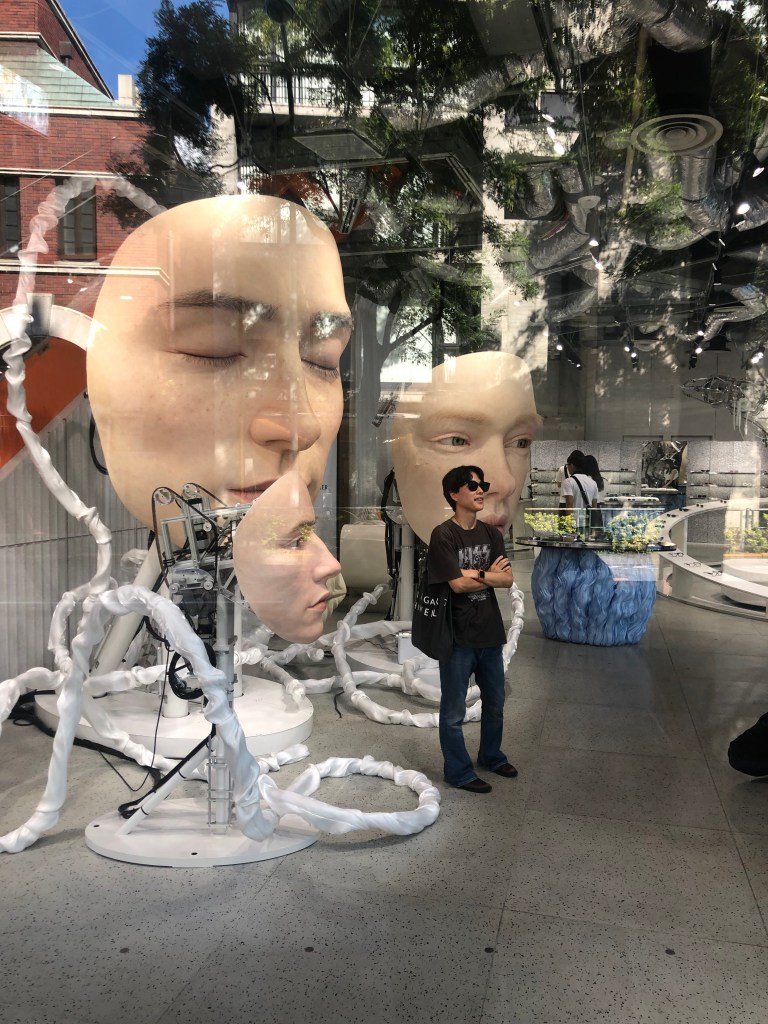
Shibuya. Rich Tokyo. He is not part of the display. He has simply walked in for a photo. The heads are wagging backwards and forwards, up and down. I think the eyes opened and shut as well. It is a sunglasses shop.
Takeshita Street, Harajuku, a suburb of Tokyo. Somewhere everyone should visit to be reminded how much variety there is in the world. (See also The Substrate.) Thrilled to have her photo taken. This was just over the street from the Micropig Cafe. I have video of this which I can’t load here which would show small pigs running over people sitting on the floor of a room. In this instance these people include our granddaughters along with another customer who appears to have three pigs climbing on her one of which might be being kissed. Otters were also an option.
One of the reasons we went to Japan was because Simon, our son-in-law, wanted to see Mt Fuji again. Fuji-san, one of Japanese Buddhism’s three sacred mountains, peak 3776m above sea level 600m higher than any other Japanese mountain, World Heritage Site, social and cultural icon, Japan’s national visual branding. And very often hidden by cloud. And that’s pretty much how it was for the three days Simon and family spent at Kawaguchi. It might have peeped out once.
It’s our last night in Japan and I’m cleaning my teeth in our hotel bathroom. Peer out the window … and look it might be Tanzawa but, right direction right size, I’m calling it Fuji.
The writing on the shop window at left says: EAT IN TAKE OUT ATELIER PORCEL ARTS LUNCH COFFEE SMOOTHIE BEER KUSHIAGE [grilled food on skewers] PASTA. That surprises me. It is somewhere near Kumamoto which in turn is somewhere near the middle of Kyushu which in turn is Japan’s fourth island, the one off the end heading towards Korea and China. The one which seems to consist mostly of volcanoes in various states of tumescence. The one more obviously tropical, more wetter, more typhoony. It’s a long way from Tokyo, closer to Seoul actually, and quite far enough from Kyoto. And they would be some of the reasons you see fewer European tourists there than in other parts of Japan.
They might have reason to visit Fukuoka, the largest city on the island, with its gracious boulevards and general air of self-sufficiency. They might have come to last year’s world swimming championships which were held there when Australia won twice as many gold medals as the US (if not more medals overall, but that’s not how we count ’em. No way. 😐).
I haven’t been everywhere in Japan, but I’ve been to enough of it to know that out of town is different to in town. You get something quite different. Five years ago I developed a big Kyushu travel plan in that expectation. I even made an at-the-time invisible friend on Yakushima as we went back and forth negotiating our stay. And now I expect to see Kentaro in Melbourne quite soon. That scheme became disrupted by what Representative Marjorie Taylor Greene refers to as the coronavirus hoax. This time we made an effort to complete some of that plan.
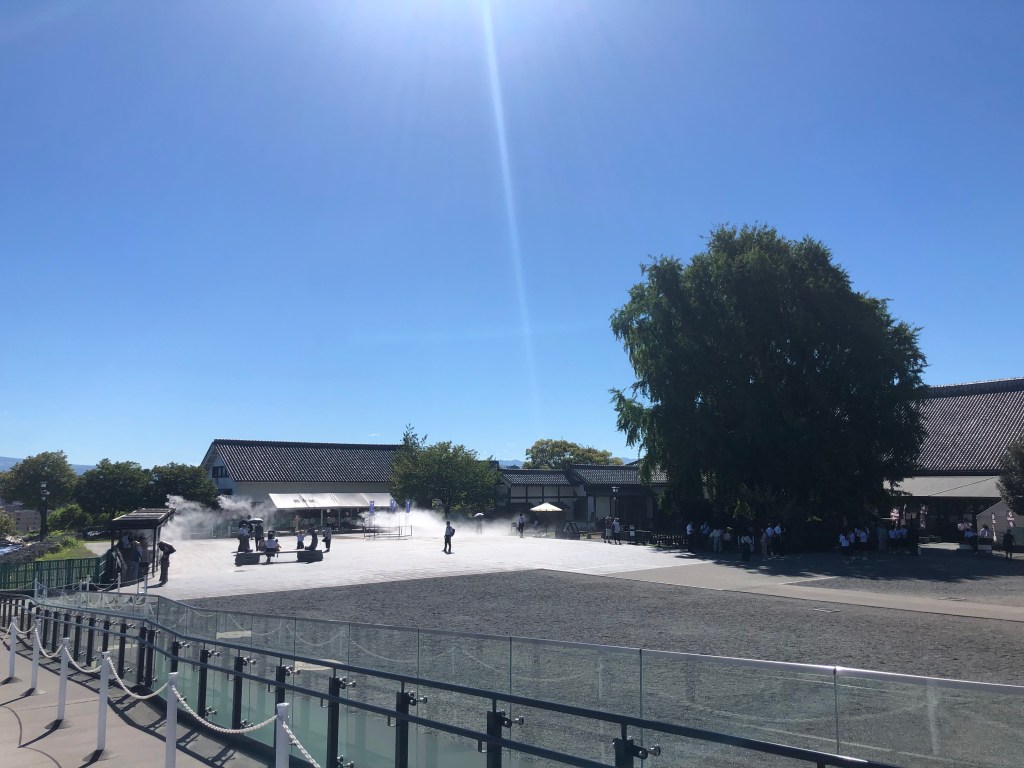
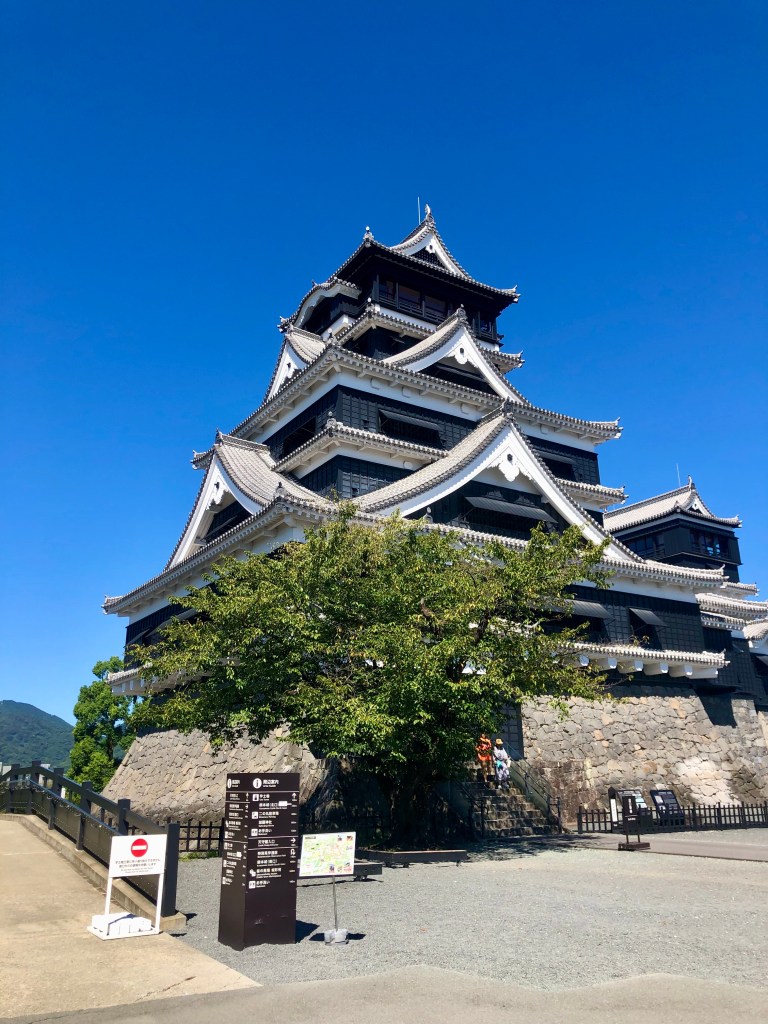
What we wanted to do was built around three substantial day walks, none of which we did. It was too hot. Over 35 every day, nearly 40 in Dazaifu. Look at these people in the yard of Kumamoto Castle:
a couple of defiant nongs out in the sun, the others huddled in the shade of the giant gingko, under shelters, umbrellas or basking in the vapour sprays. So we drove around in air-conditioned comfort having a jolly time, seeing things we wouldn’t have otherwise. I’d do all this again any time.
We flew from Tokyo to Nagasaki where we spent four nights in a really good hotel with a very large air-conditioned room, a first-rate breakfast and most congenial staff. This may have coloured my roseate view of Nagasaki. Don’t know. Then we got the train back to Fukuoka (had to return our car to the pick-up point), found Michael and went for a drive.
The Toyota Sentia Hybrid 7-seater convertible van: highest praise. If they sold them in Australia I’d give purchase strong consideration. Drove 900kms in great comfort using one tank and $4 worth of petrol. The $4 worth was to procure a receipt to indicate we had bought petrol. Might have been necessary, might not. But it’s Japan … always better to be on the safe side.
Kumamoto
We were really only going to Kumamoto so we could get to Mount Aso early the next morning.
But I knew that it had an impressive castle which had been substantially restored and when our plans changed, they included going to have a look and to ascend to the top storey which provided an excellent view of the city and its surrounds.
We left thinking you might find many other things of interest in Kumamoto.
And then Mount Aso …
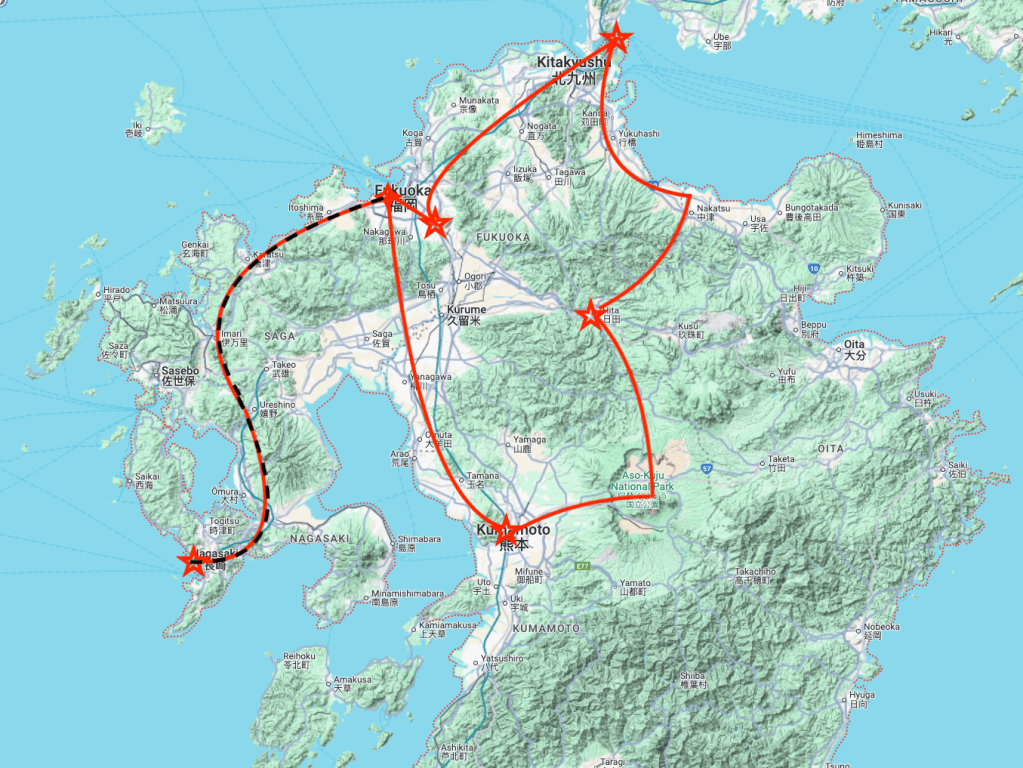
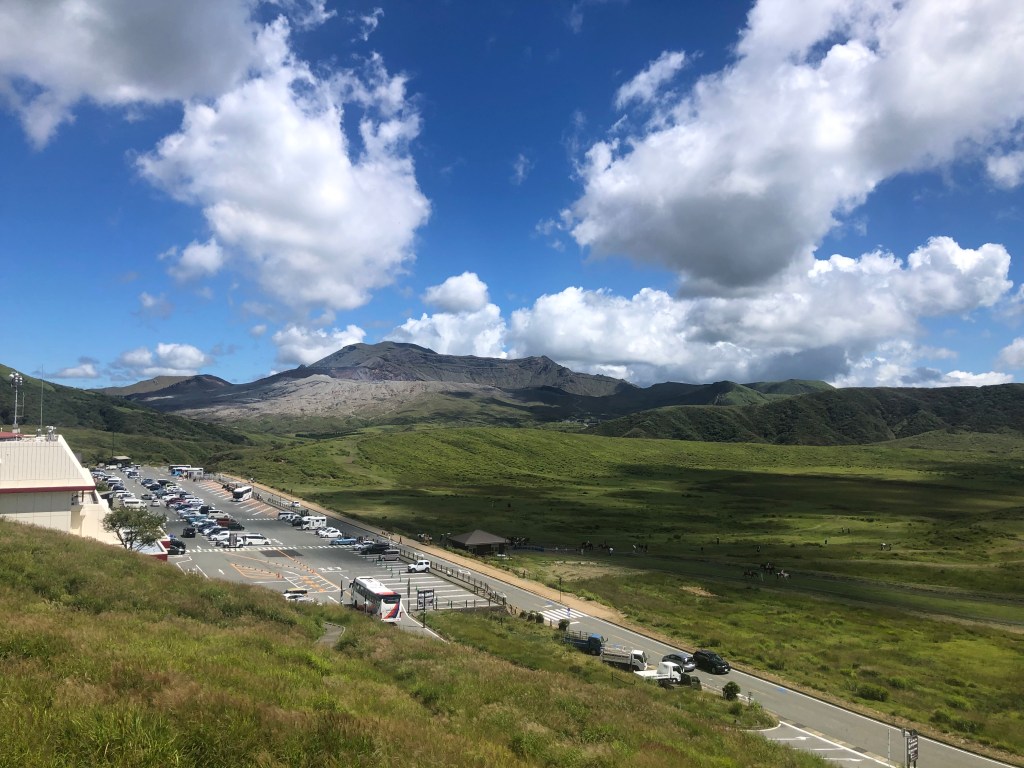
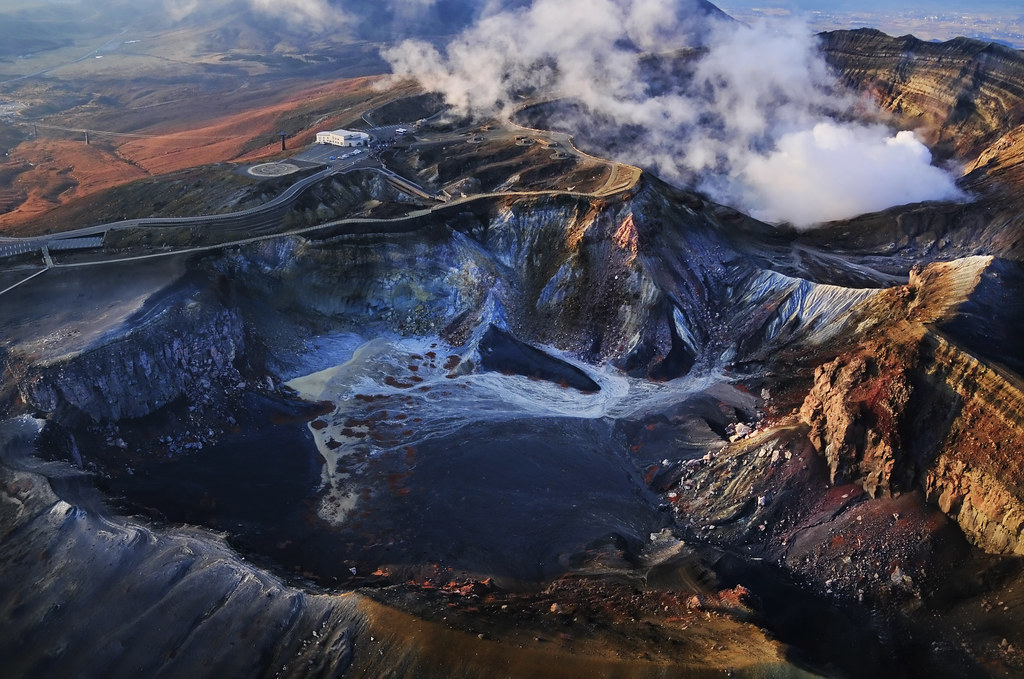
Mount Aso is the largest active volcano in Japan and among the largest in the world. It last erupted in 2021. That is to say, recently. Its upper reaches are dotted with masonry beehives for the protection of visitors should it be required. It has a very large caldera, the outer ring of what was there once and which has now collapsed, about 30 kms from one irregular side to the other. This is visible on the map further above. The elegant little cone to the left is to be found inside that ring.
Aso’s peak area is dramatically bare of vegetation, but there are several preparatory areas for leisure activity. We drove past a massive aggregation of cars on our way up and wondered why on earth they were there. It was a golf clubhouse. Look at the courses carved into its flanks. It is otherwise a national park. There was a well-patronised lookout, and then there was the comfortable party area with restaurants, cafes and horse rides (off to the right below).
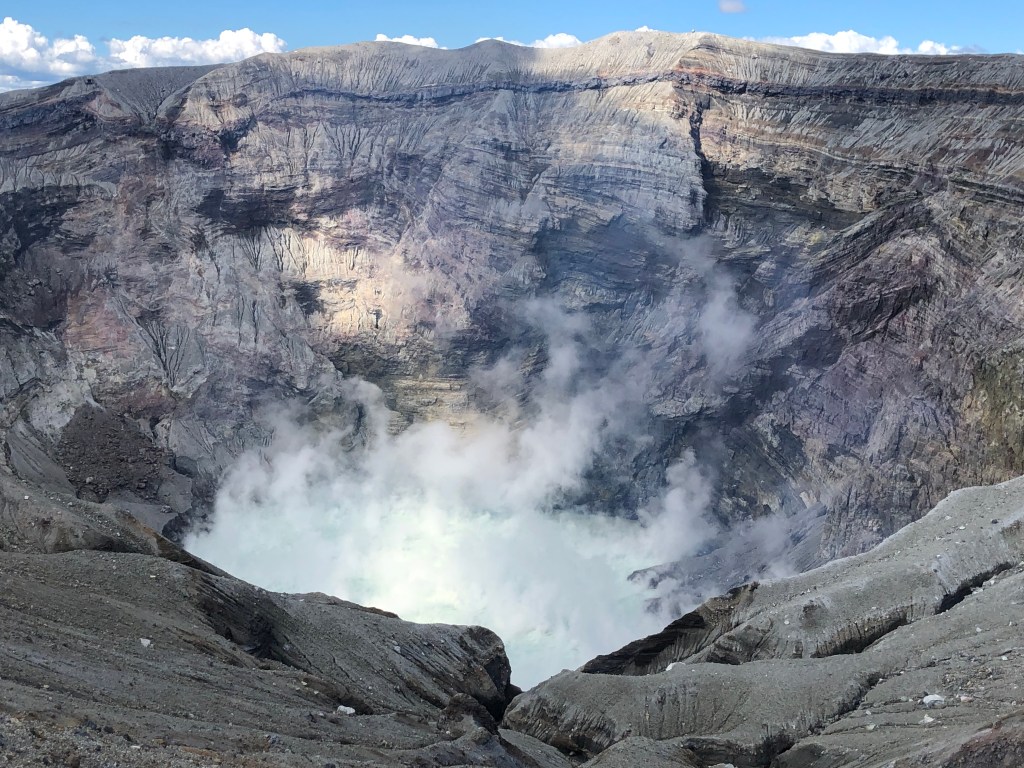
From the small off white spot in the middle of the photo above of the whole mountain complex it is possible, on payment of ¥500, to drive to another even smaller off-white spot to its left and, on occasion, to walk and climb Aso’s five peaks. Visitors to the upper reaches are rewarded with views of the bubbling sulphuric stew in the active crater.
They are also subject to a barrage of warnings both visual and aural in various languages which are especially for people with asthma, bronchitis or heart problems.
We were walking around the rim on the track closest to the crater when the warnings increased in intensity and were accompanied by arm-waving. It always does to obey warnings in Japan even if you don’t feel they’re warranted. Obedience is the priority. Several things happened at once. The air did seem to thicken up a bit. Then we started coughing. It was one of those things you don’t think will really happen. Nah … that’s just what they say, etc. But there WAS too much sulphur in the air and, after putting up the windows of the car rather sharpishly, we drove away.
Having driven across the caldera, we are looking across its paddyfields to the rugged hills on the other side.
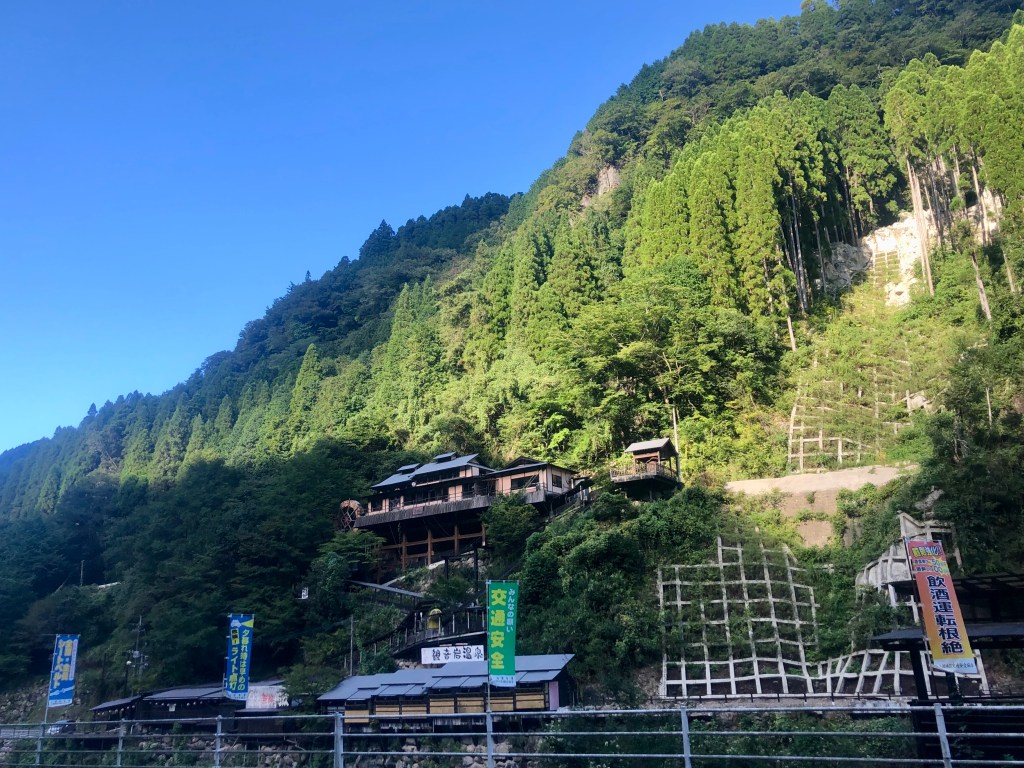
We were off to spend the night at Ukiha. It was a great drive, first through another national park and then along a series of river valleys. This (below) was an onsen establishment clinging to its hill next to some woven concrete holding that hill together. So much of Japan is beautiful but not much of it is untouched.
Ukiha
Why? Who goes to Ukiha? No one. This is one of those finger-on-a-map (to jump off to climb Hiko-san the next day; didn’t happen) and-then-find-suitable-accommodation moments. And in this, despite booking the wrong date, we were unaccountably successful.
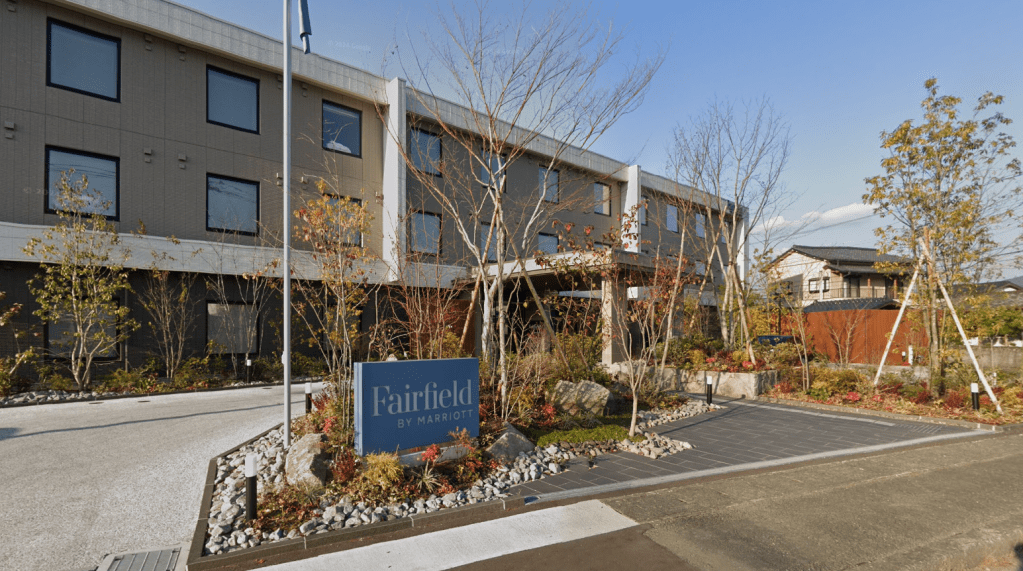
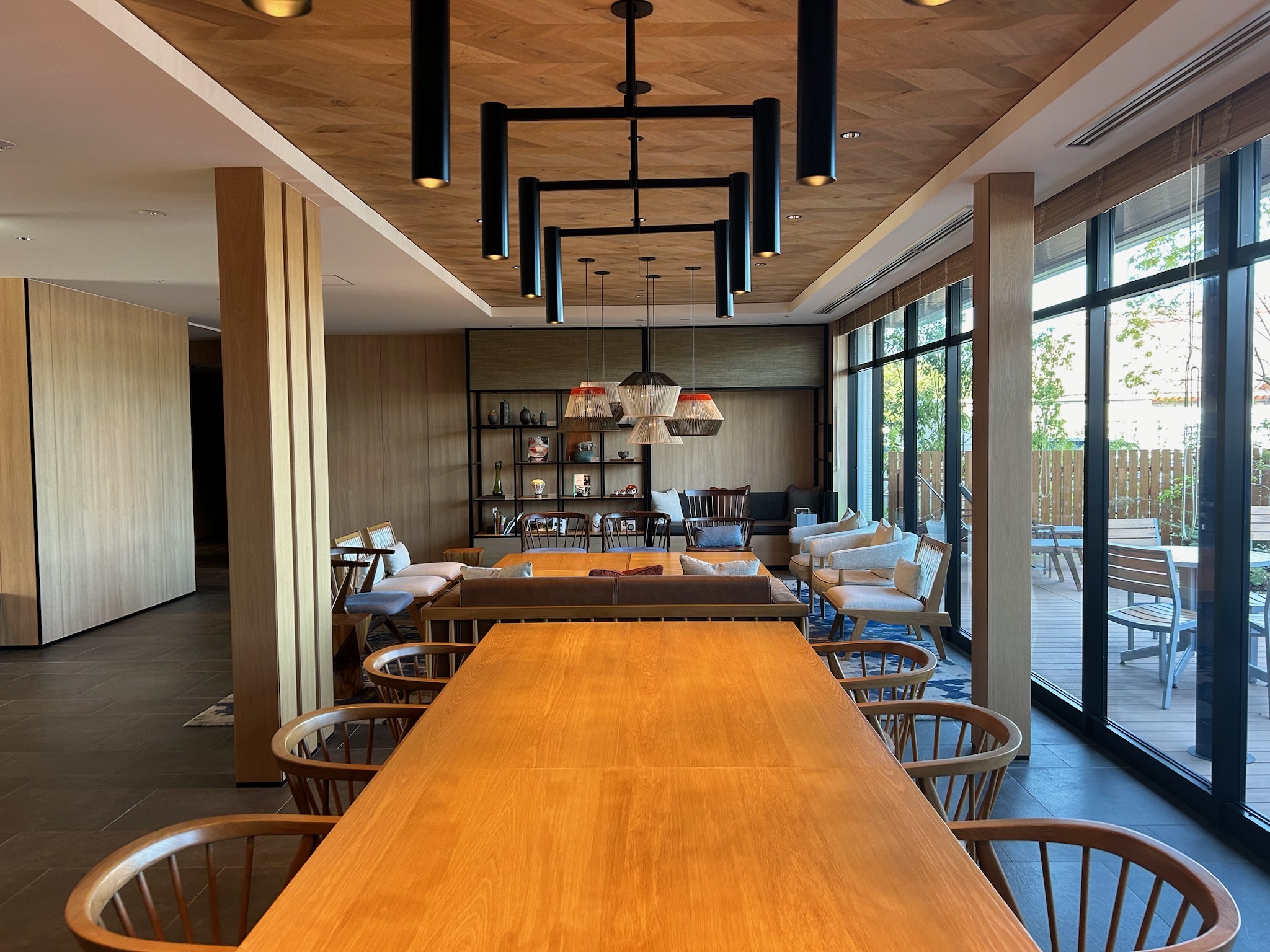
Brand new hotel, so very stylish in the middle of not very much, so much room to park the car (hoorah, always an issue in Japan), no food, but beer, a wide variety of chips and lollies and containers of formidably excellent grapes in the vending machine, several very nice places to sit and drink the beer, and wonderful staff one of whom was very excited to practice his English.
While they mightn’t have had food, they had excellent recommendations about where to eat. At their suggestion we searched for and found a fairly well hidden eatery (pictured below the two pleasant sitting places at the Ukiha Fairfield) and had what Myrna thought was the best meal of the trip. Severe Momma, dutiful daughter serving, husband cooking in a rather grotty kitchen. But oishi, delicious. And then for breakfast you could visit the farmer’s market which operated next door. You couldn’t identify much, only marvel. We did buy some nashis. I can’t remember what else.
It was round then I discovered we had been staying in an establishment, a Marriott hotel, owned by members of the Church of the Latter Day Saints. ‘Marriott International is the largest hotel company in the world by the number of available rooms. It has 36 brands with 8,785 properties containing 1,597,382 rooms in 141 countries.’ Its headquarters are now in Bethesda, Maryland but when it was founded by J. Willard Marriott they were of course in Salt Lake City. That’s what you can find out when you travel.
And you can also visit Ukiha’s Inari Shrine: you can climb 300 steps through 91 (and no, I have no idea why) torii to the entrance or, as we did, you can drive up. (There is another much more famous and heavily visited version of this near Kyoto.)
Inari (also applied to a type of sushi) means ‘rice harvest’ symbolising the idea of good fortune, blessings, something for which we should be grateful. It is a modest shrine but the hillside is covered not just with orchards — this is one of the fruit capitals of Japan — but also with what I imagined initially to be grave markers. They’re not. They’re posts with snatches of poetry written on them. ‘Looking out across the valley I think I see the distant spring blossom of Tsukushi (a suburb of Fukuoka an hour’s drive away).’ ‘Wearing a robe I was enveloped by the scent of my mother.’ ‘I fear the velvet night no more.’ ‘The full moon shines with brilliant light.’ That’s not something we have necessarily.
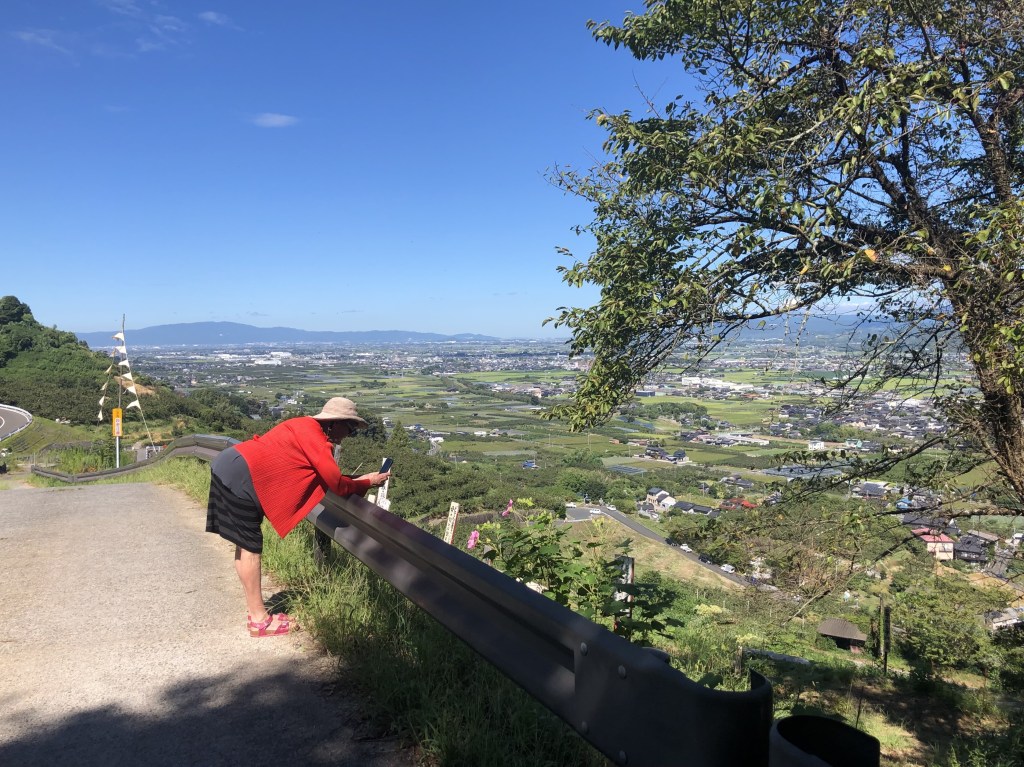
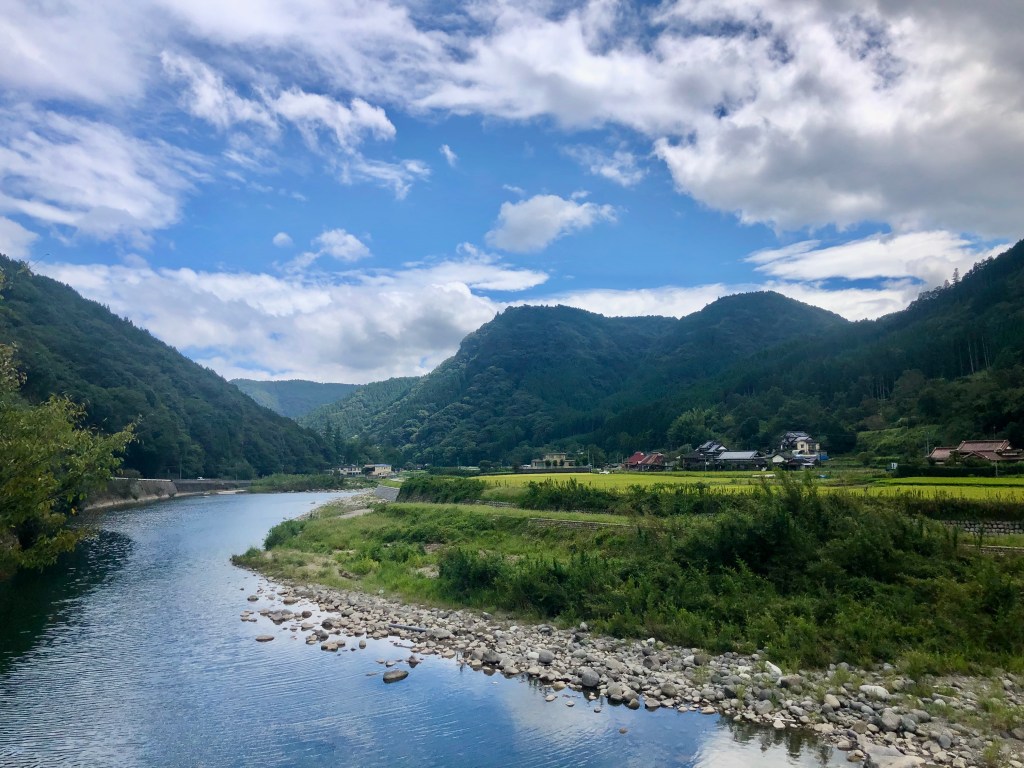
We determined that we would like to see the sea. There were murmurs about having a swim as it was still spectacularly hot. We found a road east along the Yamakuni River which provided satisfying spectacle around every corner.
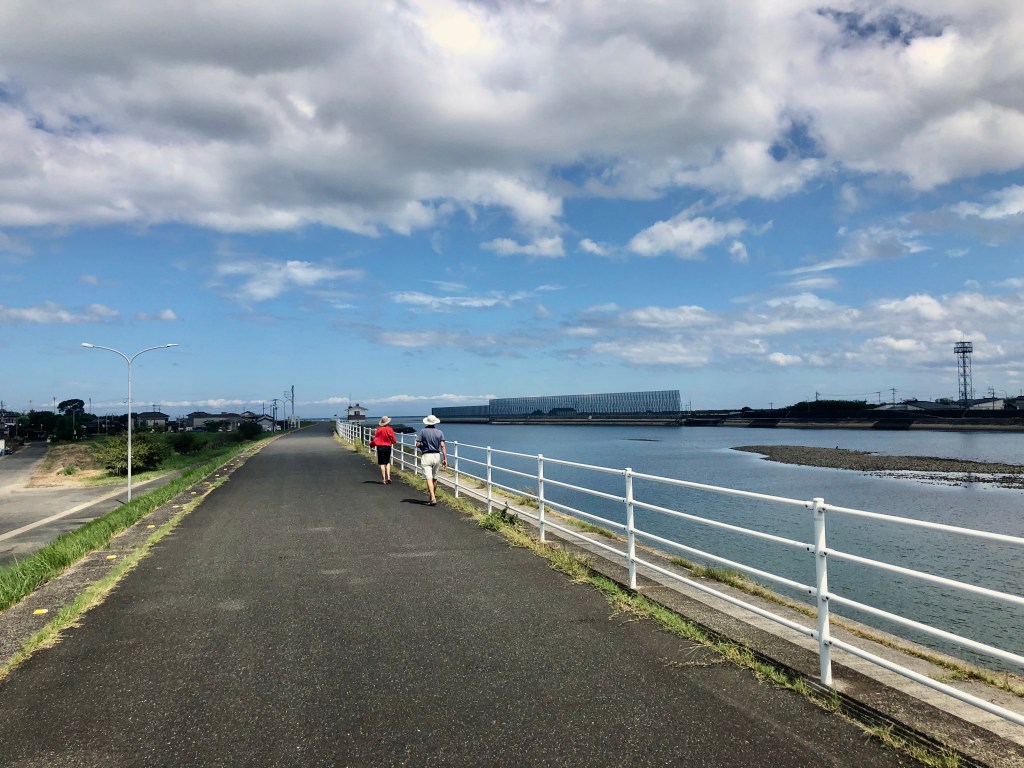
We found its mouth but no, not swimmable. Both banks of the river were built environments as they had been for 40-50 kilometres. But here there were sets of steps like tiered seating every 30 or 40m as far as the eye could see. What for? We also tried to imagine what could be behind the giant fences but couldn’t. It turned out to be a marina (with a complex of football grounds on the other shore). But again, why? Mysteries.
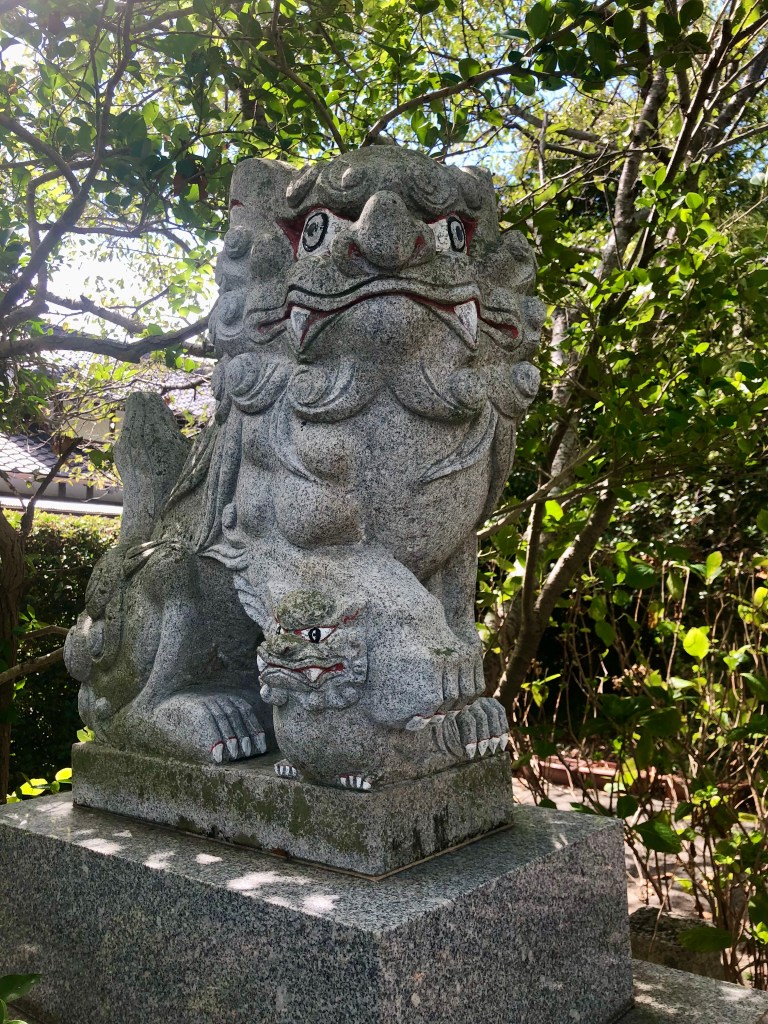
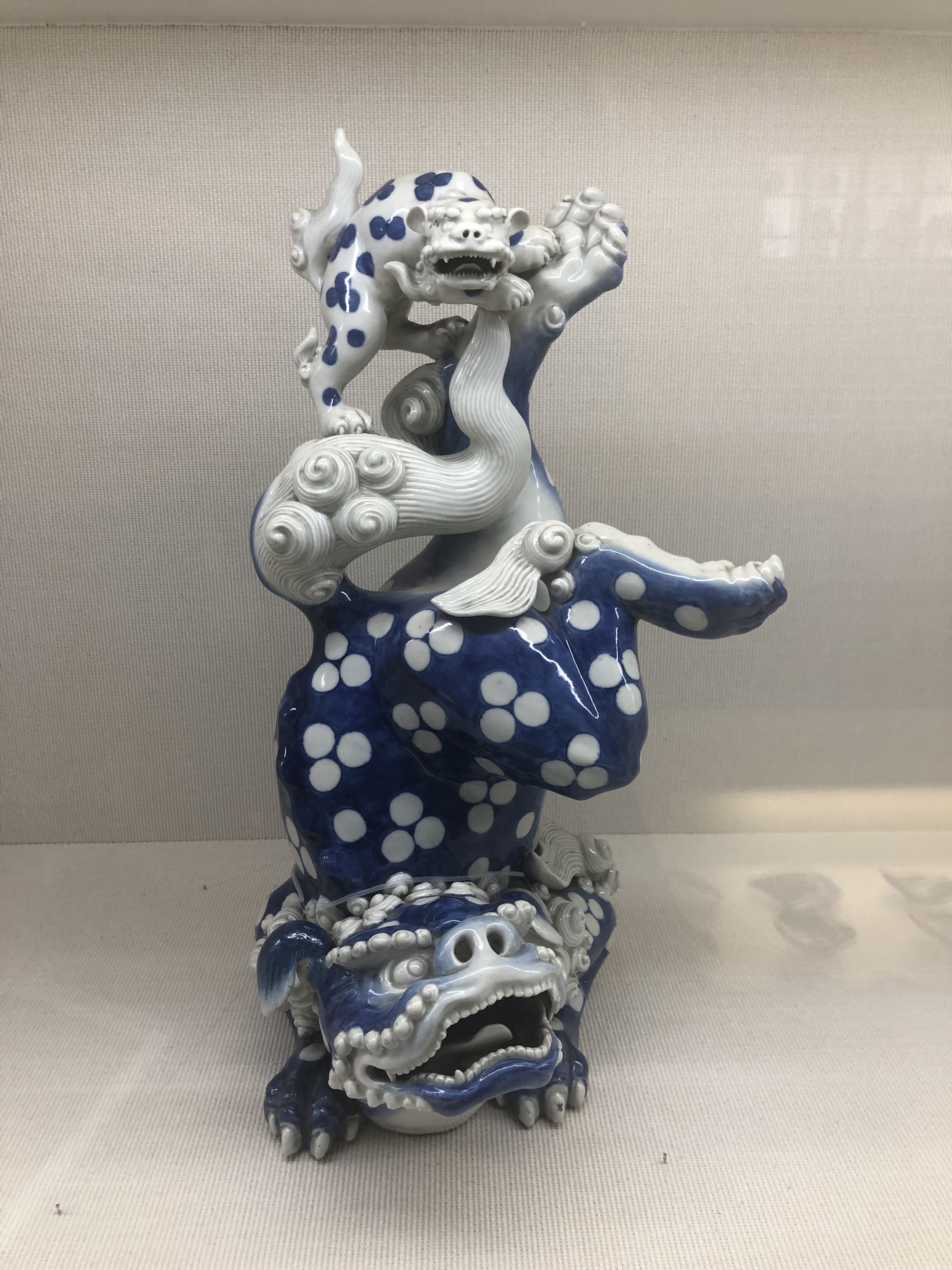
We had ended up at another shrine, Hachiman Kohyo, which has been in its present location since 535 CE. The mouth of a decent-sized river, … that could be enough to incite a shrine. And there it was. Insofar as it is famous — not very far, it is well out of the way — it is for its lion dogs.
It was this sort of neck of the woods really: another Japan. Just as interesting. (The words on the front of the Isuzu in for repair say: ‘earth-friendly environmentally-friendly people-friendly’.)
It was near enough to 3 in the afternoon and we hadn’t had anything to eat since our rather desultory breakfast (bananas and grapes I just discover). I thought I would provide a solution by finding the nearest coffee shop. It would be bound to have food as well. So we headed off to Umi-san (coffee and cheesecake) in the very very back blocks of Yoshitomi, imagining iced coffee with a great dollop of softu crema or something equally interesting in it. We’d drink that while consuming extra large slices of cheesecake.
We found Umi-san under a tarpaulin attached to a shed. He was so overwhelmed by a visit from Australians he was rendered close to immobile. He wanted conversation. Wanted to know where we’d been and why. All via Google which I was, I’ll say, too faint with hunger to operate effectively. He had no cheesecake but he could make us some coffee. But first he had to spend quite some time finding and lighting a mosquito coil. Very thoughtful of course, but we were starving.
It took him just on half an hour to make the coffee which appeared, actually very good coffee, with two ice cubes in it and nothing resembling dairy. Quite correct really, but the doctor hadn’t ordered that and was pretty disappointed. I drank what I deemed to be respectable amount, a respectful amount, of what we’d been provided with and we fled to a Lawson to find something with plenty of calories.
The Lawson. Along with the 7/11 and the Family Mart, staples of the Japanese consumer economy. But the Lawson … so very reliable.
Mojiko
We were on our way to Mojiko to stay at this hotel. The Premier. I had read, I think, that it was on an interesting site stuck out into the Hanmon Straits which separate Kyushu and Honshu and that it was nested in among an unusual collection of art deco or ‘Retro’ architecture as you will find it referred to. That turned out to be true.
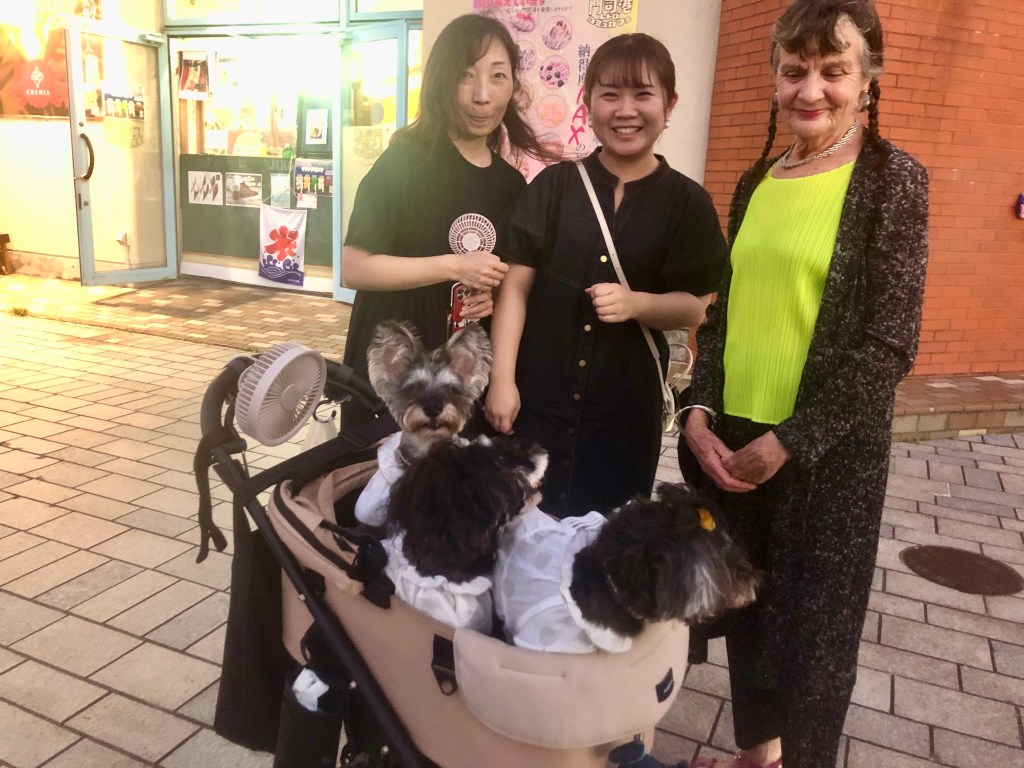
On our way to find some dinner I discovered these gals arranging themselves for a low-action selfie. They have found a boat named ‘Moji’, and they have managed to include the very ostentatious ‘Observation Room’ towering over the old Customs House. To the right you might just be able to make out clusters of lights and what might be marquees and canvas shelters. That’s what they were. We ate outside from a restaurant in the Customs House after strolling through what seemed like a dog fair with all things dog: prams, pushers, capes, hats, bells, bones, shark skin, dried meat, glow collars, anything you can imagine really, with several hundred perhaps a thousand dogs being catered for.
You may note their mmm dunno … dresses? their personal fan and the preparedness of the one at the back to have his or her photo taken.
There were beautiful buildings to contemplate.The former headquarters of the Mitsui OSK shipping company.
Breakfast suggested that there would be a story to be told about the hotel. It wasn’t overly expensive, mid-range I guess, but it was a place to take your family for a weekend away or a special occasion if you were a well-heeled member of the Japanese haut-ish bourgeoisie (congregations of whom are not always on display in Japan). And I think the highlight, the very special thing, about the Premier might have been its buffet breakfast. You could get simply anything, and if it wasn’t there they’d make it for you. I watched prodigious feats of eating, almost to the point of applause, especially by the younger members of the absolutely packed house.
But our schedule said Dazaifu, so Dazaifu it was.
Dazaifu
What’s a photo for Dazaifu? There could be so many.
The timber decoration of the Starbucks in the Baba Sando Line: this is so noteworthy it appears on guides as a tourist attraction. To its right the bustling throng is pushing their way forward for icy poles. They might have been plum-flavoured. The shrine that the customers were on their way to or from is surrounded by sacred plum trees. This was just a window in a wall near monster Japanese sweets cafes which were nearly empty. The owners had something going on.
Digressing momentarily, they were making equally popular plum cakes just a little further along the street via a sort of conveyor belt process. It would have been so incredibly hot where she was standing.
Continuing clockwise with the photos, the interior of Motsu Nabe, the restaurant in the bottom of our accommodation. Great food which could have been better if we’d worked out how to cook it properly (at the table) and decide when the cabbage went in. And then Myrna’s new Issey Miyake top on the shrine’s footbridge. An excellent colour match.
Could have been any of those; they all have stories attached. But I think this is the one.
Its existence saved us on several occasions. It is the interior of the Dazaifu Roll, an idea the specifics of which we never tested. More importantly a) it was air-conditioned, and b) unlike many of the other establishments in Baba Sando Line it was never crowded out, and c) it advertised and served excellent iced coffee.
The Baba Sando Line (just a street name really) is the major entrance way to the Tenmangu Shrine, a shrine of great importance, size and activity. The photo above is not mine because if it was it would have hundreds of people milling around in it searching for shade. The temperatures reached their apogee at Dazaifu, their zenith, their pinnacle, their peak, their apex. The energy bounce off that pavement was blinding.
Returning to the Dazaifu Roll, outside its door is the actual entry to the avenue of approach. But instead of dragons or lions or torii at the entrance to this holy collection of souvenir and lolly shops there is a takeaway yakisoba noodle joint on one side and the Dazaifu Roll on the other.
Dazaifu could today be considered an outer suburb of Fukuoka about 20 kms from the centre of the city. I thought staying there would be convenient for its Historical Trail, a half-day walk that sounded interesting. Because of the walk I knew that Dazaifu had been the seat of imperial power and the centre of politics and culture in Kyushu from the late 7th to 12th centuries — quite removed from Fukuoka — and that there had been a major complex of government buildings there, now in fairly modest ruins tended beyond any hint of authenticity. And I did know that it had an important shrine.
Dazaifu’s Tenmangu Shrine was founded in the 10th century. It is dedicated to Michizane Sugawara, a late 9th century politician and scholar who rose to pre-eminence at court. However, he chose the wrong faction in a dispute — probably the good guys — and was shamed and then banished from Kyoto 800 kilometres away from where we were. The ox pulling his cart brought him here … then, perhaps understandably, refused to move any further. Shortly after Kyoto was struck by a series of deadly storms and floods attributed to Michizane’s powers and there was a fairly hasty revision of his status. By imperial order he was renamed as ‘Tenjin’ or ‘Tenman’ and worshipped as the Shinto god of literature and learning. A shrine was subsequently built here, the head shrine of 12,000 Tenmangu shrines across Japan.
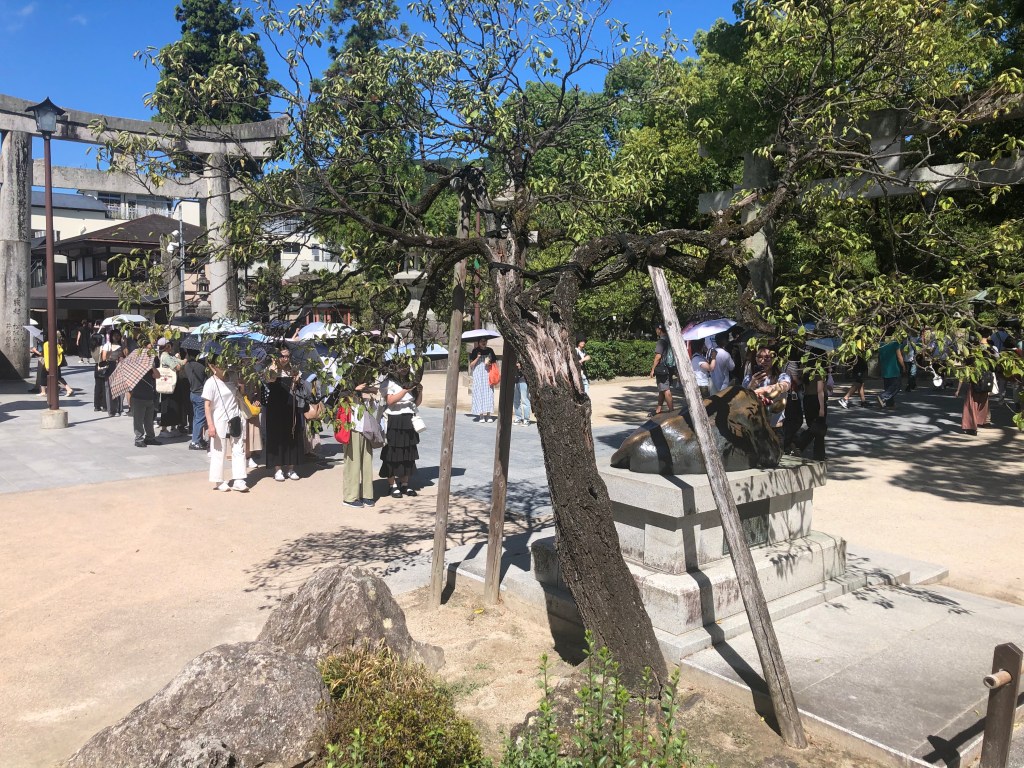
Almost guaranteeing popularity, one of Tenjin’s areas of oversight is success in exams. People here are lining up to rub the nose of a statue of Goshingyu, the ‘wisdom ox’ who decided to camp here, and to say their prayers possibly turning a C into a B+. In the foreground is one of the sacred ume (plum) trees, Tenjin’s favourite fruit.
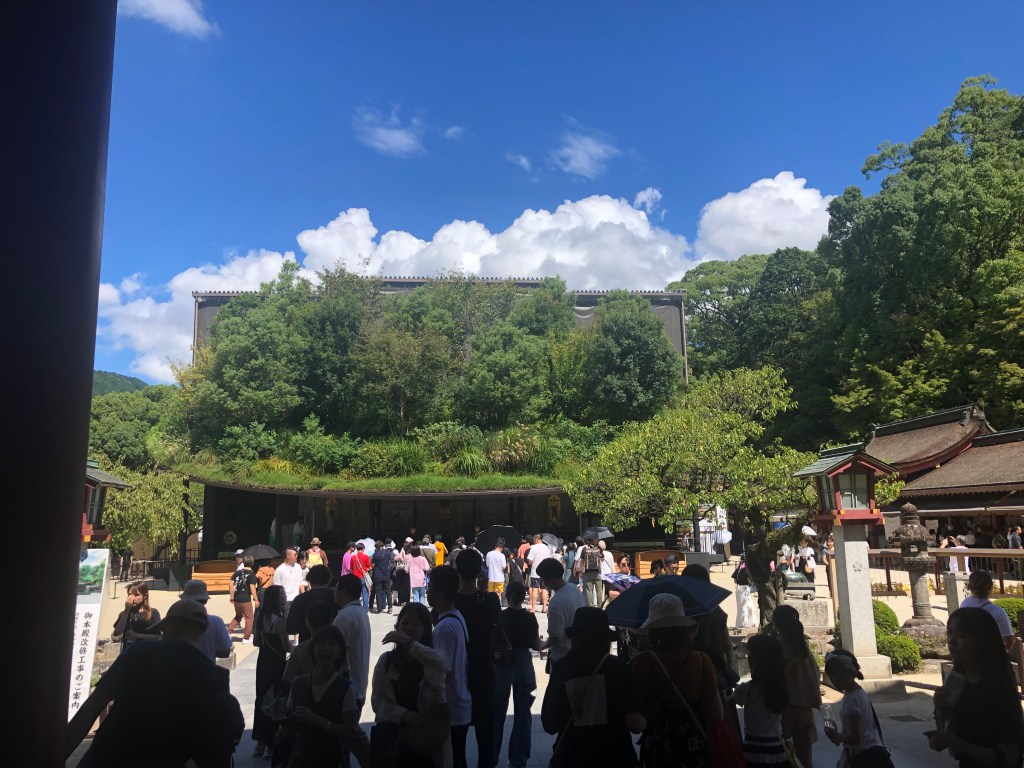
The ancestor of one of these trees, mid-ground right in the photo, is believed to have flown here from Kyoto such was the power of the master and his poetry. The other feature of this photo is the rather dramatic thicket of vegetation growing on the roof of this temple building. It has its own story.
‘In 2027, the shrine will hold the 1125th anniversary of the Grand Ceremony of Dazaifu Tenmangu. This commemorates the death of Sugawara Michinzane, a scholar and government official who is now enshrined as the deity Tenjin.’ (Not sanctification note but deification; that’s different and worth thinking about.) ‘The main sanctuary of the shrine is undergoing extensive repairs, the first for 127 years.’ A ‘temporary residence for Tenjin’ has been built to last for three years while the work is completed. ‘It is crowned with a “floating forest” teeming with diverse plant life that transforms with the changing seasons.’ That’s the ‘floating forest’ you’re looking at.
Staying with trees, which we were that day, sacred and otherwise, here is a cedar old enough to have its own devotees.
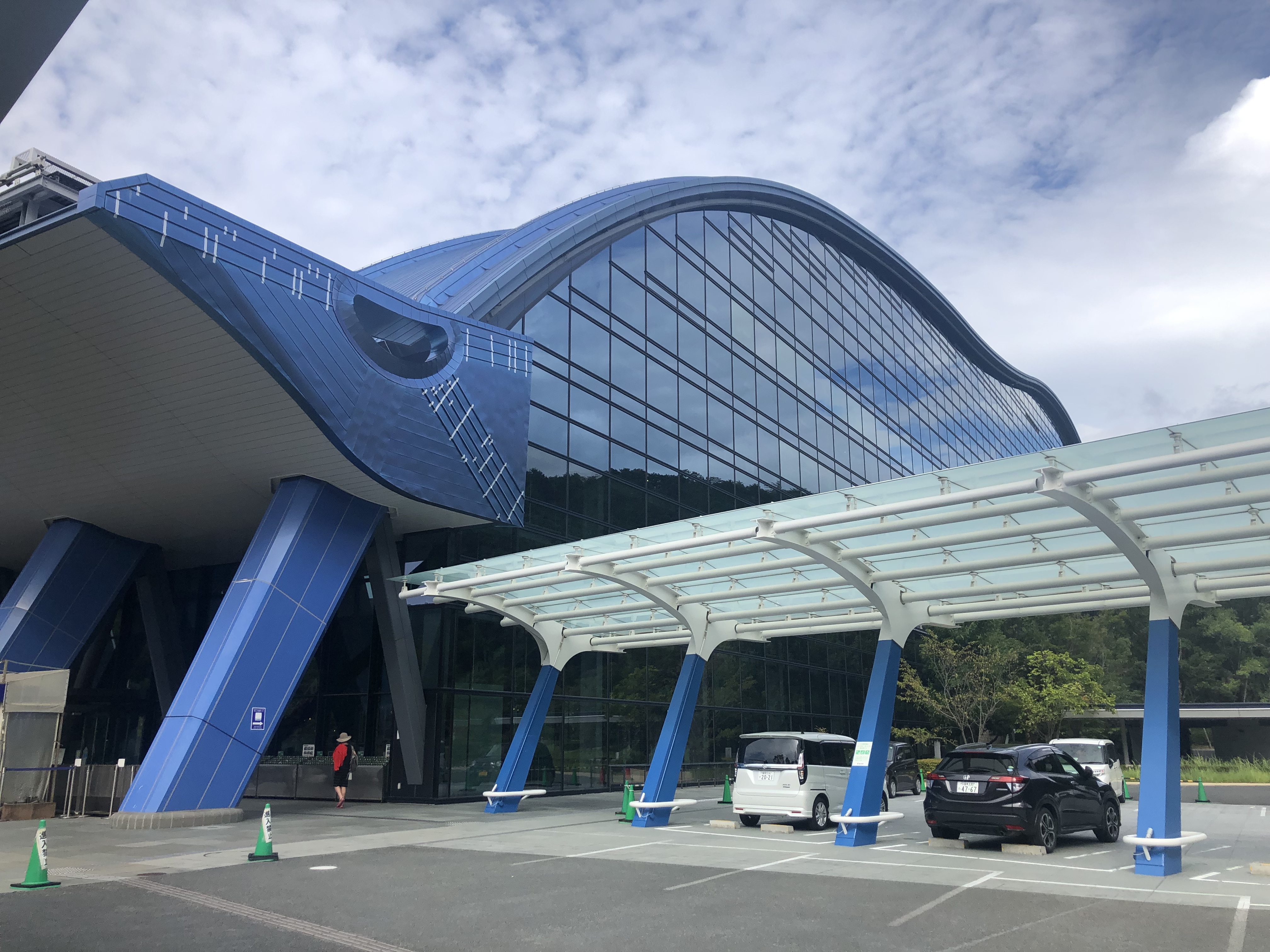
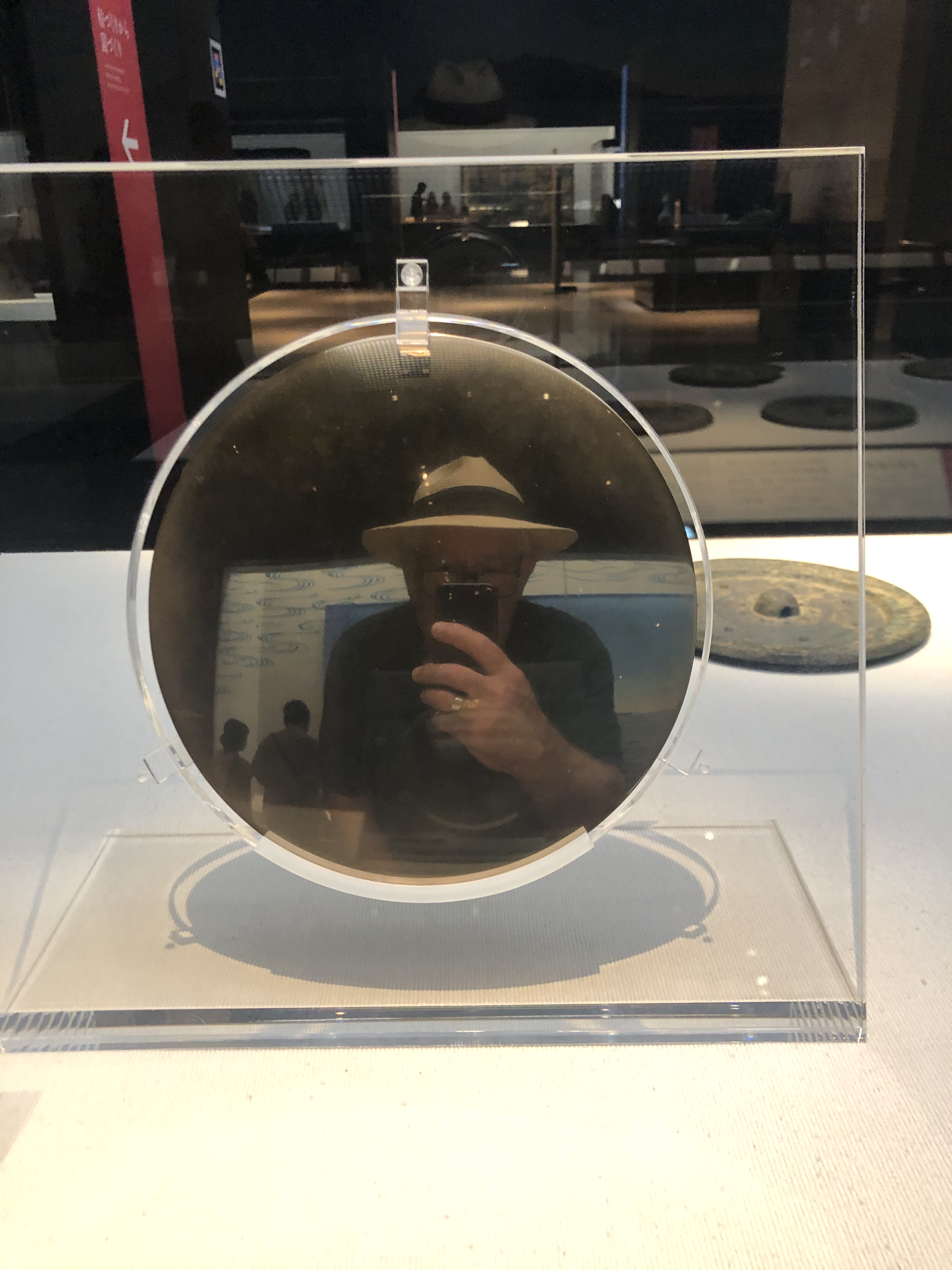
Another reason to visit Dazaifu is the Kyushu National Museum, the terminus of the Historical Walk. Its remarkable waveform is built into the hill above the Shrine. It was full of treasures one of which was a brass mirror, something I’d never seen before. To the right rises Sonic Apartments, a satisfyingly exotic place to briefly call home.
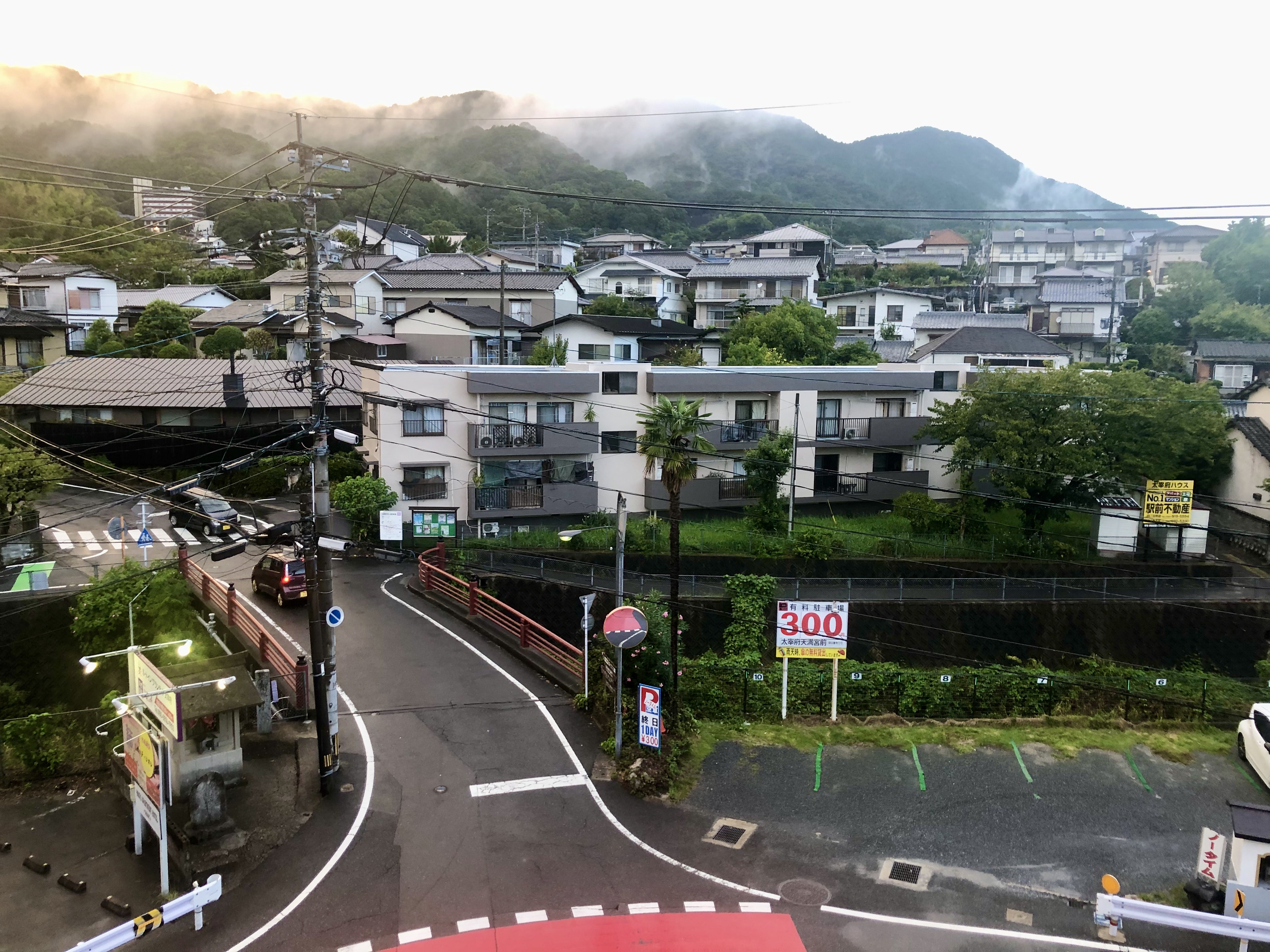
A couple of hours separates these photos from our window. In that time it had rained, the temperature had dropped a few degrees and the cost per hour at the car park had fallen ¥100 (1 AUD) an hour.
Fukuoka
We took the car back, a small matter, and then walked 12 kms around Fukuoka, a larger one. The art gallery was closed so we walked around Ohori Lake and watched these cormorants with their throats flapping and click-clacking as they tried to manage the heat.
• • • • • • • •
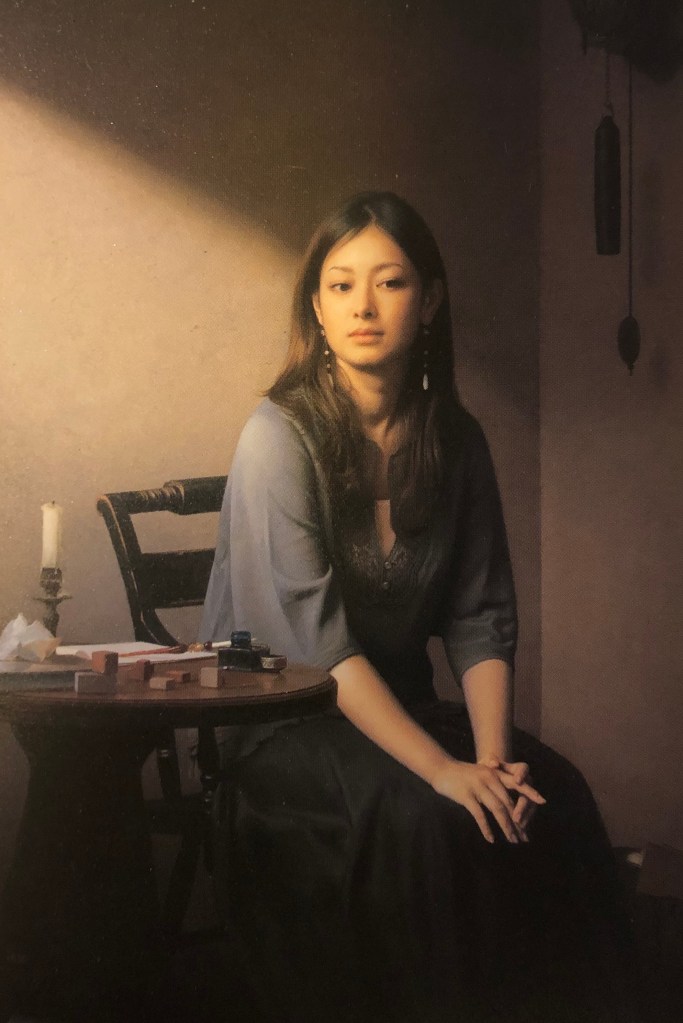
This is a digital rendering of a photo of a postcard of an oil painting. So you couldn’t say you were seeing it at its best. But you still might infer that it is a very attractive piece of work. The artist is Hiroshi Ikushima but as far as I know it doesn’t have a name.
What could it be? What’s going on here? She is preoccupied well beyond her modelling. Her hands suggest it is not a vacant, even an innocent, pensiveness. I think, perhaps, that odd combination of uncertainty and guarded determination of a woman in conditional love. But the symmetry of her features and her unquestionable beauty take the edge off that anxiety. Or do they? I’m not sure.
It was in use as the poster for an exhibition of art at the Fukuoka Asian Art Museum, an exhibition which was devoted not so much to Asian Art as examples of stunning achievements in realism.
You could grate the peel coming off the lemon below.
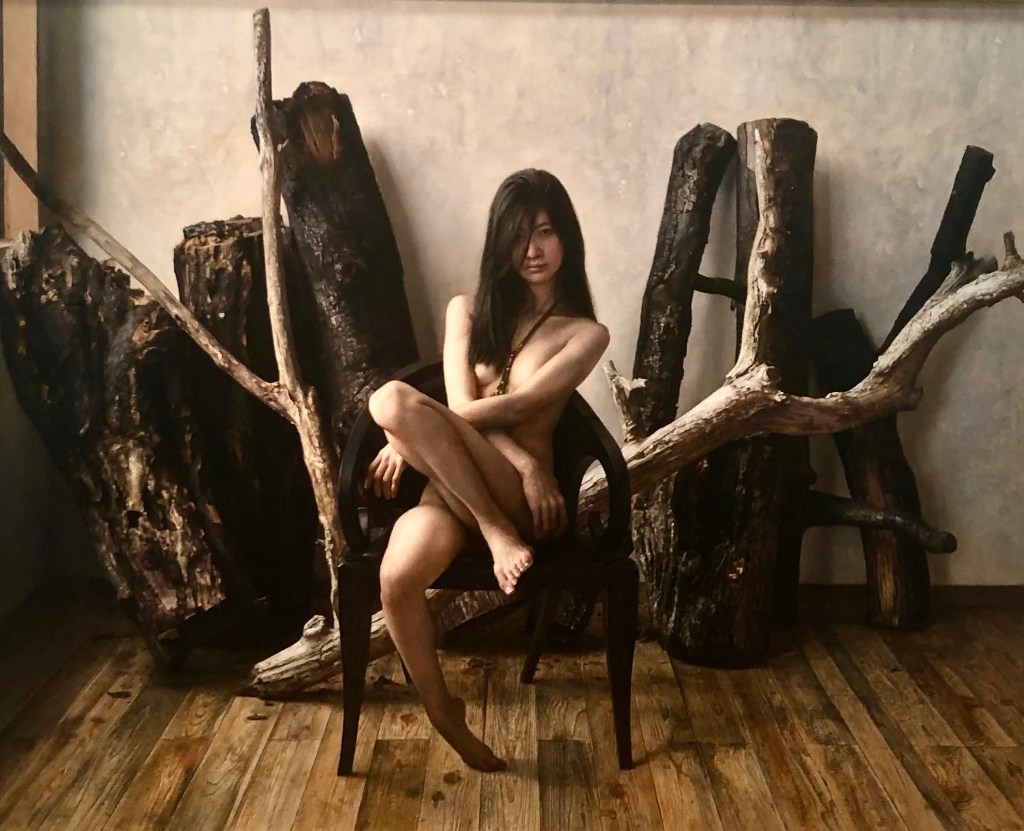
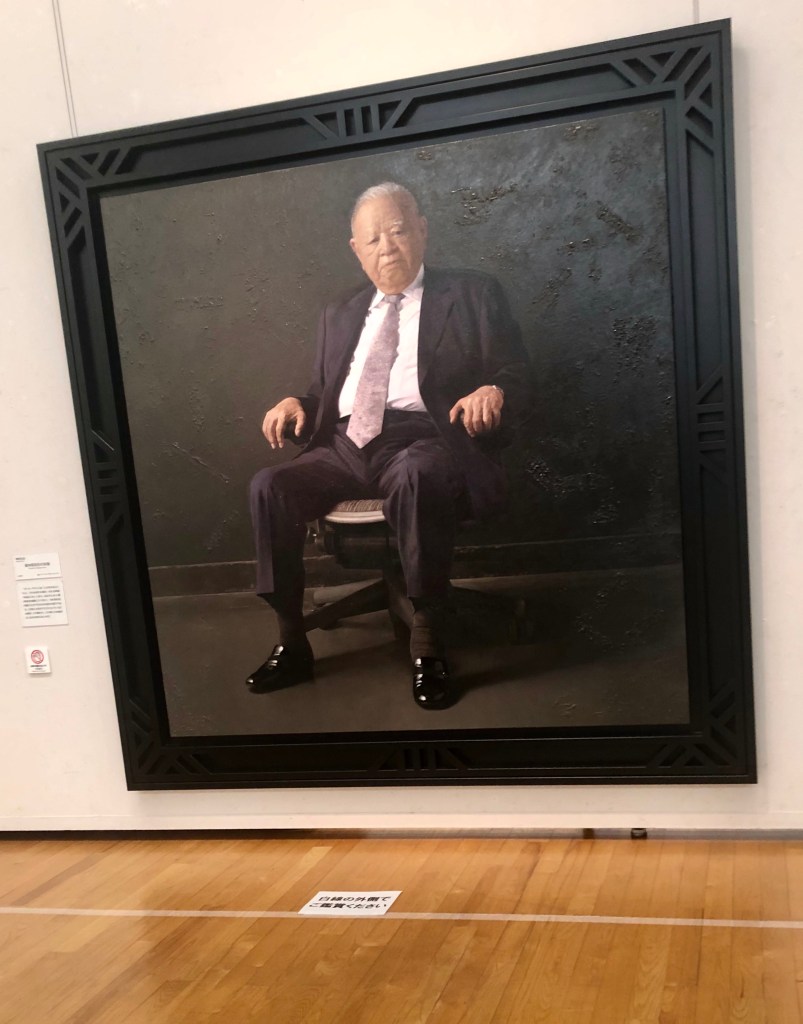
However as we got further into the exhibition things took a turn: the young women had fewer clothes and the men looked creepier.
That was characteristic of our experience at the Fukuoka Asian Art Museum. Closed at 6.00, we arrived at 5.15 and were encouraged to buy unusually expensive tickets to two exhibitions discovering at 5.28 the second one had packed up and shut the doors. Turned around, and so had the first one.
One reason why we arrived so late was that we stopped to have some sustenance. The Tomoyasu Cafe and Burgers provided genuinely outstanding thickshakes. But it was the other customers a few tables over who caught my eye. A couple, perhaps mid/late 20s. She was wearing a kimono and was perfectly made up. Perfectly. Like a very high end ad. Sometimes this sort of costume is complemented by one or more stray wisps of hair. Not in this instance. She was also strikingly beautiful. Startlingly. Like something off a film set. In my journal I’ve described him as roughcast, and I think that would be appropriate. A tradie who has washed up after work but not much more: jeans, slippers, T-shirt. They’re on a date but I’m not quite sure what type. It is 4.30pm … and it is taking place at the Tomoyasu Cafe and Burgers. She’s having a parfait. He’s having a burger. She’s doing most of the talking, bright but not familiar. She takes selfies that are hyper-organised, using a (clean) spoon, for example, as a prop. She could be very young but she has a throaty gurgle for a laugh which suggests that, regardless of her age, she probably isn’t. I couldn’t possibly take a photo. It may have a been a commercial transaction we were watching. At 4.30pm … in the Tomoyasu Cafe and Burgers.
• • • • • • • •
Fukuoka is known for its yatai (lit. ‘shop stand’), street food served from pop-up boxes, suddenly there and later suddenly not. We were a bit early to encounter the full schmeer, but we dutifully sat here and ate yakitori and oden, a mystery dish that we were assured was vegetarian. (Footnote: ‘boiled eggs, daikon or konjac, and processed fishcakes stewed in a light, soy-flavored dashi broth.’) Drank beer, memorably good on a hot night. It was all good. We were having An Experience.
We’d been summoned by a very lively tout who spoke bits of at least Russian and Chinese as well as English and knew enough about Australia to make a joke about Melbourne and coffee. When we left he said, ‘Copacetic?’ And I said, somewhat bemused and in the nicest possible way, ‘Yes. Most certainly.’ Copacetic! Extraordinary.
If copacetic brings anything to mind it might be well-built American sophomores in the 1920s or 30s, men never women, wearing large lettered jumpers exchanging agreement about the very positive nature of something. Anything. Jay Gatsby might have said it when Scott Fitzgerald wasn’t listening. It may occur, expressed hopefully, in Tender is the Night from the mouth of one of the more troubled characters. It is not something you hear every day, now or then. Neither William Faulkner nor Ernest Hemingway would have had anything to do with it.
Merriam-Webster describes it ‘as probably better known for competing theories of its origin than any other word of everyday use in American English.’ It appears in a 1919 novel about the young Abraham Lincoln. It might be like a term from Acadian French from Louisiana, coupe-sètique, which is of course only a breath (or a pee) away from meaning ‘septic tank’. African-American tap dancer Bill “Bojangles” Robinson (1877-1949) used it in radio broadcasts during the 1930s and claimed it as his own.
Copacetic. He said it. A hot night on the banks of the Naka River. Unprompted. And he was right. Copacetic.
• • • • • • • •
Just as it was sliding into its dock before taking us to Okayama.
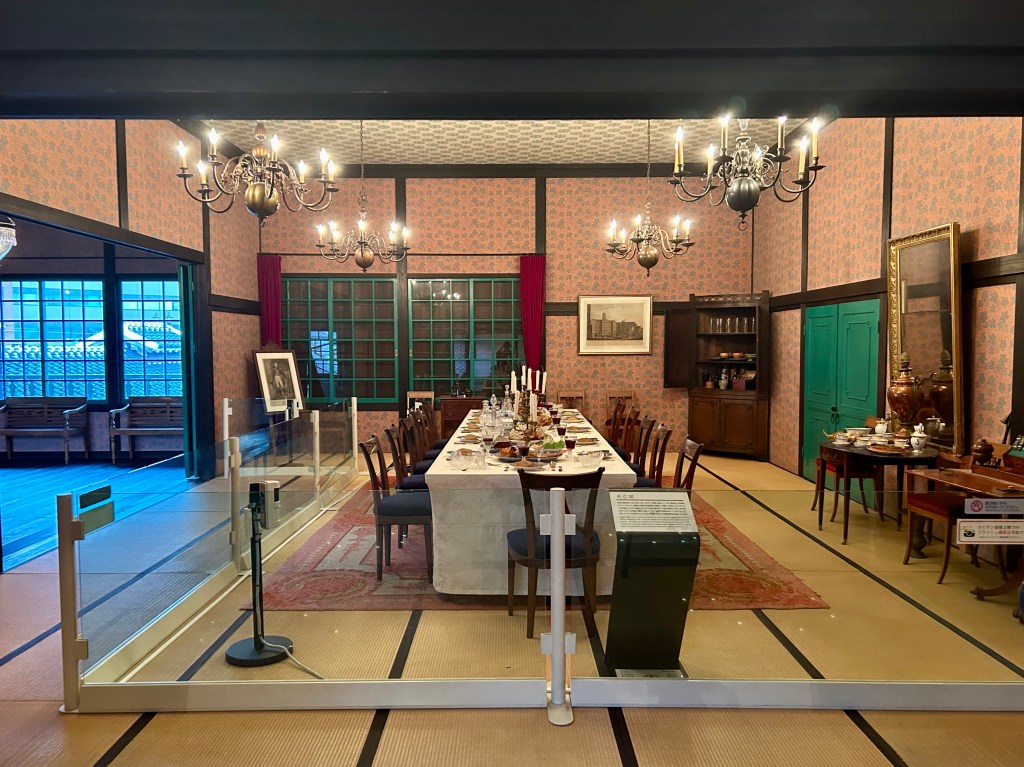
In the woodcut above it is the Dutch flag flying over Dejima (‘exit island’), an artificial island barely attached to the city of Nagasaki which on completion in 1634 was about 120m long and 75m wide. That elegant curve was shaped by its junction with the Nakashima River at its outlet into Nagasaki Bay, a traditional landing place for ships. At the right hand end it has a sea gate. It is connected to the mainland by a modest bridge that had a guardhouse at each end.
Two years earlier the Tokugawa Shogunate required 25 local merchants to build the island as part of a project to curtail the spread of Christianity and what was seen as the predations of Portuguese merchants (and missionaries) while still enabling a trickle of bilateral trade. After some muscular diplomacy and an undertaking that there would be no dabbling in any sort of religion, the Dutch East India Company was chosen to be the responsible partner.
As well as the major staples of trade, Japan was introduced to beer, coffee, chocolate, sundials and astrolabes, tar-based paint to caulk ships, badminton, photography and many new foods including cabbage and tomatoes through the sea gate of Dejima.
For just over 200 years at any one time only about 40 people lived on the island, 15-20 of them Dutch half a world away from home, supervised by around 50 Japanese officials some of whom lived on the island which was also visited by cooks, carpenters, interpreters and other essential workers.
There were no Dutchwomen there. Yūjo (‘women of pleasure’) were included among the essential workers.
Kawahara Keiga documented life at Dejima in the early 19th century in hundreds of paintings of which this is one.
The Dutch officers could, and did, eat right here most nights.
Once a year only they left the island to go to Edo (Tokyo) to pay tribute to the Emperor, of the material as well as ceremonial kind. To glam these annual events up the Dutch sometimes included exotic animals: an elephant, a cassowary, a leopard, and on one occasion a camel.
Dutch East India trading ships would visit — on average, it did vary — just twice a year in May and June, the season of favourable winds. During the years Napoleon controlled the Netherlands no ships came. For Hendrik Doeff, the Chief Factor during this period who ended up living on Dejima for 17 years, this must have been an existential puzzle. (From his log: ‘Nobody who is not here in person can imagine our state of mind. Separated from all community, attached to a place which is never visited let alone passed by ships, not knowing, not hearing, not there, in the whole other world going on outside.’)
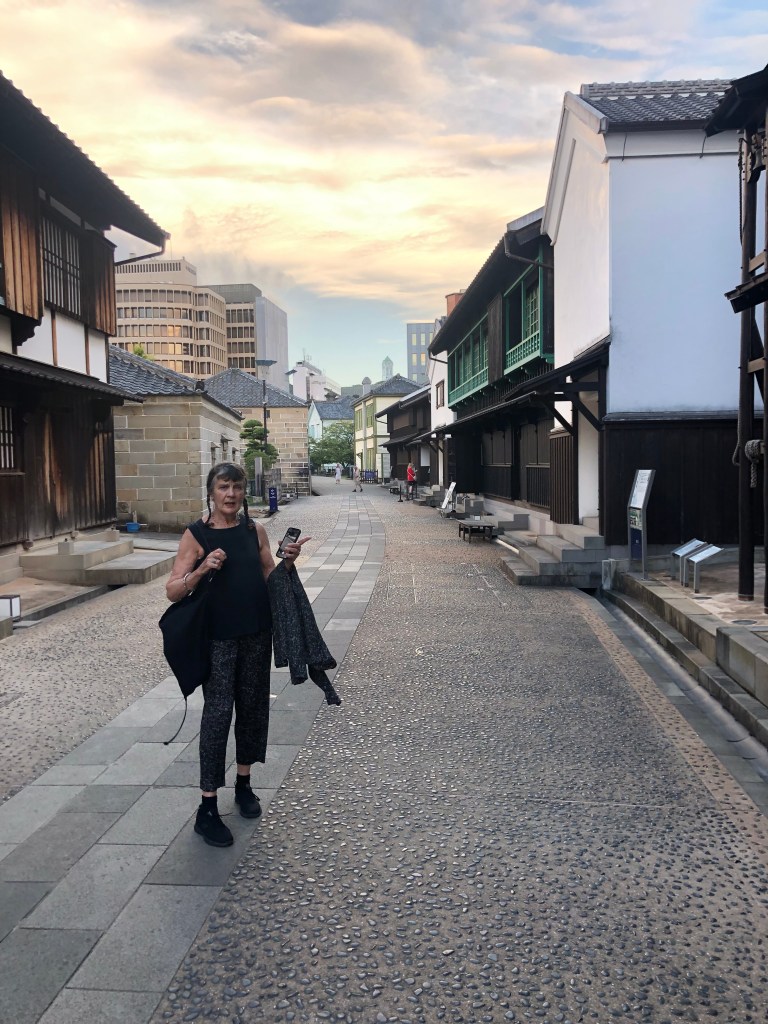
Dejima is now embedded in city buildings and surrounded by office blocks and shops with a strip of restaurants calling themselves ‘Dejima Wharf’ between the island and the bay. 18m was carved off the inner curve in 1888 as part of a diversion of the River. Today, from one angle, it looks like this.
From another, like this.
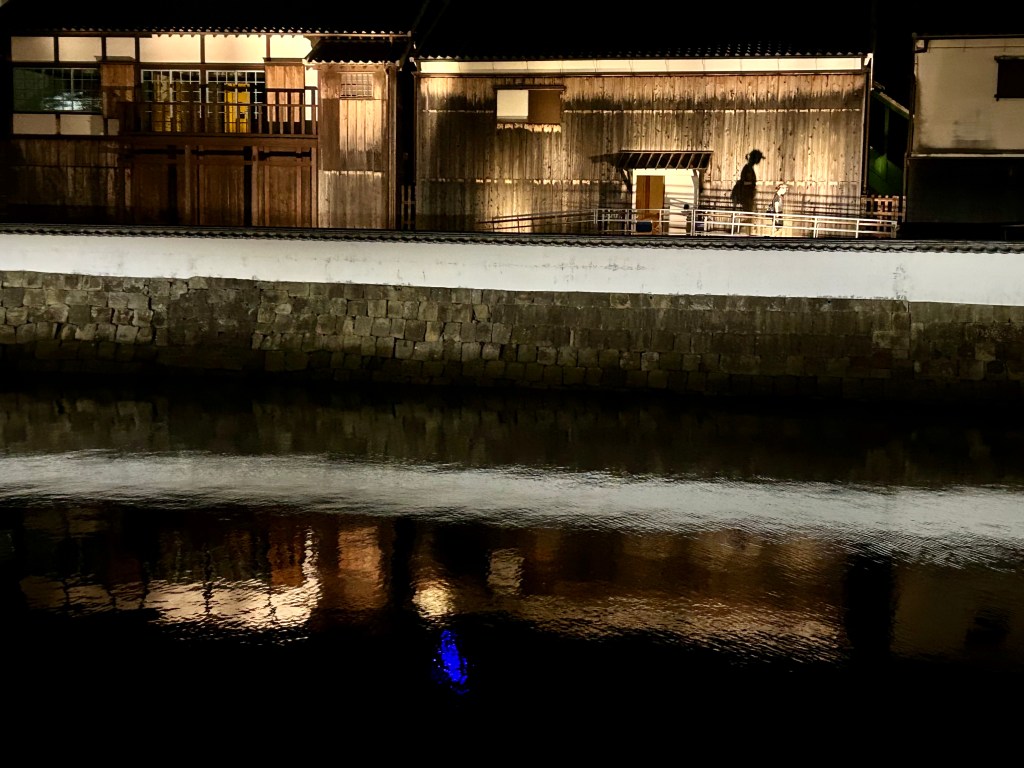
And this, I think, is my favourite photo from our trip. Taken by Myrna. It is a shadow as well as a figure against one of the Dejima warehouses. And I don’t know where the blue flash came from, but there it is.
• • • • • • • •
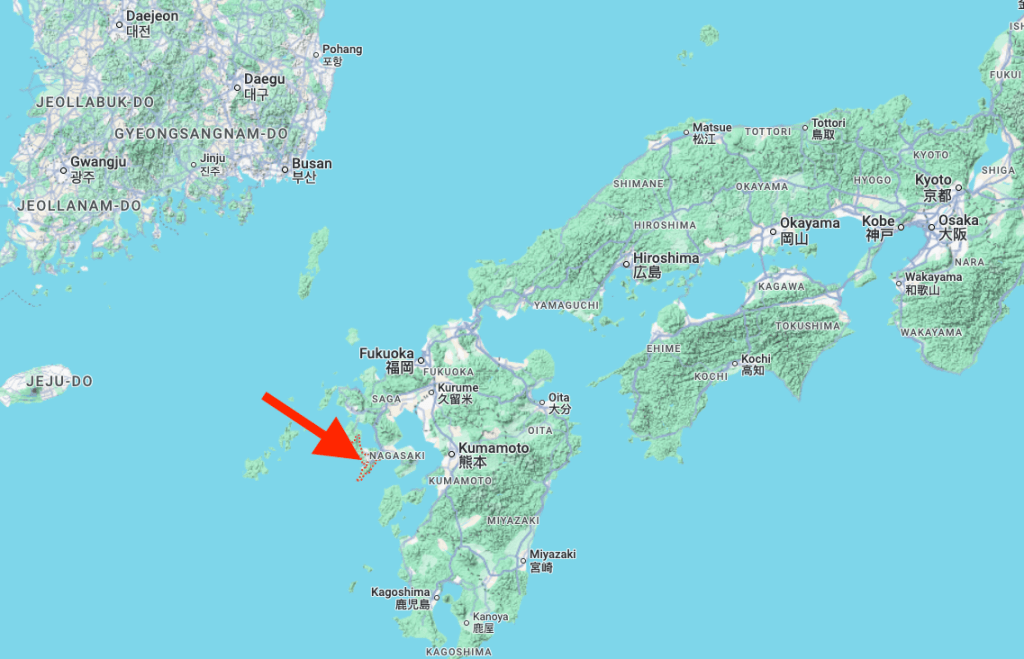
Dejima is a fertile place to start talking about Nagasaki, a city full of important stories and a great place to visit. Known largely in the west as one of the sites for exploding an atomic bomb, it is so very much more.
The city streams, long and narrow, down the valley of the Urakami river. Its population today is about 430,000, not big for a Japanese city. It was about 240,000 in 1945 when the bomb was dropped. It has a substantial and sheltered deep water harbour with industry at various scale lining its western banks. (Massive ship yards with a giant gantry on the left.)
It has always been a place where things were made: Japan’s first porcelain and glass, metal filigree and silverware, textiles and lacquerware as well as steel, machinery and armaments. This is one consequence of its location: the obvious first port of call for contact with China (silk, ceramics and lacquerware), Korea (glass) and later for European traders (the filigree and other products associated with precious metals).
You would have to assume it has always been cosmopolitan. It is a city at the edge. Edge cities … oddities like the sale aisles at Aldi — surprising enough to throw you just slightly off balance, but comfortably embedded in their own context. Nagasaki has distinctive flavours and shapes very much of its own. Customarily, there are regular attempts to rope such cities back into the mainstream. That adds to their character.
It also has an unusual religious history.
The Jesuit priest St Francis Xavier was the first Christian missionary to arrive in Japan (in 1549), first at Kagoshima in the south of Kyushu but then, more productively from his point of view, at Nagasaki and Hirardo in its north. He had matched tenets of Christianity up with aspects of Buddhism and persuasively evangelised in these terms. Hundreds converted to this version of religion quite quickly, expanding into thousands over several decades (possibly to 300,000 by the end of the 16th century; most of the inhabitants of Nagasaki for example). One of these converts was the daimyo (magnate, overlord) Omura Sumitada who in 1580 vested control of the Nagasaki prefecture in perpetuity to the Society of Jesus. Remarkably the Jesuits had their own substantial administrative region in Japan. Just think about that.
This didn’t last long. Toyotomi Hideoshi, the ‘Great Unifier’, placed the Nagasaki region under his direct control in 1587 and ordered the expulsion of all Catholic priests. He had the example of the Philippines to consider. It was not paranoid to assume that Augustinian and Franciscan friars had paved the way for the colonisation of those islands by the Spanish. In 1596 a Spanish ship, the San Felipe, had foundered on the coast of Shikoku. Those on board, including Catholic missionaries, rather foolishly suggested that they were the precursors of a much larger Spanish presence.
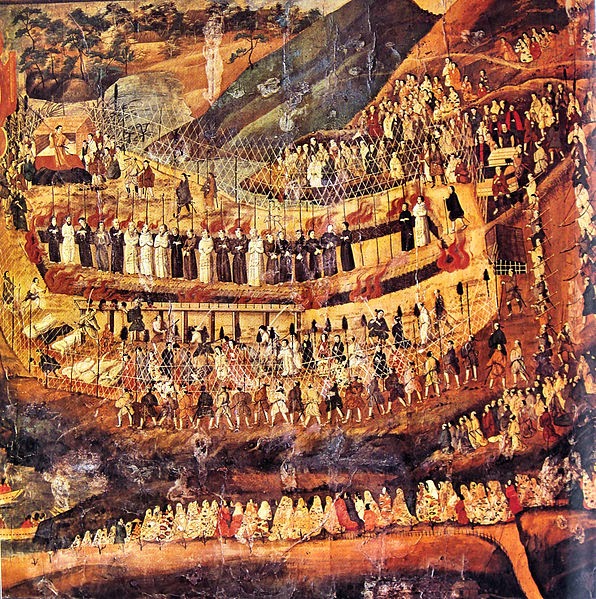
Within a fortnight Toyotomi stepped up the urgency and stringency of his suppression of Christianity beginning with the arrest, public humiliation, torture and crucifixion of the ‘Twenty-six Saints of Japan’: six Franciscan missionaries (four Spanish, one Mexican, one Portuguese), three Japanese Jesuits and 17 Japanese members of the Franciscan community, including three young boys who served as altar boys, one aged 12. This process included an 800km forced march which ended at Nishizaka Hill above the heart of Nagasaki, a destination chosen pour encourager les autres, of whom there were many at that time.
A 17th century Japanese rendering of what occurred.
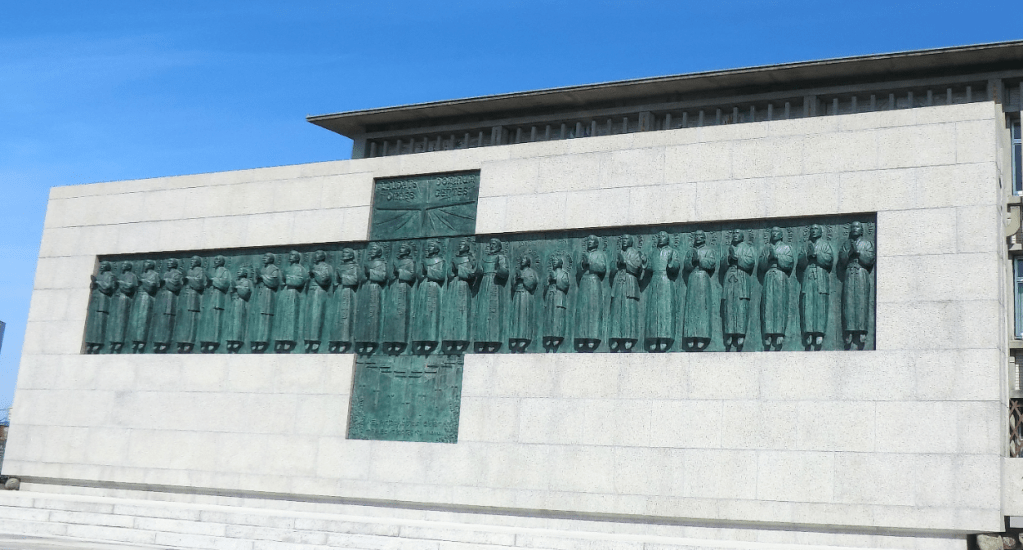
There were many other subsequent examples of Japanese martyrdom as the authorities sought to enforce the nation-wide ban on the practice of Christianity. But the Twenty-Six Martyrs, the first, beatified by the Church in 1627 and canonised in 1862, caught the wave and are widely memorialised to the extent of being the subject of their own Museum. There is no challenge in finding renderings of the event.
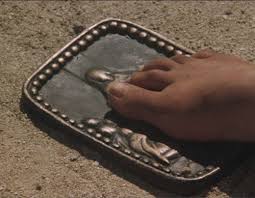
Shūsaku Endō’s prize-winning and brilliant book Silence provides a fictional account of this period and in particular the practice of having to stomp on fumi-e, images of Jesus or Mary, as part of a process of renunciation of Christ and Christianity. (Martin Scorsese made a film of the book starring Adam Driver and Liam Neeson.)
Read the book to find out what happens, but nearly the last word is given to an official who speaks to Rodrigues, the priest: “Father, it was not by us that you were defeated, but by this mudswamp, Japan.’
• • • • • • • •
This story could head off in a number of directions because the themes of politics, religion and commerce in this context are so intertwined. But the basic underlying issue is deeply familiar: how do you get what you want from an innovation/ new situation without all the bits you don’t want as well? (See eg social media, or the internet in general.) There were major benefits to be gained from contact with Europeans, not least the prospect of making a lot of money. But what were they bringing with them? Among other things, an untidy mess of alien mysticism and creeping insubordination.
In 1571 the port of Nagasaki was officially opened to world trade, at the time a limited concept. Among the first ships arriving was a Portuguese vessel which left behind cases of syphilis and other previously unfamiliar health disorders. And yet it also brought the first velvet the Nagasakians had ever seen, along with a host of unfamiliar spices from Indonesia. It offered silk and unknown types of woven cotton from China, and its traders provided good prices for Japanese silver, copper, ceramics and camphor. What do you do?
By the first few years of the 17th century the rulers of Japan had decided. They instituted Sakoku (‘chained country’), a series of directives that enforced self-isolation from foreign powers. From the Edict as it evolved in 1636:
‘No Japanese ship … nor any native of Japan, shall presume to go out of the country; whoever acts contrary to this, shall die, and the ship with the crew and goods aboard shall be sequestered until further orders. All persons who return from abroad shall be put to death. Whoever discovers a Christian priest shall have a reward of 400 to 500 sheets of silver and for every Christian in proportion. All Namban (Portuguese and Spanish) who propagate the doctrine of the Catholics, or bear this scandalous name, shall be imprisoned in the Onra, [the common jail of the town]. The whole race of the Portuguese with their mothers, nurses and whatever belongs to them, shall be banished to Macao. Whoever presumes to bring a letter from abroad, or to return after he hath been banished, shall die with his family; also whoever presumes to intercede for him, shall be put to death.’
Strong.
Foreign powers were entirely banned from any diplomatic and trade relations, with the exception of the Chinese … and the Dutch at Dejima. This situation didn’t change until the mid-1800s, when Japan was forcibly ‘reopened’ by naval emissaries of the United States.
Japan might have been closed, but the door was still open just a crack at Nagasaki. This is one of the things that makes the city special.
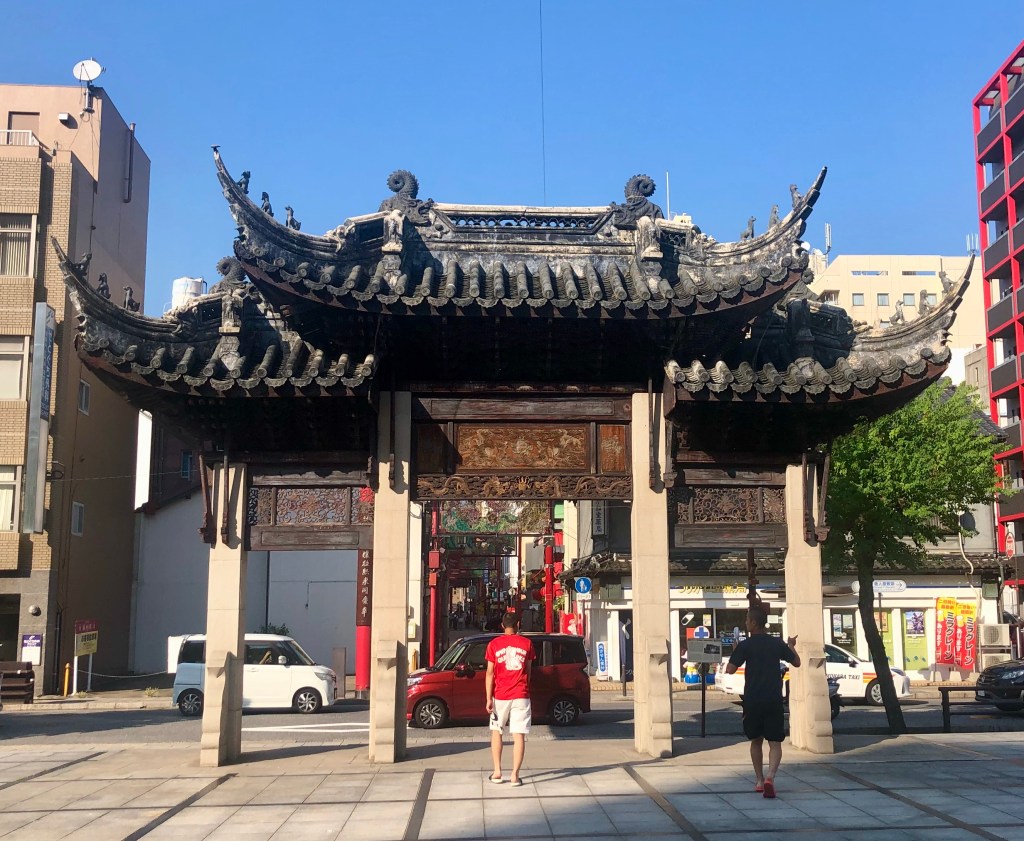
It had then and has now, unusually for Japan, a Chinatown at Shinchi (its current entrance at left). For most of its life this was a high-walled enclave which seems to have been treated more strictly than the European compound.
Among the Dutchmen on Dejima there was always a trained doctor. Engelbert Kaempfer and Carl Thunberg were two of these in the early years, skilled, professional … and endlessly curious. Both wrote books about aspects of Japan on their return from Dejima which clearly indicated that they had made the most of the crack in the doorway. It is hard to imagine that even in Japan the strictness of the observation of the rules of interaction would not have waxed and waned, particularly when there was perceived benefit.
In time Japanese and especially the well-to-do were coming from long distances to be treated by Dejima’s Dutch doctors. By 1823 when Philipp von Siebold arrived there must have been some relaxation of the rules because, after curing the illness of an influential local military officer, he was invited to set up a practice off-site and a year later he had developed a school for more than 50 students studying western medicine.
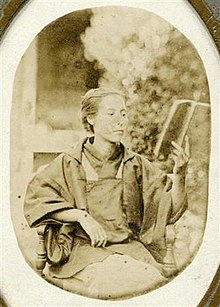
It was also Von Siebold who introduced the first piano to the nation of Yamaha and Suzuki. What a man he must have been. He is pictured below with a telescope, (‘Dutchman watching an incoming ship’, another Kawahara), along with two Japanese women one with the flame-haired child he fathered at Dejima.
This daughter, Ine (pictured somewhat older at left, but still with reddish hair), became the first trained female medical officer in Japan eventually becoming physician to the Empress. A son from his Dutch family introduced the study and practice of archeology to Japan.
Von Siebold wrote a six-volume treatise on a vast range of subjects related to Japan. Some of his collection of 12,000 Japanese plant species remains at Leiden University in Holland. He also began a huge collection of ethnographic material which provides the foundation for collections in several major museums including the British Museum.
Along with all his gifts and interests Von Siebold seems to have been arrogant and pushy with a tendency to misjudge his own indispensability. He had his own set of rules. He illegally smuggled the seeds of tea plants which became the foundation of the Indonesian tea industry to Batavia (Jakarta). Later he pressed the court astronomer for maps of Japan and Korea, also an illegal act. By chance, court officials discovered them in his possession. He was accused of high treason, was subject to house arrest and then expelled from the country. This is how his initial contact with Japan ended. This was 1825. He had done so much in that time.
The Japanese were also absorbed with the possibilities of western technology and military science. Along with medical knowledge, these fields became known as rangaku, ‘Dutch studies’ or ‘learning’ and became the foundation for a series of academies which grew up in Nagasaki over this period. Dutch had already become an influential lingua franca of the immediate region. Over time, more than 15,000 books were imported from the Netherlands and translated into Japanese for the practical value of their contents.
Despite criticism from Japanese traditionalists, Nagasaki flourished for decades as an important seat of learning. By 1853 when Matthew Perry brought his gunboats into Edo (Tokyo) Bay, as well as Siebold’s medical school, Nagasaki had a naval academy, western-style steam ship building yards, an academy of sciences with interests in physics, chemistry and optics, and the beginnings of steam engine manufacture among many other adventures into western ideas and technologies. Nagasaki was one of the heartlands of the explosion of activity which took place during the Meiji Restoration when Japan re-opened to the world, and ready for it in ways the rest of the country wasn’t.
• • • • • • • •
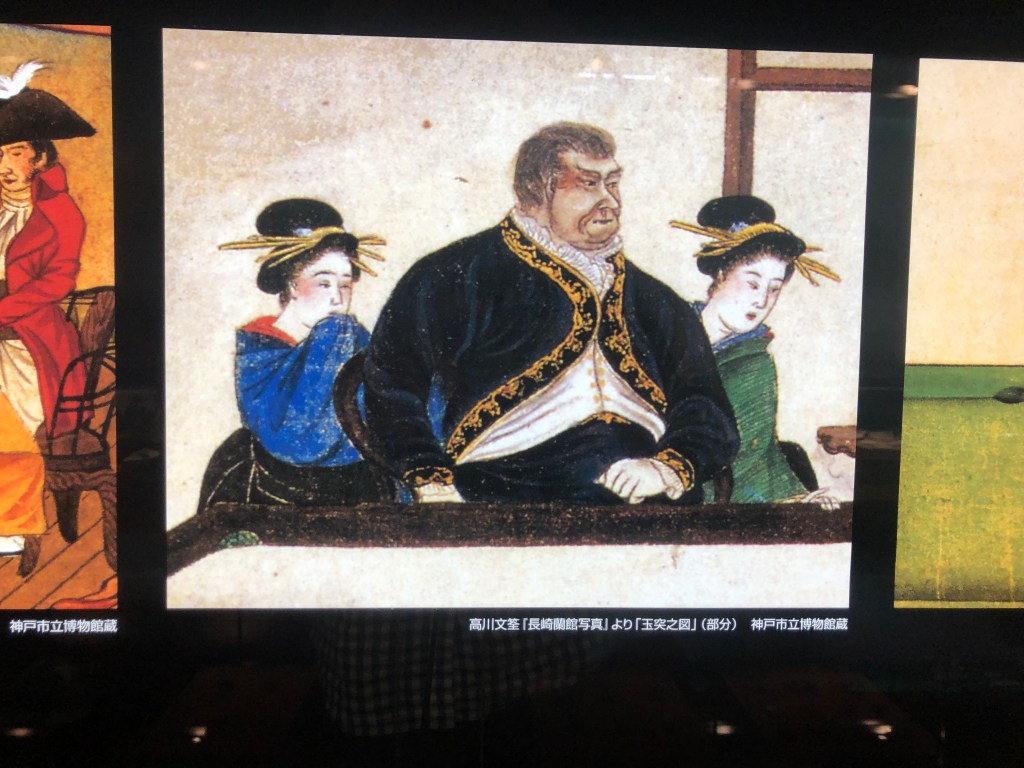
On display at Dejima. It might be construed as a commentary on gender relations during the Edo period; the tag says something about balloon fighting. But I think it is 玉突の場 (‘Ball striking table’). The game of billiards was introduced to Japan via Dejima in 1746. Intercultural exchange can be a strange and wonderful thing.
• • • • • • • •
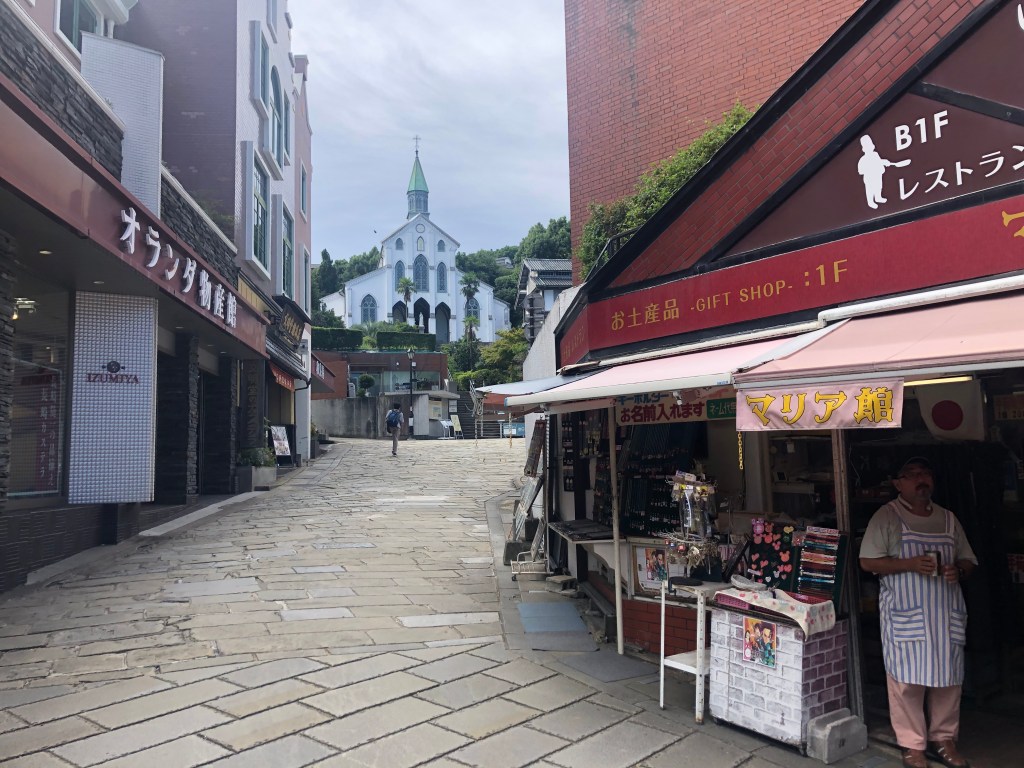
Along with a relaxation of the rules regarding contact with foreigners came a relaxation of the laws relating to religious practice. Some Christians jumped the gun. When Nagasaki’s Oura Catholic cathedral was newly consecrated in 1865 a group of several hundred Kakure Kirishitan (‘hidden Christians’) appeared, largely peasants from the upper reaches of the Urakami valley. For their imprudence they were deported to various distant parts of the country. But in 1873 when all restriction was lifted more than 30,000 people claiming to be Christian emerged — after more than 200 years in the wilderness. Their various doctrines were not immediately recognisable to the priests of Nagasaki (French at the time) who declared them Mukashi Kirishitan, ‘ancient Christians’ and not part of or welcome in the orthodoxy. But Oura cathedral is still very much there.
And it’s still there at the end of one of those tourist avenues where you can buy your fill of soft serve, biscuits, souvenirs, Castella cakes (a remnant of Portugal) and on and on.
And that really is my point. There are vestiges of this rich history everywhere.
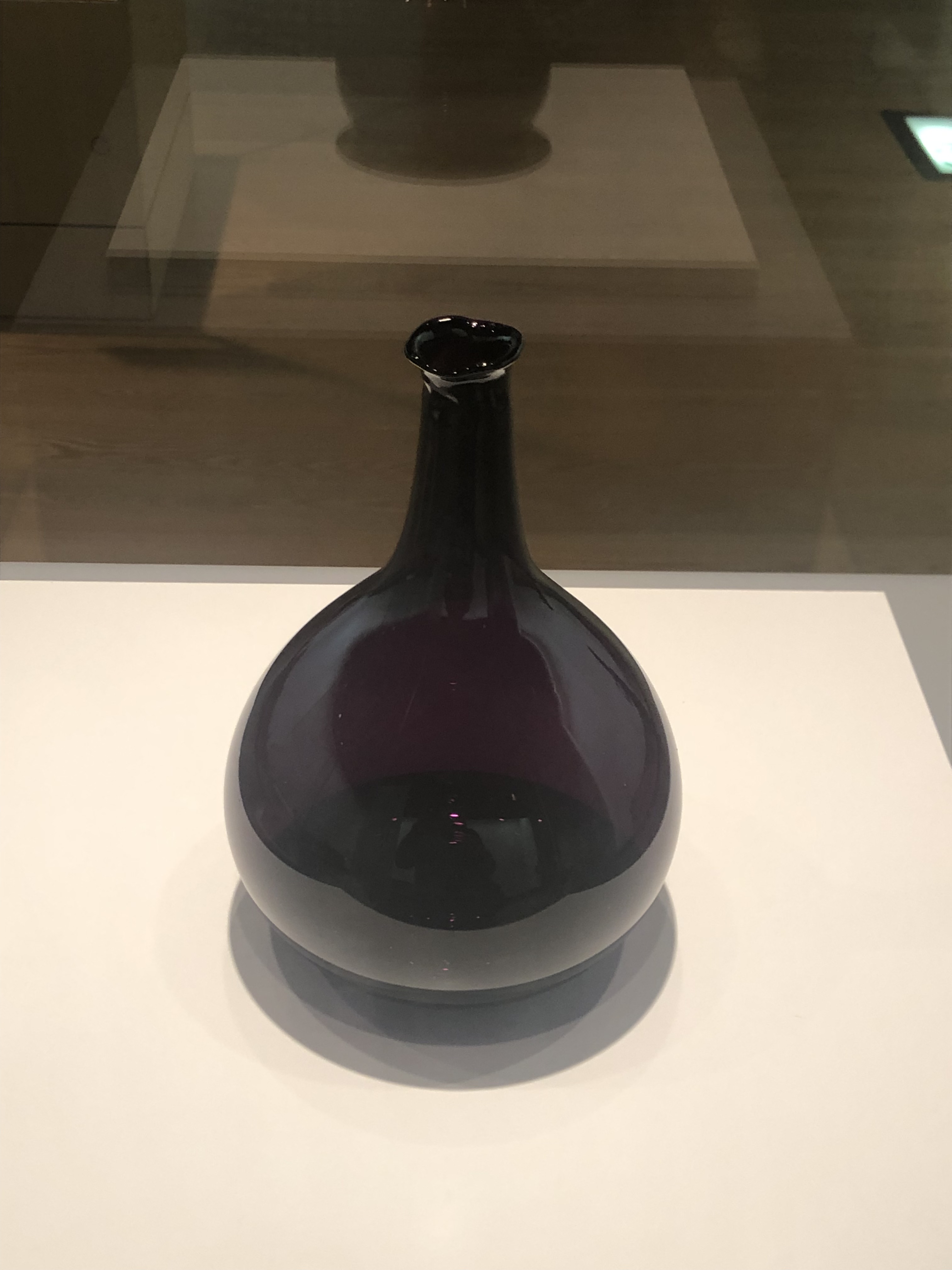
Some of the treasures we found in this imposing building, the Nagasaki Museum of History and Culture which we pretty much had to ourselves, apart from the customary rash of attendants. Look at it. Enormous! And very good.
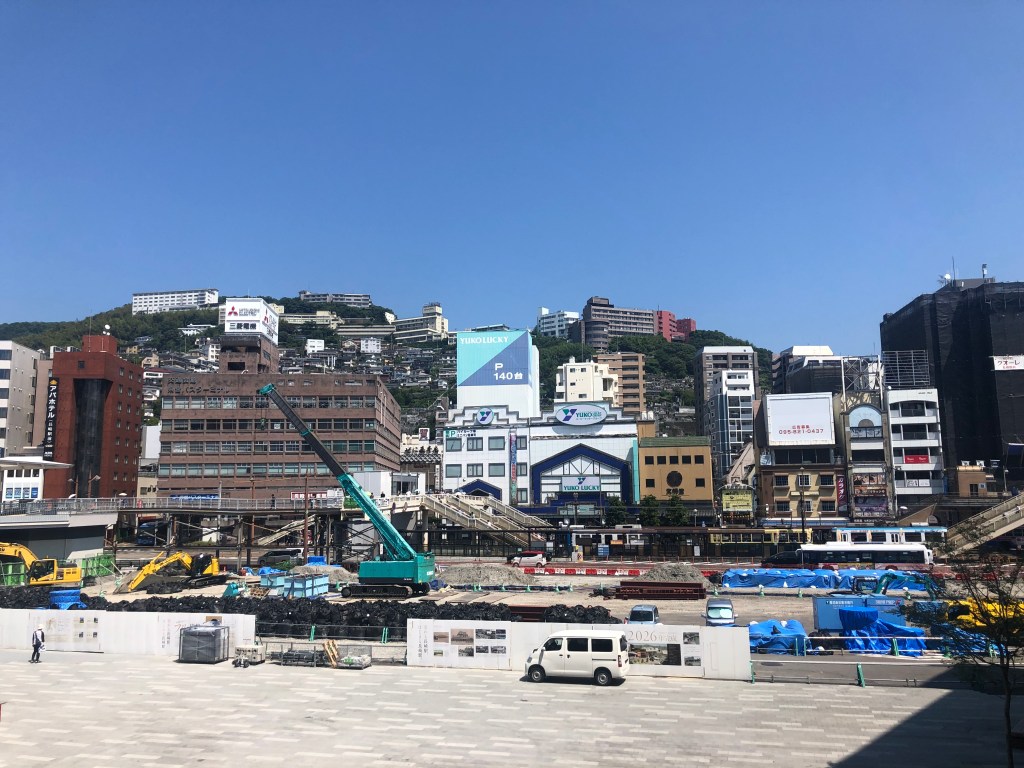
In the background and to the left of the pic below is where the 26 Martyrs met their end. But it is buried from this perspective behind one of the several giant pachinko parlours, office blocks, electronics shops just there, a major tram stop, a construction site and I am standing on the terrace of Amu Plaza a giant shopping centre attached to the very stylish Nagasaki Rail Station.
We got control of the city’s four tram lines fairly early in the piece and used them extensively to get around. But to get out of the valleys in which they run you need to walk. This is one of the things we found,
… the ‘One-legged Torii’, a reminder that there is another story at Nagasaki. There is the matter of the bomb.
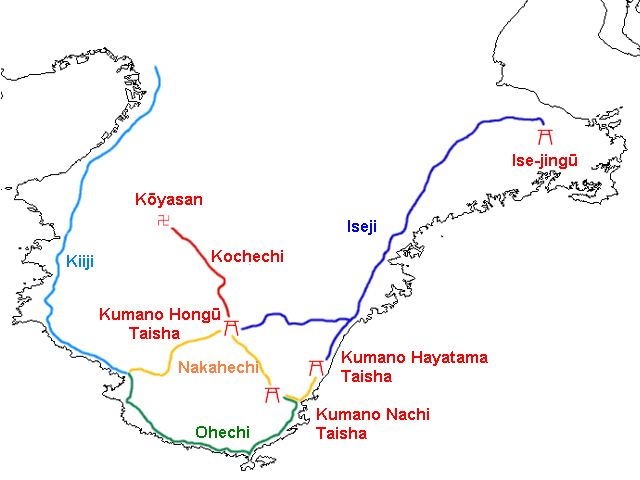
The Kumano Kodois a series of ancient pilgrimage routes that crisscross the Kii Peninsula (as below), which is south of Kyoto and Osaka. These mountainous trails were and are used to reach the Three Grand Shrines of Kumano, at Hongu, Shingu and Nachi. Shrines of what? Shugendo Buddhism borrowing extensively from and influenced by Shinto and other local forms of animism.
It was the Nakahechi variant (in yellow) where we were going, left to right.
This area has been visited as a site of religious significance by pilgrims seeking healing and salvation for more than 1000 years. More recently it has become a popular walk for tourists, including many Australians and New Zealanders. I’m not 100 percent sure why. It’s not far from Kyoto and Osaka; it is heavily marketed by several dozen companies (who benefit from conveniently located accommodation); and it is a physically-demanding challenge, some of it especially, but not outside the limits of feasibility. All strong reasons, but there are lots of options for walking in Japan which would offer more. That said, a great time was had by all and there was so much to enjoy.
Four and a half days walking after three hours on two trains and half an hour on a bus, gradually getting further and further from the conurbations of the Kansai plain, and marvelling yet again at the genius of Japanese transport engineers as we slid along beside rivers and were swallowed by tunnels.
The first day — for anyone, this is a heavily standardised process; in some cases there is no way of getting off the track end-to-end — was from Takajiri-oji to Takahara. (‘Oji’ literally meaning ‘the younger brother of one’s parent’, but in this case subsidiary shrines pointing the way to the major shrines.)
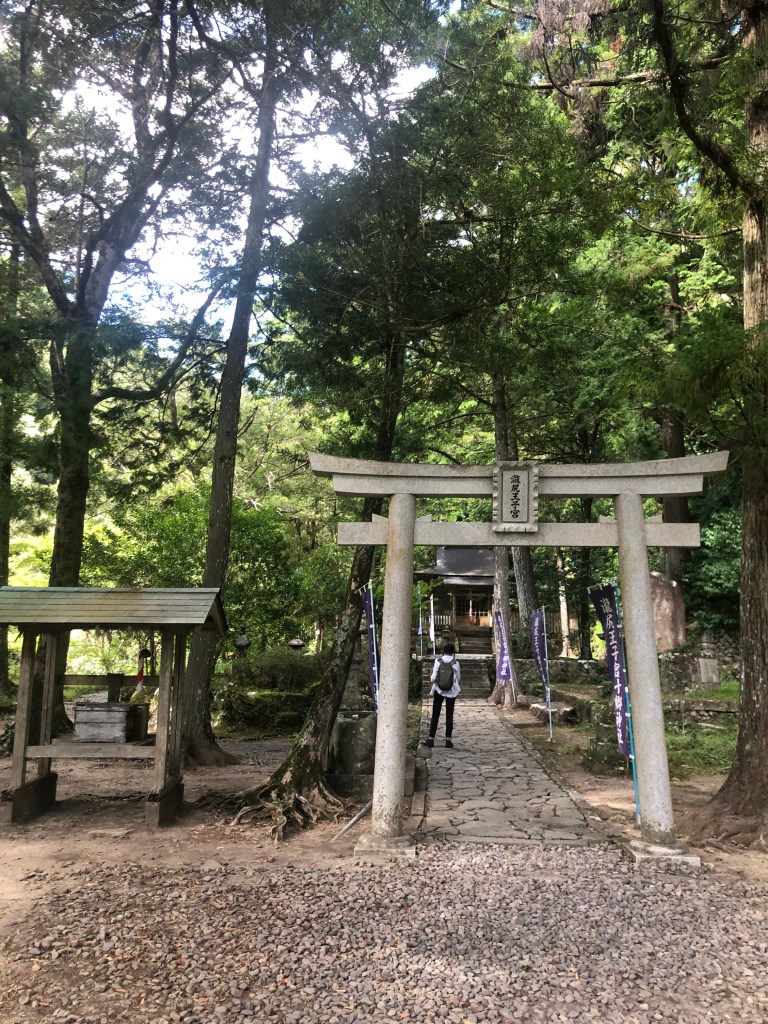
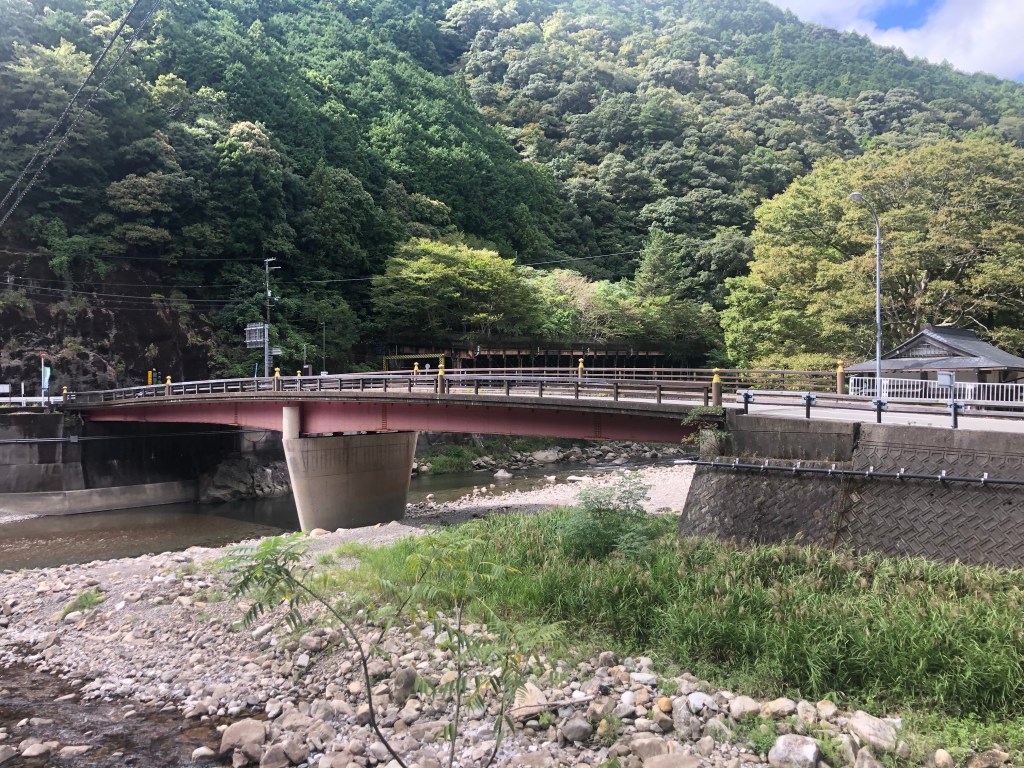
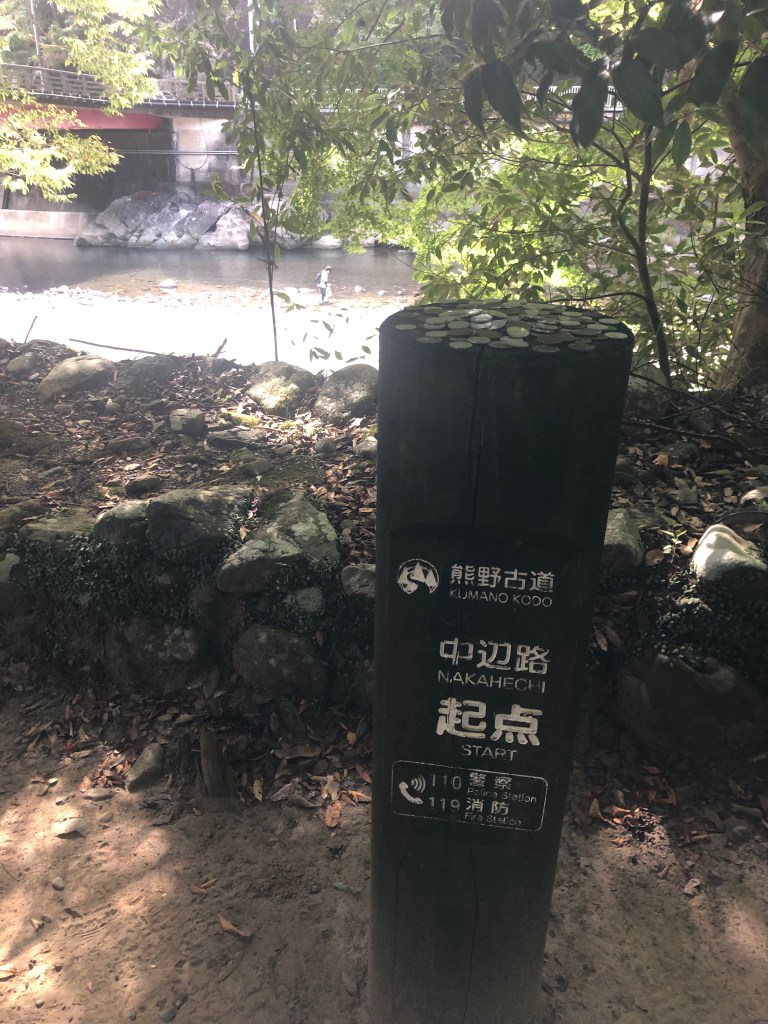
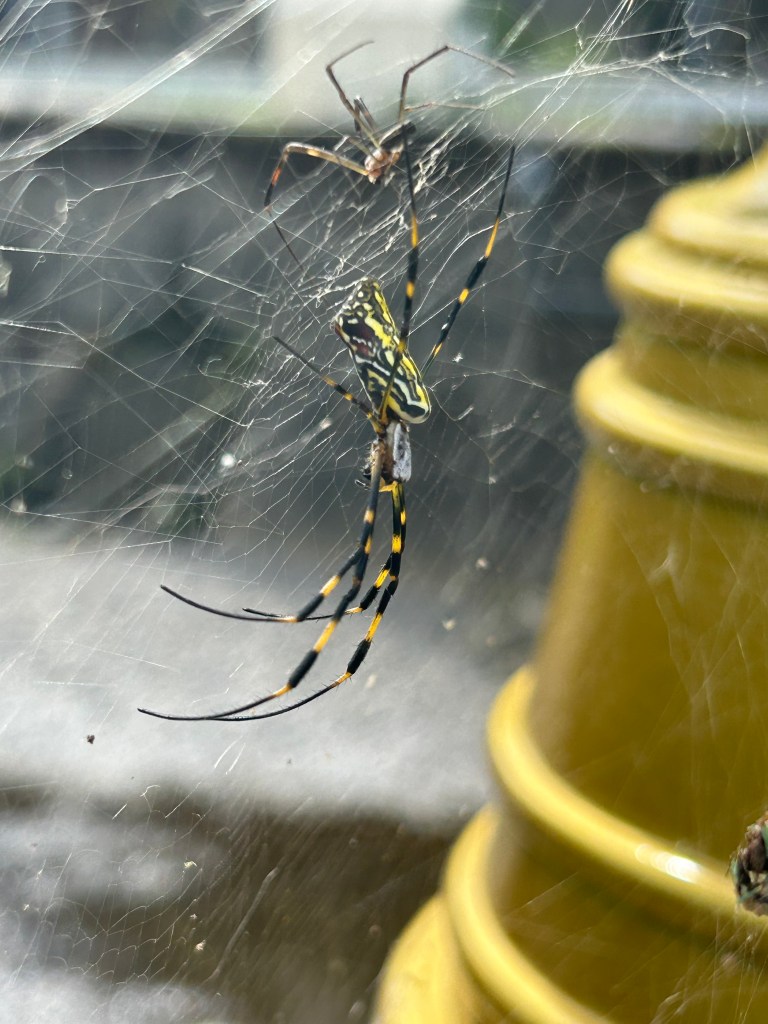
Clockwise: Takajiri-oji with its torii or gate framing the shrine itself. The bridge which provided access from the bus stop to the information centre and the beginning of the walk which is very well waymaked. A case in point: when it says ‘Start’ that’s what it means. Note the person fishing in the river just to the left of the pole. An engraved stone typical of Shinto shrines, large and small. Among other things. We decrypted one that looked like it might have some particularly cosmic insight and it said this building (a toilet block) was opened by the governor of blah blah prefecture on blah blah date. Shinto adherents believe that natural features are often enlivened by kami, spirits, and that special ones like many of the mountains on the way and the Nachi waterfall have profound powers. A spider, because it was there. A good one though. Tigers’ colours.
Had the smile wiped off my face pretty smartly. ‘Climb steadily through the forest’, the notes say, as they often do. A climb of 350m in a kilometre. Stern. And it was very hot, although not as hot as it had been. But it is a pilgrimage, what do you expect? A bit of pain and suffering might be taken as given.
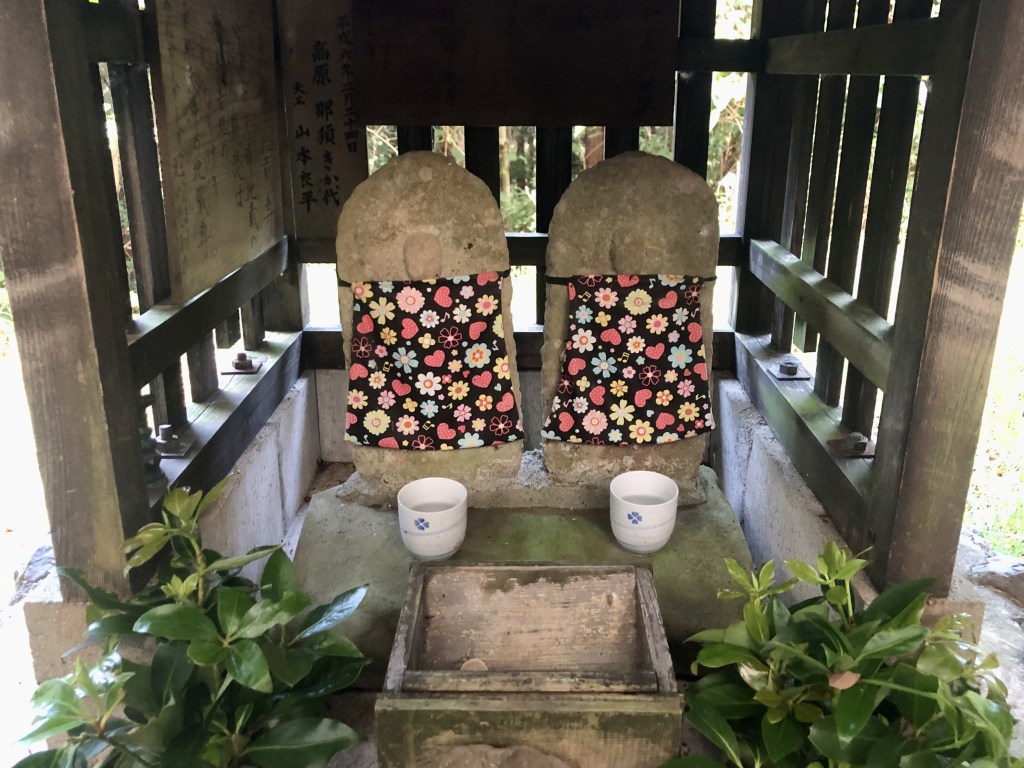
Clockwise again: One typical version of the track. A lot of it was far more broken and difficult to find footholds than this. Recently tended jizus in a small shrine on the way. Among the endless mysteries of Japanese Buddhism, a jizu is a bodhisattva, a representation maybe of a person who could have reached nirvana but has chosen not to do so that they can help others. Jizus are particularly supportive of mothers who have a child who has died in childbirth, early or stillborn. The oddity was not to see them here, but to wonder at how few there were. When we were walking on Shikoku whole hillsides would be covered in them. Arriving at Takahara (which means ‘plateau’ or high ledge’, we had gained about half a kilometre), passing a gardener at work, the mountainous, and verdant, surrounds, and a lane in the late light.
One of the features of the walk is where you might be staying and what you might eat there. The company we went with, Oku, is very good at choosing interesting minshuku or ryokan, guesthouses of various scale, and Kirin-no-sato at Takahara was an excellent example.
This is our host taking his own version of a selfie. Described by three widely distributed sources as a ‘special Japanese’, he was. Very much the exception to the rule. He sang, he danced or cantered at least, he uncovered the origins of his 20 or so guests and made a cheery little speech about the virtues of internationalism. Then he played flamenco guitar, and not for too long. Below I am pictured pledging my everlasting admiration.
It rained that night. From our bedroom window it looked like this about 5.30am —
and like this at the front door an hour or two later.
It was incredibly humid all day but didn’t rain.
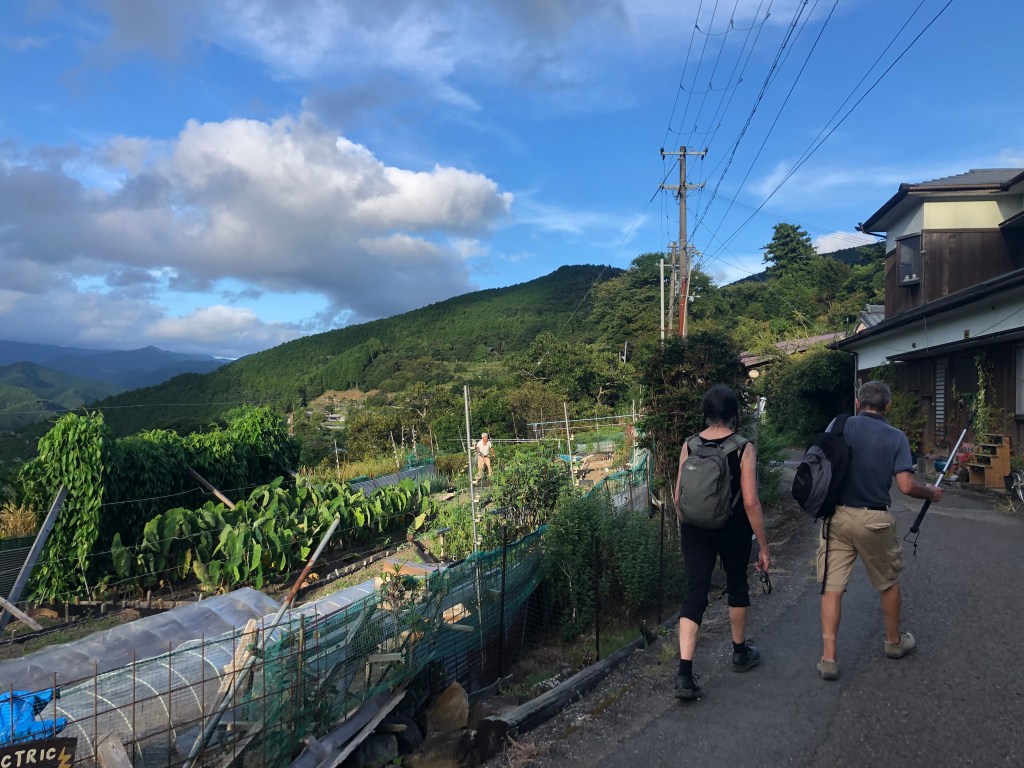
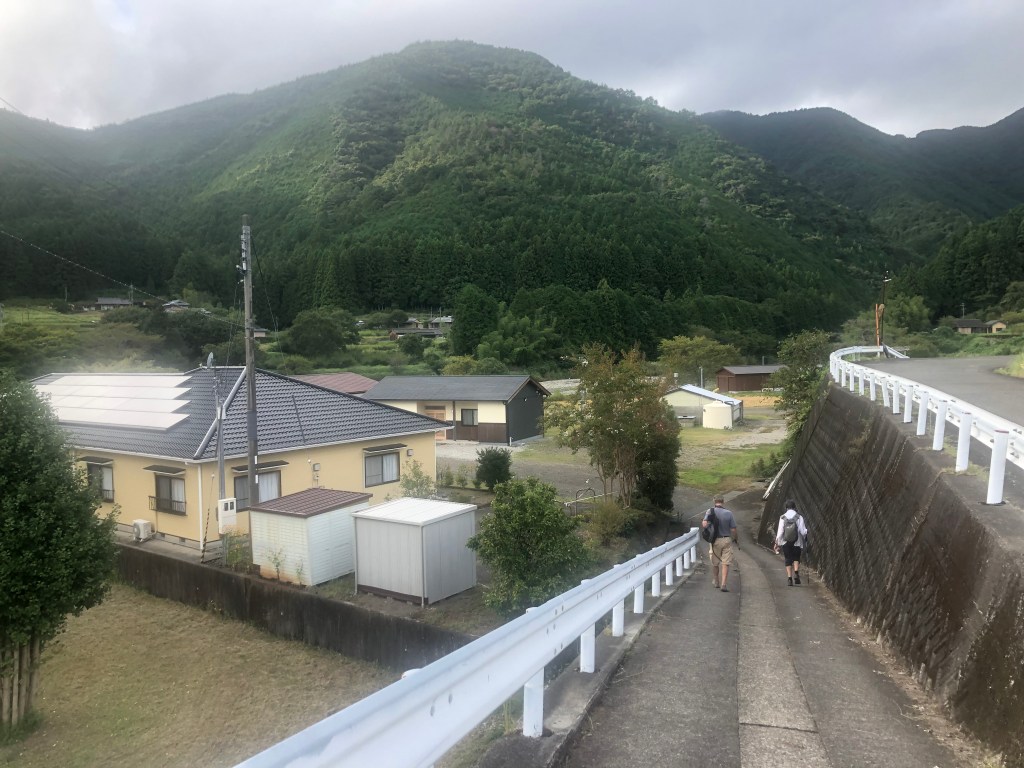
Up past the backyards again — I do like Japanese backyards walks, and there are many of them —
— and into the forest
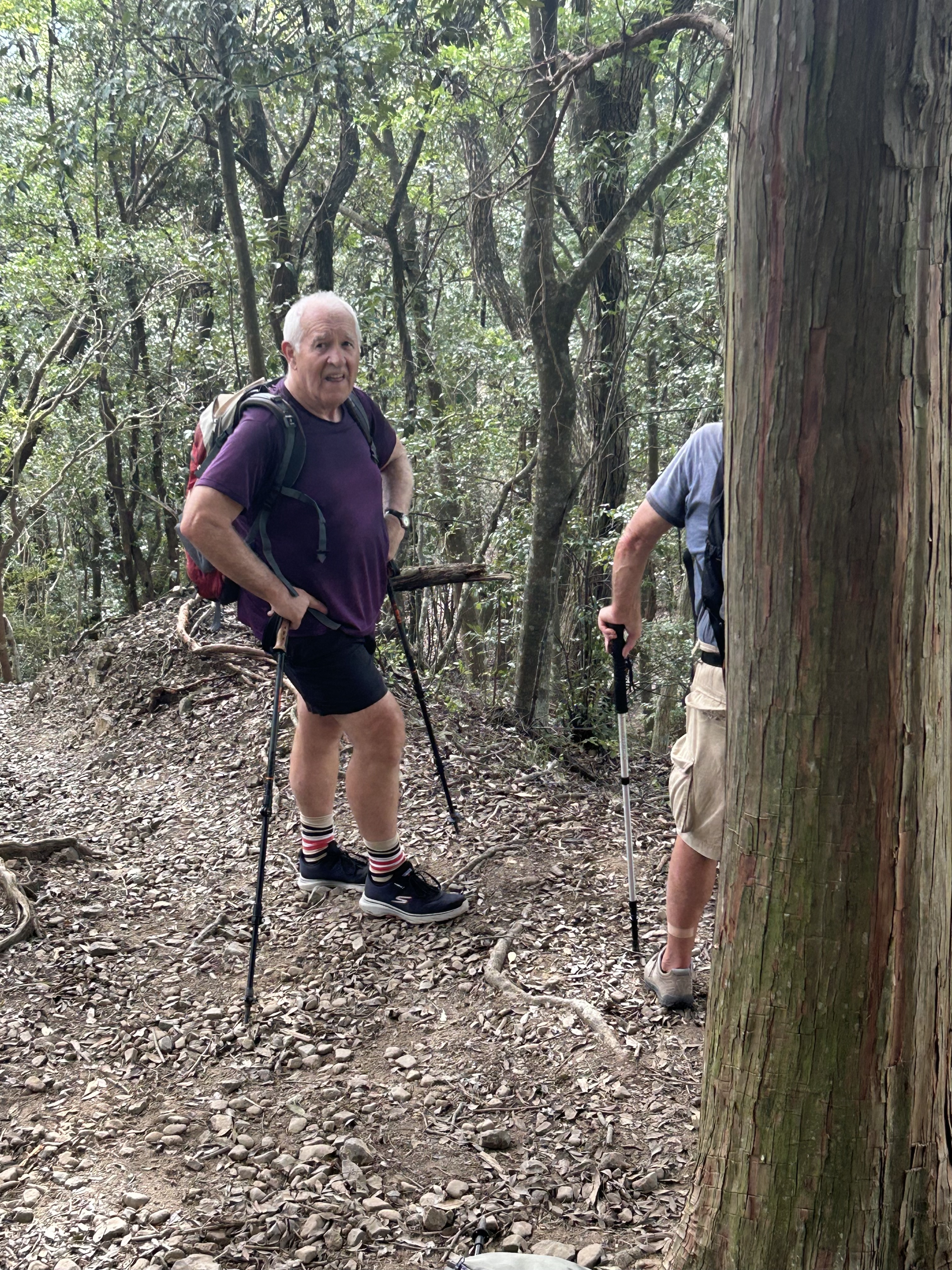
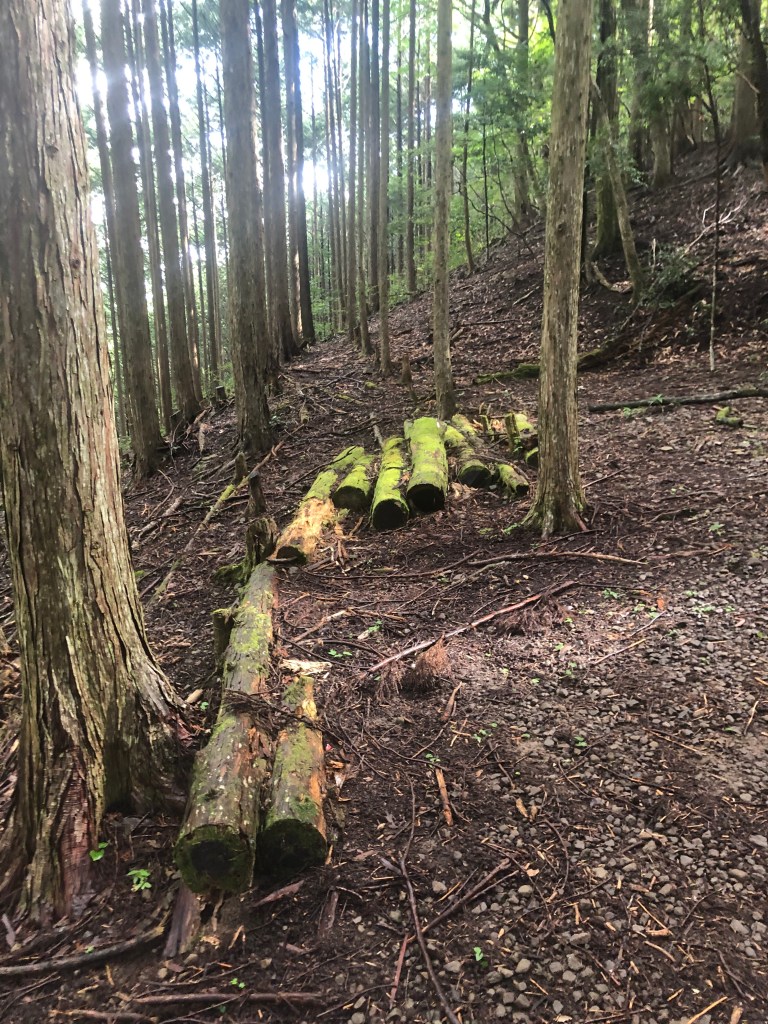
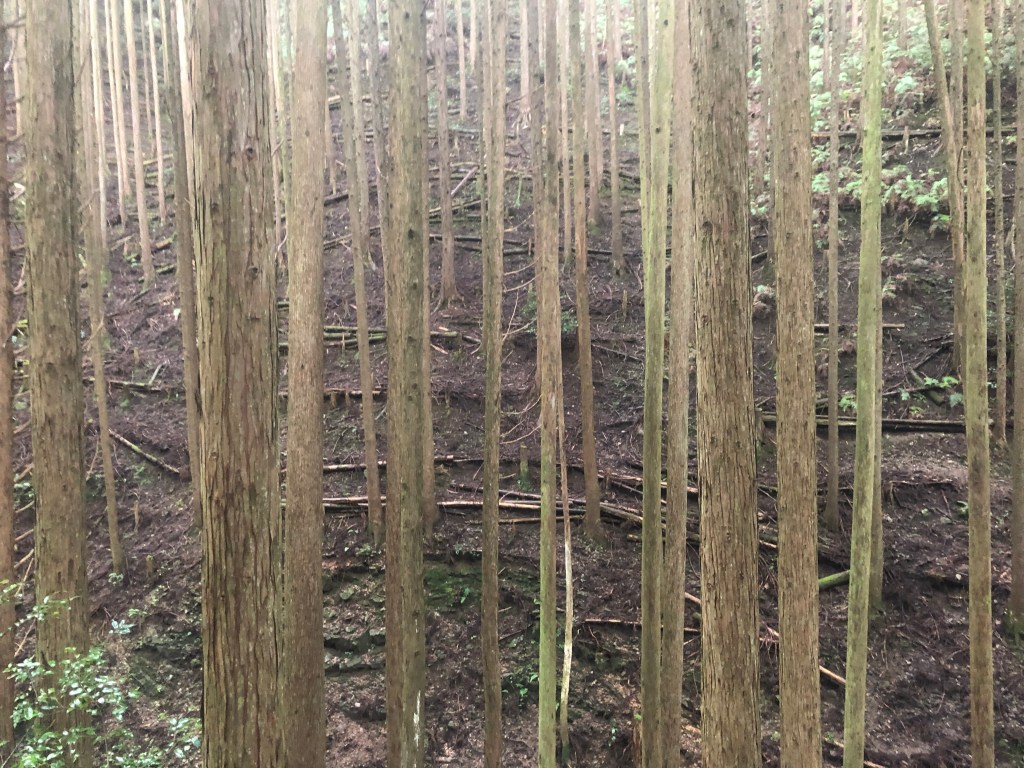
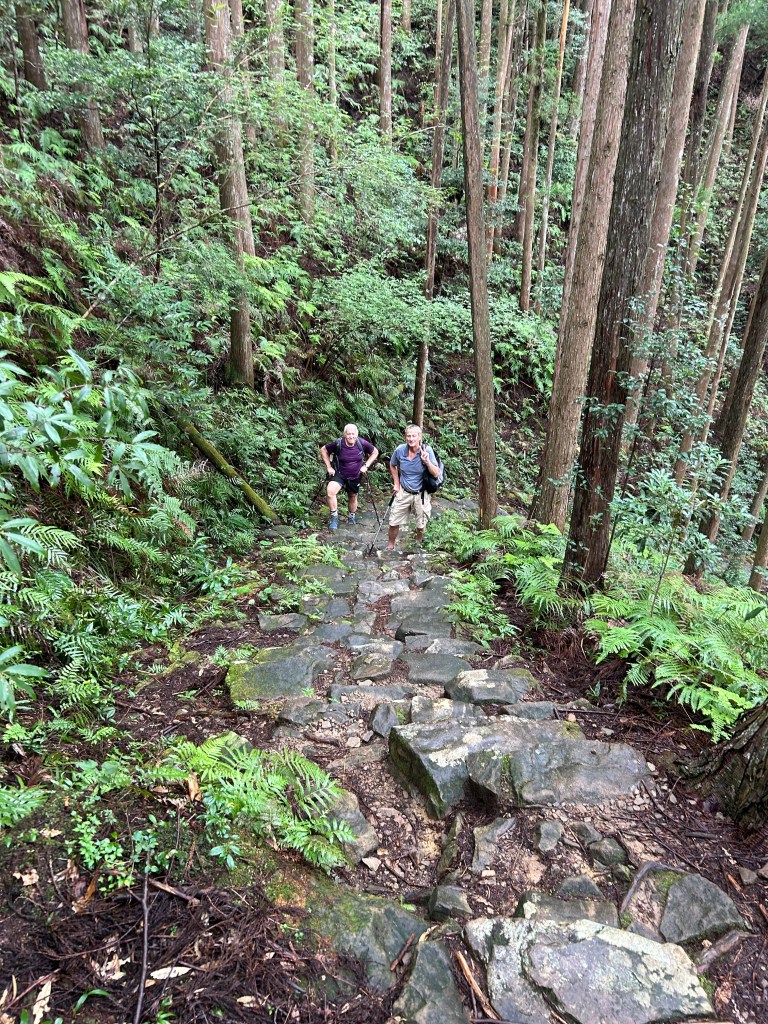
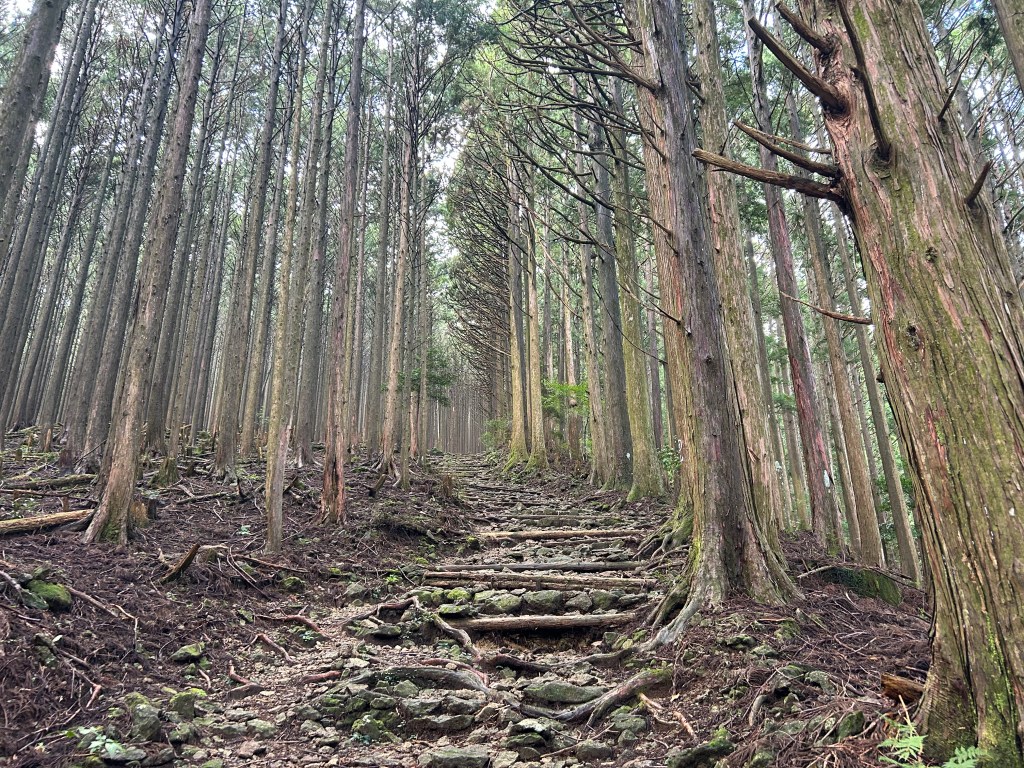
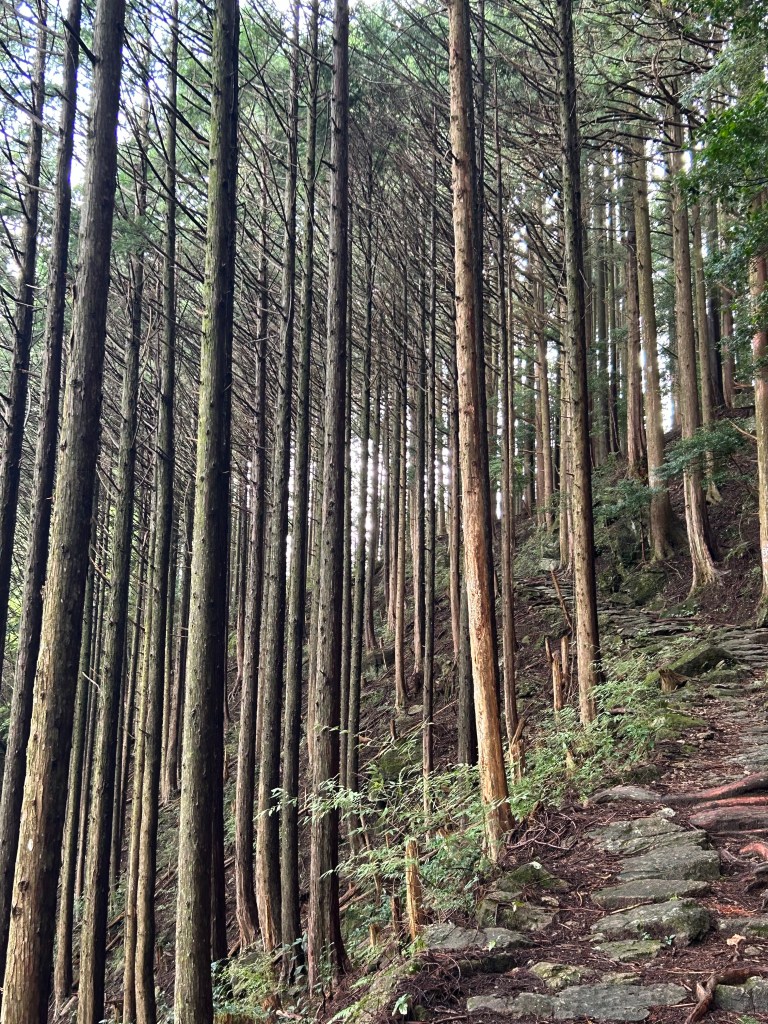
where we stayed all day. The pictures with Michael and I in them are anomalies. We are not walking through cedar forest. This might be true of 5 percent of the day and provided one of the talking points with comrades of the track. At least one found the monocultural nature of the cedar all about the same age mystifying. He pointed out the absence of bird and animal life (true), the very limited understorey (true) and ground cover (true), and wondered if it could be natural. Sitting in an onsen with him I said I thought at least some appeared to be growing in straight lines about 1.5m apart even though it would mean planting in ridiculous situations on slopes of 70-80 degrees. Subsequently we found obvious evidence of forestry, two harvested coupes in particular on from Jizo-chaya on the last day that looked like they had been subject to intense military bombardment. There were also foresters’ signs up claiming various plots. But is it all like that? Thousands of square kilometres? Could it possibly be? And here, blow me down, just to hand, is the answer I have been looking for. ‘The vast majority of forests are monoculture plantations which were planted to rebuild after the destruction of World War II.’ Planted! When you see the topography of these forests this is simply super-extraordinary. So Ian (son of a Gerrigerrup soldier settler; one for you Ned), we were right.
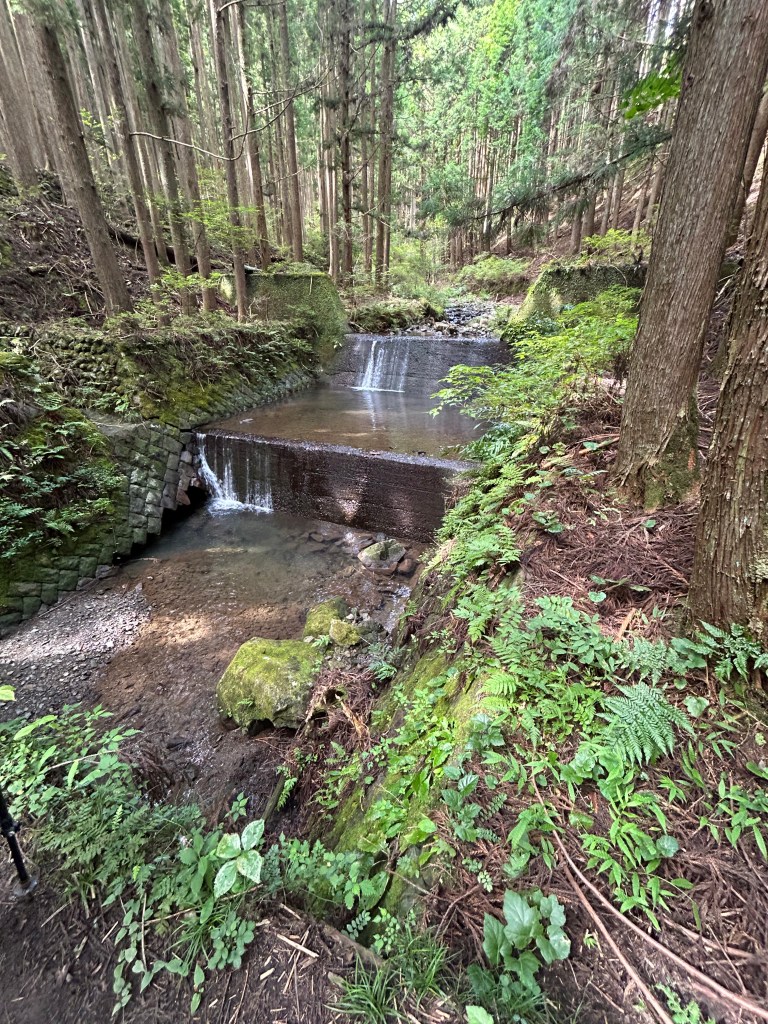
It also means that there are very few long views but the short views were often quite compelling.
I also notice just now that we climbed another 600m before a 5km descent to get to Chikatsuyu, and that we recorded the absolutely no doubt correct distance of 10.5kms as 14.6. We do tend to wander. Probably just looking where to put our feet.
Chikatsuyu was spread through rice paddies. (Yes, we were down. Proof.) There was even a lookout with a rest area to confirm it.
(Immediately above, this would be Michael checking the race results; and look at her, not even puffing.) ‘During one of the first Imperial pilgrimages here, Emperor Kazan (968-1008) was constructing sutra mounds when he picked two kaya reeds to use as chopsticks. Noticing damp on the red stalk, he inquired whether it was blood or dew. Chi ka tsuya?’ That’s what it says. I’m just passing it on. Oh, and the answer was tsuya. You can relax.
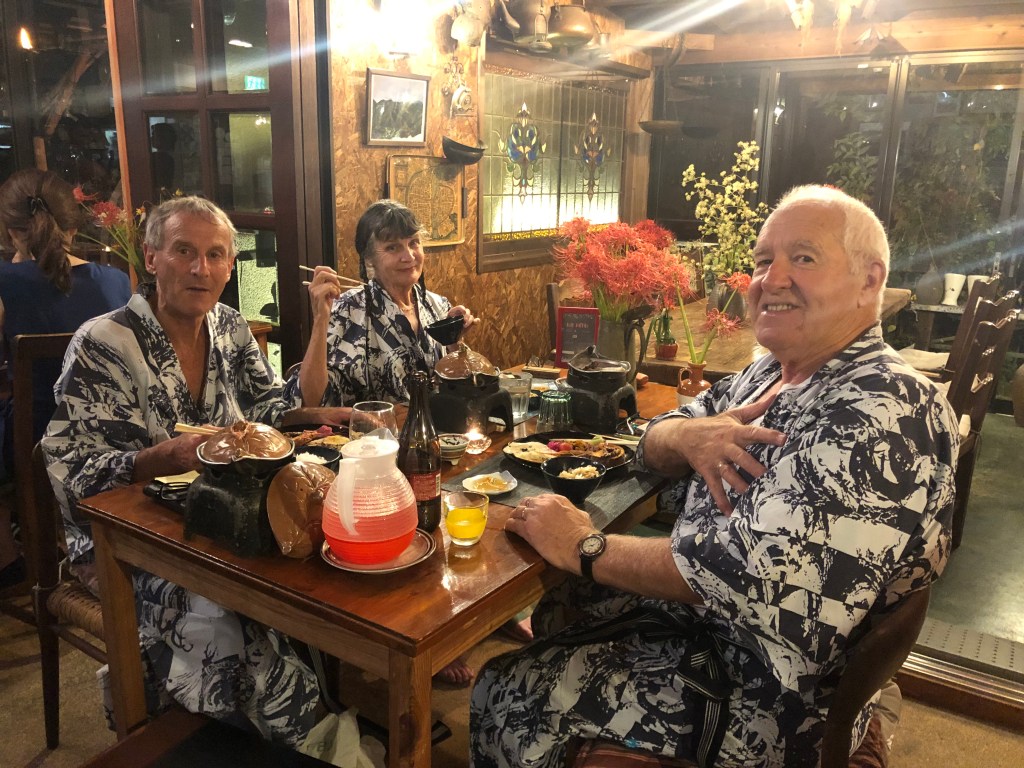
Tonight we would be in the Minshuku Chikatsuyu, prima facie suburban but with an onsen and wonderful food of which this was a small sample.
A typhoon was due the next day, he said casually. Oku have a branch, small but indicative of how much business they do on the Kumano Kodo, in an old tea house in Chikatsuyu. We thought we should consult with a knowledgable person about what our plans should be. The next section could be done at three levels of difficulty by judicious use of buses. He suggested that, given the likely weather, we pursue the easiest option. Even though my wife demurred I thought that sounded terribly wise. Insightful. Even first rate. So … you know. We cheated and took the bus with our friends from Toowoomba and various other pilgrims to Hosshinmon-oji …
where it was pissing down. Furiously. It was an umbrella day, but full of feature and interest and fun. Maybe, just maybe, because it wasn’t so far (supposed to be nearly 8, our instruments said 10.8. Wandering again.), but I think it was the day I enjoyed the most. And it was just the tail of the typhoon. The bigger winds had passed nearby the night before.
It included arriving at Hongu, one of the three Destinations, and how wonderful it was.
‘Cosmic time: Past.’ Quite. And then a few hundred metres out of town at the side of the Kumano River,
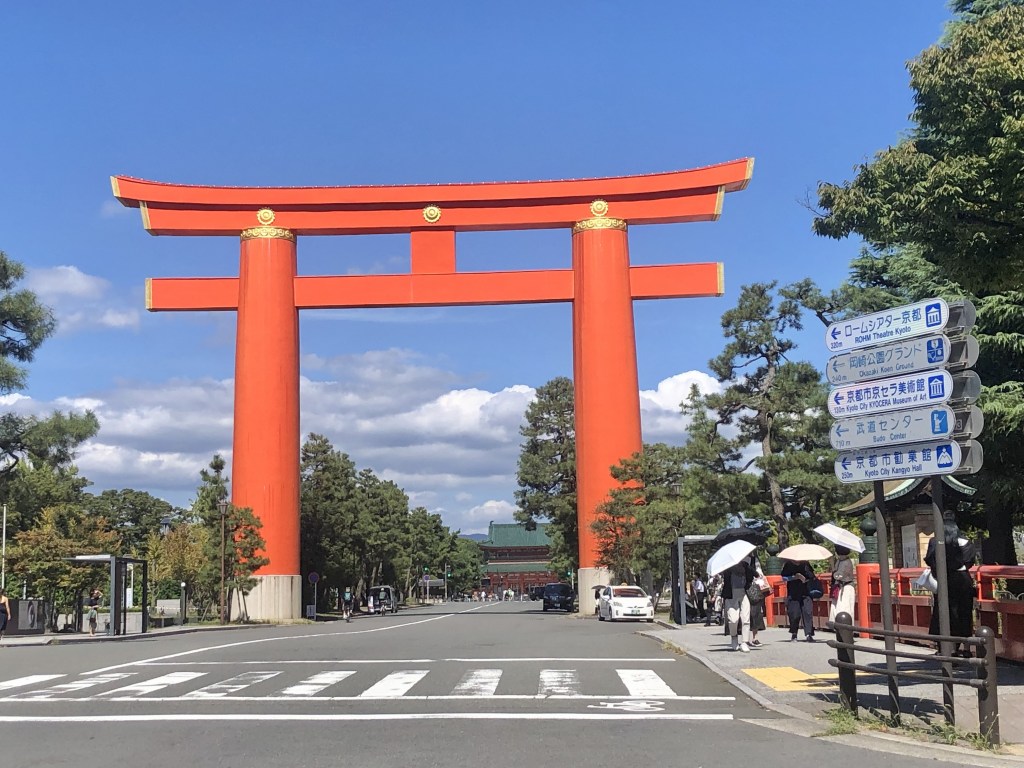
was this, the largest torii in Japan …
a gateway to a vacancy which, for whatever reason, moved me profoundly.
As far as I can understand the signs, the temple complex used to be here before it was washed away in some massive floods (I note the levees along the banks of the Kumano now), and it has been left. Vacant. Oyunohara, the place where the foundation deities descended to earth in the form of three moons in the branches of an oak.
Oyunohara, where Yatagarasu, the three-legged crow appears. Yatagarasu, the mark of rebirth and rejuvenation, the creature that has historically cleaned up after great battles, symbolizing renaissance after such tragedies. (The Japanese soccer team wears Yatagarasu on their team uniform, and it is an honoured badge for the winners of the Premiership league to wear for the consequent season.)
This day, the rain had stopped and it was very quiet. The man in the background is a worker picking up rubbish. He would find very little. And it was still. We bought wonderful softu kurema and Michael remembered his stick.
That night we stayed at Yunomineso, a short bus ride away, which describes itself as a ryokan, but one which you would have to say was a long way up market, so far up market that
a) it offered, without asking, a shoe dryer;
b) it provided an illustrated face-to-face lecture with guidebook on how to go about your business there before handing over the keys;
c) it is very close to Yunomine Onsen, a very famous version of that genre (see below) and has its own mineral springs which can be drunk, cooked in, bathed in and which turned my silver ring a bright gold;
d) it has its own indoor and outdoor onsens. Perhaps I should explain. The weary traveller strips off in the dry room, enters the wet room, washes very thoroughly, often sitting on a stool and using a small wooden bucket to contribute. After getting absolutely every vestige of soap off, same enters a large public although gender-separated bath, the onsen, often quite hot, often with mineralised water. The effect is claimed to be restorative, meditative and so on. I usually found them to be too hot and preferred a good scrub under the shower.
e) it does serve a renowned and very fancy kaiseki, the traditional Japanese version of a tasty and tasteful feast. And here it is, but without the river fish.
And here are the instructions and order of consumption supplied to each consumer with additional verbal instruction.
I tussled with the boiled sea snail but found the duck ham on apple very much to my taste. There is a photo of Michael scarfing up the horse sashimi. However, not much for the vegetarian here or often elsewhere in Japan. Myrna ate a lot of rice.
Here’s the river fish.
Don’t eat the head and bones.
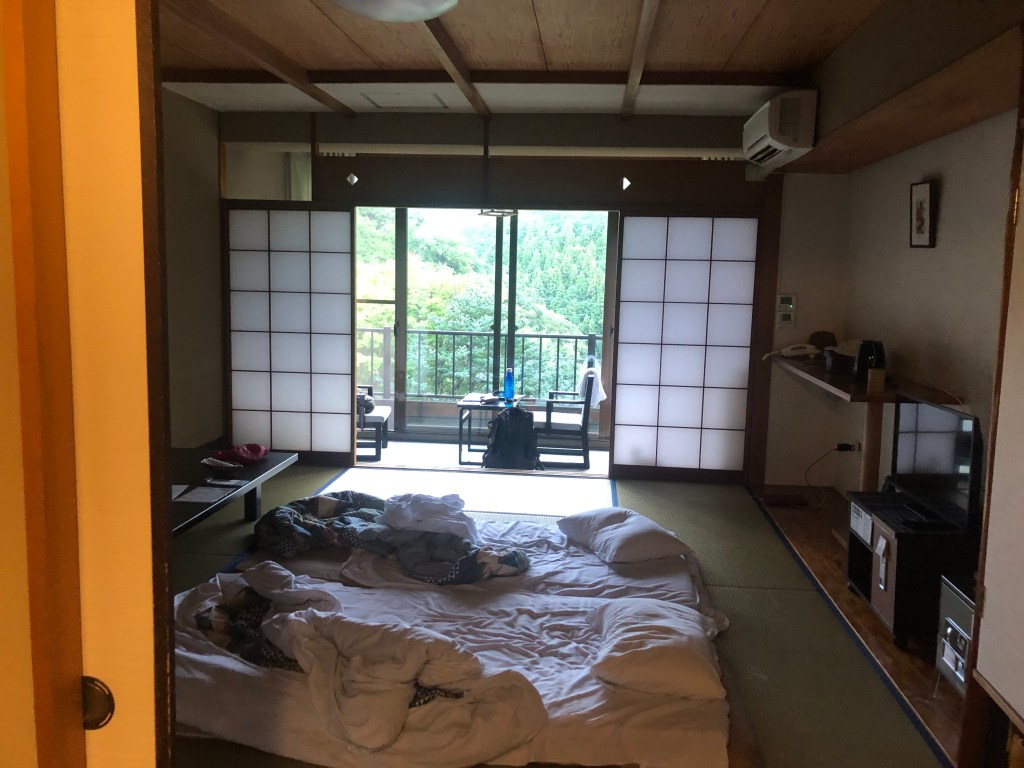
Our room. Such comfort really. AND, permitted by both the weather and the building, unconditioned air at last.
We left the next day from Yunomine Onsen, a five-minute drive from our ryokan and a very popular spa town.
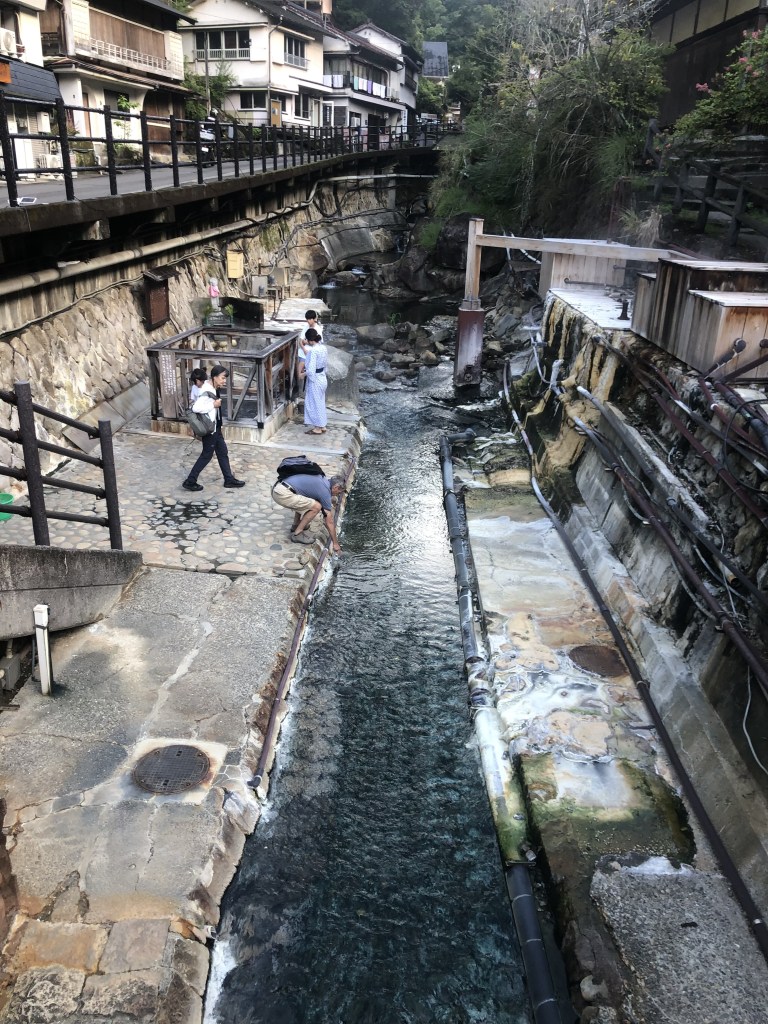
Yes. Hot. The bus driver told me that the water bubbling up in the cage behind Myrna was 90 degrees Celsius and I have no reason to disbelieve him. On the basis of visual evidence, it was heavily mineralised.
Ukegawa to Koguchi. We managed to buy some nashi pears at Ukegawa. They are heavy to carry, as big as a handshake and expensive, but they were remarkably refreshing and satisfying for a snack.
It was another day in the forest, distinguished by two things. One was that it was a beautiful day, clear, sunny, mid-20s, comparatively low humidity. The second was that there was a view. One view.
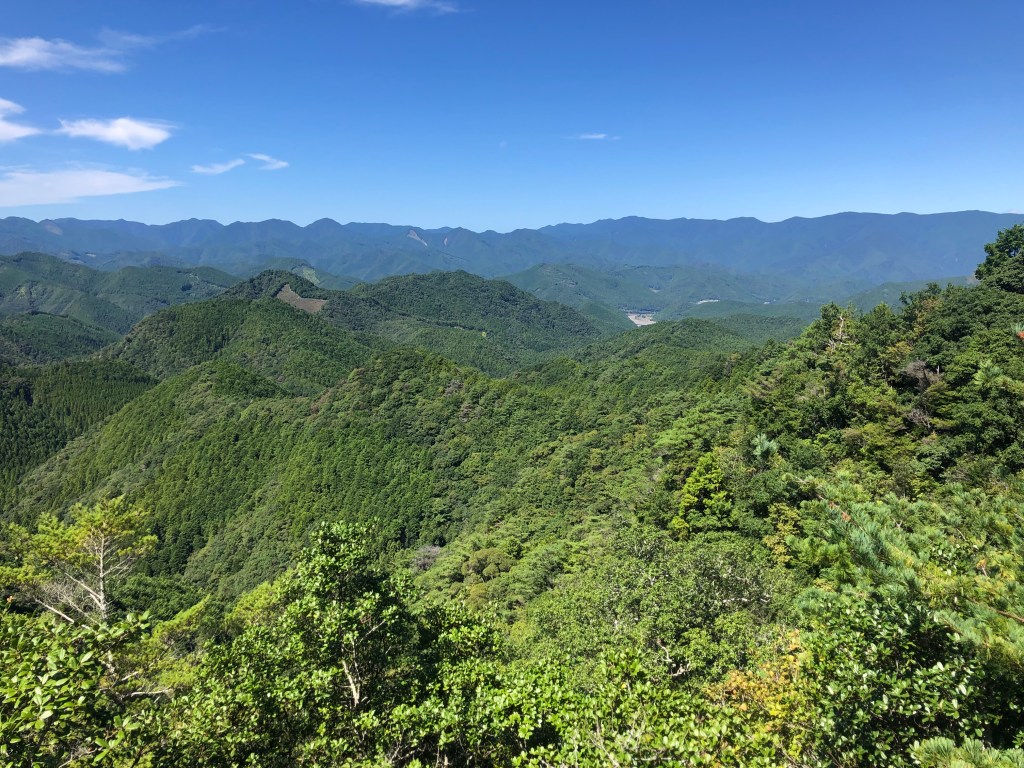
It was a long climb out of Ukegawa’s paddyfields too, 500m up but over five kilometres, steady rather than crippling, and then about half way along this day’s section of the track there is a sharp bend where the trees have been cleared, Hyakken-gura, which looks out over the ‘3,600 peaks of Kumano’. The second photo, from the edge, shows some of the places where logging has occurred recently.
Mr Fit had run ahead and we found him cooling his feet in the river at Koguchi.
Our accomodation that night was Minshuku Momofuku, the building down to the right of this road with the grass in front of it.
It had been a school building with two long single-storey wings joined by an office block.
The river ran past within 20m of our room, a lovely sound, and the windows opened wide. The food was a bit like a school canteen in that you could get what you liked and there was plenty to like. For the first time in several weeks I had cereal and fruit for breakfast.
Probably our favourite accommodation.
And then the final day. Perhaps it is appropriate for a pilgrimage to end with suffering: 14.8 kilometres, all of them difficult. We did end up walking more than 20 that day but there were extra bits at either end.
You start by sneaking in behind a small house with a pale blue (not customary) sign on it to Nachi. After most of an hour we’d done 2 ks. and it wasn’t too bad, in fact it flattened out a bit, and I thought we’ve got this beaten.
The easy bit
The young Belgians who had done the entirety of the third day in the typhoon’s rain came up and offered the idea that it was just up, then across, then down and we were nearly up. Myrna pointed out, correctly, that that was errr never true. But hope springs eternal. Anyway then it got hard, really hard.
I have noted before how hard it is to take a photo of ‘steep’ but at least you can get a bit of idea about the state of the track. You’d get to a corner and think that’ll be it. It’ll ease off. And round the corner there’d be another equivalent stretch, and then another, and then another, and then another … It took a long time to get to the first of four peaks. And then there were three more.
I look a bit done, but I shut my mouth and looked fine.
And of course, it wasn’t flat across the top. It was a constant series of sharp up and downs.
About mid-way this day there is a rest stop (accessible by a narrow road) with a shelter and vending machines. Iced coffee, ah iced coffee, has it ever tasted so good? Had lunch — rice balls, folded omelette, a bit of fish — moved on.
The view below signalled the end of the climbs. Our eventual destination, Kii-Katsuura on the coast, is visible in the background but we were getting there by bus. The temple complex at Nachi was the walking destination.
There was the small matter of getting down.
I usually find it harder than going up and it wasn’t any different this time. The surface varied. Steeper sections were often covered with rocks, sometimes stepped, sometimes flat, at times more slippery than the gravel. I found it quite hard. I think it was quite hard. I’ll say quite hard. The photos peter out around here.
Eventually we stepped out into a parking lot which signalled the edge of the Nachi compound. It had a view which led to the next descent through what I can only assume was a mighty adventure playground: huge slide, dramatic climbing frame, giant swings. And then the next section began. My knees at this stage were beginning to crumple. Steps only for the next 600 metres. I would think literally several thousand. The next sign said ‘500m to Nachi’. We stepped down for 10 minutes or so, signage says ‘450m to Nachi’. Ooo I hate that. I know we’ve gone more than 50m. We’re going down zig-zags which are about 80m long and we’ve done four. It’s a lie. Do it again. Signage says ‘400m to Nachi’. It’s a test. I’ve lost all confidence in advice and just don’t think until Myrna steps out on the first flat bit. There … and there I notice is a comparatively civilised sample of the steps. We are in Nachi.
I’m sure there is some bright witticism one could make about arriving at a temple, the Three-tiered Pagoda no less, and finding that it’s just a photo on building fabric. Does the Wizard of Oz step out perhaps when summoned? At least the Nachi Falls to its right were in honest fettle. Whatever disappointment I felt (negligible) was overtaken by the revelation that we now had to go down another 2-300 steps to get to the bus stop. I’d given over my role of navigator to take up the position of grump and did my best to grimace and moan all the way down.
What would the Buddha say? Probably chuckle and say, ‘Well did you make it or not?’ And I’d have to shut up and say, Yes. Happy in the service. It was memorable, and I’m better for it.
• • • • • • • •
We stayed at Manseiro that night, the six-storey building on the other side of Kii-Katsuura bay: a ryokan with a straight up and down version of the rules with communication via Google Translate. Dinner complex and sophisticated, I have no doubt their very finest work. I’m not sure why the gaikoku hito get parked out of the way by themselves, probably so that their infamies are not widely observed. But we were all a bit tired and I didn’t feel like too much intercultural interaction involving effort. That said, the Manseiro satisfied my two priorities: a load of washing clean and dry, and a comfortable bed. The next day, Kyoto.




































































 mcraeblog