How the World Works 101

This image has an empty alt attribute; its file name is bd235f09ab647a195ab50725b7d7df5e-uk-beaches-newcastle.jpg
Nobbys Beach, the City ocean baths, the breakwaters, Stockton to the north, Fort Scratchley is there somewhere … but that is a (rather fuzzy) pictorial version of the mouth of the Hunter River in Newcastle, NSW.

We’re in Newcastle at the open mouth of the Hunter. A land of amiable bogans, locked door nightclubs and unabashed brothels, long beaches and fast food, plus remnants of history undissolved by the earthquake. Along with regular hints of the red and blue of the Knights. The second last time we were there we went to a Knights game, explained we were neophytes and the lady in the box gave us seats on the centre line six rows back, the best in the house, for the cheapest price. That can happen in Newcastle.

And, if p then q, if the Knights … then the Johns brothers.
This image has an empty alt attribute; its file name is screen-shot-2022-10-06-at-3.09.10-pm.png
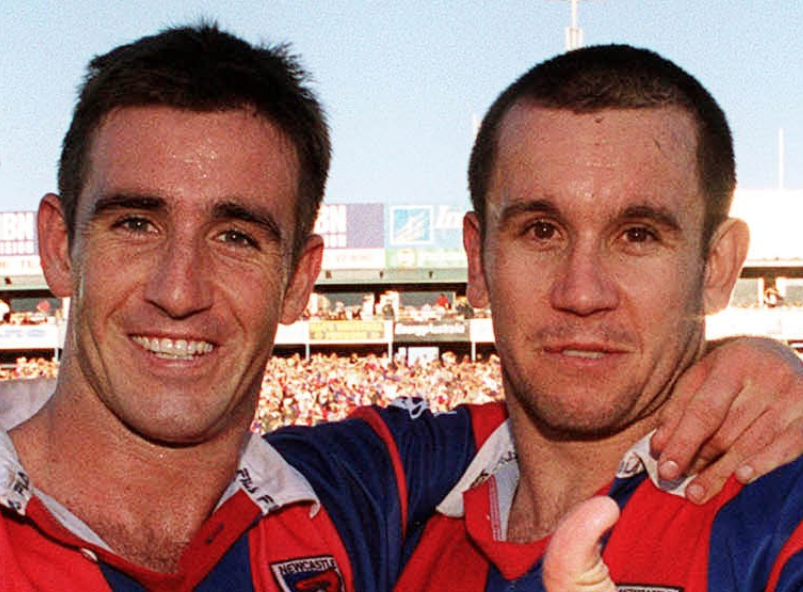
The Johns brothers: Joey on the left, Matty on the right

Matty (who styled himself as Reg ‘Bring back the Biff’ Reagan, so seamlessly) had a nice step but once having stepped seemed to leave a lurid trail of scandal wherever his feet took him. Younger brother Andrew, ‘Joey’, went a long way further in the game. Four times Halfback of the Year (Australian rugby league we’re talking about here), won the Dally M three times for the NRL’s best player, five times fans’ player of the year, twice in 1999 and 2001 awarded the Golden Boot for world’s best player (a boot for rugby league? Weird), and in 2012 anointed as only the eighth, and some would claim the best, ‘Immortal’ of rugby league.

Except he was and he wasn’t.

Yes he was nominated. But in the light of all that other business, the nomination’s status appeared to remain fluid. He was found in London by the constabulary with a tab of ecstasy in his pocket. Where someone had slipped it. Unbeknownst to him for a start: later, beknownst. On his own subsequent admission he had used drugs all his playing career although not necessarily while playing. As explained, their use was designed to ameliorate his bipolar tendencies. Possibly. There were the unfortunate and apparently uncontrolled rants at Aboriginal players, notably including Greg Inglis who might have been as good as he was. Then the awkward business of passing inside information about a horse before a race, embedded as Joey was in the high society of the racing world. After all this and more seeped out through the media, his immortality became moot.

To overcome widespread public criticism of his drug use, the rules for designation as an ‘Immortal’ were changed. Candidates are now to be judged on their playing ability alone. Nothing else. If you’ve been the best in the world, the rules can be changed to suit with only slight compunction.

And then of course there’s Daniel Johns of Newcastle, no relation, confined to his Silver Chair.

This could be just an interesting digression, but it’s actually a suitable entry to a story largely about appearances.

• • • • • • •

The Hunter might be the divide on the east coast which distinguishes the communalism of the south of the country from the rugged individualism of the north. From tidy, well-defined (boring?) towns to clumps of bush wrenched out and planted with 17 houses, a servo and a Bunnings with a view through the trees, somewhere, across a valley, to a Coles, a primary school, a The Coffee Club, a car park and an earth moving depot.

But this valley and its environs are also very beautiful. And fertile. In some ways its discovery by the European trespassers less than 100 kms north of Sydney saved the infant colonial project. In 1811 Governor Macquarie deemed the quality of its soil to be ‘excellent’ and granted land to a group of free settlers before opening access more widely. (I note in passing it wasn’t his or the Crown’s to grant, but that would be understood.) The foundations of the wine industry had been laid in the Hunter when the population back in Sydney was still wrestling to find a route across the Blue Mountains. The first coal was found there in 1791 by a group of escaped convicts and a settlement for the purpose of mining was set up in 1799.

None of that provides the reason why I like Newcastle. But I do, a lot. Never had a bad time there. It has a subterranean buzz that suggests vitality and a reasonably harmless sort of wickedness. Bob Hudson’s Newcastle Song might help explain.

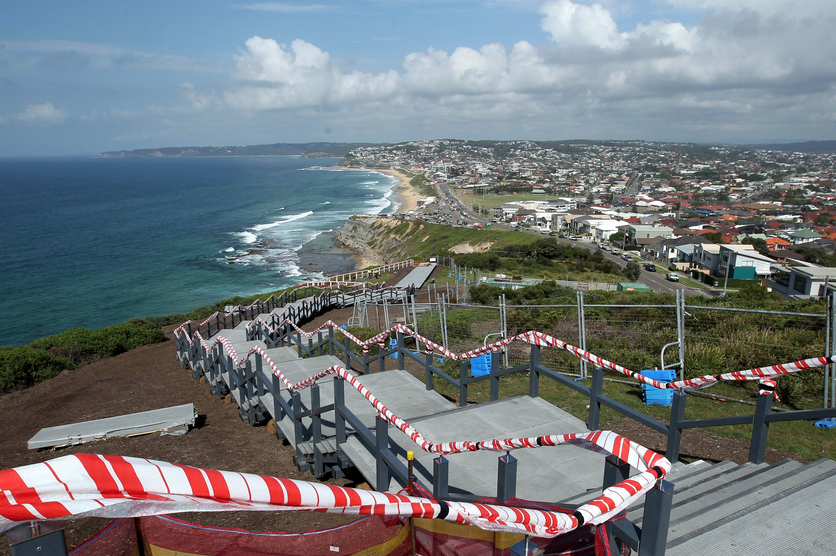
On this day we are walking along the beach. We thought we would walk from the Merewether Ocean Baths to the City Ocean Baths — I haven’t said; Newcastle has ocean baths, wonderful if ice-cold when I have tested them — along the shore path which has a name, two names actually, the Yuelarbah Track and the Memorial Walk. Gorgeous day.
This image has an empty alt attribute; its file name is screen-shot-2022-10-03-at-2.08.00-pm.png

Not my photo, an old one from the Newcastle Herald before the Memorial Walk had the tape taken off its railings. But Merewether Baths are there in the far distance. And, a memory, when we walked past the park to the right of the coastal road a group of people were playing, with a much larger group watching, quidditch. Quidditch. In Newcastle. Almost perverse.

This image has an empty alt attribute; its file name is screen-shot-2022-10-03-at-2.06.37-pm.png

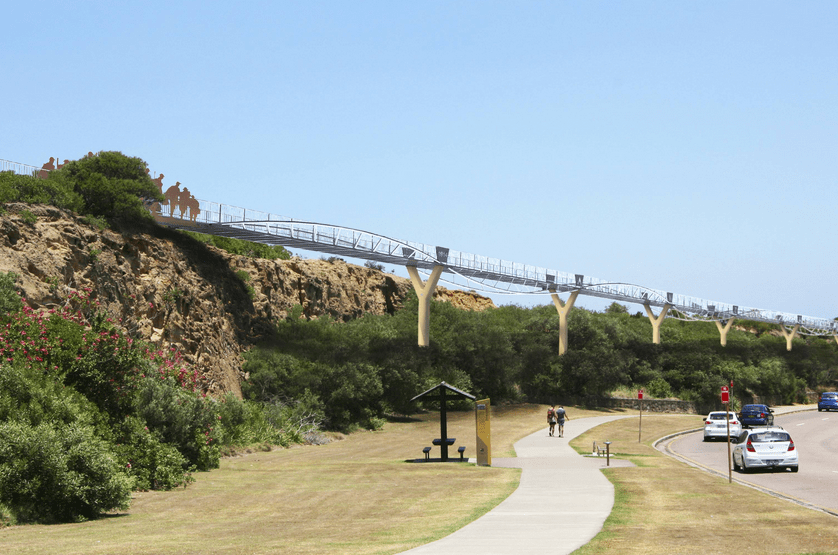
Not my pic either. It’s more theft from the Herald, but besides being a whizzo pic it introduces us to the flyover section of the Memorial Walk which from the ground looks like this.
This image has an empty alt attribute; its file name is screen-shot-2022-10-03-at-2.07.15-pm.png

The Walk celebrates the centenary of the ANZAC landing at Gallipoli, and you can see some of the soldiers being memorialised in silhouette at left above. They’re in steel because, in a splendid one-two punch, The Walk also celebrates the 100th anniversary of the founding of the iron and steel industry in Newcastle. Rio Tinto and BHP both made significant contributions to the structure in money and kind. That arty wave is stainless steel.

The steps of the first photo lead to the King Edward Park lookout that provides 360 degree views described in the literature as ‘breath taking’. We were lazing there, me thinking about steps and knees and Myrna looking out to sea. ‘Look,’ she said. ‘There’s two big boats out there. What are they doing?’ I looked as instructed and counted not two but seven. Huge tankers. Just parked. A day later we were with some friends at Mannering Park and Nick scoffed at seven. He’d seen 34 lined up.

In 2020 169 million tonnes of thermal and soft coking coal mined in the Hunter were exported via the port of Newcastle. It is the world’s largest coal export port. The port authority has recently announced the port’s operations will be powered entirely by renewable energy by 2040. (I like to inject humour into these blogs where I can.)

• • • • • • •

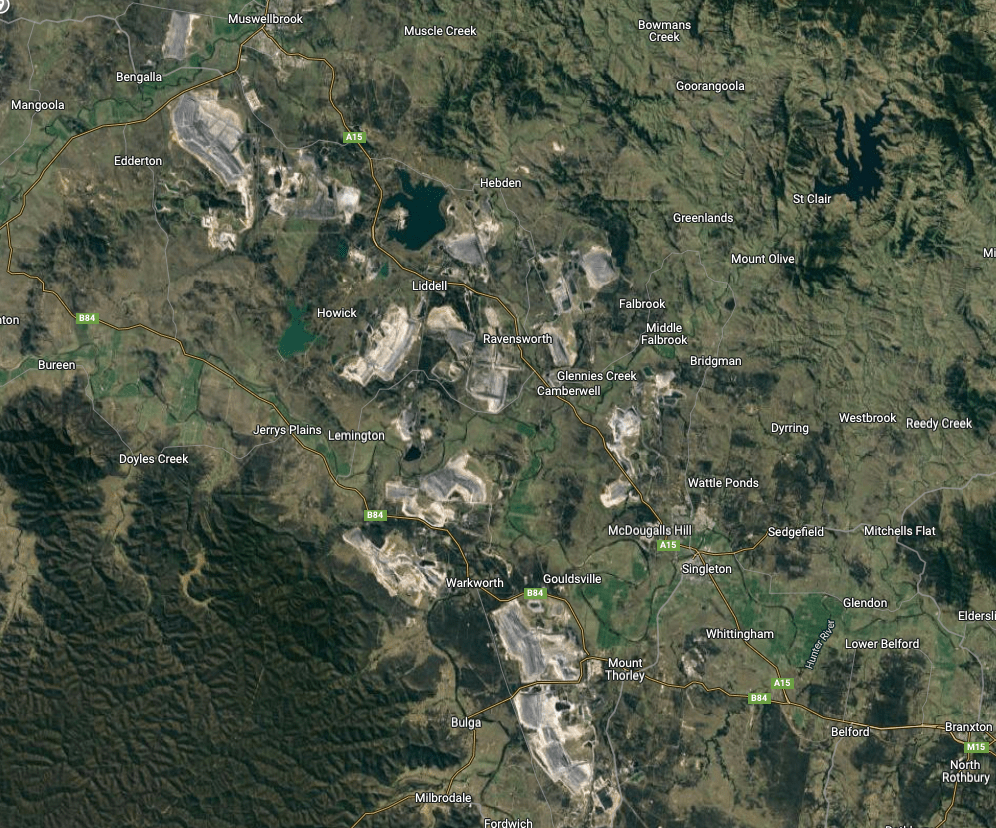
A day or so later we are driving the scenic route to Bathurst up the Hunter via the Golden Highway reveling in the rich pasture, the horse studs, the frequency of the stands of original forest that are still there, remembering that Kerry Packer established one of the world’s slickest polo fields near here. And suddenly, most abruptly — or had I just not been noticing — there are the naked colours and sharp benches of an open cut mine. At Warkworth. And then, after ‘suddenly’, came kilometre after kilometre of the exposed surfaces of the same mine. It went on and on. And came as a shock. But why would it? 169 million tonnes of coal have got to come from somewhere. And it’s here.
This image has an empty alt attribute; its file name is screen-shot-2022-10-08-at-12.25.37-pm.png

This screen shot covers approximately 3600 square kilometres. You can decide what proportion the mines, coal mines, thermal and soft coking coal mines, take up. In the left hand corner is the north-eastern verge of the Wollemi National Park. People like Eddie Obeid and Ian Macfarlane would wonder why. The seam from that mine at Warkworth probably takes you south-west? Let’s do it!

The mine we were passing was ‘United Wambo’. I know that because I saw the sign.

In August 2019 the United Wambo coal project was approved by the Independent Planning Commission, New South Wales to extract an additional 150 million tonnes of coal at a rate of up to 10 million tonnes per annum over a period of 23 years, which is to say until 2042. So that would be the IPC rather than the IPCC which may have made a different determination.

I also noticed it was owned as a 50:50 joint venture of Wambo Coal and United Collieries, suitably indecipherable generics. I thought it might be interesting to find out who or what ‘Wambo Coal’ and ‘United Collieries’ were.

Wambo Coal is an entity fully owned by Peabody Energy Australia Pty Limited which in turn is a wholly-owned subsidiary of US-based coal company, Peabody Energy Corporation, the largest ‘pure play’ coal mining company in the world. ‘Pure play’ means ‘does nothing else’; just coal, wherever it can be found, and primarily for burning to power turbines which generate electricity. A dead set fossil fuel, pretty close to pure carbon. When burnt, carbon combines with oxygen in the air to produce carbon dioxide. Etc.

Here’s Peabody Australia’s Financial Statement as published publicly.
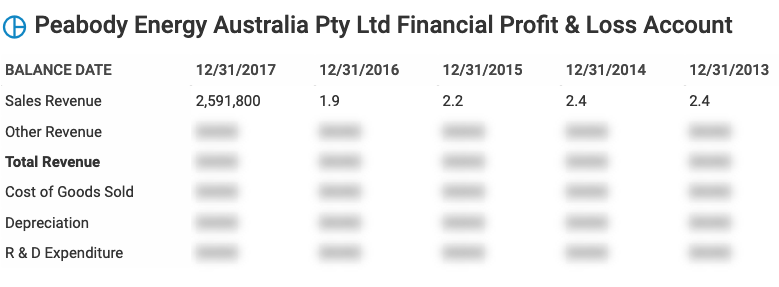
New glasses? Sure. Give that a go. Might work.

United Collieries on the other hand is a partnership between Glencore (95%) and the Construction, Forestry, Maritime, Mining, and Energy Union (5%). That’s smart isn’t it? Making the Union a partner. That’d be likely to cut down on strikes and associated bolshie behaviour.

And Glencore … Glencore might be a major contributor to the well-being of NSW (and Australia). Oddly, the page I first opened at the cafe in Denman to prove this has been taken down just a week or two later. I have been present at a change in company branding! I admired the original because it was so fulsome, a work of marketing artistry, suggesting that the company’s extraction of coal has always been little more than a byproduct of its operations if not an afterthought. But that particular page is not there anymore. Instead of environmental good works, scholarships for Indigenous kids and pumping huge amounts into community playgrounds — it’s the economy stupid.
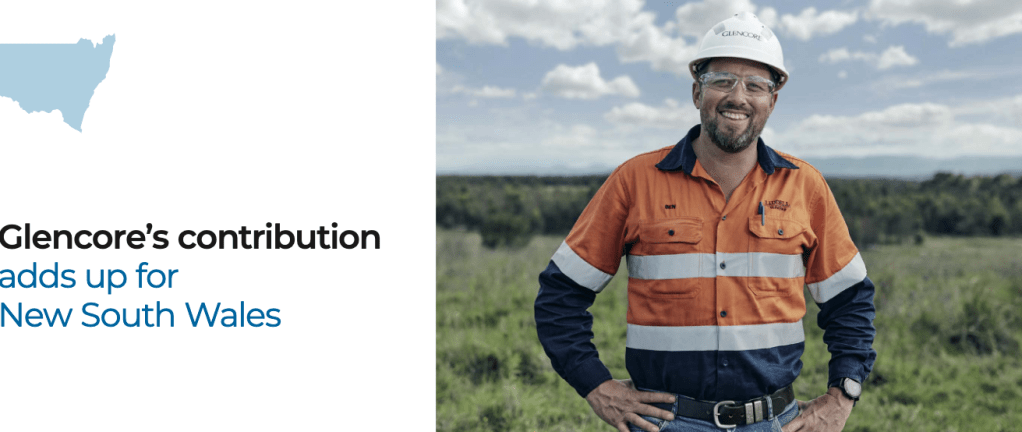
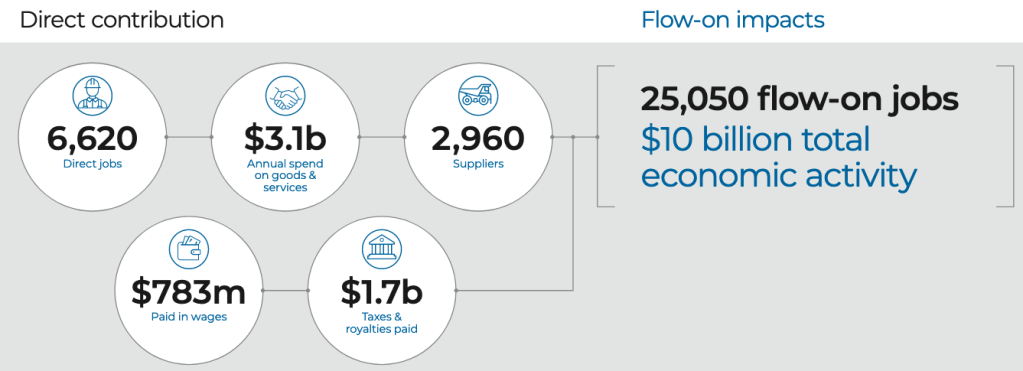
And for Australia as a whole:

I have no reason to doubt those figures nor their positive implications and consequences. Nor do I expect all coal mining to cease immediately. I’m just interested in trying to untangle the stories underneath all this.

Glencore (sometimes Glencore Xstrata), of which I had heard but knew little, is the largest company in Switzerland and somewhere round the 480th largest company in the world. But it is not the largest miner. Its core business is commodity trading and it is the largest commodity trader in the world — Global Energy Commodity Resources. In 2021 it held assets valued at US$127.510 billion. Its operating income for that year was US$8.515 billion and its net income was US$4.349 billion.

What’s a commodity trader? A person or more commonly now a business which buys and sells ‘commodities’. Like all traders, commodity traders make their money from exploiting the gap between purchase and sale price. Oil and gold are two of the most commonly traded commodities, but markets also exist for cotton, wheat, corn, sugar, coffee, cattle, lumber, silver, other metals — at present cadmium and lithium are hot trades — and yes the proverbial pork bellies indicating the significance of pork, and bacon especially, to the world’s diet. And coal.

It’s not that simple of course. No one is holding up a bag of coal (except Scomo) and saying ‘What’ll you give me for this?’ Most commodity trading involves the purchase and sale of ‘futures contracts’. A futures contract is a standardized legal contract to buy or sell something at a predetermined price for delivery at a specified time in the future, between parties not yet known to each other, … and you buy and sell those contracts. The commodity is to some extent notional and the process is, usually and straightforwardly, a form of gambling.

(Just as a matter of interest in 1970 more than 90 percent of the contracts traded related to farm produce. More recently more than three-quarters are related ‘financial instruments’, sometimes like the bundles of worthless (‘subprime’) mortgages which generated the Global Financial Crisis of 2008 and brought the Lehmann Brothers financial institution tumbling down.)

The original use of futures was to mitigate the risk of price or exchange rate movements by allowing parties to fix prices or rates in advance for future transactions. It is not a new idea. It is thought that the first version of this occurred in Japan in the late 17th century when samurai wanted a fixed price for rice (in which they were paid) after a series of bad harvests. Another source provides evidence of the Sumerians trading in this way in 4500BC.

There is endlessly more, but suffice it to say that while Glencore dabbles in food production and processing, crude oil production and is a huge international miner with interests in a very wide range of products, its primary business has been commodity trading.

• • • • • • •

Marc Rich was initially its beating heart. Here’s Marc looking the slick, stylish and charming person his customers and others who knew him consistently described him as.
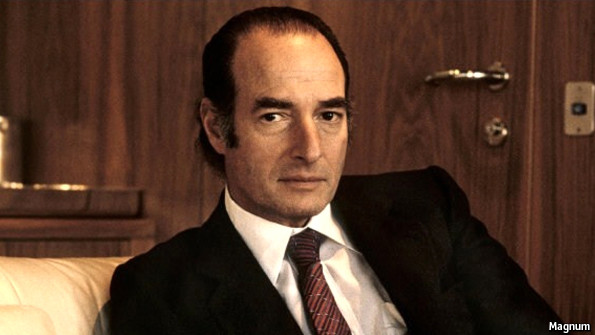
He was born Marcell Reich in Amsterdam in 1934. His family left there in a hurry in 1941 fleeing the Nazis. In the US, that land of succour, his father found fertile ground for his entrepreneurialism: in serial form jeweller, bag manufacturer, trader in agricultural products and, eventually, financier. Marcell Reich changed his name to Marc Rich and then proceeded to turn his new name into an ideophone. He left college after a semester and got a job in the mail room of Philipp Brothers, a brokerage firm. (The mail room. What even is a ‘mail room’, and why do mail rooms so often figure in the biographies of tycoons?) In the mail room Rich met Pincus Green and they forged a partnership that accelerated them upward through the ranks. After a decade Rich was running the company’s operations in Cuba, Bolivia, and Spain learning about both metals trading and working in third world countries. Then in 1974 he and Green decided to go out on their own setting up Marc Rich and Co. in Switzerland. Via a few hiccups from trying to corner the world zinc market, this eventually became Glencore Xstrata Plc.

Quite soon after branching out on his own Rich became known as the ‘King of Oil’. His particular genius was spot trading. This is where you do hold up a bag of oil and say ‘How much?’ Two days later you’ve got money in your bank account (what is known as a ‘T+2 deal’, the most common type) and your customer has got their oil (or coal, zinc, cadmium, etc. but in this case right here mostly oil). He was so successful because of the agility of his trading. The standard practice of the big oil firms was to plod through a process of establishing long term fixed price (and both public and stable) contracts with their customers. However, if you were suitably prepared, Rich could give you a deal right then, on the spot. This became one important template for the practice of modern commodity dealers.

That was one aspect of his commercial genius. The other was that he didn’t mind where he got his oil, or other commodities, from … and he didn’t mind to whom he sold them.

His time at Philipp Brothers had provided an opportunity to develop relationships with various problematic régimes and embargoed nations. He provided oil and other commodities to, for example, Fidel Castro’s Cuba, Marxist Angola, the Nicaraguan Sandinistas, Muammar Gaddafi’s Libya, Nicolae Ceaușescu’s Romania, and Augusto Pinochet’s Chile among others. He made his first really big money out of trading with the South African government when it an international trade pariah because of its apartheid policies.

In 1979, in the throes of the Iranian Revolution (Shah out; Ayatollah in), Rich used his special relationship with Ayatollah Khomeini to buy oil from Iran ignoring the American embargo. For more than 15 years Iran became Rich’s most important supplier of crude oil. In a ridiculously perverse way, during that time Rich kept Israel supplied with oil delivered through a secret pipeline from Iran. At the same time he managed to help Mossad build a network of contacts in Iran and other Middle Eastern countries. He also had extensive association with Russian mafiosi, some of whom have now become members of that country’s energy and commodity oligarchy. One of these, Marat Balagula, has his profession described as ‘mobster’.

Rich (who died in 2013 aged 78) told biographer Daniel Ammann that he had made his ‘most important and most profitable’ business deals by violating international trade embargoes. ‘He had no regrets whatsoever…. He used to say “I deliver a service. People want to sell oil to me and other people wanted to buy oil from me. I am a businessman, not a politician.'” He would not be alone in holding that perspective.

In 1981 Rich and Marvin Davis bought the media company 20th Century Fox, but due to an indictment filed against Rich for violating US trade sanctions against Iran, his assets including his holding in 20th Century Fox were frozen. He sold his holding to Davis who sold the lot on to Rupert Murdoch.

In 1983, Rich and Pincus Green were indicted on 65 criminal counts, including income tax evasion, wire fraud, racketeering, and trading with Iran during the oil embargo. The charges would have led to a sentence of more than 300 years in prison had Rich been convicted on all counts. At the time, it was the biggest tax evasion case in U.S. history.

Rich fled to Switzerland and, always insisting that he was not guilty, never returned to the US. Rich’s companies eventually pleaded guilty to 35 counts of tax evasion and paid USD90 million in fines. Rich himself remained on the FBI’s Most Wanted List. At that time it is believed that his personal fortune was in the arena of USD2.8 billion. He lived out his life in a heavily protected villa on the shores of Lake Lucerne ‘surrounded by Renoirs, Monets and Picassos’.

‘How the world works’ this blog is titled.

On January 20, 2001, hours before leaving office, U.S. President Bill Clinton defied any sort of conventional expectation by granting Rich a presidential pardon. Two factors are believed to be involved.

One line of explanation is that Rich’s pardon had been bought. Denise Rich, Marc’s first wife, had donated more than $1 million to the Democrats, as well as around $150,000 to Hillary’s Senate campaign and $450,000 to the Clinton Library Foundation during Clinton’s time in office. (Sounds cheap in the middle of the figures floating round doesn’t it.)

Clinton himself cited clemency pleas he had received from Israeli government officials, including then Prime Minister Ehud Barak. We note here that one person’s criminal can quite possibly be someone else’s hero. Was Rich perhaps Robin Hood in disguise? He had poured money into Israeli charitable institutions over the years, including around USD150 million (That’s more like it!) into the Israeli Museum that so caught our eye when we were in Jerusalem. (‘Jerusalem’s Israel Museum’, I wrote, ‘is a world class institution with stunning exhibits. How could a country of 8.5 million (2 million in 1960) which is 70 years old have such a thing? Read the tags. … You can see, and feel, how the money has poured in, the vast nation-sized sums of money.’) Shimon Peres, Ehud Olmert, Shlomo Ben-Ami, Michael Steinhardt, Rabbi Irving Greenberg, … they all lined up to speak for him. In an interview with The New York Times Clinton agreed that, ‘Israeli officials of both major political parties and leaders of Jewish communities in America and Europe urged the pardon of Mr. Rich. Israel did influence me profoundly’. This sounds more likely to me.

• • • • • • •

Rich, what a story, is dead. Glencore lives on. Profitably.

The company’s history, however, is peppered with ugly stories: corruption and pay-offs in the Democratic Republic of the Congo, tax evasion, fraud and being the source of acid rain in Zambia, dodgy deals in the Emirates. In 2011, a Colombian court was told by former paramilitaries that they stole land and killed hundreds of its inhabitants so they could sell it to Glencore’s subsidiary Prodeco, to start an open-cut coal mine. The court accepted their evidence and concluded that coal was the motive for the massacre. This particular mine remained an issue for having no environmental management plan and distributing its waste in toxic ways.

In the Congo the acid waste from one of the company’s copper processing plants was directed into the nearest river creating a famous ‘acid waterfall’ and making the water impossible to use for domestic or other purposes. CEO Ivan Glasenberg said this problem was historical occurring before the company took over the mine. There were also issues at the same mine with children as young as 10 working underground. Glasenberg described this as a cultural practice which the company was trying to eradicate. In 2013 and 2014, in direct violation of international law a subsidiary of Glencore Xstrata was awarded two offshore drilling licences off the coast of occupied Western Sahara.

In May this year, Glencore pleaded guilty to charges from the US Futures Trading Commission of corrupt dealings with foreign governments and corrupt practices related to commodities, and agreed to pay a USD1.8 billion fine. On June 21, a British subsidiary of Glencore again pleaded guilty to seven counts of bribery laid by the UK’s Serious Fraud Office. These charges related to oil operations in Nigeria, Cameroon, Equatorial Guinea, Ivory Coast and South Sudan between 2012 and 2016. The SFO found that over USD28 million in bribes had been paid to officials for ‘performing their functions improperly’.

Can you make an omelette without breaking eggs? That might be what they’d argue. Massive operations all over the world, only a small proportion of which were problematic. A lot of what was going on was just how you do business in that locality. The West would suffer and complain if it didn’t have these commodities readily available. If Glencore wasn’t doing it someone else would have been … and so on. What was it Mr Rich said again? ‘I deliver a service. People want to sell [coal] to me and other people wanted to buy [coal] from me. I am a businessman, not a politician.’ Shrug.

From 2017 to 2019 the company ran (instigated and paid for really in order to deflect possible blame) a large-scale, globally coordinated lobbying campaign to promote coal use ‘by undermining environmental activists, influencing politicians and spreading sophisticated pro-coal messaging on social media’. In October 2020, Glasenberg (now retired) argued that there was no environmental benefit in divesting from coal assets since the spun-off coal mines would likely be taken over by other players without any regard for the Paris climate goals. He instead argued for capping coal mine production, thereby running them down, and using the cash generated this way to increase the production of other raw materials in high demand due to the global energy transformation. Glencore has said it plans to reach net-zero carbon emissions by 2050 aiming at a 40 percent reduction in its carbon footprint by 2035 compared to its 2019 levels, making them on track with the Paris agreement on climate change.

• • • • • • •

‘In August 2022, the market predicted that Glencore would deliver a record profit due to its ability to thrive in volatile markets, and particularly because of its coal business that is growing rapidly during the 2022 global energy crisis. The use of coal, even in Europe, is increasing by double digit percentages as it replaces expensive natural gas from Russia. While traditional mining companies such as BHP Group and Rio Tinto Group have experienced a slowdown due to a lower demand for iron and copper ores by China, Glencore was able to increase its business mostly with coal, despite the dirty image this form of energy has. Business analysts forecast that Glencore’s dividends could exceed $10 billion in total in 2022.’

So everything’s okay then. The port of Newcastle with its renewable supplies of energy can power up and power on, and Joey Johns can forever remain Immortal.

45 degrees South, 2022

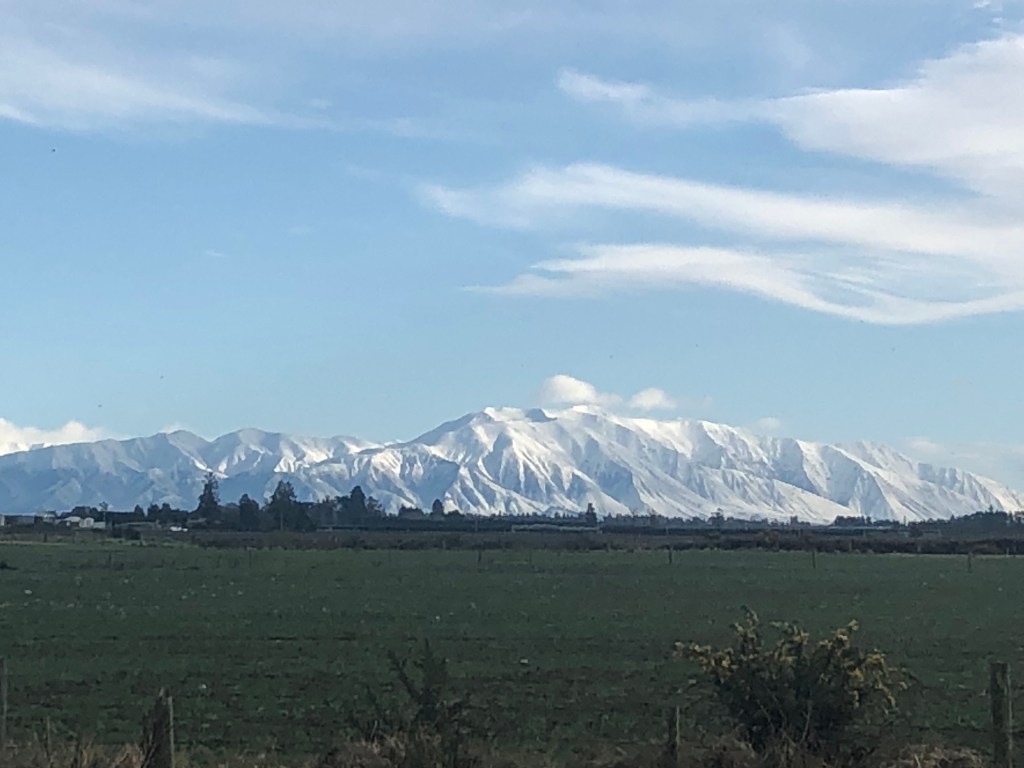
It’s probably the Waimakariri. I was too tired to know. But it is certainly New Zealand. You don’t get braided rivers like that just anywhere, especially with snow-capped mountains in the near background. There was water everywhere as we landed. Canterbury had had a foot of rain in the preceding week, a genuine wet week. It was winter and we were being international for the purposes I would say primarily of eating, sleeping and looking out the window. And seeing Rhys Darby at Christchurch’s Isaac Theatre Royal.

We had been on the theatre’s mailing list since we attended the re-opening night seven years ago after the earthquakes. Rhys Darby (at left) was going to have a concert celebrating the 25th anniversary of his stand-up comedy and while that won’t mean a thing to most people it meant enough to us to test attendance as an idea. (Flight of the Conchords? Jermaine and Brett? New Zealand takes New York? No? ah well. Rhys was Murray the band manager: ‘Now I’m going to take the roll. Brett?’ Every time he appeared the show got funnier.) His brand of humour involves his entire being while somehow remaining entirely deadpan in a very New Zealand-ish way. And yes, improbably, we went. I only loved it; he reduced Myrna to weeping mush.

The night before we had been to see Top Gun: Maverick (It was a holiday, okay? And we really wanted to have a choc top. Really. Mate, New Zealand choc tops … We drove around most of Sydenham, a southern Christchurch suburb, to find an ATM so we could accomplish the transaction. Foreign cards, in this instance, were worthless muck.) Anything more antithetical would be hard to imagine. An ageing Tom Cruise conquering some unnamed wicked country by bumping fists with young American athletes majoring in aggression and world domination, fighting off the baddies with CGI (ah yes, pardon, computer-generated imagery), a miracle of technology so removed from humankind it is hard to fathom let alone explain. Rhys just stood on the stage and said and did funny things ending the evening with his kids running around the front of the theatre distributing what we’d call thongs so they could be clapped along to his song ‘Jandals’. Not necessarily his best work, but anything more delightfully human would be hard to imagine.

However this blog is mainly just an excuse for photos, memorabilia. And to indicate that going to New Zealand for a holiday is a very desirable thing to do. I’ve made this case elsewhere, here and here and here.

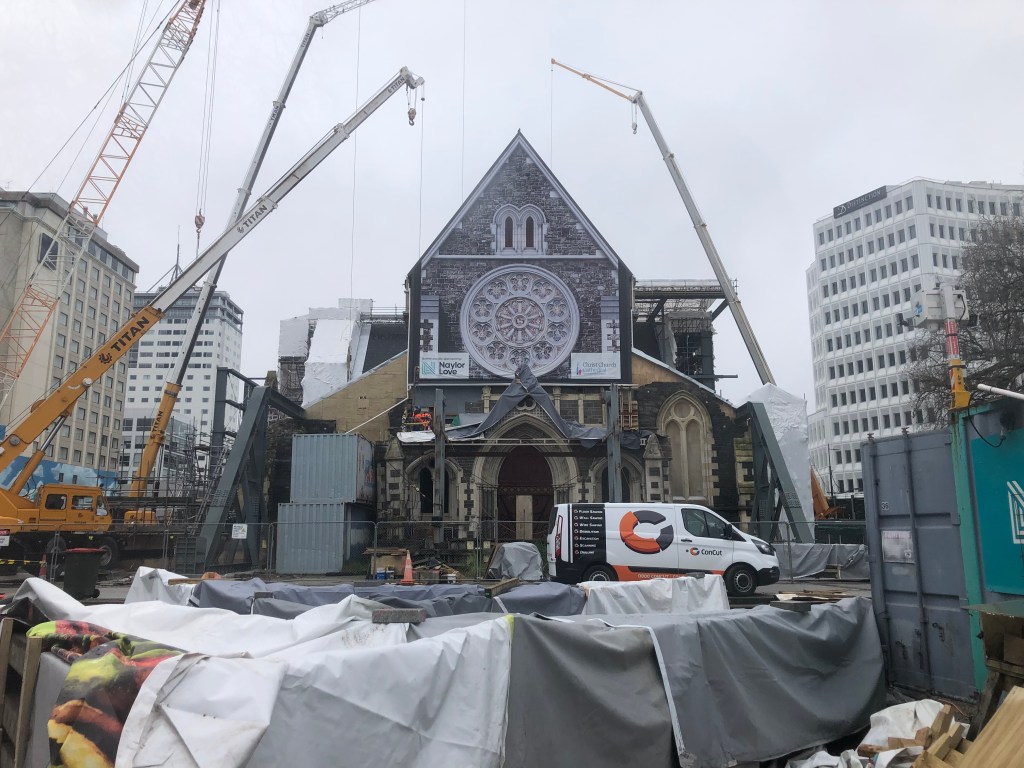
We arrived in Christchurch. It is still in recovery. It is unlikely to ever be the same as it was before the giant earthquakes of 2010 and 2011 which killed 185 people and shook its centre, including its cathedral which used to dominate the city square, to bits. It is a moot point whether hundreds of millions of dollars should be spent restoring this building. Do you justify it, as a Kiwi friend did, by referring to its iconic historical status or, as her husband suggested, do you put your money instead into rebuilding the stadium, home of the Crusaders, the greatest rugby club on earth? The cathedral remnant is still not secure enough to enter to determine precisely what needs to be done. The good-looking facade is a banner. I thought Wow! Naylor Love! sponsoring the rebuild of the front wall and window, go for it you civic-minded creatures you. But in fact they’ve just sponsored the banner.

Another fake, the wall of the Riverside market, one of three pockets of the city which remain bopping. It’s flat. Yes. Flat. A single surface. But nicely done. There’s still plenty of street art.

And the Gallery is back in business. Four offerings.

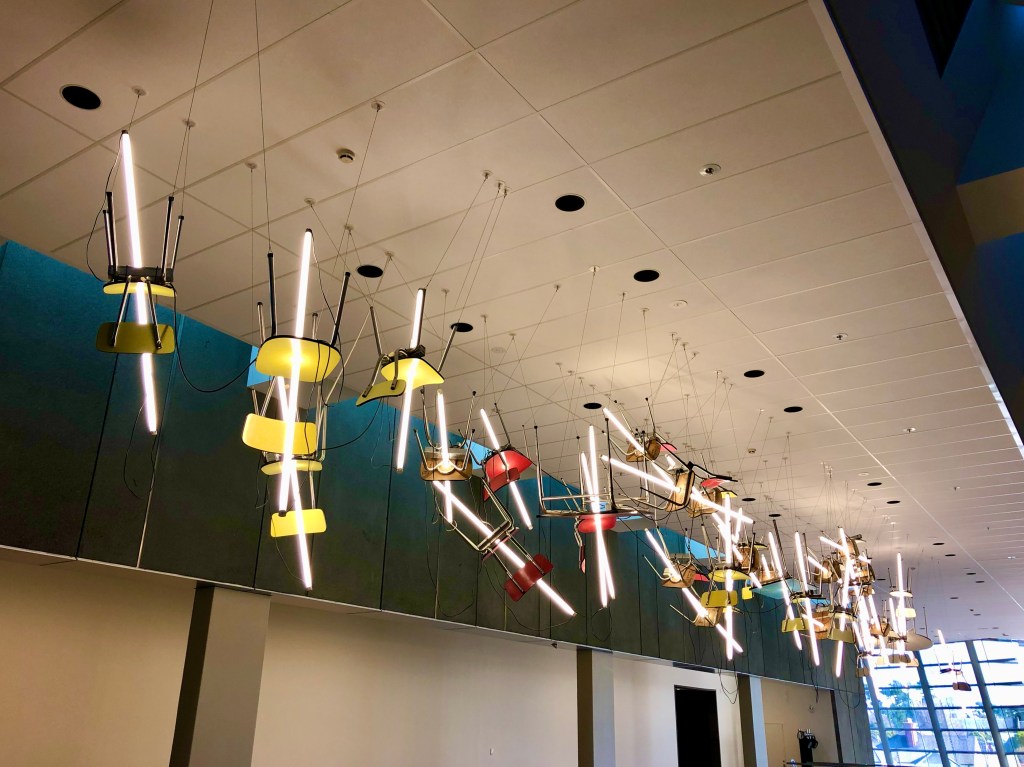
The light fittings: 60s kitchen chairs with neon tubes through them. Why not?

We visited at a changeover, so the exhibition offerings were modest. Modest, but most engaging with a strong emphasis on Victoriana. Here she is herself for example.

William Nicholson, ‘H.M. The Queen’ (1899), a lithograph derived from a woodcut, and isn’t that just marvellous. Sort of perfect in a way. A huge version of this is the major decorative feature of the external walls of Christchurch’s casino. New Zealand. They do that sort of thing over there.

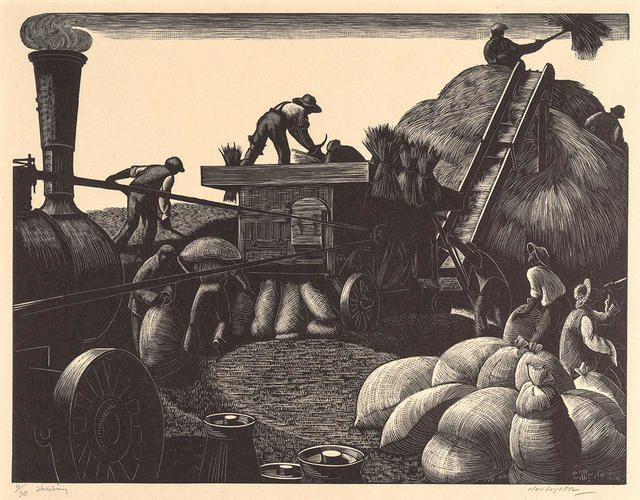
The exhibition I enjoyed most was called ‘Leaving for Work’, perhaps 40 pieces again often early 20th century about people at work. ‘Threshing’ (below), a woodcut print by Clare Leighton (1933), caught my eye along with its companion ‘Apple Picking’. She has found some wonderful blacks along with extremely inventive hatching. And look at that smoke coming out of the steam engine. Somewhere near here is one of the places that craft truly meets art.

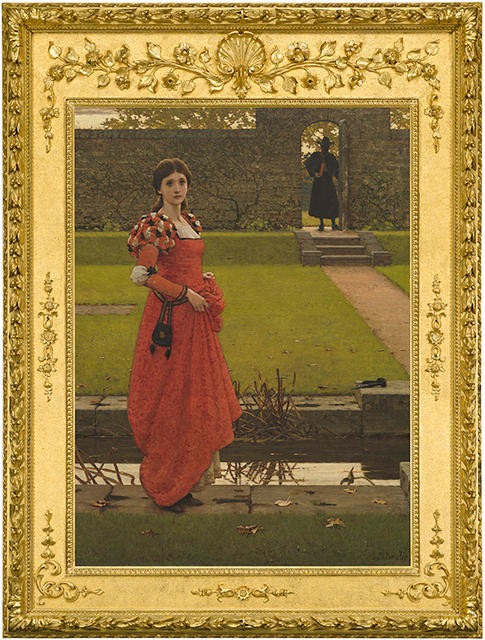
Elsewhere George Dunlop Leslie’s, In the Wizard’s Garden, about 1904. The wall notes say, ‘Because the painting puzzled viewers Leslie was asked for an explanation of its meaning.’ Well, I’ve got news for the viewers: I think I know. But, elegantly obfuscating in the prescribed Victorian manner, Leslie describes the painting as being about a young medieval noblewoman who had sought an alchemist or wizard’s guidance to discover the secrets of the future. For more distracting camouflage he throws in Nathaniel Hawthorne’s story ‘Rappacini’s Daughter’ in which case, unhappily, the garden would be entirely filled with poisonous plants. Okay. Menace. (Just nod knowingly. Thank you.)

For ourselves, concerns focused on the scones. In fact the heritage diet of New Zealanders may be under some threat.

The food cabinets are full of the products of wild and fertile imaginings — some of these dishes are even vegetarian — but the cheese scone, as perfected widely in the past, is endangered. We were concerned about its extinction until we found what we were looking for and much else, including a sausage roll which actually was a sausage wrapped in a pastry roll — how good is that, how express and admirable in fact, Shakespearean — in the Union Company Cafe, Port Chalmers. Worth a journey.

There’s some large scale new building, a lot of civic infrastructure including Te Pae, a giant conference centre which looms with its exterior collection of Canterbury greys and gigantic video screens illuminating its walls. And yes a giant squid. A whale swims past from time to time. You may make of that what you wish.

But there are still a lot of teeth missing from the jaw. Car parks — ubiquitous, endless — fill places where you feel buildings should be (and make you wonder where the hell all those cars come from … and why).

So we went looking for something other than the built environment.

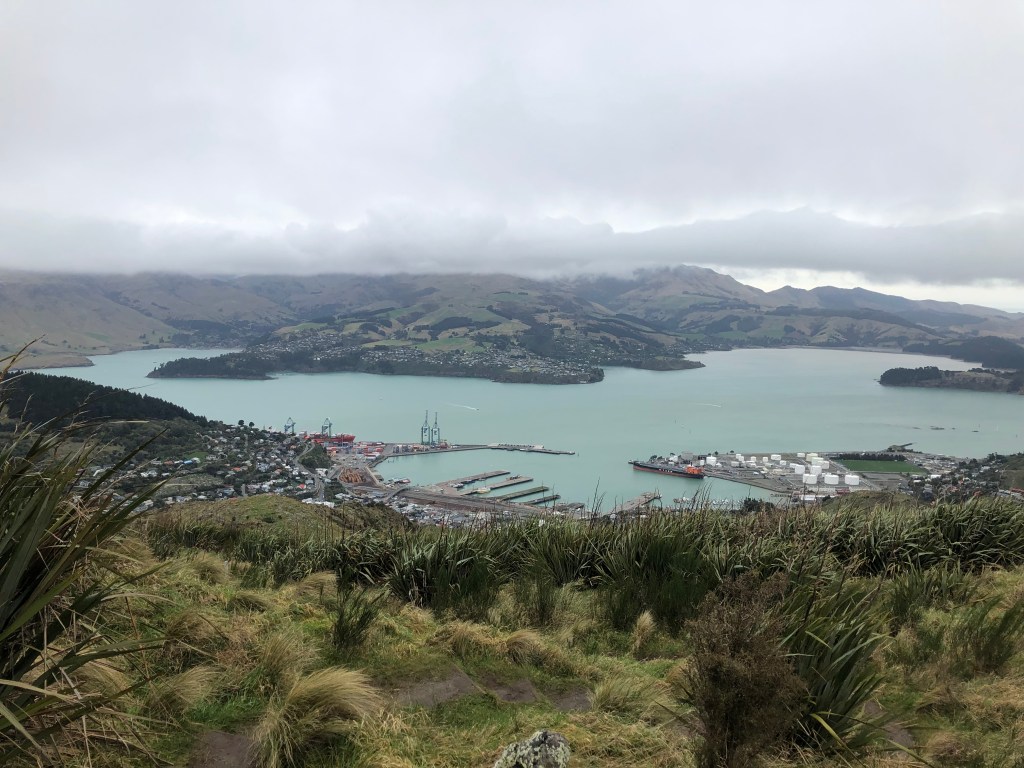
Christchurch is not a maritime city but its eastern edge runs into the South Pacific looking here from the New Brighton Pier very pacific indeed. Christchurch’s port, its crucial port both for receiving goods and more especially for dispatching the riches of the Canterbury Plain to the world, is 10 or 12 kilometres away at Lyttleton in a fractured volcanic crater.

Separating the city and Lyttleton are the Port Hills, the crater rim, just fine for a walk. On this Saturday morning it was a sharply cold day with drifts of rain and some fierce wind up high, but we were there with dozens, scores, hundreds of locals mooching walking running riding not really noticing the weather. New Zealand.

We cheated by going up some of the way in the gondola before launching out down through Major Hornbrook’s Saddle and up to the peak, Mt Pleasant.

The Avon and Heathcote, often only masquerading as creeks, drain the mudflats of Christchurch into the estuary as seen in the pic on the right. They were both running hard and the visible surface water was much more extensive than it looks here.

When there’s a dance class on, doesn’t matter where you are, you’ve just got to do it. Mercifully the internet wasn’t good enough to sustain a whole hour out on the blasted heath. Praise the Lord. We were able to move on to the summit, near which were these lichen-encrusted trees, followed by a muddy but interesting descent down to Lyttleton via the Major Hornbrook Track.

We got to Lyttleton in the mid-afternoon and both hungry and not confident about finding anything to eat in a tiny town at that hour on a Saturday afternoon. But lo and behold we found a most conscientious and capable Japanese chef, him and his wife really, who provided for us.

The okonomiyaki was a bit sludgey — by rights it should be kept cooking at the table — but everything else was delicious.

• • • • • • •

Dunedin is the capital of the Otago region and in the past a home away from home for Scots. (Edinborough = ‘Edin town’ in Old English; Dunedin = ‘Edin town’ in Gaelic.) It is famous for its hills and, in Baldwin Street, has the steepest road in the world, 1: 2.86, officially certified by Guinness Records. A town in Wales laid claim to this title in 2019 but Dunedin courageously fought back. The decision to reinstate the previous record holder was reached in 2020 following the completion of an extensive review of an appeal brought by representatives of Baldwin Street. The appeal included a comparative survey of the three-dimensional shapes of the Dunedin street and Ffordd Pen Llech. The findings revealed that in order to fairly assess the different shape of the streets, whether they’re straight or curved, steepness must be measured by the central axis (the centre line of the road). Certainly that would have been the way I would see it. Regardless, it’s steep all over the place.

It is also a university town (see immediately above: who else would?) with excellent cafes and coffee and funky clothes shops. The University of Otago comes in very high on world rankings and looks like it would be great fun to attend. The day after we arrived it was Open Day and the town was swarming with late adolescents and their parents.

This is the view from what might be the best room in town, the top floor suite of the 97 Moray Motel, Room 409, looking out over The Octagon, the nominal centre of the city. The square is furnished with a statue of Robbie Burns (described on investigation as an ‘eroto-maniac’. Why Scots put up statues to him — there’s another one in Ballarat for example — is beyond me), and a bus depot. St Paul’s Cathedral, an Anglican church, and the Forsyth Barr office block dominate. We wondered if the office block had just been erected. We couldn’t remember it. And, in which case, just who had paid whom and how much? But our mate at reception said that it had been there for ages; it was just that the exterior had recently been renovated. Hence the spotty styling, the lift block and the new top storey which offered some groovy lighting effects.

Robbie’s down there somewhere over the top of the white car.

Dunedin is the sort of place where amateurs publish ideas for city walks. (See also above.) We chose to follow the excellent and well-researched advice of Antony Hamel, barrister. Some of the advice anyway; his guide offers 20 walks. ‘Grand Homes of Dunedin’ takes you up (and up and up) to Royal Terrace just below the ‘Town Belt’. (The original instructions to the New Zealand Company’s Scottish surveyor included: ‘It is indeed desirable that the whole outside of the Town, inland, should be separated from the country by a broad belt of land which you will declare that the Company intends to be public property on condition that no buildings be ever erected upon it.’ ) You walk through the Town Belt which, even if the city has crept over the other side of it, is still 10 or more kilometres long and is still a lovely thing flourishing with several dozen different types of noisy birds. Then on to Jubilee Park and back down High Street to the Octagon.

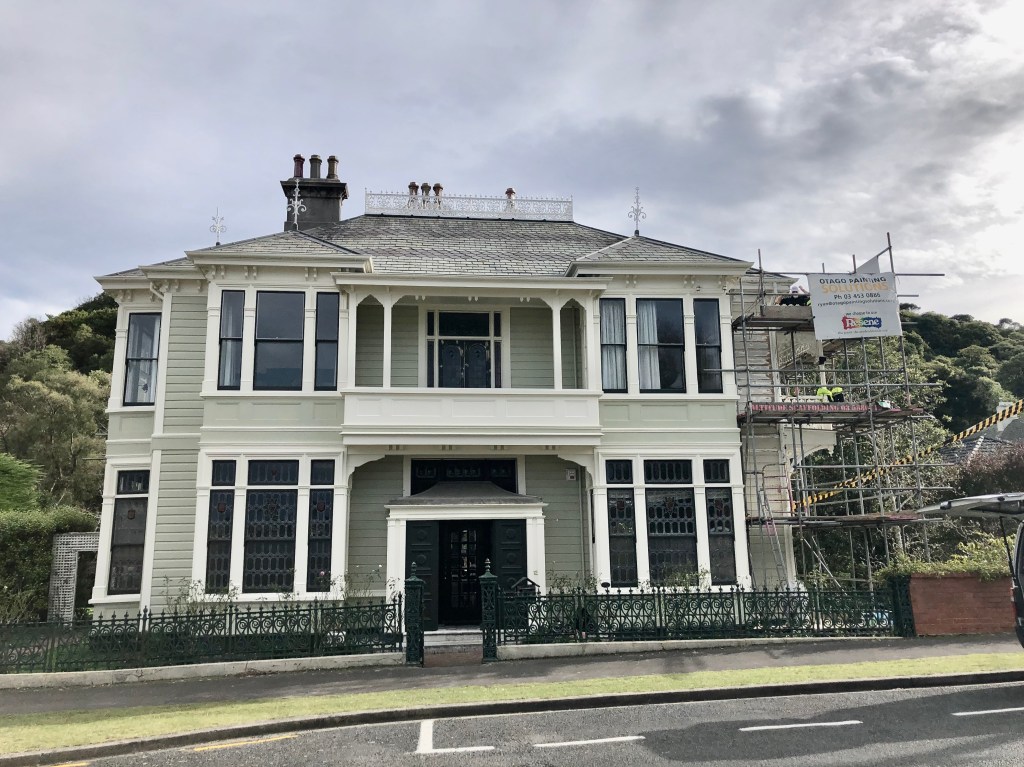
Some samples. These two in Royal Terrace were owned by the same family (Hudson’s chocolate and biscuit manufacturers), the second now being a Buddhist Centre.

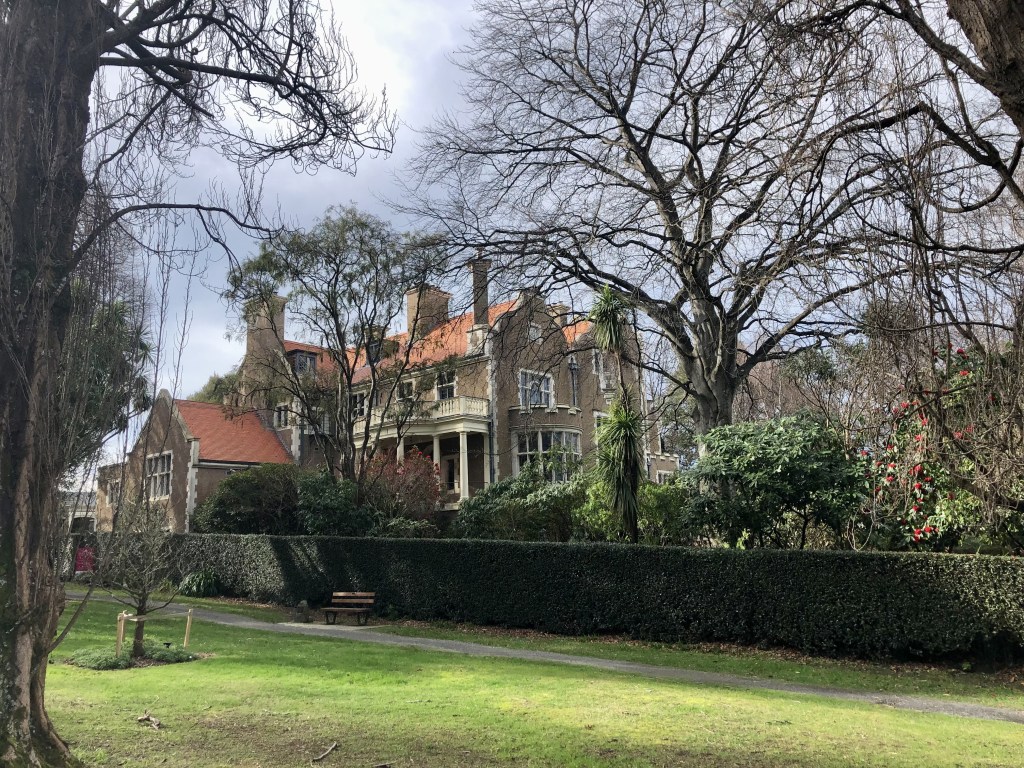
Near them is Ulveston, probably the party piece. Built for a family of four, it was subsequently vested to a somewhat nervous City of Dunedin (upkeep costs). It is now open to the public at regular specified times.

And it has a rather lovely greenhouse.

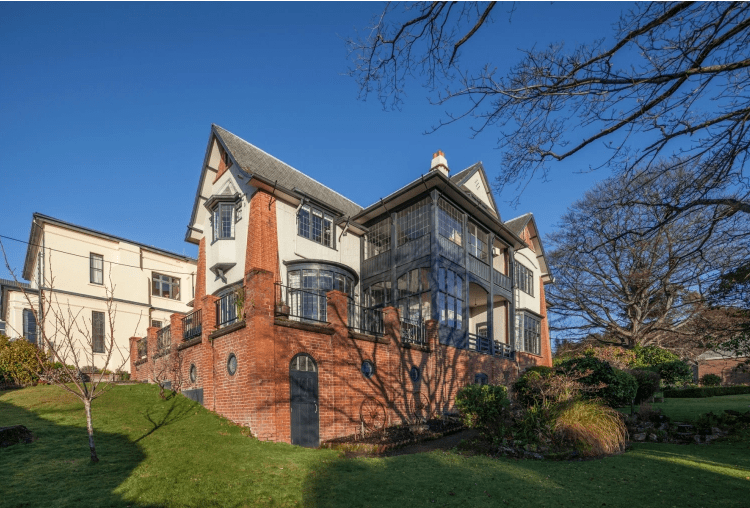
Just around the corner is the Ritchie House which has recently been bought for a very large sum of money by St Hilda’s, a nearby private secondary school for girls with the customary surfeit of funds.

On the corner in the background above is this one, a more sober affair but interesting in its own 1920s way.

… with this view across the city and the end of the harbour to Vauxhall.

Just below Jubilee Park. This wasn’t on the list but I liked it. You could talk about the San Francisco influence, or perhaps the Dunedin influence on San Francisco, or perhaps how you build houses in steep places where there isn’t much suitable stone but plenty of timber (and, in its time, gold).

• • • • • • •

Dunedin is at the end of a long bay, Otago Harbour, with the Peninsula famous for its sea life on its southern side.

We visited the Royal Albatross Centre at Taiaroa Head and this was something. Four chicks had decided to do their eight months of pre-flight maturation within 15 or so metres of the viewing station, a pill box with a glass slit. (A not very old fort with the ‘Invisible Gun’ which can be raised and lowered is close at hand.) And there they are, these fat things with legs that can only just support their 12 kilo weight.

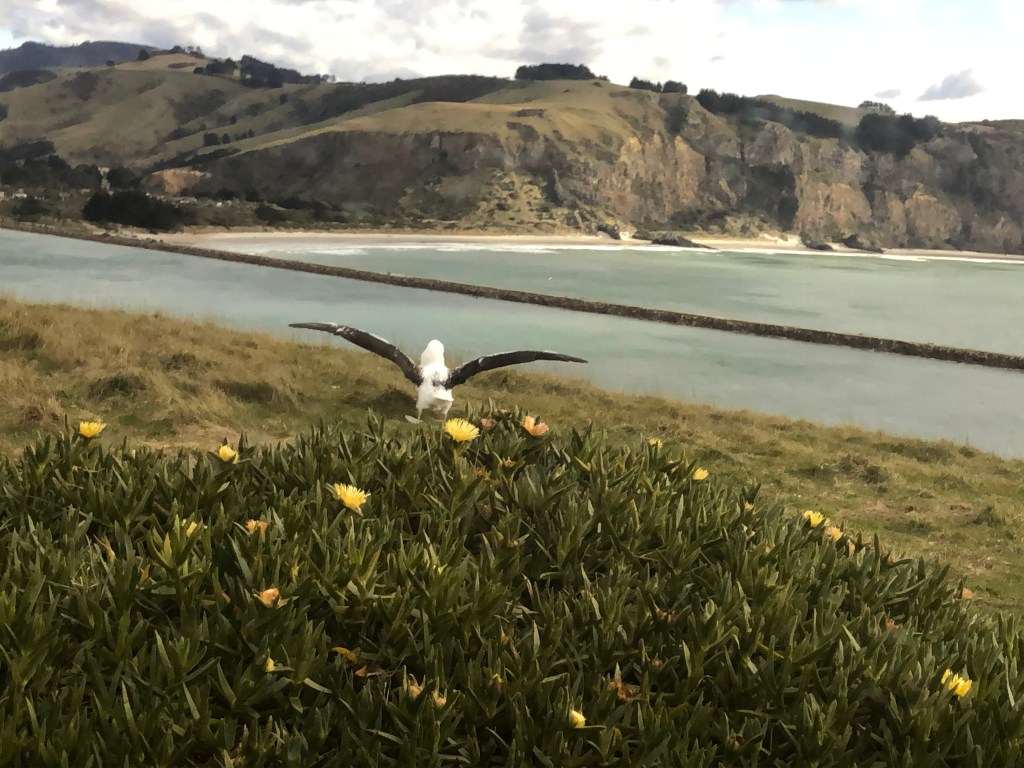
This one was stumbling around flapping its wings rehearsing flight.

Taiaroa Head is one home for about 5 percent of all the albatrosses in the world. They mate here, commonly for life, and produce one egg which is nurtured by both parents taking turns to go fishing for chick feed. The chick’s first flight, which for the one above might be 3-4 weeks away, is to Chile 10,000 kms away. Their first flight! which takes them 10-15 days! They are able to lock the tendons in their wings which have a 3+ metre span and coast on upper level air currents using only as much energy as they would sitting on the ocean surface. They stay in Chile for five years sowing their wild oats and return to the Otago for responsible parenthood. How do they know how to get here? No idea. Some say via smell. There are some orphan chicks here which are incubated, fed and nurtured by the Centre’s staff. The oldest regular visitor was Grandma, who was still breeding at 60. (If you’re interested.) It has been a sanctuary since 1927 and is a most impressive place.

We saw some adults flying and just how magnificent were they. There was a brisk wind blowing and so sensitive and I guess efficient were their aerodynamics that it wasn’t always easy to land.

On the way home Myrna decided we should go to Sandfly Bay via Highcroft Road and what a drive it turned out to be. This is a pretty gorgeous part of the world.

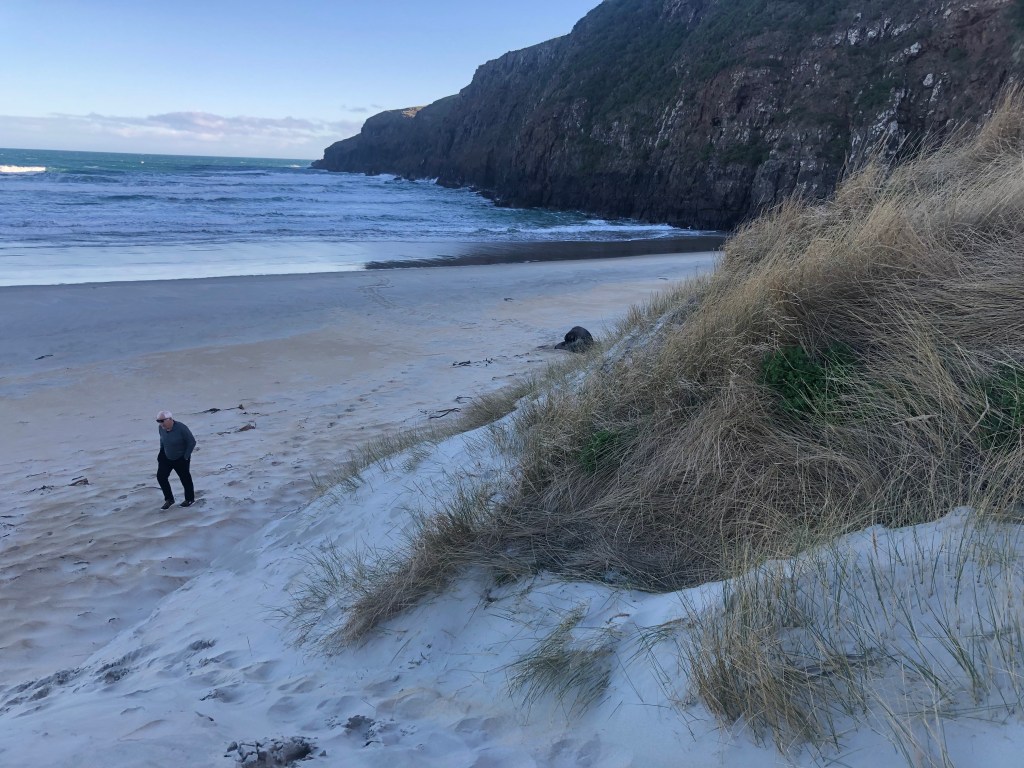
Sandfly Bay is where sand flies rather than where there are sand flies, and had its own impressive dunes with a carefully marked path for human visitors.

And we were lucky enough to be completely ignored by four panaka, New Zealand sea lions.

Here are three of them, with one heading off bored or possibly embarrassed, because it was clear that the other two were involved in some serious foreplay.

Okay. Speculative. But the female on the left would chew away at the male (do I know the genders? No. Not for certain. But my ‘she’ was smaller and sleaker.) until she garnered some similar response. Play fights. He’d get bored. She draped herself over the drift tree still chomping and whimpering, then slid back and my ‘he’ lifted himself up and just flopped on her, all half a tonne of him. It went on, but so did we. Important to give creatures their privacy.

Old bloke leaving a panaka squatting on its haunches to its own devices.

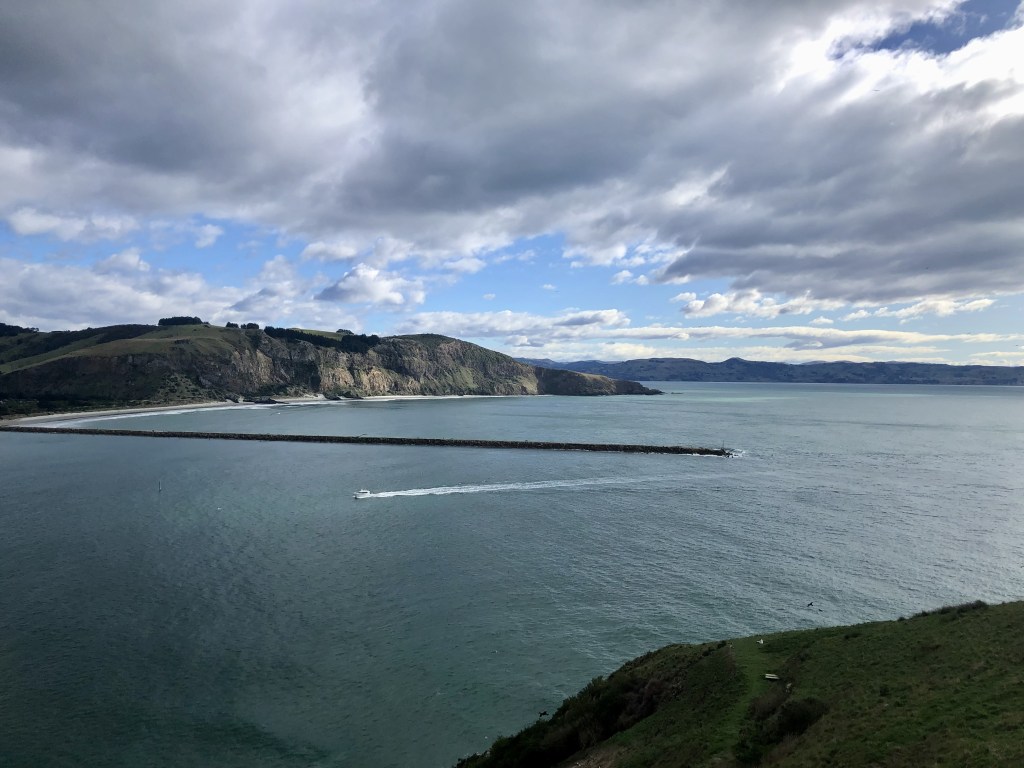
Then there’s the other side of the bay. We had seen this oddity from Taiaroa Head and thought we should investigate more closely.

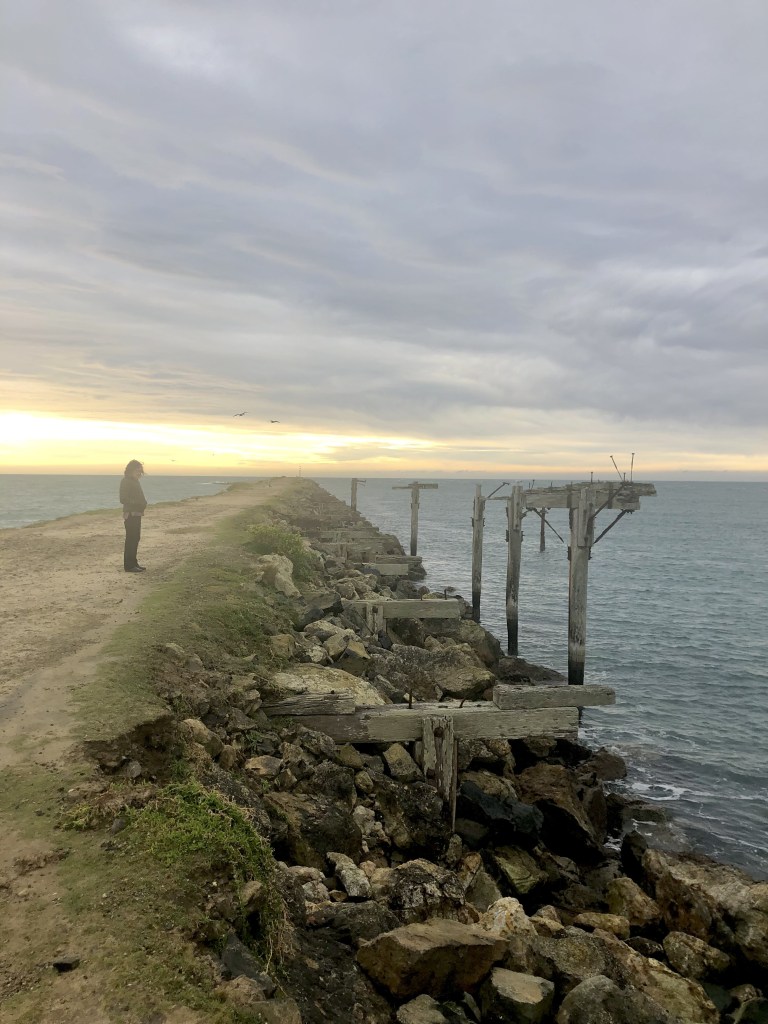
This is The Mole, all 1.2 kms of it sticking out into the mouth of the harbour. A ‘mole’ (which has the same root as ‘molecule’ and the chemical measurement ‘mole’ meaning ‘mass’) differs from a pier or jetty in that it is solid. Water can’t pass underneath it. There are nine shipwrecks contributing to the rock and cement here. The idea was to prevent sand bars blocking the entrance to the harbour. This is apparently successful, and it is repaired from time to time.

It doesn’t look like it in the pic above but this area was swarming with sea birds. I don’t know what the ones below were but I don’t think gulls: wrong beak, wrong colouring. I’m pretty sure they are terns, but in their hundreds they were wheeling and squalling, a majestic performance really.

We hadn’t had enormous luck with food. The parents and the teenage graduands were better prepared than we were and had soaked up the more obvious eating places. But I’d liked the look of a place we’d tried at St Clair Beach and thought we should give it a go. And a go we gave it. Titi. Chef’s choice of food, er hem locally sourced of course and some of the most imaginative and brilliantly successful cooking I’ve ever tasted. Everything was right. The table was Goldilocks-sized, the chairs comfortable, the service fun, alert but not intrusive, and very well educated. They had to recite the contents of each of the dishes and they did so with enthusiasm and pride. From the texture, taste and colour of the avocado foundation of the amuse bouche to the pumpkin ice cream, a bavarois with a thin coating of white chocolate for dessert, one masterpiece after another kept arriving.

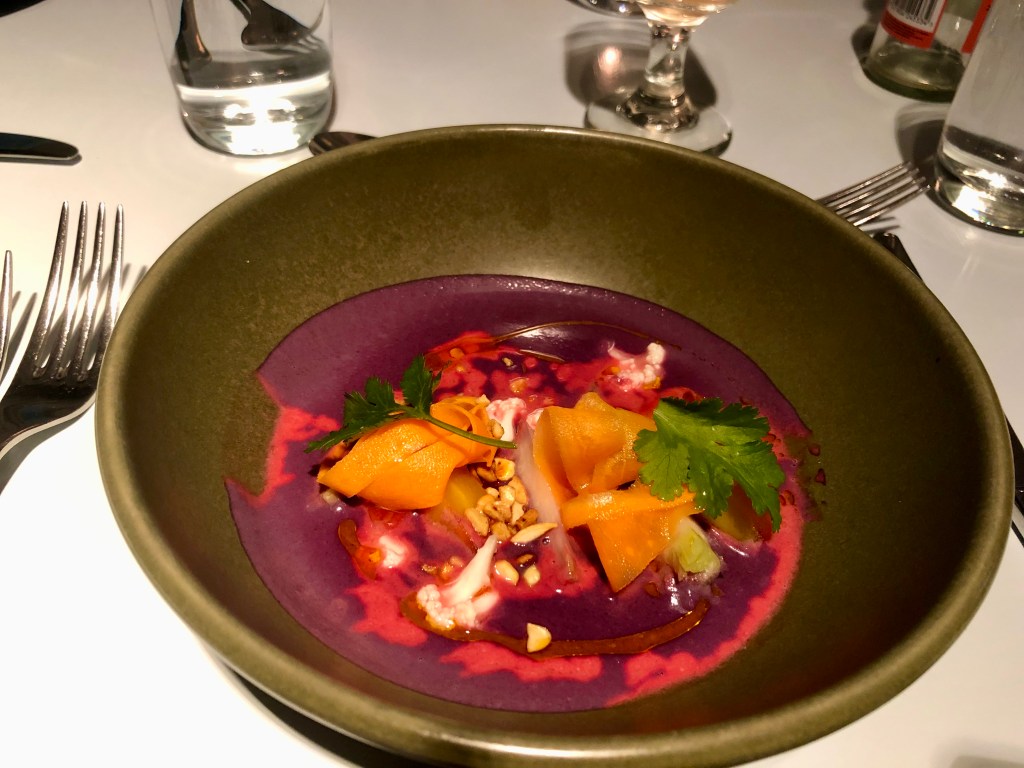
Myrna had the vegetarian offering and I’m pretty sure this was ‘Ettrick’s Carrots’, a soup with lemongrass, coconut, cashew, coriander, lime and paw paw. The purple is the carrot, the flavour of which I can only describe as enticingly warm.

I know: disgraceful. But I don’t care. Once in a while it’s good to encounter the work of a genius with food. I’d go again right now. They’d be open. 24 The Esplanade, St Clair. Come on. Why not? Let’s go.

Nearly there. I thought I’d like to show you this dish of helleborus grown at the Blueskin Nurseries in Waitati. I’ve never seen helleborus, usually a most discrete plant, with such offerings.

Back in Christchurch everything was normal again.

And finally some advice.

Press either the Go button or ‘Replay’

THE CITY: Now Open, Winter

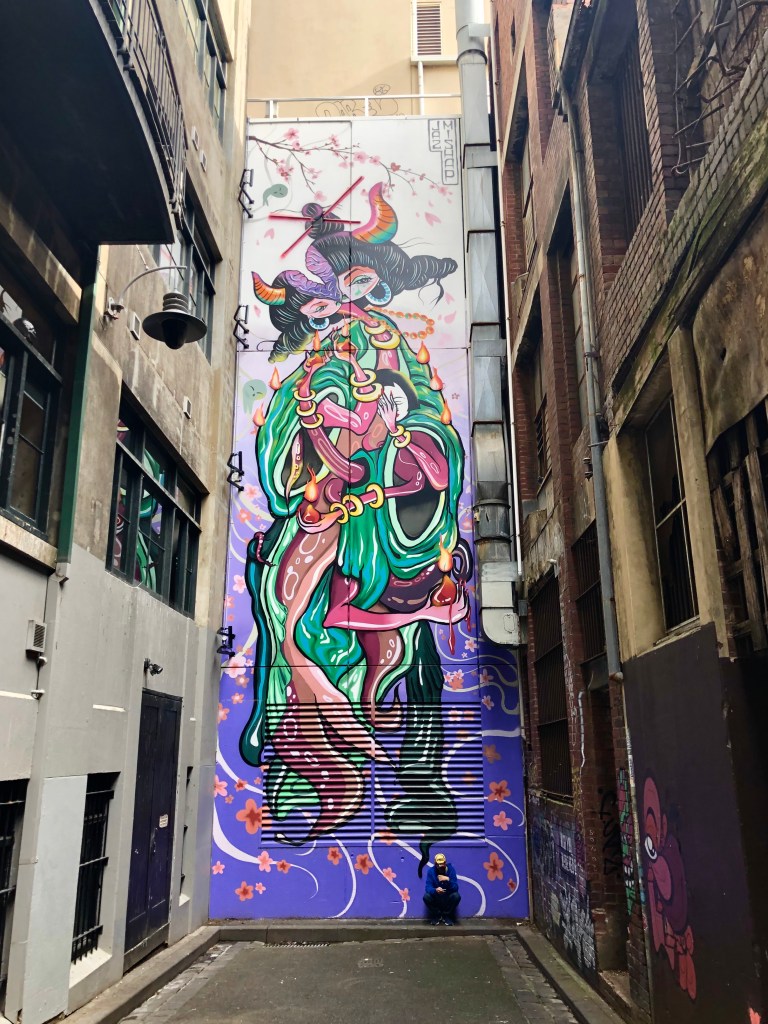
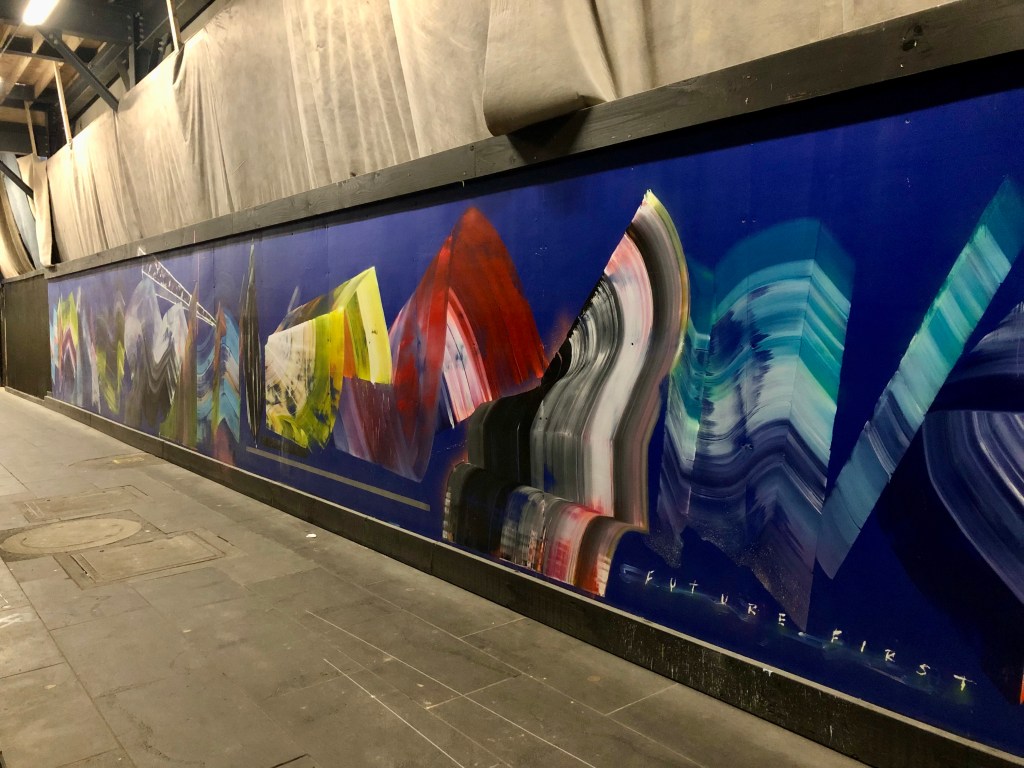
I spent a few days searching out the 40 laneway artworks from ‘Flash Forward’, a City of Melbourne project designed to … who knows really. Tart up the laneways? Support local artists? Make the City a more interesting place?

I ambled; and ambling round the city is a different experience from being on a mission to buy something in Bourke Street ranging as far as Little Bourke before getting on the tram to come home. And with the specific purpose of looking, looking around, things change. Puzzles abound.

One of the first of these is just what is going on in all that space above eye level. Like in here. What’s that all about? Is there even anyone, or anything for that matter, in there?

Here is a possible face for those rooms, hidden and immersed in his phone. Although he would meet people in the lobby.

At least he’s not on his electric bike weaving his way along the footpath terrorising the pedestrians.

And of course there are scores of such buildings and a dozen or more under construction. Below, 1954 and a few years ago from almost the same aerial vantage point. Don’t glance. Look at least twice. Use the Exhibition Buildings as a key.

In time I suppose people will be living (and possibly WFH) in those high rises, but what about the old three- to five-storey buildings that belong to 50 or 150 years ago. They can’t all be full of people replacing watch batteries or manning the headquarters of the Sleep Appreciation Society. There is just so much real estate there … and now, apparently, so many fewer people — except construction workers, tradies and maintenance men — to enliven it.

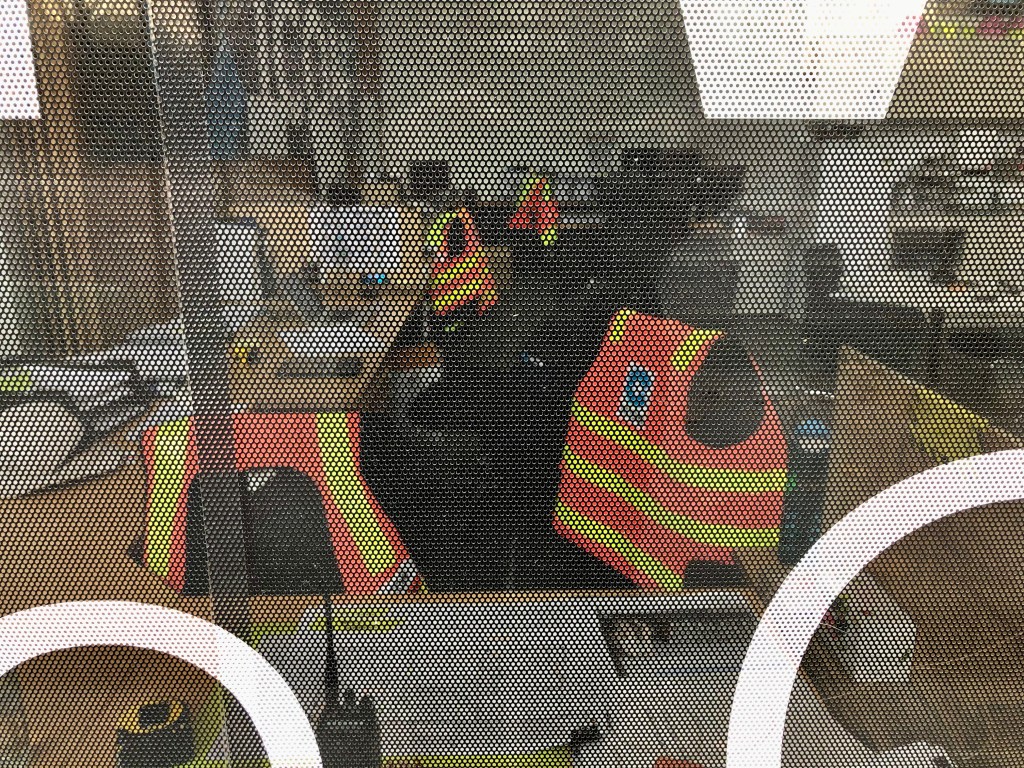
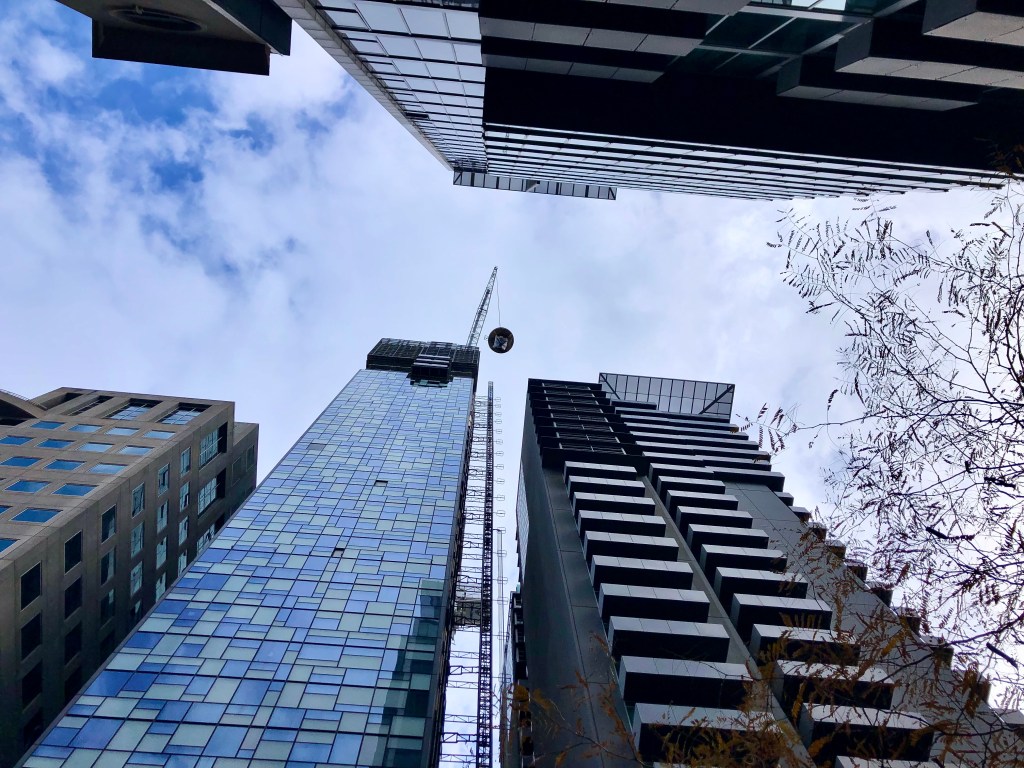
This is what a hi-vis worksite looks like when the workers with collars have gone home. Safe. Really safe. And below on the worksite, which was proceeding regardless, is what 2.8 tonnes of concrete dangling above your head looks like. Massively unsafe. I was leaning up against the first piece of Flash Forward art I found and not wearing a hi-vis jacket.

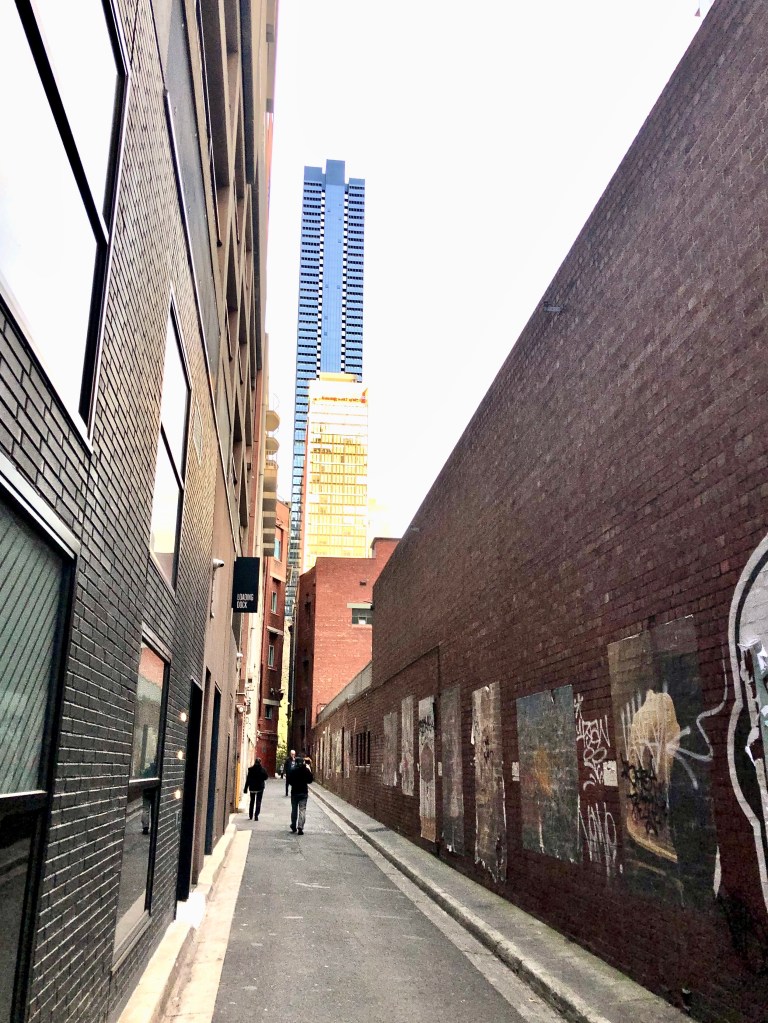
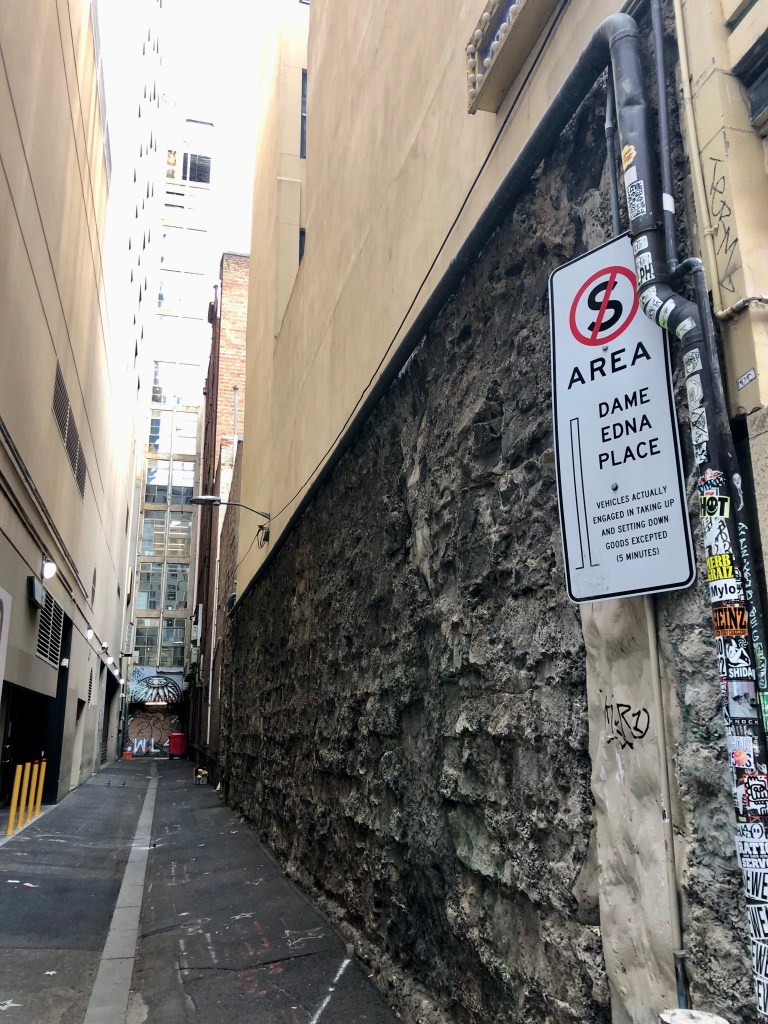
Quite nicely related, a second thing I was conscious of is that the city looms, especially if you are inclined to look up. Or if you are wandering around the lanes.

Sometimes, as on the right above, the ‘looming’ stacks up; and sometimes with chronological messages. If we start with St Augustine’s, the three generations below represent 164 years of building.

More chronology. Once the site of the Princess Mary Club, accommodation for young women workers in the city away from home, especially if that home was in the country. So much no longer; could the foreground building, once a parsonage or a manse as it is called on the nearby plan, be considered a vestigial remnant? I think no.

And John Wesley … what would he think about all this? Too much? Take it down a notch?

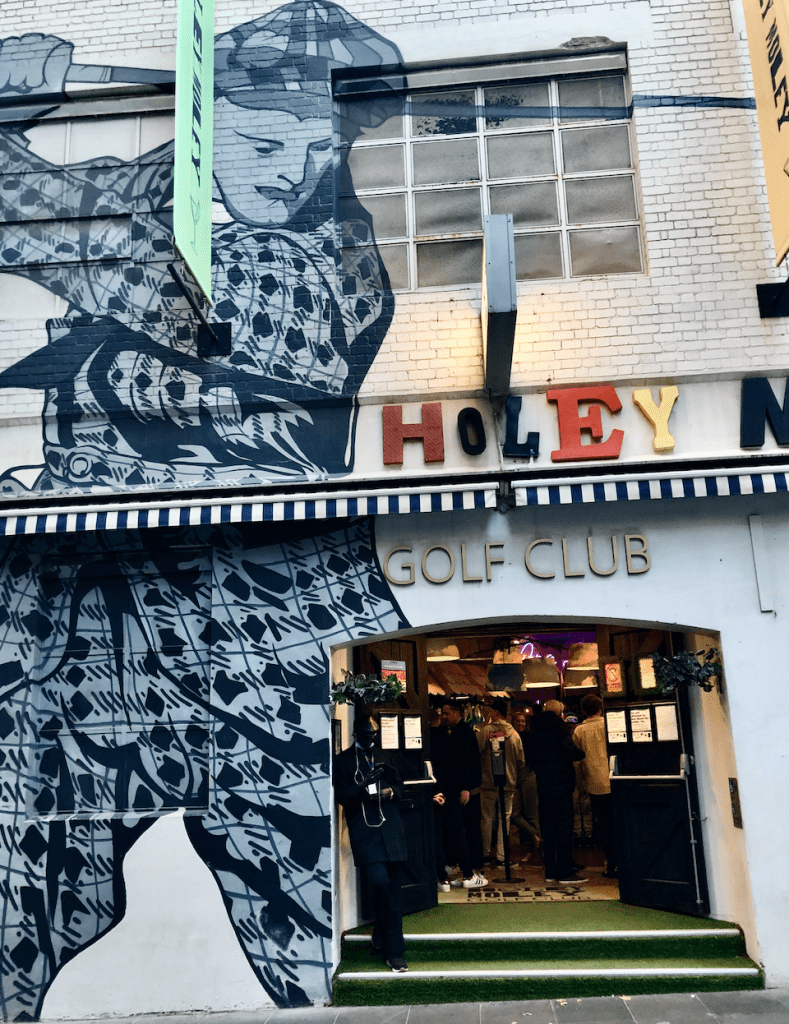
In another part of the city … one to which I never go. I don’t know who spends time in those lanes down in the south-west corner near Spencer St … a new world for me. I had never seen or heard of the Holey-Moley Golf Club for example on Little Bourke west of King. ‘This large family facility offers 27 holes of pop-culture themed golf for all ages.’ Who knew? Who actually could comprehend? But it was jumping — JAM-packed — In an otherwise fairly deserted streetscape.

Near here people were making private use of that sort of solitude.

Speaking as we were some time ago of old multiple storey buildings …

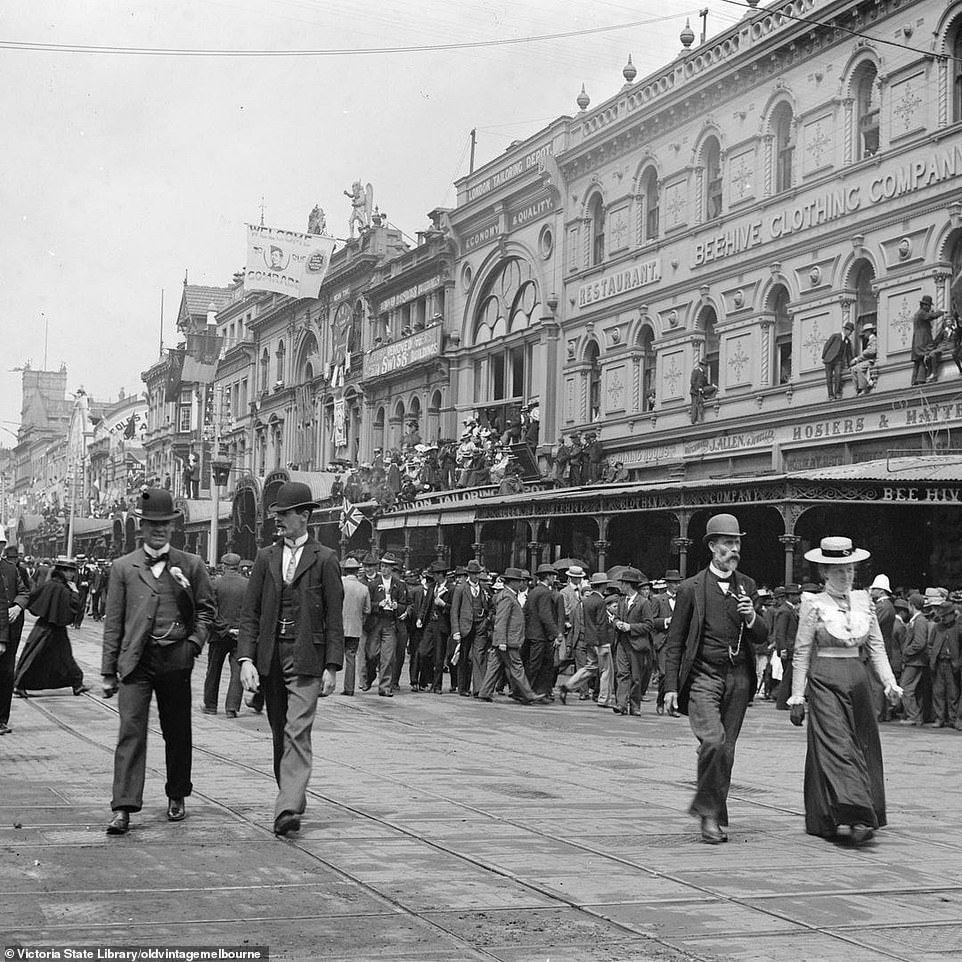
The celebration of the Relief of Mafeking in 1900 from the corner of Bourke and Elizabeth Streets, with hats de rigueur. The banner says ‘WELCOME COMRADE’. (This must be, and was of course, before the endearment ‘comrade’ developed new overtones.) Coles Book Arcade is visible at the left. In those days there appears to have been a much more relaxed approach to men and windows. The roof of the Royal Arcade’s veranda seems to have been adopted as the main viewing platform.

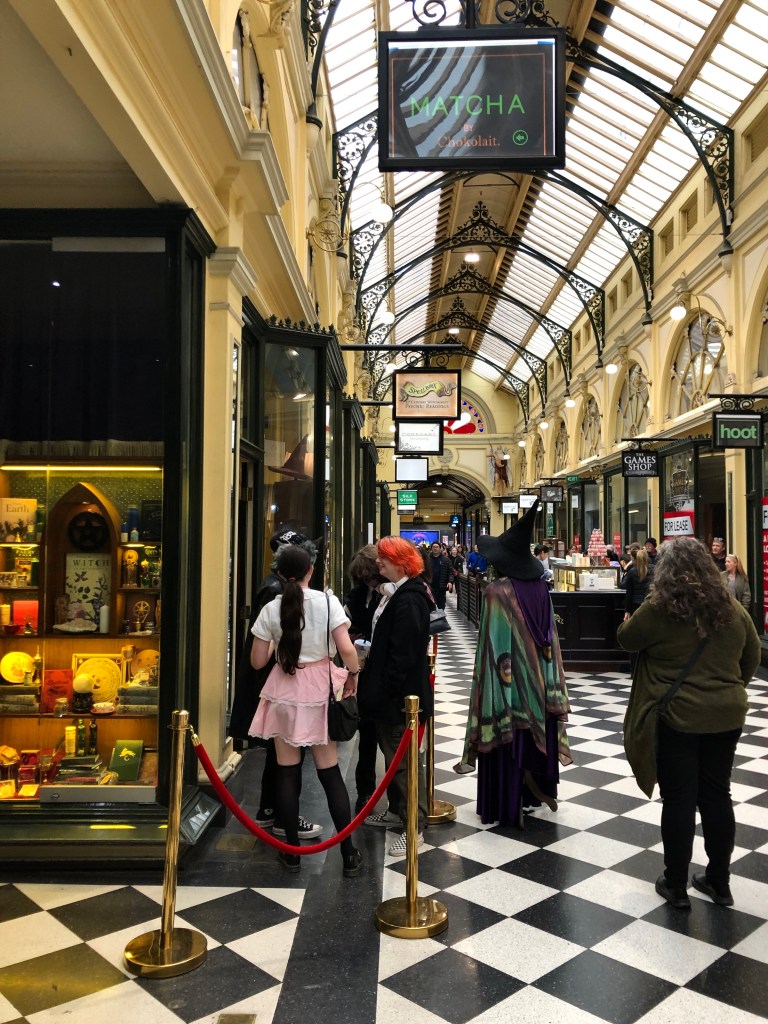
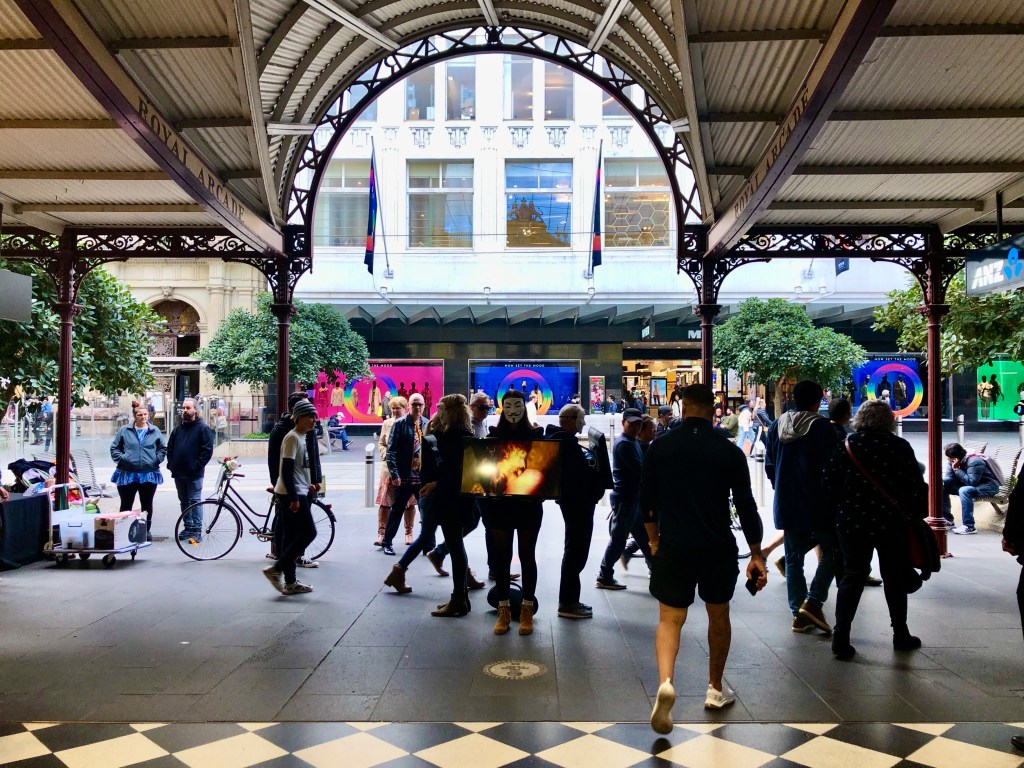
In Royal Arcade this time I found a queue at Spellbox waiting for psychic readings (via ’21st Century witchcraft’) …

… and out the front something else to catch the eye.

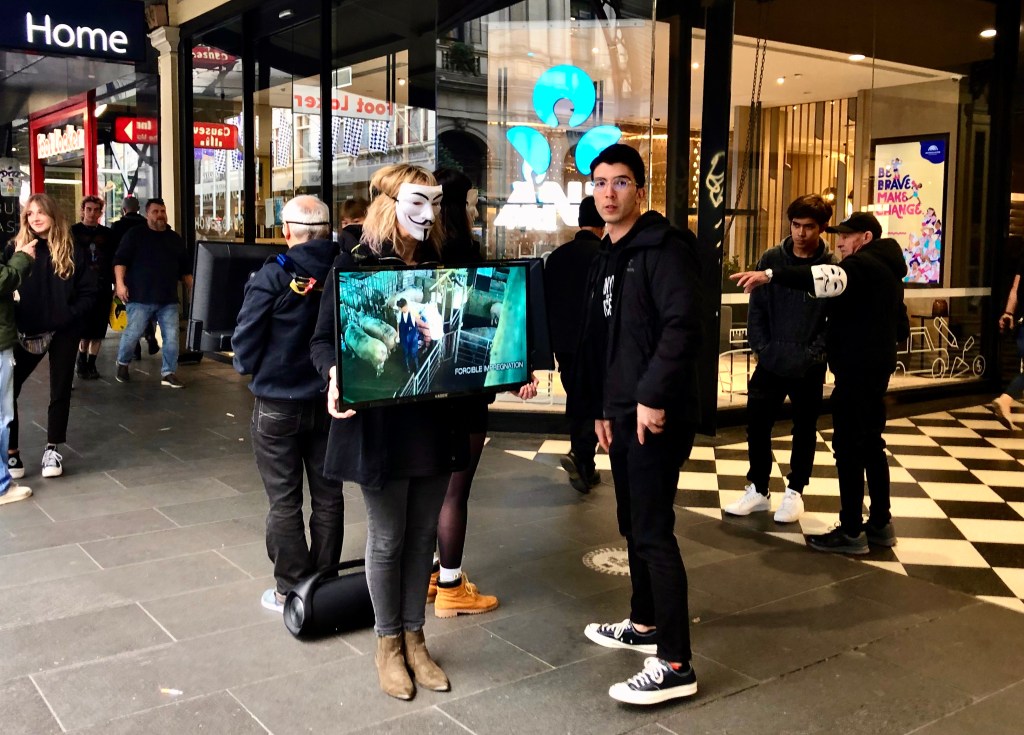
What is that? What is he holding, a fire? And why is he wearing a mask?

Looking more closely there are three of them.

SEMEN COLLECTION, it says. SEMEN COLLECTION.

FORCIBLE IMPREGNATION. Me? ME?!

Down in The Causeway we find people at work with, on the right, just enough room to turn around. No wonder he was so grumpy.

Despite its formidable decoration it was too early for the Chuckle Park Bar.

Stalactites, with the best souvlaki, the absolute best, over time, never other than tempting … was resisted.

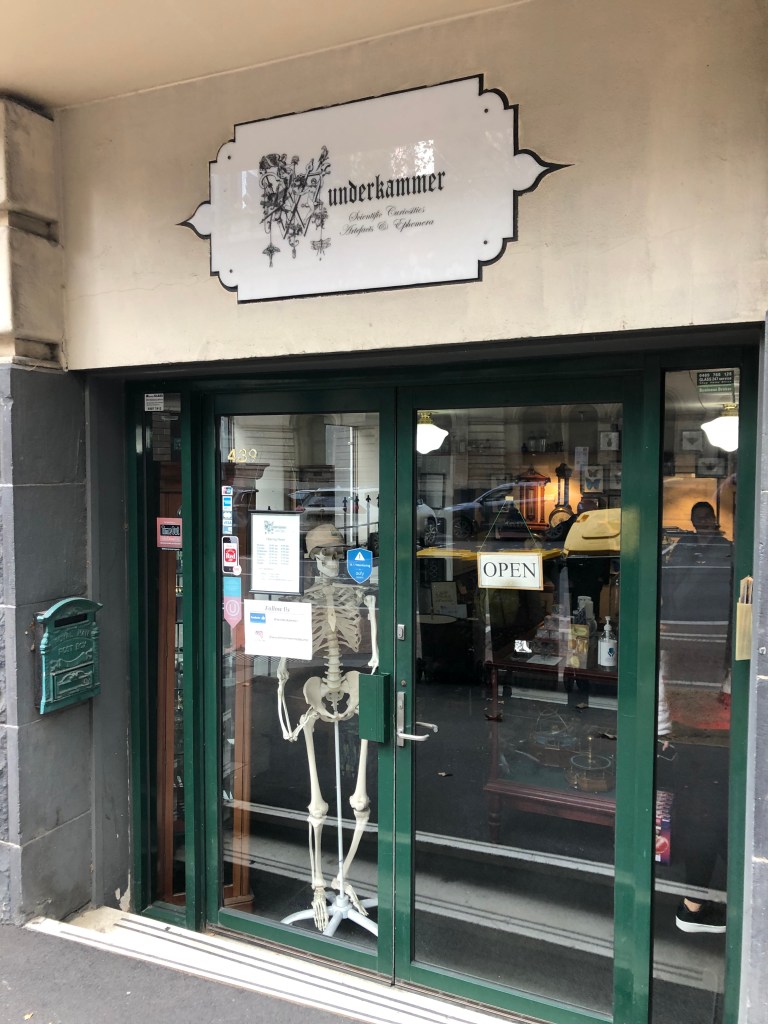
I re-discovered the Wunderkammer, literally something like ‘room of miracles’, ‘cabinet of curiosities’ in some renderings, self-advertised as ‘Scientific Curiosities Artefacts and Ephemera’ which this day included dishes one coin or key thick, dippy birds and a phrenological head.

And this cat must appear. He was hammering heavy metal riffs outside two sign-free shops, but far more importantly outside Maniax Axe Throwing, a tram, and Officeworks.

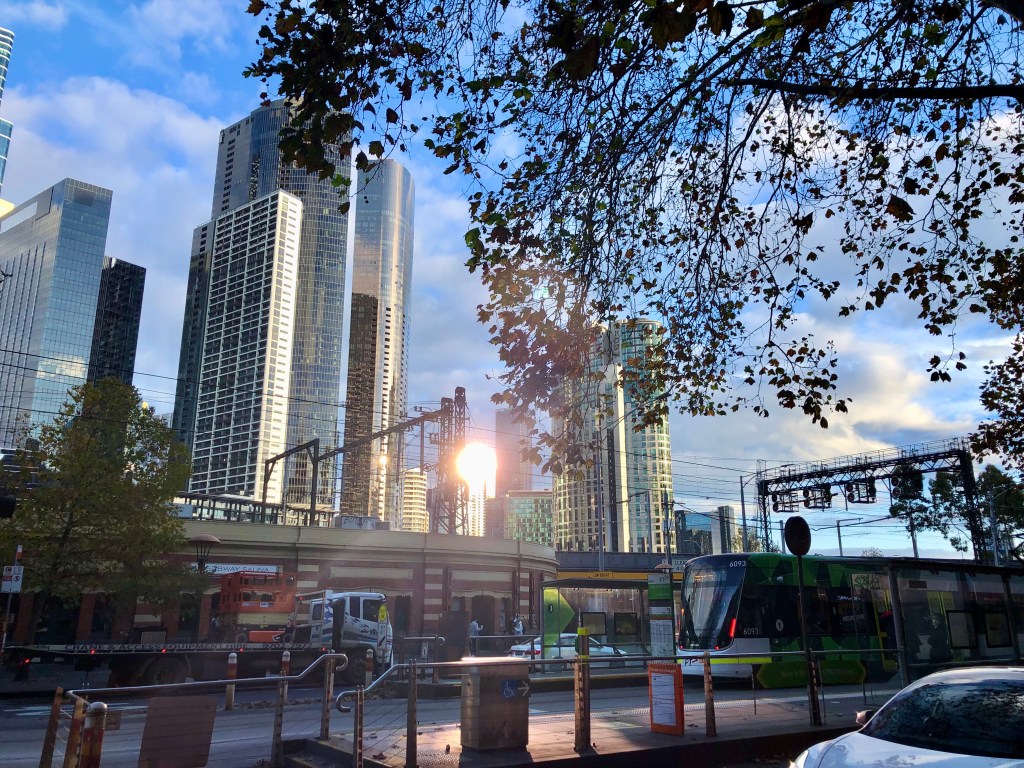
Sun glare on the way home. Just here at 5pm it was blinding. The ‘trousers’ building at the corner of William and Collins has signs up warning pedestrians about the dangers of sun glare off its walls.

Finally there is knowledge to be gleaned, if not necessarily at the Wunderkammer, then in China town.

‘It is the Thunderbolt that steers the course of all things.’ Remember that.

* * * * * *

Just a small addendum. Nothing to do with the preceding. Out of town. The merest whiff of Canberra.

So that’s how Jackson did it! With a magnifying glass and a brush the width of an ant. Can I avoid referring to irony? Yes I will.
A small sample of implements in a shed every one of which (including the spilt nails) was made entirely of glass. Startlingly good.

And now, of course, you’d like a look at the new and rather zippy lane art. CLICK>

THE CITY: Laneway Art

A new bin in our lane with the late sun describing a vivid triangle on it and highlighting its red-ness. I’m calling it art.

* * * * * * *

Myrna found an article in the paper about ‘Flash Forward’, a new lot of art in the city, art in the lanes, mostly graffer murals but not exclusively so.

I skimmed the article and looked at the pictures and thought, four, easy. Even if they are spread round the extremities of the city let’s go and have a look. So we did.

First one.

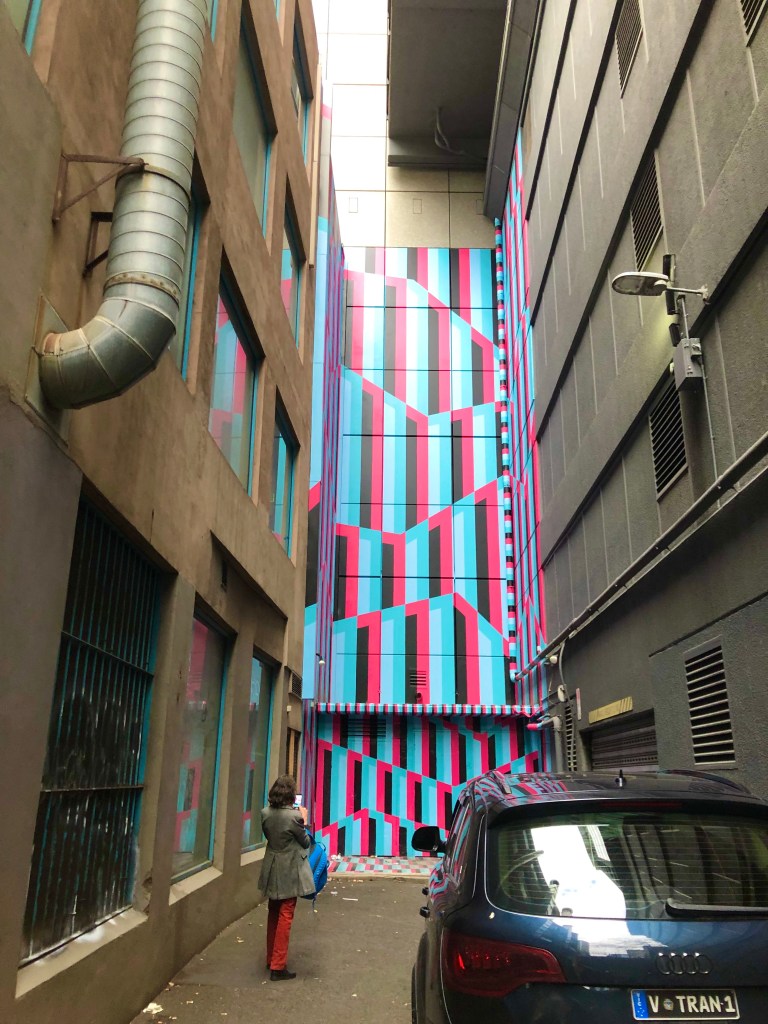
Work by Nick Azidis, at the end of Highlander Lane, off Flinders Street

The author of the article, Robert Nelson, thought the most successful of these ‘interventions’ (interventions?) were ‘those that functioned as if they’re a kind of architecture in themselves’. This is a good example. It is also a good example of the experience: turning a corner into a lane that you would otherwise never visit or even find to happen on an unexpected pleasure. A (mid-key) wow moment.

We tramped a couple of kilometres across to the diametrically opposite corner of the city to the next one.

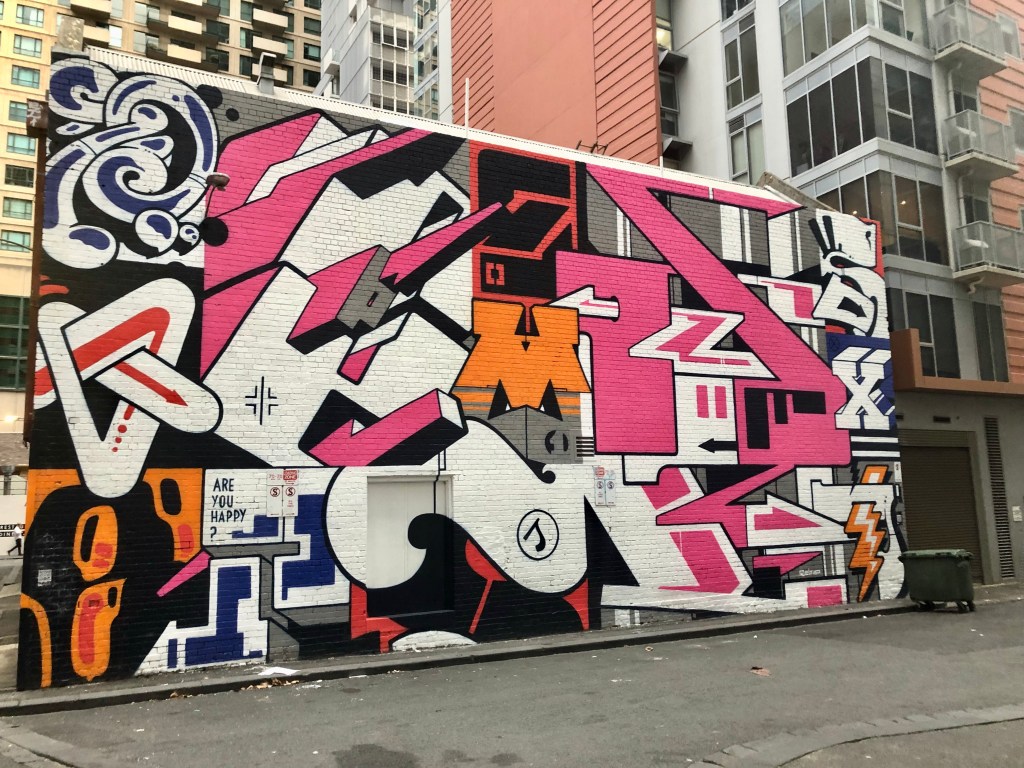
Work by Puzle, in Evans Lane near Exhibition in the north-east corner.

Previously a red brick wall with some random graffiti in the bottom left-hand corner. Better in the flesh than in the photo. But check out the separated stacked blocks at each end, all doing something different, but living together happily enough. Very strong and satisfying. I loved it.

I had to look at the next one carefully to see that I’d got it. The ‘re-casting’ of the brickwork covers the entire wall and in the top street corner, turns a page. It’s also actually very hard to see because the lane is so narrow. There would be better vantage points not available to the casual wanderer, but from the lane floor you can still see what’s going on. The sign contributing to the vibe says ‘LEISURE PLEASURE & LIQUOR’ .

Work by George Goodnow (‘Goodie) in Tattersall’s Lane near Chinatown off Lonsdale

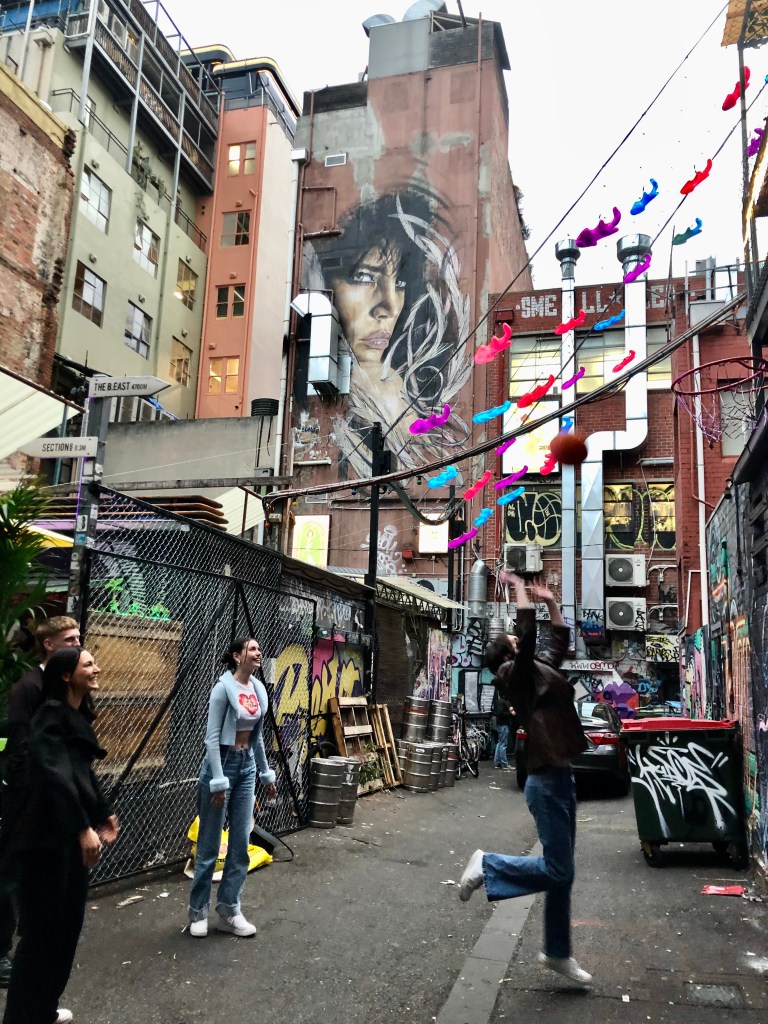
We missed this one. The suspended fish-like creatures light up at night, and the wall art … well, we might have just missed it. Neither the lowering portrait nor the game of hoops outside a lively bar is part of the show. Just an indication that the city is still a living organism.

Jarra Karalinar Steel, Stevenson’s Lane off Tattersall’s Lane

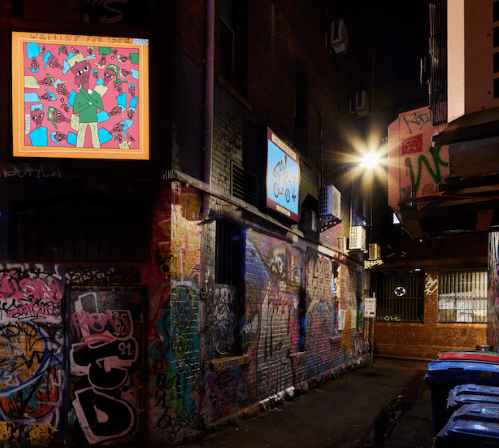
Also in Stevenson’s Lane were some witty light panels with an African flavour. You can’t see it, but I liked ‘No thoughts. Just be hot.’ The one you can see says: ‘Waiting for ideas’.

Work by Olana Janfa, also in Stevenson’s Lane.

And that’s it I thought. Good job. Enjoyed that. Then I went back to read the article more closely and I discovered that there are not four but 40. Not only that, but each art work has its own attached (and expansive) music which you can hear if you click on the link above, or this one if you can’t be bothered finding it. CLICK> It’s a big show.

So I went back to the drawing board, pencilled in another day or two for the treasure hunt and kept looking, and eventually arrived pretty close to consummation.

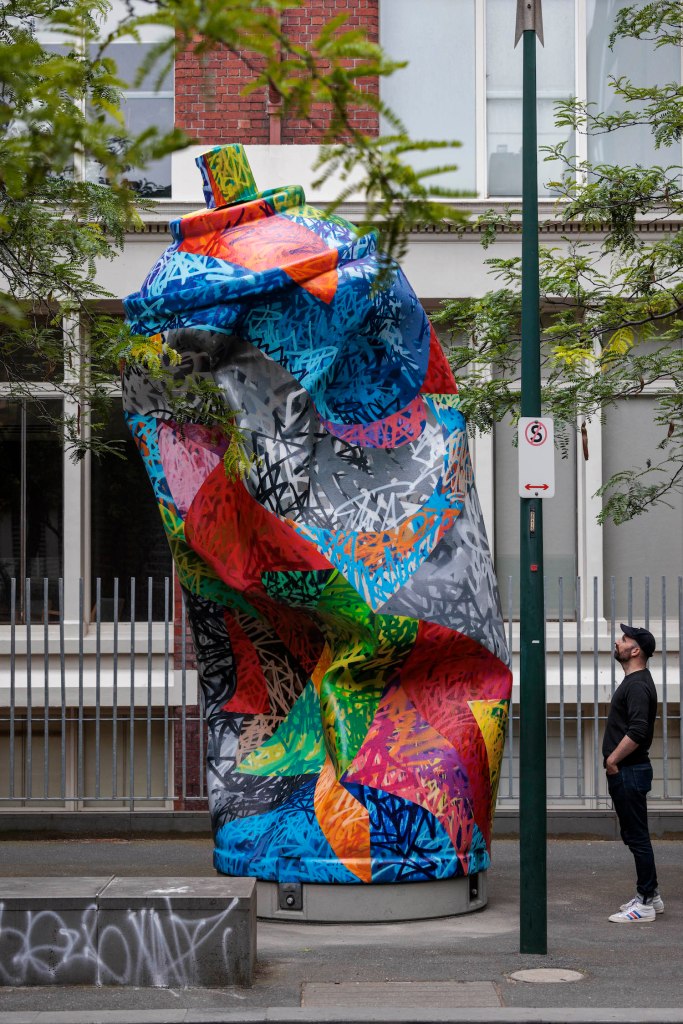
This is the first one I found on the second excursion, the crumpled spray can offering a motif for the whole show.

Work by Ling in Wills Street near the market

Some were ephemeral like this light show, and how good is that!

Work by Yandell Walton, in Platypus Alley off Little Bourke near Hardware Lane

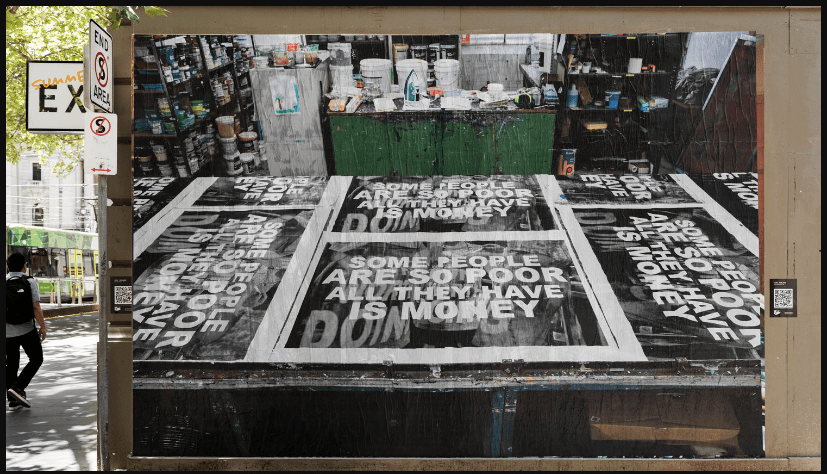
This one had come and gone. Part of a series: ‘Some people are so poor all they have is money.’

Work by Kay Abude in Windsor Place on one side of the Windsor Hotel.

Some had disappeared as construction had taken hold on building sites.

Some I couldn’t find.

Work by Gosia Wlodarczak, somewhere in the Royal Arcade

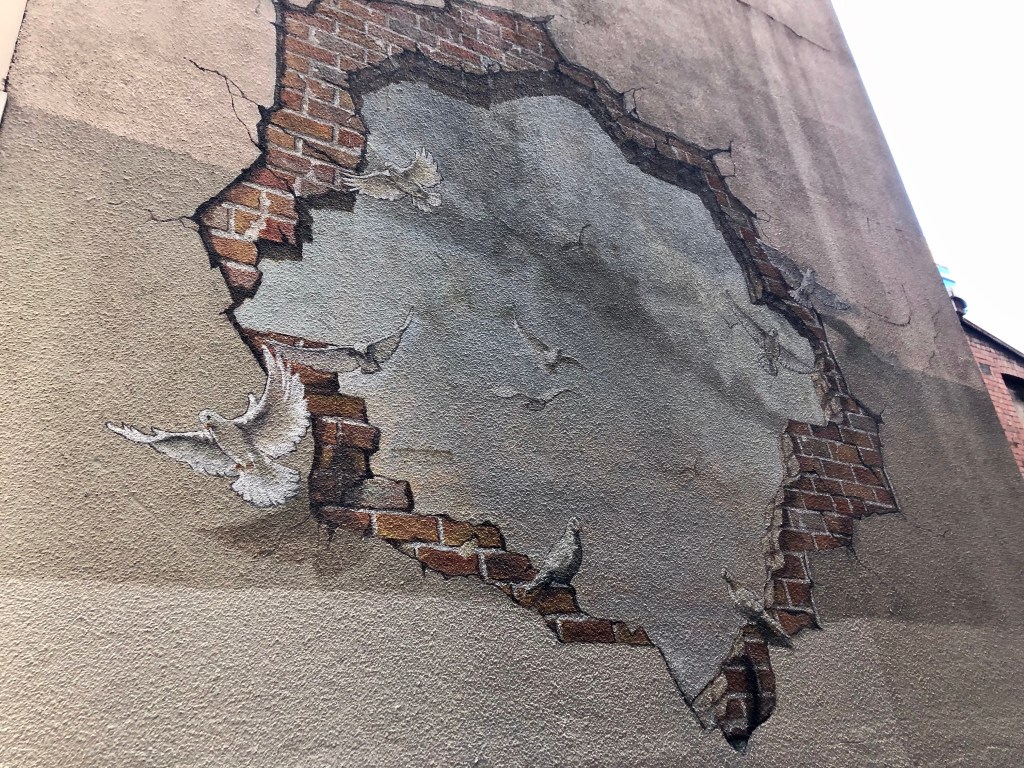
Some I found but they were the wrong ones: yes to the one on the right, no to the one on the left which is in the lane but around a corner and up the other end. But I liked the birds flying through the wall regardless.

And even if you find them, you might miss something.

Work by Ling in Finlay Alley. I added the bin because it seemed to fit.

This is what was there.

Some are in obvious places and I’ve been able to watch them grow.

Some hadn’t been finished.

Work by Textaqueen, in Foxton Lane off Market near Flinders Street

Some had. Marvellous.

Work by Drez, Ulster Place above the steps of Parliament Station.

Sometimes it was hard to distinguish what was and what wasn’t in the show. These weren’t.

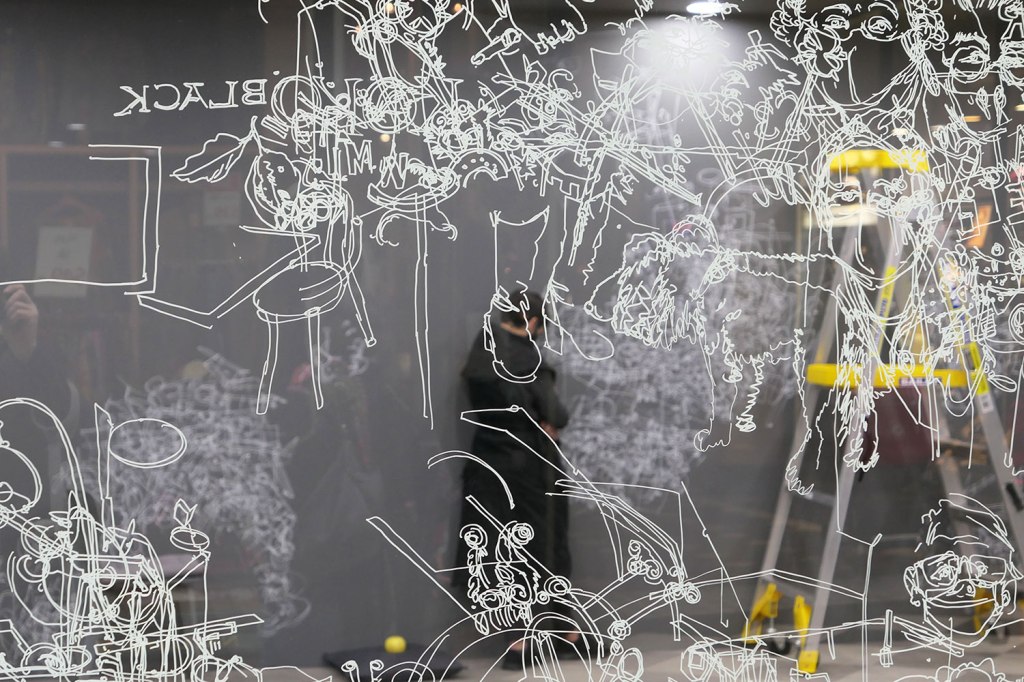
I was sorry about the last one, in the foyer of the State Bank Galleria, whoops Melbourne Galleria. The video installation was really something, especially with the added reflections. I think I’ll call it part of the show.

Two excellent ones nearby.

Another girls and cats one, maybe a remnant of the lockdown.

Work by Taylor Broekman in Bourke Place down near William Street.

Nearby are two others, both grand affairs that were hard to photograph.

Work by Bundit Puangthong at the entry to Rose Lane.

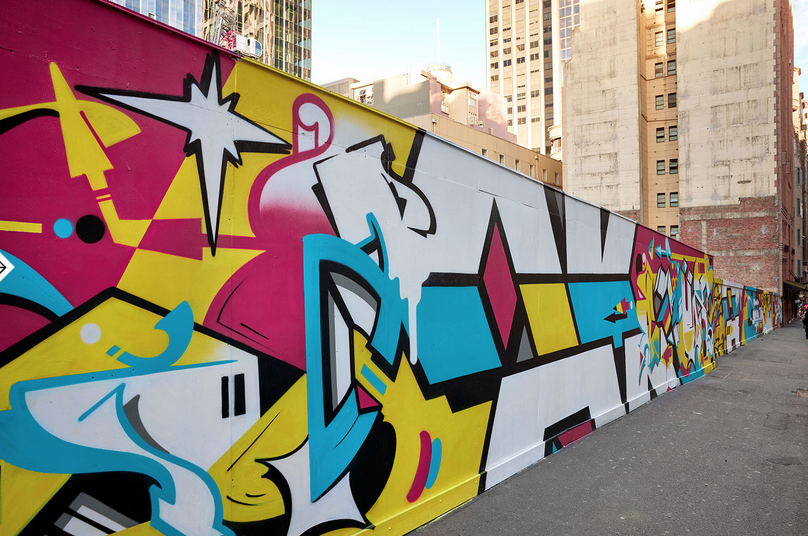
I could go on with the whole 40. But that’s rather a lot. I’ll pick a few more I liked.

Work by UB in George Johnson Lane behind the North Melbourne Town Hall. (The only one out of the city per se plus you can make the metal bits move.)

Work by Getnup in McIlwraith Place. ‘Architectural’.

Work by Prue Stevenson in Little William Street. Heartfelt and different. A detail below.

Work by Sarah Crowest in Corr’s Lane off Little Bourke, mostly an access point for car rentals. Witty and very decisive about itself
I found this which I thought was brilliant in Kirk’s Lane. However I was meant to find the work below. Less brilliant.
Work by Bacondrum
Either Drewery Place or Drewery Alley (and not in the show). Maybe for the offset provided by the figure hunched over their phone.

Work by Fikaris in Lees Place off Exhibition. Each figure is denoted. Brainy and fun to wrestle with.

Work by Shay Bakar in Whiteheart Lane off Little Bourke near Elizabeth. Strong, stylish, uses the location perfectly

A sad final story. The lane whose name has the most florid referent might just be the dullest of them all.

Final judgment: great fun finding them and mostly rewarding when found with some real standouts.

ROCK (+water and wood): Tasmania

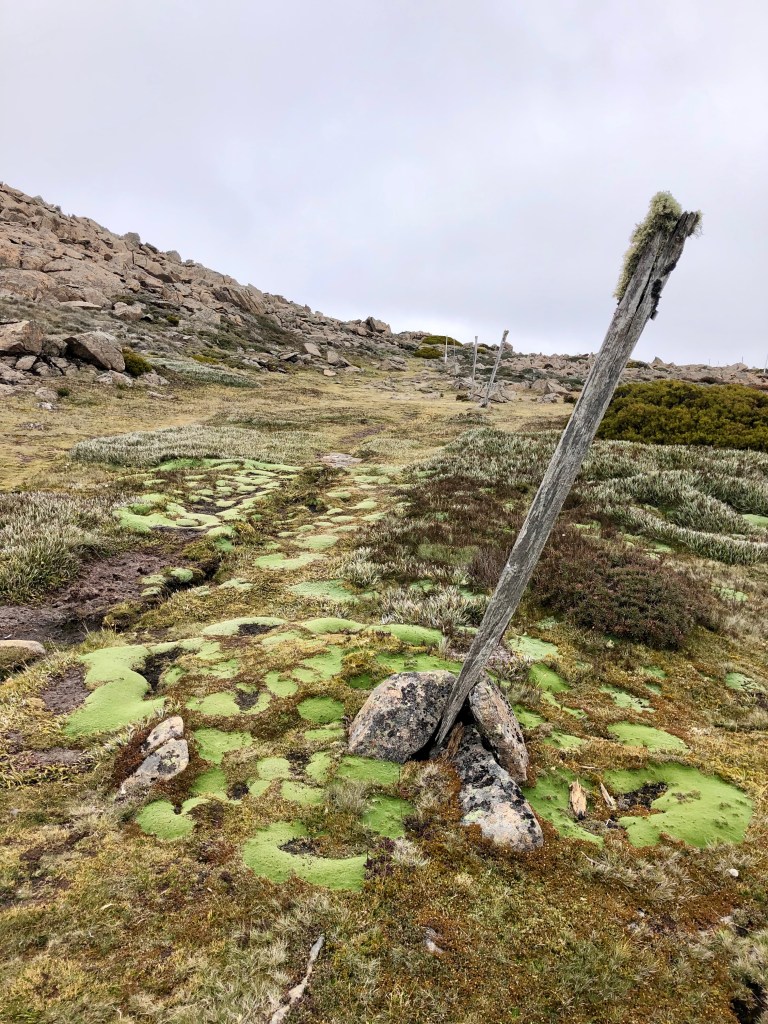
Turapina/ Ben Lomond plateau with its alpine meadows and customary drifts of cloud

Ten days, six walks. That’s what the itinerary said. But what’s an itinerary: a set of aspirations? A rough plan of what you might do? Perhaps more commonly thought of as an iron clad guarantee that everything would be all right, and that you do/ see all the things that are on that list. Directive. Yes. Except that this one had been constructed not quite at random but pretty close. According to whim and with barely plausible ambitions. Just getting on a plane for a start … what an idea. I had almost forgotten how. Booking things … it seemed like an impertinence, or if not an impertinence, a fairly low confidence flutter.

But eventually the Tamar Estuary unfolded beneath us, there was a (wildly expensive) car at the Budget depot, and Lonnie was still there in all its two- and three-storey glory.

It’s quiet after 8 apart from the hoons with the announcements from their straight thru exhausts bouncing off the empty streets and the valley walls. Tassie. Wonderful.

Why go to Tassie? Because you tried to last year on almost exactly the same dates and you couldn’t. That’s one reason. There are others. It’s the attractive forthrightness of the Jacqui Lambies. It’s looking at the results of consuming too many, far too many, Banjo’s pastries. It is an encounter with taste unfettered by fashion. It’s watching people have a go because they can. (That applies to bulldozing trees as much as it does to saving them.) It’s seeing the consequences of living proximately but feeling isolated. It’s getting your feet wet in history — all those preserved buildings and picturesque precincts, the back of Launceston’s waterfront, the golden sandstone of Hobart’s older houses, the Hope and Anchor being the oldest continuously licenced pub in Australia, the gruesome stories attached to Port Arthur, Sarah and Maria Islands, Eaglehawk Neck, not to mention the colonial treatment of its Indigenous population. History is also being lived as you watch in a form of participatory time shift. Is it 70s? 80s? Could it be in part the 1950s? And then there is MONA which is an assemblage and reflection of all these things.

Any one of those things would draw you, but probably for us the winners are the geography and climate, its natural world.

It is by no means all pristine wilderness. But even where it isn’t there is often a lot to drink in and respond to.

Near Liffey among the northern paddocks. ‘Forest Reserve’ in the background, and I think hedges of gorse in the foreground. Gorse!

And there’s this of course.

The remnants of a coupe in Evercreech Forest between Mathinna and Fingal. This area is adjacent to a Park Reserve famous for its huge trees.

But then …

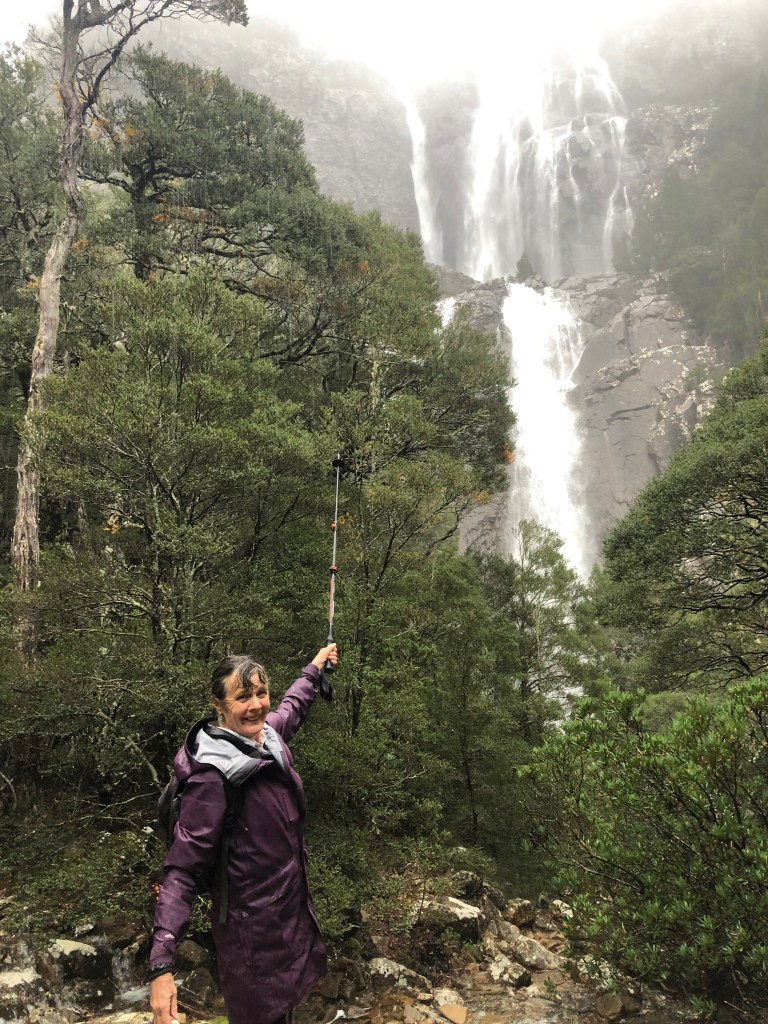
Meander Falls in spate, falling more than 90m in two, on this very wet day, dramatic eruptions.

That’s why ten days, six walks.

• • • • • • • •

Mount Arthur (Indigenous name unknown)

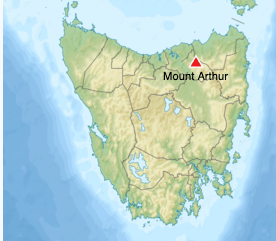
Mount Arthur (1188m asl) is 30 kms north-east of Launceston. Guides say four hours up and back; we took five. Guides say 8.5-9.5 kms all up; after wandering all over the top, my GPS said 11.8. It is called a popular walk, but I think only with afficionados and people who care. The track does not look heavily used.

We’d been there before and been rebuffed. You leave the car at the end of a dirt road sort of in someone’s quite isolated front yard and, like a lot of walks, it starts very steeply. But in this case, after a very brief concession, it gets steeper. And then there’s a boulder field. And then to get to the top you climb bigger boulders. Last time, years ago, we started late, it was pouring rain, we got to the boulder field and I’d had enough. But I remember the track as having shown real promise and you like to get to the top just to see what’s what. And as it turns out it is a wonderful walk, reasonably hard (for the aged) but with a real reward from the top.

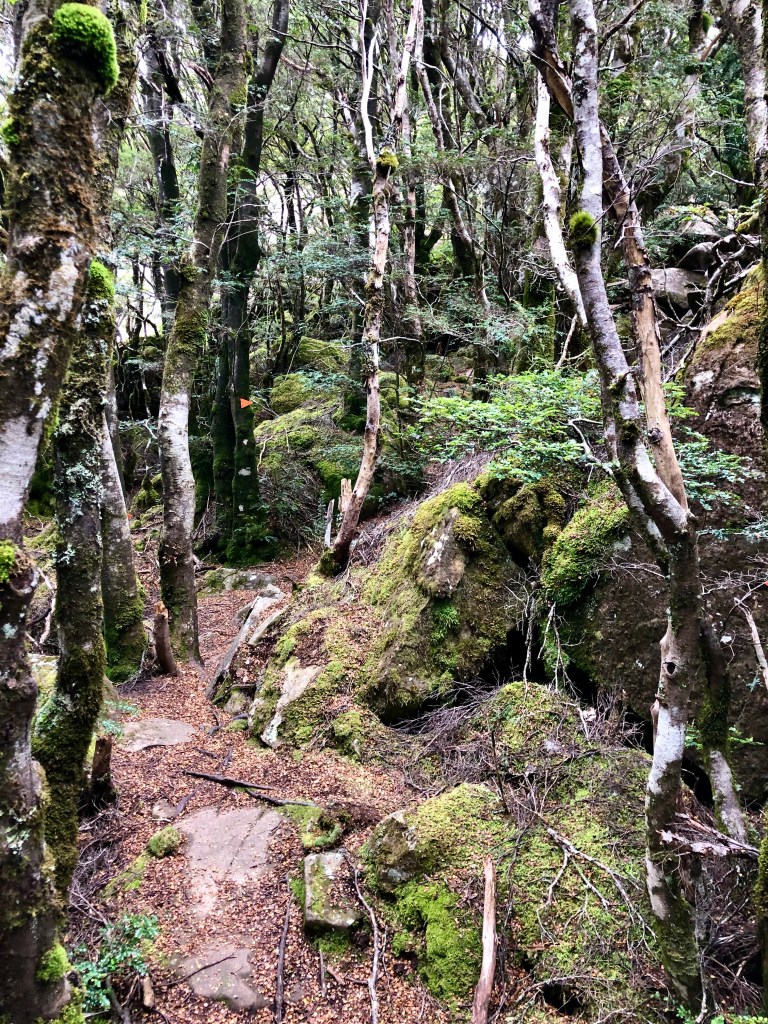
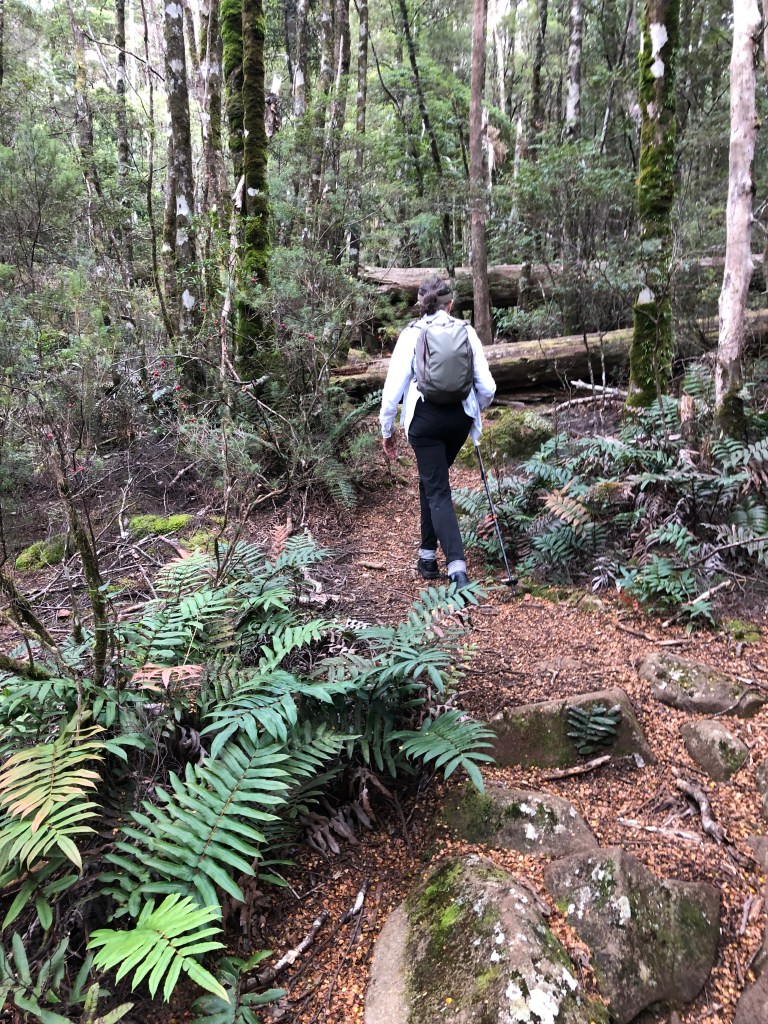
Nothofagus litter on the floor. A beech forest … that’s a bit special. Great to walk on, soft and spongy. More familiar in NZ.
The peak with its beehive cairn built in the late 1800s, a serious work of art.
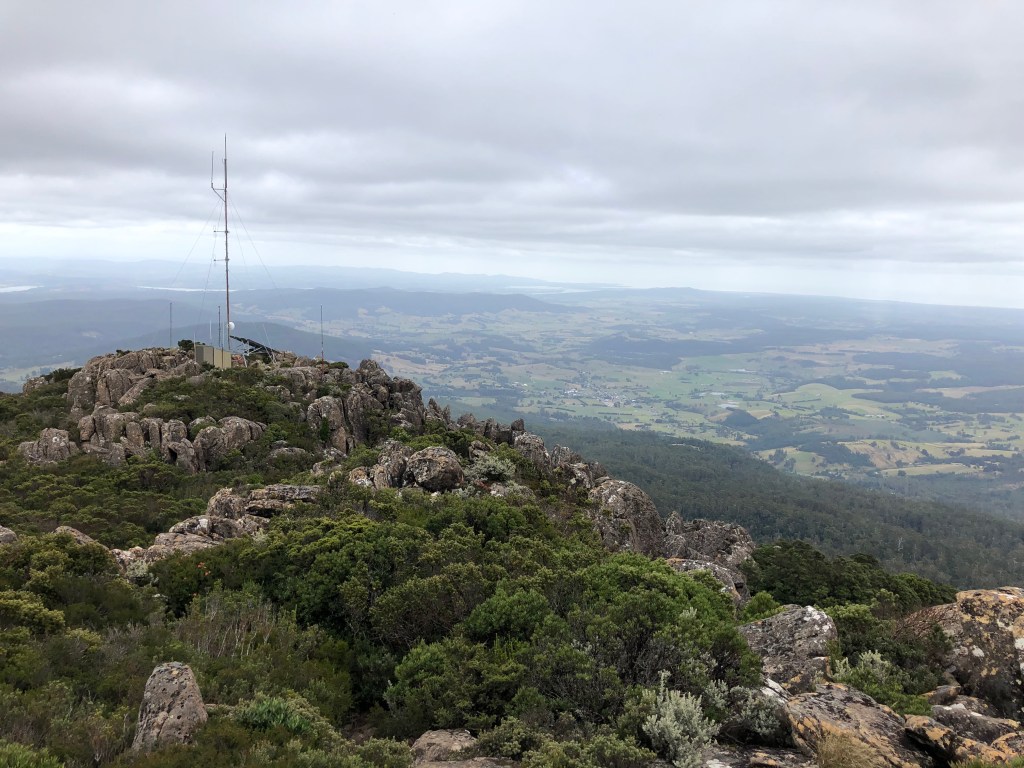
… and what you can see. The Tamar Estuary and Bass Strait to the north-west with the Western Tiers in the far background.
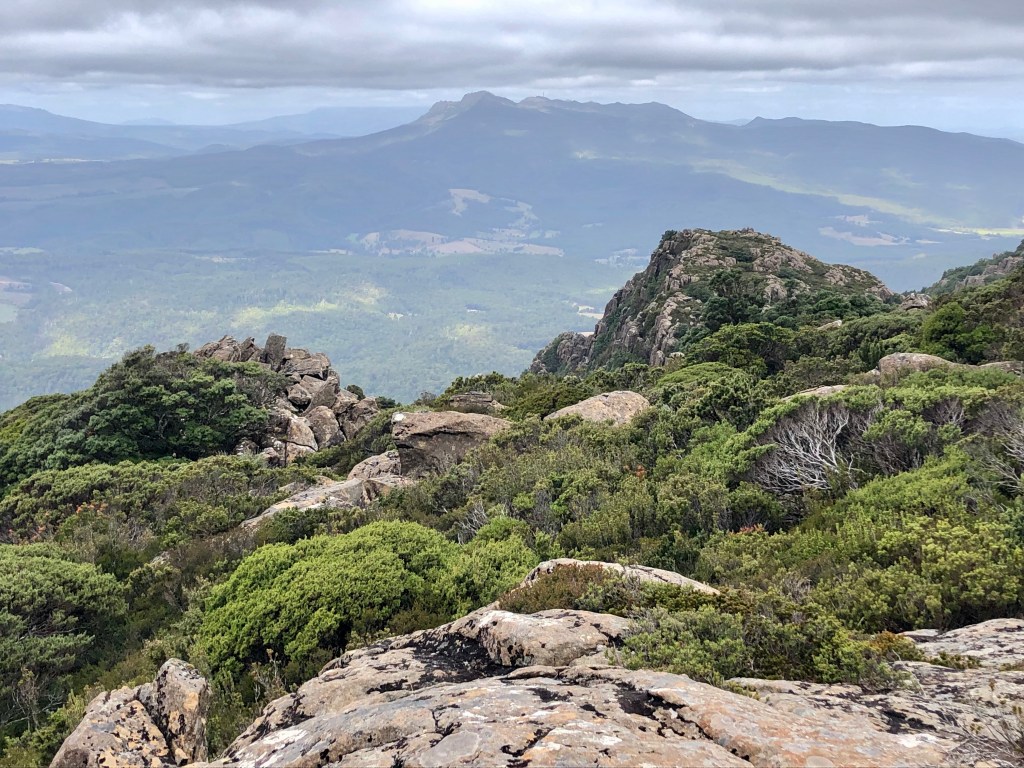
… and Turapina / Ben Lomond to the south.

Turapina / Ben Lomond

Turapina contains the second highest peak in Tasmania. A number of outcrops surround a massive boulder field plateau. The least prepossessing, Legge’s Tor is (at 1572m) the highest of these. We’ve walked here quite a lot, usually a 12km loop starting at ‘Carr Villa’, now a classy Scout Camp, and climbing up through the Big Opening to the plateau, across the Plains of Heaven (true), and down Jacob’s Ladder back to the car.

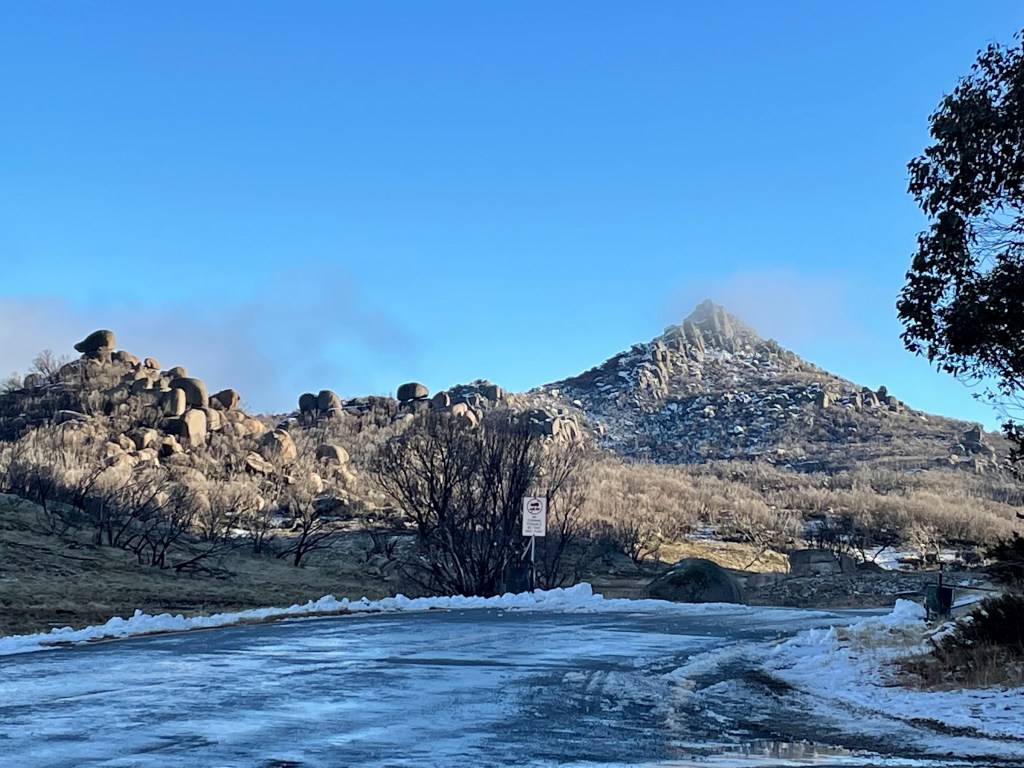
Conditions have also varied including once when the temperature dropped about 15 or more degrees in 10 minutes, almost too quickly to properly notice and get the gloves on. This photo was taken on one of those snowy days.

Mount Misery on the east side of the Big Opening, with birds.

But it wasn’t like that when we arrived this time, a blowy overcast day with no hint of snow.

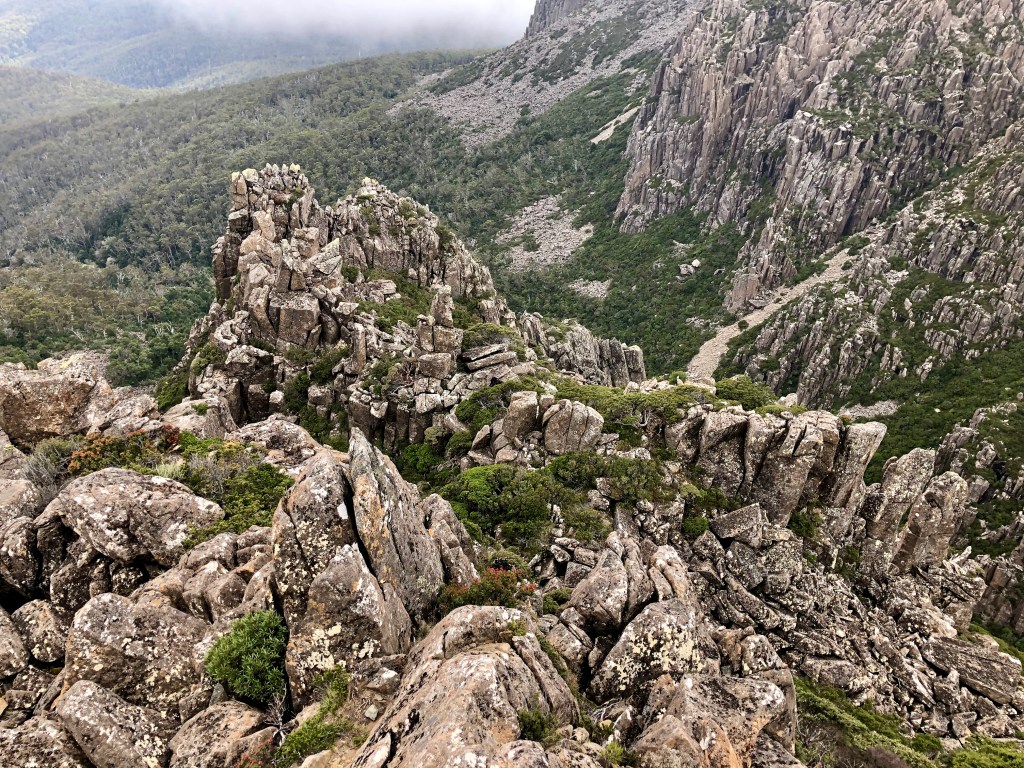
And what a marvel of dolerite columns it is.

The knees were still recovering from Mt Arthur the previous day, so we drove up to the ski village and walked across the plateau to Legge’s Tor, a few kilometres, not much more than a stroll really.

This is the road which takes you up onto the plateau and to the ski village, a one-lane road known as Jacob’s Ladder with formidable hairpin bends. Note its path through the boulder field. It is suggested that Richie Porte, a native of Launceston and a podium finisher in the Tour de France as well as a champion domestique, used to train here.
Over the edge
There would be things to know about the Summit Hut, now reasonably derelict and not far from Legge’s Tor, but I don’t know them.
Classic alpine meadow with Pincushion (in bright green) a lovely but fragile plant.
Required inclusion.

Apsley Gorge (Indigenous name unknown)

There are two Apsley Gorges within 30 kilometres of each other, one on the Douglas River and one on the Apsley River, both in the east coast Douglas-Apsley National Park, unusual in Tasmania for being dry eucalypt forest. I don’t know much about the first one, but the second has a walk attached to it.

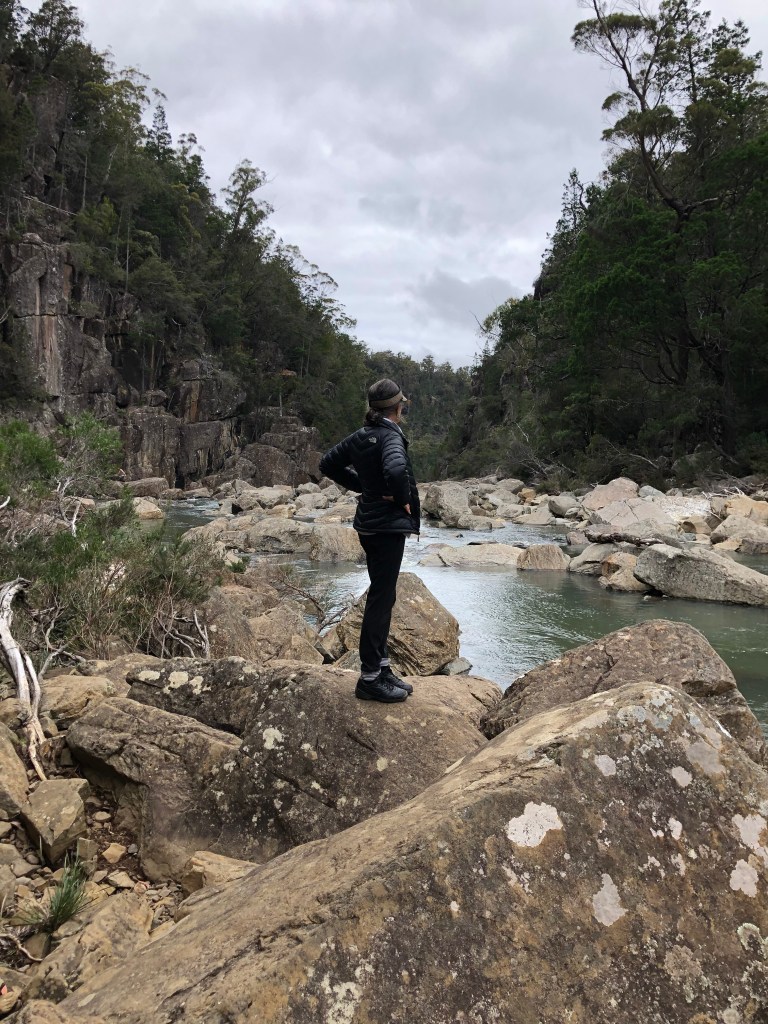
It can be a there and back, or it can be a loop, either way roughly the same distance, around six kms. The point about the loop, however, is that you walk back down, and in, the river. We had been here 20 years before and I hadn’t been properly prepared but the idea of working your way through the gorge and then down the river held major attractions. There’s a lot of pleasure to be had rock-hopping your way down a river.

Whatever your choice you can’t go anywhere without first crossing it.

You immediately notice the difference in the forest: lots of varieties of eucalypt with native pines, blackwood and grasses as well, but ratty to my untutored eye in a way that the rainforests aren’t. That said, mea culpa, this Park contains more than half of all eucalypt species found in Tasmania, a huge range of flowering plants and grasses and a great variety of wild life. None of which we saw, just as it happens.

The track rises over a headland for several kilometres and then descends sharply into the Gorge.

We thought about it, doing the loop and going back down the river, and did some modest reconnaissance. The advice is ‘if the river is knee deep in the wade across to the entry do not attempt the walk through the gorge.’ There had been some recent big rains on the east coast but it was just mid-calf. I knew that choice entailed more than a dozen river crossings, and that there are bits which you could run along and there are bits where you have to work your way through past vertical cliffs on at least one side. I watched Jan and Al, two fit 50 year-olds from Perth, do one crossing pushed around by the current and wet up to mid thigh and and thought, if it was 10 centimetres lower … but it wasn’t. Not in the mood. So we turned back into the few hundred steps to get out of the gorge and went back the way we’d come.

On return we sat here at Apsley Waterhole and had a cup of tea. This rocky-bottomed pool is apparently a favourite of swimmers and one guy did turn up to glissade into the very cold water. We were waiting for Jan and Al, as one does, and an hour and quarter after we got back they appeared, stumbling through that rock at the upper end of the pool, having had an adventure. We cheered and clapped and exchanged phone numbers. But then there were the two 20 yo girls who had also chosen to come back down the river. We rescued one from a mightily engorged leech before they left. They didn’t seem quite as well prepared. We left. Al did some work on their van, but Jan waited for them. Two and a half hours. That’s a big day out in the gorge. Glad we didn’t. Another time.

Tiarra-Marra-Monah / Maria Island

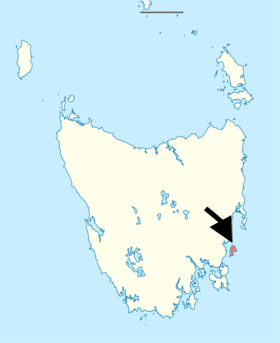
We went to Tiarra-Marra-Monah, which probably no-one anywhere ever calls Tiarra-Marra-Monah, because we hadn’t been there before. It is significant because the figure-8 island, the two parts of which are connected by McRae Isthmus, is a National Park entire. There is no shop, no car, very basic accommodation in the old penitentiary, wildlife tamed by people looking not touching, and lots of other beautiful things. And you can only get there by ferry.

The ferry was a puffer jacket and walking boot fashion show, North Face, Mountain Designs and Kathmandu all heavily represented. As evident it was a most beautiful autumn day. We hired bikes because there was a lot to see and walking wouldn’t allow us to do what we wanted which was to visit the Painted Caves and then make an attempt on Bishop and Clerk, two 700m dolerite columns on the northern end of the island.

The penitentiary buildings with, in the foreground, some Cape Barren Geese grazing, a couple of clumps of those ubiquitous bella donnas and in the far background at left Bishop and Clerk.
An outlier on the way to the Painted Cliffs, probably photographed endlessly.

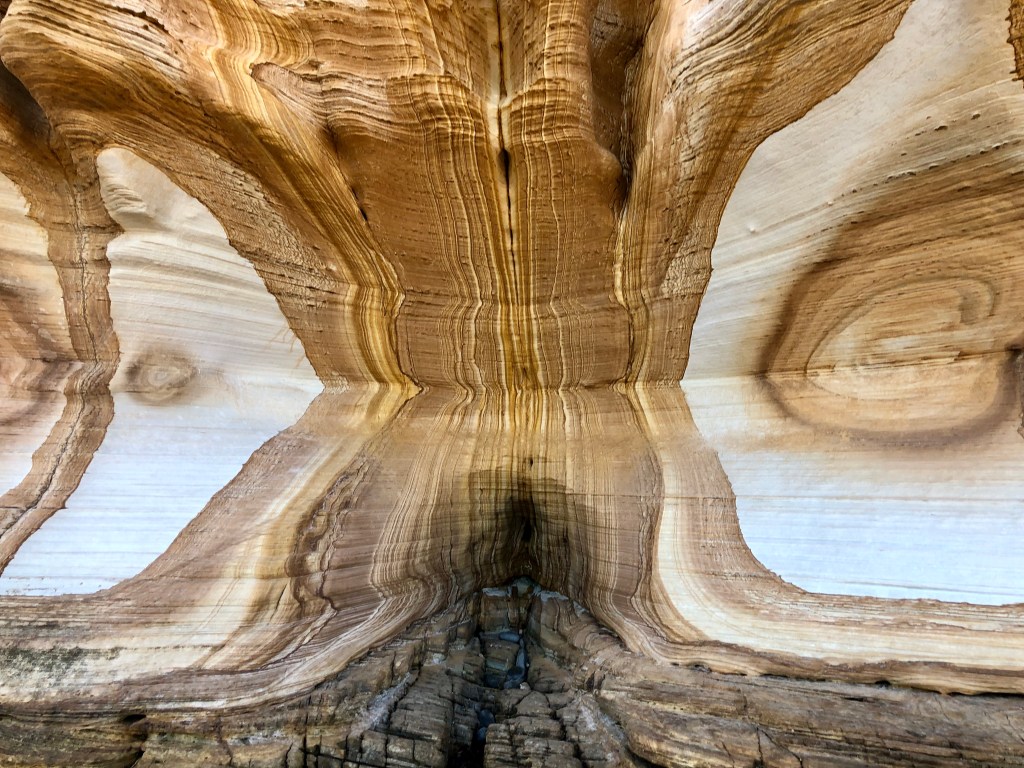
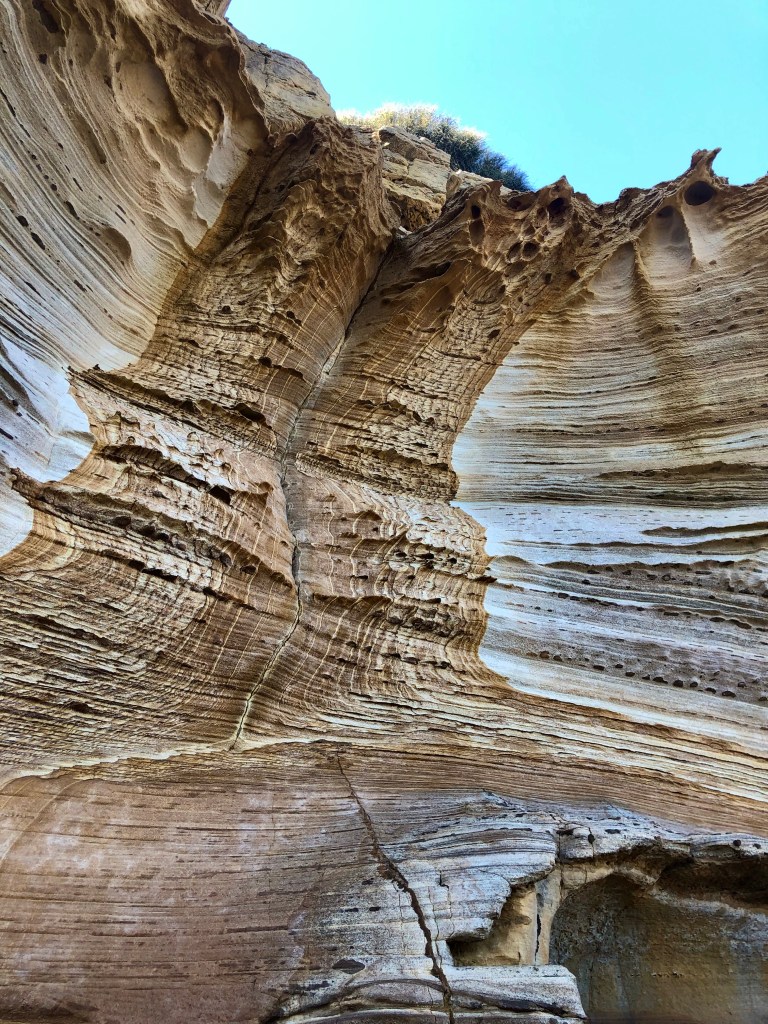
The Painted Cliffs did not disappoint. After a 100m walk along a beach, around a jutting corner were these cliffs, limestone stained along its strata by millennia of dripping iron. These cliffs are about 6-8 metres high and in full sun would have been simply amazing.

The walk to Bishop and Clerk — to the top of the Bishop really, only very good rock climbers could get up the Clerk — starts quite high on top of some ocean cliffs and its first third is quite amiable, a steady but reasonably gentle climb through forest.

This is a popular walk. There is another climb on the island up Mount Maria more difficult to reach and more difficult when you get there. But it would seem that most people who visit the island have Bishop and Clerk in their sights. There were probably about 80 people on the track with us which, while not Bourke Street, is pretty unusual. They ranged from young hippies dancing across the scree field in bare feet (‘See?! It’s just a matter of choice.’) to people who really should have consulted their doctor before setting out. Some at least of these rested at the scree field (‘scree’ smaller than ‘boulders’ but used apparently interchangeably in this location) and turned around. Some I think had never seen a boulder field before and they can look like a rock wall.

And this one is a bit annoying. It goes on beyond your expectations, you keep turning blind corners and there it is again. More! Bugger. It had captured the trekkers’ imagination. And then, when you’re through it, you look up and think you’re nearly there. But you’re not. There’s another 20 minutes.

The Clerk, 600m down to the sea.

Quite a lot of advice is offered (brochure, guide, map, bloke who rented us the bikes) not to do the last 50 metres. But really, you know … as if. You’ve got that far. You’ve beaten the scree field. What danger could lurk that would stop you from here? But sure enough there’s quite a boulder in the way, a couple of metres high with a negative face to climb onto. That is a face that slopes down rather than up, and that says in a quiet but menacing voice, you’re going to slide off here. But there are a couple of footholds in the right places and a crack that you can get your fingers into for purchase and, like most people on the mountain that day, we got to the top. I felt renewed.

Kunanyi / Mt Wellington

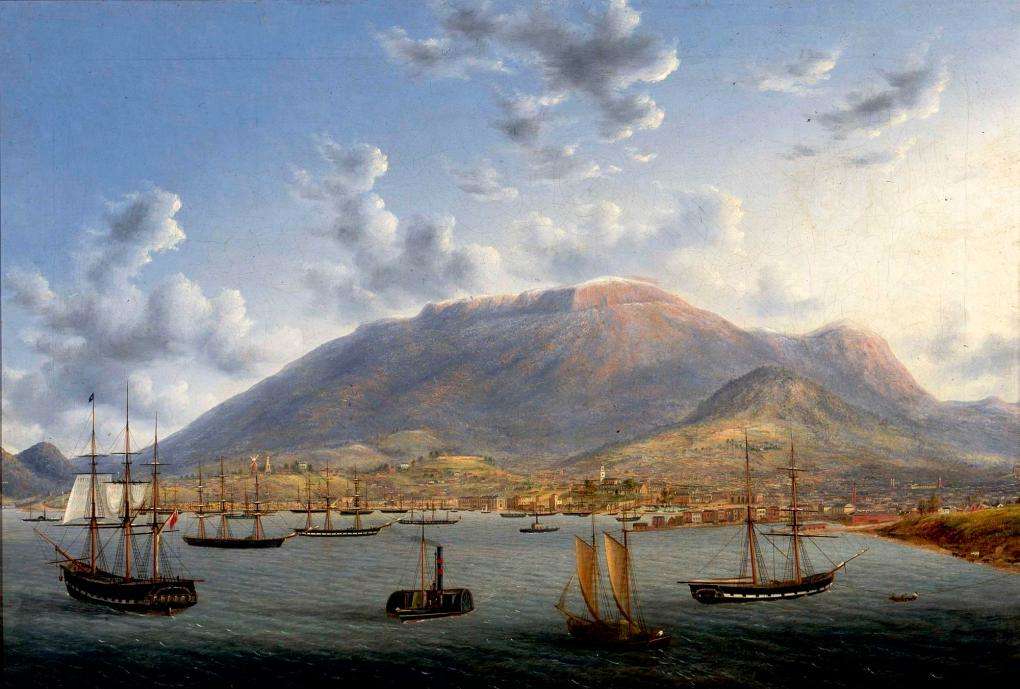
No name or date, but painted by Henry Gritten in 1856 and unmistakeably The Mountain.

You turn the corner on the way in from the airport and, bang, there it is. The Mountain. What’s the weather like in Hobart? Is there any snow on The Mountain? Can you see the Organ Pipes or are they muffled in cloud? We hadn’t come from the airport but we were coming in that road. There are other cities with natural features that announce them — Sydney has the harbour, Rio the Sugarloaf, New York Manhattan — but Hobart has The Mountain. It doesn’t really need a name but all the signage these days says ‘kunanyi / Mt Wellington’, a change legislated in 2013, and one of the State’s inaugural dual-named geographic features. So hurrah for that. Why would you want a mountain like this, here, named after an English Duke who helped supervise, at a distance, the fighting of a war with the French, half a world away geographically and much further culturally.

We’ve done a lot of walking on The Mountain — near a capital city of walkers it’s covered in tracks — and have preferences. We’d had a great family day in Nubeena and were ready for a climb. So, start at The Springs, up the Ice House Track, stiff but quick, to the top and clamber across the South Wellington track to the summit (1271m for interest). Down the Panorama Track to the Chalet and then along Organ Pipes back to the car. Might be about 12kms. Ideal really.

I noticed a few spots of rain on the cars as we left downtown Hobart but hardly any on the ground. But by the time we got to Fern Tree the gutters were running quite hard and further on up to The Springs the walls of the cuttings had sprung leaks. Water was squirting out of them, something I’d never seen before. Clearly a day for the raincoats. We were putting them on and getting organised when a bloke came over with something for us to see on his phone. He was track-builder and his gang had been up, as it happened, on Ice House Track. He showed us a video of his mate mid-calf in the torrent that was the Ice House Track. There might have been next to no rain in Hobart, Australia’s second driest capital, but a few kilometres away as the crow flies The Mountain had had 80mm overnight. He was going home and suggested we revise our plans. Fair point, and achievable. We could use tracks that ran more closely with the contours rather than perpendicularly across them.

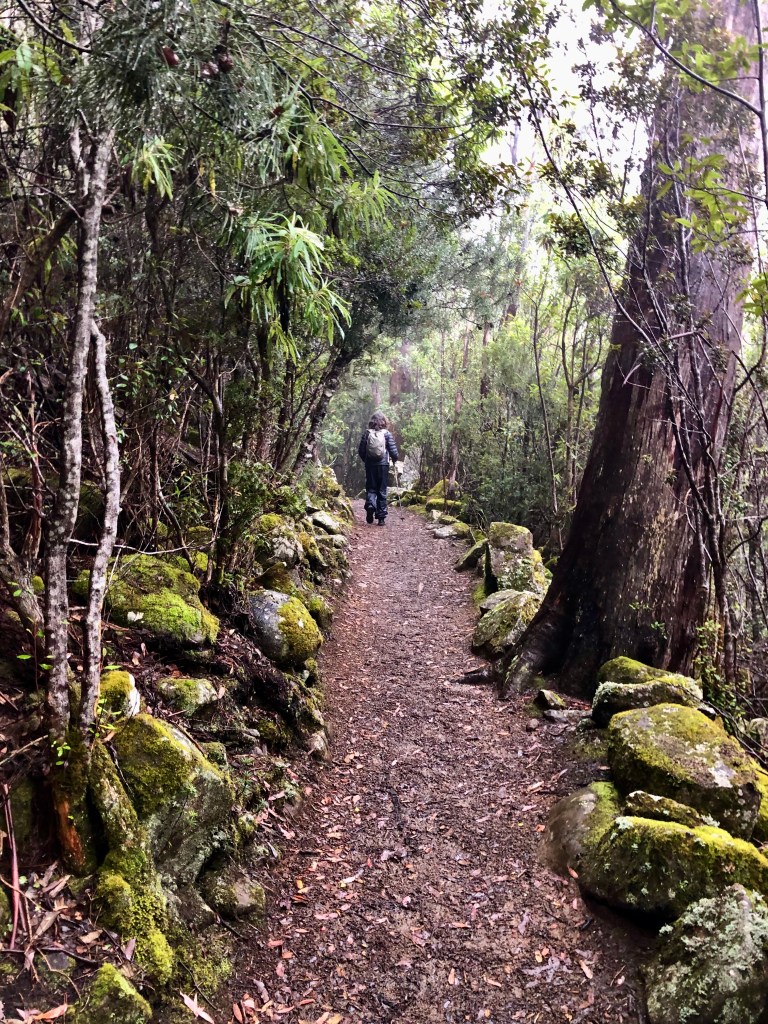
Looks fine doesn’t it: the Lenah Valley Track before traversing up to the Organ Pipes. Panorama up to the summit. Back the same way. We’d gone 200m when we heard this noise.

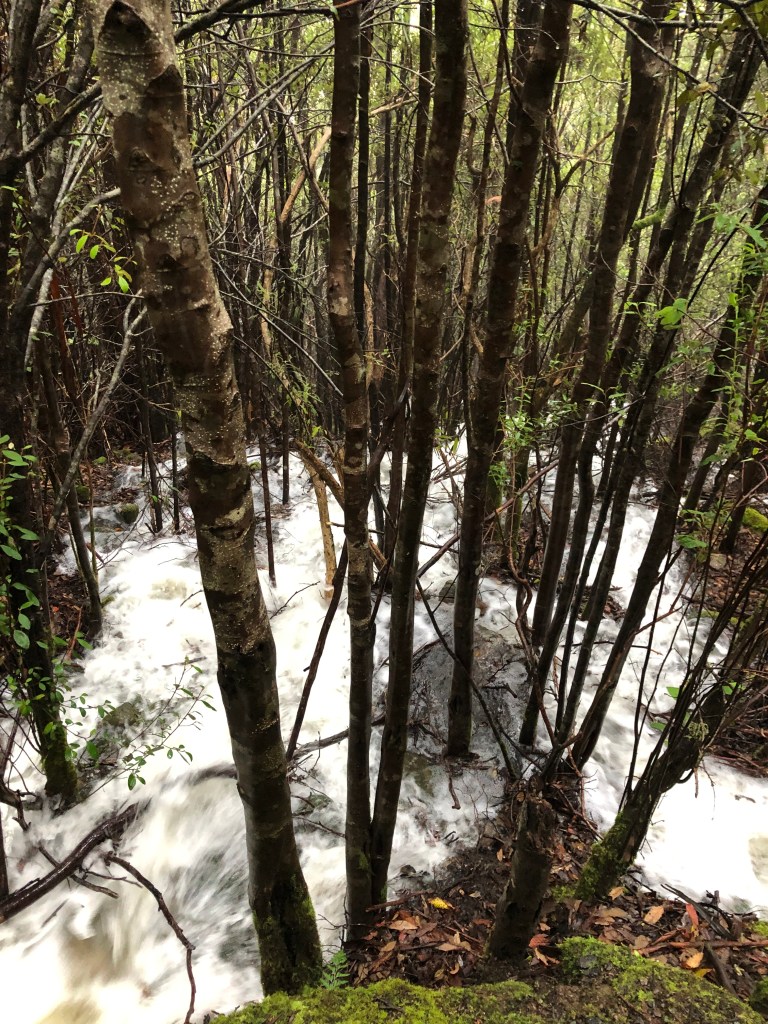
We were reasonably out of it, but the floor of the forest was running and making a great watery racket. Sort of a marvel in its own way and rather than diminish the pleasure of the walk re-directed it.

Natural foam fizzing in a gutter.

Our feet stayed reasonably dry till we needed to go up the Summit Track to the Organ Pipes. And then they didn’t. Make sure the sound is turned up.

There are plenty of boulder fields to walk across on the ‘front’ of The Mountain. Adding to the dimensions of sensory experience we experienced while doing so was listening to very active subterranean watercourses somewhere beneath us grunting and shlooooshing away.

Something special seems to happen to the colours of vegetation in the wet. This talks to walkers. I know because of the incidence of photos just like this one.

The one minute that the cloud parted allowing us to see what was below, probably the northern suburbs Glenorchy way.

It could have looked like this, but it mattered not one whit.

Meander Falls

We hadn’t been to Meander Falls before and they sounded promising. They weren’t in my standard guidebook (the excellent Day Walks In Tasmania by John and Monica Chapman), and the advice about the walk was various. Some young adventurer reports (with selfie) on the internet that he had run there and back in 2.5 hours which would make him a) a world-record holding rogainer and b) quite likely a combination of a dickhead and bullshit artist. But that’s the internet for you.

I forgot to un-pause my Map My Walks so I don’t know how far to say we walked. The signs tend to concentrate on times and congregate around 5-6 hours. In intermittent bouts of rainfall, we took six with lunch and time spent ogling.

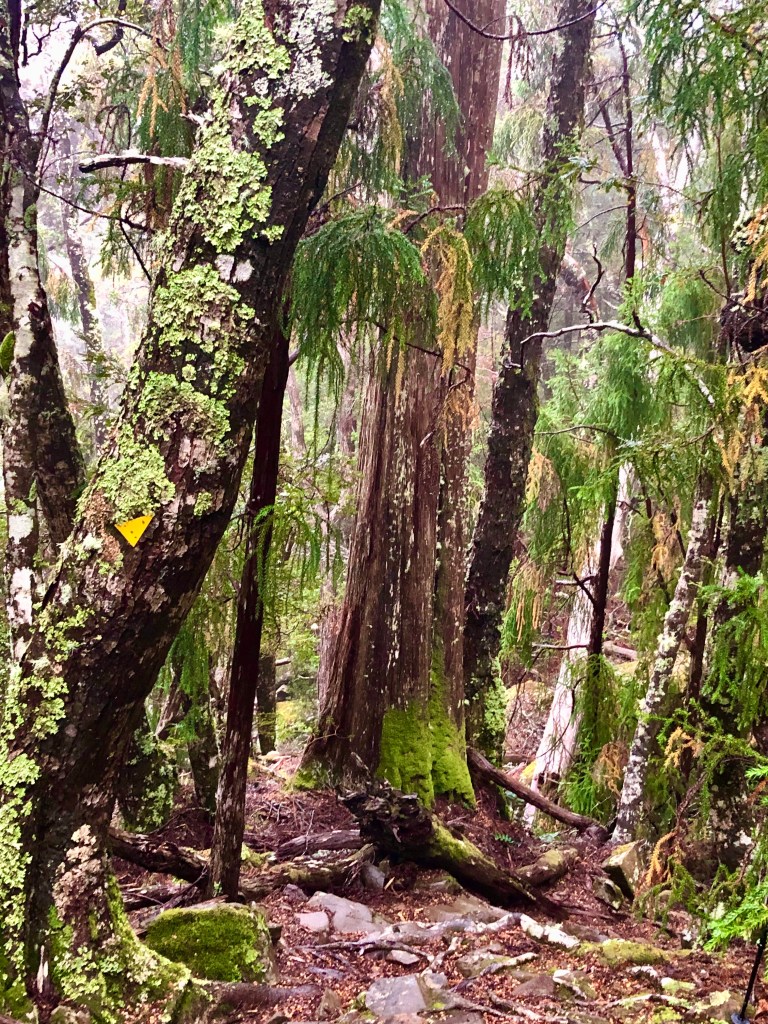
The first third (a theme is emerging here) is a stroll through beech forest next to the Meander which on this particular day was boiling, fabulous. Compared to the northern floods it was nothing of course, but in this micro-environment it was hurling down, noisy company almost all the way.

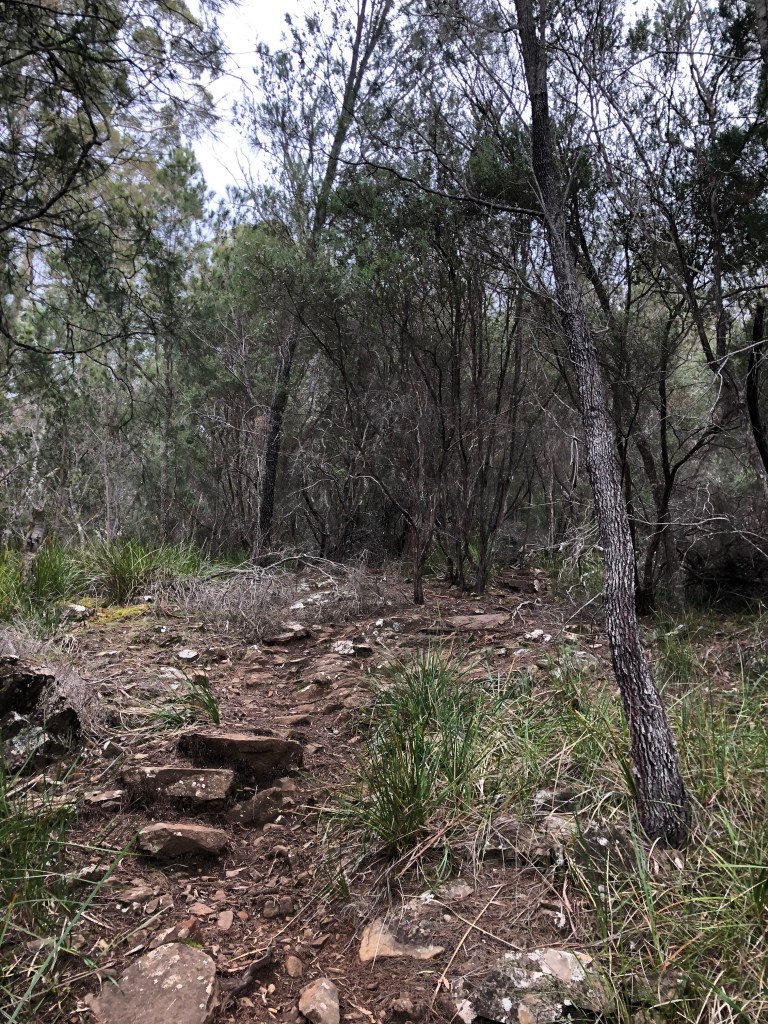
The track is officially: ‘Formed earthen track, few obstacles. Generally a modified surface, sections may be hardened. Width: variable and less than 1200mm. Kept mostly clear.’ This is a reasonably representative section of it in the second third.

The river remained company until the last third when the track veers away, still climbing steeply, to circumvent a rocky prominence. But exquisite scenery everywhere.

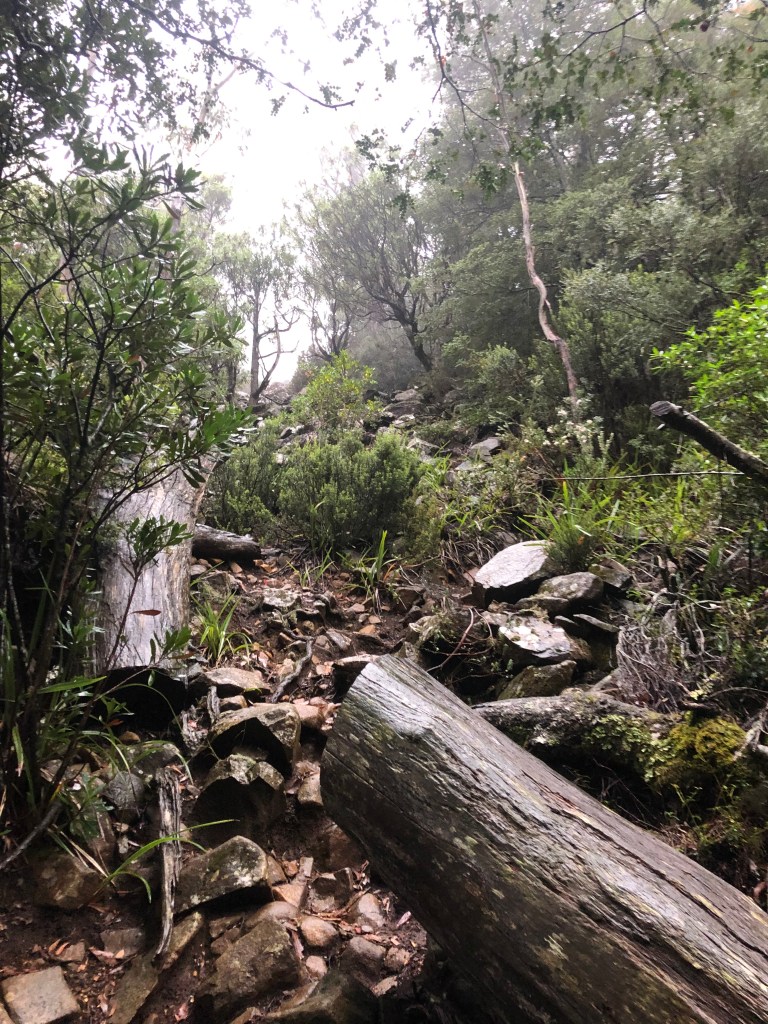
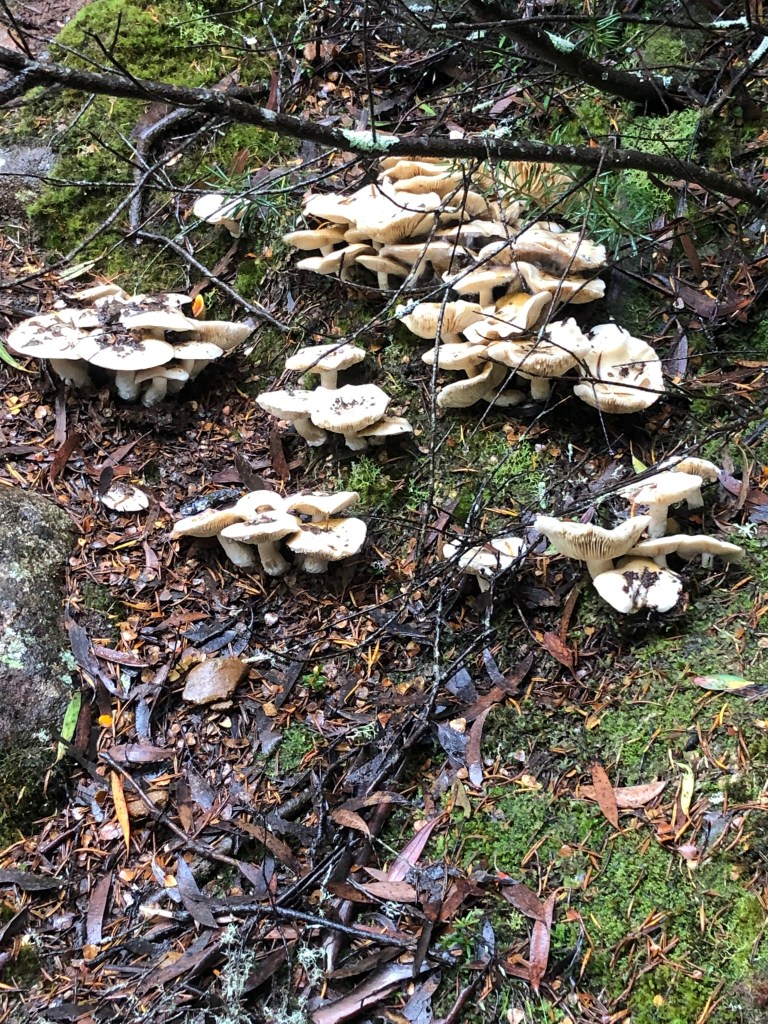
One feature of this walk was the range of fungi we saw, must have been 20 or 30 types, each seeming to be trying to outdo the other in terms of colour and form.

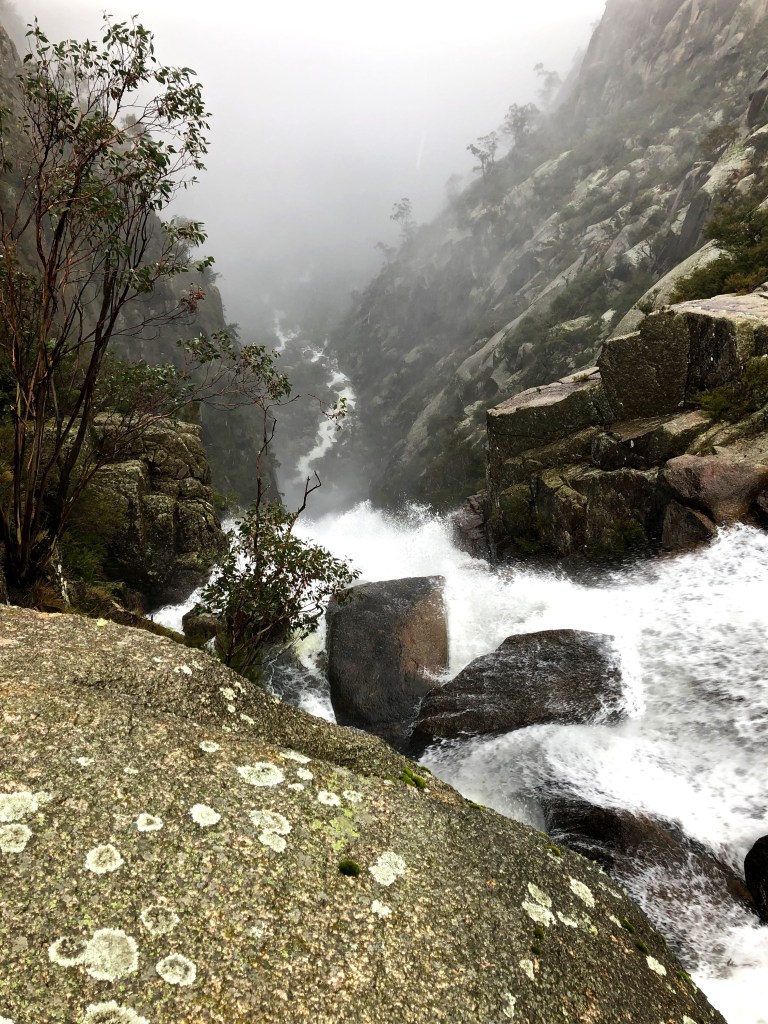
The approach to the falls — on this wet wet day; we were lucky — was signalled at some distance by their noise, a constant and increasing roaring. There’s a flattish bit across the top of a headland, very wet in this instance, before the curtain goes up. But then the curtain does go up.

When the tops haven’t disappeared into the mist the two drops are round 90 dramatic metres. They’re not the Victoria or Niagara Falls, but gee it was fun to see them. Maybe it’s the effort of getting there, or maybe it’s the cup of tea.

Happy travels.

ROCK

THE LITTORAL

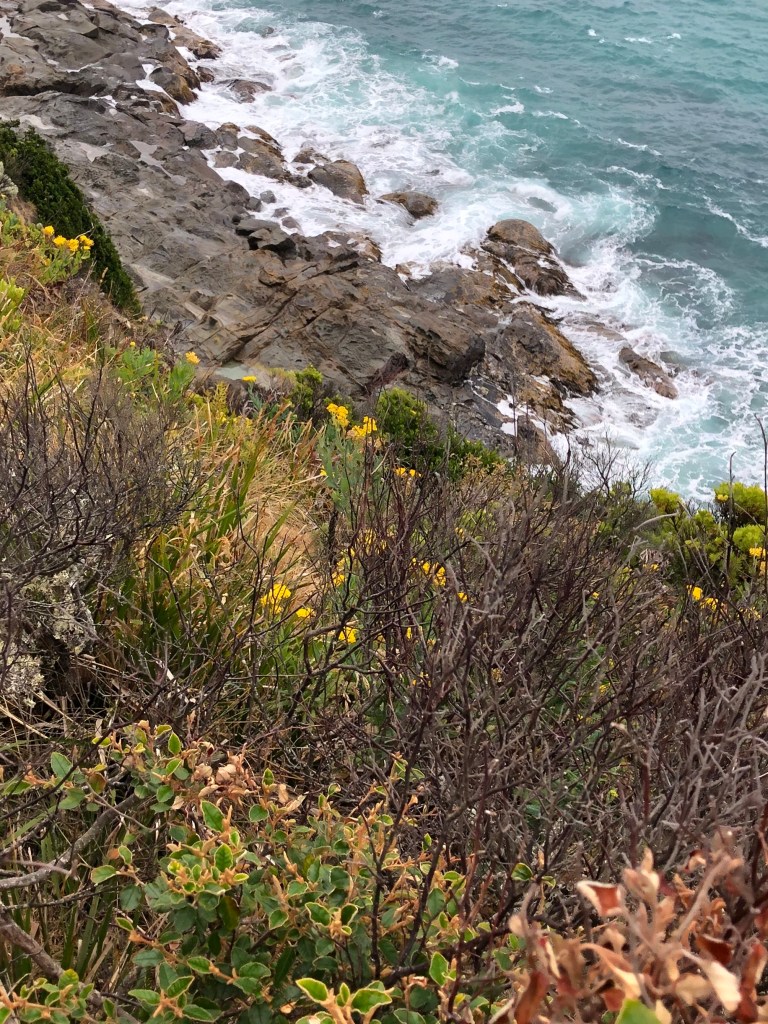
In Janice Gregg’s lovely photo of the Cape Otway coastline, the rock platform extending sometimes 50-80m out into the Southern Ocean is just visible.

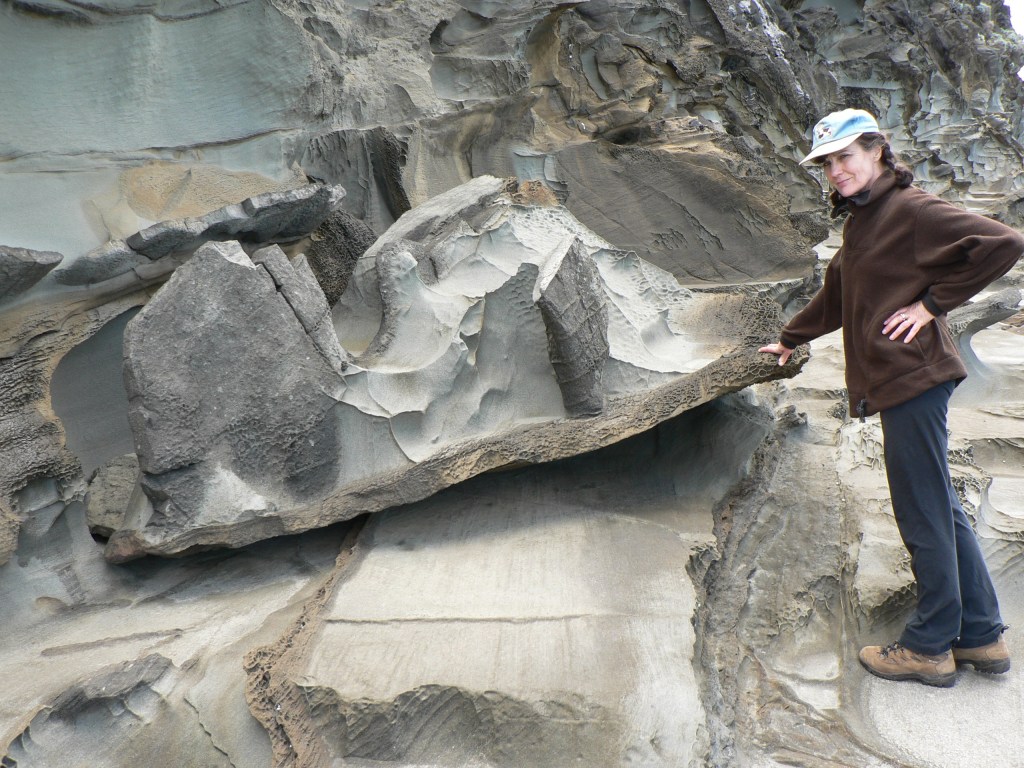
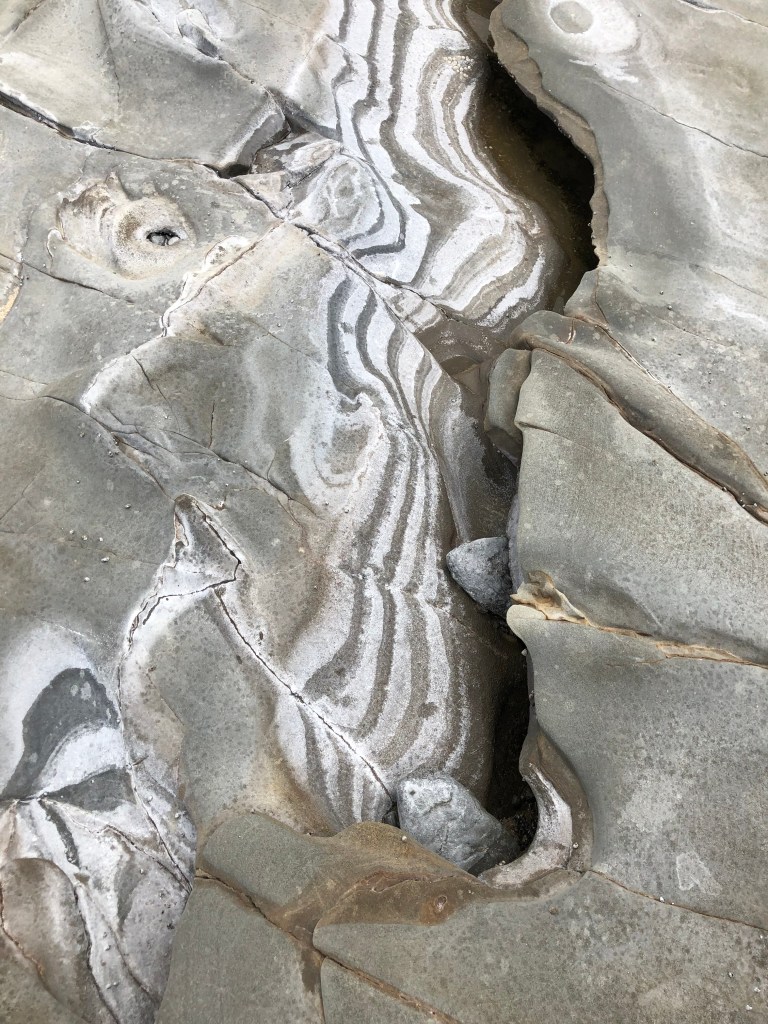
Seventeen years ago (seems like yesterday etc etc) our friend Dennis took us for a walk along a section of these platforms from Blanket Bay to Parker River only at one point needing to navigate a big watery incursion. It was a memorable walk for all sorts of reasons: the pleasure and ease of walking on smoothed rock, the strong sense of being somewhere between the punch of the waves and the scale of the cliffs which sometimes towered above, but beyond anything I think it was the extraordinary shapes and patterns in the platform itself that iced the cake.

Myrna was smaller then.

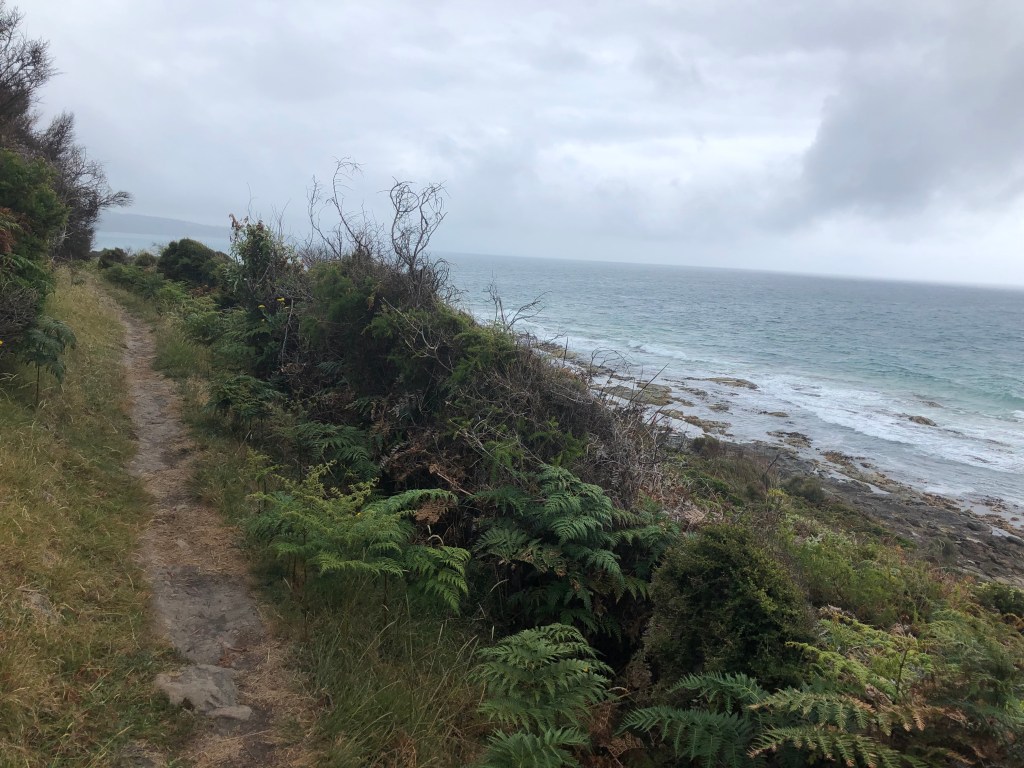
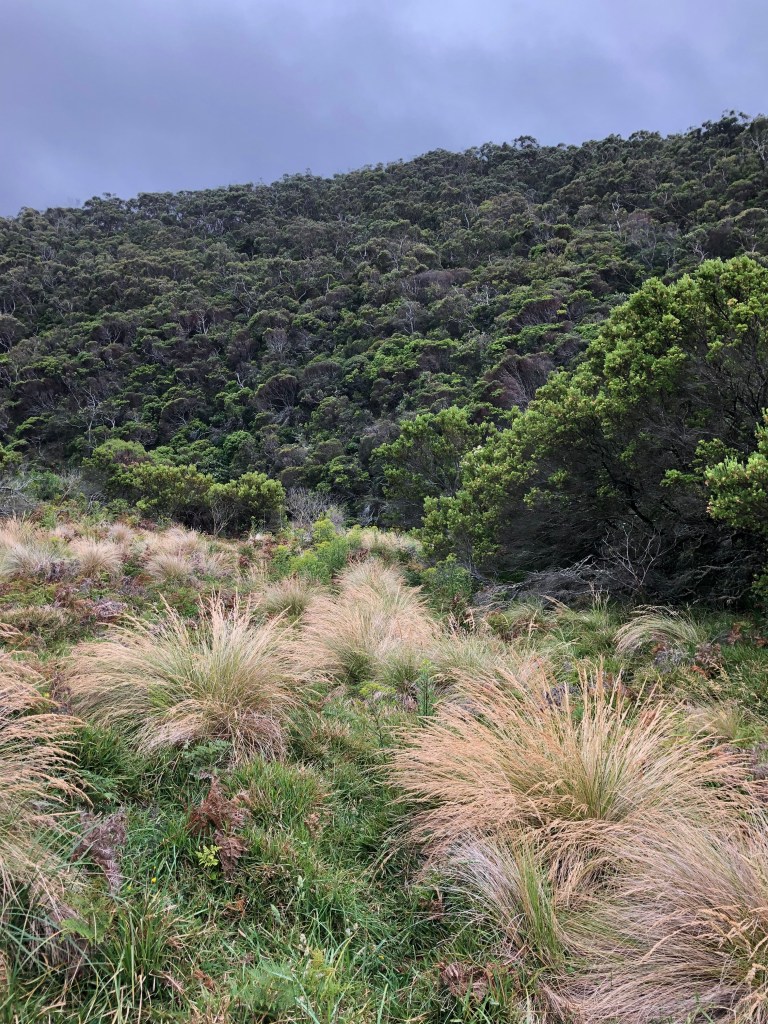
We spent a few days in the Otways after Christmas this year and I thought that walk was something I would like to do again. We couldn’t make it work but with Dennis again and Richard his son we did walk along through the forest on top of the cliffs between those two inlets, a section of the Great Ocean Walk and very pleasant in itself.

But we found another section of platform closer to where we were staying at Apollo Bay that had just as much interest:

the point at Marengo to Shelly Beach, at low tide.

Some of this is a part of the Great Ocean Walk as well — near enough to the beginning of it — but that track takes you off the rock up into the hills, in fact up and over Bald Hill directly in front of us here.

There was some company …

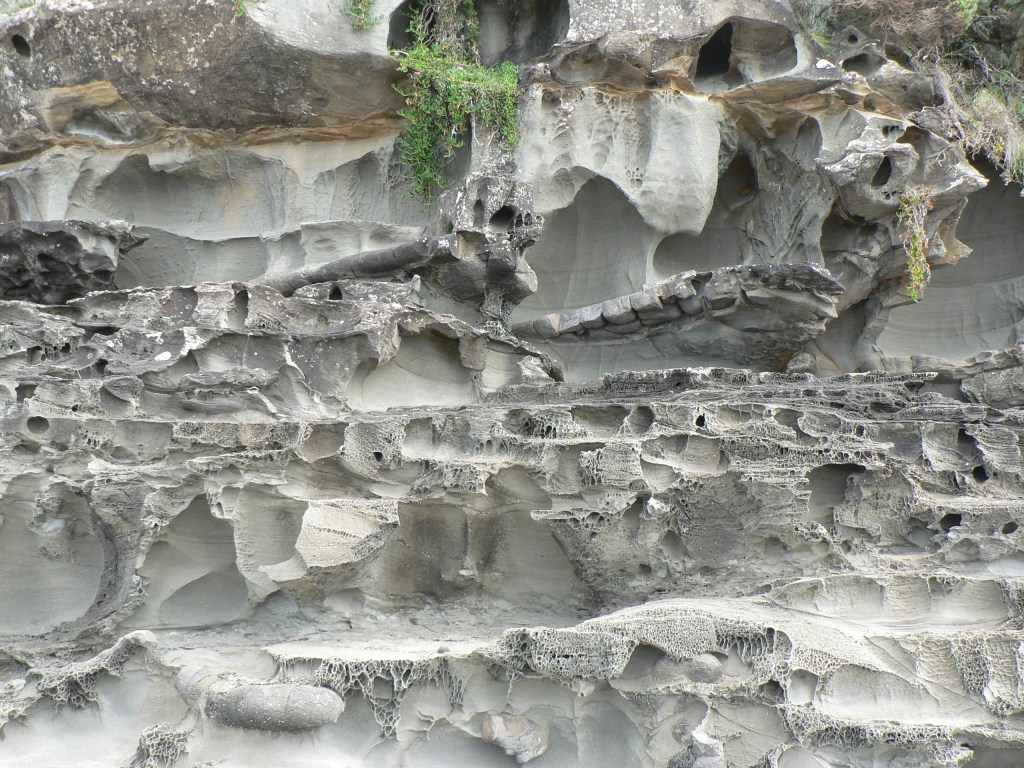
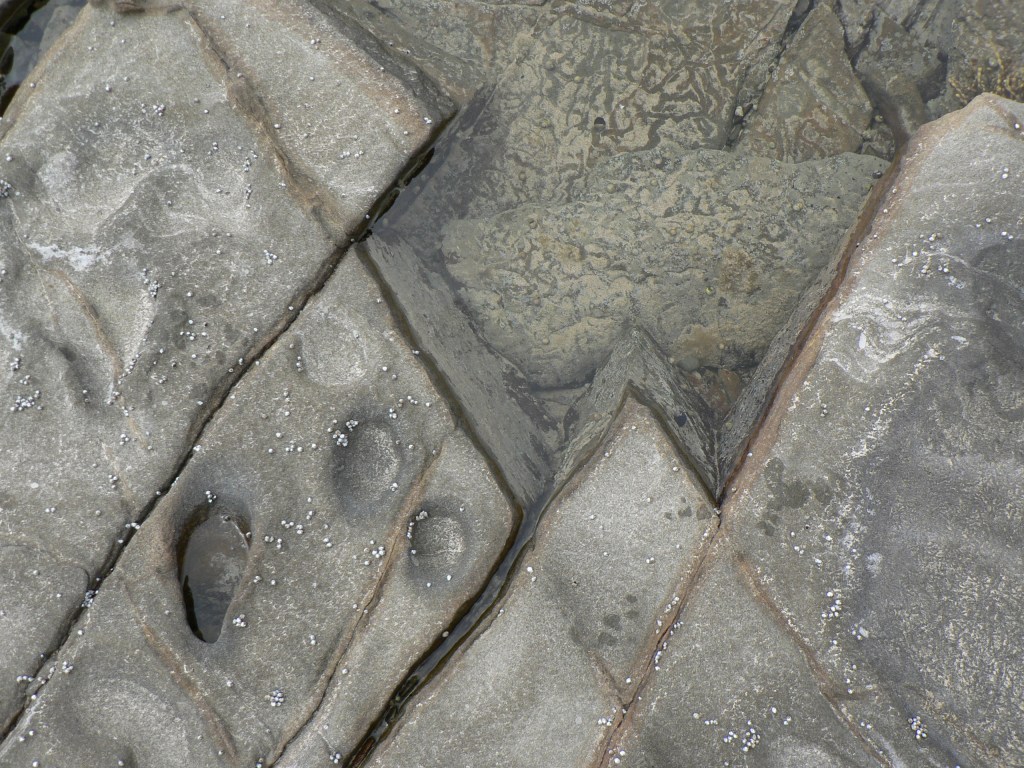
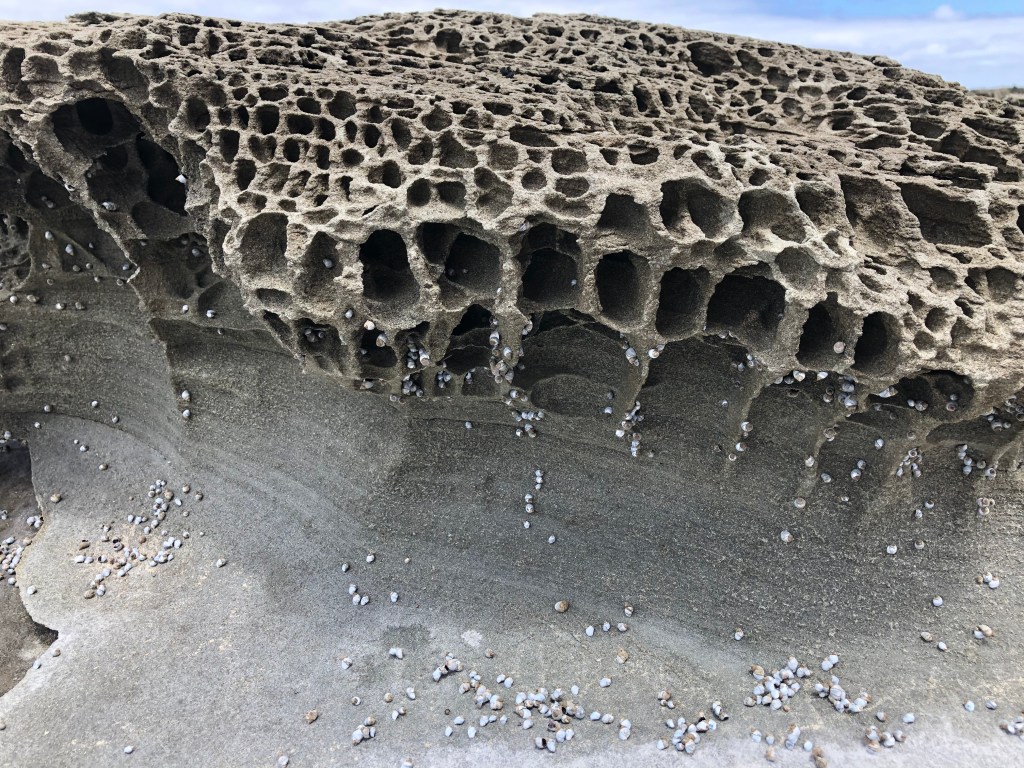
… but again it was the shapes and patterns that got me in. Quite a high proportion of the rock here is basalt, so full of holes.

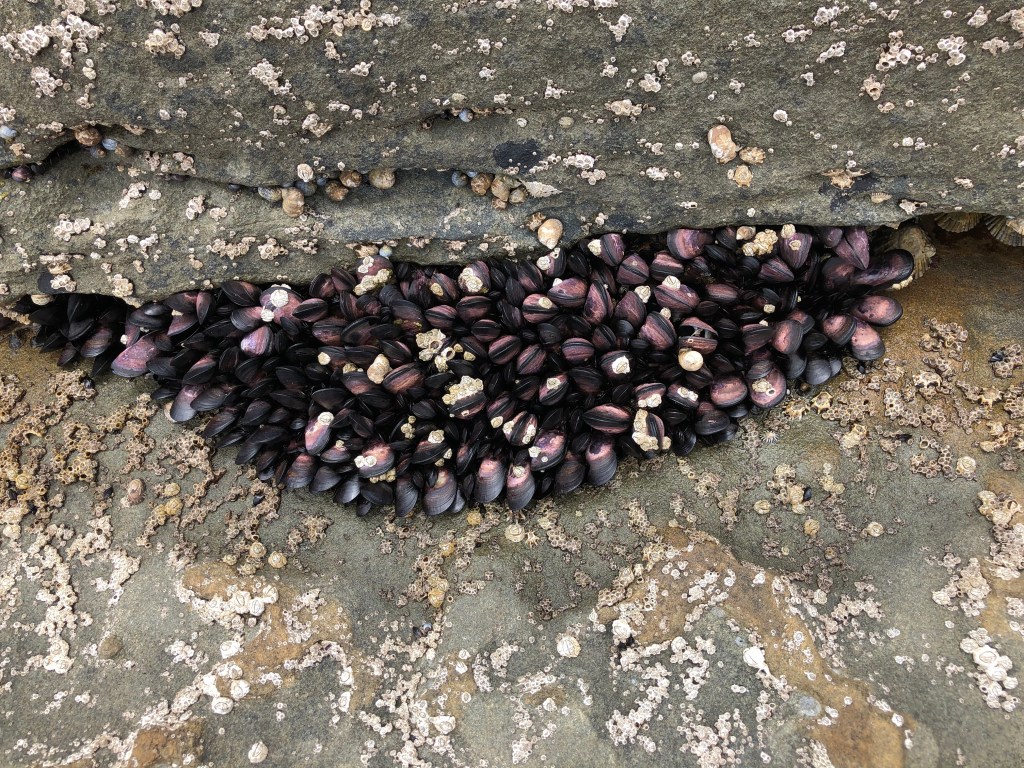
And so full of life …

And messages.

I read them, went home, and thought about what they had to say.

THE INTERIOR

We’d been here before too. Twice. Recently. The second last time water was spilling over the ledge above.

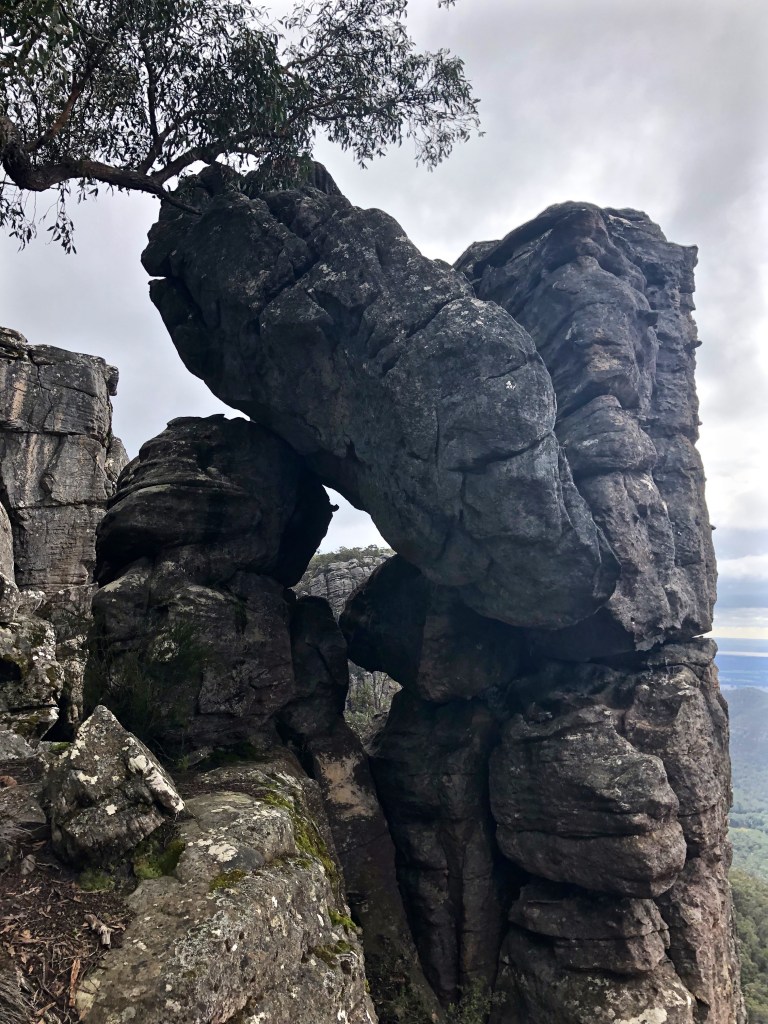
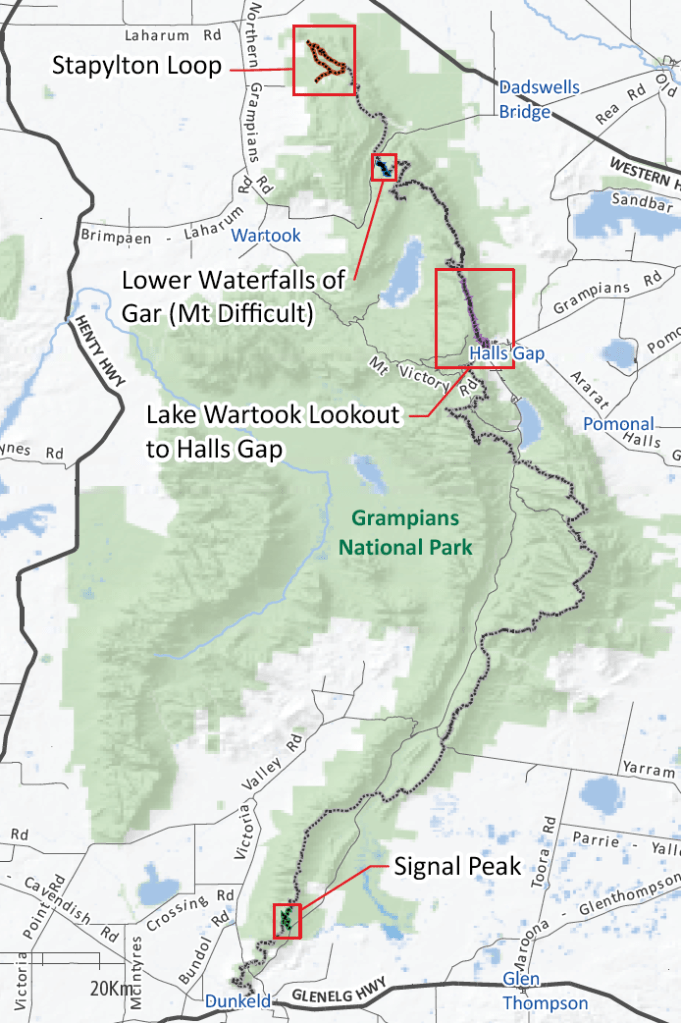
It was winter and for the very first time we had discovered the Falls of Gar (‘Mt Difficult‘), one of the new sections of track of the recently opened Grampians Peaks Trail. We’d found the three falls, all running at the time, but only got about a third of the way along this section. It was quite a shock that it was all so new and familiar only in a generalised Grampians-y way. I must have driven past here scores of times in complete ignorance of these formations.

So on a beautiful day with additional company we repeated the first few kilometres.

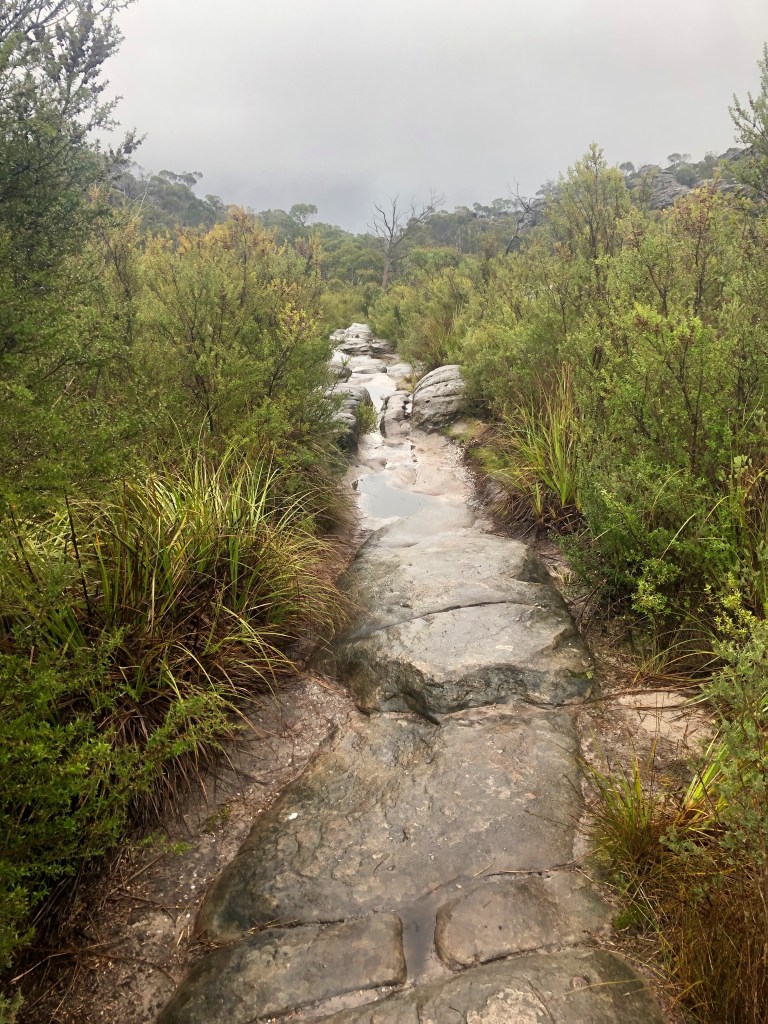
Look at the quality of this work. Construction of the new elements of the track cost $37m. I say it’s worth it; but then I would.

The climb goes up one stage before the bumpy little peaks begin, and you have a long generous walk on the flat for a couple of kilometres.

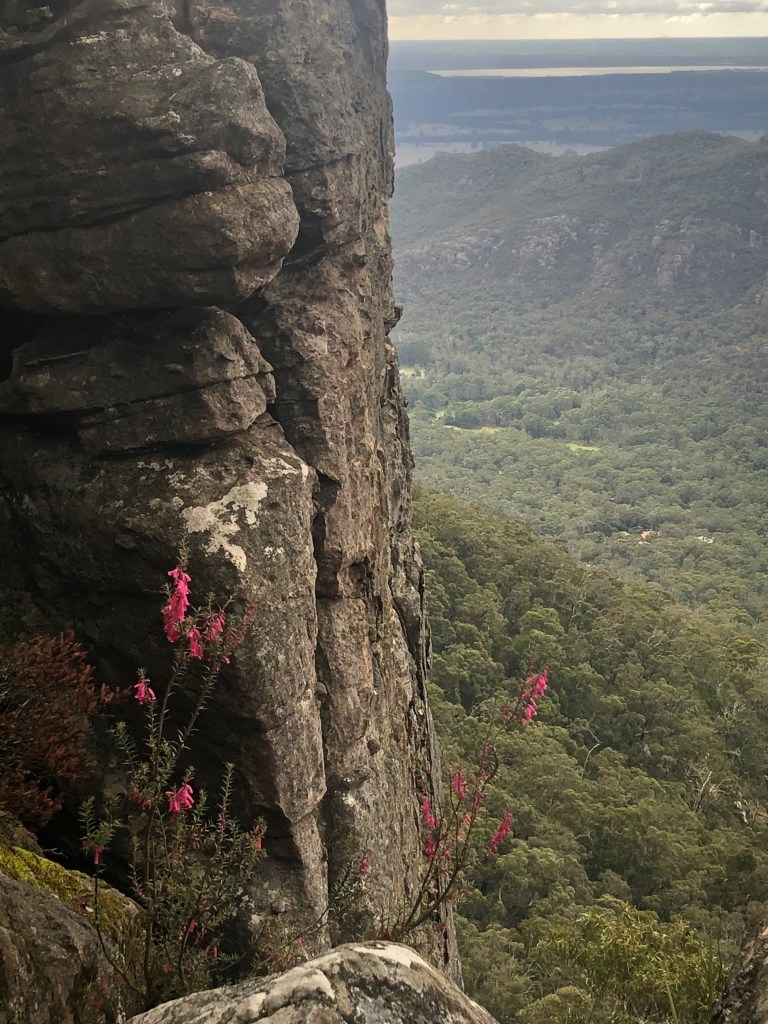
This is the view one way (west).

And this is the view in the other direction,

to an amazing ampitheatre with a host of striking formations and an unusually fine echo.

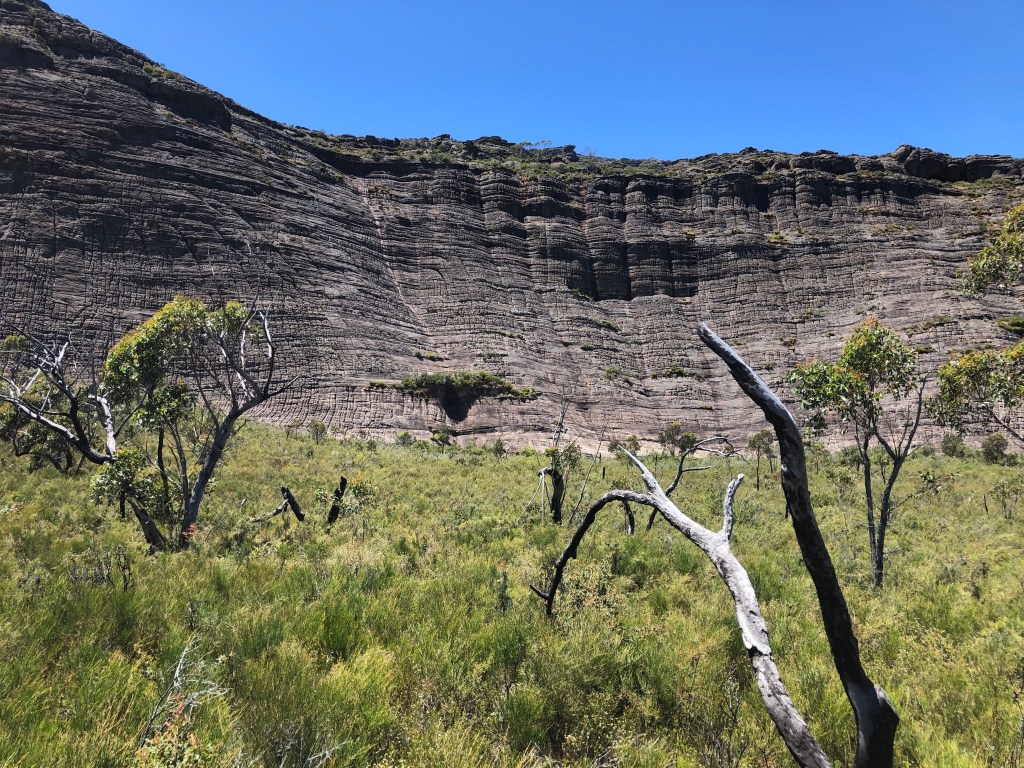
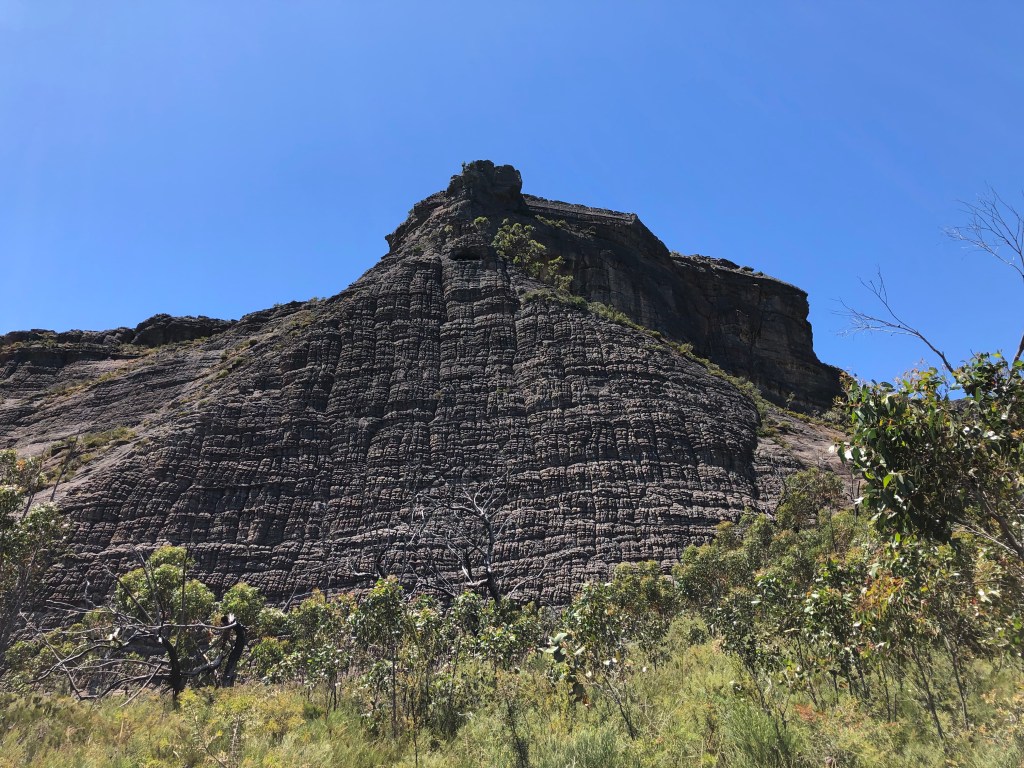
There are two large rock shelters under the peak of this slope which are likely to have paintings in them. But the art is everywhere.

I had been looking for the old track to Gar and found it. It begins at this little trace and then goes more or less straight up the face.

And then there was getting down.

The old track takes over and you descend a couple of hundred metres in a couple of hundred metres to the pool at the bottom of Beehive Falls.

I have never seen more than a finger line of water coming over the falls themselves but this pool is always there for refreshment. I think it was about 10km by the time we got back to the car, but hard to imagine a better spent 10km. Glorious.

The Big Finish

A luxury finish to what is really just a collection of holiday snaps: a Corymbia in flower outside our unit in Apollo Bay, one of dozens in the street plantings.

Once called Flowering Gums, Corymbia were declared a genus separate to eucalypts in 1990. They are called ‘Corymbia’ because a corymb has a flattish top with a superficial resemblance towards an umbel, and may have a branching structure similar to a panicle. You’ll be saying to yourself: of course, of course. Why does he have to go over that stuff?.

What a delicious explosion of colour.

RECOVERY

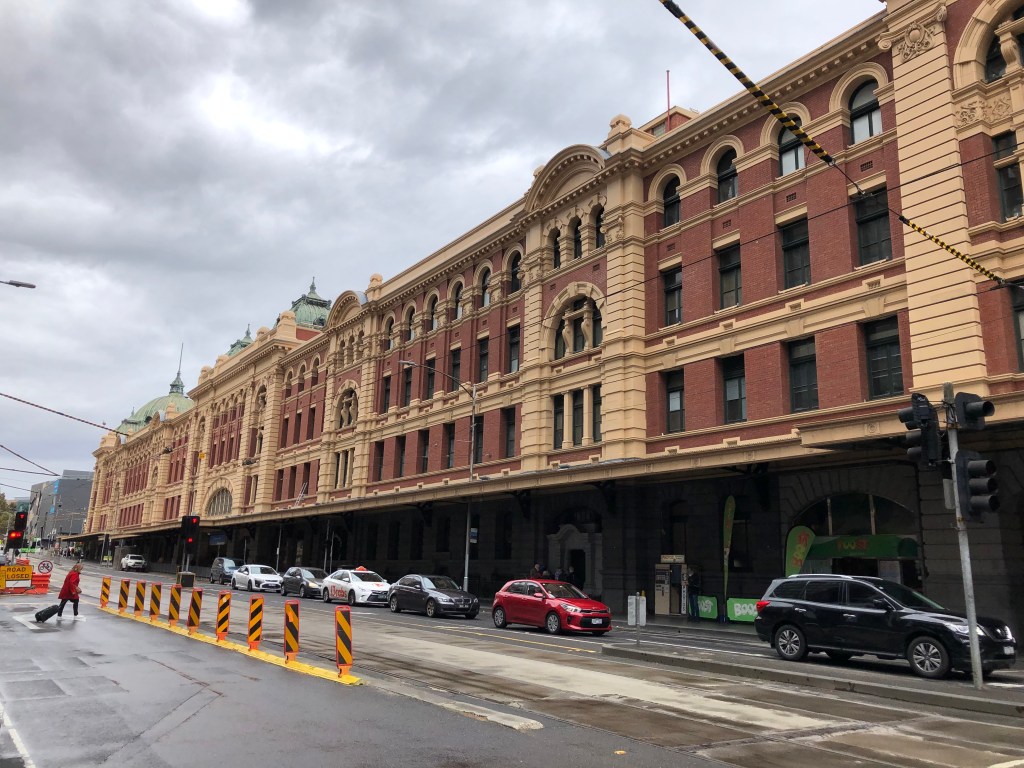
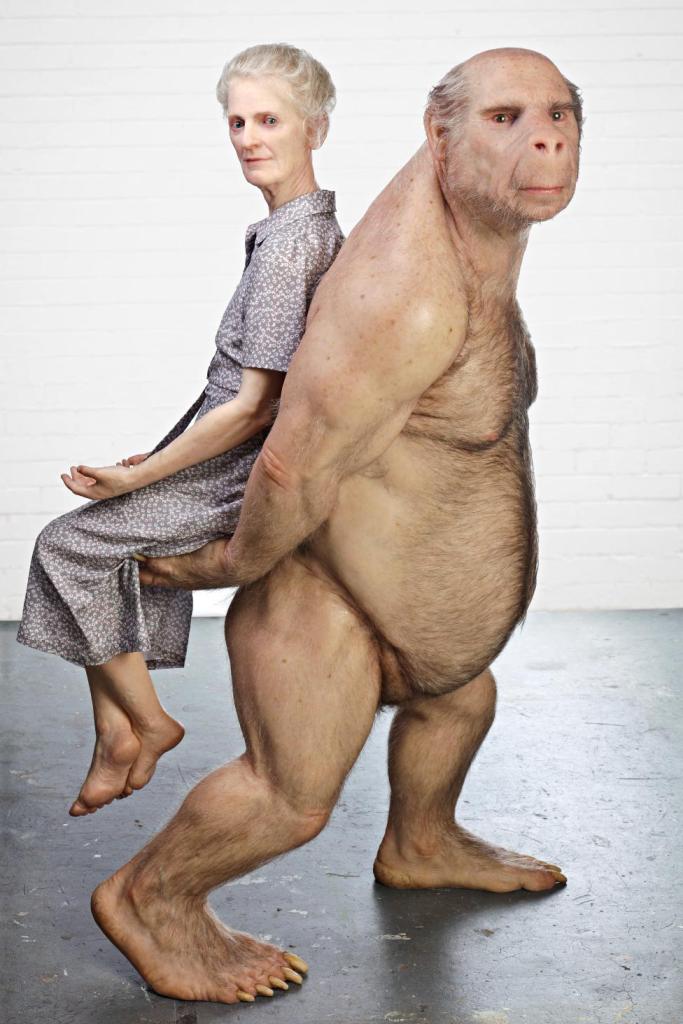
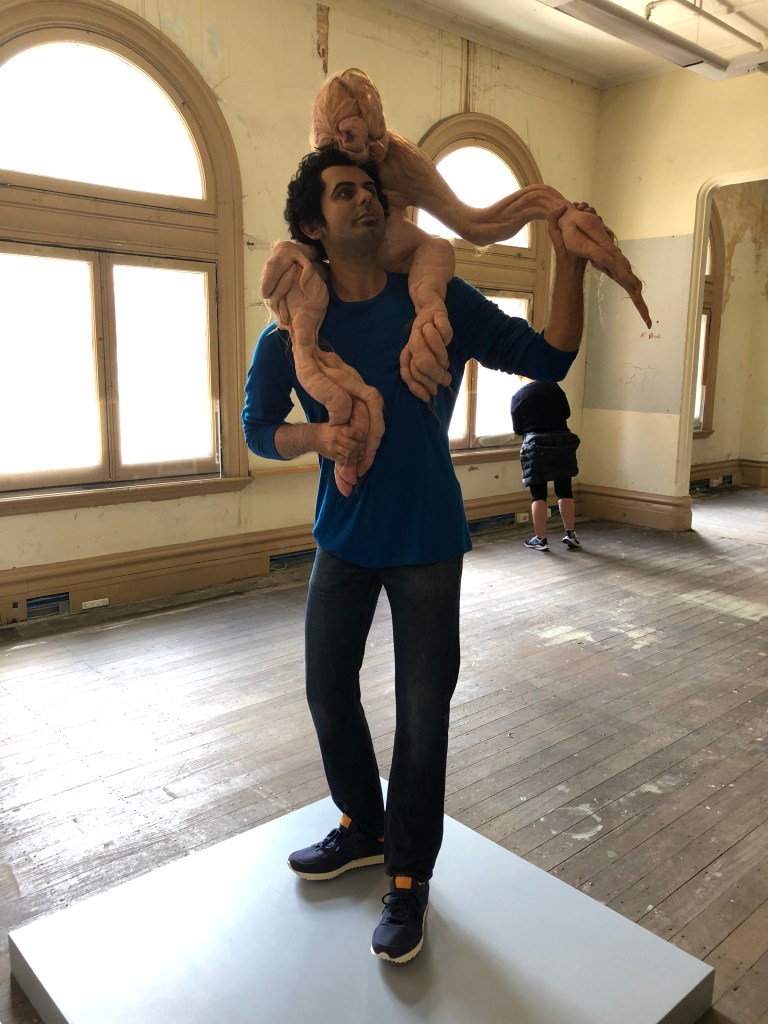
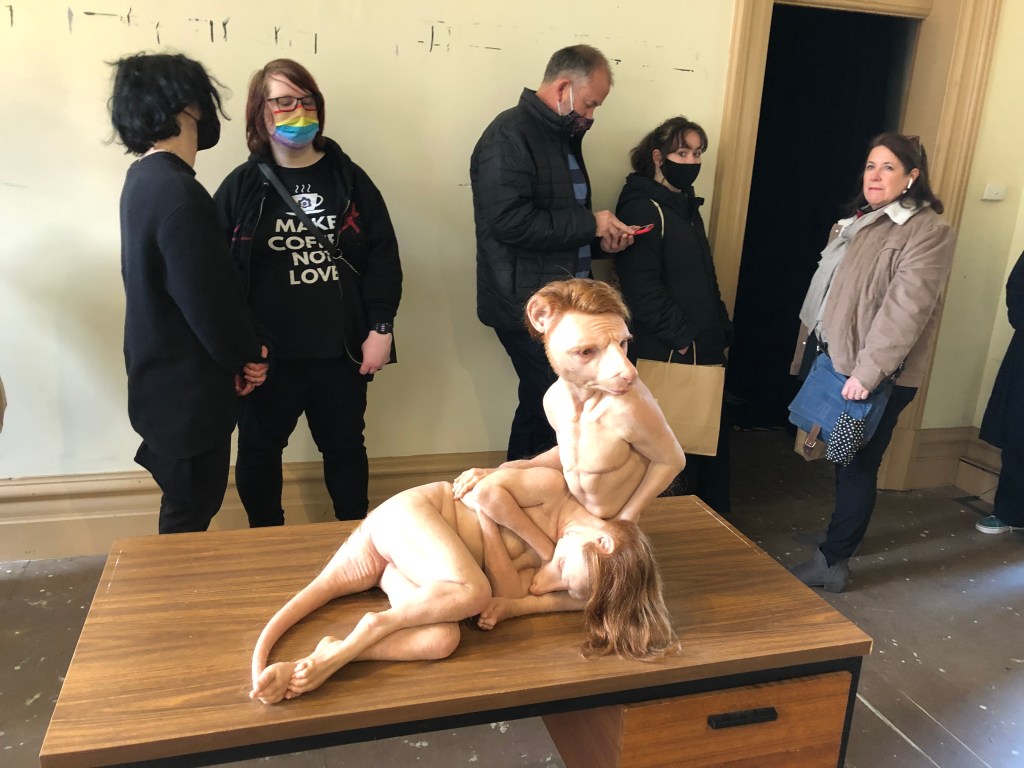
Patricia Piccinini and Flinders Street Station

This is neither the artist nor the locale.

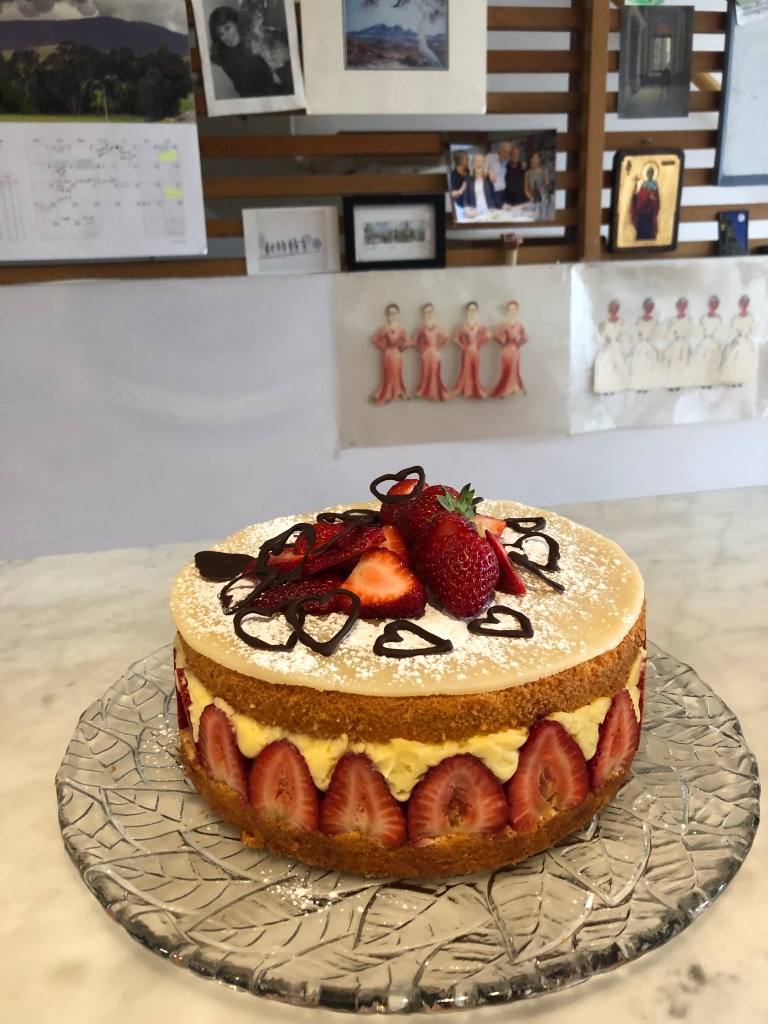
This is a Fraisier cake (think French think strawberries) with Diplomat cream and marzipan icing. Phwooaaar. Regardless of how it tastes (one down from sublime, needs cream to push it over the top), it looks wonderful with those rugged little adventures of custard and the carefully piped (home made) chocolate hearts. It was made for a special occasion, the first time the six friends in one of the photos on the wall had seen each other and eaten together — normally a regular event — in seven months.

It never made it. There was a domestic outbreak of Covid which precluded mingling.

How often has that happened in the last two years. You think you might be on the brink of some sort of return, a recovery, when the phone pings and there’s news of a new outbreak and a return to rules which have become both familiar and irksome in a passive sort of way. Just a tired sigh. The brief frisson of the panic buying of toilet rolls or people whizzing up cheerful little memes to brighten the pandemic day … that’s all long gone. So very 2020.

We’ve been locked down for 262 of the 531 days from March 14 2020 to the latest lifting of restrictions, 49 percent of the time, which included two long grey winters.

But if the Fraisier cake didn’t reach its intended mouths, there was a workaround and it was consumed anyway and with considerable enthusiasm. That’s also a story of the pandemic. Managing. Amid a particular sort of peace. Cleaner air, less traffic, less socialising, a lot less socialising, finding a nest and burrowing into it, deeper and deeper as time goes by. My Big Issue seller, just back in business, tells me he enjoyed the lockdowns and wishes there were more of them. Quiet. Not taxing.

Could be somewhere in Japan where we had planned to be, but it was near the Butcher’s Shop coffee establishment in West Melbourne where Michael and I were illicitly sitting enjoying takeaways. Crisp. Clean. Unnatural.

But one thing, a bad thing, a taxing thing, that had happened was that art of all sorts had been swallowed into one of the pandemic’s all consuming sloughs. No concerts, no soirees, no shows, no galleries. It was a reminder of how public the experience of art must always be.

In mid-2021 the RISING Festival, already postponed once, was designed to bring all this back with a rush, a huge rush, the sort Melbourne has always been able to supply so capably: 183 art, performance, music and food events, featuring over 850 local artists; 36 significant new works commissioned especially for the festival were to be unveiled, many of them to be on a massive scale.

It opened on May 26; 180,000 tickets had been sold to the various events. When it closed due to lockdown on May 28, not many of those tickets had been used. A catastrophe for those closely involved, and a bitter disappointment for many members of the potential audiences.

One of the party pieces of RISING was going to be Patricia Piccinini’s huge exhibition, ‘A Miracle Constantly Repeated’, exciting not least because of its location, the top floor of Flinders Street Station, somewhere most Melbournians have never been.

What is up there? An expansive eyrie? A ghost house? Who has even looked up from the hat shop, the hip hoppers and the homeless on that particular stretch of Flinders Street? But look at it. It could be a palace. Australia’s oldest railway station and once the busiest in the world. You may have sat on the steps ‘under the clocks’ waiting for a friend, but did you know they are heated so they’ll stay dry?

The Victorian Heritage database says: ‘The architectural style of the building is unique in Victoria, broadly Edwardian Free Style strongly influenced by French public architecture of the 1900s. The symmetrical composition of the main sections, the use of giant order, heavily rusticated piers, squat domes, broad arches and the figures in relief over the arches of the original design [which never eventuated] display this influence.

The design as executed, with an extra floor added, also includes elements found in architecture in Melbourne at the time, especially the use of red brick contrasted with coloured cement render and the grouping of windows vertically under tall arches.

‘While the building was originally welcomed as an ornament to the city, the influence of modern architectural opinions in the post WWII period saw the building derided as eclectic, ugly and tasteless, a view which still persists in some quarters.‘ A story also circulated that the post had confused the proposals and that this design was actually meant for the central station in Mumbai (Bombay).

James Fawcett and H P Ashworth were the designers. During the course of construction the Public Works Department modified their plans significantly. (You might anticipate that. See, eg, the Sydney Opera House.) Fawcett was a designer for Wunderlich as well as an architect and the acres of pressed tin in this building as well as thousands of others are according to his patterns.

For most of the building’s life the top floor was mainly used by the Victorian Railways Institute. The Victorian Railways Institute: ‘designed to encourage a corporate culture to counteract trade union influence by providing educational, social and recreational facilities for railway employees’. A curate’s egg of a very good idea. Its headquarters at the station included a concert hall, a 400-yard running track round the roof and a lecture hall at the Elizabeth Street end, which was converted to a Ballroom around 1930. Many of these facilities were available for hire by outside groups and by the ’50s the top floor of the station was home to 120 cultural, social and sporting organisations: cat lovers, rose devotees, debaters, poetry afficionados … the works. This function continued until the Institute moved out in 1984. The last ball was held in the ballroom in May 1985.

The railways were privatised in the 1990s, and the rail operators, Connex then Metro, took little interest in maintaining the station. But the condition of such a distinctive feature of the city could hardly be ignored. In 2012 the Liberal government held a competition for its refurbishment. Hassell and Herzog & de Meuron won the million dollar prize, but their plan would have cost $2billion to realise, something the judges probably should have taken into consideration.

Coming to power in 2015, the new Labor government provided a grant of $100 million for ‘urgent works to repair the station’s crumbling exterior and clock tower, and to fix the leaky roof.’ Nothing comes cheap at this scale. All the money was spent.

This is part of the third floor corridor reached by climbing 90 steps unless you are desperate to go up in one of the two lifts. This corridor on the south side from which all the rooms exit was exactly 300 of my steps from one end to the other, so round 250 metres. A physical experience of perspective. But that’s not what you are noticing is it?

You’re thinking, good gracious, look at that. What do you actually get for $100m?

* * * * * *

On the allotted day, we work our way through the fast food bohemia which is the bottom end of Elizabeth Street, home to the indigent and the edgy, always restless with a particular sort of energy, through the shuttered shops and signs of urban struggle. More than the ‘i’s have been taken out of Mag Nation. It’s all gone, the whole of it; and the Lord of the Fries must be surveying his domain elsewhere too.

The conscientious young people at the very modest entrance check our double-vaxxed status, our masks and our digital tickets because, despite all, Patricia Piccinini, ‘A Miracle Constantly Repeated’, was on. Where it was supposed be on. In the top floor of Flinders Street Station.

This is ‘The Carrier’, a highlight of Piccinini’s 2013 hit exhibition in New York.

It has some of the characteristics of her work more generally. One is the extraordinary degree of technical accomplishment (for which she is not solely responsible. In the notes to this show Piccinini acknowledges a vast team of helpers involved in the brilliant fabrication, including a nails and manicure salon.) It is also usually perplexing. Members of the American audience wondered whether or not both of these figures were hybrids, … and why both weren’t clothed? So, yes, fleshy as well. Often. Hyper-realism applied to unreal figures. So surrealism? I suppose so, in the strictest sense. And er … a bit repellent. Ron Mueck also does hyper-real figures in silicone and I find his work more easily assimilable.

So beyond a day out and the chance to have a look at the upper regions of the station my expectations were not off the scale. But then I have forgotten to say that her work is also amazingly inventive: the busiest of brains hard at work and willing to give you a look at what’s inside. So not to be too lightly dismissed.

This is how Patricia introduces her show:

If you asked me to sum up my practice in one word, that word would be ‘relationships’. You will see relationships everywhere in my work, between people and animals, and things and the world, between the artificial and the natural.

I started thinking about this exhibition in early 2020. First there were the bushfires, and then there was COVID. I mean, it was scary. But I didn’t want to just make work that reproduced that fear. Because I know how I react when I’m confronted by the scariness: I just freeze. I don’t want to freeze people. I would like there to be room for action, and for hope.

So, I wanted to make a show that acknowledges the challenges we face, but also celebrates resilience: our resilience as people, but also nature’s resilience.

I wanted to think about life itself, and marvel at the sheer unstoppable vitality of the living world around us.’

I thought, yes, that is entirely possible, and perhaps that might be something that we should be exploring more generally. Might be something there worth an additional allocation of sympathy and patience. She’s talking, at the very least, about recovery.

But the setting was speaking to me loudly as well. I looked again at this noble wreck of a building and wondered if we might need to recast the idea of ‘sheer unstoppable vitality’.

Out the grimy windows of the south side was the machinery of daily life and the polished and affectless towers of Southbank. Out the other, highly decorated remnants of grand times in history and commerce.

‘Built 1872’, ‘Rebuilt 1891’ say the large texts on the facade. Once was not enough. Either side of the golden age of ‘Marvellous Melbourne’. If not Victoria sitting enthroned on the apex of the pediment, it will be Britannia. The references are from another time. However, without any idea of what goes on in those top four and half floors — it could be anything — prima facie that building seemed like a sound and going concern.

This patch of Flinders Street is currently defined by the decorative signage of major construction works, although you can only assume that something is going on. Most of the work is underground and the rest is hidden under mass canopies. This is the future taken on faith. Tell me again Dan, when are we going to see something for all this disruption? The whole city sometimes seems like a COVID-ridden worksite, too well-tuned to the undercurrents of aggravation. Need to get a move on pal. The signage, the slow motion of white helmets high-viz jackets yellow boots, the ‘Stop’ and ‘Slow’ lollipops, were making art by themselves. Frozen, they made a big Jeffrey Smart; live, something more like a film set.

It was the same inside: tableaux wherever you looked, intended and unintended.

‘Sapling’

I started the actual exhibition here and thought, ah gosh: bloke with fleshy thing on his shoulders. Is this going to be a bit of a challenge? But I went to the notes.

… I had heard of the idea of giving personhood to plants to help save our forests, especially our old growth forests …

This led me to think about a work that might imagine a relationship between a person and a plant. But a plant represented with the sort of agency and sentience that allows us to see its connection to us, rather than its difference. I wanted to see the person as a nurturer of the plants rather than just seeing trees and plants as resources to be exploited for our benefit. I wanted to show the life in the plant creature. To me, even though there is an element of strangeness that comes from rendering them as this fleshy hybrid, there is also a sense of its sentience and vitality.

I could see what she was getting at, and it seemed less gross. Nearby were the two girls with a koala in a washing basket, the type of newspaper image which had become familiar during the recent bushfires. It’s not without its complexity: great that you’re doing it; terrible that you have to. I can’t look at it without thinking of our leader who doesn’t hold a hose no matter the type or location of the conflagration. That might make it effective art. It is impossible not to admire the luminous skill of the craft.

‘The Rescuers’. There’s a koala in the washing basket: ‘care, empathy but also strength and determination … anyone can help’.

Nearby these folk were waiting to watch a video.

‘While she sleeps’. Based on ideas about thylacines, the extinct Tasmanian Tiger.

How has this combination of animal and human been constructed? Are they humans with tails and a canine nose and mouth? I think probably yes, and I also think that that is not supposed to be where you focus your attention. Patricia suggests we think about now extinct thylacines, Tasmanian Tigers, and the possibility of recreating them from extant genetic material.

One thing I can say is that I love the wonderful, strange diversity of nature. That’s the thing about my work. I’m not here to tell you what we should or shouldn’t do. What I want to do is give you the space to think about it yourself.

‘Space’? Maybe incentive, or motivation.

She points to this painting from the the Bendigo Art Gallery collection, classic Victorian art as social commentary, as one stimulus for ‘While she sleeps’. I’ll use that as an excuse to include it here.

Is it more digestible than the humanoid thylacines? I’m going to say a qualified yes, but why? I think it might be the gent’s hair … But moving right along.

The ‘Cleaner’, a ‘kind of animal/machine chimera – a cross between a leatherback turtle and a vacuum cleaner.’ This is one of the broader tactics of the show: to link fleshy silicon with hard-edged fibre glass, complex organic coloration with solid block primaries. It is helpful perhaps to know that the existence of leatherback turtles is threatened by their propensity to clean up the bags and other pieces of plastic that infest the ocean thinking that they are jellyfish.

This might accord with another very clever thing at work here and elsewhere in the exhibition which is to pitch the focus and the cast (ever so slightly wide) of the eyes so that they look through and beyond you, wistful, into another world.

Meanwhile, out of doors, Tasmania was inviting us to ‘come down for air’. A tease. At the time you couldn’t cross the border. A suitable solecism.

Three art works.

No Fear of Depths
‘This is perhaps the most personal work in the exhibition. It presents a maternal relationship between a chimera (based on the Australian humpback dolphin) and a prepubescent girl.’
Well, ‘English on the Job’ I suppose.
and The Supporter

I may have been warming to what she was up to, but I thought this was marvellous. There is the complete surprise of the posture which is nonetheless plausible; the matter being supported doesn’t drip; and the furry creatures appearing here as in many other parts of the show are a comfort. It also seems to work constructively with the lively patterns and colours of disrepair in this room. From the doorway it provides a striking silhouette against its windows.

This is what they’re looking at. Slide the bar across.

There was much more including ‘The Couple’, a slightly monstrous couple in bed perhaps post-coitally, a parable apparently of the evils of rejection of difference. In the next room is ‘The Awakening’, a video with pulsing silicon precisely mimicking flesh working to produce something. An egg? A human egg? Hard to take your eyes off it.

Above left is an image from Piccinini’s video. On the right is a photo of the secretion of a human egg, the first she believes ever taken and sent to her by a friend AFTER she had made the video. She associates this work with joy and delight.

I began to wonder if the media she had chosen for communicating her ideas — warmth, positivity, sympathy, concern, delight in life and living — might just be too individual, too couched in a highly personal interior language, to enable them to be easily shared? Just wondering.

‘Celestial Field’

Which didn’t make the pieces any less interesting as art. Here in ‘Celestial Field’ we have hundreds of organic forms, the ones emerging from the floor modelled broadly on ovaries coming down into a uterus, the ones from the roof like broached cocoons, and in the middle two motor scooters, ‘The Balance’, in an embrace. I liked this room too. The forest of white shapes seemed to work. They controlled and ordered the space in a way that I think was intended elsewhere but hadn’t come off.

For a start I thought, in keeping with the other resonances in the room, the two motor scooters were engaged in a sexual encounter. But I looked again, several times, and decided it might be more to do establishing positions of domination and submission with overtones of aggression. Piccinini says that ‘The Balance’ is about ‘the naturalisation of technology. These are machines imagined as animals, locked in an ambiguous clinch.’ Yes they are, and in so very accomplished a manner.

Which left the Ballroom.

Finally, some clear signs of the expenditure of $100m. A lot of that exposed strutting in the roof is new. But for some reason no inner cladding. An external door led off to the left straight into thin air. There may have been a, let’s say, smoking balcony there once but there isn’t any more. There are two annexes.

I know these annexes. There would be an urn for the cups of tea (no coffee until 1974, then instant). The cups would be set out on a long tables, perhaps a trestle table, for the big jug of milk and the sandwiches and cakes. Men are unlikely to have been welcome: they wouldn’t know what to do and they would just get in the way. In my version of this annexe there would be kids darting round looking for their mum or trying to pinch a bit of cake before the appropriate time. And it would be called without even thinking about it ‘The Annexe’.

The roofing here and in the near identical one next door is visible, moulded corrugated iron, one skin thick. Nothing. You could make it move by breathing out too emphatically. What was that $100m spent on?

You will notice the decorative tape above the sink. That is historical apparently. The attendants told us that under no circumstances were they to use tape, even Blutack, to stick any notices on the walls. Heritage. So. Heritage. You don’t fix these things up properly, you leave them for (pause … a flourish of trumpets off) HERITAGE. I know about Heritage. It has its good and bad aspects.

But let’s duck back into The Ballroom. On entry La Brava, a diva with engorged canines melded with a running shoe. (Nails by Super Rad Nail Sisters of Fitzroy.)

‘… confidence, pride and beauty. She even has her own light because she is the star. … I think this is a very contemporary way of thinking about the world, to imagine bodies that are not all organic, but exist in between the organic and the artificial. La Brava evades that dichotomy of human and animal and other stuff because she is all of them, and she is revelling in it. I love her!!’

With roots in Tina Turner, and Dame Joan … mmmm, well oui et non.

The main feature in The Ballroom is tree as mirror ball, ‘The Mothertree’.

And in its branches one will find an inadvertent self-portrait among the tangle of ideas.

Up on the band platform is a woman with a creature in a maternal embrace.

Her role might be to show how the space might be both filled and observed. One of the roles of the photo is to show the new metal bracing in the roof and the way the hard plaster has cascaded off the naked brickwork. I am standing on RoggeWood Formwork Plywood which is made in China. That covers most of the floor and adds its own dimension to the cultural story.

Out in the street the trams are also sending messages. ‘You have THE WILL. We have THE WAY’ sounds like something from another more chirpy time. The billboard is working the same vein. ‘The future belongs to the ready’ who appear to be educated at Deakin University and live near the sea. Perhaps in a beach house but not too close to the shoreline.

It had been a significant outing. We had been out, a good start; and we had been out to something … which was even better. And it was art, and interesting art, challenging to some degree and very encouraging in intent if not always in execution. And we had seen the interior of the top floor of the station. More to be done there guys, unless it’s to become a giant series of art studios. That would be a good result wouldn’t it. Suitable. Appropriate.

I started writing this weeks ago. Christmas et al had not intervened. After that excursion I had been left with the sense that things were coming good, that people were out again — such an important thing for a happy city — and that this would be exactly the right place to finish somewhere on Elwood beach near the beginning of the mini-planets.

But then other things happened. I remain positive but not, at this stage, to OMICRON.

Sophie’s Story

Sophie Skarbek has been a dear friend of ours for forty years. Myrna met her at one of Helen Brack’s art classes and they have pursued their interest in art together ever since. But she has become an important part of our social life as well, a character bubbling over with warmth and brightness and a Polish Australian very proud of and interested in her heritage. We seem to have quite a few friends who have Polish backgrounds, enough to awaken a keen interest in the vagaries of Polish history and to spend time travelling there. Sophe was chief among them.

Forty years is quite long enough to see many life changes, some significant like the death of her much admired husband Andrew. So the stories of the forty years beforehand appeared only as hints or passing mentions in another context. For us anyway. Her children might have got stronger doses. But as she has got older the need to connect the parts of those early years and to leave a record has become stronger.

This would be a remarkable story any time: ten years of wandering without any clear destination in parts of the world that might seem, from our parochial perspectives, exotic. Three when it started and 13 when she arrived in Fremantle, Sophie’s story while quite probably endlessly rehearsed in her mind is still an outline. A different type of story would have been contained in her mother’s journal which, in the process of attempts at publication, somehow became lost.

But stories like this have new relevance at this time when displacement is coming in waves — from Africa, from Syria and now from Afghanistan, and in the future from the impact of climate change — to a less receptive collection of possible hosts where this issue is being used to shore up brittle forms of nationalism and the political insecurity which breeds nativist thugs.

Just how hard could it have been, even with the support of the Polish Army? And when the Polish Army is taken away, what then?

My Journey

Sophie’s mother Helena and father Tadeusz.

My mum Helena Antonina Ney was born in 1907 in a town called Zabno near Krakow. There were seven children in her family, five girls and two boys. Apolonia Eleonora — Ciocia (‘Auntie’) — was the eldest. Mum, 15 years younger, came last. Teofil (at right) who was born just after Ciocia is the best known and appears in Polish Wikipedia. He was a spy catcher.

I know very little about my dad’s family. His name was Tadeusz Kurzeja and he was born in a town called Novy Sacz in the foothills of the Tatry mountains which separate Poland from Slovakia. He had brothers and was the same age as my mum.

My mum met him in a town called Kamien Koszyrski south of Pinsk, in what was then eastern Poland (Polesie) now Belarus. My mum was a teacher and my dad a school inspector — that is how they met — and  Kamien Koszyrski was where I was born on 11th August 1936.

I was just three when Germany invaded Poland from the west in September 1939 and Soviet Russia from the east three weeks later. My brother Janusz was eight at the time. Auntie was visiting us when the war broke out and that is why she remained with us over time. It was a visit that lasted ten years. She was married but had no children.

Both my dad and Teofil were officers in the Polish army. (Ciocia’s husband had died as a result of ill health during the First World War.) My uncle was a major, later a colonel and my dad a lieutenant in light artillery army reserve based at Pinsk. So when the invasions occurred they both were called to arms. They were captured on the eastern front sometime in the March or April of 1940. Shortly after both were executed at Katyn along with 22,000 other Polish military officers and community leaders. (That is why today we belong to the Katyn-Syberak Organisation.) We did not know the truth of what happened to them because for a while we kept receiving letters from my dad.

[See below at the end of the blog for more about Katyn.]

1940

On 14th April, Auntie, Mum, Janusz and I along with hundreds of thousands of Poles were exiled to Russia by the NKVD, the ‘People’s Commissariat for Internal Affairs’, the Russian secret police. They knocked on our door at 3 o’clock in the morning. I remember Mum was sick with a cold. The officer was reasonably nice. She asked him where we were going. He wouldn’t tell us but told her to pack plenty of warm clothes. We had only a few hours to pack — we each had bundles and we had some hot bread and Polish sausage — and were put into a train consisting of cattle trucks. Our truck had 30 or 40 people in it. That journey took over two weeks. We all cried when the train crossed the Urals. We were leaving Europe behind. Our neighbor, Mrs Lancucki and her son Christopher were in in the same wagon and we children played together. How we survived I still don’t know.

The train stopped somewhere in pitch black darkness at night and we were told to get out. We had arrived … at Glubokoye in northern Khazakstan. For two years we lived on a small kolkhoz, a Russian settlement which included a farm worked by a collective of families and labourers under the direction of the Soviet government. There were all sorts of people there, like Japanese who had been captured in the skirmishes between Russia and Japan in the early 30s as well as Kazakhs, Mongols and so on. It seemed like the end of the world. Once again I don’t know how on earth we survived.

These are photos taken at Glubokoye round the time Sophie and her family were there. But as she says her dwelling was a mud rather than wooden hut. These people, perhaps carefully chosen because it is a ‘propaganda’ photo, almost certainly look healthier than the Polish Siberaks would have been. But it is probably accurate in terms of the representation of men and women.

My brother went to Russian school, Mum worked in some factory and Auntie looked after the children. There was not much nourishment and they were very hard conditions. We lived in mud huts, two families to a hut. The Lancuckis shared ours. The buildings were surrounded by huge steppes (open plains) where nothing much grew, no trees, only grass and tumbleweed. I remember wolves howling at night and being very scared of their noise. There were cows and we children collected their dung for heating our living space. In Winter the temperature could sometimes be minus 40C. Then in Summer it could be plus 40C.

My mum knew Russian so she got a job in a factory for which she was actually paid. As a result we had some income. Mum was also able to exchange things we managed to bring from Poland for food. The women loved her lipstick. We mostly ate flat bread and potatoes. Occasionally we were given some wheat grain and Ciocia had to make flour out of it. But we were always hungry.

The letters from Dad stopped coming. Mum used to go to the NKVD offices to ask about him and was told ubyl which means ‘gone’. That was all. The same thing happened to letters she sent to him. Ubyl.

1942

In 1942 Germany invaded Russia and the Polish government/ army operating from ‘Free Europe’ and London began negotiating with Russia to fight against Germany. One of the difficulties was that Polish generals were enquiring about the whereabouts of the officers who had been captured. The Russians said they escaped, but of course they were already dead, most of them killed at Katyn.

One of the conditions of these negotiations was to allow the Polish people who had been forcibly taken to Russia to leave the country. Only about 200,000 of a million or more Poles who were displaced were allowed to leave before Stalin decided to ‘close the border’, taking offence at the Polish negotiating group’s horror at the discoveries at Katyn by the International Red Cross.

We got out because a Polish soldier said we were his family and we were given a pass to travel within Russia. My mum decided the only way out was to get to a big train station, that was in Petropavlosk about 130 kms north from Glubokoye. We got there in a lorry mum hired with all the money we had left that she had managed to save.

Polish refugees, children, at a camp in Uzbekistan during the early years of WWII.

It took us two months, always travelling south, always south, [several thousands of kilometres] to get to Uzbekistan where the Polish army was forming. We went through Uzbekistan and Turkmenistan to the Caspian Sea from where we could get to Persia (Iran now), and the re-forming Polish army.

A Polish army lorry in Persia.

This army gradually grew strength and fought on various fronts — North Africa, Italy (where Mussolini was sympathetic to Germans). At the famous Battle of Monte Cassino which was one of the turning points of the second world war the Polish flag was the first to fly in victory. Polish pilots also played a role in the Battle of Britain. Once we found the army we would had their protection and we could also live in camps alongside the soldiers.

Late in 1942 the Army, which we had found by this stage, arranged for us and other refugees to travel across the Caspian sea in an open rusty old boat to Pahlavi in what was then Persia (now Iran). It was a horror of a journey for most of two days as it was extremely hot and the boat had no overhead cover. It was jam-packed, a lot of the passengers were very sick and we stayed as close as we could to the rails. I have a memory of white shadows tipping over into the water. They would have been the dead.

Polish refugees arriving in Iraq, a British newsreel, click here.

After landing we were transported from the coast of the Caspian to Tehran, again in the back of lorries, a beautiful but very rough journey. The camp where we lived for nearly a year was just outside Tehran. Our camp was near the Polish army camp, and so schools and hospitals were very well organised. My mum was able to restart her teaching career.

A Polish refugee camp near Tehran.

At one time here my brother, Janusz, got very sick with diphtheria and was admitted to the army hospital. After he recovered he became an army drummer boy and led the army band in their daily marches. We smaller kids followed them and sang along with them. I also spent a few weeks in the infectious diseases part of the hospital with scarlet fever. I was only allowed see my mum through a window, but some nurses were Polish so that was reasonably okay.

We loved Persia. The Shah, Reza Pahlavi, treated us like guests and had parties for children where we used to entertain by dancing our Polish folk dances. At that time Persia, which remained neutral during WWII, was very ‘westward looking’ and wanting to be European, and Tehran was a very beautiful city with huge bazaars. We were given a little money with which we bought lots of fruit, melons, watermelons, halva and nuts. We loved pistachios best. We had no idea about this but for a week at the time we were there Stalin, Churchill and Roosevelt held a meeting to decide the ‘Big Three’ strategy for the next phase of war which included the invasion of Italy.

The ‘Big Three’ at Tehran.

However, for us, Tehran was only a transit place. Again we had to leave and climb on board a lorry for an unbelievable journey — very hazardous over mountains on steep curvy roads, and very scary. The army people with us told us not to look down, but we could see where cars and trucks had come off the sides of these roads and gone down the cliffs. We were fed Sao biscuits and canned corned beef with powdered Vitamin C orange-flavoured drinks. This trip also provided our first taste of American chewing gum. After a few difficult days, we reached the city of Ahvaz near the top of the Persian Gulf where it was as hot as blazes.

Our camp was on the sandy beach of the Persian Gulf. We swam in the sea among drifts of smelly oil. There were oil tanks everywhere, full of oil ready for export I suppose.

I lost a little gold medallion that Ciocia gave me in the sandy seashore. But amazingly this was found. We considered this some sort of miracle!!! I still have it, with the dent where the boy who found it stepped on it.   

The Persian Gulf was one of the most dangerous places then with German U-boats patrolling day and night, silent and unseen. But we travelled safely through the Gulf on our way to Karachi which was then an Indian port.

The Batory which left Poland the day before war was declared, and thereafter became an important component in the transport of Polish refugees. By the look of the costume, this photo may have been taken in more settled times.

Can you imagine our delight when we boarded a ship called ‘Batory’? It was a pre-war Polish luxury tourist ship with Polish sailors and Polish food. At night the ship had to have heavy drapes on the portholes to keep it as dark as possible. Our beloved ‘Batory’ had to be returned to communist Poland after the war. However some of the crew left the ship and to our greatest delight the captain of the ‘Batory’ was second-in-charge of the ship which eventually carried us to Australia. After the war he entered the British commercial navy.

And astonishingly here he is — Captain Eustazy Borkowski in 1937 at the ceremony of the bestowal of the ship’s ornamental badge.

Anyway we had a most beautiful if scary journey. Every day we had drills of getting into lifeboats in case of emergency and I was terrified. A young sailor said to me, ‘Young lady if you don’t get in I will have to put you in by your pigtails’. I was quietly in love with him and I always wondered what happened to him in the end.

As my mum was an important person being a teacher we sat at the captain’s table for meals and I was made to eat meat which was something new to me.

1943

We arrived safely in India (now what is Pakistan) after a few days. We cried saying goodbye to our Polish sailors and our Polish ship. The crew cried too as we were considered a very special cargo.

The town of Karachi was set in a desert-like landscape. It looked like a desert and felt like a desert, very hot. There were  two seasons in the year. It was either very dry and hot or very wet and hot.

Polish girls dressed up at Karachi Refugee camp. Sophie believes that SHE, amazingly again — this is a photo plucked from the internet — is the girl second from the right. She remembers the scalloped border on her apron.

The camp where we lived for nine months (in 1943) was outside the city. It was called ‘Country Club’ for fun. We lived in huge white army tents with maybe 16 beds in each. Showers and toilets were separate and had to be shared and we had to walk to them. At night we needed torches and we were scared of the jackals which were howling away. We did have potties ‘just in case’ in the tents. Women and children were separated from boys over 16 and any men who happened to be there, but we could still be together as a family.

The refugees were mainly women and children. The men were doctors, teachers or administrators along with those sent to rehabilitate after being wounded at the front in northern Africa. We had a hospital that also consisted of tents. School, where we started learning English, was ‘under the stars’, in the fresh air or tents. There was no electricity, except in the hospital. The only permanent building was the chapel on the hill which was made of wood.
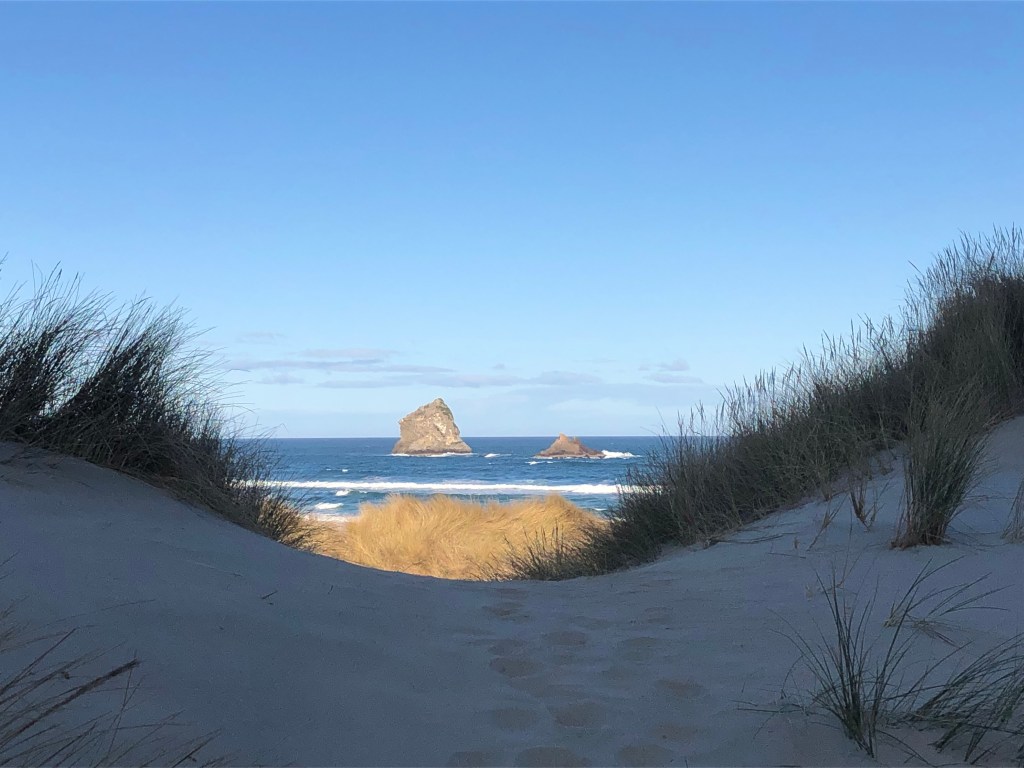
The camp was very close to both the US and British army and air force bases. Hence we were surrounded by soldiers, and pilots flying very close to our camp just to show off to the young Polish women, I am sure. They were very good to us, especially the US guys. Their smart uniforms were made of a lovely soft khaki material and they looked very swish. The Brits uniforms were khaki as well but they looked starchy. They wore shorts. We were in the tropics after all! A few of the Yanks had Polish names, and there was a young black guy whose name was … Kwiatkowski.

The army guys and women loved us as they missed their families so much. Once again we entertained them with songs and dances in their canteens. At Christmas we were invited to their camps and each kid was given a toy, and that is where my talking doll ‘Elzunia’ came from. She was made in Canada and used to cry and say ‘mama’ when you squeezed her. Her eyes moved as well. She was the size of a 3-month old baby. Her torso was soft but her hands, feet and head were made of a sort of porcelain. Elzunia had a sad end at Clifton Street when Bo dropped her.

People got malaria and some other tropical diseases. My mum had headaches often. We received pretty strong anti-malaria medication as well as inoculations for a million diseases like cholera, yellow fever, typhoid and so on. In Poland all kids got smallpox inoculation soon after birth. Antibiotics were available as was nylon. My auntie got some nylon from parachutes and she made us blouses but made a few mistakes at first as she ironed them and they melted of course.

1943-1948

Karachi was just a transit camp too, so we found ourselves transported to a permanent one in Valivade in southern India, again hundreds of kilometres ending up well south of Bombay. I remember when we arrived in Bombay and had a bit of stopover time. We saw it at night, all lit up as we travelled along the bay, and it looked absolutely beautiful. This time our journey was overland by train and took several days. We stopped at Pune one of the busiest railway stations in the world then. Finally we boarded a local train and went down to Kolhapur and from there to Valivade about 15 kms away.

Our settlement here was built for us, brand new, and was absolutely fantastic. We had long barracks divided into apartments of 3 rooms and a kitchen, there was a verandah and a garden with banana and papaya trees. The  communal bathrooms and loos were a walk away but it was okay because the place was well lit up at night. We were so happy as it was much nicer and more comfortable than where we lived at Karachi.

My mum taught at the school next to our ‘apartment’ and I went to school there. My brother was already going to high school. The settlement was very well designed into ‘suburbs’ and we were close to the church and a hall on the hill where we had theatre, plays and films, most of them in English. English was our second language at school, sort of, with teachers knowing the language but pronouncing it in a Polish way and, as you can imagine, our English was not very good. There were trade and other schools for the older students. Education has always been highly valued by Poles and there was education for children and young people wherever we went.

There was also the town square where speakers announced the news, both local and world. So we were well informed about current affairs, with the main interest of course being in what was happening with the war. We had access to Free Europe Radio but we also had Polish newspapers delivered to us just a few days after they were published in London. It was then news about Katyn started filtering through. We had been notified that our father was ‘missing in action’, but names started coming as well.

The doctors and dentists lived the ‘high life’, that is they had electricity in posh houses. We didn’t, using these huge gas lamps for study, for Ciocia to sew and for my mother to prepare lessons sitting round our huge table. We had Xmas and other parties with yummy food.

Polish refugees at a Polish Refugee camp in India enjoying a Christmas party with a Maharaja.

There was no running water but Indian ladies brought both milk and water every day in beautiful pots carried on their heads. They also did our laundry and cleaned and polished our mud floors with dried cow dung. This was perfectly fine and hygienic to use. It had been through a baking process and it did not smell. It sounds peculiar but I assure you it was fine. The Indian ladies would go along our streets and advertise in Polish ‘prac, mazac, mam’sia?’ — in other words ‘wash and polish (smear) the floors, madam?’

Indian people and Poles had shops well stocked with everything we needed. So apart from the tropical diseases like malaria, we were happy and pretty healthy. My mum and Janusz both got malaria badly, but Ciocia and I did not. We had constant jabs for things like cholera.

Something we loved was catching a horse carriage which would take us to Kolhbapur. Everyone, and there were about 5,000 of us (almost all Poles at this stage) who lived in Valivade, loved it.

We were better off than some of the village people but not rich and not in charge of our lives. Indian people liked us and, as you know, hated the English. There were many small revolts against the English government, but it all went very badly when Mahatma Ghandi, ‘the Great Soul’, who wanted a peaceful solution to the departure of the British was assassinated. It all went horrid. We cried along with the Indians but rejoiced with them when they got independence from Britain in 1947.

But it was not the golden solution as India was divided into two or three really with Muslims moving and moved to East and West Pakistan, leaving India for Hindus and Buddhists creating another dreadful and scary problem with a lot of violence.

1948-50

That meant our idyllic camp had to close. We had an opportunity at that time to go to England which my mother would have liked. There was a Polish soldier with exactly the same name as my father who we could have gone with, but we would have had to leave Ciocia behind as she was too old to meet the conditions for entry (over 40) and that was unthinkable.

We were transported to Africa, to what was then British East Africa and what is now Uganda, at that time a peaceful place. Once again we travelled by ship this time to Mombasa, then by train to Nairobi. From Nairobi we went to Koja, a camp south of Kampala on a promontory that went out into Lake Victoria, where there were already many Poles who had come directly to Africa. There were at least four other different camps in states like Tanzania (then Tanganyika) and Rhodesia (Zimbabwe).

For newsreel footage of Polish refugees in Africa, click here.

This camp was surrounded by African villages. We could hear the drums most nights and watched the smoke from their fires which might have been signals across the villages. The Africans were very friendly to us and we used to do trades with them for fresh fruit and vegetables with things that we had.

Africa was beautiful but the camp was so disappointing after Valivade even though the climate was much kinder than hot, monsoony India. We lived on the banks of Lake Victoria so we got this ‘cooling effect’ from the water.

Polish girls arriving at an African refugee camp.

We lived in huge mud houses, one for the family, once again with no electricity but they had very basic bathrooms and loos (a hole in the floor). I went to high school, Mum taught, Janusz was doing his HSC-Matriculation and Ciocia was running a restaurant for people who worked. We were well off as both women brought money into the family. A local boy, ‘Guiseppe’, helped Ciocia in the kitchen.

Malaria and the deadly bilharzia from parasitic worms in fresh water were the two main diseases. We were not allowed to swim in the lake which was full of crocs and hippos, but we used to go and get water lilies which were beautiful.

There was an English priest there who took it on himself to learn Polish so he could talk to us. He used to run all sorts of activities for us, like scouts and excursions around the place. He was a good man who was very nice to us.

We did some travelling. We went to Entebee not far from the beginnings of the Nile and where there was an airport. We also took a trip to Murchison Falls and had other excursions into the jungle.

We all dreamed of going to Poland after the war but Mum said no as it was run by communist government and we knew by then that we had lost our father. So there really was not much to go back to. Our Polesie had become ‘Belarus’ and the whole map of pre-war Poland had changed.

Trouble was beginning in Uganda. Violent uprisings were becoming more common and it was no longer a safe and happy place to live. We knew, again, that we would need to leave. In 1950 we heard that Australia was looking for white migrants like the Italians who lived in Africa, but heard they would take Poles as well. Mum thought it would be a place where her children could get educated and there were conditions on other places which made it difficult for Ciocia. Both age and health conditions had to be satisfied.

A train took us from the camp back to Mombasa, the port we would leave Africa from. This was a memorable trip through beautiful landscape and with any number of animals to see: giraffes, elephants, deer, all the things people go to Africa to see. Sometimes the train stopped to let us look more closely.

You can read more about the Poles in Africa here.

1950

We boarded an old American army ship, the ‘General Langfitt’, for the journey to Australia. That was where we found that our ‘Batory’ captain was second-in-command and where we reconnected with other Poles from Africa who hadn’t spent time in India, including Christofer Lancucki who had been in the same cattle wagon as us during our expulsion from Poland and whose family shared the same hut at Glubokoye ten years earlier.

After three weeks of a pretty awful sea voyage, in February 1950 we arrived in a very drab Fremantle, bereft of people and trees, such a different port to Mombasa, so colourless and boring. We were transported to Northam by buses and left in an disused Army Camp with corrugated iron barracks. Again we had no running water but we did have electricity. The barracks were divided by grey army blankets into ‘living spaces’ for women and children with boys over 16 settled in the Men’s Barracks. Janusz was now over 16 so he lived separately from us.

The Camp had people from various European countries: Hungarian, Czechs, Italians, even some Germans. We thought, where the hell did we arrive? The Australians in charge thought we all spoke German so announcements were made in German: ‘Achtung. Achtung’ … We thought, Christ what’s going on here?!

The food was mutton and other Ozzie delicacies. The communal barracks were hot; the loos and showers were miles away. We cooled water by filling canvas army bags and hanging them on tree branches. Ice cream would have melted by the time we brought it ‘home’. There was a Canteen where Saturday dances and other recreation activities were held.

English classes consisted of teaching songs like ‘Goodnight Irene’. We all had to laugh when a lady put her hand up and said in a sing-song Polish voice to the teacher, ‘Very sawrry/ but I have to go to larvva – tawry’.

My mum in her fashion, got bored and sick and tired of waiting, so she went to Perth to a CES office and said, ‘I want a job’. And she got one in Christ Church Grammar School as a House Mother looking after the boys who boarded there. I found my way to a Catholic Boarding School, Mum helped Ciocia to find a job and my brother made his way to Perth as well and got a job in a factory.

The beginnings were very hard indeed, a bit funny in a way, but even with our broken English somehow we managed.

Okay. I just had to write this down because we thought we were brought to a very peculiar country but we were happy as it was free, far away from Europe and wars.

  • * * * * * * *

The Katyn Massacre

The massacre at Katyn occurred in 1940 in a forest which is nearly exactly half way between Moscow and Minsk. It sets off and otherwise frames Sophie’s Story.

On 1 September 1939, the invasion of Poland by Nazi Germany began. The Soviet invasion of Poland began from the other direction on 17 September. The Red Army advanced quickly and met little resistance, as the Polish forces facing them were under orders not to engage. It was widely understood that the Russians were coming to help Poland resist the Nazi forces. However a pact, the Molotov-Ribbentrop Pact between the Nazis and Russians, had been agreed which among other things secretly provided for the (fourth) partition of Poland: half, more or less, to the Germans and half to the Russians. Somewhere between 250,000 and 450,000 Polish soldiers and policemen were captured and interned by the Soviet authorities. Some were freed or escaped quickly, but 125,000 were imprisoned in camps run by the Russian secret police, the NKVD. Many thousands of Polish civilians were also deported to the Soviet Union. The Polish Institute of National Remembrance estimates roughly 320,000. Other historians suggest two to three times that many.

Lavrenty Beria had turned the NKVD into a vehicle for establishing and maintaining a regime of terror to shore up Stalin’s authority, at the same time establishing his own form of control. Evidence suggests that even before the war had begun he had developed plans and made arrangements for the subjugation of conquered states, with Poland as the first target. His strategy was to execute the country’s core leadership.

The same strategy — in this case adopted by the Nazis — is described on the walls of the original concentration camp at Oswiecim, better known as Auschwitz. First the army officers, then municipal and other government officials, then educators and other professionals. Young people will be taught another language and enough maths only to work effectively in factories. Nothing else. I remember standing there reading it and being struck by the importance attached to education and educators … and the urgency attached to their destruction.

The document at left is Beria’s proposal to Stalin (with Stalin’s scrawled endorsement) to execute 25,700 Polish ‘nationalists and counterrevolutionaries’ kept at camps and prisons in occupied western Ukraine and Belarus. The Soviet leadership, and Stalin in particular, viewed the Polish prisoners as a ‘problem’ as they might organise resistance to Soviet rule. They decided the prisoners inside the ‘special camps’ were to be shot as ‘avowed enemies of Soviet authority’. This status was determined via intensive interrogation and the names of prisoners who showed signs of demurral were added to the list.

Those who died at Katyn included soldiers — half the Polish officer corps (including Tadeusz Kurzeja and Teofil Ney) — 200 pilots, a prince, major landowners, 20 university professors, 300 physicians, many hundreds of lawyers, engineers, and teachers, and more than 100 writers and journalists. For whatever reason 395 were saved.

The executions were carried out individually. The banality of the details of the process is among its most horrific aspect. It makes it real. The first transport carried 390 people but that was too many to execute overnight. Numbers were subsequently kept to 250 per night. The executions, a single shot to the back of the head, were carried out with German-made pistols supplied by Moscow because the alternative Russian weapons recoiled too violently. Shooting became painful after the first dozen executions. The chief executioner for the NKVD, Vasily Blohkin, is reported to have personally shot and killed 7,000 of the condemned over 28 days in April 1940. This information was drawn from a Belarussian participant decades later. He’d forgotten nothing.

Something so appalling was of course kept secret.

In a twist, in June 1941 the Polish Government-in-exile signed a treaty with Russia to pursue the war as allies against the Nazis (who has just invaded western Russia), with a Polish army to be formed in Russia. The Polish General undertaking this task sought to locate the missing officers. Stalin assured him that they had all been freed but that Russia had lost track of their whereabouts. They may have gone to Manchuria he surmised.

It was the Germans who made public the discovery of some of the Katyn graves containing ‘the remains of many thousands of Polish officers’. Goebbels used the find to try to drive a wedge between the two new allies. He wrote in his diary: ‘We are now using the discovery of 12,000 Polish officers, killed by the GPU (the Russian State Political Directorate), for anti-Bolshevik propaganda on a grand scale. We sent neutral journalists and Polish intellectuals to the spot where they were found. Their reports now reaching us from ahead are gruesome. The Führer has also given permission for us to hand out a drastic news item to the German press. I gave instructions to make the widest possible use of the propaganda material. We shall be able to live on it for a couple of weeks.’

The Russians immediately and vehemently denied any responsibility placing the blame on the ‘German hangmen’, taking it so seriously as to withdraw from the agreement with the Polish Government-in-exile accusing it, of all things, of collaboration with the Nazis.
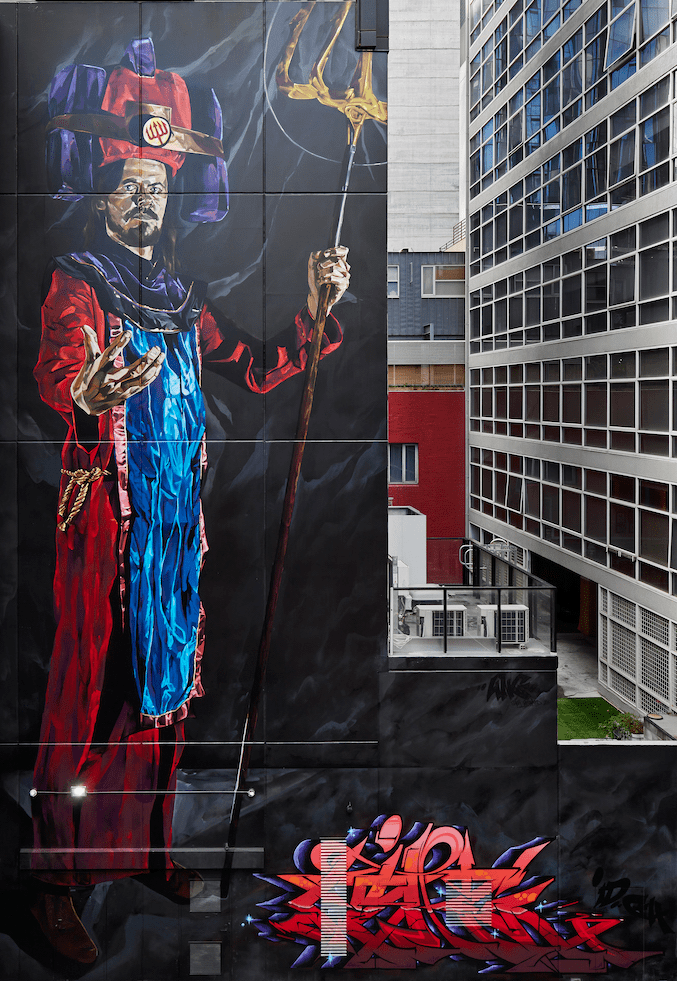
In 1943 during the course of the Nazi retreat, the Russians returned to this area. Part of Goebbels entry in his diary on 29 Sept 1943 reads: ‘Unfortunately we have had to give up Katyn. The Bolsheviks undoubtedly will soon “find” that we shot 12,000 Polish officers. That episode is one that is going to cause us quite a little trouble in the future.’ And so it proved. The Russians made every effort to destroy evidence (which included no documents found related to any period after 1940, the state of the deterioration of the bodies and so on) and to influence the international commissions investigating the massacre. Kim Philby appears to have blocked the information about it coming to the British Government from agents in Poland.

It wasn’t until almost 50 years later in 1989 that Soviet scholars confirmed that it was Beria and Stalin who had ordered the massacre. In 1990 Mikhail Gorbachev went public with the admission that the NKVD had executed the Poles and confirmed that there were two other burial sites similar to the site at Katyn. And yet today there are still countless documents including some which could finally confirm the identity of the dead which remain embargoed by the Russian Government.

Even after 80 years the memory of Katyn runs deep.

Part of the Katyn Memorial at Wroclaw.

Coronaviral days: The Houses of Fawkner

Howard Arkley (1993) Australian House, held by the Hamilton Art Gallery

ART TALK

From Crawford, A. and Ray, E., Spray: The Work of Howard Arkley, Craftsman House, Sydney, 1995, pp.88-89:

… Arkley’s homes are far from ironic – they appear as if painted by a proud owner. Yet, ironically, given Arkley’s engagement with feminism, it was the suburbs that feminists often accused of locking women into the subordinate role of home-maker. The movement which had motivated his earlier work could be seen in his celebration of the house, regarded throughout the modern era as a woman’s domain, far from the masculine world of work. Yet one could also contend that his emphasis on the suburban exterior reasserted a masculine image of the home for it was often a male responsibility to maintain the suburban façade, with its driveway, ornamental garden beds and neatly mown.

Regardless of these issues, the Australian dream is to own one’s own home, and here the ambition was writ large and loud as Arkley took the house as a commodity and rendered it as a marketable façade with a Pop aesthetic. This was a Pop sensibility attuned to the Antipodes and pulsing with knowing and self-awareness. Arkley knew his audience would recognise the message and identify with the dream of the house. His confidence was reflected in the stridency of the airbrushed panels, throbbing and resonating with a keen sense of an Australian aesthetic. When Arkley first showed his vibrant interpretations of this symbol, it was as if the penny had dropped not only for the artist but for the public. Pop had come to the Australian suburbs and the suburbs had come to Pop:

ARTIST TALK

‘What I am trying to do, I believe, is explicitly the right thing, and if it isn’t me, it will be someone else. It has to be done. And we’re not just talking about the work, but inspiring a whole generation of future artists to delve into this area and exploit it. It looks like an overstatement, like it’s obvious, and I would rather make subtler art, but I don’t think it will get across.

What I would actually like to do is equivalent to when you’re driving along in the country and you look at the landscape and you say ‘Oh, there’s a Fred Williams.’ You change the way people see it. And you can make people look at it. In the same way that David Hockney has changed the way people can look at Los Angeles, the swimming pools, Hollywood’s Mulholland Drive, good God, that could be Lower Templestowe Road! I just want people to see it.’

* * * * * * *

Fawkner is a child of the 60s. At the time, once you passed Mahoney’s Road you were on your way to Sydney. On the limit, crossing the boundary. It consisted of cheap housing, quite a lot of which was erected at the government’s behest set in rectangular and repetitive town planning punctuated with green bits left to memorialise Charles Mutton and Someone Evans, but raw and perturbing like all such sites.

Sixty years later the massive expanses of the Cemetery remain, dividing the world quite carefully by religious denomination (although ‘Baptist B’ is plumb next to ‘Chinese’). (Could it be that the journeys of the different sections have discrete features which can’t be shared, or even … that they arrive at different destinations in the after-life!?)

But it is the other side of Sydney Road which interests us on a warm sunny Coronavirus Sunday afternoon with the carwash closed and bowls and netball just off.

Mutton and Evans were replaced years ago by Martinelli and Evangelidis and their countrypersons from Greece and Italy.

But now, 60 years on, Fawkner is Turkish: a land of kebabs, gozleme, saksuka, pide, iskender, pilav, borek and lahmacan. And of hot cars, muscles bulging out of black T-shirts and, where the women are not veiled, dramatically glamorised femininity.

These are not Turks from the heights of Istanbul. They are more likely to be from places closer to Syria and Iran than the Bosphorus. What do they make of Fawkner with its shopping strip in Bonwick Street off Jukes Road? (Bonwick. Jukes. What?) What do you hold on to? And how do you respond to an urban setting 50 or 60 years old compared to one 1500 or far many more years old?

I suppose you first of all attend to the primary structural elements of life: food, shelter, family, soccer, and then over time turn your attention to embroidering them at will, perhaps pleased with the fact that you can do so much to mold things as you would like them to be, perhaps daunted by the scale of taking what you might think of as a wasteland and making it homely and to your taste. You look at the housing stock and you might just be grateful there is a roof to put over your family’s head. Or you might think how weird and alien is this? Why would they build houses like this and on these blocks that are all the same size? And so badly tuned to the climate? And separated from each other? In fact why is there all this focus on separation? Where do we sit and drink our coffee and smoke our cigarettes? Where is the market? Where is the sheesh palace? Where is my village?

Right here perhaps. Partly anyway.

I understand this as a major physical manifestation of culture, the filling out of detail in personal and civic preferences for the look and feel of buildings and their surrounds, how they operate, how they relate — a constant and unrelenting process of change and adjustment in the context of a constant and unrelenting process of preservational push back. But when it has been going for 60 years you must get a different result from an operation which is a millennium or more old.

The Turks are now giving Fawkner an identity. Opposite Mama Lordy’s pizza joint is a brand new and very stylish house clad in up-to-the minute corrugated iron which flies three Turkish flags. But I wander.

When the original housing stock of Fawkner was built it was pretty much of a piece: double-or single-fronted Howard Arkleys. It is gentrifying quite rapidly and so you get two-storey infill of brick veneer and Blueboard or tight little rows of units. Or, as you will see, someone’s wet dream in semi-rusticated concrete block. Or set off with palm trees. But it is also showing the distinctive character, and choices, of the people who live there, diversifying quite wildly. Perhaps especially in the relationship to the garden. And that draws us back closer to thinking about the Turks and the general question of how you might make a home and what such a thing might look like.

Because it is not a millennium that these houses have been here those choices are more visible. I find them intriguing. Let’s have a look at some of the ones I chose to take pics of as we walked (sometimes for rather obscure personal reasons like a concern with stormwater drainage).

And because whenever you go for a walk there is always something to look at, some surprise …

Not Turkish at all. Look you just never know what you’ll come across do you?

What would Howard make of all this? I think he’d probably love it.

I include the photo of this tree as a matter of self indulgence. (It’s not even in Fawkner. Fawkner begins on the other side of the road.) But every time I go past it — which is regularly, a daughter and family live 150m to the right — I think what a simply magnificent creature this is, and what a remarkable example of survival.

WET MOUNTAINS

During the last relief from being locked down we visited the mountains. Jessie and Myrna climbed up Mount Buffalo’s Big Walk on a cold day with, apart from a few brief breaks, a heavy dripping mist clamped down on everything.

We were sitting having a late lunch (provided by the estimable Support Team) and across towards the Gorge was the brief revelation pictured below. Drama.

It’s Jessie’s photo with her flash new phone. Superb.

From the other direction Crystal Brook was spilling over the Gorge to another version of itself several hundred metres below.

With the wrinkles and creases of its eddies, Crystal Brook drains Hospice Plain, sometimes under snow, more frequently under water but most often dry. This was an occasion.

Wet wet wet. Weather persons like to conjure up distress at the prospect of rain. ‘I’m sorry Pete. It’s going to be wet for the next few days.’ ‘But we can look forward to some better weather next week can’t we Jane.’ ‘Sure can Pete.’

From almost any point of view — almost, unless you’re a house painter for example — there’s nothing wrong with weather like this. We could start from the proposition that we couldn’t live without it and move from there. But stormy weather on a mountain is profoundly good for the soul as well.

It could be suggested that the aesthetics of these conditions might be best enjoyed from snug interiors with good windows. Like this one in fact.

Breakfast at Chestnut Tree Apartments looking towards, but not seeing, Bogong.

Or this one, with not one but two fires which we just happened to find in a shelter hut near the Chalet — a real surprise. Go Parks Victoria.

The view out its window.

Or even from the warmth of a car.

The slabs near Mackey’s Lookout, all slick with a centimetre or so of run-off.

But there’s nothing like being out in it.

Eurobin Creek near the entrance.
Not the weather, but the sort of thing you go to Mount Buff to see.

While the Support Team undertook rehabilitation at the Bright Gym next day, the Intrepid Adventurers went back up on the plateau for another long walk: Long Plain, Mount Dean, Dingo Dell, wet feet most of the way and a certain amount of snow and ice.

Another masterpiece from the new phone and its owner-manager.

Ice crystals in an old foot print.
The Horn (and peak) of the buffalo from near Cresta carpark.

And then on the way down it all cleared and suddenly there were the Buckland and Ovens Valleys in all their late afternoon shimmering splendour.

* * * * * * * *

Determined to make the most of the break in lockdowns we headed off to the Grampians almost as soon as we got home from the Alps.

Weather? Yes of course. Wet. In this case, standing on top of The Pinnacle after walking from The Sundial, majorly wet in driving sleet. (Hmm ‘majorly’. You can think about that. Is he just trying to keep up with the young people I wonder?) And very very cold — freezing — just there, a big wind chill factor.

But not wet all the time.

I have wondered about the tendency to look at rock formations and anthropomorphise them. (‘Anthropomorphism: the attribution of human traits, emotions, or intentions to non-human entities. It is considered to be an innate human tendency.’) This takes concrete form in the naming process, say as something domestic (The Flat Iron, The Cool Chamber) or otherwise familiar (Fallen Giant, The Alligator, Elephant’s Hide, The Grand Canyon). I’m sure that’s better than naming them after obscure — or famous — humans.

I have commented elsewhere about the tendency on Mount Buff to name everything: The Sarcophagus, The Piano, The Cathedral, the Monolith, Mahomet’s Tomb, Giant’s Causeway, The Leviathan, Whale Rock, The Sentinel, Og Gog and Magog etc etc etc. Perhaps not strictly anthropomorphism, but wandering round the ball park.

Maybe we need to do that, or maybe we used to, and, as nature has been experienced (and understood) at a rapidly increasing distance, that’s dropped off. I notice in the Grampians most of the signs that used to be attached to such formations have been taken away. Too cheesey perhaps? Too 1950s?

This cold day I found myself thinking whether formations like the one above have ever had a name, especially a Jardwadjali or Djab wurrung name? Perhaps they are too common in the Grampians to matter in that way. Perhaps only the really remarkable sites/ features/ spectacles (of which there are more than ample) received that sort of attention.

Just going on a bit randomly, if I call this a bus stop, or a group of friends lining up for a mass selfie, am I betraying something about myself? And should I quit right now?

Perhaps I should marvel from a more elevated non-verbal perspective. That’s probably right. So much thrilling to see everywhere you look.

Equilibrium.
Pink heath, Victoria’s floral emblem. Just thought I’d note that. Flowering unseasonally on a sheer rock face.
Anything Mount Buff can do the Sundial range can do just as well.

A lot of tracks become water courses after rain: they’re cleared, they’re often lower, they’ve often been chosen because they at are the bottom of two inclines. Or, in New Zealand, because you won’t care or notice the difference.

This is a track on the Tongariro plateau.

Even when they’re raised on rocky ribs like this one they hold water.

Another one of those formations … hmmm The Artichoke, The Bag of Lollies, The Hand Grenade, The Transplanted Hair, The …

* * * * * * * *

The average annual rainfall on the eastern side of the Grampians is double that on the west. The next day we were thinking of a walk with Robert near where we were in the central Grampians. But the weather looked shocking, enough even to turn us back and barely worth a 90-minute drive from Horsham. However, he had an idea about a walk near Troopers Creek, and the further north we drove the more the weather improved. (‘Improved’. An unnecessary judgment right there.) The more the prospect of life-giving rain diminished. (Much better.) Can I say it turned out to be a lovely day? No I didn’t think so.

This track was a discovery: brand new and part of the very slowly evolving Grampians Peaks Walk, from Mt Zero, the northern tip, to Dunkeld in the south. There will be 100 km of new track as well as 60km of established trail and Parks Victoria thinks it will take 13 days.

The part of this track that Robert knew about, ‘Lower Waterfalls of Gar (Mt Difficult)’, had just been opened, brand new, and very carefully and thoroughly constructed: ‘Troopers Creek’ to Beehive Falls below Budjun Budjun (Briggs’ Bluff). ‘Troopers Creek’ has a very new and well appointed camp site now. I have thought, known really, that Troopers Creek is about 4 km south of this site and that the creek that runs through it is really Dead Bullock Creek, but this is more of that name quibbling business.

It did have waterfalls and they were wonderful, running enough to justify the naming process, and, to me, completely unknown. We didn’t do it all — it was a Sunday arvo stroll — but what we saw was compelling.

This rather ordinary photo was taken from the car as we headed down Roses Gap Rd towards Wartook. It all reminded me again of what I wrote about the Grampians in my remembrance of when we lived there.

Over Djibilara (Asses Ears) through Glenisla Crossing towards Billiwin at sunset from Reed Lookout.

Much of the Grampians out of the tourist swarm has a very particular and striking flavor. It resonates with something that is difficult to describe. It’s incredibly particulated but of a piece; it works; but it’s not you, or me anyway. Both fragile and resilient; scrubby but graceful; worn out but enduring; brimming with life but a lot of that life is crepuscular or nocturnal.

What a place. Really.