
Well some of them anyway.
The Cheese Scone
We have for some time now been concerned about the fate of New Zealand’s National Dish, the cheese scone. The Cheese Scone has been one of the drawcards which has brought us back so many times over 30 years. Like this …

… and this one isn’t even mine. I had to ask the woman sitting next to me if I could take a photo of hers because it was the last one available that day at Floriditis (Cuba St, Wellington; very reliable for a bit of something during the course of the day.)
It’s actually cheese and parsley but it’s got it all. Good size. The cheese garnish is browned. Excellent texture, quite open and fluffy, light, hasn’t been handled too much in the making, cut rather than hand-shaped. Prospectively lashings of butter. THAT is what we’re talking about. THAT.
Two years ago I expressed my concern in another blog about what I can only call the hipsterisation of the NZ bakery offering. There we were in C1, Christchurch’s Home of Cool, looking at a cabinet which included lamingtons w/- white chocolate, coconut and [I quote] ‘a hypodermic berry syringe’. Below the Banoffie Pies and the Custard Squares and to the right of the Caramel Walnut Brownies and the Marshmallow Caramel Slice were ‘Hemp Raw Balls, w/- walnuts, almonds, linseeds [sic], sunflower seeds, dates, apricots and prunes dipped in vegan chocolate (🤔), pumpkin seeds, cranberries and Kako Samoa.’ Good I’m sure, even remarkable, but NOT the cheese scone.
However, we think the cultural worm may have turned. It’s quite possible we were wrong in the first place and the locals were just hiding them from us. Graham and Barbara will remember that we took them on an excursion to find the best Cheese Scone in the North Island, and it was a task. We found some monsters, but size while useful is not everything. There was some suggestion that they were trying just too hard. But this investigation entailed effort. You should just be able to breeze into a coffee shop or a bakery — just anywhere really — and, bang, there they are, smiling up at you, fresh and inviting consumption.
Whether things have changed or whether it was just happenstance, we think things Cheese Scone-wise may be on the up, maybe scone-wise in general.
Here are some options, for example, lined up at The Record Keeper (and yes they sell records as well as sustenance) in Geraldine. [And a big Hi to Ricky and Marty.]
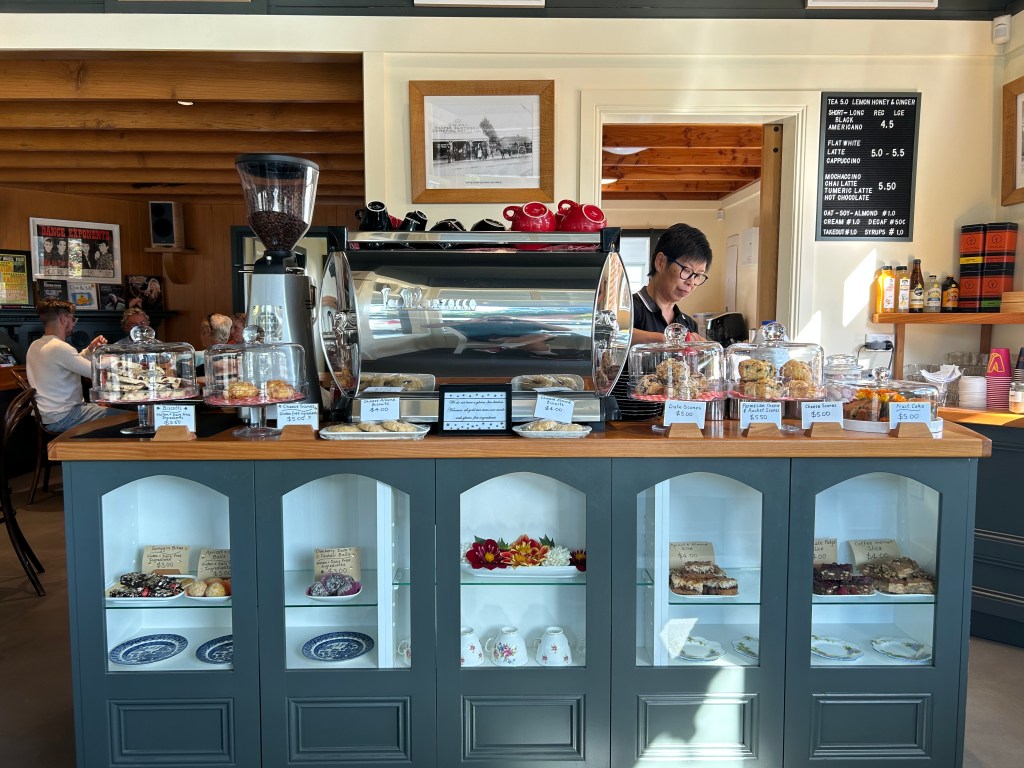
From the right: the parmesan cheese and rocket scone, the date scone, the Cheese Scone. Exemplary.
But this must become a story of a return visit to Union Co. of Port Chalmers, a cute — can I say ‘cute’, well… about anything really in NZ? In context it sounds like an aspersion is being cast and that’s my furtherest intention. I withdraw. Port Chalmers, a picturesque ville 14 kms along the side of the Otago Harbour from Dunedin where things are unloaded from ships and moved and stored with a tidiness bordering on the anally retentive.

This is some of Port Chalmers. Find the roundabout with the big white building. (Activities are built into this blog. Also explore: ‘historic’, ‘library’, ‘formerly Town Hall’.) Diagonally opposite is a red roof and just to its left is a reddish triangle. Its triangular shape is just one of the endearing features of the Union Co. (Espresso and Baked Goods).
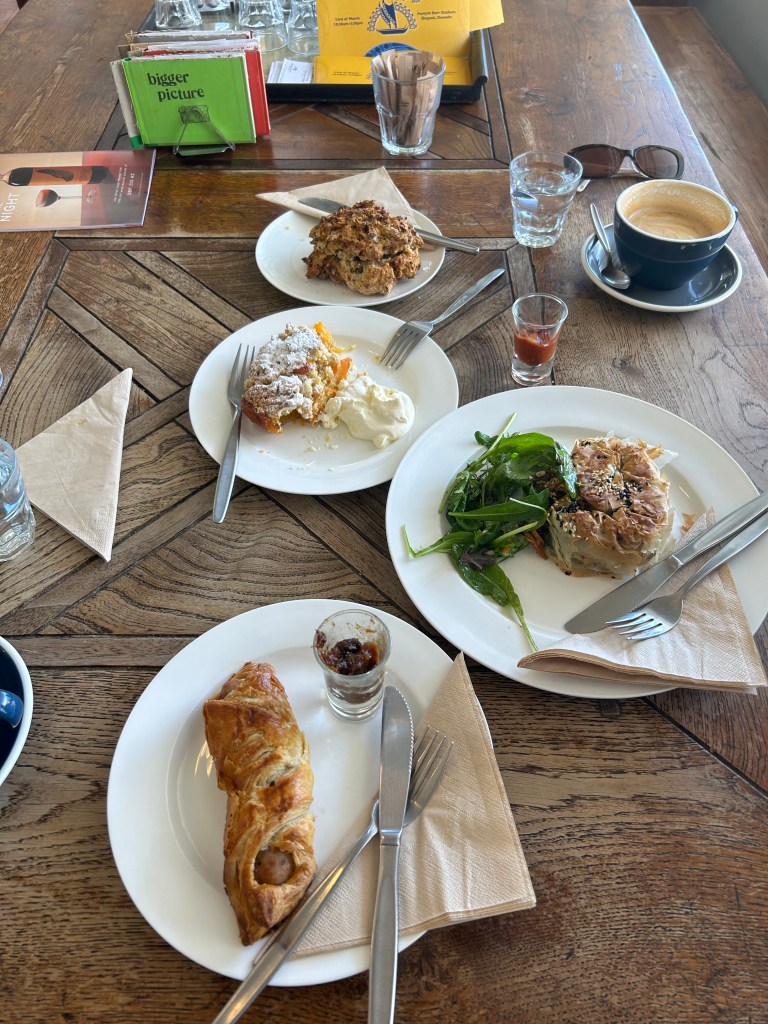
Look at this for a spread. From the top: the Date Scone, warmed sliced buttered; then I’ve forgotten how it was named here [revision 17/4, with the help of Pete Cole, the baker. It is an apricot fruit slice with what were probably Moorpark apricots. They usually get their fruit from the Dunedin Farmers’ Market]; spinach and fetta roll w/- leaf salad; and the Pièce De Résistance, a sausage roll which is a (delicious) sausage wrapped in a roll of pastry, served w/- homemade chutney, that is to say — an actual SAUSAGE ROLL. How elemental. How fundamental.
They also serve a very fine version of The Cheese Scone.
It’s a destination not a cafe. Michelin has no award sufficient.
* * * * * * *
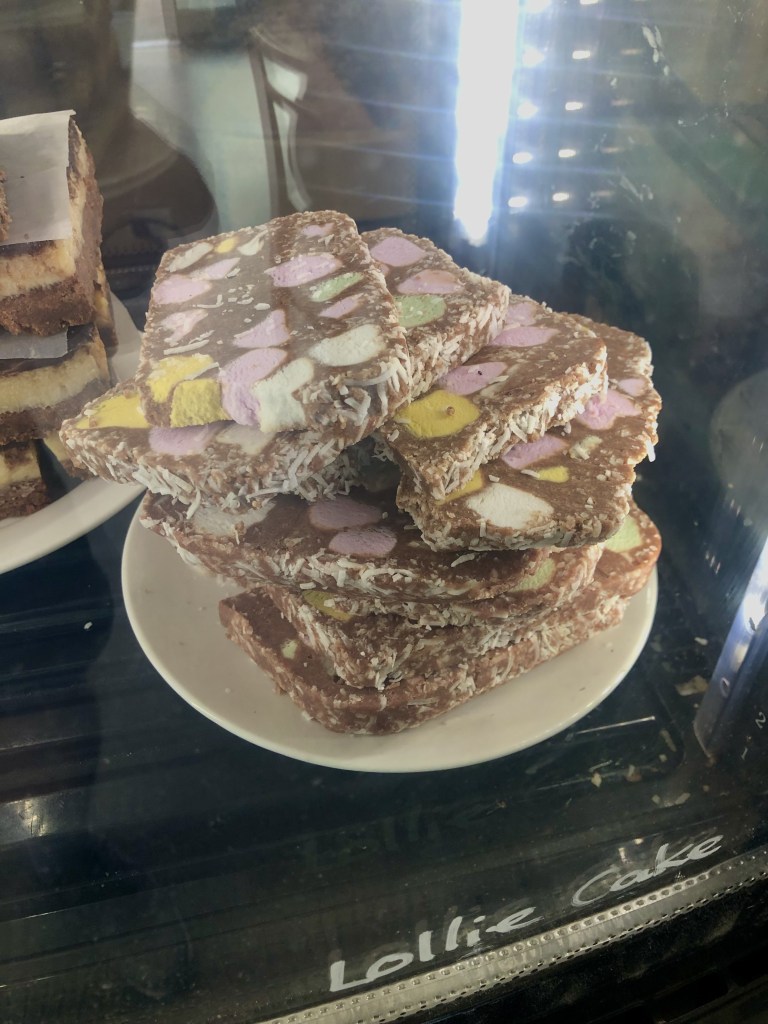
Elsewhere. … Just say no.
‘Bench with a great view’
As long as you like hills, Dunedin is a great place for walks. (It still has the Guinness record for the steepest street in the world.**)
We have a favourite which includes a climb up to Royal Terrace for a tour of the grand houses (see eg at right) and subsequent immersion in the deep greenery of the Town Belt.
In the course of this process recently, something new caught our eye.

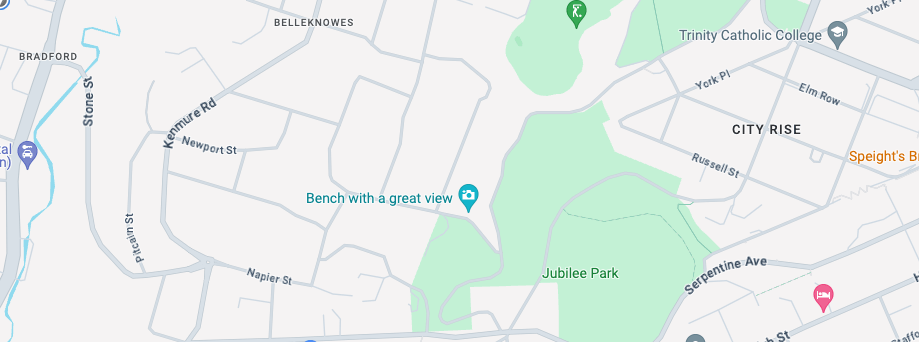
On Google Maps: you can see the degree of magnification, quite low. Not down to blocks and street numbers. ‘Bench with a great view’! Unusual, possibly — who could say? — unique. Or … a deadpan Kiwi joke? That would make sense.

This is the bench.
This is the view.
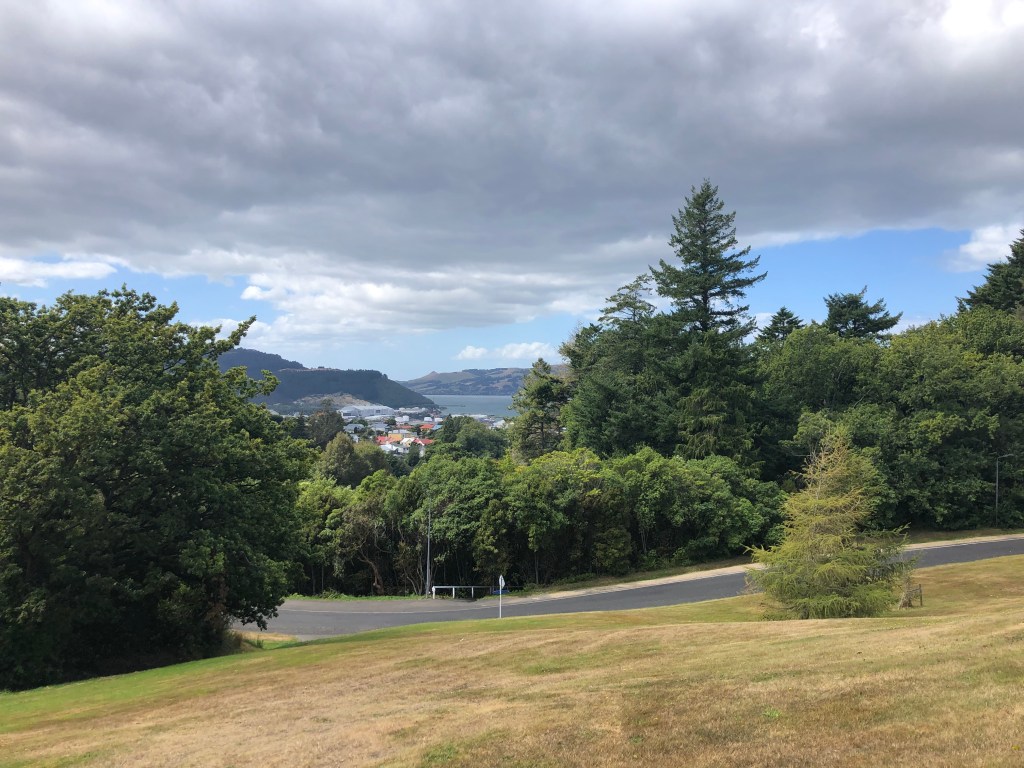
Mmm … yeah. Well not really. Not in this context. Not in this hyper-competitive field. I’m leaning towards the joke.
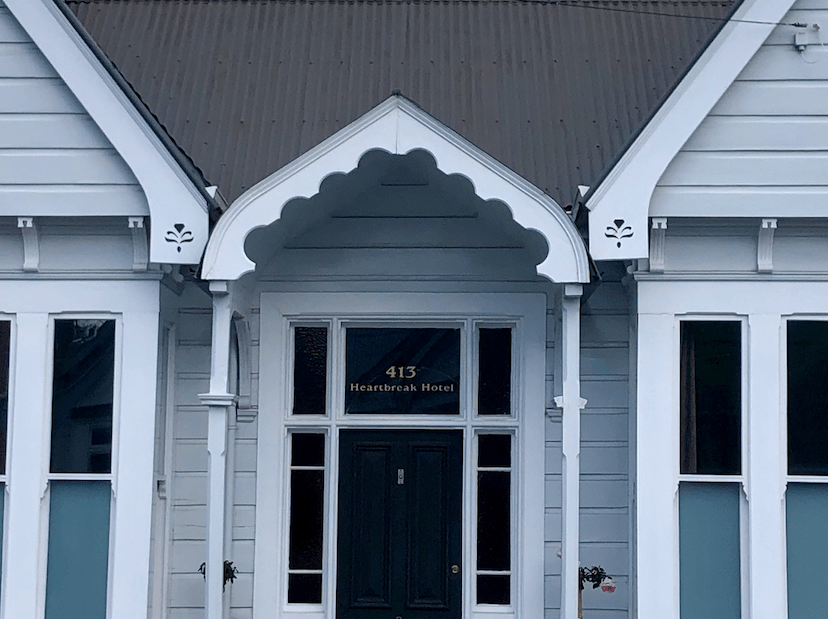
Same walk, later. B. Findlay correctly identified this as being down the end of Lonely Street.
[** Footnote: Baldwin Street, 1: 2.86. A town in Wales laid claim to the title in 2019 but Dunedin courageously fought back. The decision to reinstate the previous record holder was reached in 2020 following the completion of an extensive review of an appeal brought by representatives of Baldwin Street.]
And just incidentally …

The backyard of Dunedin’s Otago Boys High. Just boys. Doing boy-type things. NZ stuck with gender-segregated secondary schools longer than Australia but now, of the country’s 2528 schools, 2410 are co-ed. Nonetheless those 108 segregated schools enrol 92,000 students. The substantial buildings? The splendid grounds? Dunedin was settled/ occupied by Scots who have long believed in a) well set up and lasting public buildings (preferably stone), and b) education. The city’s University of Otago was established in 1859, the first in the country, still with a strong reputation and a marked impact on the vitality of its host city.

This service may be of assistance to some readers.
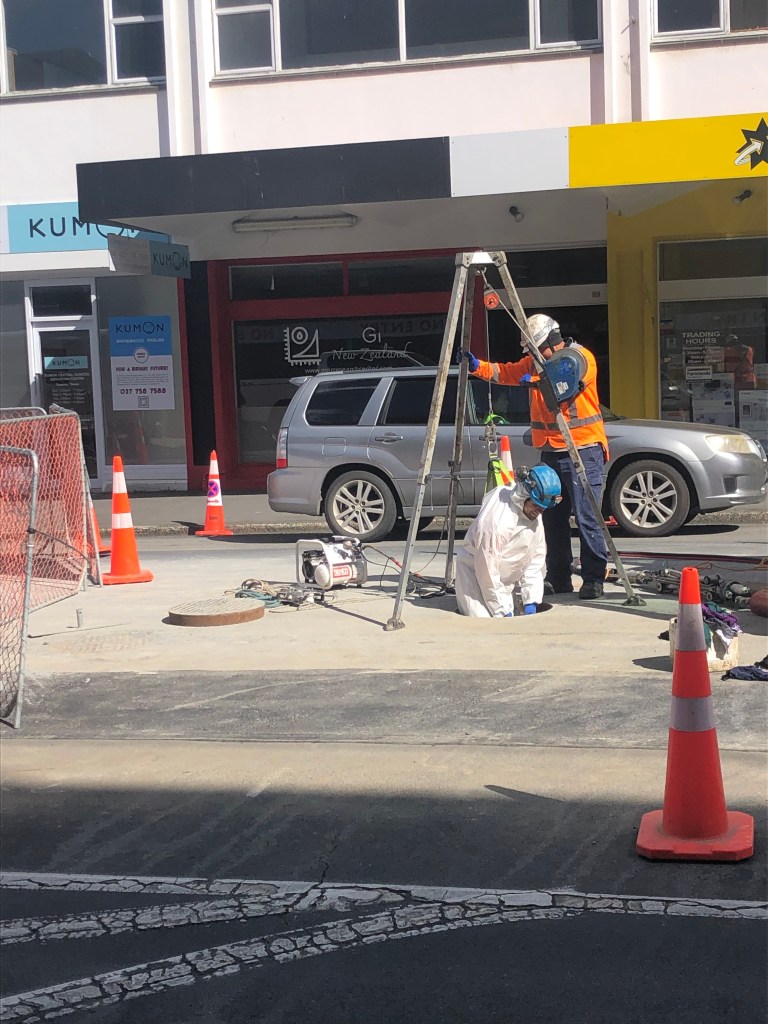
Dunedin again. George St, the main commercial street, is being pedestrianised? beautified? Tarted up anyway. But first they have to catch these creatures. I don’t know whether they cook them or what.
Christchurch: Recovering
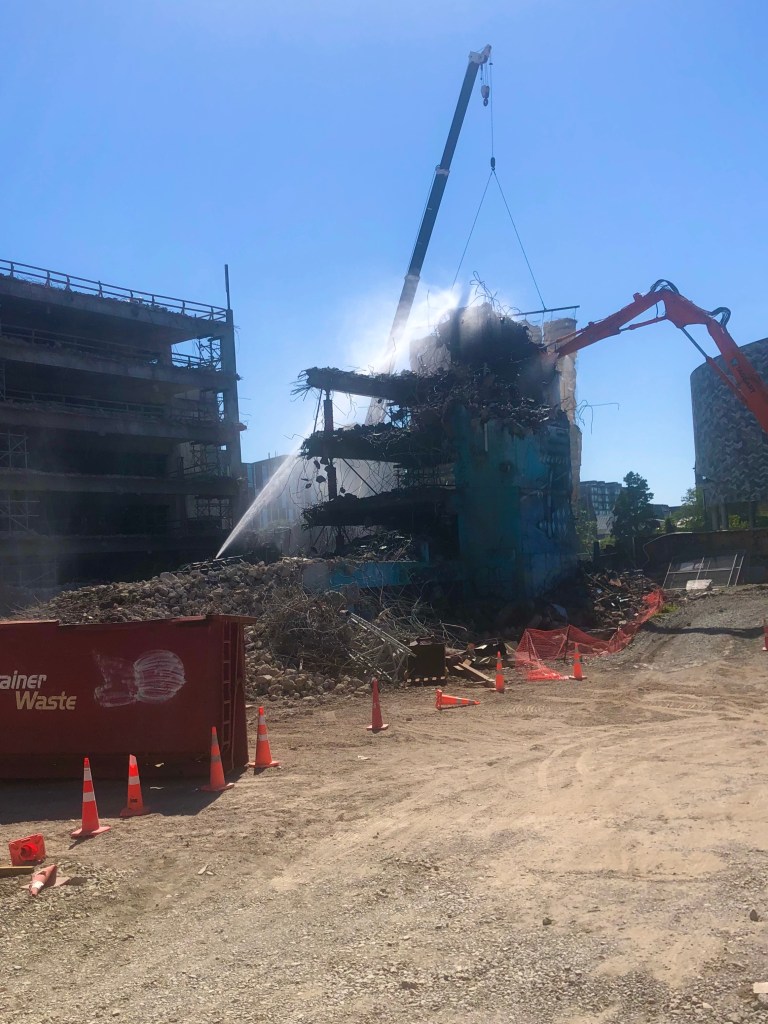
We have been following life in Christchurch since the devastating earthquakes of 2010 and 2011. (See here and here and here for example.) And, unsurprisingly, it has been a slow and difficult recovery. As indicated at left, buildings are still coming down. The distraction this time was bushfires, if not as we know them, brushfires maybe, in the Port Hills.
But the city itself seemed to have breathed a huge sigh of relief since our visit two years ago. It would certainly be that many of the ubiquitous building sites had finished their work. The center of the city looked a bit like that. The shipping container shopping centre has been moved on for example. And the tourists seem to have returned.
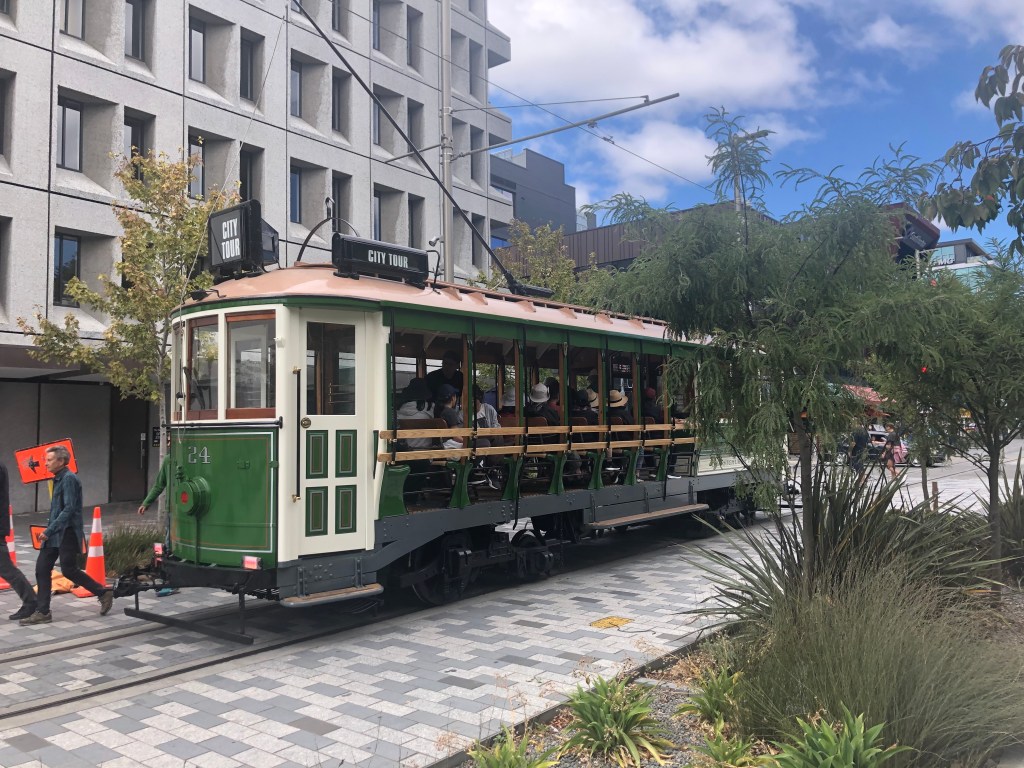
Only tourists would take the tram. But, route substantially extended; carriage full.

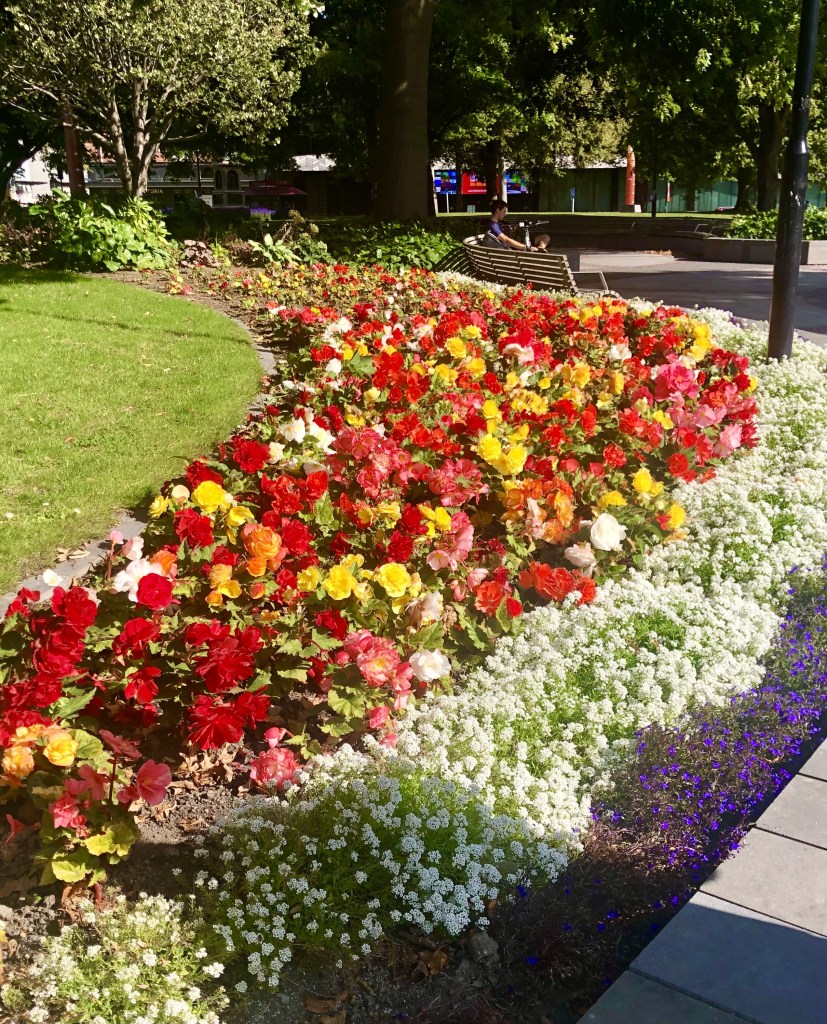


Taken from almost the same position in High Street outside the coffee palace C1: in 2008, 2012, 2024. The corgis — and the seat for that matter — have gone, but otherwise the restitution is near complete.


Captain Scott may have been tampered with but in quite a congenial and impermanent way.
We do repeat ourselves.


Major Hornbrook’s Track, Port Hills. 2022, and 2024. Drier. Warmer.
Attempts to take photos of NZ mountains
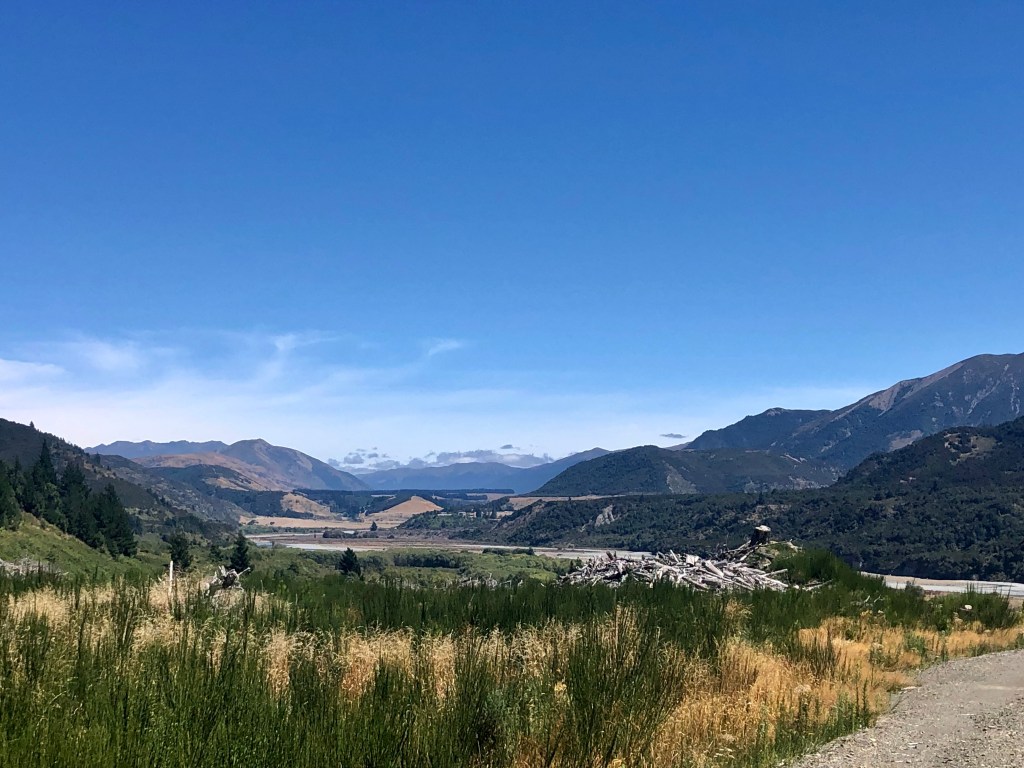

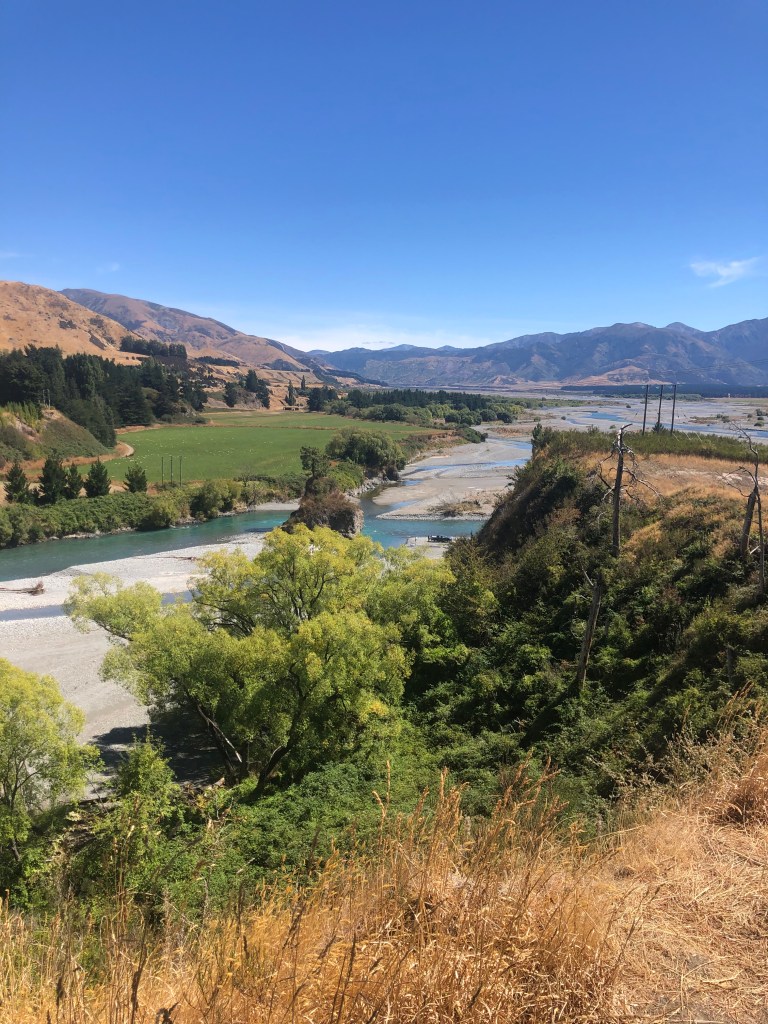


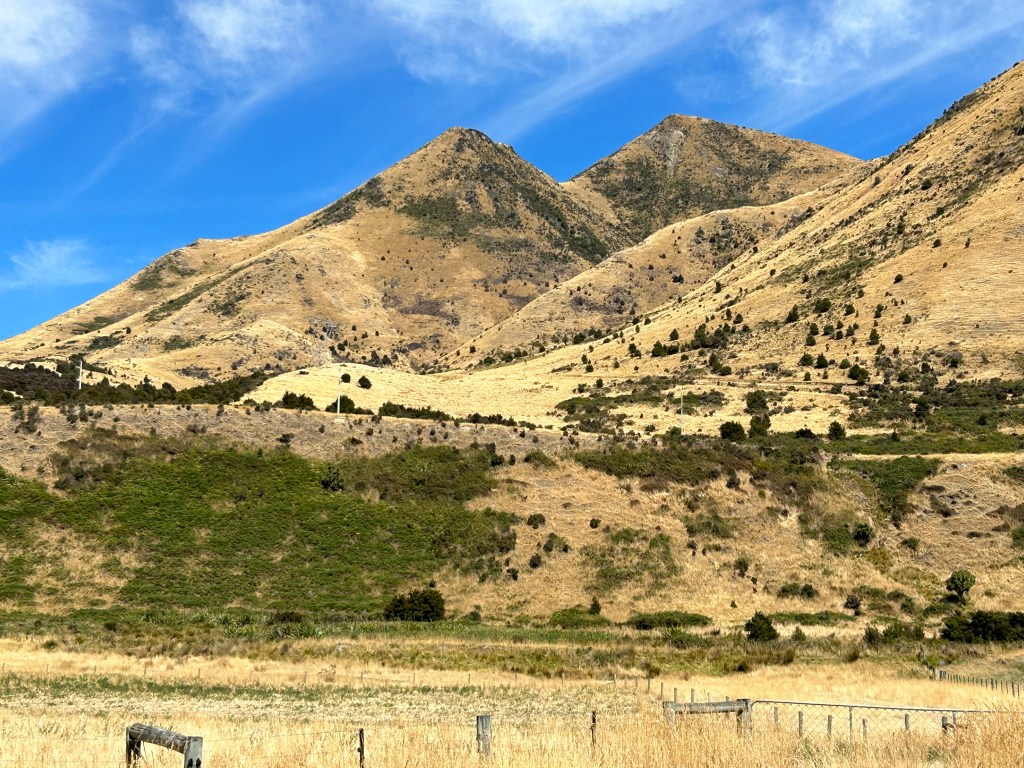

There’s a lot of art going on currently preparing for an exhibition later in the year. It has a vegetal theme. But it also needs backgrounds, mountains preferred. So we set to to take snaps of mountains and sort of kept failing. These all come from within 100kms of Waiau, an area which both has hills rather than mountains and was very very dry. The green bits you can see are either being irrigated or pine plantations. The Otago, the Canterbury Plain and Marlborough (especially) were in the grip of record-breaking droughts. We were going to climb Mount Isobel at Hanmer Springs but were prohibited from doing so because of the danger of fire. That’s different.
A Lloyd Rees Moment at Kaikoura
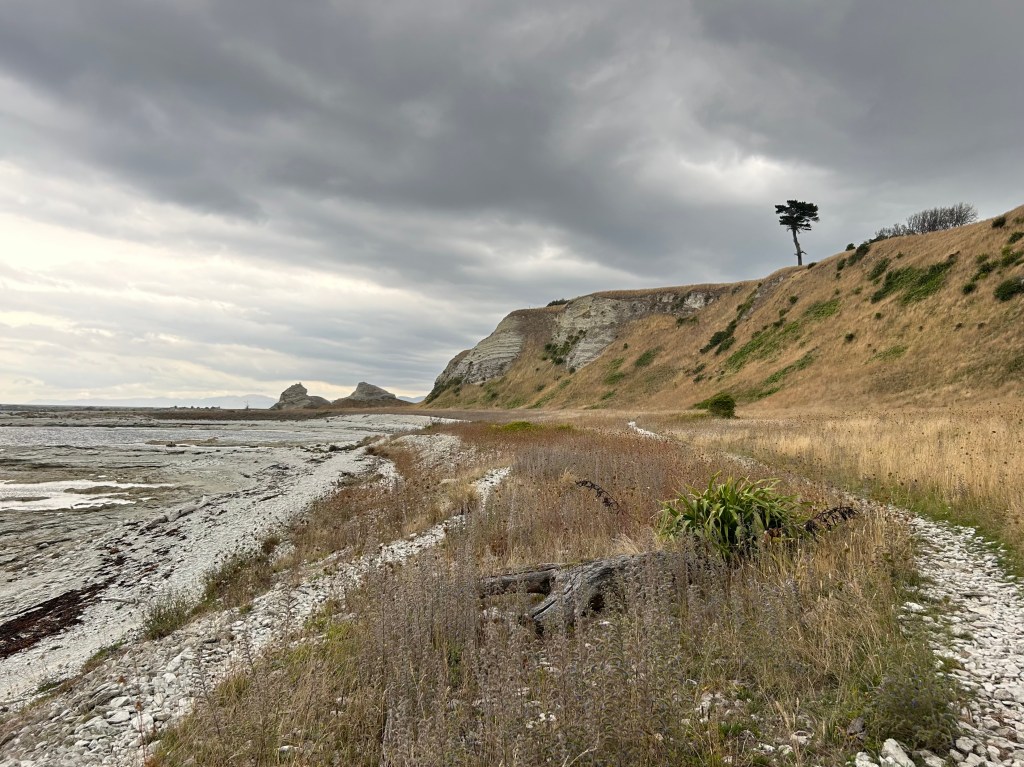
One of the pleasures of Kaikoura is this walk around the headland, past the seal colony and the lone pine, on towards the soft hills, each cape and bay with its own special nature.
I climbed up this lump and took the photo below of the next bay, and that’s what it looked like. At this point of the day, evening coming on, they are the colours with the big pads of limestone plumped up below the shallow pools and that interesting set of weedy browns and dark greens.


Lloyd Rees I thought. That’s it! That’s his landscape.
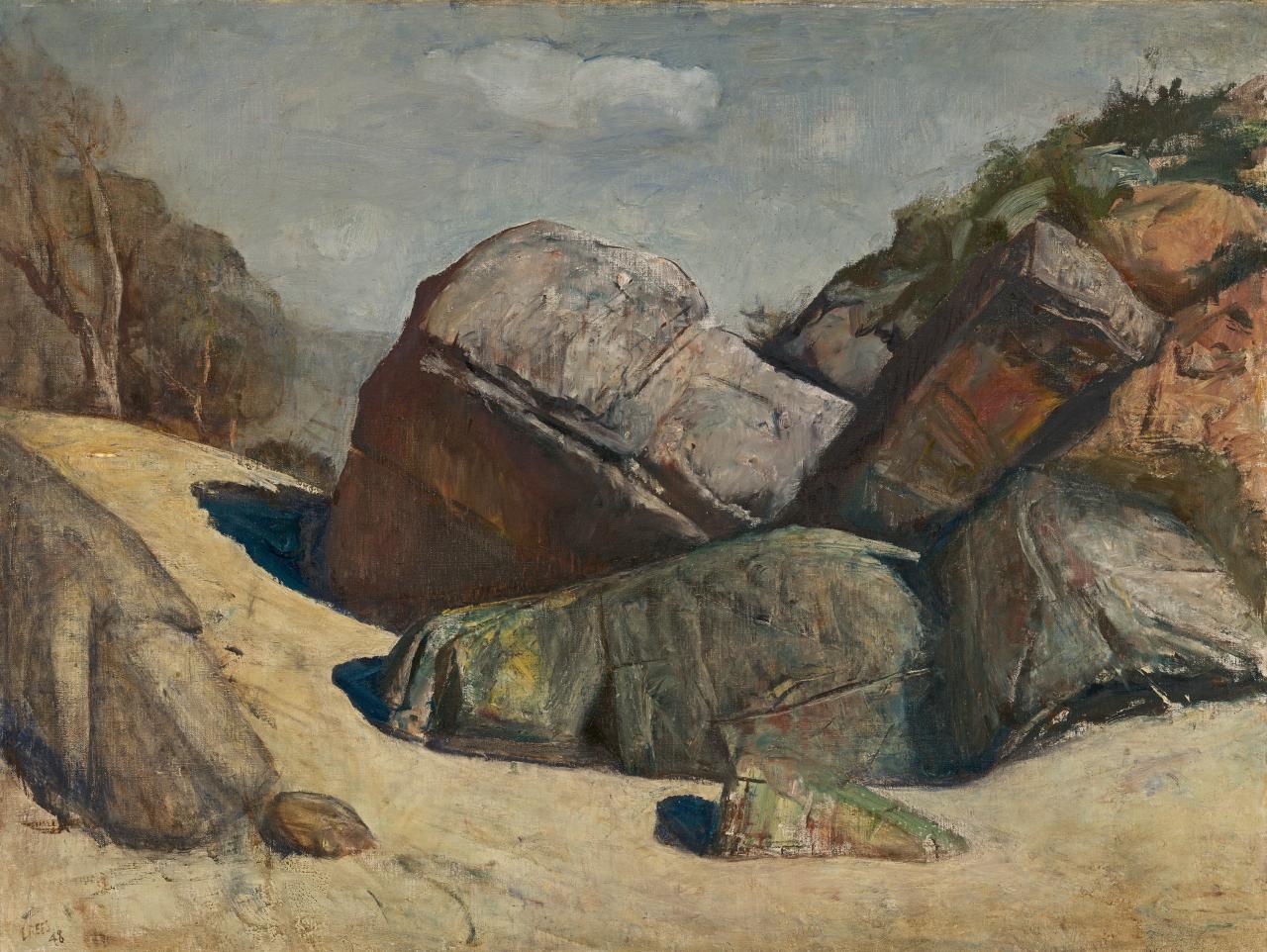


Above, we have left and clockwise, ‘Portrait of Some Rocks’, ‘The Road to Berry’ and ‘The Summit Mt Wellington’. A Lloyd Rees is always worth seeking out.

Pursuing the same colour palette, artiste enjoying landscape.
And just incidentally …

Whoooooosh. Yes. Right. Whoooooosh. What’s next?

The last time we took the waters at Hanmer Springs it was snowing. This time it was hovering round 30. Can I say, it is more pleasant lowering yourself into springs of about 38C when it’s very cold rather than when it is quite hot. However, excitingly, the centrifugal tog dryer was there … except that I now discover they can be found at select locations on the Australian mainland.

Earthquake-proofing Wellington
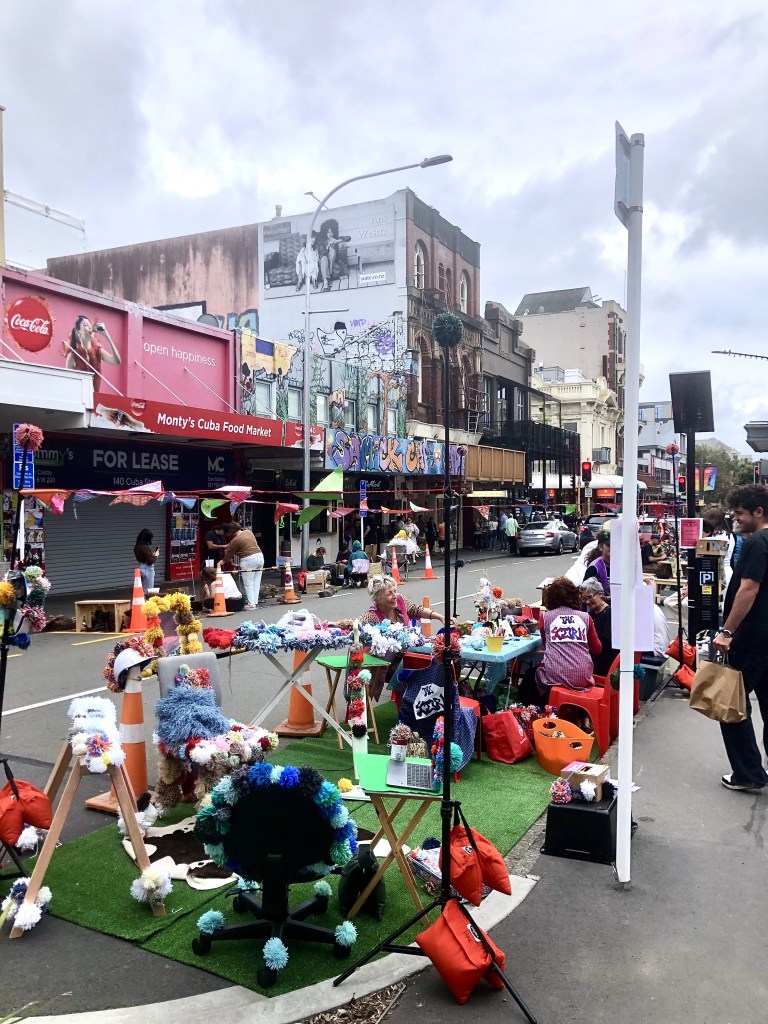
There was, as usual, plenty of life in Wellington’s streets. These folk were making pom-poms to give away and entertaining passers by with general good cheer. But you might note that Open Happiness Monty’s Cuba Food Market is For Lease. The streetscapes had far more black eyes and missing teeth than in the past. One major reason is the notice behind me. This one.


Prompted by the disaster in Christchurch and the major quake centred just out of Kaikoura (which had an impact on some Wellington buildings), in 2017 the NZ Government decided to review its requirements for earthquake-proofing buildings. For the first time, the new guidelines included buildings with pre-cast concrete floors in the ‘at risk’ category and significantly downgraded their rating. (Earthquakes don’t shake you up and down; they mostly shake you side to side, and that is what buildings need to resist. Flat and very heavy pre-cast concrete will wobble back and forth and then may, as happened in Christchurch, collapse.) The City Council estimates that there are 150 buildings in Wellington with pre-cast floors, including many government buildings and a number of new-ish hospitals just for example.

2019. The Wellington Public Library, ‘the city’s hub’, was the first building closed. Truckloads of books and artefacts were moved elsewhere. You can imagine the scale of the job. And this is how it looks today. Still shuttered and empty five years later.
Then came Wellington’s largest office building, the 17-storey Asteron Centre opposite the railway station. A new building assessment reduced its quake rating by more than two-thirds, prompting another scramble to leave by tenants. Next came the building where the 1000 Education Ministry staff were housed.
The Amora on the waterfront with a commanding view of the harbour from every room has also been closed for five years. It was once our hotel of choice. There are scores of other buildings in a similar state.

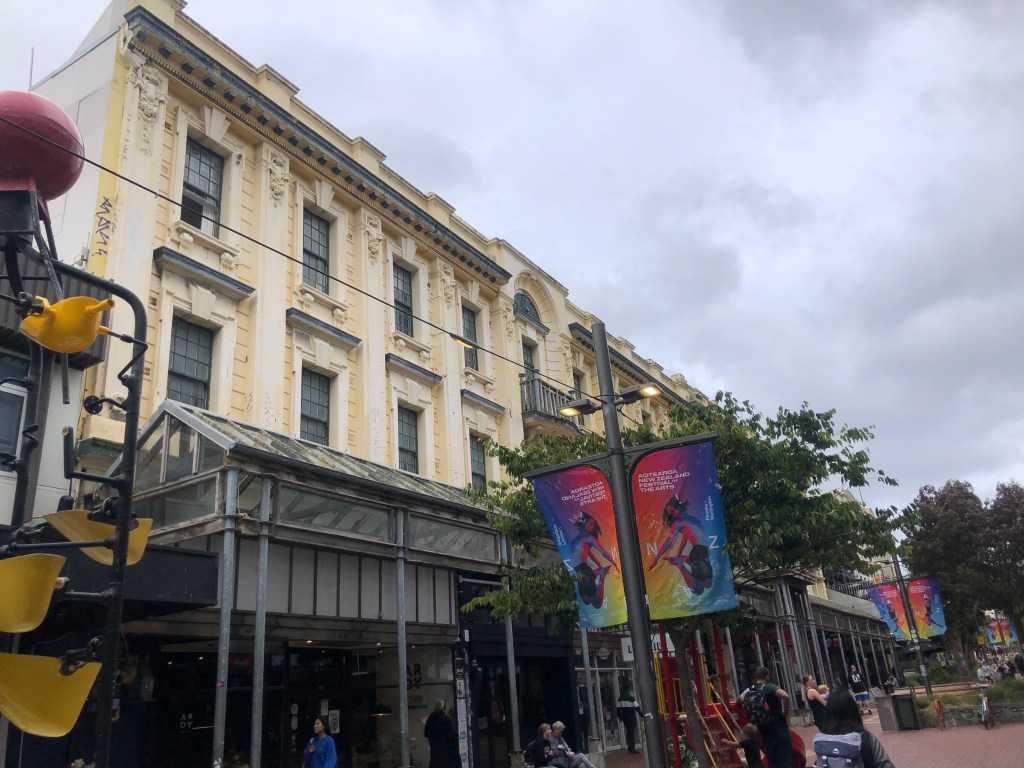
The notice above is on this building in Cuba St, heart of lively Wellington. It is immediately below another notice which indicates the building’s heritage status. Once the Wellington Workingmen’s Club, it turns out not to be one building but two, built in 1904 and 1908, the newer one including the baroque arch. I doubt that the millions required for earthquake-proofing will be spent here. Two ideas meeting uncomfortably. As a Councillor recently noted: ‘Heritage listings make buildings almost impossible to tear down, and also impossibly expensive to fix.’

Speaking of which, above is the Town Hall (100m down the street from the library) as it was when it opened in 1904, described by a local realist as ‘a stone and masonry building, on unstable reclaimed land, in a city built on a fault line’. Trouble, or what?
At right, decorated in scaffolding, is how it is today.
This has been going on since 1931 when the 50m clocktower and classically-derived portico were removed after earthquakes near Hawkes Bay. The decorative elements around the roof line were dispensed with in 1942 after further quakes in the Wairarapa.
A report commissioned 30 years later by the Historic Places Trust described it thus: ‘The building in its present state is of dubious merit both historically and architecturally. It has lost the greater part of its original Victorian swagger, pomposity, and grandeur, and become an ill-proportioned mockery of a classical work of architecture.’ No one but builders have been inside since 2013. The current revision, which includes earthquake-proofing will end up costing more than $300 million, a lot of NZ dollars, and an eleven-fold increase on the initial estimate.


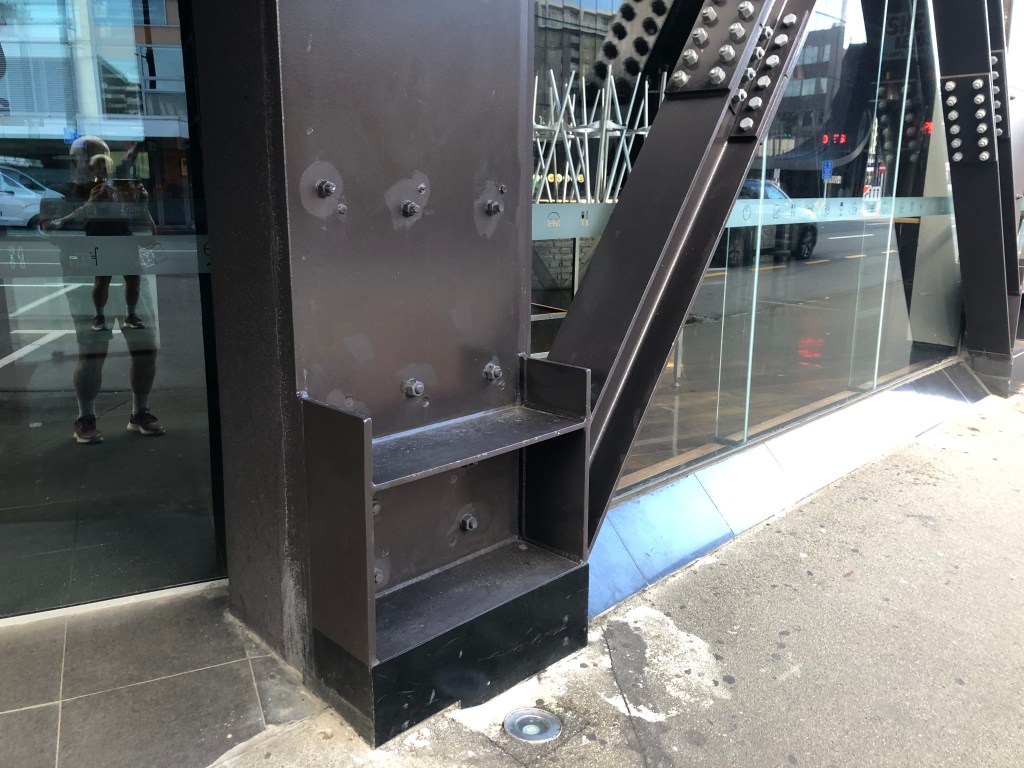
This is the sort of thing you have to do.
This building was over the road from our hotel which itself had new triangulating steel trusses in its corridors. But here they’ve chosen to do it to the front wall (that you can see, probably the other three exterior walls as well), that is to attach an entirely new superstructure of what I considered to be massive steel beams designed and fixed to avoid lateral stresses.
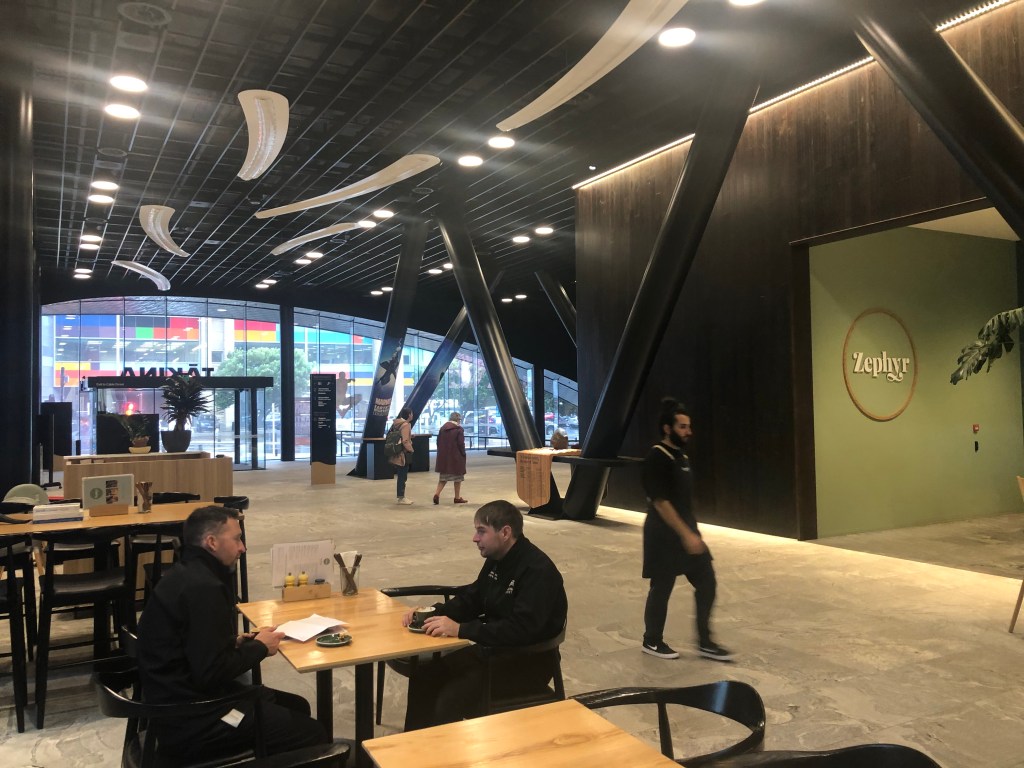
In new buildings like the near new Tãkina conference centre (next to our hotel and housing not much more presently than a Marvel comic exhibition and a coffee shop. (Cheese scones: 😕)) the triangulating reinforcement has been integrated into the initial design.
Understandably Mark Dunajtschik who built and developed the Asteron Centre is not pleased. He is quoted as saying, ‘Earthquake engineering is built on so much uncertainty that it makes weather forecasting look good’. He notes the plans for the revision to his building will cost more than the original design and many millions more to realise. ‘The chance of somebody getting killed on the way to this building is vastly greater than their chance of getting killed inside the building. Take the current risk aversion to its logical conclusion and Wellingtonians will soon be living in nuclear fallout shelters.’
Engineering New Zealand says the risk to occupants of a building which doesn’t meet the new requirements is 10 to 25 times that of an equivalent new building that just meets the code. The new building target is around 1 in 1,000,000 chance of death – about the same as a lightning strike. Now that’s risk averse.
Complex these things.
These changes have certainly knocked downtown Wellington around. But cheer up. You can still get meat on fries for $18 at the Cafe Laz.

* * * * * *
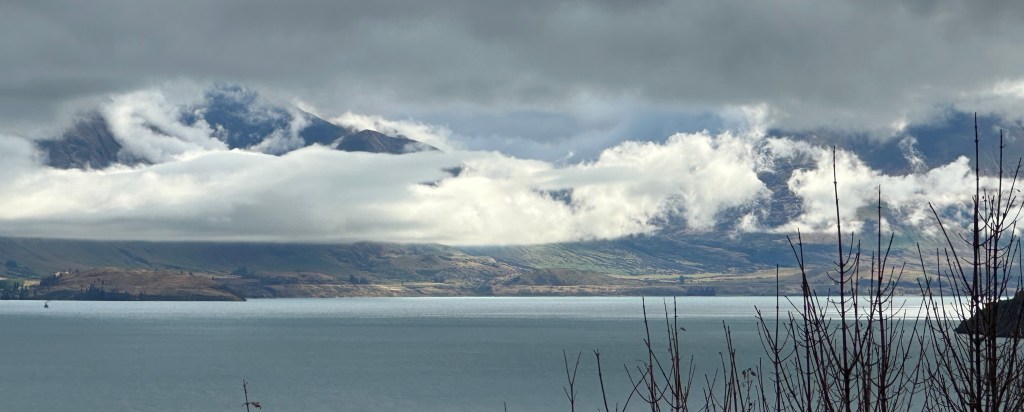
Always so much to enjoy in Aotearoa, the Land of the Long White Cloud.
 mcraeblog
Pingback: The Horizontal City (and other stories) | mcraeblog
I love the landscape photos, especially Kaikoura. I’ve always liked Lloyd Rees. The Kiwis are stoical folk, as are you two. It may be the Scottish element.
Ned