In early August 1945, atomic bombs were dropped first on Hiroshima and then three days later on Nagasaki. This is a precise replica of ‘Fat Man’, the second bomb. The dark colour is a compound designed to seal the seams of the outer shell.
There were several reasons why Nagasaki was included in the list of target cities. One was its location as a major port and as an industrial centre for Mitsubishi where ships, military equipment and armaments were produced, employing 90 percent of the city’s workforce. Another was, unlike most Japanese cities, it had suffered very little damage to this point in the war so it would be possible to quite precisely estimate the bomb’s impact. It could play its role in a scientific experiment.
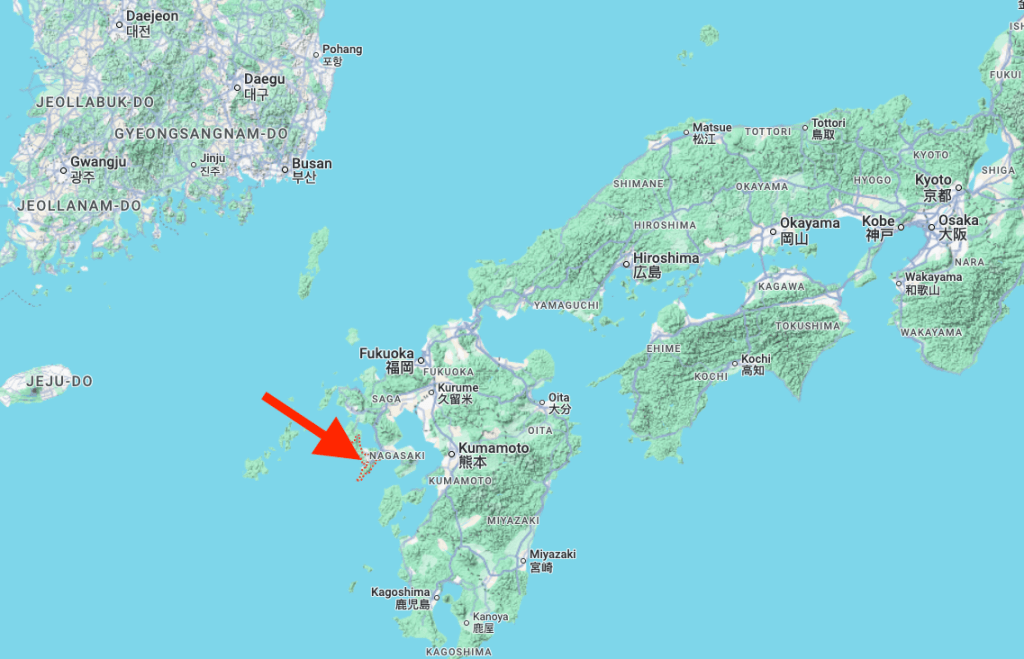
Kokura (in the upper red rectangle), on the other edge of Kyushu, was the initial target. But heavy cloud coupled with black smoke from burning coal tar lit precisely to obscure the site from enemy bombers meant there was limited capacity for visual identification. The plane carrying the bomb was handicapped by an inoperative fuel pump which meant there was no access to 2,400 litres of the petrol it was carrying. It flew on to Nagasaki where the same weather conditions prevailed but, just as returning to base became essential, there was an opening in the cloud, the weapon was armed, the electrical safety plugs were removed, the bomb doors released and Fat Man, one of three such, was dropped targeted on a tennis court in the mid-reaches of the Urakami valley four or five kilometres from the centre of town.
One presumes it hit the tennis court although the impact of the destabilisation of the 4.85 kilograms of plutonium it contained was felt equally at the two primary schools and cathedral close at hand. Two of the Mitsubishi plants were destroyed along with those working in them, who included 4,000 Korean slave labourers. One count has 39,000 dead immediately, then within 12 months perhaps 70,000.
It might be pointed out that in one night the fire bombing of Tokyo by the allies killed 135,000, and that that fire bombing continued over weeks. It might also be pointed out that Russia’s choice to enter this war was the most likely impetus for Japan to surrender.
Historian Martin Sherwin suggests that there is a consensus among students of this aspect of the war: ‘The [deployment of the] Nagasaki bomb was gratuitous at best and genocidal at worst’.
There are others who think that, regardless of the real reasons, the bombings in combination provided a suitable public scrim for the Japanese capitulation.
• • • • • • •
Of course being in Nagasaki we went to the Atomic Bomb Museum. Of course. There are things you must see there because, in the circumstances, they must be confronted.
The Hypocentre the day after the bombing. The blast was visible from the air 180 kms away. Although most things within a radius of 1.6 kms were completely destroyed (severe impact was noted 4-5 kms away), the stanchions holding up the wires for the electric trains are somehow standing; a factory’s chimneys remain upright in the background. A tumble of bloated bodies can be identified. But the really weird thing is that people are walking around with their clipboards having no idea of the continuing presence of danger. This is a bomb unlike others; there is so much of its impact you can’t see.
The bomb doors opened at precisely 11am.
At the same time one of the support aircraft dropped three packages of instruments designed to measure the bomb’s impact. Each package contained a letter to Professor Ryokichi Sagane, a physicist who had studied at Berkeley and had been a colleague of three of the scientists responsible for the development of the bomb. The letter urged him to tell the public about the danger of these weapons. They were found and passed to Sagane a month later.
I find that both strange and plangent. What is that? An attempt at expiation?
As indicated by the clock, the bomb exploded at 11.02.
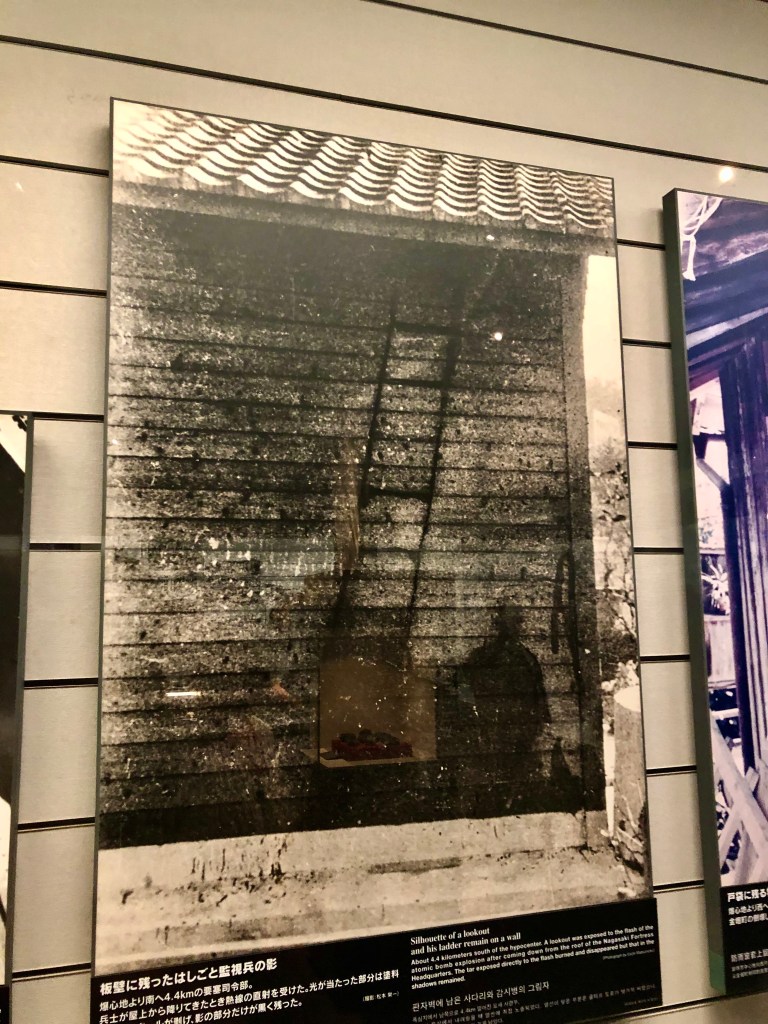
I had read about this at Hiroshima, but this seems like a definitive illustration. The bomb blast 4.4 kms away has disintegrated the watchman, who has just climbed down from the roof, and his ladder. But their ‘shadows’ are left.
These ‘objects’ have been between the bomb’s flash and the wall and have left their imprint not as flesh or substance but as something more akin to a photographic image.
These shadows along with victims moving with flesh dripping off them are two of the frequently commented phenomena associated with the bomb’s impact.
But how much better to have died like this rather than to have lingered on with radiation sickness for months, years — immobilised, suppurating wounds, ulcerated skin, constant diarrhoea and vomiting, permanent headaches.
• • • • • • •
I left moved, but not as much as I might have been and not, I think, in the direction intended. We had been to Hiroshima before and had had the very dramatic experience of listening face-to-face to the testimony of a survivor. ‘We left’, I concluded that blog, ‘chastened’. I didn’t feel chastened this time. The meaning had shifted focus.
It’s not even about ‘atomic bombs’ any more; it’s about ‘nuclear armaments’. Russia, the United States, the United Kingdom, France, China, India, Pakistan, Israel and North Korea possess over 12,000 nuclear weapons almost all of which are vastly more powerful than the bombs that were dropped in 1945. And when I say vastly more powerful, the Russians have tested ‘Tsar Bomba’ which was 4,200 times more powerful. Glass shattered in windows 780 kms distant as a result of its blast which was visibly evidenced more than 1000 kms away. All buildings in a town, Severny, 60 kms away were destroyed. Atmospheric changes were recorded in New Zealand.
Have we become inured to these issues, or do we manage them by ignoring them?
What was front of mind for me after the visit to the Museum was not the nuclear threat, but the increasing fecklessness of leaders oblivious to the medium and long term consequences of their actions and the cheapness of their motives. I was thinking of the results in Ukraine, the Sudan, Gaza, Lebanon and elsewhere. We can kill the leaders of Hezbollah with three American-made and -provided 8000lb bombs. Why worry about nuclear arms? We can revel in the impact of conventional weapons which have become so much more sophisticated and deadly what does ‘conventional’ even mean? Worrying about nuclear weapons suddenly seemed so very last century.
It might also be me getting older and suffering fatigue at the record of humanity’s infamies. But my worst suspicion is that we need another cataclysm, a catastrophe of the highest order, to revise this behaviour, to rekindle something like fellow feeling and civil behaviour on anything but a local level. The ‘rules-based order’ that emerged after the last world war — including the current ‘Rules of War’, the Geneva Convention for International Humanitarian Law, now broken casually and mendaciously daily — was born from a clear memory of its horrors and the equally clear realisation that no one wins a war. No one. There is no glory, no honour, no triumph in the consequences of fighting, not for the vanquished and not for the victors. Wars never leave resolution behind. The ‘lesson’ the enemy is taught is to hate their opponent, perhaps more covertly but with just as much passion. And the consequences, so widely visible today, are the collapse of empathy, of generosity of spirit, of curiosity about and tolerance of others.
‘Lest we forget’, we say every 25th of April. I’m afraid we’ve already forgotten.
• • • • • • •
In the documentary The Fog of War, former U.S. Secretary of Defense Robert McNamara recalls General Curtis LeMay, who relayed the Presidential order to drop nuclear bombs on Japan, saying: “‘If we’d lost the war, we’d all have been prosecuted as war criminals.” And I think he’s right. He, and I’d say I, were behaving as war criminals. LeMay recognized that what he was doing would be thought immoral if his side had lost. But what makes it immoral if you lose and not immoral if you win?’
In the woodcut above it is the Dutch flag flying over Dejima (‘exit island’), an artificial island barely attached to the city of Nagasaki which on completion in 1634 was about 120m long and 75m wide. That elegant curve was shaped by its junction with the Nakashima River at its outlet into Nagasaki Bay, a traditional landing place for ships. At the right hand end it has a sea gate. It is connected to the mainland by a modest bridge that had a guardhouse at each end.
Two years earlier the Tokugawa Shogunate required 25 local merchants to build the island as part of a project to curtail the spread of Christianity and what was seen as the predations of Portuguese merchants (and missionaries) while still enabling a trickle of bilateral trade. After some muscular diplomacy and an undertaking that there would be no dabbling in any sort of religion, the Dutch East India Company was chosen to be the responsible partner.
As well as the major staples of trade, Japan was introduced to beer, coffee, chocolate, sundials and astrolabes, tar-based paint to caulk ships, badminton, photography and many new foods including cabbage and tomatoes through the sea gate of Dejima.
For just over 200 years at any one time only about 40 people lived on the island, 15-20 of them Dutch half a world away from home, supervised by around 50 Japanese officials some of whom lived on the island which was also visited by cooks, carpenters, interpreters and other essential workers.
There were no Dutchwomen there. Yūjo (‘women of pleasure’) were included among the essential workers.
Kawahara Keiga documented life at Dejima in the early 19th century in hundreds of paintings of which this is one.
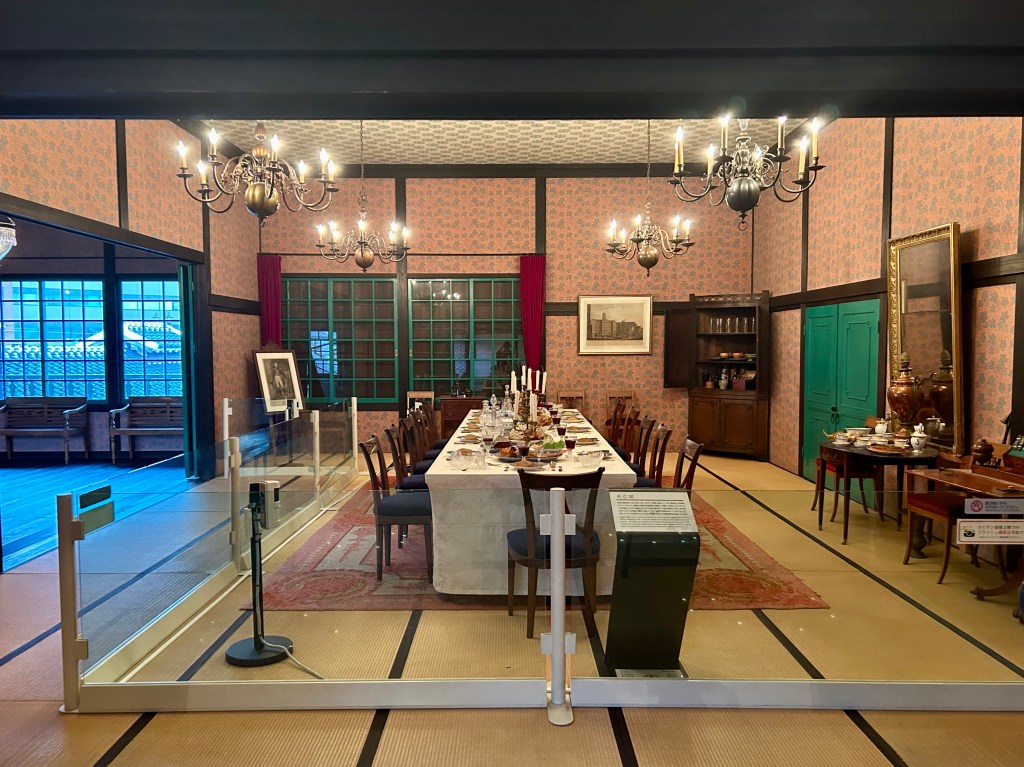
The Dutch officers could, and did, eat right here most nights.
Once a year only they left the island to go to Edo (Tokyo) to pay tribute to the Emperor, of the material as well as ceremonial kind. To glam these annual events up the Dutch sometimes included exotic animals: an elephant, a cassowary, a leopard, and on one occasion a camel.
Dutch East India trading ships would visit — on average, it did vary — just twice a year in May and June, the season of favourable winds. During the years Napoleon controlled the Netherlands no ships came. For Hendrik Doeff, the Chief Factor during this period who ended up living on Dejima for 17 years, this must have been an existential puzzle. (From his log: ‘Nobody who is not here in person can imagine our state of mind. Separated from all community, attached to a place which is never visited let alone passed by ships, not knowing, not hearing, not there, in the whole other world going on outside.’)
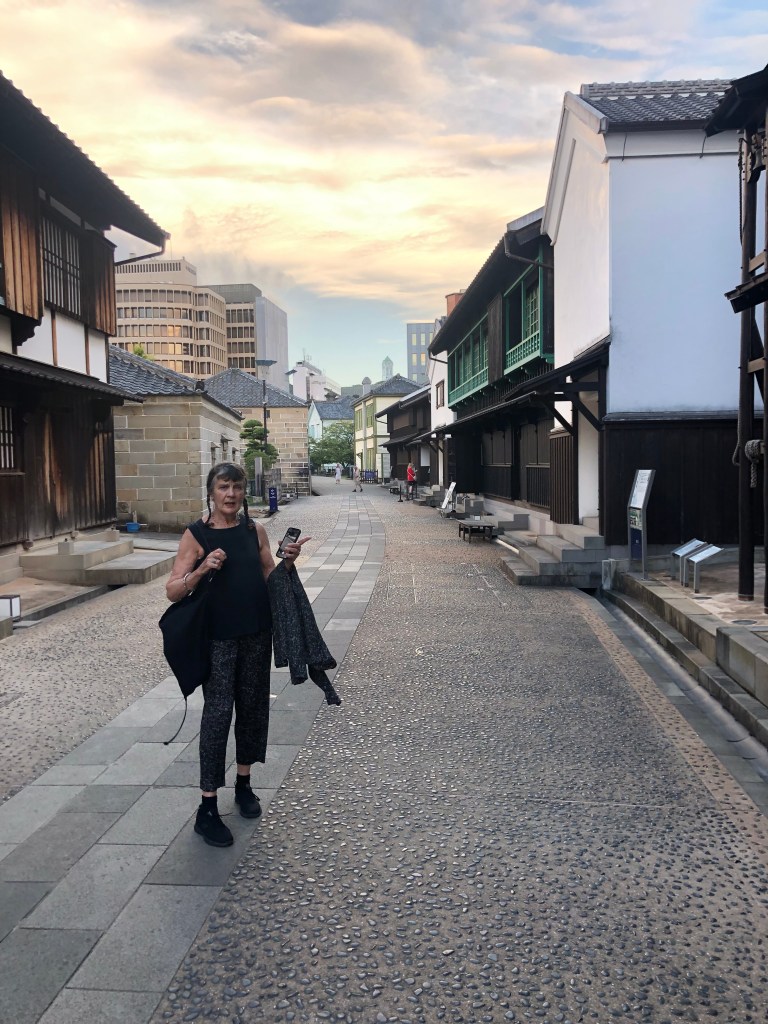
Dejima is now embedded in city buildings and surrounded by office blocks and shops with a strip of restaurants calling themselves ‘Dejima Wharf’ between the island and the bay. 18m was carved off the inner curve in 1888 as part of a diversion of the River. Today, from one angle, it looks like this.
From another, like this.
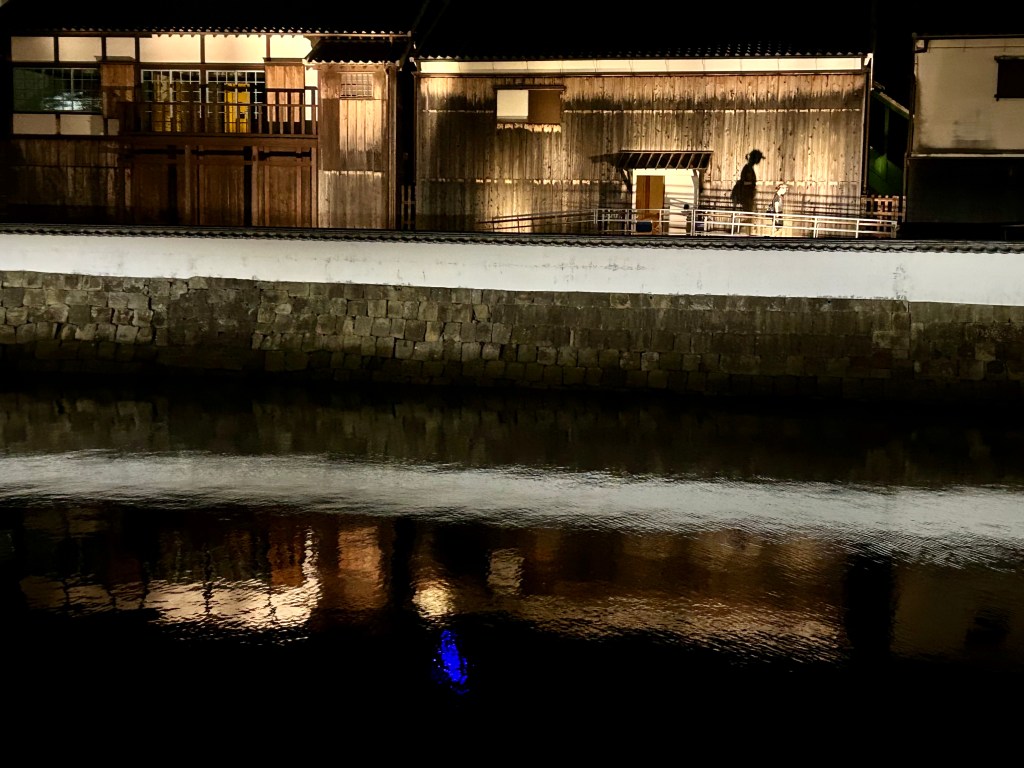
And this, I think, is my favourite photo from our trip. Taken by Myrna. It is a shadow as well as a figure against one of the Dejima warehouses. And I don’t know where the blue flash came from, but there it is.
• • • • • • • •
Dejima is a fertile place to start talking about Nagasaki, a city full of important stories and a great place to visit. Known largely in the west as one of the sites for exploding an atomic bomb, it is so very much more.
The city streams, long and narrow, down the valley of the Urakami river. Its population today is about 430,000, not big for a Japanese city. It was about 240,000 in 1945 when the bomb was dropped. It has a substantial and sheltered deep water harbour with industry at various scale lining its western banks. (Massive ship yards with a giant gantry on the left.)
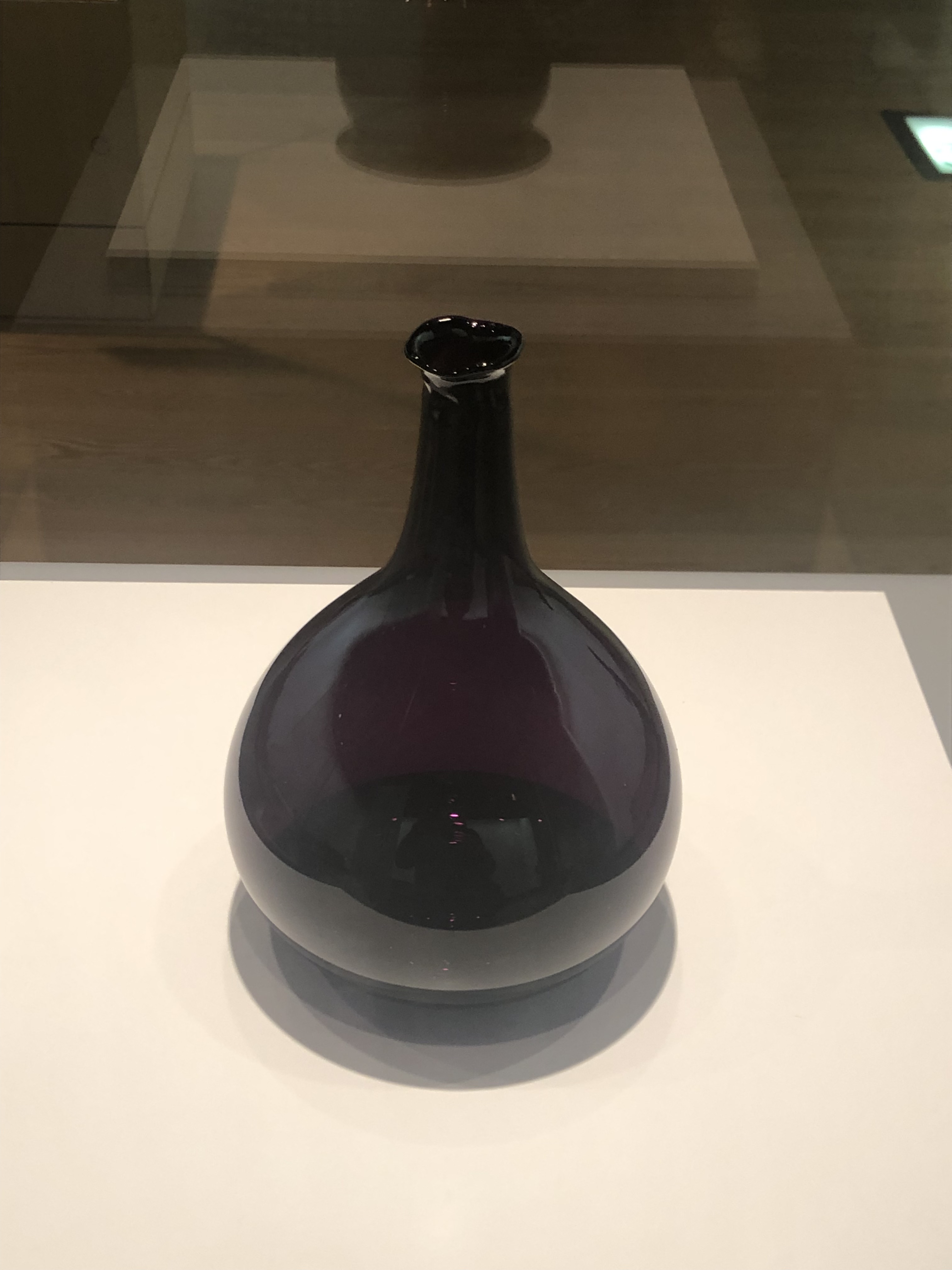
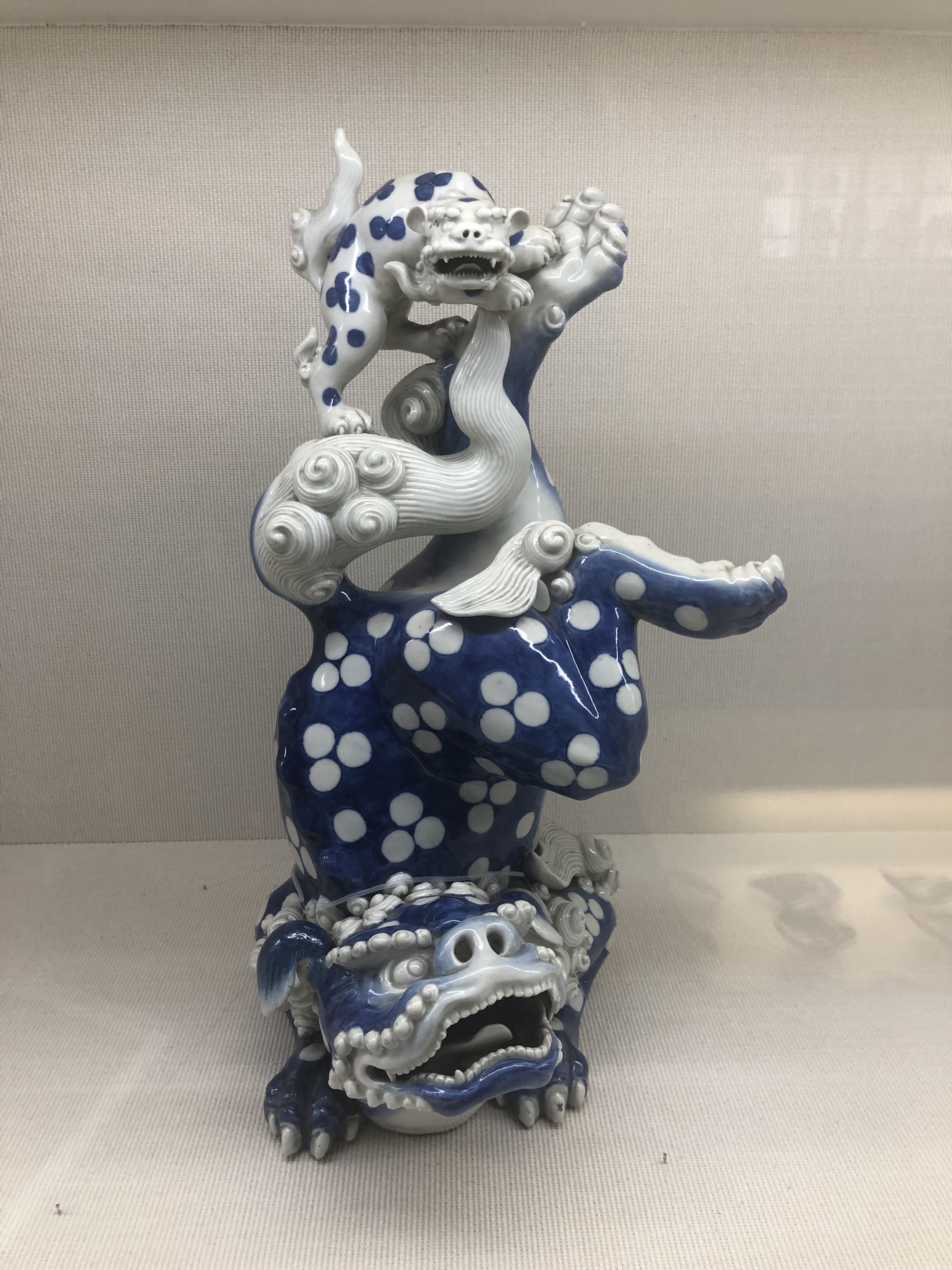
It has always been a place where things were made: Japan’s first porcelain and glass, metal filigree and silverware, textiles and lacquerware as well as steel, machinery and armaments. This is one consequence of its location: the obvious first port of call for contact with China (silk, ceramics and lacquerware), Korea (glass) and later for European traders (the filigree and other products associated with precious metals).
You would have to assume it has always been cosmopolitan. It is a city at the edge. Edge cities … oddities like the sale aisles at Aldi — surprising enough to throw you just slightly off balance, but comfortably embedded in their own context. Nagasaki has distinctive flavours and shapes very much of its own. Customarily, there are regular attempts to rope such cities back into the mainstream. That adds to their character.
It also has an unusual religious history.
The Jesuit priest St Francis Xavier was the first Christian missionary to arrive in Japan (in 1549), first at Kagoshima in the south of Kyushu but then, more productively from his point of view, at Nagasaki and Hirardo in its north. He had matched tenets of Christianity up with aspects of Buddhism and persuasively evangelised in these terms. Hundreds converted to this version of religion quite quickly, expanding into thousands over several decades (possibly to 300,000 by the end of the 16th century; most of the inhabitants of Nagasaki for example). One of these converts was the daimyo (magnate, overlord) Omura Sumitada who in 1580 vested control of the Nagasaki prefecture in perpetuity to the Society of Jesus. Remarkably the Jesuits had their own substantial administrative region in Japan. Just think about that.
This didn’t last long. Toyotomi Hideoshi, the ‘Great Unifier’, placed the Nagasaki region under his direct control in 1587 and ordered the expulsion of all Catholic priests. He had the example of the Philippines to consider. It was not paranoid to assume that Augustinian and Franciscan friars had paved the way for the colonisation of those islands by the Spanish. In 1596 a Spanish ship, the San Felipe, had foundered on the coast of Shikoku. Those on board, including Catholic missionaries, rather foolishly suggested that they were the precursors of a much larger Spanish presence.
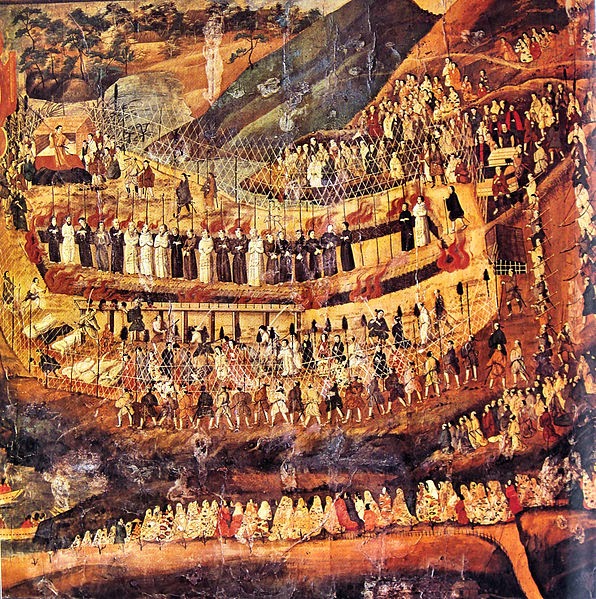
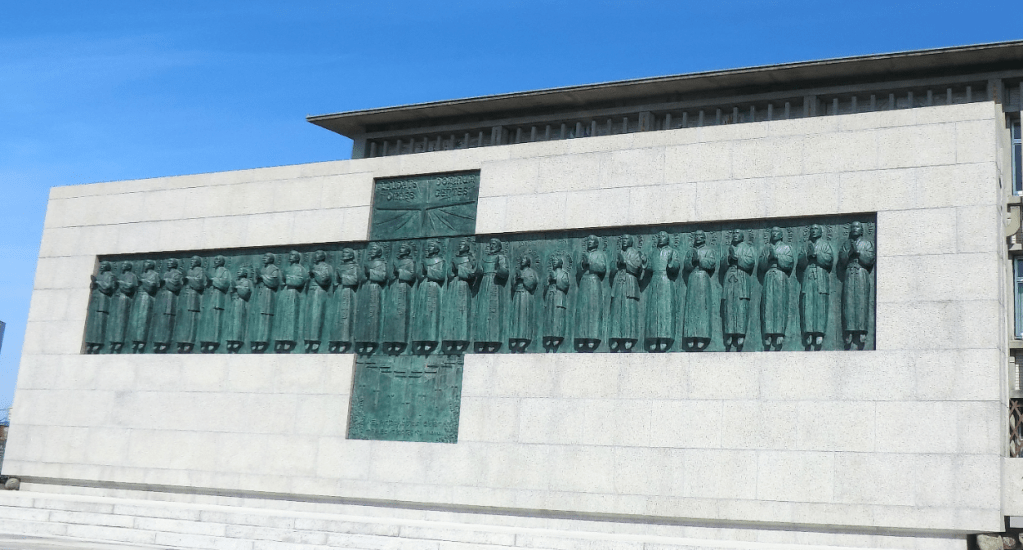
Within a fortnight Toyotomi stepped up the urgency and stringency of his suppression of Christianity beginning with the arrest, public humiliation, torture and crucifixion of the ‘Twenty-six Saints of Japan’: six Franciscan missionaries (four Spanish, one Mexican, one Portuguese), three Japanese Jesuits and 17 Japanese members of the Franciscan community, including three young boys who served as altar boys, one aged 12. This process included an 800km forced march which ended at Nishizaka Hill above the heart of Nagasaki, a destination chosen pour encourager les autres, of whom there were many at that time.
A 17th century Japanese rendering of what occurred.
There were many other subsequent examples of Japanese martyrdom as the authorities sought to enforce the nation-wide ban on the practice of Christianity. But the Twenty-Six Martyrs, the first, beatified by the Church in 1627 and canonised in 1862, caught the wave and are widely memorialised to the extent of being the subject of their own Museum. There is no challenge in finding renderings of the event.
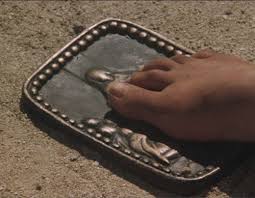
Shūsaku Endō’s prize-winning and brilliant book Silence provides a fictional account of this period and in particular the practice of having to stomp on fumi-e, images of Jesus or Mary, as part of a process of renunciation of Christ and Christianity. (Martin Scorsese made a film of the book starring Adam Driver and Liam Neeson.)
Read the book to find out what happens, but nearly the last word is given to an official who speaks to Rodrigues, the priest: “Father, it was not by us that you were defeated, but by this mudswamp, Japan.’
• • • • • • • •
This story could head off in a number of directions because the themes of politics, religion and commerce in this context are so intertwined. But the basic underlying issue is deeply familiar: how do you get what you want from an innovation/ new situation without all the bits you don’t want as well? (See eg social media, or the internet in general.) There were major benefits to be gained from contact with Europeans, not least the prospect of making a lot of money. But what were they bringing with them? Among other things, an untidy mess of alien mysticism and creeping insubordination.
In 1571 the port of Nagasaki was officially opened to world trade, at the time a limited concept. Among the first ships arriving was a Portuguese vessel which left behind cases of syphilis and other previously unfamiliar health disorders. And yet it also brought the first velvet the Nagasakians had ever seen, along with a host of unfamiliar spices from Indonesia. It offered silk and unknown types of woven cotton from China, and its traders provided good prices for Japanese silver, copper, ceramics and camphor. What do you do?
By the first few years of the 17th century the rulers of Japan had decided. They instituted Sakoku (‘chained country’), a series of directives that enforced self-isolation from foreign powers. From the Edict as it evolved in 1636:
‘No Japanese ship … nor any native of Japan, shall presume to go out of the country; whoever acts contrary to this, shall die, and the ship with the crew and goods aboard shall be sequestered until further orders. All persons who return from abroad shall be put to death. Whoever discovers a Christian priest shall have a reward of 400 to 500 sheets of silver and for every Christian in proportion. All Namban (Portuguese and Spanish) who propagate the doctrine of the Catholics, or bear this scandalous name, shall be imprisoned in the Onra, [the common jail of the town]. The whole race of the Portuguese with their mothers, nurses and whatever belongs to them, shall be banished to Macao. Whoever presumes to bring a letter from abroad, or to return after he hath been banished, shall die with his family; also whoever presumes to intercede for him, shall be put to death.’
Strong.
Foreign powers were entirely banned from any diplomatic and trade relations, with the exception of the Chinese … and the Dutch at Dejima. This situation didn’t change until the mid-1800s, when Japan was forcibly ‘reopened’ by naval emissaries of the United States.
Japan might have been closed, but the door was still open just a crack at Nagasaki. This is one of the things that makes the city special.
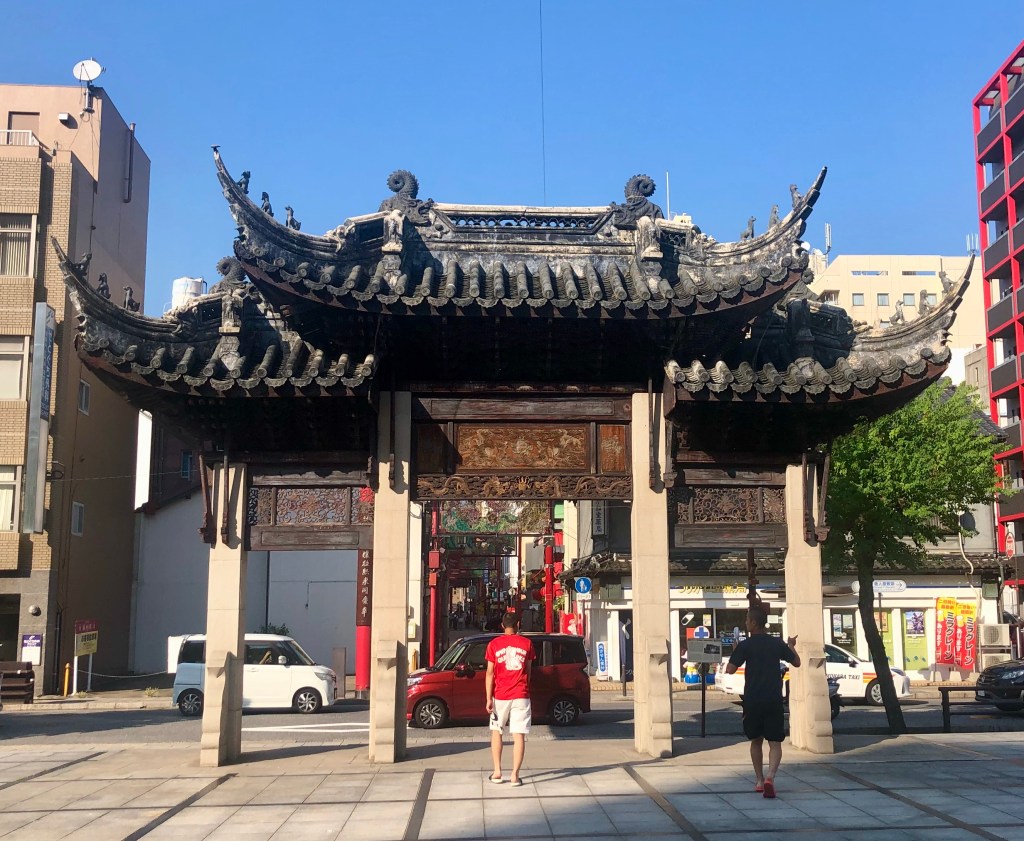
It had then and has now, unusually for Japan, a Chinatown at Shinchi (its current entrance at left). For most of its life this was a high-walled enclave which seems to have been treated more strictly than the European compound.
Among the Dutchmen on Dejima there was always a trained doctor. Engelbert Kaempfer and Carl Thunberg were two of these in the early years, skilled, professional … and endlessly curious. Both wrote books about aspects of Japan on their return from Dejima which clearly indicated that they had made the most of the crack in the doorway. It is hard to imagine that even in Japan the strictness of the observation of the rules of interaction would not have waxed and waned, particularly when there was perceived benefit.
In time Japanese and especially the well-to-do were coming from long distances to be treated by Dejima’s Dutch doctors. By 1823 when Philipp von Siebold arrived there must have been some relaxation of the rules because, after curing the illness of an influential local military officer, he was invited to set up a practice off-site and a year later he had developed a school for more than 50 students studying western medicine.
It was also Von Siebold who introduced the first piano to the nation of Yamaha and Suzuki. What a man he must have been. He is pictured below with a telescope, (‘Dutchman watching an incoming ship’, another Kawahara), along with two Japanese women one with the flame-haired child he fathered at Dejima.
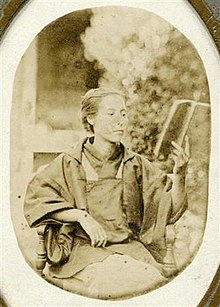
This daughter, Ine (pictured somewhat older at left, but still with reddish hair), became the first trained female medical officer in Japan eventually becoming physician to the Empress. A son from his Dutch family introduced the study and practice of archeology to Japan.
Von Siebold wrote a six-volume treatise on a vast range of subjects related to Japan. Some of his collection of 12,000 Japanese plant species remains at Leiden University in Holland. He also began a huge collection of ethnographic material which provides the foundation for collections in several major museums including the British Museum.
Along with all his gifts and interests Von Siebold seems to have been arrogant and pushy with a tendency to misjudge his own indispensability. He had his own set of rules. He illegally smuggled the seeds of tea plants which became the foundation of the Indonesian tea industry to Batavia (Jakarta). Later he pressed the court astronomer for maps of Japan and Korea, also an illegal act. By chance, court officials discovered them in his possession. He was accused of high treason, was subject to house arrest and then expelled from the country. This is how his initial contact with Japan ended. This was 1825. He had done so much in that time.
The Japanese were also absorbed with the possibilities of western technology and military science. Along with medical knowledge, these fields became known as rangaku, ‘Dutch studies’ or ‘learning’ and became the foundation for a series of academies which grew up in Nagasaki over this period. Dutch had already become an influential lingua franca of the immediate region. Over time, more than 15,000 books were imported from the Netherlands and translated into Japanese for the practical value of their contents.
Despite criticism from Japanese traditionalists, Nagasaki flourished for decades as an important seat of learning. By 1853 when Matthew Perry brought his gunboats into Edo (Tokyo) Bay, as well as Siebold’s medical school, Nagasaki had a naval academy, western-style steam ship building yards, an academy of sciences with interests in physics, chemistry and optics, and the beginnings of steam engine manufacture among many other adventures into western ideas and technologies. Nagasaki was one of the heartlands of the explosion of activity which took place during the Meiji Restoration when Japan re-opened to the world, and ready for it in ways the rest of the country wasn’t.
• • • • • • • •
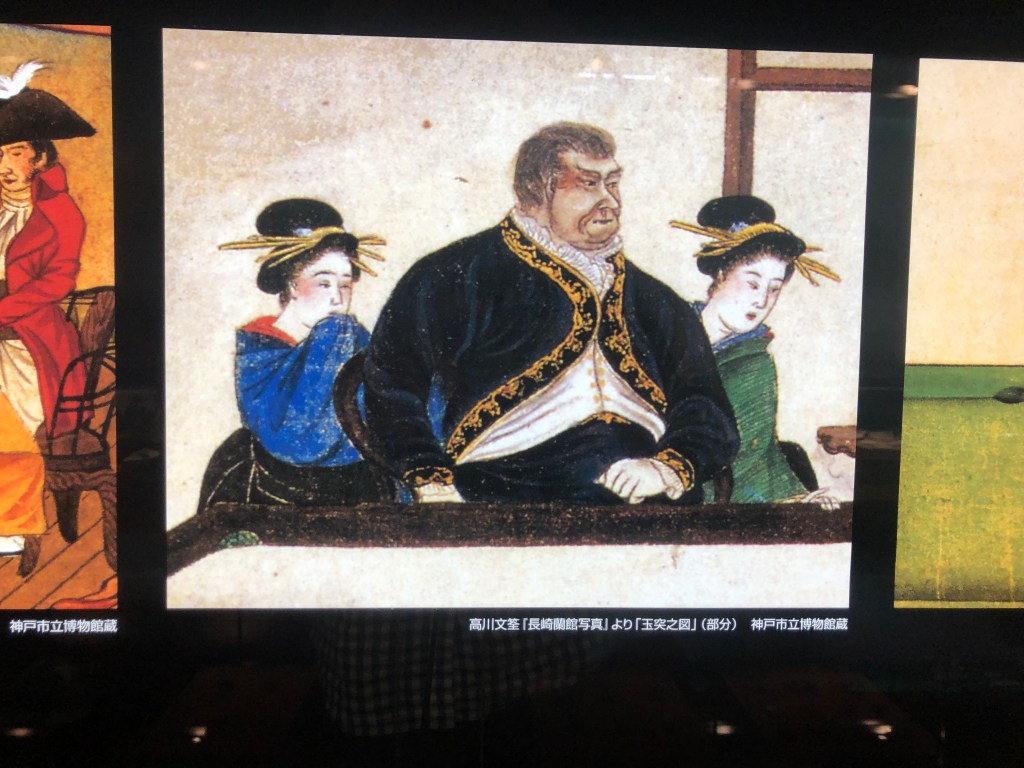
On display at Dejima. It might be construed as a commentary on gender relations during the Edo period; the tag says something about balloon fighting. But I think it is 玉突の場 (‘Ball striking table’). The game of billiards was introduced to Japan via Dejima in 1746. Intercultural exchange can be a strange and wonderful thing.
• • • • • • • •
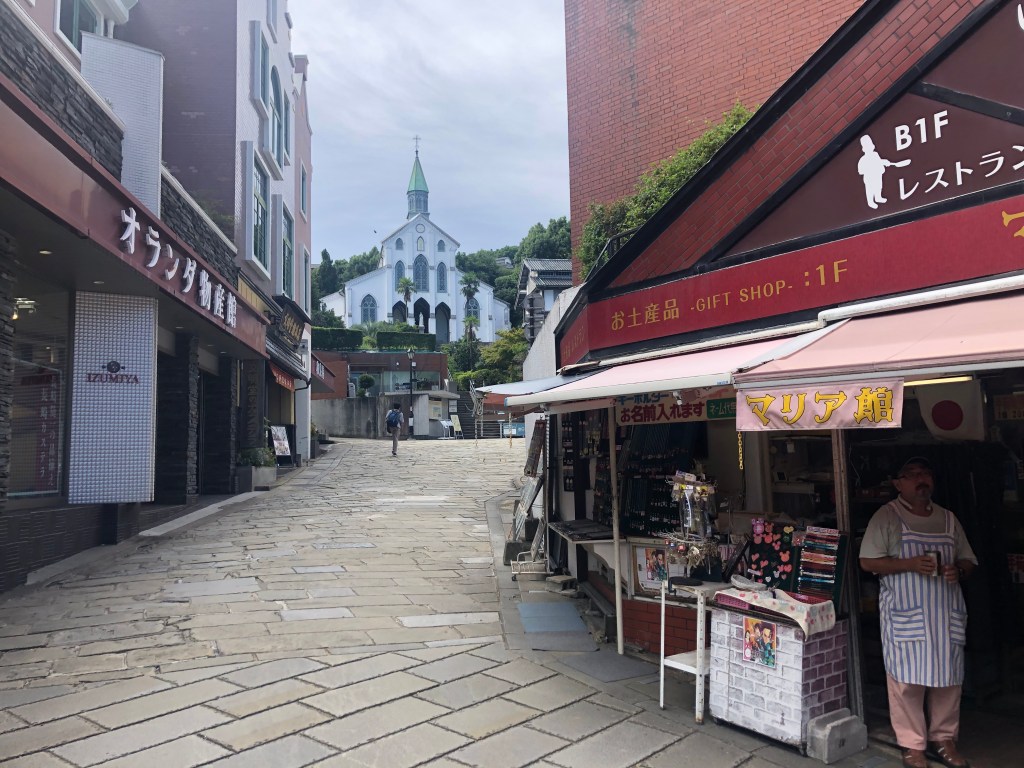
Along with a relaxation of the rules regarding contact with foreigners came a relaxation of the laws relating to religious practice. Some Christians jumped the gun. When Nagasaki’s Oura Catholic cathedral was newly consecrated in 1865 a group of several hundred Kakure Kirishitan (‘hidden Christians’) appeared, largely peasants from the upper reaches of the Urakami valley. For their imprudence they were deported to various distant parts of the country. But in 1873 when all restriction was lifted more than 30,000 people claiming to be Christian emerged — after more than 200 years in the wilderness. Their various doctrines were not immediately recognisable to the priests of Nagasaki (French at the time) who declared them Mukashi Kirishitan, ‘ancient Christians’ and not part of or welcome in the orthodoxy. But Oura cathedral is still very much there.
And it’s still there at the end of one of those tourist avenues where you can buy your fill of soft serve, biscuits, souvenirs, Castella cakes (a remnant of Portugal) and on and on.
And that really is my point. There are vestiges of this rich history everywhere.
Some of the treasures we found in this imposing building, the Nagasaki Museum of History and Culture which we pretty much had to ourselves, apart from the customary rash of attendants. Look at it. Enormous! And very good.
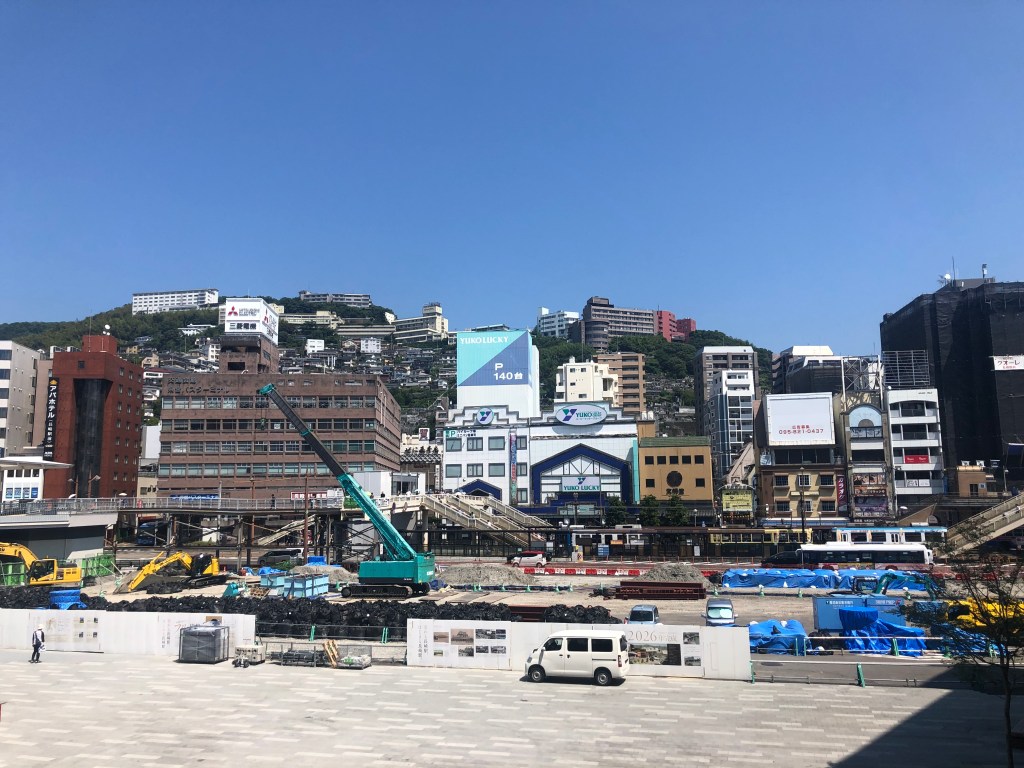
In the background and to the left of the pic below is where the 26 Martyrs met their end. But it is buried from this perspective behind one of the several giant pachinko parlours, office blocks, electronics shops just there, a major tram stop, a construction site and I am standing on the terrace of Amu Plaza a giant shopping centre attached to the very stylish Nagasaki Rail Station.
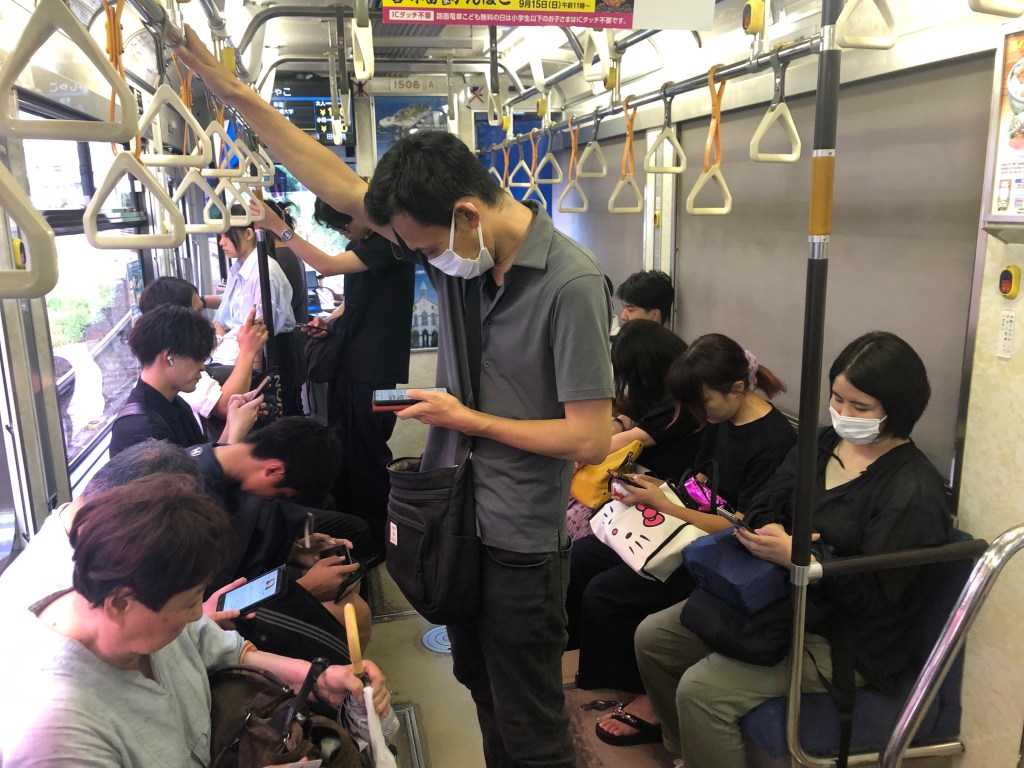
We got control of the city’s four tram lines fairly early in the piece and used them extensively to get around. But to get out of the valleys in which they run you need to walk. This is one of the things we found,
… the ‘One-legged Torii’, a reminder that there is another story at Nagasaki. There is the matter of the bomb.













 mcraeblog