‘We desire to have a city that will be the Gotham of Australia … [and] in a few years will rival London in size, Athens in art and Paris in beauty.’ King O’Malley in 1904, an American masquerading as Canadian so he could be a member of the Australian parliament, taking on the job, as Minister for Home Affairs, of designing and developing a capital for Australia.
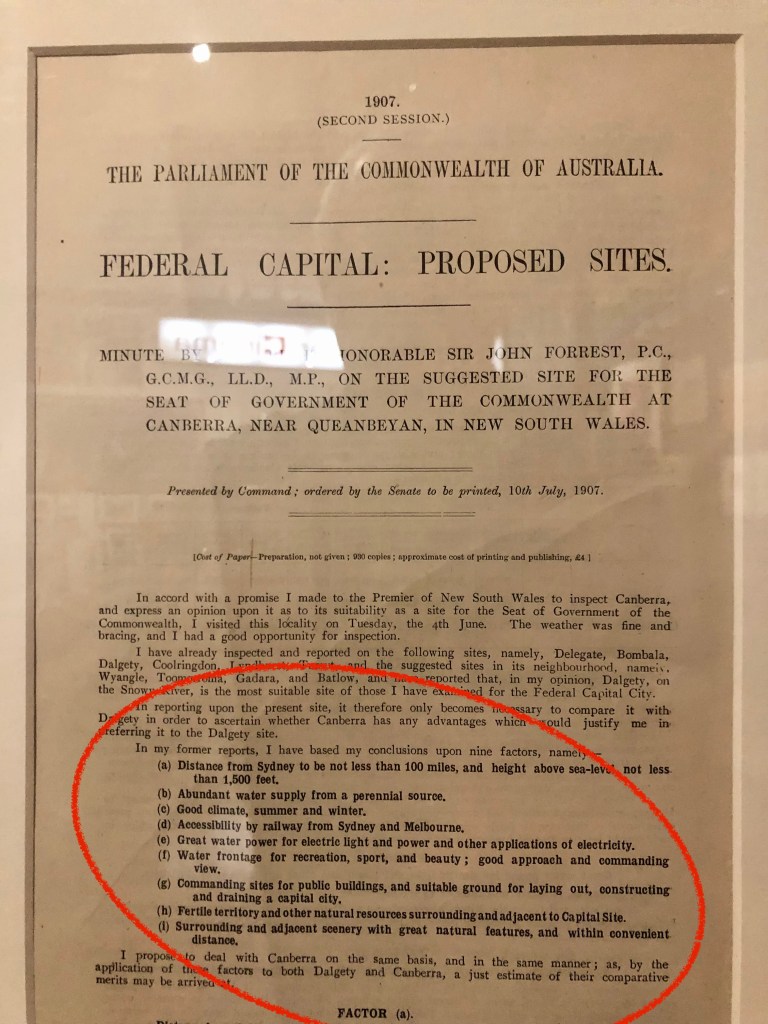
1907: The minute containing Sir John Forrest’s report to parliament on a site for the national capital.
Dalgety, about 150km south of the ACT, got the initial nod for the site of the new capital but the NSW government wouldn’t cede the land. Too hard and expensive to build a rail connection certainly, but also too far from Sydney. Canberra was second choice from eight options.
The word ‘Canberra’ may be a corruption of Ngambri, the name of one of the four Indigenous tribal groups living there prior to the disruption and assumption of their lands. Or it may mean (in Ngambri) ‘space between a woman’s breasts’, the breasts in this instance now called Mt Ainslie and Black Mountain.
Alternative names proposed at the time included: Austral, Aurora, Captain Cook, Caucus City, Cookaburra (😬), Dampier, Eden, Eucalypta, Flinders, Home, Hopetoun, Kangaremu, Myola, Meladneyperbane, New Era, Olympus, Paradise, Shakespeare (🤔), Sydmelperadbrisho, The National City, Union City, Unison, Wattleton and Wheatwoolgold. Probably lucky some of those didn’t get up.
1927, the opening of Parliament House by the Duke of York.
Not the Duke of York, but almost certainly with more claim to the land.
Imagine. It would have been a very strange life. Government from a paddock. Note the comparative absence of trees.
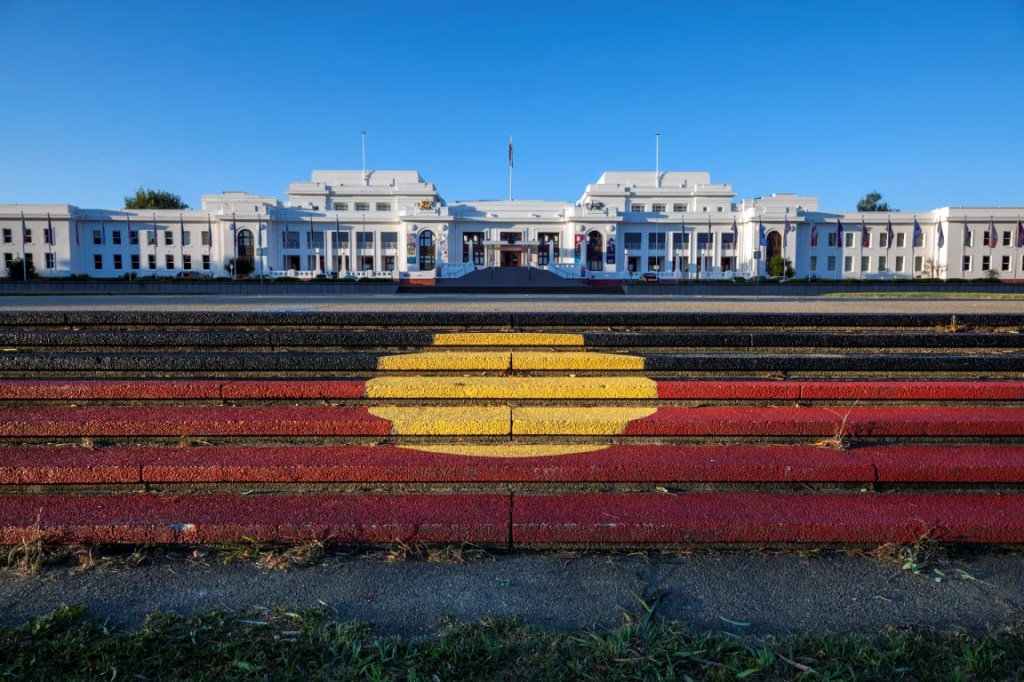
Building of the new ‘old’ parliament house commenced in August 1923 and was completed, after what must have been a constant series of construction and other challenges, early in 1927. It was not designed by the Griffins, Walter Burley and Marion Mahony, but it could have been. Very Chicago School: clerestories, very strong horizontals, interesting sight lines, furniture matching walls matching floors matching fixtures matching ceilings. Passionately symmetrical, built round the two houses — Reps and Senate. Snug, I thought. A building very easy to warm to if not to heat.
The old King’s Hall with King George V standing guard.
The view via this transect through the House of Reps frames the War Memorial (invisible here) perfectly.
John Smith Murdoch, Australia’s first Commonwealth Government architect, did design it in what was called the ‘stripped classical’ style. Good job, but it was only ever intended to be temporary. It does seems like a lot of work and effort for a temporary building.
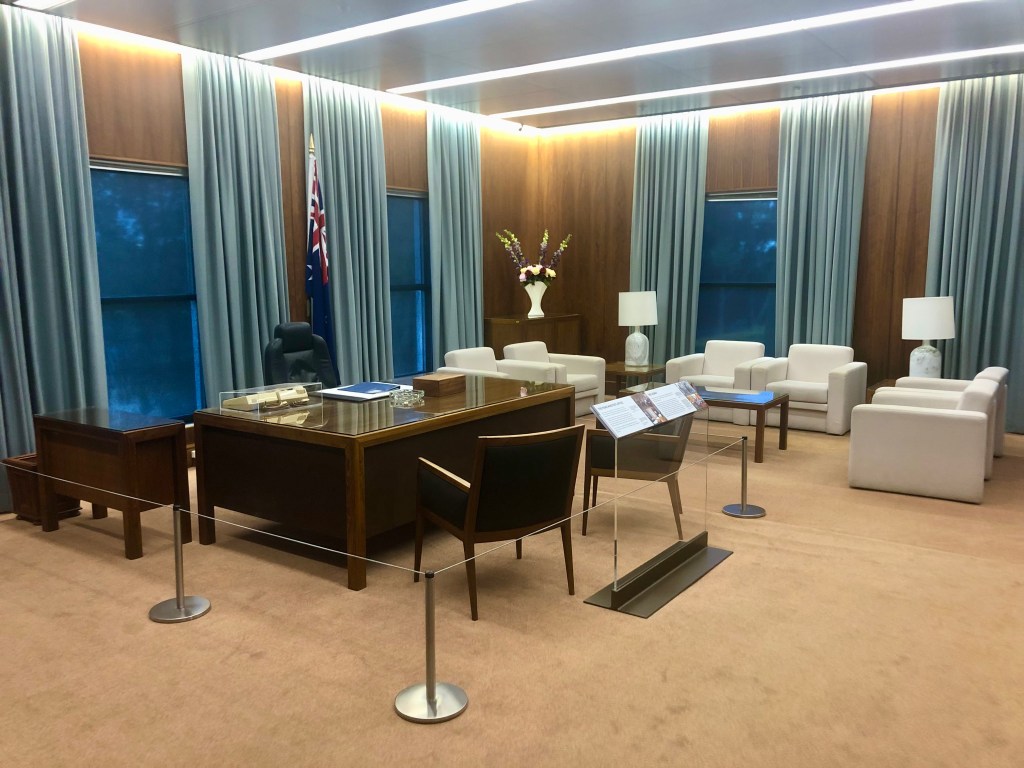
The Prime Minister’s Office, to my eye perfectly fit for purpose. Bob Hawke’s voice is heard.
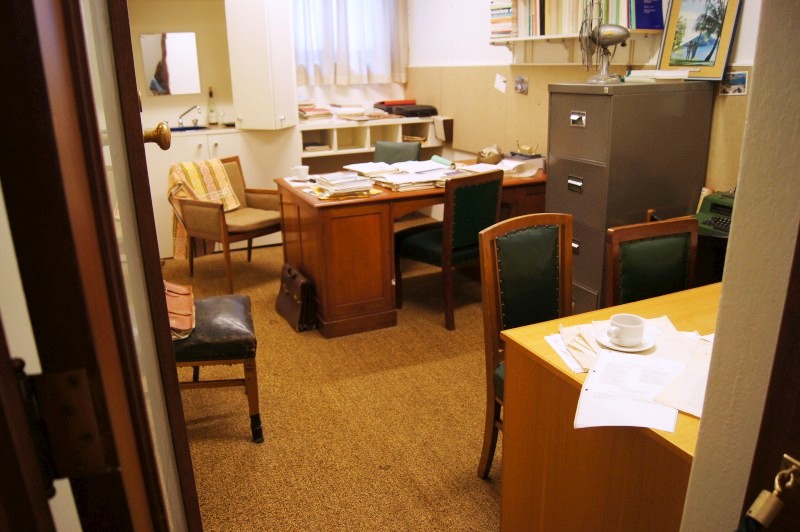
The Prime Minister may have had ample space but a run-of-the-mill MP and three aides would work in an office smaller than this, about 4m x 2.5m. Shall we say limited confidentiality which, who knows, may have been a good idea. New Parliament House where more than 5000 people work on sitting days has nearly eight times the floor space of the old one.
Labor gets a surprisingly good go in the displays, away, that is, from the John Howard Library. And, yes, that is The Australian Constitution being kicked downstairs.
Always was …
• • • • • • • •
‘You won’t find a whole settled essentially stable community that is so smug, so bourgeois, so comfortable, so well-educated. I mean this may be fucking paradise. I’m not saying it is. But it’s as good as it gets.’ (Jack Waterford, staple of the Canberra Times, legend. And I know just what he means. It has occurred to me every time we go there. All those facilities. All that cycling and jogging.)
It can be quiet downtown.
Although there will usually be a jogger to add to the vibe.
It will also be socially aware, generously so.
With plenty of thoughtful instruction.
• • • • • • • •
In his very good book about Canberra, Paul Daley suggests ‘the role of a [national] capital is to host its legislature and judiciary, its memory (the National Library of Australia; the national archives, the galleries), its conscience (the Aboriginal Embassy and the National Museum of Australia with its vast collection of Indigenous remains and relics) and tell the story of disastrous events that almost derailed a fledgling federation (the Australian War Memorial).’
In a recent visit we made the most of these, especially its memory.
One of the reasons for our visit was to have a look at ‘Fit to Print’, the exhibition in the National Library curated by Mike Bowers of press photos printed from glass-plate negatives (one chance only). A very generous selection and display from the 18,000 or so held by the Library in its Fairfax Collection. All round 1930: another time, another life.
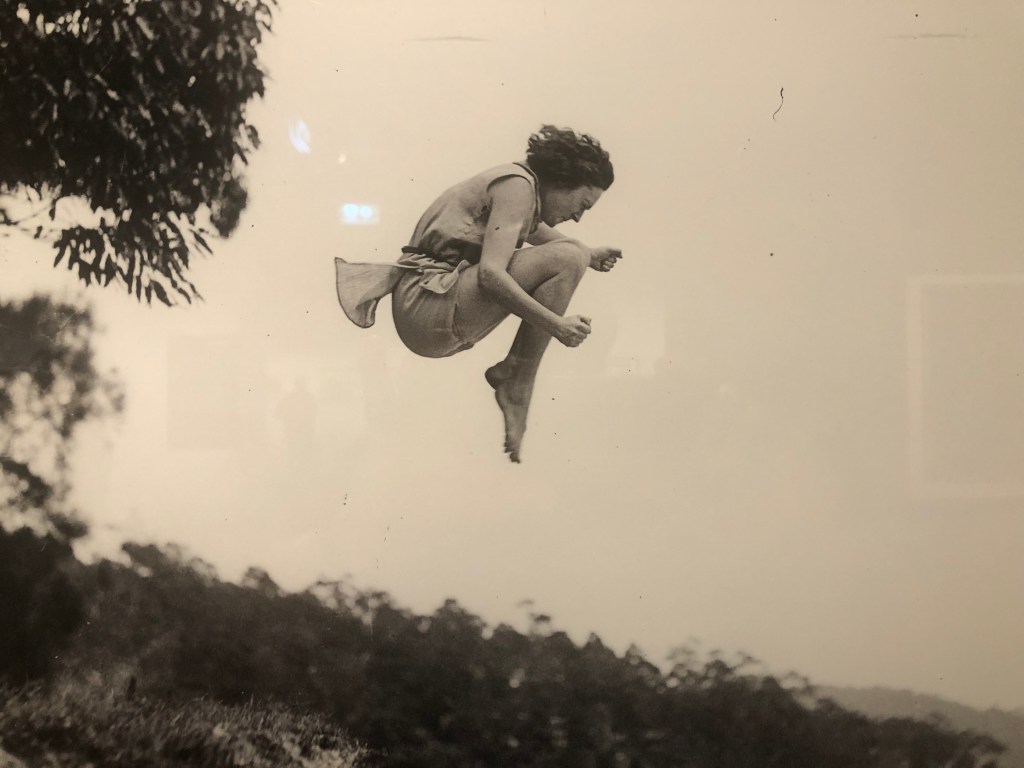
Moments caught at a performance by Inge Stange’s dance gymnastics students, Sydney 1933. ‘This type of physical education is better adapted than almost any other for inspiring inner cheerfulness and new courage to face life in these uncertain times.’
William Lygon, 7th Earl of Beauchamp and, for a time, Governor-General of NSW, with some chaps at Bondi. ‘I doubt’, he observed, ‘whether anywhere in the world are finer specimens of manhood than in Sydney. The life-savers at the bathing beaches are wonderful.’ Using certain information about his activities which could only be described as salacious, his enemies were able to move him on. Smith’s Weekly noted that when his wife divorced him at the time ‘it came as little surprise’. But, bless him really. He’s having such a good time.
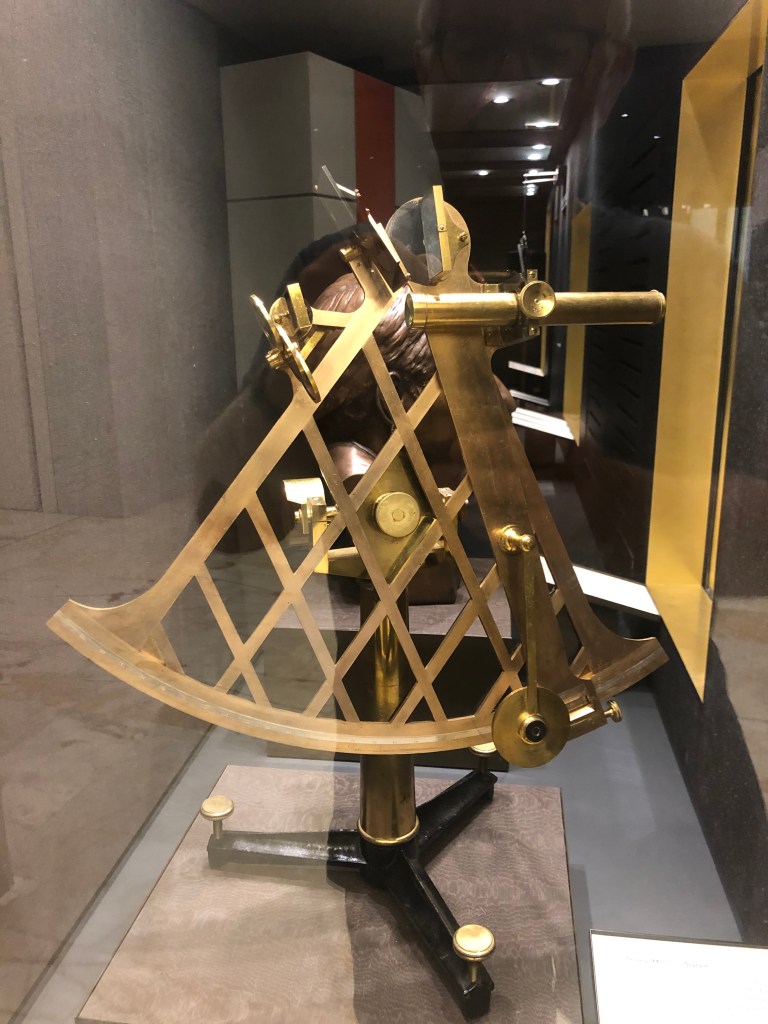
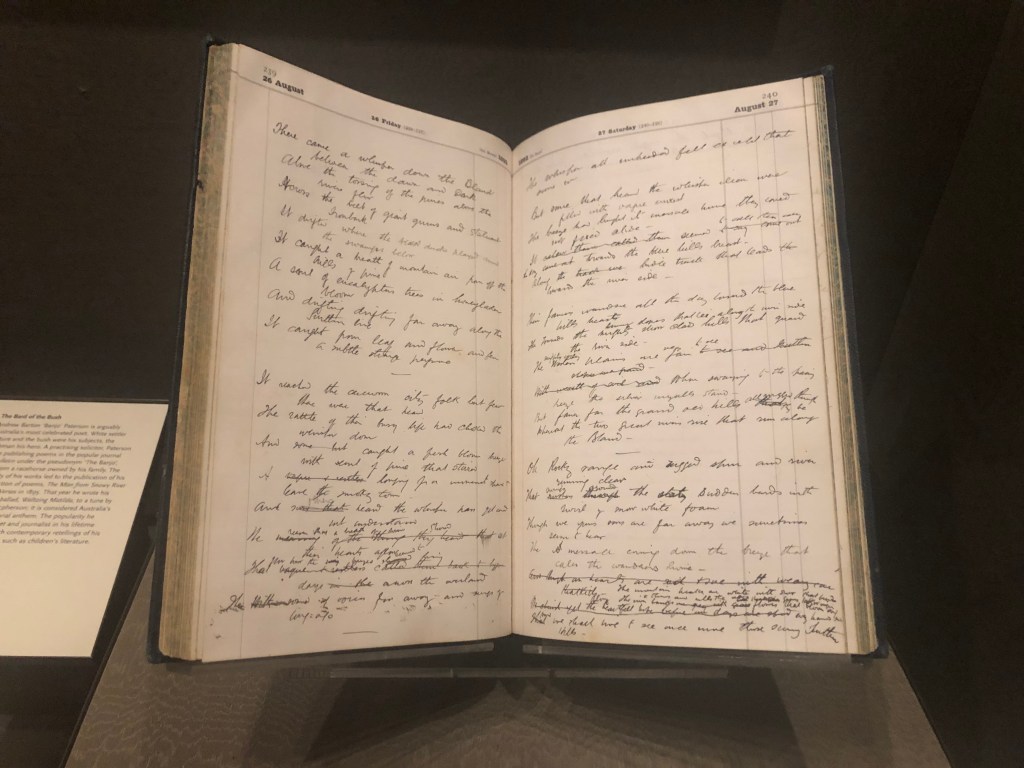
The National Library also had its customary display of ‘treasures’. I liked these two among others:
At left, Major Mitchell’s sextant; and above, Banjo Paterson’s ‘Diary used as a notebook’ open at a draft of ‘The Wind’s Message’. Not his finest work, but ‘The Man from Snowy River’ is just over the page.
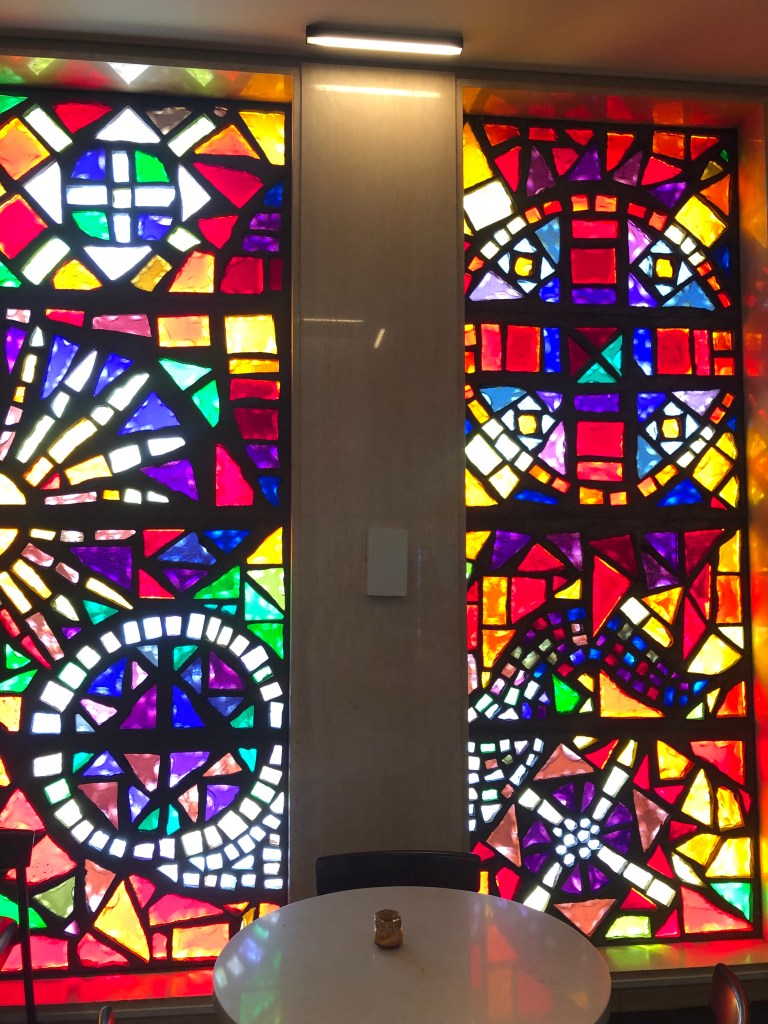
And … you can look at Leonard French’s glorious windows while you’re having your coffee.
National Library: 9.7/10. At least.
And then there was the Gallery. You must go to the Gallery, but it was looking and feeling a bit Brutalist, just a tiny bit stuck around 1980, those enormous rooms bullying their contents which examined closely seemed like they might be second choice. The new Gaugin, the new Monet, the new Munch: not my favourites anyway, but the sort of thing you might mention when you are talking about examples of the absolute range of an artist’s work including when they had a go at something that didn’t quite work.
Best thing downstairs by a mile —
What a very great painting that is. And what a cultural landmark. It was time.
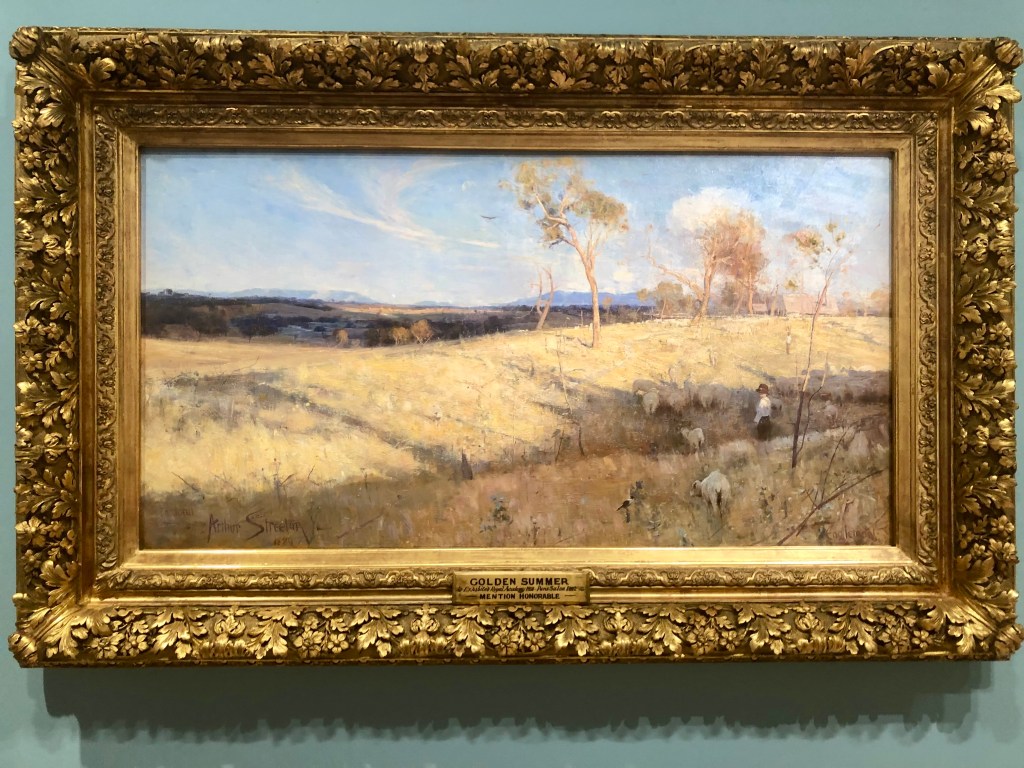
Upstairs was ‘Golden Summer, Eaglemont’ in its very fancy frame. A Mention Honorable at the Paris Salon of 1892 is noted. I’m confirming golden and not just because it’s the Dandenongs in the background. This was the title piece (called ‘Golden Summers’ at the time for some reason) for the best exhibition of Australian Impressionists ever mounted, NGV 1985. I remember it indelibly.
Also upstairs was this, ‘Bush walkers’ by Freda Robertshaw painted in 1944.
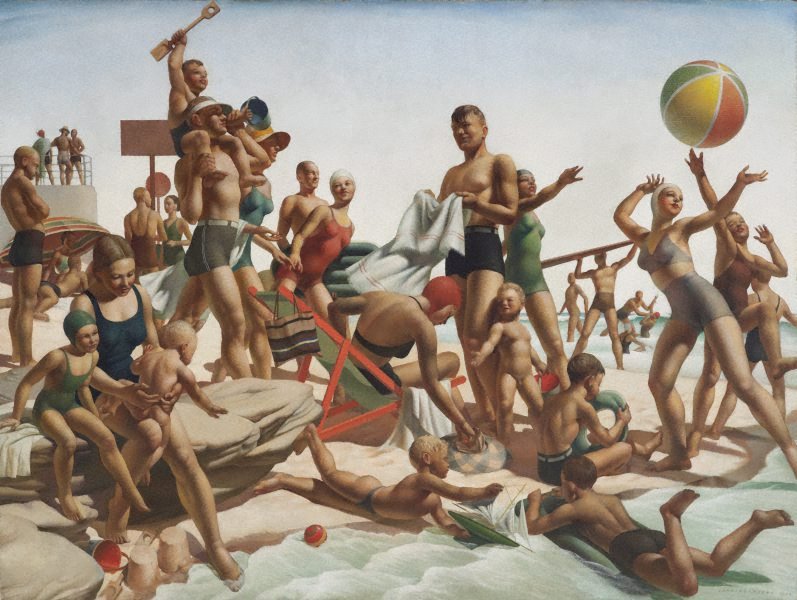
Intriguing. So carefully painted, and so formidably un-bushwalkerly. The figures, frozen from inception to completion, would not have been capable of walking anywhere let alone in the bush. Could they be aliens perhaps? Which is not to deny the considerable interest of the painting. I’d be happy to look at it carefully …hmmm, four times a week. Evidently the same genre as Charles Meere’s iconic ‘Australian Beach Pattern’ (which can be found in the Gallery of NSW) from just a bit earlier. Similarly carefully painted. Statuary, with a sea made of actual glass. That ball, suspended forever. (You might note the hint of domestic violence in the deep background. Us Aussies! Always up for a laugh.)
Just incidentally it is on record that Englishman Meere really didn’t like the beach, and he may have painted himself into the picture as the chap at left looking at least thoughtful (perplexed?) if not entirely discomfited.
Also on display was an exhibition of contemporary ukiyo-e, Japanese woodblock prints, the best known example of which is Hokusai’s ‘The Great Wave off Kanagawa‘. In his Hawaii Snorkel Series Japanese-American Masami Teraoka offers his own take on the slightly libidinous shunga tradition. His ‘View from Here to Eternity’ is below. The placement of the woman’s head provides a challenge.
There was also this glorious ‘Lotus Table’ by A&A Design, 1200mm in diameter and made out of ‘custom-dyed rye straw’.
The Drill Hall gallery had a very large exhibition of conceptual art which we think we are unable to explain except that some conventional thinking is involved as well as aesthetic appreciation. I liked it but not as much as a series in the same place by Simon Gende, an artist from PNG. (When did you last see paintings exhibited by an artist from PNG?) Even more exotic was that the theme of the series was the attack on the World Trade Centre and subsequent events stalking, capturing, killing and burying Osama Bin Laden.
This is ‘Twin Towers’. The legend in always so attractive Pidgin at the bottom says ‘Tupela balusbumpin Twin Tower long America USA‘. ‘(‘Two planes [balloons/ birds/fellas] crashing into the Twin Towers which belong to/in America USA.’)
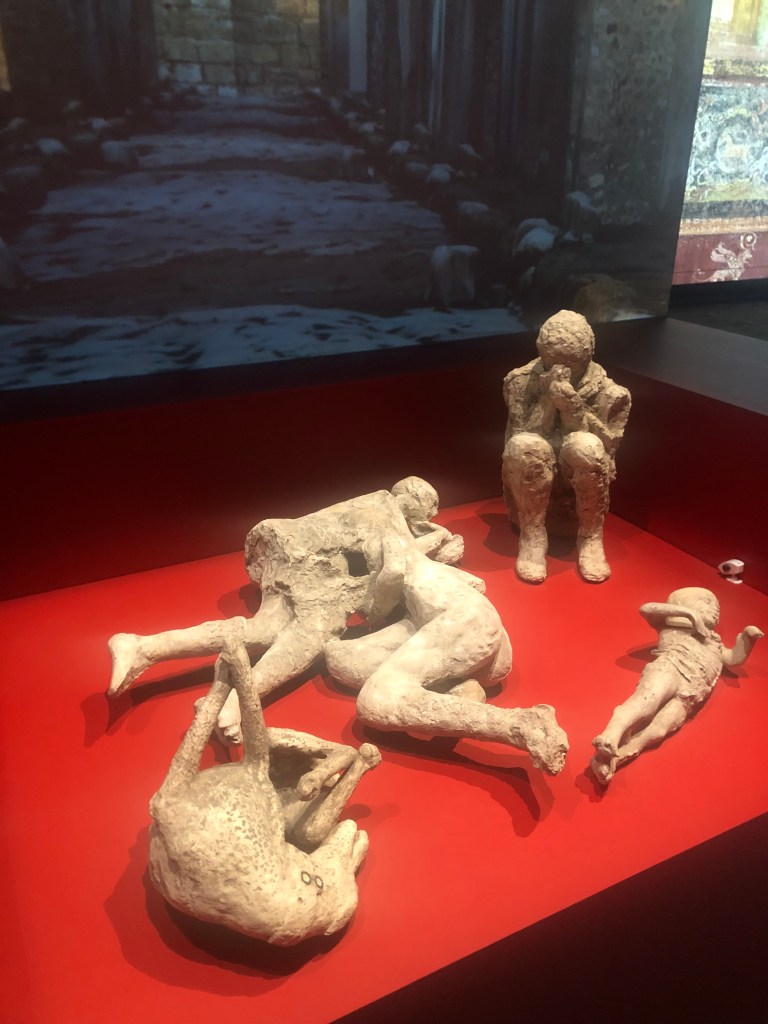
In the museum, one-third closed for a new exhibition when we were there, we found the last day of Pompeii, so to speak, a good deal made out of not very much but with its moments …
and a pink van plus Holden. Good. And someone taking a somewhat decontextualised selfie.
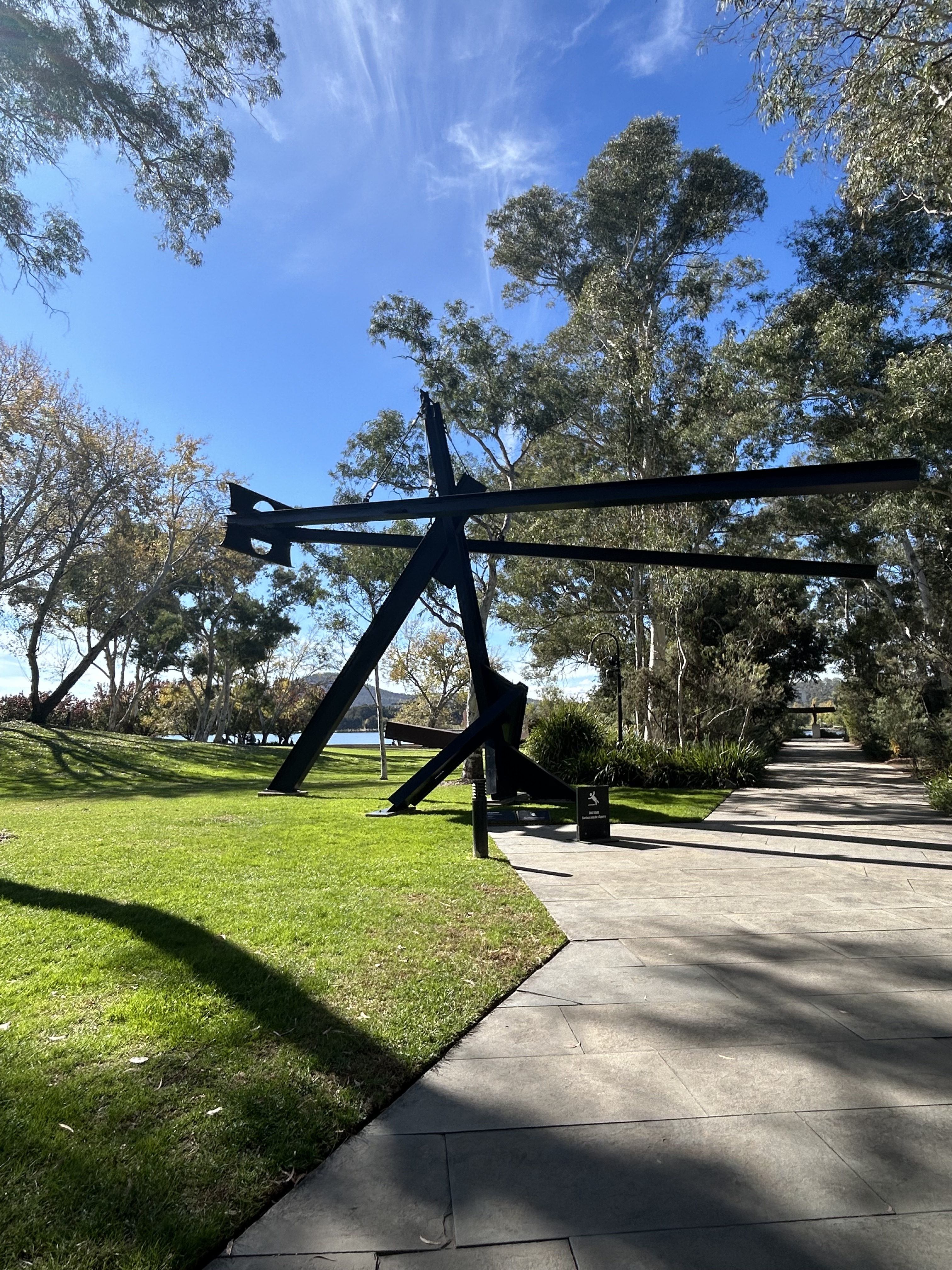
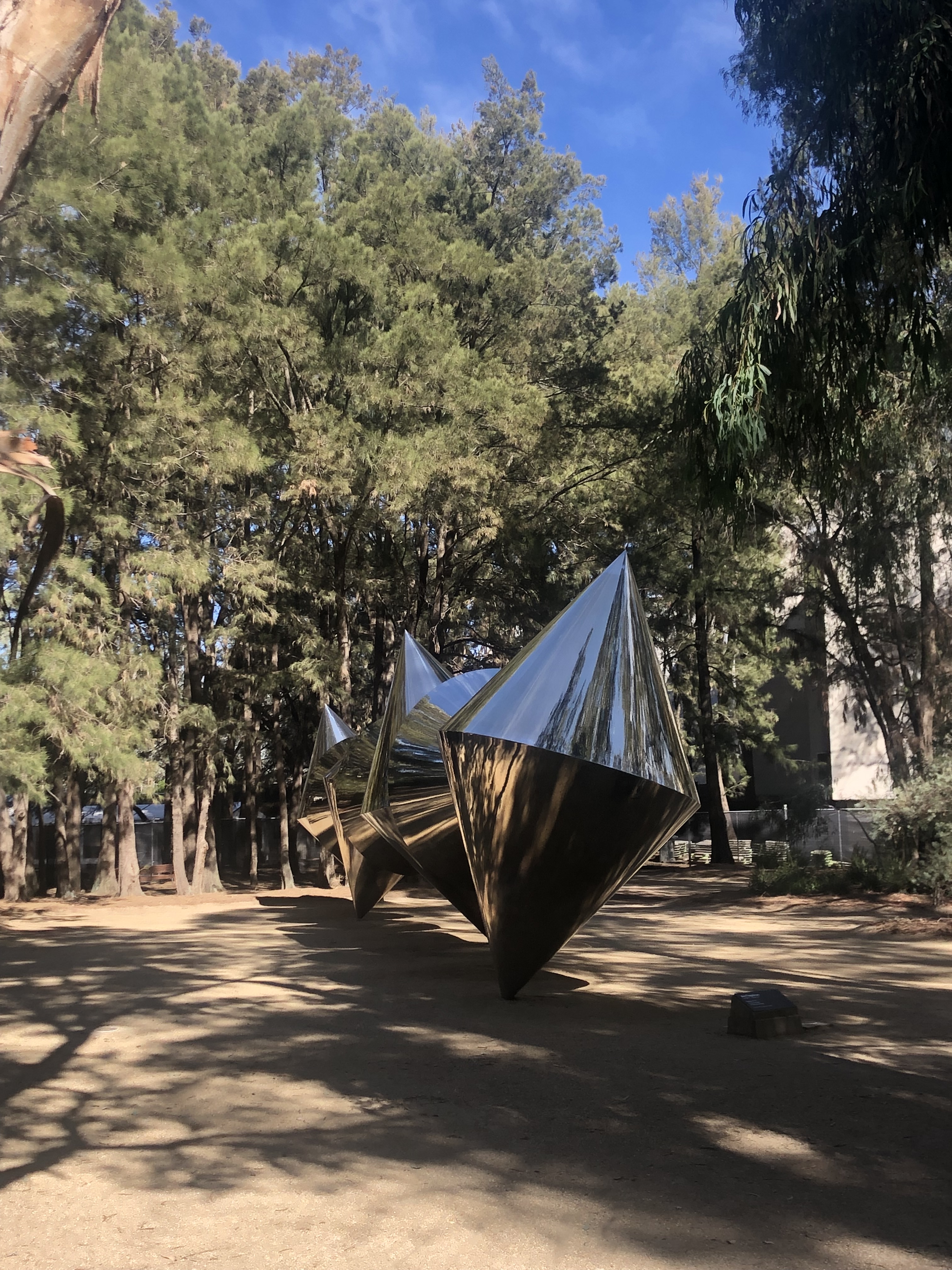
It is a city — now, so very much not in 1927, and not really till the 1970s — of public art … (You can tap on these pics to see them better.)
and edifice. Hard to move without bumping into, or at least experiencing, an edifice.
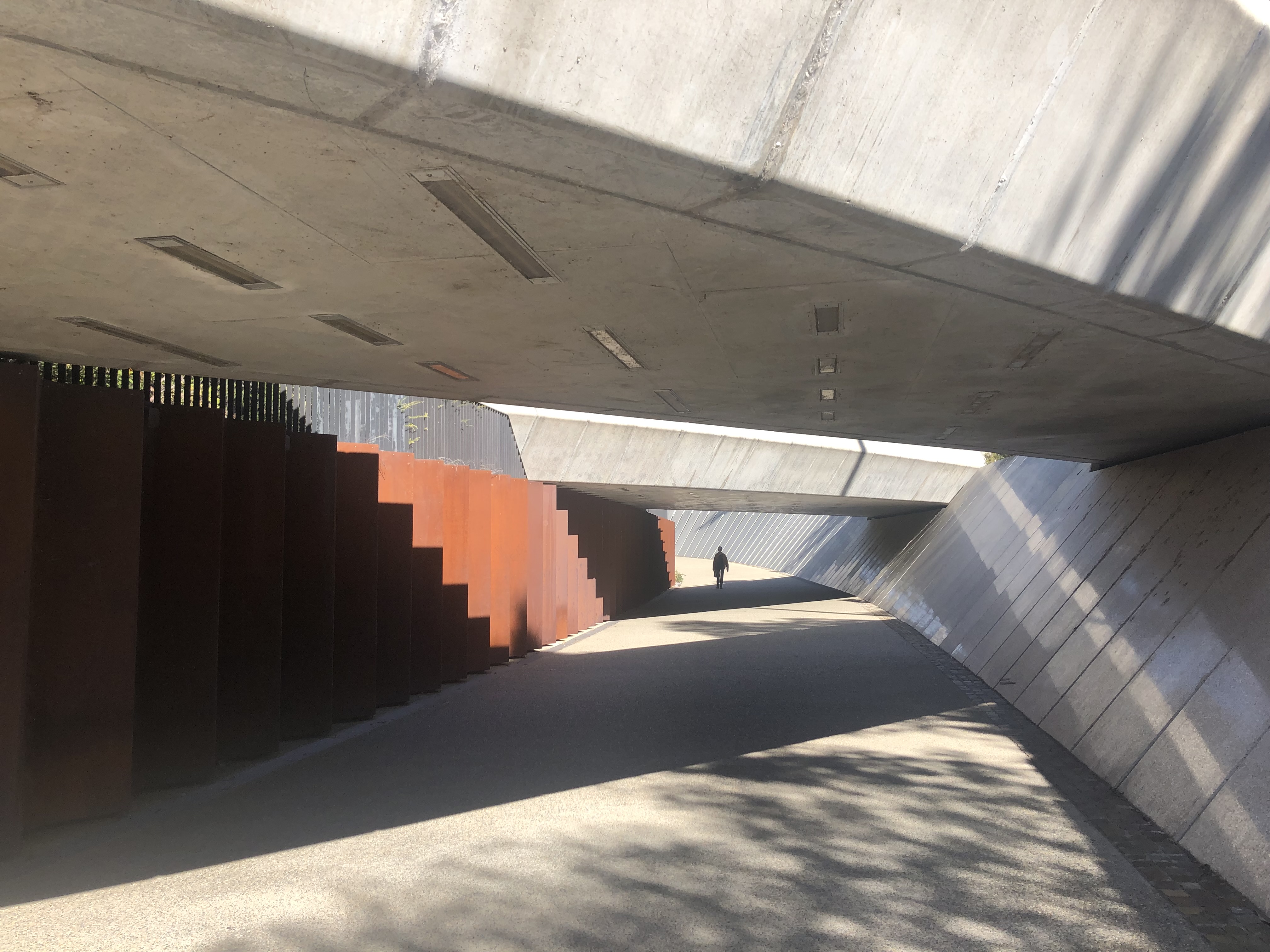
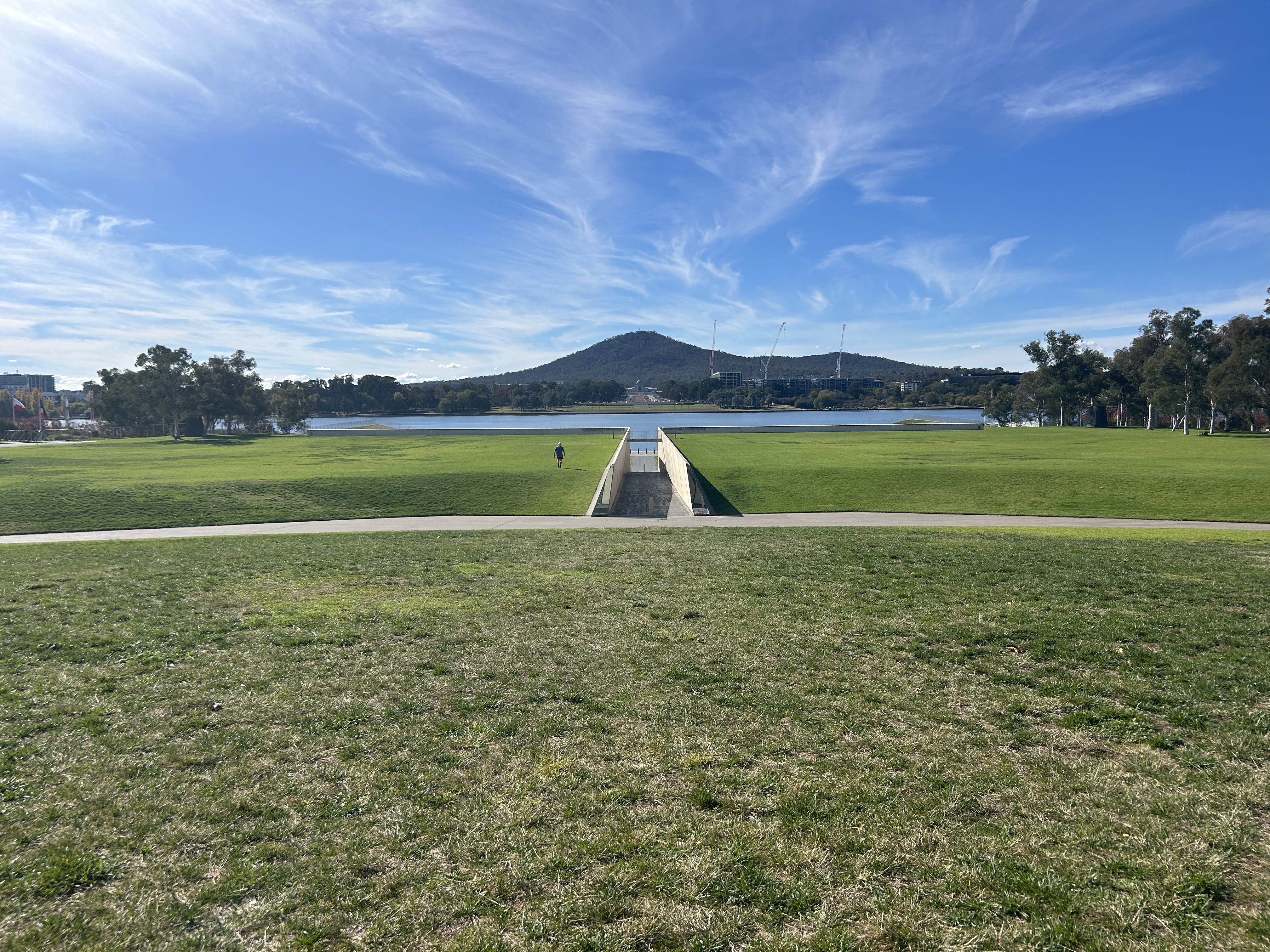
The Gallery (bottom left), the High Court building (‘Gar’s Mahal’) overwhelming two galahs as it does its users, the massively over-engineered Bowen Place pedestrian underpass, and the mysterious ‘Commonwealth Place’, the outcome of a competition, from front and back, itself just in front of John Dunmore Lang Place. John Dunmore Lang, a Scotsman, a Republican and an Australian patriot who didn’t live to see Federation. I don’t know what he’d make of Canberra today. His Place is largely a blank of struggling lawn.
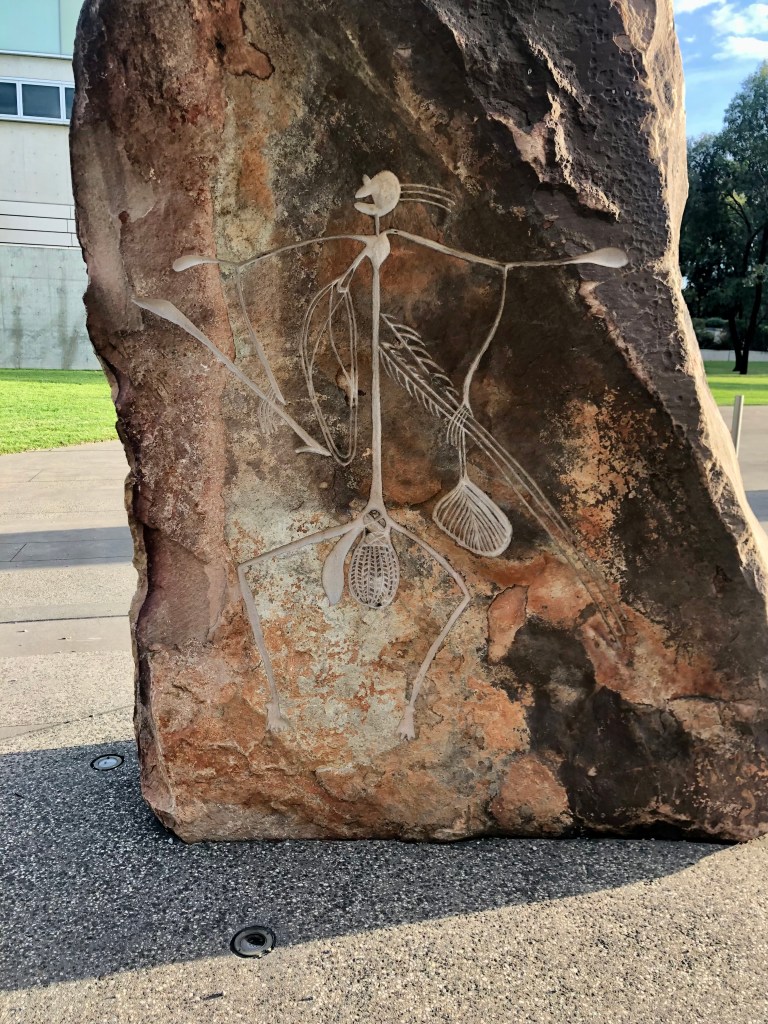
But just along from here is Reconciliation Place which does have a range of features including these standing stones each of which incorporates some First Nations art.
As appropriate the art is representative of different traditions and cultures, quite easily recognisable like the one on the left. But I have never seenGwion Gwion (at right) with all their complexities anywhere other than the Kimberley. Perhaps a courageous decision.
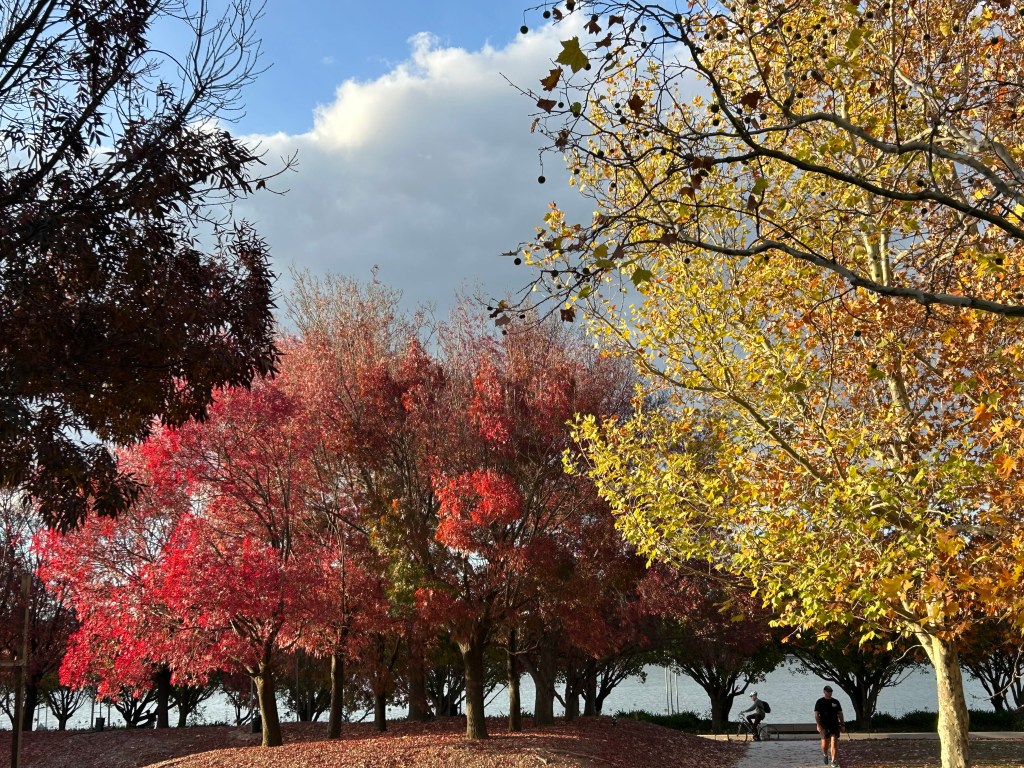
And trees. Trees trees trees. Hundreds of thousands of them. One of the great arboreal projects of Australia. What a wonderful thing. Especially thinking back to the bare paddocks of 100 years ago. It was autumn of course and there was ample evidence of the extent of alien deciduous planting …
and the absorption with monocultures, a version of town planning aesthetic concerns dominating the truths of ecology, but at least they’re trees.
A bit of the National Arboretum from its main pavilion.
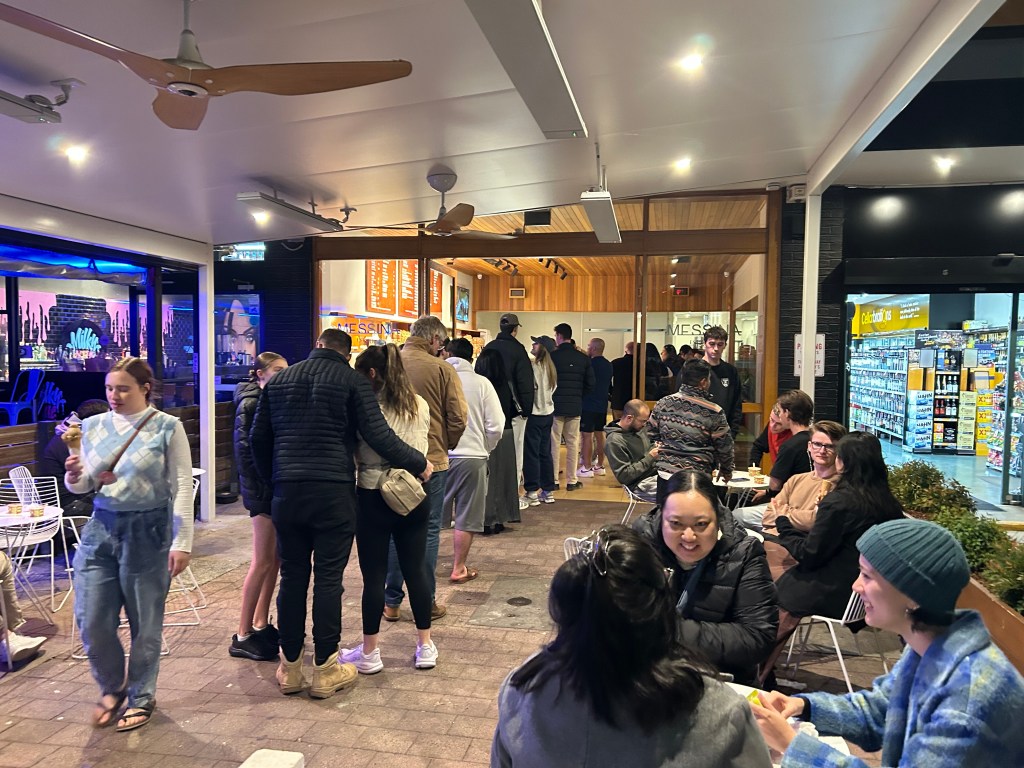
Perhaps the most signal image from our trip was this: round 9pm, Lonsdale St as downtown as you get, temperature minus 4, queuing up at the Messina gelato bar for ice cream. You might imagine otherwise, but you don’t miss out on a thing in Canberra.
Yes. ‘Sunday’. Ken Done. Dominant in its gold frame at the public threshold of the Art Gallery of New South Wales.
The attached note says: ‘Sunday was painted from a beach house on the Wyargine Point in Sydney Harbour that Ken Done calls “The Cabin” nestled into the landscape of Rosherville Reserve and overlooking picturesque Chinaman’s Beach. … While Sunday was painted from and inspired by this setting, Done says it’s not a direct representation. It “reflects a feeling that shows the joy of being in this space. The pattern of the clouds, the boats, the people on the beach … it is a feast. And if colour is a language, then the language for Sunday is joy.”‘
It would have been unthinkable not so long ago. Ken Done? Not to be taken seriously. A bit awful really. Hopelessly commercial. For tea towels, place mats, cheap scarves, possibly swimwear; and for people who don’t know anything about art.
But, frankly,how absolutely correct that placement is: Sydney as it would like to see itself and sometimes is. Gorgeous.
The Harbour was covered with scales of sun glitter, the bridge exhibited itself like a formidable flexed (and symmetrical) bicep, the Opera House was perched on Bennelong’s Point like a ruffled cockie. And then in the evening there was the breeze, an erotic whisper, the fag end of the Southerly Buster massaging your sensibilities and because it is summer leaving dainty beads of humid sweat.
Melbourne to live, but Sydney for a visit.
We’d come as the final leg of the Tour de Siblings to celebrate my 75th birthday — we’re all getting on — and this was to see 90 year-old Dorothy. I thought we would stay at Kings Cross. I hadn’t been there for a while and the station is handy. It was also just a walk to her church in Waterloo where we would meet.
I had some uncertainties about the accommodation I’d booked and paid for. It had been very hard, impossible actually, to get in touch with the property owners to find out, for example, how we would get in. So I was disappointed rather than flabbergasted to arrive at a laundrette with no obvious place to sleep or make a cup of tea. I had two ideas in my pocket. The first provided a room but with no view and we needed some offset for our distress. The second — the Hotel Indigo, warmly recommended — had everything we needed including wide perspectives through our windows over Woolloomooloo to the city.
The Cross has tidied up and gentrified since I last looked, especially the Potts Point end (which was always pretty schmick).
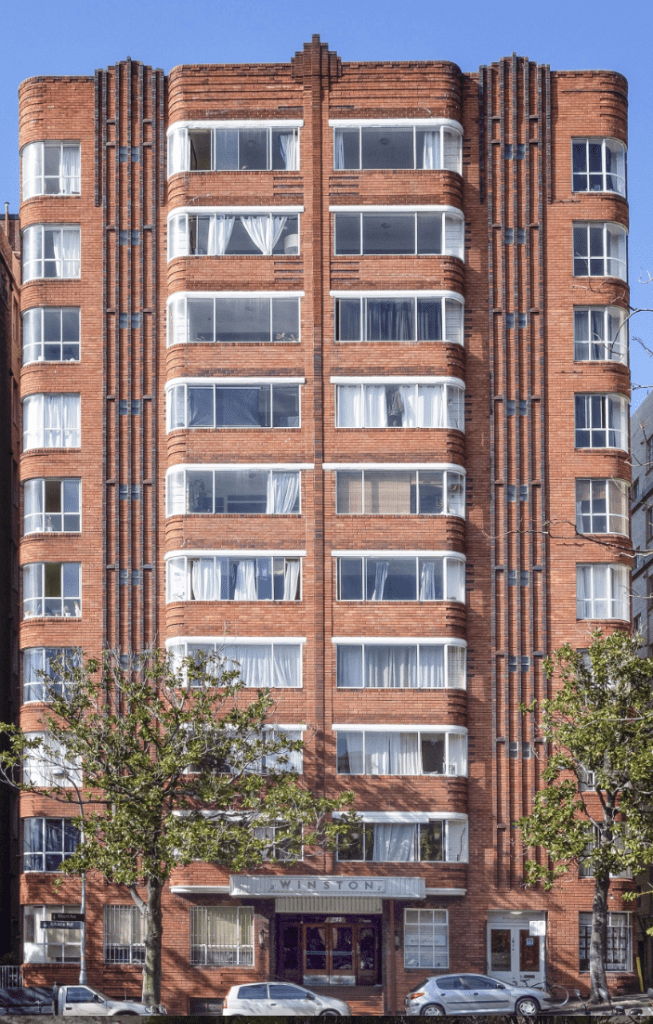
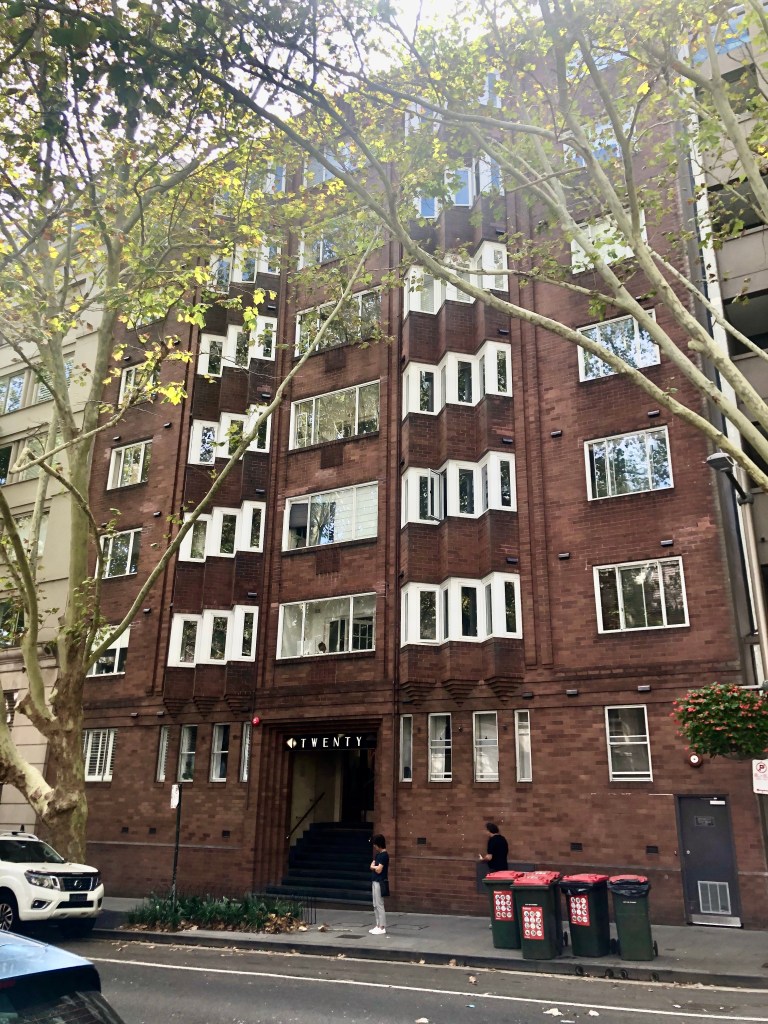
In the 1930s buildings of this sort
were replaced by buildings of this sort
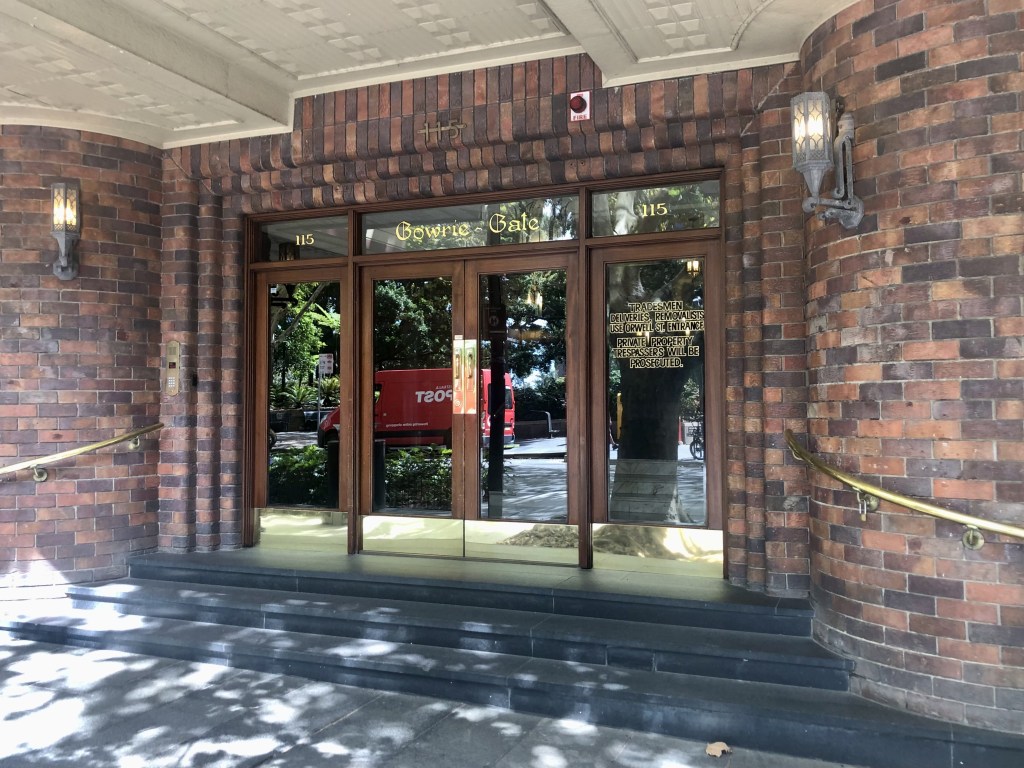
with entrances like this.
Art Noveau Deco run wild. [There now Graham. Okay now?] And after nearly a century they’d still be good those apartments.
Just for the memories.
The Gazebo, the ‘Gazza’, once a hotel and for a long time my Sydney accommodation of choice, now apartments and a distinctive building visible from many points of the skyline.
I knew this was the El Alamein Fountain but thought it was located in Anzac Square. I now discover that acre of paving and concrete is the Lambert Peninsula National Park and think that to be a bit weird.
The walk from the Cross to South Sydney Uniting ambles its way through the tree-lined streets of Darlinghurst and Redfern full of blunt but picturesque Georgian cottages tight to the footpath. Every 100 or 150 metres there are hole-in-the-wall places with a dozen boxes or stools on the footpath where people eat pain au chocolat and drink coffee. Runners pad past in their leisure wear; torsos often naked for the men, nearly so for the women. Buff bodies everywhere. Gay couples (in the week before Mardi Gras) lean in to each other, sublimely indifferent to public interest. These streets are theirs.
There are cities in the world that would kill for areas like this. There are other cities which would kill them off promptly and decisively.
Dorothy is 90, a sweetheart and a bit of a dag. As well as that she is the Reverend Dorothy McRae-McMahon, resolute pioneer of the place of women in the church, the author of a dozen popular books of liturgy, and a warrior — without necessarily meaning to be so, it came to her as naturally as breathing — for the rights of the downtrodden.
She has a gift for saying and writing things that people can connect with, especially those living with trouble, helping to ease their pain. God has spoken to her mysteriously but directly. Her certainty of that is complete. You can make of that what you will but in her line of work it is practical.
For many years she was the minister at Pitt St Uniting in the heart of the city. But now she is a parishioner at South Sydney, a most remarkable church on the southern fringe of its inner suburbs. The church property is 100m from Redfern Park where the Rabbitohs used to play, and more saliently where Paul Keating gave the Redfern Address, still a vivid reminder of what all Australians should know, remember and take to heart: “It was we who did the dispossessing. We took the traditional lands and smashed the traditional way of life. We brought the diseases and the alcohol.”
The church’s congregation is unusually diverse: in terms of sex and gender; in terms of affluence; in terms of cultural and ethnic background; in terms of education; in terms of health and wellbeing; in terms of drug of choice (which might be Ceremonial Grade matcha). Dogs, kids, people in off the street looking for some shelter just absorbed into the mass which I remember on my visits as being striking for its relaxed intimacy. Stuff going on all over the place, but still having a purposeful shape, capped off with a shared feed.
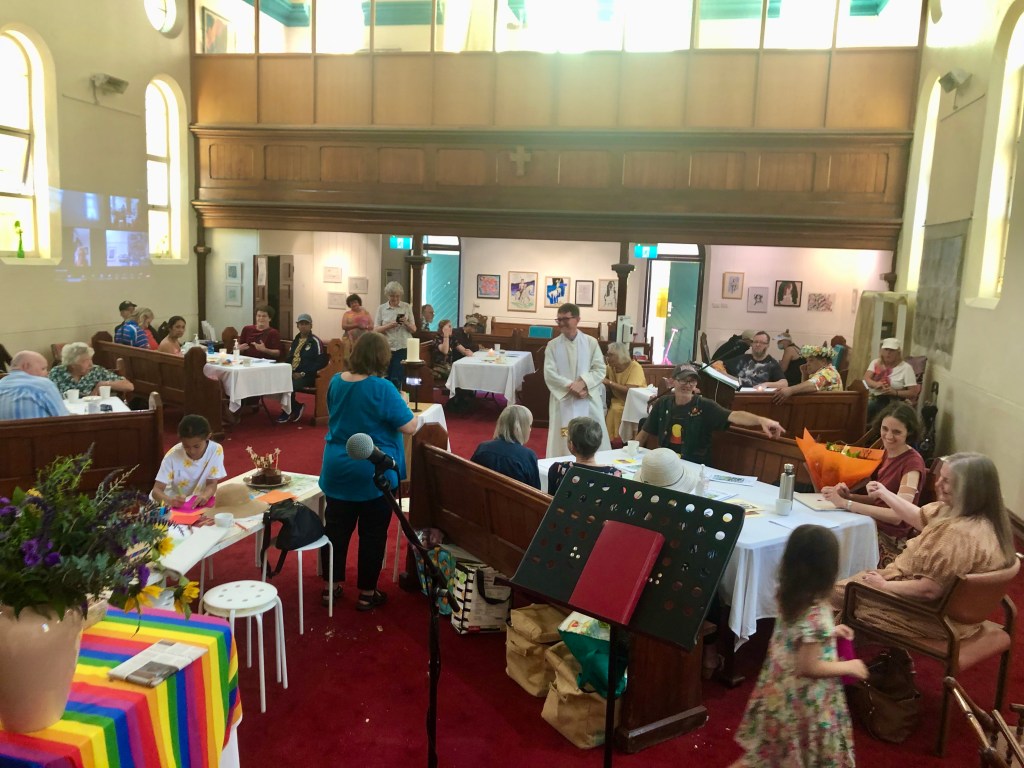
That’s a church service. But a year ago. Various parts of the church building are being renovated because the Sydney sandstone of its decorative front has turned out to be porous and flakey. The service I went to most recently was held in a community centre a short way down the road. But just the same sort of thing. Everyone publicly welcomed by name, the minister providing the homily but not a lot else. There were a dozen ways to contribute and perhaps 20 people did, reading lessons, providing notices, or mentioning people and their situation to be remembered in thoughts and prayers.
One reason I wanted to use this photo is because Andrew Collis is in it. It is shared magic, but he’s the magician. Slight, quiet, but both deft and definite, he is such an admirable presence. There is not the slightest sense of disorder, nor is there anything about these services that is dumbed down. A lot of the ideas discussed are chewy and testing.
The text for that Sunday’s thinking out loud — like everything else, so carefully prepared — was Luke 4: 14-30, a curly one made more so by the reality of its rendering.
Jesus goes home to Nazareth and at the synagogue reads from Isaiah: “The Spirit of the Lord is upon me, because he has anointed me to bring good news to the poor. He has sent me to proclaim release to the captives and recovery of sight to the blind, to set free those who are oppressed.” He rolls up the scroll and sits down. You can see it. This is direct reportage. Then he says, ‘It’s me. You heard it here first. I’m the one.’ After the ‘That’s Joseph’s lad though isn’t it? I thought he was a carpenter’ moment, “All spoke well of him and were amazed at the gracious words that came from his mouth.”
There follows a bit of to and fro where Jesus seems to be demanding to be a prophet but without honour in his own country. The history of prophecy, he suggests, is that people like Elijah and Elisha largely ignored local issues and did their best work elsewhere. But “when they heard this, all in the synagogue were filled with rage.They got up, drove him out of the town, and led him to the brow of the hill on which their town was built, so that they might hurl him off the cliff.” A sharp turn, about which you’d like more detail for full comprehension. However, and what might or might not be the moral of the story: “But he passed through the midst of them and went on his way.”
It’s a story with its share of puzzles, but this day it seemed to be about courage in the midst of adversity, about adhering to your principles, about being honest and open regardless of the consequences. And that would all fit.
Andrew has been there for 10 years and I imagine the fact that there is a garden and chooks in a chook pen at the back of the church might be at least indirectly down to him. I grow in confidence when I look at the list of the church’s working groups: Arts, Mirrung Garden, Hospitality, Ministry Development, Property and Finance, Safe Church, and the ‘South Sydney Herald’ a monthly with a circulation of 10,000. How do these things grow out of such apparently sparse resources? Andrew has been there for 10 years, but for only a few weeks longer. I hope another hero emerges.
This might be the modern church everywhere. I don’t know. I’m not an adherent. I don’t as a rule go to church. But this is the ultimate Anti-Trumpism, alive and well. However modestly, ‘Great’ in actuality rather than as a word on a red cap. This is lived and productive and sustaining diversity, equity and inclusion — the much maligned DEI — and proof that it can happen at least somewhere and be beneficial for all concerned.
• • • • • •
Finally the gallery seems to have been tarted up. There’s better stuff in the new building; there has been some re-hanging among the Victorians for the first time in living memory; the Asian section has been re-imagined. My arts correspondent tells me there is a new director. This turns out to be only prospectively true. July. So it wasn’t that. Just time for a bit of house-keeping, and the revelation again of the superior quality of the AGNSW’s Indigenous collection.
A fine way to finish. Ginger Reilly at his best: Nyamiyukanji, the river country with gnak gnak, Ginger’s Jukurrpa, in the foreground.
In the woodcut above it is the Dutch flag flying over Dejima (‘exit island’), an artificial island barely attached to the city of Nagasaki which on completion in 1634 was about 120m long and 75m wide. That elegant curve was shaped by its junction with the Nakashima River at its outlet into Nagasaki Bay, a traditional landing place for ships. At the right hand end it has a sea gate. It is connected to the mainland by a modest bridge that had a guardhouse at each end.
Two years earlier the Tokugawa Shogunate required 25 local merchants to build the island as part of a project to curtail the spread of Christianity and what was seen as the predations of Portuguese merchants (and missionaries) while still enabling a trickle of bilateral trade. After some muscular diplomacy and an undertaking that there would be no dabbling in any sort of religion, the Dutch East India Company was chosen to be the responsible partner.
As well as the major staples of trade, Japan was introduced to beer, coffee, chocolate, sundials and astrolabes, tar-based paint to caulk ships, badminton, photography and many new foods including cabbage and tomatoes through the sea gate of Dejima.
For just over 200 years at any one time only about 40 people lived on the island, 15-20 of them Dutch half a world away from home, supervised by around 50 Japanese officials some of whom lived on the island which was also visited by cooks, carpenters, interpreters and other essential workers.
There were no Dutchwomen there. Yūjo (‘women of pleasure’) were included among the essential workers.
Kawahara Keiga documented life at Dejima in the early 19th century in hundreds of paintings of which this is one.
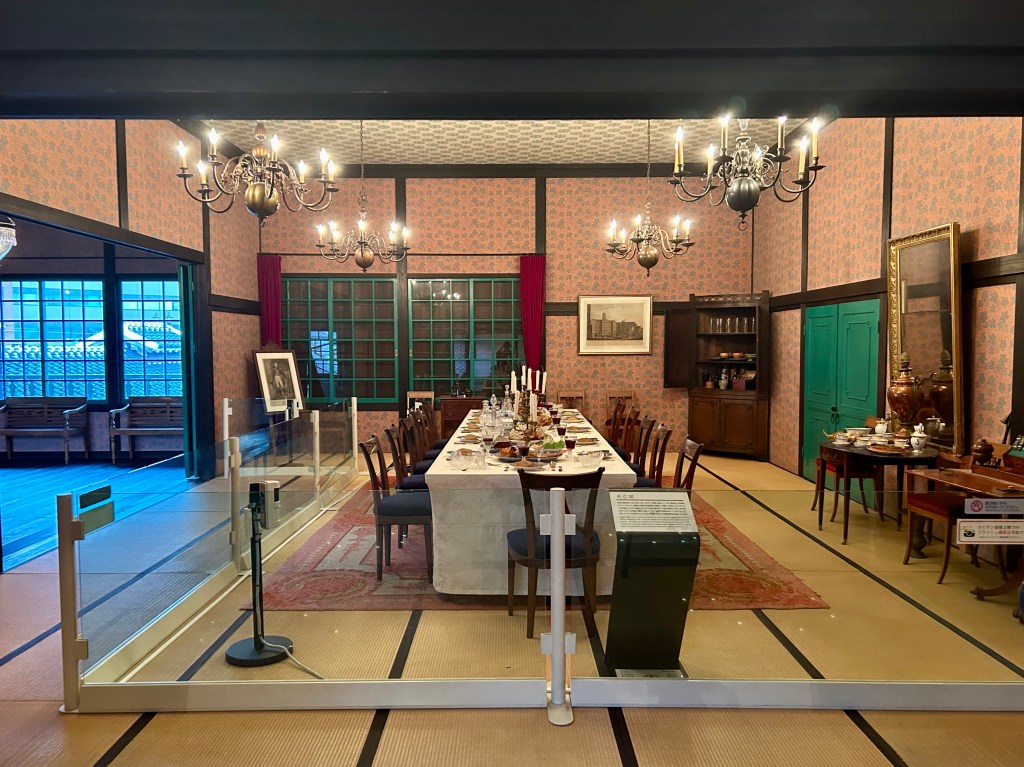
The Dutch officers could, and did, eat right here most nights.
Once a year only they left the island to go to Edo (Tokyo) to pay tribute to the Emperor, of the material as well as ceremonial kind. To glam these annual events up the Dutch sometimes included exotic animals: an elephant, a cassowary, a leopard, and on one occasion a camel.
Dutch East India trading ships would visit — on average, it did vary — just twice a year in May and June, the season of favourable winds. During the years Napoleon controlled the Netherlands no ships came. For Hendrik Doeff, the Chief Factor during this period who ended up living on Dejima for 17 years, this must have been an existential puzzle. (From his log: ‘Nobody who is not here in person can imagine our state of mind. Separated from all community, attached to a place which is never visited let alone passed by ships, not knowing, not hearing, not there, in the whole other world going on outside.’)
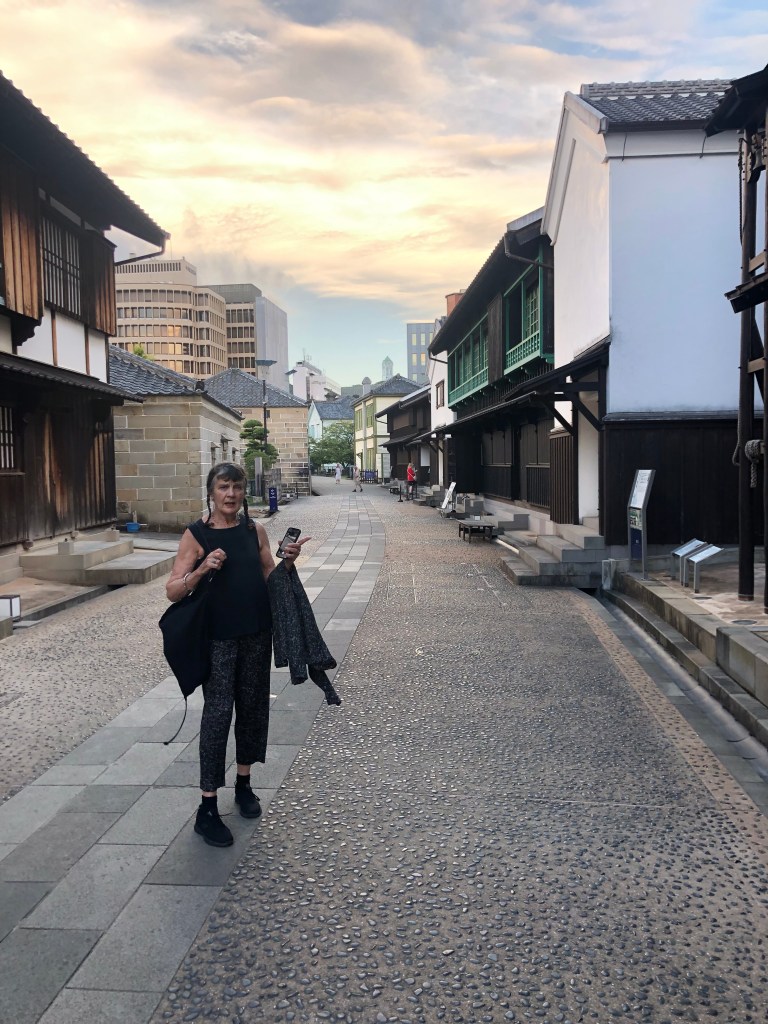
Dejima is now embedded in city buildings and surrounded by office blocks and shops with a strip of restaurants calling themselves ‘Dejima Wharf’ between the island and the bay. 18m was carved off the inner curve in 1888 as part of a diversion of the River. Today, from one angle, it looks like this.
From another, like this.
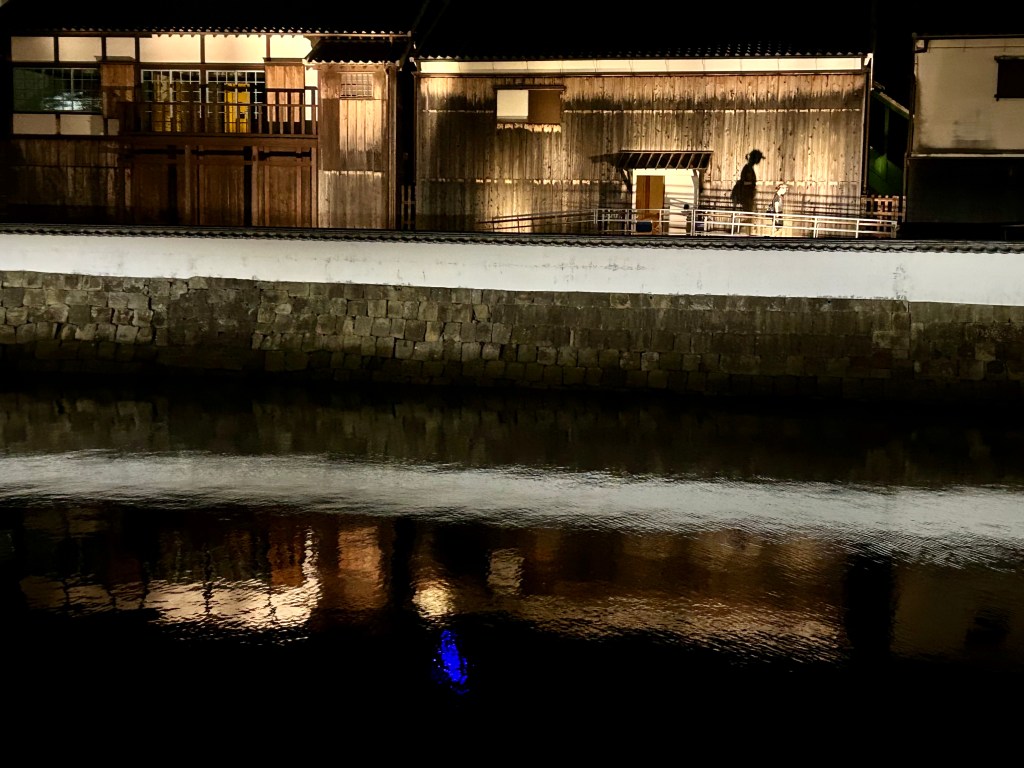
And this, I think, is my favourite photo from our trip. Taken by Myrna. It is a shadow as well as a figure against one of the Dejima warehouses. And I don’t know where the blue flash came from, but there it is.
• • • • • • • •
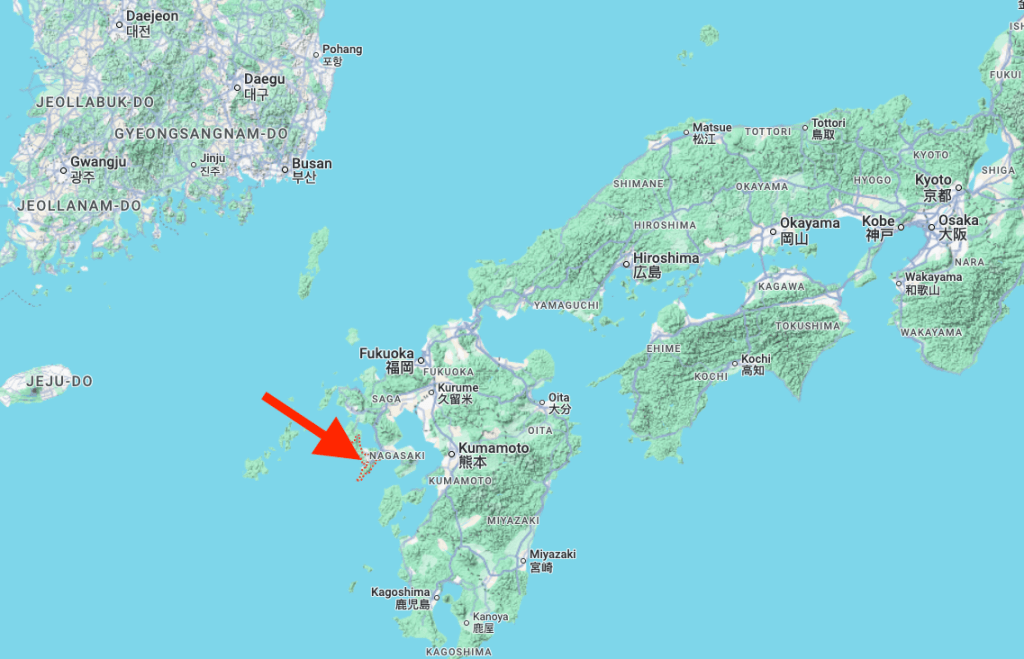
Dejima is a fertile place to start talking about Nagasaki, a city full of important stories and a great place to visit. Known largely in the west as one of the sites for exploding an atomic bomb, it is so very much more.
The city streams, long and narrow, down the valley of the Urakami river. Its population today is about 430,000, not big for a Japanese city. It was about 240,000 in 1945 when the bomb was dropped. It has a substantial and sheltered deep water harbour with industry at various scale lining its western banks. (Massive ship yards with a giant gantry on the left.)
It has always been a place where things were made: Japan’s first porcelain and glass, metal filigree and silverware, textiles and lacquerware as well as steel, machinery and armaments. This is one consequence of its location: the obvious first port of call for contact with China (silk, ceramics and lacquerware), Korea (glass) and later for European traders (the filigree and other products associated with precious metals).
You would have to assume it has always been cosmopolitan. It is a city at the edge. Edge cities … oddities like the sale aisles at Aldi — surprising enough to throw you just slightly off balance, but comfortably embedded in their own context. Nagasaki has distinctive flavours and shapes very much of its own. Customarily, there are regular attempts to rope such cities back into the mainstream. That adds to their character.
It also has an unusual religious history.
The Jesuit priest St Francis Xavier was the first Christian missionary to arrive in Japan (in 1549), first at Kagoshima in the south of Kyushu but then, more productively from his point of view, at Nagasaki and Hirardo in its north. He had matched tenets of Christianity up with aspects of Buddhism and persuasively evangelised in these terms. Hundreds converted to this version of religion quite quickly, expanding into thousands over several decades (possibly to 300,000 by the end of the 16th century; most of the inhabitants of Nagasaki for example). One of these converts was the daimyo (magnate, overlord) Omura Sumitada who in 1580 vested control of the Nagasaki prefecture in perpetuity to the Society of Jesus. Remarkably the Jesuits had their own substantial administrative region in Japan. Just think about that.
This didn’t last long. Toyotomi Hideoshi, the ‘Great Unifier’, placed the Nagasaki region under his direct control in 1587 and ordered the expulsion of all Catholic priests. He had the example of the Philippines to consider. It was not paranoid to assume that Augustinian and Franciscan friars had paved the way for the colonisation of those islands by the Spanish. In 1596 a Spanish ship, the San Felipe, had foundered on the coast of Shikoku. Those on board, including Catholic missionaries, rather foolishly suggested that they were the precursors of a much larger Spanish presence.
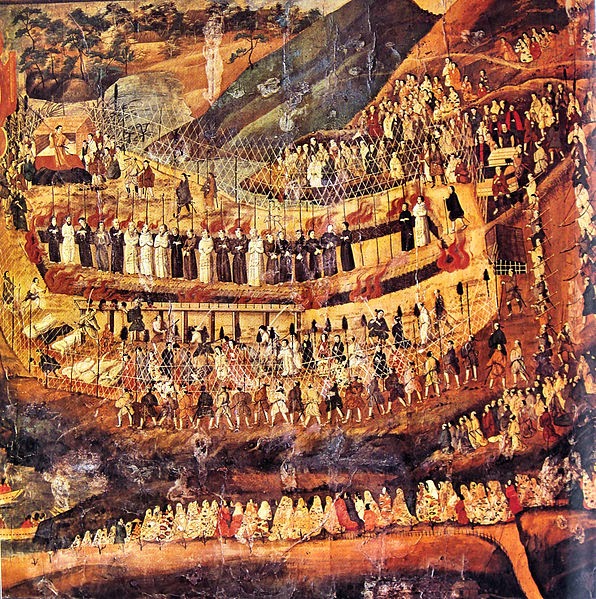
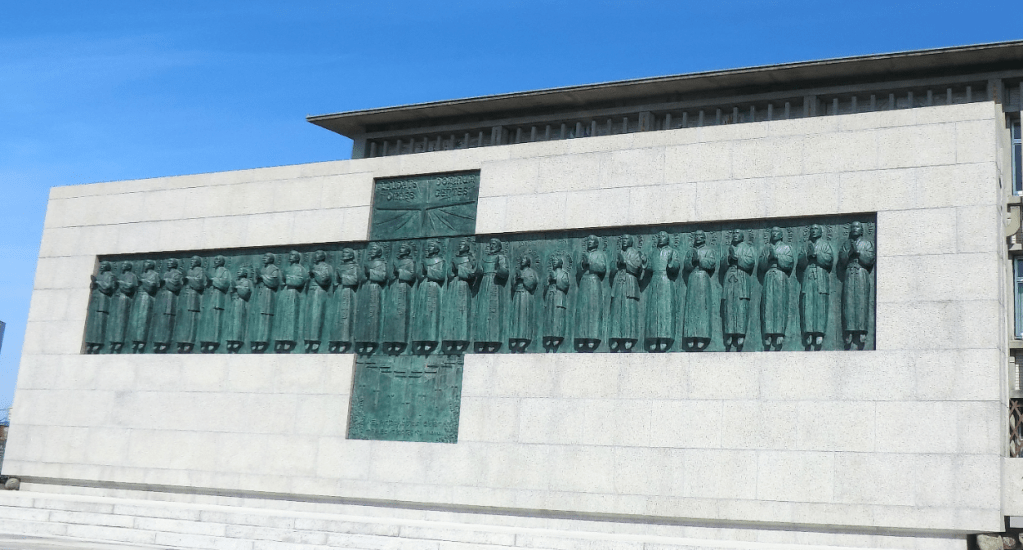
Within a fortnight Toyotomi stepped up the urgency and stringency of his suppression of Christianity beginning with the arrest, public humiliation, torture and crucifixion of the ‘Twenty-six Saints of Japan’: six Franciscan missionaries (four Spanish, one Mexican, one Portuguese), three Japanese Jesuits and 17 Japanese members of the Franciscan community, including three young boys who served as altar boys, one aged 12. This process included an 800km forced march which ended at Nishizaka Hill above the heart of Nagasaki, a destination chosen pour encourager les autres, of whom there were many at that time.
A 17th century Japanese rendering of what occurred.
There were many other subsequent examples of Japanese martyrdom as the authorities sought to enforce the nation-wide ban on the practice of Christianity. But the Twenty-Six Martyrs, the first, beatified by the Church in 1627 and canonised in 1862, caught the wave and are widely memorialised to the extent of being the subject of their own Museum. There is no challenge in finding renderings of the event.
Shūsaku Endō’s prize-winning and brilliant book Silence provides a fictional account of this period and in particular the practice of having to stomp on fumi-e, images of Jesus or Mary, as part of a process of renunciation of Christ and Christianity. (Martin Scorsese made a film of the book starring Adam Driver and Liam Neeson.)
Read the book to find out what happens, but nearly the last word is given to an official who speaks to Rodrigues, the priest: “Father, it was not by us that you were defeated, but by this mudswamp, Japan.’
• • • • • • • •
This story could head off in a number of directions because the themes of politics, religion and commerce in this context are so intertwined. But the basic underlying issue is deeply familiar: how do you get what you want from an innovation/ new situation without all the bits you don’t want as well? (See eg social media, or the internet in general.) There were major benefits to be gained from contact with Europeans, not least the prospect of making a lot of money. But what were they bringing with them? Among other things, an untidy mess of alien mysticism and creeping insubordination.
In 1571 the port of Nagasaki was officially opened to world trade, at the time a limited concept. Among the first ships arriving was a Portuguese vessel which left behind cases of syphilis and other previously unfamiliar health disorders. And yet it also brought the first velvet the Nagasakians had ever seen, along with a host of unfamiliar spices from Indonesia. It offered silk and unknown types of woven cotton from China, and its traders provided good prices for Japanese silver, copper, ceramics and camphor. What do you do?
By the first few years of the 17th century the rulers of Japan had decided. They instituted Sakoku (‘chained country’), a series of directives that enforced self-isolation from foreign powers. From the Edict as it evolved in 1636:
‘No Japanese ship … nor any native of Japan, shall presume to go out of the country; whoever acts contrary to this, shall die, and the ship with the crew and goods aboard shall be sequestered until further orders. All persons who return from abroad shall be put to death. Whoever discovers a Christian priest shall have a reward of 400 to 500 sheets of silver and for every Christian in proportion. All Namban (Portuguese and Spanish) who propagate the doctrine of the Catholics, or bear this scandalous name, shall be imprisoned in the Onra, [the common jail of the town]. The whole race of the Portuguese with their mothers, nurses and whatever belongs to them, shall be banished to Macao. Whoever presumes to bring a letter from abroad, or to return after he hath been banished, shall die with his family; also whoever presumes to intercede for him, shall be put to death.’
Strong.
Foreign powers were entirely banned from any diplomatic and trade relations, with the exception of the Chinese … and the Dutch at Dejima. This situation didn’t change until the mid-1800s, when Japan was forcibly ‘reopened’ by naval emissaries of the United States.
Japan might have been closed, but the door was still open just a crack at Nagasaki. This is one of the things that makes the city special.
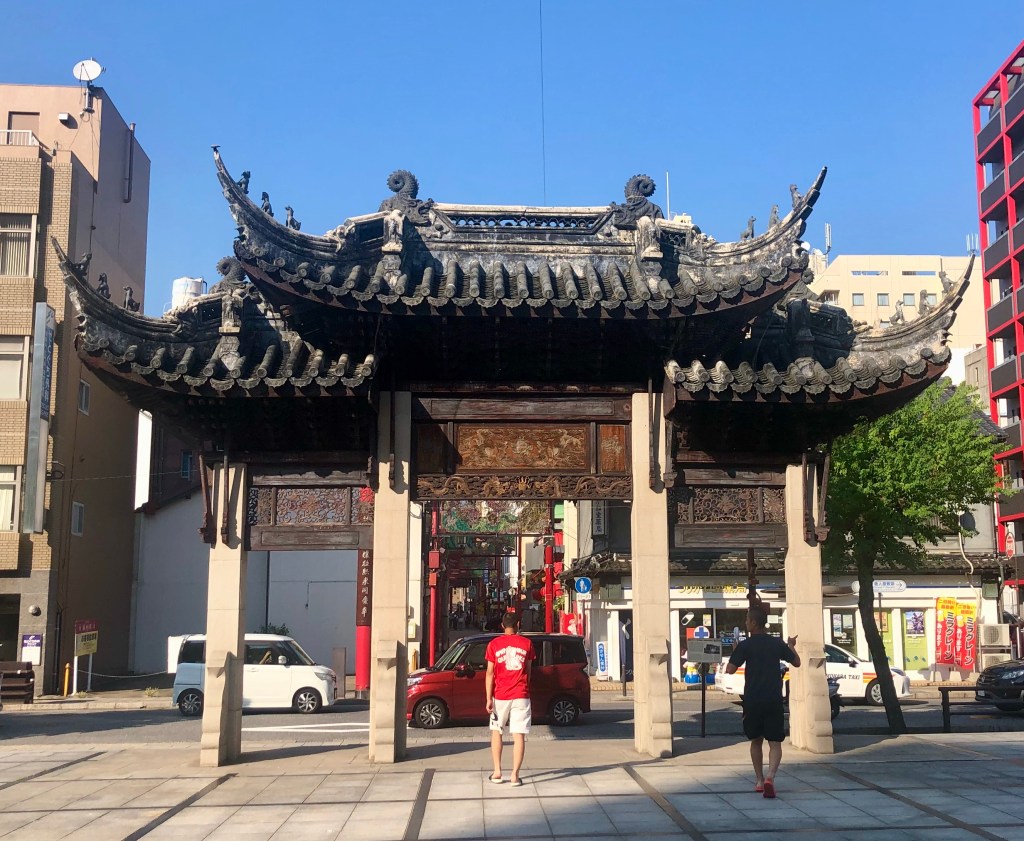
It had then and has now, unusually for Japan, a Chinatown at Shinchi (its current entrance at left). For most of its life this was a high-walled enclave which seems to have been treated more strictly than the European compound.
Among the Dutchmen on Dejima there was always a trained doctor. Engelbert Kaempfer and Carl Thunberg were two of these in the early years, skilled, professional … and endlessly curious. Both wrote books about aspects of Japan on their return from Dejima which clearly indicated that they had made the most of the crack in the doorway. It is hard to imagine that even in Japan the strictness of the observation of the rules of interaction would not have waxed and waned, particularly when there was perceived benefit.
In time Japanese and especially the well-to-do were coming from long distances to be treated by Dejima’s Dutch doctors. By 1823 when Philipp von Siebold arrived there must have been some relaxation of the rules because, after curing the illness of an influential local military officer, he was invited to set up a practice off-site and a year later he had developed a school for more than 50 students studying western medicine.
It was also Von Siebold who introduced the first piano to the nation of Yamaha and Suzuki. What a man he must have been. He is pictured below with a telescope, (‘Dutchman watching an incoming ship’, another Kawahara), along with two Japanese women one with the flame-haired child he fathered at Dejima.
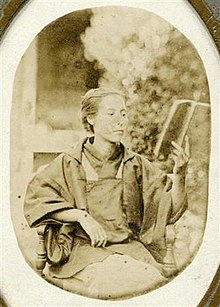
This daughter, Ine (pictured somewhat older at left, but still with reddish hair), became the first trained female medical officer in Japan eventually becoming physician to the Empress. A son from his Dutch family introduced the study and practice of archeology to Japan.
Von Siebold wrote a six-volume treatise on a vast range of subjects related to Japan. Some of his collection of 12,000 Japanese plant species remains at Leiden University in Holland. He also began a huge collection of ethnographic material which provides the foundation for collections in several major museums including the British Museum.
Along with all his gifts and interests Von Siebold seems to have been arrogant and pushy with a tendency to misjudge his own indispensability. He had his own set of rules. He illegally smuggled the seeds of tea plants which became the foundation of the Indonesian tea industry to Batavia (Jakarta). Later he pressed the court astronomer for maps of Japan and Korea, also an illegal act. By chance, court officials discovered them in his possession. He was accused of high treason, was subject to house arrest and then expelled from the country. This is how his initial contact with Japan ended. This was 1825. He had done so much in that time.
The Japanese were also absorbed with the possibilities of western technology and military science. Along with medical knowledge, these fields became known as rangaku, ‘Dutch studies’ or ‘learning’ and became the foundation for a series of academies which grew up in Nagasaki over this period. Dutch had already become an influential lingua franca of the immediate region. Over time, more than 15,000 books were imported from the Netherlands and translated into Japanese for the practical value of their contents.
Despite criticism from Japanese traditionalists, Nagasaki flourished for decades as an important seat of learning. By 1853 when Matthew Perry brought his gunboats into Edo (Tokyo) Bay, as well as Siebold’s medical school, Nagasaki had a naval academy, western-style steam ship building yards, an academy of sciences with interests in physics, chemistry and optics, and the beginnings of steam engine manufacture among many other adventures into western ideas and technologies. Nagasaki was one of the heartlands of the explosion of activity which took place during the Meiji Restoration when Japan re-opened to the world, and ready for it in ways the rest of the country wasn’t.
• • • • • • • •
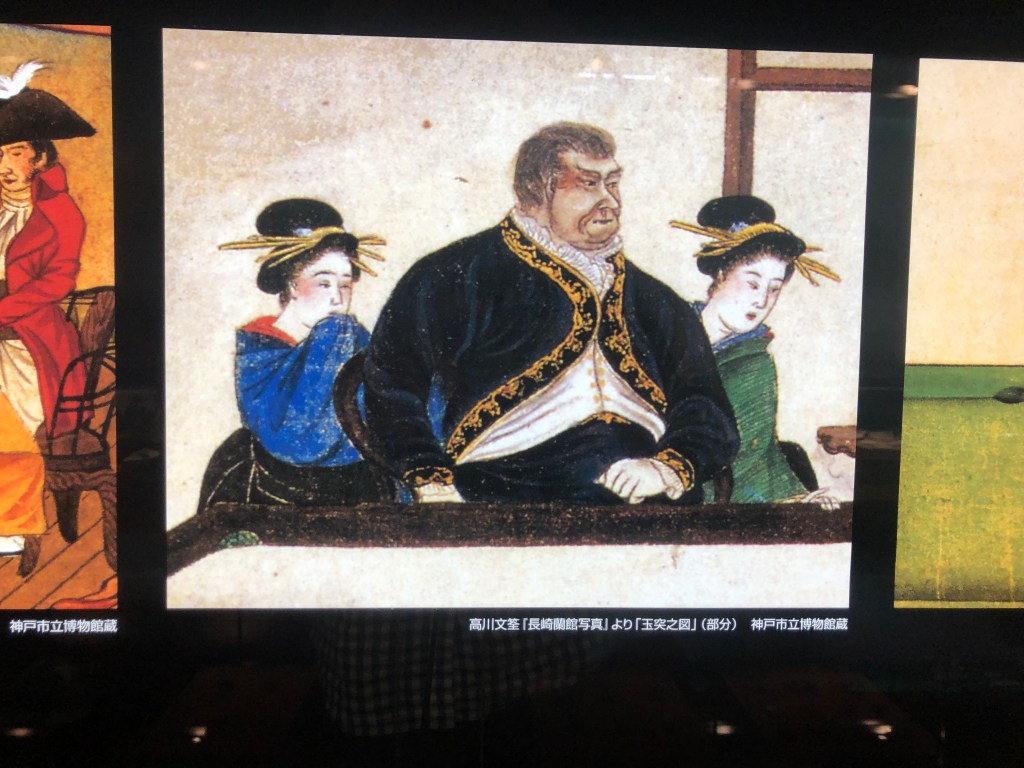
On display at Dejima. It might be construed as a commentary on gender relations during the Edo period; the tag says something about balloon fighting. But I think it is 玉突の場 (‘Ball striking table’). The game of billiards was introduced to Japan via Dejima in 1746. Intercultural exchange can be a strange and wonderful thing.
• • • • • • • •
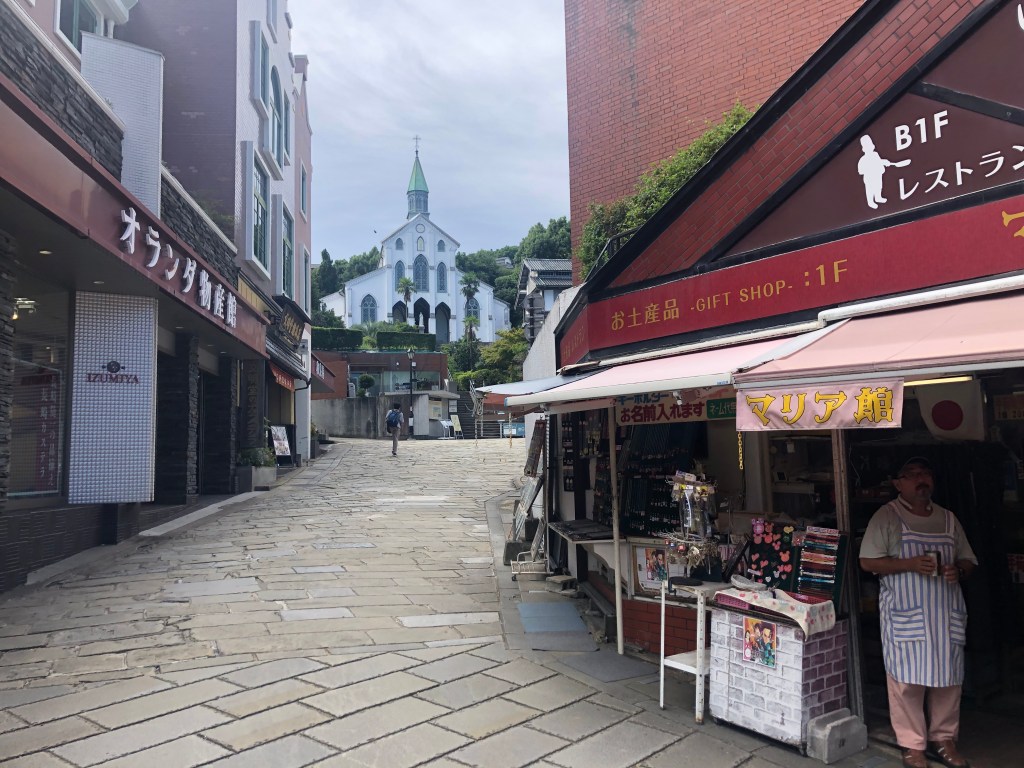
Along with a relaxation of the rules regarding contact with foreigners came a relaxation of the laws relating to religious practice. Some Christians jumped the gun. When Nagasaki’s Oura Catholic cathedral was newly consecrated in 1865 a group of several hundred Kakure Kirishitan (‘hidden Christians’) appeared, largely peasants from the upper reaches of the Urakami valley. For their imprudence they were deported to various distant parts of the country. But in 1873 when all restriction was lifted more than 30,000 people claiming to be Christian emerged — after more than 200 years in the wilderness. Their various doctrines were not immediately recognisable to the priests of Nagasaki (French at the time) who declared them Mukashi Kirishitan, ‘ancient Christians’ and not part of or welcome in the orthodoxy. But Oura cathedral is still very much there.
And it’s still there at the end of one of those tourist avenues where you can buy your fill of soft serve, biscuits, souvenirs, Castella cakes (a remnant of Portugal) and on and on.
And that really is my point. There are vestiges of this rich history everywhere.
Some of the treasures we found in this imposing building, the Nagasaki Museum of History and Culture which we pretty much had to ourselves, apart from the customary rash of attendants. Look at it. Enormous! And very good.
In the background and to the left of the pic below is where the 26 Martyrs met their end. But it is buried from this perspective behind one of the several giant pachinko parlours, office blocks, electronics shops just there, a major tram stop, a construction site and I am standing on the terrace of Amu Plaza a giant shopping centre attached to the very stylish Nagasaki Rail Station.
We got control of the city’s four tram lines fairly early in the piece and used them extensively to get around. But to get out of the valleys in which they run you need to walk. This is one of the things we found,
… the ‘One-legged Torii’, a reminder that there is another story at Nagasaki. There is the matter of the bomb.
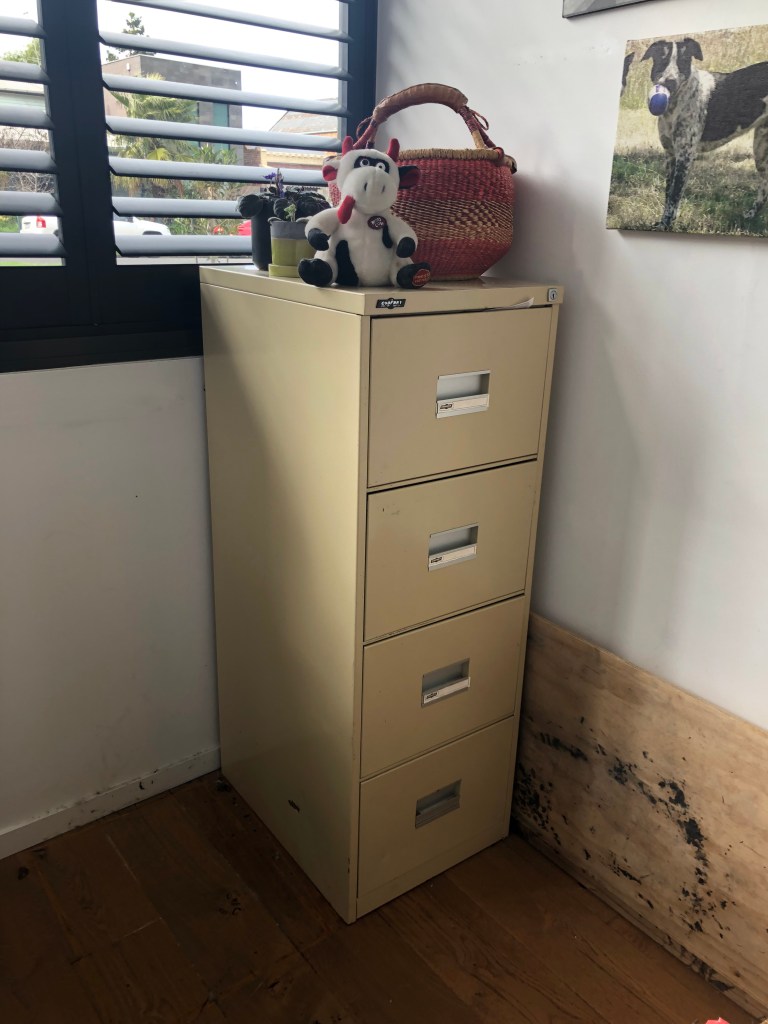
This filing cabinet — a fine example of anachronism — has been itinerant since its originator died, never really finding a home. Perhaps I should say a truly welcoming home.
Four drawers full of (dadah!!) ‘The Anderson History’, it has had plenty of homes. After a period of periodic and occasionally enthusiastic stocking it stood dormant at Laurel Street where it was honoured through the idea rather than the active relationship, the idea being that in that pile, in there somewhere, would be nuggets, gold, revelation, the real story. Marion was sure. She had included all sorts of ephemera: not just lots of letters and photos, but invitations, forms, certificates and even a (small) bit of an aeroplane that had come home from the war. (See more below.)
It moved to Margaret Grove where, in my study, its top provided a place to leave empty coffee cups and bits of paper that weren’t immediately needed. Four drawers that might have been locked. There was an opportunity to do so. The lock is built in but almost astonishingly a key could always be found. However it remained largely unviolated. Myrna may have checked that there was actually something in there a time or two.
Then, after our shift, it went on a country jaunt to Ripon Road which was appropriate in some ways: Western District, biggish house, country comfort, a place given over to enterprise and tenacity. That would suit the broad thrust of the story still undisturbed inside its thin steel walls.
But it returned to the city and went north to Gloucester Street. Jessie said she wanted it … mmm did she say she wanted it? Might be a bit strong. Had room for it. This was the one time it was moved when death or the sale of its contemporary resting place was not involved.
But Jessie likes history, always has, so we could gently lever it onto her. And it could be her turn to make jokes about it. It went with her to Cowper Street. To say the cats enjoy it as a vantage point is true but not intended to sell her investigations short.
* * * * * The idea of family history has a siren call. I’m sure one purpose is to elevate your self-esteem by finding some distant hero who might just be a relative with the same sort of nose as you. And by some distant hero I actually mean any number of distant heroes. Cartloads. All fascinating. And significant, highly significant. Let me offer an example, appropriately highlighted:
The clan produced not only poets, musicians and clerics. Duncan McRae was a noted warrior said to have defended practically single-handed the almost impregnable castle of Eilean Donan against the attack of 400 McDonald fighting men, killing their chief with his last arrow.
Colin Farquhar McRae, The McRae Heritage
Single-handed. Killed the chief with his last arrow! Just how cool is that?! You might like to meet me on that basis alone.
As a rule you don’t stop to think that William Anderson was the Member of the Legislative Assembly for Windermere in the first Victorian parliament. But when you do there are moods in which you might feel at least momentarily enriched.
Family history might also be useful to explain something about you: why you like dogs say, or your propensity to feel just a little bit Scandinavian.
But its real value might be the unexpected clicking into place of pieces, simple pieces not corners or edges, of a jigsaw providing a larger base of meaning to what you know about yourself. With reference to what might be found in those four drawers: who or what was Myrna? Naples as a surname? And Aldridge, was that a person? Why was the Anderson house in Horsham called ‘Pencloe’? And did the Browns really live at Jesmond? (Yes they did. The Walter/ Fallaws must have bought it from them.) J.C. Brown and his engineering works, what did they do? And was he the Mayor of Geelong, or was that his brother?
There have been people who have I have known who have had this knowledge as lived experience. They’ve talked it. (I’m only slightly embarrassed that I used to say, ‘I’m glazing over. I’m glazing over’ as the recitation of possible connections went on. ‘Joycie Jones. I think she was a …’)
And then there is the lens that domestic history provides for the undulations of larger historical events. Is that what happened? Did they notice? Did they react? What were they doing?
The piece of aeroplane mentioned above is in this photo along with a letter from one of the many David Andersons, in this case someone who would have been a great uncle to our girls. The letter says in part:
‘Dear Mother [Florence, who had both a sister/ best friend and a granddaughter called Myrna],
I have missed a week in writing to you, but you will see why later. Part was written at sea and a short note from here where we’ve now been a fortnight … . Haven’t done any work for seven weeks, so naturally will be slightly stale. … Apart from being on leave we have resided in a first class pub which is really our officers’ mess and is very comfortable. Of course there has been the usual reception, routine of records, issue of equipment etc. In our spare moments we have been to see the oldest church in England 11th century at Christchurch, etc. …’
It provides a happy story of tourism (loved the English countryside, hated the cities) and youthful larks. But it is a letter from the war, and a short while later there will be another letter explaining that Anderson D. C. RAAF was in plane which flew into the side of a Welsh mountain. Hence the aeroplane shard. The story builds itself out of parts and moves towards that ah yes … I get it, that’s what happened moment.
Another of the filing cabinet’s treasures — and I know this because it is, within a fairly narrow compass, quite famous and is allowed out for air from time to time — is a photo of Myrna’s mother (aforesaid Marion) at Longeranong (an agricultural college close to where she lived in Horsham) with the Land Army during the Second World War.
This photo is famous because, the story goes, she only went there once and the photographer put her on a tractor and took her photo because she was so good looking. There is plenty of evidence of the latter, clear wide smiling but slightly distant eyes with their own allure, insert acceptable synonym for shapely, hair that hadn’t been too deconstructed by the outdoor life (a little bit Chloe Sevigny perhaps?). But two other photos of all the Land Army girls have recently emerged and she’s there wearing different clothes each time so she could even have been a regular. Yesterday I found a certificate that confirms her appointment as a Lieutenant in the Land Army. You wouldn’t get that for your looks alone.
That’s the sort of thing you can check with the right sort of documentation. And the right sort of documentation was probably in that filing cabinet waiting for a diligent soul.
* * * * *
Jessie started working her way through its contents with great application. Stuff went to the Geelong Historical Society, the War Memorial Records, the State Library of Victoria, ‘Melbourne Royal’ which now runs the Royal Melbourne Show (a pamphlet of the program from the 1920s). And a certain amount to the bin. Files were established and she developed an actual familiarity with the contents. Bless her.
There was one item which showed quite a deal of promise, a first-hand account of the arrival and establishment of the Anderson family, Marion’s forebears.
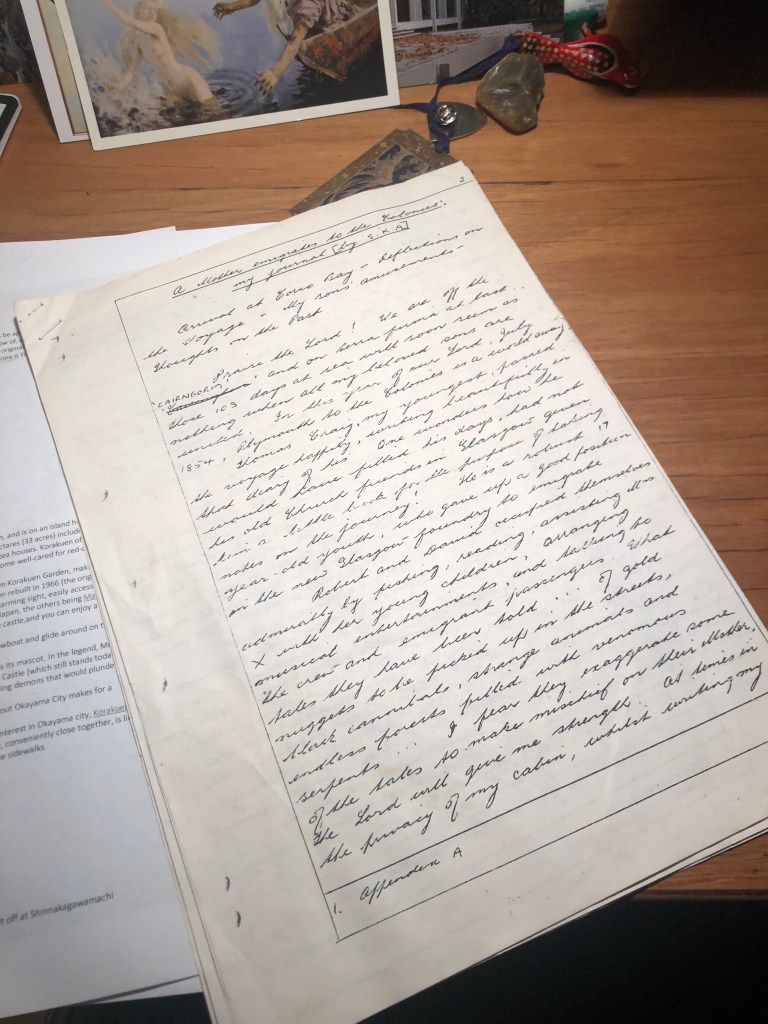
It is a ten-page handwritten and photocopied document entitled A Mother Emigrates to the Colonies: My Journal [by S.K.A.]. And that would be Sarah Katherine Anderson, mother of the six quite formidable Anderson brothers. It was sometimes referred to as ‘The Letter’ which it isn’t; it is self-described as extracts from a journal.
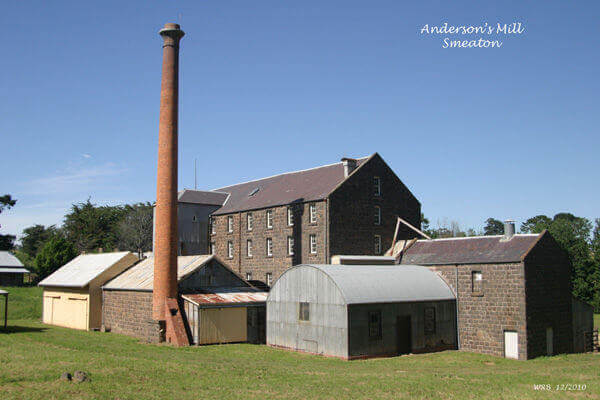
There are strong reasons for finding it of interest. We have, for example, been to Smeaton to see the very impressive Anderson Mill, now apparently an important Central Victorian tourism landmark. We encountered and walked along part of the Anderson tramway when we were doing the Goldfields walk. When I was writing the blog about this I uncovered many parts of the Anderson story new to me, and it came home, as they say, that Sarah was the great-great-great-grandmother of our children. And now here is her journal, or at least extracts from it … a real discovery.
It is written in a tight flattened cursive script which presents difficulties for most people who didn’t learn to write accompanied by an inkwell. So I suggested I’d type it out.
I was absorbed as I typed. Dates right. Events right. Emigrant Scots make new lives for themselves in the colonies through skill, ambition, persistence and hard work. I also thought this is not a story you hear much these days.
But here it is. It is well worth a read.
* * * * *
A Mother Emigrates to the Colonies: My Journal [by S.K.A.]
Arrival at Corio Bay — reflections of the voyage — my sons’ amusements — thoughts on the past
Praise the lord! We are off the ‘Cairngorm’ and on to terra firma at last. Those 103 days at sea will soon seem as nothing when all my beloved sons are united. In this year of Our Lord 1854, Plymouth to the Colonies is a world away.
Thomas Craig, my youngest, passed the voyage happily, writing beautifully in that diary of his. One wonders how he would have filled his days had not his old church friends in Glasgow given him a little book for the purpose of taking notes on the journey! He is a robust 17 year-old youth, who gave up a good position in the new Glasgow foundry to emigrate.
Robert and David occupied themselves by fishing, reading, assisting Mrs X with her young children, arranging musical entertainments and talking to the crew and emigrant passengers. What tales they have been told … of gold nuggets to be picked up off the streets, black cannibals, strange animals and endless forests filled with venomous serpents … I fear they exaggerate some of these tales to make mischief on their Mother. The Lord will give me strength. At times in the privacy of my cabin, whilst writing my journal, I sought comfort by smoking my pipe. Tobacco is my secret weakness … the Lord have mercy on me.
My sons are high spirited and adventurous, and at times the confinement of the ship proved tiresome. We were fortunate that Captain X was attempting to reach Australia in record time. The boys are so excited and enthusiastic about prospects in the Port Philip District that any feeling of remorse I may have had is overcome. What a joy it will be to have all my sons together again!
More thoughts on the Past —
It was a wrench leaving my beloved Scotland, land of my birth. I had resided at New Cumnock, Ayrshire for half a century. However, after dear William’s passing, it was not too harrowing to sell our farm ‘Penclo’. Why the sins of the fathers should be visited on their sons I’ll not know.
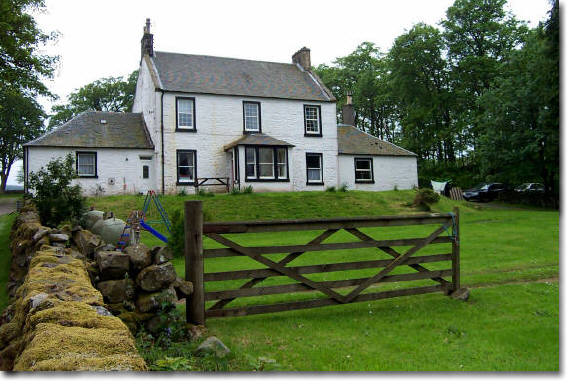
This is ‘Pencloe’ in New Cumnock. You would find it today on the Robbie Burns Trail.
With all our industry and integrity we could not clear the inherited debts. I brought the account book of the sheep sales with me. My sons will be delighted to see the excellent prices fetched.
It is just 17 years since that terrible day when the Lord took our dear William. But I must not dwell on the past. Raising an errant daughter and six lively sons without a Father’s authority has been troublesome. The Lord will surely judge I am but doing my duty.
My sons’ achievements —
I wonder of what account the long hardwon Glasgow education will be to them in the Colonies. Sending them off to St. Giles University with but a bag of oatmeal was indeed rigorous, but they will not improve their station in life without Education. My literacy comforts and consoles me. I have brought Robert’s Veterinarian Certificate with me, John is a cartwright, James a carpenter, William an agricultural labourer, David an engineer and dear Thomas Craig taken from his excellent prospects to emigrate.
We arrive — Corio Bay — First Impressions — July 1854 — Disembarkation
At dawn we have our first glimpse of Point Henry. I search for my dear sons as the ‘Carrington’ [sic] berths and wagons pass by on the muddy roads. ‘Dear Mama! Do come! Do you not ken Wm., John and Jas?’ Thomas Craig calls me to greet these three bearded men. Three long years it is since I said farewell to them. How they have changed! They are lean and sun-burned. James’s wife Katrine Vallance and their Australian-born Mary, my first grandchild, welcome us. What a bonny 3 year-old bairn she is! Give thanks to the Lord, we meet again.
John attends to the unloading of our chattels. My big black trunk should have protected its contents, including my family Bible, from the damp. I do hope the seeds William specifically asked for have not been adversely affected by the sea water. He reports the climate and soil of the Colonies are excellent for horticulture. For my part, I insisted on bringing my own little Baltic pine dressing table from ’Penclo’. It is modest but sturdy and will serve well — a remembrance of home.
We say ‘au revoir’ to our shipboard friends and journey by coach to Collingwood, Melbourne Town. The heavy baggage will follow later. I must admit to being filled with curiosity to see our new residence.
Life in the city — Collingwood‚ gold fever
Suddenly I hear ‘Mama! Mama! Look!’ Thomas Craig points to a group of men carrying picks and shovels, some pushing loaded handcarts. ‘Gold! Gold! We’re going to make our fortune on the diggings!’ we hear one cry. I can see the lust for gold and riches in their eyes. Oh! How will my sons resist Mammon’s tempting? What an air of excitement is all about. Many shops are left unattended as their owners are off to seek a quicker fortune on the diggings.
My sons have established a modest building construction enterprise in Collingwood. We all occupy a wooden dwelling in Smith Street, kindly rented to us by Mr X.
We decide to move
The winter climate is delightful. We do not need to spend much time indoors which is fortunate as our residence is too small. We all hold a round table conference and decided to move to Stoney Rises, Smeaton, where Robert with his wife Maggie have taken up land. Perhaps summer in the hills will be more agreeable. I confess I have cast aside my whalebone stays. They are much too constricting in this colonial heat, and are apt to bring on me a fit of the vapours. Thomas Craig attended the Scots Church on the Sabbath wearing no coat. I prayed God would forgive his lack of decorum in his splendid new Collins St kirk.
Journey to Smeaton
Thomas Craig travelled with me by Cobb and Co. Coach to Ballarat. It cost £1-5-0 each, us departing at 6am, and arriving at Cobb’s Stables by 3 pm. I am still sore from the bumps and jolting from the rough roads, and have a slight chill from being put out at the flooded Bacchus Marsh ford. But I thank God I did not need to walk as do some miserable riff-raff, miners and heathen Chinese. Rumours of new gold strikes abound, as do stories of what really happened at the Eureka uprising in Ballarat last year. Those hot-headed Irish are bound to cause strife.
At Smeaton
Robert and Maggie gave us a great welcome to their modest but comfortable dwelling of some local timber. It has a solid floor and is secure against the rain and wind. He is prospering, having acquired Mr X’s excellent flock of yews [sic] and five breeding doggs [ditto]. Robert’s veterinarian training is of great count. He keeps his own flocks well-attended and breeds excellent wool from the best stock available. His advice is much respected and well paid for by the district farmers. John is having constructed a huge bluestone flour mill on Birch’s Creek. He is diverting water from upstream, to power the stone mill wheels which grind the corn.
Further opportunity — James at Dean
The Good Lord has shewn James that an easily-won golden fortune is not to be his. He came from the Blackwood diggings over the ranges to arrive at Dean in the Bullarook Forest on Christmas Day AD 1855. He speaks highly and enthusiastically of the prospects and urges his brothers to take up land there. He has taken a holding with the remains of his ’Penclo’ inheritance, plus a little gold success, established a home and begs us to hurry there urgently before the good land is all bought up.
Journey’s End — from Smeaton to Dean
The ten-mile journey was agreeable. Robert spared us an excellent team to haul the wagon with my personal effects. And what a forest. For once James was not exaggerating. Trees of a hundred feet and more. Native animals aplenty and colourful exotic birds with strange calls. At times I am homesick for the tuneful blackbird and nightingale. Mr X. has released two pairs of mavis [Scottish mistle thrush], so they may breed too and add tune to the present cacophony. Birds as colourful as these would be seen only within the aviary of a grand house in Scotland.
Much to do — Clearing the forest — sawmills — felling timber — Labour — the railway — locomotives — Barkstead to Dean — the Schoolroom — The Chapel — Farm routine
The big forest about my home ‘Loatta’ is soon cleared. An old Abo indicated this place to mean ‘resting place beside water’, so we have adopted ‘Loatta’ as our property name. At the Dean mill logs are sawn into boards and taken by wagon to Creswick, Allendale, Broomfield, and sometimes Ballarat to build houses or line deep mines. Further away are tall straight forests of messmate, peppermint, whitegum, candlebark, wild cherry and native pine. The valleys afford some fresh streams and abundant springs lined about with all manner of ferns, tree ferns and pretty flowers. The wattles are golden in late winter and spring. What strange seasons these are: at home ‘Penclo’ would now have its first early snow. At Yuletide we prettied the dwelling with green branches, but I miss the holly and pine. William has planted the redwood seeds he got from a miner from California. They are growing apace, as are the Chilean pines, cypress, cedars and the orchard.
Naturally I continue to keep the business transactions accounts as none of the men can spare the time. I try to keep a rein on my sons’ ambitions. Last week we purchased an adjoining allotment. Already some land is sown to oats — after the first harvest we had winter feed enough for our horses, plenty of seed for the new field and a tidy sum from the sale of the remainder. How abundant is the Lord and this soil.
We have no lack of labourers — the gold fever has ebbed, and many family men are satisfied to abide in small cottages with constant employment and good prospects. I see the need for a chapel and schoolhouse. These children will not be growing up to fear the Lord, or know their numbers. I am never idle. Daily I use my knowledge of healing herbs to attend to any sickness or accidents.
A New Scheme
The forest close by has been cleared, but the demand for sawn timber continues. David and Thomas Craig have envisaged a means by which logs and sawn timber may be brought down from the Bullarook Forest and Barkstead to Dean. They hope to apply their engineering skills to a clever scheme to build a timber tramway on which will run a locomotive.
Tragedy strikes
This sad day, the twenty-fifth of January 1858, my youngest son Thomas Craig was suddenly and tragically taken from us. Whilst timber-getting at the Bullarook Forest, he was stricken to the ground by a loose branch from a falling tree. A strong north wind blew the branch away from its expected path, striking him a severe blow on the head. He was pinned to the ground and never regained consciousness. Our sad cortege took him to rest at the new cemetery at Creswick where God willing I will join him when my time comes. So this alien land has claimed my last born whose expectations of it were so high. And him here but four years, and just into his twenty-second year. I am distraught with grief, but I must not question the wisdom of the Lord who gives me comfort and strength.
Construction of the tramway
David and Jas. continue with the construction of the timber tramway. Robert resides at Stoney Rises having just taken up more land in Derby in the Sandhurst District. John’s Smeaton mill is now in full production. As dear Thomas Craig was so enthusiastic about the tramway project, I will honour his memory by attending to its completion as soon as possible.
The Barkstead mill now employs 150 men who have built their homes from timber offcuts. A secular school has been established.
We have seen to the construction of our School Room which stands apart from the main dwelling. It is wooden, 12 ft x 22’ x 10’ and lined with panelboard. Miss X is the very capable governess. The Reverend Kennedy comes from Creswick to instruct the children in the Presbyterian faith. The Church of England clergyman is most tiresome about insisting on preaching his Papist nonsense. The Wesleyans are building a chapel beside the stream on the south. I regret to write that the ungodly spend much time and currency at the public houses — either at Macs, the Dean Hotel, or Mr Lennon’s ‘Comet’ at Bullarook.
Visit by William and family
A recent visit by William and his family created a most agreeable diversion. He told of a call by the itinerant artist William Tibbits whom he engaged to paint a delightful watercolour of his residence. The charge was one guinea. Little Tom, Jack, Joyce and Nat wanted to be drawn into the picture, but were forbidden. Their inclusion would have cost extra. [William Tibbits was renowned for this sort of thing. He left a substantial record of the colony’s newly built environment. Here he is at left.]
My Portrait
I have been persuaded to sit to have my portrait drawn. Mr Y promises good value. His samples in pastels on grey paper are very effective. I dress in my best black dress and tie my white lace Sunday Bonnet over my fair hair which I severely part in the middle and tightly braid. I decide to wear the pretty cameo brooch from ‘Penclo’ — my last memento of dear home. The picture is to be mounted in an ornamental frame. I wonder what will become of it, but am feeling too tired to really care, and my cough worsens. I pray I will not be judged guilty of the sin of vanity.
Construction of the tramway continues
The two tramway bridges are due to be completed before the winter rains swell the East Moorabool and Werribee Rivers. They are imposing 50’ high structures reinforced to take the weight of the locomotive. The tramline will run the fourteen miles to Dean and the trip with timber to Buggylanding will be 20 miles. Four daily trips are planned in the summer and three in winter. How proud I am of my sons’ skills and yet I worry. This tramway is to cost £50,000 without the bridges. Then too, there are all the locomotives to import as well as parts for repair and maintenance. The saw blades too are brought from Scotland.
Overwhelming tiredness
I feel very tired. It is eleven years since our arrival in the colony. Today, July 12, 1865, I have had excruciating pain in my chest. I will write no more. My sons come to farewell me. I have great cause to be thankful to Him who has guided me through a long and good life. I long to be laid to rest besides Thomas Craig.
* * * * *
And now, a change of tack, and another story about history.
It’s a true story but she didn’t write it.
As I typed I became more and more convinced I wasn’t reading anything written by Sarah Anderson. It wasn’t immediate because I was busy typing. But I started hearing the voice of the writer and it wasn’t hers.
The document consists of excerpts spread over an 11-year period, short excerpts, probably just picking the eyes out of what is referred to as a journal. And, of course, it all chimes pretty much with what we know to be true about the family — a broad picture, just some if not all of the bones, but they are in the right place.
The three boys migrate from Ayrshire in 1851, land in Adelaide and work off their indenture in South Australia, chase gold in Victoria with some fairly modest success, establish a construction business in Collingwood and so on. Yes. Mum and the younger three boys come three years later. The family set up in Central Victoria, build a tramway to help strip most of the useful timber out of the Bullarook Forest, develop a major cereal mill … No question. All present and correct, and worth knowing and finding interesting if you’re a local history buff or a member of the family. That’s what happened.
But she’s been on the ship for 103 days and gets the name wrong? ‘Carrington’ for ‘Cairngorm’? A transcription error no doubt. Easily done. It might be the same with ‘Penclo’ for ‘Pencloe’ where she had lived for 50 years. Although I’m not sure a Scot would make that mistake. Transcription again. And strange to have a first glimpse of Point Henry as notable … I’d be surprised if Point Henry was called Point Henry in 1854, but there now see — I’m wrong. Named after Captain Edwin Whiting’s brig ‘Henry’ which anchored there in 1836. But why would you notice and comment on Point Henry, a very undistinguished protuberance at the entry to Corio Bay? If you lived in Geelong you could well know it, but arriving from Scotland? However, it might have been one of those landmarks that, say, the Captain talked about — you know — That’s when you know you’re really there! — that become indelible in a traveller’s mind. And they exist. I know they exist.
Ducking off to her cabin to spoke her pipe … could have, could well have… sparks the narrative up quite a bit. Colour, in what I must say is a fairly disciplined and bloodless portrait. But just a bit out on the edge. The choice to anonymise the people, X, Y, she has dealings with might be deemed polite or at least politic. Might be a habit. She could have written ‘heathen Chinese’, but I think it is more likely if she wrote anything of the kind she would have used, in keeping with the times, the plural version ‘Chinee’.
But — and this is where my confidence collapsed — she would NOT have written, or said, or thought, ‘An old Abo’. Too clumsy. Too vulgar. Too intimate. (And as if her sons would leave the accounts entirely to her. As if.) It’s not her.
I reread it more closely and became convinced I wasn’t reading a woman’s writing.
Why? There is the absence of affect for a start. This is a middle-aged, formed, woman starting a new life at the other end of the world. Things will NOT go smoothly. She will worry, have setbacks, be troubled, homesick, feel threatened not least by the comic list of Australian stereotypes which is still used to frighten Englishmen. She will feel, if not necessarily talk about her feelings. That would be Scottish. But she will register them, and not in the way that occurs here.
Will she really make a list that goes ‘messmate, peppermint, whitegum, candlebark, wild cherry and native pine’, or note that the school room is ‘12 ft x 22’ x 10’ and lined with panelboard’, or that the two tramway bridges will be ‘imposing 50’ high structures reinforced to take the weight of the locomotive’? No mate. Nah. That’s the sort of thing I’d do. It’s not her.
She will be interested in domestic detail: what you put on the table to eat, what you put on the table to eat on and with, what you wear, where you might buy it, how you spend your time out of the forest, and especially who you are socialising with, and how they’re getting on with each other. Because that’s what life is.
And quite possibly this is all acknowledged somewhere that we don’t know, Like the ‘Journal of Sarah Anderson as recounted, or imagined, by …’. And that’s fine.
When you go back to it with this in mind, you note that it all has that tone of slightly heroic late Victorianism, a masculine textbook style of missing out no fact — it is very dense with information and very tidy, covers all topics — while cross dressing with regular exclamations of piety.
And I think that makes it even more interesting as a version of how somebody, a capable but not gifted writer, thinks a middle-aged Scottish woman in Central Victoria from 1854 until 1865 would describe her life. And he, for it is a he, is wrong.
We’ll have to look elsewhere for that sort of truth. And you know where it might be found? Somewhere in the contents of that capacious filing cabinet. (And I will even hazard a guess where: in the endless correspondence between Florence Anderson and her sister Myrna Charlton.)
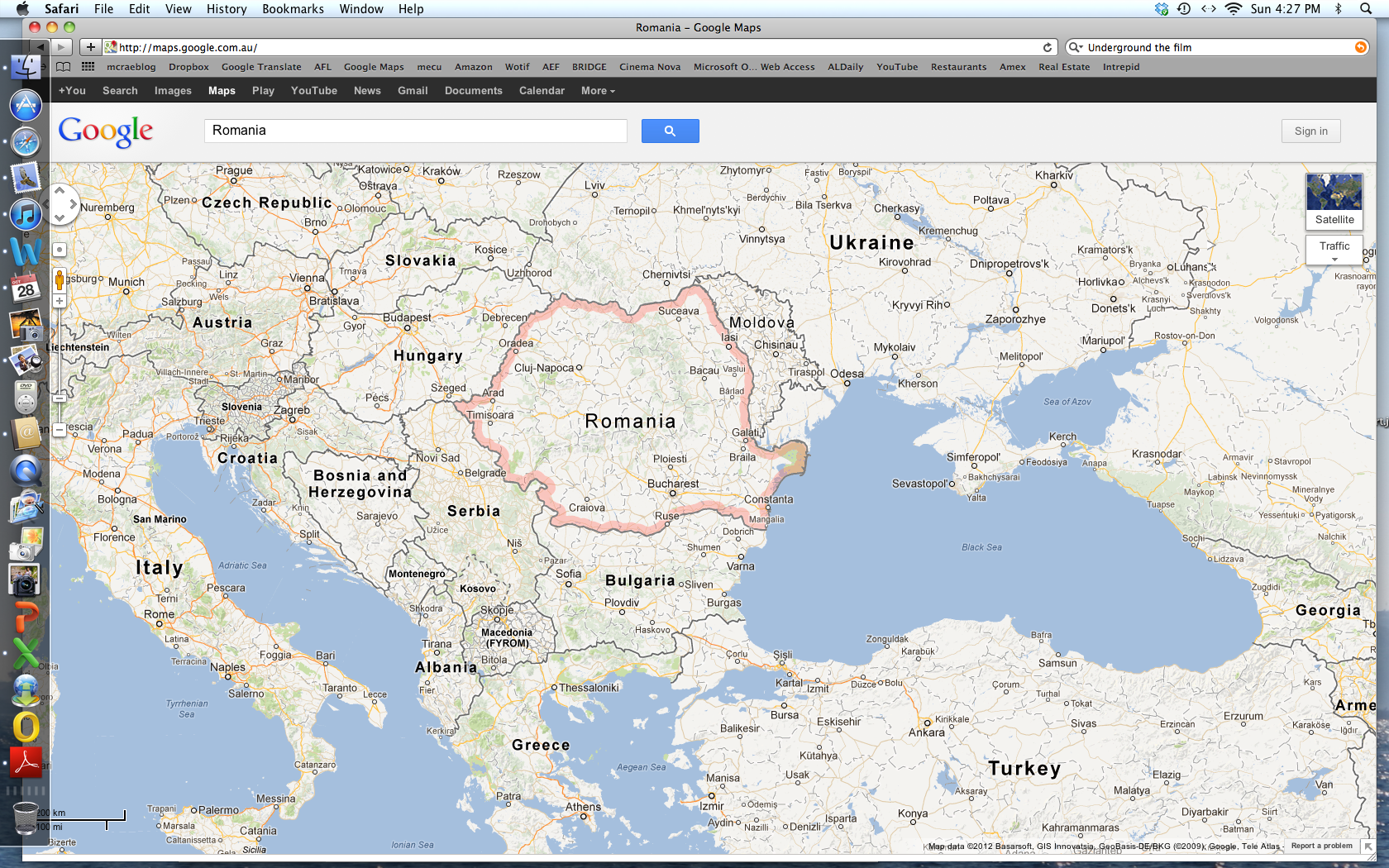
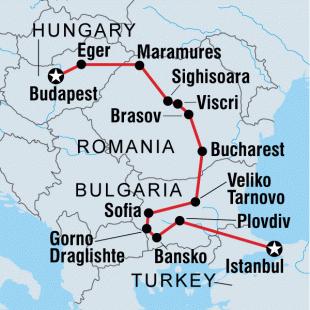
I got an email the other day, a while ago now, asking me to explain where Romania was because my correspondent couldn’t work out the screen shot in a previous post. I thought this might present an opportunity to stick in some bits and pieces that don’t obviously go anywhere else and to answer some questions.Geography. Okay. There. That’s Romania. Bordered to the north by the Ukraine and Moldova (now there’s another new (but actually very old) one for you), to the west by Hungary and to the south by Serbia and Bulgaria. After providing the southern border, the Danube turns sharply north at Silistra and drains through a vast marshy delta into the Black Sea. There is a sprawl of seaside resorts down this coast which continue all the way to Turkey and beyond. The Carpathians curl across its north and down through its centre leaving the Pannonian Plain to the west, and to the east the coastal plain which is part of the steppelands which finish somewhere near Siberia. It is almost exactly the same size as Victoria but a lot harder to get around. This is where we went. Maramures is a region not a city.
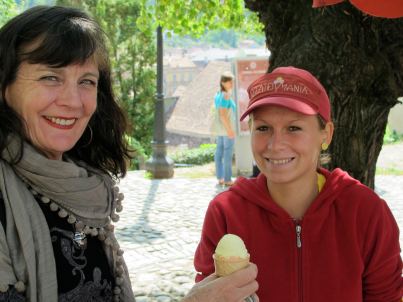
The people. I took this photo not just because the ice cream was good, which it was, but because this charming Romanian at Sighisoara seemed to suggest a much more widespread physical type: smooth olive skin, neatly defined features, warm brown eyes, slender, sometimes tall but generally not. I don’t know whether you are allowed to talk about physical types; probably not. But at Brasov (‘brush-off’) I had this sense of being surrounded in the Square on a party night by hundreds of very good looking people with similar features.
At left Mircea Eliade, the great Romanian philosopher and writer. Ionescu fits. Even Ceaușescu, at right, at a pinch.
History. Romania doesn’t get its name from the many Romany (‘gypsies’) who live there. That’s a story for another day. It gets its name from its inhabitants’ desire to be clear that they are ‘citizens of Rome’, and in fact one of the very last remnants of that classical empire. But both Herodotus and Thucydides are clear that the people who originally lived between the Danube and the Tisa were Dacians (not to be confused with Thracians who lived where contemporary Bulgaria is).
In the second millennium of the Christian era, this was part of the Ottoman empire, the dominant ‘international’ political influence of at least half that period. It wasn’t a heartland of the empire in the way that the western Balkans and Greece were, and in fact when Mehmet II was at his peak so was Vlad Tepes, (‘tsepesh’ if you care, also ‘The Impaler’) providing constant interference and harassment from the northern provinces of Wallachia, much of today’s Romania, and Moldova. (Vlad had a son called Mihnea ‘the Bad’. If you were his dad wouldn’t that set you back? It would me. But in the circumstances, it may have been his father who coined the tag.)
I have found the vestiges of the Ottoman empire irresistible, and its story bears greatly on this whole area. So, indulge me a few glimpses.
I must have been away the day the Ottomans were done, an empire that lasted 600 years, possibly about 10 times longer than the international dominance of the US of A. (The Persian Empire wasn’t covered in great detail either as I remember. As for Ashoka … well! The new National Curriculum will resolve these problems I am sure.)
The Ottomans emerged from nowhere if that’s what we can call the Anatolian foothills. No city, great or small; just raggle taggle bands of nomads who got a taste for real estate which eventually extended from the Persian Gulf to the walls of Vienna and from North Africa to the Crimean peninsula and beyond. This was the Abode of Peace, Dar ul-Islam, and areas outside it Dar ul-Harb, the Abode of War.
Although this expansion had been going on for a century or more, the first recorded battle is a giant landmark in Balkan history which remains a bitter and provocative memory today. On 15 June 1389 they destroyed the Serb forces at Kosovo on the Blackbird Field and swept north. Their ‘capital’ was Bursa south of where Istanbul is today near the shore of the Marmara Sea, and their playground for hunting and leisure was Edirne now on the border of Turkey and Bulgaria where our bus was stripped and our luggage searched at 1.30 in the morning before we were sent on our way. At its height its armies were assembled each year on 23rd April, St George’s Day (how odd that the patron saint of both England and the Ottomans was St George, and that both versions are depicted, as we saw in Cappadocia, slaying a dragon), and the season of conquest — north, south, east or west, whatever had been chosen — would begin. After six months or so, for 200 years, these armies which often included the sultan would return fat with the spoils which would make them temporarily rich and new tax regimes which made them rich for a great deal longer.
The Ottomans won (for several hundred years, invariably) because they had cannons and because they were organized. Theirs were the first armies in the world to have uniforms, to be paid timar, a regular stipend, and to have a band playing to egg on the warriors. (We heard what such a band would sound like in the 1453 Museum in Istanbul and it would have been suitably terrifying.) The shock troops were janissaries, a quite particular form of levy. Every three years towns, especially in the Balkans and Greece but more widely spread as well, would be visited by a representative of the empire to select the finest Christian youths — the fittest, the strongest, the best looking, the power forward match-winners (in a localised football note, think Carey, Brereton, Brown, Ablett snr.) — to serve the Sultan in a complicated form of slavery. They were taught Turkish, fed, housed, educated and trained and never allowed to marry. This semi-desirable situation was not available to Turkish Ottomans because Muslims could never be slaves.
Here we see Kemal Ataturk, hero of modern Turkey and its President for 15 years, in a janissary uniform.I can’t help you with why. The remarkable head gear is said to be shaped like a sleeve of the gown worn by the founder of the Dervish order. Its name, ketche, can be literally translated as ‘felt’. It was worn by all janissaries without exception.
The janissaries became soldiers, and those who displayed particular aptitude for study became kapikullari, the bureaucrats who provided the empire with its strength. The CEO of the empire was the Grand Vizier who walked the finest of lines between being all powerful and subject to strangulation by the Sultan’s bowstring (among the jobs of the Head Gardener). Of the 36 Grand Viziers who followed the Sultanate of Mehmet II, 34 were not Muslim born and several were Jews. The Grand Vizier who caused the building of the bridge over the Drina, Sokolovic, was doing his Serbian home town a favour. (For a visual sample of the area and an aural sample of the book click here.)
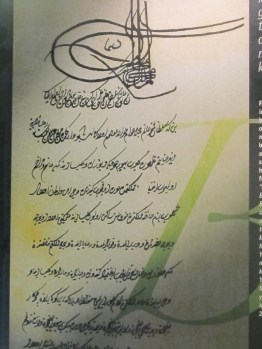
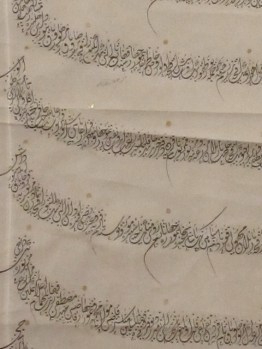
The Ottomans were comparatively benign rulers. At left is a copy of the edict of Mehmet II guaranteeing religious freedom to Bosnia in 1458 for example, which enabled Bosnia to survive as such an unusual amalgam of Muslim Turk (or Bosniak), Catholic Croat and Orthodox Serb, for as long as it did. (Digressing, Ottoman script is truly remarkable as this close up of a ‘deed’ describing the towns and villages to be administered by one pasha illustrates. One story says that it derives from the illiterate Osman’s signature, inking his fingers and swirling them across the page.)
The Ottomans didn’t interfere much with local culture or language. As a rule, new, or old, subjects were not required to become Muslim. A rough but comparatively consistent form of justice was instituted. They weren’t traders; that was left to the Armenians who built their own niche in the empire’s workings. They were rentiers, and the rent was, for the times, fair. The real violence was kept for the palace and its inhabitants.
Sultans were lineal descendants of the House of Osman and, for the first few centuries at least, when a Sultan was near death or died, fratricide was the standard and accepted practice. The son who got in first and organized the killing of his siblings (often half siblings considering that at its peak the Sultan’s seraglio had around 4000 women) would ascend to the throne. As with many of the royal houses of Europe this did not produce an especially healthy lineage.
The taking of Constantinople (from the remnant members of the Byzantine Empire) was a high point in Ottoman history, not least because it united ‘the two halves of the world’. It’s a story too long to be told here, but it includes the portage of dozens of large vessels over Pera (where we stayed in Istanbul) to be refloated behind the giant chain which cut off access by water to the Golden Horn. Ten metre long brass cannon which could fire shot weighing ¾ of tonne moved by carts pulled by 30 bullocks and attended by 700 men damaged the walls. Mehmet had an army of what may have been 300,000 men, but even so was constantly being counseled that this was inadequate to defeat the fortifications defending the 4,983 (names recorded) inhabitants capable of bearing arms. The deep defensive ditches (correctly, fosses) between the double walls were filled with the bodies of the dead so that other forces could cross them. But in the end it appears that the Ottomans won simply because someone from inside left a postern gate, the tiny hidden entrances used to nip in and out while a siege was in progress, open. The failed siege of Vienna 150 years later where the Ottomans were defeated by what we now call an extreme weather event is an equally dramatic tale.
Albanians were still paying tribute to Turkey in the 20th century, still sending delegates to a parliament which had become a shell game with no pea.
This is the empire described by Tsar Nicholas II as ‘the sick man of Europe’, a phrase which has delighted sub editors ever since. The bigger it got, the more flaccid it became. It never seemed to learn that there were other sources of wealth besides plunder; and when the plunder dried up, the cost of the war machine broke the country. Among other infamies, the janissaries began charging ‘tooth rent’, a cost to food suppliers generated by the act of eating, and famously revolted before being disbanded.
One of the Sayings of the Prophet that had strong currency in the Empire was: ‘Every novelty is an innovation. Every innovation is an error. Every error leads to hellfire.’ Time was thought to be circular rather than linear. Evliya Celebi (at left), a janissary who among many many other things wrote, describes himself looting the same house he looted one year previously and looking for and finding the hatchet he had left there, a small proof of the ubiquity of eternity. Great empires become encrusted with a thousand types of cosmopolitanism, all too digestible when the direction is strong and the leadership inviolate. But when the order changes what is left is a potpourri of romance and memories.
After that modest digression, back to Romania — Food. Superb. Delicious. Wonderful. Here’s a portion of what the Intrepid trip notes had to say about food: ‘Vegetarians might find the menu selection less varied than they would see at home. Vegetarianism is not as common in this region and generally the choices are basic, involving vegetables and fried cheese. Vegans will find it even more challenging. Vegetarians might choose to supplement meals with supplies bought from home, e.g. protein bars, dried fruits and so on.’ Not so.
A full tilt Romanian evening meal is likely to consist of soup (phonetically ‘chorb’ or ‘chorb-uh’ everywhere in the eastern Balkans and Turkey) often vegetal, salad (anything up to 10 or 12 on a restaurant menu, variations on a theme, with shepherd’s salad the heartiest with corn, cheese and nuts), stew (the Hungarians do not have a mortgage on goulash), cake and fruit. Polenta in various forms appeared as an option at most meals. Cheese was a staple. At one hotel where we had breakfast I counted 14 different types. Snacks come out of the street windows: a score of different types of pretzels, and layers of filo, rolled or flat, filled with cheese or fruit. Shops selling gyros (the meat we get in souvlaki) were everywhere. Breakfast was bread (often home made), hard and soft cheese, excellent yoghurt, tomatoes and peppers — and when I say tomatoes and peppers, I mean tomatoes and peppers straight out of the garden such as you have never tasted. Four of our five local guides commented on the exodus of young people from country regions. Each of them, remarkably, used the image of there being no one left to tend the tomatoes to describe the calamity that was in the offing.
It is true that we were there at the height, or just after, of the harvest; but what we ate was food rather than salt, sugar and fat. Here are the highly photogenic Mat and Luz eating in a hotel in Velika Tarnovo (Bulgaria actually), the sort of meal we could have had although from memory I think I had a cheese omelette and Myrna a salad at the same table. What you are looking at is a ‘sache’ (that mysterious English word) of roast vegetables, another of pieces of pork, some bread which has been on the griddle and some polenta.
Accommodation. Great. Clever. Very well located 3-star hotel accommodation, very clean, very comfortable, everywhere with wifi internet connection. Three ‘homestays’, which could be better described as very good quality bed and breakfast places; not, definitely not, sleeping on straw palliasses being nudged by donkeys. At right Myrna is on the stairs of the one we stayed in at Sighitu, and yes that is a Jag in the driveway. To the considerable amusement of all those not concerned, Chris and Joop did have drawer beds in Viscri. Our room had an ensuite and a gorgeous ceramic stove just in case the weather turned cold which, of course, it never did.Why did I become interested in eastern Europe? I’ve been wondering that myself. It could have been getting excited about Balkan music after watching Emir Kusturica’s film ‘Underground’. It was so gay, so crazy, such a exhilarating mixture of east and west. And that’s an interest I’ve pursued. But it might have been reading Neal Ascherson’s book The Black Sea, a masterpiece, which introduced me to the Samartians, the Scythians and the Pechenegs and the prospect of ecological catastrophe if the Black Sea turns itself upside down (which is all too possible). I also think it introduced me to the idea of the Saxon villages in Transylvania which ever since I have wanted to see. And then during the troubles in the mid-90s I was reading Robert Kaplan’s Balkan Ghosts and Ian Malcolm’s Bosnia: A Short History and Rebecca West’s Black Lamb Grey Falcon. All these are from a genre of writing which attracts me greatly: going somewhere and thinking out loud about what it means (another master, the Pole Ryszard Kapuściński).
More recently I’ve read Patrick Leigh Fermor’s Between the Woods and the Water. An 18 year-old Englishman determines to walk from Amsterdam to Istanbul and has adventures on the way. A Time of Gifts, devoted to the first section of the walk is not as good, but once he crosses the Danube at Esztergom, in Hungary but on the Slovak border (in 1934), the story just gets so interesting and the language begins to sing. As well as being a war hero, a boxer, a horseman, the lover of a Romanian princess and an historian, Leigh Fermor is a stylish magician with the English language.
There is a story attached. Not only did he write this book in his 70s, five decades after the experiences he describes, but he left all his notes at a Romanian country house he was staying at in the 1950s. They were miraculously recovered 25 years later.
This book sits with Robert Byron’s The Road to Oxiana, Eric Newby’s A Short Walk in the Hindu Kush and maybe Bruce Chatwin’s In Patagonia (a bit disappointing on a recent read) on a list of the great contemporary travel books ever written. There is vivid curiosity, exuberance and joy, all great human qualities, in each of these books, all that I have mentioned in fact.
Was our trip anything like these adventures? Of course not. We were cosseted middle-aged tourists, and anyway the world has changed so very much. But still, there were times when the fragrance of these experiences of travel could still, just, be sniffed in the air. Now where were we? Ah yes. Three favourites.