

The writing on the shop window at left says: EAT IN TAKE OUT ATELIER PORCEL ARTS LUNCH COFFEE SMOOTHIE BEER KUSHIAGE [grilled food on skewers] PASTA. That surprises me. It is somewhere near Kumamoto which in turn is somewhere near the middle of Kyushu which in turn is Japan’s fourth island, the one off the end heading towards Korea and China. The one which seems to consist mostly of volcanoes in various states of tumescence. The one more obviously tropical, more wetter, more typhoony. It’s a long way from Tokyo, closer to Seoul actually, and quite far enough from Kyoto. And they would be some of the reasons you see fewer European tourists there than in other parts of Japan.
They might have reason to visit Fukuoka, the largest city on the island, with its gracious boulevards and general air of self-sufficiency. They might have come to last year’s world swimming championships which were held there when Australia won twice as many gold medals as the US (if not more medals overall, but that’s not how we count ’em. No way. 😐).
I haven’t been everywhere in Japan, but I’ve been to enough of it to know that out of town is different to in town. You get something quite different. Five years ago I developed a big Kyushu travel plan in that expectation. I even made an at-the-time invisible friend on Yakushima as we went back and forth negotiating our stay. And now I expect to see Kentaro in Melbourne quite soon. That scheme became disrupted by what Representative Marjorie Taylor Greene refers to as the coronavirus hoax. This time we made an effort to complete some of that plan.
What we wanted to do was built around three substantial day walks, none of which we did. It was too hot. Over 35 every day, nearly 40 in Dazaifu. Look at these people in the yard of Kumamoto Castle:
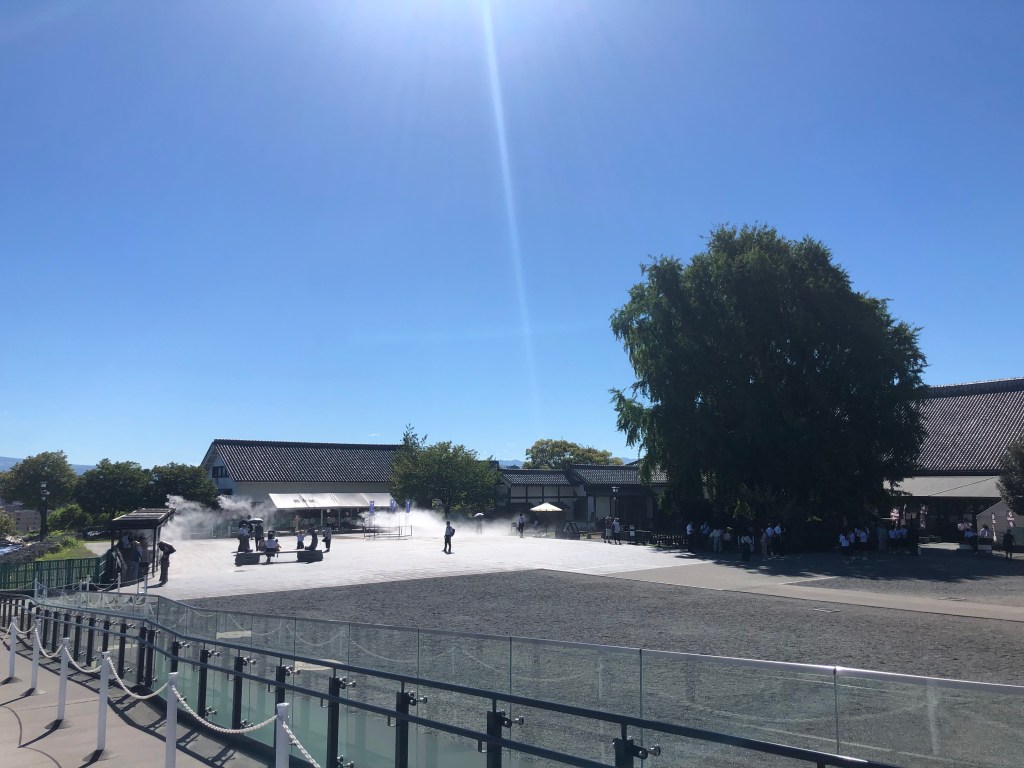
a couple of defiant nongs out in the sun, the others huddled in the shade of the giant gingko, under shelters, umbrellas or basking in the vapour sprays. So we drove around in air-conditioned comfort having a jolly time, seeing things we wouldn’t have otherwise. I’d do all this again any time.
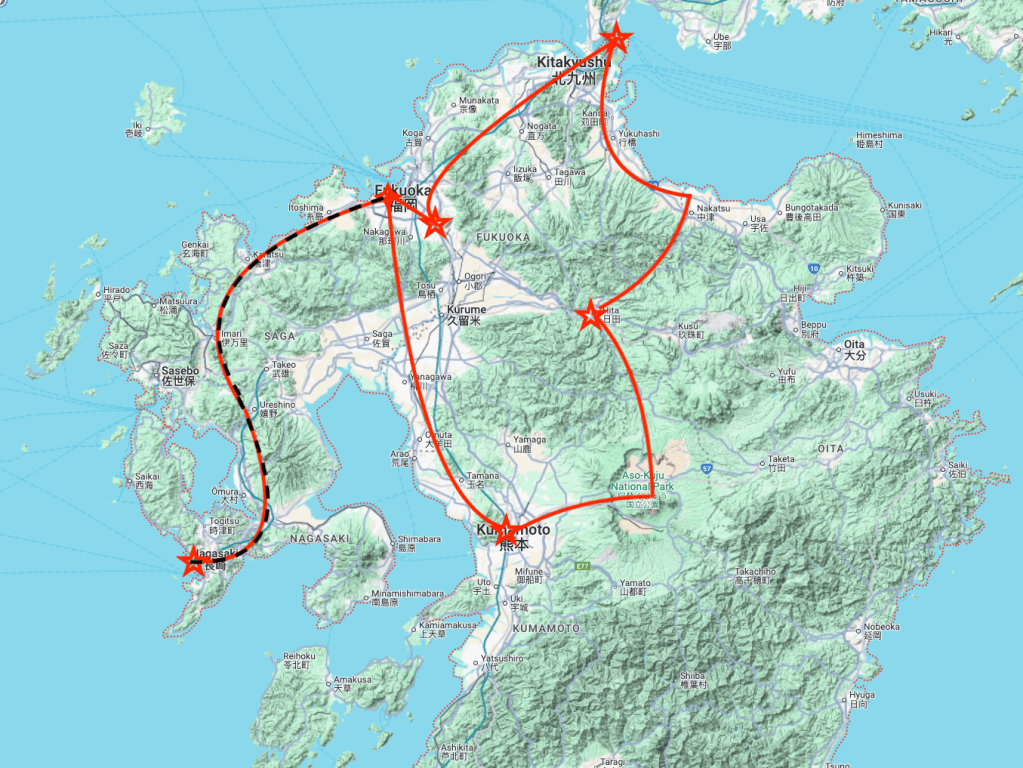
We flew from Tokyo to Nagasaki where we spent four nights in a really good hotel with a very large air-conditioned room, a first-rate breakfast and most congenial staff. This may have coloured my roseate view of Nagasaki. Don’t know. Then we got the train back to Fukuoka (had to return our car to the pick-up point), found Michael and went for a drive.

The Toyota Sentia Hybrid 7-seater convertible van: highest praise. If they sold them in Australia I’d give purchase strong consideration. Drove 900kms in great comfort using one tank and $4 worth of petrol. The $4 worth was to procure a receipt to indicate we had bought petrol. Might have been necessary, might not. But it’s Japan … always better to be on the safe side.
Kumamoto
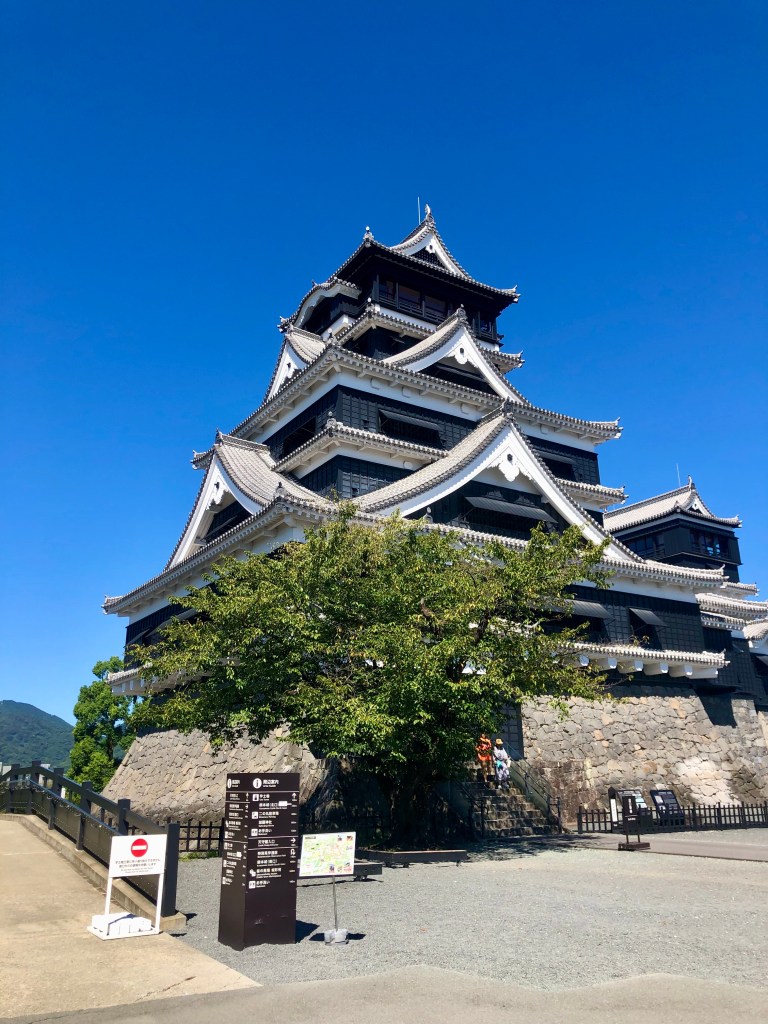
We were really only going to Kumamoto so we could get to Mount Aso early the next morning.
But I knew that it had an impressive castle which had been substantially restored and when our plans changed, they included going to have a look and to ascend to the top storey which provided an excellent view of the city and its surrounds.
We left thinking you might find many other things of interest in Kumamoto.
And then Mount Aso …


Mount Aso is the largest active volcano in Japan and among the largest in the world. It last erupted in 2021. That is to say, recently. Its upper reaches are dotted with masonry beehives for the protection of visitors should it be required. It has a very large caldera, the outer ring of what was there once and which has now collapsed, about 30 kms from one irregular side to the other. This is visible on the map further above. The elegant little cone to the left is to be found inside that ring.
Aso’s peak area is dramatically bare of vegetation, but there are several preparatory areas for leisure activity. We drove past a massive aggregation of cars on our way up and wondered why on earth they were there. It was a golf clubhouse. Look at the courses carved into its flanks. It is otherwise a national park. There was a well-patronised lookout, and then there was the comfortable party area with restaurants, cafes and horse rides (off to the right below).
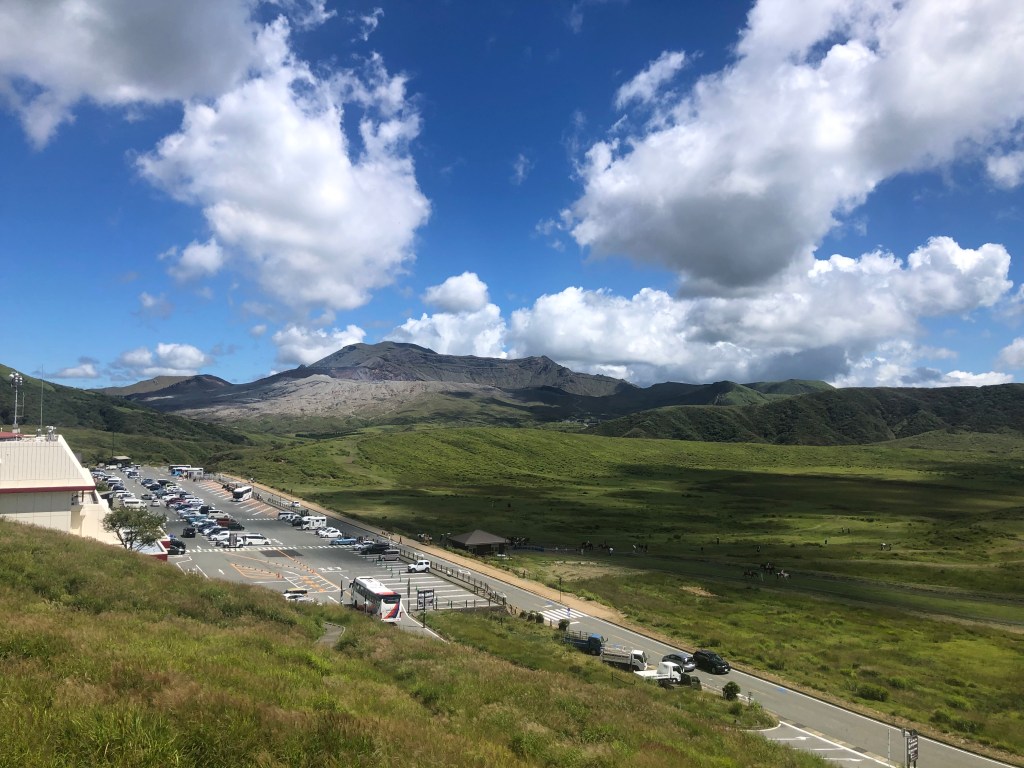
From the small off white spot in the middle of the photo above of the whole mountain complex it is possible, on payment of ¥500, to drive to another even smaller off-white spot to its left and, on occasion, to walk and climb Aso’s five peaks. Visitors to the upper reaches are rewarded with views of the bubbling sulphuric stew in the active crater.
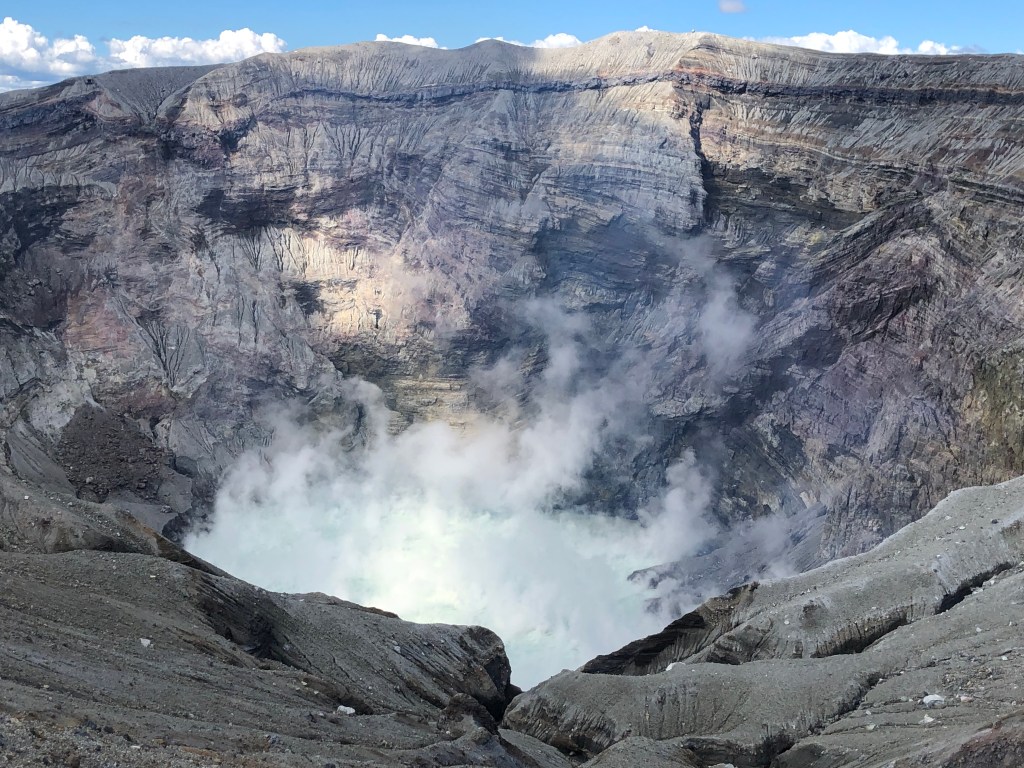
They are also subject to a barrage of warnings both visual and aural in various languages which are especially for people with asthma, bronchitis or heart problems.
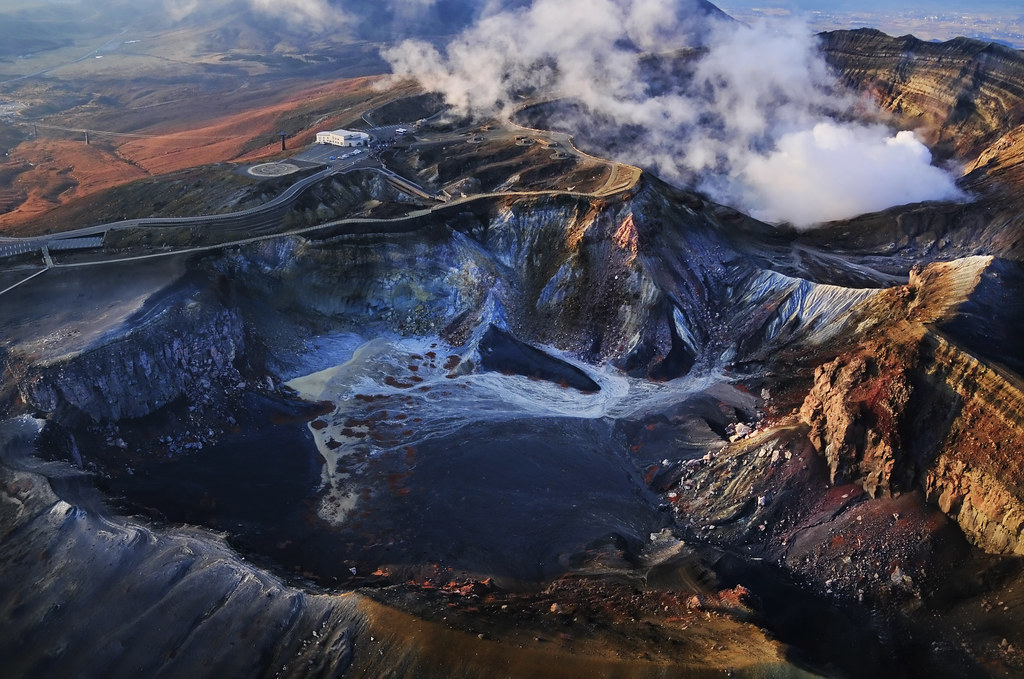
We were walking around the rim on the track closest to the crater when the warnings increased in intensity and were accompanied by arm-waving. It always does to obey warnings in Japan even if you don’t feel they’re warranted. Obedience is the priority. Several things happened at once. The air did seem to thicken up a bit. Then we started coughing. It was one of those things you don’t think will really happen. Nah … that’s just what they say, etc. But there WAS too much sulphur in the air and, after putting up the windows of the car rather sharpishly, we drove away.

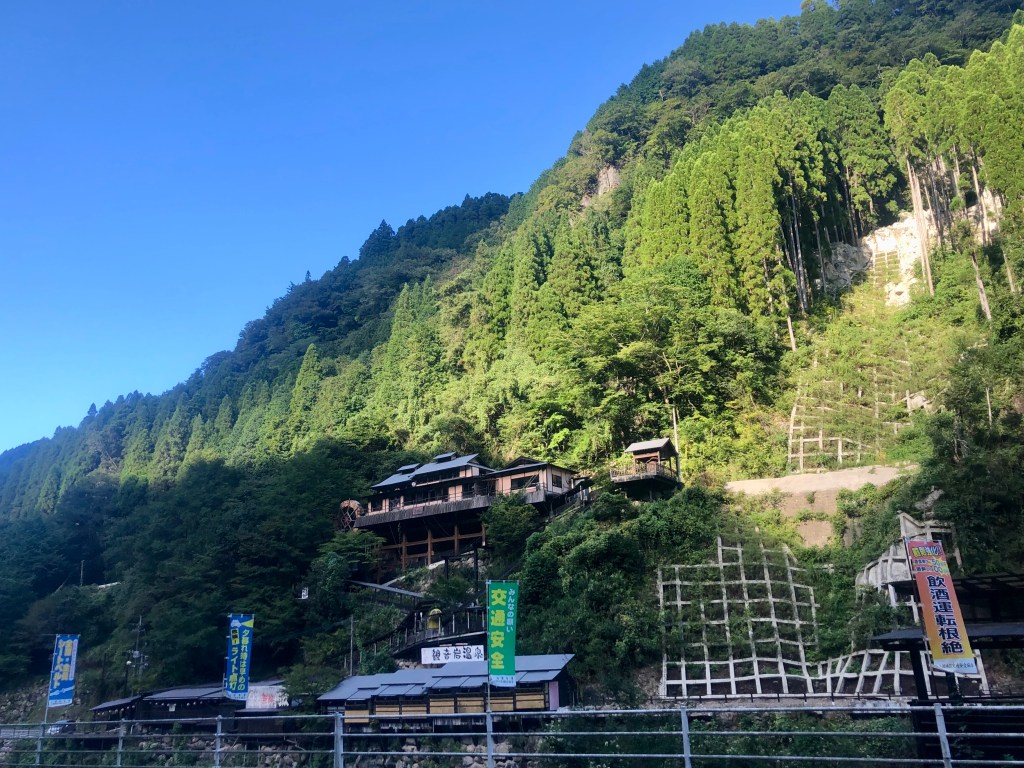
We were off to spend the night at Ukiha. It was a great drive, first through another national park and then along a series of river valleys. This (below) was an onsen establishment clinging to its hill next to some woven concrete holding that hill together. So much of Japan is beautiful but not much of it is untouched.
Ukiha
Why? Who goes to Ukiha? No one. This is one of those finger-on-a-map (to jump off to climb Hiko-san the next day; didn’t happen) and-then-find-suitable-accommodation moments. And in this, despite booking the wrong date, we were unaccountably successful.
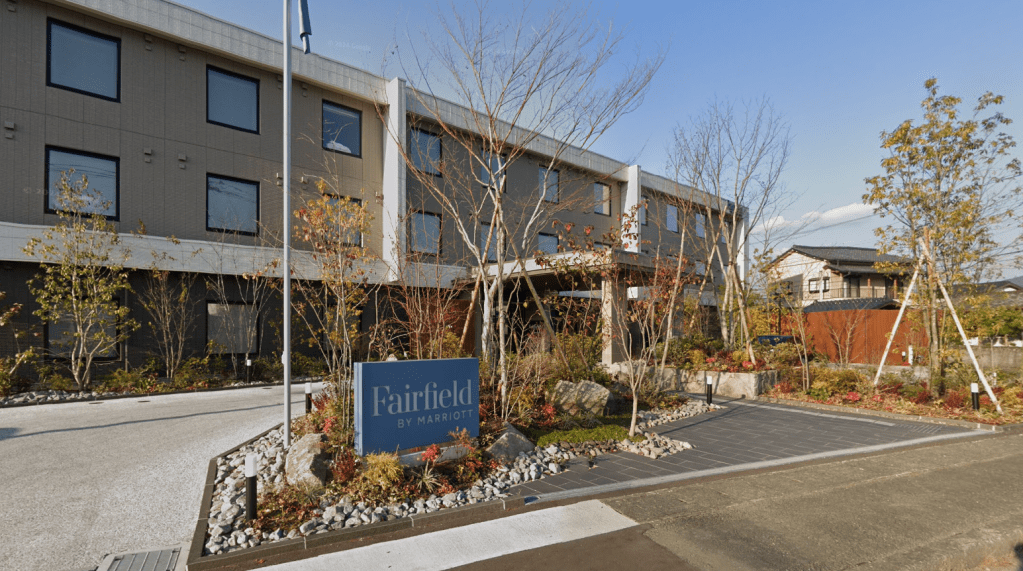
Brand new hotel, so very stylish in the middle of not very much, so much room to park the car (hoorah, always an issue in Japan), no food, but beer, a wide variety of chips and lollies and containers of formidably excellent grapes in the vending machine, several very nice places to sit and drink the beer, and wonderful staff one of whom was very excited to practice his English.
While they mightn’t have had food, they had excellent recommendations about where to eat. At their suggestion we searched for and found a fairly well hidden eatery (pictured below the two pleasant sitting places at the Ukiha Fairfield) and had what Myrna thought was the best meal of the trip. Severe Momma, dutiful daughter serving, husband cooking in a rather grotty kitchen. But oishi, delicious. And then for breakfast you could visit the farmer’s market which operated next door. You couldn’t identify much, only marvel. We did buy some nashis. I can’t remember what else.

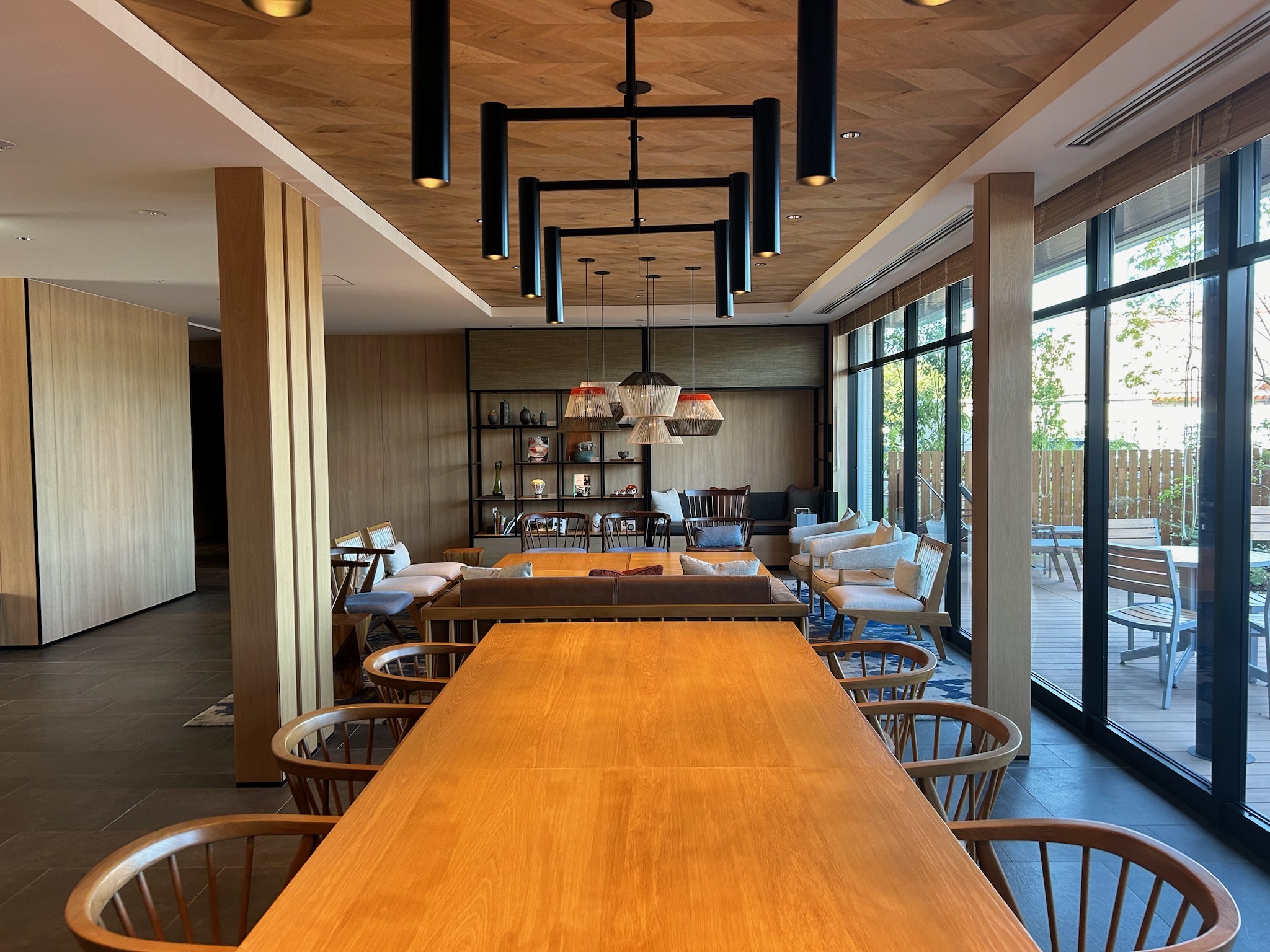

It was round then I discovered we had been staying in an establishment, a Marriott hotel, owned by members of the Church of the Latter Day Saints. ‘Marriott International is the largest hotel company in the world by the number of available rooms. It has 36 brands with 8,785 properties containing 1,597,382 rooms in 141 countries.’ Its headquarters are now in Bethesda, Maryland but when it was founded by J. Willard Marriott they were of course in Salt Lake City. That’s what you can find out when you travel.
And you can also visit Ukiha’s Inari Shrine: you can climb 300 steps through 91 (and no, I have no idea why) torii to the entrance or, as we did, you can drive up. (There is another much more famous and heavily visited version of this near Kyoto.)

Inari (also applied to a type of sushi) means ‘rice harvest’ symbolising the idea of good fortune, blessings, something for which we should be grateful. It is a modest shrine but the hillside is covered not just with orchards — this is one of the fruit capitals of Japan — but also with what I imagined initially to be grave markers. They’re not. They’re posts with snatches of poetry written on them. ‘Looking out across the valley I think I see the distant spring blossom of Tsukushi (a suburb of Fukuoka an hour’s drive away).’ ‘Wearing a robe I was enveloped by the scent of my mother.’ ‘I fear the velvet night no more.’ ‘The full moon shines with brilliant light.’ That’s not something we have necessarily.
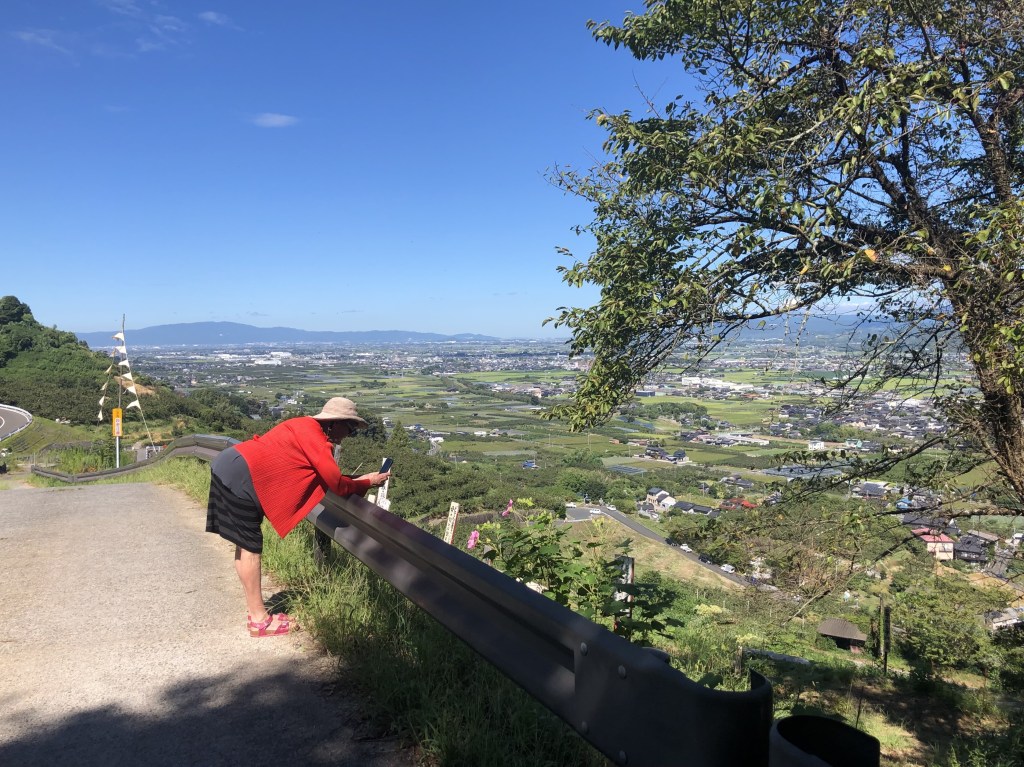
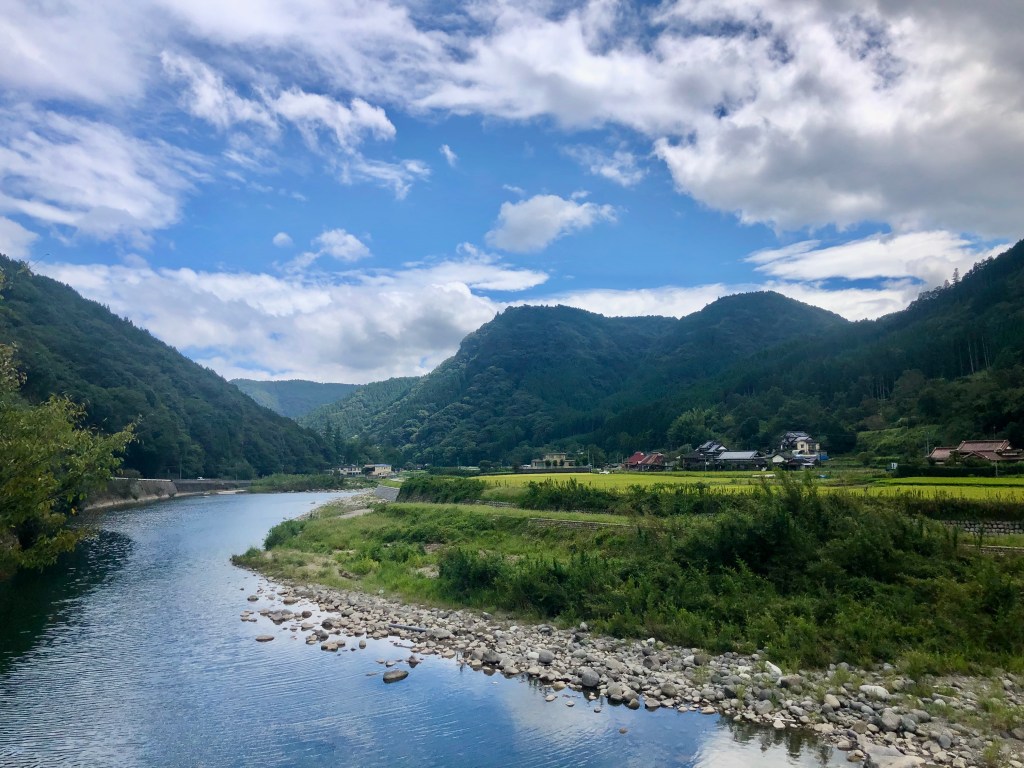
We determined that we would like to see the sea. There were murmurs about having a swim as it was still spectacularly hot. We found a road east along the Yamakuni River which provided satisfying spectacle around every corner.
We found its mouth but no, not swimmable. Both banks of the river were built environments as they had been for 40-50 kilometres. But here there were sets of steps like tiered seating every 30 or 40m as far as the eye could see. What for? We also tried to imagine what could be behind the giant fences but couldn’t. It turned out to be a marina (with a complex of football grounds on the other shore). But again, why? Mysteries.
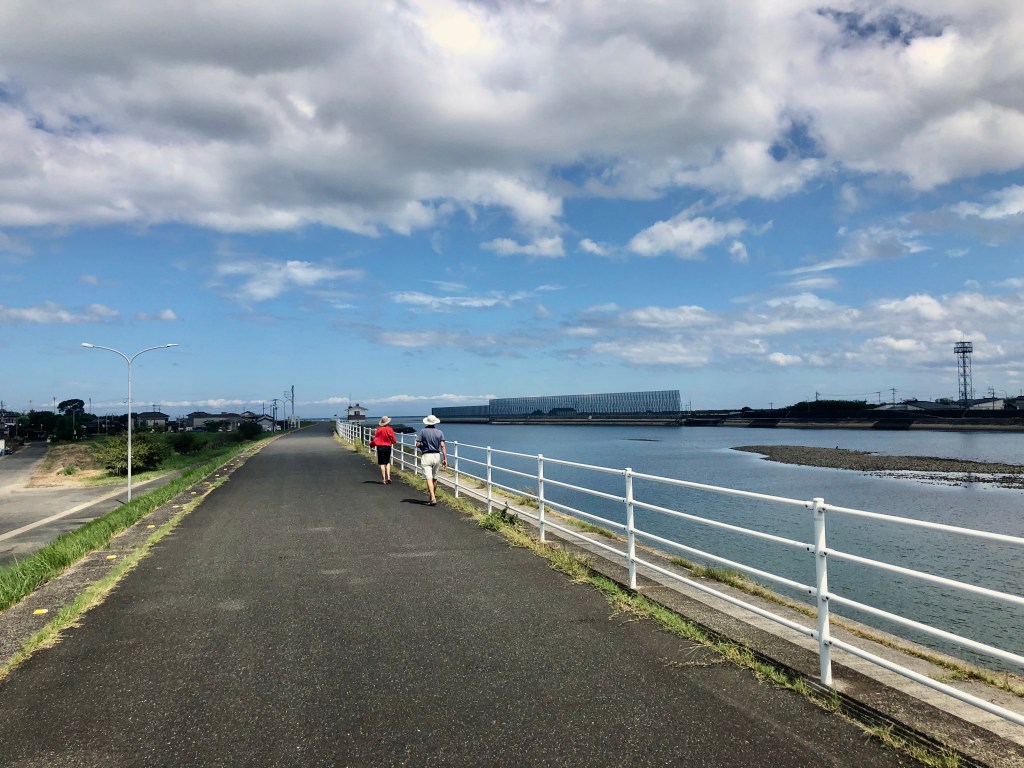
We had ended up at another shrine, Hachiman Kohyo, which has been in its present location since 535 CE. The mouth of a decent-sized river, … that could be enough to incite a shrine. And there it was. Insofar as it is famous — not very far, it is well out of the way — it is for its lion dogs.

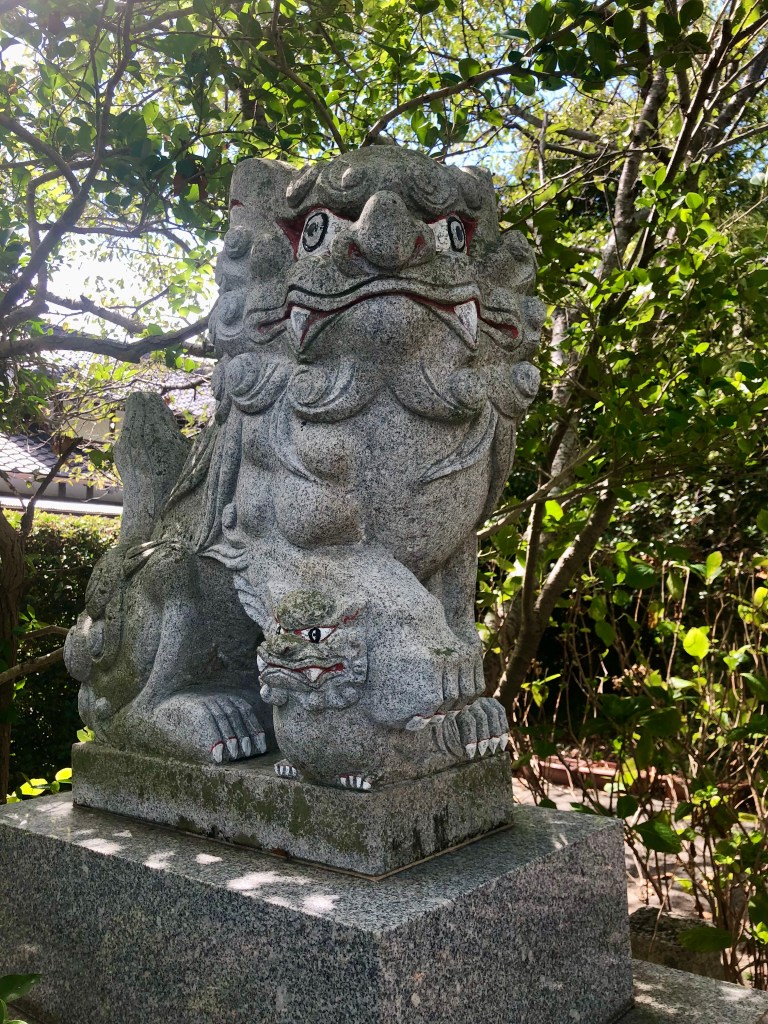


It was this sort of neck of the woods really: another Japan. Just as interesting. (The words on the front of the Isuzu in for repair say: ‘earth-friendly environmentally-friendly people-friendly’.)
It was near enough to 3 in the afternoon and we hadn’t had anything to eat since our rather desultory breakfast (bananas and grapes I just discover). I thought I would provide a solution by finding the nearest coffee shop. It would be bound to have food as well. So we headed off to Umi-san (coffee and cheesecake) in the very very back blocks of Yoshitomi, imagining iced coffee with a great dollop of softu crema or something equally interesting in it. We’d drink that while consuming extra large slices of cheesecake.
We found Umi-san under a tarpaulin attached to a shed. He was so overwhelmed by a visit from Australians he was rendered close to immobile. He wanted conversation. Wanted to know where we’d been and why. All via Google which I was, I’ll say, too faint with hunger to operate effectively. He had no cheesecake but he could make us some coffee. But first he had to spend quite some time finding and lighting a mosquito coil. Very thoughtful of course, but we were starving.

It took him just on half an hour to make the coffee which appeared, actually very good coffee, with two ice cubes in it and nothing resembling dairy. Quite correct really, but the doctor hadn’t ordered that and was pretty disappointed. I drank what I deemed to be respectable amount, a respectful amount, of what we’d been provided with and we fled to a Lawson to find something with plenty of calories.

The Lawson. Along with the 7/11 and the Family Mart, staples of the Japanese consumer economy. But the Lawson … so very reliable.
Mojiko
We were on our way to Mojiko to stay at this hotel. The Premier. I had read, I think, that it was on an interesting site stuck out into the Hanmon Straits which separate Kyushu and Honshu and that it was nested in among an unusual collection of art deco or ‘Retro’ architecture as you will find it referred to. That turned out to be true.


On our way to find some dinner I discovered these gals arranging themselves for a low-action selfie. They have found a boat named ‘Moji’, and they have managed to include the very ostentatious ‘Observation Room’ towering over the old Customs House. To the right you might just be able to make out clusters of lights and what might be marquees and canvas shelters. That’s what they were. We ate outside from a restaurant in the Customs House after strolling through what seemed like a dog fair with all things dog: prams, pushers, capes, hats, bells, bones, shark skin, dried meat, glow collars, anything you can imagine really, with several hundred perhaps a thousand dogs being catered for.
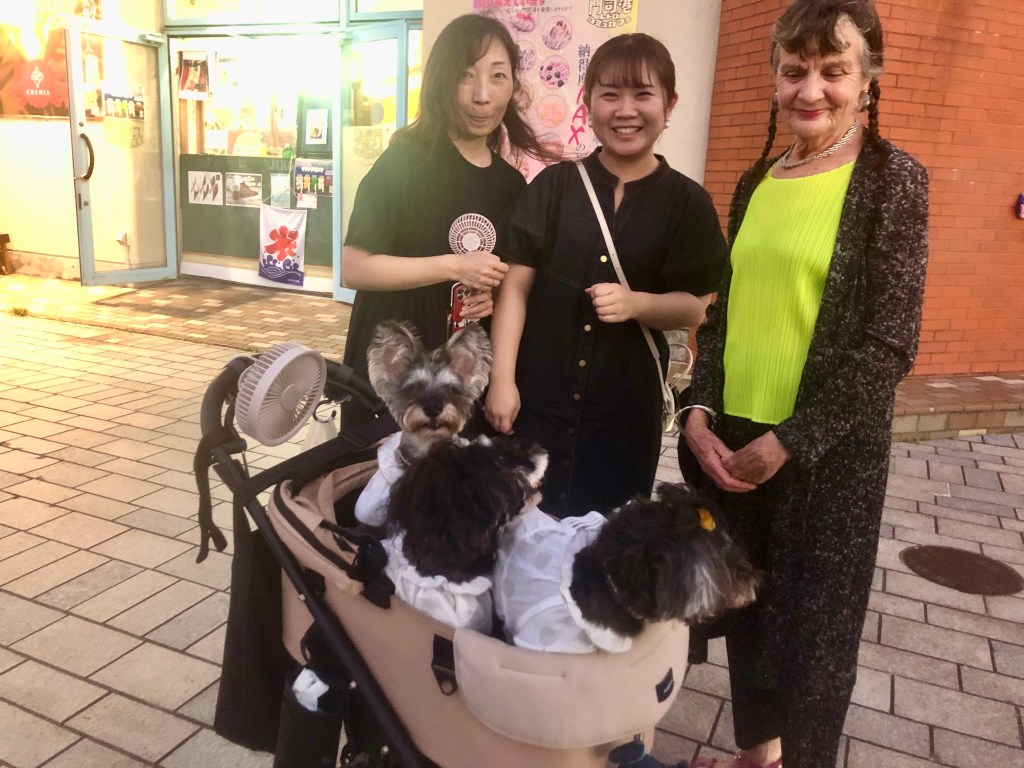
You may note their mmm dunno … dresses? their personal fan and the preparedness of the one at the back to have his or her photo taken.

Breakfast suggested that there would be a story to be told about the hotel. It wasn’t overly expensive, mid-range I guess, but it was a place to take your family for a weekend away or a special occasion if you were a well-heeled member of the Japanese haut-ish bourgeoisie (congregations of whom are not always on display in Japan). And I think the highlight, the very special thing, about the Premier might have been its buffet breakfast. You could get simply anything, and if it wasn’t there they’d make it for you. I watched prodigious feats of eating, almost to the point of applause, especially by the younger members of the absolutely packed house.
But our schedule said Dazaifu, so Dazaifu it was.
Dazaifu
What’s a photo for Dazaifu? There could be so many.


The timber decoration of the Starbucks in the Baba Sando Line: this is so noteworthy it appears on guides as a tourist attraction. To its right the bustling throng is pushing their way forward for icy poles. They might have been plum-flavoured. The shrine that the customers were on their way to or from is surrounded by sacred plum trees. This was just a window in a wall near monster Japanese sweets cafes which were nearly empty. The owners had something going on.

Digressing momentarily, they were making equally popular plum cakes just a little further along the street via a sort of conveyor belt process. It would have been so incredibly hot where she was standing.
Continuing clockwise with the photos, the interior of Motsu Nabe, the restaurant in the bottom of our accommodation. Great food which could have been better if we’d worked out how to cook it properly (at the table) and decide when the cabbage went in. And then Myrna’s new Issey Miyake top on the shrine’s footbridge. An excellent colour match.
Could have been any of those; they all have stories attached. But I think this is the one.

Its existence saved us on several occasions. It is the interior of the Dazaifu Roll, an idea the specifics of which we never tested. More importantly a) it was air-conditioned, and b) unlike many of the other establishments in Baba Sando Line it was never crowded out, and c) it advertised and served excellent iced coffee.

The Baba Sando Line (just a street name really) is the major entrance way to the Tenmangu Shrine, a shrine of great importance, size and activity. The photo above is not mine because if it was it would have hundreds of people milling around in it searching for shade. The temperatures reached their apogee at Dazaifu, their zenith, their pinnacle, their peak, their apex. The energy bounce off that pavement was blinding.
Returning to the Dazaifu Roll, outside its door is the actual entry to the avenue of approach. But instead of dragons or lions or torii at the entrance to this holy collection of souvenir and lolly shops there is a takeaway yakisoba noodle joint on one side and the Dazaifu Roll on the other.
Dazaifu could today be considered an outer suburb of Fukuoka about 20 kms from the centre of the city. I thought staying there would be convenient for its Historical Trail, a half-day walk that sounded interesting. Because of the walk I knew that Dazaifu had been the seat of imperial power and the centre of politics and culture in Kyushu from the late 7th to 12th centuries — quite removed from Fukuoka — and that there had been a major complex of government buildings there, now in fairly modest ruins tended beyond any hint of authenticity. And I did know that it had an important shrine.
Dazaifu’s Tenmangu Shrine was founded in the 10th century. It is dedicated to Michizane Sugawara, a late 9th century politician and scholar who rose to pre-eminence at court. However, he chose the wrong faction in a dispute — probably the good guys — and was shamed and then banished from Kyoto 800 kilometres away from where we were. The ox pulling his cart brought him here … then, perhaps understandably, refused to move any further. Shortly after Kyoto was struck by a series of deadly storms and floods attributed to Michizane’s powers and there was a fairly hasty revision of his status. By imperial order he was renamed as ‘Tenjin’ or ‘Tenman’ and worshipped as the Shinto god of literature and learning. A shrine was subsequently built here, the head shrine of 12,000 Tenmangu shrines across Japan.
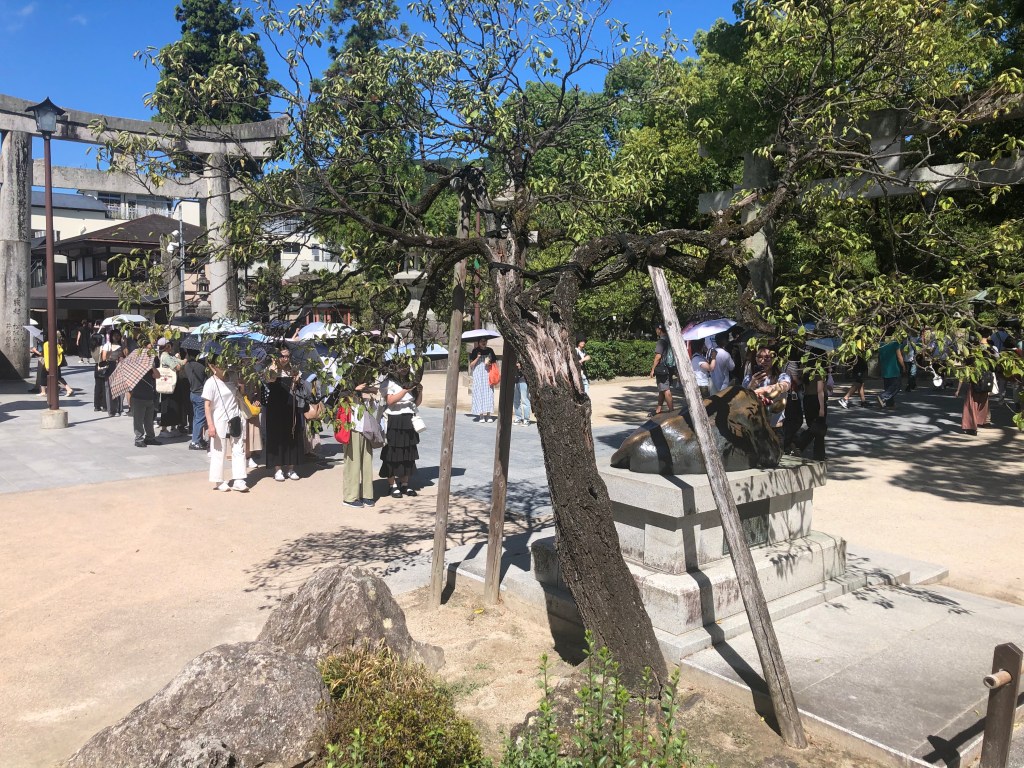
Almost guaranteeing popularity, one of Tenjin’s areas of oversight is success in exams. People here are lining up to rub the nose of a statue of Goshingyu, the ‘wisdom ox’ who decided to camp here, and to say their prayers possibly turning a C into a B+. In the foreground is one of the sacred ume (plum) trees, Tenjin’s favourite fruit.
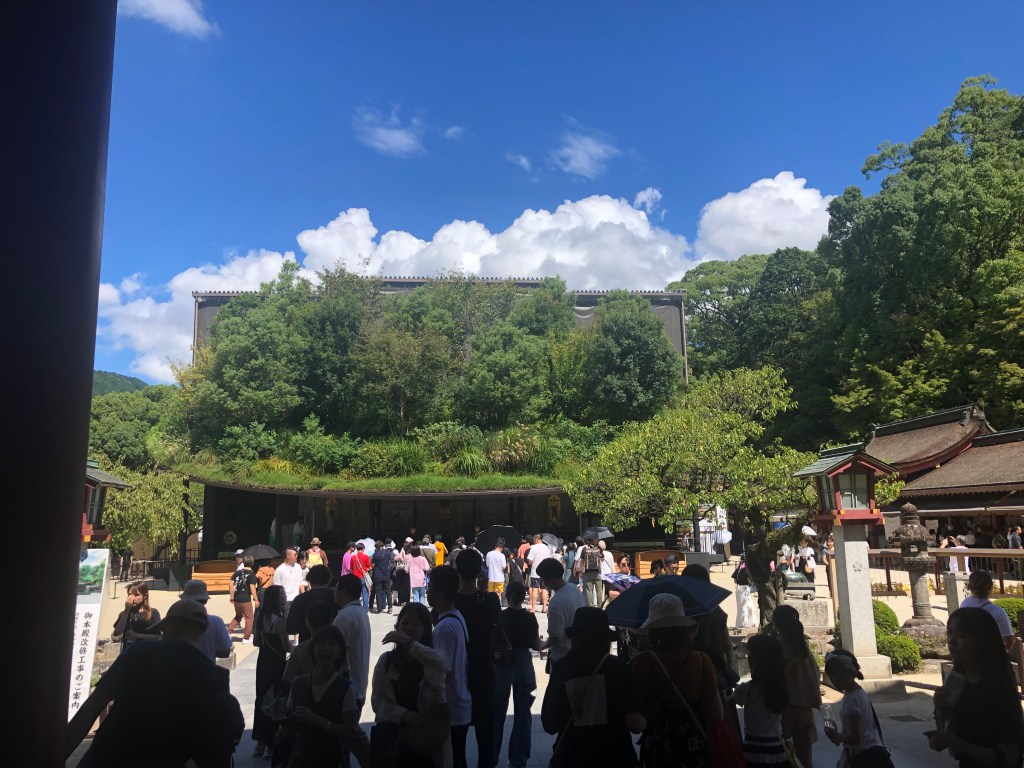
The ancestor of one of these trees, mid-ground right in the photo, is believed to have flown here from Kyoto such was the power of the master and his poetry. The other feature of this photo is the rather dramatic thicket of vegetation growing on the roof of this temple building. It has its own story.
‘In 2027, the shrine will hold the 1125th anniversary of the Grand Ceremony of Dazaifu Tenmangu. This commemorates the death of Sugawara Michinzane, a scholar and government official who is now enshrined as the deity Tenjin.’ (Not sanctification note but deification; that’s different and worth thinking about.) ‘The main sanctuary of the shrine is undergoing extensive repairs, the first for 127 years.’ A ‘temporary residence for Tenjin’ has been built to last for three years while the work is completed. ‘It is crowned with a “floating forest” teeming with diverse plant life that transforms with the changing seasons.’ That’s the ‘floating forest’ you’re looking at.
Staying with trees, which we were that day, sacred and otherwise, here is a cedar old enough to have its own devotees.

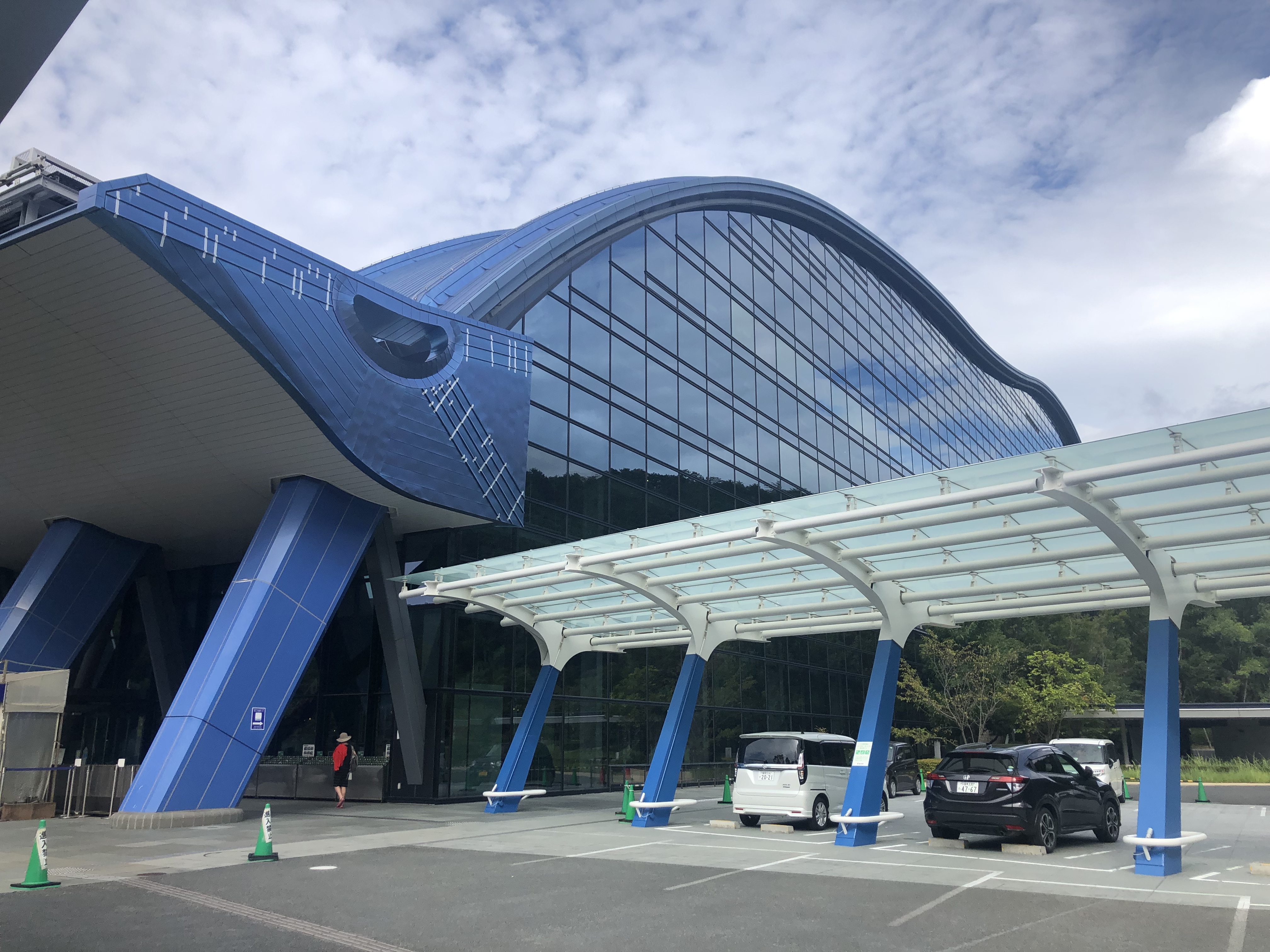
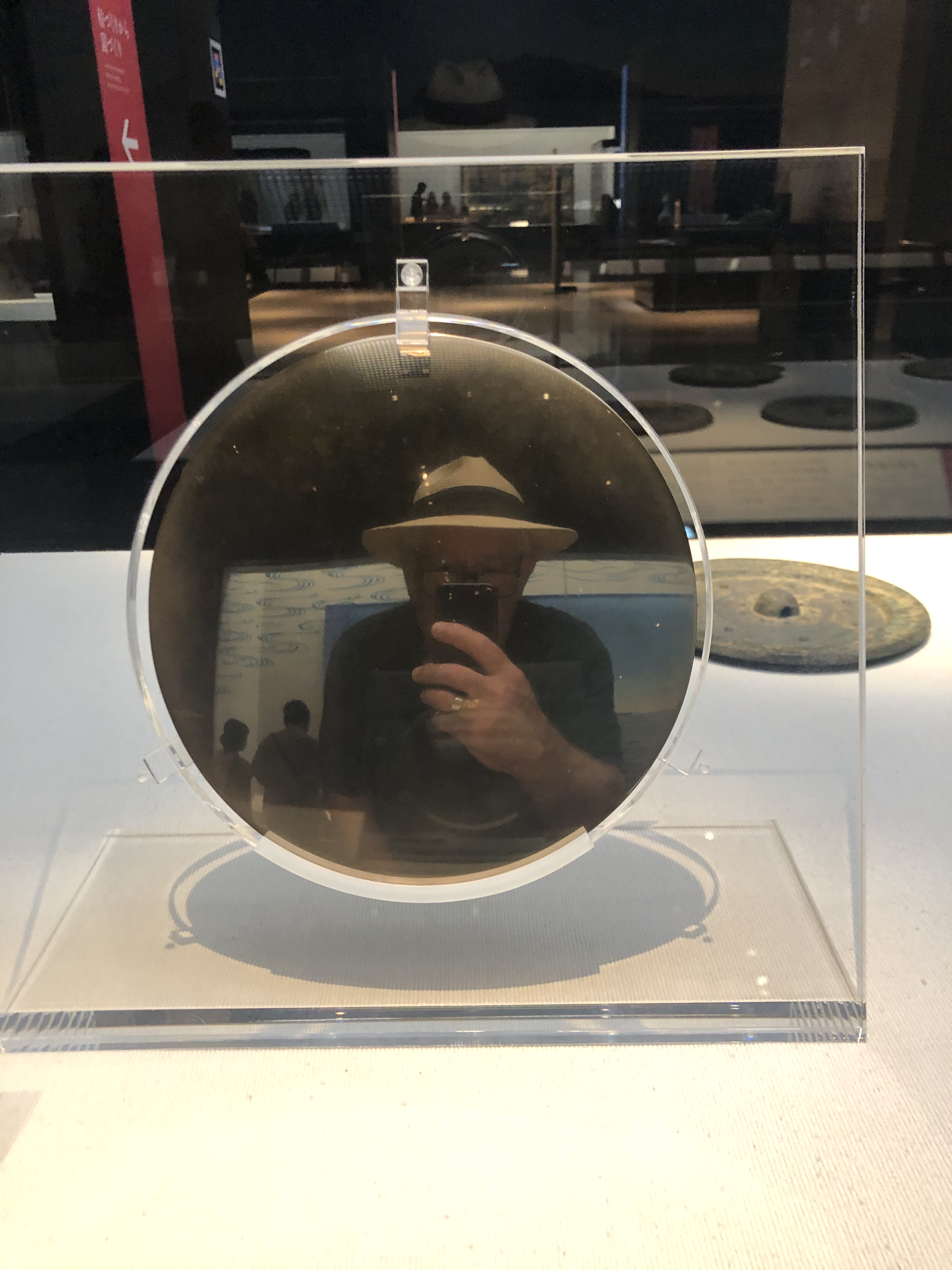

Another reason to visit Dazaifu is the Kyushu National Museum, the terminus of the Historical Walk. Its remarkable waveform is built into the hill above the Shrine. It was full of treasures one of which was a brass mirror, something I’d never seen before. To the right rises Sonic Apartments, a satisfyingly exotic place to briefly call home.

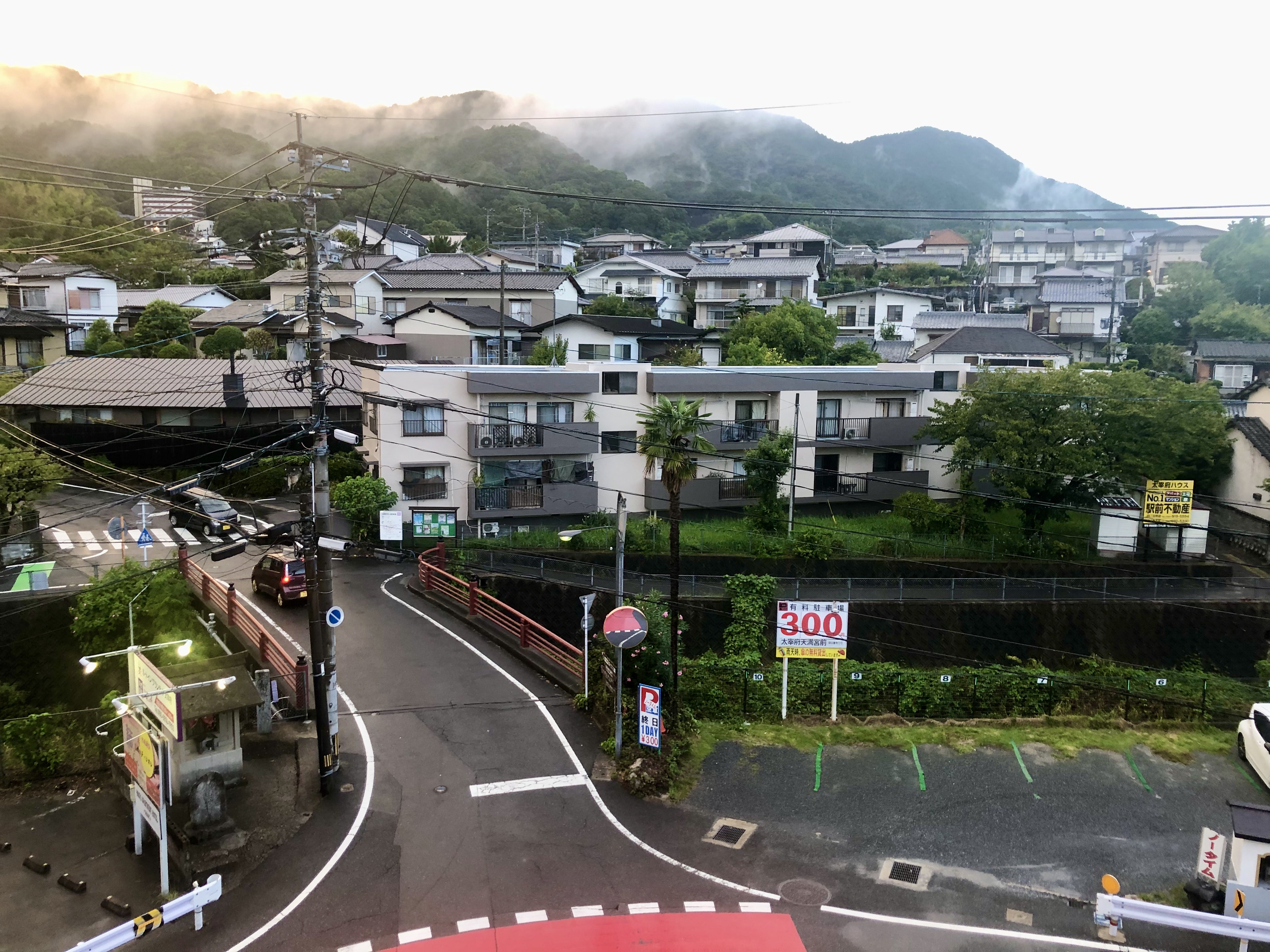
A couple of hours separates these photos from our window. In that time it had rained, the temperature had dropped a few degrees and the cost per hour at the car park had fallen ¥100 (1 AUD) an hour.
Fukuoka


We took the car back, a small matter, and then walked 12 kms around Fukuoka, a larger one. The art gallery was closed so we walked around Ohori Lake and watched these cormorants with their throats flapping and click-clacking as they tried to manage the heat.
• • • • • • • •
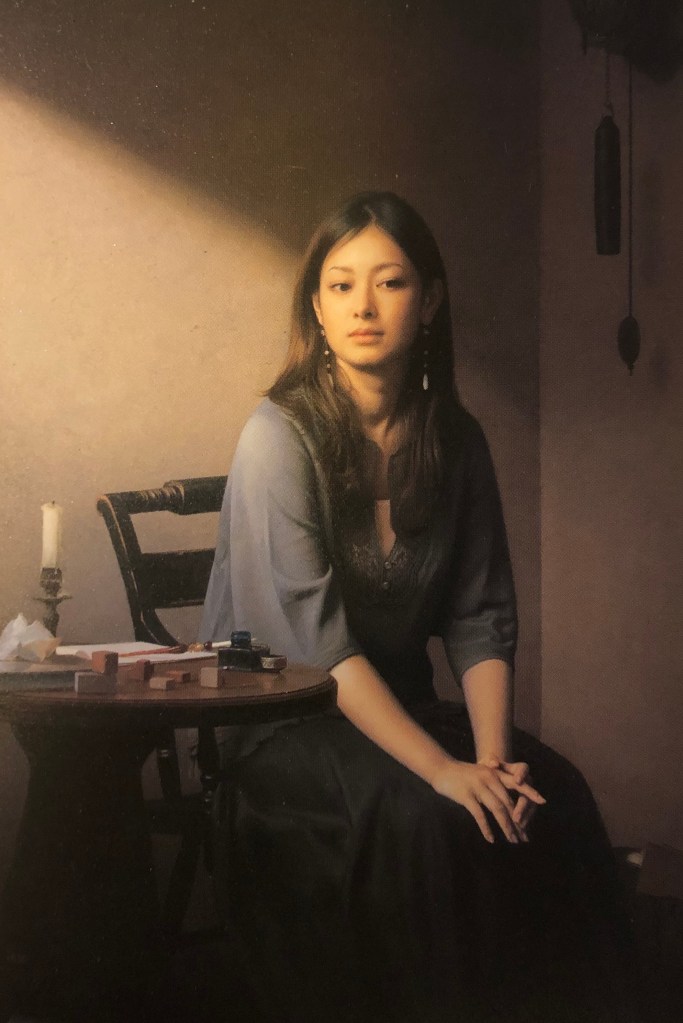
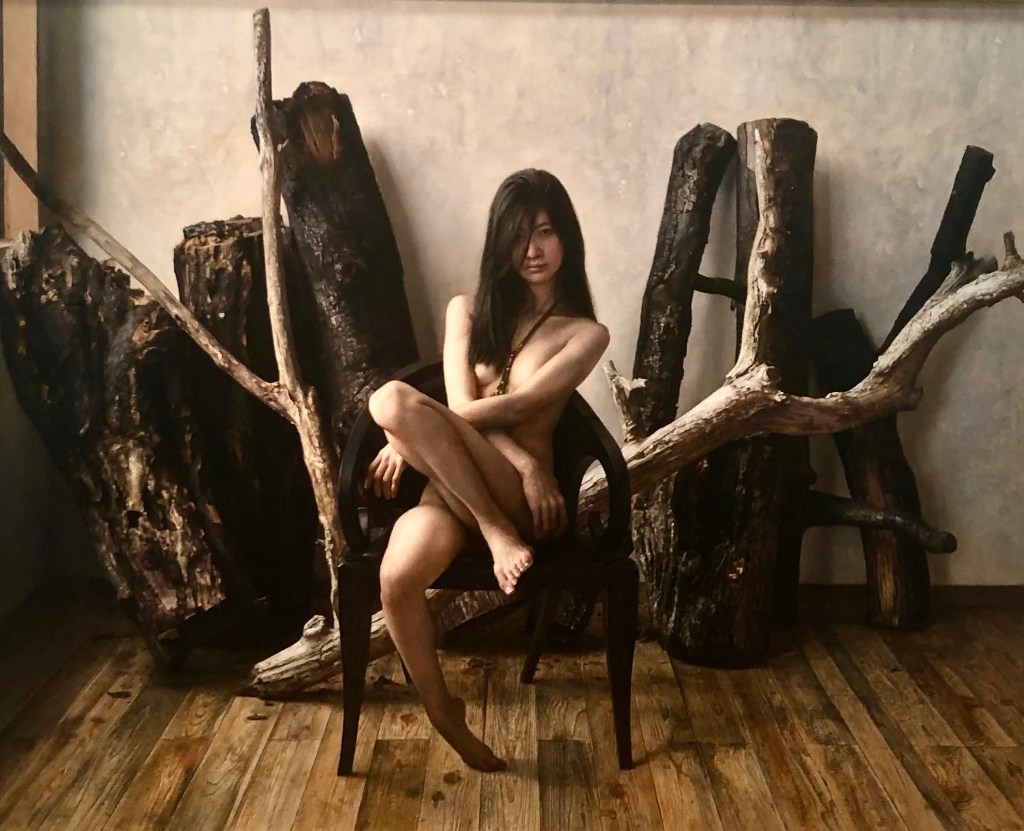
This is a digital rendering of a photo of a postcard of an oil painting. So you couldn’t say you were seeing it at its best. But you still might infer that it is a very attractive piece of work. The artist is Hiroshi Ikushima but as far as I know it doesn’t have a name.
What could it be? What’s going on here? She is preoccupied well beyond her modelling. Her hands suggest it is not a vacant, even an innocent, pensiveness. I think, perhaps, that odd combination of uncertainty and guarded determination of a woman in conditional love. But the symmetry of her features and her unquestionable beauty take the edge off that anxiety. Or do they? I’m not sure.
It was in use as the poster for an exhibition of art at the Fukuoka Asian Art Museum, an exhibition which was devoted not so much to Asian Art as examples of stunning achievements in realism.
You could grate the peel coming off the lemon below.

However as we got further into the exhibition things took a turn: the young women had fewer clothes and the men looked creepier.
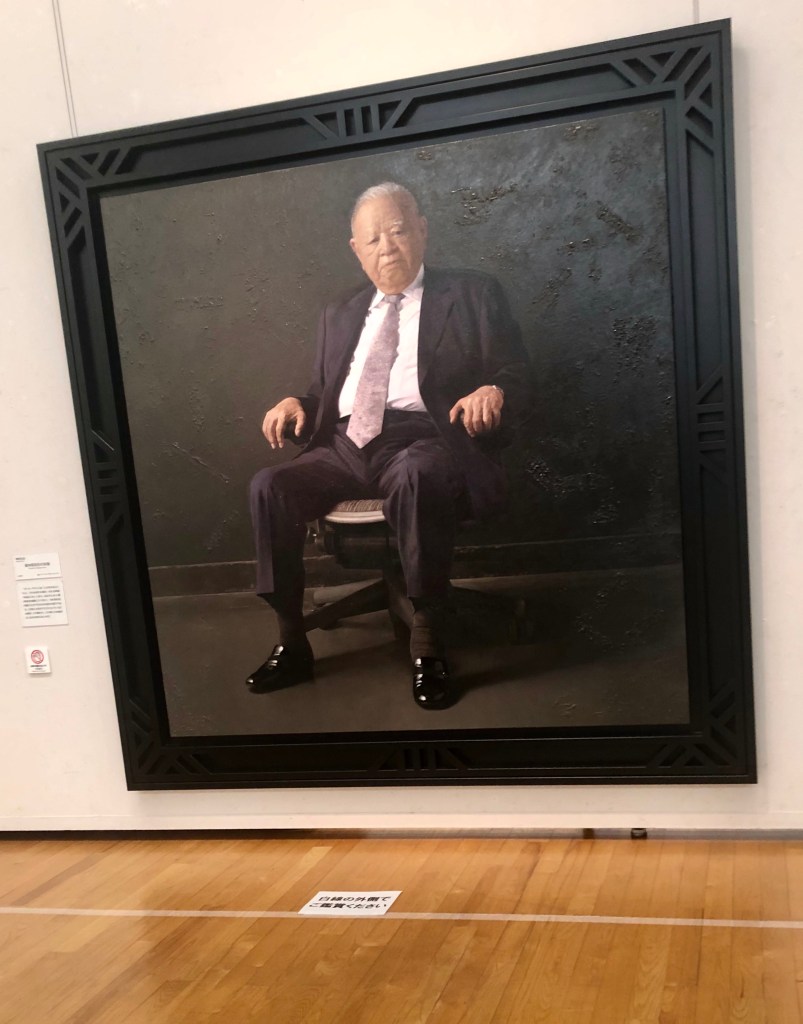
That was characteristic of our experience at the Fukuoka Asian Art Museum. Closed at 6.00, we arrived at 5.15 and were encouraged to buy unusually expensive tickets to two exhibitions discovering at 5.28 the second one had packed up and shut the doors. Turned around, and so had the first one.
One reason why we arrived so late was that we stopped to have some sustenance. The Tomoyasu Cafe and Burgers provided genuinely outstanding thickshakes. But it was the other customers a few tables over who caught my eye. A couple, perhaps mid/late 20s. She was wearing a kimono and was perfectly made up. Perfectly. Like a very high end ad. Sometimes this sort of costume is complemented by one or more stray wisps of hair. Not in this instance. She was also strikingly beautiful. Startlingly. Like something off a film set. In my journal I’ve described him as roughcast, and I think that would be appropriate. A tradie who has washed up after work but not much more: jeans, slippers, T-shirt. They’re on a date but I’m not quite sure what type. It is 4.30pm … and it is taking place at the Tomoyasu Cafe and Burgers. She’s having a parfait. He’s having a burger. She’s doing most of the talking, bright but not familiar. She takes selfies that are hyper-organised, using a (clean) spoon, for example, as a prop. She could be very young but she has a throaty gurgle for a laugh which suggests that, regardless of her age, she probably isn’t. I couldn’t possibly take a photo. It may have a been a commercial transaction we were watching. At 4.30pm … in the Tomoyasu Cafe and Burgers.
• • • • • • • •

Fukuoka is known for its yatai (lit. ‘shop stand’), street food served from pop-up boxes, suddenly there and later suddenly not. We were a bit early to encounter the full schmeer, but we dutifully sat here and ate yakitori and oden, a mystery dish that we were assured was vegetarian. (Footnote: ‘boiled eggs, daikon or konjac, and processed fishcakes stewed in a light, soy-flavored dashi broth.’) Drank beer, memorably good on a hot night. It was all good. We were having An Experience.
We’d been summoned by a very lively tout who spoke bits of at least Russian and Chinese as well as English and knew enough about Australia to make a joke about Melbourne and coffee. When we left he said, ‘Copacetic?’ And I said, somewhat bemused and in the nicest possible way, ‘Yes. Most certainly.’ Copacetic! Extraordinary.
If copacetic brings anything to mind it might be well-built American sophomores in the 1920s or 30s, men never women, wearing large lettered jumpers exchanging agreement about the very positive nature of something. Anything. Jay Gatsby might have said it when Scott Fitzgerald wasn’t listening. It may occur, expressed hopefully, in Tender is the Night from the mouth of one of the more troubled characters. It is not something you hear every day, now or then. Neither William Faulkner nor Ernest Hemingway would have had anything to do with it.
Merriam-Webster describes it ‘as probably better known for competing theories of its origin than any other word of everyday use in American English.’ It appears in a 1919 novel about the young Abraham Lincoln. It might be like a term from Acadian French from Louisiana, coupe-sètique, which is of course only a breath (or a pee) away from meaning ‘septic tank’. African-American tap dancer Bill “Bojangles” Robinson (1877-1949) used it in radio broadcasts during the 1930s and claimed it as his own.
Copacetic. He said it. A hot night on the banks of the Naka River. Unprompted. And he was right. Copacetic.
• • • • • • • •

 mcraeblog