TIME: The Bradshaws/ Gwion Gwion

World pre-history has no parallels even remotely comparable in age or skill [to these paintings]. Truly the Bradshaw artists were the Ice Age’s Michelangelos.

— historian Ian Wilson, Lost World of the Kimberley
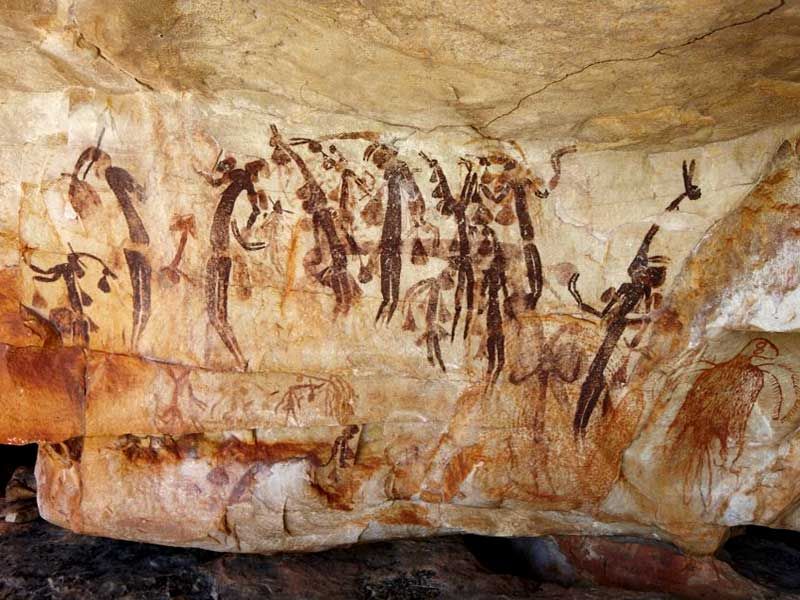
For 120 or so years these intriguing rock paintings — sophisticated, finely outlined then painted, and now lithified, actually grown into and become part of the rock — were known by the non-Aboriginals who discussed them as ‘Bradshaws’. Today it would be more acceptable to call them Gwion Gwion, their name in Ngarinyin. In their spread across the Kimberley, an area as big as Spain, they are also known among local Aboriginal groups as djimi, giro giro (kiera kiro or girri girri), and guyon (or kuyon).

Gwion Gwion can refer to the work of the artists who are believed to have painted them, children of Djilinya, a mythical female or, alternatively, the long-beaked bird Guyon (‘sandstone thrush’) that pecks at rock faces to catch insects which sometimes causes their wing or other body parts to bleed. (That’s the northern Kimberley story. In the central Kimberley they say the beak bleeds.) The blood trickles down the rock to create these images which are almost uniformly and unusually a very dark browny-red, ‘mulberry’ as it has been described. They are detailed, precise and have all sorts of ornament.

The chief Bradshaw fans have divided them into four types:

  • Tassel figures: have tassels hanging from their arms and waists, along with various other recognisable accessories, such as arm bands, conical headdresses and boomerangs. This style is the earliest, most detailed and most common.
  • Sash: while similar in appearance to the Tassel figures, the Sash body is more robust and has a three-pointed sash or bag attached to the figure’s belt.
  • Elegant Action Figures: are almost always shown running, kneeling or hunting with multi-barbed spears and boomerangs. These are difficult to place in the style sequence as they are the only figures that are not superimposed over a painting from another period. In fact they are the only style that has not been defaced.
  • Clothes Peg Figures: were named (by Walsh, see below) after their resemblance to old wooden clothes pegs. They are also referred to as Straight Part Figures. In a stationary pose, segments of their bodies are missing, such as their waists, arms and feet, the result of different colour pigments, such as whites and yellows, fading over time. Many of the images are shown in aggressive stances. At least one panel [below] shows a battle with opponents arrayed in ranks opposite each other.

These are clearly not Aboriginal categorisations. Nor are the more readily encountered detailed descriptions of the figures.

A fine Sash Bradshaw displaying a wide range of the accoutrements found associated with this Group. The long head dress has a single feather mounted through its upper extremity, with double tiered tassel extremity. A Prong Variation of the Winged Headdress feature is mounted to the right side of the head. A neck-mounted dillybag is visible beneath the right armpit, and a cluster of four Chilli Armpit Decorations beneath the left. … [Etc. Etc.] The Bradshaw Foundation
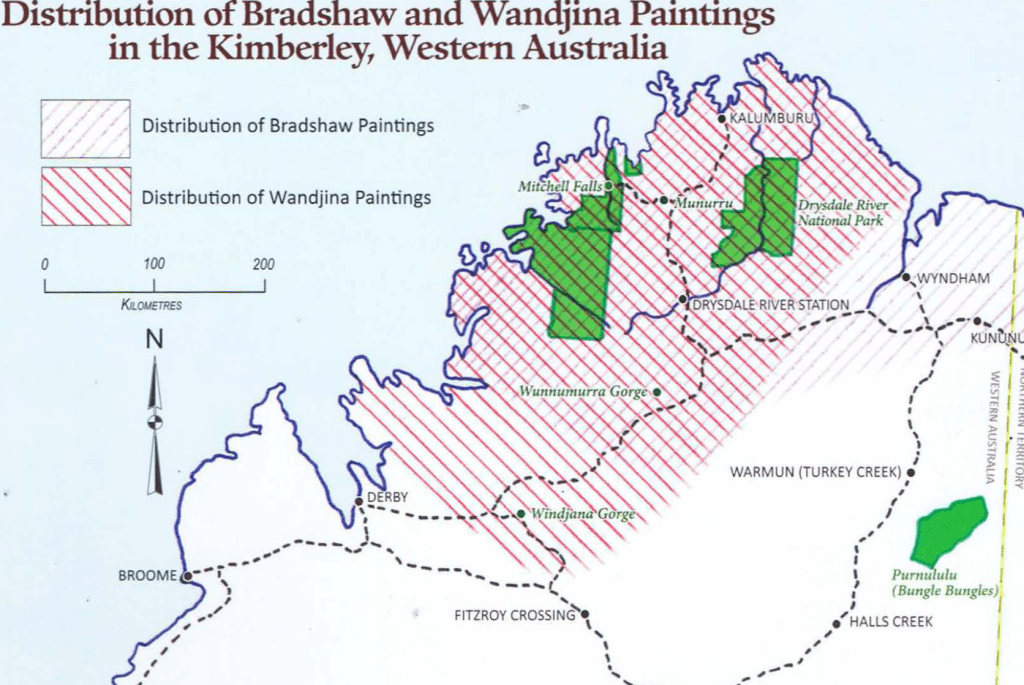
In the same area the very different Wandjina figures can be found.
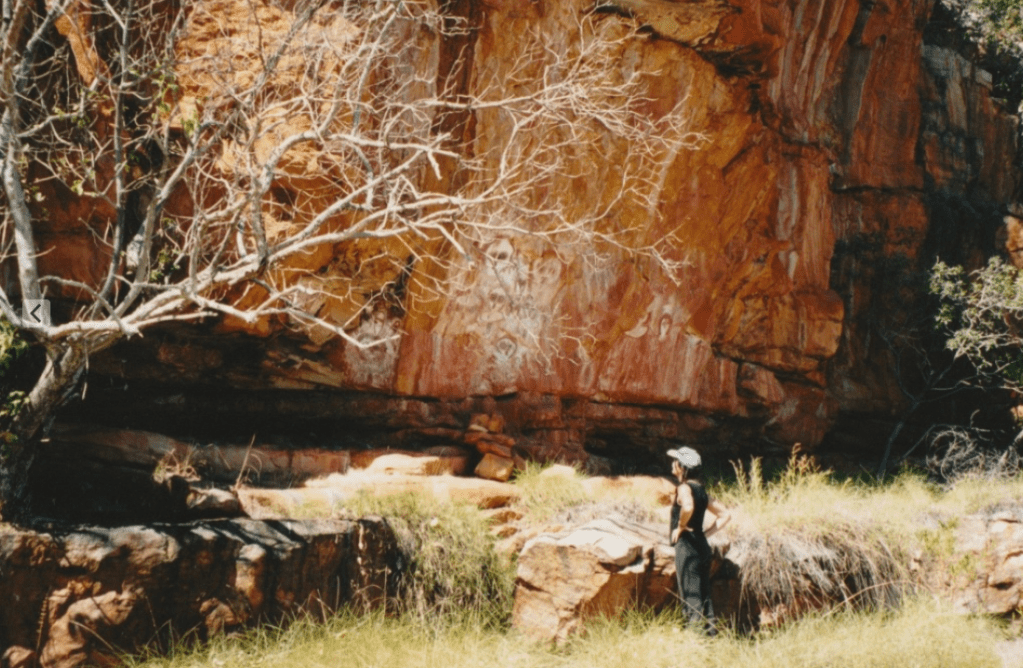
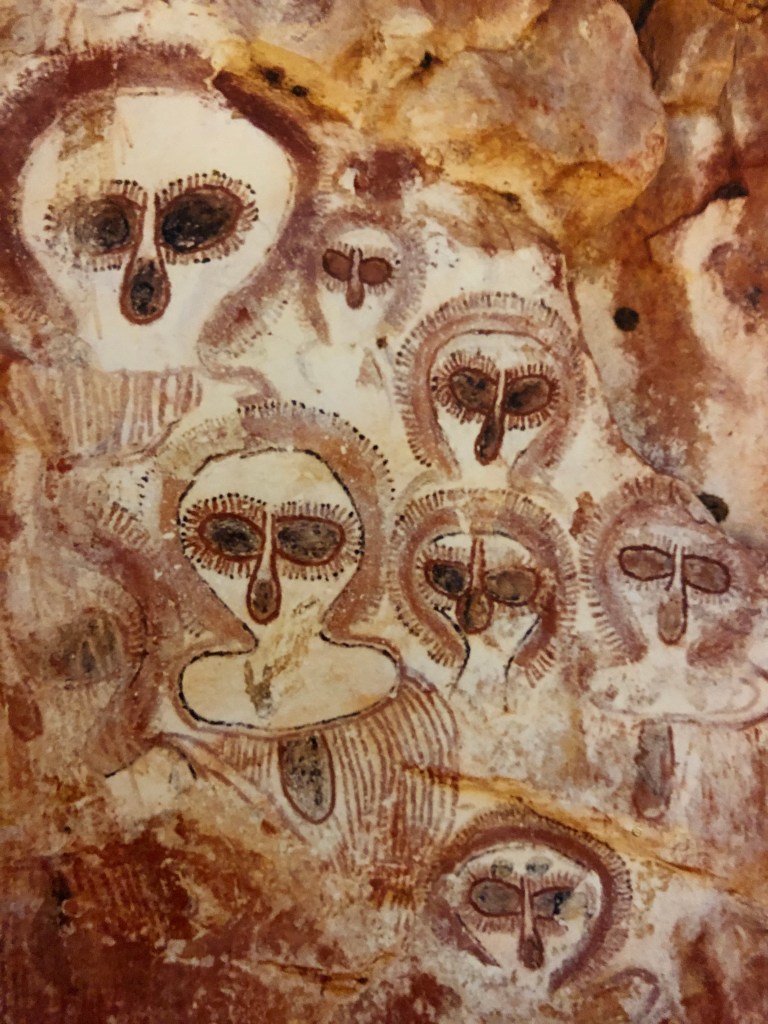
These figures can be clearly placed. They belong to the Mowanjum peoples of the Kimberley and that attachment is active and strong. They are cloud and rain weather spirits. A number of the paintings have been convincingly dated in their original forms from about 3800-4000 years ago. It has been suggested that this art style was generated by the end of a millennium-long drought occurring across northern Australia and the beginning of regular annual (and life-giving) monsoons. Wandjina typically have no mouth. One explanation for that is that rain would never stop if they did.

These paintings are still believed to possess great power and therefore are to be treated with great care and respect. According to Mowanjum belief, annual repainting in December or January ensures the arrival of the monsoon rains.

The automatic response might be to think that Wandjina must be much older than Gwion Gwion. But as this photo illustrates it is not uncommon to find Wandjina superimposed over Gwion Gwion. Leaving a puzzle.

********
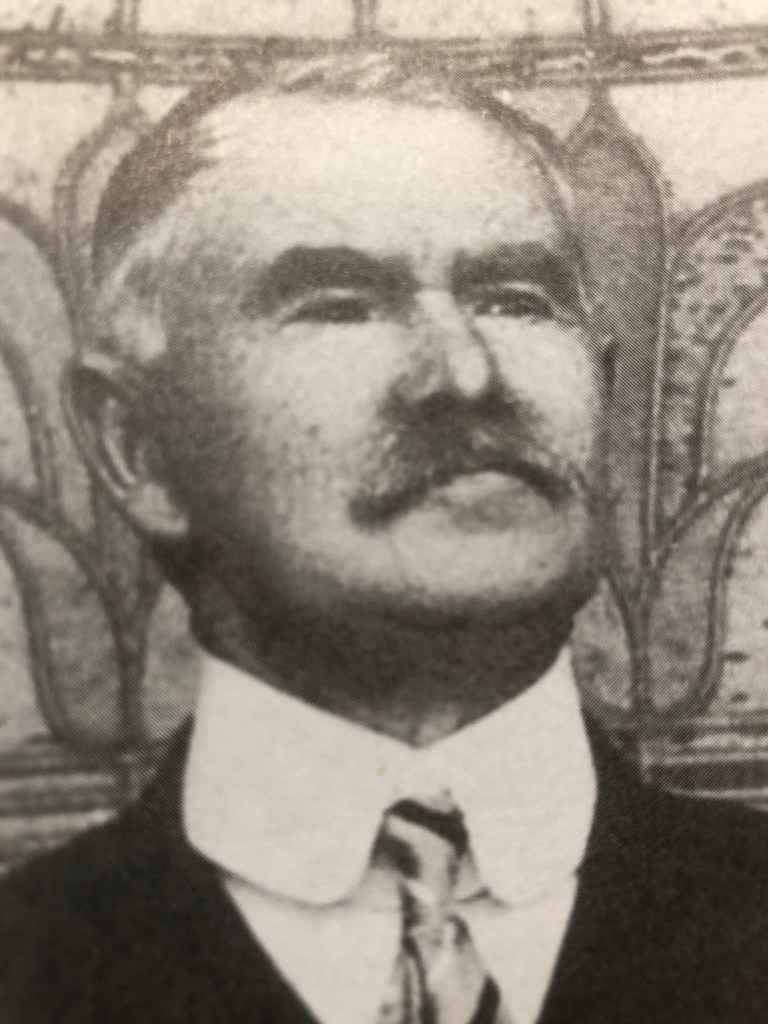
Joseph Bradshaw

The Gwion Gwion have drawn, and transfixed, European ‘enthusiasts’ since land speculator Joseph Bradshaw stumbled over his first set near the Roe River in the Kimberley in 1891. He was looking for suitable pasture with his brother and seems to have been lost. He reported his finds in the subsequent year. His drawings, pooh pooh-ed initially, proved to be remarkably accurate and detailed. He also made his own comments including the much quoted:

The most remarkable fact in connection with these drawings is that wherever a profile face is shown, the features are of a most pronounced aquiline type, quite different from those of any natives we encountered. One might think himself looking at the painted walls of an Egyptian temple.’

In 1938 Doctor Andreas Lommel, a member of Germany’s renowned Frobenius Institute, lived for several months in the Kimberley researching Aboriginal rock art. After his second expedition to the Kimberley in 1955, he stated his belief that the rock art he referred to as the ‘Bradshaw Paintings’ may well predate the ancestors of present Aborigines.

And so we’re off and firing. As well as inviting the attention of unusual and highly imaginative whitefellas, Gwion Gwion really do seem to have some magical powers. You see them and you MUST construct your own story around them. And it WILL be the right one. OKAY?

Here’s one of ever so many.

‘As the Bradshaw Paintings progressed in time they displayed a distinct trend of decline into barbarism. The decline is noticeable in artistic skills, composition, themes, motives and aesthetics. There is a noticeable increase in imperfect figures, and short stocky human forms appear together with the slender Bradshaw figures. Both homo-forms are clad in the Bradshaw tradition. The finely choreographed graceful postures gradually transit into wielding of weapons.

‘The cause of multilateral decline is seen in the emergence of an external pressure, infiltration, inherent internal decay and eventual annexation by barbaric and warring new comers, probably the earliest wave of invasion (from the Indian sub-continent) by what is referred to as the Australian Aborigine. Such a quiet conquest infers the Bradshaw People were peaceful and hospitable, unaccustomed to deceit.’ (‘Unaccustomed to deceit!’ You can read that into 20,000 year-old rock art?)

This is ‘Anthropologist GL Seymour’ and the publication which quotes is called Australia for Everyone, guidance for visitors to Australia. I can find plenty of other material like this, but I can’t find any other reference to him on the net except for quite a number of word-for-word transcriptions of the passage above along with his summary. ‘The invaders eventually overtook the rule [sic] and overwrote the sophisticated culture, concluding that what the British did to the Aborigines, they themselves appear to have done to the Bradshaw People upon their arrival in Australia’.

********

Bradshaw’s name lives on in The Bradshaw Foundation, an international organisation dedicated to rock art founded by sculptor John Robinson who grew up in Australia but subsequently lived in England. He is one of those who have been much moved by a trip to the Kimberley for the purpose of looking at rock art. American billionaire Robert A. Hefner is its current President and Hungarian industrialist Damon de Laszlo is Chair of its Board.

This is part of what the Foundation’s website has to say about Gwion Gwion rock art today:

The Australian Rock Art Archive currently focuses on the rock art of the Kimberley region, featuring the Gwion Gwion rock art, also known as the Bradshaw paintings, and the Wandjina rock art. The Gwion Gwion rock art is claimed to be the earliest figurative art in the world. Sixty-five thousand years ago, our ancestors crossed by boat in groups from Timor into Australia. It is just possible that some members of these groups were assigned the task of recording their beliefs, hopes, fears, and spirits by painting on the rocks of carefully considered locations. If that is the case, the cave paintings of the Kimberley region of north west Australia could be among the earliest figurative paintings ever executed.

The approximate date of the colonisation of this continent is based on scientific evidence. The date of the Gwion Gwion rock art is not. In fact, the mystery surrounding this distinctive style of rock art, who the artists were, when they were painted, and for what reason, is part of their attraction. Unfortunately this mystery has sometimes been used as a political vehicle to hijack the art, and in so doing, obscures their beauty and sophistication.

Speaking of which:

‘Commenting on the idea of a referendum to recognise Aboriginal and Torres Strait Islanders in the constitution, Liberal Democrat senator David Leyonhjelm says there are doubts about whether Aboriginal people were the first occupants of Australia. “There are some anthropologists who argue that”, he said this morning. Senator Leyonhjelm cited the cave art known as the Bradshaws or Gwion Gwion in the Kimberley in Western Australia, although he mistakenly said they were in the Northern Territory. “There are some anthropologists around who say they are so distinct from more recent Aboriginal cave paintings, that they suggest that there was a previous culture … to the Aborigines,” he said. “The fact that there is even a doubt raised about it would suggest to me that it is not necessarily a good thing to put in the constitution.“‘ (ABC News: 25/6/18)

********

I’ve seen three sets of Gwion Gwion. This is my rather ordinary photo of one.

Grahame Walsh (at right) saw thousands. (8742 have been recorded to date.) Before his death in 2007 he had created a set of 1.2 million slides of rock art now in the custody of the Kimberley Foundation.

He is the author of what is believed to be one of the truly magisterial works of its type, ‘Australia’s Greatest Rock Art’, constructed at the Government’s behest as part of the Bicentennial celebrations. One hundred individual sections cover the rock art of every Australian state and territory as well as every major rock art region and style: materials, craft details, location, antecedents, context. 390 colour plates. Weight: 3 kgs. Awarded the Thompson Medal in 1990 by the Royal Geographical Society. Today you can buy a new copy for $1200, second hand for $800 to $380 (pretty scruffy).

In 2004 he told Michael Winkler for ‘The Age’: ‘[Australian rock art] is my life’s obsession, and I’ve devoted everything I had to it. Health, wealth, personal happiness and friendship, I’ve sacrificed the lot in the quest. Now I’m 60, two buggered knees, my wife’s gone, and I’ve got no dough — but I’ve gained a higher understanding of the cognitive development of humankind than probably anyone else in this country.’ And all that after failing Year 10, leaving school at 16, becoming a newspaper photographer and then a park ranger in Queensland’s Carnarvon National Park.

He believed that the Bradshaws provide irrefutable evidence of another people (the ‘Erudite Epoch’) preceding the Aboriginal peoples of the Kimberley.

Besides being utterly consumed by his mission, it seems like he was a nice guy, well meaning, open, even innocent. In the video below the widely respected Dame Elisabeth Murdoch, Rupert’s mother, proclaims Walshe’s insight and integrity. You can judge for yourself. The video also provides a very good look at the country and situations where Gwion Gwion occur.

********

Why does any of this matter? Are these just academic questions?

Well no … they aren’t. If Walsh was right, for example — and his views still have plenty of adherents — Aboriginal people have lived in the Kimberley for 10,000 years or less. But more to the point, they displaced the original ‘owners’. What does that mean for land rights cases for example? While whitefellas only have to have something for five minutes to establish ownership, the way the law is set up means that Aboriginal people have to establish occupancy virtually in perpetuity for their rights and title to land to be formally recognised (remembering this law supplants the operative idea of terra nullius, ‘nobody’s land’).

But even more importantly it cuts right into the notion, so important to Aboriginal culture and life, of permanent and enduring connection to the land, something that no one else has a right to. Always was, as well as always will be. Always.

********

The photo which accompanied Michael’s story was taken in Alan and Maria Myers’ house in North Carlton. The dingo rather takes pride of place but look at the two other artworks.

Maria Myers played a fundamental role in the setting up of the Kimberley Foundation (‘Researching, preserving and promoting Kimberley rock art’). In a 2013 story on the WA 7.30 Report she says: ‘I’d like to get the piece of Australia’s story that’s locked up in Kimberley rock art and I think it’s also a big part of the story of the emergence of modern humans in the world’.

The Kimberley Foundation currently boasts Laurie Brereton as Chair of its Trustees, Maria Myers is now Deputy, and ‘Twiggy’ and Nicola Forrest are its chief patrons: heavy hitters, big money, considerable power. As well as its own quite sophisticated operations, the Foundation funds a Chair in Rock Art at the UWA and a Chair in Archeological Science at Melbourne Uni (where Alan Myers is Chancellor). In 2002 the Foundation was an enthusiastic supporter of Grahame Walsh and the most important source of his funds.

But in 2017 the Foundation decided Walsh was wrong.

‘The late Grahame Walsh’s meticulous recording of the Kimberley’s most remote art-decorated caves went on to become the bedrock of current research that appears to disprove his own theory of discontinuity. Kimberley Foundation Australia Chair Maria Myers, who knew Walsh well until his death in 2007, says a decade of scientific study of rock art based on Walsh’s legacy is revealing a different picture of prehistoric artistry in the Kimberley.

‘Walsh believed that no continuous link existed between the painting of the Gwion or Bradshaw period … and the beginning of the Wandjina period of wide-eyed spirit figures. They appeared to be made by different peoples, he concluded. But in the ten years since Walsh died, “We have found more and more sites that we don’t know whether to put in the clothes peg period or the early Wandjina period,” says Myers. “They are what Grahame always said he couldn’t find — they are transitional. So there is no period of discontinuity between the two.”’ (‘Rock Art Researcher Got it Wrong’ The Australian 25/9/17.)

Another amateur, Dr David Welch, a medical doctor based in Darwin, played a crucial part in the development of the new schema. His monograph ‘From Bradshaw to Wandjina: Aboriginal Paintings of the Kimberley Region, WA’ (2016) tells the story, this time as a result of working with dozens of Aboriginal groups and getting their stories.

The broadly agreed chronological sequence at present is

  • firstly rock markings: incisions, grooves, hollows which might relate to ceremonial life, identity markers, changes in the landscape
  • naturalistic: large sometimes life size animals, fish and plants. Hand prints or stencils
  • Gwion: see above, except
  • static polychrome figures (formerly described as ‘clothes peg’ figures): schematized, usually straight human forms; dominated by groups of people rather than deities, depicting headdresses, multi-barbed spears and spear throwers. They are finely painted in red and orange, with faded white and yellow paints, creating the illusion of unpainted or ‘missing’ parts
  • painted hand: enormously varied with bichrome and polychrome depictions of objects, humans, animals, plants, lines, finger dots and non-figurative motifs. This diversity may show the marking of clan estates during the Holocene Period
  • Wandjina figures: see also above.

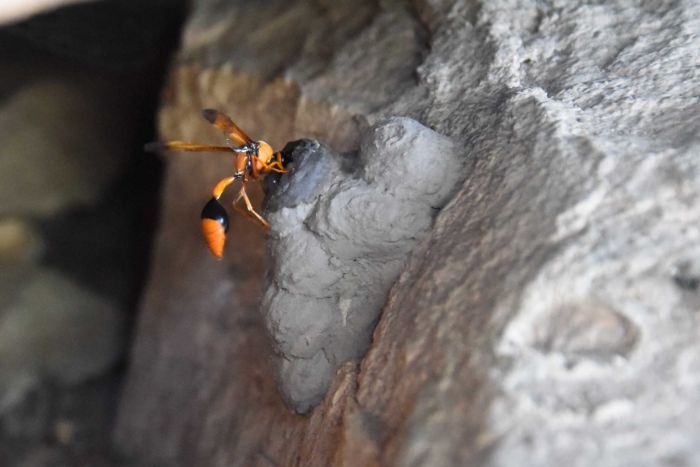
And just how old are any of these? The Wandjina figures can be carbon-dated to 3,800-4,000 years before the present (BP). The ‘painted hands’ seem to belong to 7,000-10,000 years BP. Information about the age of Gwion Gwion art has been drawn from the brilliant and widely noted dating of a series of fossilised mud wasp nests built over paintings. (‘When the mud wasp collects sand off the floor she’s also picking up tiny pieces of charcoal.’) The oldest of these to date has been 18,000±1,500 years BP.
The naturalistic period presents some intriguing cases.

This is believed by some scientists to be a painting of a marsupial lion found under some small Gwion Gwion paintings. As far as we know marsupial lions became extinct more than 45-50,000 years BP, although Kim Akerman, the primary author of this article, thinks 25-30,000 years might be more likely.

It is generally agreed that the earliest rock markings were made at least 40,000 years BP.

And who was making this art? Very hot off the press from a group of South Australian researchers in partnership with Aboriginal families and communities:

[Via access to historical collections of hair samples,] we were able to map the maternal genetic lineages onto the birthplace of the oldest recorded maternal ancestor (sometimes two to three generations back) and found there were striking patterns of Australia’s genetic past.

There were many very deep genetic branches, stretching back 45,000 to 50,000 years. We compared these dates to records of the earliest archaeological sites around Australia. We found that the people appear to have arrived in Australia almost exactly 50,000 years ago.

Those first Australians entered a landmass we collectively call “Sahul, with New Guinea connected to Australia. The Gulf of Carpentaria was a massive fresh water lake at the time and most likely a very attractive place for the founding population.

The genetic lineages show that the first Aboriginal populations swept around the coasts of Australia in two parallel waves. One went clockwise and the other counter-clockwise, before meeting somewhere in South Australia.

The occupation of the coasts was rapid, perhaps taking no longer than 2,000 to 3,000 years. But after that, the genetic patterns suggest that populations quickly settled down into specific territory or country, and have moved very little since.

The genetic lineages within each region are clearly very divergent. They tell us that people – once settled in a particular landscape – stayed connected within their realms for up to 50,000 years despite huge environmental and climate changes.

We should remember that this is about ten times as long as all of the European history we’re commonly taught.

This pattern is very unusual elsewhere in the world, and underlines why there might be such remarkable Aboriginal cultural and spiritual connection to land and country.

As Kaurna Elder, Lewis O’Brien, one of the original hair donors and part of the advisory group for the study, put it:

Aboriginal people have always known that we have been on our land since the start of our time, but it is important to have science show that to the rest of the world.

What a story.

********

Part of his heritage. But what on earth do they mean for the rest of us?

And now for something completely different … READ ON.
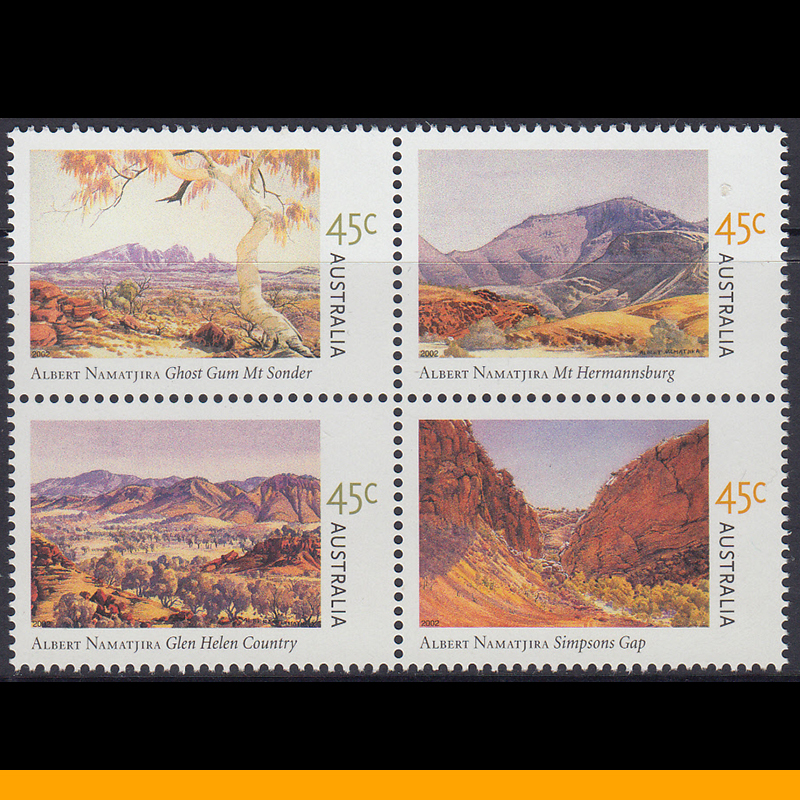
JUSTICE: Albert Namatjira

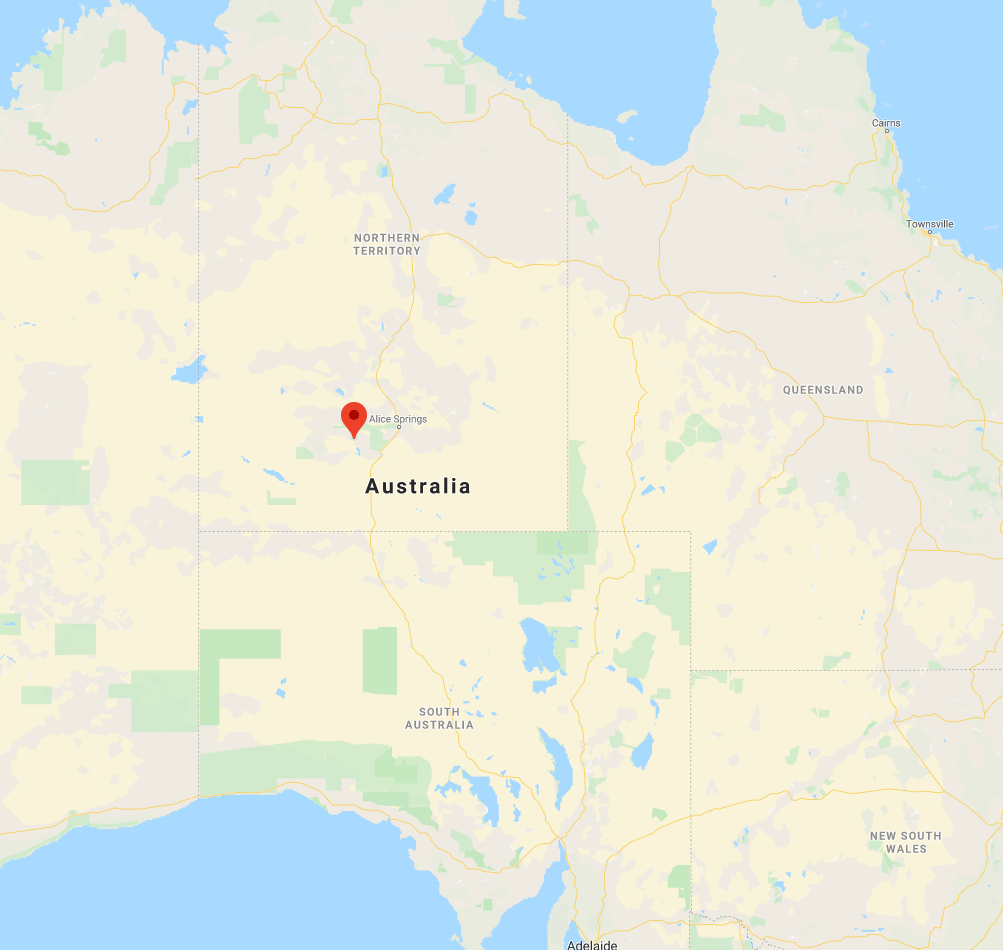
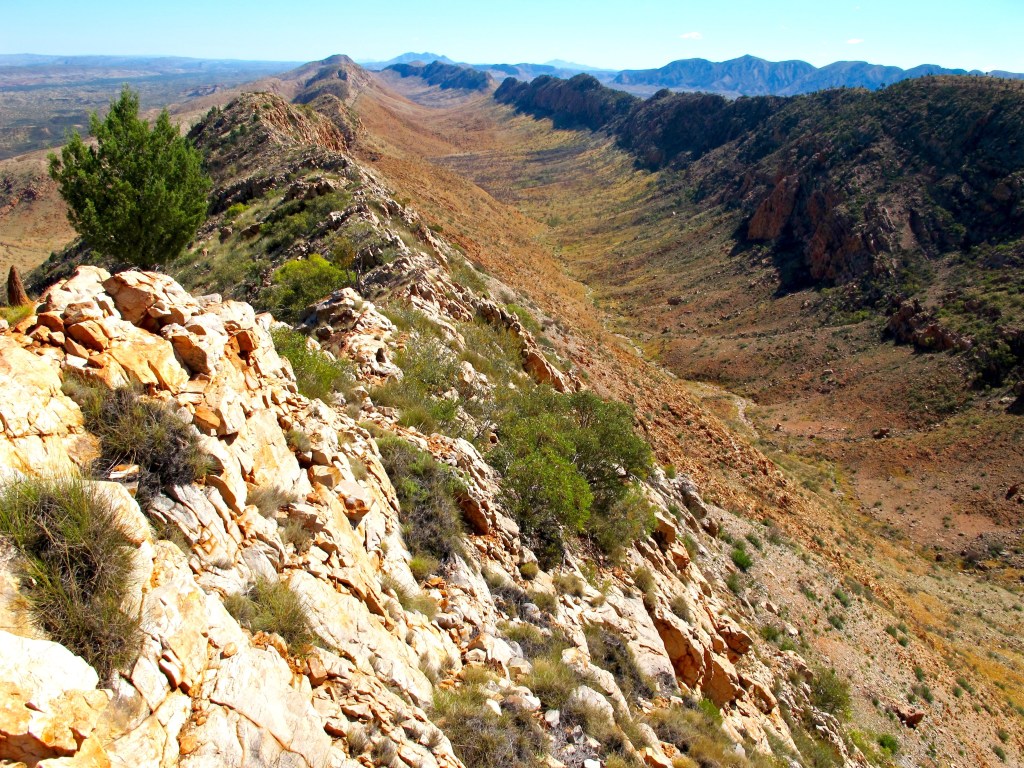
NOTES: None of Albert’s paintings, all water colours, included here look anywhere near as good as they do in reality. In real the colours quiver and melt into each other in a way they just don’t when digitally rendered (a process which is always looking for and defining borders, in or out, yes or no, sharp not soft) or for that matter when they appear in the pages of an art book. The shadows are both more profound and more intelligible. The perception of depth is much more evident and dramatic. See them in the flesh if you can. Anyone could have taken the landscape photos below in this extraordinary country, but I did. They were taken while walking through the Western MacDonells on the Larapinta Trail, one of the world’s greatest walks, starting at Alice Springs’ Old Telegraph Station and finishing at one peak of Mt Sonder.

What a dreadfully difficult relationship Albert Namatjira had with the whitefellas that had taken over his country: adored at one moment and treated appallingly the next — at the same time even. It would have been torture. That might be a function of celebrity; it might be the afflictions that come with being in so many ways The First; and it might be being black in a whitefella’s world. Almost certainly all three. Adam Goodes would understand perfectly.

The extraordinary Mt Sonder, or Rwetyepme (‘roo-chip-ma‘)

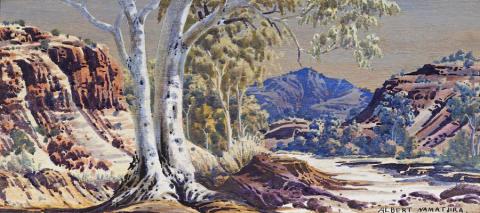
His story has been better known than it is today. In the 1950s prints of his Mt Sonder with or without ghost gums belonged on the wall or mantlepiece with the family photos under the flight of pottery ducks and the mirror with the bunch of flowers semi-silvered into it.

Albert was a hero, an important figure in the post-war wave of national self-identification that Australians were undergoing at the time, an exploration full of both insecurity and bumptious assertiveness. He belonged with the wattle, the cricketers, Vegemite, Holdens, the Melbourne Olympics and a home of your own with a Hill’s Hoist, his dignified and handsome face beaming over the lot of them as though providing benediction. ‘We’ could put that face on a stamp knowing that it wouldn’t cause us any trouble. ‘We’ could almost … well, almost, claim him as One of Us.

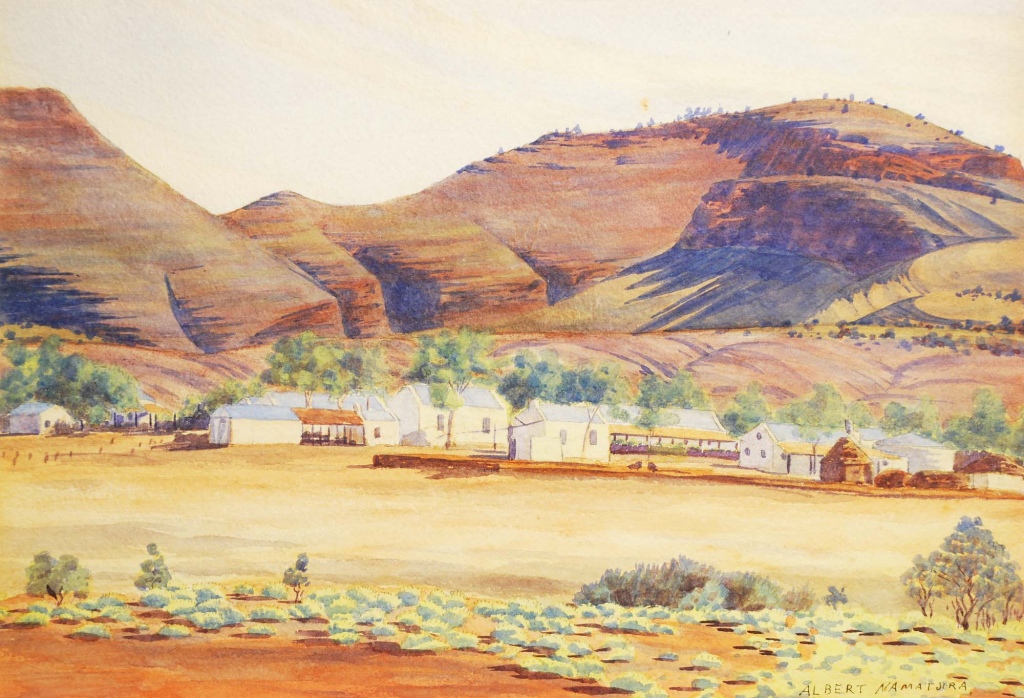
Hermannsburg, 1938. Araluen Gallery, Alice Springs, NT

He was born in 1902 to Western Arrernte (‘urrunda’) parents who had chosen to ‘come in’ to Hermannsburg Lutheran Mission at the western end of the MacDonnells. (Hermannsburg was known as Ntaria beforehand and is again now.) In Arrernte, these ranges which extend for more than 600km are called Tjorita, and were formed by the wanderings, clearly visible here, of the giant caterpillar Yeperenye.

Under the influence of the firm but reasonably benign form of Christianity espoused at Hermannsburg, he was christened and his name changed from Elea to Albert. ‘Namatjira’, flying ant dreaming, was his father’s Arrernte name. He called himself just Albert until he felt he needed to do otherwise.

For 13 years he learnt what any kid would learn on a mission with a full program of education coupled with a fourth ‘R’, religion, joining the other three. He remained a dedicated Christian until his death. But at 13 he was initiated, meaning going to live in the bush for six months, enduring designed hardship including specific physical ordeals, being taught the Law and customary practice, learning the stories and songs of his country and of his own jukurrpa — establishing his place in the Aboriginal world in fact.

He became a cameleer, for some time working a route between Oodnadatta and Hermannsburg, about 800 kms one way, … and one way to immerse yourself in this remarkable country. He also worked as a ringer and stockhand to try to bring some money in to the impoverished mission.

In time he married Ilkalita (christened as ‘Rubina’), a member of a neighboring community and one of the mainstays of his life. The couple built a house near the mission, and Albert supported his growing family (eventually with ten children) by doing odd jobs. These included making and selling small pieces of artwork. In 1932, the year he turned 30, two Melbourne artists visited the mission. Rex Battarbee was one.

Albert, Axel Poignant, another artist and film maker, and Rex. 1946

Battarbee’s story deserves a detour. What on earth was he doing there? He was born and brought up in Warrnambool (about as far away from Hermannsburg as you could get on the continent) before enlisting for the First World War. During fighting at Bullecourt, he was shot through the chest, face and both arms. He was invalided to Australia and hospitalised for several years, his left arm remaining crippled. Unable to resume farm work, he studied commercial art in Melbourne, but decided instead to become a landscape painter.

In a further unlikely turn of events, Rex went on a series of outback tours in a T-model Ford rejigged as a mobile home with his friend John Gardner. It was during the third of these excursions that they arrived at Hermannsburg and were asked by the missions’s superintendent Pastor Friedrich Albrecht — a complex and interesting man, a Pole by birth who lived at Hermannsburg for almost 30 years and spoke fluent Arrernte — to exhibit what they had been painting.

This would have been a moment, the first time the mission folk had seen their country represented in this way. How to respond? Shock? Puzzlement? Anger? Withdrawal in horror at this appropriation of their dreamings? The crowd shouted for joy upon recognising each location and pulled each other hither and thither to see each new work. Word of the exhibition spread at unintelligible speed. During the two days of the show more than 300 Aboriginal people saw it.

Rex Battarbee Central Australian landscape 1936 34 x 55cm National Gallery of Australia
A photographic version. He must have been sitting just a little west of here. What a mountain this is. Simply majestic.

Albert’s response appears not to have been complicated. He was absolutely clear that he wanted to paint too. Battarbee describes him as ‘waiting’ for their return two years later. He had visioned up in his mind that he could look after the camels for me while I taught him to paint. As one indication of the nature of mission life Battarbee had to ask Pastor Albrecht for permission to employ Albert as a camel-boy. It was on this series of excursions that Albert did his first water colours.

He was a very clever man with great ambition to become an artist, a marvellous pair of hands and marvellous eyes, and he had no mistakes to unlearn. That is why he was so easy to teach, he was just like a sponge or a piece of blotting paper. He absorbed everything, and it was easy to eliminate mistakes because you only had to tell him once and he never did it again.

At the same time Battarbee recognised that Albert was teaching him about his, Albert’s, country, not just by the aesthetics of his choice of locales but by his explanations of their significance. It does seem to have been a meeting of minds. Albert’s warmth, good nature and charm is strongly evident in the 1947 film ‘Albert Namatjira: An artist’s life’ in which he acts out various components of his life and development. (See it now on Kanopy. It’s worth it.)

Pastor Albrecht took 10 of Albert’s paintings from this experience to a church conference at Nuriootpa.

Kangaroo in Landscape is one of those paintings. You can see how his colour fields are still filling in outlined drawing. This is one of the important changes in his work as it became more sophisticated and practiced: paint straight to the paper.

Despite rock bottom prices, only four sold. In a gesture of solidarity and encouragement Albrecht bought two himself. A year passed with sporadic sales of paintings, mulga plaques, boomerangs, carvings, and other artefacts. Then Albrecht decided to get back in contact with Battarbee.

He’s as keen as ever and working hard to improve himself. He’s been painting when he can even when the others go walkabout. … Perhaps you could contemplate taking some as part of your exhibition. Adding thoughtfully: This may spoil the unity of your show, which would be distinctly to your disadvantage. As time goes by we shall have more opportunities of bringing his work before the public. This, too, suggests something about the nature of mission life. It doesn’t do to make simple judgments.

Three of Albert’s water colours were included in Battarbee’s next exhibition with a collection tin nearby. Eight pounds were donated. In 1938 Battarbee arranged an exhibition of 41 of Albert’s paintings in Melbourne. They sold out in three days. From that point on he never had trouble selling paintings. That seems to be the moment everything changed.

It might be noted that W. H. Gill who directed the gallery where Albert’s exhibition occurred gave Battarbee a note: ‘I suggest you take some good photos of the man … I consider it would be best to show him purely as a Native and not wearing Any European Clothing so as to maintain and convey to the public that he is a pure Aboriginal and not Civilised.’

Battarbee later moved to live in Alice Springs where among other things he set up and provided art classes for local Aboriginal people. In the photo below one figure appears to have been pasted in. But it’s where he felt he belonged. And bless him and his curiosity and his confidence in the truth of common humanity.

* * * * * * *

When Princess Margaret turned 21 in 1951 Australia’s gift to her was a Namatjira. Her level of appreciation is not recorded. During her sister’s first visit to Australia in 1954, the Queen was invited to view a specially mounted exhibition of Albert’s work in his company. Always far more polite than Margaret, she said she liked it.

* * * * * * *

Colour. That’s one reason. Colour. Can you believe what he’s up to? There can’t be country that looks like this. It’s simply too … fierce, overdone.

Talipate, Western MacDonnells c. 1950. Benalla Art Gallery

Look at the purple! You can’t have purple in the foreground. It’s to indicate distance, to mellow things down … hang on … what’s this?

Simpson’s Gap, Runutjirba. My photo.

But a huge range of skills besides colouration is on show: structure, management of distance and depth and the turn of the plane.

See, for example, the way the light before the storm is managed both in the coloration of the sky and on the rocks in the left foreground. Albert once told William Dargie he knew ‘how to make a tree look the same colour whether it was in the light or shadow’, and that a famous painter, who Dargie doesn’t identify, didn’t. (It was Hans Heysen. Don’t tell anyone.) Albert does. And that’s what you’re looking at. Probably without noticing.

* * * * * * *

How big was Albert? Huge. This letter sent from India asking for an autograph had no trouble finding him.

His career took off almost immediately and just kept growing, over a decade becoming well outside the capacity of the Mission to manage. The Aranda Arts Council was established to supervise production, pricing, release and sales. Many of the artists — and Albert was not alone in selling paintings, he was just the chief figure in the Hermannsburg School — went elsewhere. (One reason was that the Council paid on sale rather than consignment.) Albert was among them. As his paintings proliferated, unlicensed, onto prints, post cards, tea towels, trays, beer coasters and anything else you can imagine, for 11 years Albert would bring four paintings a week to John Cummings who would sell them from a gallery next to his pharmacy in Alice Springs. Cummings was one of the better dealers. Albert was also doing business with people who would give him 20 quid for a painting to be sold a week later for 300.

By this stage a celebrity, he had become a photo opportunity, for art lovers, for tourists, for random passers by, for sticky-beaks peering into his property and house, for journalists and, because of all that, for governments.

Without him even knowing, in 1957 he became Australia’s first Aboriginal ‘citizen’, and what a strange and offensive idea that is.

‘Welfare’ Ordinances governing life in the Northern Territory (and in other states in varied form), passed as law first by South Australia and later as it took control of the Territory by the Commonwealth, meant that all Aboriginal people who lived in the NT were under the control of the administration. Couldn’t live where they wanted, couldn’t build a house, couldn’t claim a basic wage, couldn’t buy alcohol or drink in pubs and, of course, couldn’t vote.

The initial colonial wars were appalling, but we can pretend they were distant, sporadic, conducted by thugs, and possibly poorly attested. This business, however, is within living memory, and was universal, durable and institutionalised. You can’t argue about it or pretend that it might not have happened. A Government edict establishes a group of people as third rate, simply by being members of that group. It denies them rights so fundamental it is hard to think of them as rights at all. They are not ‘citizens’ of the country where their forebears have lived for many thousands of years. What does that make a ‘citizen’? I’m afraid it can only mean a member of a group of cruel insensitive exploiters.

Albert and Rubina became citizens simply by having their names removed from the register of ‘Full-blood Aboriginal Wards of the State’ (and not at their behest, but by the cunning plan of the publicity machine of the Australian Government). Their children’s names were still on the list as were those of all their relatives, and it hardly needs saying but the system of obligatory sharing is deeply embedded in Aboriginal culture. Bark paintings of animals, for example, may map the directions for distributing the kill.

Albert had been struggling with this. His ‘family’ had become more and more extensive and as a result his outgoings were eclipsing his income. He never became as wealthy as the whitefella press was inclined to suggest and at what should have been the peak of his fame and earnings his family was reduced to living in a series of makeshift shelters. One of his expenses was having water carted to them.

His life and financial situation were openly and intrusively discussed in public and by the press. Pastor Doug Nicholls and the Aboriginal Advancement League went chasing royalties and license fees on his behalf. John Brackenreg, director of Artarmon Galleries where most of his work was placed, thought that it would be ‘in Albert’s best interests that any additional royalties should accumulate [ie be retained at the gallery’s pleasure]. Unless of course he specifies otherwise in writing.’ (That’s where the copyright to ALL his paintings ended up until three years ago. After an intervention by Dick Smith of all people, copyright was returned to the family on October 14, 2017.)

And now to the part of the story that people are inclined to remember.

He had started drinking.

Albert never drink before. At Sydney, he had a friend, they share a little bit wine. Those people taught him to drink them artist friends. He come back to Alice he was number one artist and he started to drink because he had learned in those places. Then he gave drink to his relatives.

After Albert was citizen, he started to drink. Trouble is that government gave us wrong citizen, for drinking. Instead of different kind of citizen, living citizen. Once this drinking come in, this destroy all the people in Australia. And Albert. (Nhasson Ungkwanaka, Albert’s pastor)

The actual offence arose from the investigation of the death of a woman at a party at Morris Soak out of Alice where he had been living at the time.

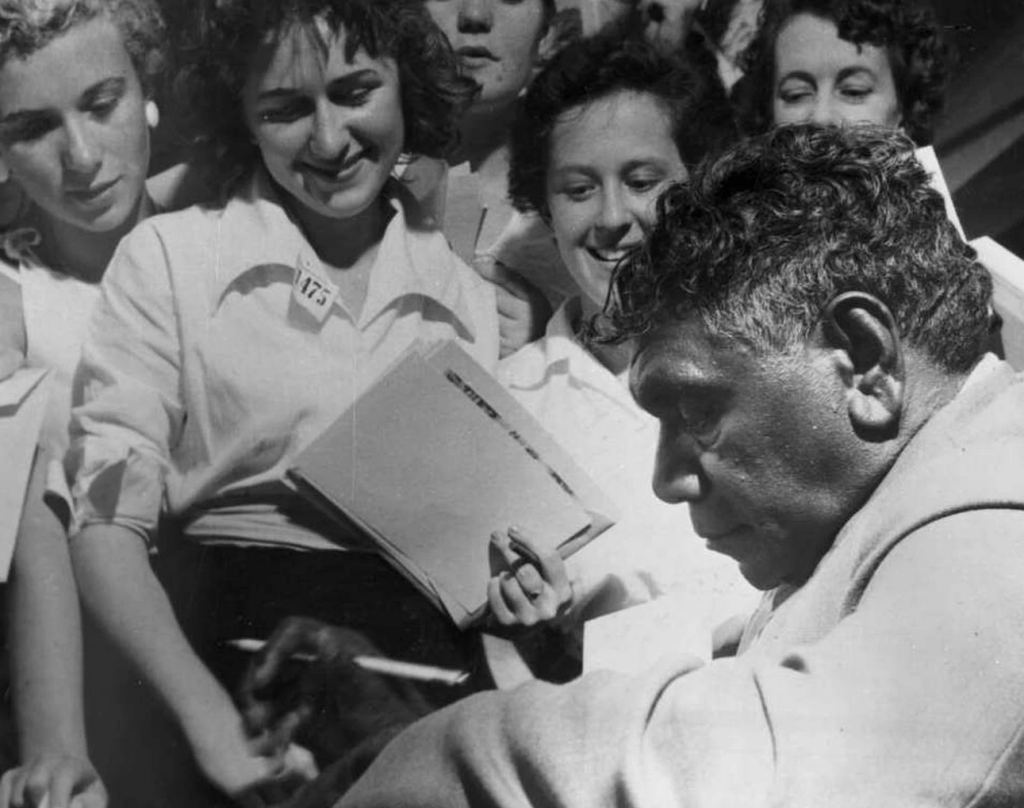
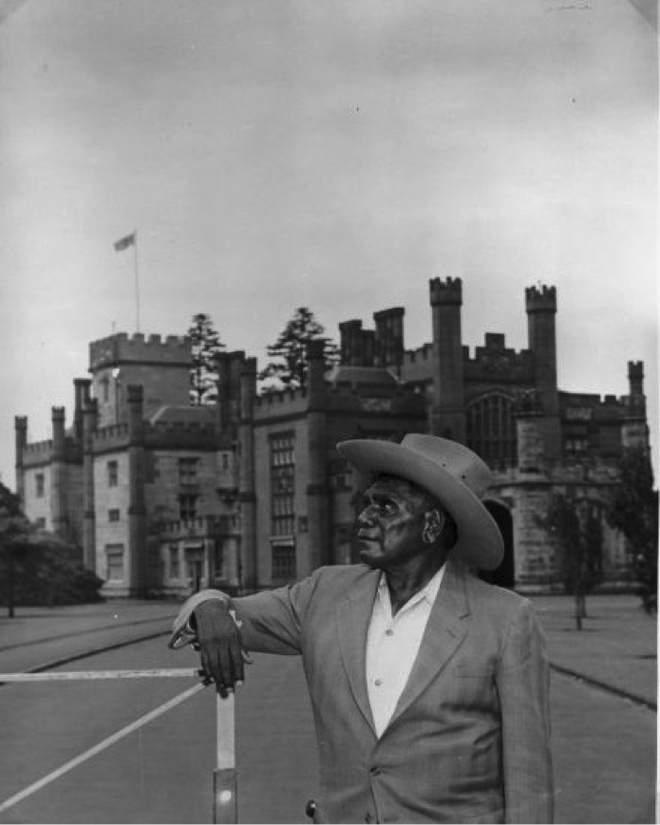
After receiving the Queen’s Medal at Govt House (NSW)

Albert Namatjira: first Aboriginal Australian citizen, recipient of the Queen’s Coronation Medal, first Aboriginal subject of the winner of the Archibald Prize, most famous artist in Australia, charged with supplying alcohol to members of his extended family.

Charged, found guilty. Two appeals. The press is howling. Pro, anti, shame on the government, shame on Albert, shame on his family, shame on blackfellas. Shame job all round. Six months, reduced to three months to be served in a fairly liberal facility at Papunya, but still …

Following sentencing, Albert was heard to say in court:

I cannot go on like this. I cannot stand it any longer. I would rather put a rifle to my head and end it all than go on. Why don’t they kill us all? That is what they want.

He died ten weeks after his release. He hadn’t been well for some time and an accident with the bonnet of the truck donated to him by Ampol led to the amputation of the index finger of his left hand. He was admitted to hospital with angina, a failing liver and pneumonia. But you could readily be forgiven for thinking he had died of a broken heart.

Gordon Bennett, 1989 Valley of the Ghost Gum

* * * * * * *

Critics have often been vocal in their dislike of Albert’s art. Gum tree one side, or gum tree the other, kitsch, dated and, brutally, ‘too white’, ‘too assimilated’, ‘turned his back on his people and his country’. (‘The dull and studied watercolours one might expect from an old maid’: much-vaunted anthropologist Claude Levi-Strauss wrote in 1966.)

I have thought some the more anodyne versions of that criticism myself in the past without knowing why. Osmotic consumption of ill-digested second-hand opinion I would say. Art is profoundly subject to fashion; things come and go and I might have thought Albert’s art like a lot of representational landscape painting was something that had come and gone. Something my mother would (and did) like perhaps.

Then some years ago I saw a dozen or so of the Araluen Centre’s collection in Alice Springs. Of his 2000 works it is believed that most of the very best are in the hands of private collectors and we may never see them, but these stood out as really exceptional paintings, charismatic paintings, the sort you look at and think how did he do that? How has he drawn me in so deeply? I saw the ‘Seeing the Centre’ retrospective of his work in Canberra in 2002 celebrating the centenary of his birth and I was sold. In this case his works were surrounded by other artists of the time including Rex Battarbee, and his many familial artist successors, and it was Albert’s works that leapt out of the crowd. As with a lot of great art, it is the absolute certainty of his control. He’s well past having to wrestle with his craft; he’s thinking how he can make a picture great.

I have little doubt that one of the main reasons why his work became so popular — Australia’s best known, and loved, painter for decades — is that he was generous enough to show us his country, a country that largely exists in our imaginations.

In the ’50s the proportion of Australians who had had a look at this part of the world would have been tiny. But its place in the lore of the country — still the British outpost, built more firmly on colonial foundations than it is now — would have loomed large. Four-wheel drive SUVs have made the country smaller but the Red Centre is nevertheless an iconic idea more than a reality for most of us. It is a strange phenomenon that something about which you know very little shapes your identity. It is an even stranger phenomenon that you can be gladly introduced to it by people whose very existence is problematic for you.

When we paint we are painting as we always have done to demonstrate our continuing link with our country and the rights and responsibilities we have to it. Furthermore we paint to show the rest of the world that we own this country, and that the land owns us. …

Many years ago an Aboriginal man from central Australia, Albert Namatjira became very famous as a painter. Using Western watercolour paint techniques he painted many landscapes. But what non-Aboriginal people don’t understand, or choose not to understand, was that he was painting his country, the land of the Arrernte people. He was demonstrating to the rest of the world the living title held by his people to the lands they had been on for thousands of years.

Not only did non-Aboriginal people refuse to recognise this, but many have said that he wasn’t any good as a painter anyway, that all he was doing was mimicking a European art style and making pretty pictures. No one asked him the name of the country he was painting, or the Dreamings that had made that country important. They thought that all the old man needed was money for his paintings, and nothing else. The buyers did not recognise the Aboriginal law that bound his paintings to the land.

All our painting is a political act.

— Galarrwuy Yunupingu ‘The Black/White Conflict’ in Wally Caruana (ed.) Windows on the Dreaming

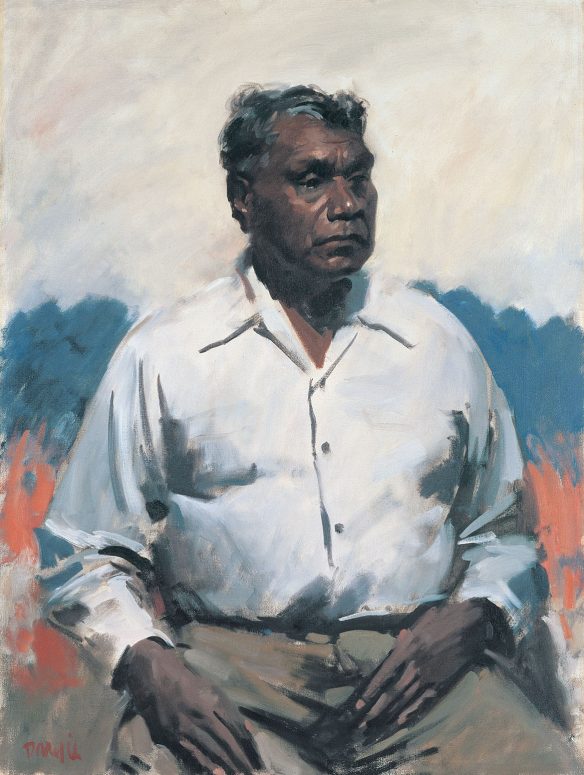
William Dargie Albert Namatjira, winner of the Archibald Prize 1956

Robert Campbell Junior. Ever heard of him? No? Well let’s correct that … READ ON.

IDENTITY: Robert Campbell Jnr

This image has an empty alt attribute; its file name is abo-history-facts-1988.jpg
Abo History (Facts) 1988
130 x 200cm
Held by the National Gallery of Australia

You might be finding the detail of this painting hard to see. Its date for example. 1988. Also known as the Bicentenary. Perhaps its title. Abo History (Facts).

From top left: Dad brings a kangaroo home. We might be fishing, chasing kangas or both. Life is good. Whitefellas turn up in ships with a flag. They start chopping down trees and killing blackfellas, although some blackfellas are helping them out. We build a house, they build a house. We’re growing things and fishing together and sharing the produce. Still good. Uh, we’re off in the bush getting stuck into the grog; and they won’t let us use the swimming pool they’ve built. Second from the left, bottom row — them whitefullas, they’ve introduced ‘dog tags’, the thing we hate most in the world. Albert all over again mate. What the hell are ya!

Under the ‘protection’ legislation of 1943 in most parts of Australia individuals were permitted to apply for an ‘exemption’ from the Act [‘Act’ meaning the legislation controlling Aboriginal people at the time]. An exemption or ‘dog tag’ as it was often referred to, meant that an Aboriginal person wasn’t treated as Aboriginal for the purpose of the Act. [Think about that!] They were entitled to vote, drink alcohol, move freely, and their children could be admitted to ordinary public schools. [Which indicates, of course, that these were things ‘Aboriginal’ Aboriginal people could not do.] They were however prohibited from consorting with other Aboriginal people who were not exempt. This renunciation of their traditional lifestyle was promoted as the only opportunity to overcome poverty, gain work and access to education and social welfare benefits.

Thus Aboriginal people could buy alcohol at a bar (if permitted by the barman), on the condition of renouncing their family and heritage. What a deal! Sign me up!

Same frame: we can go to the pictures but we have to sit up the front in a special section roped off for blackfellas. Next: we’ve all been jammed together onto a ‘mission’. We decide to burn it down. Last: Aboriginal deaths in custody. (Current rate of Aboriginal incarceration: 2440 per 100,000 population; non-Aboriginal, 216 per 100,000. Aboriginal people about 2 percent of the Australian population, about 27 percent of the prison population. 434 Aboriginal deaths in custody since 2010. All data, 2020)

This image has an empty alt attribute; its file name is screen-shot-2020-05-12-at-5.41.51-pm.png

Robert Campbell Junior was born in 1944 and grew up near Kempsey on Burnt Bridge Mission. Dave Sands, a near contemporary and a champion Aboriginal boxer with a fight record of 108 fights — 97 wins (62 by knockout), 7 losses, 4 no contests — grew up at Burnt Bridge too. In his bigger fights he was billed as being Puerto Rican for fear of turning the fans away.

This image has an empty alt attribute; its file name is images-3.jpg
The Fighting Sands Brothers, 1989
55 x 92 cm

Burnt Bridge Mission. You can read about some of its worst aspects here (Jennifer’s Story from Bringing Them Home) and here (Ian Lowe’s story of being taken away). These stories are both about being taken away from the Mission and there are people today who were brought up on Missions that speak warmly about those experiences contrasting them favourably with what happens in rural towns today. But those two stories speak to the other side. They are, literally, almost unbearable.

This image has an empty alt attribute; its file name is sid65093s.jpg.164x165_q85.jpg

My dear friend Merv Bishop, the man who took this photo, Australia’s first Aboriginal press photographer and probably the first Aboriginal person to work on a mainstream Australian newspaper, spent six years of his life from 1974 working for the Commonwealth Department of Aboriginal Affairs making a photographic record of Aboriginal and Torres Strait Islander life around the country. This was in some respects a dream job; in others heart breaking. ‘The things I’ve seen brother boy …’, sucking on his clenched teeth, eyes flashing, shaking his head.

That included spending some time at Burnt Bridge. He went back in 1988. The year of the Bicentenary. Among his later photos were these.

This image has an empty alt attribute; its file name is 376.2008s.jpg.505x329_q85.jpg
This image has an empty alt attribute; its file name is 174.1991s.jpg.505x371_q85.jpg

He can take a snap that Merv.

This image has an empty alt attribute; its file name is merv_bishop.jpg.460x2000_q85.jpg
This image has an empty alt attribute; its file name is 13446.jpg
Self-portrait

Robert Campbell left the Mission when he was 14. His art career had begun by doing outline drawings on boomerangs to sell to tourists which his father filled in with poker work (via a heated wire). In his later teens he moved on to scenes on bits of cardboard in gloss house paint that he found leftover at the tip. He’d sell those too, ‘for a carton’. He moved to Sydney and did ‘all the jobs that wasn’t good enough for white people’ — manual labour, factory work, pea picking, brickie’s mortar boy. Sick of this, he went back to Kempsey where he ran into another artist, Tony Coleing, who suggested getting back into painting, this time with better tools: art paint and canvas or artist’s board.

It was then, 1987/88, that the men in red ties began appearing. (Abo History is an early work from this period.) The background patterning, figurative elements, colours and stylistic conventions in his work are all based on traditional Ngaku clan designs found on boomerangs and shields. The National Gallery curator states confidently that the ties are symbols of life and vitality. Other commentators assert equally firmly that they are symbols of ‘suffocation and stifling conformity’. I am inclined to think he found something that would work like a dream to give his figures vigour and interest, and then it became a trademark. A beauty.

Interviewed in 1990 he said:

When I paint, I don’t copy or make a sketch first. It just comes from within me and I keep going. I have a picture in my mind — it’s the spirit in me. It just guides my hand.

I’ve seen some Aboriginal drawings from the Northern Territory in magazines and I kept adding and creating my own style — the Aboriginal spirit in me that I’d lost. When we were on the mission the old people weren’t allowed to talk the lingo, not allowed to teach us. They were too frightened they would be sent away or something. I’m 45 years-old now and yet I’m still searching for that Aboriginal identity that I’ve lost.

One stream of his work is political.

This image has an empty alt attribute; its file name is screen-shot-2020-05-28-at-4.27.11-pm.png
The Dog Tag, 1989
91 x 120 cm

The Dog Tag has the additional inscription Tyerabarrbowaryaou which in Ngaku means ‘I shall never become a white man’.

This image has an empty alt attribute; its file name is 559.1994s.jpg.505x349_q85.jpg
Map of the massacre of Blacks in the Macleay Valley, 1989
79 x 115cms
Art Gallery of NSW

There are records of massacres in his work and a great many stories of dealings with the police. But he also painted the world of his day, the things he was interested in, possibly with an eye to his market as well: the disappearance of Azaria Chamberlain, ‘Australia II’s’ victory in the 1983 America’s Cup, the Moon landing, Ash Wednesday, the racehorse trainer Bart Cummings, the boxer Jeff Fenech, Senator Neville Bonner. And he dug more deeply into the day-to-day of his heritage.

This image has an empty alt attribute; its file name is dhtwebsite.jpg
Hunting Tucker, 1993
124 x 199 cm, private collection

This image has an empty alt attribute; its file name is 654771-robert-campbell-jr-blue-light-man.jpeg
Blue Light Man: the Ghost of Gravelly Hill
private collection

I love the shimmering vitality in his work, but there is always an active mind in play as well as a very gifted hand. It’s that mind and the experience that has formed it which provided another reason for inclusion here.

New South Wales has a larger Aboriginal population than any other state or territory. The rail heads along the Newell Highway (Parkes, Forbes, Dubbo, Narrabri, Moree) and the rich sub-tropical forests and lush riverlands of the north coast produced concentrations of Aboriginal people.

However individual, Robert Campbell’s story would resonate directly in the lives of tens of thousands of Aboriginal people from this area alive today: the Mission background; still somewhere near Country, but not quite; still somewhere near family but parts of that are a blur; lost lingo, lost old time Culture. Something new constructed as culture which includes memories of dispossession and cruelty, grog, intermittent trouble with the law, racism. Struggling with your identity, your place in the world and your future. Sometimes cut badly adrift. But friends, maybe a kind teacher (or priest, or art dealer) among the dross, time spent in the bush, hunting, watching and playing football, doing things together, and feeling that thread of community whatever it might be — but which is not extinguished. Maybe Campbell was more of an Aboriginal artist than he could ever allow.

The first time I went to Walgett, not too many years ago, Marge and I went to the wrong pub for tea. We wouldn’t have minded, but we’d gone to the black pub — no women either — when we should have been at the white-as-white Bowlo. We were gently moved on. Walgett’s pretty bad of course. The shops that are left are all shuttered at night and often during the day.

This image has an empty alt attribute; its file name is r797082_6983170.jpg
Charlie Perkins

And it was the Moree pool that was ‘whites only’ when Charles Perkins and the Freedom Riders arrived in 1965. (In fact Aboriginal children could swim there — before 3pm and as long as they’d been thoroughly scrubbed before entry by the pool staff.)

I never saw this but when I was working at Moree, several people whose views I trust absolutely told me that quite regularly on Saturday nights the whitefellas from the north side of the Namoi would get on the charge (get drunk) and go and take pot shots with their rifles at the Aboriginal camp fires on the other side. That’s 10 years ago. Not that many years ago.

And that’s one of the reasons I think Robert Campbell Junior is a great artist. He looked at this, and more, straight in the eye, put it on paper and somehow, somehow, like a lot of blackfellas I know, not only kept his sense of humour but stayed civilised.

And the big finish. And you can’t get bigger than Emily … READ ON.

MONEY: Emily Kame Kngwarreye

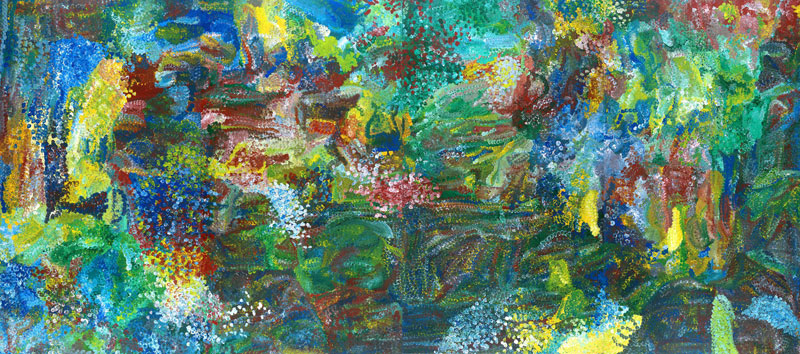
This image has an empty alt attribute; its file name is earths-creation_web-o.jpg
Earth’s Creation, 1994
275 x 632cm

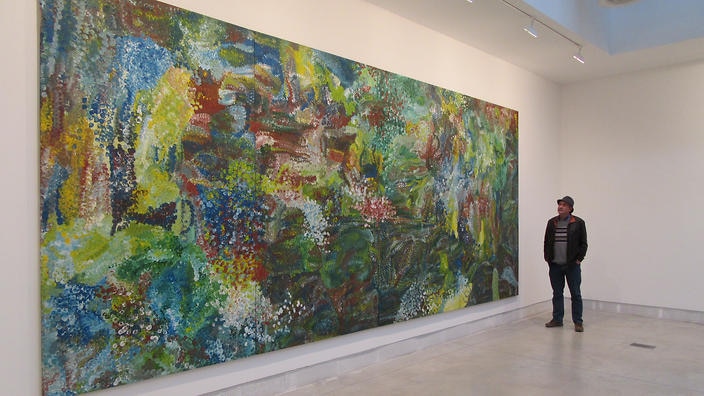
This is the second most expensive piece of Aboriginal art ever purchased. After appearing as a highlight of the international artists’ exhibition at the Venice Biennale of 2015, it was sold in 2017 for $2.1m. Four panels of synthetic polymer paint on linen mounted on canvas.

And huge.

This image has an empty alt attribute; its file name is venice_biennale_oct_2015.jpg

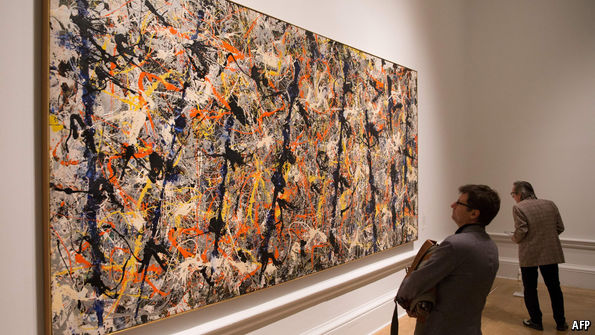
Emily Kngwarreye’s paintings are described by leading international art academics as being equal to the works of Monet and great Abstract artists such as Jackson Pollock, Willem de Kooning, and Mark Rothko. Experts have argued that Earth’s Creation, painted at Utopia on the edge of the Simpson Desert in Central Australia … is an even more important painting for Australia than American painter Jackson Pollock’s Blue Poles, purchased by the National Gallery of Australia in 1973.‘ (The Wikipedia entry)

So there. Monet. Pollock. Rothko. Emily. (Sufficiently big time to have her own design decorate a Boeing 787. How nice that it’s a ‘Dreamliner’.)

In 2007, at one strongly-defined peak of the Aboriginal art market, Earth’s Creation was sold for $1.056m to Tim Jennings, long time owner of Mbantua Gallery & Cultural Museum in Alice Springs. It was initially commissioned for an Adelaide bank but Jennings decided that such a work should ‘come home’ to Alice. In a blog he expanded on why it is more important to Australia than Blue Poles (estimated current value $70+m).

Earth’s Creation was painted by a genius Australian [who was] without any formal or informal art training.

Emily, a female Australian Aboriginal artist, at the age of eighty or thereabouts, combined a deep rooted Aboriginal lifestyle with being a modern, contemporary, abstract painter. …

Aboriginal Art is the bridge of cultures. With paintings of the magnitude and quality of Earth’s Creation, Emily is reaching out to the world. She is putting both Australia and Aboriginal culture on the map.

* * * * * * *

(You’re wondering what the most expensive Aboriginal painting has been? Of course you are, and it’s a convenient segue. But keep all that in mind. They’re the topics.)

This image has an empty alt attribute; its file name is warlugulong_1977.jpg
Clifford Possum Tjapaltjarri Warlugulong
202 x 337cm
Held by the National Gallery of Australia

I don’t know what Mr Tjapaltjarri got for Warlugulong when he painted it, but the Commonwealth Bank bought it for $1,200 and hung it in a cafeteria for 20 years before it sold at auction on the 24 July 2007 for $2.4m.

The painting includes elements of nine distinct dreamings, of which Lungkata’s tale is the central motif. Lungkata is the Bluetongue Lizard Man, an ancestral figure responsible for creating bushfire. The painting shows the results of a fire caused by Lungkata to punish his two sons who caught a kangaroo and declined to share it with their father. On the right are their skeletons. Art talk: ‘an epic painting, encyclopaedic in both content and ambition’.

This image has an empty alt attribute; its file name is clifford-possum-tjapaltjarri.jpg

Clifford Possum Tjapaltjarri’s Country was out north-west of Alice Springs near Yuendemu. But in 1971 he was at Papunya when a white school teacher, Geoffrey Bardon, began an art program for the kids at the Papunya School. The men of the community took it up and famously painted a mural, ‘Honey Ant Dreaming’, on one of the walls of the school (painted over in 1974 by a maintenance man, an historical misfortune) as well as everything else even vaguely suitable that they could get their hands on. ‘I just could not keep the boards up to them’, Bardon has written. This is the birth of Papunya Tula Pty Ltd, the company/ association/ group these men established to manage their production, … and also the foundation of desert art and ‘dot painting’.

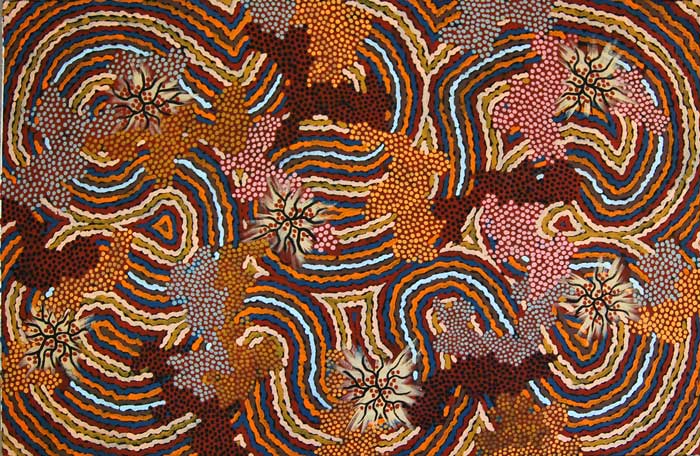
This is dot painting — actually while a wonderful painting not a great example — from about 1993, although with Clifford Possum’s extra flourishes, the brushing out to form the flash points of the storm of the Dreaming he was painting.

This image has an empty alt attribute; its file name is clifford-possum-4f7ed87112f7c.jpg
Clifford Possum Tjapaltjarri Water Dreaming c.1993
83 x 126cm
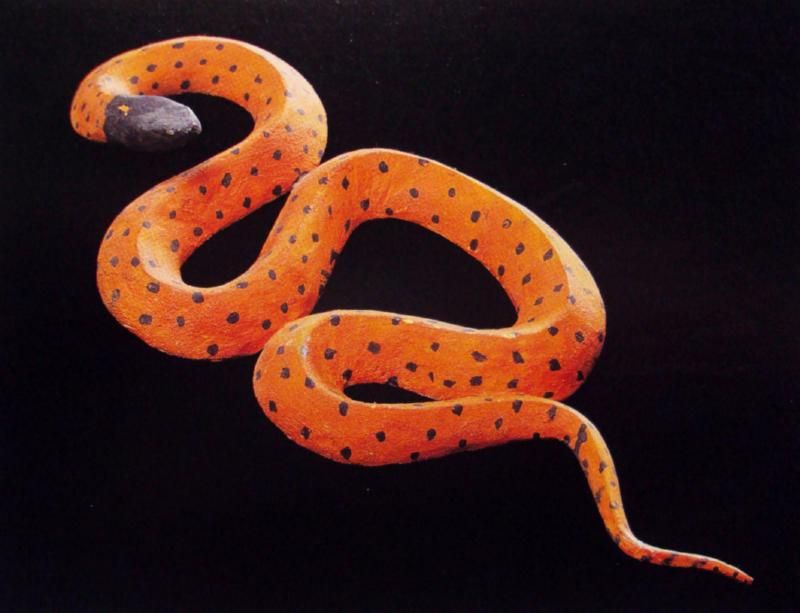
This image has an empty alt attribute; its file name is c78255d88eb267625da0855514e9b5e3.jpg

It might be noted that Tjapaltjarri was painting and carving wood art well before this. At right is one of his snakes.

Not much happened for a decade, but in the ’80s this movement exploded. Art centres were established in communities throughout the Northern Territory and Western Australia. In 2010 there were more than 120 such groups in the Centre and across the north from Yirrkala to the Kimberley. You could make money in a culturally legitimate way that brought high levels of satisfaction to individuals and, at least as importantly, to their communities. Today there could be as many as 16,000 Aboriginal artists working in remote Australia. Art commentator Sasha Grishin suggests that, per capita of population, this is ‘the highest concentration of artists anywhere in the world’.

The explosion has not been, to put it mildly, without its difficulties. Clear evidence was provided by the number of whitefellas suddenly hanging round and the range of gambits they employed to take advantage of this situation. There was money swirling round this world such as had never been seen before, and there is nothing like throwing big handfuls of cash into a group of people to disturb its equilibrium. (If you want to read about vicissitudes of the Aboriginal art market try Adrian Newstead’s very fine inside story of this and other periods of Aboriginal art, The Dealer is the Devil.)

* * * * * * *

But even in this eruption Emily Kame Kngwarreye (say ‘(k)ing-gorr-eye’) leapt out of the pack as something very special. From an excellent article in ‘Artlink’ by Margo Neale, curator of her three most important exhibitions:

This image has an empty alt attribute; its file name is emily-1400h.jpg

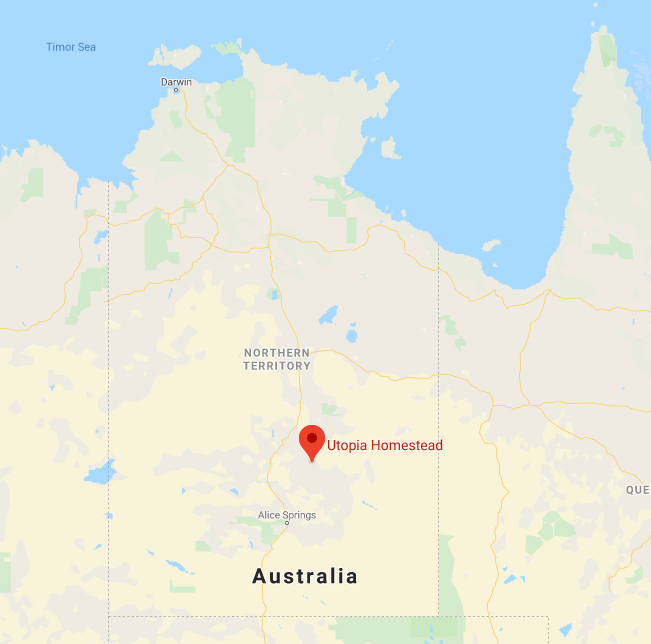
Emily Kame Kngwarreye was black, female, spoke little English [fewer than 20 words] and was already elderly when she started painting on canvas, in the middle of the Australian desert, on a patch of country called Utopia [the possibly ironic name of a giant cattle station] some 260 kilometres northeast of Alice Springs, a place she rarely left over her 80-plus years.

She was in her late 70s when she was introduced to painting in acrylics on canvas after a decade of working in batik with the Utopia women’s group. Neither batik nor painting on canvas is traditional; both were introduced, in the 1970s and 1980s respectively, as part of a government re‑skilling program.

Perhaps because painting on canvas grew out of the women’s batik group, painting on canvas became a women’s activity, unlike the situation at Papunya begun by a men’s painting group. These were and remain strongly gendered societies. But Kngwarreye broke the mould. 

This image has an empty alt attribute; its file name is screen-shot-2020-05-25-at-4.07.05-pm.png

At Utopia it was Kngwarreye’s painting that secured her place in the Western art market and brought millions of dollars* into the community as the undisputed boss of the ‘money story’. She was the golden goose. Emily had no biological children of her own, although many others, so occupied a separate place and this, combined with her strong personality (described as bossy), her age, ceremonial status and past employment as a cameleer (a man’s role) also secured her unique status. The strength of her arms from cameleering was not an insignificant factor in the power and character of her painting stroke. [*Estimated at $20.2m, more than twice as much as any other Australian female artist (Margaret Olley, just for the sake of interest).]

She is believed to have produced more than 3000 works during her eight-year career as a professional artist. (Rodney Gooch, see below, says 6000.)

This ooo ahh story could be balanced off to some modest degree by the fact that she had spent decades making body art for ceremonial purposes. But, imagine. You’re an art dealer and there is this … this machine pouring out high value product at an unfathomable rate. The punters simply cannot buy it quickly enough. No wonder the scam artists, and others, pulled up in their endless Toyota loads scouring Utopia for scraps.

Emily’s work developed in quite different directions over those eight years. Earth’s Creation, where we started, was done ‘dump dump’ style, clumps of paint manipulated (‘pounded’ according to one observer) with implements including a shaving brush. Neale calls this her ‘colourist’ period and it came just two years before her death.

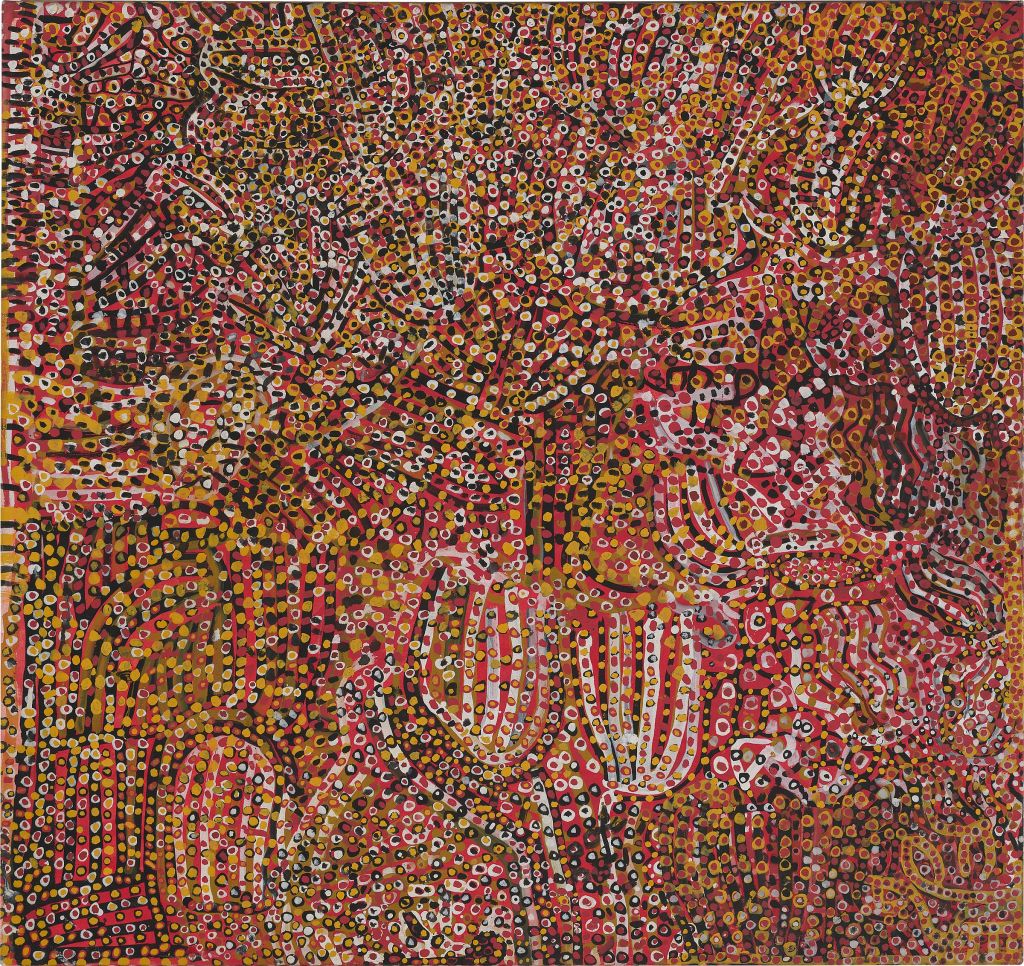
Her earliest works are dot paintings. Ntange Dreaming, below, is one of her earlier works but her very special eye is already manifest in the way the dots have been managed. The double dots — big white, small red and black and so on — are a cunning tactic for generating depth. They also trace lines which could be imagined as suggesting growth and fertility. Her jukurrpaKame‘ (or ‘Kam‘) means the flowers and seeds of the desert yam, and this painting could be construed as being about growth, harvest, fertility. It could, but it has also been described as a self portrait.

This image has an empty alt attribute; its file name is 119248.jpg
Ntange Dreaming, 1989
135 x 122 cm
National Gallery of Australia

Do we need to know what it means in those sorts of ways? Could we? I am inclined to recognise it as a jubilation of paint with a particularly keen appreciation of colour and settled form. It’s just so … good. So convincing. Art. (Not ethnography.)

Then there are the ‘slab’ pictures of another phase, the Awelye (ritual ceremony) series.

This image has an empty alt attribute; its file name is untitled_awelye_web-o.jpg
Untitled (Awelye), 1992


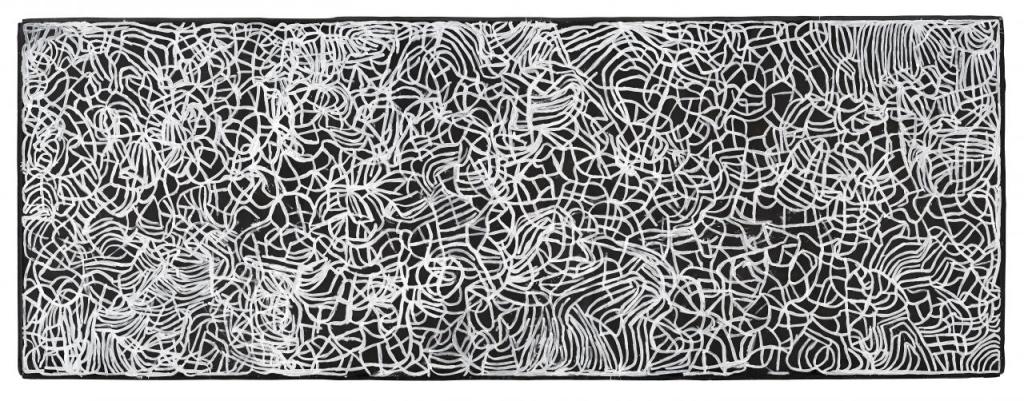
There are hundreds of these, and they relate to body decoration at women’s ceremony. But with their emphasis on line they suggest the shift in direction towards the endless ribbons of some of her later work (Yam Dreamings: if you want to be literal, tracks from where yams have opened cracks in the earth as they mature underground).

This image has an empty alt attribute; its file name is 1280-3.jpg

Big Yam Dreaming (1995), all 3 by 8 metres of it, is one of the National Gallery of Victoria’s treasures and is, along with Earth’s Creation, one of Emily’s two poster pieces.

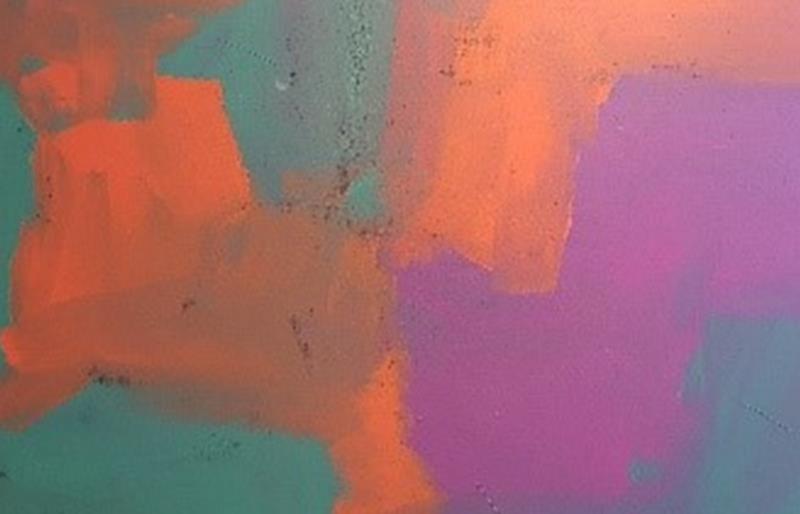
Finally a move to colour fields, some of which are even simpler than My Country (1996) pictured here.

This image has an empty alt attribute; its file name is 1318800_135350_emily-kame-kyngwarreye-last-painting.jpg

As noted above, when asked what she painted, she always gave the same answer.

Whole lot. That whole lot. Awelye (my Dreaming), Arlatyeye (pencil yam), Arkerrthe (mountain devil lizard), Ntange (grass seed), Tingu (Dreamtime pup), Ankerre (emu), Intekwe (favourite food of emus, a small plant), Atnwerle (green bean), and Kame (yam seed). That’s what I paint, whole lot.

This sacred rock Alhalkere both is the location of, and is, her jukurrpa.

This image has an empty alt attribute; its file name is rock-1400w.jpg

* * * * * * *

I have encountered what I would call some of the bottom 10 percent of the 3000 works — knock ups, lines without obvious purpose or pleasure, muddy noodling, colour looking a little like where a brush was cleaned and not much more — in that direction anyway. You’ll find them for sale online for vast prices that you usually have to inquire about. Or I could have been looking at some of the endless fakes. That’s entirely possible.

But as well there is some of her authenticated (and acclaimed) work I like less. For example, I like the paintings from the Awelye period and the Yam Dreamings better than I like Earth’s Creation and its many likenesses. But when she is on form, and she so frequently is, my goodness! There is such confident exactitude in her judgment. Such surety.

Her international career began in Japan. Her work was championed by the distinguished curator Akira Tatehata, in 2008 director of the National Museum of Art in Osaka. He loved her work, was passionate about it, but couldn’t say why. I don’t know how to explain this work. I can talk about it in formal terms, structure, composition, lines, colour but I just don’t know how she got there. I can draw comparison with Brice Marden, with Pollock and particularly with Yayoi Kusama but I know how they got there. … It is a miracle and I just have to proclaim her a genius. But this is only an interim answer. (Quoted in Margo Neale’s article.)

I like the idea of an interim answer because the question is difficult. How does Emily fit into modern art? Some people really worry about that question, and not in moderate or generous ways.

* * * * * * *

In 2013 an exhibition called ‘Australia’ was mounted at the Royal Academy in London. It consisted of hundreds of works one-fifth of which, the first section, were by Aboriginal artists. Emily’s Big Yam Dreaming was a centrepiece.

The critical response went off all over the place including some faint praise (good because it’s like what we’ve already decided is good, that sort of thing). But the general tenor was two thumbs firmly down. Waldemar Januszczak (‘Sunday Times’, 22/9/13) preferred:

original ancient rock art to the dull canvas approximations, knocked out in reduced dimensions, by a host of repetitive Aborigine artists making a buck. Out of a tremendous Indigenous tradition, fired and inspired by an enormous natural landscape, the Australian art world has managed to create what amounts to a market in decorative rugs. Opening the show with a selection of these spotty meanderings, and discussing them in dramatically hallowed terms, cannot disguise the fact that the great art of the Aborigines has been turned into tourist tat.

Brian Sewell of the ‘Daily Mail’ provided his own matchless off spin.

The exhibition is divided into five sections, of which the first is Aboriginal Art — but of the present, not the distant past, at last ‘recognised as art, not artefact’. By whom, I wonder? For these examples of contemporary aboriginal work are so obviously the stale rejiggings of a half-remembered heritage wrecked by the European alcohol, religion and servitude that have rendered purposeless all relics of their ancient and mysterious past. Swamped by Western influences, corrupted by a commercial art market as exploitative as any in Europe and America, all energy, purpose and authenticity lost, the modern Aboriginal Australian is not to be blamed for taking advantage of the white man now with imitative decoration and the souvenir. The black exploits the white’s obsession with conspicuous display and plays on the corporate guilt that he has now been taught to feel for the ethnic cleansing of the 19th century — a small revenge for the devastation of his culture — but the Aborigine offers only a reinvented past, his adoption of “whitefella” materials and, occasionally, “whitefella” ideas (Jackson Pollock must surely lie behind the longest of these canvases) undoing his “blackfella” integrity.

Bang. So stick that up your jumper you colonials. By the way, is the Rum Corps still operational? I fancy a drink.

In the ‘Financial Times’ Jackie Wullschlager tip-toed carefully through some well-prepared background, and then …

The largest Aboriginal work here is an eight-metre canvas of livid tangled white skeins of paint, Anwerlarr Anganenty (Big Yam Dreaming), by Emily Kame Kngwarreye. How authentic is it? A ceremonial leader who began painting on canvas in her seventies, Kngwarreye was promoted as an overnight sensation and became the first Aboriginal artist to sell for more than $1m. Her vigorous all-over compositions recall Jackson Pollock – perhaps too closely. One example is not definitive but, according to Philip Batty, senior curator at Melbourne’s Victoria Museum, Kngwarreye’s later work is simply “a mirror image of European desires”.

Uh oh. Sprung?

This image has an empty alt attribute; its file name is 20161001_bkp507_1.jpg
Hmm… is that an Emily I wonder?

What’s this thing about Pollock? The two artists were born round the same time, but Emily lived her life almost entirely on Utopia in the middle of the Simpson Desert. She spoke two languages neither of which was English, of which she had just a few words. She couldn’t read or write in any language. Even if she did it would be fair to say that Utopia would never at any stage have been awash in art books. Besides which Pollock poured, dripped and splashed; Emily painted. She had brushes. If you can’t see the fundamental differences between Blue Poles and Big Yam Dreaming … well, what can I say? They both do big ones and they both have a formidable colour sense. Was that enough to trick the critics, or did they just get on a congregational roll, a delicious English pile on?

And just who is this Philip Batty? Was he misquoted? Taken out of context? A Murdoch Press/ ‘Spectator’ snark? Right here the story unfolds with complex beauty.

* * * * * * *

Philip Batty is not a sedentary rodent immured in an inner suburban retreat which he has never left, sharpening his poisonous claws on a keyboard. Philip Batty is currently the Senior Curator of Anthropology at Melbourne Museum who has co-authored (with Judith Ryan of the NGV) an important book about the origins of Western Desert art. But in his past life he was one of the three people who established CAAMA, the Central Australian Aboriginal Media Association, a landmark media organisation (radio network, video production company and later, a television station). Right there, rock solid, huge credentials. But more to the point, for a time, Rodney Gooch worked for him.

When he joined CAAMA in 1983, I was the organisation’s co-director and therefore Rodney’s manager, although I don’t think anyone could ever really manage Gooch. Before taking up this position, he had been a head waiter at an Alice Springs restaurant where he organised and performed in the occasional drag show. He was extremely energetic, gregarious, creative, and generous to a fault. But he could also get into a terrible funk. (These quotes all come from an article by Batty for ‘Art Monthly’, July 2009 ‘The art of the art advisor: Rodney Gooch and the invention of Aboriginal art at Utopia’. The link is problematic.)

Moroccan Caravan. Rodney Gooch and his camels which he trained and with which he crossed the Simpson Desert. Riding them are Sam Todd and Fairlie Beckner. November 20, 1981. (Photo by Joanna Bailey for Fairfax Media). Flair, or what?

Rodney Gooch became the Art Adviser for the Utopia community.

The Art Adviser occupies a special, if impossible place in the world of Aboriginal art. They are usually white, young and enthusiastic and employed in Aboriginal art centres throughout remote Australia. Fortunately, their zealous commitment to the job helps fortify them against the difficult nature of their work.

Apart from the tedious business of running an art centre, they have to go cap-in-hand to governments each year for funding; soothe angry artists convinced that they have been ripped off; work out what will sell and encourage their artists to paint accordingly; stretch and undercoat innumerable canvases; watch for ‘carpetbaggers’ circling around their artists; deal with vehicle break-downs miles from nowhere; and butter up rich buyers at glittering exhibition openings.

Finally, they must do all this knowing that their artists will give away their ‘art money’ to innumerable relatives or spend it on second-hand cars that inevitably fall apart.

As an art advisor working at the Aboriginal community of Utopia in Central Australia, Rodney Gooch dealt with all these problems and more, but he also took the art of art advising to a more entrepreneurial level.

The short version. Gooch began at CAAMA as a producer and promoter of the Aboriginal bands CAAMA was helping to establish. The batik program at Utopia had been set up some years before in 1978 but, like many such things, after a promising start was foundering and the Aboriginal Development Corporation asked CAAMA to provide assistance.

Gooch, who according to Batty had previously shown minimal interest in or knowledge of Aboriginal art, was chosen for the task (quite probably by his Aboriginal boyfriend’s brother who was on the selection committee and knew an entrepreneur when he saw one). He visited Utopia and the very first time came back wildly enthusiastic ‘laden with brightly-coloured batik silks’ to sell at the CAAMA shop.

However, after some initial success, sales fell away. It was art that was making the money in Alice, not craft. The shop was sliding downhill to the extent that it was threatening the liquidity of CAAMA which at that time was bidding in an extremely pressured environment for a commercial television station licence (which became Imparja).

Rodney decided to take a more interventionist approach. He bought best quality acrylic paint and ‘constructed, stretched and undercoated 100 canvasses all exactly the same size’ and carted them off in the CAAMA truck to the women of Utopia. He showed them how to mix and use the paint and encouraged them to shift from traditional desert ochres to more varied, brighter and more vivid colours and avoid what he called ‘computer painting’, highly symmetrical alternating dots. He didn’t have to work to persuade the women. Painting was a lot easier and quicker than producing batik. Of the 100 canvasses he eventually retrieved 82. (He worried even then about the destination(s) of the other 18.)

Gooch developed links with dealers around Australia including the curator of Robert Holmes à Court’s collection of Indigenous art, the largest in Australia. Sales exhibitions were mounted with the National Gallery of Victoria and the Art Gallery of NSW. Private galleries were chosen to be key stockists. This process both supported and rode on the rocketing interest in Aboriginal art from remote areas. But the big day came when James Mollison, then Director of the National Gallery of Australia, happened by the CAAMA shop.

Mollison told Rodney that Emily was ‘one of the finest Abstract Expressionists he had ever encountered’, although he was somewhat puzzled. How, he wondered, had an elderly Aboriginal woman living in remote Central Australia ‘mastered’ the techniques and aesthetic conventions of an art movement based in New York? How indeed. Emily spoke very little English, nor could she read nor write. In fact, there was only one white person in the world who had a reasonable grasp of Emily’s language (the linguist, Jenny Green). And as far as Rodney and I knew, Emily had never travelled beyond Central Australia.

It seemed to me that Mollison – an urbane man with little knowledge of Aboriginal people – was projecting his own artistic predilections onto Emily’s work and her aesthetic intentions. But who was to challenge the illusions of the most powerful aficionado in Australian art?

Of course, Rodney had no intention of questioning Mollison’s take on Emily. How she fitted into the history of western art was irrelevant. In any case, Rodney’s knowledge of the New York school of Abstract Expressionism was only marginally better than Emily’s which appeared to be non-existent.

Far more important was the fact that Mollision had not only fallen in love with Emily’s work; he had also bought several of her paintings for the National Gallery of Australia. [A footnote: when Mollison moved to the National Gallery of Victoria he organised the acquisition of Big Yam Dreaming.]

In 1991 Gooch left CAAMA and set himself up as an independent art adviser working with selected artists mostly from Utopia including Emily with whom he had developed a close relationship. It was his idea to make paintings on bits of the car wrecks — doors were popular for a time — which litter the desert. He had a gift for understanding the market and its movements and there is no doubt that he added his own considerable flair to ideas for paintings. Who knows? He might have known about Pollock, Rothko, de Kooning, Krassner, Clyfford Still and Yayoi Kusama. Well … Pollock maybe, Blue Poles made a very big splash, but the others … only just the barest maybe.

What is in no doubt is that he didn’t paint the paintings. Or that the women of Utopia did.

After noting several problems that Gooch helped to leave behind — carpet baggers, fakers, desperadoes, exploiters of many kinds — Batty has no doubt that his legacy is positive. Nor that if it wasn’t him, it would have been somebody else. Purists will object, Batty writes, preferring to imagine that Aboriginal art emanates from some pristine, pre-industrial past. But Aboriginal art is an intercultural phenomenon, shaped both by its Aboriginal producers and non-Aboriginal consumers. Rodney clearly understood the nature of this cross-cultural relationship.

That’s what Batty said, and of course he’s right. And he did NOT say that, under the influence of a western Svengali, Emily was knocking out Pollocks.

At the peak of his powers and influence and under the spell of Emily’s work, Time art critic Robert Hughes ‘recognised’ the burgeoning Aboriginal cultural flowering as ‘the last great art movement of the 20th Century’. Emily wouldn’t have cared.

In 1993, she collected a prestigious Keating Award and was taken to the Art Gallery of New South Wales. Margo Neale writes: An eager entourage wheeled her to a painting by renowned Australian abstract expressionist Tony Tuckson that they were sure she would relate to — after all, everyone else seemed to see connections between her work and his. On tenterhooks they waited for her happy recognition of a fellow genius. Eventually, she erupted into her Anmatyerre language. The translation revealed that she was worried about her sick dogs back at Utopia and wanted to go home. To stimulate a more appropriate response, the curator Deborah Edwards explained Tony Tuckson’s painting process and his interest in mark‑making and action painting, hoping she would see some connection. Kngwarreye responded in language: ‘Oh poor fella, he got no story. No Dreaming.

Art or ethnography? Pretty much both. (And forget about the money. That’s a different topic altogether.)

This image has an empty alt attribute; its file name is screen-shot-2020-05-27-at-3.41.15-pm.png
The creation of Earth’s Creation

* * * * * * * * * * * *

A FOOTNOTE

Some time ago now I read an article in the ‘New Yorker’ called The Painted Desert. It’s a good yarn which you can read by clicking on the title.

Australian Aboriginal desert art is the broad subject. The Papunya Tula Co-op and Rover Thomas get a mention.

But it is primarily concerned with the story of the Ngurrara mob making up their minds whether or not to sell one of two paintings that they used to describe their country in a land claim (of almost 78,000 square kilometres, about the size of Austria). One of the reasons this is a good story is that the claim was, at first sight and eventually, six years later, successful. One Land Claims Tribunal member described the painting as ‘the most eloquent and overwhelming evidence that has ever been presented’. And isn’t it just?

Ngurrara, The Great Sandy Desert Painting, National Gallery of Australia, 10m x 8m

Note the size: 10 metres by 8 metres, painted by 19 Ngurrara artists. The horizontal mid line is the Canning Stock Route.

Getting your case through the Tribunal is a first step in a long and tortuous legal process. The adviser working at Fitzroy Crossing’s Mangkaja art co-op, was asked to contact someone who might offer information and guidance about selling at least one of the two paintings to provide some cash for the ageing artists. Three had already died. After discussions they decided they would sell one but not for any less than $20,000. Imagine. They could be confidently assured that such a monster painting of such huge cultural and political significance would realise more than that, perhaps 50 times more.

True to ‘New Yorker’ form, the article is very long and packed out with any possible material that a journalist could hoover up for colour, and to fill out 30,000 words. But being the ‘New Yorker’ it will have been assiduously fact-checked which is why I was a little bit tossed when the article seemed to be suggesting that Fitzroy Crossing was in Ngurrara country.

No one disputes (no one would dare) that Fitzroy Crossing is located at the confluence of four mobs: Bunuba and Gooniyandi definitely meeting at the town, the Nyikina a bit further downstream towards the coast with Walmajarri off to the south. Ngurrara country is further inland, real desert country. Its language groups do include Walmajarri, but also Wangkajunga, Mangala and Juwaliny. Perhaps this is the sort of thing you can’t readily fact check.

It just so happens that I was in Fitzroy at this very time and in fact bought an artwork at Mangkaja painted by two Kija ladies I know. The larger purpose of my presence was to introduce a couple of senior members of the Australian school education fraternity to life in remote Australia to try to increase their interest and involvement in the education of Indigenous kids. The Presidents of the Australian Secondary and Primary Principals Associations were the guests of honour.

It was during the Wet. The Fitzroy River, when in flood the river with the largest volume of flow in Australia, was lapping over the bridge (the ‘Crossing’) more than 15 metres above its level in The Dry. Visitors tend not to go to the Tropics in the Wet but, as long as the Monsoon has broken, that’s a mistake. The pindan (‘red soil’) country just leaps into life, furiously, actively, noisily, visibly. It’s like some sort of explosive chemical reaction which I suppose, in elemental terms, is precisely what it is. Just add water and step back.

The estimable John Hill had carted us off to some community schools well off the beaten track. Getting in and out had been something of a challenge, a modest sort of adventure in fact. But we had slept and eaten well at the Fitzroy River Lodge well out of the way of anything in town that might have freaked my colleagues out. (A fairly long list. Which is another thing about the article. The writer seems to take every chance she can to press the poverty, alcohol, sitting in the desert doing weird things buttons. It’s easy enough to do but there’s a lot more going on, and a lot that’s more interesting. It’s the tourist’s mistake, one I’ve made often enough.)

Back to Broome to fly home. Four hours of sliding along a road covered with water — in all that time the Willare roadhouse the only sign of human life — to find that the cyclone we’d been monitoring was due in Broome maybe that night, maybe next morning. Ha ho. So straight to the airport.

Broome takes some international flights and occasional direct flights from Sydney and Melbourne, but the main flight in and out of Broome was a sort of extended mail run around the west coast, a Qantas flight with maybe 150 passengers: Perth – Karratha – Broome – Darwin in the morning; turn around to do the same thing backwards in the evening. If you didn’t want to stay for the cyclone that was the flight to be on.

There are two things about wanting to get out. One is you mightn’t want to be in a cyclone, although none of the locals seemed especially bothered. Everything built in Broome in the last 25 years is supposed to be cyclone-proof. The correct way to prepare is to drive to the bottle shop and procure as much of the merchandise as the proprietors will allow, and hope your mate has been to the supermarket for the chops and snags. Looking at the queue of cars curling away from the drive-through, certainly 500 metres worth, the town was preparing.

The second is that you might get stuck for a while wherever you are. It’s not just that you need to wait for a plane to be able to fly after the storm. The whole schedule is kicked out of whack, so you wait your turn. It could be two or three days, but you don’t know. That might moderate what follows.

We’d booked for the next day so I wasn’t over-confident about getting out that night, although you never know. Not much travel in the Wet. We made our representations to the harried staff. There would be pressure for seats and we probably wouldn’t be leaving and there were people who needed to leave more than we did. Families with little kids, and so on.

The Broome airport is pretty much an open air affair, which suits. You can have quite enough of air conditioning. We’re sitting there watching the world go past, and there’s a commotion. Three top-of-the-line Land Cruisers drive up and screech to a halt like something out of a movie. You don’t screech to a halt. There may also have been ‘get out of the way’ type honking. You don’t honk either. Nine, count them, nine people, an entourage, got out, all apparently in a state of acute anxiety, and began shouting at people: people handling baggage, people who were booking, people who were helping with parking, people who were standing in their way. And then they started demanding things. Demand demand demand in strident American voices which included the identifier ‘We’re “New Yorker”‘ as though all gates would open; and when all gates didn’t open, they started metaphorically kicking them down. The main gentleman started screaming at the booking receptionist.

This is him. Tim Klingender, ‘the Sotheby’s expert who mounted Sotheby’s 1994 exhibit of Aboriginal paintings who divides his energy between Sotheby’s clients — whom he calls “the richest two hundred thousand people on the planet” — and Aboriginal communities, where the living conditions and life expectancy rival those of the most dismal outposts of the developing world.’ I am quoting from the article.

The focal point otherwise was a woman with an attack of the vapours, sobbing when she wasn’t making acidulous and strident remarks to the airport staff.

And this is her. Prize-winning journalist and author Geraldine Brooks with her prize-winning journalist husband Tony Horwitz. ‘They have two sons – Nathaniel and Bizuayehu – two dogs, three alpacas and a mare named Valentine. They live by an old mill pond on Martha’s Vineyard, Massachusetts and spend as much time as possible in Australia.’ (‘About Geraldine’, author’s website) Next time you’re reading Nine Parts of Desire, March, Year of Wonders or Caleb’s Crossing, just remember that.

I wasn’t absolutely certain that I had the right crew, but voila!

There was, indeed, a big rain coming. A cyclone moved close to the coast that night deluging roads and closing airports. After three days of being immersed in the world view of the Walmajarri, I wondered briefly if the snake spirits were angry about the artists’ decision to sell the painting. Apparently not: the cyclone never touched down on land. Klingender and I made it back to Broome before the Great Northern Highway became inundated.

The Presidents somehow managed to get on (we know who you are Ted Brierley and Tom Croker), and the crazed nine, (Q. How many people does it take to write a ‘New Yorker’ article? A. Well …) still complaining, managed to bump three families and elbow their way on to the plane. Memorably unpleasant, twenty years later.

I had two nights at the Mangrove Hotel. It blew a bit. There was a snatch or two of Stairway to the Stars, the moon reflecting on ripples in the Indian Ocean. The hotel’s lawn terrace is the perfect viewpoint. Then, with my painting, I went home … to another world entirely.

Bush Tucker, Madeleine and Yangkana Laurel, 2002, Our kitchen wall

Winter Coronavirus Sunday Arvo

World Heritage Site. Exhibition Buildings, gardens and fountain. Not much to do with the text but the day before. A very pregnant woman and her partner dressed in skintight white clothes were having their photos taken in various sculptural poses in/near the fountain.

11.6. Feels like 7. Clear. Still. But with that icy note in the air.

I stretched out a mid-morning trip to Essendon to deliver some newly-made medical scrubs to a Pakistani Australian (nurse? aide? doctor?) with his two gorgeous young children who lived in a recently constructed suburban mansion. As always Essendon seemed Catholic and hilly and in the morning cold, and despite the endless family muscle cars, slightly frozen and surreal. Weird for weird times.

At the coffee shop the Greek owner stood just inside the door and directed traffic as owners might but rarely do. A young woman with two rather clever patches of dyed yellow thatch in her otherwise jet black hair (I did say it was Essendon) sorted out everything else with such deftness it was gripping. The conversation in the coffee shop had dints in it, assertive but stop-start declarations about what you could and couldn’t do. ‘No mate. No way. You can’t. They won’t letcha.’ The BMW SUVs kept up a steady stream going past, broken by the occasional Porsche Cayenne. Essendon. Plenty of money out there. Plenty of money spent out there anyway.

In the afternoon, it’s Sunday, we decided to go over to the Uni tram stop and take the first one that came past to its terminus and then walk home. It’s the busiest tram stop in the world with eight lines running through it, so there were options. It turned out to be a Number One, East Coburg to South Melbourne Beach. Wasn’t my first choice but who cares. We put our masks on and climbed aboard.

The terminus of this line is at the corner of Victoria Avenue and Beaconsfield Parade. We were at the beach. The cafes and coffee shops were full, the paths along the beach heaving with active wear and kids on scooters. Beaconsfield turn right along the beach to Station Pier then turn right up the light rail reserve back to the city.

Myrna needed a location for a Zoom dance so for a start we thought we’d bother the fishermen on Lagoon Pier.

We crossed the river over Webb Bridge, a bundle of modern architecture near Charles Grimes Bridge, Charles Grimes being the Surveyor General of NSW and the first European who ever saw the Yarra.

I looked down the river and it wasn’t Melbourne as people usually imagine it. Perhaps ever. But there was something about the whole that seemed to capture the afternoon. This place that time. Monumental, but vacant.

Then it seemed like wherever I looked it was the same.

This track takes you past Docklands Stadium where there was a game on. And the crowds had gathered, he says with heavy irony.

The forecourt warning about kicking the footy — ‘a no no. No punts, no big torps, no droppies or even bananas’ — was entirely unnecessary.

Dyse couldn’t even remember what to believe in.

Some kids were playing basketball watched by Ben Simmons and Liz Cambadge.

But the restaurant overlooking the forecourt was like a lot of other restaurants.

Food was coming from other sources. (The dominant form of traffic in our neighbourhood.)

It’s probably important to say Myrna did find a place to do her dance. It wouldn’t be coronavirus times if there wasn’t something slightly weird going round on video. All I can do is apologise we didn’t have the light rail passing in the background.

You may have noted the careful washing of hands (0.02-0.09) before the show really gets on the road.

Strange days.

Black Mountain #1

The Locals: standard Montenegrin street attire

Cattaro is a tiny, greatly coveted, much-fought-for town. The natural port for Montenegro but the property of Austria, it swelters, breathless, on a strip of shore, with the waters in front of it, and the the great wall of the Black Mountain rising sheer up behind.

Behind the town starts the rough zig-zag track, the celebrated ‘ladder of Catarro’ which until 1879 was the only path into Montenegro, and is the one the peasants still use. The making of the road was for a long while dreaded by the Montenegrins, who argued that a road that will serve for a cart will serve for artillery. The road that can let in artillery can let in something more subtle, irresistible and change working. The road was made, [by the Austrians] and there is now no barrier to prevent the twentieth century creeping up silently and sweeping over this old world land almost before its force is recognised. Whether the hardy mountain race which has successfully withstood the gory onslaught of the Turk for five hundred years, will come out unscathed from a bloodless encounter with Western civilisation time alone will tell.

Crnagora [in Montenegrin ‘crna’=black, ‘gora’, mountain], gaunt, grey, drear, a chaos of limestone crags piled one on the other in inextricable confusion, the bare wind-swept bones of a dead world. The first view of the land comes as a shock. The endless series of bare mountain tops, the arid wilderness of bare rock majestic in its rugged loneliness, tell with one blow the suffering of centuries. The next instant fills one with respect and admiration for the people who have preferred liberty in this wilderness to slavery in fat lands.

— Through the Lands of the Serb (1904) Mary Durham, yet another of those astonishingly intrepid English women travellers

IMG_1614.jpg

‘Cattaro ‘is called Kotor now. The old walled city where tourists of Dalmatia still swarm is at the bottom of the picture. The ‘Ladder’ is the zig-zags going up the hill, seemingly endless when you’re walking up them on a hot day. But this is what you see from the top.

IMG_1903.JPG

Quite something. Enough to attract 30 cruise ships a day in the high season. The passengers rush onto shore in crocs led by an umbrella lady or gent, wander through a few squares, look in the Cathedral of Saint Tryphon, wonder who St Tryphon was, buy an ice cream and a souvenir and tear off again. They generally leave by 6 at night and I can’t remember if that’s by choice or required by ordinance.

This is meant to be a story of a walk and to some degree it is. Walking occurred. The intention was to do a self-guided walk from Perast (one of the villages close to Kotor on the coast of the Bay) to arrive 160kms later at Stari Bar via, among other places, Cetinje, the old capital, and Virpazar.

I had chosen ZalaZ as our support company, partly because ‘Acquainting local people is a natural consequence of any ZalaZ tour’, partly because ‘walking by rare explored trail, observing all on historical Montengrin sites’, and partly because of the direction and length of the route.

Before our arrival I had had an extensive, cheerful and confidence-inspiring correspondence with Vlatko of ZalaZ and Jadranka his do-everything sidekick. The only issue was his warning about how hot it might be. 30s. Didn’t sound too bad. We had walked in heat before.

We left Tel Aviv at some ungodly hour (2.30am on checking) and shared a jammed plane with a barely semi-godly throng of Jewish holiday-makers who until expiring with exhaustion were happy to begin the holiday on the plane. At Tivat, one of the postage stamp size bits of flat land in Montenegro, the transfer car wasn’t waiting. And that was sort of it really. After the hustle of Jerusalem, Montenegro was going to be a study in patience. Things, good things, excellent things, would happen but perhaps not as you might have arranged. And anyway it was hot, glaring white calcium rock hot. Exasperating hot.

The soccer World Cup was on, and that will become evident as the story unfolds. The finals ran through this ten days with lots of upsets, and the excitement machine that was Luka Modric and Croatia doing its business. Huge.

Why Montenegro? We had tried to get there once before and were thwarted by illness. I had looked at the vast limestone scarp along the Dalmatian Coast and thought that would be good walking, … once you got up it would be anyway. The Bay of Kotor is sometimes considered the southern-most fjord in Europe, and therefore an oddity. The fact that it’s actually a drowned river valley doesn’t make it any less impressive up close. It’s a marvel. And so Montenegro … well, why not?

Mary Durham would add, at some length, the resilience and nobility of the stoic Montenegrin people, their honour, their decency, their patience, their individuality and yet their cohesion as a nation, a nation that over 500 years remained unconquered by the Ottomans no matter how hard they tried. (See also below in Black Mountain #2.)

Old Kotor is a walled city jammed up against the base of Black Mountain and consists of a higgledy-piggledy aggregation of lanes and squares. That’s what the tourists come for.

That said, it’s quite small and it didn’t take long for us to get the hang of it. But when we arrived we simply could not find our accommodation. We had risen very early and were keen for a snooze. Eventually someone told us to go to the camera shop near the Sea Gate square and see if we could find Mr Porteli. We did, and he was charming and very relaxed, including about the absence of the promised and paid for transfer. But you must move on quickly.

Our rooms wouldn’t be ready till later and we hadn’t had breakfast. So we slumped into a couple of the very comfortable wicker chairs above and counted the number of tours going past (17 in the first hour). As I drank my third cup of very good coffee I thought hmm that must be what Kotor is, a large-ish playpen for (as it turns out predominantly English and Russian) tourists. They were out sunning themselves in what felt like 40 unmediated degrees of radiant heat. When we found the pool it was just a bit of the coastline fenced off in concrete, albeit decoratively, water in water out with the tide, but entirely swimmable. After nightfall we watched a crowd of athletic young men practising water polo there (a pic appears below) but I fancy no members of Primorac Kotor, occasional superstars of the Montenegrin version of the sport who train in an indoor pool in another part of the valley to which newer Kotor has expanded.

To pass the day we walked, we swam, we snoozed in our very comfortable quarters. In that time Brazil had beaten Mexico 2-0 and Neymar had proven himself to be one of the genuinely great divers of all time. Not just a bit of diving, but powerhouse diving, straight into the turf howling with pain, possibly without an opposition player even being on the field.

At night we had dinner in the Tryphon Square with hundreds of others. And then the orchestra played. Just how delightful is that. One night only: 10-14 year olds from a Slovenian music school. The two soloists played cello and accordian, and that alone was just about worth going to Montenegro for. Their version of ‘Hallelujah’ left not a dry eye in the house. So good. There were two momentary interruptions as Spain came back from 2 nil down against Japan. But then Spain’s extra-time winner coincided exactly, precisely, with the last note of the encore which led to an enhanced and prolonged roar. It was all glorious. Everyone and everything was forgiven.

We had set ourselves for collection at 10am at the Sea Gate — no cars in the Old City, decidedly one of its attractions — and duly Vlatko appeared. Only one or two readers of this blog will understand this, but a sort of Montenegrin Chris Dewhurst.

I can see him running up these cliffs, strong, fit, a giant with a particular sort of masculine invulnerability and a great willingness but only a modest capacity to understand the frailty of others.

His mind was elsewhere. He had just bought a new property, a small farm out of Sremski Karlovci in Serbia where, strangely enough, we had been and where his family was waiting for him.

He had all the gear for us, and all the gear wasn’t much. You’re looking at it. Three laminated army ordinance maps on a some huge scale — I think Los Angeles might have been on one of them — an envelope of accommodation vouchers, and a laminated booklet of notes. The latter unfortunately was written in Montenegrin English, something you don’t think will matter till it does. Lamination was so they could be re-usable and yes they had. Oh and a phone, yes a phone, which I just could not figure how to work. I lucked in a few times, but the antediluvian combo of buttons was beyond me.

I liked him, found him plausible and interesting, but he was thinking how long it was going to take him (ages, a complicated and tiring drive) to drive over the mountains to northern Serbia more than 700 kms away.

He left us in Perast to stay with some friends of his, the first night’s accommodation in a room so small our cases had to be left outside in the hall in a household with a three year-old and a whopping but fairly new baby with a great set of lungs. Dad had a quite high-powered government job in Podgorica; when she was working, mum was an English teacher. And, besides accommodating Vlatko’s customers, they were renovating this their holiday house. It was an experience, and that’s what you go for. ‘Acquainting’.

Perast (above) is one of the many towns besides Kotor that cling to the side of the bay. Our Lady of the Rocks in the middle of the Bay (at right) is its principle attraction although it is a most picturesque hamlet with options for very good eating. Fish, straight out of the Bay. That’s what they say anyway.

That’s Perast. To fill in our afternoon we found a place to swim round the far corner. And I have just noticed that in this photo at right you can see the important part of the next day’s route, the one that caused all the bother.

At night the whole town was watching the soccer at the Montenegrin equivalent of a pub. Round of 16. England dead lucky, 4-3 over Columbia in a penalty shootout. More diving than the Great Barrier Reef.

We were collected by a boatman first thing-ish from this very jetty in fact and taken over to the village on the other side, Donji Stoliv before climbing up to Gornji Stoliv (Lower and Upper Stoliv I’d guess), the roofs about half way up that you can just see in the pic above if you look closely. Then more or less straight up over Vrdola Pass, the saddle you can see, along the top of Vrmac Peninsula, the other side of the Bay, then down down down back to Kotor: 800m up and 800m down.

It all looks so obvious now. Prosaic even. You can see it all in the photo. If you’ve been there before even once, the shape of the walk would be embedded, the way clearly evident, maps not much more than a nuisance. All you’ve got to do is find the entrance, and the boatman did that for us. Tamo, tamo. There. There.

And while it was a bit of a push — quickly passing over the fact that, if there were any left in the scattered houses, this is the way five year-olds would daily get to school and home again — the track was unambiguous. But then we got to Gornji Stoliv.

When you do this walk here are the appropriate instructions from this point. It’ll take you less than five minutes to pass through.

At the T-intersection entrance to Gornji Stoliv you will find a sign post near a large cross. One sign pointing right (west) says to ‘Vlaka Vdrola’. Ignore this sign. After turning left, 100 metres further along the track into the village you will come to a small alcove built into a stone wall. To its right is a narrow flight of stone steps which is the entry to the next phase of your walk.

At the top of the steps the track immediately turns right. You will see waymarking of a white dot in a red ring which continues. The next 3-400 metres is an area covered in goat tracks and locating the waymarks is something of a challenge but essential. After 500 metres or so this problem is resolved. The track becomes very hard to locate but the waymarking is reasonably consistent every 50m or so and will take you to the Pass.

That’s not what happened. Our map at this point sort of dissolved into unintelligibility due to the size of the scale. The notes said ‘walk to centre of town to cistern and pump. You may pump water. You may buy some goat cheeses from the locals.’ Have I mentioned that it was really hot and that we’d been climbing for 90 minutes or so? I think I may also have passed over the fact that there was bitter dispute about the next course of action.

We went into the town, which didn’t actually exist, just a scatter of empty houses, searching for a cistern. What could a ‘cistern’ be? Down into the town via a waymarked track which might eventually have taken us back to the coast, and back again and then back right up to the church this time which you can see in the background in the photo below, quite a climb up steep stone steps, to find someone cleaning up a grave who roared at us when we tried to get directions. Water? No water here! NO water. I became confident that if we followed the sign to Vlaka Vdrola we’d get there for sure. So we did about 30 minutes in a direction 90 degrees wrong which eventually petered out into a goat track of limited interest covered in blackberry vines.

Myrna 50 metres after the problem signpost and 50 metres before the flight of steps we needed to find. Meditating on what idiots men are.

I had started hating the track notes at this stage. ‘Cistern’, pump’, ‘centre of town’. What on earth could they mean? Later Vlatko asked why I didn’t ring him up at this stage. Apart from not really being able to work the phone, I imagine he would have repeated exactly what was in the notes because when you know a track so well how do you explain to someone who is coming to it so raw. And so cross. And so keen to get the promised drink of water from the ‘cistern’.

For the umpteenth time we went back to looking at the stone alcove for a clue. We had presumed this was the cistern somehow, and I noticed there was a narrow, perhaps 30 cms wide, flight of steps going in what I knew to be the right direction but apparently into a house. We climbed them and avoided the house with a sharp right turn. The waymarks which were everywhere started reappearing in an encouragingly systematic way which was just as well because this area was thick with goat tracks, and after another 60 minutes or so we were at top of the Pass (below). Still faintly furious. We had wasted 90 minutes getting through Gornji Stoliv.

Once we climbed the steps we did pass a plastic tank in a wire cage (well out of sight from below). That would be the ‘cistern’ I assume, except that cisterns are either underground water storages or storage tanks for toilets.

I had offered to rewrite Vlatko’s publicity material in more conventional English. He was interested for a minute and then said no. He thought people found it enjoyable. So sure. Ok. Lovely. Loads of Balkan charm. In retrospect I think he might have been referring to the excellence of his style rather than the preponderance of half and three-quarter mistakes, strange vocab and weird constructions that disturbs a pedant like me.

But I was talking about his publicity material. The laminated track notes were considerably worse, in part less directions than ruminations on Montenegrin life and history and in part ‘walk the salamander back downwards’. And track notes matter. They really should be precise and clear. We never found the pump or the centre of the village, but we did find this view.

Perast is hidden to the right of the conical peak in the mid-ground. We are looking north-west out to the Aegean (eventually). Lovcen, a Montenegrin icon, is on the skyline.

And we found a sign and kept at it.

‘All trails in stone area/ solid sole boots recommended.’ There it is in black and white. I had chosen to wear my old walking shoes, very comfortable but the Vibram on the soles was worn thin and had softened in this heat and, as advertised, we were walking on tracks made of broken rock. There was nowhere much to get off and every step hurt.

Just here there was some shade. However for several hours in the middle of the day we had been walking in direct sun with massive glare coming off the grey rock, probably high 30s in the shade and, weak reed that I am, I had a touch of sunstroke. Sunstroke requires the lowering of body temperature. Pouring water over your head works quite well. Lying down in a cool room does as well. Neither were available. One reason was that I’d been counting on refills at the ‘cistern’ which hadn’t eventuated.

Low on water, we got to the end of the ridge and with all the errors we’d made we’d done about 15 or 16 kms, and we had to get down here via a process that wasn’t 100 percent clear.

This is Kotor and environs. The Old City is only the small triangle in the middle; the fancy pool patronised by the super water polo team is under the red roof.
Same thing but on the other side of the Bay.

We had to find the ‘salamander’ amid instructions about a grassy field and restored historic building that could have meant anything. The ‘salamander’ turned out to be one of those endless zig-zags with stone edgings and big drops (no possibility of hoon tracking) that we discovered Montenegro specialised in.

It was SO far down. When we did bottom out it was still a few kms through the suburbs, and shops that sold drinks were nowhere to be found. I had put my head under a garden tap to my great relief. But plenty of time was left for constructing my side of the next conversation with my friends at Zalaz. Even before we got onto the ‘salamander’, I had advanced the idea that I wasn’t going to do any more of this, and Myrna replied, yes, we might be intrepid but we’re not stupid.

I did feel slightly stupid. This was really a domestic walk, hardly out of sight of Kotor, up across down, what could go wrong especially compared to where we were off to next. But far more than stupid I was feeling aggrieved, if that’s a summative adjective for hot, tired and cross.

So, possibly looking like sweaty versions of death, we found Jadranka in her shop. Three things to tell her: 1) it’s too hot for us (our fault), 2) the materials are hopeless (Vlatko’s fault), 3) we’re quitting. Those three matters communicated, we (okay, I) limped off to the accommodation that had been arranged for us where we were welcomed by two stern man looking just a fraction like Serbian mafiosi saying, ‘You pay now. This company never pay.’ We got him to ring Jadranka who persuaded him otherwise and we collapsed onto the broken bed with the air con on high, and that night ate brilliantly almost by ourselves just outside the city walls at Bastion No.1.

It had been a big day.

Could be me pointing to my injured pride, but it is actually the patron saint of walkers St Jacques with coquilles and bubo, looking suitably surprised although I think he would have known. This statue is within whispering distance of the highly visible skull and bones advertised as being those of St Tryphon and a host of other religious art treasures.

I’d like to have a pic of Jadranka to insert here, a tall athletic type who ran a gift shop rather up the back of town as well as someone who tidied up after Vlatko. I’d like to insert a picture in simple gratitude. [I did! There she is at right.] There was the Montenegrin strongperson, but there was also the Montenegrin gracious host. She was both.

We came good after a sleep and a leisurely breakfast and formulated a plan. We would go back to Mr Porteli to see if he had another couple of nights available in one of his most satisfactory units in Kotor. Zalaz still had our money, so we would go back to Jadranka and see what we could negotiate. We agreed that after a couple more nights in Kotor she would arrange a driver to take us to Cetinje and to Virpazar where we would stay in rooms we’d booked and paid for, and then go on to the capital Podgorica from where we’d leave. And that’s what happened.

Kotor had at least a day’s worth of interest. We wandered to and fro, thoroughly investigating St Tryphon’s and the many and varied other churches in the Old Town, along with water polo practice at the town pool.

Can you follow the wall up this cliff? It is continuous even when the substrate is almost vertical. Imagine building it. Nah. Can’t. Imagine it being useful? Nah? Me neither. But at its apex is a fort, and if you stay at Kotor for more than half an hour and are in reasonable condition you get yourself on The Ladder and see if you can get as far as The Fort.

As it happens that was the next part of our walk and Myrna thought it would be a good idea. Did I? I am not at liberty to comment. Commercial-in-confidence.

It was furiously hot again. But we got going, perhaps in an effort to recover our dignity, and just as well because otherwise we would have missed this, an American from New York with, what, gosh, a seven-pack I would think. His equally muscular girlfriend could only do upside down. We just stood there. Applauding of course.

The Fort, I said. That’ll do. Hmm just a bit further, she said. We are less than a third of the way up The Ladder. So of course it was just a bit further. A bit further which began by having to find and climb through this window. Montenegro. Different to, say, Japan.

And then we went a bit further again. ‘How about we just go to …’, that type of thing. Before climbing again, this entailed descending through the ruins of an old town — goats and an old and highly picturesque church. How Montenegrin. Unmissable really.

By dint of a light breeze it was getting slightly cooler as we climbed but not much. A good deal of the vegetation on this track was herbs, fragrant with the sun beating down on them. Rosemary, sage and thyme were easily recognisable. Where they came from and how they survived are mysteries.

Our eventual destination is the peak here.

Just a bit further, just a bit further. To that hill. Round that corner. Another 15 minutes. There’s a mast up there. Three more zig-zags. It’s flattened out here … and we surprised ourselves.

Just in time to see one of fancier cruise ships evacuate a long stream of brown effluent into the Bay. The one at right actually.

I guess that’s what they do. But we can’t end on that note.

On the way up we had enjoyed large wonderfully sustaining glasses of pomegranate juice at this hillside establishment.

On the way down we did even better: bread, tomatoes, speck, cheese, pomegranate juice — and beer. Everything they had to offer really. Most gratifying.

This was most of the next day’s walk as per ZalaZ. As it happened we couldn’t have done the next day’s walk because there was a competitive car rally ripping up the tracks in the Lovcen National Park and it was closed — the manly side of Montenegro.

That night we had a pizza watching Belgium defeat Brazil 2-1. Brazil had four gettable chances in the last three minutes, but heck, you just never know how things are going to pan out do you.

There’s much more of interest about Montenegro to be found right here. And what an interesting place it is.

Black Mountain #2

It may be self-evident but building roads in Montenegro is both difficult and expensive.

There are not a lot of ways to get from Kotor to Cetinje (‘se-teen-yer’) by car — in fact just the one. As the local Spotted Crake flies it is about 12 kms; by car 54; and because of the serpentine quality of the road an hour or more was spent in the company of our driver Alex, one of the great entertainers we met in Montenegro.

Alex spends his winters in Belgrade and his summers by the sea. He was born in Kotor but did his law degree in Serbia. This was not an uncommon pattern among the Montenegrins we spoke to. The links between these two countries, and Russia, are strong. On discovering we were Australian, he proffered deep state information about the current and past lives of Paul Hogan and the source and etymology of the word ‘kangaroo’ roaring laughing as he did so. (On landing at Cooktown in 1770 Banks asked a local, presumably in his best Georgian English, what was that? ‘Gangurru’, Guugu Yimidhirr for ‘I don’t know’, was the reply. That’s how the story goes and how Alex’s story went. It’s good. But awkwardly ‘gangurru’ is the Guugu Yimidhirr word for what we would call the Eastern Grey Kangaroo. His stories about Paul Hogan were probably just as apocryphal but a lot funnier.)

He had a lot to say about the ancient and more recent Balkan wars, a very considered history lesson really, registering considerable disgust about what ‘they’ had done to ‘themselves’. When we got to Mary Durham’s assertion that ‘[Montenegrins were] the hardy mountain race which … successfully withstood the gory onslaught of the Turk for five hundred years’ he snorted as only Balkan men can snort — and they practice it daily from a very early age. (Snorting): They say the Ottomans [Mary’s ‘Turks’] didn’t conquer Montenegro. They did. Three times. Every time they could be bothered. Then they left. What was there? Stones. Nothing but stones. Who wants that!? (Snort.)

It was in fact a great drive, captivating for more reasons than Alex’s commentary. We went via Budva (above), Montenegro’s St Tropez where Russians and rich Serbs have their beach holidays to the extent that they had caused a massive shift in property values according to Alex, and Montenegrins can no longer afford to live there. And we went across the karst ridges, calcium grey with strips of green hanging on tight to gullies and cracks, to Cetinje, the old capital, at the foot of Lovcen National Park where we would have arrived on Vlatko’s schedule and at about the same time. But instead of spending five minutes (or two hours) passing through we were able to stay most of two days at what was once the world’s smallest national capital.

Cetinje became significant during the rule of Prince Nikola Petrovic in the mid-19th century. The Biljarda, the ‘billiard house’, the first ruler’s residence and a place of great national pride, was built there then along with a hospital and some other public buildings. But in the 1860 census Cetinje still had only 34 households.

And, with apologies to Mary Durham, it was after 14 years of Ottoman rule that it became the capital in 1878. All credit to the Montenegrins for driving them out, but the Ottomans had become a decadent shadow of their former selves by that time, and just a few decades later the Austrians stepped into the role as landlord.

After 20 years as an ‘independent principality’, Montenegro was proclaimed a kingdom in 1910. As a consequence the Government House and several other major buildings including a street of embassies were built in Cetinje. Quoting from a Montenegrin document: ‘The population census from the same year recorded a massive growth in the world’s smallest capital, registering 5,895 inhabitants.’ It may make sense at this stage to note that the country’s current total population is 631,000 (or two and bit Geelongs). Podgorica, the current capital, is the biggest city with 150,000. The third biggest city, Herceg-Novi, has less than 20,000 people.

You can fit a lot of contemporary Cetinjes into Geelong (15 if you’re counting), but that only makes it more attractive. Despite the palaces, the monasteries, the museums and galleries, the embassies, and despite the fact that it’s a picturesque ‘past glories’ sort of spot with a lot to say about itself and its surrounds, and despite the wonderful tree-lined avenues and green swards, foreign tourists don’t go there. These chaps would be more representative of the visiting class.

I assume that these two would be locals. Ah youth, glorious youth! You can warm your hands from that blush.

We were hungry and headed for the square with a massive rain cloud gathering over our heads.

Along with most others who were out and about, we sat down at the Caffe Bar ‘Dvor’ (‘palace’) in the main square. And then it rained.

Mountain rain. Orchestrated with massive claps of thunder and streaks of lightning, I have never seen, or heard, such rain. It pounded ferociously for ten minutes, then it stopped and it turned into a lovely day.

We visited King Nikola’s Palace, a modest affair with a faintly Ruritanian feel.

The accessible parts of the ground floor had displays of highly-decorated pearl-handled pistols, highly-decorated swords and highly-decorated uniforms complete with medals, sashes, ribbons, epaulettes and jazzy buttons.

Fully dressed, one would have been a sight to behold, and I guess that’s the point.

Upstairs, the modesty was more evident. It’s a small show. This is the main state room for the conduct of diplomacy.

The main bedroom, nicely matched ornate furniture but tiny.

Out in the street we moved on past all sorts of intriguing architecture. Like most of the big buildings, the Blue Palace had seen better days.

The Russian Embassy has been one of the really grand buildings of Cetinye.

But after a fire in 2002 when it was an art school, its interior is currently derelict. You can read an interesting story about it here. (Keep going with the ‘Comments’ if you want to know what the plaque on the wall says.)

And this was the French Embassy until 1914. There is a wonderful run of tiles under the bottom windows which is hard to see just here.

All sorts of remarkable things really.

It was also incumbent on us to visit the monastery, ‘a spiritual centre for centuries’ but also for complex geopolitical reasons home to a fragment of the True Cross, the Right Hand of John the Baptist and the icon of the Madonna of Philermos. (See if you can work out the complex reasons. Clue: Jerusalem > Istanbul > Malta > St Petersburg > Belgrade > Ostrog > Cetinje **Answer far far below.)

I’m always keen to get a look at a good icon, particularly such auspicious ones. But despite the very high quality of the Orthodox decoration they weren’t to be found in the monastery. National Treasures, they were kept in the National Museum.

We found the National Museum. The third of it which was open turned out to be not where the icons were. However it was where they had THE great collection of Montenegrin art and, like many such things, it was terrific. There was the usual evidence of following larger movements (okay, let’s do Impressionist now …) but also of a great deal of originality ranging from St Genevieve who looks to be in big trouble (although the angel is on standby with a towel)

to a major collection of the very individual works of Vojo Stanic.

If you’re prepared to wander you just don’t know what you’ll find.

As recommended by our exemplary host we ate at the restaurant Kole. Tournedos Rossini: that night — not necessarily always — 6.8/10. We had already seen England beat Sweden convincingly and returned to watch a very tense game Russia versus Croatia. To my initial and unwarranted surprise all the locals were barracking emphatically for Russia, the home team and tournament host. One all after 90 minutes. Croatia scored late in extra time for certain victory. But then Russia tapped one in (Fernandez, brilliantly) just as the whistle blew for full-time. 2-2. The Croatian keeper Subasic had pulled his hamstring and was limping badly. Now defeat was looking closer to certain. But somehow he managed to stop the first penalty. Next up for Russia, Fernandez who had played so well, missed everything. And that was enough. 4-3 Croatia. My team. Ha!

Another drive, this time to Virpazar, along the two long sides of an isosceles triangle and through the outskirts of Podgorica which was a surprise, I wasn’t looking at a map at the time. Our driver assured us that Podgorica was a rubbish place, industrial, warehouses, run down, that sort of thing. We’d been told this several times, and that brief glance suggested it might be true. Myrna was becoming resigned to the idea that Montenegro might not be the place to plunder for wardrobe renewal.

‘Pazar’ attached to a name indicates a market or ‘bazaar’, something the Ottomans did leave behind. ‘Vir’ means ‘whirlpool’ and that’s what the locals called it. I might have this wrong but I believe Virpazar, today, is valued by Montenegrins as THE locals’ holiday resort — the one, the serious one, with its own iconic qualities. It is on the flood plain of the Morača which brings silt down from the endless mountains behind Podgorica and thus it is a remarkably fertile area in a country not renowned for its fertility. It is located within a national park. It is also the access point to a lacustrine boating paradise to the north of the bridge and to the south and east the rest of Lake Skadar, and although shared with Albania pretty much down the middle, a defining feature of Montenegrin life.

Huge and, yes, lovely …

Vir not so much.

My view was coloured by our accommodation. I don’t have a photo of our room but I have found this one of a luxury suite in our hotel. Our room was smaller, cases on the bed smaller, up six flights of stairs, no aircon, no TV, no hot water, no bath mat. ZalaZ accommodation in fact: of the people, living simply, learning about essentials, acquainting. No real reason for complaining which nonetheless my journal indicates I continued to do describing Bobo, our host, as ‘terrifyingly hospitable’. The hotel however did have a nice garden square in front of it.

And that’s Vir really … a boaty resort, and nothing much else going on.

We decided to complete our day there we’d go for a walk. Round the top of the lake to the hills behind the nearby town of Godinje seemed a suitable target, again where our walk with Zalaz would have taken us.

Godinje is in the centre. We followed the track up into the hills above.

This walk had several noteworthy features. The first was the constant presence of the lake and, although its moods didn’t shift much — too big, too grand — in navigational terms it was reassuring.

The second was just how astonishingly lush the gardens were. Flowers, vegetables, fruit, vines, just burgeoning.

We looked high and low for somewhere to eat and even went well off our track chasing signs that suggested there was a resort at the top of the lake presumably on the coast. I can find it looking now and, as I write, it is open. But that’s not much help is it.

But the third bonus was walking up the track inland to a collection of houses which might or might not have been called Lekovici where we met this guy whose name I was told but can’t remember. Perhaps Lekovič.

As I look now this might be the Organic Paradise Restaurant with a preponderance of 5/5 digital ratings. But I’d be pretty sure it wasn’t when we there. It did look like somewhere you might get something to eat and drink if you asked, as long as you were willing to listen to someone keen for a chat.

He was back in his home town. There was a strong suggestion that his aged father, who he had returned to care for after five years away, was the local seigneurial figure. As a rule he and his family (wife and 10 year old son) wintered in Novi Sad, a biggish city in northern Serbia not so very far in fact from Vlatko’s newly-acquired farm, but had spent most of the last five years in the Canary Islands living in a tent. Five years, and apparently the Canary Islanders had not taken to them. It was very important for us to understand that when his son got sick no one helped or even showed any concern.

One reason for living in the Canaries was that he was sick of the way Serbs and Croats were at each other’s throats, while in the meantime failing to realise that Germany was manipulating Europe’s economies and turning people into slaves, especially in weak countries like the smaller parts of what used to be Yugoslavia, read Montenegro.

Smart, articulate, well-educated, good English, but just slightly off-putting. I think we did look at the cellar where his forebears had hidden from the Turks, the Austrians, the Nazis and whoever else was inclined to do damage, but we declined the trip through the tunnel to show how you could come out at the church of Sveti Nikola a kilometre away and escape.

We drank a glass of his entirely presentable wine, ate some of his wife’s bread and salad, paid him €10, avoided his tour of the town and, shifting the route a bit, walked home satisfied. We ate dinner at a restaurant with an overwhelmed kitchen in a thick cloud of mosquitoes which later joined us for bed.

Podgorica had had a bad rap so far among our Montenegrin contacts.

‘Flat’ appeared to be one problem and, yes, it is on the Zeta Plain, silt deposited by the Morača, Ribnica and other rivers which meet there. But ‘Podgorica’ means ‘the area below Gorica’, a hill which has now been absorbed into the city. And what does ‘gorica’ mean? Little hill. (Rather better than ‘Titograd’ which was its name from 1946-92, a celebration of the Marshall who stuck the Balkans together with his own particular type of glue. Originally Titovgrad, it was recorded incorrectly in the public annals and common usage turned it into the mistake.)

But being a bit flat and very fertile made it a popular place to live from the Iron Ages on. The Roman Emperor Diocletian was born in a village on the fringe of the city still called Duklja. (‘Doclea’ not ‘Dioclea’: another name incorrectly rendered, by the Romans this time.) A centre for trade, it became a major Ottoman fortification (ah Mary …) and several thousand Slavs and Albanians were imported to populate it. The Albanians seem to have maintained a major interest in it. The Bushati family from Shkodra ruled for 70 years from the mid 19th century.

‘Industrial’. That’s another slap. Before World War I, most of Podgorica’s economy was in trade and small-scale manufacture, an economic model established during the long rule of the Ottomans. After World War II, Podgorica became Montenegro’s capital and a focus of the rapid and somewhat oppressive urbanization and industrialization that was typical of Yugoslav communism; economically good, environmentally less so. Industries such as aluminium and tobacco processing, textiles, heavy engineering, and wine production were established in and around the city. The Plantaza vineyard forming one boundary of the city is claimed as the largest in Europe. But with the dismemberment of Yugoslavia the command economy collapsed, and the UN/ NATO sanctions of the late ’90s just added to the pain.

Boris was driving us from Vir to Podgorica and he had a lot to say about this. He himself had 17 cars, but he was unusual. Most people weren’t rich he said. As we went past he pointed to the massive aluminium plant on the outskirts of town, secured for Montenegro during the late 60s via a profoundly dodgy tender process. ‘7000 people used to work there. Now less than 1000. All propped up with Russian money.’

Another critique. ‘It was bombed flat in the war.’ And so it was. First by the Luftwaffe in 1941, then the British in 1943, then the Americans in 1944 — 76 recorded bombing raids. (Also by the NATO forces in 1999 despite Montenegrins having very little involvement in the Balkan wars of the time.) About one-tenth of the civilian population was killed by this process, yet another reminder that ‘collateral damage’ is a euphemism pasted over a much nastier reality. After the war Tito promised he’d rebuild it and he did his best in a post WWII Eastern bloc way.

2000’s Millennium Bridge in the foreground, the post-war tower blocks in the mid-ground and the Plantaza grape vines beyond.

‘Nothing interesting is left.’ That too. We visited The Old City and it doesn’t seem to have been worthy of a photo. This is someone else’s. No it’s not. Can’t find one. It seems like no one else has thought much of it either. A few disembodied stone walls treated with limited compassion.

‘Boring.’ Hmm that’s what they say

As we drove through the tree-lined boulevards to be dropped at the door of our hotel, it didn’t look, prima facie, like ‘boring’ was exactly the right word. It looked rather lovely.

Our very comfortable hotel was in the middle of an active street beer/ coffee/ food culture with hundreds of people (invisible in this picture) sitting outside, chatting and having their lunch.

I was hungry and as is often the case on arrival picked the wrong place to eat, a very strange idea of a croque m’sieur, but what the hell.

We reconnoitered. We found the Old City such as it was. The Art Gallery/Museum was closed, but we followed the river along and the famous monument was there. This is worth visiting right here. I know. Weird. Did you notice the silver skull embedded into the platform? A memorial to Vladimir Vysotsky, ‘a Soviet singer-songwriter, poet, and actor whose career had an immense and enduring effect on Soviet culture’, and a regular thorn in the side of the administration, donated by the Russian government. Why? Who knows.

And the famous Millennium bridge.

As well as this sort of thing …

Did you notice this bloke? Might be a bit Montenegrin.

And while it might be a bit down at heel, it was NOT boring as we ambled along. There was always something to see.

Suddenly, out of nowhere so to speak, this magnificent creature appeared.

The Cathedral of the Resurrected Christ. What a building! and about 10 years old when we saw it with work still going on in its surrounds.

The lower orders are these massive blocks of limestone — most roughcast, some carved — which are just so impressive, a wonderful amalgam of construction and art.

And then you enter …

WHAM.

Everyone gets a go.

We walked home down Vasa Raickovica through the rather scungy high rise and shops of Novi Grad (yes ‘New Town’) and discovered an outstanding patisserie where we made up for all the food we hadn’t eaten. Podgorica was developing a whole new glow.

No soccer that night: the break for the semis, but after an excellent meal at Laterna we sat in a pub watching a street orchestra play sweet and sour Balkan music.

A genuine Ottoman relic, in good order

Next day we set ourselves to find a mosque, an Ottoman clocktower, a museum, a pool and succeeded with the lot. Several mosques really via an interesting and little used route through the backblocks.

The clocktower sat next to Pod Volat restaurant, a Podgorican icon, and it was an authentic Montenegrin experience. Lord Rowland would have been proud of us. Among the heavy duty masculine throng who looked formidably tough and their several glamorous female companions, I had beer and cevapci, Mernz an omelette and some remarkable cakes to ease off with, celebrating the end really. We’d been away for six weeks and that’s enough for anyone.

Then, after waiting a mysterious length of time for it to open, we found one of the great pools: clean clear water, happy swimmers, perfect temperature and immaculately maintained and supervised.

And that was pretty much that. Podgorica … ooooo, tonight 8.9.

In the evening France, looking inspired, beat Belgium. But I was more interested in England v. Croatia.

Kieran Trippier scored from a free kick in the first five minutes — ‘IT. IS. DELICIOUS!!! PICTURE PERFECT!!!!! THERE IS NOT A BETTER STRIKE THAN THAT!!’ — and a note of supreme confidence entered the English commentator’s voice. ‘We’ve got this, and almost certainly the Cup itself. In fact hold on. I’ll just put a call through to the PM about arranging the victory parade.’ An hour later Perisic pounded one in and (slightly deflated) ‘Croatia’s cravings are satisfied. … At least for now.’ A number of threatening shots on goal followed. ‘PICKFOOOORD (the English keeper)!!!!. PICKFORD IS AN IMPENETRABLE BRICK WALL!’ But then Mandzukic poked one through the bricks. (A sort of a death gurgle, as he announced) ‘England are hurting.’

Strangely, impossibly, both destiny and fate had been thwarted, or at least re-imaged as we might say these days. Croatia was playing in the final. The revenge of the Balkans. Hardy mountain races!! Mary was right all the time!

(Perhaps I do not need to add that of course Montenegrins are not Croats, not Serbs, not Albanians, they’re Montenegrins — Mary’s point precisely.)

Proof of hardiness: a Montenegrin dance.

** THE ANSWER: ‘Although Cetinje has been one of the most important spiritual centers of Montenegro for centuries, three highly esteemed and miraculous Christian relics (namely a fragment of the Crucifixion Cross, the Right Hand of St John the Baptist and the Icon of Madonna of Philermos) found their way by a combination of unusual circumstances. The relics, which had been stored in Constantinople (Istanbul) for centuries, belonged, after the Turkish conquest in the modern 15th century, to the Knights of the Order of St John. Thereafter they were taken to Malta [Home of that Order]. The Knights of the Order, forced to leave their seat, took the Holy Relics to Russia and bestowed them to Russian Czar Pavel. The Russian Emperor commissioned his best goldsmiths to make the golden chests for these precious relics and the golden frame for the Icon, both which were then decorated with jewels. After the decline of the Russian Monarchy, the Relics were handed to the Yugoslav Royal Family of Karadjordjevic. At the beginning of the Second World War, they in turn entrusted the Holy Relics to the Ostrog monastery in Montenegro [built into the side of a cliff in the Montenegrin hinterland], where they were enshrined until 1952. Nowadays they are kept in the National Museum in Cetinje.’

Yeah okay. A hard one.

[modestly] better news

For Bax and Deirdre. (and Myrna took a lot of the photos.)

Charles Conder, A Holiday at Mentone 1888 Melbourne. Oil on canvas. Held by the Art Gallery of South Australia. Look at it again. What IS he doing? Two lots of John Cleese in the one picture. But summer. Yes. Definitely Summer.

No one in my vicinity needs to be told it’s been a dud summer: a tragic summer, a horrible terrible summer. Coronavirus is making the running just now, but it was the bushfires that did the lasting damage. At one stage there was a report, now seared into my memory, that four percent of Australia was on fire.

This was the official estimate of areas prone to bushfire in August last year.

That is a pretty good description of exactly where they happened. Were we prepared? No WE weren’t. Scomo wasn’t. The Federal Government wasn’t. But the fire chiefs and emergency services were.

Not perhaps for the scale of what occurred, nor its intensity and the massive damage to the biota. Over 18 million hectares burned as of mid-January. Two billion animals are estimated to have been killed.

This occurred mostly in forested mountainous terrain. Just over twenty per cent of Australia’s forests burnt this summer.

This is a disaster of this type unprecedented at any other time or in any other place. Biodiversity is concentrated in forests: they are home to more than 80 per cent of all terrestrial species of animals, plants and insects. So, when forests burn, the biodiversity on which humans depend for their long-term survival also disappears.

For some reason, that seems to be a hard idea to get across. It’s not because animals are cute that there is cause for concern. Nor should we be grateful for the relative absence of insects. And, if you should need one, it is actually a VERY good reason to cancel the duck-hunting season.

But this is intended to be a [modestly] better news story.

8 8 8 8 8 8 8 8 8

We’d been spoiled by a very successful trip to Warrnambool but we still needed some eucalyptal air in our lungs. Nothing arduous, nothing too far away: just a taste of the Alps. So we decided to do the Baw Baw plateau walk or bits of it: Mt St Gwinear car park along ski trails to the top of St Gwinear, down through some boggy flats up to join the Alps walking trail, a climb to Mt St Phillack, lunch at Freeman’s Flat, then another kilometre or two to The Tors, and back to where we came from. On a most beautiful day.

The cairn marking the top of Mt St Gwinear, 1505m ASL from memory. St Phillack 1585.

Saint Gwinear? Celtic martyr, possibly apocryphal, probably named Fingar. Saint Phillack then? Irish (or British) martyr, not well enough established even to be apocryphal. Could have been named Felec or Felicitas. File naming process under ‘Mysteries’.

So, a climb up to the ridge in the background and following it for eight or so km. That’s the story. (But look at the form of the mountain ash in the foreground. Premier League material.)

I wasn’t sure whether or not we might run into large burnt patches. I had a vague recollection that Erica, close at hand, had been evacuated in a fire emergency.

But look what we could see on this lovely day.

In this photo the horizon would be 80-100km away and it was thickly forested all that way. The fires had been further east and north and, tragic though they had been, there are still mountain forests left in Victoria and we were in the middle of one at its very best, with plenty of radiant heat in the atmosphere and water under foot to sustain and encourage more growth.

We had begun the day at Peterson’s Lookout leaning over a pulpit of grey conglomerate to peer down at the Tyers River which looked like it had plenty of water in it. Hoorah.

It wasn’t Early early, but as the shadow indicates, about the time you might expect bird song. But the cacophony of bird noise as soon as we got out of the car was an encouraging surprise. They were all there. Kookas announced our presence and soon they were all joining in: yellow-tailed black cockatoos creaking away, magpies chortling and gurgling, Major Mitchells and Sulphur-crested cockies squarking, a lyre bird or two chiming in with copies and a chain saw on the other bank, flights of crimson rosellas careening through the undergrowth, tree creepers creeping on trees, finches foraging, grey shrike-thrushes just being their modestly glamorous selves. The point is that they were all there, all correct and in glorious disorder. They might have been migrants from the carnage elsewhere. But at least they were there.

As well as the remarkable fungus, this photo has got a fly and an ant in it. The March flies were tiresome, as they can be, but after I got into stride I couldn’t begrudge them their place and their role in it and if they were going to survive by nipping at my legs, then … just get on with it I guess.

Over St Gwinear (which has its own Facebook page!) you come to Gwinear Flat. It mightn’t look like it, but this is a wonderland of vegetation. You might be looking at 50 or 60 different species of vegetation.

Myrna is bending over looking at these: snowy white mountain gentians.

They are snow gums in the background, and these ones, so eminently photogenic, haven’t been burnt. (Scoparia after flowering in the foreground.)

They are ‘young’ (maybe 60-70 yo) and briskly healthy. Muscular in fact.

And this is one of these precious places that I have written about a number of times: an alpine mossy bog.

This one is full of all sorts of bits and pieces: mint bush, members of the Bossiaea family (pea bushes), Scoparia, sedges, heaths, but under all that there will be mosses and bogs holding water and allowing it to ooze into trickles which become creeklets constantly aggregating to find their way eventually into a river. What you are looking at is an example of the source of 30 per cent of all the water that flows into the Murray. And exposure to serial fires will kill them. But not this one. It seemed luxuriously healthy.

The flowers were not at their peak but they were out: trigger plants (below), Billy Buttons, alpine daisys, Everlastings in several colours.

But perhaps the best news. Regularly along the track, as usual almost always on some prominent feature, a protruding rock or root, a firmly embedded branch, we would come across these — fresh wombat scats.

All is well in parts of the world.

Cockatoo Island

Cockatoo-Island-aerial-Credit-Mark-Merton-2400x1350.jpg

Not Goat Island, Snapper Island, Shark Island, not Pinchgut nor Spectacle Island. It’s Cockatoo Island, the biggest island in Sydney Harbour, about 3.5 km west of the bridge: filled out to 18 hectares, carved into new shapes, three-dimensionally, from its original triangle. Great slices taken out of it for shipyards.

In the foreground of this photo is an old pump, a remnant of the island’s past — in this instance as a ship building site.

For three nights we stayed in the building on the top of this artificial cliff, what once were supervisors’ cottages, which have been refurbished for visitors.

The decks provided a wonderful albeit often rather smoky view down the Harbour.

And no. Don’t be silly. It’s not smoke. It’s night time.

The island has a resonant history which, as we toured, I couldn’t help but see as art.

Welcome.

Forever

The Sydney Harbour foreshore is rich in evidence of thousands of years of Aboriginal life, most evident in rock carvings and shellfish middens. But no such evidence has been found on Cockatoo Island, the Aboriginal name of which is Wareamah. The island is located at the intersection of the lands of the four tribes of the Eora nation which may provide one reason for this. But it also seems possible that the island may have been a place where women’s ritual took place, a special place not for domestic habitation. It is also possible that it was in reaction to what was observed in the 1839 Sydney Gazette: ‘It is without water and is said to abound in snakes.’

The current harbour foreshore: a jangle of tree roots, sandstone blocks natural and ashlared, remnant and contemporary infrastructure, 1950s ideas —  usually rendered in concrete — about how the seaside should be, tenacious and lush sub-tropical vegetation. Patterns of both contestation and settlement, one strong line matched by another, both ferns and sandstone blocks supporting the play of light.

See what I mean? It’s art.

Convict prison 1839-69

Norfolk Island was bulging at the seams. In Tasmania Lieutenant-Governor Franklin was refusing to accept any more second-conviction convicts. ‘No place in New South Wales would be so well calculated [for an extension of prison facilities] as Cockatoo island, surrounded as it is by deep water, and yet under the very eye of authority,’ wrote Governor Gipps.

As can be customary, the execution didn’t always match the calculation.

‘Mr Inspector Lane … has paid much attention to the condition of the prisoners at night. He has often seen them at the iron gratings gasping for fresh air from without, and he “wonders how they live”. The brutalising effect on the prisoners is admitted by all, and it is described by some as terrible in depravity. Crimes of the deepest dye are committed.’ (Select Committee on Public Prisons, 1861)

There’s a silence about this image. It looks like deep breath, clear air. Your eye might be drawn by the yachts in the background or attempt (unsuccessfully) to locate the Drummoyne Pool. The implication is time past rather than any reflection on what happened here.

‘I saw Swan sitting in a recess … I thought it would be a grand opportunity for settling old scores with my tormentor. Walking quickly to where he was, I sprang at him, seized him by the two ears, and in death-like grasp, with the full strength of my powerful arms, dashed his head against the stone wall. The blood spouted in torrents from his mouth and nostrils.’ (William Derrincourt, Old Convict Days, published after long detours in 1899)

Rothko.

You can look into the blank entries to the oubliette chambers, isolation cells excavated recently after decades of disappearance, forgotten-ness in fact as well as name. These oubliettes were entered from above via a ladder which was subsequently hauled up, or you might be thrown in. No natural light. Just you and sandstone, its considerable natural attractions turning into an implacable torture.

‘From its roof I was placed in a cell, six feet by eight feet and nine feet high. As soon as the trapdoor closed I was besieged by an army of enormous rats’. In the morning not only had the rats eaten through his jacket, used as a pillow, where his food was stashed but they had also eaten the toes out of his boots.

The architecture seems to request acknowledgment of its symmetry. But it might also be a calmness onto which you can paste your own thoughts. Even though this evening the sky was celestial, the scabbling and weathering on the sandstone ensures that the symmetry is not clean, that it has character, that it prompts a response. They are gun racks (in the guardroom) and firing slits in the far wall although it is unclear where they might be aimed. But you don’t need to know. You can just appreciate the visual form.

Reform School 1871-88

In 1871 the island became an industrial school for orphaned girls and a reformatory for girls convicted of crimes. The Vernon, an aged ship, was anchored off the north-east corner as a training ship for as many as 500 orphaned boys.

‘ … Three girls came abreast of the ship, in a semi nude state, throwing stones at the windows of the workshops — blaspheming dreadfully and conducting themselves more like fiends than human beings. I was compelled to send all the boys onto the lower deck to prevent them viewing such a contaminatory exhibition.’ (The Superintendent of the Vernon to the Principal Under Secretary, 1871)

Shipyards 1913-1992

The island had been a shipyard for decades before 1913. Excavations, by convicts, often in leg irons, sometimes up to their waist in water, of the graceful slopes of Fitzroy Dock were begun in 1847 and completed in 1857.

How does this sort of thing work? (A graving dock, like a grave, right?) You drive the boat in (sail originally), shut the gate, pump the water out and then do whatever you need. Furiously maritime. In more recent years it was claimed that Cockatoo Island workers could dock a boat, clean and paint it and send it on its way in eight hours.

During the years between the reform school and the focus on shipbuilding and maintenance, the island returned to being a prison for petty criminals. However, in 1913 the Commonwealth acquired it to become the dockyards for the Royal Australian Navy. Busy during the First World War, it became frantic during the second.

  1. Titan Floating Crane (20 storeys high, able to lift 150 tonnes); 2. USS LST 471; 3. HMAS Australia; 4. River Hunter; 5. TSS Nairana; 6. HMAS Hobart; 7. HMAS Bataan; 8. HMAS Arunta; 9. USS Glimer; 10. HMAS Barcoo

You will also note how the island has become almost completely covered in building. Perhaps half, by area, of these buildings have now been removed leaving big aprons,

one of which (below) has become a home for fixed tents. The friends who took us there played a significant role in setting this arrangement up.

But plenty of evidence of ship-building remains. In the photos above and below are four steel plate benders so heavy and unwieldy it was decided to leave them where they were, one of the island’s many sculptural wonders.

Close at hand is the slipway, a symphony in concrete and rust industrialised by the regularity of measurement markings, made art by sea air and abandonment — an installation, a major work.

Below, a wall of the design wing, one of the monster storage rooms for patterns (pattern makers: leading edge 50s technology, even in retrospect so impressive).

Acknowledging Mondrian, but better. There’s more work and life in the colour gradients of the panels than anything he painted. So much work has gone into creating an effect of harmony. The rusty grilles balance the white form in the lower quadrant; the vent at the top and the little black door play off each other. Even the rust on the corrugated iron works. Wonderful.

More than anything else it was this that set me off thinking about the island as a gigantic art site.

But once I began I couldn’t stop. Ships … mass, scale, weight, power, size.

And just look at these. Form follows function: folders, benders, stampers, presses, guillotines. From another world. What superb pieces.

Joseph Beuys and Anselm Kiefer, eat your hearts out.

The machine room is the oldest workroom on the island. Built by convicts, again out of sandstone, it is left with some machines just sitting — creatures in steel, wildly complex but stationery, full of potential but not about to burst into life. Not without a figure present, a turner in overalls and boots with an oilcan and a big rag hanging out of his/her back pocket. Not without Kevin.

Static — but visually there is so much going on. The flavour of the way the paint is flaking off the sandstone, the soft light from the arched windows, the colours in the timber supporting the gantry, the offset of the variegated bricks in the middle of the background, the effect of the translucent but green-tinged fibre glass cladding. Suddenly those steel beams spring to life, and you become conscious that the joists above them are original: old, knotted and weathered but, as appropriate for a workshop and because of their herringbone strutting, now rarely practiced, still true and square.

A figure (thank you MM) adds a graceful sway to the squareness of the composition and the power of the gantry.

The wall to the right contains several works of abstract expressionism.

And finally a little bit of social realism: the entry to Dog-Leg Tunnel. Banksy (Very) Light.

‘The closure of the island as an operational dockyard was one of those events in the life of a city of region that signals the end of an era. For many it was a jolt to realise that an industrial site had run its course. The fraternity of Cockatoo Island workers and their families, generations of tradesmen, naval architects and administrators, felt the loss most acutely. They understood the depth of experience, knowledge and hard work that had been invested in the dockyard, the decades of achievement that had contributed to Australia’s economy and naval preparedness. They understood too, how easily this great legacy might slip from view.’

This comes from a history of Cockatoo Island from which I’ve borrowed heavily. The legacy is still there, if not in full view, readily accessible — made far more so by the efforts of the Sydney Harbour Trust and its hospitable and helpful employees. The island hosts concerts, art exhibitions, school excursions, film making, parties, openings and closings. It seems to me it’s going just fine.

If there is a niggle of concern it would be about the fortunes of the hundreds of tradesmen and, by the time of closure, tradeswomen, and apprentices and their knowledge and skills. This country sometimes seems just so willing to sell off capacity to make things. Maybe they’ve been absorbed into the shipyards of the present and future. I hope so.

We left the island having had an exceptionally good time, and because it’s an island we left by boat just as we had arrived. One of the key points I guess is that it is a maritime experience, foreign to but delightful for landlubbers like me. You take the ferry from Cockatoo Island to Circular Quay. Camera pointed, I continued with the idea of encounters with art.

A repeat pattern — regularity — suggestive of endless shoe boxes, set off by life boats with a ‘safe’ Hi-Viz roof along with decorative ribboned ‘handles’ of rope for floundering souls to grasp. Secure hatches and guaranteed flotation regardless of the size of the seas. It mightn’t be exciting, but it is orderly and secure. The Titanic, but so very safe.

It turns out that this ship is Ovation of the Seas, the ship from which on December 9th last year a party disembarked to visit Whakaari also known as White Island, just off the coast of New Zealand.

Cornelia Parker at the MCA

Cornelia Parker is a major figure in the British art world. It was a coup for Sydney’s Museum of Contemporary Art to mount the first major retrospective of her work. And a challenge.

Her most famous work is this one — a shed (full of shed-like material) blown up by members of the British Army caught mid-explosion.

Cold Dark Matter: An Exploded View 1991 (with all the bits and pieces suspended from a grid on the ceiling).

Not everyone’s cup of tea. Among the bits and pieces here are the remnants of a violin. One observer at least has recoiled in horror at this discovery. You never know just how people will react do you, just what will catch their eye.

* * * * * *

I had never heard of Ms Parker and as usual didn’t have my brain quite in gear as I entered the exhibition. I saw this.

That looks interesting I thought. Bits of dirt suspended from the ceiling. Very carefully I should add. I rather liked it. It had a rather superior sort of stillness about it and the shadows provided another dimension.

I read the label. The name of the work is ‘Subconscious of a Monument’. The bits of dirt, ‘desiccated clay’, have been dug out from under the Tower of Pisa — dug out not for the purposes of art but engineering — which as a result leans less than it used to. One question, perhaps the first: Uh huh … so errr … why did she do that? The second: what should we think?

Immediately next to it is this video.

A Palestinian resident in Jerusalem speaks about his family’s work of making crowns from thorn bush cuttings. In peak months he sells several thousand. His hands and those of his son are pitted with the endless cuts and piercings that come from the work. They seem to be sitting on seats out of a wrecked plane. His son is completely impassive.

Self-described, the man himself is simply a businessman making a living. He sees no irony or complexity in what he is doing. But we can. It’s hardly possible to avoid. He’s a Palestinian/ it’s Jerusalem/ they are selling crowns of thorns to Christians/ it’s a business/ and so on and so on … There are a series of big stories attached to these ideas. And is THAT art?

I was getting more interested. There was the suggestion of a particular sort of British mind at work. British? Not British. English. The sort of Englishperson who loves games and unravelling webs of knowledge. Stephen Fry.

Round the corner is her ‘Magna Carta’, a 13m long embroidery for an Oxford College and the British Library to celebrate the 800th anniversary of its signing. In fact, a 13m long embroidery of the Wikipedia entry for ‘Magna Carta’ on 15 June 2014, the 799th anniversary, exact right down to the references (about a quarter of its total length) and the illustrations.

The particular section at left, about 200x150mm, took 400 hours, and a great deal of skill, to embroider.

It’s an interesting reminder that Pope Innocent III was involved in the advent of the very English Magna Carta. England was mixed up in Europe a long time before the EU came along.

So far so dramatic. Good, but just as people were doing, you could walk past it pretty easily without paying much attention. The idea of the Magna Carta mightn’t mean much on a Sydney summer afternoon.

But the more assiduous viewer then reads that, to rub in its theme of legality, most of the piece was hand-stitched by 33 convicts. All sorts of celebrities contributed bits and pieces. Germaine Greer did two sentences. Jarvis Cocker stitched ‘common people’ the name of one of his songs. Julian Assange did one ‘freedom’, Edward Snowden did one ‘liberty’. Several senior justices of the British High Court contributed (‘justice’, ‘denial’ and ‘delay’). One sentence was stitched during his visit to Guantanamo Bay by a human rights lawyer. The work includes a tea stain from a prisoner’s cup and a spot of blood from Guardian editor Alan Rusbridger (‘contemporary political relevance’) who accidentally pricked his finger while sewing.

Like the Pisa clay piece, an understorey (and an under story) has been built. Literality, but with a twist. Awaiting discovery. And embroidery.

* * * * * * *

From time to time Ms Parker likes smashing things up to reconstruct. (See, for example, the shed above.) ‘Re-Presenting’ she calls it, in the sense of looking at things in another way. She has described such things as ‘cartoon deaths’, the sort of thing that might happen to Tom or Jerry, while pointing that, even if this has been smoothed out and disguised in the finishing stages, sculptural practice usually entails a certain amount of violence.

For ‘Thirty Pieces of Silver’ she drove a steamroller over items of silver — cutlery, food service, trays, musical instruments, vases … she’s ‘drawn to things with a past’ — to create what she now describes as thirty ‘pools’ which have ‘become almost natural objects’. They were there at the MCA suspended in patterns, ‘pools’ I guess, properly. Thirty of them.

In a 1992 piece, ‘Words that Define Gravity,’ Parker wrote a dictionary definition of ‘gravity’ out longhand, and then magnified and replicated each of the words in cast lead and threw them off top of the chalk cliffs of southern England. To complete the work, she collected the lead words, mangled by the fall and left with chalk impressions, and suspended them on threads just above gallery floor level. ‘The words were made illegible by real gravity’.

She returns to ideas to enlarge them. In 1997 Parker exhibited Mass (Colder Darker Matter), suspending the charred remains of a church that had been struck by lightning in Texas while she had had a residency there. Eight years later, Parker made a companion piece, Anti-Mass, using charcoal from a Kentucky church which had been destroyed by arson. She discovered when she went to look at what had happened that in the US the cause of burning churches is rarely lightning, especially when they have largely black congregations. She also discovered a group of white Americans who make it their job to help those churches get rebuilt. Strings of narrative attach to these pieces.

Her work is also often fun. She has made a collection of ‘faces of Jesus’ occurring in unlikely places, on a piece of tortellini and in oil stains found on the floor of car parks for example, or this one in the end of a Kit Kat. Something of a triumph. (And, it must be said, this is observation of the keenest order.)

* * * * * * *

So what do we have here then?

We know that she is absorbed by found objects. But she likes the back of things, the underside, what’s left when you take things away (like the War Room, at left, what’s left when you stamp out millions of poppies for Remembrance Day), what things are like before they’re constructed (the beginnings of a pistol in Sydney). She likes oppositions (embroideries with antonyms, one set of words on one side, the other on the reverse, both showing through); she likes comparisons and measurements (wire drawn from the silver in a melted teaspoon to the length of the height of Niagara Falls for example). She likes the attachment of stories and consequences (the Magna Carta).

She offers an invitation to join in these rather strange perceptual journeys. Things can be seen this way, she says. Fun isn’t it. And interesting. And challenging. And sometimes beautiful, or if not beautiful, at least deeply satisfying.

She describes herself as a grasshopper, but I don’t think any other creature, bird insect animal, has a mind quite like hers.

She is an original, an oddity that I can’t help thinking of as English, with the directness and confident self-exposure of an upbringing in the shires and, paradoxically, with feet squarely planted on the ground (while her eyes are darting round). It might be an unusual form of common sense on view.

The works can be easily read; you’re not tested by establishing the meaning but by the profusion of meanings. You can have a look at her (good, strong, immensely active) mind at work but you’ll have to bring your own game. In that regard they can sometimes seem a bit like a general knowledge quiz, (speaking as someone who believes emphatically in the general knowledge quiz). It might be that set of demands that make it art, the clincher anyway.

There is also a firm and attractive morality at work. It might seem political, but it’s not. Something far more fundamental is in play. I liked that.