

It depends what you count but, correctly, I think it probably begins here.
We were at the Plaza Hotel, downtown Boston, American upper mid-range which means impossibly expensive, a small comfortable room with a view of a wall but, if you could find your way, only a 10 or 15 minute walk with luggage to Back Bay Station. It was a quiet morning.
An Amtrack express to Moynihan Hall next to Penn Central Station in New York in order to catch the AirTrain to JFK. Quite a good connection, Moynihan Hall is a very slick operation. Long Island Rail Road from Moynihan Hall to Jamaica, a suburb in Queens, not a country. Bought the AirTrain tickets at Jamaica by ignoring the queue and providing custom to a woman in a Muslim scarf who was offering exactly the same tickets for exactly the same price for exactly the same journey but a lot quicker and more easily. That part went okay. Could have been a hiccup but there wasn’t.
In fact a bit of a wait for Swissair to Zurich. An excellent flight with amazing food, but who wants a big meal at 11 o’clock at night?
It is mid-afternoon locally the next time I was in (Zurich’s) fresh air. We walked to our hotel. I think the phone said 1.3 kms. Just a jog through industrial wasteland which being Swiss was not a wasteland at all, very tidy and precise, but not very human. The hotel was a cracker. Ibis. 118AUD. Room about exactly the size of its twin beds. Light goes on and off with the shower door. Perfect. Got the tram into town and spent a few hours wandering around old haunts. Marvelled at the luxury on display in and around Bahnhoffstrasse,

ate sweets at Sprüngli and roesti and ‘Zuri’ wurst (hausgemachte) at the ever so elegant Hauptbahnhoff cafeteria.


Got up at 2.30am a bit spaced out. Goodness knows what my body thought the time was. We had organised a taxi to take us to the airport. A 20 minute walk at that time was asking just too much. He arrived on time, bless him, he was nice and I gave him a 10 franc tip. Possibly excessive, but I was very grateful. Checking my money shortly after I discovered that rather than the 20 Swiss francs in addition, I’d paid him 20 Mexican pesos or, with commission, less than one Swiss franc if you could be bothered changing the note. I’m genuinely sorry, and if he likes to get in touch I will make good.
Zurich to Nice, a one hour international flight with a bit of international mucking round at departure and next to none on arrival. It’s warm and sunny. The sun glints on the Mediterranean rather than the Atlantic. A €50 cab ride to the gare that provides exclusively for the Chemin de Fer de Provence, the Train des Pignes. I left my excellent Panama hat in the cab. I had the faintest hope that the driver might bring it back to the station. Fail. We meet Michael who will come with us for the next two weeks. It’s good to see him. It’s a wait, and when you’re very tired waiting is quite hard. For some reason the four daily services with a one-carriage train on a single route has been compressed to two, and we have several hours to wait until the next one. But not only that, there is a peturbation, a disruption. Later we discover that they are building two new stations. But it means taking the train to Plan du Var about one-third of the way, then transferring to a bus to take us to our destination at St Andre-les-Alpes about 2.5 hours away.

This (train) trip is supposed to be a big deal, très très touristique in the parlance, with a society of Friends to look after it. We’re following the much molested River Var up into the foothills of the alps through limestone crags. People do it for pleasure, although I think most of the very crowded passengers were just going home, a handful off at each stop. My eyes have gone a bit wobbly, and I’m not enjoying it as much as I should. I just really want to get there and have a sleep.
The bus driver is fierce; he attacks the endless corners missing the rock walls by centimetres, skillful but wearing. At last across a lake I think I see Saint Andre. We’re nearly there. We drive past our hotel, like within 30m of the front door, which is vaguely annoying, but then we drive past our stop a kilometre away at the station. There are 15 people still on board: where is he taking us? Representations are made to this effect. But he’s going to the end of the route come hell or high water and then going to return, another 40 minutes. Why goodness only knows. I also suggest that he might like to drop us at our hotel seeing he’s going past the door. I seem to have insulted the reputation of his mother.
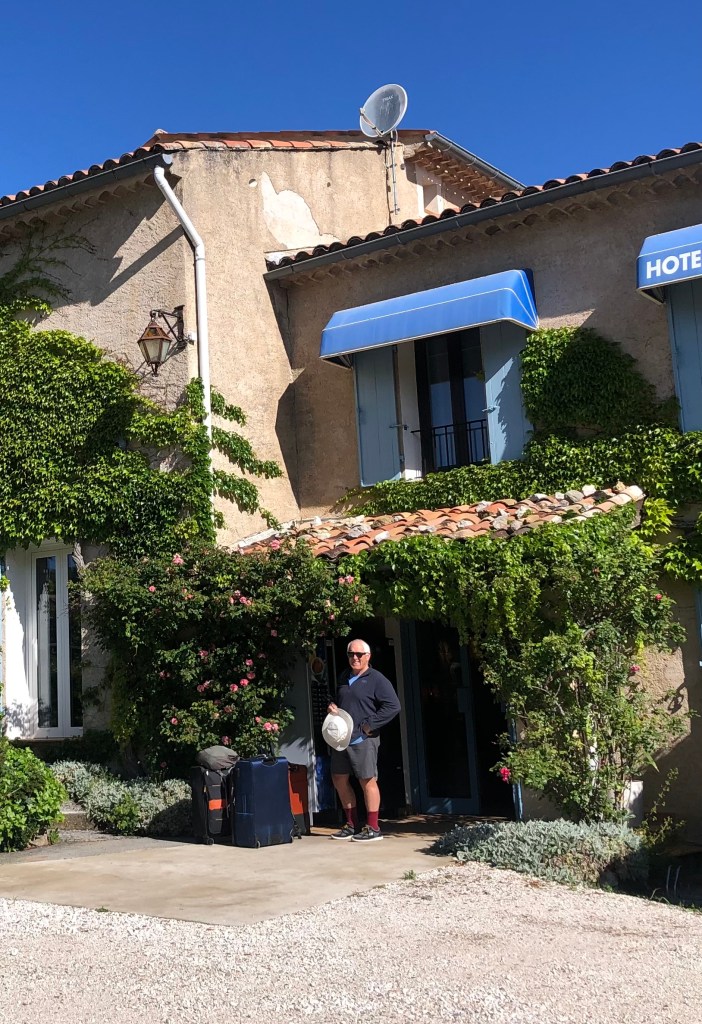
Eventually we get off and, hoorah, our hosts are there to pick us up and take us to their hotel. Splendid. We get to the hotel, an interesting old place, classic rural French, and Myrna and I collapse into bed, not quite sure what day it is and whether it’s bed time. But it is bed time. An hour or so later I wake up …
I don’t know why I include these stories. Is it that I know just what a seductive spell schadenfreude casts? Perhaps it is some sort of purge, some sort of catharsis. Or, not trusting that the wonderful pics will provide a sufficient offset, it might be building a platform for a story about something very desirable that went well, but unless you did it yourself might be a bit boring? (That is a rhetorical question mark. I don’t want to know your answers.) I’ll bind myself (and my dwindling self esteem) together and continue.
I went to sort out my pack and get things ready for departure early next morning. My case was there, Myrna’s case was there, Myrna’s pack was there … and my pack wasn’t. My pack contains our passports, my wallet, our credit cards, a substantial wad of cash, the maps, and I don’t know how to balance this off against all that stuff, but I couldn’t really go walking without a pack. I needed my pack. I have a feeling that might have been my keenest concern because I wasn’t thinking that well. I just wanted my pack. I wanted the absence of problems.
So, I don’t have to spell it out. Freak out, search the room, search every place I’ve been, go a bit crazy, try to tell the very very pleasant person who’s been left in charge but who doesn’t speak any English what’s happened. My French is more than a bit creaky anyway, but when you’re jet lagged and tired … my demeanor rather than my language probably communicated the scale of the issue. Madame, j’ai perdu mon sac (I didn’t know the word for ‘pack’; we negotiated it). Rouge et gris, oui? Rouge et gris. Il contient all my stuff, passeports (that struck a chord) blah blah blah. Check the car. The host has driven somewhere else and is out of range. Check where we got out. His New Zealander parapenting mate turned up and drove me round a bit. But this was all just time-filling and the illusion of a response really. I knew where it was. I was sure, very confident even in my decrepit state, that I’d left it on the bus in the overhead shelf above our seats and in my enthusiasm to disembark I’d left it there. And in that case, a whole panoply of other issues unravels. Where’s the bus? Nice, a million miles away? Might as well be Boston. The driver is an arsehole and I’ve been cross with him. What sort of help is he going to provide?
Look, the walk will be much more interesting. It’ll be on soon. Duck off and make a cup of tea.
We found a man in the container serving as a waiting room while the new station is being built, a man who was being paid to sit there. That probably wouldn’t happen in Australia, but it would in Singapore and it could (pre-retirement age) in France. We throw ourselves on his mercy. It is all in fast French with a great many discouraging gestures, but an hour or so later disrupting a dinner which for a range of reasons I was finding hard to eat, we are called back to the station. A peculiar mini-bus arrives filled with people … plus my rather shitty pack, its contents intact. How that happened … no information. Don’t care. Pleased. Thanks. Enormously grateful. Just want to go to sleep.
And that my friends, that is how we got to the starting point of the Haute Provence walk with support organised by Walkers Britain with five remarkable days and 100 pretty glorious kilometres in front of us.
Michael had the forecast: max 13C, storms, winds, rain.
St Andre-les-Alpes to Castellane
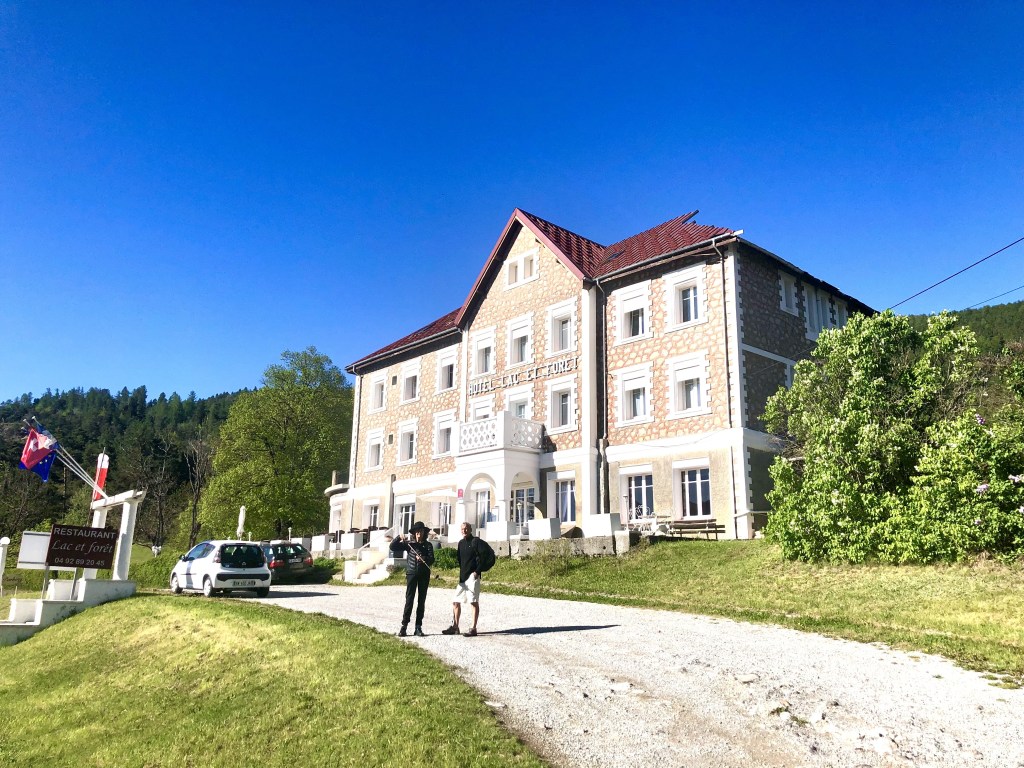
But it doesn’t look like that does it. Almost implacably blue.
A very fine day’s walking. Up onto a high ridge above a lake, de Castillon, which is followed almost all day. A steady and quite long climb but punctuated by rolling hills and not much in the way of human intervention. Long views followed by a steep descent into what looks like a rather advanced holiday camp at Cheiron before finding our way into Castellane which the notes describe as a small but significant town because it was on Napoleon’s route from Nice to Paris. About 22 kms we think.
The first decision, about 50m from the front door of the hotel.
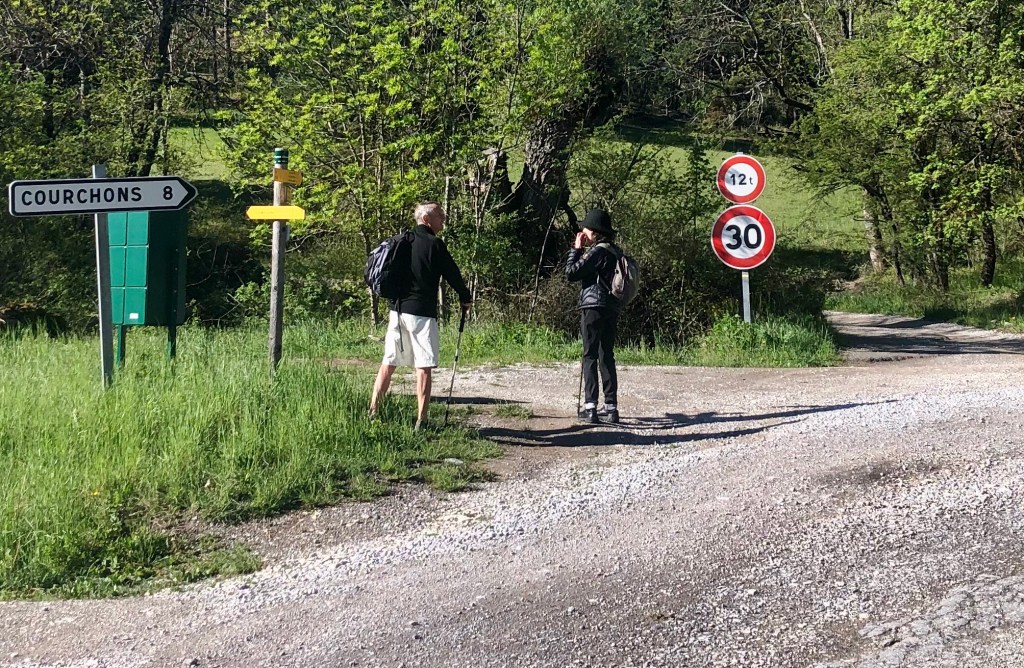
On the second day we got on to the GR 4, one of the walking routes (‘Grandes Randonnés‘) that criss-cross France and are generally well maintained and carefully waymarked, but the track this day was a local construction and required a bit more thought for navigation. The yellow signs were the key. Of the four options hard left was a walking track that took us gradually up above St Andre which is just visible here background left.

The track took us past this working farm, La Rouchas. (‘Use this opportunity to buy goat’s cheese from the locals’, a recurrent nutty track note).

Michael had a chat to the owner, the only person we saw on the track this day. He had been there for 38 years during which time he had restored the masonry buildings — now looking wonderful. He had dogs, cows, goats, chooks, a fabulous vegetable garden, a small orchard. It was a version of a dream, but a lonely dream.
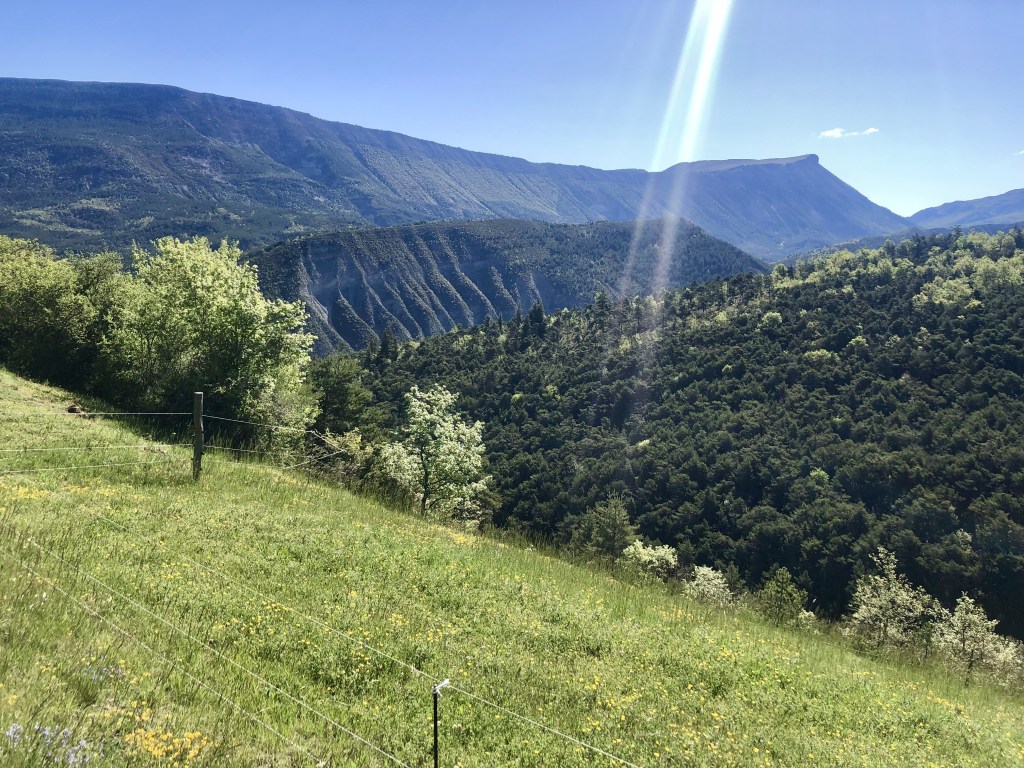
What a view he had. The high point of that ridge, behind us in this photo, was our immediate destination. Near its crest a suprise.
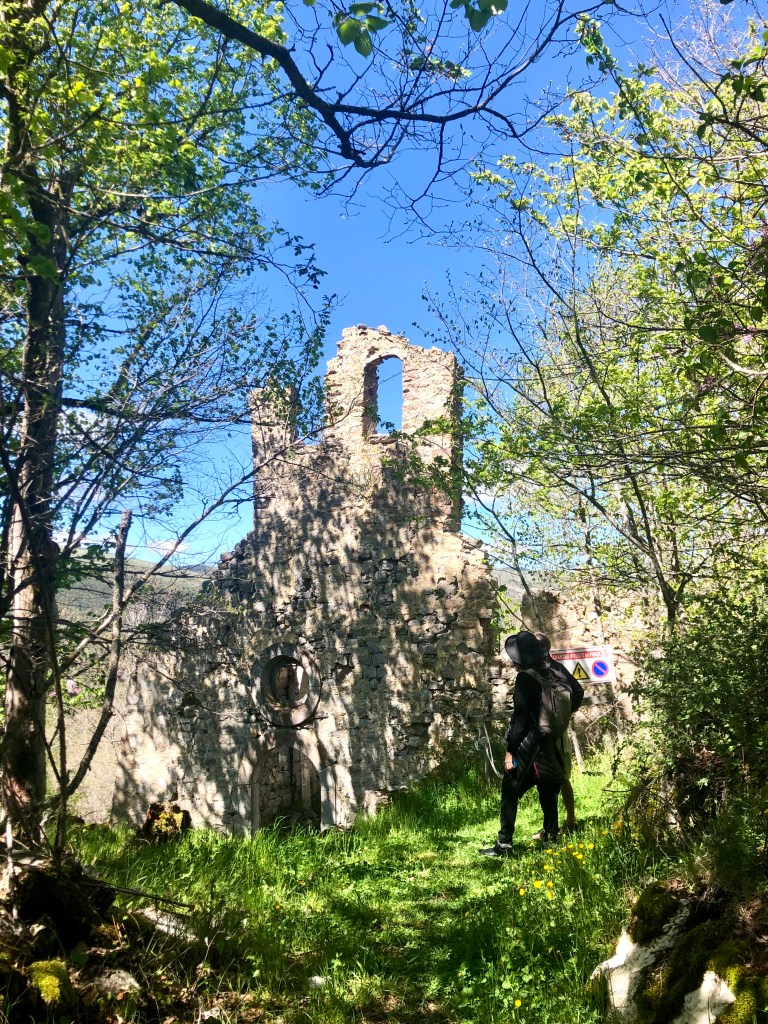
Who would build a chapel in such an out of the way place? And, once built, who would use it?
But then over the top of this ridge the houses of a small settlement began to appear. Not users of a chapel so much as people with very nice résidences secondaires and in the case of the big house, the headquarters of the Société de Chasse (Hunt Club) Le Courchons which has a plaque nearby remembering the efforts of the Marquisards around here during the second world war.


It all seemed so unlikely on this beautiful day: full of smells and rural whispers but otherwise no more active than this photo. If it looks like a pleasant place to go walking … correct.
We turned right at this calvaire and headed steeply upwards to the high point of the walk, the whole walk in fact (1412m), the Crête du Loup, Wolf Ridge, with the Lac de Castillon still in view. (That was its colour, feeding as it does the Verdon, the ‘green river’.)

Steeply steeply down, and then a surprise …


… the Mandoram ashram. (Click to enlarge.) The silver and once gold metal structures which surround the property are believed, by some, to harvest energy. The track, such as it was at this point, ‘badly eroded gullies’ to quote, ran round its borders. It was the sort of descent that blackens the end of your toes with the additional pleasure of a heap of broken rock under foot, but we got down to see Cheiron, a tease, with Castellane nested in the background between the two peaks.

And, I told a lie, we ran into another walker at a track junction about 4kms out of Castellane. He was much bemused by the idea of Australians who had walked from St Andre-les-Alpes but very helpful and understanding when we asked him the quickest way to Castellane. It had been a big day. A flat and amiable dirt road took us from there into the town’s outskirts, turned a corner and … gracious!

Yes, this one. At this particular moment I was sitting on the terrace of our hotel having a beer and texting Russ and Mary.

A church for dedicated parishioners. You’ll spend some time thinking up a possible name. A challenge? Got one? Come on. No? Well, step back, it’s … Notre Dame du Roc.
Castellane to Point Sublime

A very comfortable night at Castellane’s Grand Hotel du Levant. Today’s walk would take us into serious limestone country. Out of town on a tarmac road with a vehicle grade with interesting surroundings getting steeper with time. After 8kms the notes suggest that there is some relief. I don’t know that I remember that. Things might have flattened out a bit. Or not. Then a few kms that had even Michael puffing, a hard climb, before topping out at Suech, alpine pasture that in the afternoon light seemed exquisite. Exquisite. A huge drop off on a gravel road to Rougon, a tiny town perched on the end of limestone promontory before a nasty extra 2kms further down to Point Sublime. 22kms Michael says. Felt like …
Michael had the forecast: max 13C, storms, winds, rain.
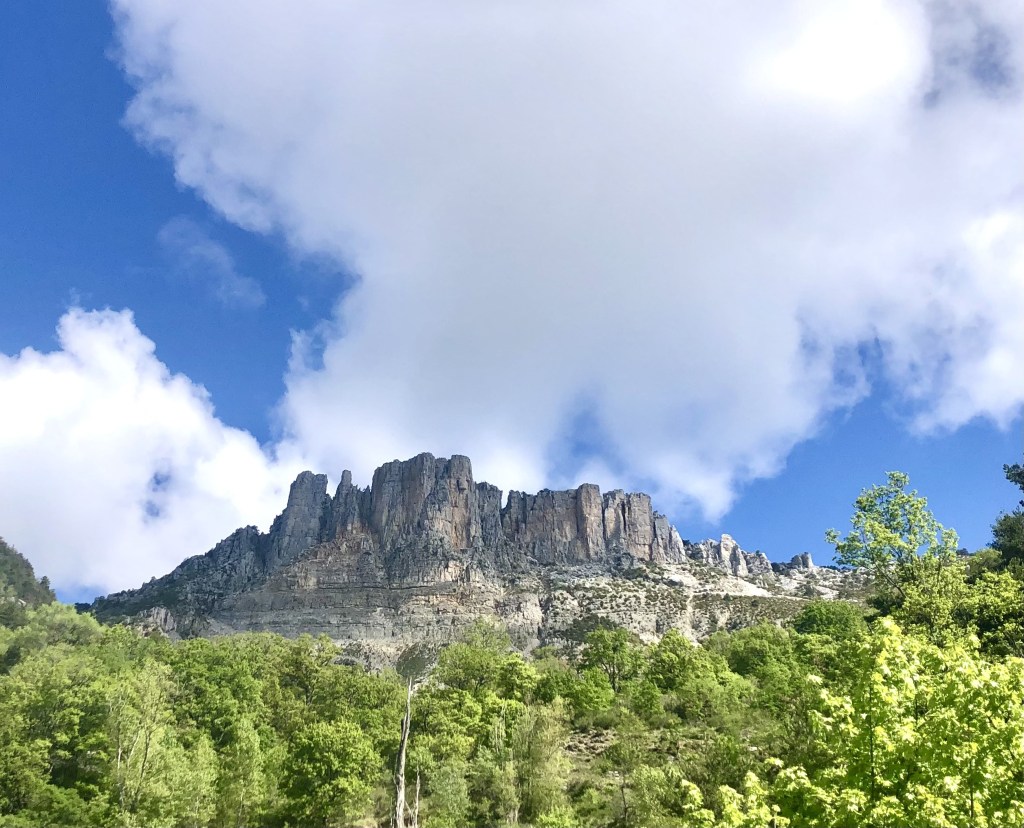
This rather wonderful grey pyramid is the totem for most of this day’s walk. It must have a name but I can’t find it. It might be Ste Etienne the something, but maybe not. It is deserving.

We spent quite a few hours walking around it. Below one side, then the other, near enough to 180 degrees (click to enlarge): you can walk quite some distance in a day.

If you look closely at the first photo you can see the near horizontal line of the track coming off its right hand flank. There is a junction in that saddle with a slightly vertiginous track leading to a chapel, the Chapelle St Jean. Another remarkable oddity. On the right below is its view on a long lens north to the Cadières de Brandis. There are buildings below these pedestals. They are Chasteuil where we sat and had our lunch. No idea how, but you can get there by car.

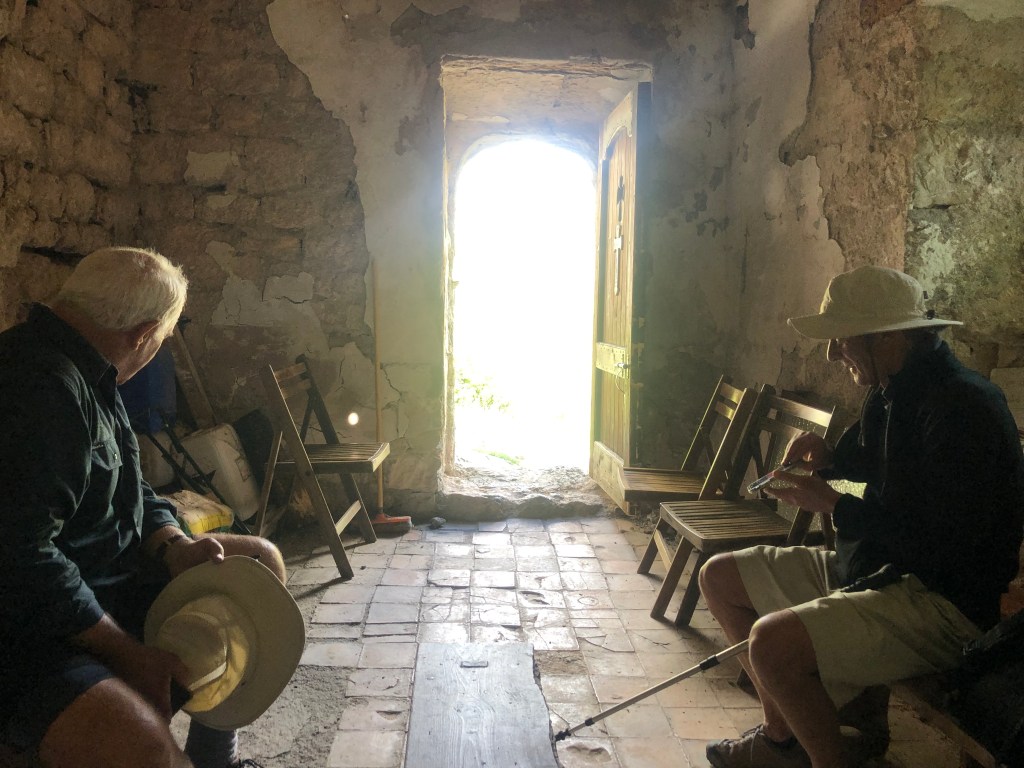
And just to show we actually were in the congregation.
That might have been the flat bit. Because very soon after it really wasn’t. (Click to enlarge.)
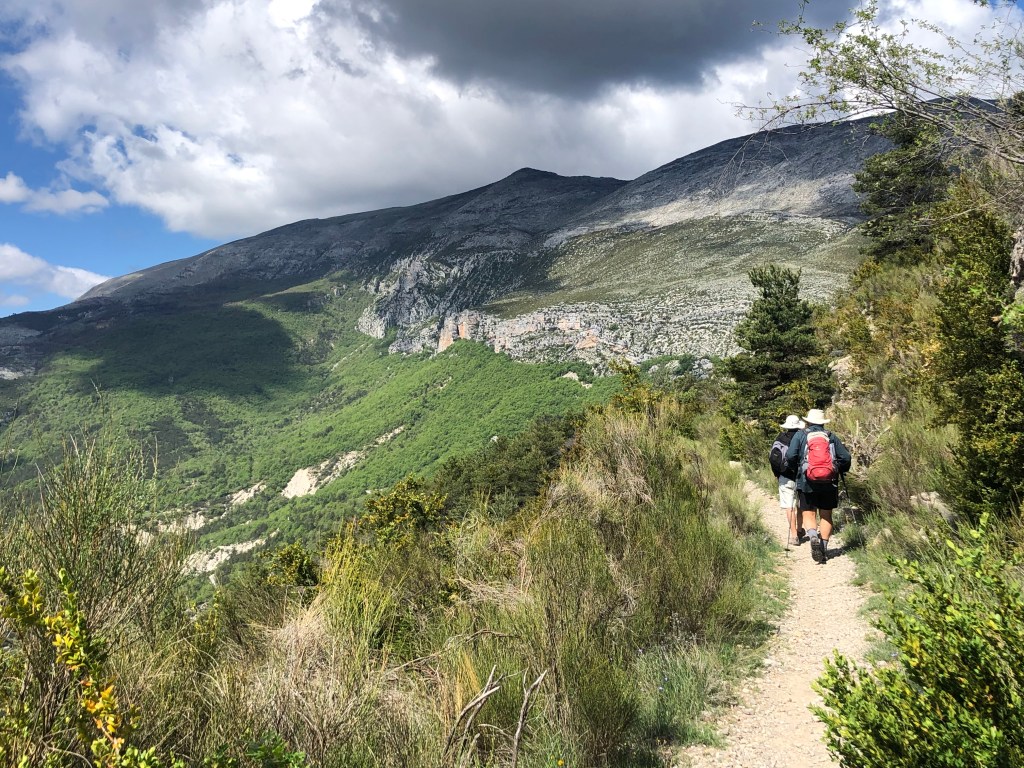
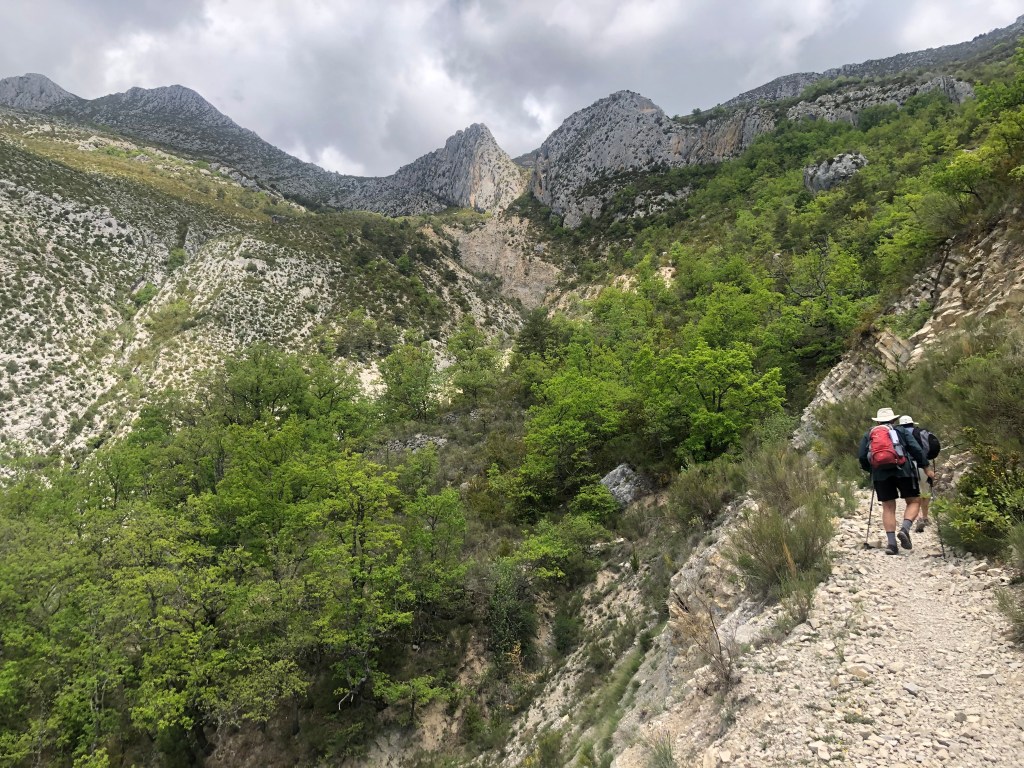
The destination is one of the saddles in the right hand photo, and it was very hard work. But once there …

the meadows of Suech, and yes there is a 4-wheel drive track across it accessed from the other side by a road so steep — down which we walked — that the car which preceded us backed down several sections presumably because of the advantage of using the higher reverse gear ratio to control the descent.
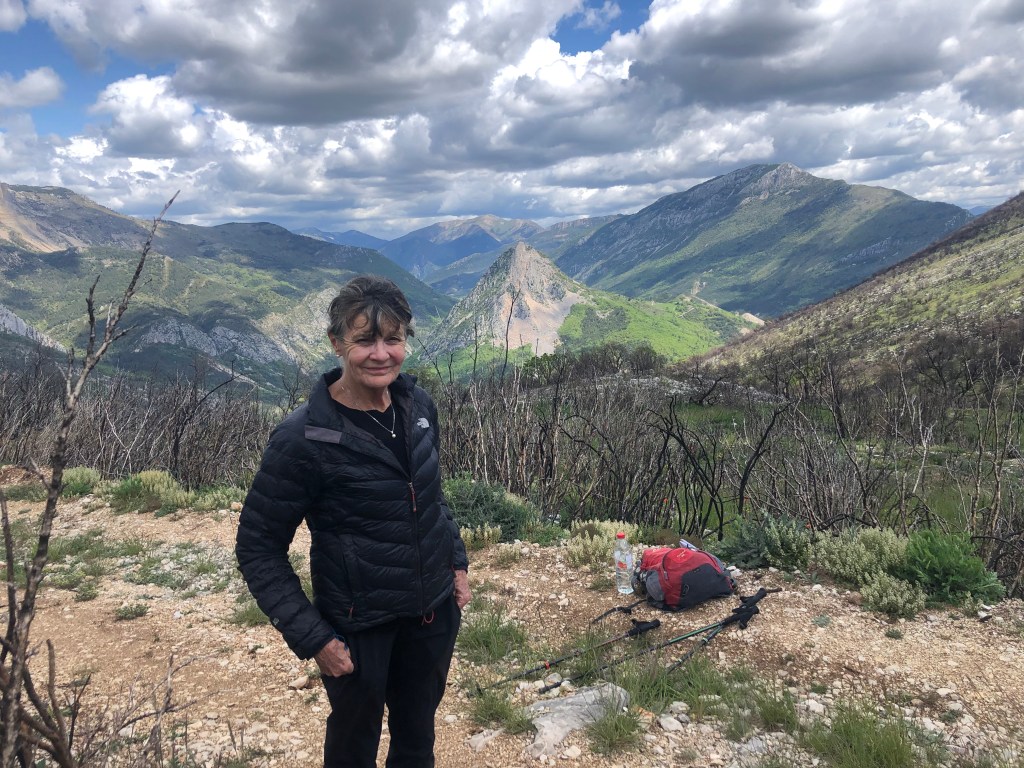
There had been flowers all the way, hosts of poppies down lower, but perhaps because of the contrast with the burnt wood these somehow seemed particularly vivid.

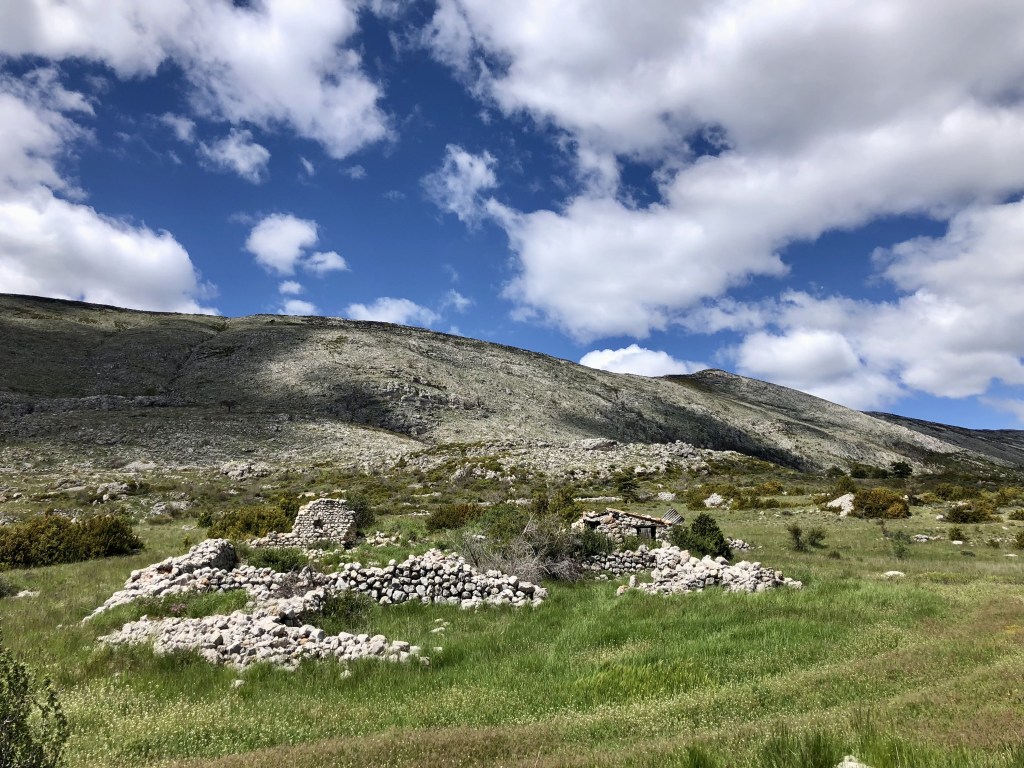
Sections of it were covered with remnants of stone fences and shepherd’s huts because in seasons with days like this it would have been a great place to graze stock, although there were warning signs about the presence of attack dogs used to fend off wolves and lynx. Lynx! I would love to have seen a lynx. Imagine!
But after half an hour or so walking across it, we had to get down. This is Rougon (with a hard ‘g’) perched below us.
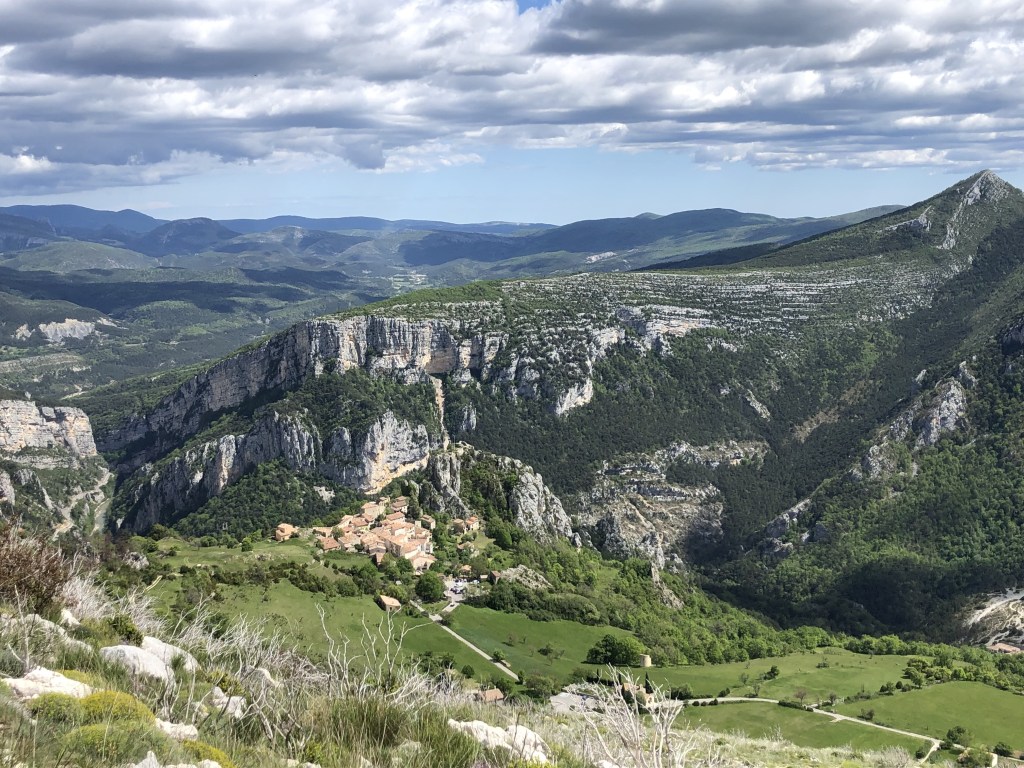
There was once a castle on top of this crag, and you can’t really see but she’s hanging out her washing.

We got to Rougon and sat in the al fresco section of La Terrasse de Rougon drinking Orangina and watching quite an expert game of boules imagining (me) that Point Sublime was just in the next street. It wasn’t. It was another 30-40 minutes. Just the auberge at Point Sublime. Nothing else.
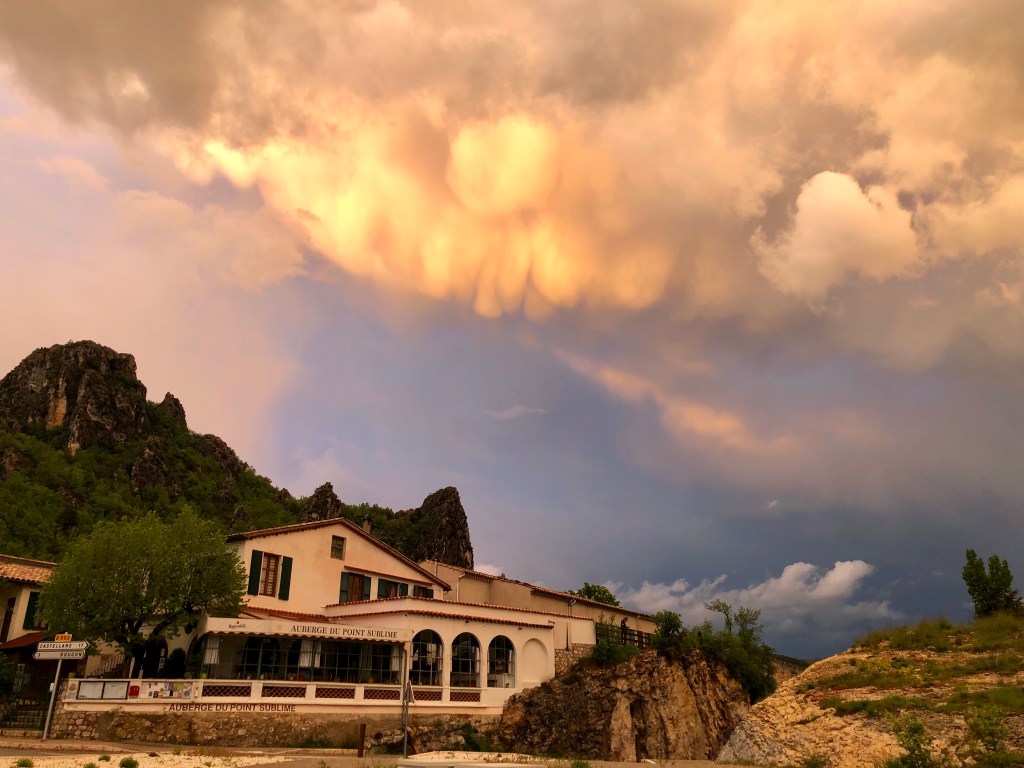
After dinner Myrna and I went for a walk of reconnaissance and there was this remarkable light, not to mention the cloud formations. I’ve done nothing to either photo.
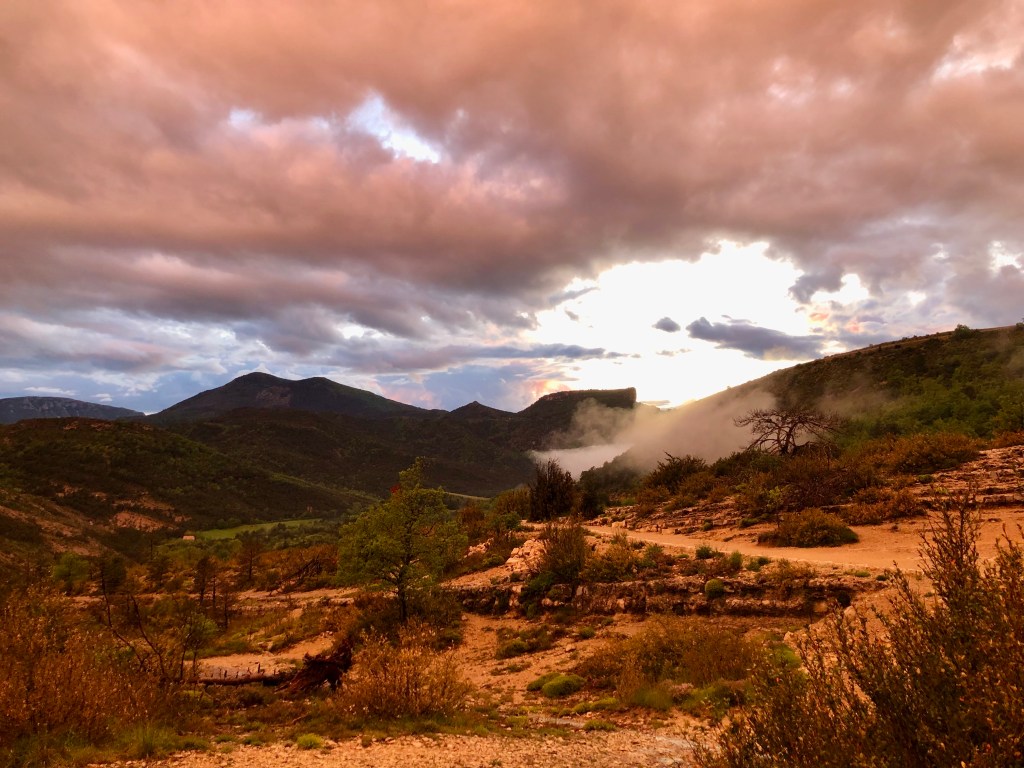
A good night’s sleep was required because the next day was the big one, the Gorge de Verdon. Total descent, 1419m; total ascent, 1567m. Murder. Plus the staircase up the Brèche Imbert, the tunnels. And the zig-zags up to La Maline.
And Michael had the forecast: max 13C, storms, winds, rain.
Point Sublime to La Palud-sur-Verdon

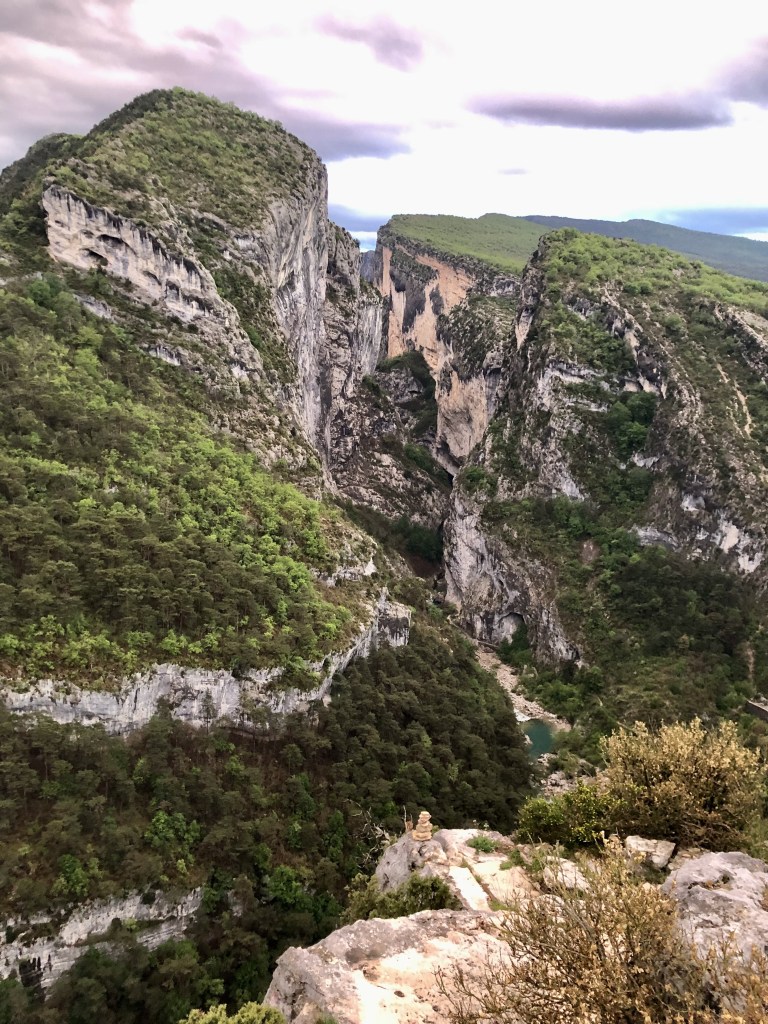
The Gorge runs from Point Sublime about 25 kms before the Verdon enters Lake de Ste Croix and things settle down a bit. The walls are so steep that for most of it the map has very few relevant contour lines. These are sheer drops, some of about 700m. There are startling rock formations wherever you look. Access is aided by a number of low level tunnels drilled for hydroelectricity but never used for that purpose. The long one takes about 10-15 minutes to walk through and you really do need a torch. Perhaps a third of it is a track rolling quite casually through a thin forest on the gorge floor, but there is one point where you climb most of the way up to the plateau level, and then climb down again almost to the river. There are several others where you have steep climbs and descents over rocky incursions. There are around seven sections where fixed iron railings have been installed to protect the faint of heart from exposure. It is usually walked from the direction opposite to the way we were going because it is easier to manage most of the major obstacles.
Some of these things I knew. I had a good torch for example. Others I didn’t. The Gorge is a wonderful heaving roiling thing, and a challenge.
The night before it had been about 13, and we had had electrical storms, some wind and a power of rain, hard mountain rain, sleet and hail at one point visible through the French windows of our room. The advice was that, if there were storms, do an alternate walk, a circuit around the eastern plateau. There were a lot of bits slippery when wet.
But when we woke up it wasn’t raining. The upper levels of the Gorge were in a thick blanket of fog, we had some rain gear and we had had luck with the forecast the previous couple of days. And we really wanted to do it. Excellent breakfast, one of very many, at the auberge. Bade goodbye to Madame and moved on.

Actually I had made one move towards self-preservation. I had asked Madame to book a taxi to take us from La Maline to the day’s destination, La Palud. Otherwise after we’d climbed out of the Gorge there would be an 8km walk, two hours or so, along a reasonably busy road to our hotel. The track notes say 10.5 kms along the bottom of the gorge; our GPS gave an alternative rendering, 13.7 from Point Sublime to the bottom of the La Maline staircase and then another 2.85 before topping out. That would be plenty.
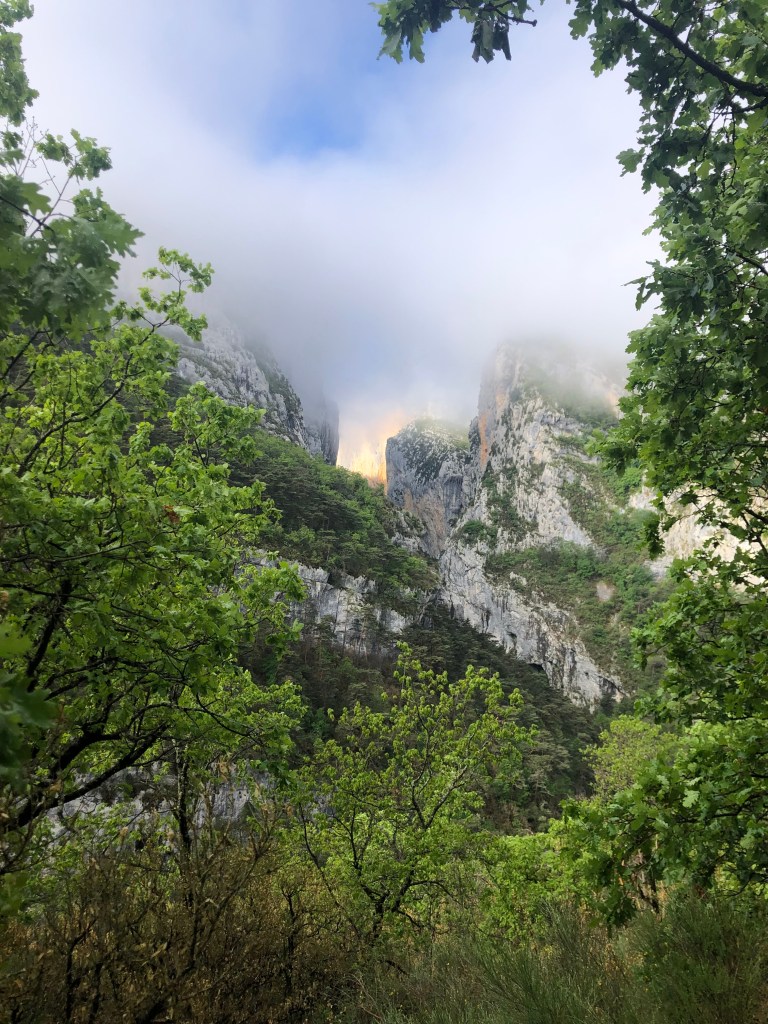
That’s the view for us nearing the bottom. A killer. Superb. But it’s also the sun on a wall a few kms in the direction we are pursuing, … and the fog is breaking to reveal at least some blue sky. We’d be right.
Just pics for a while.

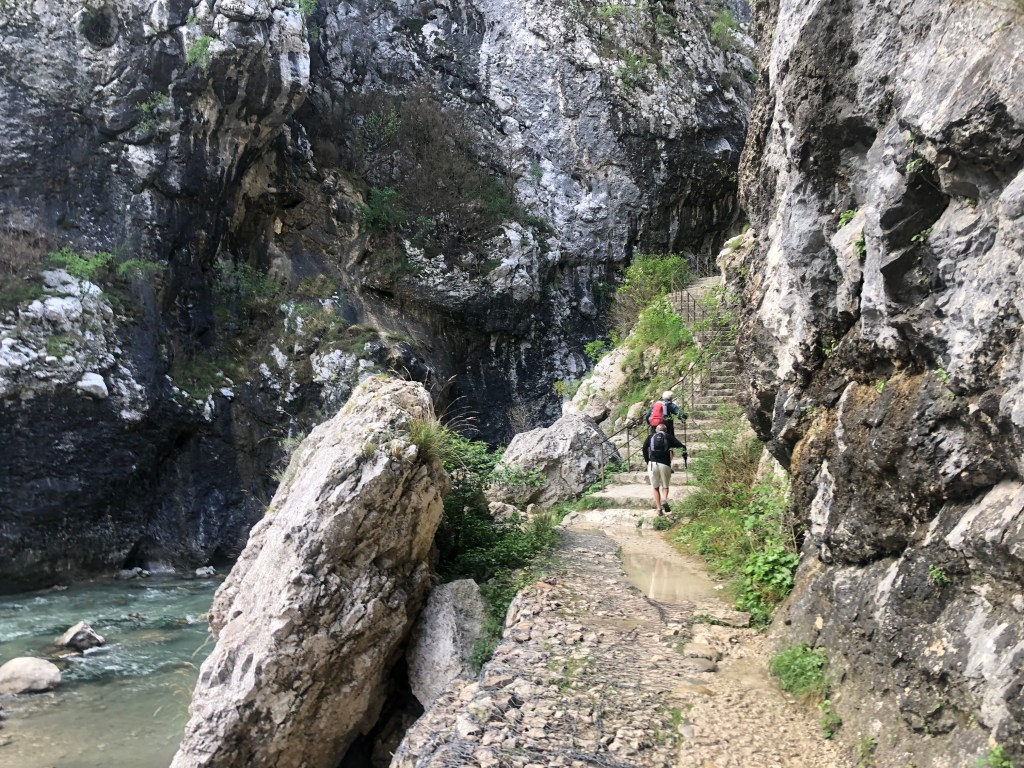
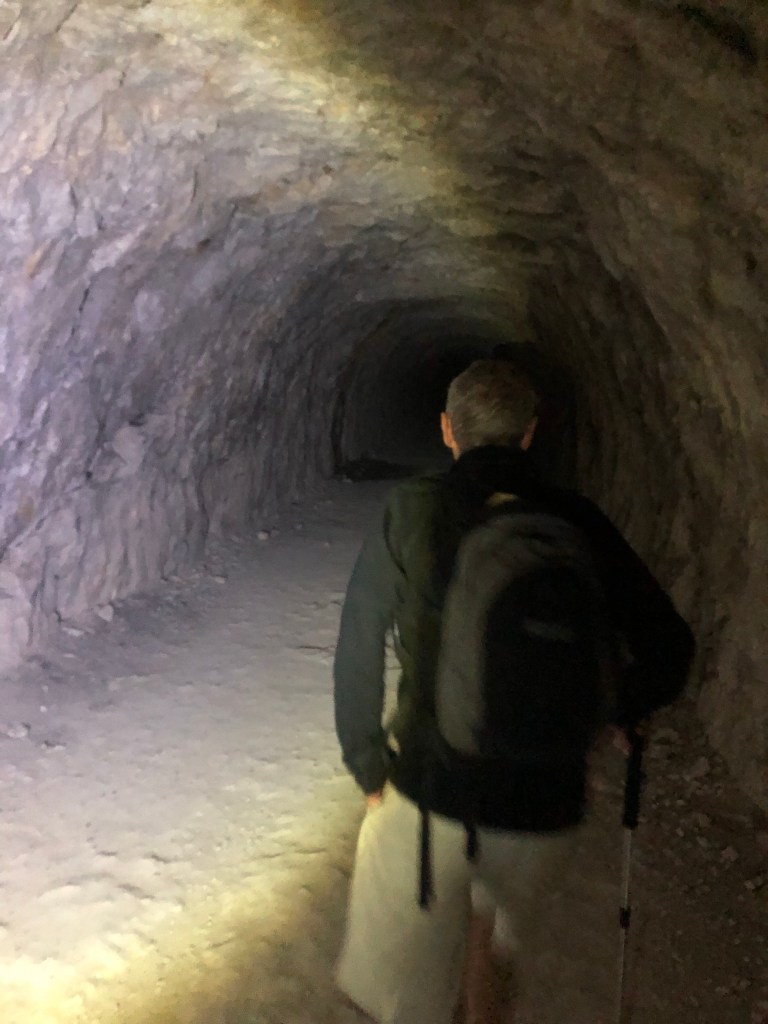
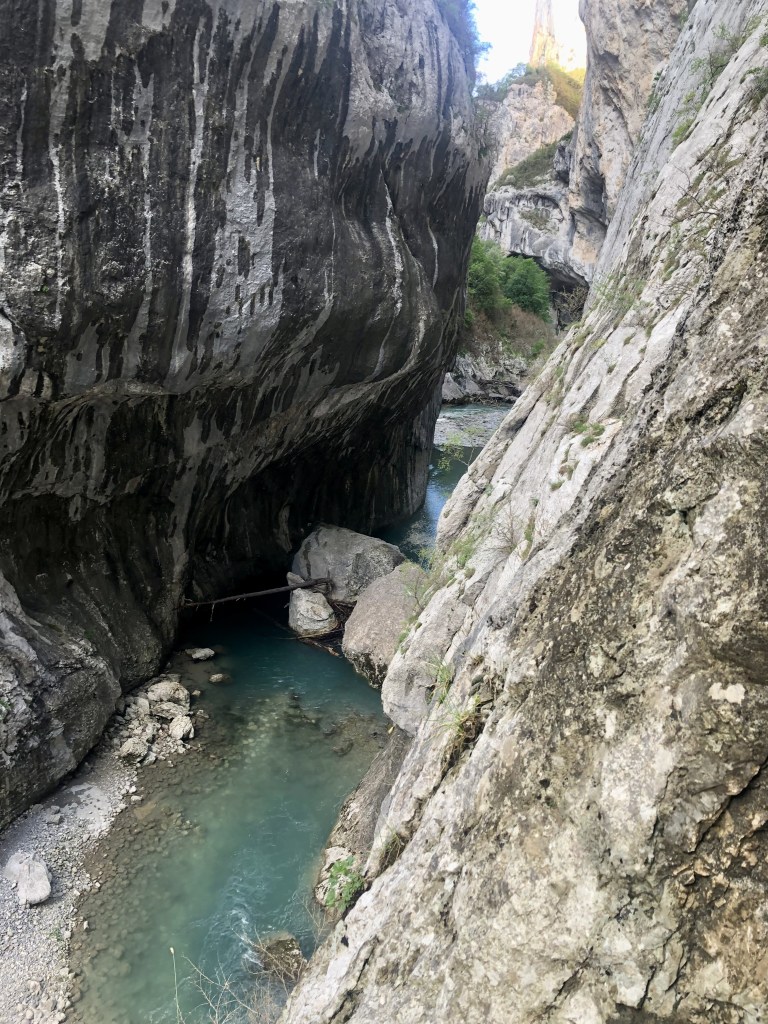


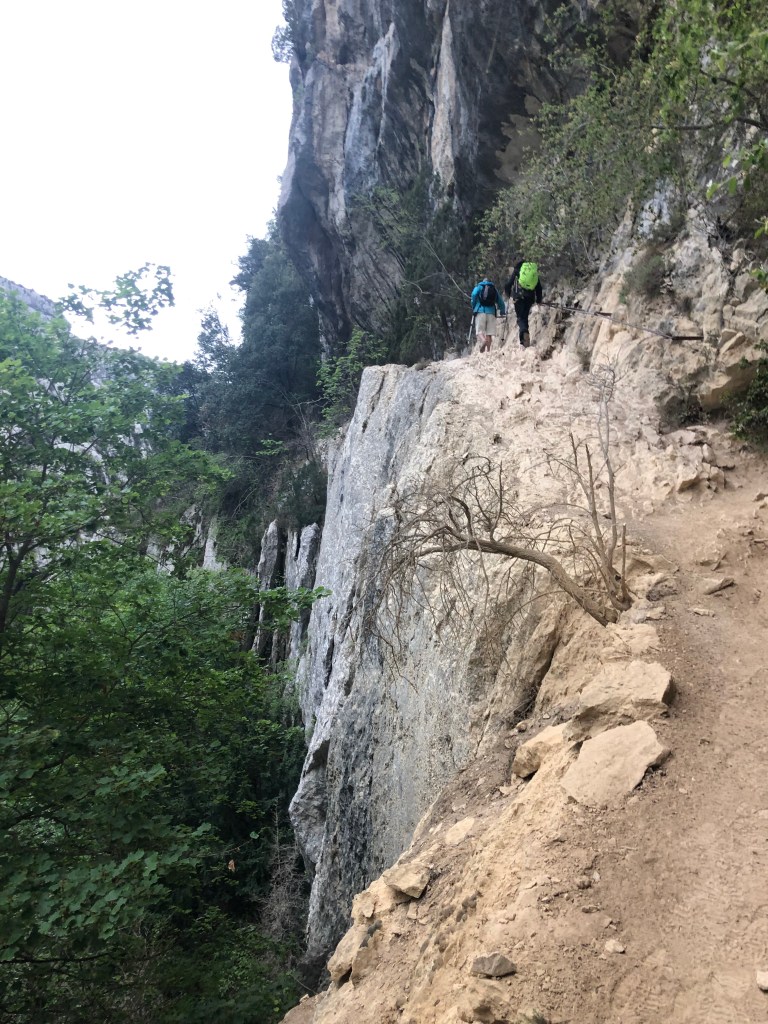

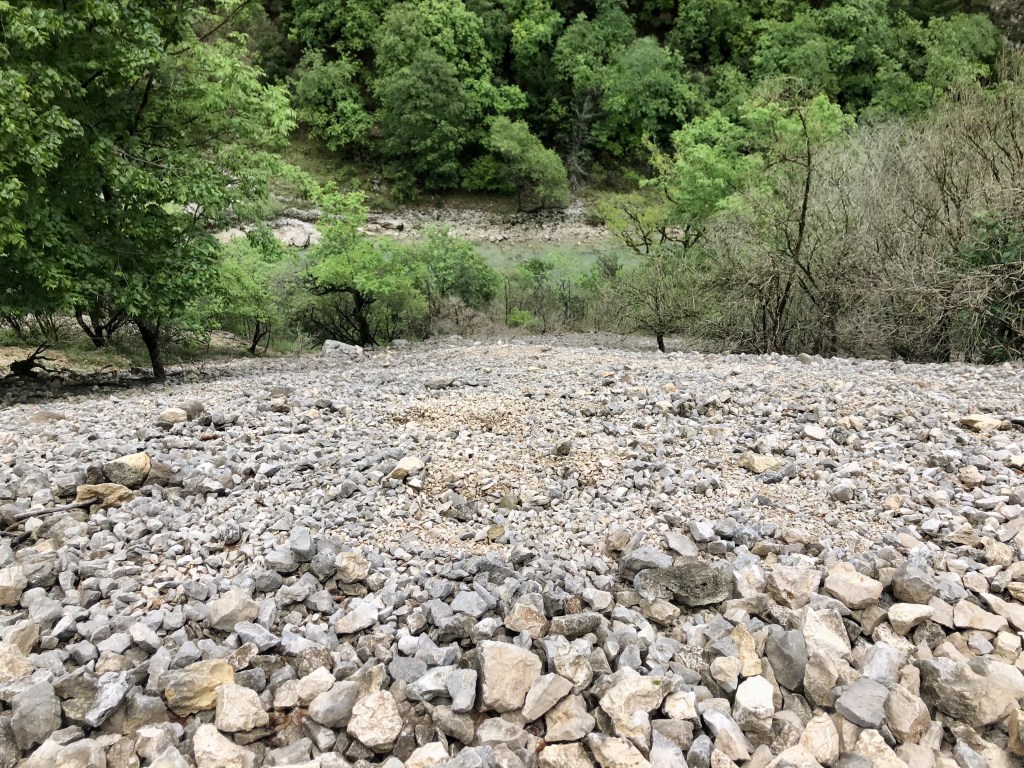

There were a number of people coming the other way, perhaps 20-25, maybe more, in small groups. It was about here that I stopped and chatted to one and we made humorous jokes about climbs and descents and how enormous the risers were on some of the stone steps where there were stone steps, and how was the other end and how long had we taken etc. Said farewell, and I saw these and said, ah some stairs and did a little dance of resignation. And they laughed. It might have been in a slightly inappropriate manner. I got to the top of the flight above, turned to my left and looked up.
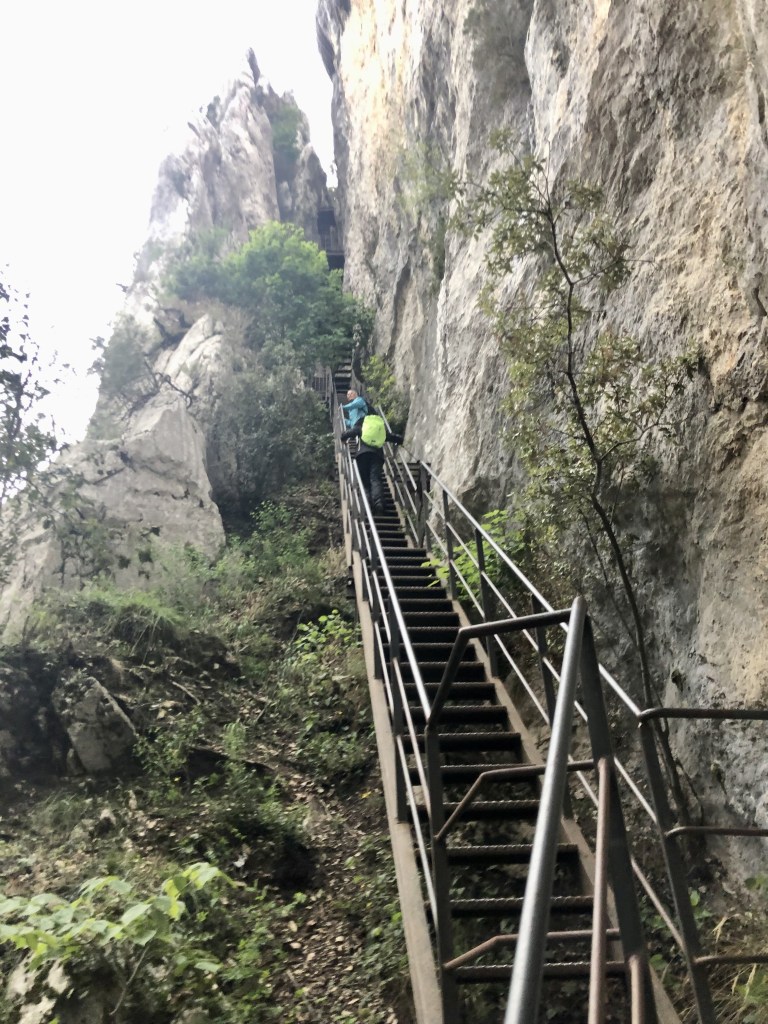
This is the Brèche Imbert, a quite brilliant feat of engineering. Brèche, meaning, well, ‘breach’, but also more relevant here, ‘opening, slit, cleft’. Climbers might call it a chimney although it’s a bit too wide for that. Imbert for Iwan Imbert who designed the route and the first staircase, now replaced, in 1925. The walk through the whole gorge was completed for the first time by Edwin Martel in 1928 so, unlike so many similar things, it is not an ancient route. The first stair case had 239 steps. I’m guessing but I think there were a dozen flights of 20 steps. There may be fewer, but I can confidently assert there are a lot. All told, it must be more than 100m pretty straight up.
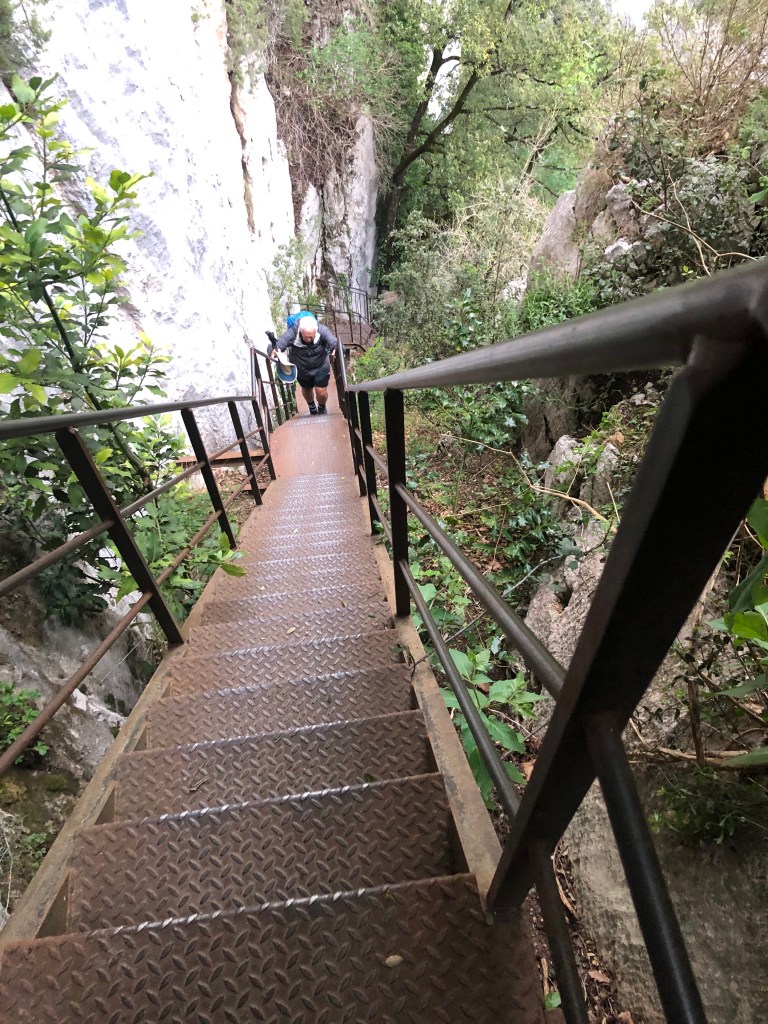
At the top, when you get there, you can do some hand climbing and get on top of a boulder to reach a belvédère, one sought by a pair of fellow walkers who had fallen by the wayside several kilometres back. Belvédère: ‘a panoramic view’. This one.

I think this might be where we had lunch …

and there are no more photos for the next three hours or so because my phone was in a plastic bag in my pack. It had started raining, not viciously, just steadily and it took at least 10 or 15 minutes to get wet through. But as Myrna says drawing on her literary foundations, ‘Sakes, it’s only weather’, and motion keeps you warm and there was plenty to motion about. So much motion.
The taxi was due at 4.00 at the top of the hill and we were making good time when we got to the bottom of the La Maline climb. La Maline is a chalet installed on the lip of the canyon, and some person or group over a period of time has built a zig-zag track (17 turns as I count them) which runs between the top and bottom. It has been thoughtfully constructed on a good grade but, Lord, there’s a lot of it. My heart rate was, well … high. Sky high really. It might have been to have a(nother) excuse for a rest that I saw this tree and wanted to photograph it.
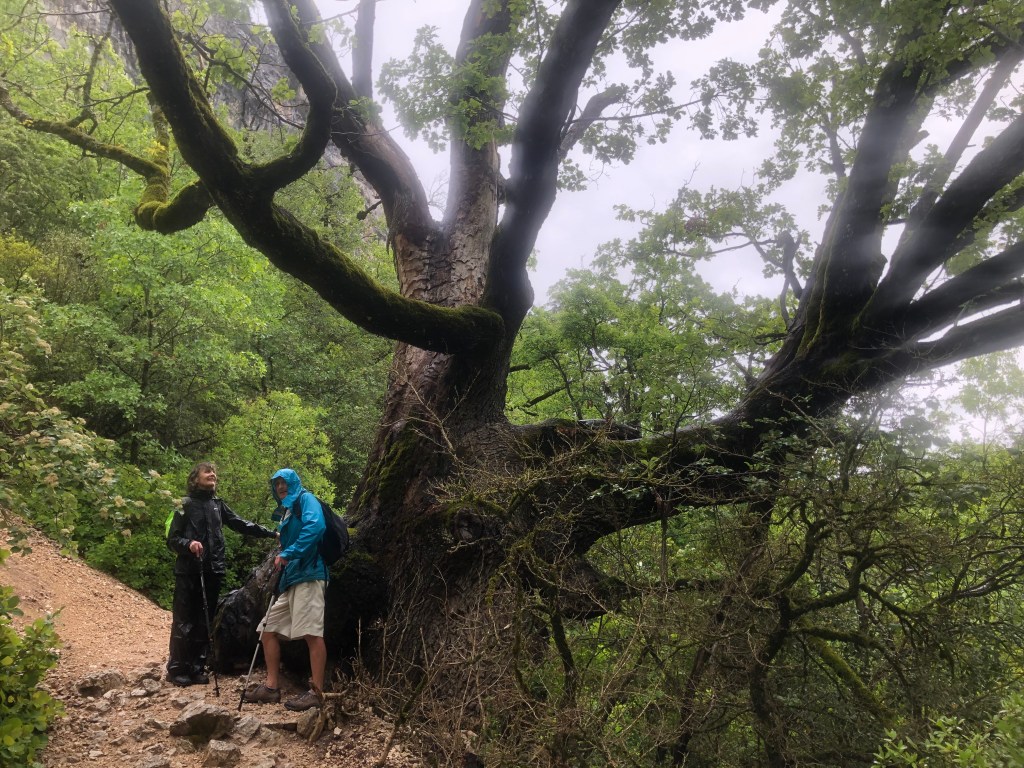
I note that at this stage the rain had diminished or stopped. We might have been close to the end of the serious zig-zags. I could see a building apparently a hundred metres or more above us and way way over to the left. I think I might have reassured my colleagues that that couldn’t possibly be the Chalet. But the track went on and on, up and up and then into a formidable upwards leftwards curl. That building was our destination.
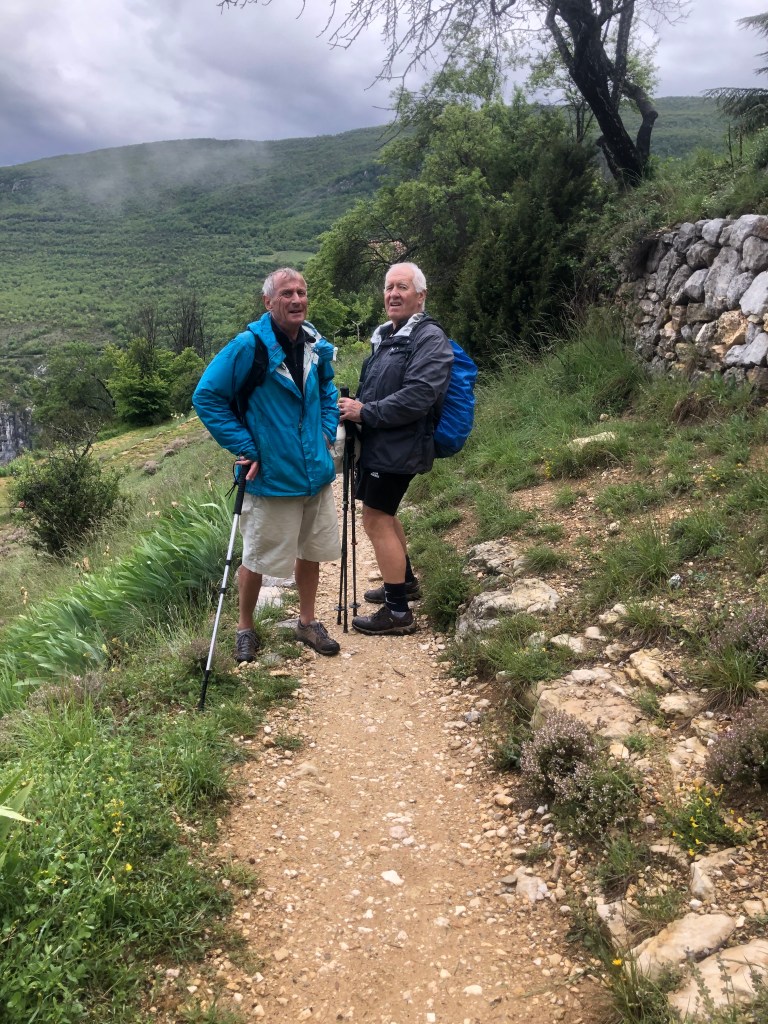
When we arrived, not long before the taxi was due, we discovered the chalet was closed for renovation, so not even a beer or an Orangina to celebrate.
In the shortish trip from La Maline to La Palud I found out about the state of Pascal’s business, why he was driving, what it entailed, his children and grandchildren and the divorce settlement which had underpinned all this. The conversation was half and half in butchered French and English, probably ridiculous to listen to but quite satisfactory as a participant. By the time we got to the Hotel Le Provence I had made a new friend.
Moustiers-Sainte-Marie
La Palud is a sort of trailhead for adventurers and not thick with social or commercial opportunities, but Le Provence was a most satisfactory hotel. An offer was made not just to dry clothes but to wash them as well. The staff were friendly, the food excellent and the bed soft. Over dinner we discussed the next day, 21 kms to Moustiers. After the Gorge day I was feeling a bit scratchy. I was of a mind to join Pascal and our luggage in the taxi as it was moved along to the next destination. There was some agreement but by morning Michael had decided to walk the road to Moustiers which was, of course, practicable and just fine.
So, relatively clean, dry and rather avidly anticipating a rest I climbed into the back of the taxi and Myrna had the chance to enjoy Pascal’s conversation. Michael was about an hour down the road when we passed him. In short order he would be coming to this view, Lac de Sainte Croix showing the effects of drought and quite probably climate change. The plateau over the other side on the right was one of our next destinations.

I had no idea about this but Moustiers (according to sources which I am unable to cite) is one of the 30 most beautiful/ picturesque/ interesting villages of France. Big call! France … such stern competition. One of the 30 best! But regardless we had made an extremely fortunate choice for a rest day. It had dozens of places to eat, many more to sell you faïence, a very particular sort of pottery which I didn’t feel I needed, but lavender, après-après midi outfits in white, and a wide variety of ice cream.
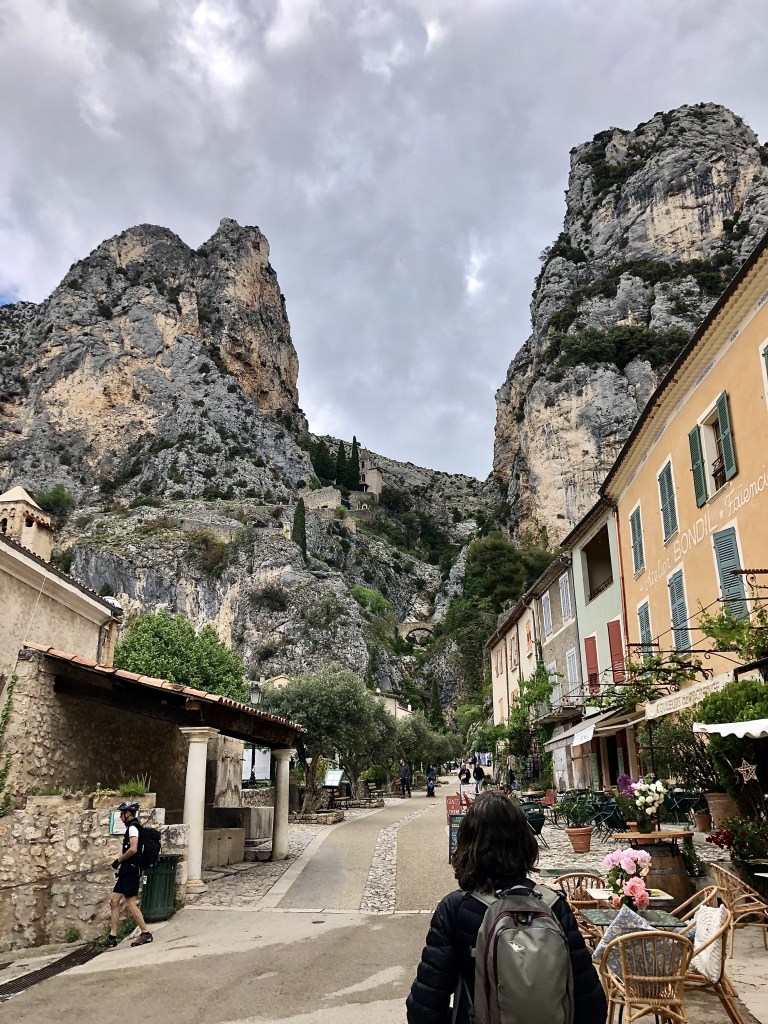
In the photo above we are looking at three, the sum really, of what it is — besides its rather exquisite setting — that gives Moustiers its heft.
- At the bottom of the rocky notch in that patch of greenery a very healthy spring emerges and runs through the centre of town allowing for, inter alia, pretty cool places with upper end prices to sit and eat and look at flowing water.
- Directly above that you can see a building. That is La Chapelle Notre Dame de Beauvoir. Let me quote: ‘The first known mention of this chapel, then called Our Lady of Between the Rocks (let’s say, ‘of the Gorge’), is from the 9th century AD. … The renaming of the chapel was carried out in the 12th century in response to the numerous miracles performed here by the Virgin. Pilgrimage to Notre Dame expanded rapidly, encouraged by the Church which granted, or sold, indulgences to the pilgrims. In the 17th century these pilgrimages took on a particular form. Stillborn babies were brought here — who in some instances (‘resurrected’ is the word used but I’ll say) recovered — to be baptised and to ensure the salvation of their souls. They were buried in a part of the cemetery designated for that purpose. This process is referred to as ‘solicitation’ and chapels recognised for these miracles are called Chapels of Respite. Notre Dame de Beauvoir is the most important in Provence.’ (Public info board)
- Higher again, suspended between the two crags on a chain and scarcely visible in this photo is a star. (It’s yellow er … gold. You can find it if you can magnify the pic.)There are some medieval records that refer to its presence. In more recent times there have been five replacements and the latest is 1.8m across. No one knows the original explanation of its purpose although the local history buffs like the idea that a knight called Sir Blacas escaped from the Saracens and put the star up (no small feat) to give thanks to the Virgin. It might be more likely that it was a village effort to seek some form of religious protection after they were almost entirely wiped out by the forces of Queen Jeanne in 1445.
Strong play Moustiers. Very strong play. Throw in the faïence and the ice creams and it could really be top 10. It is also the hub for a number of very pleasant walks which we proceeded to do. (Click to enlarge.)
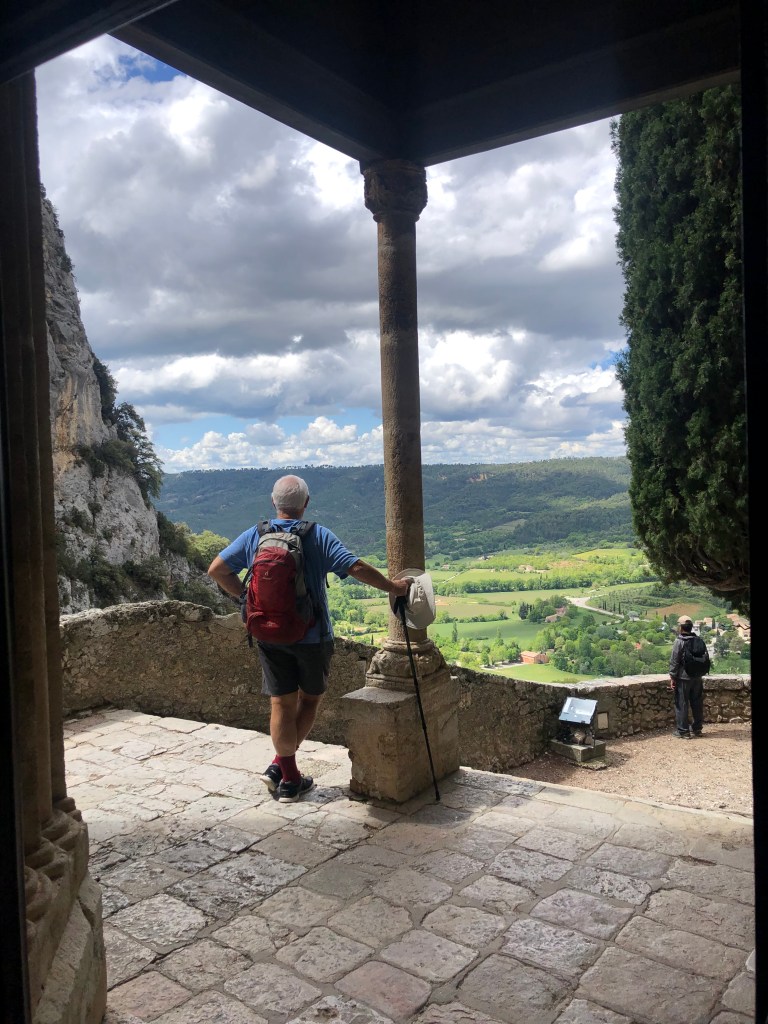


PLUS I had a very good burger for lunch (just as Michael appeared) almost within reaching distance of The Source, below The Chapel AND within sight of The Star … and enjoyed the food and felt better than I had for days. That night at La Bonne Auberge I had confit duck with a cointreau and orange sauce. I cannot begin to tell you how excellent it was. Moustiers! Top five. Easily.
Michael foreclosed on the forecast.
Moustiers-Sainte-Marie to Riez

An easy day. Down through outer Moustiers to the rivulet that the Spring helps form. Up the other side, quite a steady climb, about 300m in 2-3kms. Across the Valensole Plateau framed by the lake and the water catchment we just climbed out of. Flat as a pancake for 10+ kms. Bit of up and down into Roumoules and then Riez, the end, an easy 4-5kms away. 21kms

It was a very mellow Sunday, the sort of weather Provence might be renowned for. We could expect, I thought, some company on the road.
We were leaving the mountains and the limestone crags behind and having a close encounter with the extraordinary fecundity of parts at least of the French countryside. Often walks start with a big climb but this one had a very gentle start, easing down through the well-heeled ‘suburbs’ of Moustiers flush with a great many accommodation options including a turreted faux castle with a menu attached to its gate. The climb began once we had crossed a stream that had seen busier days. It wasn’t going to fill the Lac. The climb went on a bit, but it was more that we were on this very chewed up 4-wheel drive track, maybe a farm or forestry track, with big sprays of gravel in the corners and deep ruts that were hard to walk on. Up on the plateau the ground was also quite wet, very clayey, and there was little difficulty in establishing a 50mm platform under your shoe.
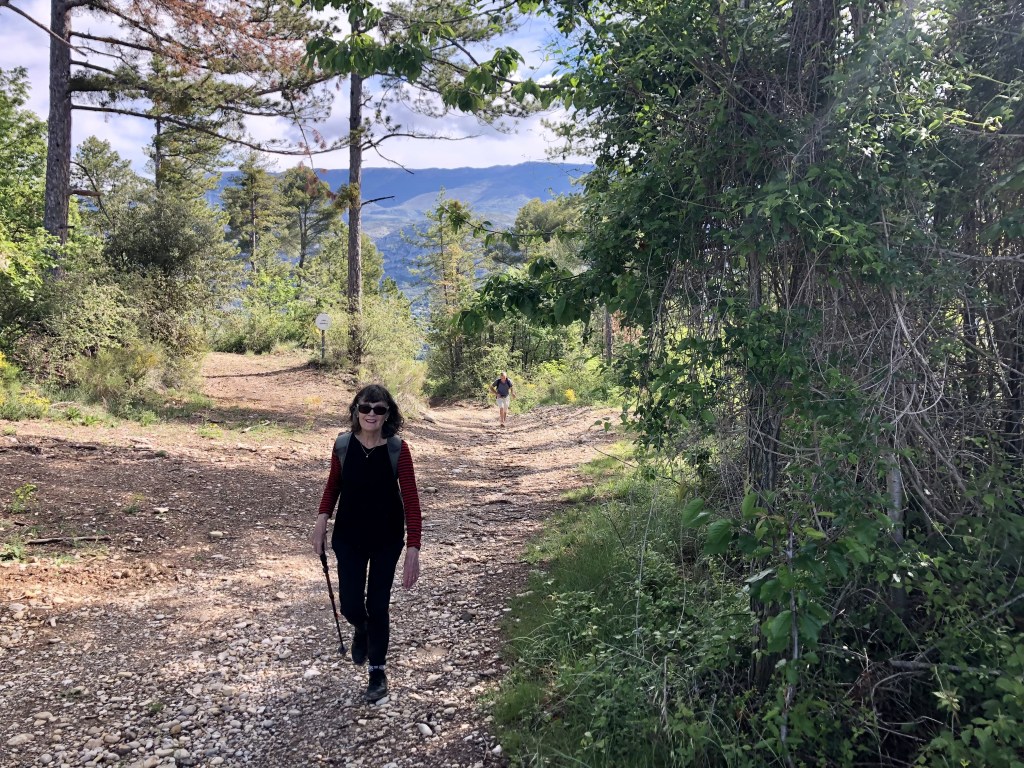
This pic is included only as a record that I was first up this climb. I was in fact feeling extra well. Walking can be like that. You give your body a chance to catch up and then it tells you how much all that exercise has been appreciated. Moustiers wasn’t looking any worse from afar nestled into its rocky surrounds.
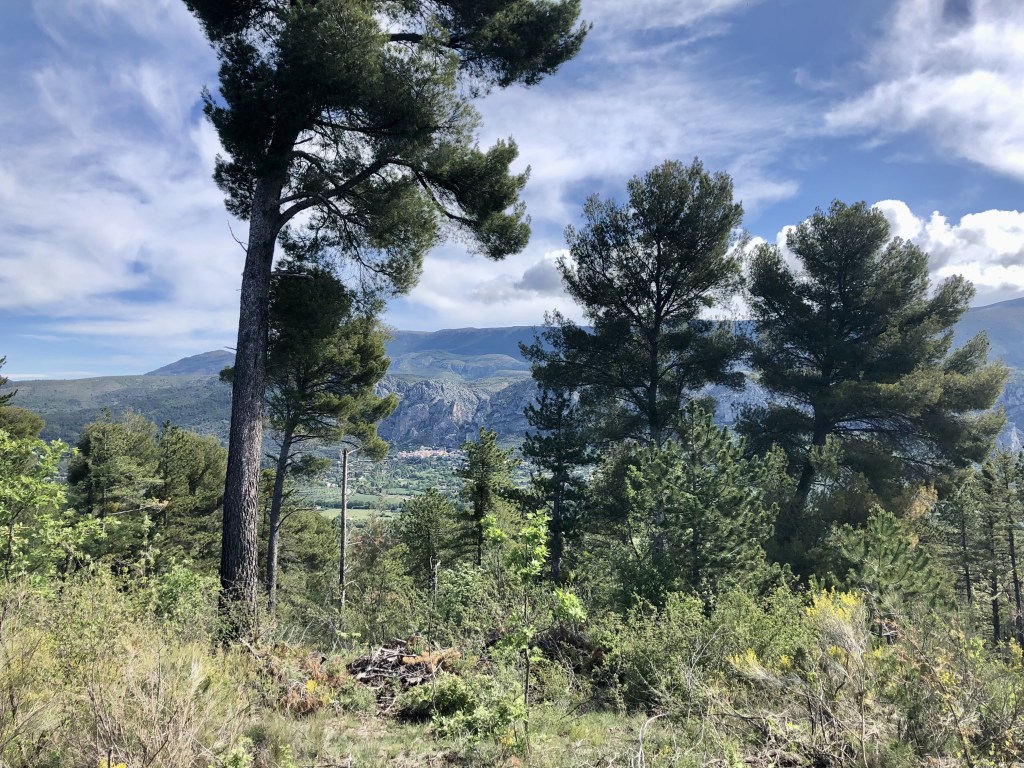
But we weren’t looking in that direction. More like this.


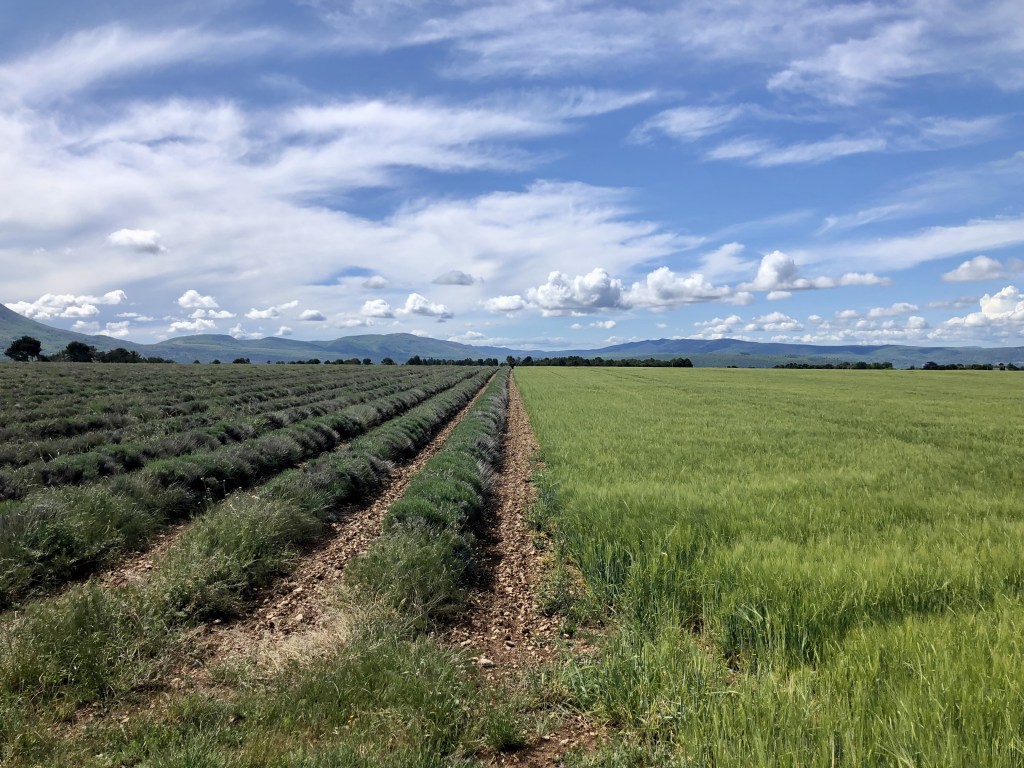
Lavender, hundreds of hectares of it, aubergines, barley, oak orchards for propagating truffles. No vines, some few orchards devoted to apple and pears but endless ground crops with big houses and big sheds and big pumps to suck up artesian water and big sprayers to circulate it. It was a study in productive land management. Other forms of study occurred.
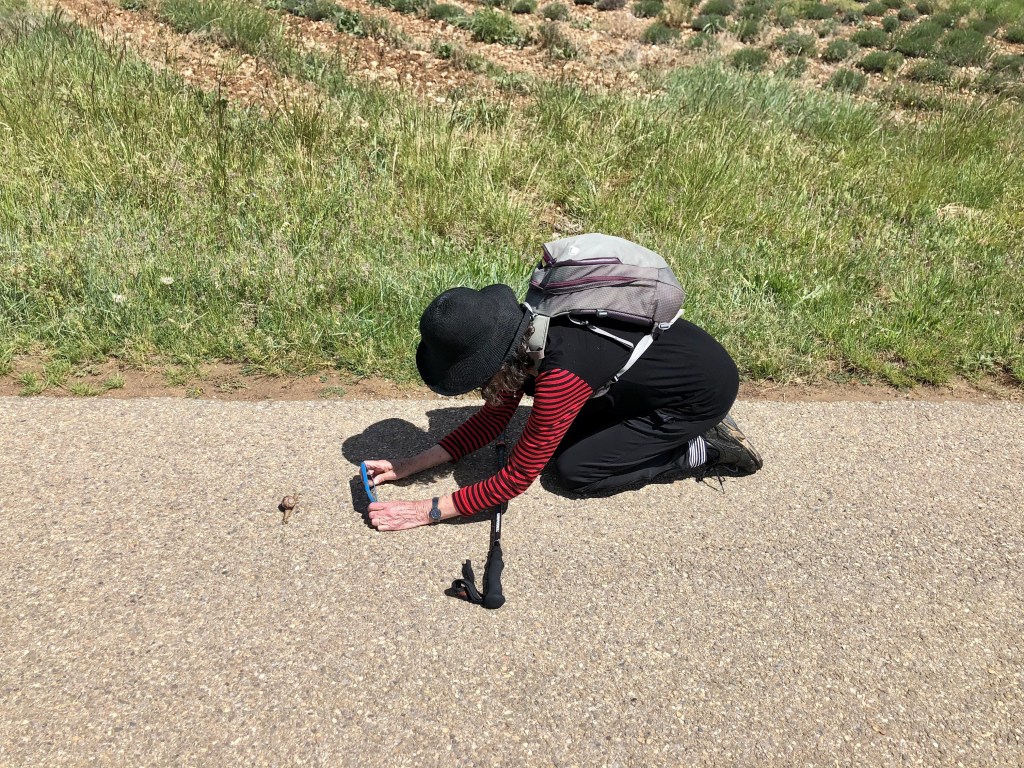
There were people about but not many. Just here these boys hissed past at considerable speed accompanied by motor bikes with flashing lights and support cars. I think I was watching a moment or two of the Tour de Verdon.

Around lunch time we were developing high hopes for what Roumoules might offer. The only town we would pass through during the day anywhere on our walk, what would it have? Fresh baguettes, say with intriguing fillings? Something warm? Interesting small pies with … hmmm a truffle sauce? Wonderful pastries probably for sure.
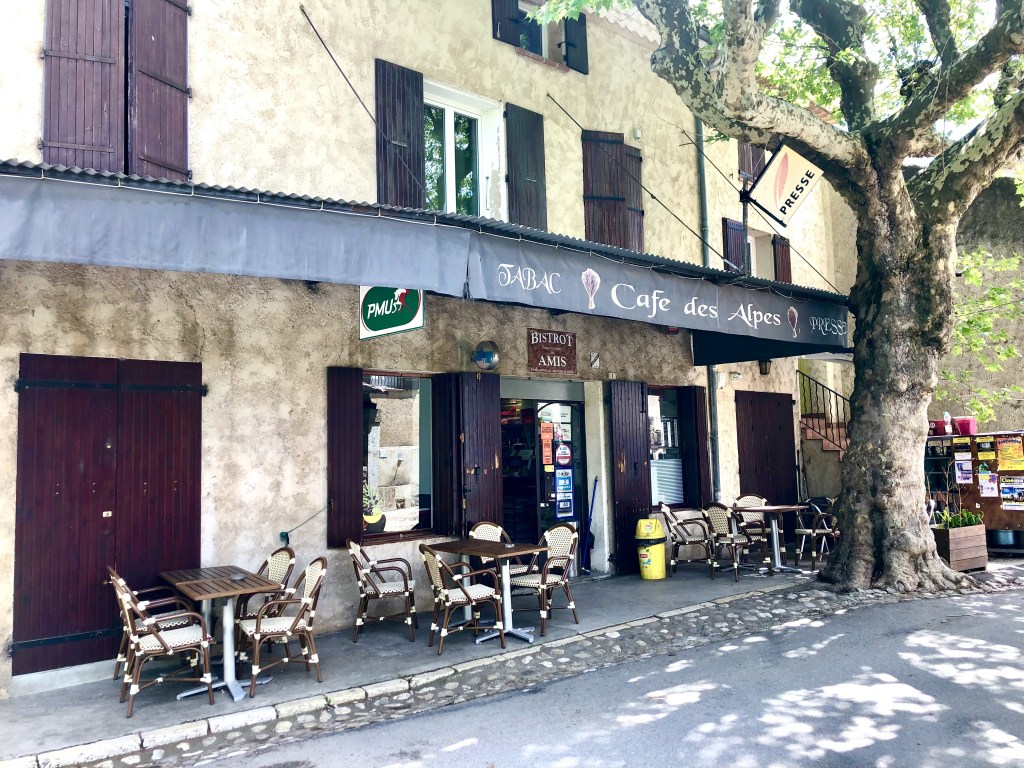
Ah Roumoules, Roumoules, Roumoules. It had a large Salle Polyvalent (Yes indeed. What on earth could that be you’re wondering? Try ‘multi-purpose’) and the distressed remnants of a pizza shop which still appears on Google maps. And it had the Cafe des Alpes as a last resort. I see it’s a ‘Bistrot des Amis’ which might be some sort of secret drinking club because at about 1pm Sunday arvo the amis including the female barkeep were having a raucous party, the sort where you lurch as you roar some comment which you forget about half way through, and swing at your best friend and miss. The sound system was so loud (Motown and disco as I remember) that she couldn’t hear my shouted request for a Pellegrino Limone. Lots of drinks but not much food on offer.
This photo was taken on departure, ours, but also everyone else’s. There might have been three left inside but the others had piled into a series of cars being driven by members of the amis presumably to honour the sacred French Sunday lunch somewhere else.
As the folk below were doing at the Roumoules aire pique-nique.
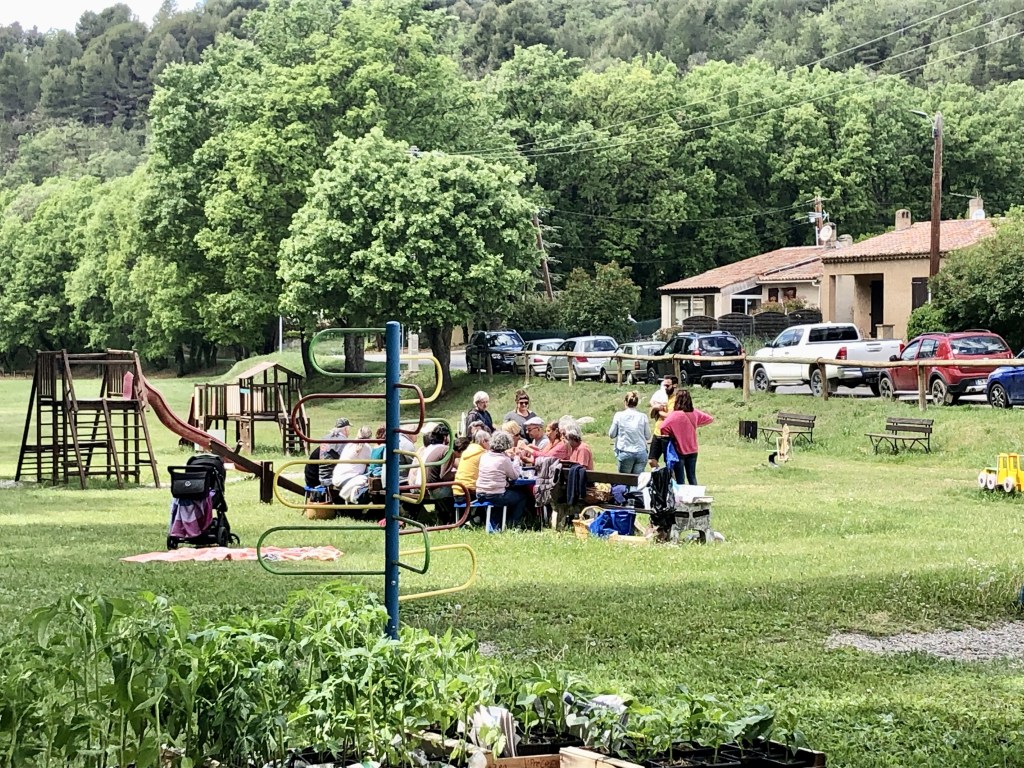
That would have been good over there. Nice wine, quiches, salades, fresh bread, perhaps some very carefully cooked cold fish, thinly-sliced charcuterie, cheeses. We were on the other side of the nursery stall digging through the remnants of five days of lunches. I still had some bread that we’d bought at St Andre, a pear, some fairly heavily punished bananas, a small tin of tuna, a dob of pate which had been supplied by the Auberge de Point Sublime, cakes! I’d forgotten. One piece of very fine apple and honey slice/flan provided from the same source. Some old goat’s cheese. Had a drink of water. Moved on.
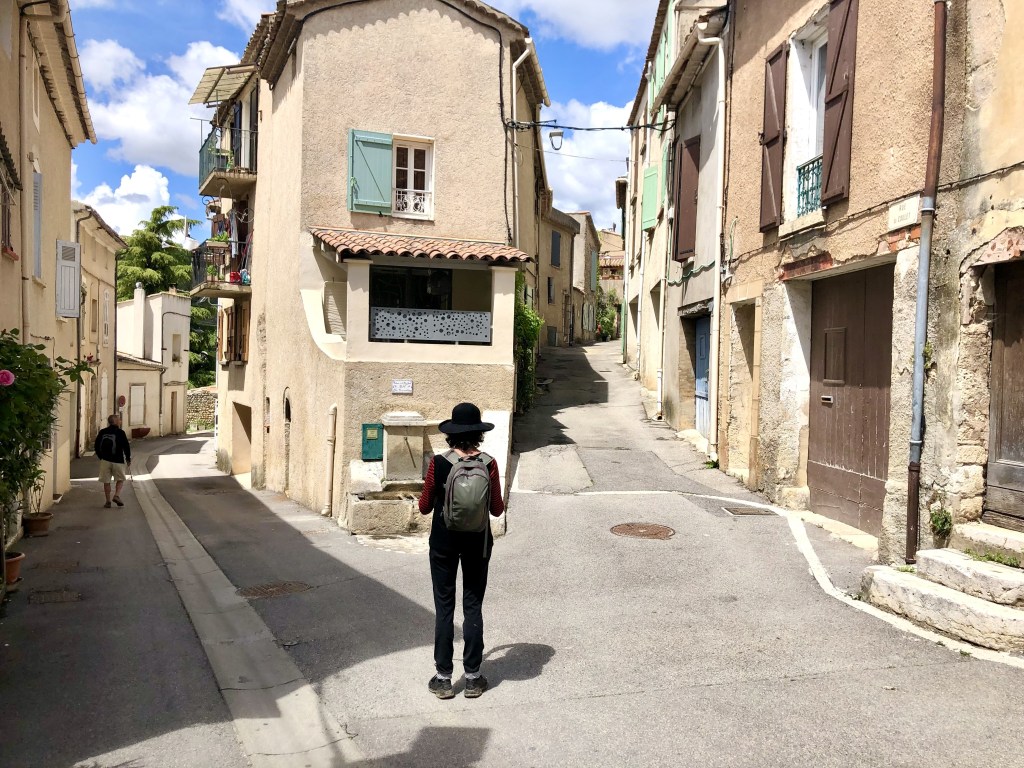
You take the high road, I’ve already taken the low road. Navigation, about which there was negligible disagreement. Included just for the photo really.

And so we arrived at Riez!, la pointe (semi) finale. This sign isn’t telling us much except that all of Riez! is under video surveillance.
Riez’s point of difference is that it has columns, Roman columns, and not only can you have a look at them you can imagine the very large gesture that they’ve been attached to. (Click to enlarge.)


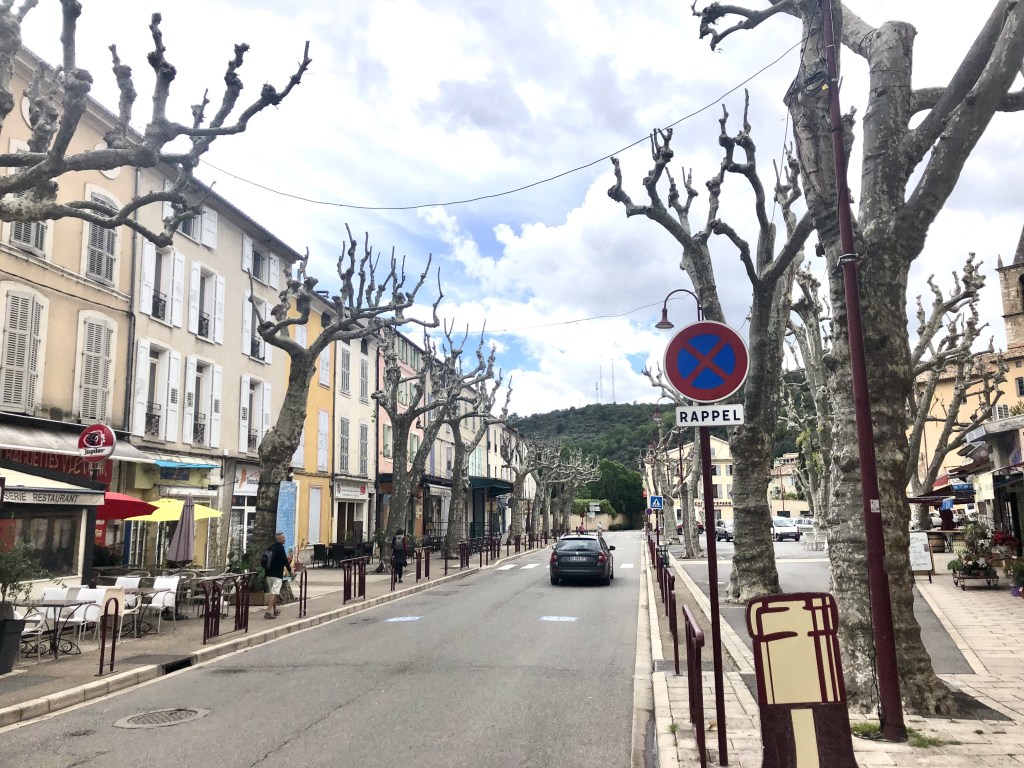

And yes we were spending the night at the Hotel des Colonnes, just the three available rooms (ours almost half a floor) and a shop, first established in the 17th century, adjusted several times since, but still redolent of other times and our hostess’s strikingly individual and interesting taste in art. It was sort of like a large installation. Memorable.

Our efforts to celebrate the end of the walk and its duration, all of it wonderful, were hampered by it being Sunday night in a small French town. We had something of a search before finding someone who beckoned us in. Le Petit Provence: next time you’re in Riez don’t miss it. Bream very recently out of the sea, excellent vegetables, and Michael ordered Crepes Suzette. It was on the menu but I don’t think they’d actually provided one since … oooo the mid-19th century. The assembled throng (others were hungry too) burst into applause when the balloon went up so to speak, and the conflagration took proper hold.
Taxi to Manosque the next morning, to meet a tiny, slow, and massively crowded train to Aix where we spent a day and a half.
Aix-en-Provence
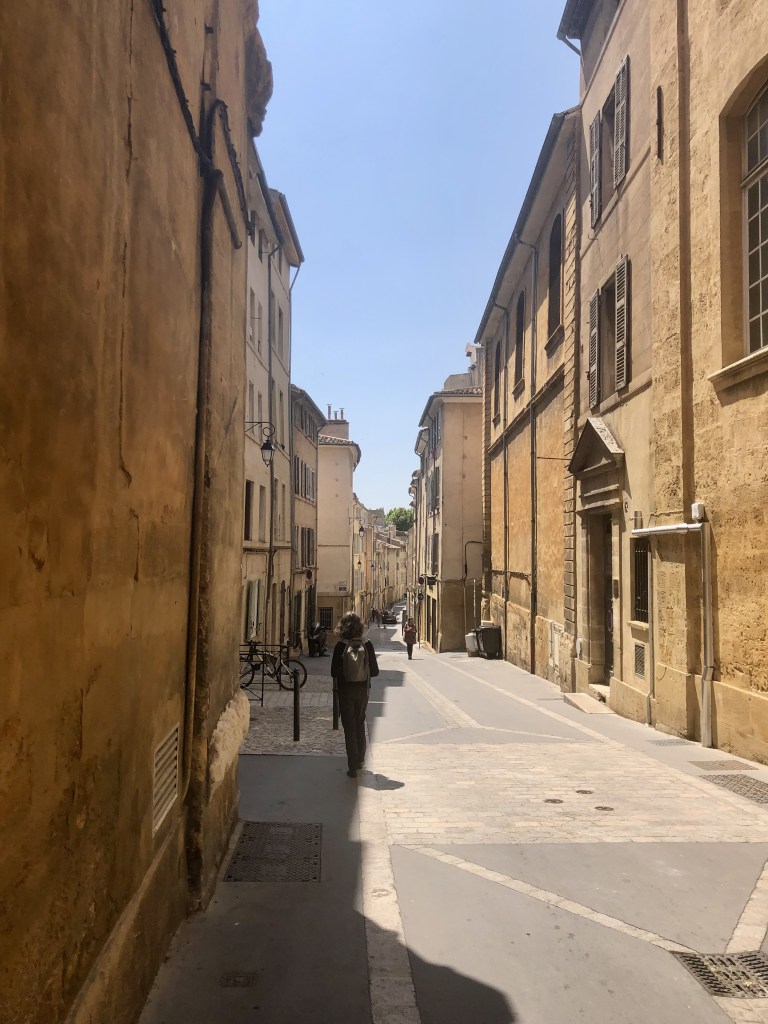
If Moustiers wasn’t in a different size category, Aix (round 20 kms north of Marseille and connected to it by housing) would severely test its ranking. Huge numbers of tourists but in manageable clumps. Formidably picturesque and stylish, there’s plenty of money in Aix. A 1000 options for food and drink (all sorts, we had sushi after we arrived), important architecture mostly old but some new, a university town full of young people and their vitality, great galleries … it was everything I had hoped it might be.

One quite modest reason for knowing about it is that Cezanne lived here and nearby is Mt Sainte Victoire, his talisman, painted countless times (actually 91 works are known). Here he is in 1906, according to Maurice Denis at the Granet gallery …

which, as well, had a very serious and thorough David Hockney exhibition. Hockney called this ‘My Parents’. Our children might soon too.

A very last photo before we pick up the car in which we will drive north to Heidelberg.

In the truffle shop on the Rue d’Italie. Nothing sold here but truffles: truffle bits, truffle-based, truffle-influenced, truffle-infused, truffle-smudged … the entire shop, and his job was to sell them. He was four weeks into the job and had already mastered it. Charming, warm, knowledgable, he almost made me forget I don’t really like truffle.
Into the car. First they didn’t have one, annoying; then they found one — oddly a red A3 Audi hatchback just like the one in our garage, but newer — pleasing. Wrong side of the road again. Off we go. La Roche de Solutré 400 kms away by 3pm.
 mcraeblog
Pingback: THE ROADS OF NEW ENGLAND | mcraeblog
A wonderful hike but it sounds very tiring. I couldn’t do anything like this any more. In 2013 I hiked the Tour de Mont Blanc (TMB for short) starting and finishing in Les Houches (just down the road from Chamonix) with my long term hiking companion, Julia Avis. That hike took 14 days and was also very strenuous and I certainly couldn’t do it now. However, it was spectacular all the way and the food and drinks were outstanding. Raclette seemed to be the speciality of quite a few of the auberges. I didn’t think that I’d be able to sleep in a dormitory but I had no trouble; I was very tired at the end of each day. There were a few really hairy sections where the only way to continue was via ladders. Unfortunately the ladders always seemed to finish level with the end of the climb rather than having extension hand holds to take you to safety. I could only manage by walking straight up to them and starting climbing; no contemplation of the danger, just straight onto the ladder. After the hike we went south to a small village which would surely rank in the top five in France, for her fiftieth birthday celebrations (although I’ve forgotten its name; somewhere near Valence). Julia now lives in Bordeaux, having migrated there a few years ago.
i am seated in a very comfy armchair in freezing melbourne. the heating is turned up, warm coat and socks and a large whiski to warm the insides. Reviewing the photos and notes the walking distances seem shorter, the steep inclines are flattening out, the staircase that James Stewart of Vertigo would never have attempted is just a challenging memory, the certainty that the weather forecasts would be wrong, and those sumptuous french breakfasts before we set off each morning are still with me. Small towns, country, side and villages were beautiful, the big cities too noisy. We only dropped out for a few days but what an appetiser. Provincial France has certainly got some life left
That’s the real story.
Loved every bit of it David – including the drama of the lost sac à dos! I’m so impressed that you all made it – those stairs would have done it for me. Thanks for the wonderful detail and glorious photos.