
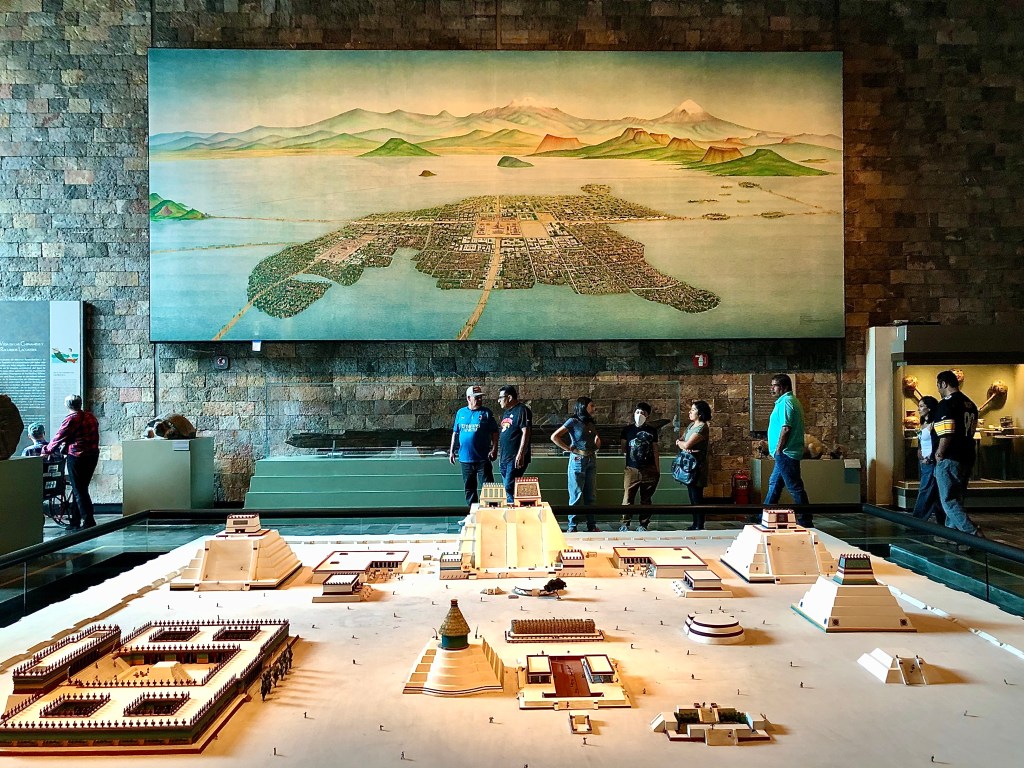

Early in the 14th century the Mexica were a small, obscure nomadic tribe searching for a new homeland. One of the many things they were good at was dates. We can say with confidence that in 1325AD their wanderings came to an end. They entered the valley in which Lake Texcoco was situated and put down roots there because they were also a profoundly religious people. A serpent had been observed fighting an eagle on a cactus. This was a sign, the sign, to stop and settle.
This place became Tenochtitlan which two hundred years later at the beginning of the 16th century was one of the largest and, in some ways, the most sophisticated cities in the world, smaller than Constantinople but as populous as London and Paris. It was most carefully planned on a grid based on the cardinal points of the compass. It had causeways between islands for transport, aqueducts to carry fresh water and sewers to dispose of waste. It supervised and benefited from trade across the indigenous nations of the peninsula. Its scientists and mathematicians had developed a sophisticated understanding of astronomy, time and certain forms of manufacture. As Cortés was delighted to discover, they mined, smelted and fashioned precious metals including alluvial gold. They had wide well made roads, but no beasts of burden. Wheels were used only for toys. Over a reasonably short period of time (1325-1521) the city had developed from its bare, wet origins into a metropolis, the heart of an empire led by a single ruling leader supported by classes of nobles, priests, warriors and merchants.
The city was founded on a small island in the western part of the lake. To create living and farming space the Mexica sank piles into the water and formed small land masses they called chinampas, or floating gardens. Until they became stabilised which they did to some degree over time — Mexico City is still visibly wobbly — they could operate like wicking pots, absorbing water from below and not having to rely on the variable rain fall. They have now populated most of where the lake once was.
I knew about this. I’d read the book. (Inga Clendinnen, Aztecs: An Interpretation, not to be missed, masterly.) And just while we’re here, the word Aztecs, which in Inga’s book only appears on the cover. (Almost.) ‘Aztec‘ was a term coined by German explorer Alexander von Humboldt derived from ‘Aztlan’, the term the Mexica used to describe their original home in northern Mexico. He wrote about this in 1810 and the term was taken up and popularised — obviously most successfully — by American historian William Prescott. ‘Aztlan’ means ‘place of the white heron’ which suits my purposes here.
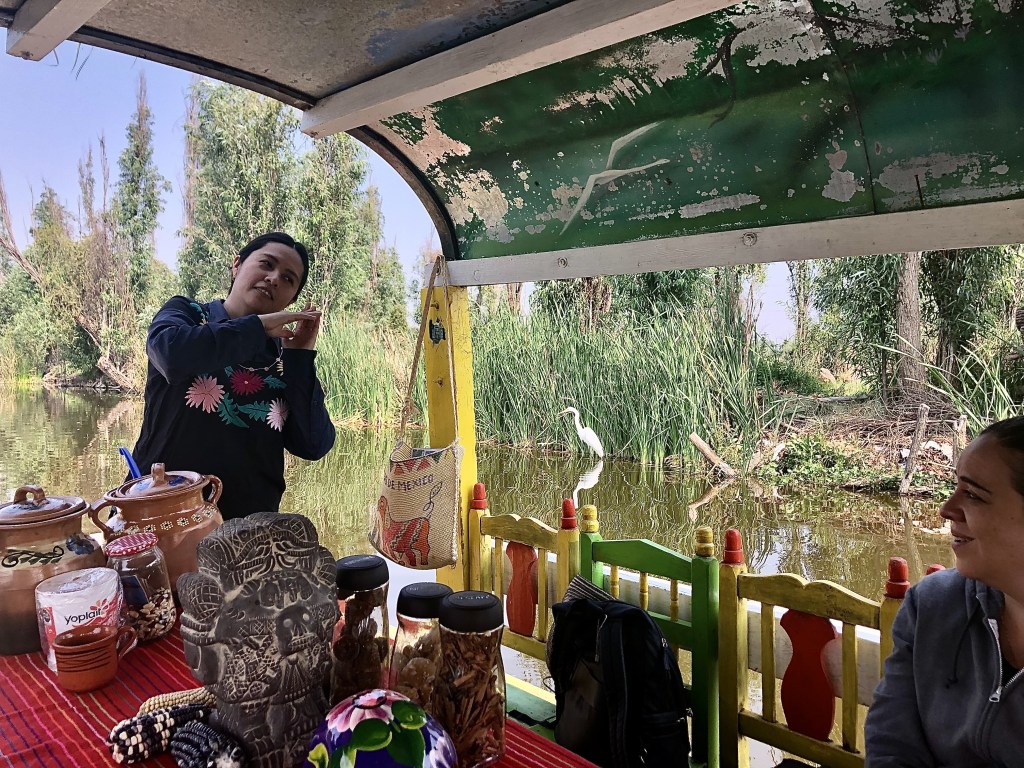
We are at Tlahuac (‘La wuck’ is close enough), and Alfredinho is telling us about chinampas. As far as she knows, Alfredinho’s forebears have lived right here since pre-Columbian times. Our guide Valeria is at right. Now I look there is an effigy of Coatlicue, ‘Snake skirt’, in the foreground along with some gaily coloured corn and a Yoplait jar. And in the background there is one of the many white herons we saw on this and other days. We are about 25kms south from the centre of Mexico City and still in the remnants of Lake Texcoco. This is somewhere you wouldn’t be unless you were on a tour, and perhaps more accurately on a very particular tour with Val who was rather wonderful. And in the background is the edge of a chinampa.
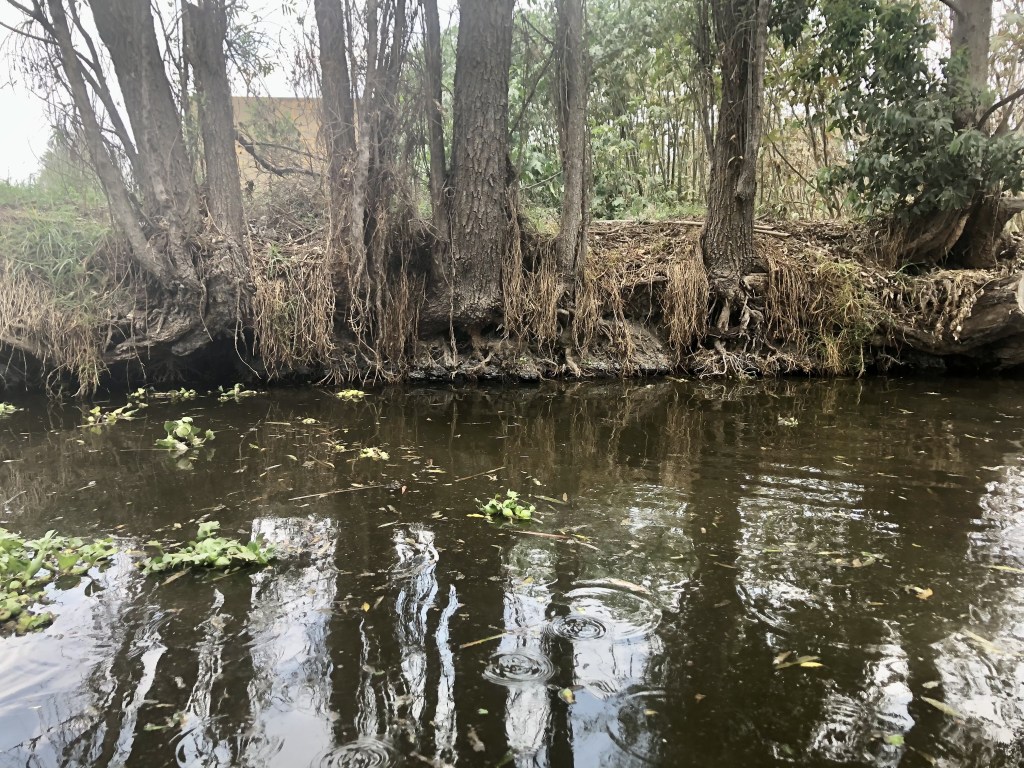
The trees planted for the purpose have constructed a bank with their fiercely interwoven roots. Several hundred years of earth moving, composting and vegetal litter has produced this result.

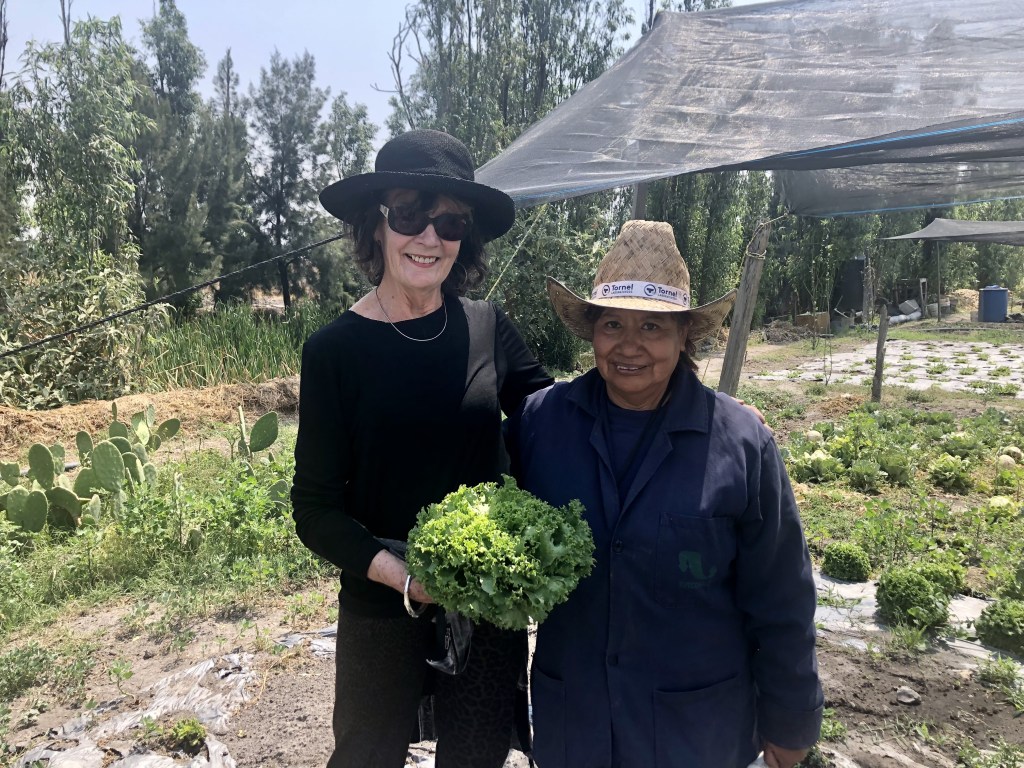
We were assured, in the most contemporary of terms, that everything grown here was completely organic and pesticides were never used, although post-Columbian plastic was used for cloches to support seedling growth and some out-of-season produce. It is worth noting that climate change had impacted on the nature of work here.
We had lunch all of which had been grown in a section of this chinampa (many families have plots here) and it was very nice indeed.


A view on the way back from lunch. The hills in the background are covered with the houses of the wealthy.
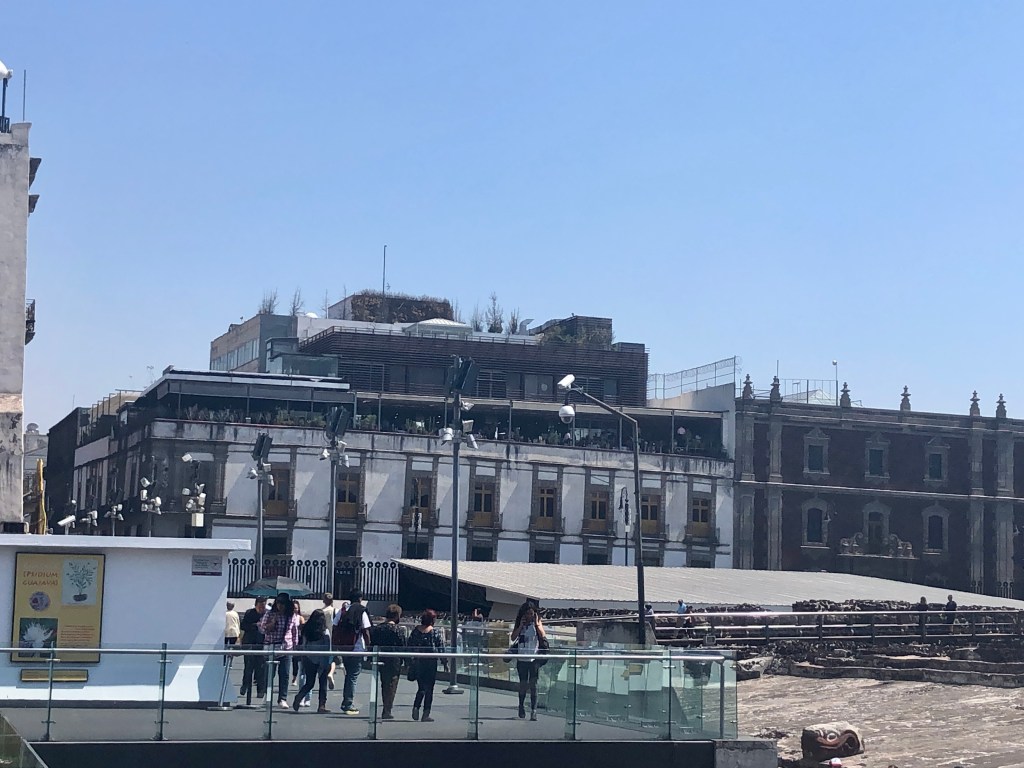
To qualify the tourist romance, other parts of Tlahuac are believed by the locals to have been built on the rubble generated by the monster earthquake of 1985. This has added to the already considerable instability of the region. Most of Mexico City is subject to subsidence (up to 15cms a year in town, 40cms a year in Tlahuac). At left is an example from right next to the cathedral and the Templo Mayor. Look at the balcony. Groundwater extraction (see The Sacred Cenote) contributes significantly to this problem.
The worst affected are those living in the pueblos originarios (pre-Hispanic towns) which scatter through the Tlahuac region, an area growing rapidly from an influx of people from other parts of the country to live on the city’s fringe in the hope of finding ways to make a living. These fringe areas also happen to be those most prone not just to subsidence but to earthquake damage as well. In The Labyrinth of Solitude Mexican Nobel Prize winner Octavio Paz talks about how ‘Our territory [Mexico] is inhabited by a number of races speaking different languages and living on different historical levels.’ This has social and economic consequences.
Everything is a package.
We remain on botany.
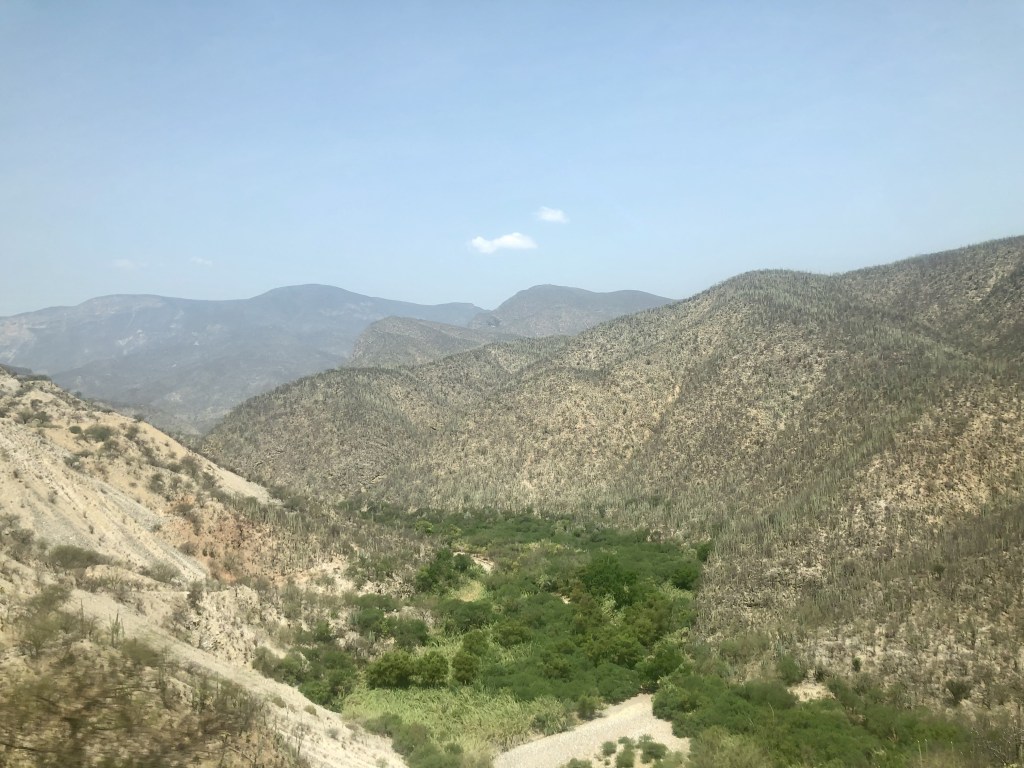

Unalloyed good. No qualification. It is the Jardín Etnobotánico de Oaxaca, the Ethno-Botanical Gardens of Oaxaca.

You can only visit under supervision, so we were on a tour. It was very hot with little shade and the tour was to last two hours. I was sure I couldn’t possibly last one hour let alone two. But I was left wanting more. The guide was Caroline a mature-aged Canadian botanist who had lived in Oaxaca for at least part of many years, and she was brilliant. Two of the most entertainingly educational hours I have had in my life.
What did I learn?
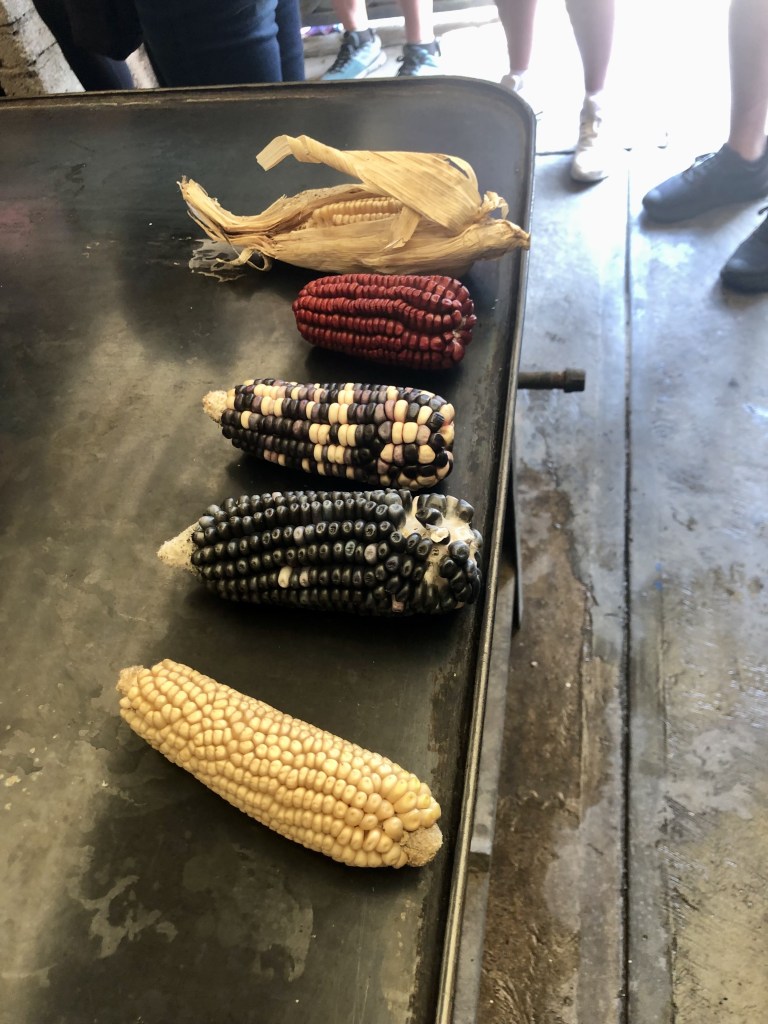
47 varieties of corn, all manner of colours, are grown in Mexico. None of them is ‘sweet corn’ as we know it. 28 of these varieties are endemic to Oaxaca Province. The kernels are hard and, and, through selection and breeding, tend to be large. Their primary purpose for millenia has been for flour. I add: tacos, round pancakey affairs made out of corn flour are the staple of the Mexican diet. They can be found on most street corners and are served with your choice of filling: refried beans, shredded pork, guaca mole (‘avocado sauce’), carne (MEAT). To me they taste of the smell of earth, soil that is, most certainly savoury rather than sweet. That smell/taste can be found throughout Mexican food. Corn is ubiquitous.
There are several thousand varieties of peppers. Only one genera is ‘hot’. I add: which doesn’t stop it being used very widely in Mexican cooking. EXCEPT, it is very frequently served as an accompanying salsa which you can choose to include in your meal or not. Often there were three: red (conventionally very hot), green (hot but often in local and unusual ways), ‘white’ or clear (lots of differing things, garlic and onions for example). Three of goodness knows how many. Regionality is defined to some extent by the nature of the sauces served with easily recognised meals.
La Ceiba, ya’axché in Mayan, the kapok tree, is one the two trees sacred to Meso-American peoples. They considered them as a connection between the earth where their roots reached down into other realms and heaven where their crowns towered. Can grow up to 75m high, their branches distinctively stick out at right angles, their trunks are covered in very sharp, and hardy, spines which can be up to 20mm long. Impaling oneself on the spines has had meaningful gravity in a range of spiritual contexts. And of course, their fruit is full of useful fibre. En passant, Cortés ordered the hanging of Mayan emperor Cuauhtemoc from a Ceiba, just turning the knife.

The second is the ahuehuete, the Montezuma Cyprus. It has very strong and useful timber. Its resin was also widely used to treat gout, ulcers, skin diseases, wounds, and toothaches.

There are more than 2000 species of cactus. More than half are endemic to Mexico. Brazil has the next most, fewer than a quarter. Canada has none. Nor has Australia. They grow very slowly but, without intervention from insects, humans or disease, there is no reason why they can’t live forever. Almost literally. The primary form of threat at present is climate change because they have a low capacity to adapt to fundamentally changed climatic circumstances.
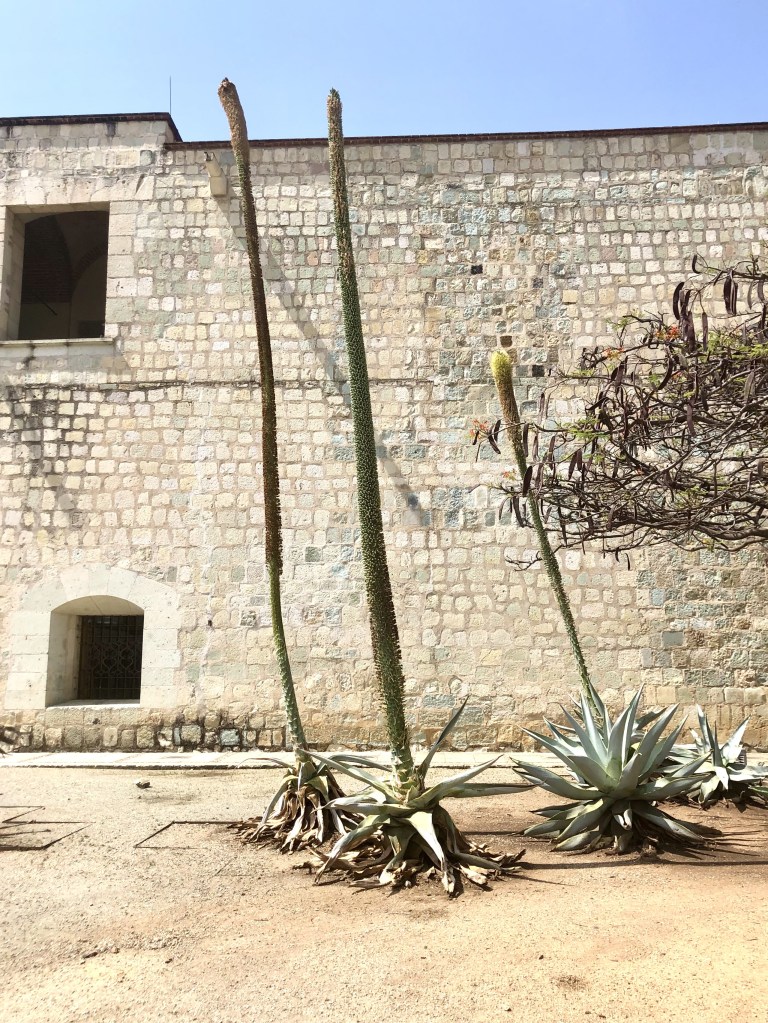
Despite it having spikes the agave, or maguey, is not a cactus. It is a succulent and was fundamental to pre-Hispanic life. It was the source of fibre, so clothes, shoes, rope, roofing thatch, thread and so on and on. Its spines were used for needles, its leaves for lining baking processes in the earth. Its sap can be used as a sweetener. It is also the source of pulque, an alcoholic drink, used for example by sacrificial victims and still drunk today. But not as widely as its derivatives, mezcal and tequila. And, yes my goodness, they do flower, a precursor to death.

The sap of the copal tree is valuable for its olfactory properties. Through history it has been used as incense, as well as a varnishing and gluing agent, and a medicine. When burned, Copal resin produces a sweet, earthy smell. But it is also excellent wood for carving. Oaxaca is known for many things, its mole sauces for example, but also its art. One of the things you can find there that you can’t really find anywhere else, certainly not in the same profusion, is alebrijes, carved and decorated animal figures the ‘product of the nightmares’ of the artists. These rather special and very big ones were produced by husband and wife, Jacobo and Maria Angeles, and in the Oaxaca art gallery.


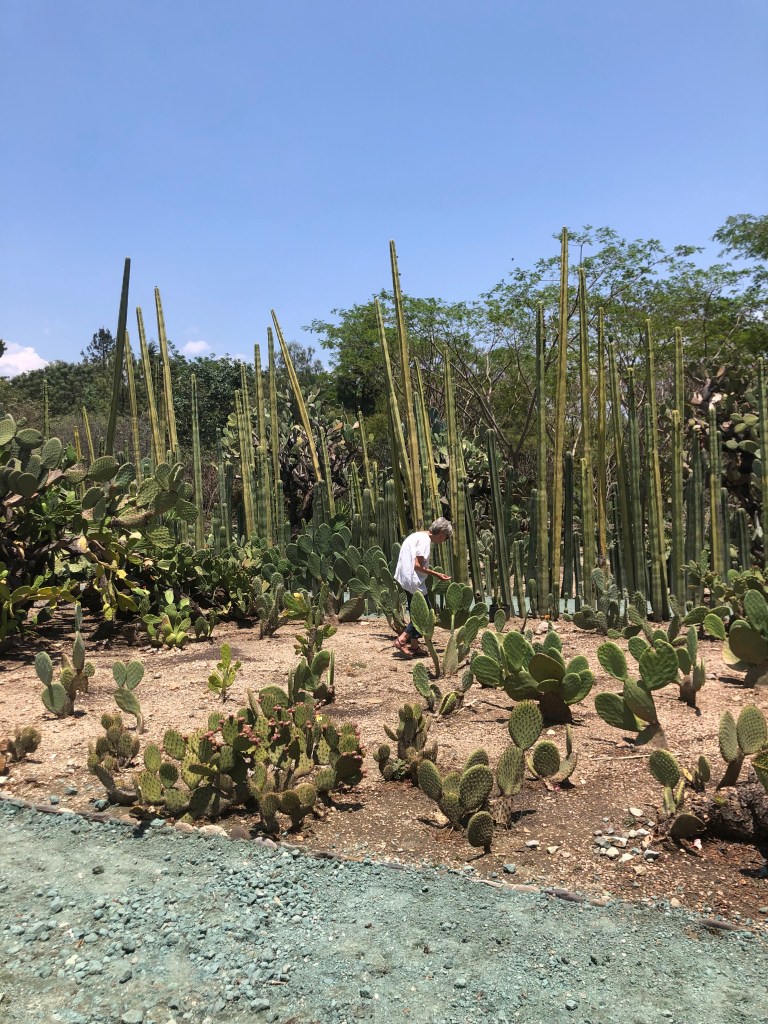
Lastly, Caroline is pictured collecting bugs off the prickly pear in the foreground. She brought them over and encouraged tour members to squash them, then claimed that what we were looking at was the most valuable export from the Americas to Europe for 150 years. They were cochineal bugs. The bugs are about 5mm long and in the past they were collected by brushing them off the plants. The amazing red they produce is now used to colour food and lipsticks, but in the 16 and 17th centuries they were the primary source of all red dye. Red, the royal colour, was almost impossible to reproduce in any other way until artificial dyes came along. More valuable than gold.
Why do we know so much about pre-Hispanic peoples? Firstly it isn’t that long ago that they were introduced to a larger world. Secondly, they offered endless narrative imagery in carvings and drawings and their own imagaic languages. Thirdly, they spoke many languages but Nahuatl, the language of the Mexica, was translated into Spanish and vice versa very early on, not least by a Nahua noblewoman Cortés took as his mistress. (Footnote: ‘La Malinche’ who even has a major pass named after her. In contemporary accounts she is pictured marching at the front of the army with Cortés. He dumped her.) Considerable effort was also put into alphabeticising it so it could become, as it did, a written language. Vast amounts of information were stored in codices — pictures and writing on European paper — on all sorts of subjects and over time. Here we have one sheet drawn from the Codex Osuna, a message directed to the Spanish king.
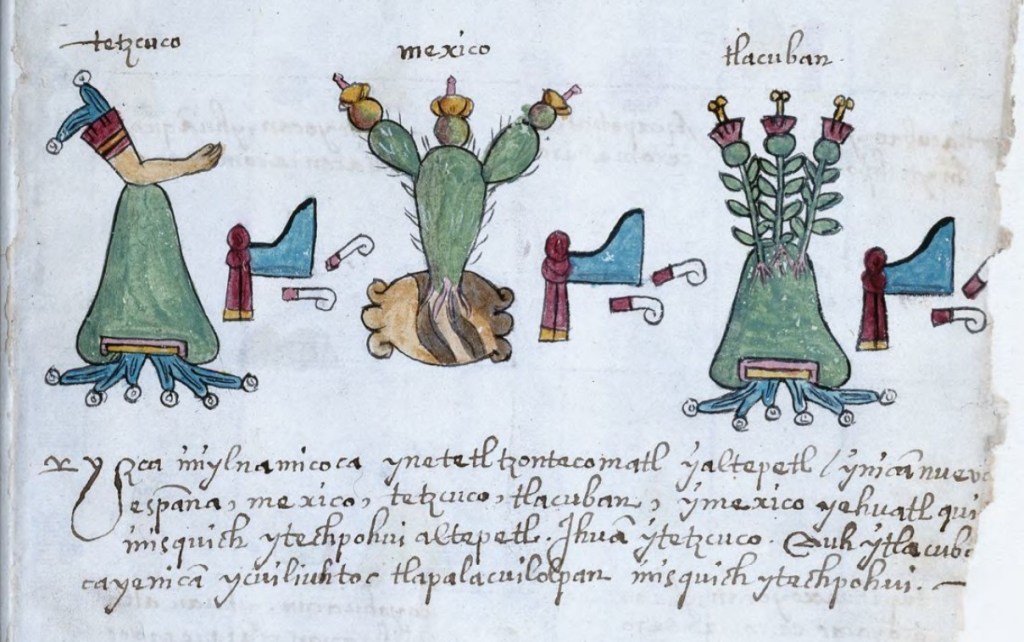
The writing is in Nahuatl. The middle ideograph is about harvesting cochineal. It is a complaint about not being paid for work. Interesting that they could. This is not an entirely subject people.
• • • • • • • •
We move on. Death and religion.
 mcraeblog
Pingback: Entering: Mexico | mcraeblog
Amazing stuff – and a great memory David.
Absorbing really. Thanks for going through all this – and letting us into this world. Otherwise we’d never know.
An entertaining read David – thanks!