
Hmm well I seem to have a different sort of audience. Mature perhaps? Out of the TikTok Zone? Or just prepared to put in the hard yards after a big preseason? 386 people had pressed the button to view (or more correctly the button to view had been pressed that many times, but also by a lot of different people) 16 hours after I posted ‘Flooding the Zone’. For me, that’s viral. 42 of them were in America where I can confidently guess at only two of their names. So, good I guess.
Hmm I wrote that yesterday. Today something more dramatic has happened. Another 494 people have opened the blog with very large representations from Germany and the US. I am surprised about that. Oh well, good. I suppose. [There were two more days like that and then a taper.]

Just before we get too much further I want to make an important correction.
The blog initially asserted that this video at left has been viewed 3 million times. The eagle-eyed Mr Findlay spotted that it had actually been viewed 40 million times. He claims that only half of them were him. (A claim that might be disputed by John Cook, or perhaps he’s happy to acknowledge just the other half were him!)
• • • • • • • •
I have said before that very few people leave comments. But they do send me emails which I very much appreciate. It’s keeping in touch. And they also say a lot of interesting things.
I would like to refine a couple of things before turning to a larger question.
• I want to dispense with the idea that I’m an old fart banging on about my distress concerning what the kids are up to these days. Do I really need to? Maybe not. However … I’m happy to be an old fart, but what I am writing about is a subject in which I am an active and very willing participant. It is a subject with a fat discourse which grows by the day, and of sufficient moment for social media manipulation and regulation to be under consideration right now by governments in many countries including this one. (See below.) Even if it only deeply affects, as I suggest and acknowledge, only a minority of the population, it’s a matter of concern for everyone.
• And for my own satisfaction, of course not all manufactured food is bad for you. Pasteurising milk, for example, meant one of the great leaps forward in public health. Cooking could be considered a process of manufacture. Then there’s milk chocolate bullets … great. However, hyper processing is different and some processes in particular are difficult to justify.
If you want to chase up more about hyper processed food you could read this excellent article. If you do you will find out that:
- in the UK 61 percent of 2 to 5 year-olds energy intake comes from hyper processed foods, even more than in the US;
- these kids are increasingly rejecting any food with texture that differs from puree. One result of which is a higher level of tooth decay, another is speech delay because the muscles required for chewing are the same as those required for forming sounds;
- one baby food pouch can contain four teaspoons of sugar
- parents commonly believe that these hyper processed foods are ‘healthier’ than alternatives.
• For the Netflix fans: On Netflix you can find some excellent and challenging entertainment produced by smart young things, children of the millennium. Stranger Things was not to my taste but it was to a lot of other people’s. Squid Game had to watched with sub titles and thus was not conducive to random auditing. Severance, another hit, demands committed attention. Succession, Slow Horses and the first two series of White Lotus are among the finest television fiction ever made and were made available via streaming services HBO, Apple+TV and Binge respectively. Maybe the best and most taxing of the lot, Adolescence, was produced by and made available via Netflix, and among the many things it is about are the dangers and depradations of social media!
But my point in the blog was about the nature of a particular process, a series of processes really, developed and employed by Netflix to tailor content to the preferences of its audience and, it would seem to me, by knocking off a lot of worthwhile edges.
It is not alone in this regard. There could be a horde of examples but Spotify provides one precisely made to order. (Spotify being the world’s leading music streamer with over 30 percent of total volume.)
In her book Mood Machine: The Rise of Spotify and the Costs of the Perfect Playlist Liz Pelly describes how, in 2016 under pressure from investors, ‘Spotify’s internal research showed that many users were not coming to the platform to listen to specific artists or albums; they just needed something to serve as a soundtrack for their days, like a study playlist or maybe a dinner soundtrack. In the lean-back listening environment that streaming had helped champion, listeners often weren’t even aware of what song or artist they were hearing. As a result, the thinking seemed to be: Why pay full-price royalties if users were only half listening? It was likely from this reasoning that the Perfect Fit Content programming was created. … The message that quickly filtered through to artists was that the more beige your sound, the more likely it was to find a place on a Spotify playlist and earn some cash. Hence the rise of a homogeneous genre dubbed “Spotifycore”, which you’ve doubtless heard even if the term seems unfamiliar. It’s a bit ambient, a bit electronic, a bit folky, a bit indie, a nonspecific wish-wash possessed only of a vague wistfulness.’
Spotify-associated companies have churned out and loaded millions of hours of this ‘music’, also described as ‘aural wallpaper’, sometimes created with Ai and pushed by the company’s algorithms to a dominant position on Spotify playlists. Six months ago CEO Daniel Ek — who is Swedish; being an arsehole is not confined to any particular nationality — tweeted that ‘creating content costs Spotify close to zero.’ Pelly correctly claims that Spotify is not in the music business; it’s a technology enterprise.
• While you can talk about body image controversies and doing silly things which are dangerous, a fair bit of what’s on You Tube Shorts, TikTok and other short form video media is harmless. But if you spend two or three hours a day with eyes and brain glued to its content you can expect a negative result. Not all users do this. Some do. As Victor pointed out in his response, some people, at least initially, also choose to use crack cocaine. Or for that matter SportsBet. There aren’t enough of them however, and certainly enough of them with a political agenda, to elect a government.
• I am genuinely in awe of the cleverness of much of what I’m writing about. It represents apex thinking on top of mountains of research a lot of which may well have been conducted by people who had the best possible motives and aspirations.
In February 2012 Mark Zuckerberg wrote a letter to prospective investors in which, inter alia, he suggested: ‘Today, our society has reached another tipping point. Facebook hopes to rewire the way people spread and consume information … by giving them the power to share. … People sharing more — even if just with their close friends or families — creates a more open culture and leads to a better understanding of the lives and perspectives of others. We believe that this creates a greater number of stronger relationships between people, and that it helps people get exposed to a greater number of diverse perspectives.’
As it turns out, that and a few other things as well. As Jerry Seinfeld said, ‘There is no such thing as fun for all the family.’ Everything comes as a package.
Careless People: A Cautionary Tale of Power, Greed, and Lost Idealism by former senior Facebook employee Sarah Wynn-Williams (a book which should really be read asap) contains a four-page description of the way in which Facebook and other social media were used to get Trump elected in 2016. This is some of that.
‘Trump’s campaign [for which Facebook provided a number of its most skilled personnel] amassed a database … of over 220 million people… It charted all sorts of online and offline behaviour: gun registration, voter registration, credit card and shopping histories, websites visited, what car they drive, where they live and the last time they voted. The campaign used Facebook’s “Custom Audiences from Custom Lists” to match people in that database with their Facebook profiles. … Then they’d pair their targeting strategy with data from their message testing, so people likely to respond to “build a wall” got that sort of message. … At any given moment, the campaign had tens of thousands of ads in play, and by the time they were done millions of different ad variations. … Many of these ads contained inflammatory misinformation that drove up engagement and drove down the price of advertising as these ads were shared among like-minded people.
A propos of this, Robert W reminded me of the nature and influence of Milton Friedman’s doctrine: A company has no social responsibility to the public or society; its only responsibility is to its shareholders.
Apocalypse now? Or soon anyway?
After they finished reading the blog Andy reports that he and Ruth said as one (which would be unusual), ‘We’re fucked!’
Any construction, like a blog say, entails selection of emphasis and detail. I might be just as guilty as the people I’m talking about in the blog of engendering panic, distress and anger. A perpetrator as well as a victim! Eeeeeeeeeeee …
I haven’t tried to dampen things down, nor have I tried to ramp them up. I was predominantly interested in seeing how far the hyper processed/ hyper palatability notions could be pursued when applied to social media, and I think the answer is a very long way indeed — and the more evidence I collect, like the Spotify example above, the more certain I become of their pertinence. Sarah Wynn-Williams’ book is an extended and highly detailed dissertation on my thesis.
But I go outside and the sky hasn’t fallen in. The fruit in IGA is much as ever. They are selling eggs, expensive sure, but there are eggs there. Do I have a problem with too much immersion in news media? Maybe. Not enough to do? An inadequate number of suitable distractions? Hmmm … If I went to America what would I find? Things chugging along happily with hardly any recognition that the country had a new President, you know, all much the same as ever, 350 million people in a settled state. Nothing like what is being portrayed in the sorts of things I read. (On the other hand, maybe not. Yesterday was Liberation Day, and not so good for Lesotho, or Heard Island. Yeah, maybe not.)
Terrible things have happened in the past. These issues are pretty low key compared to 1938-50 in Europe say, or the plague that nearly completely eliminated the population of Central Asia in the 14th century, or the ice age which began with the volcanic eruption of 536. And from a more contemporary perspective, is this worse than what might happen as a result of climate change? (Just incidentally, one of the terrible things that Trump and his boys have done is to stop the work of the National Oceanic and Atmospheric Administration which, with the UK’s University of East Anglia, has been by far the world’s most important source of climate information.)
And even if it seems bad, how should we react? Wait and see what if anything happens? Wait till we’re personally affected? Limit our kids’ screen time? Ban functions of Insta or Facebook? Or, recognising how madly unpopular (and probably impossible) this would be, just block the lot? Or hunker down and keep our heads low waiting it out?
This isn’t the first time anybody has thought about this. As recounted in Careless People, Facebook’s entry to China is a case study of this process, a story of uncertain steps and the chilling commercial impulses which resulted in the ceding of control over Facebook’s data and ‘privacy’ to the Chinese Government. But the message, hardly ever heard in the West: you can make the tech bros bend to your wishes if you choose to.
The popular target seems to have shifted to the impact on children and adolescents, something all adults who don’t work for techo companies might agree about. (Altho I note the number of tech company bosses who strictly regulate their children’s screen time and social media usage.)
• • • • • • • •
On the 3rd December last year legislation was rammed through the final sitting of the Australian Parliament (for the year), supported by both government and opposition, setting a minimum age limit for the use of social media platforms Snapchat, TikTok, Facebook, Instagram and X. The Online Safety Amendment (Social Media Minimum Age) Bill 2024 requires ‘age-restricted social media platforms’ to take reasonable steps to prevent Australians under 16 years from having accounts on their platforms. Social media platforms operating in Australia have 12 months to develop and roll out systems to enforce the age restrictions, which are expected to be in place by the end of 2025.
The platforms will be subject to penalties ‘to a maximum of 150,000 penalty units (currently equivalent to AU$49.5 million) for a breach of the minimum age obligation by corporate actors, and for breaches of industry codes and standards, to reflect the seriousness of the contravention, consistent with community expectations.’ So there.
But I fear that could be just bouncing up and down on the high board without really looking at what’s in the pool, or whether there’s a pool there at all.
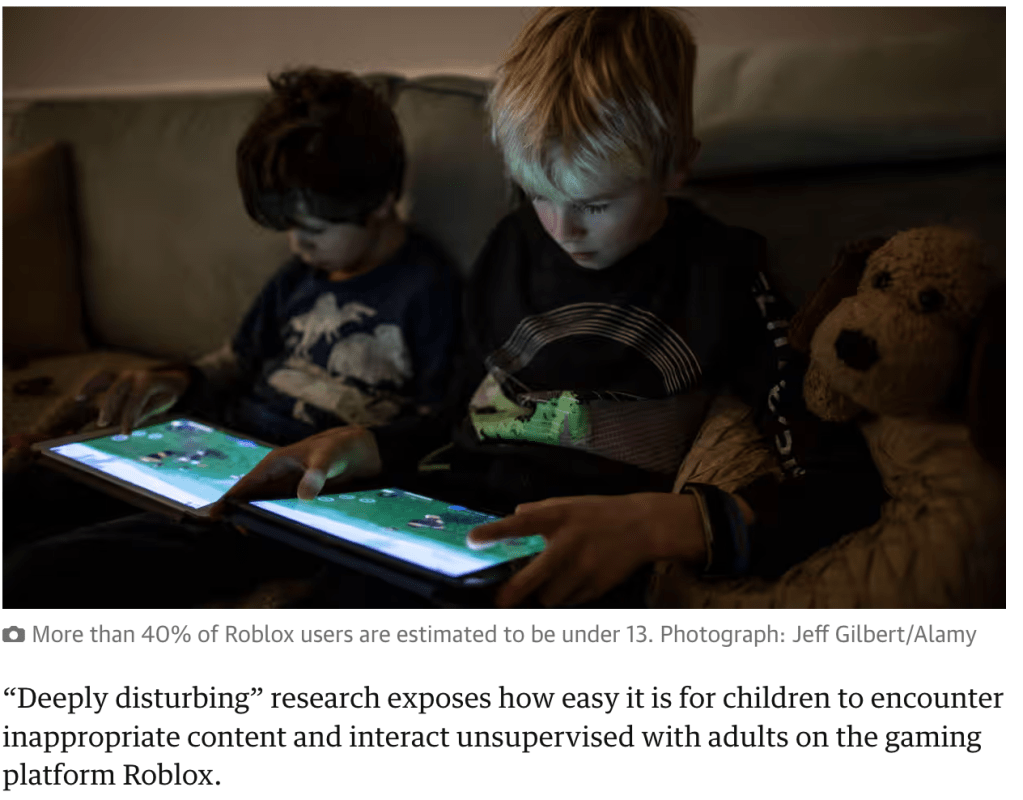
There is the matter of the targeted platforms (Snapchat, TikTok, Facebook, Instagram and X). They’re the big ones but all of them have multiple forms and are constantly changing and adapting to whatever is popular. Where’s YouTube and YouTube Shorts? Or is that ameliorated because of the existence of YouTube Kids? How about Reddit, Quora, Threads, and Tumblr one of the most popular sites in the UK among adolescents onto which until recently you could load porn in almost any form. You can’t any more, only nudity; but then there are the myriad other sites which are not ‘age restricted’. Roblox was supposed to be for kids, but look what’s happened here and here.
Next there is the small matter of establishing the age of users.
Five to ten years ago the big issues were maintaining young (and older) users’ privacy and security. There is a monster flip involved here to providing enough personal data to establish and confirm age and allowing the companies to collect and store that data. EXCEPT the legislation requires ‘the destruction of information following its use.’ It does seem a lot like wishful thinking. If you say something it will come true: the sine qua non of Trump-ism.
In their submission to Judge Robert French’s recent and relatively thorough investigation into legislating about kids and social media for the South Australian Government, the tech companies noted: ‘The hard fact is that there is no error free means of determination of the age of users of an account. The antagonists are the users themselves: current age verification is extremely easy to get around by lying about your age.’
Age verification that relies on personal information for ID has a low success rate and is too easy to avoid and generates all sorts of privacy issues. Age verification that relies on facial recognition technology is too often inaccurate to be of much use. (‘Such technologies can create barriers to inclusion as they may not perform well for some skin tones, genders or those with physical differences.’) Meta, remarkably and without complete confidence, uses Ai to flag users under the age limit based on their behaviour on the app.
For these reasons and others, the platforms vigorously assert that age verification should occur at the point of purchase via app stores. You might consider that as kicking the can well back up the road. We might conclude that they really really really don’t want to be responsible for user age verification. But you might also wonder just how effective that would be. Age verification would still be required.
French’s conclusion was as follows:
‘Whatever regime is established by the South Australian Government, it will not be perfect. Effecting compliance across the industry will be challenging. Compliance will require age assurance measures, location measures [in this instance re living in SA] and, where applicable, verification of parental consent. Enforcement measures may be complicated by the fact that many providers are companies which are located outside Australia. The legislation would apply to existing as well as prospective users of social media services. There will undoubtedly be workarounds by knowledgeable child users. However, the perfect should not be the enemy of the good.
In 2019, efforts were made to make the UK ‘the safest place in the world to be online’ via the Online Harms White Paper. Social media firms were to abide by ‘mandatory duty of care’ to protect users and would face heavy fines if they failed to deliver. A new independent regulator was to be introduced to ensure companies met their responsibilities. One practical step was to ban under 13s from use of social media. But Theresa May was Prime Minister and it was the Tory Government in its very last throes of attempted competence, and it didn’t work as data drawn from a subsequent (2022) UK investigation shows.
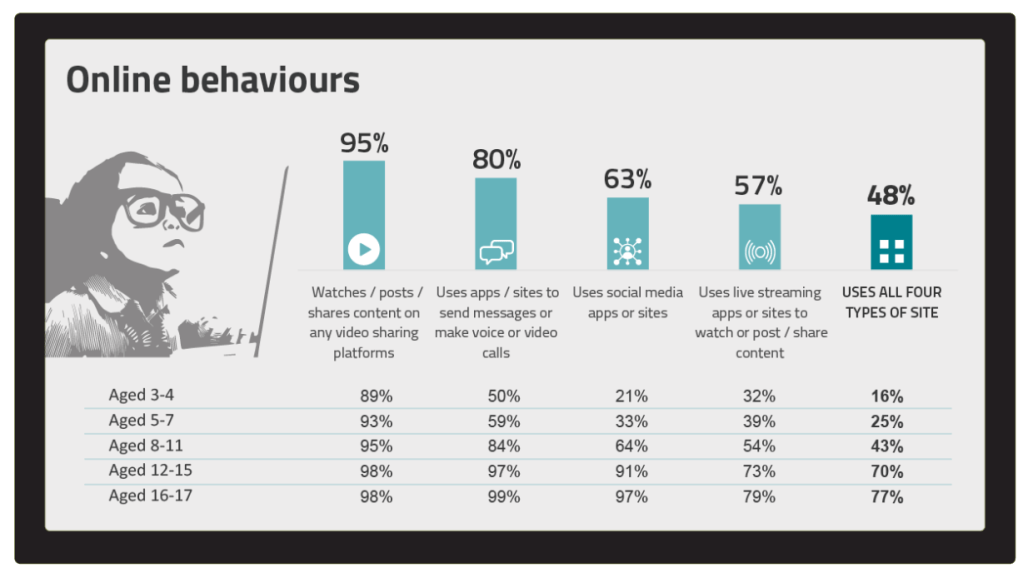
You might take note of the online behaviour of 3-7 year olds (in the UK) in 2022. These data also indicate that 17% of UK 3 year-olds had their own phone. You can read OfCom’s most recent report here.
Denmark has led the EU in thinking about and action on these issues recently suggesting that no under 13s should have a phone or tablet and that these devices should in any case be banned from all primary and junior secondary schools and after school clubs.
You might be thinking, yes, hoorah. However, while finding that spending longer on phones and social media in general was unequivocably linked to lower grades, poorer patterns of sleep, disruptive behaviour and a lack of exercise, researchers from the University of Birmingham also found that these outcomes did not differ between students in schools that banned phones and those that did not. The study, published in the Lancet’s Regional Health Europe journal, also found that attempts to restrict phone use at school did not lower the overall time children spent on their devices throughout the day.
The report of this type I have found most useful is the U.S. Surgeon General’s Advisory Social Media and Youth Mental Health (2023, pre-Trump). Crisp, clear, comprehensive, all the characteristics of the best American research and thinking, it begins:
‘Social media use by youth is nearly universal. Up to 95% of youth ages 13–17 report using a social media platform, with more than a third saying they use social media “almost constantly.” Although age 13 is commonly the required minimum age used by social media platforms in the U.S., nearly 40% of children ages 8–12 use social media.’ (See for comparison the UK figures cited above.)
It is unequivocal about their perceived value:
‘A majority of adolescents report that social media helps them feel more accepted (58%), like they have people who can support them through tough times (67%), like they have a place to show their creative side (71%), and more connected to what’s going on in their friends’ lives (80%).’
And pins down the actual issues:
‘Social media platforms are usually designed to maximize user engagement, which has the potential to encourage excessive use and behavioral dysregulation. Push notifications, autoplay, infinite scroll, quantifying and displaying popularity (i.e., ‘likes’), and algorithms that leverage user data to serve content recommendations are some examples of these features that maximize engagement.
‘Some researchers have shown that social media exposure can overstimulate the reward center in the brain and, when the stimulation becomes excessive, can trigger pathways comparable to addiction. Other studies have shown that people with frequent and problematic social media use can experience changes in brain structure similar to changes seen in individuals with substance use or gambling addictions.
‘A longitudinal cohort study of U.S. adolescents aged 12–15 (n=6,595) that adjusted for baseline mental health status found that adolescents who spent more than 3 hours per day on social media faced double the risk of experiencing poor mental health outcomes including symptoms of depression and anxiety. According to a survey of 8th and 10th graders, the average time spent on social media is 3.5 hours per day, 1-in-4 spend 5+ hours per day and 1-in-7 spend 7+ hours per day on social media.’
Robert French hoped that ‘One non-legal beneficial effect of the law may be to arm parents with the proposition that it is the law not them that restricts access to social media for children in South Australia.’ And for some kids and their families he may well be right. It would seem that a whole arsenal of weapons might be required to take on this issue.
It runs up against the free speech issue of course and the selective notion of liberation that is evolving so quickly, the one that goes ‘I should be allowed to do anything I like, but as for you …’. This is the constant Musk response and why he claims he bought Twitter to free it from the ‘woke’ interference of fact checking misinformation and removal of egregious posting. ‘Government censorship of speech is intolerable in a free society.”
This takes us into complex territory. What sort of controls are socially desirable or acceptable? Think smoking; think gambling; think nonsense cures which might make you more sick. One line of argument here goes you let people do what they like until they incur a shared social cost, like that of health care, and then you have a fair basis for intervention. But there will still be argument, and resistance. This is not unlike the tension in a democracy between the rule of experts and having a country which ostensibly is under the control of The People and their wishes. Then you think about the diet of what The People may have been fed and how assiduously it has been tailored not just not their wishes but to pleasure centres of which they might be quite unconscious.
I don’t have a solution. There are people who do and some of them seem worth listening to. A great deal of the related advice on the internet is about managing personal behaviour and addiction, but that obviously veers away from the source of the problem. There are things that could be done. The list of things above in the Surgeon General’s Advisory that begins ‘push notifications’ could be regulated. An interesting idea mooted in the UK was to show all kids Adolescence and try to get them to think about it. But this territory is just so unchartered.
When I get glum I think of seat-belt legislation, an unarguable infringement of personal freedom but at the same time an unarguable good. Instituted. Sustained. Effective. Cause: Effect. When things shake down and when the requisite number of cataclysmic things have happened something brainy like that might be employed. I hope so.
For those who got this far a little treat.

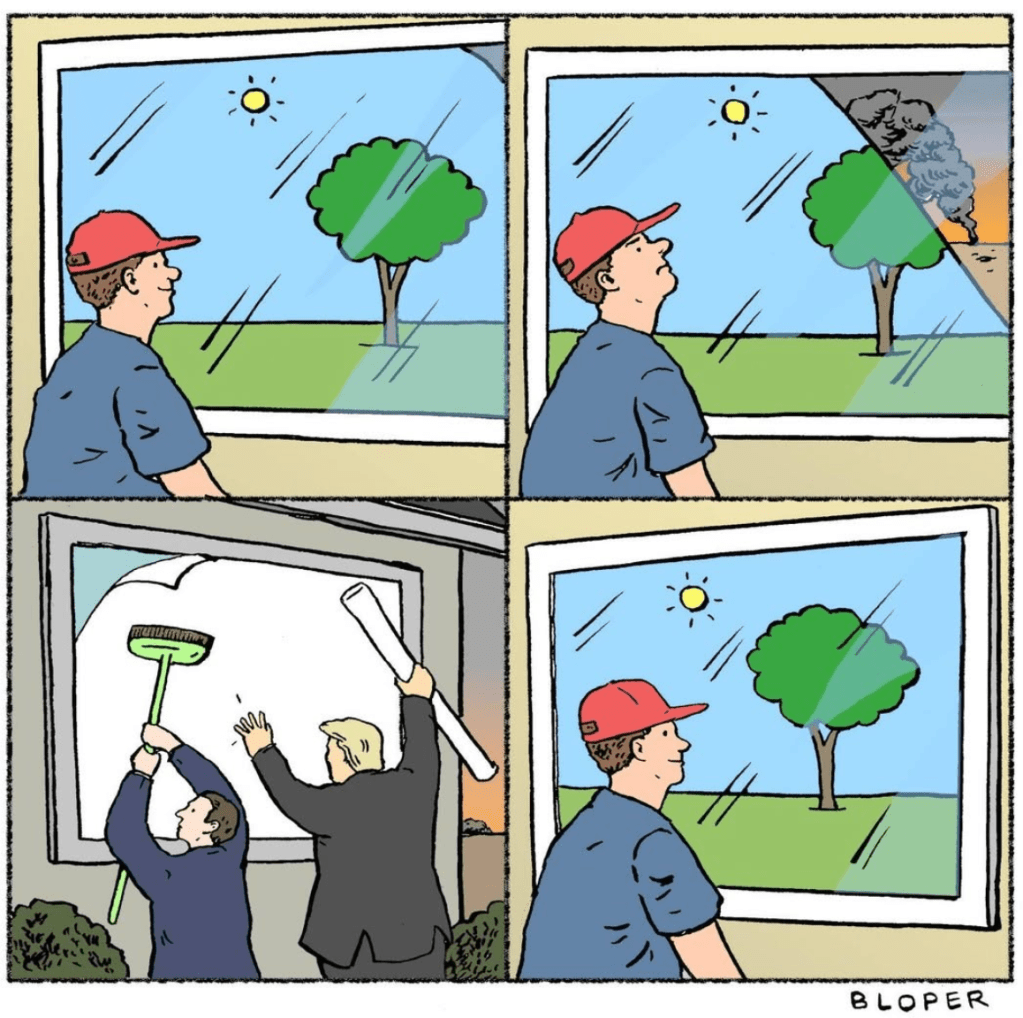
It seemed relevant.
 mcraeblog