Hmm well I seem to have a different sort of audience. Mature perhaps? Out of the TikTok Zone? Or just prepared to put in the hard yards after a big preseason? 386 people had pressed the button to view (or more correctly the button to view had been pressed that many times, but also by a lot of different people) 16 hours after I posted ‘Flooding the Zone’. For me, that’s viral. 42 of them were in America where I can confidently guess at only two of their names. So, good I guess.
Hmm I wrote that yesterday. Today something more dramatic has happened. Another 494 people have opened the blog with very large representations from Germany and the US. I am surprised about that. Oh well, good. I suppose. [There were two more days like that and then a taper.]
Just before we get too much further I want to make an important correction.
The blog initially asserted that this video at left has been viewed 3 million times. The eagle-eyed Mr Findlay spotted that it had actually been viewed 40 million times. He claims that only half of them were him. (A claim that might be disputed by John Cook, or perhaps he’s happy to acknowledge just the other half were him!)
• • • • • • • •
I have said before that very few people leave comments. But they do send me emails which I very much appreciate. It’s keeping in touch. And they also say a lot of interesting things.
I would like to refine a couple of things before turning to a larger question.
• I want to dispense with the idea that I’m an old fart banging on about my distress concerning what the kids are up to these days. Do I really need to? Maybe not. However … I’m happy to be an old fart, but what I am writing about is a subject in which I am an active and very willing participant. It is a subject with a fat discourse which grows by the day, and of sufficient moment for social media manipulation and regulation to be under consideration right now by governments in many countries including this one. (See below.) Even if it only deeply affects, as I suggest and acknowledge, only a minority of the population, it’s a matter of concern for everyone.
• And for my own satisfaction, of course not all manufactured food is bad for you. Pasteurising milk, for example, meant one of the great leaps forward in public health. Cooking could be considered a process of manufacture. Then there’s milk chocolate bullets … great. However, hyper processing is different and some processes in particular are difficult to justify.
If you want to chase up more about hyper processed food you could read this excellent article. If you do you will find out that:
in the UK 61 percent of 2 to 5 year-olds energy intake comes from hyper processed foods, even more than in the US;
these kids are increasingly rejecting any food with texture that differs from puree. One result of which is a higher level of tooth decay, another is speech delay because the muscles required for chewing are the same as those required for forming sounds;
one baby food pouch can contain four teaspoons of sugar
parents commonly believe that these hyper processed foods are ‘healthier’ than alternatives.
• For the Netflix fans: On Netflix you can find some excellent and challenging entertainment produced by smart young things, children of the millennium. Stranger Things was not to my taste but it was to a lot of other people’s. Squid Game had to watched with sub titles and thus was not conducive to random auditing. Severance, another hit, demands committed attention. Succession, Slow Horses and the first two series of White Lotus are among the finest television fiction ever made and were made available via streaming services HBO, Apple+TV and Binge respectively. Maybe the best and most taxing of the lot, Adolescence, was produced by and made available via Netflix, and among the many things it is about are the dangers and depradations of social media!
But my point in the blog was about the nature of a particular process, a series of processes really, developed and employed by Netflix to tailor content to the preferences of its audience and, it would seem to me, by knocking off a lot of worthwhile edges.
It is not alone in this regard. There could be a horde of examples but Spotify provides one precisely made to order. (Spotify being the world’s leading music streamer with over 30 percent of total volume.)
In her book Mood Machine: The Rise of Spotify and the Costs of the Perfect Playlist Liz Pelly describes how, in 2016 under pressure from investors, ‘Spotify’s internal research showed that many users were not coming to the platform to listen to specific artists or albums; they just needed something to serve as a soundtrack for their days, like a study playlist or maybe a dinner soundtrack. In the lean-back listening environment that streaming had helped champion, listeners often weren’t even aware of what song or artist they were hearing. As a result, the thinking seemed to be: Why pay full-price royalties if users were only half listening? It was likely from this reasoning that the Perfect Fit Content programming was created.… The message that quickly filtered through to artists was that the more beige your sound, the more likely it was to find a place on a Spotify playlist and earn some cash. Hence the rise of a homogeneous genre dubbed “Spotifycore”, which you’ve doubtless heard even if the term seems unfamiliar. It’s a bit ambient, a bit electronic, a bit folky, a bit indie, a nonspecific wish-wash possessed only of a vague wistfulness.’
Spotify-associated companies have churned out and loaded millions of hours of this ‘music’, also described as ‘aural wallpaper’, sometimes created with Ai and pushed by the company’s algorithms to a dominant position on Spotify playlists. Six months ago CEO Daniel Ek — who is Swedish; being an arsehole is not confined to any particular nationality — tweeted that ‘creating content costs Spotify close to zero.’ Pelly correctly claims that Spotify is not in the music business; it’s a technology enterprise.
• While you can talk about body image controversies and doing silly things which are dangerous, a fair bit of what’s on You Tube Shorts, TikTok and other short form video media is harmless. But if you spend two or three hours a day with eyes and brain glued to its content you can expect a negative result. Not all users do this. Some do. As Victor pointed out in his response, some people, at least initially, also choose to use crack cocaine. Or for that matter SportsBet. There aren’t enough of them however, and certainly enough of them with a political agenda, to elect a government.
• I am genuinely in awe of the cleverness of much of what I’m writing about. It represents apex thinking on top of mountains of research a lot of which may well have been conducted by people who had the best possible motives and aspirations.
In February 2012 Mark Zuckerberg wrote a letter to prospective investors in which, inter alia, he suggested: ‘Today, our society has reached another tipping point. Facebook hopes to rewire the way people spread and consume information … by giving them the power to share. … People sharing more — even if just with their close friends or families — creates a more open culture and leads to a better understanding of the lives and perspectives of others. We believe that this creates a greater number of stronger relationships between people, and that it helps people get exposed to a greater number of diverse perspectives.’
As it turns out, that and a few other things as well. As Jerry Seinfeld said, ‘There is no such thing as fun for all the family.’ Everything comes as a package.
Careless People: A Cautionary Tale of Power, Greed, and Lost Idealism by former senior Facebook employee Sarah Wynn-Williams (a book which should really be read asap) contains a four-page description of the way in which Facebook and other social media were used to get Trump elected in 2016. This is some of that.
‘Trump’s campaign [for which Facebook provided a number of its most skilled personnel] amassed a database … of over 220 million people… It charted all sorts of online and offline behaviour: gun registration, voter registration, credit card and shopping histories, websites visited, what car they drive, where they live and the last time they voted. The campaign used Facebook’s “Custom Audiences from Custom Lists” to match people in that database with their Facebook profiles. … Then they’d pair their targeting strategy with data from their message testing, so people likely to respond to “build a wall” got that sort of message. … At any given moment, the campaign had tens of thousands of ads in play, and by the time they were donemillions of different ad variations. … Many of these ads contained inflammatory misinformation that drove up engagement and drove down the price of advertising as these ads were shared among like-minded people.
A propos of this, Robert W reminded me of the nature and influence of Milton Friedman’s doctrine:A company has no social responsibility to the public or society; its only responsibility is to its shareholders.
Apocalypse now? Or soon anyway?
After they finished reading the blog Andy reports that he and Ruth said as one (which would be unusual), ‘We’re fucked!’
Any construction, like a blog say, entails selection of emphasis and detail. I might be just as guilty as the people I’m talking about in the blog of engendering panic, distress and anger. A perpetrator as well as a victim! Eeeeeeeeeeee …
I haven’t tried to dampen things down, nor have I tried to ramp them up. I was predominantly interested in seeing how far the hyper processed/ hyper palatability notions could be pursued when applied to social media, and I think the answer is a very long way indeed — and the more evidence I collect, like the Spotify example above, the more certain I become of their pertinence. Sarah Wynn-Williams’ book is an extended and highly detailed dissertation on my thesis.
But I go outside and the sky hasn’t fallen in. The fruit in IGA is much as ever. They are selling eggs, expensive sure, but there are eggs there. Do I have a problem with too much immersion in news media? Maybe. Not enough to do? An inadequate number of suitable distractions? Hmmm … If I went to America what would I find? Things chugging along happily with hardly any recognition that the country had a new President, you know, all much the same as ever, 350 million people in a settled state. Nothing like what is being portrayed in the sorts of things I read. (On the other hand, maybe not. Yesterday was Liberation Day, and not so good for Lesotho, or Heard Island. Yeah, maybe not.)
Terrible things have happened in the past. These issues are pretty low key compared to 1938-50 in Europe say, or the plague that nearly completely eliminated the population of Central Asia in the 14th century, or the ice age which began with the volcanic eruption of 536. And from a more contemporary perspective, is this worse than what might happen as a result of climate change? (Just incidentally, one of the terrible things that Trump and his boys have done is to stop the work of the National Oceanic and Atmospheric Administration which, with the UK’s University of East Anglia, has been by far the world’s most important source of climate information.)
And even if it seems bad, how should we react? Wait and see what if anything happens? Wait till we’re personally affected? Limit our kids’ screen time? Ban functions of Insta or Facebook? Or, recognising how madly unpopular (and probably impossible) this would be, just block the lot? Or hunker down and keep our heads low waiting it out?
This isn’t the first time anybody has thought about this. As recounted in Careless People, Facebook’s entry to China is a case study of this process, a story of uncertain steps and the chilling commercial impulses which resulted in the ceding of control over Facebook’s data and ‘privacy’ to the Chinese Government. But the message, hardly ever heard in the West: you can make the tech bros bend to your wishes if you choose to.
The popular target seems to have shifted to the impact on children and adolescents, something all adults who don’t work for techo companies might agree about. (Altho I note the number of tech company bosses who strictly regulate their children’s screen time and social media usage.)
• • • • • • • •
On the 3rd December last year legislation was rammed through the final sitting of the Australian Parliament (for the year), supported by both government and opposition, setting a minimum age limit for the use of social media platforms Snapchat, TikTok, Facebook, Instagram and X. The Online Safety Amendment (Social Media Minimum Age) Bill 2024 requires ‘age-restricted social media platforms’ to take reasonable steps to prevent Australians under 16 years from having accounts on their platforms. Social media platforms operating in Australia have 12 months to develop and roll out systems to enforce the age restrictions, which are expected to be in place by the end of 2025.
The platforms will be subject to penalties ‘to a maximum of 150,000 penalty units (currently equivalent to AU$49.5 million) for a breach of the minimum age obligation by corporate actors, and for breaches of industry codes and standards, to reflect the seriousness of the contravention, consistent with community expectations.’ So there.
But I fear that could be just bouncing up and down on the high board without really looking at what’s in the pool, or whether there’s a pool there at all.
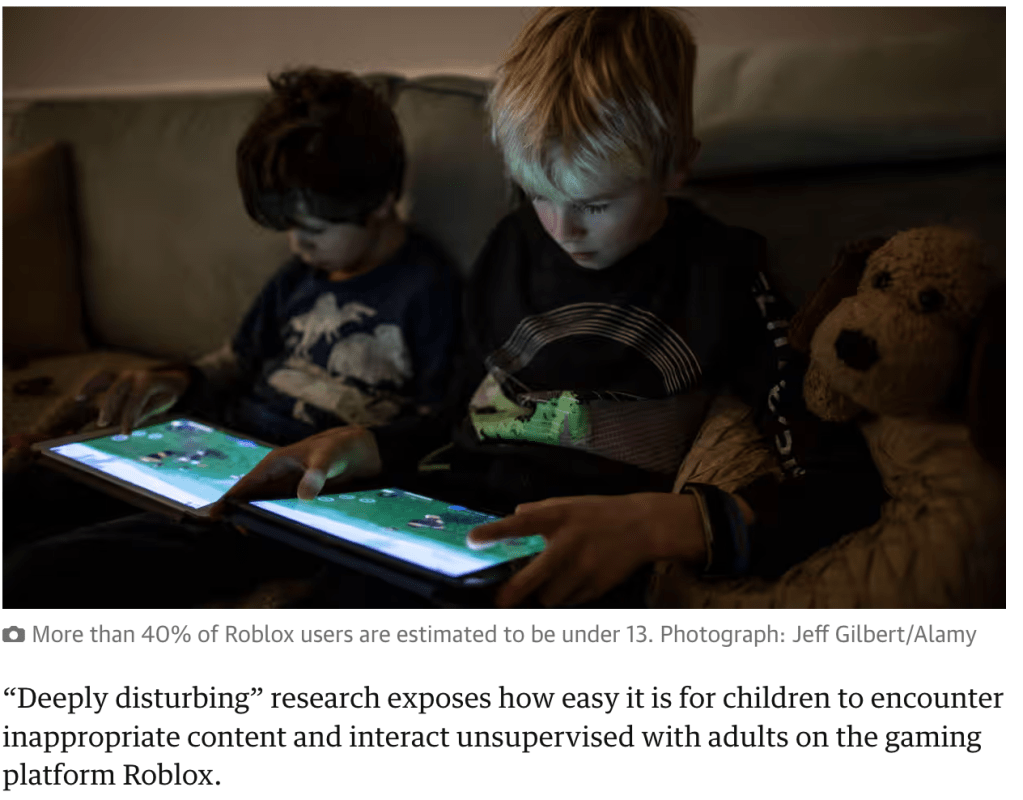
There is the matter of the targeted platforms (Snapchat, TikTok, Facebook, Instagram and X). They’re the big ones but all of them have multiple forms and are constantly changing and adapting to whatever is popular. Where’s YouTube and YouTube Shorts? Or is that ameliorated because of the existence of YouTube Kids? How about Reddit, Quora, Threads, and Tumblr one of the most popular sites in the UK among adolescents onto which until recently you could load porn in almost any form. You can’t any more, only nudity; but then there are the myriad other sites which are not ‘age restricted’. Roblox was supposed to be for kids, but look what’s happened here and here.
Next there is the small matter of establishing the age of users.
Five to ten years ago the big issues were maintaining young (and older) users’ privacy and security. There is a monster flip involved here to providing enough personal data to establish and confirm age and allowing the companies to collect and store that data. EXCEPT the legislation requires ‘the destruction of information following its use.’ It does seem a lot like wishful thinking. If you say something it will come true: the sine qua non of Trump-ism.
In their submission to Judge Robert French’s recent and relatively thorough investigation into legislating about kids and social media for the South Australian Government, the tech companies noted: ‘The hard fact is that there is no error free means of determination of the age of users of an account. The antagonists are the users themselves: current age verification is extremely easy to get around by lying about your age.’
Age verification that relies on personal information for ID has a low success rate and is too easy to avoid and generates all sorts of privacy issues. Age verification that relies on facial recognition technology is too often inaccurate to be of much use. (‘Such technologies can create barriers to inclusion as they may not perform well for some skin tones, genders or those with physical differences.’) Meta, remarkably and without complete confidence, uses Ai to flag users under the age limit based on their behaviour on the app.
For these reasons and others, the platforms vigorously assert that age verification should occur at the point of purchase via app stores. You might consider that as kicking the can well back up the road. We might conclude that they really really really don’t want to be responsible for user age verification. But you might also wonder just how effective that would be. Age verification would still be required.
French’s conclusion was as follows: ‘Whatever regime is established by the South Australian Government, it will not be perfect. Effecting compliance across the industry will be challenging. Compliance will require age assurance measures, location measures [in this instance re living in SA] and, where applicable, verification of parental consent. Enforcement measures may be complicated by the fact that many providers are companies which are located outside Australia. The legislation would apply to existing as well as prospective users of social media services. There will undoubtedly be workarounds by knowledgeable child users. However, the perfect should not be the enemy of the good.
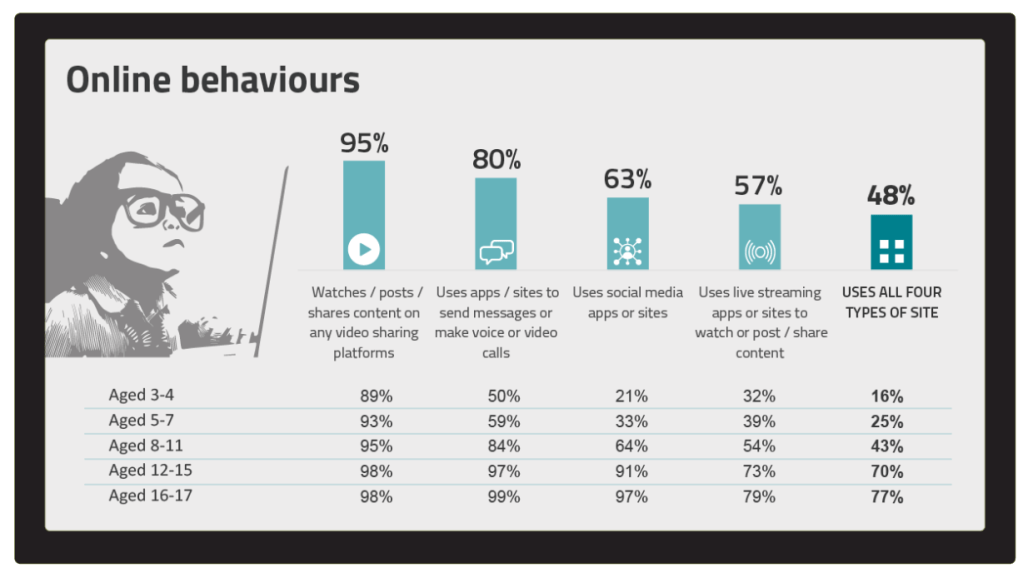
In 2019, efforts were made to make the UK ‘the safest place in the world to be online’ via the Online Harms White Paper. Social media firms were to abide by ‘mandatory duty of care’ to protect users and would face heavy fines if they failed to deliver. A new independent regulator was to be introduced to ensure companies met their responsibilities. One practical step was to ban under 13s from use of social media. But Theresa May was Prime Minister and it was the Tory Government in its very last throes of attempted competence, and it didn’t work as data drawn from a subsequent (2022) UK investigation shows.
You might take note of the online behaviour of 3-7 year olds (in the UK) in 2022. These data also indicate that 17% of UK 3 year-olds had their own phone. You can read OfCom’s most recent report here.
Denmark has led the EU in thinking about and action on these issues recently suggesting that no under 13s should have a phone or tablet and that these devices should in any case be banned from all primary and junior secondary schools and after school clubs.
You might be thinking, yes, hoorah. However, while finding that spending longer on phones and social media in general was unequivocably linked to lower grades, poorer patterns of sleep, disruptive behaviour and a lack of exercise, researchers from the University of Birmingham also found that these outcomes did not differ between students in schools that banned phones and those that did not. The study, published in the Lancet’s Regional Health Europe journal, also found that attempts to restrict phone use at school did not lower the overall time children spent on their devices throughout the day.
The report of this type I have found most useful is the U.S. Surgeon General’s Advisory Social Media and Youth Mental Health (2023, pre-Trump). Crisp, clear, comprehensive, all the characteristics of the best American research and thinking, it begins:
‘Social media use by youth is nearly universal. Up to 95% of youth ages 13–17 report using a social media platform, with more than a third saying they use social media “almost constantly.” Although age 13 is commonly the required minimum age used by social media platforms in the U.S., nearly 40% of children ages 8–12 use social media.’ (See for comparison the UK figures cited above.)
It is unequivocal about their perceived value:
‘A majority of adolescents report that social media helps them feel more accepted (58%), like they have people who can support them through tough times (67%), like they have a place to show their creative side (71%), and more connected to what’s going on in their friends’ lives (80%).’
And pins down the actual issues:
‘Social media platforms are usually designed to maximize user engagement, which has the potential to encourage excessive use and behavioral dysregulation. Push notifications, autoplay, infinite scroll, quantifying and displaying popularity (i.e., ‘likes’), and algorithms that leverage user data to serve content recommendations are some examples of these features that maximize engagement.
‘Some researchers have shown that social media exposure can overstimulate the reward center in the brain and, when the stimulation becomes excessive, can trigger pathways comparable to addiction. Other studies have shown that people with frequent and problematic social media use can experience changes in brain structure similar to changes seen in individuals with substance use or gambling addictions.
‘A longitudinal cohort study of U.S. adolescents aged 12–15 (n=6,595) that adjusted for baseline mental health status found that adolescents who spent more than 3 hours per day on social media faced double the risk of experiencing poor mental health outcomes including symptoms of depression and anxiety. According to a survey of 8th and 10th graders, the average time spent on social media is 3.5 hours per day, 1-in-4 spend 5+ hours per day and 1-in-7 spend 7+ hours per day on social media.’
Robert French hoped that ‘One non-legal beneficial effect of the law may be to arm parents with the proposition that it is the law not them that restricts access to social media for children in South Australia.’ And for some kids and their families he may well be right. It would seem that a whole arsenal of weapons might be required to take on this issue.
It runs up against the free speech issue of course and the selective notion of liberation that is evolving so quickly, the one that goes ‘I should be allowed to do anything I like, but as for you …’. This is the constant Musk response and why he claims he bought Twitter to free it from the ‘woke’ interference of fact checking misinformation and removal of egregious posting. ‘Government censorship of speech is intolerable in a free society.”
This takes us into complex territory. What sort of controls are socially desirable or acceptable? Think smoking; think gambling; think nonsense cures which might make you more sick. One line of argument here goes you let people do what they like until they incur a shared social cost, like that of health care, and then you have a fair basis for intervention. But there will still be argument, and resistance. This is not unlike the tension in a democracy between the rule of experts and having a country which ostensibly is under the control of The People and their wishes. Then you think about the diet of what The People may have been fed and how assiduously it has been tailored not just not their wishes but to pleasure centres of which they might be quite unconscious.
I don’t have a solution. There are people who do and some of them seem worth listening to. A great deal of the related advice on the internet is about managing personal behaviour and addiction, but that obviously veers away from the source of the problem. There are things that could be done. The list of things above in the Surgeon General’s Advisory that begins ‘push notifications’ could be regulated. An interesting idea mooted in the UK was to show all kids Adolescence and try to get them to think about it. But this territory is just so unchartered.
When I get glum I think of seat-belt legislation, an unarguable infringement of personal freedom but at the same time an unarguable good. Instituted. Sustained. Effective. Cause: Effect. When things shake down and when the requisite number of cataclysmic things have happened something brainy like that might be employed. I hope so.
Donald Trump won the 2024 Presidential election with 77,284,118 votes, 2,284,952 more than his opponent. 63.9% of eligible voters voted, round about the average. From this distance and vantage point you can only wonder why any of those 77+ million votes were cast for a convicted felon, a bankrupt, a corrupt fraud, a vulgarian and, not least, for a vengeful, cruel, shameless and erratic old man. What were they thinking?
There are many explanations for why Trump won: Biden hanging on too long, poor campaign, wrong candidate, general distrust of government, a mood for disruption, and anyway he didn’t win by that much. All true no doubt. But it seemed to provide evidence of something more fundamental which is occurring. What were they thinking? Perhaps they weren’t thinking at all. Perhaps something had shifted in their consciousness. The need for entertainment had become much more pressing than any concern for governance.
What follows is inevitably conjectural. Not everyone is addicted to hyper processed food, not everyone pursues life as a TV show, not everyone watches the slurry on Netflix, not everyone spends all day on Tik Tok, not all students have AI write their essays.
But a lot of people do; and these things and their multitudinous like inevitably have an impact, a powerful impact, the most powerful impact that our ingenuity can manufacture … a shift driven by mountains of money heedless of consequences and well out of sight of regulation — because it’s just what happens these days. And I guess that’s the issue.
It was Steve Bannon that got me wondering.
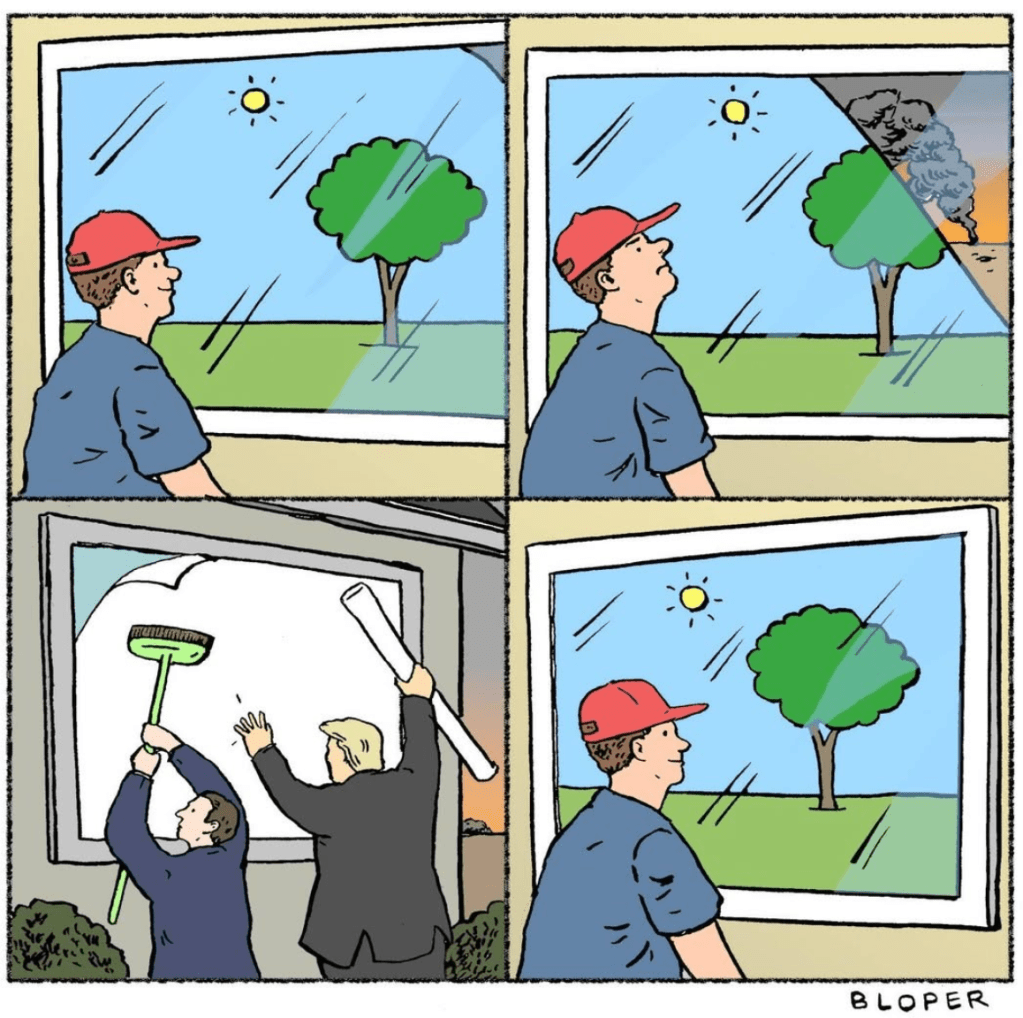
“The Democrats don’t matter,” he told writer Michael Lewis [as long ago as 2017]. “The real opposition is the media. And the way to deal with them is to flood the zone with shit.”
• • • • • • • • •
Life as Bliss Point
And then we recently watched a show from SBS On Demand called ‘Irresistible: Why we can’t stop eating’. It is about ultra-processed food and its increasing prominence in diets world-wide.
Ultra-processed food is made by manufacturing companies. The top ten world-wide are Nestlé, PepsiCo, Coca Cola, Unilever, Tyson Foods, Kraft Heinz, Mondelez International, Conagra, Campbell Soup and General Mills, all but two of which are based in the US. Collectively these ten — there are many many more — had an annual turnover in 2023 of $US4.668 trillion (if a trillion is 1000 billion) and a world-wide reach. They are particularly active in Africa.
And what is it? It is often a slurry of cereal (rice, soy, wheat, corn) and/ or modified dairy products (whey permeate for example) with additives which allow it to taste, feel, smell, and SOUND (say ‘snap’ ‘crackle’ and ‘pop’) like something you’d really really want to eat. It can be baked, grilled, puffed, breaded, sauced, and reproduced endlessly. It can be frozen, reheated, micro-waved, deep fried. It can be made to look simply amazing and our supermarket shelves are full of it … bright, exciting, attention-grabbing.
And we buy it. And you buy it. And we all buy it. Not necessarily in large quantities, but when we’re in a hurry and blah blah blah. It’s just convenient. But there are some people, a growing number here as well as in the US, who buy it far more frequently and for whom it has become a staple food source.
Why would you want ultra-processed food?
A lemon cake you cook yourself with standard ingredients might cost you $4.60. It will have a shelf life of a few days. The same item produced in this different way, to all intents and purposes looking and tasting the same, will cost 40c and last for anything up to two or three months. I’m running a shop; what am I going to go for?
Vegetables and fruit especially have a short life once picked, they’re expensive to transport and relatively difficult to process. If I can offer you two lots of powder which will make yoghurt taste like it has got actual strawberries in it and some modified starch which will give it a delicious creamy feel on the tongue and some strings of colouring that seem like fruit traces, are you going to say no?
This process and its component additives have been okayed by regulators. (Well, self-regulators anyway.) As required by law the ingredients are listed on the packet. And of course all food consists of chemicals one way or another.
However as well as being ultra processed, these foods are made to be hyper palatable. They often combine fat and sugar in ways not found in nature which draw immediate and sizeable responses from the reward centres in the brain which say ‘I would like more of that and pretty much straight away’. They are often made soft so that they can be eaten quickly (or crunchy but dissolve close to instantly in your mouth. Think Cheezels, Twisties) with two results: you want some more because of the impact on your reward centres; your body doesn’t have time to produce its standard response that you’re no longer hungry and don’t need any more food.
This is compounded by encouraging the idea of eating as grazing. You eat all day, not just at mealtimes, to keep your energy up through that blast of sugar. You need a Snickers now. ‘You’re not you when you’re hungry’; ‘A Mars a day helps you work, rest and play.’
But we’re not just talking about junk food or fast food or snacks. Any food you buy in a box — apple pies, fish fingers, frozen pizza, frozen roast dinners — is likely to have been manufactured in an interesting and sophisticated way.
These foods have been around for a long time. American supermarkets began stocking them in the 1950s. But the industry really took off in the 1970s not least because of Howard Moskowitz’s work. He believed in, and established in practical form, the idea of the ‘Bliss Point’.
“The Bliss Point for salt, sugar, or fat is a range within which perception is that there is neither too much nor too little, but the ‘just right’ amount of saltiness, sweetness, or richness. The human body has evolved to favour foods delivering these tastes: the brain responds with a ‘reward’ in the form of a jolt of endorphins, remembers what was done to get that reward, and makes us want to do it again.”
Moskowitz’s ideas took firm hold. They were later validated by MRI brain scans during some of which people ate various forms of chocolate ice cream which caused the orbitofrontal cortex, the ‘pleasure centre’, to ‘glow like a furnace’.
If there is a way of optimising food in that way, making it cheaper, more durable, tasty and attractive, food that people really want, what’s the issue? It sells. People are happy. Some make money.
The ’70s were also the time when the rates of obesity and its consequences began soaring in the US, more than doubling in 10 years. Some of the consequences of a diet heavily skewed to ultra processed food include higher rates of a variety of forms of cancer, cardiac disease, cardiovascular disease, hypertension, sleep disorder and, very commonly, Type 2 diabetes. You die earlier.
[Digression: Two adjacent Googled questions. 1) ‘Are Cheezels baked or fried?’ ‘Baked to crispy, crunchy perfection and smothered with deliciously cheesy flavor. Pop them on your fingers and eat them one-by-one for some finger luscious fun. Cheezels are a popular party snack for children.’ [And yes of course they are. That’s a key part of the deal. Train ’em up.] 2) ‘Are Cheezels healthy?’ ‘No, Cheezels are not healthy. They are high in fat, calories, salt, and saturated fat, and low in fibre and protein. They also contain high levels of artificial flavouring, colouring, and MSG.’ ]
You know the solution to these problems. Buy fresh food. Cook it yourself. That’s relevant but not why we’re here.
• • • • • • • • •
There are two things I want to point out. Firstly, how ingenious to be able to pull flavours apart and reconstitute them artificially. Brilliant. Astonishing. There is no end to human ingenuity. Secondly, this process has been driven by commerce rather than any wish to improve, or with much concern for, the quality of human and other life. $US4.668 trillion remember? That’s a lot of Doritos, and a lot of people eating them.
But that’s not the mission either. It’s more in this ballpark.
The current Vice President of the United States is having an angry debate with some of the Catholic bishops of America. ‘Speaking with Fox’s Sean Hannity, Vance suggested that efforts to provide charity to immigrants, which are favored by “the far left”, contradict Catholic teaching. “There’s a very old school — and I think it’s a very Christian concept, by the way — that you love your family and then you love your neighbor, and then you love your community, and then you love your fellow-citizens in your own country, and then after that you might consider the rest of the world.” He was apparently referring to St Thomas Aquinas’s idea of “ordered love,” or ordo amoris, set out in the “Summa Theologica” — an immense work, foundational to Catholic thought, that Aquinas left unfinished at his death in 1274. This is at odds, he suggested, with Americans’ care for immigrants.” (Paul Elie Vance brawls with bishops New Yorker 11/2/25). Vance isn’t just a hillbilly. He has law degree from Yale. Under the new dispensation he can propose fearlessly that selfishness is a fundamental tenet of Christianity.
James Martin, a Jesuit priest responded. ‘In its simplest terms, the apparent demise of #USAID is the result of the world’s richest man ending a program that helped millions of poor people. You don’t need a Ph.D. in moral theology to see why this is evil.‘
I think of Vance’s argument as something ultra processed. The second is simple fare, but food.
The mission is to think about what we’re currently feeding our brains, how that’s changing, and the contribution its consumption makes to the socio-political climate of which Trump is just one lurid peak.
• • • • • • • • •
Life as TV
What we consume shapes us, cognitively. What we do, and especially do repetitively, shapes us. Repetition, as every musician, dancer, scientist and dictator learns, trains the neural networks to make some thoughts and thought patterns more durable than others. They stick.
‘I strongly believe that the Gaza Strip, which has been a symbol of death and destruction for so many decades and so bad for the people anywhere near it, and especially those who live there and frankly who’s been really very unlucky. It’s been very unlucky. It’s been an unlucky place for a long time.
‘Being in its presence just has not been good and it should not go through a process of rebuilding and occupation by the same people that have really stood there and fought for it and lived there and died there and lived a miserable existence there. Instead, we should go to other countries of interest with humanitarian hearts, and there are many of them that want to do this. …
‘This can be paid for by neighbouring countries of great wealth. It could be one, two, three, four, five, seven, eight, 12. It could be numerous sites, or it could be one large site. But the people will be able to live in comfort and peace and we’ll make sure something really spectacular is done. …
‘The US will take over the Gaza Strip and we will do a job with it too. We’ll own it and be responsible for dismantling all of the dangerous unexploded bombs and other weapons on the site, level the site and get rid of the destroyed buildings, level it out. Create an economic development that will supply unlimited numbers of jobs and housing for the people of the area … do a real job, do something different.’ (D. Trump, press conference with Netanyahu, 5 Feb 2025)
Satirical clip made with AI, published privately then taken down by its creators, then reposted by Trump on his website ‘Truth Socials’ with an approving comment.
I know 78 year old men. I hang out with them. I’m in the ballpark of being one. I know they’re not 36 or 45 anymore. I know the way their thoughts aggregate, concentrate and lose range. I know that what they know is what they learnt some time ago. I know they become more absolute in those beliefs and less able to apply them to new contexts. I generalise, but Trump on Gaza is an almost perfect example of randomly reaching for the familiar in an utterly alien context.
He’s not a 4-D thinker, nor a master strategist, nor a diplomatic genius, nor a nonpareil deal maker. He’s an old man, a retired, and grasping, real estate developer and that is his default setting. I’m not sure he has many other settings.
Except one. He’s been a TV star.
He’s an entertainer. He knows how to attract and hold attention, and he’s learnt to forswear all shame, even the idea of it. ‘That’ll make great television,’ he muses out loud, as he sends Zelenskyy on his way and destroys the Western Alliance.
• • • • • • • • •
The man in front of you, it always seems to be a man, counts silently making large gestures with his fingers, … three, two, and in you walk. You’re on. Prompted by large flashing signs the audience — as one — welcomes you. As one. There are no naysayers here, no hecklers. The response is automatic, sustained, strong and warm. Basking in it and acknowledging it is the beginning of the show.
The show has a well-defined shape often according to a well-anticipated formula. It begins, it follows a scripted narrative arc, various anticipated things happen although there will be some sharp little shocks on the way to keep you watching. The characters will be drawn in heavy outline and act in predictable ways. Viewers can count on the routine comfort of catchphrases (‘You’re fired!’ ‘Drill baby, drill.’) and the prompt from a laugh or applause track to tell them how to feel. The formula, inviolate, will be worked through to a conclusion that will find the Bliss Point but which will leave you hungry for more.
The Apprentice, Trump’s show, survived on a certain amount of melodrama (contingent on Trump’s moods and unpredictability), glamour, and the underlying idea that your dreams, all of them, are achievable if you try hard enough. The show’s spectacle of suffering (another attraction to tune in for) came from people not trying hard enough and not being sufficiently obedient to the tenets of The Big Man. They were fired, and the audience roared for more.
It was a ‘reality’ show. It ran for 15 seasons, 2004-2017, all but one of which Trump hosted. That’s long enough for it to shape your understanding of how the world works, for it to become real in your mind. It was a reality show.
During his first Presidential stint, Trump played Trump as President. He made modest and sporadic efforts to do what Presidents do, to observe the protocols and conventions, to sometimes say and do appropriate things.
But in this second and so much darker series with so many more daily thrills he is playing Trump as himself, Trump as Roy Cohn trained him to be. He has mightily improved his script writers, the very best that the American Heritage Foundation can provide (through Project 2025). He has stocked his cabinet almost entirely with oddities who will guarantee attention, be utterly biddable and ‘look good’. ‘Trump understands, by instinct and through experience, that the line between entertainment and power in American life has effectively dissolved’ (Stephen Marche ‘America’s Cultural Revolution’ in The Atlantic 3/3/25).
As Megan Garber put it in the same journal (6/3): ‘In the context of history, this is an emergency. In the context of the show, however, it is simply one more twist in the story. Government by “reality,” like the TV genre, has no obligation to be factual. It has no obligation to be moral. It has no obligation to be anything at all. Wisdom, cruelty, accountability, democracy — in the bleak politics of “reality,” these things no longer exist. They can’t exist. Only one thing matters, as the show goes on: Is it great television?’ She could have added: And how is it playing with my audience?
You could see this as an unavoidable but chosen route to becoming hyper processed. How might an appetite for this sort of sustenance be constructed?
• • • • • • • • •
Life as Netflix
Including Vatican City and Palestine, there are 195 countries in the world. Netflix has subscribers in 190 of them, 283.2 million all up. Last year it generated $US33.7 billion in revenue, with a profit of $US5.4 billion. Those facts alone would make would make it worthy of attention. But it’s got more to tell us.
‘For a century, the business of running a Hollywood studio was straightforward. The more people watched films, the more money the studios made. With Netflix, however, audiences don’t pay for individual films. They pay a subscription to watch everything, and this has enabled a strange phenomenon to take root. Netflix’s movies don’t have to abide by any of the norms established over the history of cinema: they don’t have to be profitable, pretty, sexy, intelligent, funny, well-made, or anything else that pulls audiences into theatre seats. Netflix’s audiences watch from their homes, on couches, in beds, on public transportation, and on toilets. But most often they aren’t even watching.’
Genius or what!
The main source for this part of the story is an article by Will Tavlin in n+1. His primary interest is in showing how Netflix first ate up video stores, then dug its way into live broadcast television (especially as its streaming clones multiplied), then ‘brought Hollywood to the brink of irrelevance’ by shifting the ways movies get produced and distributed but, even more, changing the nature of what films are and what they might offer.
All that’s telling, but what interests me more are the remarkable parallels with the manufactured food story. Let’s talk hyper palatability.
The platform has an unimaginable amount of data about its subscribers. It knows what sorts of devices you watch on; which scenes you skip, pause, or rewind; and how long it takes you to abandon a show you don’t like or finish a season that you love. (These data created the option to ‘binge’.) It also has the capacity to know in granular detail what you and the other 283 million subscribers will watch.
Netflix now has about 17,000 or 19,000 items for you to watch, the vast majority Netflix Originals. (The figure is disputed. Netflix has only recently started releasing information about its operations.) But it doesn’t matter to you because you’ll never visit the labyrinthine chambers of its library. In an immediate and easy access process you will be served a selection of what it has been determined you will like. The algorithm, now with the assistance of AI, has spoken. You are in fact a member of one of approximately 2000 ‘taste groups’.
If you rely on subscriptions for your income as Netflix mostly does, you need to reduce ‘churn’, the rate at which customers cancel. So instead of acquiring films cheaply from independent film makers and out of date blockbusters, Netflix led the way in turning to safer, more uniform product that could be made in-house, and replicated and tailored to the tastes of their subscribers.
Tavlin talks about the Typical Netflix Movie. ‘The TNM covers every niche interest and identity category in existence, such as a movie about a tall girl, Tall Girl, but also Horse Girl, Skater Girl, Sweet Girl, Lost Girls, and Nice Girls. Seemingly optimized for search engines, the title of a TNM announces exactly what it is — hence a romantic comedy about a wine executive called A Perfect Pairing, or a murder mystery called Murder Mystery. … The characters’ dialogue is stilted, filled with overexplanation, clichés, and lingo no human would ever use.’
Netflix’s product is filled with overexplanation because the company has led the way in ‘second screen’ material, stuff you have on when you’re doing something else like knitting or cleaning the dining room or looking at your phone. There are some famous examples of this. One is from a shocker called Irish Wish. ‘We spent a day together’, Lindsay Lohan’s character tells her lover, James. ‘I admit it was a beautiful day filled with dramatic vistas and romantic rain, but that doesn’t give you the right to question my life choices. Tomorrow I’m marrying Paul Kennedy.’ ‘Fine,’ he responds. ‘That will be the last you see of me because after this job is over I’m off to Bolivia to photograph an endangered tree lizard.‘
This super-obviousness has newly infected mainstream cinema as though the makers and producers can no longer expect audiences, any audiences, to connect dots or to take time to make sense of more than trivial ideas. THIS is what’s happening the film shrieks, and we’ll not only show you but have a character say, ‘THIS is what’s happening.’ This comes into sharp relief somewhat startlingly when it doesn’t happen. We’ve just seen Francois Ozon’s new film Quand vient l’automne and it’s in the last few minutes or even after the film has finished when the light bulb goes on, and what a snakey startling light bulb moment it is. Fabulous. Because he respects his audience, he hasn’t been afraid to give it some cognitive work.
Then there’s one of my big beefs: the endless stuffing of landscape shots and plot reiteration to fill out the required eight hours for a series. If no one much is watching and no one at all is watching intently, economy and precision are not priority requirements.
Netflix has also discovered people don’t much like documentaries (unless they are about David Beckham or car racing). What do they like? ‘Grisly true crime, garish cult exposés, celebrity hagiography, sports and food miniseries, pop science, and pets.’ (Hey! Isn’t that what I used to see at the checkouts in supermarkets?) Yeah, that’s what we like.
Do I need to underline that the quest here is for hyper palatability, and that the consequence is hyper processed entertainment food in the service of making money from subscriptions that somehow you never remember to cancel?
Tavlin concludes: ‘Economists talk about so-called “zombie businesses”: companies that survive only because of the availability of cheap capital, who stagger along, refinancing debt, never failing — artificial, undead things. And I think about this concept when I look back at the tech world’s takeover of culture. That these business strategies, and this river of money diverted to bring them to fruition, created a sort of zombie discourse in our culture, one that appeared vital and real, and then — coincidentally or not, over the last few years — dissolved before our eyes.‘
And do I need to say just how ingenious to be able to pull aspects of film apart and reconstitute them quite directly according to data collected about the wishes of the audience down to the level of individual user preference, a process which itself would once have been deemed miraculous. Brilliant. Astonishing. There is no end to human ingenuity. Secondly, this process has been driven more by commerce than any wish to improve, or even with concern for, the quality of human and other life.
Soma: a drug that produces artificial happiness and keeps you at a perfect equilibrium between happiness and sadness. Aldous Huxley, 1984 (written in 1931) No news. But we’re so so much better at it now.
• • • • • • • • •
You also must have stimulation.
Life as Tik Tok
‘Pur’ = purchase. Yes really.
The US Government has had TikTok in its sights for years now on the basis that the Chinese Government is/was using it to gather data that will be useful from a security point of view (including from armed forces enlistment ads). Maybe. Who knows? (You can read the whole weird story here.) But one of the things that distinguishes TikTok from other social media platforms is the enormous amount of data that is made available about itself, its users, its product and especially its commercial impact.
Some things you may not know about TikTok.
TikTok has 1,925 billion users globally, with 190 million monthly active users in the United States. It is still only the fifth largest social media platform (Facebook/Meta has more than 3 billion users). The TikTok app has been downloaded 4.92 billion times world-wide.
There are 272 videos posted on Tik Tok every second, 16,000 videos posted every minute, 981,000 thousand videos posted every hour,34 million videos posted each day.
70% of its users for whom age data are collected are between 18 and 34. A vast unrecorded group, estimated to be 44% of all users, are under 16 attracted by exactly the things that younger people might be attracted by.
The slight majority of users (55%) are men. Men also access it considerably more frequently. (They’d like the pranks, men.)
At April 2024, India was the country with the largest TikTok audience, with almost 680 million users. Indonesia was second. The US was third with around 121.5 million users. Brazil was fourth. The Chinese version, Douyin, had 380 million users.
The average user opens the TikTok app 20+ times per day.
In the US, kids who are on TikTok spend an average of 113 minutes daily using it, which is slightly higher than the global average of 107 minutes. That time has doubled since 2019.
61% of TikTok users discover new brands and products on the platform. 92% of TikTok users take action following the content they see on TikTok (share, comment, follow, like, etc.).
In 2024, Khaby Lame, Senegalese-Italian influencer and the highest-paid content creator on the platform, made US$20 million through his posts on TikTok. He has over 162 million followers. He has never spoken in a post.
TikTok earned an estimated US$18.2 billion in 2024.
I’m not a user of TikTok but for the purpose of researching this story I have watched several hours of YouTube Shorts, (You can too: YouTube Shorts) to all intents and purposes the same thing. The Shorts are capped at a minute, shorter than the cap for TikTok, but have very much the same content.
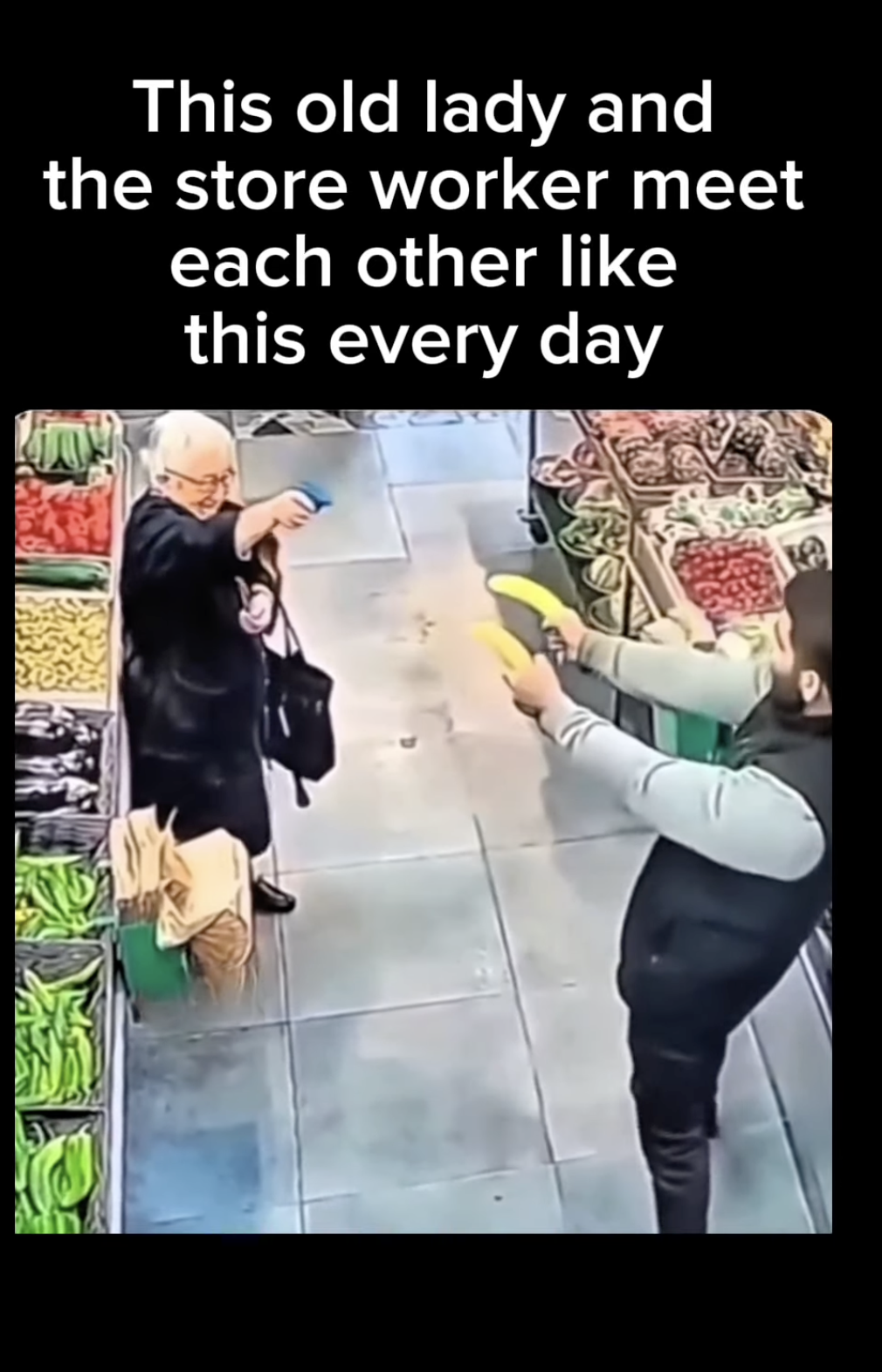
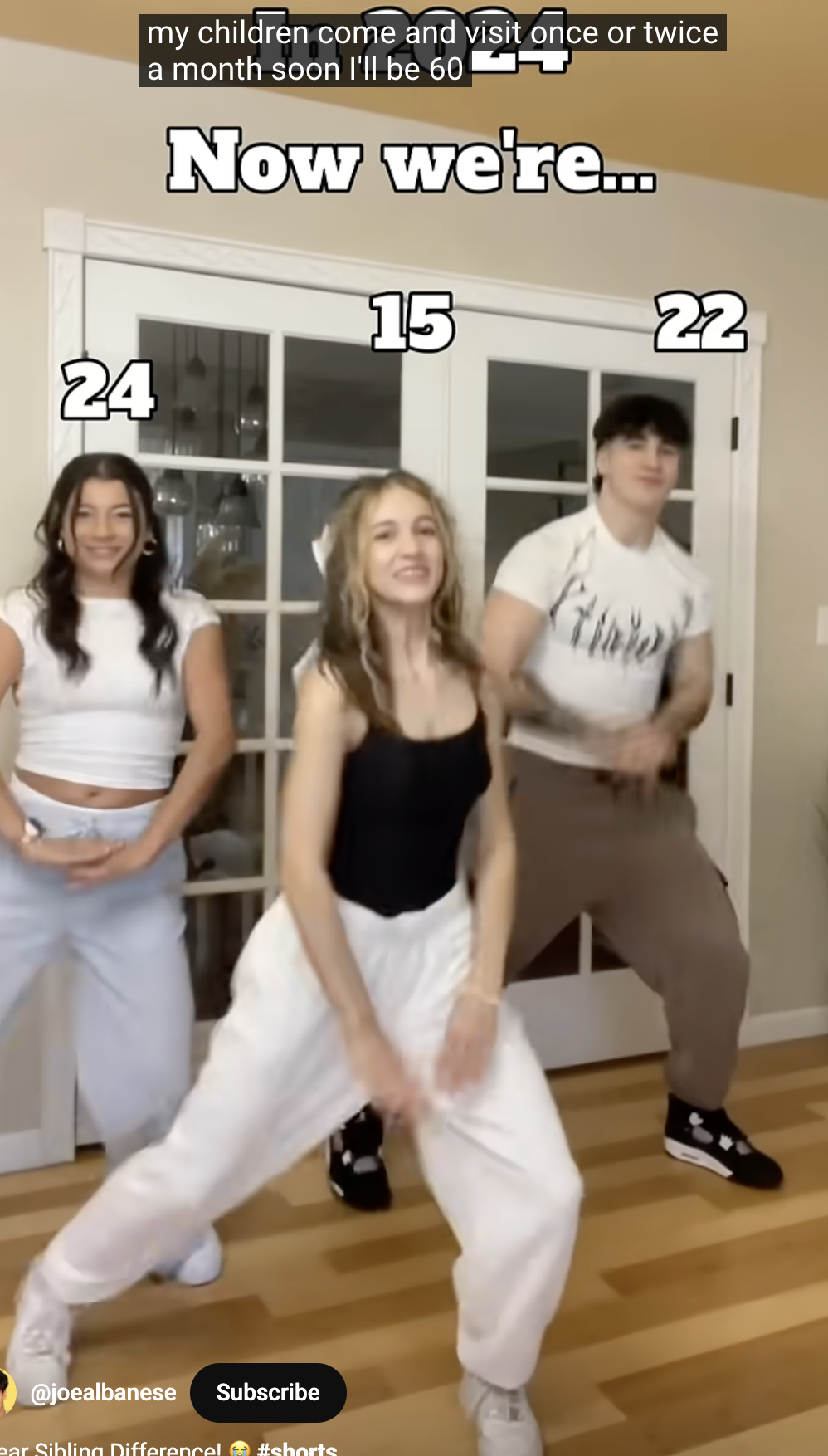
From the top left clockwise: crazy cute supermarket jokester; policeman asking arrested man why he’s so happy; car being chased by a cop car suddenly turns right in front of a truck, tricks cop car; family doing the same dance separated by six years; prone bloke throws a basketball the length of the court for an extraordinary goal, girlfriend doesn’t film it (irony: someone else is; kicker: girls are inattentive and stupid); set up so a stationary person on a platform is hit by the front window of a bus and travels through the entire body of the bus coming out unhurt. None of them should be missed.
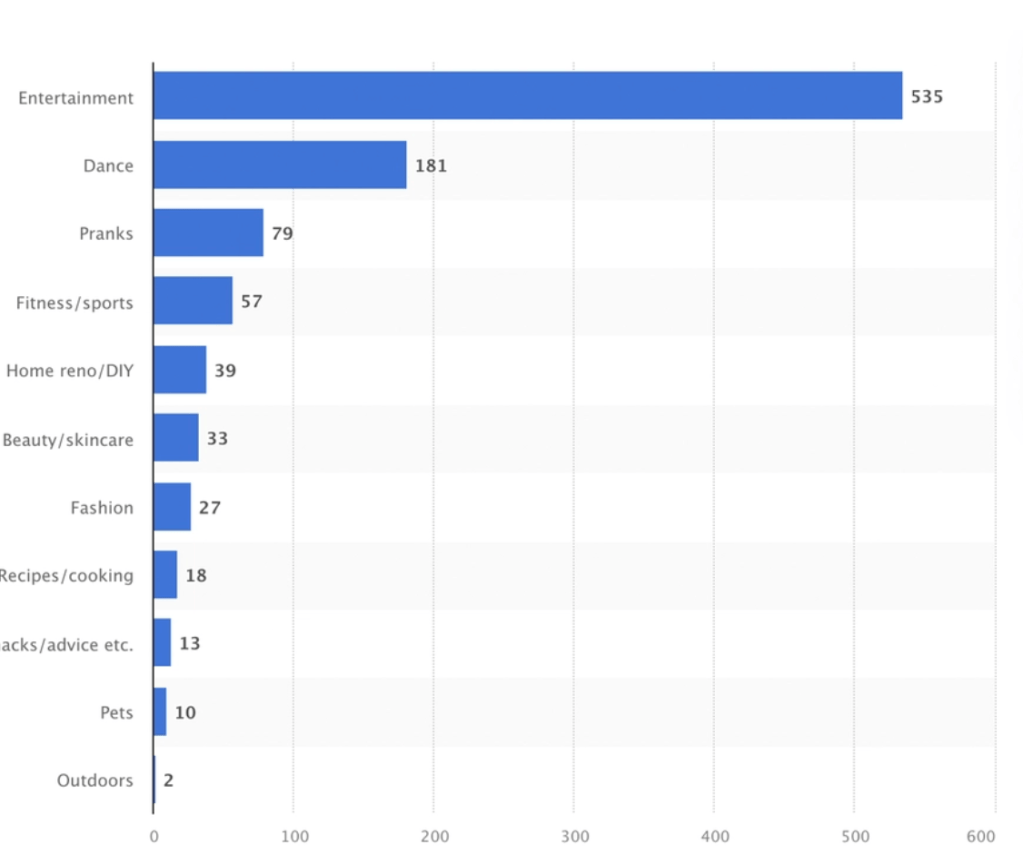
What is the content of those 34 million a day videos?
The numbers refer to the number of billion hashtag views. That’s also about what the proportions looked like to me. One in four or five is an ad very carefully integrated into the flow and style of the other offerings. It is worth noting that 82% of views of ‘Beauty/skincare’ posts result in a product purchase.
I seemed to get a lot of DIY. But in addition in about 1 in 12 cases the algorithm gives me Donald Trump doing or saying something stupid. I imagine that would come under ‘entertainment’. It would also however be generated by nothing I’m doing on YouTube but on the way the cookies embedded in the sites of the New Yorker, The Atlantic, the New York Times and various other platforms I frequent read my viewing preferences.
I am data on the internet. I have a shape. My appetite is known. I am being fed.
I could have been there for hours. I was. There was unrelenting supply. They’re short. They require very little concentration. Fundamental advice to constructors: ‘TikTok’s format encourages quick, engaging content, and videos around 7 seconds can be easily consumed and shared, making them more likely to capture attention quickly.’ Slurp. (Cheezels!!) They start big with an attention grabber and stay big with plenty of OMG! Did you see THAT moments. And what will the next one bring!?! They slide down like sandwiches made from Tip Top Supersoft White. They melt in your mind. You scarcely notice. It’s just that that roll of fat round your capacity to discriminate might be getting bigger, and the idea of cognitive load is becoming a distant, and rapidly evaporating, memory.
For when you’re making your own TikTok contributions here is a list of ‘5 steps proven in 2022 by a group of scientists to generate viral videos’ (ones with several hundred thousand views or more in a 24-48 hour period). They include: find out when your audience is tuned in and post at least four new videos a day (and not more than 10); use captions; use close ups not mid or long shots; shoot using the point of view of the viewer — probably all excellent ideas if that’s the mission you’re on.
But Number One is ‘Be Popular’. ‘Cultivating popularity is at the core of TikTok’s virality. Building a loyal following and establishing credibility within the TikTok community are key factors for success.’ That would probably be correct. I remember the popularity phenomenon from the early days of Facebook. ‘She wants to be my Friend? Who is she? At school? Really? That’s 30 years ago. Oh look here’s Roger. I thought he was dead. How many Friends have you got? I’ve got …’
Another strongly associated tip is to ‘Discover Your Niche’. ‘Social affiliation plays a crucial role in going TikTok viral. Humans are inherently social beings, driven by a desire to connect with others with similar interests.‘ And apparently, in a surprising number of cases, with a desire to hate anyone who doesn’t share them.
Because this list doesn’t contain some of the most important and well established ideas for going viral: Be Enraged. Be Outrageous. Farm Engagement. What A Joy It Is To Spread Conspiracy Theories. I’ll say anything, JUST GIVE ME YOUR ATTENTION. And this is not TikTok, which in this context appears utterly anodyne: it’s Musk’s Twitter/X, it’s Zuckerberg’s moderation-free Meta/Facebook, it’s 4chan where among other horrors you can actually watch libtards being violently assaulted and many million other websites, an enormous proportion of active sites.
And it’s Alex Jones claiming the Sandy Hook massacre of school children was a fake set-up.
Went viral with that one. 👍👏👍
On the 24th September 2012 on his website ‘Infowars’ Jones claimed that the shooting deaths of 20 primary-aged students and six of their teachers was a ‘giant hoax’ and ‘the fakest thing since the $3 bill.’ Daily revenues to the Infowars online store increased from $48,000 on Sept. 24 to more than $230,000 on Sept. 25. Total user sessions on the Infowars site increased from about 543,000 on Sept. 23 to about 1.8 million on Sept. 24. Success. (President-elect Donald Trump contributed a message of support at the time and promised not to let him down: ‘Alex has an amazing reputation.’) Relatives of the victims who have been harassed and threatened by Jones’ supporters (! can you believe that?!!) have not yet received one dollar of the eventual $85 million settlement which in any case would hardly make up for their loss. (I use this ageing example because the lawsuit it gave rise to provided relevant data and because of its particular egregiousness. If you want an example happening right now, well … look anywhere, but try Turtleboy.)
Hatred feeds on itself and spreads its targets. Suspicion is an appetite that is never fully sated. It’s emotion that counts. These media provide the (mostly anonymous) chance to rant. Publicly. The louder and weirder your rant, potentially, the bigger audience you will garner — and the more satisfied you will feel, the more endorphins will be released.
And that’s how you discover your niche, how you find out who your friends really are. This process will provide confirmation of what you already think cementing your views into the hardest concrete. (And this is so comprehensively established I need no references. Look up Confirmation Bias.)
I’ve got a friend who (like 38% of people who vote Republican in the US) thinks, believes, is supremely confident, that Barack Obama was born in Kenya. Obama’s birth certificate, which has been posted on the Internet, shows that he was delivered in Honolulu on August 4, 1961, at 7:24 P.M. Confirmation of these facts exists in the form of birth announcements that appeared in two Honolulu newspapers, the relevant pages of which have also been scanned and posted on the Web.
This became an issue during Obama’s Presidential campaign when a blog of a woman objecting to the possibility of his candidacy went viral. Obama’s campaign aides set up a website in response called Fight the Smears. On it, they posted a scan of his birth certificate. ‘Next time someone talks about Barack’s birth certificate, make sure they see this page,’ went the text.
Do the job? When those who had been ‘talking about’ Obama’s birth certificate looked at it on the Web, they found exactly what they thought they would. Some blogs noted that if the scan of the certificate was enlarged several times a light halo could be seen around each letter. The crosshatched border on the document did not seem to match the cross-hatching on another birth certificate issued in Hawaii around the same time. The scan did not show the raised seal required of an official state document.
‘The image is a horrible forgery,’ a self-described ‘forensic computer examiner’ calling himself Techdude declared in a blog on Atlas Shrugs. ‘Enough work has been done by photoshop experts to show that this is not a real document,’ ClearCase_guy asserted on the site Free Republic. “And that begs the question: WHY?‘ As indeed it does.
Apparently still operating under the assumption that people turn to the Web for information, the Obama campaign tried again. It allowed FactCheck.org, a nonpartisan research organization, to inspect the document at the campaign’s headquarters, in Chicago. ‘FactCheck.org staffers have now seen, touched, examined and photographed the original birth certificate,’ the group’s website announced on August 21, 2008. ‘Our conclusion: Obama was born in the U.S.A. just as he has always said.’ Nine high-resolution photos accompanied the post, showing the raised seal, as well as a set of creases.
‘I, for one, of course, am not surprised,’ JM Hanes wrote on the site JustOneMinute. ‘I mean he’s had more than two months to find a better forger.’ When, on October 31, 2008, Hawaii’s Director of Health, Chiyome Fukino, issued a statement saying that she had ‘personally seen and verified that the Hawaii State Department of Health has Sen. Obama’s original birth certificate on record,’ she was dismissed as a plant (today, probably, a ‘DEI hire’). (This story is derived from an article in the New Yorker by Elizabeth Kolbert. Further evidence for its fake news-ishness?)
Nor has any of this had the slightest effect on the view of my very highly educated friend. He is a bit shocked by my credulity.
There is virtually no opinion an individual can hold that is so untethered, so crazy, that he or she will not find other adherents on the internet. ‘Views that would ordinarily dissolve, simply because of an absence of social support, can be found in large numbers on the Internet, even if they are understood to be exotic, indefensible, or bizarre in most communities,’ Cass Sunstein, a legal scholar and distinguished public servant writes. (The American Medical Association estimates that more than 85% of internet posts on cancer contain inaccurate or misleading information.) ‘The most striking power provided by emerging technologies is the growing power of consumers to “filter” what they see.’
He suggests, with evidence, that certain tendencies of the human mind interact badly with certain features of modern technology, much as certain prescription drugs interact badly with alcohol.
That was 15 years ago. What appears to have happened is that in a phenomenally crowded field the nonsense and worse, much worse, content has increasingly been validated by being mainstreamed, among other ways, through ideas about ‘Freedom of Speech’. After all measles can be sorted through diet and Vitamin A.
And after all — have I said this? Are you still there? — it’s only ATTENTION that matters. (HEY!!! Did you just see what that cat did with the ping pong ball and the fire hydrant! Holy smokes.)
Oh attention and um … well, the bottom line. ‘The content of these websites does not reveal the machinery of influencing, the deals signed, the nondisclosure agreements reached, the metrics used to measure the dollar value of the audience’s emotional response. It can look like information while carrying very little or no meaning. As long as it generates emotion the owners of the medium do everything they can to stop you taking any action that would harm their economic interests.’ McMillam Cotton in the New York Times 9/2/25.
There are two things I want to point out. Firstly, how ingenious the operation of the internet is and how extraordinarily it has drawn on popular creativity and given everyone a voice. Brilliant. Astonishing. Incredibly positive. There is no end to human ingenuity. Secondly, this process has latterly been driven by commerce rather than any wish to improve, or with much concern for, the quality of human and other life.
[Addendum, from The Everything Market Insider: ‘We are all drowning in this massive content space with podcasts, videos, and articles, among others. This will increase exponentially with Gen AI playing across content creation to delivery. Users will gravitate towards content that resonates with their interests and needs, and the social platforms’ continuous evolution of algorithms to focus on user behaviour, engagement, and preferences underscores this trend.
‘However, many brands are still not taking an audience-centric approach to creating content. Brands are creating content based on what they want to publish. While there’s a place and value for brand-voice content, brands will need to diversify their content strategies and content mix. With the rise of AI-generated content, it is not about producing more content but also considering the right content that aligns with the brand messaging while appealing to the nuanced preferences of your audience, ensuring that your content intersects with their FYPs.’ (For Your Page, a much sought after TikTok advisory for what you’d like.)’]
Life as Feels: a subset
If you want to know what’s going on the world watch at least a few minutes.This video has had more than 40 million views. It goes for an hour. It is one of dozens created by this person. She is one of thousands of people doing this. The message: scrape a book, don’t read it.
From The Guardian, 3/3/25:
Visceral videos of people playing with slime or braiding hair soothe those who feel overwhelmed by in-person contact
‘Younger adults are increasingly overwhelmed by in-person interaction and soothing themselves instead with sensory online content, according to a report on the wildly popular online content known as ASMR.
‘ASMR – autonomous sensory meridian response – describes a particular sensory phenomenon that is triggered by specific sights or sounds, which usually begins with a tingling sensation across the scalp and results in feelings of deep calm and relaxation.
‘Platforms such as YouTube and TikTok are crammed with thousands of these visceral videos, in which ASMR creators play with squishy slime, role-play braiding the viewer’s hair, whisper loving affirmations or paint the camera lens with spit, all aimed at stimulating these “tingles”.
‘Now the award-winning behavioural insights agency Revealing Reality has published a landmark report on the phenomenon, interviewing viewers and creators of ASMR content and analysing thousands of videos based on common triggers – such as exaggerated whispering, breathing and mouth sounds, tapping and crinkling sounds, gentle or fluttering hand movements – which many people use to help them unwind and sleep.’
• • • • • • • • •
I can’t bring myself to write anything about this.
Life as AI
‘The proportion [of British tertiary students] using AI tools [to submit written work] surged from 66% in 2024 to 92% in 2025, meaning just 8% of students are not using AI, according to a report published by the Higher Education Policy Institute and Kortext, a digital etextbook provider.
‘Josh Freeman, the report’s author, said such dramatic changes in behaviour in just 12 months were almost unheard of, and warned: “Universities should take heed: generative AI is here to stay.”‘ ‘UK universities warned to ‘stress-test’ assessments as 92% of students use AI’ The Guardian 24/2/25
And what that means is that you have to learn how to use one of the AI apps, but that would be about it.
Not only will IT hyper process your diet, it will eat it for you too.
• • • • • • • • •• • • • • • • • •
Life as Something Else
I said Hurricane Dorian is going into Alabama, and I think it will. You can see the line. Alabama. Great State Alabama. Very good line, one of the best. Same sort of pen I use for my signature. A great signature … probably World’s Best.
In this story Trump is not the problem; he is a symptom. He was elected, albeit narrowly and with some voters at least expressing buyers’ remorse, because he was able to find a sufficiently large bloc of people living out their media lives, social and otherwise, as reality. He was perfectly tailored for this role, his shameless unfitness actually being a major drawcard. This is hyper processed food making itself hyper palatable at a scale difficult to imagine and with potentially dreadful consequences.
Alarmist? When radio was broadcast for the first time in the early 20th century there were critics who thought that it would generate confusion and hysteria. For the first time you could send unfettered material into people’s living rooms, a process which couldn’t be regulated or stopped. Then there were the issues with the advent of TV which I am old enough to remember. It would rot children’s minds. They would sit there in front of the idiot box (yes, the idiot box, you may remember) goggle-eyed, not do their homework, and go to bed with their head full of rubbish.
Is this situation different? Here are three reasons why it could be.
One is scale. It hardly needs saying just how big and diverse the social media phenomenon is, and how rapidly it is changing. In front of your eyes it expands in all sorts of directions and in ways you can’t anticipate. (TikTok, for example, began in 2016 but has only really been going bang for six years. Just wait for the impact of AI. You will not believe it.) And of course, although I’ve been focusing on the US, it is a world-wide phenomenon. From past work I remember that Indonesians are the heaviest users of social media in the world. You can find connection in the Brazilian rainforests and the Norwegian tundra, literally anywhere you’d like to look. And you can find the same sorts of things happening in Turkiye, Hungary, Indonesia, the Philippines, Brazil, East Germany, Holland, … and serious attempts going on to find that audience in Australia. (Not as developed yet Dutts. It will be.)
A second reason is the nature and distributed form of engagement. Television was thought to be a particularly a problematic case because it combined image with sound and was thus vastly more impactful. But even so it was just received. Now you can answer back. Immediately. And, if you want to be in the game, you must. Everyone is or can be a publisher; this time it really is unfettered, and extremely powerful ways have been found of building your involvement. An incredibly sophisticated understanding of your cognitive bliss point has evolved, so much of which is emotion and so much of which can be rage. Fox Media and Murdoch’s journals might light the fuse, but the explosion occurs in your head and comes out via your typing fingers.
And the last is the ways in which this experience is monetized. So many ways, so very many ways. Netflix subscriptions, iCloud storage, WordPress payments are too obvious. You’d forgotten Alex Jones’ merch, Belle Gibson’s cancer cure tonics and Gwyneth Paltrow’s vaginal candles. The impression left after reading quite a lot of material about digital marketing is that it has become another economy with its own identity and rules and in the end not a thousand miles away from the scam which is bitcoin.
Thinking about the past American moguls, you could travel on their railroads, you could use their banks, you could put their petrol in your car which they had made for you. But what’s the product you’re consuming here? It’s somewhere in the air. You have to be persuaded it exists, you have to be persuaded of its fundamental necessity, you have to be persuaded that it’s one of the core functions of your life. And of course that’s happened. Could you live without digital connection? (Lost your phone? Bloody hell. What are you going to do now?) You don’t have to be persuaded any more; you and your friends are doing the companies’ work for them. That transition has occurred, is well over. You WILL pay because you MUST.
• • • • • • • • •
I haven’t neglected the obvious point that I wouldn’t, couldn’t, be writing this and you wouldn’t be getting it without access to these technological miracles. I am not trying to make a moral point here, just here anyway. It is just something that has happened: clever boys have run wild, driven by vivid and striking imaginings. You can make a lot of money, that’s part of it; and, like any mogul you can accumulate a lot of power. But, like clever boys who have run wild, they haven’t really been thinking about what they are doing and the whole range of its consequences.
Musk’s Twitter posts provide an outstanding illustration. After reading them — they were a must read for the industry — a social media executive said: ‘The dominant reaction from all the threads I’m in is Everyone looks so fucking dumb. It’s been a general Is this really how business is done? There’s no strategic thought or analysis. It’s just emotional and done without any real care for consequence.’
In other words, like a reactive organism rather than a cognate and civil being. This is also the biggest impact for their customers. Some — not all of course, but enough to elect Trump — are being turned from cognate and civil beings into reactive organisms. It’s not the amount of screen time although that matters; its the new ‘language’, in the broadest sense, of the content, and its violence. The ‘Like’ button changed everything.
• • • • • • • • •
There are two precious things at risk.
I have long thought that rationality in the sense that I want to use it here is a very fragile thing. It’s not something that you grow into automatically. It’s like a foreign language that has to be learnt over time and with a great deal of practice. Even then its use might not become habitual.
What am I talking about? We leap backwards to the Enlightenment where, to the chagrin of the church, a number of ideas about rationality and rational process were established. In no particular order and just for example, how to investigate causal relationships, how to explore and identify patterns in data, how to use and talk about the relevance and usefulness of various forms of evidence, the very idea of a fact and the separation of fact and fantasy and fact and opinion, and the value and practice of objectivity. If you had to summarise, you might describe this as a search for truth, an explanation of the world around you in which anyone could have confidence. Science from the Latin scientia, ‘observing and understanding our surroundings’.
I don’t think these are natural or instinctive behaviours. They are hard won byproducts of formal education, and always need protection and support. They are now being associated with behaviour by the ‘elites’ … the untrustworthy ‘elites’ whose only purpose in life is to shore up their own comfort, ease and security in their gilded towers and who also try to force everybody to respect choice of pronoun, Welcome to Country and men changing in the girls’ toilets. You say you’re an expert … well so am I. IMHO I know as much as you do because I’m alive.
Do these notions of rational process matter? They are artificial constructs but they are functional to the point of absolute necessity. Forget making fighter planes or flying to Mars, do you cross bridges with confidence? Do you have electricity? Does hot water run out of your tap? How is the pipe that brings that water fabricated? How are the plants you eat grown and nurtured? How do you avoid measles? Vaccination would be my choice, but then you might have another idea. Freedom of Speech. By the way have you seen the TikTok with the dog counting beans?
The idea of objective versions of truth has no obvious purchase on Trump and his crew. Acting as influencers for the influencable, they consistently model the way it can be ignored. But, on the other hand, they are operating in an increasingly fertile and newly supportive ‘I have alternative facts’ environment.
The second is the disruption of the social compact, the set of taken-for-granted understandings by which, for example, you are polite to people you don’t know, that you take turns, that you queue, that you are generous to people who are clearly less well off than you are, that you win with grace and speak courteously of your opponents, that you respect people’s right to air their views, that as a default you look for common ground. There’s those ones, and then there’s ones like accepting the outcome of a fairly contested election, respecting the legislative process, not interfering with the rule of law, trying to promote peaceful and constructive relationships in both micro and macro contexts.
For decades, for the term of my life, those things have been left lie, understood as ways you probably should behave. It’s how you train kids at primary school — a very good marker. You don’t always follow through of course, but if you think about it you assume they’re the optimum position. And you think that without detailed investigation. It’s just how things are. Obvious. We need to bump along together. Two lots of supporters can go to the footy and sit next to each other without getting into fights. Who’s going to try to pick that apart? It’s good. It’s how we get by. That’s all.
[WHAAAAAT! You think that? You’re a fucking idiot mate. Tell me your address and I’ll fucking dox you and your fucking mother.#auntie_jean]
What if you say manners are rubbish, you can just ignore them? Or, who said you have to be polite, or thoughtful, or considerate? What’s the comeback? Well dear, it’s a convention we have. Everybody does it or should do it. You don’t have to think about it.
‘A democracy depends on widely internalized acceptance of the legitimacy of rules, norms, and institutions. Blind and irrevocable trust in any particular individual or organization is never warranted. But when citizens lose trust in elected leaders, health authorities, the courts, the police, universities, and the integrity of elections, then every decision becomes contested; every election becomes a life-and-death struggle to save the country from the other side.‘
We depend so much on stable assumptions and expectations which are rarely subject to contest. When the hammer drill of social media, some social media, is applied to them the whole situation becomes far more insecure. And YOUR side is just as guilty of this as MY side.
‘It identified seven groups that shared beliefs and behaviors. The one furthest to the right, known as the “devoted conservatives,” comprised 6 percent of the U.S. population. The group furthest to the left, the “progressive activists,” comprised 8 percent of the population. The progressive activists were by far the most prolific group on social media: 70 percent had shared political content over the previous year. The devoted conservatives followed, at 56 percent.
‘These two extreme groups are similar in surprising ways. They are the whitest and richest of the seven groups, which suggests that America is being torn apart by a battle between two subsets of the elite who are not representative of the broader society.
What’s more, they are the two groups that show the greatest homogeneity in their moral and political attitudes. This uniformity of opinion, the study’s authors speculate, is likely a result of thought-policing on social media: “Those who express sympathy for the views of opposing groups may experience backlash from their own cohort.” In other words, political extremists don’t just shoot darts at their enemies; they spend a lot of their ammunition targeting dissenters or nuanced thinkers on their own team. In this way, social media makes a political system based on compromise grind to a halt.’
The ‘lefty’ ‘liberal’ ‘Cancel Culture’ warriors are at least as culpable for the current situation — and probably for Trump’s win — as ‘the MAGA base’. The content of the conflict is almost irrelevant. It’s the conflict and all its testosterone-fuelled thrills that count. Fuck the damage. Fuck the consequences. My-rocks-are-off.
• • • • • • • • •
I know. You don’t eat much processed food. Yeah I know that. Me neither. You watch the ABC, maybe a bit of Britbox. Uh huh. You’ve forgotten to cancel your Netflix subscription. Yeah. Me too. You’re not on Socials except for a bit of Facebook to see what the kids are up to, but you don’t spend much time on it. Digital news media? Oh yeah sure. A couple of feeds. You’ve got Foxtel too? Yeah but just for the footy. You watch Sky every now and again, heh heh, to be honest just to get furious with that poor old prick Andrew Bolt and those preening young girls they have on. Like Rita Panahi, who the fuck does she think she is! Peta Credlin! Tony Abbot in drag you mean! You spend a bit of time, I know surfing is an archaic term, an anachronism, but surfing, seeing what’s around. Quite a bit of time really. Check things on Google. Someone said the other day, ‘Remember when people didn’t know things?’ I do, but I’m a bit of an outlier. You?
• • • • • • • • •
I have mentioned the SBS program that set me off thinking about this business. Another prompt was the sight of an apparently demure 60 year-old Texan woman walking down a road wearing a cape embroidered with ‘Fuck Joe Biden’ in enormous letters.
This was a third:
According to a Pentagon study, more than three-quarters of Americans between the ages of seventeen and twenty-four are ineligible to join the armed forces, because they are overweight, unable to pass the aptitude test, afflicted by physical or mental-health issues, or disqualified by such factors as a criminal record.
It came from an article about the shortage of personnel in the American armed forces. It surely couldn’t be right I thought. Couldn’t be. I chased the source and it came from Military News Daily, what appears to be a sophisticated and authentic recruitment news site connected to the military.
But, like, who knows? The Zone is flooded with shit.










 mcraeblog