
Mexico City is like another world
Nice this year they say
— Donald Fagan, ‘Maxine’
Orientation


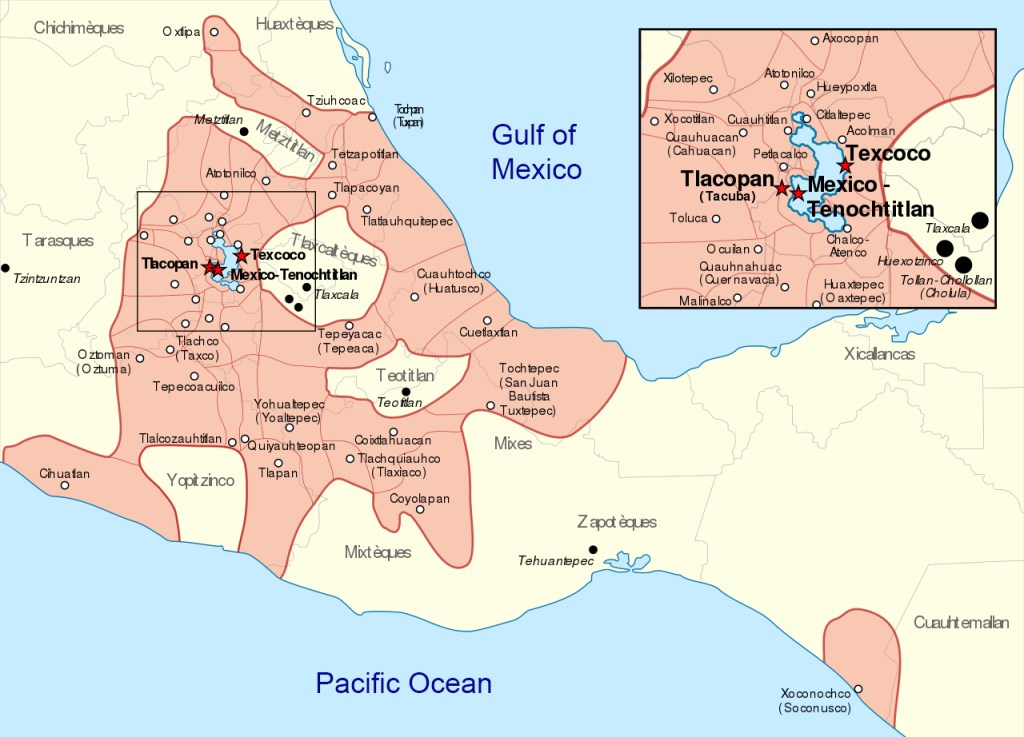
Mexico is the 13th biggest country in the world. I didn’t know that. We arrived in Mexico City (in the red rectangle on the left). What is it, half, two-thirds of the way south of the US border? Didn’t see anything north of that. Looking at the country’s ‘Peace and Well being’ Index, the closer you are to the American border the less peace you can expect to encounter and the more constrained your well being. The drug gangs are spread around, but they cluster in the north. Where we were (in our tourist bubble perhaps?) there was not the slightest sign of trouble. We did get up at 3 o’clock one morning — encountering the steely grey of dawn an unfamiliar experience for me; and it was both steely and grey — for the bus ride from San Cristobal to Palenque. This was to avoid any encounter with the unrest which is troubling Tabasco Province. No one was going to get shot but the bus could have been held up for a while. We travelled about 2800kms with confidence. It’s a big country.
And, as you might imagine of an isthmus between two giant continents, it is mountainous. The altitude of each of the first three cities we visited is higher than any point in Australia. Popocatépetl, an active volcano which was in hiding the day we went to Cholula hoping to see it, is 5400m high. Reaching out to Cuba is the Yucatan Peninsula some of which is very flat indeed, and a good deal of which is tropical unlike the more easterly spine. The Equator runs well to the south but the country is still generally hot. A lot of the country is very dry. It rains in central and south Mexico in their summer and autumn, May-October.
In 1519 Cortés began an invasion by Spaniards from roughly where the major port on the Caribbean, Vera Cruz, is today. Conciliatory at first but progressively becoming more violent, in 1521 he was in a position to destroy Tenochtitlan, the Mexicas‘ capital, and did so. (‘Muh-shee-ka’, Aztecs, but the name they called themselves.) He could not have done what he did without very considerable help from the many peoples of Meso-America who did not like the Mexica. There remain many many indigenous peoples in Mexico who have differing cultures, languages, styles. In addition Mexico has had slaves from Africa and a great deal of immigration from the US ranging from commandants of capitalism to high-maintenance hippies. Trotsky was only one of many Russian and central Europeans to seek asylum there. Of course, Spaniards came, some no doubt considering it an exciting and rather mystifying version of a suburb of Madrid or Seville until they discovered otherwise. It has drawn horticulturalists, historians, archeologists, anthropologists, geologists and many other ologists. From a US perspective, it is close, relatively easy and the food can be enticing. As with Cortés, the sense that you could make money here might be enduring. And people have. Carlos Slim, for example, is an outrageously rich man. A decade ago he took his turn at being the richest person in the world. The wealthiest suburbs of Mexico City — Polanco, Bosque de Lomas, La Condesa — are as opulent as anywhere. And if you want cool, try Roma Norte or parts of Oaxaca (‘uh war-ka’. This will recur.)
Injection
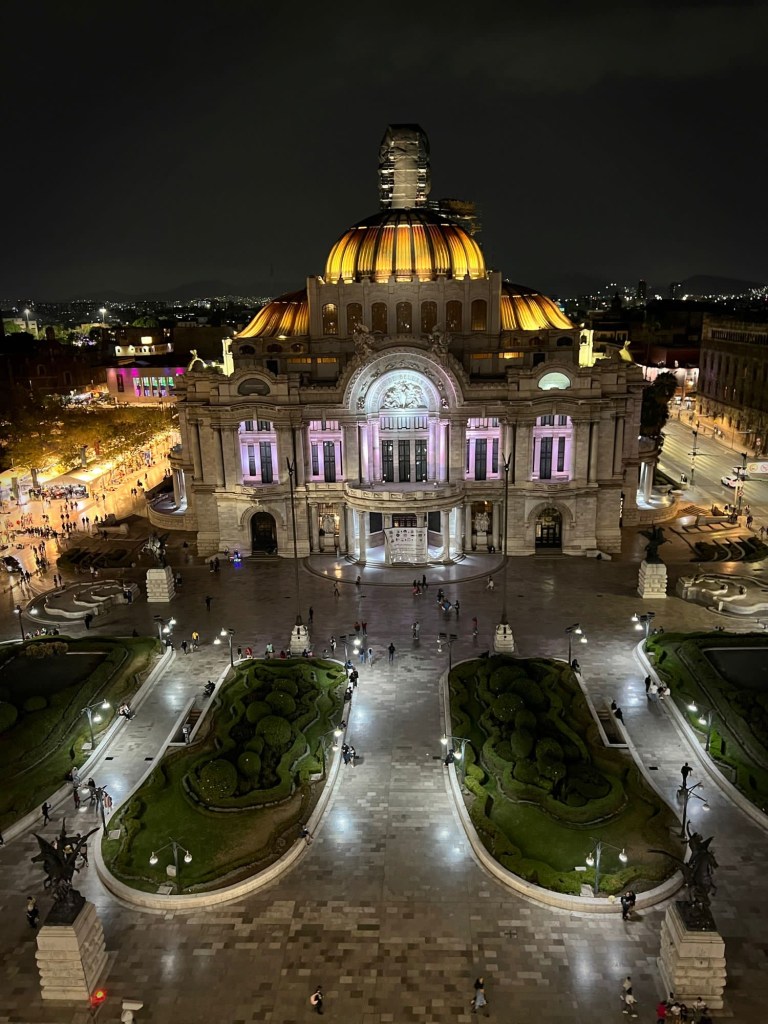
On our second night in the city we went to see the Ballet Folklorico of Mexico at the Palacio de Bellas Artes, the Palace of Fine Arts. The building itself was worth the price of admission.
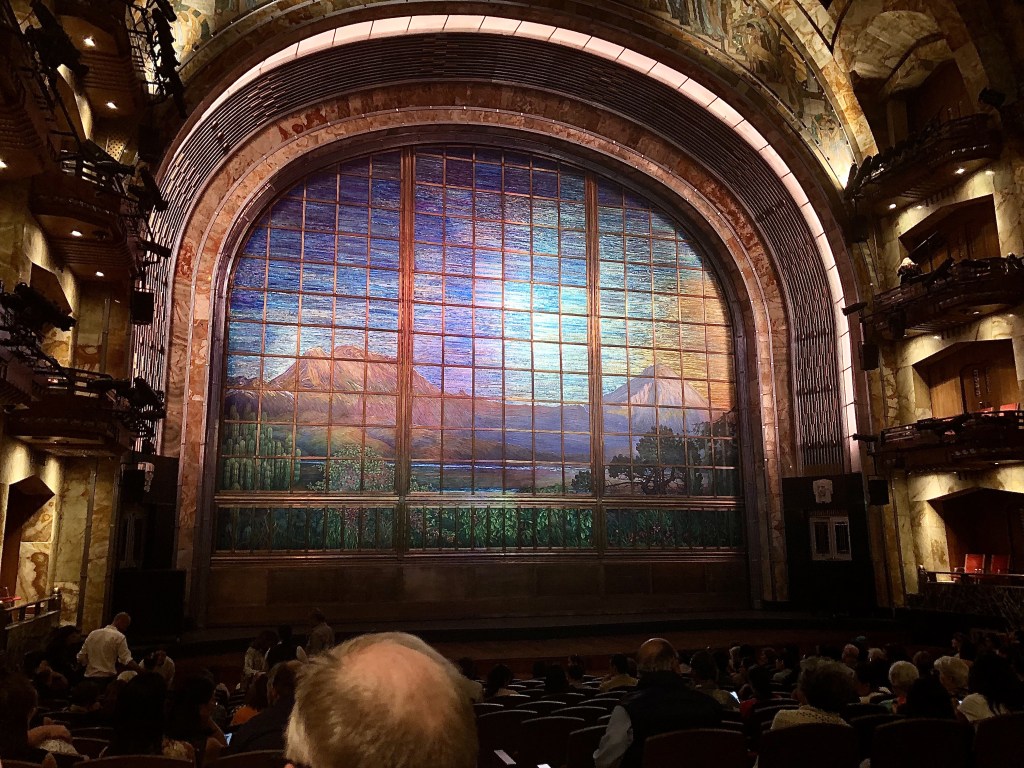
And then inside was the curtain made by Tiffany of New York. Out of glass. (I include the bald head of that American to remind me usefully that there are people in the world who know everything.)
I was still suffering from the occasional jetlag dropout — when you’re suddenly both asleep and for example reliving an unhappy event from your 20s or perhaps driving a car over a cliff — and wasn’t entirely persuaded at the beginning. A bit hokey maybe? But by the time we got to singing along with ‘Viva Mexico’, the monster finale, not a dry eye in the house, I was shouting applause.
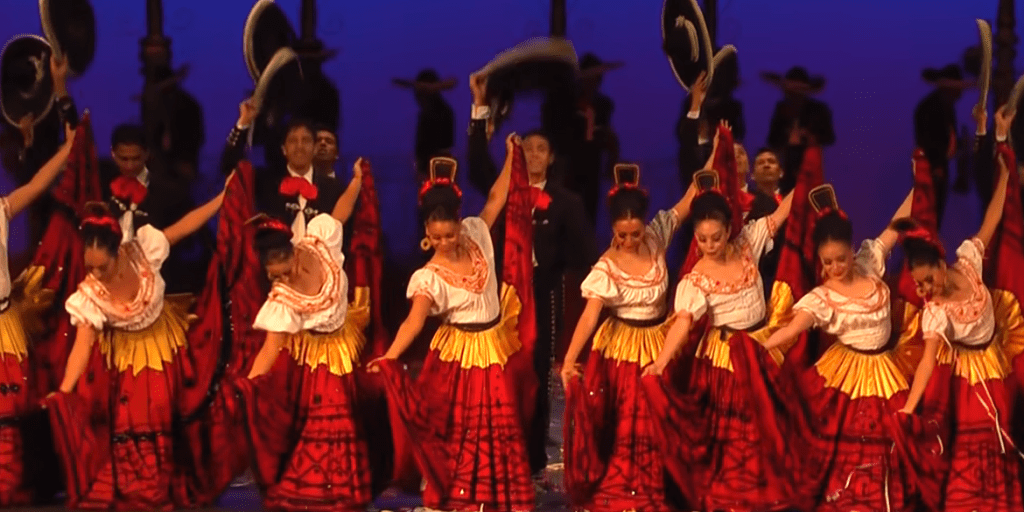
This is only a screen shot. You can watch the lot if you like. Here.

It was an introduction to, among other things, death and its symbols, the solitary indigenous warrior, the startling headdresses of Moctezuma, the cowboy and cowgirl, mariachi Mexico’s very own music which I had unaccountably forgotten, the ribbon dance, duelling harps, astonishing bands and the elegance of Mexican ‘folk’ dance, more varied and interesting and simply more beautiful than so many of its ethnic competitors. Flamenco, tap and ballroom somehow merged to produce something deeply original, the women dressed in skirts with 540 degrees of cloth that were a crucial part of the dance. Bits from everywhere but somehow making sense as a whole.
The night after we were in Puebla and the Lucha Libre, ‘Free Fight’, happened to be on.

On the travellers’ principle Do Everything, we went. Downtown at the dedicated stadium were dedicated fans housed above either side, according to their propensities, behind wire fences. The wrestlers appear, beat their chests, salute their followers, taunt the opposition fans and then do their business for 20 minutes or so. Consequently they drag themselves from the ring, apparently spent and mortally injured.
It’s a dance, choreography at a very high pitch and practiced to a polished gem. I can confirm that during the making of this event no participants were harmed. None. Even the bloke dressed like a chook. If the Ballet Folklorico had been magnificent, this had been bullshit, but magnificent bullshit. Glorious passionate ornate bullshit … that could, like that fascinating amalgam which is Mexican Catholicism, be taken seriously.
Every country might have their crazy sports, but Lucha Libre just seemed to suit Mexico down to the ground.
• • • • • • •
Mexico City is the sixth most populous city in the world. Its heart is the Zócalo, this massive public square.
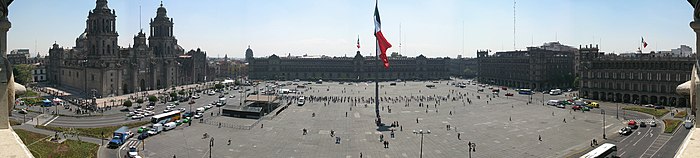
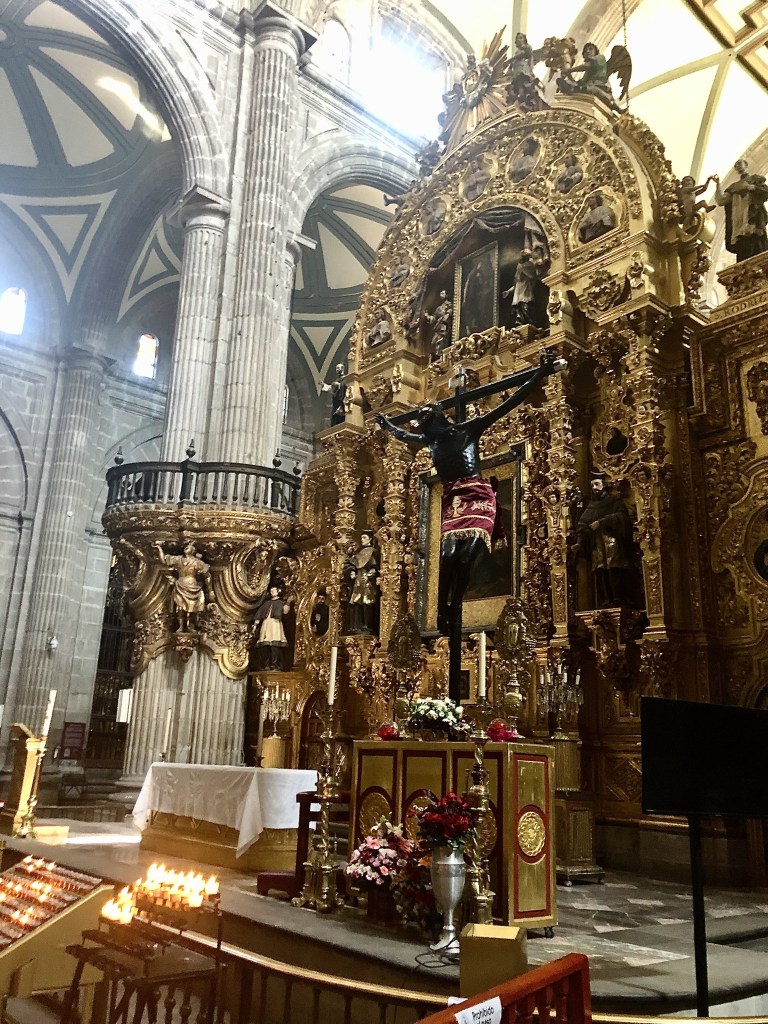
The square is surrounded by the National Palace (in the middle), various government offices, some upscale housing and the cathedral. On the left in the picture, it is an amalgam of constructions and styles, the contribution of several different centuries, coming apart in places but a masterpiece of religious inspiration and baroque imagination.


Between and behind the palace and the cathedral this can be found, remnants of a Mexica temple, the Templo Mayor, which, in its day, defined not just the centre of the city but the precise cardinal points of the compass and in fact the sacred centre of the universe as the Mexica knew it to be. Fundamental, powerful, serious, consequential.
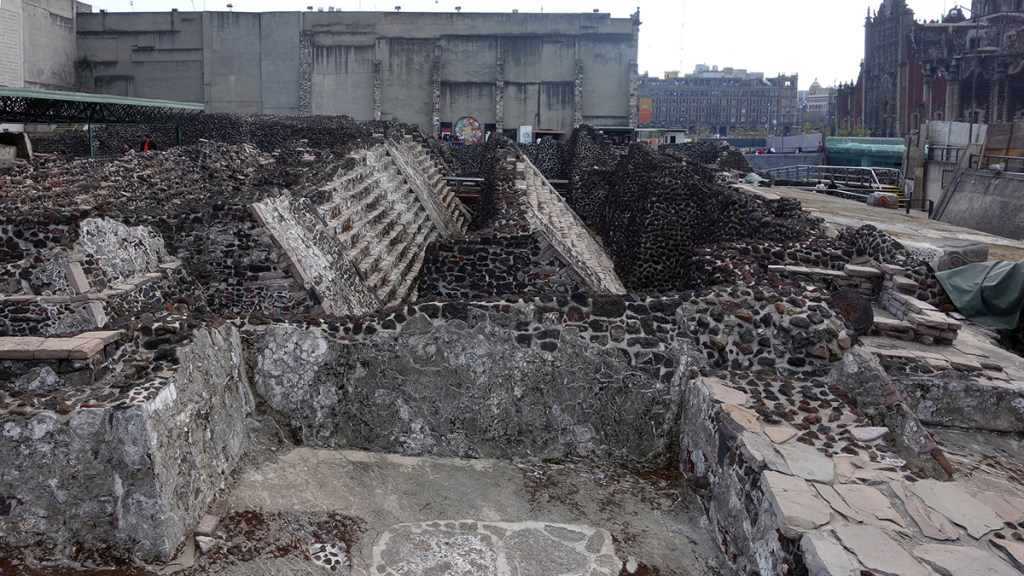
In order for the sun to come up each day, the blood of countless hundreds of thousands — mostly captive warriors from other communities colonised by the Mexica for that very purpose — had spilt down its steps. Stretched face up over a large convex carved stone, priests holding the four limbs, a plunge of an obsidian or flint cutting instrument, reaching in for the beating heart to display it, skin flayed off and for some time worn by nobles and warriors. For us savage, perhaps barbaric, drama; for them, presumably, quotidian life.
When Hernán Cortés was administering the final coup to that Mexican world in 1521, the temple was one of the first things he destroyed, razing it to the ground, building a cathedral on the site and laying the foundations for several centuries of colonial regimes, … correctly other colonial regimes. He wasn’t just tackling a world view; he was destroying an unpopular empire which itself had colonised a substantial portion of the Mexican isthmus, ocean to ocean, in what would seem to us a very bloody and brutal fashion.
Mexico hosted the Olympic Games in 1968. The ‘Zócalo‘ is a few hundred metres from the Plaza of the Three Cultures (pre-Columbian, Spanish and Independent) where, ten days before the Games were to open, students protesting the Mexican government’s use of funds for the Olympics rather than for social programs (and onlookers and locals and children and old people) were surrounded by the government forces and shot at with live ammunition. Estimates of fatalities range from 200 to 500; certainly more than 1000 were badly wounded. 1354 were arrested. The ‘Massacre of Tlatelolco’ is an open sore in Mexican memory. Responsibility has been disputed and widely assigned. It seems it was the US, for example, that provided the weapons on the basis that they were to be used ‘to ensure the Olympics proceeded peacefully’. It wasn’t until 2001 when the government finally changed after 71 years, President Vincente Fox opened the files. The information they contained validated reporters’ eye witness accounts:
Thousands of students gathered in the square. The government version is that the students opened fire. There is clear evidence now that there was a unit that was called the Brigada Olímpica, or the ‘Olympic Brigade’, that was made up of special forces of the presidential guard, who opened fire from the buildings that surrounded the square, and that that was the thing that provoked the massacre.
The opening of the Games proceeded as normal. (It was here Tommie Smith and John Carlos, first and third in the men’s 200, gave their black power salutes. Peter Norman came second and, for being on the podium, was banned by Australian officials for life. In another odd miracle Bob Beamon broke the world record for the long jump by 55cms, something that just does not happen. That record stood, not approached, for 23 years.)
‘Zócalo‘ is not the Mexican or Spanish word for ‘Square’ or anything of civic relevance. It is the word for ‘plinth’. In 1843 Antonio López de Santa Anna, who — counting puppets — may have had six terms of Presidency between 1832 and 1853 and is somewhere near the top of the highly contested field of Mexican leaders who ‘failed the nation’, cleared the markets which had grown up on this area. This followed riots which resulted in a number of deaths and the destruction of much of the informal infrastructure which had been developed. In the centre of this new plaza he determined to build a monument to Mexican Independence. But his project got only as far, so to speak, as first base.
For ever and a day, the ‘Zócalo‘, the centrepiece of the city’s centro historico (and also that of Oaxaca, Mérida, Guadalajara and many other Mexican cities) contains a joke, and an anti-authoritarian joke at that, a tiny eruption of revolt. (Footnote for Santa Anna: It was he who lost Texas to the US and then kept negotiating more bits away to prop up his rule. More especially, he married two young heiresses and was present at neither wedding.)
The layers that are present here in the Zócalo and its surrounds, including the Palacio and the Plaza de las Tres Culturas as elsewhere in Mexico, are thick and rich, all of them, as complex as any in the world with this contemporary mix of old, new and even older worlds, of unkempt and churning governance, of cruelty warmth and generosity, and the conspicuous prominence of religion, entangled with sex and, especially, death — all in a blaze of unabashed flagrant colour.
That, I think, is why you would choose to visit Mexico.


There is more. A good deal more.
Tune in here for growing lettuce on top of a lake.
 mcraeblog