
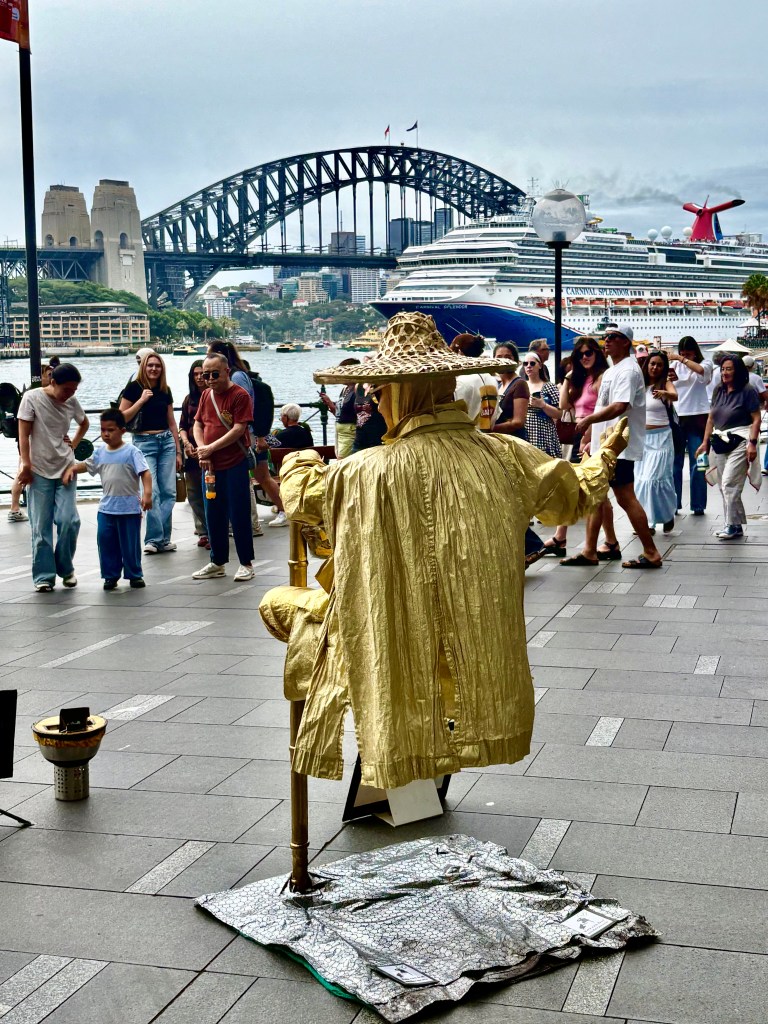
Just to get you in the mood. Sydney? Of course. Can’t you see the cruise ship? The concourse of the Opera House with The Toaster at our backs. Look again. His trick is that he’s suspended in the air. Doesn’t do much else, but isn’t that enough? So wonderfully Sydney.
But Ron Mueck at the Gallery. That’s our focus.
We’ve been following him for quite a while. I saw ‘Pregnant Woman’ in Canberra in 2003, so that’s a while. He was born in Melbourne in 1958 and spent some of the first 40 years of his life as a model-maker. A highlight: creating, building and voicing the character of Ludo for Jim Henson’s film Labyrinth. And then when he was about 40 he started making — at least some — big ones.
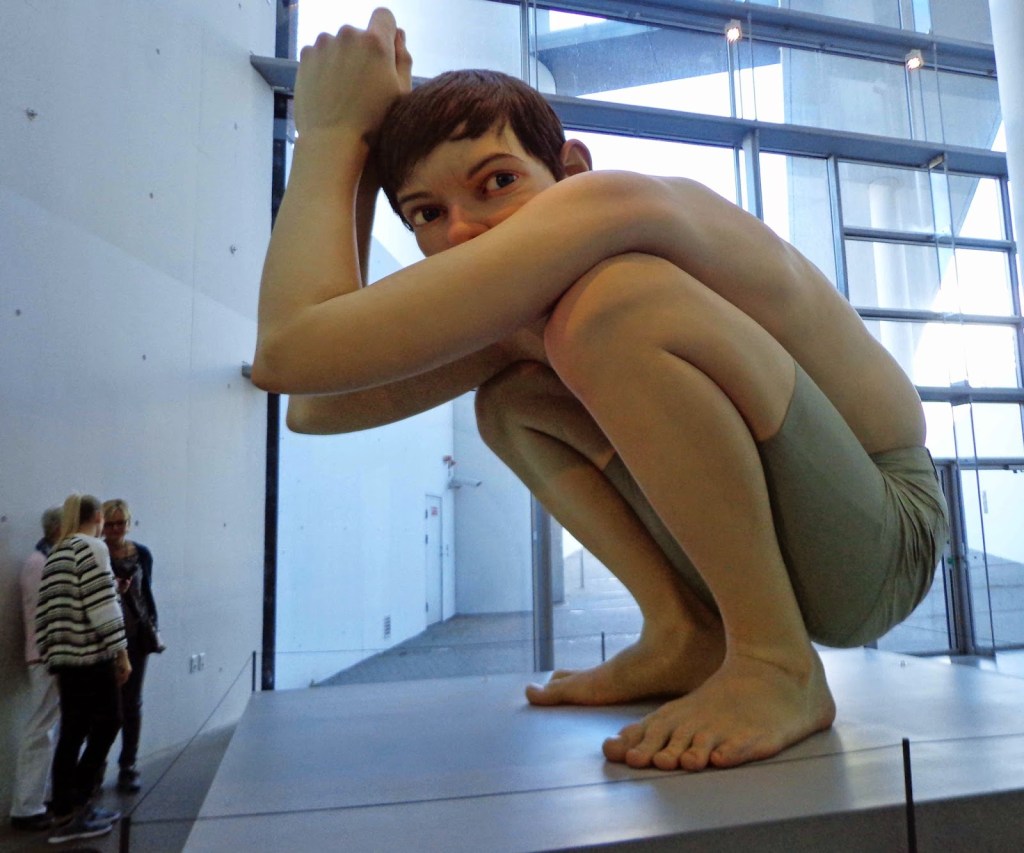
‘Boy’, his first major work, still sits in the foyer of Denmark’s National Art Museum in Copenhagen. (See also ‘Crouching Boy’ below.)
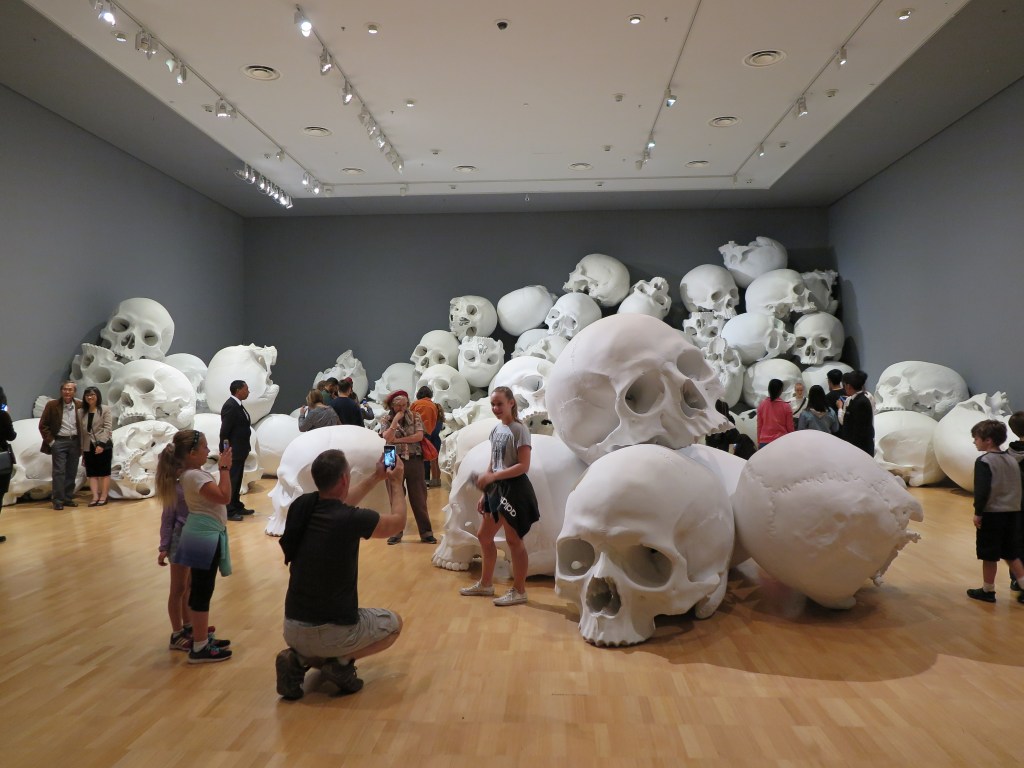
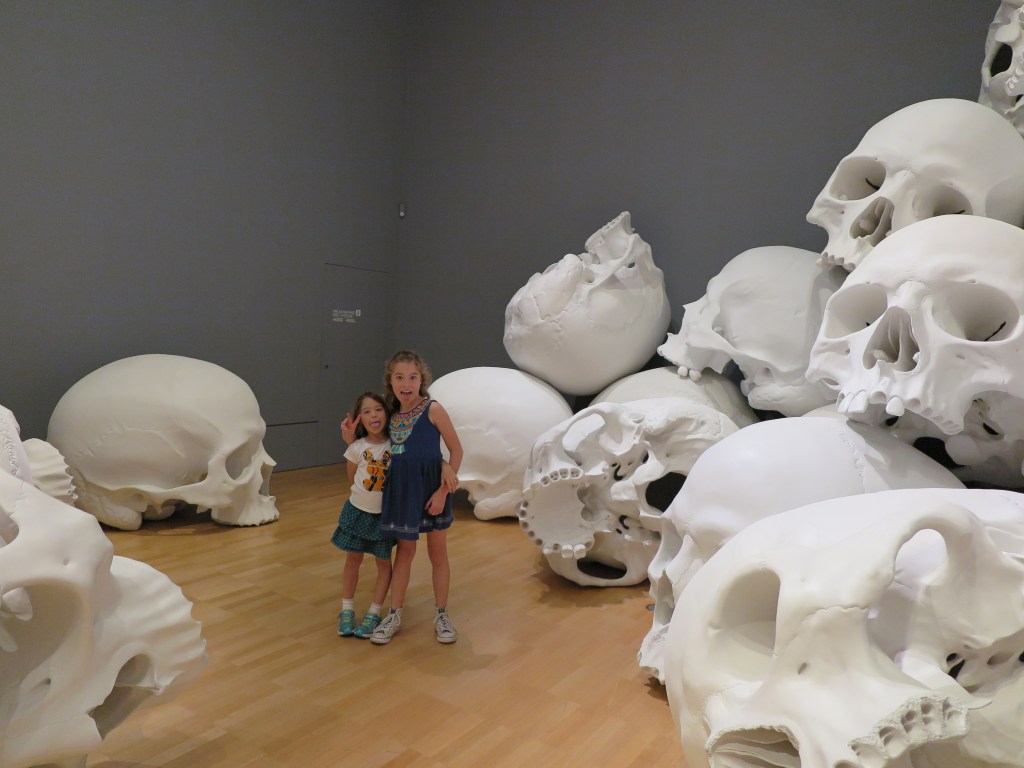
Some years ago we took the girls to see ‘Mass’ (inter alia) at the NGV.
‘… a somber study of mortality, and an extension of mueck’s hyperrealistic sculptural practice, ‘mass’ draws from the biological structure of the skull, regarded by him as extraordinary facets of humanity. the installation brings to mind the massed remains in the catacombs of paris, an imposing wall of human heads that resonates with a simultaneous and strange sense of impermanence and eternality. in ‘mass’, mueck celebrates the form that links all humanity, and pays homage to a symbol that has stood within the art of essentially all cultures and religion. surrounded by skulls covering nearly every surface of the walls, visitors are reminded of the transience of life.’
Mmmm yes. Straight to the heart of things. Quantisentialment. Love that art talk. (But is there a prohibition on the use of capitals? I can’t keep up.)
Anyway he’s pretty good, and always worth a look. Here’s ‘Pregnant Woman’.
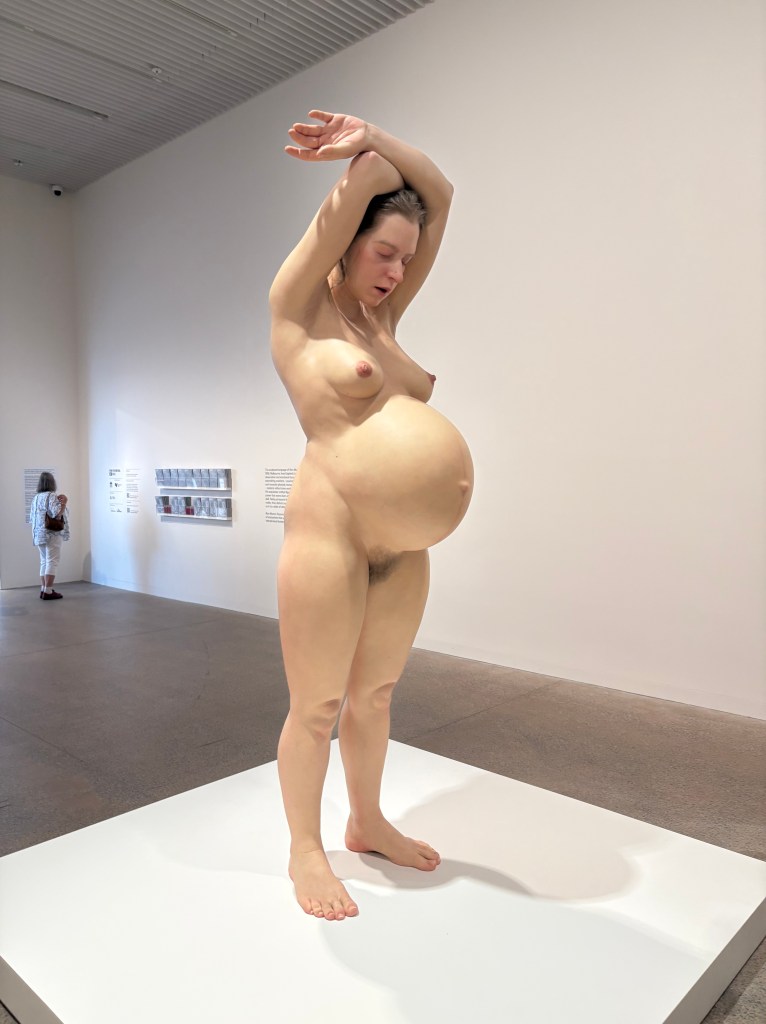
There can be no argument about his craftmanship. None. It is simply extraordinary. His observation is meticulous. (Look at the way the shorts ride out on the boy below not to mention the remarkable care with which all the clothing has been scaled and created.) But his work has always had further layers of significance. You are meant to look harder, to discover new information and to think again.
The most direct example in this exhibition was ‘Young Couple’: nondescript except for their startling reality coupled with just a tiny sliver of cartoon.
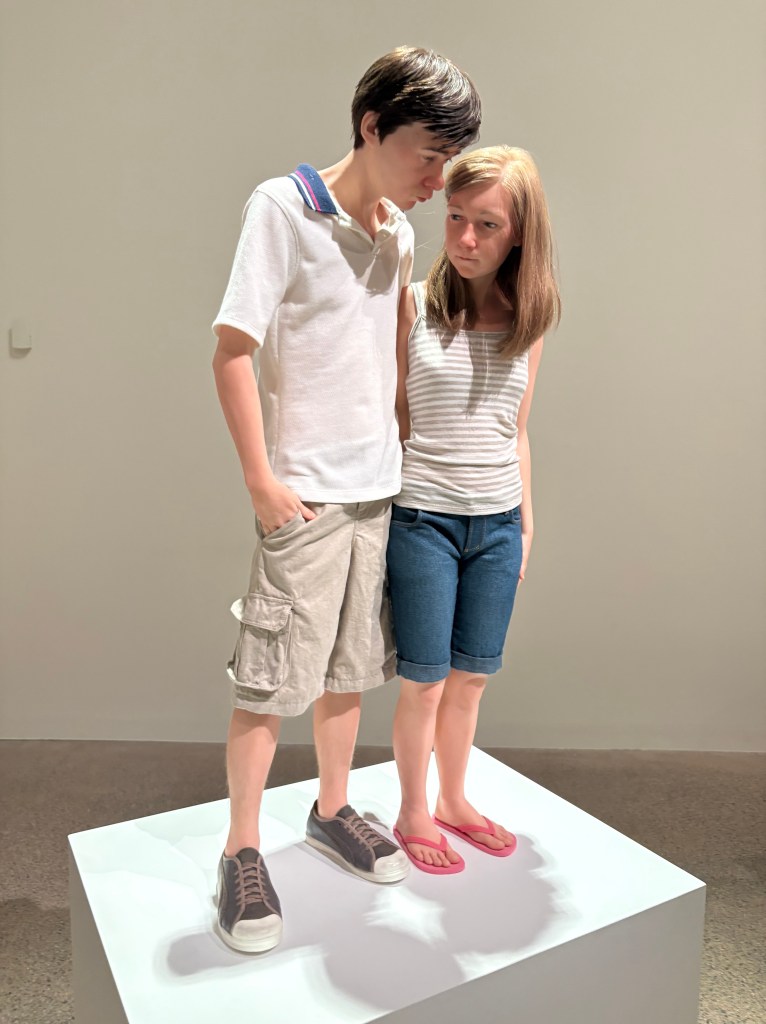
But you move around the back of the work, and you see this.
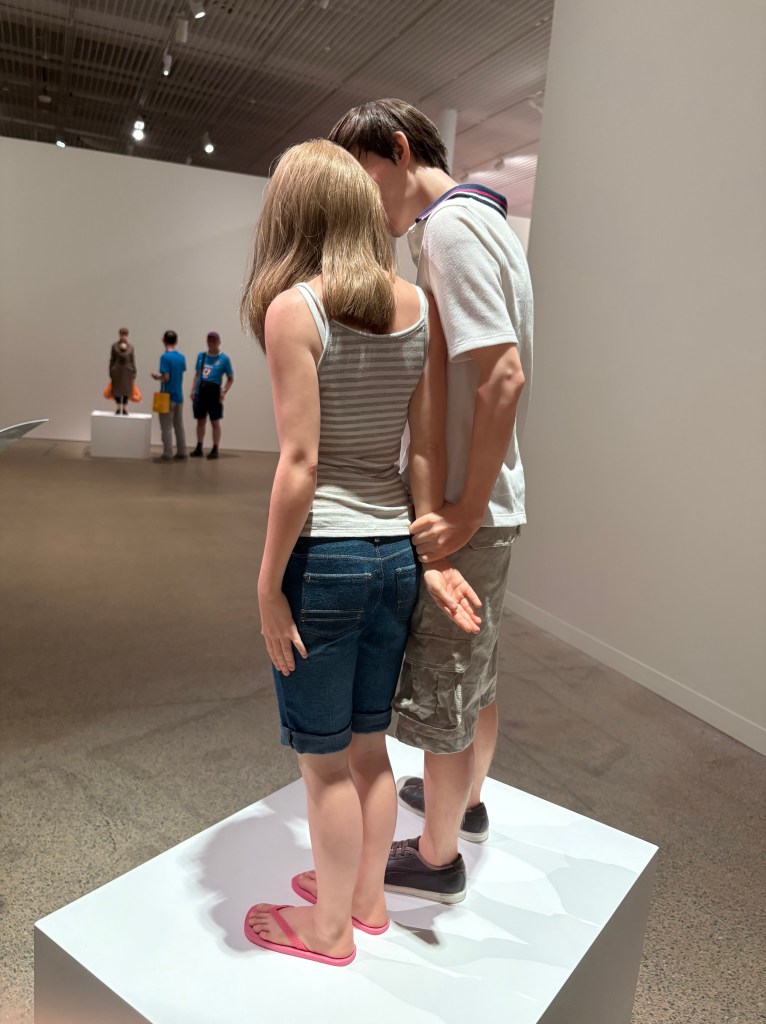
And you look again more closely at their expressions … the anxious fixity of her stare, and — now you know — something off about the set of his mouth.
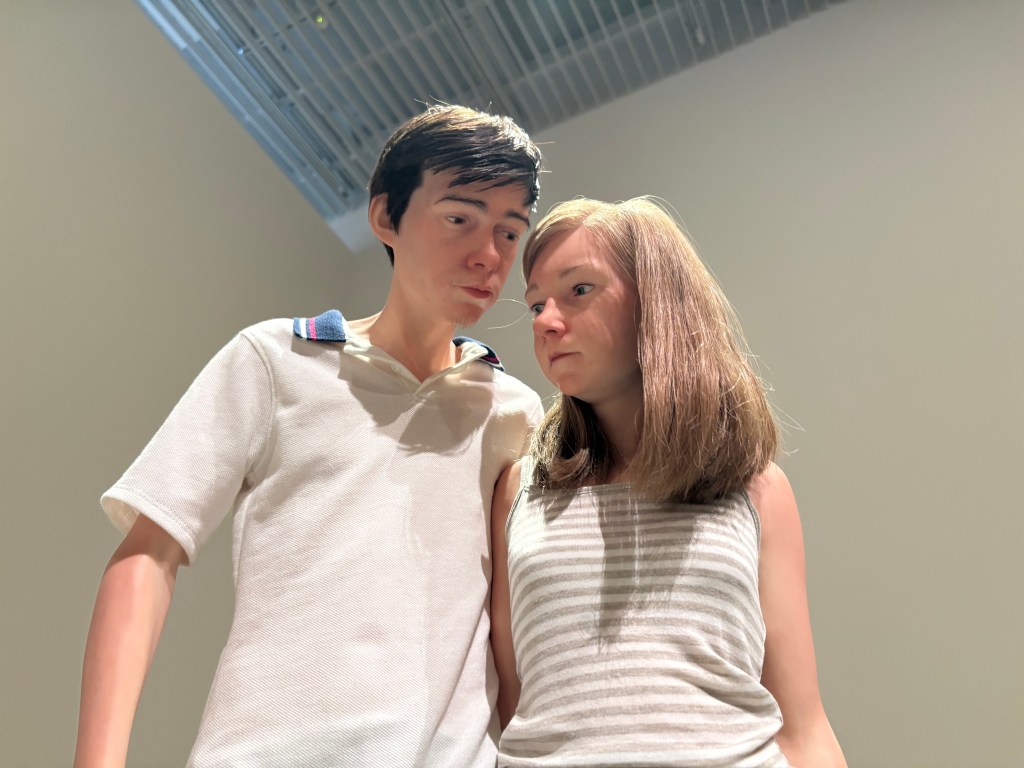
Ah, yes, that’s what’s going on. Creepy. A lot of people find Mueck’s work creepy. And I think we would have to say at least some of it is. Quite deliberately. I think the task he has set his audience in these works is to find just what that creepiness is about. To somehow nail what we’re finding unsettling. That’s the point. The ooo ahh moment which requires a cerebral qualification, a bit of brain work.
You mightn’t always be able to nail it — ‘Man in Blankets’ is about 800mm x 500mm, a little one —
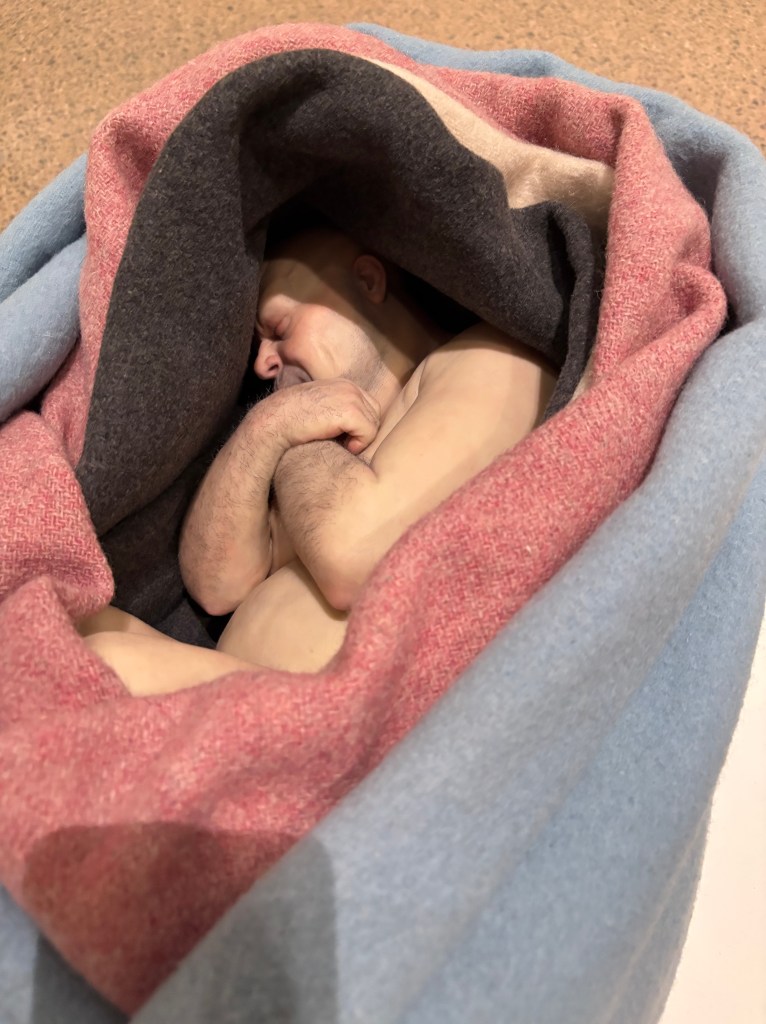
but this might help:
‘Mueck affectionately cocoons his figure in blankets (so far so good), offering the protection of a whorled nest that draws us down to the tiny man with distress (or annoyance) etched on his forehead. Or does the bright light of the gallery, and our presence, simply irritate him and interrupt his sleep? (No. Hugely unlikely.) The swaddled Lilliputian (phhoooof, pushing it a bit here) is preposterously part man, part infant (a ‘bearded baby’). (‘bearded baby’, with scare quote marks 🤔) As such, though we see a man, we care about him tenderly — if we are so inclined (If not?) — as we would a child.’
That’ll do. This genre of writing presents enormous challenges and tremendous potential for failure. And, irregardless, irregardless I say, you can look for yourself. It’s weird as.
He’s called this young woman ‘Ghost’.
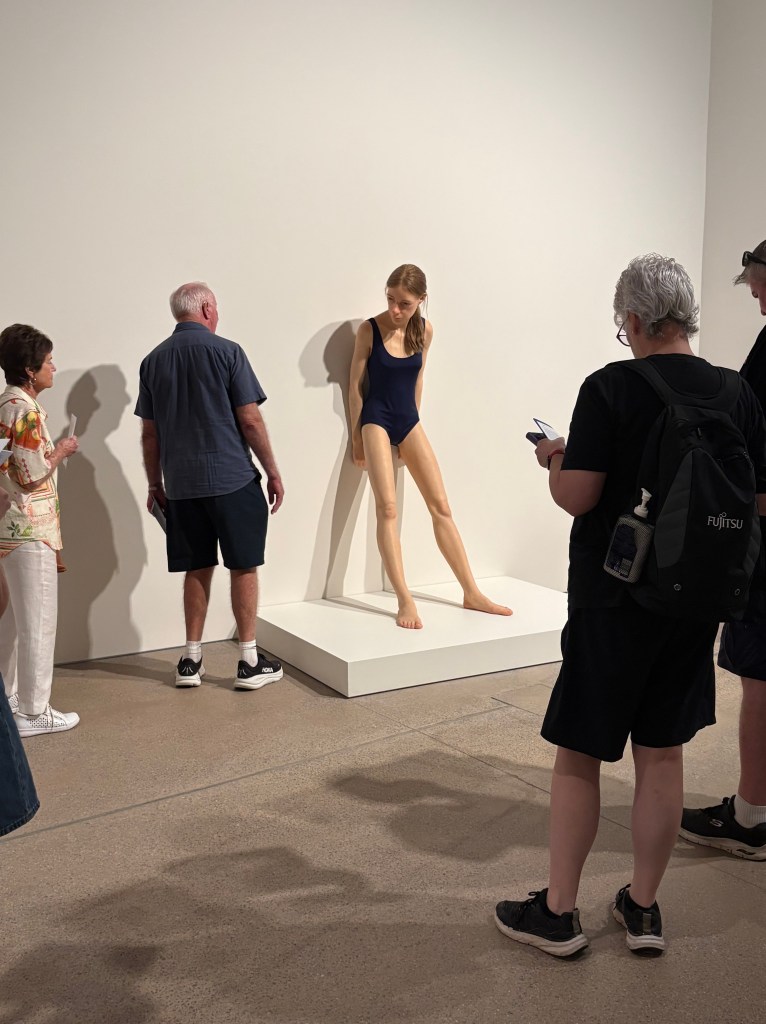
And yes it could be the young girl from the couple above. (For that matter it could be a younger version of the ‘Pregnant Woman’. The female faces in this collection do tend to repeat albeit in interesting ways.) And at this moment she is keeping that gent at bay. Just how perfect is the choice of the bathers. Vulnerable. Withdrawn. At the same time exposed.
‘The Spooning Couple’. This is one view.
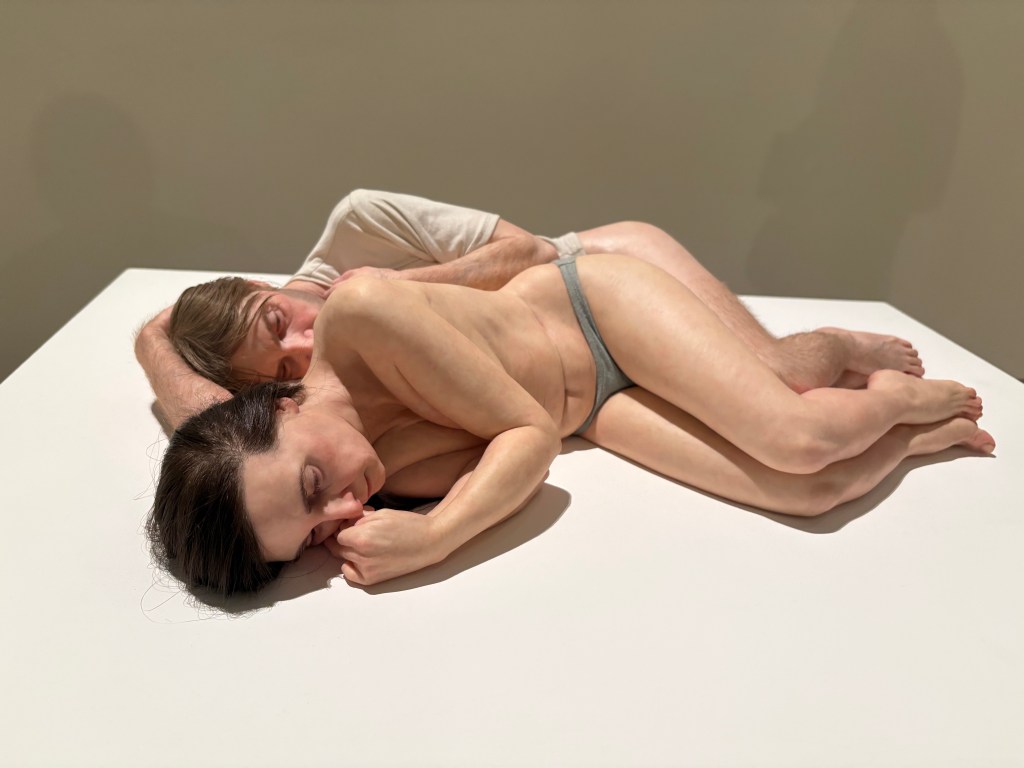
Shift the angle slightly and the atmosphere changes quite dramatically.
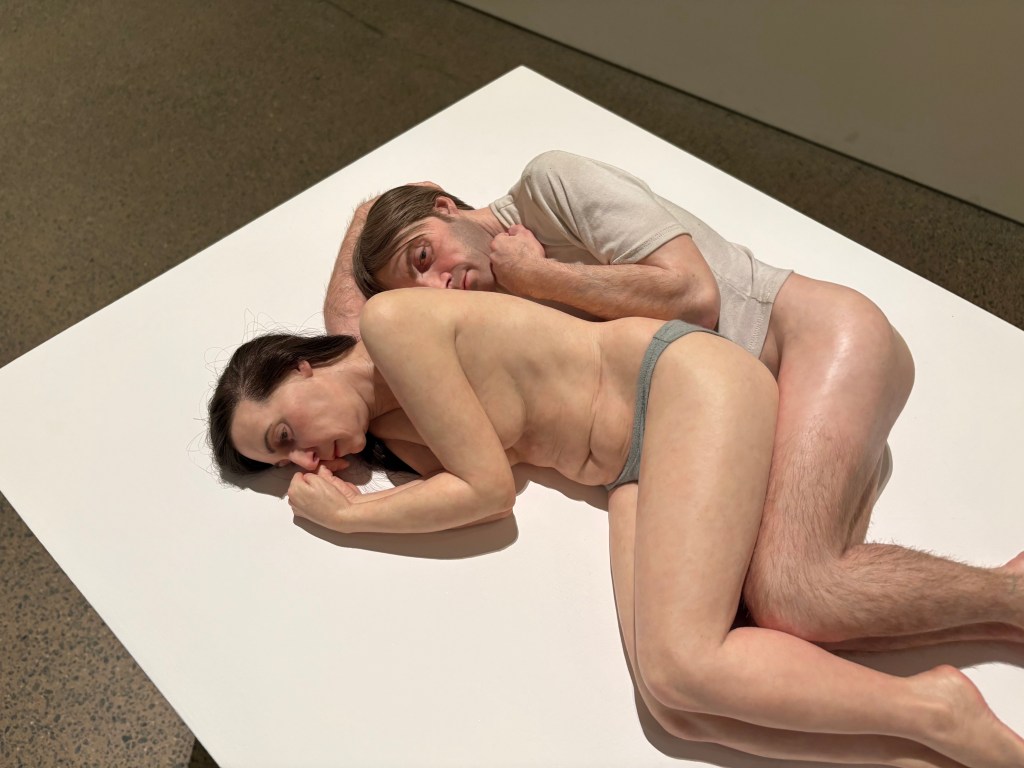
While their bodies are corresponding, their minds are elsewhere. It is a slight touch but so consequential.
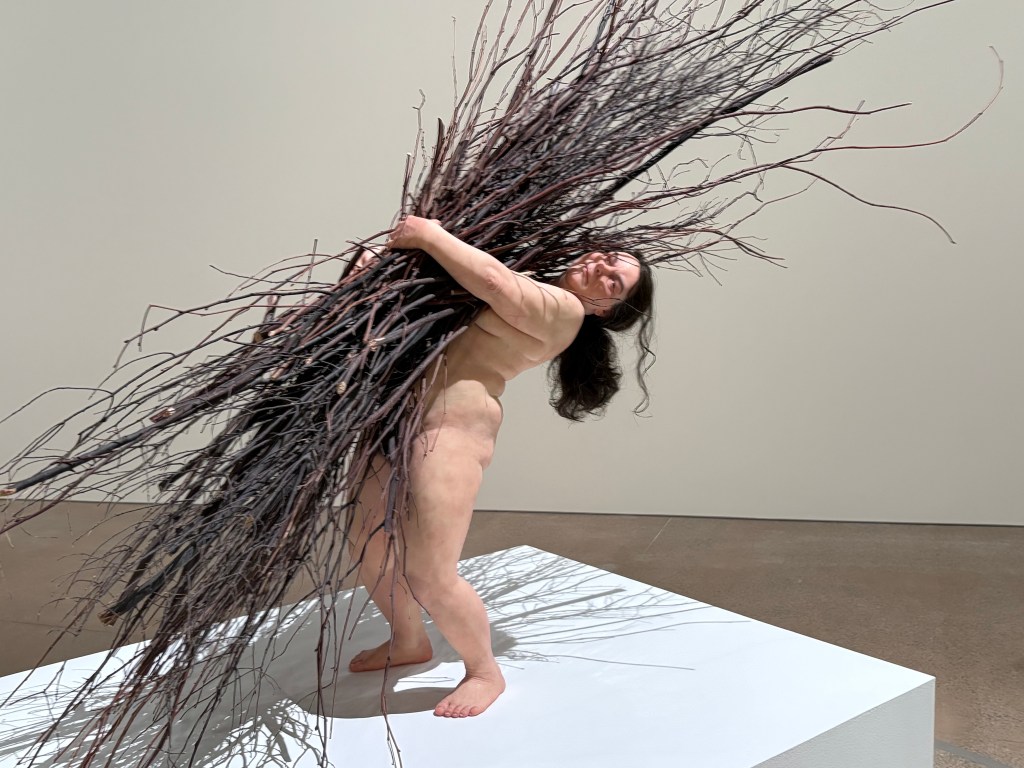
She (‘Woman with Sticks’) is having a much better time. The notes suggest she is undertaking this labour like Penelope weaving and unpicking her cloth endlessly as she awaits Ulysses’ return. Maybe. Maybe not. In fact, not. More the satisfaction of getting hold of a really BIG bunch. That’s enough.
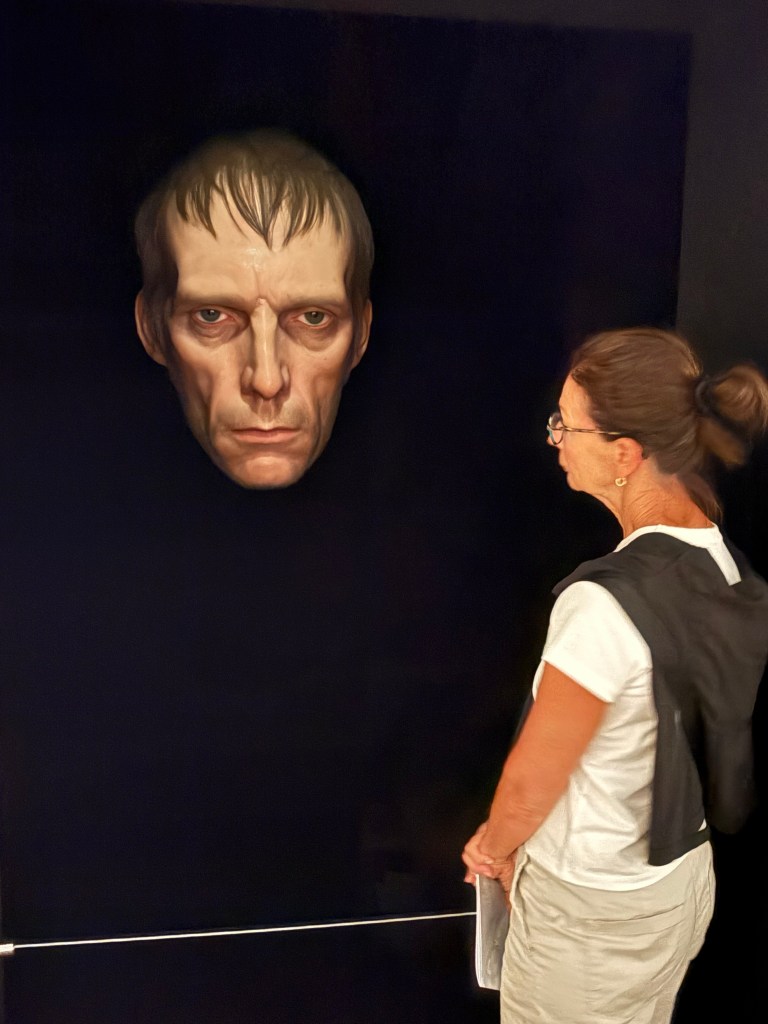
Off in its own cavity was this: ‘Dark Place’. While it was 3-dimensional (and much bigger than it appears in the photo), it doesn’t look like it here, and I’m not sure it did in situ. It might be that you need his work fully exposed to appreciate it properly, and that no lighting, for this purpose, is as good as day or otherwise full light.
No such problem with ‘Crouching Boy in Mirror’.
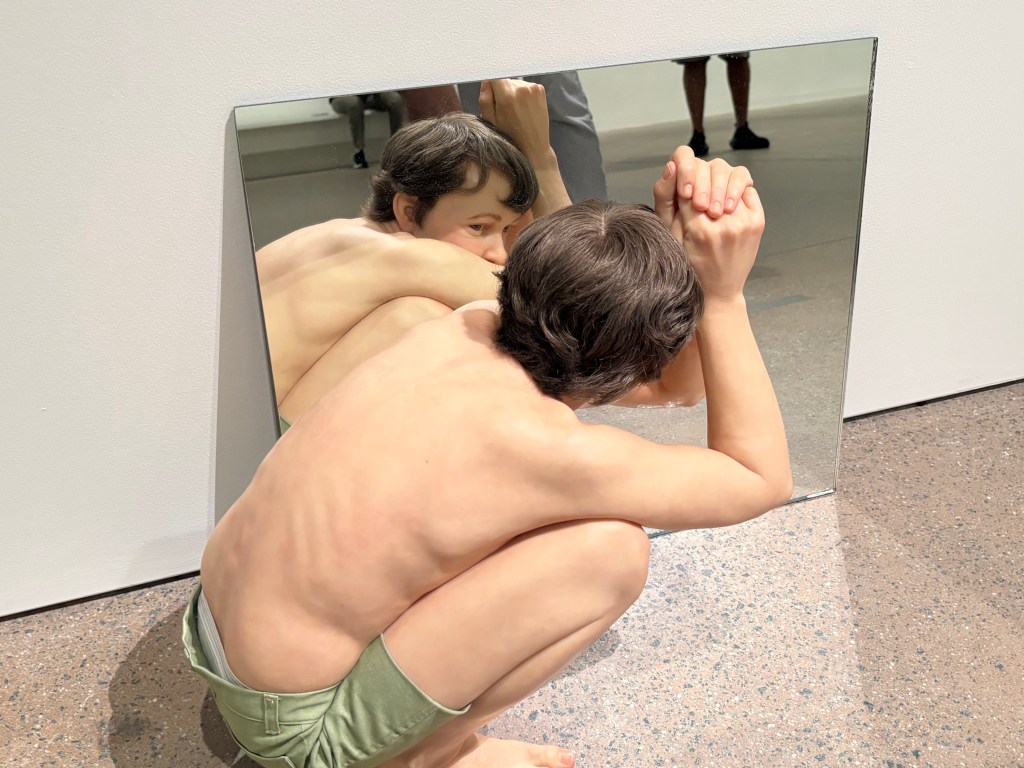
About life size, just checking himself out. How’s he looking? Pretty good, and very much as he did last time he checked. He doesn’t know his shorts are riding out showing his undies and he doesn’t really care.
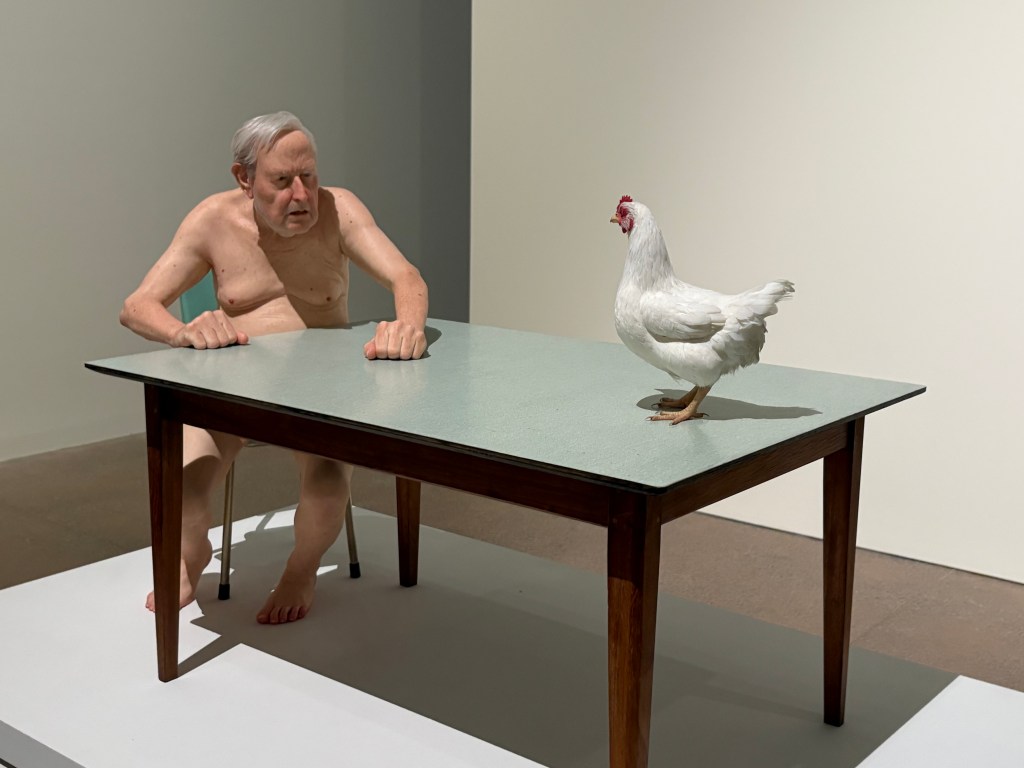
‘chicken/man’, a portrait we are told of a neighbour and friend with one of the chooks he owns. The undercurrents here might be a bit surreal but they are also cheery. Two buddies communing: that’s how I read it. One of his most popular works. I like it a lot. It’s about my life stage where we chat to non-verbal creatures and objects.
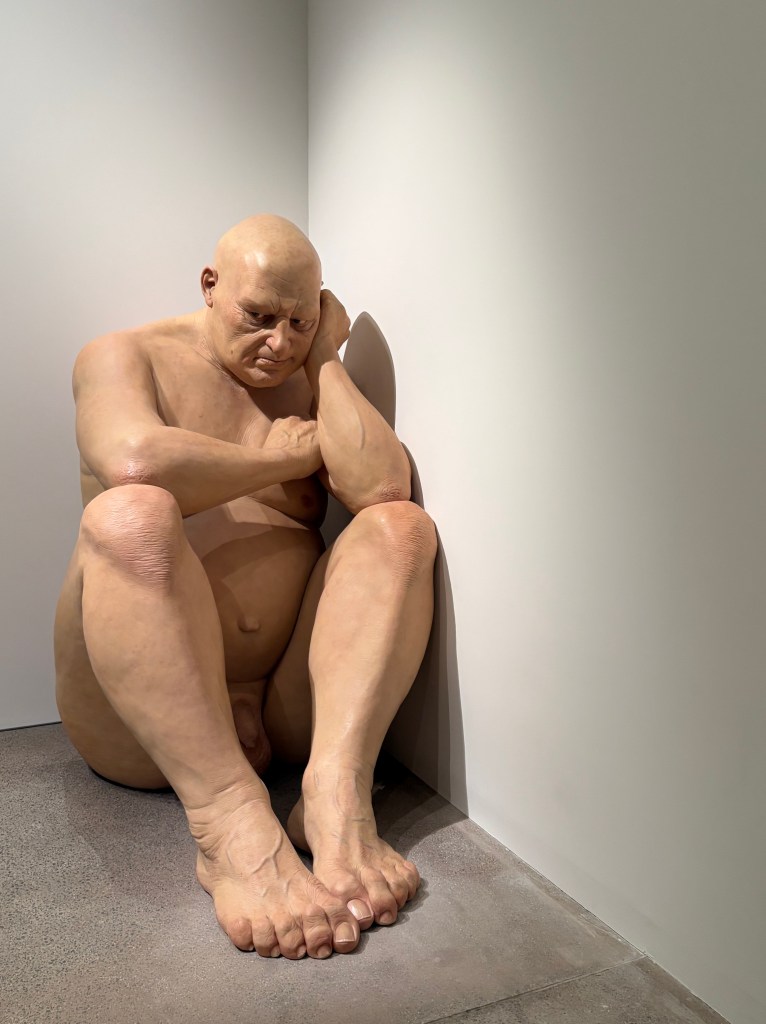
‘Big Man’. So powerfully focused. An enigma. Is he perhaps digesting, with difficulty, some intense slight or hurt? It’s such a masculine expression. Is he visualising some sort of revenge? Could he perhaps be mulling over something he wishes he hadn’t done, trying to become absorbed into this corner, invisible, an aspiration that this very substantial assemblage of flesh won’t allow. I say gripping.
Recently Mueck’s work has taken a more obviously dark turn. This was represented here by ‘Havoc’ (the dogs) and ‘This Little Piggy’.
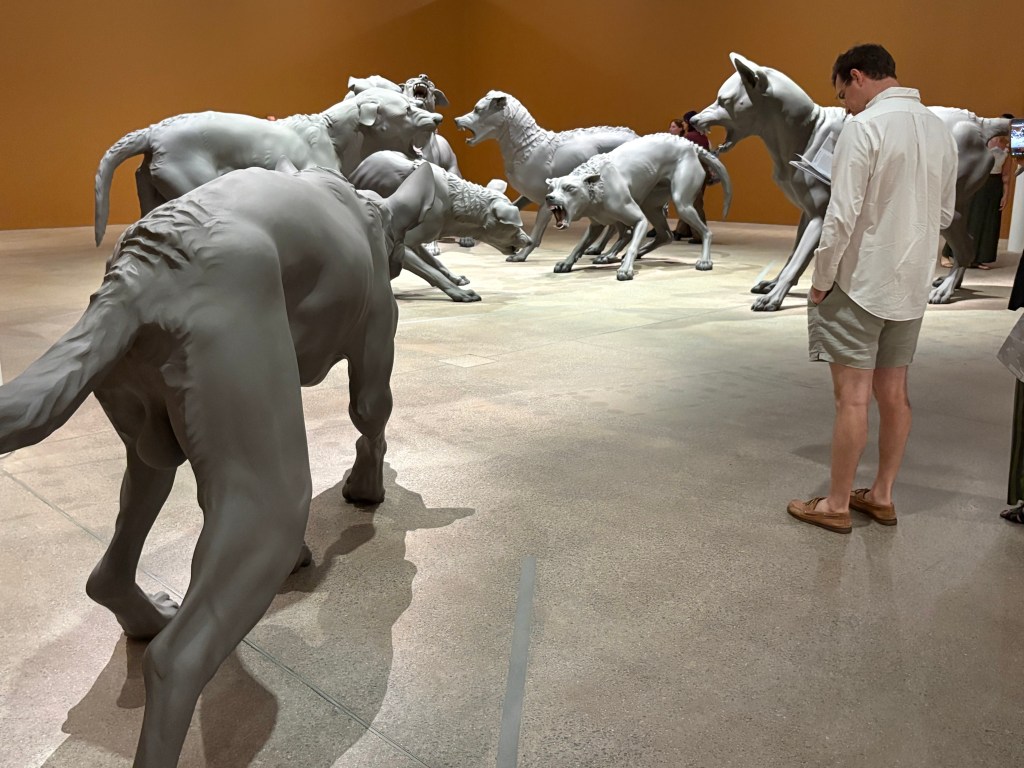
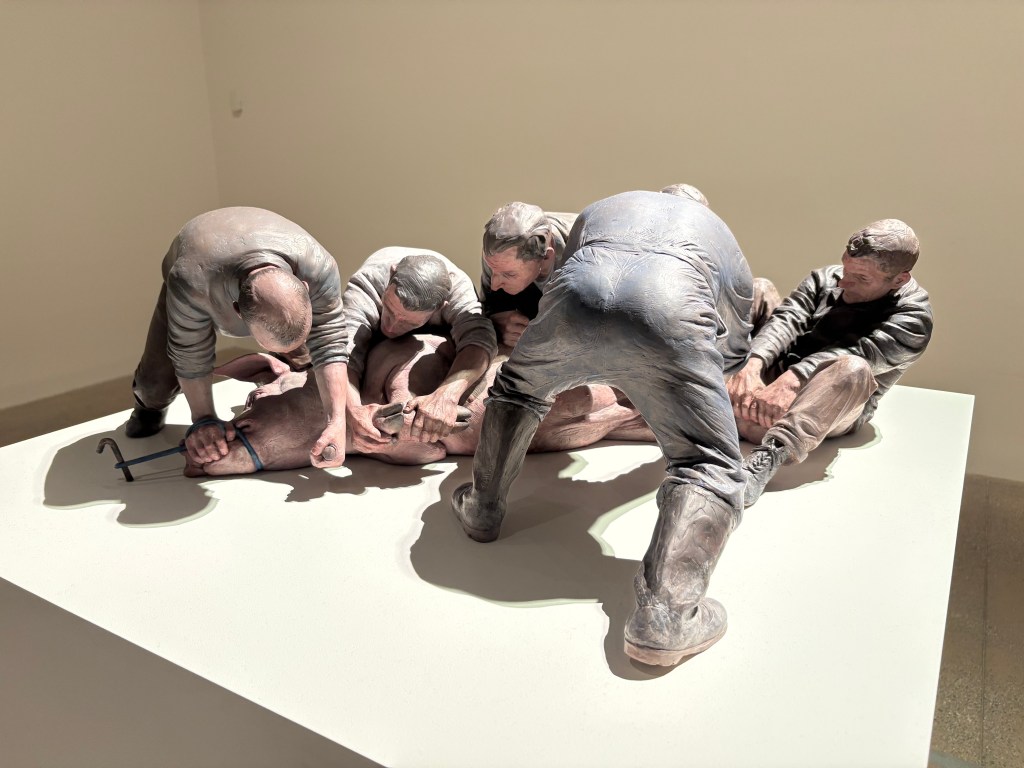
These works take years to complete. I think he might have wanted to loosen up a bit. The modelling isn’t nearly as detailed as in his older work even if the structures are more dynamic. I don’t know how I feel about that, but the dominant adjective might be ‘obvious’.
Less clearly manifest is the last piece in the exhibition, ‘Couple under an umbrella’, from a decade or so ago.
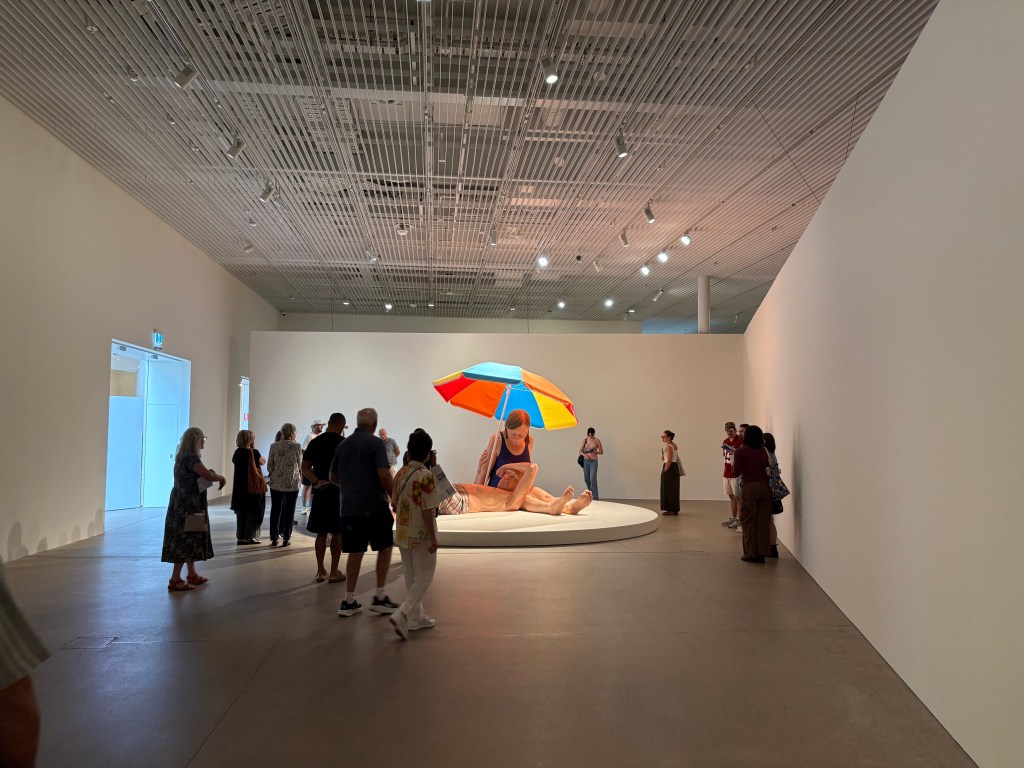
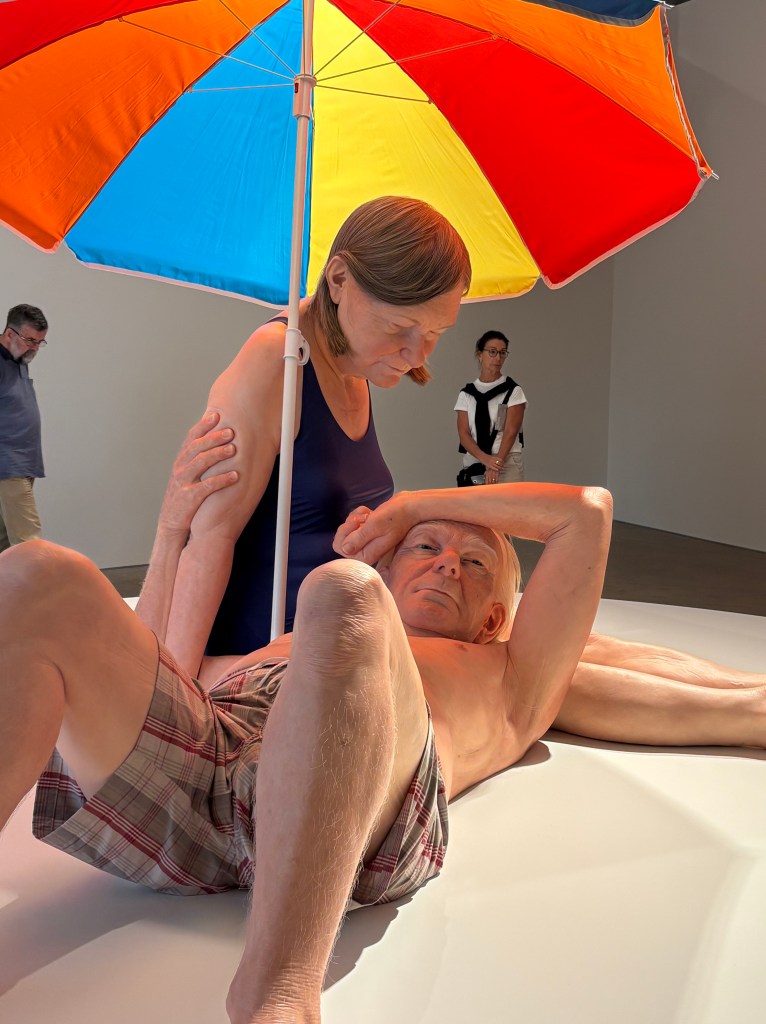
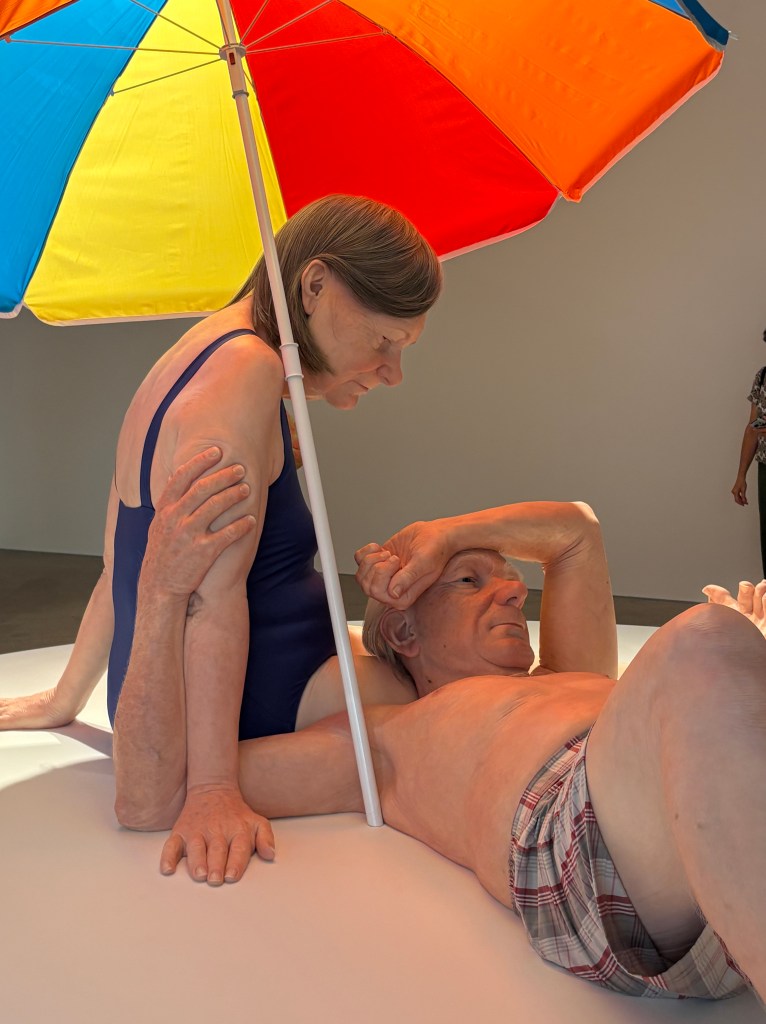
I liked this a lot. There is an accustomed fondness in their posture while at the same time they have expressions with the ambiguous vacancy of older people. (Oi! Are you with us? Oh yeah … just drifting off a bit. What was it you were saying again?) And they’re at the home of somnolent reflection, the beach. Sort of. Really they are quite emphatically in an art gallery. And they’re not leaving. They are so definitively motionless.
Christopher Allan, ‘The Australian’s’ distinguished art critic, always worth reading, uses seven-eights of a long piece to reflect on the evolution of the figure in sculpture on his way to concluding: ‘As hyper-naturalistic models, …[Ron Mueck’s pieces, which he is reviewing] are without peer. But as sculptures, they have little interest or really even presence.’
He chooses a long and scholarly route to get to this point, but his signposts are these.
• ‘Art, as a form of aesthetic understanding, arises from reimagining and remaking the world in an alien medium. The beauty of art is inseparable from the distinctive character and even resistance of the materials employed: it is hard to carve wood or marble, and the finished work will have the combined and complex character both of the subject and of the wood from which it is carved, uniquely embodying the intelligence and skill with which the act of understanding has been achieved. The trouble with Mueck’s material is that is entirely malleable, offers no resistance and is devoid of character.’
That’s an unusual idea arriving from a mysterious place. It suggests that art works should be judged, among other things to be fair, by the materials they are made from. Paintings, for example, might be valued by whether they are constructed out of oil paints, acrylics, water colours or, more testing, collage. Given the astonishing amount of effort that goes into his work, I think Mueck would argue at some length about whether his wide-ranging materials ‘offer no resistance’. And, in the unlikely event that we were challenged to do so, I think we would have no trouble in recognising his material as ‘alien’. I’m sure that art does arise ‘from reimagining and remaking the world in an alien medium’, but that’s not saying much apart from ‘art is something made’. We know that.
(And a bit of an ‘Australian’ give-away: ‘When you are making things as literally naturalistic, both in superficial appearance and in attitude, as his young couple in shorts and thongs, there is no room to play with the masses and volumes of the body, or to think about expressive action and gesture beyond the most anecdotal and banal level. The fact that the figures are dressed in ugly mass-produced clothing makes it even harder to do anything interesting with the figure.’)
• To his second point: ‘The very essence of the classical style, in fact, lies in the delicate balance between artifice, ideal proportions and the naturalism of real bodies. And generally speaking, later masters of sculpture, from Donatello to Rodin, have sought a similar balance, even if they have found it at different points. In sculpture as in painting, we recognise a work as both a product of human artifice – an object of bronze or a pattern of brushstrokes – and simultaneously as the evocation of something in the world. We never forget, nor do we want to forget, that we are looking at a statue or a picture.’
I don’t think anyone looking at Mueck’s work would be tricked into thinking that they weren’t ‘statues’ or, for that matter, were ‘real’.
Christopher could have just said, YUCK, as do some friends of mine whose opinions I value.
I do think Mueck’s works have interest, both individually and collectively, because of the layering of meaning I’ve referred to, the something else that is almost always there. Like Allan, I think his more recent work — the dogs and the pig wrestle — are not as interesting as his earlier pieces. They are a little like the ground announcer at a tight football game telling the crowd to ‘make some noise’, an unnecessary plunge into obvious-ville.
And there it is. You can make models and there’s not much going on. You see dogs and go Wooooo, genuinely applauding Mueck’s skill and the computer that helped make them. But that’s it. I’m with Christopher there.
Or you can make sculptures, like the spooning couple or the ‘Big Man’, which make you want to look again to grapple with their fine-grained subtleties, and I have no difficulty finding triggers for that in most of the works in this exhibition.
There. And I’ve got paid nothing for saying so. Until next time …
 mcraeblog