BEING RICH: Singapore

‘NDP’? ‘National Day Parade’ which will occur on August 9th. This is May 24. You will never convict Singapore of being underprepared, not for an event like this anyway. I am standing just above where the Prime Minister and his associated dignitaries will sit. In time the white expanse will fill with spectacles. (In the background, the three towers with a boat on top, is the Marina Bay Sands.)

It is special this year because it is the 100th anniversary of Lee Kuan Yew’s birth. LKY: First Prime Minister 1959-1990, ‘Minister Mentor’ of Singapore (the fist behind the throne?) from 2004-2011 and still a member of parliament when he died in 2015. Some political history. Has any leader lasted that long — 56 years — in and around the nucleus of power in a country that gives democracy quite a good go?
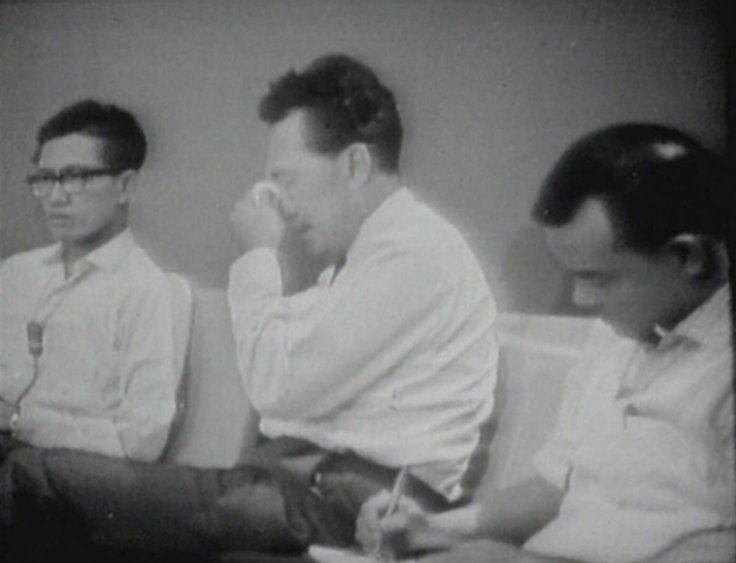
We watched him break down in tears as he announced that, yes, Singapore really was leaving Malaysia. The Parliament of Malaysia had voted quite decisively, 126–0, in favor of a constitutional amendment to expel Singapore from the federation. ‘For me, it is a moment of anguish. All my life, my whole adult life, I have believed in merger and unity of the two territories.’ And then he asked the television cameras to be turned off and because it was 1965 (on the 9th August), and perhaps because it was LKY asking, they did.

He must have been left wondering just what on earth was going to happen to his country. It had an important and busy port, but no natural resources, no capacity to feed itself, issues with water supply and no obvious prospects.

• • • • • • • •

We were in the National Museum and absorbed by the story of Singapore it told. It had always had a port and been important for that reason having a commanding position in the Malacca Straits, the main shipping route between China and India. But over the centuries the source of its governance had wavered: Indonesian (which of course was not Indonesian but most commonly Sumatran or Javan), Siamese and other groups from the north, not always Malayans who appear to have only settled their peninsula a matter of several hundred years ago and have often not been the dominant group. And Chinese. There is strong evidence that Singapore, or Temasek as it has been known for very much longer, is the oldest known Chinese settlement outside of China.

In the early 17th century it got caught up in the wars between the Portuguese and the Sultan of Malacca and was utterly destroyed, ‘sinking into obscurity for two centuries’ as one history has it.

When Stamford Raffles displayed interest in 1819, the port had a population of just a few hundred and the whole island less than 1000. He was interested because it would provide a deep water port with fresh water and supplies of timber for refurbishment of British vessels seeking to increase their leverage over the Dutch as well as providing a haven from pirates on this major trade route. Raffles had a proposition which — coupled with a number of events which included kidnapping and bribery, standard colonial fare really — induced Sultan Hussein to grant the British the right to establish a trading post on Singapore (together with an annual payment to him of £5000).

And, an intimation of things to come, Raffles decided that, to increase usage and to undercut Dutch trade restrictions, the port should be duty free. Over the subsequent decades it became a busy entrepôt, a port where a cargo could be purchased and trans-shipped to another destination — and above all, a place where business could be done.

And, for the National Museum, this is really where the story begins.
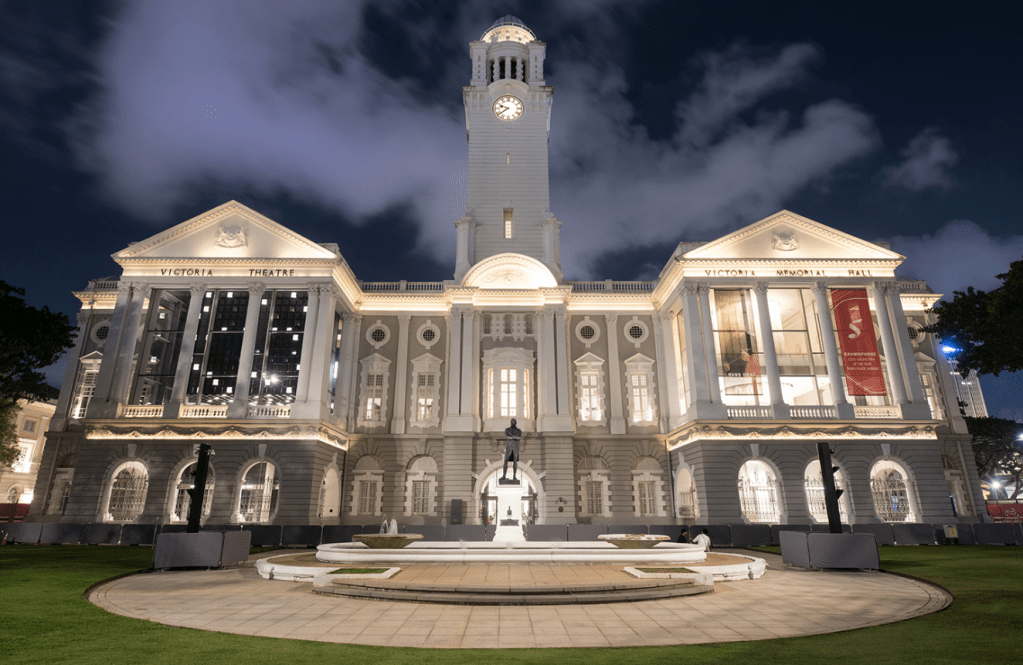
Raffles, who has a rather grand statue in front of what is now the Victoria Theatre among many other forms of recognition including the eponymous hotel, was only there for six months. William Farquhar took over. His portrait in the museum suggests a rather stiff Scotsman wearing a uniform which would be impossibly unsuitable for a tropical climate.

Farquhar probably had a difficult row to hoe because one standard gambit in colonialism is intervene, establish military supervision, then forget. He was left with very little income from acceptable sources and so sold licenses for gambling and the sale of opium and turned a blind eye to the commerce in the slavery which was taking hold. The conventional view is that during his tenure things went bad. Raffles returned three years later for an inspection and was disgusted. He drafted a set of new policies for the settlement, which included the banning of slavery, closure of gambling dens, the prohibition of carrying of weapons, and taxing what he considered to be social vices such as drunkenness and opium-smoking. He also laid out a plan for the physical development of the colony.

That’s one line of thinking. More contemporary evaluations suggest that it was Farquhar who built the foundations and Raffles was just a noisy show pony with better connections in England. Regardless, Farquhar was dismissed and his place taken by John Crawfurd who, it really could be argued, did all the hard bullocking work. It was he who negotiated and signed the Treaty which gave the British access to the whole island.

In a region that howled ‘Merdeka, merdeka, merdeka’, independence, independence, independence, not so long ago, I was taken by the near affectionate prominence given to the British and their 150 years of control in the Museum’s display. LKY was educated at Cambridge, and it might be important that the largely Singaporean actors in the film ‘Crazy Rich Asians’ have British accents.

There were Chinese living here before the British became formally involved, but immigration driven somewhat ironically by the Opium Wars increased their number quite rapidly. By 1870 Singapore’s population had reached nearly 100,000, more than half of them Chinese.

Jump. It’s after WW II. The Japanese have come and gone, senior partners in the process of knocking things about terribly. The colony’s infrastructure has been devastated. But a common enemy has helped to cement a sense of unity among the disparate Singaporean ethnic groups. Trade through the port has slowed to a crawl. Tin and rubber are keeping a very patchy economy afloat.

Jump. It’s 1963. Despite worries about internal security and ‘the communist threat’, political independence from Britain has been granted. Next question: should Singapore become a part of Malaysia, already an amalgam of a number of states? Various parties had their reasons. The British thought that this would be a more likely bulwark against the communists (who had recently become more prominent in Singapore). Singapore’s politicians, those in favour — including LKY, a very committed advocate — thought that there would be economic and political advantages in being part of a larger country. The dominant Malayan party, UMNO, thought that this would mean that the Chinese influence in Singapore could be offset.

A referendum is held in Singapore. An option to vote ‘No’ is not included on the ballot paper. Nearly 30% of the returns are left blank in protest and almost all the remainder vote for Option A which is to join Malaysia but with full autonomy, the most arm’s length of the options. Joining was not a popular move.

Jump. But not far. It’s 15 months later and the Malaysian Government has just passed Article 153 of the Constitution of Malaysia, still operative, which provides for ‘safeguard[ing] the special position of Malays’ and goes on to specify and establish in law ways to do this, such as establishing quotas for entry into the civil service, and discriminatory access to public scholarships and public education. Although in the last few centuries the Bumiputra (‘sons of the soil’) have always been the largest racial segment of the Malaysian population (about 65%), their economic position has tended to be comparatively precarious. Thirteen years after the establishment of the constitution and the discrimination in their favour, they controlled only 4% of the economy, with much of the rest being held by Chinese and foreign interests.

LKY was furious about the passing of Article 153: ‘The Malay have the right as Malaysian citizens to go up to the level of training and education that the more competitive societies, the non-Malay society, has produced. That is what must be done, isn’t it? Not to feed them with this obscurantist doctrine that all they have got to do is to get Malay rights for the few special Malays and their problem has been resolved.

Jump. Only a few months later. There have been race riots in Singapore. People have died. There is uncertainty among some senior Singaporean politicians about the benefits of remaining in the federation. The Malaysian Prime Minister Tunku Abdul Rahman decides that Singapore must be expelled. The Malaysian Parliament votes. 126-0.

At the time Singapore’s unemployment rate is hovering round 12-15%. There is a housing crisis, the education system is a mess, lack of sanitation creates rolling outbreaks of serious diseases, a predatory Indonesia threatens intervention … no wonder LKY wept during the announcement.

What to do? Encourage foreign investment with tax breaks, build industrial parks, establish the world’s largest suite of oil refineries, the busiest port, one of the busiest airports, deregulate the labour market, engage the Israeli army to help build a fighting force, crack down on public and private misbehaviour (no drugs, or chewing gum, in Singapore). In short become a poster child for the theories of Hayek, Friedman and other proponents of runaway capitalism.

But with a proviso … with massive state intervention. The largely ethnic Chinese government knew what it wanted and set about getting it.

Public housing was built like crazy, a strong reliable and competitive education system was developed, a sophisticated and up-to-date post-school training apparatus was put in place, there was almost uncircumscribed expenditure on infrastructure. (Try the subways! Credit card check on and off.) Cleanliness was instituted as a heavily promoted public good. A lot of work was been put into encouraging you, countryman and visitor alike, to behave in a way which is generally thoughtful and considerate of others. (Current population: 5.454m, 75% ethnic Chinese.)

Paternalism? Sure. But the product is stable, secure and, in some instances, simply and obviously awash with money.

The Marina Bay Sands

Luxuriate in the ultimate lifestyle with unparalleled views and unforgettable experiences.

Revel in unparalleled views at Singapore’s luxury hotel and lifestyle destination. Newest Room Collection. Access to Infinity Pool. World-Class Dining. Luxury Shopping. A landmark of modern sophistication, Marina Bay Sands is Asia’s most iconic destination for chic city-stays. We bring the world’s best entertainment, culture, food, nightlife and experiences right to your door.

The project is more than the sum of its buildings, it is an entirely new urban sector of Singapore, a vital district that is connected with nature, interactive, of a human scale, and climatically sustainable. The seamlessness of indoor and outdoor public space is a hallmark of Marina Bay Sands and a major factor in its success. ($S8b is the quoted value.)
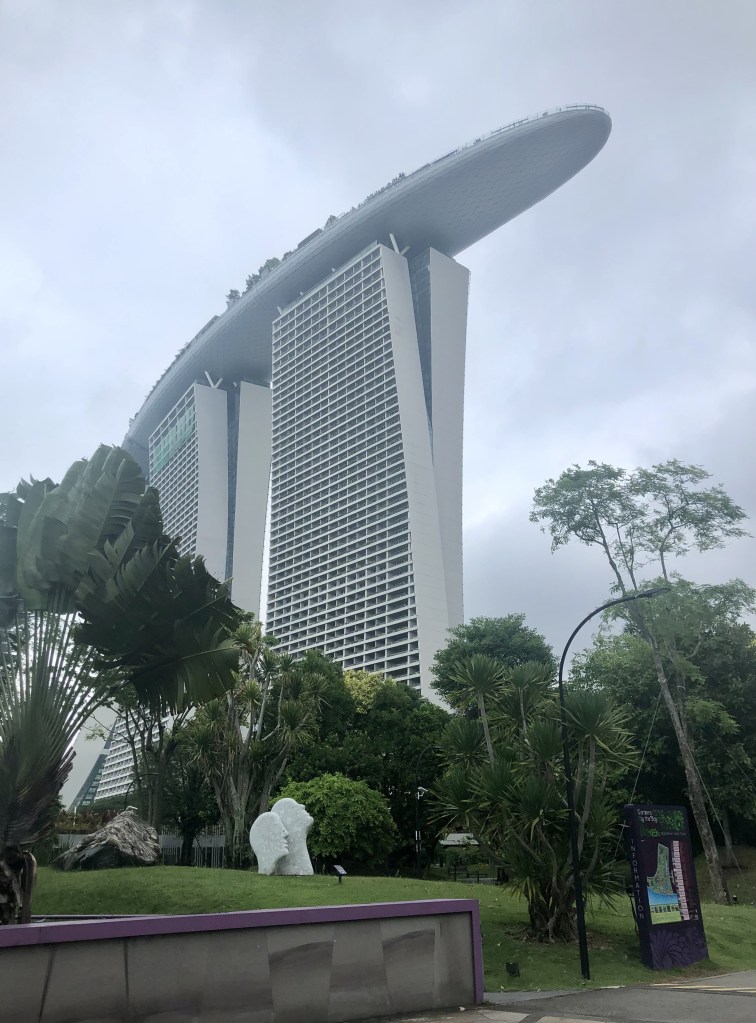
Bottom end $729 a night. Top end. Well, toppish end that you can get anywhere near, $2975pn but that of course is with the $100 food voucher. However I can’t even find a price for the Merlion Suites (387 sq m, bigger than most people’s houses), ‘set on the 50th floor and up, offering panoramic views of Gardens by the Bay and the Singapore Strait. Apart from a private butler to heed your every need, your experience includes a bespoke cocktail experience, complimentary massage for two, and a complimentary round-trip limousine ride.’ I just cannot find a price. How do I book?

On its 56 floors, the MBS has 2561 rooms, 230 of which (all of them really) are out of reach of you and I.

On its 57th floor is ‘an expansive and lush 2.5 acre garden skypark which includes gardens, restaurants, a one of a kind infinity edge pool, and a public observation deck, the longest occupiable cantilevered structure in the world’. Here’s the pool. (It will be self-evident perhaps that these are not my photos.)
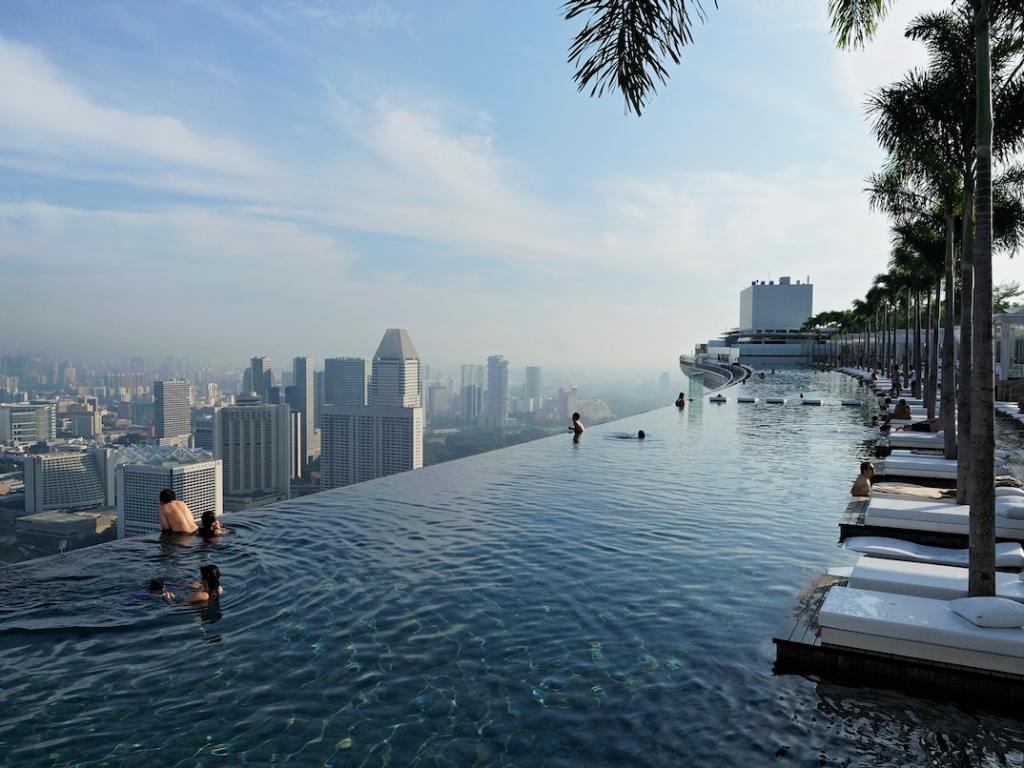
You might have seen this in action in the closing scenes of the film ‘Crazy Rich Asians’. Entirely appropriate. There’d be some arrangement I imagine to stop you toppling over.

I bow low before the architects and every single person involved in the construction process. Who was it I wonder who had their tools out on the prow of the longest occupiable cantilevered structure in the world when it was under construction? A collection of heroes. You would need more than a head for heights.

I had additional thoughts. Just a couple of things.

Each tower is ‘double-loaded’ by which I think is meant that there are two bits which embrace each other eccentrically about 5/8s of the way up. Each ‘front’ sea-facing tower is heavily curved which means you can’t put lifts in them, so every time you want your butler, they (pronoun neutral) presumably have to come up the other tower and walk briskly across the walkways attached to the atrium to heed your every whim. That would inflate the ‘heeding’ time a bit. But … ppfft … nothing.
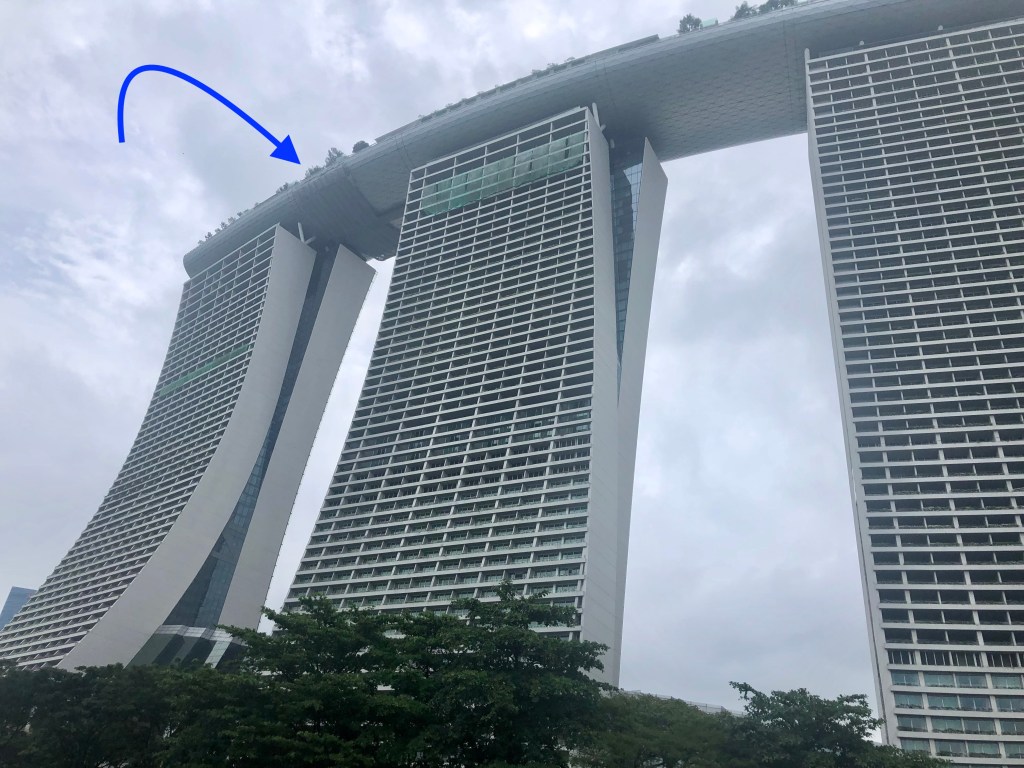
However as we approached I did notice that rather like the ‘Endeavour’, as Lieutenant Cook steered it to safety through the shoals of the Great Barrier Reef after it had been holed, the high-flying ship has been fothered (blue arrow). However, running a canvas rig round the hull might be in keeping with the nautical theme. It may possibly have foundered on the reef of unwarranted expectations, or some portions of gold bullion (see ‘Alan’ below) may have slipped and punctured the infinity pool.
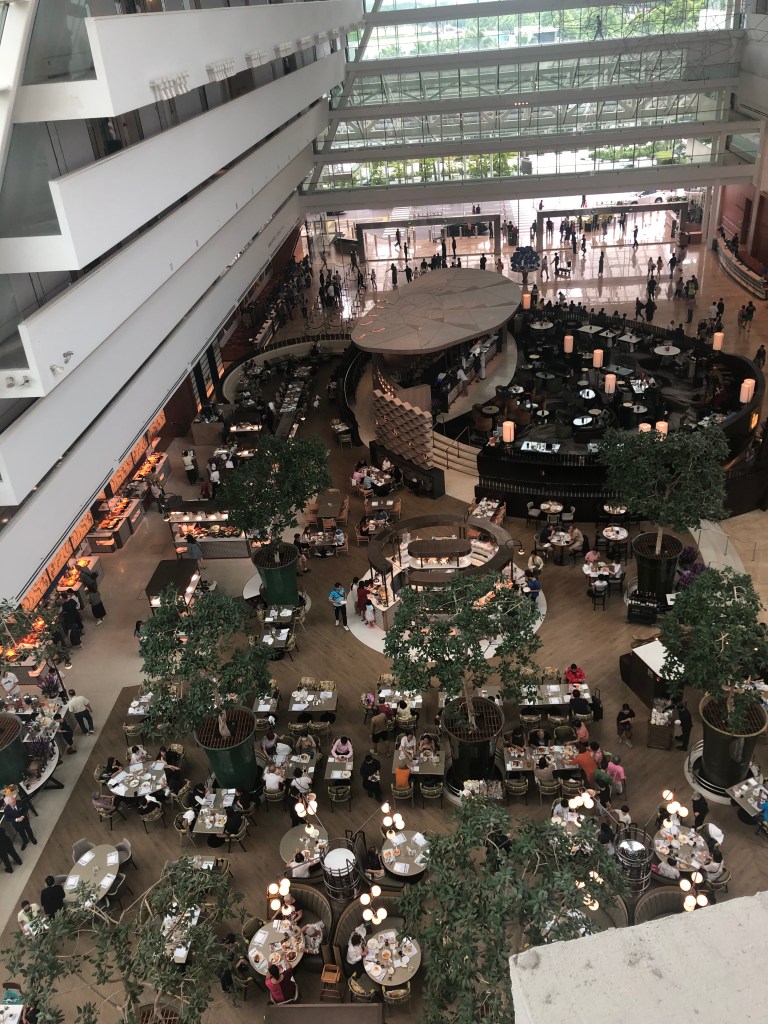
There is a public walkway through the atrium at about level 10 and you are able to watch, enviously, all the action below. (How would you cool that area I wonder; it’s more like the interior of a major pyramid than an atrium.) The walkway takes you towards the ‘Shoppes’, and if you want high end anything you’d be able to find it there. PLUS you can pay to have a ride up and down a 75m bath in a sampan.
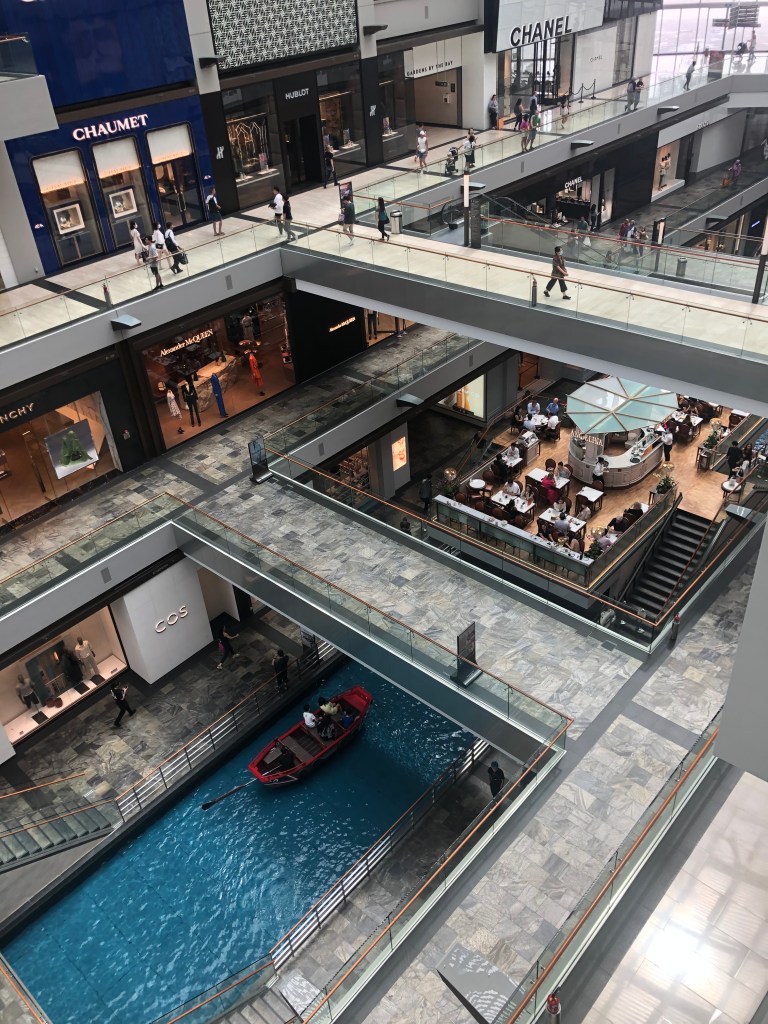
I got this glimpse as I got out the other side of the atrium and I found myself having a febrile narrative construction experience. (I haven’t mentioned it was very humid.)
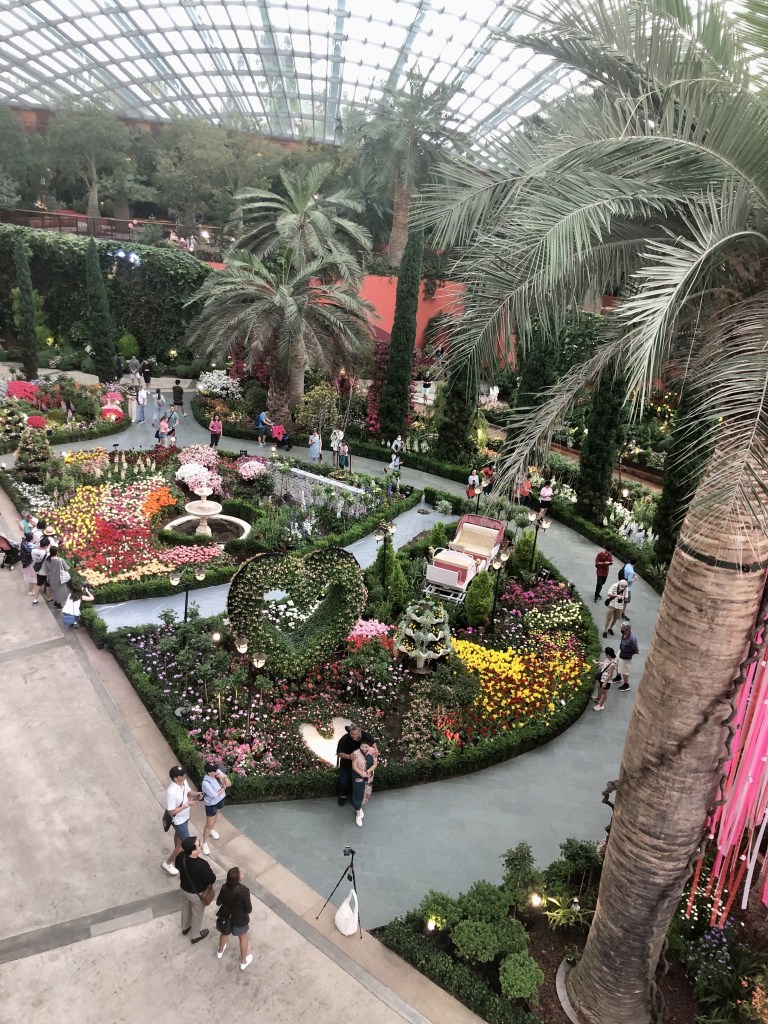
So, you pull into the harbour on the cruise ship. Mass-scale limousine service to the atrium of MBS. Dig in at the all-day buffet. Think seriously about the bespoke cocktail experience, but decide to save it for later. Electric cart to nearby Flower Dome (at left). Take selfies in front of the love heart and join the crowd who for some completely unintelligible reason pile gravel on the top of the cactii. (Just … why?) Return to MBS. Lift to heavily cantilivered observation deck. Take in sights. Wet toe. Go to Shoppes and think of buying some Moncler sneakers (below) for $S1875 but for some reason hold off. Laters. Enjoy the bespoke cocktail experience with the all-you-can-eat evening meal. Sleep, exhausted. Take mass-scale limousine service back to the boat, and Bob’s your uncle. You’ve done Singapore.

And so, finally, you can join the customers of Philipp Plein (not ‘plain’, ‘full’) and become as one with them.

Another reason for going to Singapore

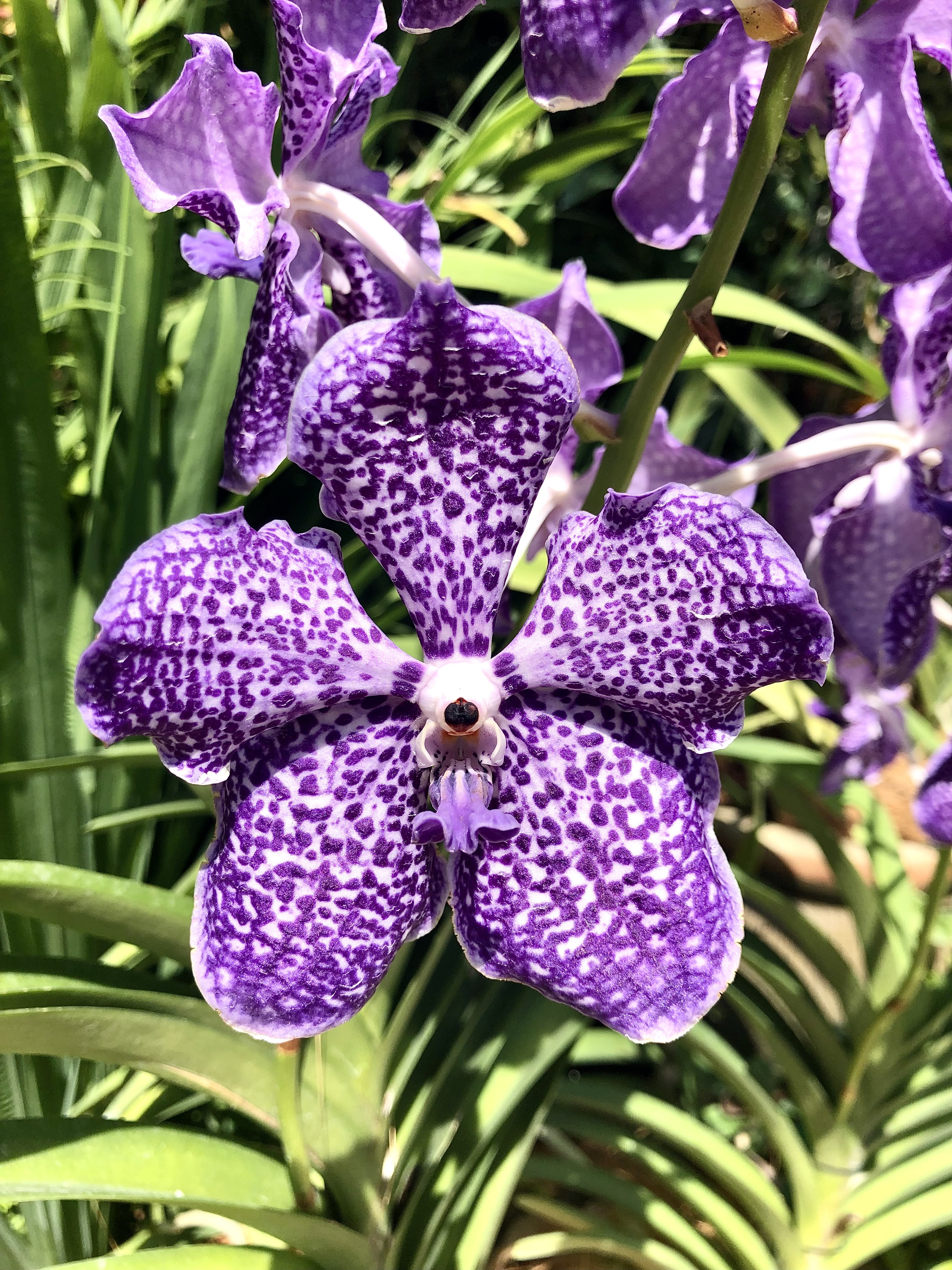
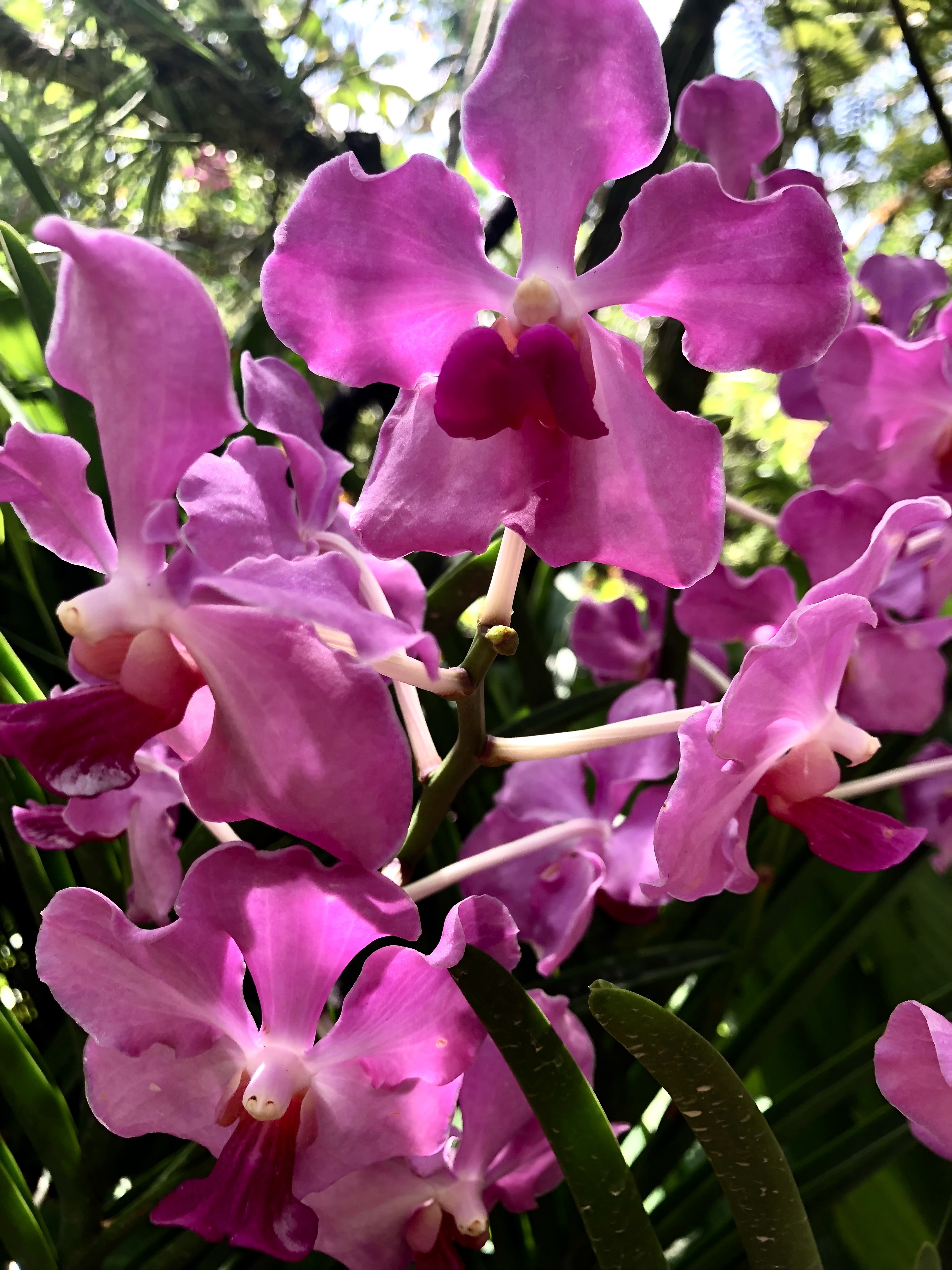
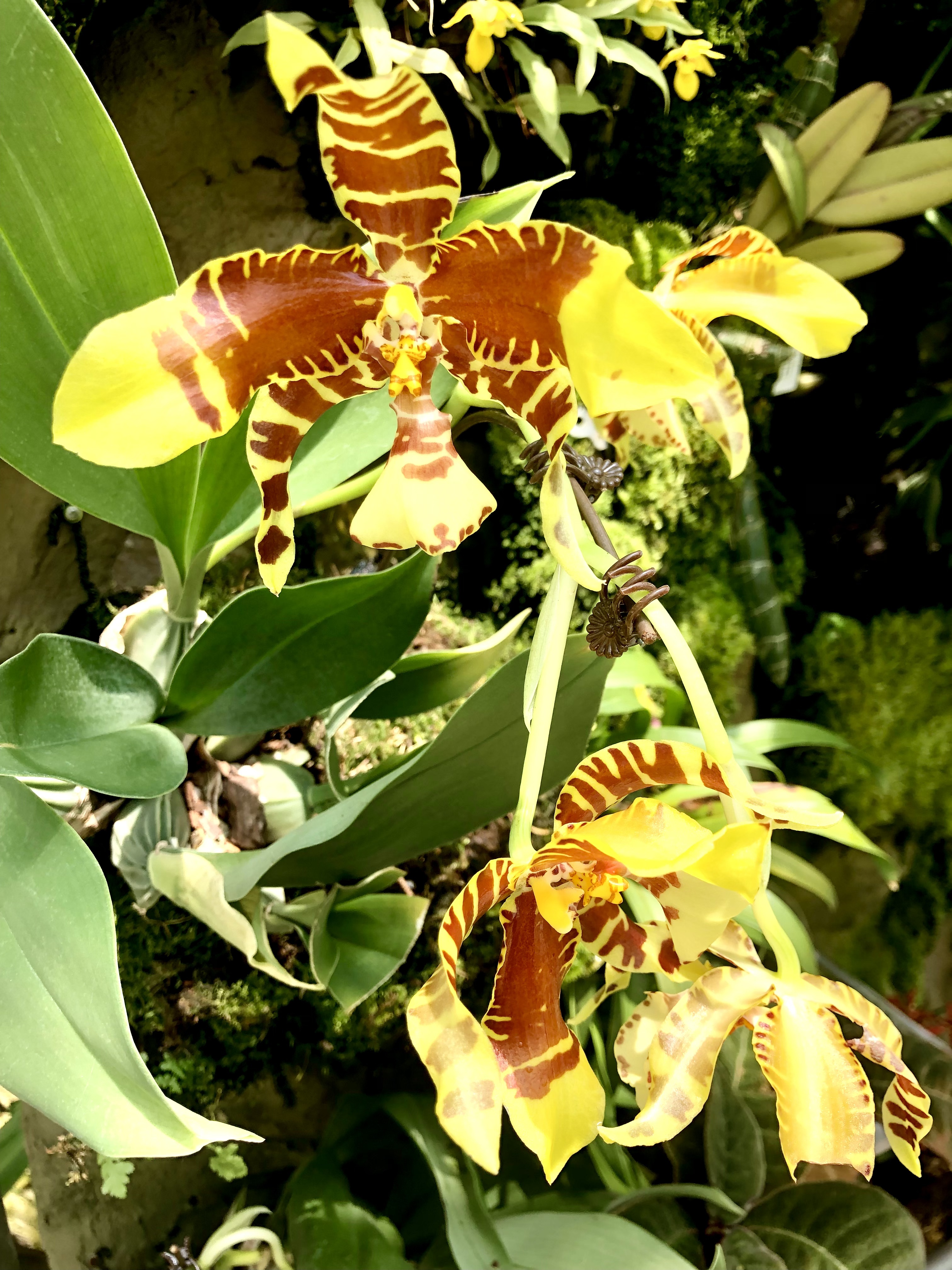
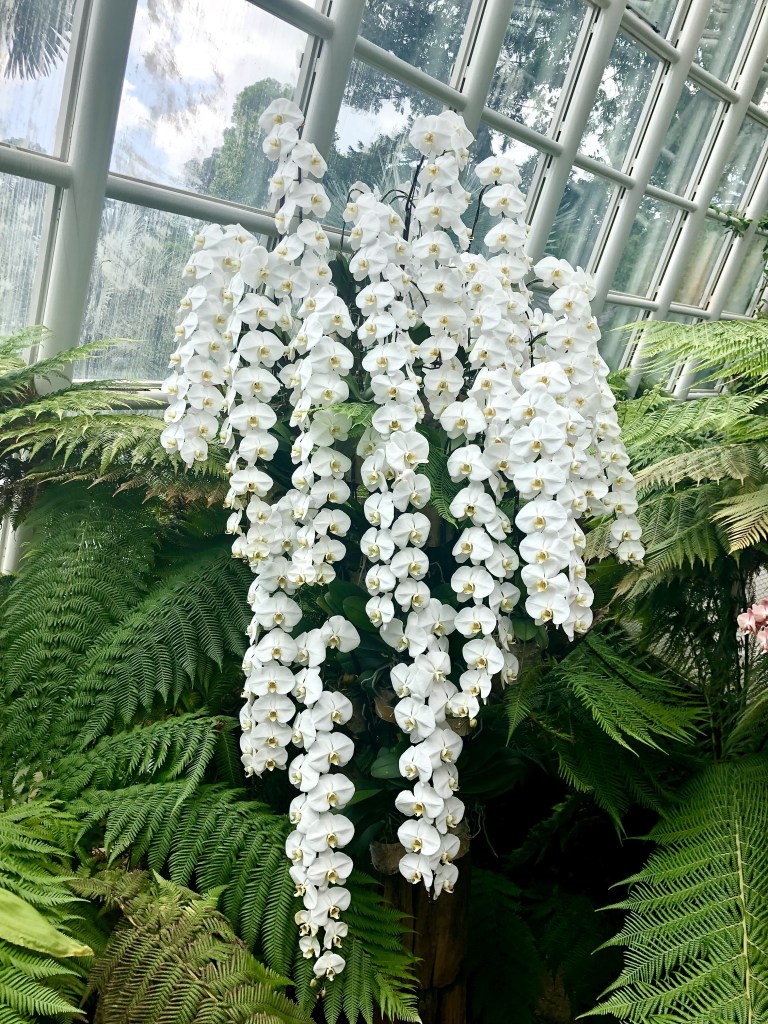
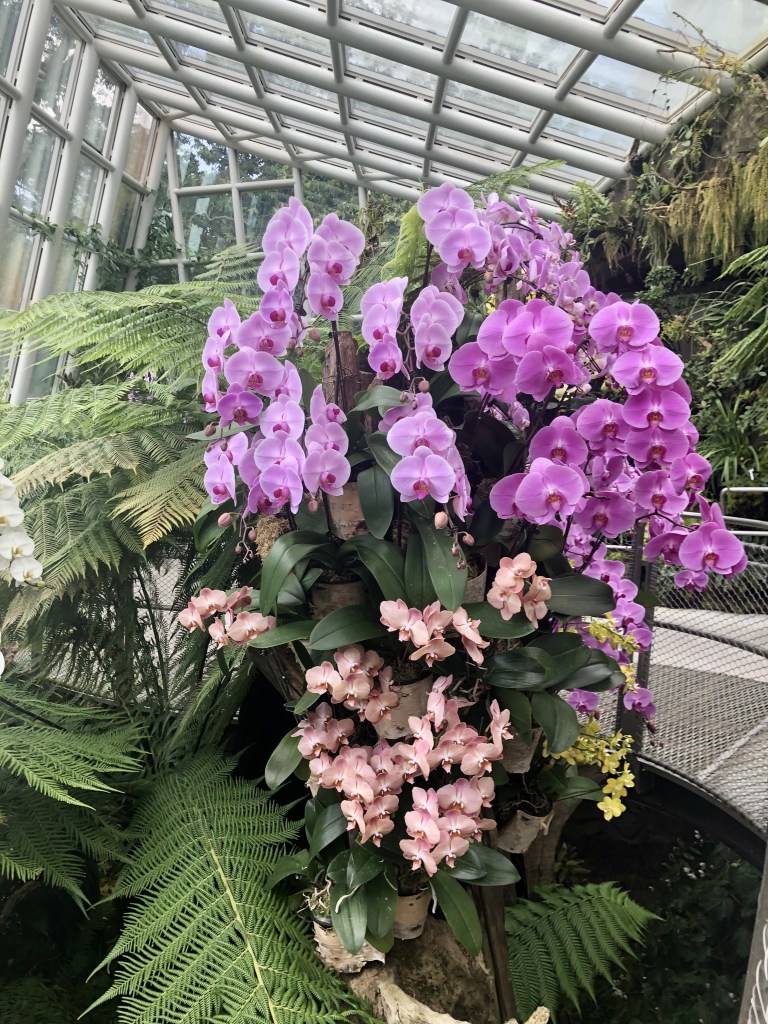
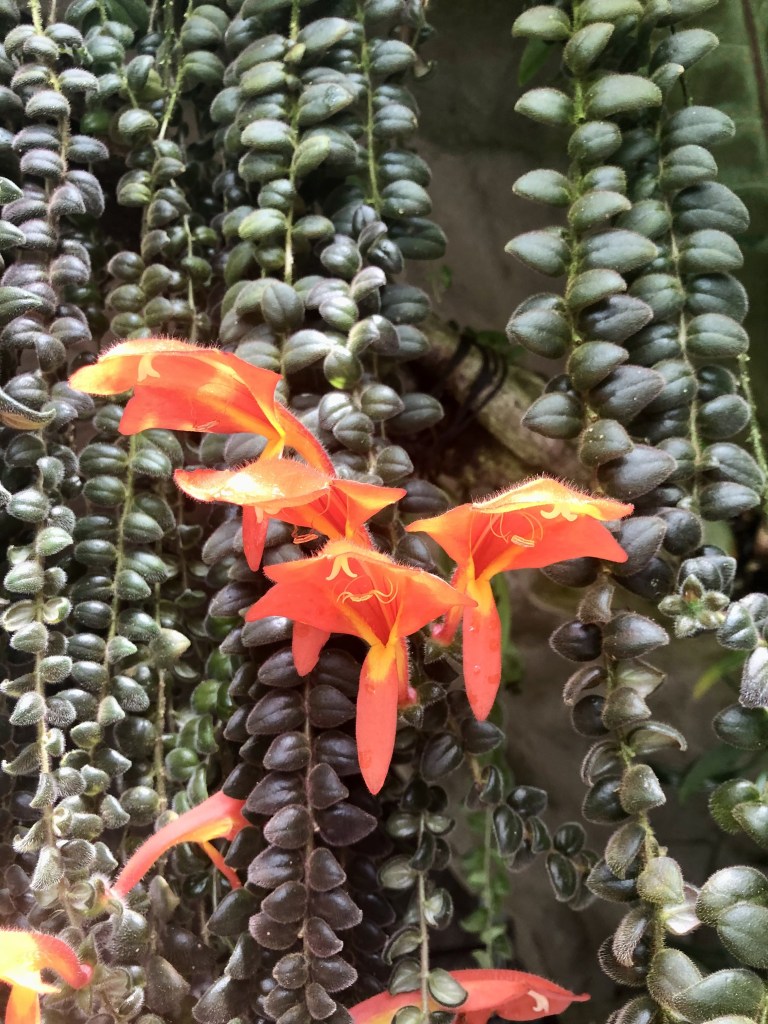
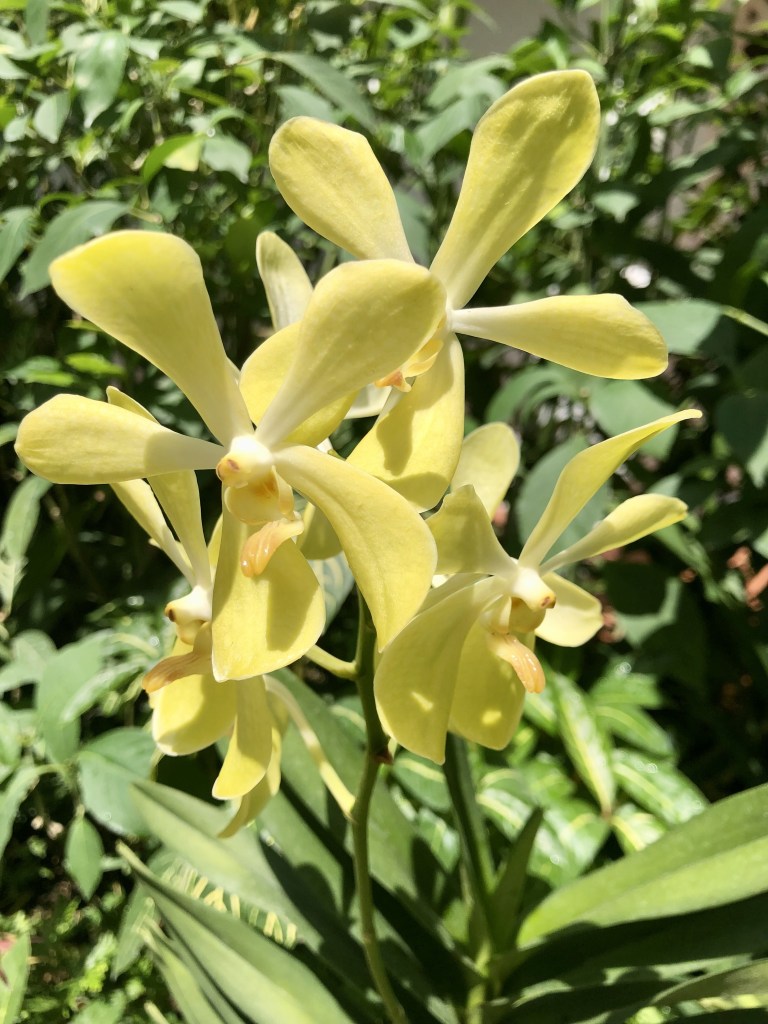
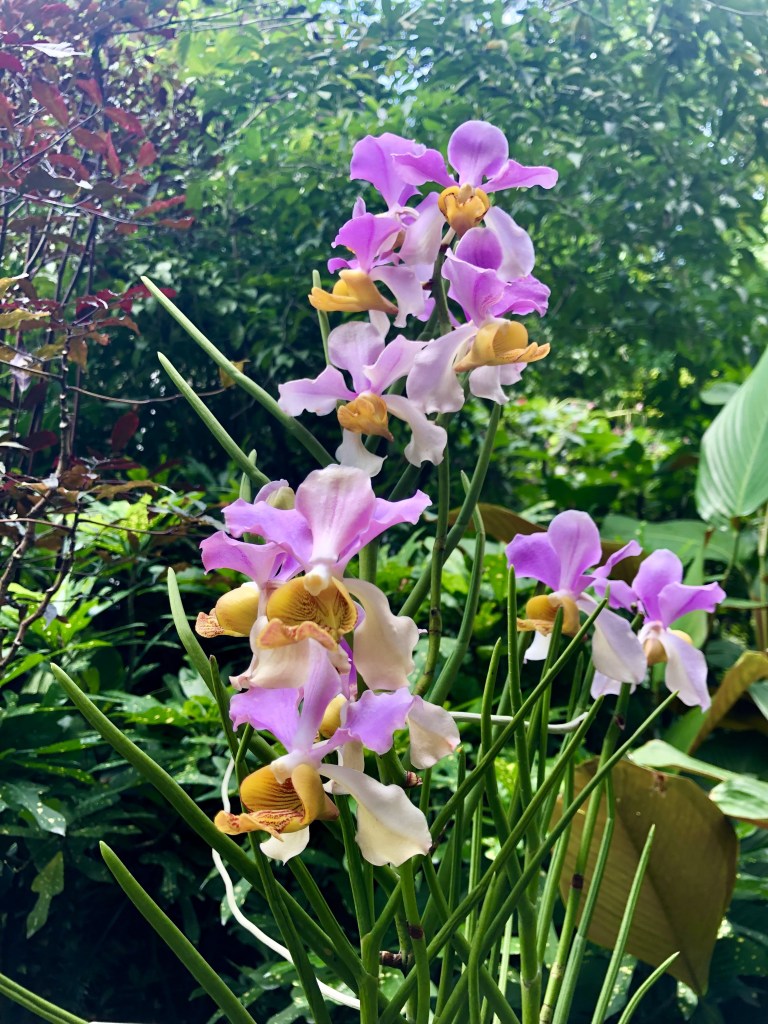
A visit to the Orchid House in the Botanical Gardens.

You can click on any of the images below to make them full screen.
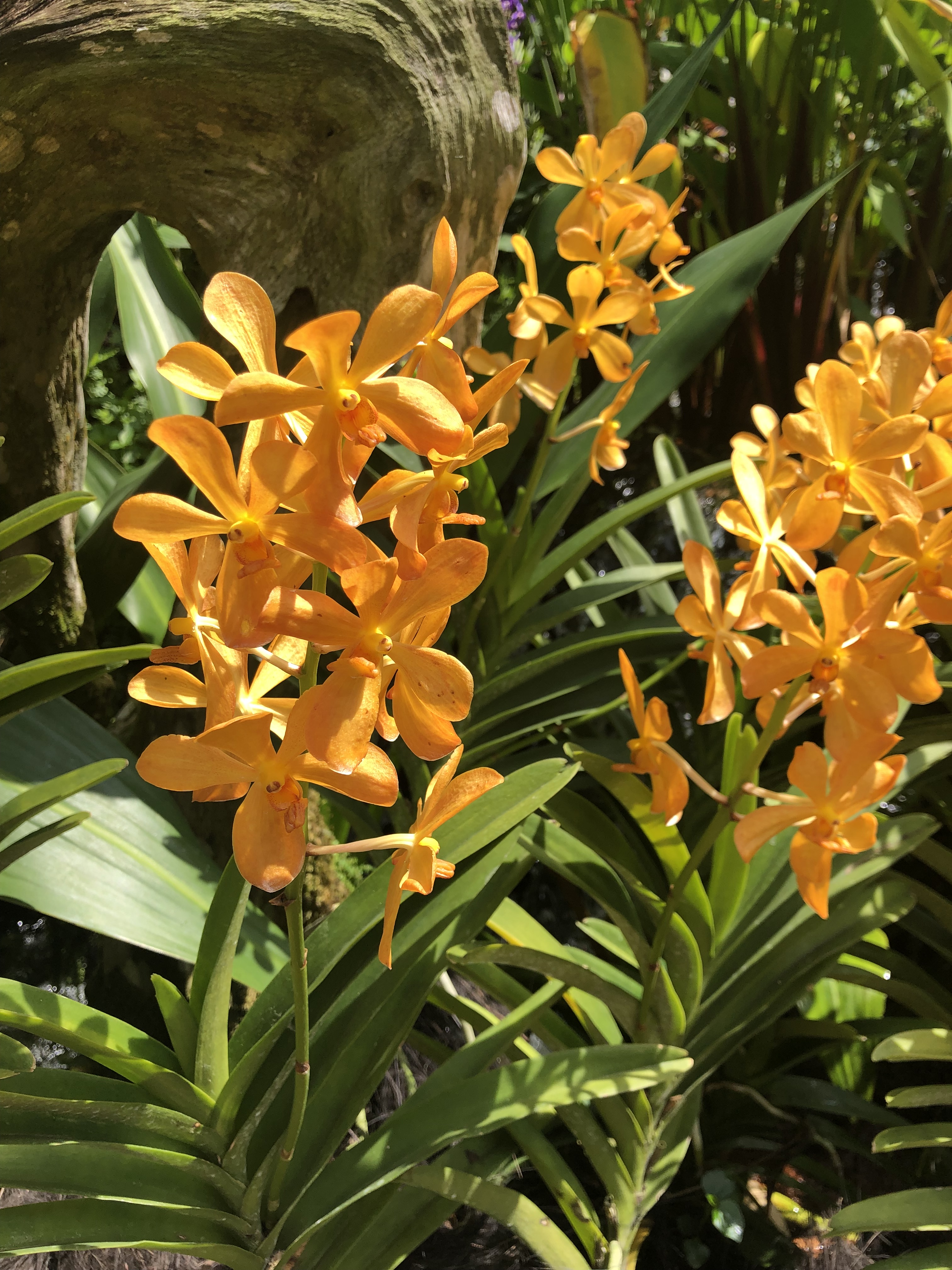
Orchids (Orchidaceae) are the second largest family of flowering plants in the world with about 28,000 species. If New Guinea, which has more than 900 endemic species, is included in Australasia, which is geologically and historically reasonable, they emerged from Australasia.

They are distinctive because of the fusing of the male and female parts of the flower (the ‘column’). Either side and below the column all of them have three lateral petals set above three outer petals or sepals. The lower lateral petal is the ‘lip’ modified to provide a platform for insects.

This one has an unusually big lip, almost a basin.

They can grow in cascades.

Or more modestly.

And I love them.

Singapore takes them sufficiently seriously to grow new strains and name them for visiting world leaders. Thus …
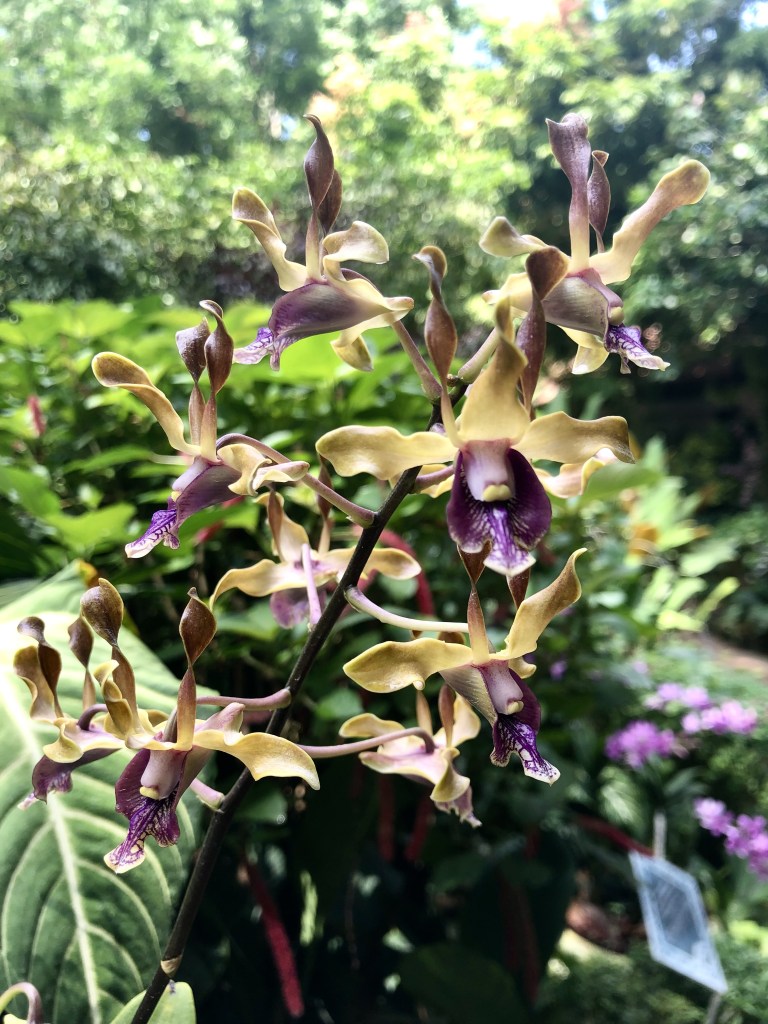
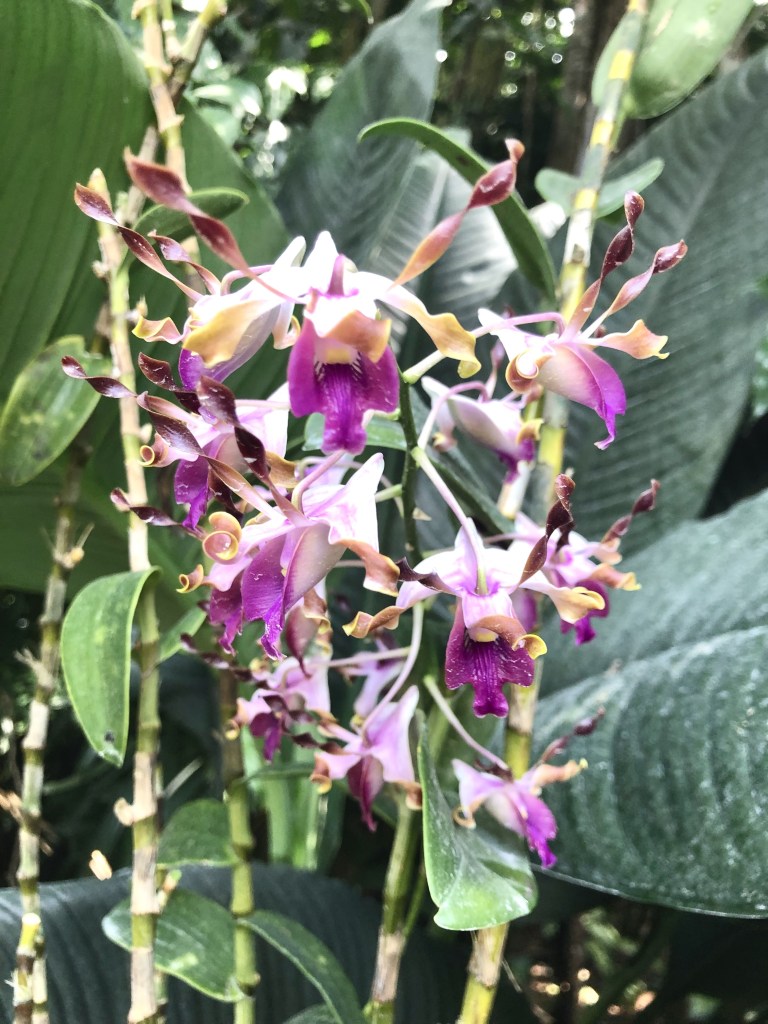
And, DAH DAH, just in the last few days … the Albanese.
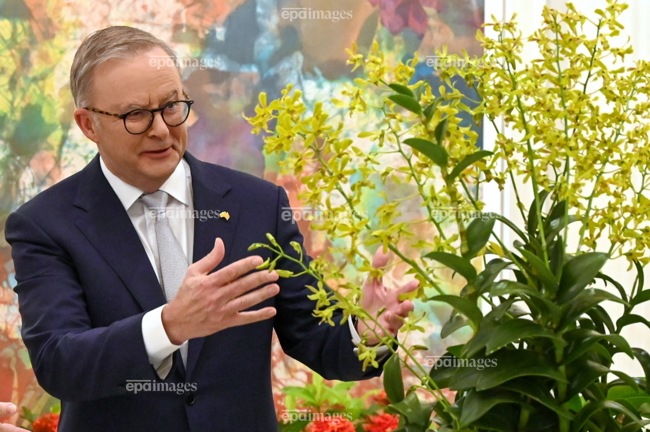
Alan

Alan drove us from and to Changi airport. He was a brisk and cheerful young man with a pony tail, and extremely well organised. Before we arrived he sent me the entry forms for Singapore to fill out and post (digitally) so that arrival would be as speedy and easy as possible. He sent me directions and photos of exactly where he would meet us. (‘Just in front of Heavenly Wang.’) And there he was. Precisely. He charged a fixed price which I had already paid and was extremely efficient delivering us to our hotel. I asked if he would take us back again.

We mucked him around a bit with our pick up time for departure which he absorbed with equanimity. The only issue was that he had to do another job, but he would be there as close to our agreed time as he could. He arrived exactly on time because the other pickup had not turned up. He had waited the stipulated time, 40 minutes, but no show. He didn’t mind terribly. He’d done his best — advice, texts, photos, directions — plus he’d already been paid. Does that often happen? ‘Sure. These women come to Singapore from other parts of Asia, Pakistan this woman, to make some money — you know what I mean — and their papers are no good, can’t fill out the entry form, want to stay for longer than they’re allowed. They get taken into a back room and who knows when they get out. Maybe three hours, maybe tomorrow. Happens all the time.’

It had been Alan’s 11th trip to the airport that day. ‘Eleven!’ ‘Yeah. That’s what I do. 280 bookings a week. Booking.com.’ ‘Goodness. What sort of company does that? What sort of hours does it make you work?’ ‘It’s my company. I got 50 drivers, but I can’t get them all the time. So I drive seven days a week round the clock. No curfew at Changi.’ ‘It’s your company and you drive seven days a week?’ ‘Yeah, sure. Got to be reliable and my drivers got other jobs. Singapore you make money. So much money here.’

He went on to tell us that (Sir, but this blog does not as a rule recognise bestowed titles) James Dyson, the British inventor of the eponymous vacuum cleaner, had not long ago bought a five-bedroom penthouse — by repute, Singapore’s largest — in Chinatown’s Guoco Tower for $S73m (A Singapore dollar was worth just more than an Australian dollar when we were there.) A couple of months later he had sold it to Leo Kogan of Kogan electronics fame for $S62m dropping considerably more than 10 mill with transaction costs. ‘He didn’t care. It was nothing to him. He already got another little house in Bukit Timah worth more than 50 mill. But why do that? Why throw the money away? They have games these guys to see how much money they can spend. Indonesian rich guys all come here, Widjaja family, Tommy Hamami, they all come. Lot of money going round in Singapore. Do deals you know. Property, finance.’

[Footnote: Before moving to Singapore Dyson was one of Britain’s foremost advocates of Brexit. This was just before exiting Br himself. What’s sauce for the goose may not necessarily be sauce for the gander.]

‘I’ll tell you something. Give you a little tip. This is how they get around the border people. You can move money like this too.’ (Sure. Me and my billionaire friends.) ‘They get gold and melt it down into little pieces, but it’s got to be 99% pure. If it is the metal detectors won’t find it. They don’t react you know. They can’t read it! You know you can put it somewhere on your body and no one will find it.’ So there’s a tip for nothing. Why would you do that? I wanted to know. ‘I don’t know. I’m not one of them. But there’s always advantages in moving money round so no one knows.’ Our non-Booking.com ride was a cash deal.

Before setting up his driving company Alan had been in the Singapore army for 33 years, close to impossible I thought looking at him, and he’d risen up the ranks as far as he could go while maintaining his Malaysian citizenship. He was offered a senior rank but for citizenship reasons had to decline it. ‘My father lived here all his life and kept his Malaysian citizenship too. Now he’s gone back to Malaysia. Just across the strait you know. Not far. But he got old and couldn’t afford to live here.’ How old was he when he retired? ’72.’ And he can afford Malaysia okay? ‘It’s about one quarter, one third, the cost. Still eat well, live well.’ Alan could see a time when he might want to do that too, but that wasn’t the main reason for maintaining his citizenship.

‘I got a precision engineering company. Micro precision. I run it while I’m waiting at the airport. I sit in the car with my computer and do business. At the moment I am negotiating with a Chinese company for them to set up in Malaysia. The US boycott messed up their business. They dropped 80 percent, so they need their stuff to be coming from another country.’ Good heavens could be fitted in here somewhere. ‘You’re negotiating this now?’ ‘Yeah. Found the land. Nearly finished. Happen soon. Good business is quick business. Everyone happy then.’ We had a discussion about the value of precision engineering. Fundamental we agreed. The car wouldn’t go without it.

We got to the airport. Changi’s not that far from downtown and despite it being Friday night the traffic had eased, and we’d got through a lot in a short time. ‘I’ll make a lot of money’, he laughed, and he told us a story about his 10-year old son cheerily fleecing his mates. Too strong? Probably. Doing business with his mates. I’ve forgotten the detail but it was about delaying gratification through the resale of something he had. ‘He make 15 percent! Ten years old! We Chinese you know. We’re good at it.’

I’d had my wallet out to give Alan all the Singaporean cash I had, not much, but he deserved it all. About five minutes after he drove away I realised I’d left it in the car. But then I relaxed. Alan would know what to do with it. Like many of his compatriots he’s extra good with money.
WINE, RELIGION: Burgundy

The Cru

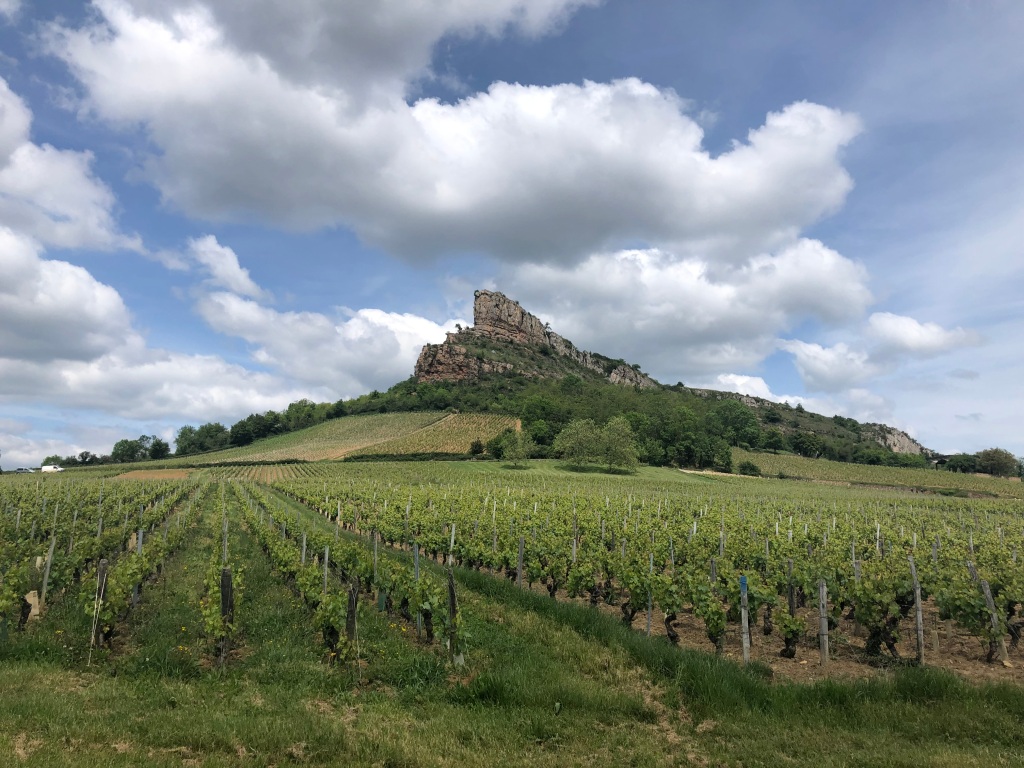
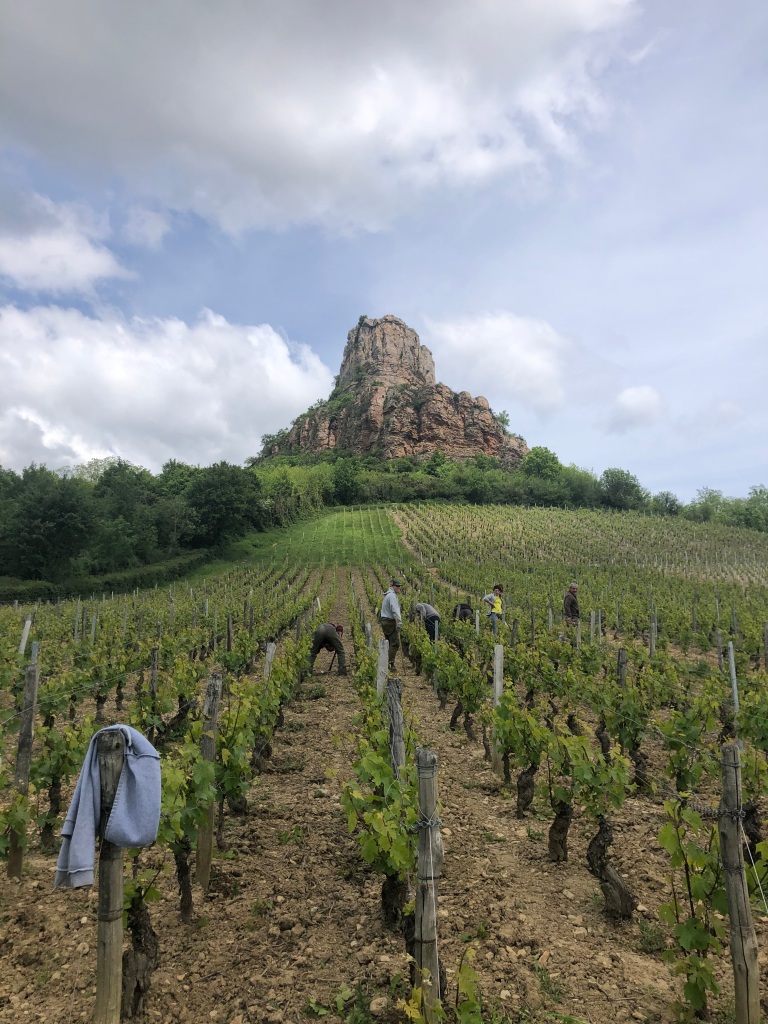
I am standing in Pouilly. A kilometre or so back round to my right is Fuissé. The combination of those names is likely to cause wine buffs to quiver.

I am also standing at the foot of La Roche de Solutré, a dramatic limestone crag. It is unusual in the gently rolling hills of Burgundy but not completely isolated. There is another crag, La Roche de Vergisson, a few kms to the north albeit with fewer features and less definition. This roche however, has interesting archeology, historical horses, a host of birdlife and a museum. It also has a very generously sloping track up which you can stroll for the wonderful views from the summit.

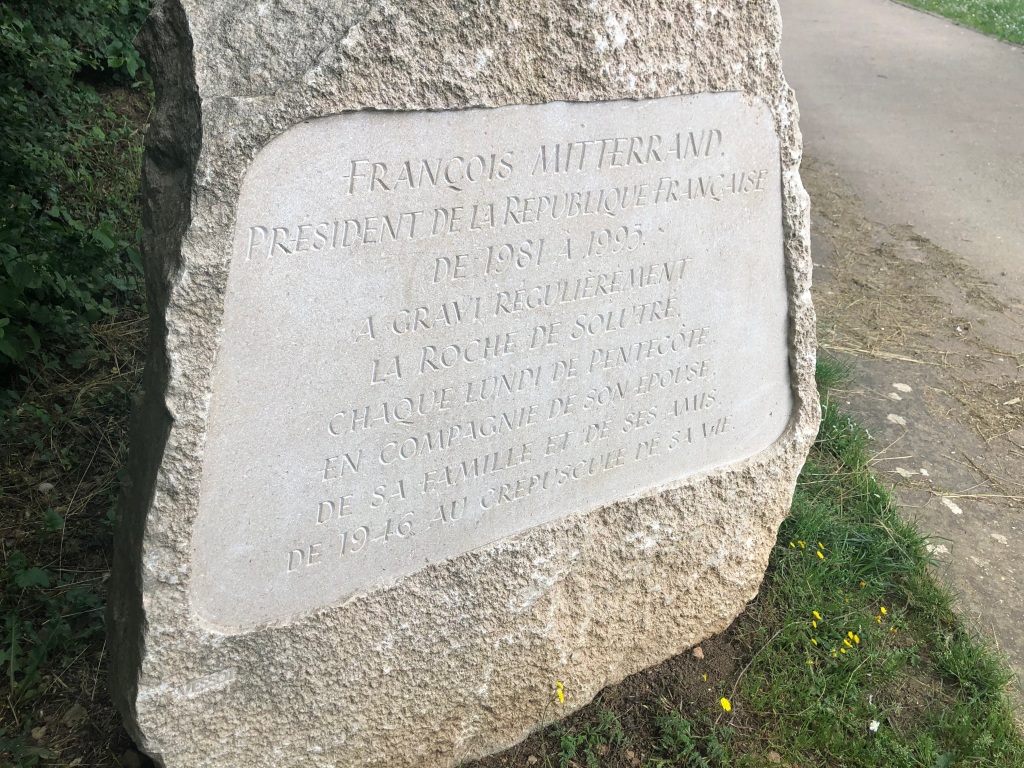
We are here because our friend Andre has wanted to trace the steps of Francois Mitterand’s annual pilgrimage to its summit. I think he said, ‘To see if I can pick up his vibrations.’ It’s the sort of thing Andre would say. (Click below to enlarge the photos.)

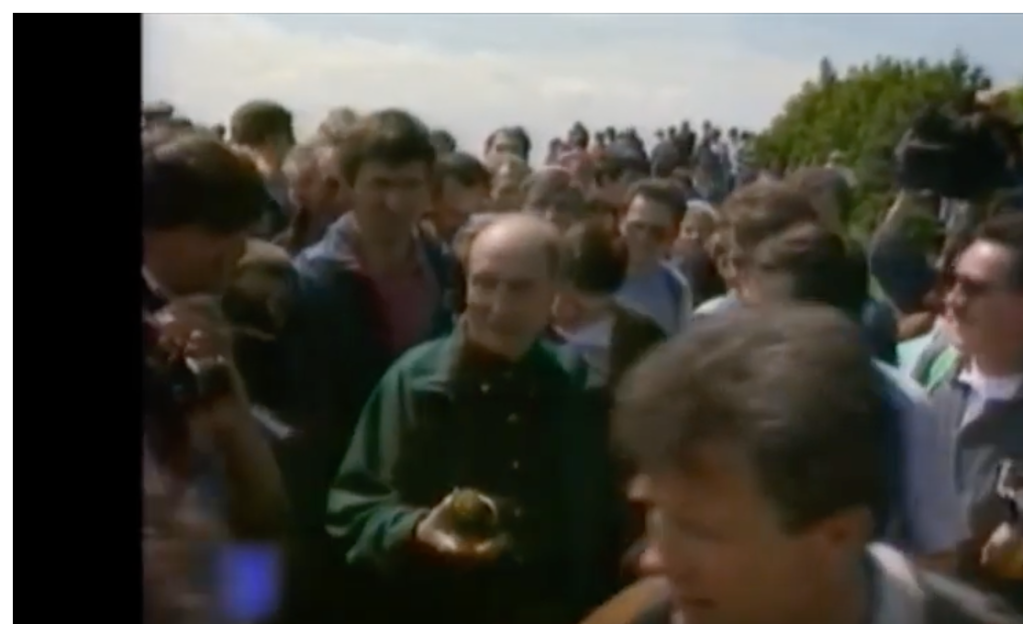
Andre is not the only one who knows about this. The text sculpted into the block says: ‘Francois Mitterand, President of the Republic of France from 1981 to 1995 regularly climbed La Roche de Solutré on Holy Thursday (or ‘Ascension Day’!) in the company of his wife, his family and his friends from 1946 until the twilight of his life.’ Video records suggest that these weren’t solitary meditative events but rather that his ‘family’ and ‘friends’ amounted to a substantial crowd, not to mention the scores of people with cameras, notebooks and sound recording booms.

In the first photo I am also looking at a grand cru vineyard. (Grand cru, ‘great growth’.) We are moving here into the region of heritage, sentiment and poetry. Burgundy has climats, but you don’t look up or check the forecast; you look down and rub what’s on the ground between your fingers. ‘Plot’ is a closer translation than ‘climate’. (In passing, Burgundy grows pinot noir and chardonnay with a small amount of gamay and very little else.)

But the source of the grand cru idea is straightforwardly commercial: how do you establish the price of a kilo of wine grapes? And, I believe, it only goes back to 1919 when it was introduced in Champagne as a way of managing issues of provenance and regionality and controlling the influence of middle men who were shaking down growers with no agreed basis for negotiating price.

The vines of each village or smaller defined areas (climats in Burgundy) were given a score ranging from 100% of the annually established ‘full price’ (also ‘grand cru’) down to 22.55%, nameless and rare. It wasn’t long before the vast majority of the Champagne harvest was assessed as being above 80%, although to be in the 90-99% range, premier cru, was still rare and 100%, grand cru, only ever a tiny proportion of harvest. Formally at least, this all came apart under EU rulings in 1990 that centrally indicative prices were incompatible with a free and fair market. (Surely grounds to prompt a Frexit? Surely.)

Generalisations are difficult as each wine region established its own differing criteria and procedure for establishing levels of cru. There was, however, a detailed list of the criteria used historically to define the various crus of Burgundy in the wine museum at Beaune (‘scientific’ in the classic French mode), and I am trying to remember what was on it. Pente was number one. I do remember that, ‘slope’, and I think 5-8 degrees from horizontal was required for grand. ‘Minerality’, ‘aspect’ and ‘drainage’ were three others. So it’s not the grapes; it’s the terroir. Primarily. I think grand and premier cru growers may have been required to have their own chateau and cellars in Bordeaux. Only a tiny number of climats in the long limestone crest of Burgundy where wine is grown were ever designated grand cru.

It might be what the French have instead of superstition.

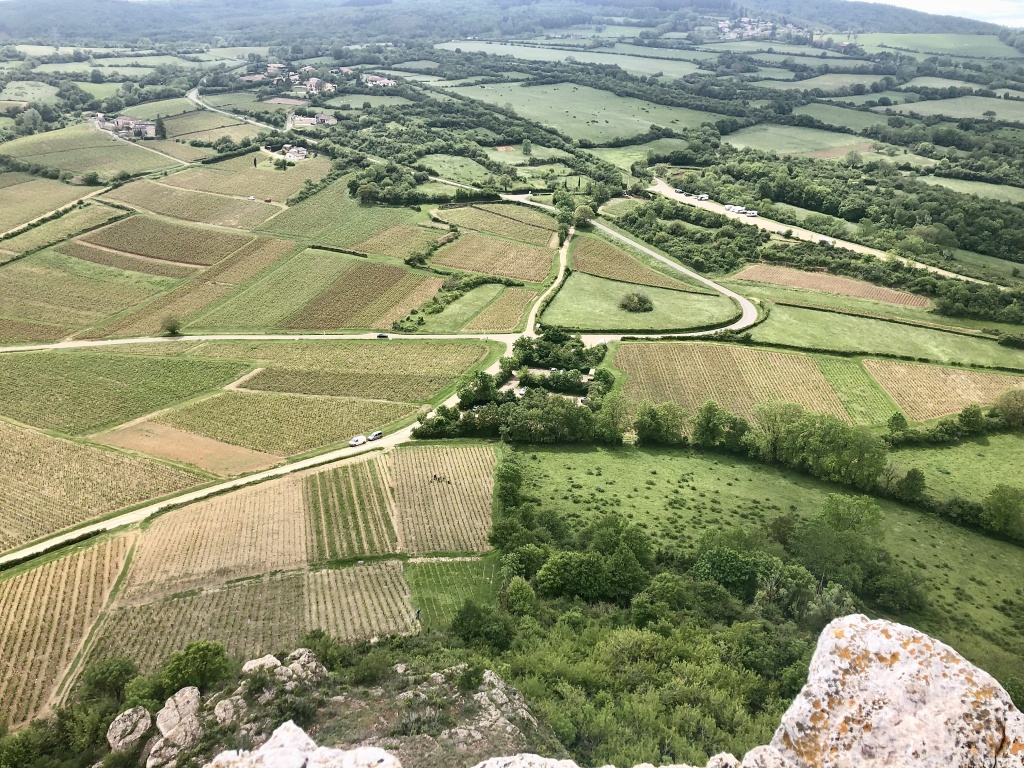
Grand cru (but of course only a tiny portion of the landscape in the photo) from the top of Solutré

In the first photo I am also looking at a crew tending the vines, still hard at it in the photo immediately above as I notice now. We saw hundreds of these gangs as we drove through the north-south extent of Burgundy. It’s May. Only May I am inclined to say. Harvest will not occur until some time late September/ early October. The muscular knotty trunks of the vines have been pruned over decades and longer to 40-50 cms; the first trailing runner is at present about 60-80cms long. Others are emerging, but only one will be cosseted. And these vines are cosseted. Like pets.

No single person or company will own the entirety of those plots. They will own six rows here and three rows there, another 14 in a plot elsewhere. The elderly maps in the museum recognising this fact contained a maze of information necessarily at a very large scale. We watched a film that suggested that, in some cases, each single vine will be known by their owner and expectations established accordingly. The vendage, the harvest, is a national event. It can be ruined by rain or variations in humidity. The phase of the moon will play its part. As I suggested, wine might be what the French have instead of superstition.

We drank three fancy bottles of wine. The Pommard 2014 at ‘L’Ardoise’ was from what has been a premier cru domaine immediately to the south of Beaune where we were staying. Had something interesting to say at every point and was deeply satisfying. The chardonnay from Meursault (Domaine Michelot, 2018) the next night was like a universe in a bottle. Just so much going on. This is one reason why people like wine: it can be such an organic stimulating almost living thing. In Strasbourg to celebrate our 50th wedding anniversary we had the most expensive, a cab sav from Bordeaux because Andre thinks they’re the best. It started with a bit of promise and at the end left a light mineral note. But in the middle was a gaping void.

One Meal

We weren’t engaged in a visite gastronomique, but with Andre and Robin for company — Andre to dream, describe, categorise, evaluate and generally go on about, and Robin to make it happen — you are likely to eat well. We had two excellent meals in Beaune at L’Ardoise, ‘The Slate’. We were there on the weekend of a public holiday, so joining the throng really. Several dozen restaurants with the cream of the alternatives booked out. Beaune and its vineyards — and its eateries — would always be a popular destination for domestic travel in France. Later we had a very good meal at a golf club near Hagenthal Le Bas. In fact we went up a hill to get there so it might have been Hagenthal Le Haut. Hmm, now I look it was in reality the Basel Golf and Country Club. No wonder it was so posh. It had the advantage of a wonderful view. As did the Krafft Restaurant on the banks of the Swiss side of the Rhine in Basel next day.

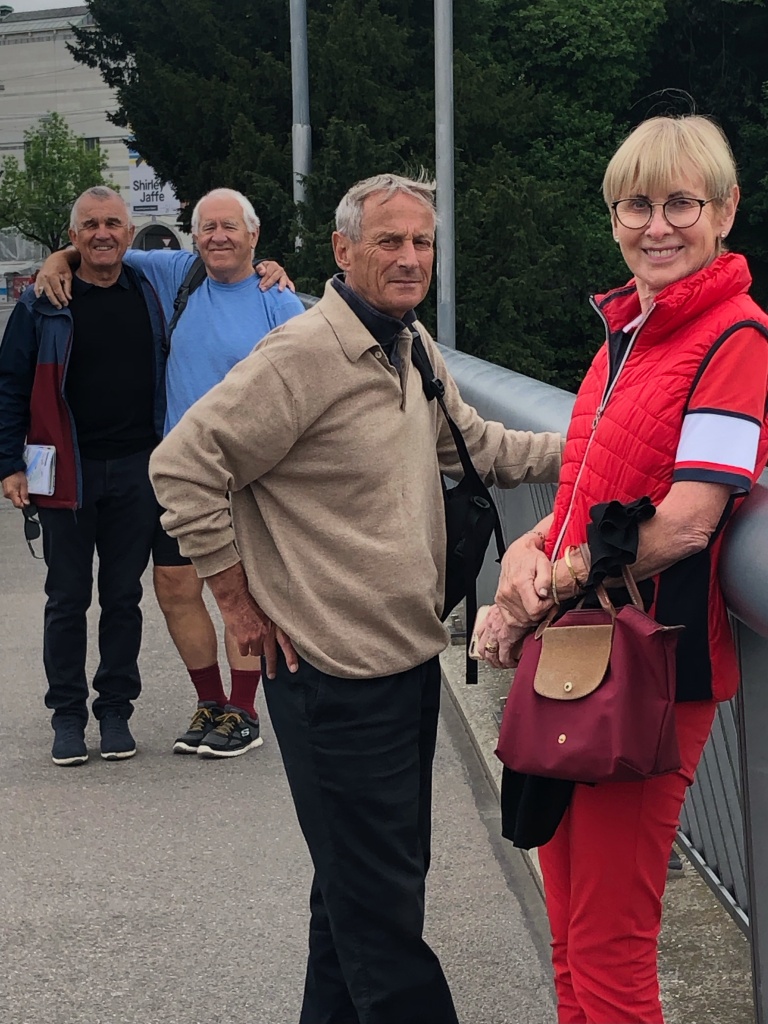
And here we are on the bridge over the Rhine on our way there, squinting into the sun coming from the French side and looking just slightly malevolent. Hungry. That’s my excuse.

There were also some very good meals on the walk. But I think the one I most enjoyed was one of the simplest.

We were staying in Beaune in the top floor and mezzanine of a very old building the ‘Chancellors Garden’ which provided access to a small but pleasant deck.

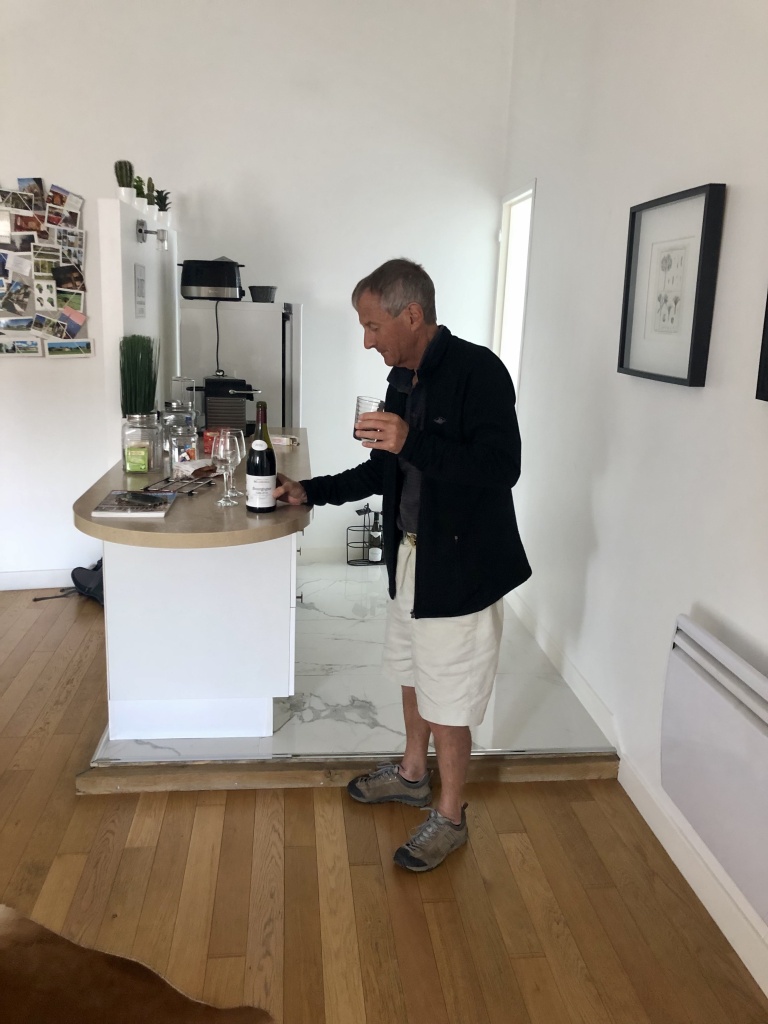
Michael had found a good bottle of pinot and some baguettes. Andre had scoured the super market for superior cheese and cold meats bringing home a wide selection of both. We had bought some fruit and cakes. And we sat in the sun and ate, drank and talked.

The food and drink were extra good but it was the talk that made it memorable. A serious and knowledgeable account of why the Parliament of Europe was an important body; the ways in which democracy could be under threat; the early attempts at town planning in Paris, Grenoble and Melbourne and what that meant for community action, and bureaucracy, at that time; whether or not the set of values that we grew up with were still pertinent or even in existence. Serious, well-informed and interesting talk. You don’t get that every day; I don’t offer it that often. It was just one of those moments.

Saint Martha

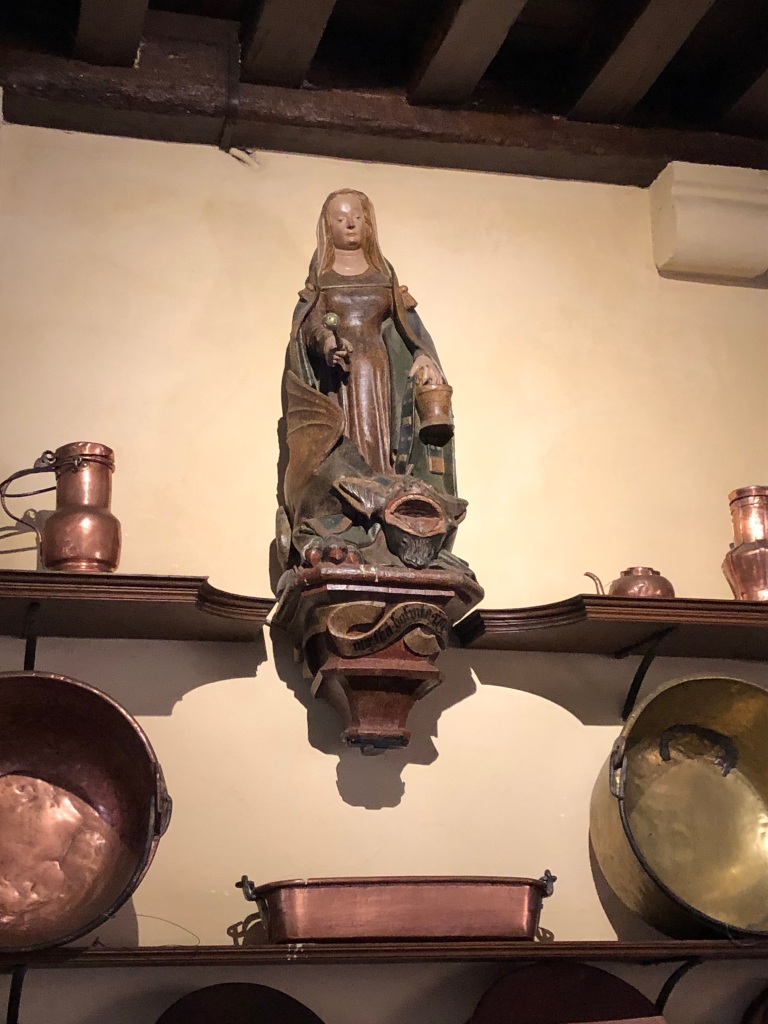
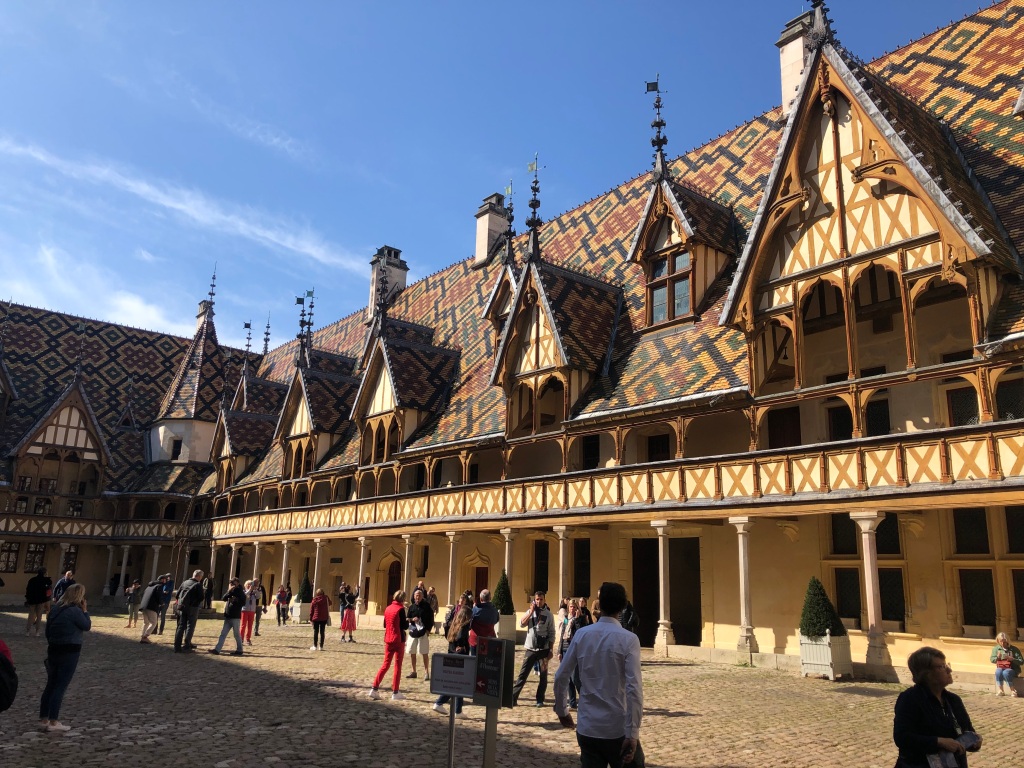
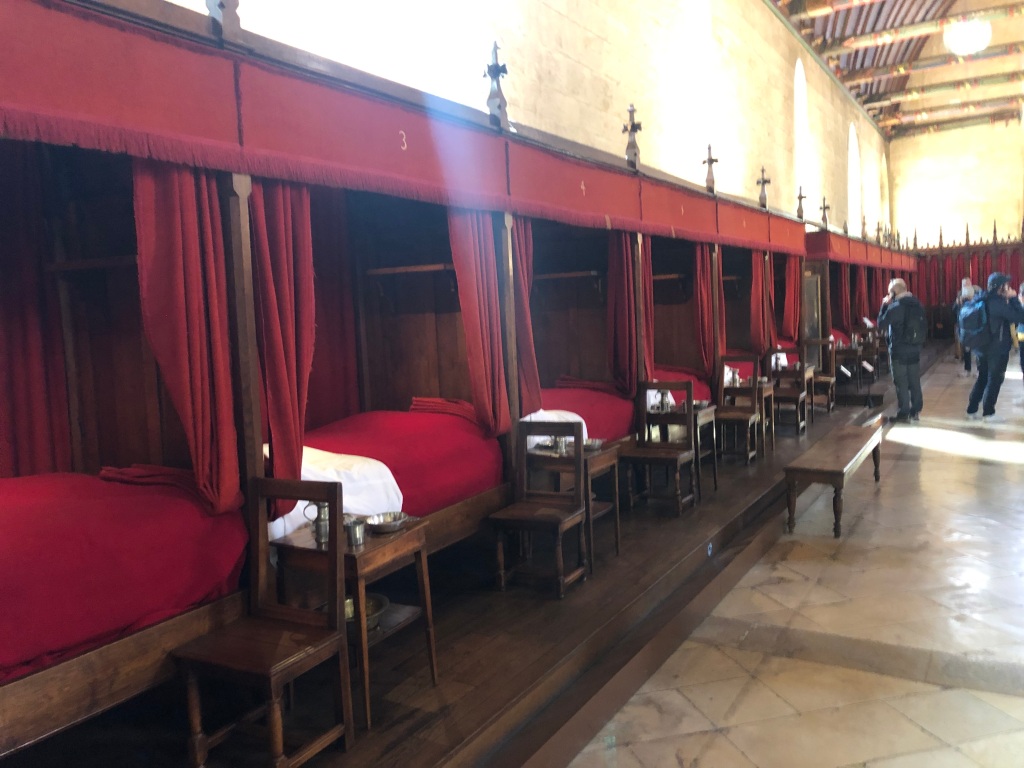
This is a matter of some importance. It is Saint Martha, an exciting discovery at the Hospice of Beaune. The Hospice is a 15th century building realising the fine intentions of the region’s chancellor, Nicolas Rolin, and his wealthy wife Guigone de Salins, to more systematically care for the sick.

Saint Martha! This is like the bootstudder of a mid-table club winning the Brownlow. There will be those who have known about this situation all along, but I’m not one of them. I’ve always had a soft spot for Martha and not just because of my very positive disposition towards domestic labour. I’ve always thought she got a raw deal.

Luke 10, from verse 38:

Now as they went on their way, [Jesus] entered a certain village where a woman named Martha welcomed him. She had a sister named Mary, who sat at Jesus’s feet and listened to what he was saying. But Martha was distracted by her many tasks, so she came to him and asked, “Lord, do you not care that my sister has left me to do all the work by myself? Tell her, then, to help me.” But the Lord answered her, “Martha, Martha, you are worried and distracted by many things, but few things are needed — indeed only one. Mary has chosen the better part, which will not be taken away from her.”

In contemporary life this is always matched in my mind with an event which occurred years ago when we lived in the Grampians. A distinguished academic and his wife and family were staying with us and about 9 o’clock there was a call from the tent outside: ‘Bernie could you come and give me a hand getting the kids to bed please.’ A very sharp rejoinder. ‘Not now Mary. I’m on ideas.’

‘I’m on ideas’ has entered our venacular meaning, ‘I’m such a hopeless self-absorbed prick it’s almost funny’, and I’m afraid I’ve never been able to dismiss the idea that in the Biblical case the Lord may have been on ideas and that Mary was only encouraging him. They could have done the dishes first, and then got on ideas. But I have no evidence that this is a popular idea. I think the general run of thinking as well as the tendency of the story is: Yeah Mary. She’s got her priorities straight. Off to the concert/ ball/ party. We’ll do the vacuuming tomorrow. Or Mum will. And if she goes all long-suffering on you, mention the Lord.

And, lo and behold, in this grand household in Beaune, so emphatically embodying good works, here’s Martha being celebrated. Love that. Pleased. And if she’s rendered as very plain with what could be called a long-suffering expression on her face, what the. Realism is not a new movement in art. It’s a hospice. She’s probably been on the bedpans.

In fact, and this is the basis of her sanctification, in her day she successfully tamed a ‘monstrous beast’, The Tarask (look at the pic more closely), living on the banks of the Rhône (🤔), by sprinkling him with holy water. ‘She then tied her girdle to its neck, leading the beast to the villagers who cast rocks and spears at it until it died.’ Wow. A bit much? OTT? The Tarask: ‘A huge dragon, fatter than a bull, longer than a horse, it had the face and head of a lion, teeth sharp as swords, the mane of a horse, a back that was hatchet-sharp with bristly scales keen as augers, six feet with bear-like claws, the tail of a serpent, and a double shield/carapace — like a tortoise’s — on each side, with poison breath that could kill living creatures.’ And I think that when the holy water came out there was a person hanging out of its mouth, so there is little question that zero-tolerance, even fatal, intervention was warranted. Fair play all round.

I’m reading this as the capacity of the calm and fully-grounded to take the sting out of the exotic and near frivolous. Saint Martha was adopted by the nursing sisters of the hospice as their protectress, and is the patron saint of servants. (Servants! … oh gosh, that’s a bit of a blow. Not really the idea. Ah well. Not On Ideas I guess …).

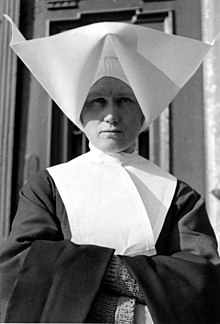
Le Corbusier’s wimple

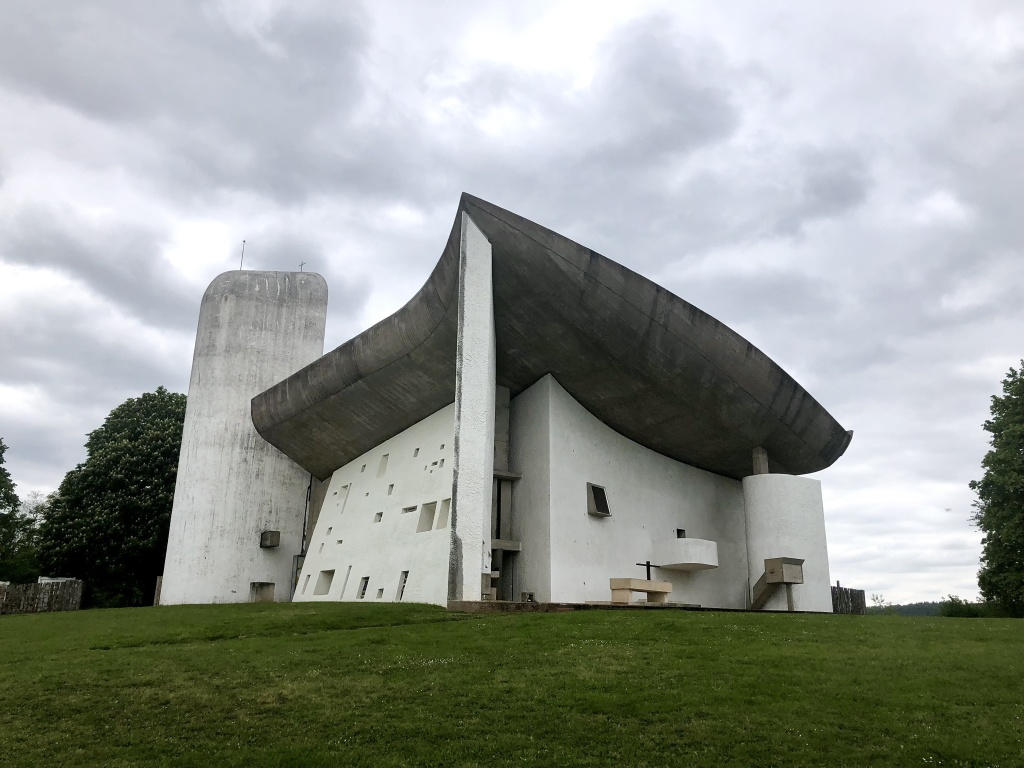
We decided to visit two places on the drive between Beaune and Basel. The first was the Château du Clos de Vougeot which was a bit of a fizzer. The second was Notre-Dame du Haut just out of Ronchamp.

As its name suggests it is a Catholic chapel sited on a very pretty hill with 360 degree views, towards the Jura to the south and east, the Vosges to the north.

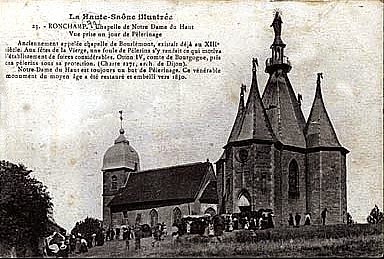
The original building, at left, some of it dating from the 4thC, was destroyed in 1943 by German bombing. After the war, it was decided to rebuild on the same site. Le Corbusier (a nickname, no first name), one of the most prominent architects of the 20thC, was commissioned to design a new one.

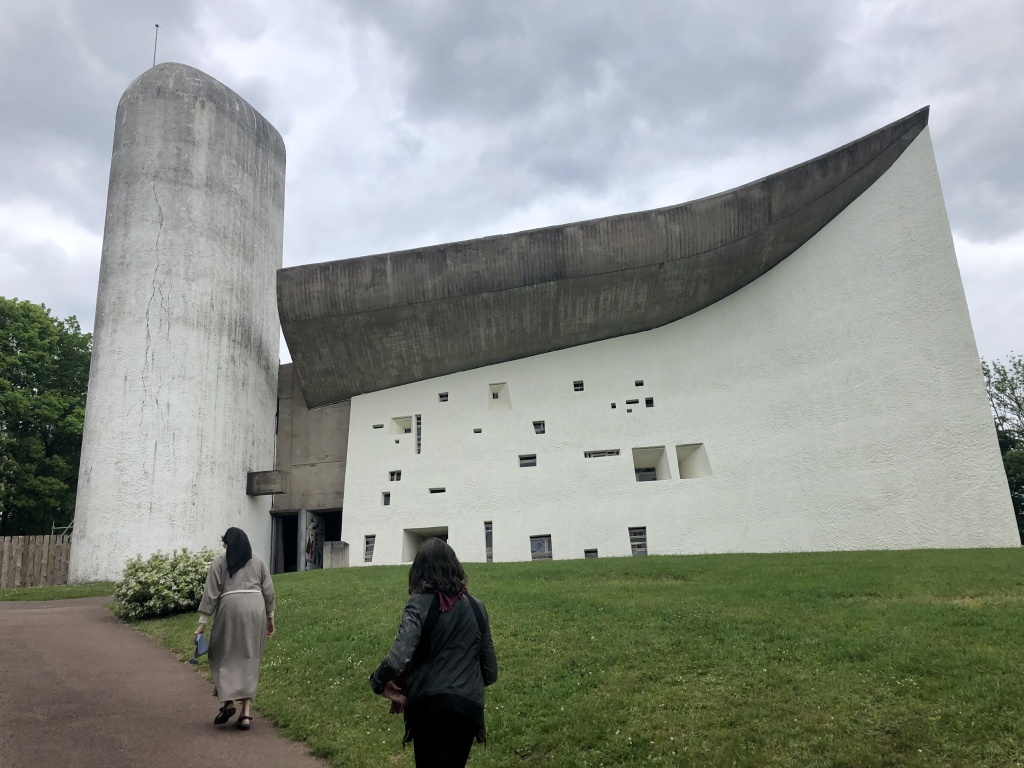
The new chapel ‘was built for a reformist Church looking to continue its relevance’. Planning began in 1952 and the building was finished in 1955. The result was controversial from the first. The chapel is small and eccentric. The materials are not conventional. The pic above is taken from the photogenic angle. ‘Round the back’ was covered in scaffolding when we were there, but with the scaffolding down it still looks a bit like a utility area with a staircase somewhat inelegantly running through it. And yet, in 2016 it was placed on the UNESCO World Heritage List because of its importance to the development of modernist architecture.

The ‘tower’ is in Burgundy stone. Most of the rest of the structure including the roof is reinforced concrete. The walls’ surface has been sprayed with shotcrete which is just what it sounds like, pneumatically-sprayed concrete giving a very heavily textured finish, and then painted white. The roof is not sitting on the walls. It is sitting on pylons built into the walls allowing a clerestory, visible below, of perhaps 150mm to let light in and perhaps to provide the illusion that it is floating.

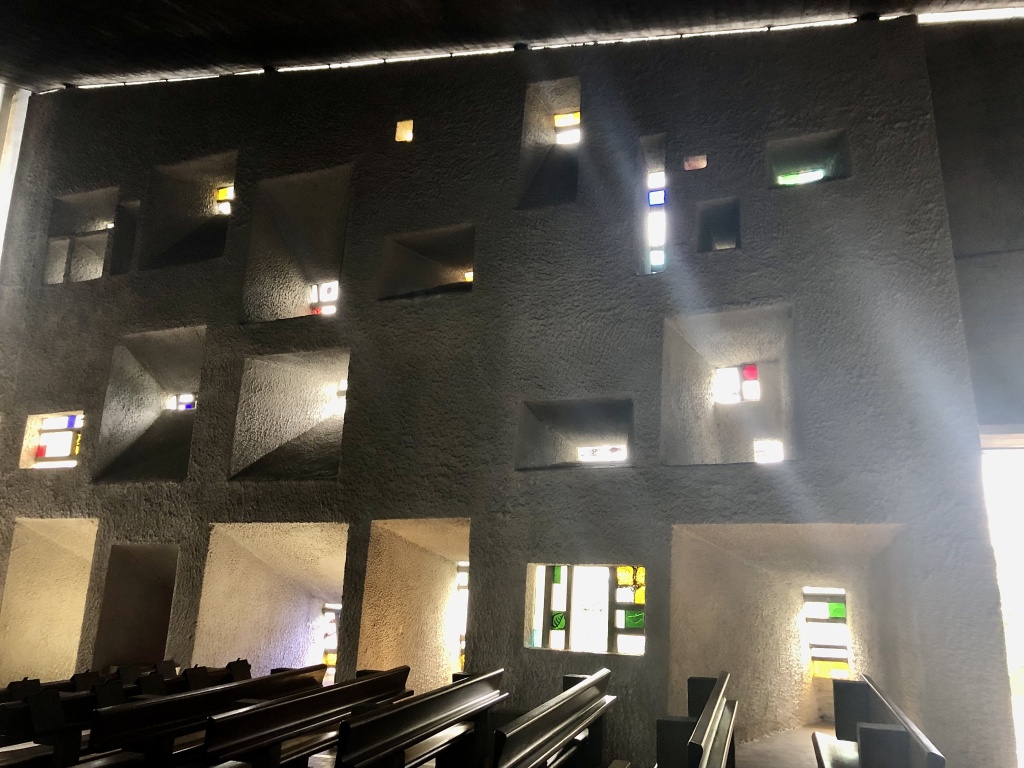
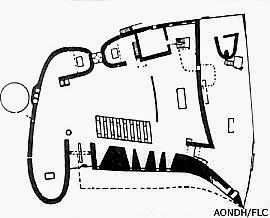
Above is the south wall from the interior. At left is a plan which indicates the unusual character of that wall. It begins from a point (at right) and eventually becomes more than 3 metres thick. Not customary practice. As a result the ‘windows’ are not just irregularly placed with irregular colours and patterns, but are of irregular depth. At bottom right in the photo you can see that the window indentation has almost become a small room.

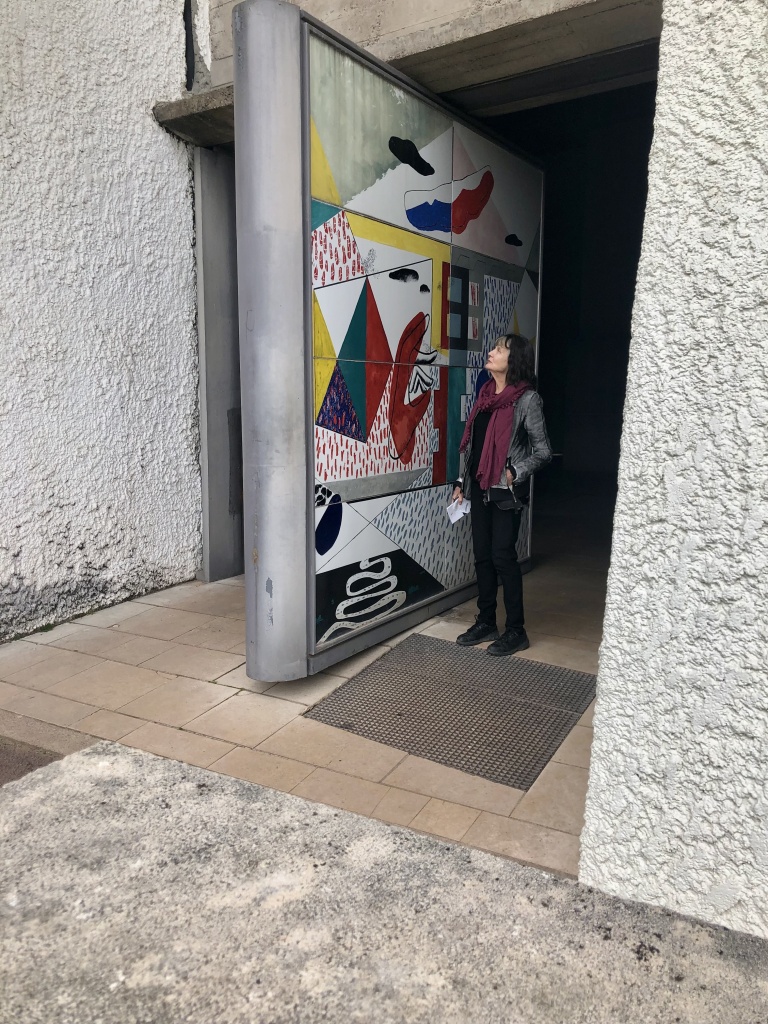
Le Corbusier chose to paint the massive pivot door himself.

So far, so good.

I think I was alone among the five of us in liking the interior. I found it meditative and probably conducive to worship. (It has a very small regular congregation, a handful, although there is a ‘working’ convent adjacent down the slope.) It’s the exterior where the problems emerge. You could say it looks just a little bit 1955, modernity unleashed but unresolved, and that suggests the main problem — reach exceeding grasp. Today you could build this much more easily than you could in 1955. It would look less ragged and ‘home-made’ (maybe undesirably), and would be far more durable.

Recently €4m has been spent renovating the south wall which looks good but, as you can just see in the photo, is still standing off the tower. A black filler has been used to seal the gap which probably means problems with the foundations managing the extraordinary weight and eccentric loading that south wall imposes.

The roof is reinforced concrete too, a wildly ambitious stroke. It gives you the wimple, but it must have been shockingly difficult to build. And it shows. The right hand corner that we can see has extensive concrete sickness with rusty steel reinforcement exposed. (In the first pic above, it can be seen in the ‘point’ of the south wall, roof to ground.) Not the complete kiss of death but very difficult and very expensive to fix. It may need in the order of another €8-10m to sort out the whole building.

Various arms of government, and the public, have been generous to date. But would you? Would you keep at it? The only basis for doing so is to consider the chapel as what it is, an artefact, a cultural phenomenon (oddity?), rather than a working building. And even then … How many worms in that can?

I was very pleased to have seen it, but we didn’t, as invited, leave a donation.

The new Kunstmuseum (art gallery) in Basel

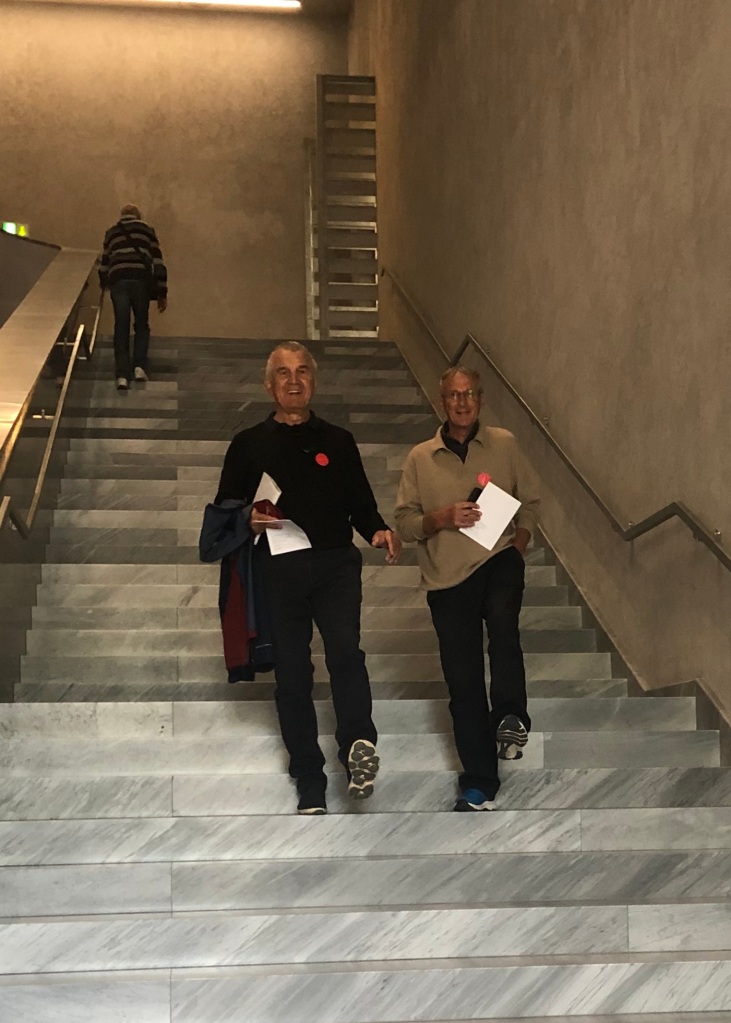
Now that’s design. Less ambitious, but ever so stylish. (Below the lads enjoying the gallery experience.)

• • • • • • •

OKAY. Ça suffit! Enfin, Singapore and money. Close friends.

WALKING: Haute Provence

It depends what you count but, correctly, I think it probably begins here.

We were at the Plaza Hotel, downtown Boston, American upper mid-range which means impossibly expensive, a small comfortable room with a view of a wall but, if you could find your way, only a 10 or 15 minute walk with luggage to Back Bay Station. It was a quiet morning.

An Amtrack express to Moynihan Hall next to Penn Central Station in New York in order to catch the AirTrain to JFK. Quite a good connection, Moynihan Hall is a very slick operation. Long Island Rail Road from Moynihan Hall to Jamaica, a suburb in Queens, not a country. Bought the AirTrain tickets at Jamaica by ignoring the queue and providing custom to a woman in a Muslim scarf who was offering exactly the same tickets for exactly the same price for exactly the same journey but a lot quicker and more easily. That part went okay. Could have been a hiccup but there wasn’t.

In fact a bit of a wait for Swissair to Zurich. An excellent flight with amazing food, but who wants a big meal at 11 o’clock at night?

It is mid-afternoon locally the next time I was in (Zurich’s) fresh air. We walked to our hotel. I think the phone said 1.3 kms. Just a jog through industrial wasteland which being Swiss was not a wasteland at all, very tidy and precise, but not very human. The hotel was a cracker. Ibis. 118AUD. Room about exactly the size of its twin beds. Light goes on and off with the shower door. Perfect. Got the tram into town and spent a few hours wandering around old haunts. Marvelled at the luxury on display in and around Bahnhoffstrasse,

Aren’t they great? Sf850 (A$1432.07)

ate sweets at Sprüngli and roesti and ‘Zuri’ wurst (hausgemachte) at the ever so elegant Hauptbahnhoff cafeteria.

Got up at 2.30am a bit spaced out. Goodness knows what my body thought the time was. We had organised a taxi to take us to the airport. A 20 minute walk at that time was asking just too much. He arrived on time, bless him, he was nice and I gave him a 10 franc tip. Possibly excessive, but I was very grateful. Checking my money shortly after I discovered that rather than the 20 Swiss francs in addition, I’d paid him 20 Mexican pesos or, with commission, less than one Swiss franc if you could be bothered changing the note. I’m genuinely sorry, and if he likes to get in touch I will make good.

Zurich to Nice, a one hour international flight with a bit of international mucking round at departure and next to none on arrival. It’s warm and sunny. The sun glints on the Mediterranean rather than the Atlantic. A €50 cab ride to the gare that provides exclusively for the Chemin de Fer de Provence, the Train des Pignes. I left my excellent Panama hat in the cab. I had the faintest hope that the driver might bring it back to the station. Fail. We meet Michael who will come with us for the next two weeks. It’s good to see him. It’s a wait, and when you’re very tired waiting is quite hard. For some reason the four daily services with a one-carriage train on a single route has been compressed to two, and we have several hours to wait until the next one. But not only that, there is a peturbation, a disruption. Later we discover that they are building two new stations. But it means taking the train to Plan du Var about one-third of the way, then transferring to a bus to take us to our destination at St Andre-les-Alpes about 2.5 hours away.

This (train) trip is supposed to be a big deal, très très touristique in the parlance, with a society of Friends to look after it. We’re following the much molested River Var up into the foothills of the alps through limestone crags. People do it for pleasure, although I think most of the very crowded passengers were just going home, a handful off at each stop. My eyes have gone a bit wobbly, and I’m not enjoying it as much as I should. I just really want to get there and have a sleep.

The bus driver is fierce; he attacks the endless corners missing the rock walls by centimetres, skillful but wearing. At last across a lake I think I see Saint Andre. We’re nearly there. We drive past our hotel, like within 30m of the front door, which is vaguely annoying, but then we drive past our stop a kilometre away at the station. There are 15 people still on board: where is he taking us? Representations are made to this effect. But he’s going to the end of the route come hell or high water and then going to return, another 40 minutes. Why goodness only knows. I also suggest that he might like to drop us at our hotel seeing he’s going past the door. I seem to have insulted the reputation of his mother.

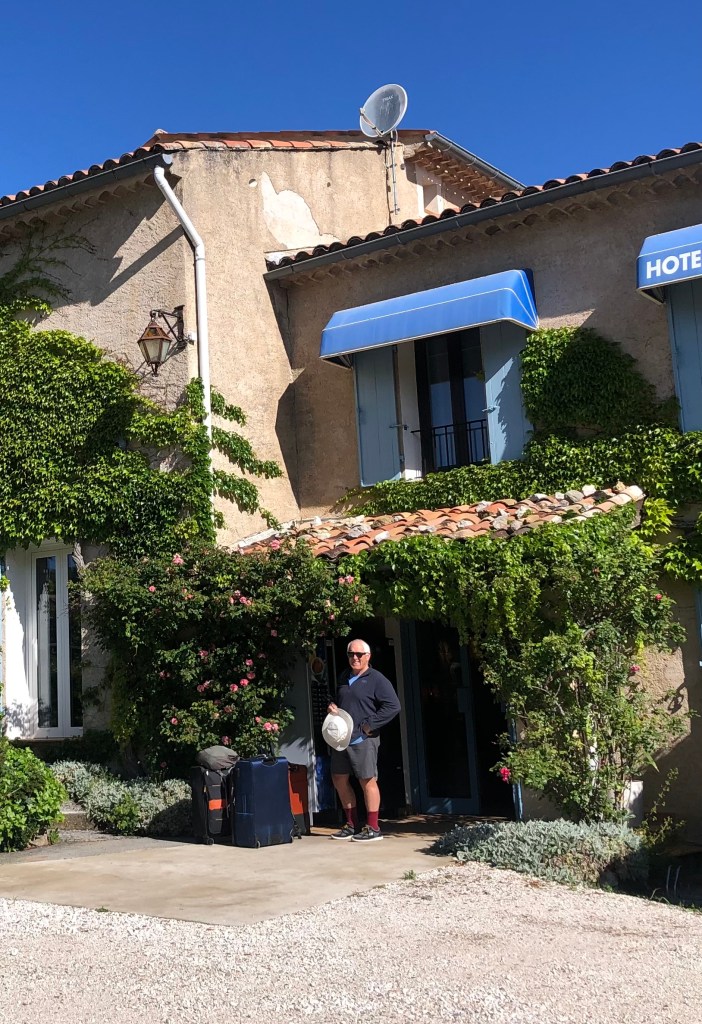
Eventually we get off and, hoorah, our hosts are there to pick us up and take us to their hotel. Splendid. We get to the hotel, an interesting old place, classic rural French, and Myrna and I collapse into bed, not quite sure what day it is and whether it’s bed time. But it is bed time. An hour or so later I wake up …

I don’t know why I include these stories. Is it that I know just what a seductive spell schadenfreude casts? Perhaps it is some sort of purge, some sort of catharsis. Or, not trusting that the wonderful pics will provide a sufficient offset, it might be building a platform for a story about something very desirable that went well, but unless you did it yourself might be a bit boring? (That is a rhetorical question mark. I don’t want to know your answers.) I’ll bind myself (and my dwindling self esteem) together and continue.

I went to sort out my pack and get things ready for departure early next morning. My case was there, Myrna’s case was there, Myrna’s pack was there … and my pack wasn’t. My pack contains our passports, my wallet, our credit cards, a substantial wad of cash, the maps, and I don’t know how to balance this off against all that stuff, but I couldn’t really go walking without a pack. I needed my pack. I have a feeling that might have been my keenest concern because I wasn’t thinking that well. I just wanted my pack. I wanted the absence of problems.

So, I don’t have to spell it out. Freak out, search the room, search every place I’ve been, go a bit crazy, try to tell the very very pleasant person who’s been left in charge but who doesn’t speak any English what’s happened. My French is more than a bit creaky anyway, but when you’re jet lagged and tired … my demeanor rather than my language probably communicated the scale of the issue. Madame, j’ai perdu mon sac (I didn’t know the word for ‘pack’; we negotiated it). Rouge et gris, oui? Rouge et gris. Il contient all my stuff, passeports (that struck a chord) blah blah blah. Check the car. The host has driven somewhere else and is out of range. Check where we got out. His New Zealander parapenting mate turned up and drove me round a bit. But this was all just time-filling and the illusion of a response really. I knew where it was. I was sure, very confident even in my decrepit state, that I’d left it on the bus in the overhead shelf above our seats and in my enthusiasm to disembark I’d left it there. And in that case, a whole panoply of other issues unravels. Where’s the bus? Nice, a million miles away? Might as well be Boston. The driver is an arsehole and I’ve been cross with him. What sort of help is he going to provide?

Look, the walk will be much more interesting. It’ll be on soon. Duck off and make a cup of tea.

We found a man in the container serving as a waiting room while the new station is being built, a man who was being paid to sit there. That probably wouldn’t happen in Australia, but it would in Singapore and it could (pre-retirement age) in France. We throw ourselves on his mercy. It is all in fast French with a great many discouraging gestures, but an hour or so later disrupting a dinner which for a range of reasons I was finding hard to eat, we are called back to the station. A peculiar mini-bus arrives filled with people … plus my rather shitty pack, its contents intact. How that happened … no information. Don’t care. Pleased. Thanks. Enormously grateful. Just want to go to sleep.

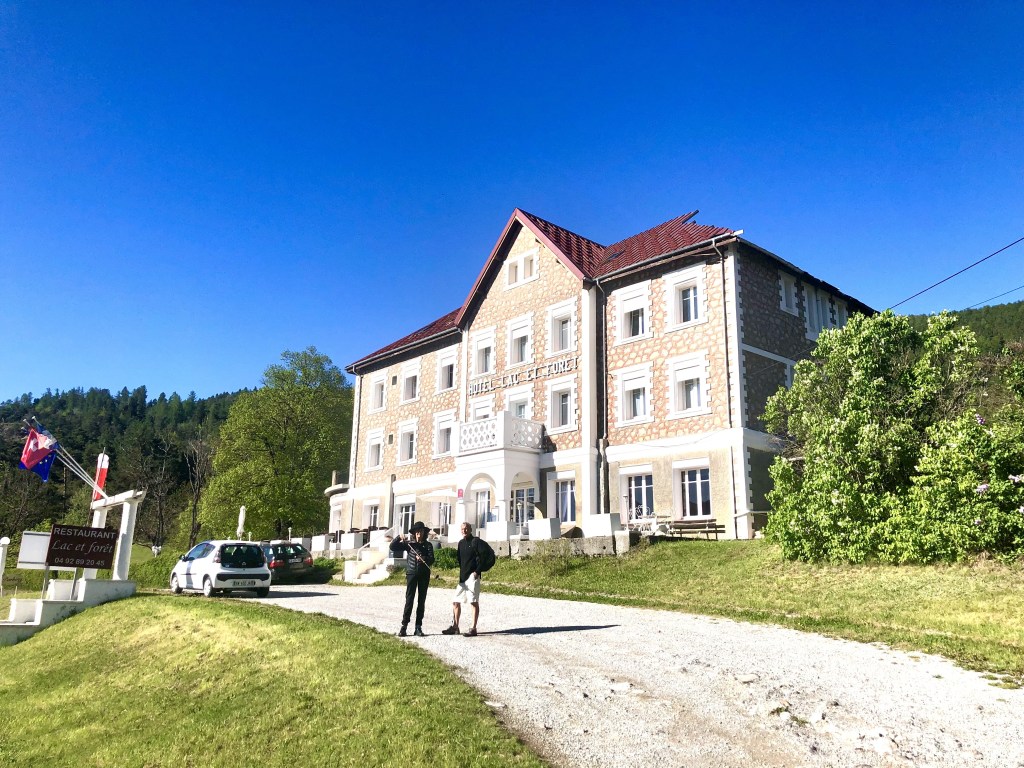
And that my friends, that is how we got to the starting point of the Haute Provence walk with support organised by Walkers Britain with five remarkable days and 100 pretty glorious kilometres in front of us.

Michael had the forecast: max 13C, storms, winds, rain.

St Andre-les-Alpes to Castellane

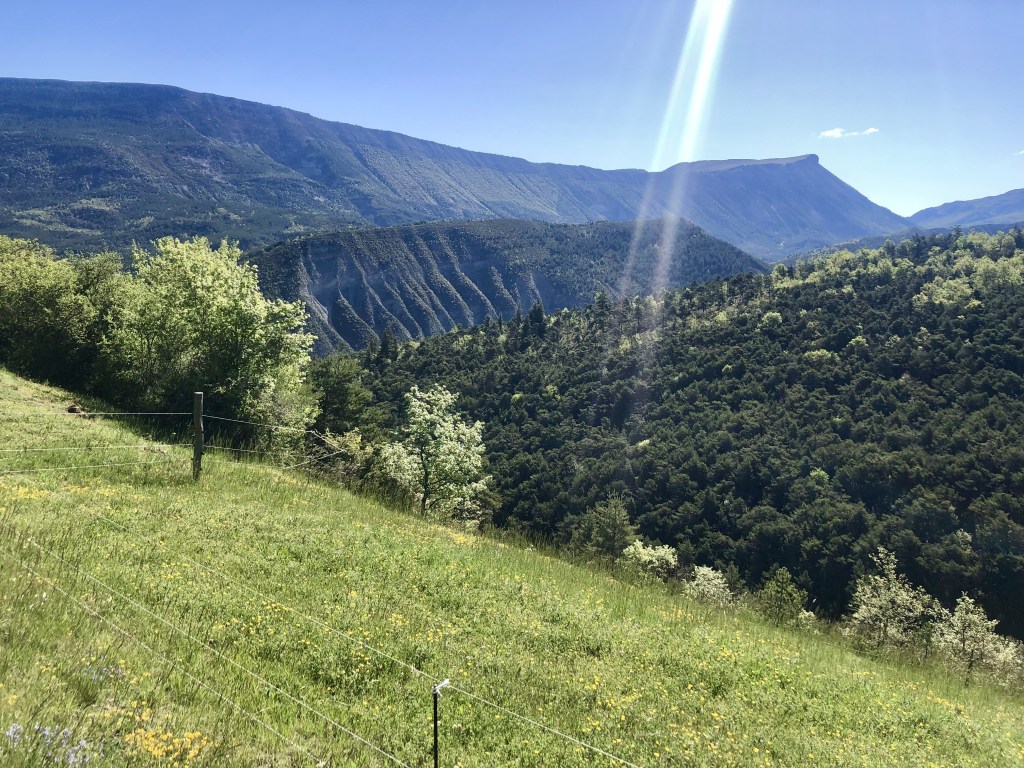
But it doesn’t look like that does it. Almost implacably blue.

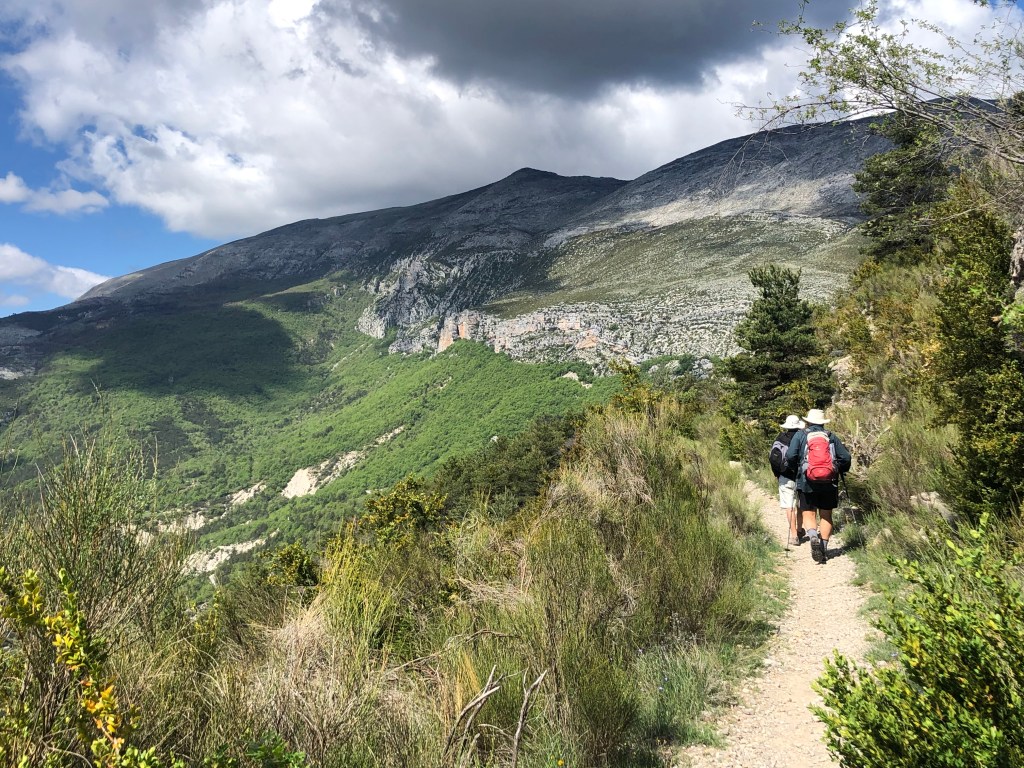
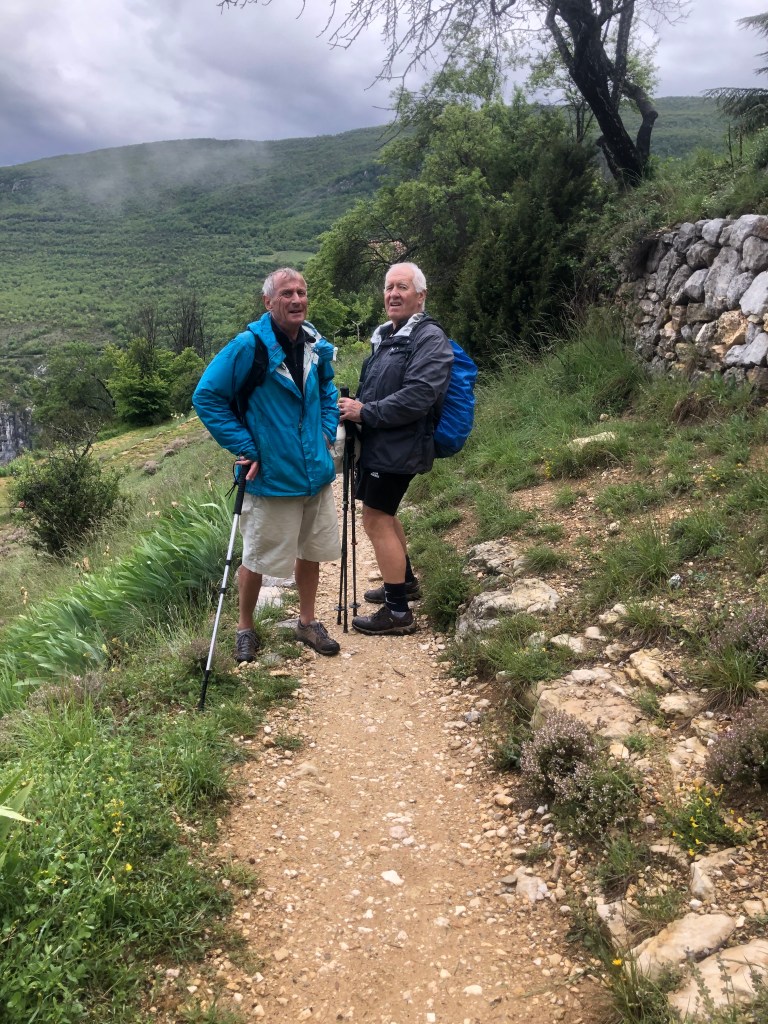
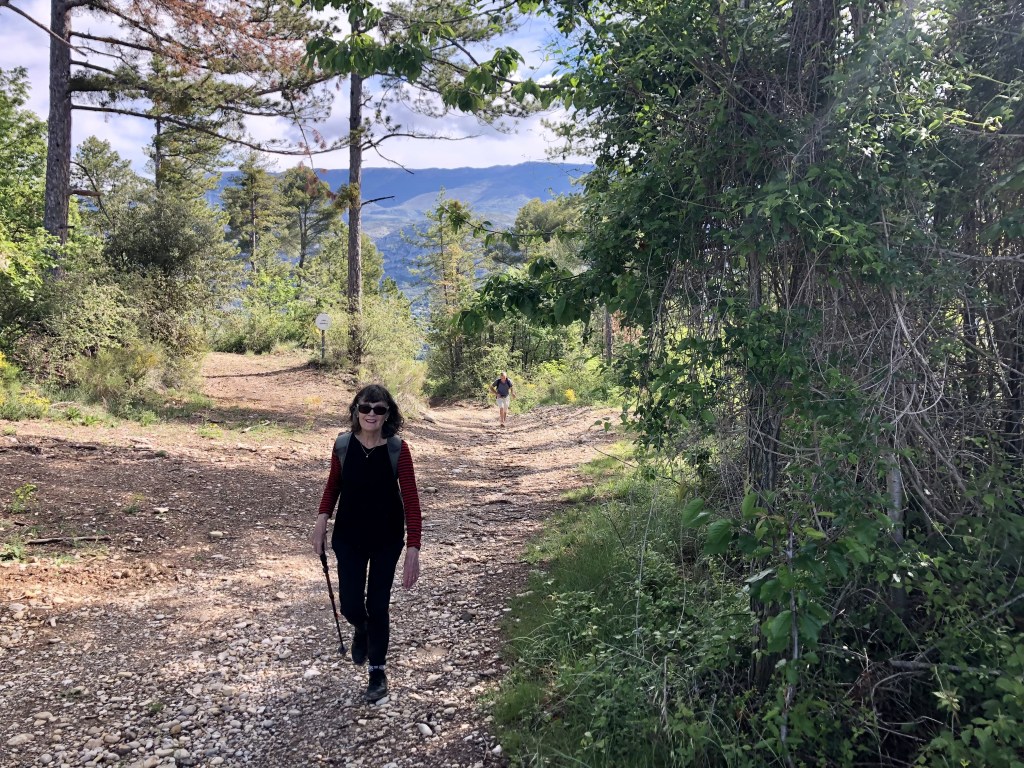
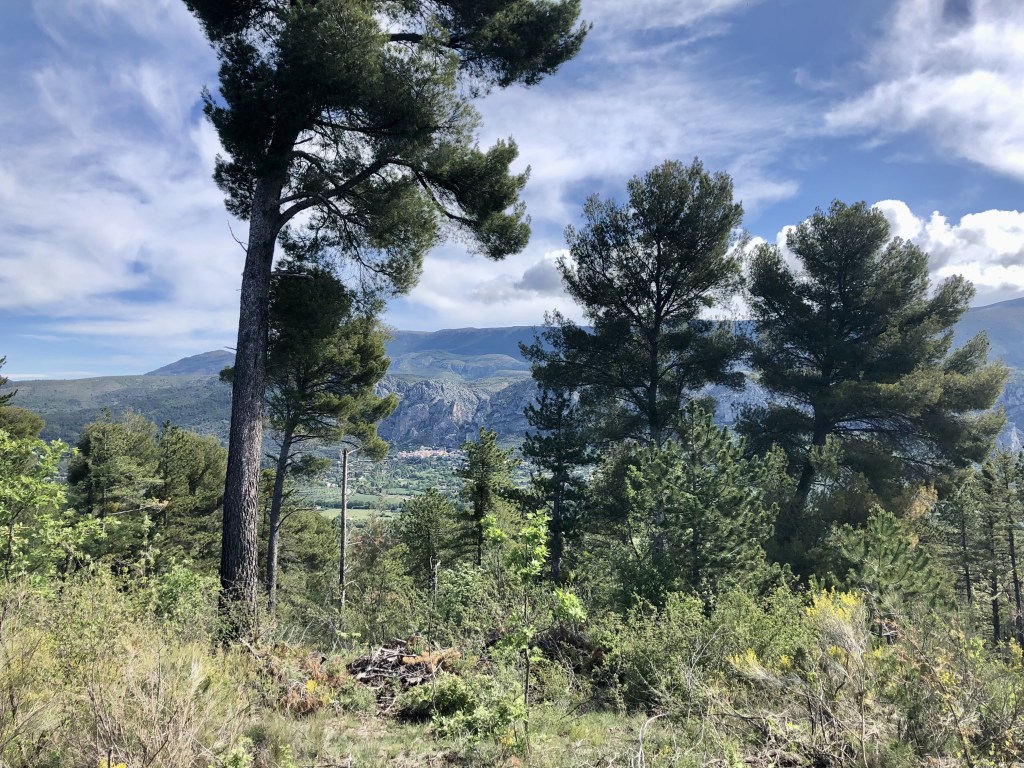
A very fine day’s walking. Up onto a high ridge above a lake, de Castillon, which is followed almost all day. A steady and quite long climb but punctuated by rolling hills and not much in the way of human intervention. Long views followed by a steep descent into what looks like a rather advanced holiday camp at Cheiron before finding our way into Castellane which the notes describe as a small but significant town because it was on Napoleon’s route from Nice to Paris. About 22 kms we think.

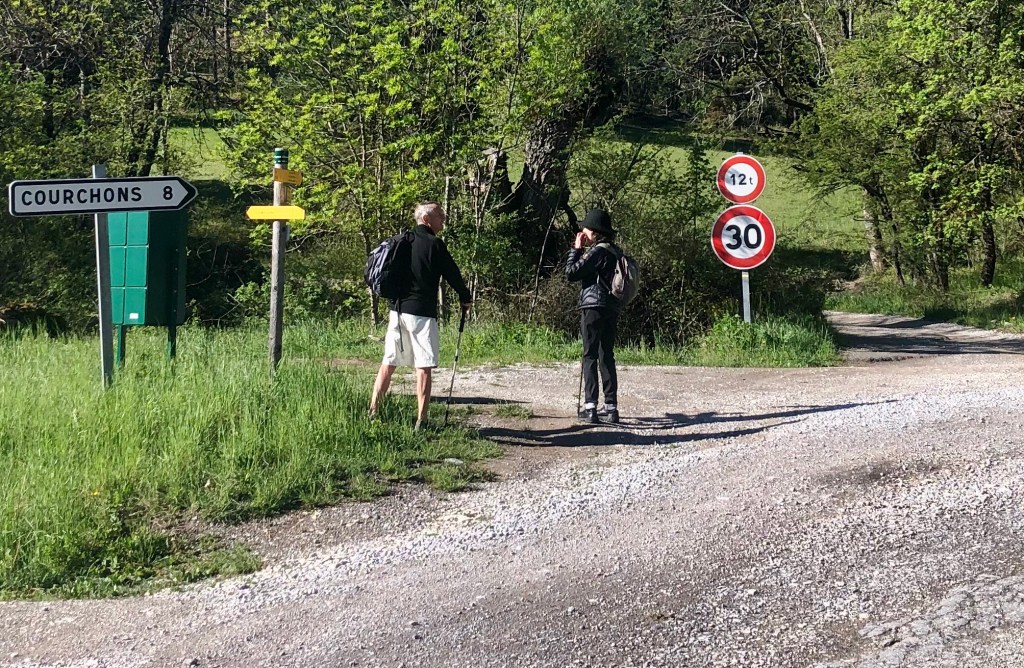
The first decision, about 50m from the front door of the hotel.

On the second day we got on to the GR 4, one of the walking routes (‘Grandes Randonnés‘) that criss-cross France and are generally well maintained and carefully waymarked, but the track this day was a local construction and required a bit more thought for navigation. The yellow signs were the key. Of the four options hard left was a walking track that took us gradually up above St Andre which is just visible here background left.

The track took us past this working farm, La Rouchas. (‘Use this opportunity to buy goat’s cheese from the locals’, a recurrent nutty track note).

Michael had a chat to the owner, the only person we saw on the track this day. He had been there for 38 years during which time he had restored the masonry buildings — now looking wonderful. He had dogs, cows, goats, chooks, a fabulous vegetable garden, a small orchard. It was a version of a dream, but a lonely dream.

What a view he had. The high point of that ridge, behind us in this photo, was our immediate destination. Near its crest a suprise.

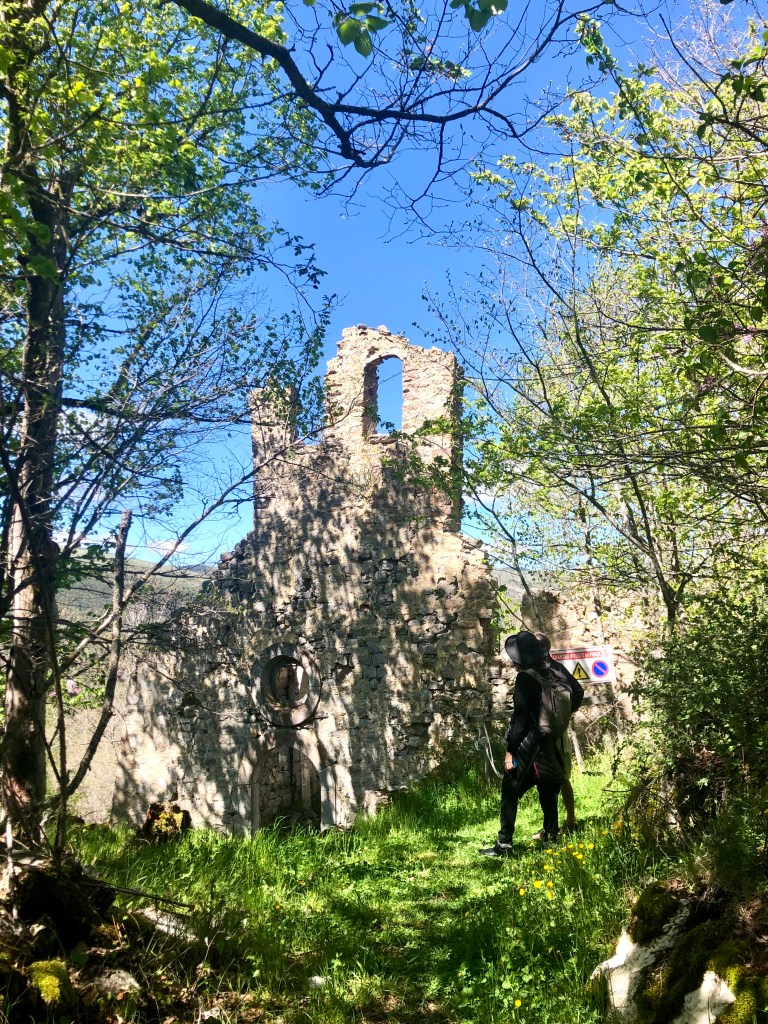
Who would build a chapel in such an out of the way place? And, once built, who would use it?

But then over the top of this ridge the houses of a small settlement began to appear. Not users of a chapel so much as people with very nice résidences secondaires and in the case of the big house, the headquarters of the Société de Chasse (Hunt Club) Le Courchons which has a plaque nearby remembering the efforts of the Marquisards around here during the second world war.

It all seemed so unlikely on this beautiful day: full of smells and rural whispers but otherwise no more active than this photo. If it looks like a pleasant place to go walking … correct.

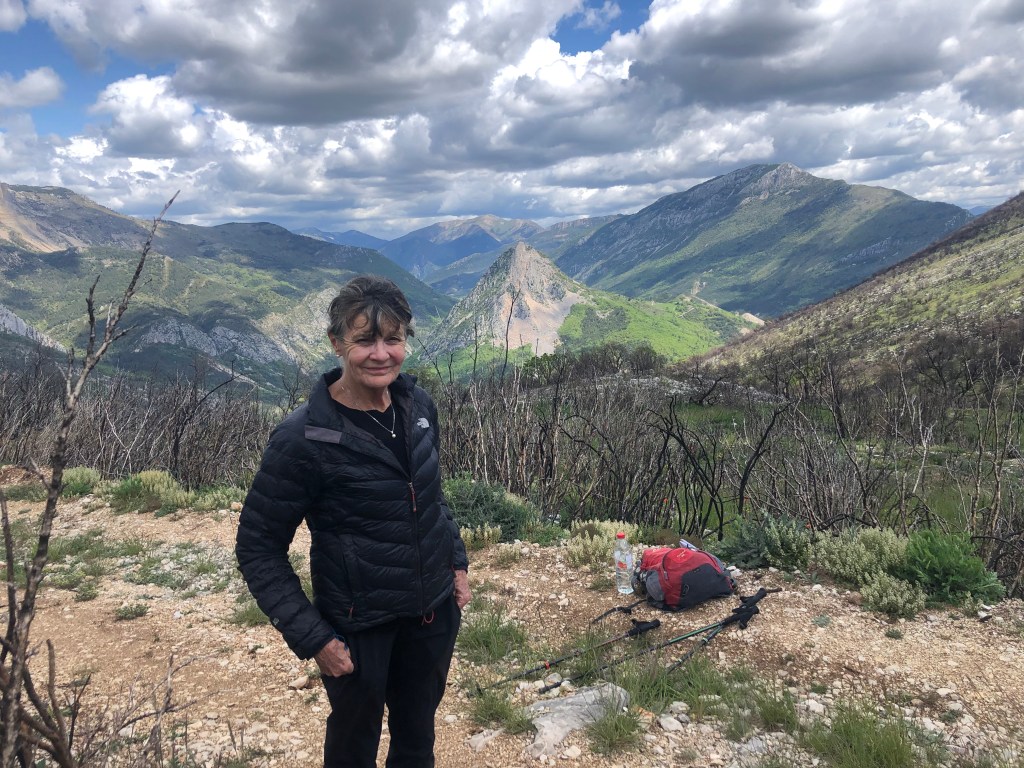
We turned right at this calvaire and headed steeply upwards to the high point of the walk, the whole walk in fact (1412m), the Crête du Loup, Wolf Ridge, with the Lac de Castillon still in view. (That was its colour, feeding as it does the Verdon, the ‘green river’.)

Steeply steeply down, and then a surprise …

… the Mandoram ashram. (Click to enlarge.) The silver and once gold metal structures which surround the property are believed, by some, to harvest energy. The track, such as it was at this point, ‘badly eroded gullies’ to quote, ran round its borders. It was the sort of descent that blackens the end of your toes with the additional pleasure of a heap of broken rock under foot, but we got down to see Cheiron, a tease, with Castellane nested in the background between the two peaks.

And, I told a lie, we ran into another walker at a track junction about 4kms out of Castellane. He was much bemused by the idea of Australians who had walked from St Andre-les-Alpes but very helpful and understanding when we asked him the quickest way to Castellane. It had been a big day. A flat and amiable dirt road took us from there into the town’s outskirts, turned a corner and … gracious!

Yes, this one. At this particular moment I was sitting on the terrace of our hotel having a beer and texting Russ and Mary.

A church for dedicated parishioners. You’ll spend some time thinking up a possible name. A challenge? Got one? Come on. No? Well, step back, it’s … Notre Dame du Roc.

Castellane to Point Sublime

A very comfortable night at Castellane’s Grand Hotel du Levant. Today’s walk would take us into serious limestone country. Out of town on a tarmac road with a vehicle grade with interesting surroundings getting steeper with time. After 8kms the notes suggest that there is some relief. I don’t know that I remember that. Things might have flattened out a bit. Or not. Then a few kms that had even Michael puffing, a hard climb, before topping out at Suech, alpine pasture that in the afternoon light seemed exquisite. Exquisite. A huge drop off on a gravel road to Rougon, a tiny town perched on the end of limestone promontory before a nasty extra 2kms further down to Point Sublime. 22kms Michael says. Felt like …

Michael had the forecast: max 13C, storms, winds, rain.

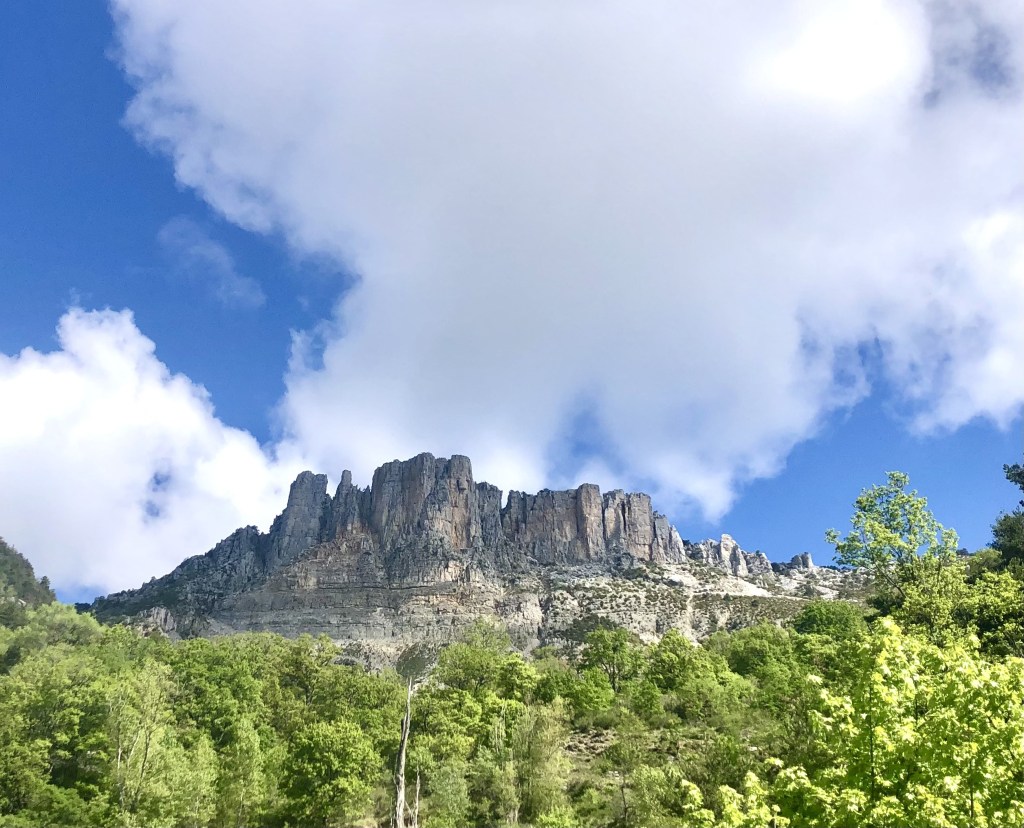
This rather wonderful grey pyramid is the totem for most of this day’s walk. It must have a name but I can’t find it. It might be Ste Etienne the something, but maybe not. It is deserving.

We spent quite a few hours walking around it. Below one side, then the other, near enough to 180 degrees (click to enlarge): you can walk quite some distance in a day.

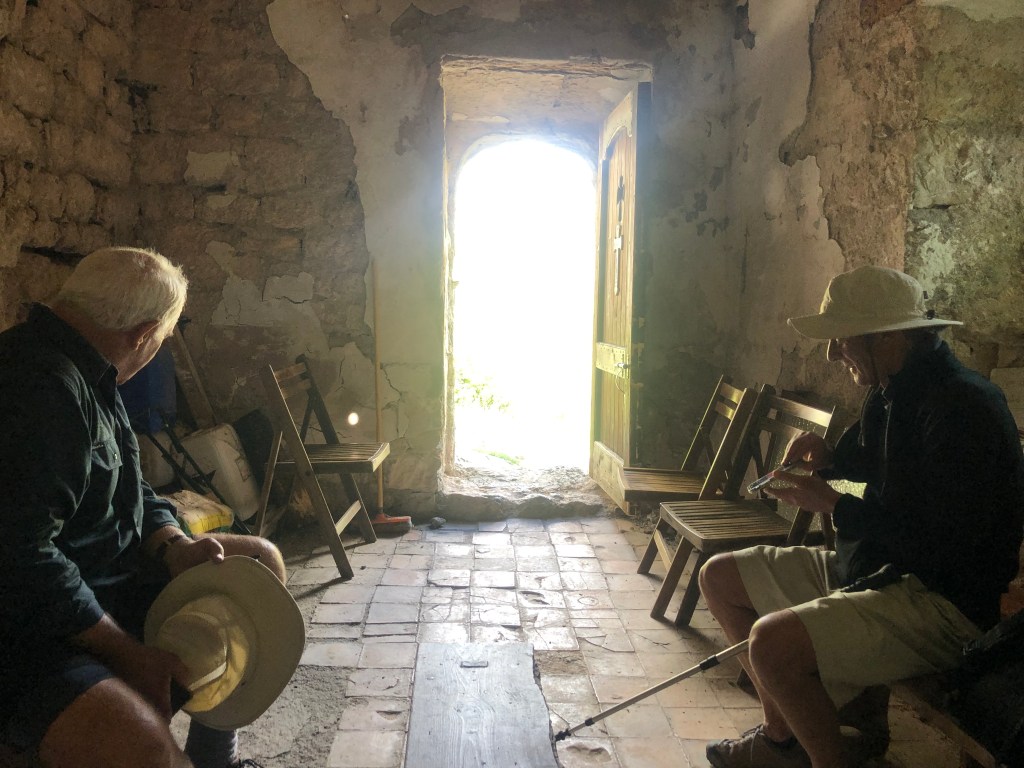
If you look closely at the first photo you can see the near horizontal line of the track coming off its right hand flank. There is a junction in that saddle with a slightly vertiginous track leading to a chapel, the Chapelle St Jean. Another remarkable oddity. On the right below is its view on a long lens north to the Cadières de Brandis. There are buildings below these pedestals. They are Chasteuil where we sat and had our lunch. No idea how, but you can get there by car.

And just to show we actually were in the congregation.

That might have been the flat bit. Because very soon after it really wasn’t. (Click to enlarge.)

The destination is one of the saddles in the right hand photo, and it was very hard work. But once there …

the meadows of Suech, and yes there is a 4-wheel drive track across it accessed from the other side by a road so steep — down which we walked — that the car which preceded us backed down several sections presumably because of the advantage of using the higher reverse gear ratio to control the descent.

There had been flowers all the way, hosts of poppies down lower, but perhaps because of the contrast with the burnt wood these somehow seemed particularly vivid.

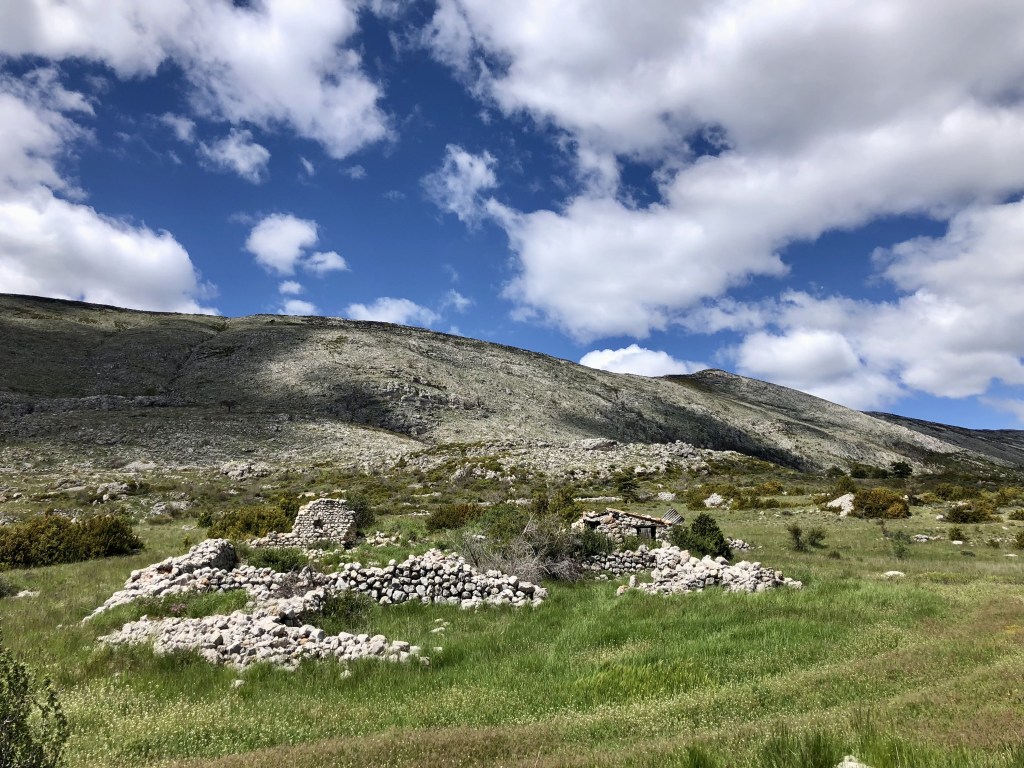
Sections of it were covered with remnants of stone fences and shepherd’s huts because in seasons with days like this it would have been a great place to graze stock, although there were warning signs about the presence of attack dogs used to fend off wolves and lynx. Lynx! I would love to have seen a lynx. Imagine!

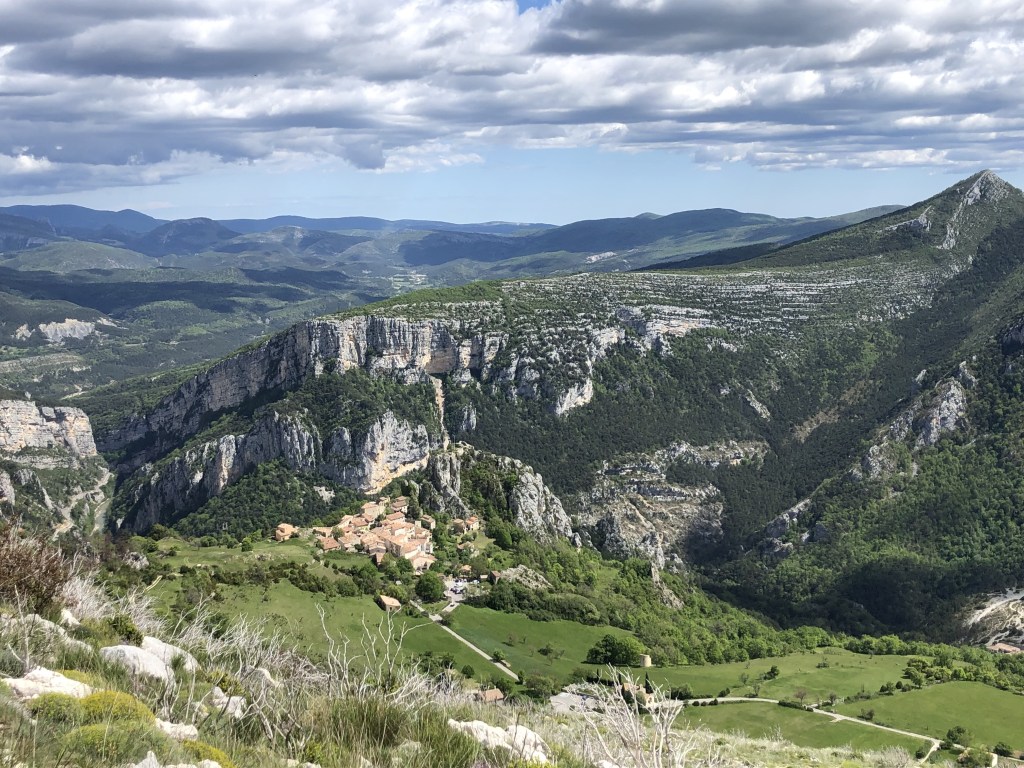
But after half an hour or so walking across it, we had to get down. This is Rougon (with a hard ‘g’) perched below us.

There was once a castle on top of this crag, and you can’t really see but she’s hanging out her washing.

We got to Rougon and sat in the al fresco section of La Terrasse de Rougon drinking Orangina and watching quite an expert game of boules imagining (me) that Point Sublime was just in the next street. It wasn’t. It was another 30-40 minutes. Just the auberge at Point Sublime. Nothing else.

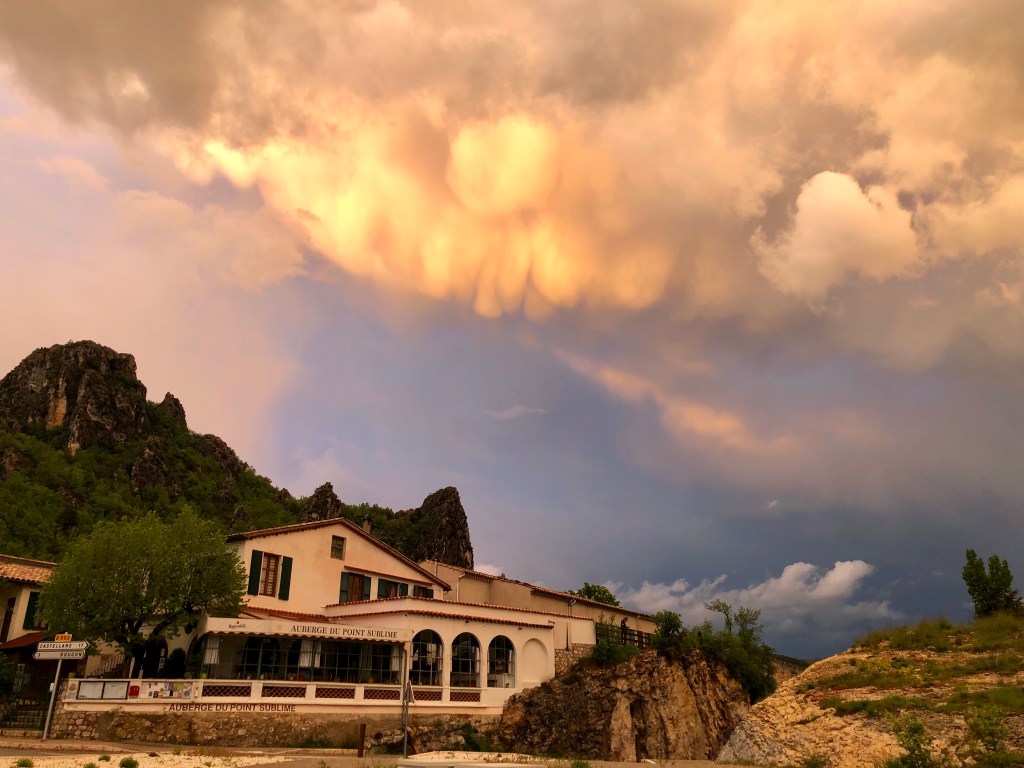
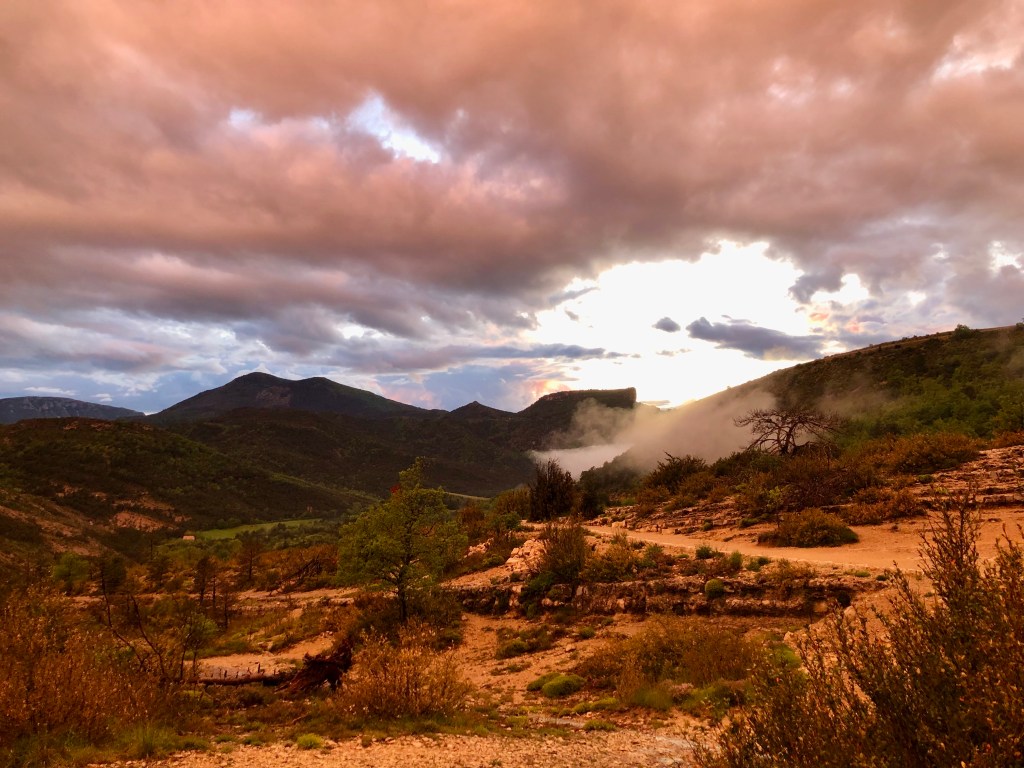
After dinner Myrna and I went for a walk of reconnaissance and there was this remarkable light, not to mention the cloud formations. I’ve done nothing to either photo.

A good night’s sleep was required because the next day was the big one, the Gorge de Verdon. Total descent, 1419m; total ascent, 1567m. Murder. Plus the staircase up the Brèche Imbert, the tunnels. And the zig-zags up to La Maline.

And Michael had the forecast: max 13C, storms, winds, rain.

Point Sublime to La Palud-sur-Verdon

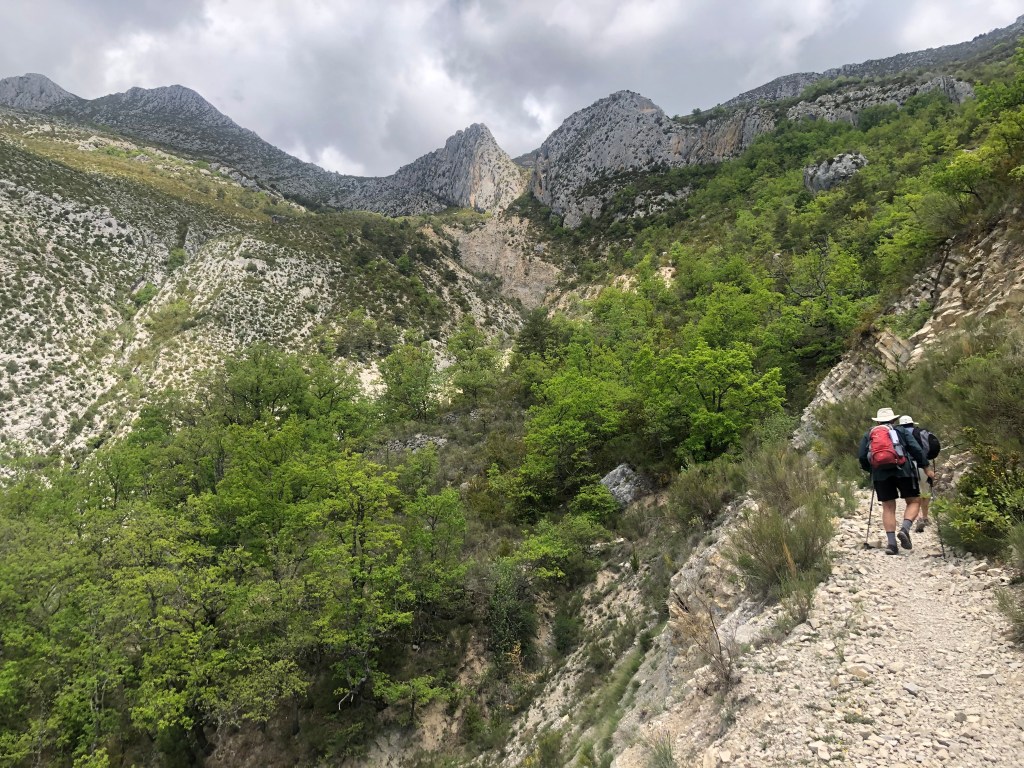
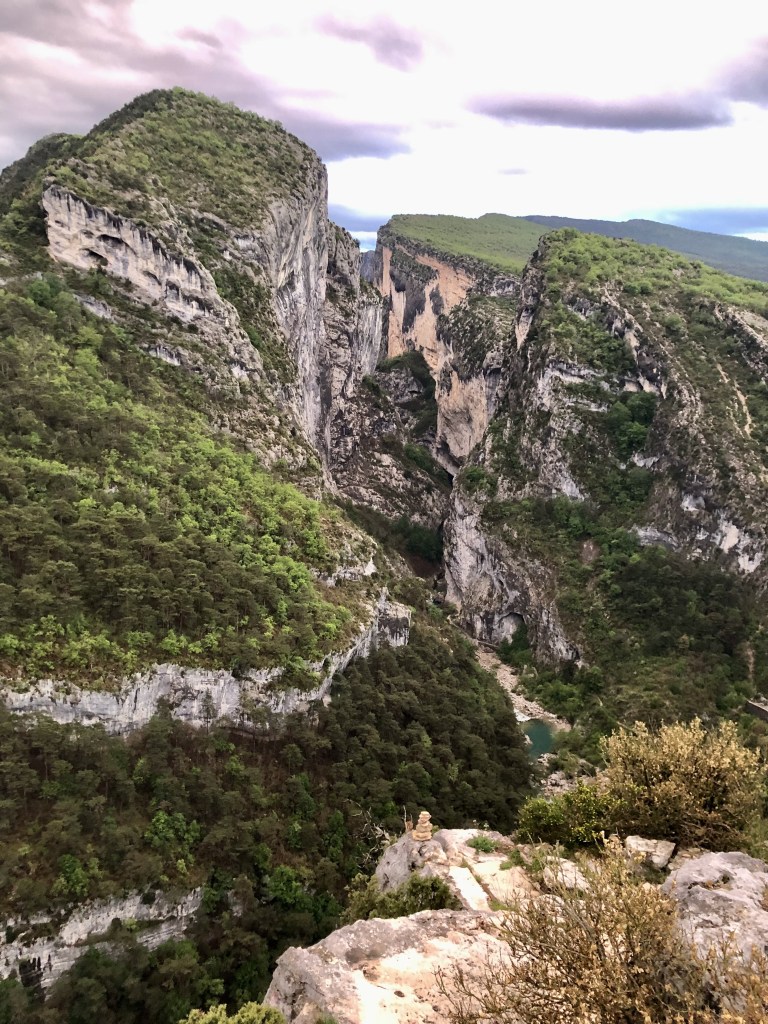
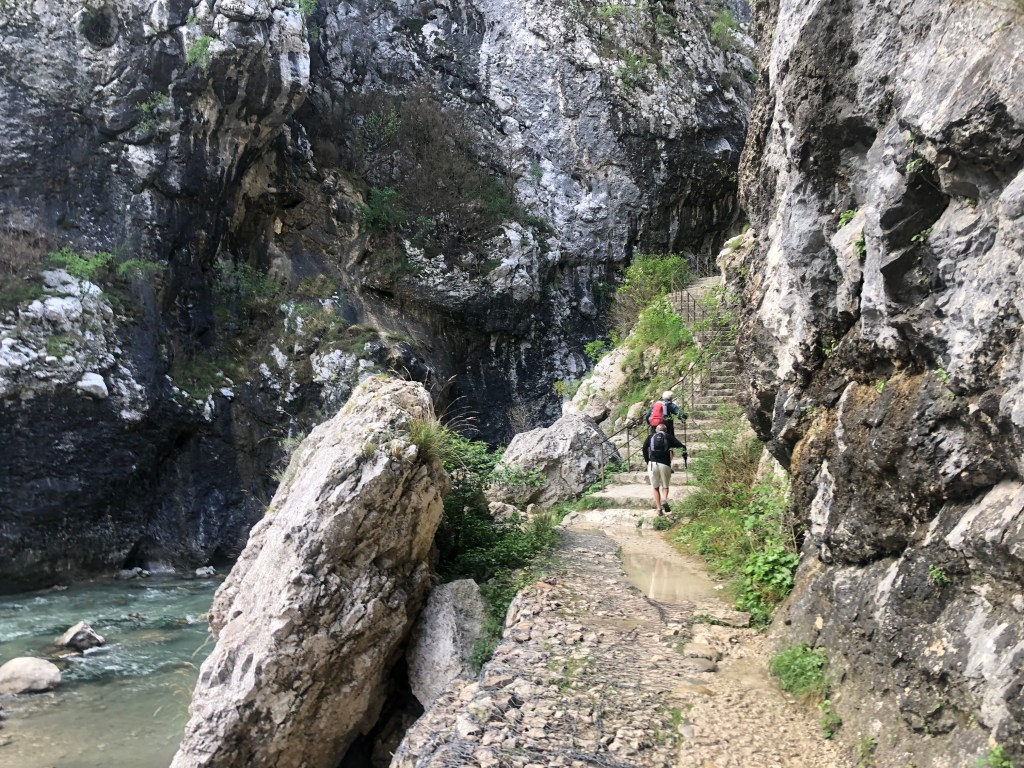
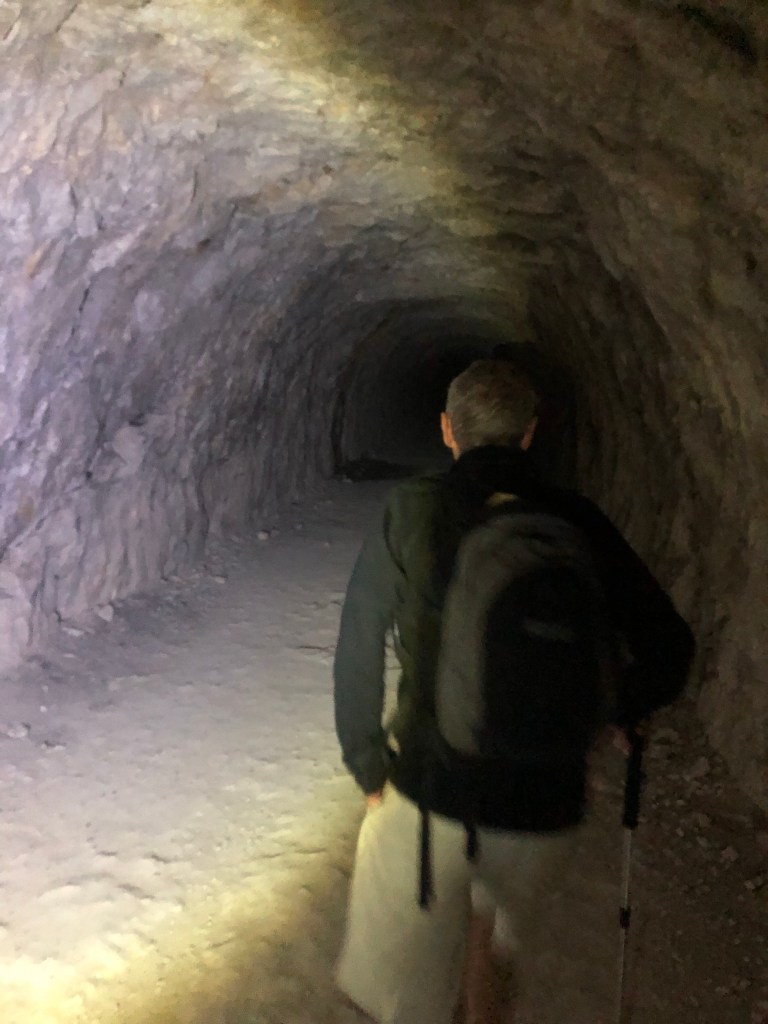
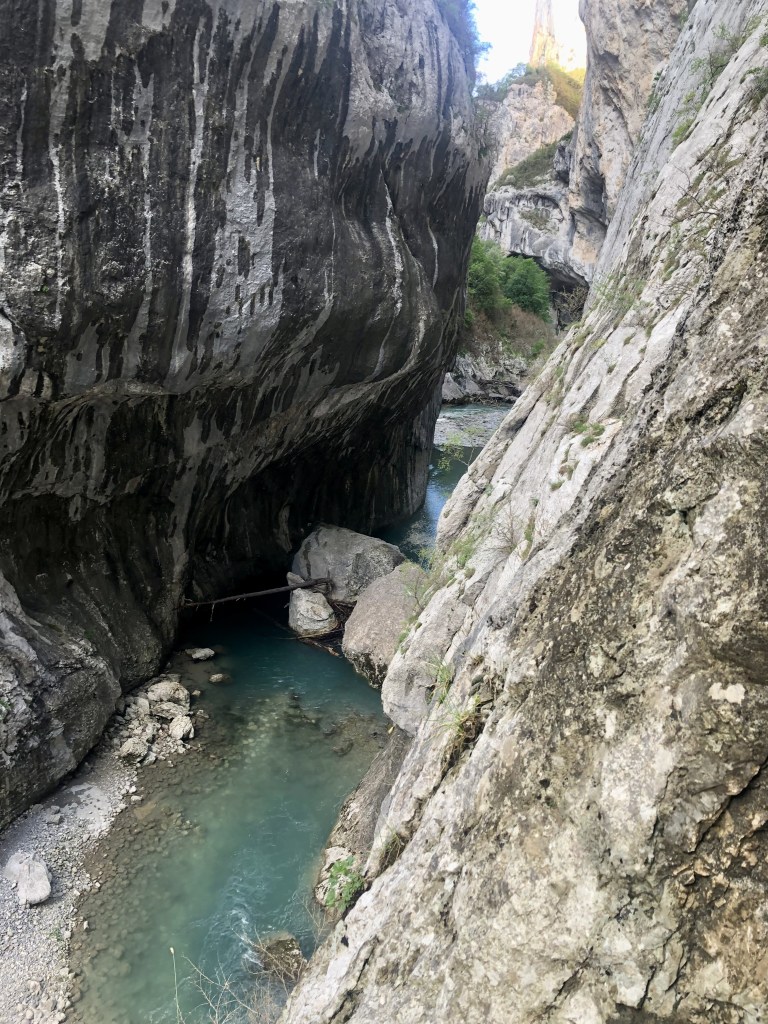
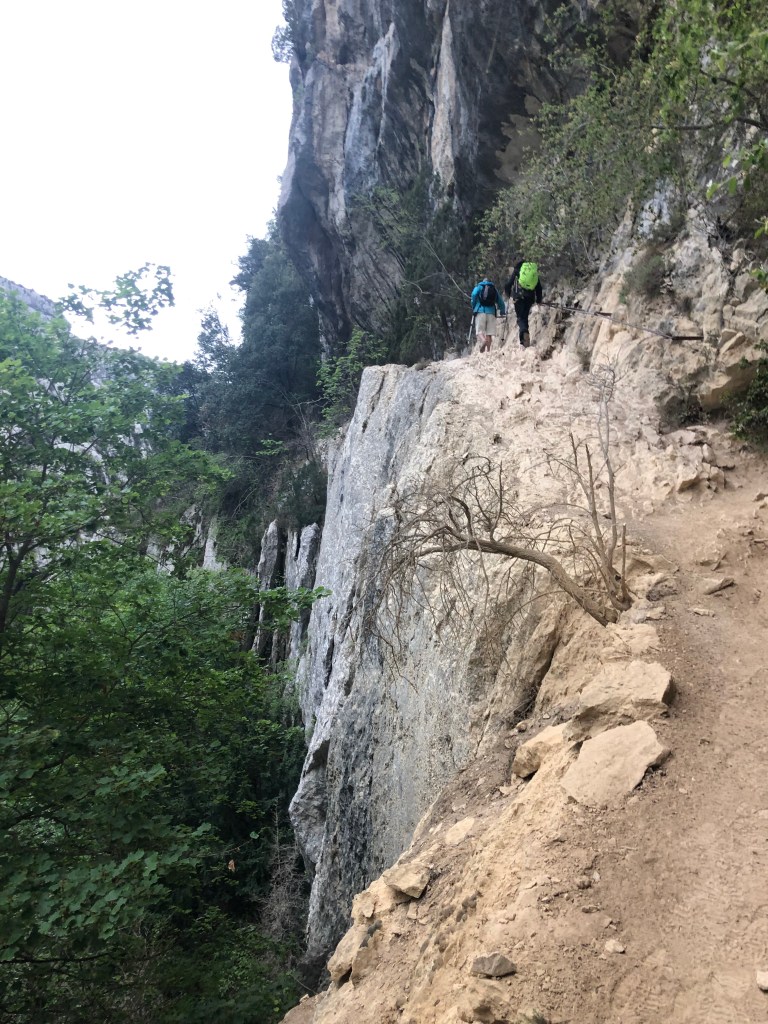
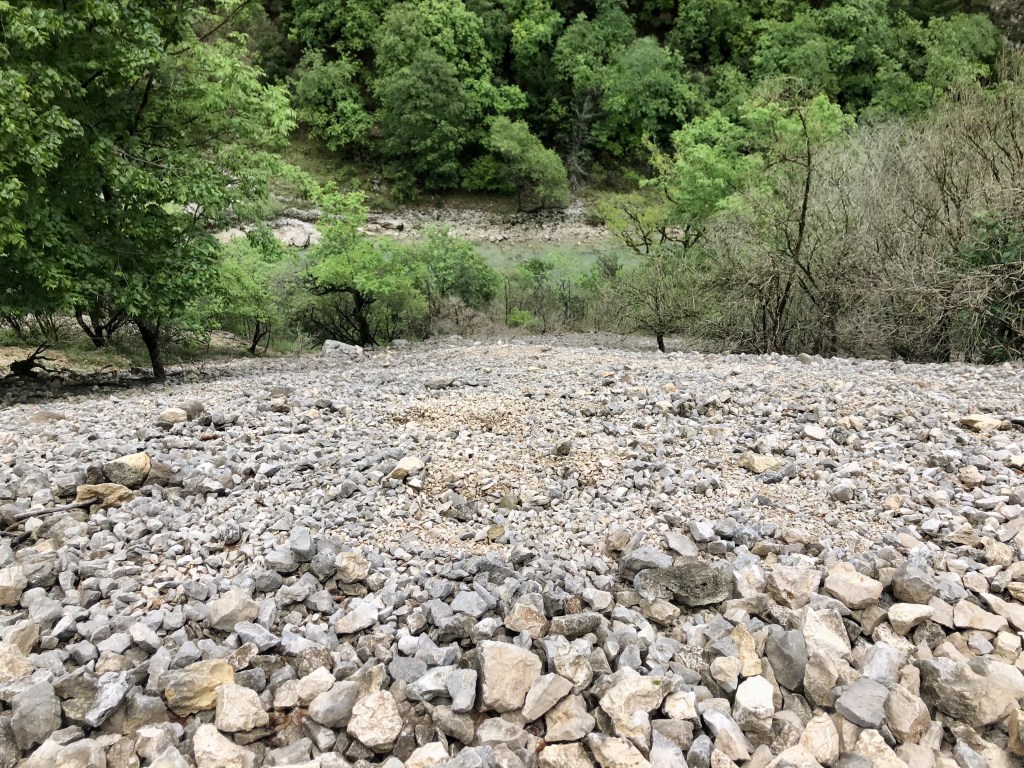
The Gorge runs from Point Sublime about 25 kms before the Verdon enters Lake de Ste Croix and things settle down a bit. The walls are so steep that for most of it the map has very few relevant contour lines. These are sheer drops, some of about 700m. There are startling rock formations wherever you look. Access is aided by a number of low level tunnels drilled for hydroelectricity but never used for that purpose. The long one takes about 10-15 minutes to walk through and you really do need a torch. Perhaps a third of it is a track rolling quite casually through a thin forest on the gorge floor, but there is one point where you climb most of the way up to the plateau level, and then climb down again almost to the river. There are several others where you have steep climbs and descents over rocky incursions. There are around seven sections where fixed iron railings have been installed to protect the faint of heart from exposure. It is usually walked from the direction opposite to the way we were going because it is easier to manage most of the major obstacles.

Some of these things I knew. I had a good torch for example. Others I didn’t. The Gorge is a wonderful heaving roiling thing, and a challenge.

The night before it had been about 13, and we had had electrical storms, some wind and a power of rain, hard mountain rain, sleet and hail at one point visible through the French windows of our room. The advice was that, if there were storms, do an alternate walk, a circuit around the eastern plateau. There were a lot of bits slippery when wet.

But when we woke up it wasn’t raining. The upper levels of the Gorge were in a thick blanket of fog, we had some rain gear and we had had luck with the forecast the previous couple of days. And we really wanted to do it. Excellent breakfast, one of very many, at the auberge. Bade goodbye to Madame and moved on.

Actually I had made one move towards self-preservation. I had asked Madame to book a taxi to take us from La Maline to the day’s destination, La Palud. Otherwise after we’d climbed out of the Gorge there would be an 8km walk, two hours or so, along a reasonably busy road to our hotel. The track notes say 10.5 kms along the bottom of the gorge; our GPS gave an alternative rendering, 13.7 from Point Sublime to the bottom of the La Maline staircase and then another 2.85 before topping out. That would be plenty.

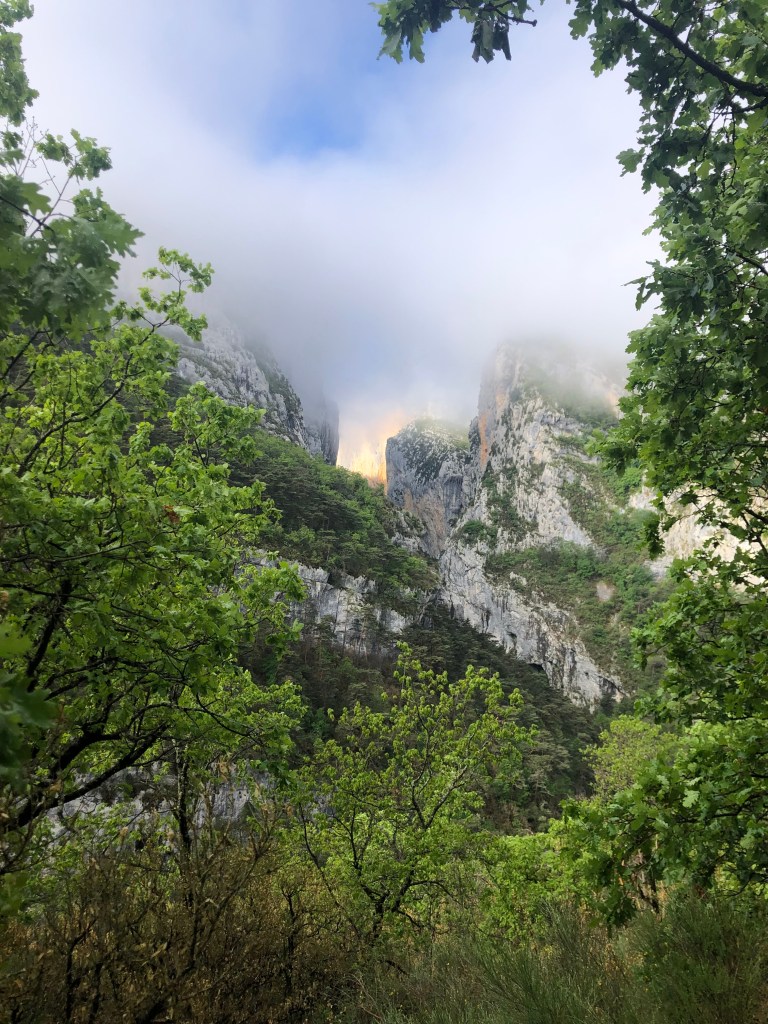
That’s the view for us nearing the bottom. A killer. Superb. But it’s also the sun on a wall a few kms in the direction we are pursuing, … and the fog is breaking to reveal at least some blue sky. We’d be right.

Just pics for a while.

One of the public vantage points
The entry near the floor to the main tunnel.
Through one of the tunnel ‘windows’
The easy bit
Exposure
And that’s scree, close to straight down

There were a number of people coming the other way, perhaps 20-25, maybe more, in small groups. It was about here that I stopped and chatted to one and we made humorous jokes about climbs and descents and how enormous the risers were on some of the stone steps where there were stone steps, and how was the other end and how long had we taken etc. Said farewell, and I saw these and said, ah some stairs and did a little dance of resignation. And they laughed. It might have been in a slightly inappropriate manner. I got to the top of the flight above, turned to my left and looked up.

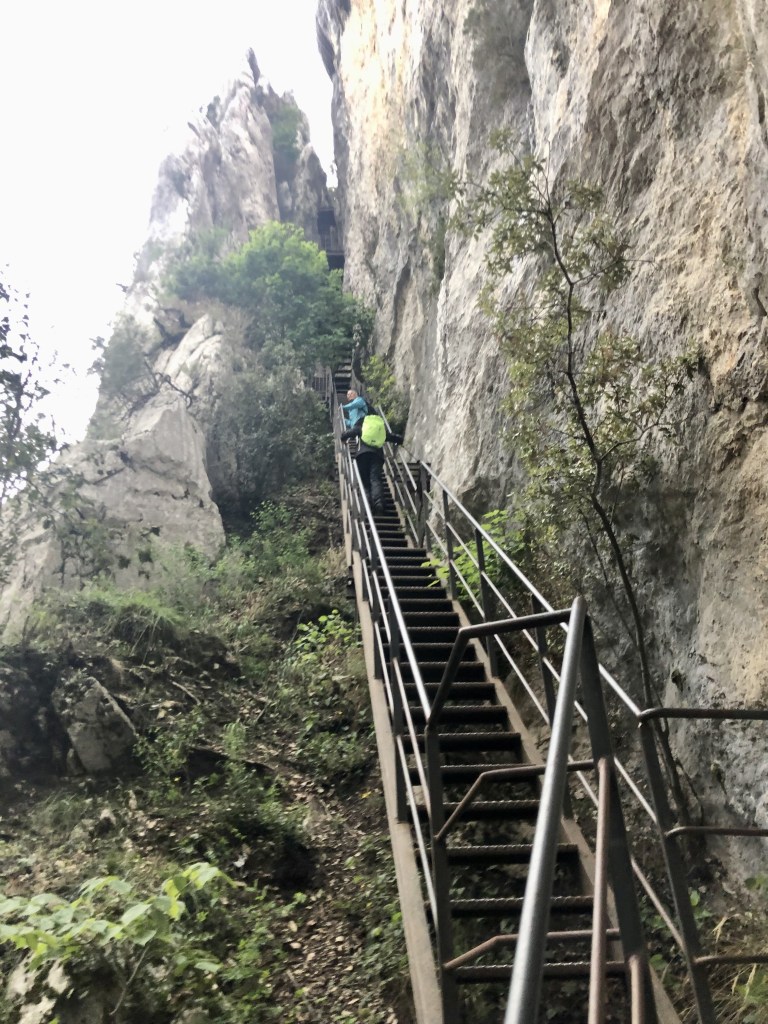
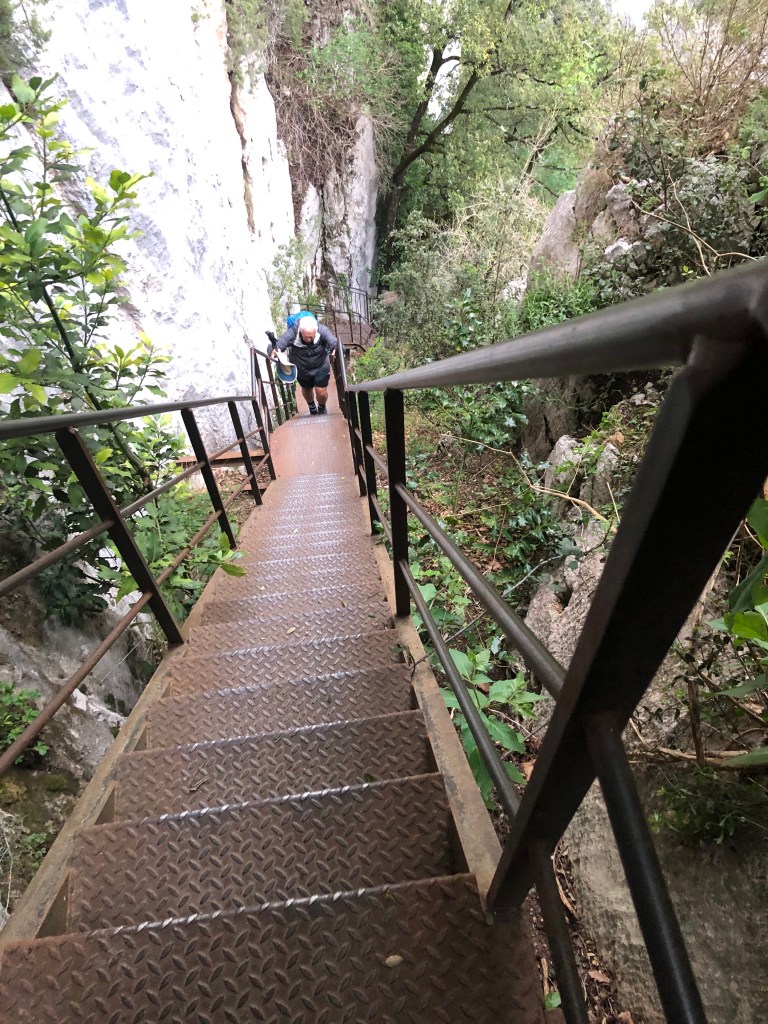
This is the Brèche Imbert, a quite brilliant feat of engineering. Brèche, meaning, well, ‘breach’, but also more relevant here, ‘opening, slit, cleft’. Climbers might call it a chimney although it’s a bit too wide for that. Imbert for Iwan Imbert who designed the route and the first staircase, now replaced, in 1925. The walk through the whole gorge was completed for the first time by Edwin Martel in 1928 so, unlike so many similar things, it is not an ancient route. The first stair case had 239 steps. I’m guessing but I think there were a dozen flights of 20 steps. There may be fewer, but I can confidently assert there are a lot. All told, it must be more than 100m pretty straight up.

At the top, when you get there, you can do some hand climbing and get on top of a boulder to reach a belvédère, one sought by a pair of fellow walkers who had fallen by the wayside several kilometres back. Belvédère: ‘a panoramic view’. This one.

I think this might be where we had lunch …

and there are no more photos for the next three hours or so because my phone was in a plastic bag in my pack. It had started raining, not viciously, just steadily and it took at least 10 or 15 minutes to get wet through. But as Myrna says drawing on her literary foundations, ‘Sakes, it’s only weather’, and motion keeps you warm and there was plenty to motion about. So much motion.

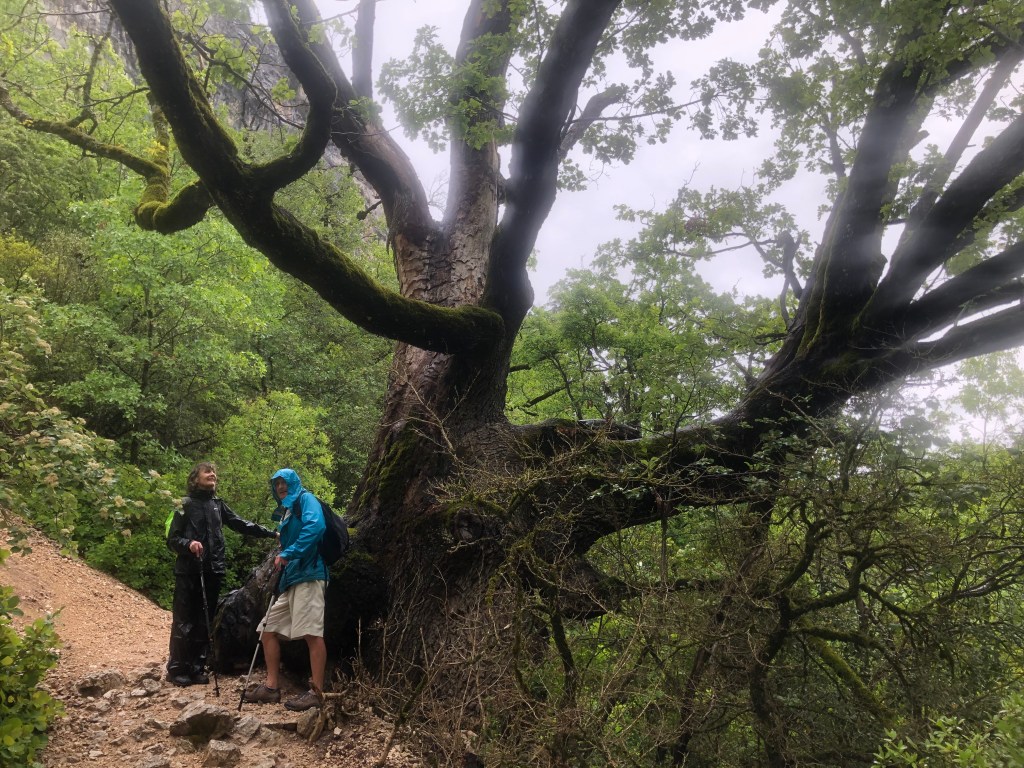
The taxi was due at 4.00 at the top of the hill and we were making good time when we got to the bottom of the La Maline climb. La Maline is a chalet installed on the lip of the canyon, and some person or group over a period of time has built a zig-zag track (17 turns as I count them) which runs between the top and bottom. It has been thoughtfully constructed on a good grade but, Lord, there’s a lot of it. My heart rate was, well … high. Sky high really. It might have been to have a(nother) excuse for a rest that I saw this tree and wanted to photograph it.

I note that at this stage the rain had diminished or stopped. We might have been close to the end of the serious zig-zags. I could see a building apparently a hundred metres or more above us and way way over to the left. I think I might have reassured my colleagues that that couldn’t possibly be the Chalet. But the track went on and on, up and up and then into a formidable upwards leftwards curl. That building was our destination.

When we arrived, not long before the taxi was due, we discovered the chalet was closed for renovation, so not even a beer or an Orangina to celebrate.

In the shortish trip from La Maline to La Palud I found out about the state of Pascal’s business, why he was driving, what it entailed, his children and grandchildren and the divorce settlement which had underpinned all this. The conversation was half and half in butchered French and English, probably ridiculous to listen to but quite satisfactory as a participant. By the time we got to the Hotel Le Provence I had made a new friend.

Moustiers-Sainte-Marie

La Palud is a sort of trailhead for adventurers and not thick with social or commercial opportunities, but Le Provence was a most satisfactory hotel. An offer was made not just to dry clothes but to wash them as well. The staff were friendly, the food excellent and the bed soft. Over dinner we discussed the next day, 21 kms to Moustiers. After the Gorge day I was feeling a bit scratchy. I was of a mind to join Pascal and our luggage in the taxi as it was moved along to the next destination. There was some agreement but by morning Michael had decided to walk the road to Moustiers which was, of course, practicable and just fine.

So, relatively clean, dry and rather avidly anticipating a rest I climbed into the back of the taxi and Myrna had the chance to enjoy Pascal’s conversation. Michael was about an hour down the road when we passed him. In short order he would be coming to this view, Lac de Sainte Croix showing the effects of drought and quite probably climate change. The plateau over the other side on the right was one of our next destinations.

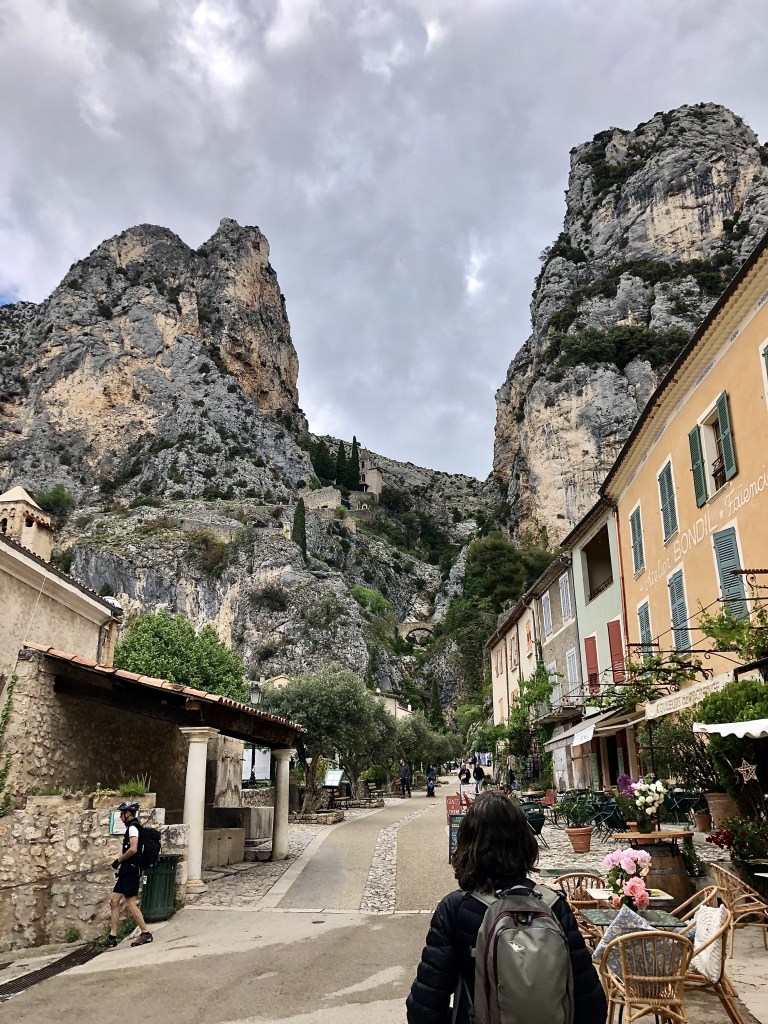
I had no idea about this but Moustiers (according to sources which I am unable to cite) is one of the 30 most beautiful/ picturesque/ interesting villages of France. Big call! France … such stern competition. One of the 30 best! But regardless we had made an extremely fortunate choice for a rest day. It had dozens of places to eat, many more to sell you faïence, a very particular sort of pottery which I didn’t feel I needed, but lavender, après-après midi outfits in white, and a wide variety of ice cream.

In the photo above we are looking at three, the sum really, of what it is — besides its rather exquisite setting — that gives Moustiers its heft.

  1. At the bottom of the rocky notch in that patch of greenery a very healthy spring emerges and runs through the centre of town allowing for, inter alia, pretty cool places with upper end prices to sit and eat and look at flowing water.
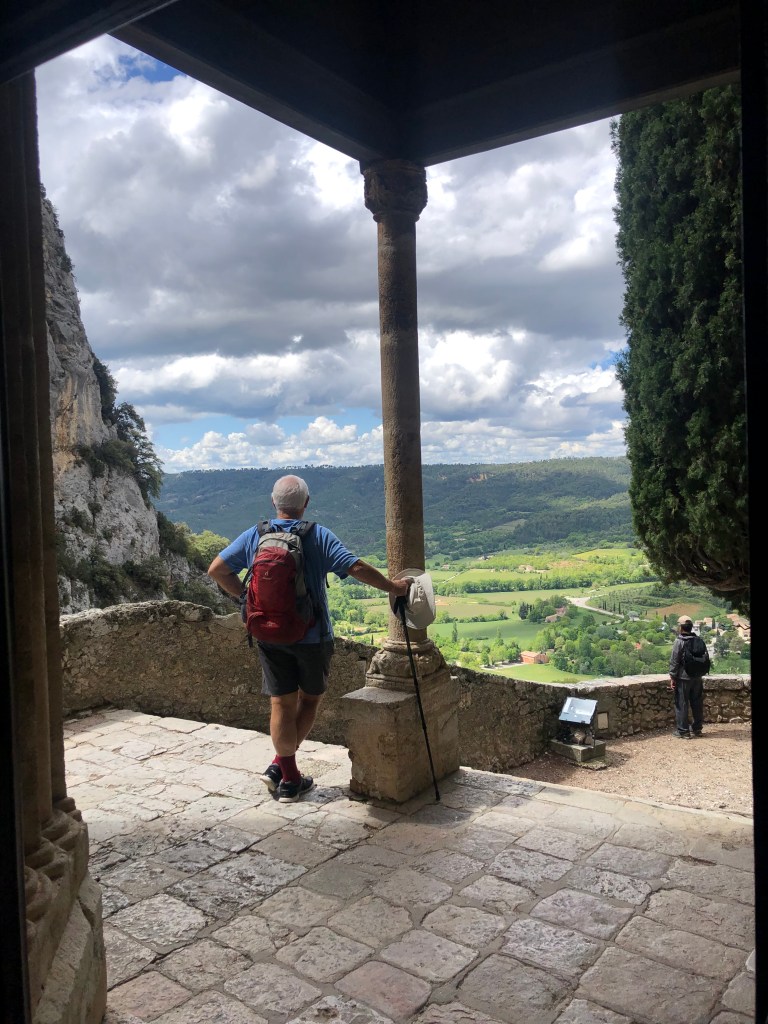
  2. Directly above that you can see a building. That is La Chapelle Notre Dame de Beauvoir. Let me quote: ‘The first known mention of this chapel, then called Our Lady of Between the Rocks (let’s say, ‘of the Gorge’), is from the 9th century AD. … The renaming of the chapel was carried out in the 12th century in response to the numerous miracles performed here by the Virgin. Pilgrimage to Notre Dame expanded rapidly, encouraged by the Church which granted, or sold, indulgences to the pilgrims. In the 17th century these pilgrimages took on a particular form. Stillborn babies were brought here — who in some instances (‘resurrected’ is the word used but I’ll say) recovered — to be baptised and to ensure the salvation of their souls. They were buried in a part of the cemetery designated for that purpose. This process is referred to as ‘solicitation’ and chapels recognised for these miracles are called Chapels of Respite. Notre Dame de Beauvoir is the most important in Provence.’ (Public info board)
  3. Higher again, suspended between the two crags on a chain and scarcely visible in this photo is a star. (It’s yellow er … gold. You can find it if you can magnify the pic.)There are some medieval records that refer to its presence. In more recent times there have been five replacements and the latest is 1.8m across. No one knows the original explanation of its purpose although the local history buffs like the idea that a knight called Sir Blacas escaped from the Saracens and put the star up (no small feat) to give thanks to the Virgin. It might be more likely that it was a village effort to seek some form of religious protection after they were almost entirely wiped out by the forces of Queen Jeanne in 1445.

Strong play Moustiers. Very strong play. Throw in the faïence and the ice creams and it could really be top 10. It is also the hub for a number of very pleasant walks which we proceeded to do. (Click to enlarge.)

and around town generally

PLUS I had a very good burger for lunch (just as Michael appeared) almost within reaching distance of The Source, below The Chapel AND within sight of The Star … and enjoyed the food and felt better than I had for days. That night at La Bonne Auberge I had confit duck with a cointreau and orange sauce. I cannot begin to tell you how excellent it was. Moustiers! Top five. Easily.

Michael foreclosed on the forecast.

Moustiers-Sainte-Marie to Riez

An easy day. Down through outer Moustiers to the rivulet that the Spring helps form. Up the other side, quite a steady climb, about 300m in 2-3kms. Across the Valensole Plateau framed by the lake and the water catchment we just climbed out of. Flat as a pancake for 10+ kms. Bit of up and down into Roumoules and then Riez, the end, an easy 4-5kms away. 21kms

Michael reviewing where we’d been

It was a very mellow Sunday, the sort of weather Provence might be renowned for. We could expect, I thought, some company on the road.

We were leaving the mountains and the limestone crags behind and having a close encounter with the extraordinary fecundity of parts at least of the French countryside. Often walks start with a big climb but this one had a very gentle start, easing down through the well-heeled ‘suburbs’ of Moustiers flush with a great many accommodation options including a turreted faux castle with a menu attached to its gate. The climb began once we had crossed a stream that had seen busier days. It wasn’t going to fill the Lac. The climb went on a bit, but it was more that we were on this very chewed up 4-wheel drive track, maybe a farm or forestry track, with big sprays of gravel in the corners and deep ruts that were hard to walk on. Up on the plateau the ground was also quite wet, very clayey, and there was little difficulty in establishing a 50mm platform under your shoe.

This pic is included only as a record that I was first up this climb. I was in fact feeling extra well. Walking can be like that. You give your body a chance to catch up and then it tells you how much all that exercise has been appreciated. Moustiers wasn’t looking any worse from afar nestled into its rocky surrounds.

But we weren’t looking in that direction. More like this.

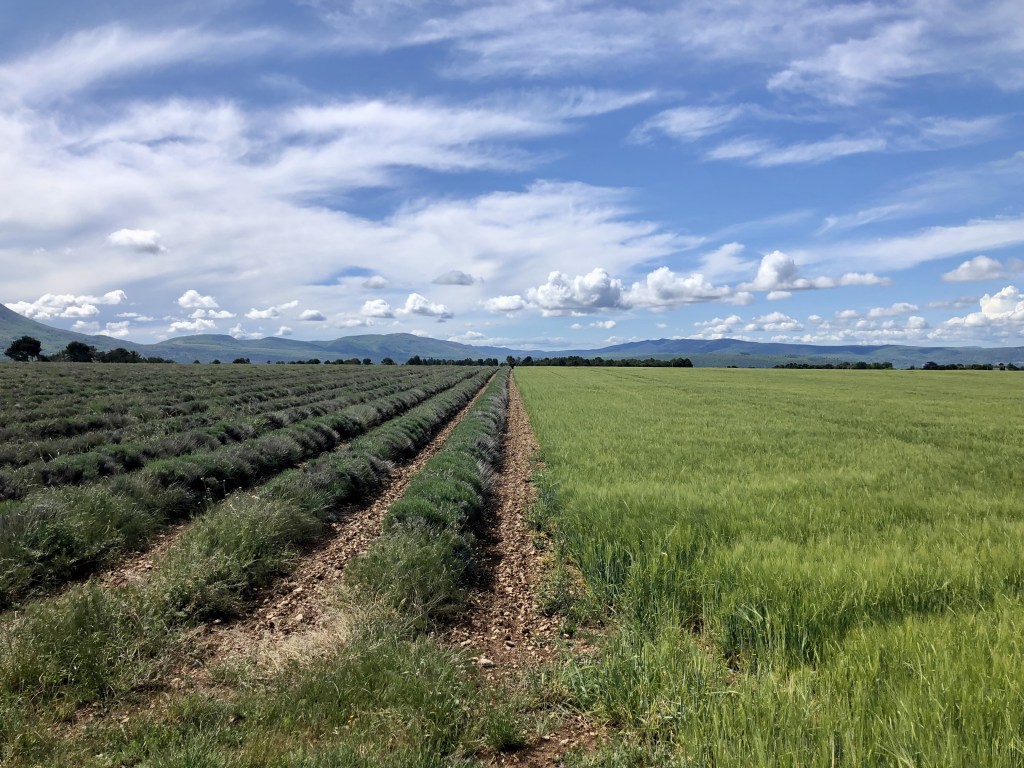
Lavender, hundreds of hectares of it, aubergines, barley, oak orchards for propagating truffles. No vines, some few orchards devoted to apple and pears but endless ground crops with big houses and big sheds and big pumps to suck up artesian water and big sprayers to circulate it. It was a study in productive land management. Other forms of study occurred.

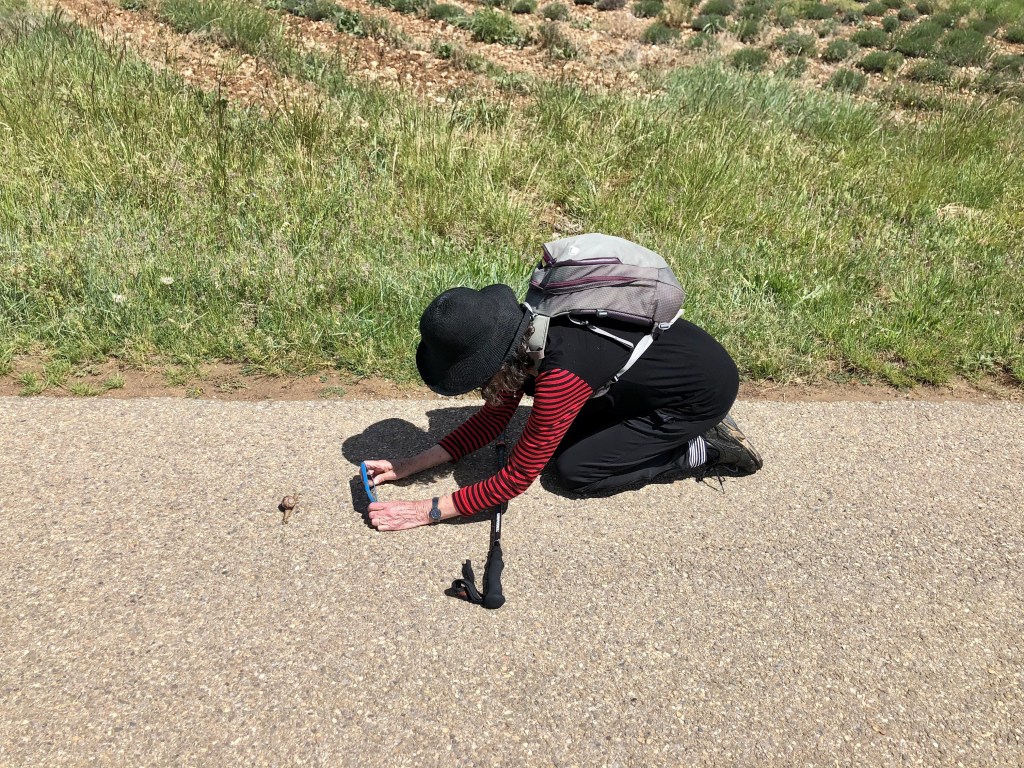
All creatures great and …

There were people about but not many. Just here these boys hissed past at considerable speed accompanied by motor bikes with flashing lights and support cars. I think I was watching a moment or two of the Tour de Verdon.

Around lunch time we were developing high hopes for what Roumoules might offer. The only town we would pass through during the day anywhere on our walk, what would it have? Fresh baguettes, say with intriguing fillings? Something warm? Interesting small pies with … hmmm a truffle sauce? Wonderful pastries probably for sure.

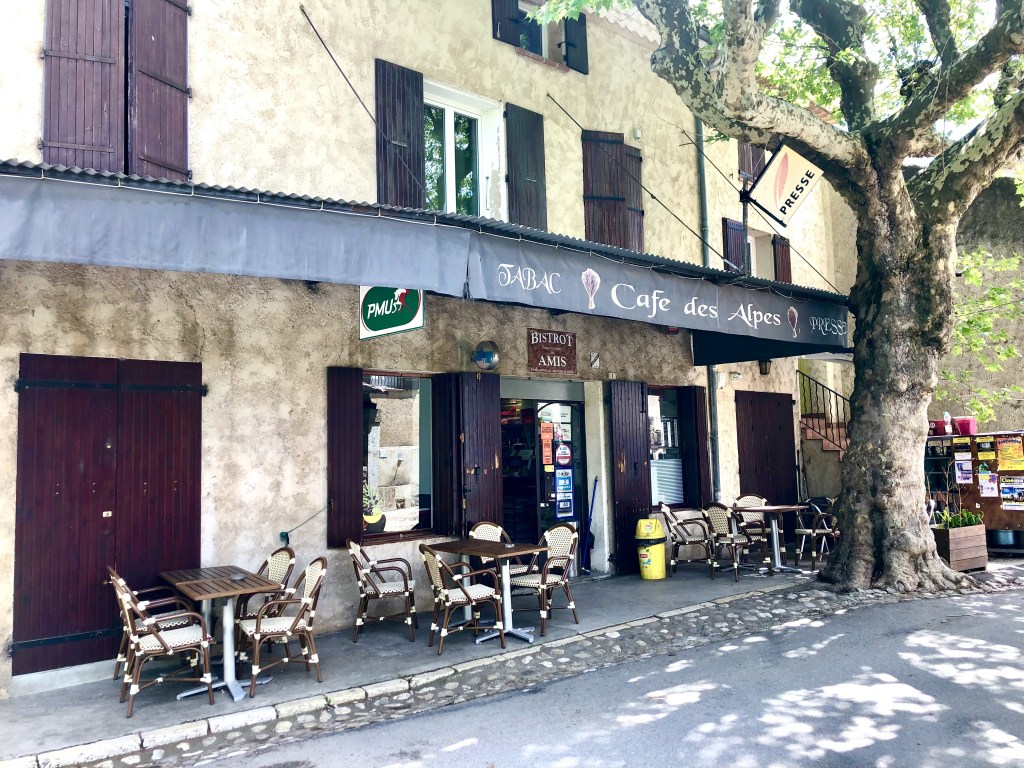
Ah Roumoules, Roumoules, Roumoules. It had a large Salle Polyvalent (Yes indeed. What on earth could that be you’re wondering? Try ‘multi-purpose’) and the distressed remnants of a pizza shop which still appears on Google maps. And it had the Cafe des Alpes as a last resort. I see it’s a ‘Bistrot des Amis’ which might be some sort of secret drinking club because at about 1pm Sunday arvo the amis including the female barkeep were having a raucous party, the sort where you lurch as you roar some comment which you forget about half way through, and swing at your best friend and miss. The sound system was so loud (Motown and disco as I remember) that she couldn’t hear my shouted request for a Pellegrino Limone. Lots of drinks but not much food on offer.

This photo was taken on departure, ours, but also everyone else’s. There might have been three left inside but the others had piled into a series of cars being driven by members of the amis presumably to honour the sacred French Sunday lunch somewhere else.

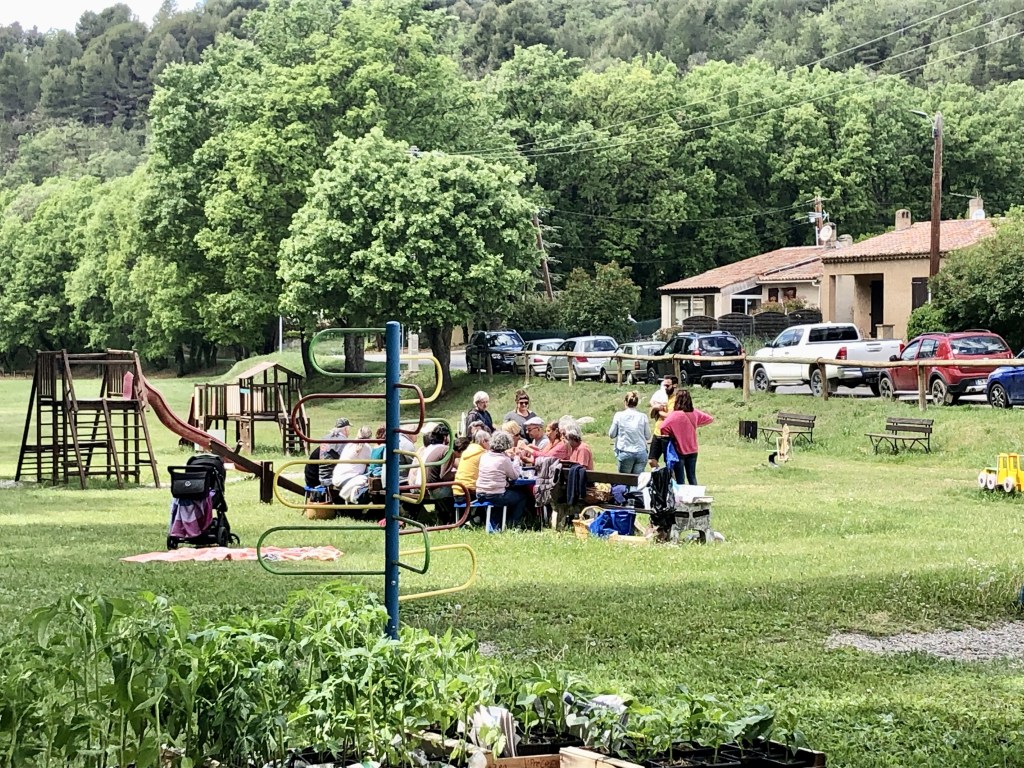
As the folk below were doing at the Roumoules aire pique-nique.

That would have been good over there. Nice wine, quiches, salades, fresh bread, perhaps some very carefully cooked cold fish, thinly-sliced charcuterie, cheeses. We were on the other side of the nursery stall digging through the remnants of five days of lunches. I still had some bread that we’d bought at St Andre, a pear, some fairly heavily punished bananas, a small tin of tuna, a dob of pate which had been supplied by the Auberge de Point Sublime, cakes! I’d forgotten. One piece of very fine apple and honey slice/flan provided from the same source. Some old goat’s cheese. Had a drink of water. Moved on.

You take the high road, I’ve already taken the low road. Navigation, about which there was negligible disagreement. Included just for the photo really.

And so we arrived at Riez!, la pointe (semi) finale. This sign isn’t telling us much except that all of Riez! is under video surveillance.

Riez’s point of difference is that it has columns, Roman columns, and not only can you have a look at them you can imagine the very large gesture that they’ve been attached to. (Click to enlarge.)

And yes we were spending the night at the Hotel des Colonnes, just the three available rooms (ours almost half a floor) and a shop, first established in the 17th century, adjusted several times since, but still redolent of other times and our hostess’s strikingly individual and interesting taste in art. It was sort of like a large installation. Memorable.

Our efforts to celebrate the end of the walk and its duration, all of it wonderful, were hampered by it being Sunday night in a small French town. We had something of a search before finding someone who beckoned us in. Le Petit Provence: next time you’re in Riez don’t miss it. Bream very recently out of the sea, excellent vegetables, and Michael ordered Crepes Suzette. It was on the menu but I don’t think they’d actually provided one since … oooo the mid-19th century. The assembled throng (others were hungry too) burst into applause when the balloon went up so to speak, and the conflagration took proper hold.

Taxi to Manosque the next morning, to meet a tiny, slow, and massively crowded train to Aix where we spent a day and a half.

Aix-en-Provence

If Moustiers wasn’t in a different size category, Aix (round 20 kms north of Marseille and connected to it by housing) would severely test its ranking. Huge numbers of tourists but in manageable clumps. Formidably picturesque and stylish, there’s plenty of money in Aix. A 1000 options for food and drink (all sorts, we had sushi after we arrived), important architecture mostly old but some new, a university town full of young people and their vitality, great galleries … it was everything I had hoped it might be.

One quite modest reason for knowing about it is that Cezanne lived here and nearby is Mt Sainte Victoire, his talisman, painted countless times (actually 91 works are known). Here he is in 1906, according to Maurice Denis at the Granet gallery …

which, as well, had a very serious and thorough David Hockney exhibition. Hockney called this ‘My Parents’. Our children might soon too.

A very last photo before we pick up the car in which we will drive north to Heidelberg.

In the truffle shop on the Rue d’Italie. Nothing sold here but truffles: truffle bits, truffle-based, truffle-influenced, truffle-infused, truffle-smudged … the entire shop, and his job was to sell them. He was four weeks into the job and had already mastered it. Charming, warm, knowledgable, he almost made me forget I don’t really like truffle.

Into the car. First they didn’t have one, annoying; then they found one — oddly a red A3 Audi hatchback just like the one in our garage, but newer — pleasing. Wrong side of the road again. Off we go. La Roche de Solutré 400 kms away by 3pm.

THE ROADS OF NEW ENGLAND

We’d never had a look at New England and I thought we should and that driving might be a good way to do it. Just random driving: along the coast for a start and then upstate into the hills. I shut my eyes, pointed and picked Franconia as the far destination. It was in about the right place and had a motel, so that’s what we did.

EN ROUTE

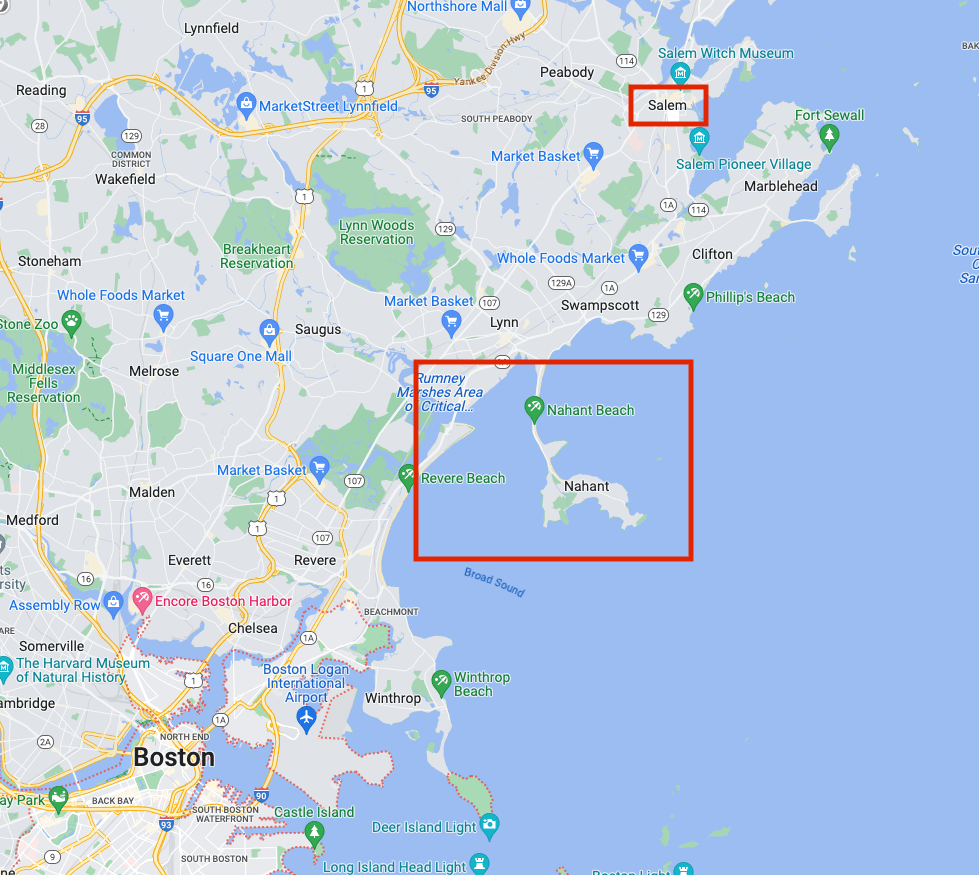
I noticed Salem in the broad vicinity. Salem! The Scarlet Letter, The Crucible. American Gothic. Witches. Weirdos. What would you see? You’d think it would have to be worth a visit. That could be our first destination.

Salem turned out to be something like an outer suburb of Boston which didn’t make the drive any less interesting.

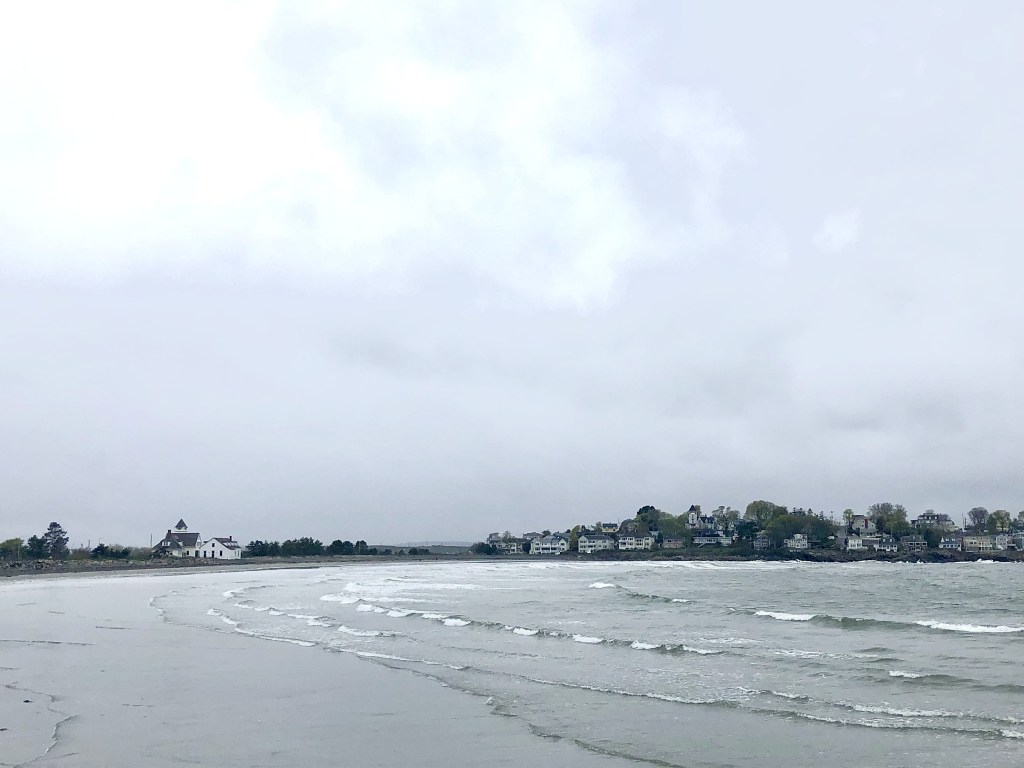
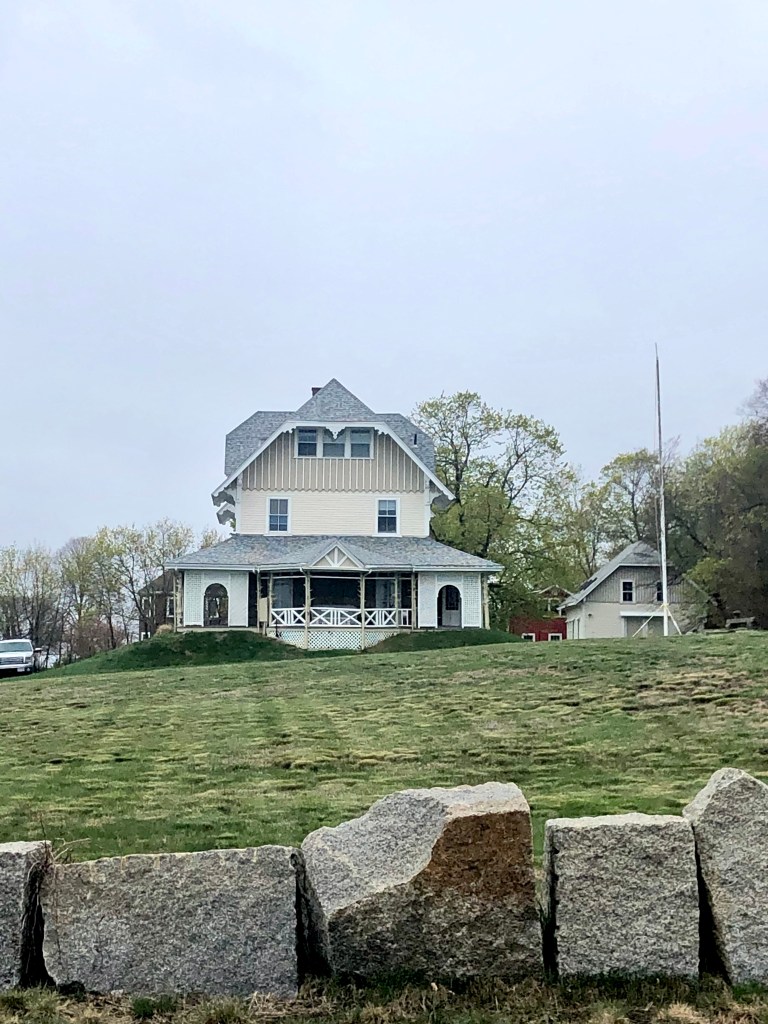
I had noticed this geographical feature and thought we might investigate. There was also I noticed somewhere to eat, and drink, near the end of the neck and that it might be a good place to have lunch. Both repaid. Nahant, while not the Hamptons nor Cape Cod, still had plenty of houses to look at. Linne, our very fine waitstaff, who had just got her real estate license, assured us that they were as tightly held as I thought they might be. (You can click on these to get a better look.)

SALEM

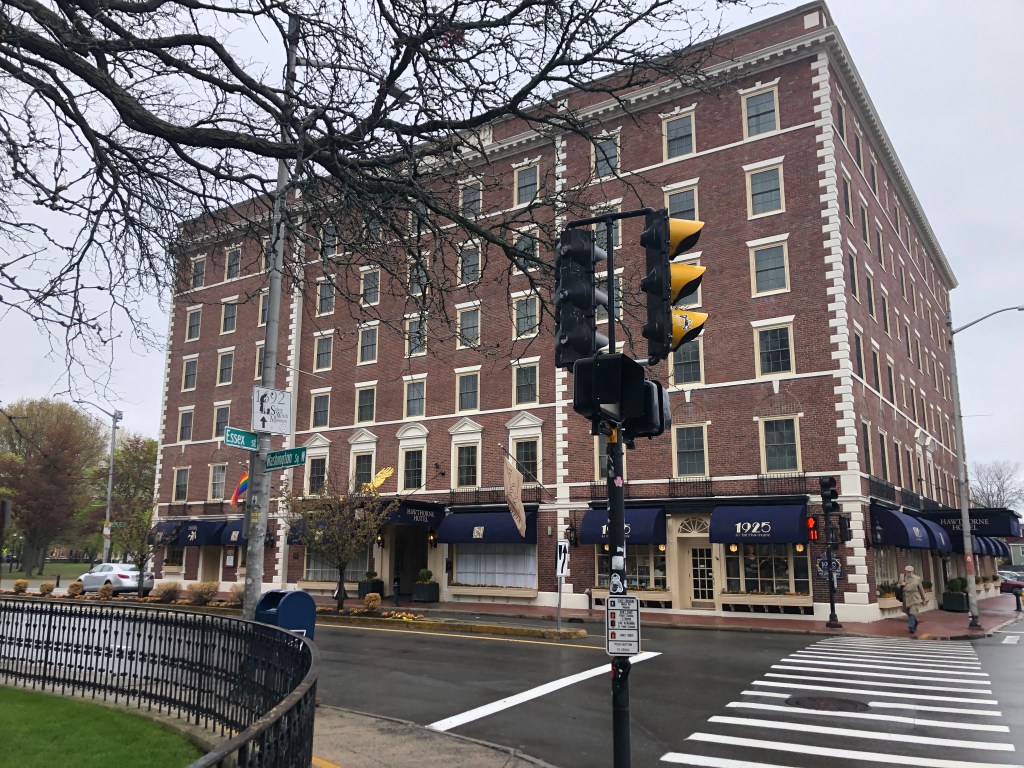
I wore my Big Red ‘A’ into the Hawthorne Hotel but no one else seemed to be wearing one so I took mine off and we retired to Nathaniel’s Bar which seemed at least a bit appropriate.

There we found Danny Mac and his band, or rather his new band because he was once in ‘Boston’ — the band not the city. He was the short one with the beard. He had two mates and they played Jackson Browne, Eagles, old Van Morrison, Kinks and were terrific. Our vintage you might say.

There were ten in the audience. Four were clearly there for the music, the other four were having a noisy girls night out, and the other two were us. I failed another test of America here. As things wrapped up I noticed the keen but undemonstrative fan drop a $100 bill into the hat. Then the couple sitting next to us dropped in a roll of unidentified denominations, and we had nothing suitable to offer, not a cracker. You can’t drop a credit card into a hat. Well, I don’t think you should anyway. I left full of applause but embarrassed. It’s the sort of thing you ought to consider.

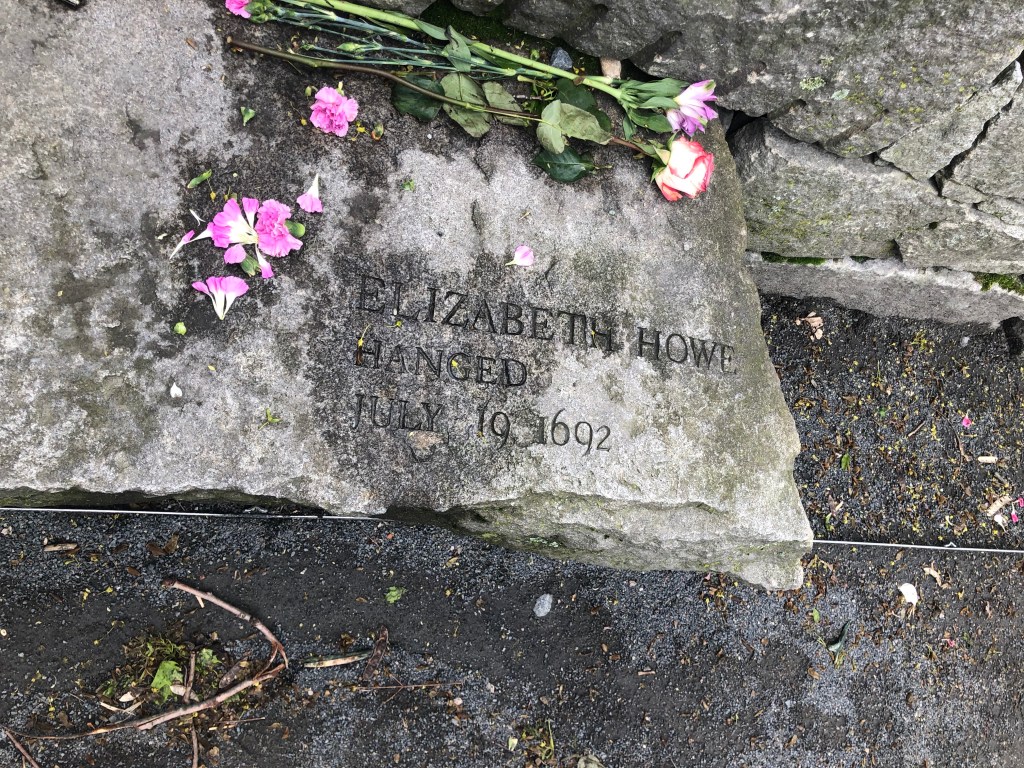
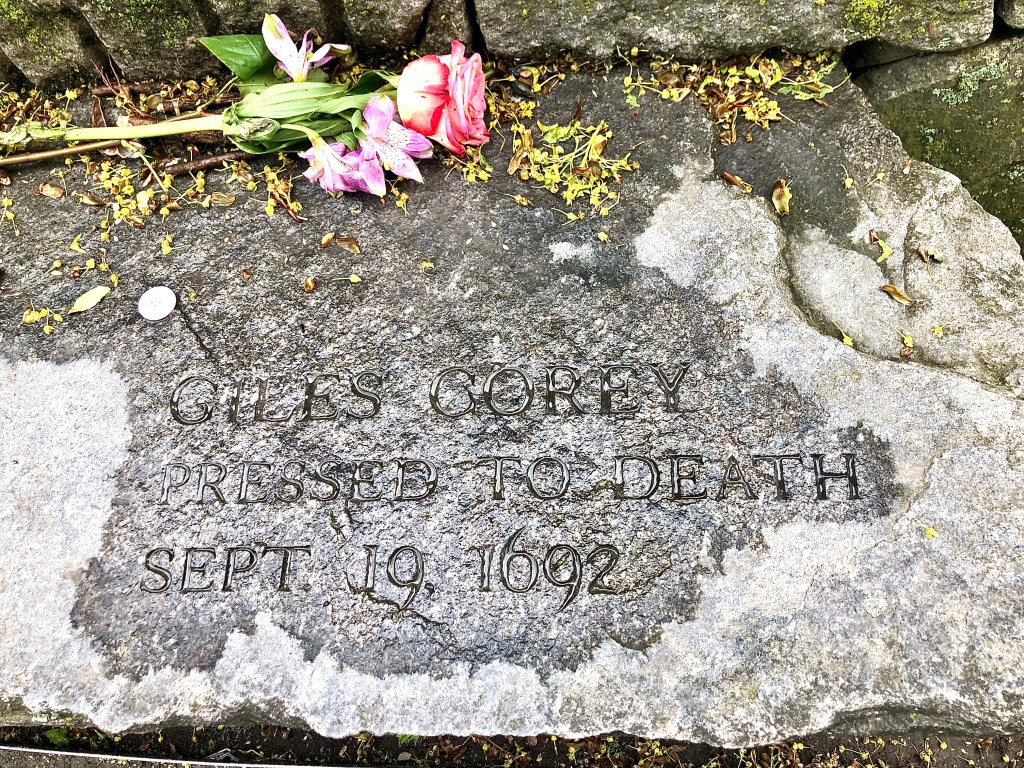
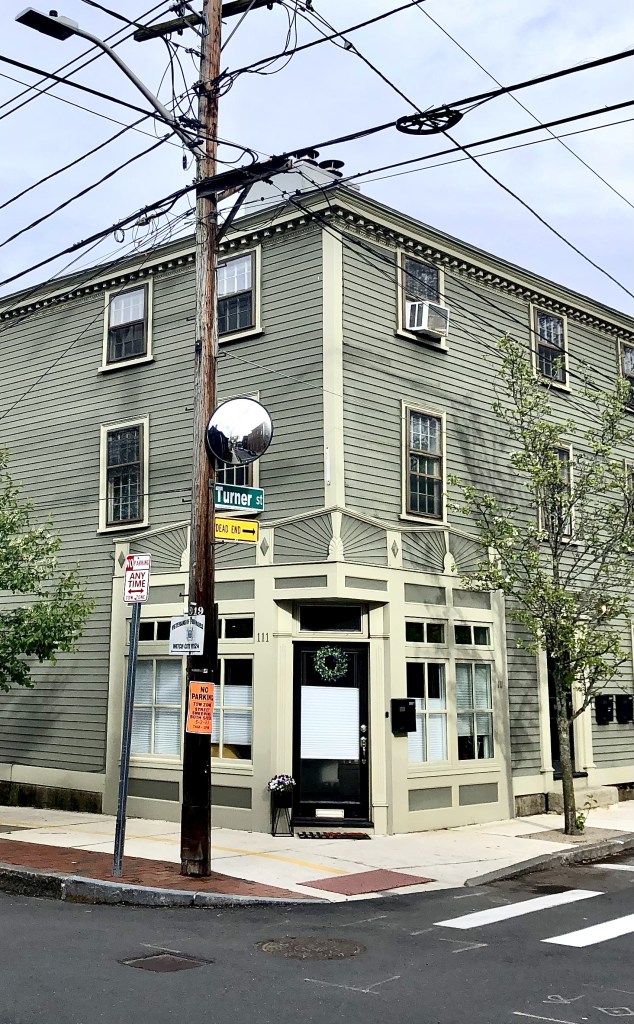
We had better luck with the possessed girls, poor old John Proctor and Giles ‘more weight’ Corey. They were there for us, or at least had been. Click to discover that Giles Corey was ‘Pressed to death’.

But I think Salem has misunderstood ‘The Crucible’ and the events on which it is based. The point is there aren’t any witches, no one was really possessed, it was all a fabrication. Even reading through the allegory, Miller was providing commentary on the McCarthy trials. He was against what was happening. Against. Deceit, hogwash, folderol, concoction, falsehood, rubbish. A big collection of mis-spokenness. Both history and Miller make that clear. But, on the other hand, how many tourists is that going to draw?

We could have spent time at The Black Veil Shoppe of Drear and Wonders, the Dairy Witch Icecream shop, the Witch House at Salem, the Witch Dungeon Museum, Chambers of Terror, the Salem Witch Trials Museum and Memorial, Hex: Old World Witchery, Artemisia Spells and Botanicals, Stardust, Vampfangs, Circle of Stitch Witches, Crow Haven Corner (‘Readings are available by the talented Witches of Crow Haven! Walk-ins are available but appointments are recommended’), The Cauldron Black, Hauswitch … and that’s by no means the end of it.

The House of Seven Gables is another (somewhat mysterious) attraction. I think maybe Nate was born there. Its ‘mission is to be a welcoming, thriving, historic site and community resource that engages people of all backgrounds in our inclusive American story.’ That’s where we were. I saw one Trump sticker. These aren’t the people who are going to vote him back in.

For me — Myrna was drawing — Salem’s primary interest was the range of housing in its old quarter.

These aren’t good examples but I like their style. Simple, precise with just a bit of nonsense. The green one was 30m from where I did a load of washing (a highlight: loved it, appreciated it, it’s my go).

This one (‘Derby House 1762’ the sign says) I include because it is a perfect example of a style in American architecture. Harvard and the expensive suburbs of Boston are covered in buildings of this sort although mostly very much bigger: flat frontage, symmetrical composition (including dormers and chimneys), mini arches over the windows as decoration (they might be structurally useful), a whiff of a portico with a modest step, identical windows fitted flat to the line of the wall, white or cream highlighting. No exterior weather protection apart from the roof and wall. They’re like houses kids would draw. It seems that it’s what’s inside that counts.

THE WHITE MOUNTAINS

American Food, Portsmouth, Maine.

Always plenty.

We drove inland from Portsmouth not having much idea about where we were going or what we’d see. Just for a look. It was very early Spring and the blossom that was out was mostly pink but there was enough to give an indication just how attractive this part of the world could be. We found our way without intending to onto the Kancamagus Highway.

The Kancamagus Highway is now designated an American Scenic Byway for its rich history, aesthetic beauty and culture. The Byway takes you through a path [about 45 miles long and full of sweeping bends] cut through the White Mountain National Forest with breathtaking views of the White Mountains, the Swift River, Sabbaday Falls, Lower Falls and Rocky Gorge. The Kanc takes you to an elevation of just under 3,000 feet at its highest point at Kancamagus Pass on the flank of Mt. Kancamagus near Lincoln, NH.

The road was littered with trailheads, dozens of them. The peaks were covered in snow. There would be some excellent walking here. And, yes, just great. A really good drive. These are the Lower Falls.

Action at the Franconia Thrift shop.

It was only later that I realised we’d almost driven to Canada.

• • • • • • • •

We drove from Franconia back to Boston making an effort to stick to B roads, successful for the first third, unsuccessful for the second third when we needed to hurry, and not an option for the last third. But I will remember that first third, ambling back and forth across the Connecticut River, the border dividing Vermont and New Hampshire, in an exquisitely fertile river valley. (I saw a moose bumbling its way across the road into the forest.)

I took one photo. Only one. Not even when we had lunch at Jake’s Carwash in West Lebanon; not even when we drove through the highly individual second homes lining Lake Mascoma; not even when we went past the Shaker Museum at Enfield, three very large and impressive buildings (at right) somewhere near nowhere which I would love to have visited.

This is the photo.

So to remember that drive I thought I’d write down the names of all the little towns we went through between Franconia and Concord. They have their own references and collective magic.

Franconia, Sugar Hill, Lisbon, Woodsville, Haverhill, Piermont, Lyme, Bradfield, Fairlee, Eli, North Shetford, Lower Slade, Hanover, West Lebanon, Plainfield, Cornish Flat, River Valley, Claremont, Enfield, Wilmot, Concord.

The last ten miles into Boston was arduous and finally we had to negotiate our way through this: feasible, but you had to keep your wits about you, exhausting for the navigator. (Top right hand corner: Boston Tea Party ships and museum. Below, Gillette World Shaving Headquarters.)

And then after a good night’s sleep in a comfortable bed we went somewhere else, to which there are some stories attached. We went from driving to walking.

REVOLUTION! Boston

The Massachusetts State House on Beacon Hill from The Common. The gilded dome was originally copper overlaid by Paul Revere, silversmith and metal worker. It was built on what had been John Hancock’s cow pasture.

Boston is the seat of the American Revolution, not where everything happened, but the absolute heart of the ferment.

Like a lot of these blogs, this is a story about colonialism. In this case an uprising of colonials against their overlords. One thing that cuts it out from the herd is that this time the colonials were white Europeans and the whole show takes on, so to speak, a different complexion.

The American Revolution: is it too much to say a marker in the history of the world? A beacon of liberty and idealism? Realised? Hold those in your head.

A further question, although it might damage the seriousness with which the previous questions are considered. Does walking round historical sites per se do anything for you? It behoved us to find out. We’re in Boston walking the Freedom Trail to find the American Revolution.

• • • • • • • • •

On a cold and wet day we got out of the subway at Park Street arriving at the start point, The Boston Common, America’s oldest public park.
It has a story of its own. The first attempt at European settlement on the Shawmut Peninsula (now, in a much expanded version, downtown Boston) failed. But one man, William Blackstone (or Blaxton), decided to remain and lived alone for five years on his allotment of 50 acres at the foot of Beacon Hill.

Meanwhile a group of Puritans had settled in Charlestown on the north side of the Charles River but were struggling with rocky soil and a lack of fresh water. Blaxton sent them a letter of invitation (how would he have done that? Not by post certainly) inviting them to move south and share its benefits. Over time that population enlarged and Blackstone was encouraged to sell most of his very large plot for common use: 44 acres for £30, each household contributing six shillings. He went elsewhere.

130 years on in 1768, a force of 4,000 British troops was sent to Boston to quell ‘disturbance’ and to re-establish ‘public order’. They were quartered on the Common. Unsurprisingly, their arrival had precisely the opposite effect. Unsurprisingly, there was a high rate of desertion.

We saw The Common in several lights. This was the first time. It looked and sounded a lot like a drug deal. Other times in better weather it was pulsing with crowds doing all the things that crowds do.

On the Tremont Street side one encounters this. It’s called ‘The Embrace’, and commemorates an embrace between Martin Luther King and his wife Coretta after King had given a speech on this spot about human rights and those of African Americans in particular. It’s enormous (note the people for scale) and brilliantly constructed but it’s hard to find much fondness in it. It looks just a tiny bit like Dali’s ‘Soft Construction with Boiled Beans’. I just discover that it’s new. It had only been there a few months when we saw it.

The Park Street Church towers over the eastern corner of the Common.

It wasn’t even there during the Revolution. ‘America, My Country ‘Tis of Thee’ was first sung here but I don’t think that counts.

Next door is the Granary Burying Ground.

Benjamin Franklin’s parents are buried under the dominant obelisk, the biggest memorial in the cemetery. (His parents!) John Hancock has a big memorial invisible over on the right. Paul Revere, Peter Faneuil, James Otis, Crispus Attucks, and Samuel Adams are also buried here although their graves are not obvious. The guy in the red top coat would have known but he was busy declaiming.

This is the site, and site only, of America’s first public school, the Boston Latin. Hiding in the bottom left hand corner is a statue of Benjamin Franklin who was a student there until he dropped out. It is claimed that there was a shout of ‘Close your books. School’s done and war’s begun’ on April 19 1775. Treat that as you wish.

In the background between the two sets of statuary is America’s oldest commercial building with a sign on it saying ‘CHIPOTLE Mexican Grill’. Among other things, it was once a publishing house which produced The Scarlet Letter, Walden and Uncle Tom’s Cabin. Good, interesting, but not really about liberty. The statues are about posh Bostonians ignoring the plight of the poor Irish immigrants who eventually took over Boston and had one of their own elected as President of the whole country.

The Old South Meeting House, closing in a bit here. This is where 5,000 Bostonians gathered in 1773 to hear whether there was any new compromise in the British policies enraging them. There wasn’t. The Sons of Liberty marched from here to the docks (not far, five or ten minutes brisk walk) and 342 chests of tea were dumped into the harbour.

Even closer. The Old State House where so much of the talking action happened, the forum for the orators and lawyers of the colonies. The British officials were consistently outplayed for a decade before the seams came apart.

Under the balcony is a memorial to the place, actually nearby rather than exactly here, where in 1770 the ‘Boston Massacre’ occurred, the place where seven or five locals were shot and killed by British soldiers.

In time the Declaration of Independence was read from its balcony.

Paul Revere’s House. ‘The ground floor includes a typical late-18th century kitchen with cooking implements and a large Hall restored and furnished to look as it might have when the first owner lived here. Upstairs chambers contain period furnishings from Paul Revere’s era, including several pieces that belonged to the Revere family.’ 10 bucks a head. We thought we’d let it go. But liked the car.

‘”One if by land and two if by sea”, Old North Church lit the way for the American Revolution.

The plaque says: ‘The signal lanterns of Paul Revere displayed in the steeple of this church April 18 1775 warned the country of the march of the British troops to Lexington and Concord.’

That’s it all right. Quite plain without the imminence of war, but that’s it.

Faneuil Hall. We are closing in now. Peter Faneuil was a successful businessman, one of the few who sided with the angry people early. The hall was an important meeting place for the sharing of emotions and ideas and organising events.

But who is that there in front on the podium?

‘Samuel Adams 1722-1803. A Patriot. He organised the Revolution and signed the Declaration of Independence.’ And you’ve never heard of him. Or have you? Was it just me?

• • • • • • • •

The American Revolution: is it too much to say, a marker in the history of the world? No. Unquestionably it was. Even Zhou Enlai would agree sufficient time has passed to agree it had enormous impact. But how should we characterise it? What does it look like without the glories of its post facto descriptions and justifications? Was it an unusual perhaps unique high point in the history of idealism? Or does it look different at home in its underwear?

• • • • • • • •

The Revolution came alive for me in Boston’s Museum of Fine Arts in a way that it didn’t on the walk. That can happen. But in the gallery — and of course another great American gallery, a big call but better curated I think than MOMA — there they all were. John Singleton Copley had painted them all.

I had been reading Stacey Schiff’s book The Revolutionary: Samuel Adams. It had just been published and very positively reviewed but I was finding it hard going. Over-written I thought, and she seemed to be making a point of his ordinariness, highly principled, very rational, but ordinary. Something like the kiss of death to a biography. Nonetheless it got me in for reasons which I will explain.

As far as I understand it, and it isn’t very far, this is what happened.

Between 1700 and 1775 the European population of the 13 American colonies multiplied more than 12 times. As a consequence they went from being isolated outposts to something quite different. Urban clusters were beginning to take form, small enough to have strong community contacts and interaction, but big enough to develop a degree of sophistication: with growing professional classes, a caste of prosperous native by birth merchants emerging, and the surfacing of a group of people with enough freedom from the grind of manual work to think and put their thoughts into writing. Public discourse was emerging with loyalty to its locale rather than locations 3000 miles away.

In the mid 18th century the American colonies might be considered teenaged societies, full of hormones and vitality but at the same time roiling away with unfocused resentments, unenthusiastic about adult direction. And the adults weren’t much help. Britain, considerably weakened by the Seven Years Wars with France and India which lengthened into nine years, was not taking much notice of the emerging maturity of these colonies.

Francis Bernard was sent to govern Massachusetts in 1760 seeking a quasi-retirement posting to allow him to indulge his interests in classical music and good books. These plans were consistently disrupted by vexations in the local parliament and commotion in the streets. He consequently made judgments that he and his employer would come to regret. It was he who ordered the regiments of troops for Boston. Thomas Hutchinson, a native of Boston who succeeded him, appears to have been worse. Pompous, clever, arrogant and possibly malicious, his life seems to have been dogged by a continuing rumble of disappointment and failed expectation. ‘Everything in American life happens contrary to probability’, he wrote. You can’t help think that if both men had been better attuned to their environment and more inclined to negotiation the revolution may have at least been postponed.

In England the erratic George III reigned and news from America was both unsystematic and deeply coloured by its sources. Benjamin Franklin was in a position in the mid 1770s to discover in London eight months worth of formal correspondence from the colonies most of which had not been opened.

John Singleton Copley, Samuel Adams. No finery but such intentness of regard. Painted just after the ‘Massacre’, he grips his instructions for boycotting British goods in his right hand and points with his left to the Massachusetts charter of 1691 which he he believed guaranteed the citizens’ rights. All business.

Samuel Adams was one of the primary exponents of public discourse and one of the authors of those unopened letters. Although his family was quite wealthy (church deacons but also brewers you mightn’t be surprised to hear), he appears never to have had much money and to have stumbled badly in his role as a tax collector leaving him twice with the responsibility for paying other people’s taxes. But with pen in hand or standing, speaking notes in hand, he was indefatigable.

He was educated at Harvard, already more than a 100 years old, and became absorbed with the demands of logic and rationality. His writing had great verve but also great clarity. And great volume. Boston had three of the four first newspapers published in America, usually weekly, not very thick but given sometimes to acid commentary and bitter personal attacks thus guaranteeing an audience. In the 1760s the Boston Gazette had a circulation of 2000, very substantial in the circumstances. Adams began writing for The Independent Advertiser but then moved to the Gazette where he was a regular correspondent although, as was the custom of the times, writing pseudonymously. These newspapers were the mass media of their day and played a huge role in shaping public opinion.

Adams was also a politician, a long term member of the Massachusetts House of Representatives, holding senior roles and building and maintaining influence. He had a range of allies including his frontman for a time James Otis, a lawyer and renowned orator but with shakey mental health which eventually left him disabled. His cousin John who became the second President of the United States was a close collaborator. John Hancock, son of wealthy merchants, provided the money which helped to keep Adams out of debtor’s prison. Adams became his mentor and friend for a decade or more until they fell out over Hancock’s ‘extravagances’. Adams thought them inappropriate to his role. (It is Hancock’s florid signature at the top of the Declaration of Independence which has led to ‘John Hancock’ being used in America as slang for ‘signature’. He was at that time President of the Continental Congress, the vehicle for the co-operation of the colonies.)

But Adams could legitimately be thought of as the coordinating force of this phase of anti-British sentiment. He was the one writing the critique. Jefferson may have written, ‘We hold these truths to be self-evident, that all men are created equal, that they are endowed by their Creator with certain unalienable Rights, that among these are Life, Liberty and the pursuit of Happiness’, but Adams would have had to hand the list of 27 grievances which follow. They are the substance of what he had been corresponding with the Crown and its representatives about for more than 20 years.

John Adams, John Hancock (with gold braid), Thomas Hutchinson, James Otis all by Copley.

There is a broadly agreed set of milestones in the progress of the American colonies towards declaring independence. They mostly seem to to relate to tax, commonly an unedifying and complex topic.

As mentioned above, Britain was in a weakened financial state after its commitment to a long and draining set of wars and there was a dominant school of thought in the British Parliament that the colonies, if not providing income, should at least pay their own way.

This is what the British Parliament’s Sugar Act of 1764 was intended to achieve, the first taxing of the American colonials. It was not well received. The Boston Town meeting, a semi-formal body, approved instructions developed by Adams with help from Otis that the tax legislated under this Act was not to be paid. Then in response in 1765 the British Parliament with its nose increasingly out of joint, passed the Stamp Act which required colonists to pay tax on printed materials.
This doesn’t sound like much but it sparked a furore which encouraged Adams to organise a boycott of British imports. Andrew Oliver who was charged with the implementation of the Stamp Tax, was hanged in effigy from a tree, the ‘Liberty Tree’, in the Common. The sign read, ‘What Greater Joy did ever New England see / Than a Stampman hanging on a Tree!’ Sides were drawing up. The Tree was later cut down and used for firewood by British Loyalists during the siege of Boston.

Oliver’s house was ransacked shortly after. On the same night a mob surrounded Lieutenant-Governor Hutchinson’s house to demand his agreement to rescind the tax. (Oliver was his brother-in-law. Hutchinson’s family held 11 significant paid posts in the Massachusetts public service at the time. He himself had four of them.) They came back some nights later and completely gutted Hutchinson’s North End mansion, even dismantling and taking its cupola. This is one of the events that led the British to send a detachment of troops to Boston.

In 1770 the Boston ‘Massacre’ occurred. (This is an engraving ‘Engrav’d, Printed & sold by Paul Revere’ who seems to have been highly entrepreneurial as well as a very capable odd jobs man.)

A mob of three or four hundred Bostonians was baiting British soldiers near the Old State House, spitting at them as well as throwing various projectiles, taunting them to ‘Open Fire’ in return. One sentry, Private White, was knocked down with a stone and then did open fire as a group led by a Black/ Native American former slave then whaler, Crispus Attucks, charged towards them to attack with various ad hoc weapons. Attucks has a role in history as ‘the first person killed in the War of Independence’.

This story is very murky. Other soldiers opened fire, the command may or may not have been given, and three (or five) people were killed immediately, two (or three) dying later of their wounds.

This of course was a disaster for the British. What? Killing their own (WHITE) subjects now?

With emotions running very high, Samuel Adams asked his cousin John to lead the legal defence of the soldiers so that justice could be seen to be done, ineluctably. Later, when the charges were dismissed by that same process, he wrote a furious critique of what had happened, not really shifting his position but, as so often, being absolutely fixed in his view of what the right thing might be. In this case, hanging of the soldiers. He moulded this event, as he had many others, into his spacious narrative of English infamies.

The reach of his writing expanded through his creation of a ‘committee of correspondence’ initially throughout Massachusetts but spreading in reasonably short order to the other 12 colonies some of which were ripe for this sort of talk. (But not all. Maryland, for example, was not a signatory to the Declaration of Independence.) The British tried to outlaw and short circuit this process which was conducted quite secretively, but failed. Very hard to stop something like that. Strategically it was essential for the colonial agitators; obvious, but still a masterstroke that no one else had tried.

And then in 1773 came the Tea Party.

An additional cause of the British Government being short of money was that the taxes which the East India Company had paid (more than £400,000 per year, huge sums) were evaporating because of Dutch smugglers undercutting its prices. Another consequence was the creation of a massive stockpile of tea. Lord North, who had his hand on the wheel in England, had an obsessional interest, not in the rights or otherwise of the home country to tax the citizens in its colonies, but in getting cash to pay the British employees who worked in them. Why should the colonies cost Britain money!? he thundered in his Parliamentary exclamations.

So the Townshend Revenue Acts were passed placing a tax on the import of all British goods including tea to the US colonies, while at the same time taking determined steps to increase the importation and sale of the East India tea mountain. In fact these Acts officially made tea cheaper than it had been. The tax was reduced from 25% to 10%, making it one penny per pound cheaper than it was when purchased from sources supplied by Dutch and other smugglers. But the Americans weren’t much interested in such fine points. It was the gesture – which could be very easily read – rather than the detail.

In October 1773 seven ships full of tea were sent to the colonies, four bound for Boston, and one each for New York, Philadelphia, and Charleston. News of the new tax and its consequences only reached America shortly before the ships.

In New York, Philadelphia, and Charleston, protesters compelled the tea consignees to repudiate their interest. In Boston Hutchinson forcefully urged the consignees (two of whom were his sons) to stay the course.

On the ships’ arrival in Boston Adams convened a meeting at the Old South Meeting House attended by an enormous crowd, nearly half of the city’s population. It was during this meeting — Adams struggling and failing to maintain order — that the Sons of Liberty marched off to meet their mates who were in charge of the discharge. This group was almost certainly dockers. It was noted how capably they handled the cranes and the ship’s unloading machinery. A few of them wore fancy dress which some took to be Indian.

This is Boston Harbour. You can pretend tea is flowing into it.

Several thousand onlookers were in attendance and strangely when investigations occurred no one could identify any of the people involved. No one. And you don’t think about this, but apparently there was so much tea (about 46 tonnes) it formed into viscous mats on the surface of the water and didn’t disperse for quite some time.

The British, for many reasons not least the threat to their authority, are mightily affronted. They have some time to think about what they are going to do, what recompense they are going to extract and who will pay. Little of immediate consequence occurred, but the issues are stacking up into quite a pile.

It is two years later when things have escalated considerably that news comes to hand that colonial militias are stockpiling weapons, both private and supplied by the French, at Concord and elsewhere upstate. The redcoat regiments begin to gather… what were they going to do? Were they going to march inland or were they going to be shipped up the coast?

Grant Wood’s The Midnight Ride of Paul Revere, held of course by MOMA

At left, the young Paul Revere, Copley again in the Boston gallery.

Paul Revere’s Ride might be better known than Samuel Adams. This is the thing about messaging. You write a very popular poem 90 years after the event (Henry Wadsworth Longfellow’s poem was published in the Jan 1860 edition of The Atlantic), and you can say what you like.

One [lantern] if by land and two if by sea”. Yes that was the signal but it wasn’t for Revere; it came from Revere. He didn’t row himself across the Charles; he was taken by a crew organised by the Sons of Liberty. He didn’t get to Concord that night. (It’s quite a step. It took us nearly 50 minutes on a turnpike in a very comfortable car.) And it’s only Revere. No it wasn’t. Warrants had been issued for the arrest of Samuel Adams and Hancock who were in Lexington, and William Dawes rode with Revere to warn them. They were joined by a local doctor, Samuel Prescott, at Lexington for the ride on to Concord. All three were detained by a British detachment. Prescott and Dawes escaped. Revere was taken back at gunpoint to Lexington. Only Prescott got to Concord to warn the militia. Prescott.

The next day, April 19, 1775, with battles at Concord and Lexington, the War of Independence began.

• • • • • • • •

Samuel Adams has been a controversial figure. Hutchinson, in particular, wrote bitter diatribes about him accusing him of being a rabble rouser and of leading, in person, riotous behaviour. Others, historians, have labelled him a dishonest character assassin or even ‘Machiavelli with a cloven Foot’. It was more common in the 19th century to think of him as an old-fashioned and not particularly effectual Puritan. In the 20th century we have psychological studies (Harlow, 1923) describing him as a ‘neurotic crank’ driven by an ‘inferiority complex’, and a broader view that he was not much more than a propagandist with a dictatorial manner.

But I think I know what he was like. He was a Methodist: not literally, but like Methodists can be, fiercely principled (and very much against mob violence), urgently driven by ideas about what a society and its citizens should be like, the rights they should have and which should govern the shape and tenor of their community. Driven to the point of obsessiveness about this. Consumed. Very little interest in private fortune or ‘success’ as it might commonly be described. In fact disturbed by displays of ostentation. (See his rejection of Hancock for example.) Disciplined, and partly because of that discipline, able. Energetic because driven and because he doesn’t drink much and his socialising is usually in the service of his cause. And for these reasons, a bit annoying. But if you want something done, hire a Methodist (except that they’re not for hire).

I also know what he was up to with his writing. On a comparatively tiny scale I have done it. I have watched and participated in the construction of a cause through let’s call it pamphleteering although it is much much more. You construct a set of simple ideas and embed them in a deep and familiar understanding of your audience’s context. You repeat them in various ways, you embroider them, you find local examples to which the audience can relate. You find ways of making the cause both intimate and shared. This is what we’re all ‘thinking’, ‘thinking’ in inverted commas because it’s really what we’re all feeling. You give uncertainties a focus and a cause. You find and name an enemy and ways of diminishing them. All in a good cause.

I’ve suggested that the colonies at the time were ‘teenaged’ societies. In 1765 the population of Boston was 15,520, a country town; the colony of Massachusetts as a whole had 245,718 European inhabitants; the 13 colonies as a whole less than 2 million. I’ve also said they were likely to be ‘full of hormones and vitality’ and ‘roiling away with unfocused resentments’. In 1765 and on, there was so much opportunity to focus those resentments, and even though Adams might have had the cleanest of hands there would always be others who enjoyed the edges, the jokes and caricatures, the slander, the accusatory gossip, and yes the rabble rousing, and yes even the tar and feathering that happened to the consignees of the tea in Philadelphia and Charleston. Relishing all that really. Serious entertainment.

As one might imagine, a great deal of investigation has gone on into when the idea of becoming independent from Britain emerged. Schiff is consistently interested in this question and decides that it really wasn’t until 1770 or later that Adams was entertaining the idea of seeking independence. The focus of his work for two decades had been trying to get the boss to mend his ways, not to resign. He’s a Methodist, a committeeman, not a natural revolutionary. He is long-sighted enough to be very worried about the consequences of declaring independence. He may well have been wondering how many of his countrymen would die in a war with Britain.

Adams’ message which spread far and wide was ‘no taxation without representation’, a good one. Clear and unarguable really. Talk about ‘freedom’ and ‘liberty’ was around, but I would say as atmosphere, easy noise. It didn’t seem to have much concrete purchase. Even in late 1775 Jefferson was saying in a letter to his dear friend (at the time) and confidante John Randolph: ‘I am sincerely one of those, and would rather be in dependence on Great Britain, properly limited, than on any other nation on earth, or than on no nation.’ It is also easy to forget the large percentage of Americans who stayed committed to the British Empire and fought in the war as Loyalists, and the immense complications and confusion which arose after Independence had been declared.

I am prepared to suggest that there wasn’t a vision splendid of an egalitarian society in circulation, except perhaps over port late at night among intimates. While talking about equality, the Black slaves, for example, were left out of the considerations of the Declaration of Independence in order to manage the sensitivities of Southern colleagues. (The British had the nerve to use this as a critique.)

It wasn’t ‘Life, Liberty and the pursuit of Happiness’ that motivated the colonists, it was that they didn’t want to pay more, or perhaps any, tax and, more to the point, the British and their representatives were at the same time both ignoring them and giving them the shits. Adams knew that. He knew his audience in a way that the British and those representatives never seemed to, and he unquestionably massaged his accounts of events in that direction; not lies, but you could at times be forgiven for thinking it just might be shading into propaganda.

Of course, once the fighting started all this counted for nothing. Forget reasons and argument, forget purpose and long views. You’ve just got to pick a side and try to be the winner. THEN you can start talking about ‘certain unalienable Rights’. You pop a writer in a room for four days and he can come up with stuff like that. And that’s what happened.

Adams melts away after the war begins. He’s in his late 50s, an oldish man in the 1770s, although there is a portrait of Paul Revere (that man again!) looking very hale in his late 70s. A bit liverish with his political companions, Adams has got ‘tremor disease’ in his hands which in a few years won’t allow him to hold a pen. He has a term as Governor of Massachusetts, but the national running — the ongoing Big Picture — is made by people who have flair and a certain type of presence he hasn’t, people whose names you remember: Jefferson, Madison, Franklin, Washington.

Yes Washington was there too, but by Copley’s competition, Gilbert Stuart. Boston is on fire in the background, but the British are on the run.

• • • • • • • •

Look. Don’t think about this too long, but could there be a mass of people in the US at present with unfocused resentments? Could they be angry about something both simple and fundamental like not having enough money when they can see others awash in it? Could they need an enemy to blame? Could there be groups willing to construct a worldview for them which identifies and describes that enemy? Is there a simple message or two that they can chant. Say: Build the wall, or … Make America Great Again (capitalising each word for emphasis). Is the difference between 1770 and today simply that today there is no Samuel Adams apparent? Or has their Samuel Adams become our Fox News? If so, what happens then? It might be more like 1770 than you think.

But don’t think about this too long. Come driving instead.